There was already magic in the air when Medeski, Martin and Wood took the stage on December 1, 2000 at The Palace Theatre in Albany. The night was cold but the rumors were hot that some very special guests would be joining MMW that night.
Those rumors turned out to be true. Elysian Fields founder/guitarist Oren Bloedow as well as Brazilian percussionist Cyro Baptista joined Medeski Martin and Wood for the entire show. Rumors had been swirling like an upstate snow squall that Phish frontman Trey Anastasio would be there and when He joined Medeski, Martin and Wood (plus Bloedow and Baptista) late in the second set, the energy of the crowd and the band reached some amazing heights.
The night began with some ambient improvisation from Medeski, Martin and Wood with special guests Bloedow and Baptista joining from the start. Instrumental grooves set the mood and seemingly took the audience from jungle to the tropics and through various soundscapes before leading in to “The Dropper.” The first pure melodies of the night then followed with “Nostalgia in Times Square.” From “The Dropper” to “Times Square” – the psychedelic journey had begun and the band took the crowd on what sounded like an audio description of a psychedelic experience through New York City.
One can almost see the different store fronts, streets, alleys, cabs, people and hallucinations as MMW and friends wind their way from Times Square through “Angel Race (I’ll Wait For You)” and “Shacklyn Knights”, the latter featuring some vintage psychedelic 60’s style guitar leads from Bloedow. A heavy trance like percussion jam brought a return to “Shacklyn Knights” before closing the first set with a dark and jazzy “Seven Deadlies,” again invoking the chaos of mixing psychedelics and The Big City.
Ticket stub for Medeski Martin and Wood, which featured sit-ins from Trey Anastasio, Oren Bloedow and Cyro Baptista.
Set two began with John Medeski laying down an eerie organ intro before Billy Martin kicked in a big beat on drums for “Big Time”. Chris Wood’s bass fueled the opening jam while MMW was once again joined by Oren Bloedow and Cyro Baptista. The Five-some took the music to deep, dark space before returning to planet Earth via the Jimi Hendrix classic “Third Stone From The Sun” which featured funky grooves and blistering lead guitar from Oren Bloedow and a percussion breakdown. The crowd erupted as Trey Anastasio appeared and it was announced that “another special guest” was going to join the stage. The new ensemble, armed with one of the world’s most talented guitarists kicked off with MMW’s “Partido Alto” with Trey adding his signature guitar style.
When asked about this show, Capital region resident Maria Levin, who was in attendance said, “Trey playing “Partido Alto” with MMW is still one of the highlights of my live music life.” “We Are Rolling,” “Start Stop” and a haunting, Roky Erickson-esque “Dracula” had Trey and company exploring the far reaches of the universe with a sound that seemed to encapsulate some of the best elements of Phish and MMW. Jax Why commented in the Facebook group PHISH TOUR 2014, “A superb evening. The “rumor” was not much of a surprise by the time Big Red (Trey Anastasio) emerged for the second set. However, the style and energy in which He played was. It was quite a different sit-in from when Trey joined MMW in Austin, TX about 4 years prior. Mature jamming and placement with intent and patience.” Following “Dracula,” Chris Wood captivated the Palace Theatre crowd with a bass solo that set the tone for a jazzy, funky and at times scary “Chubb Sub” that closed out the set.
After a standing ovation, Medeski, Martin, Wood, Bloedow, Baptista and Anastasio returned to the stage and sent the fans home into the Albany night with a “Swamp Road” for the ages.
The collaborations at The Palace Theatre in Albany on December 1, 2000 would not only lead to an unforgettable night for those in attendance but also change the course of jamband history. This magical night in Albany was the first time Trey Anastasio and Cyro Baptista joined forces together on stage. Trey would invite Cyro to join The Trey Anastasio Band in 2002. Cyro continues to be a part of TAB to this day.
It was inevitable that the band would get something going for their 20th anniversary run, as you just don’t disregard an occasion like that for any reason – you just play. Fans waited for the announcement by the time IT was over, figuring that the band would go on its first Halloween run since 1998, adding to anticipation that the band would put on another musical costume, with endless limits.
poster by Hollie Dilley
However, as the band inspected exactly what the date of the first show was, so that a 20th anniversary was correctly timed, it seems that the date of 10/30/83 was incorrect, even though they had a 15th anniversary out in Vegas of 1998. As it turns out, the first show for the ROTC folks was 12/2/83, and they arranged a four night Northeast run to celebrate, with special guests at the first show, and an elongated show at the final destination, Boston’s Fleet Center, with a myriad of special guests guessed at in anticipation of something spectacular. The Boston show had its highlight in the set break montage video, but no special guests to mention of. Fans were happy though, as it was by far the hardest ticket since NYE 2002 to obtain, and those who were warm inside had no complaints from where they were sitting.
By far the coldest Phish run ever, the shows had snow, ice, wind, and more snow as the band progressed from Nassau Coliseum on Long Island, to the Wachovia Center in Philly, to the Knickerbocker Arena (note: not the Pepsi) in Albany, and the Fleet Center in Boston as part of a four-day run of shows many fans attempted to see all four of. The run could even be characterized as one gigantic show: Nassau was a solid opener, Philly was the bathroom/cigarette/beer break, Albany was the second set heat, and Boston was the after-party.
Outside at all these shows, it was far too cold/rainy/snowy to have a lot scene of any kind, so fans simply piled into bars and parking garages to peddle what they had to keep the tour afloat for themselves, in hopes they might make the next show, and/or home in the coming days.
Artwork by Drew Suto
Some fans felt that this run was spectacular, and perfectly executed, even though others wondered where the spark from summer 2003 went. At least a few older fans looked at the run as sealing the bands fate in their eyes, with the best years clearly behind them, especially after the Vegas 2004 run. Many fans wondered what happened, although Miami might have swayed some opinions in the end.
Nassau featured not only the highly appropriate guest in The Dude of Life on vocals for a rare (and final) ‘Crimes of the Mind’, but also a setbreak wedding of two highly committed fans of the band and each other. Making a Phish show your wedding venue was only done previously at the Clifford Ball, and a tribute to the concentrated community spirit of Phish.
poster by TRIPP
Philly had high-energy crowds a day after Nassau, but execution had some fans wondering what was up. Tom Marshall came up to sing lyrics to ‘Buffalo Bill’, a departure from his regular appearances on ‘Run Like an Antelope’. The Philly show left fan waiting for more indeed.
Albany, the second hometown to Phish, one of the regular tour starts, endings and all-around in-betweens, the Knick was the home to famous Dead shows and disks, as well as memorable Phish shows (see 12/13/97 – Bring on the Dude!). The entire atmosphere of this show was positive, as special guests at the two previous shows made fans wonder who was next to sit in. Following “YEM” in the second set, Trey brought up a very special guest, the band’s first guitarist (aside from Trey), who left the band under mysterious circumstances – Jeff Holdsworth. The original songs that he had written – “Camel Walk” and “Possum” – were played with a degree of both difficulty and success by Holdsworth with the band he left behind almost 17 years ago. A cover of “Long Cool Woman”, by the Hollies was played by the part-time quintet, a tribute to the first show that Holdsworth was playing at. By the time the band broke into Antelope, you could no longer hear Jeff, as his guitar was turned down to inaudible levels, as his playing could not keep up with the boys who ventured beyond the three-year mark. Tom Marshall came up to sing the original lyrics that he penned, and the show ended with a monster version of Hendrix’s “Fire”, again with Holdsworth. Fans were pleased to see him on stage again, but a computer operator in Canada definitely overstayed his welcome that evening in Albany.
However, the overall purpose for bringing Jeff out was a symbol that Phish was and is about family. Boston featured a memorable second set and a video montage during the setbreak that fans clamored to see, particularly since the first notes of Fluffhead were heard in a dormroom video from the early 1980s. This more than made up for a first set that many wondered if anything special would be brought out for the second set, particularly the special guests everyone talked about coming – Santana, the Giant Country Horns, anyone and everyone?! Fishman handed out a cake towards the front row during setbreak for fans to dive into, as many did, regardless of sticky hands that would not be cleaned till after the show. The second set did bring the heat fans were looking for, with monster versions of “Maze,” “Frankenstein,” and “Piper,” that made this show and run well worth it. Regardless, the detractors are present on the vibe/performance of this run, as it was an asterisk to many between a hot summer and even hotter time in Miami for New Years Eve.
Phish – Nassau Coliseum, Uniondale, NY – Friday, November 28, 2003
Set 1: Bouncing Around the Room, Runaway Jim, Ghost > What’s the Use? > AC/DC Bag > First Tube, Frankie Says > Bathtub Gin -> Free
Set 2: Waves > Sample in a Jar > Down with Disease[1], Walls of the Cave, Two Versions of Me, Crowd Control[2], Mike’s Song > I Am Hydrogen > Weekapaug Groove
Encore: Crimes of the Mind[3]
[1] Unfinished. [2] Debut. [3] The Dude of Life on vocals.
Disease was unfinished. This show included the debut of Crowd Control. Trey introduced Mike to sing “his song.” Crimes of the Mind (first since July 10, 1994 at SPAC – 504 shows) featured the Dude of Life on vocals. During the song, the Dude congratulated Phish on their 20 years together, and wished them success for 20 more.
Phish – Wachovia Spectrum, Philadelphia, PA – Saturday, November 29, 2003
Set 1: Wilson > Cars Trucks Buses, Limb By Limb, Dirt > Seven Below, Divided Sky, Fast Enough for You > Julius
Set 2: Twist -> Simple > Taste > Makisupa Policeman[1], Buffalo Bill[2] > David Bowie, Strange Design > Character Zero
Encore: Friday
[1] Keyword referenced waking up in “Hempstead.” [2] Tom Marshall on vocals.
Trey teased San-Ho-Zay in Seven Below, Julius, and Twist. The lyrics to Makisupa referenced waking up “in Hempstead.” Later in Makisupa, Trey commented on the upcoming 20th anniversary of the band, and noted Makisupa as the first original Phish song ever played. Trey also commented on his long-standing friendship with Tom Marshall and said that Tom had written Makisupa when he was a child. Trey brought Tom out on stage and noted that he thought Makisupa was written in 1969, leading Tom to note that we “have a 60’s song.” Prior to Tom singing on Buffalo Bill, Trey noted: “Tom is now going to sing you a song about a boss, a log, and a piece of rope.”
Phish – Pepsi Arena, Albany, NY – Monday, December 1, 2003
Set 1: Chalk Dust Torture, Stash, Guyute, Thunderhead > Sparkle, Wolfman’s Brother > Good Times Bad Times
Set 2: Tweezer -> Also Sprach Zarathustra > You Enjoy Myself, Camel Walk[1], Possum[1], Long Cool Woman in a Black Dress[1] > Run Like an Antelope[2]
Encore: Fire[3]
[1] Jeff Holdsworth on guitar and vocals. [2] Jeff Holdsworth on guitar and Tom Marshall on vocals. [3] Jeff Holdsworth on guitar.
Tweezer was preceded by a Dixie tease. Camel Walk through Fire featured Jeff Holdsworth on guitar. This was Jeff’s first known performance with his former Phish brethren since May 17, 1986 (1,348 shows). Camel Walk, Possum, and Long Cool Woman (first since October 30, 1998, or 180 shows) also featured Jeff on lead vocals. Antelope featured Tom Marshall on vocals.
Phish – Fleet Center, Boston, MA – Tuesday, December 2, 2003
Set 1: Harry Hood > Cavern, Birds of a Feather, Ya Mar, Horn > Piper > Anything But Me, Water in the Sky, Down with Disease
Set 2: Rock and Roll -> Weekapaug Groove[1] -> Tweezer Reprise[2] > Frankenstein -> Kung -> Frankenstein, All of These Dreams, The Wedge, Boogie On Reggae Woman > Cities > Maze, Waste
Encore: Bug
[1] Unfinished. [2] Mike’s Song lyrics sung by Trey.
This gig commemorated the 20th anniversary of the first Phish show. In the audience, a section of seats were roped off to make way for a music stand. The music stand held a three-ring binder that contained lyrics from the Phish canon, but it did not play an active role in the performance. Ya Mar contained teases of The Tra La La Song (One Banana, Two Banana). At the end of Disease, a video screen descended behind the stage. As the house lights remained down, a 25+ minute video was played featuring retrospective highlights from throughout Phish’s career. Before the second set, Mike brought out a tray of desserts and shared them with fans in front of the stage. Highway to Hell was briefly teased by Trey before Rock and Roll. Weekapaug was unfinished. Tweezer Reprise included lyrics (sung by Trey) from Mike’s Song. Appropriately, the post-show house music was the Beatles’ song Sgt. Pepper’s Lonely Heart’s Club Band (which begins with the lyric, “It was twenty years ago today…”).
When I was growing up in the early 70’s, a hazy time captured in Richard Linklater’s movie Dazed & Confused, we were very, very serious about our music. As hyper-hormonal, aspiring teenage guitar heroes in middle-class Queens, we had an especially deep allegiance to one particularly muscular strand of music – the power trio.
Many an argument and more than a few fist fights erupted as we debated which threesome was ultimo. We weighted our own preferences with those of the critics at the major music weeklies like Rolling Stone and Hit Parader. These were the opinions of purported wiser men, ones that we consumed with blind Biblical fervor. They were words of praise, and just as often snark, that had a big and, in the cases like the below, misguided in hindsight influence on our views.
Was it Cream, the Jimi Hendrix Experience or the guitar-less ELP who were the best rock trio? Maybe it was Rush, Blue Cheer, The James Gang or Beck, Bogert and Appice? Or was it those rock quartets that were essentially three-piece instrumental bands, if you didn’t count their peacock strutting, axe-less singers – Led Zeppelin, The Who or Black Sabbath?
By 1970-71, with the demise of Cream and the death of Hendrix, and from a strict fan popularity sense, it was Grand Funk Railroad.
Grand Funk were a prime exponent of high energy, no nonsense “Rust Belt Rock.” It was a hard rockin’ trio that roared out of Flint, Michigan with a powerhouse drummer with a hot air balloon-sized Afro (Don Brewer) and a bassist who made you dizzy by incessantly sliding up and down the neck of his axe into his riffs (Mel Schacher). Then there was the lead singer/guitarist/principal songwriter, Mark Farner. He was a Mexican jumping bean of a man who proudly showcased his slim Cherokee heritage by striding the stage shirtless and with ass length locks, just like Geronimo.
Grand Funk had the fortune and misfortune of being managed by Terry Knight, the quintessential shifty Svengali who did all the talking for them and, ultimately, made off with their royalties, song publishing and oil well investments.
A few short months after forming, Grand Funk broke out nationally with three show-stealing sets secured by Knight at the Atlanta Pop Festival in 1969. By the end of the year, they would hit gold record status twice –with their debut disc, On Time, and the self-title “red” album.
And just like Led Zeppelin and Black Sabbath, the wisenheimer critics at Rolling Stone and other magazines hated them… as much as millions of fans loved them.
And while the band was of Midwestern origin, many of the most memorable moments of their early career unfolded in New York City, beginning with several shows in 1969 at the Fillmore East and their debut at Madison Square Garden in December 1970.
“We always really loved the New York audiences,” says Farner. “They were always super enthusiastic and would send us waves of emotion as we played. It made New York City the site of some of our biggest and best gigs.”
With the release of their third album in 1970, Closer to Home, manager Knight and Grand Funk would do what no other band before them had – purchase a street-long billboard in Times Square.
“Terry spent $100,000 of our money on that sign,” says Farner. “Mel Schacher and I went down there in a cab, walked around the corner and were stunned by what we saw. This was a time before cellphones, so we took a picture with our eyes. We had only purchased it for a month but got lucky when the billboard workers went on strike. It stayed up there for four months total and probably helped sell a lot of albums.”
Another New York apex took place when Grand Funk returned to the Big Apple to play Shea Stadium on July 9, 1971.
“We sold out way faster than The Beatles – 72 hours vs. five weeks,” continues Farner. “We chose Humble Pie to be our opener because we had done a tour with them in Europe. We would hear them singing Motown and R&B chestnuts in their dressing room before the show and knew they were our kind of guys. Steve Marriot was a truly great singer and showman.”
“When I see the video of Shea, it all comes back. I get goosebumps and can see myself fighting back the tears and floating three feet above the stage as I’m trying to sing ‘I’m Your Captain (Closer to Home).’ With a crowd of 50,000 like The Beatles, we really didn’t hear much of what we were playing.”
In 1972, Grand Funk would return to NYC for two shows to raise money for Phoenix House, the pioneering drug rehab center. It was here that they would also dramatically part ways with their manager.
“We were 19, 20 when started Grand Funk with Terry and he wanted to create a mystique, so he wouldn’t let us talk to the press, something I think soured them on us right from the start,” adds Farner. “He took out a centerfold ad in the holiday edition of Billboard Magazine where he was literally giving the finger to the industry, flipping off the world. When we found out how much of our money he was taking as manager and producer, we decided it was time to fire him.”
“He actually tried to confiscate our equipment at the first Phoenix House benefit because we fired him,” continues Farner. “But we had some big Michigan farm boys like Big Tree working as our roadies. We went ahead with the shows, with our equipment, and raised enough to open seven Phoenix Houses.”
“Our December ’72 show was also shot and aired on ABC’s Rock Concert. What I remember most is our lighting engineer Steve Graff putting dance wax all over the stage which made it super slippery and really restricted my dance moves!”
Grand Funk would continue to return to New York for many shows throughout their career. They also recorded one of their most successful albums here, 1974’s All the Girls in the World Beware!!!,with producer Jimmy Ienner at the famous Record Plant. It was a disc that spawned two Top 5 hits, the cover song “Some Kind of Wonderful” and the Farner-penned “Bad Time.”
Farner also has fond memories of another lost chunk of New York music history, its famous strip of music stores on West 48th Street.
“I especially loved visiting Manny’s,” adds Farner. “Bill Eberline from Sunn Amps told me about it and it really was like a candy store for guitar players. There was nothing of this magnitude until Guitar Center and Sweetwater came along.”
Though he was the front man and writer of 92% of their classic material, today Farner is no longer a part of Grand Funk. He was voted out of the corporation (and band) in 2000 by bassist Schacher and drummer Brewer, who went to law school during a band break to better manage the music business.
But Farner and his old bandmates are gaining new followers via dozens of reaction videos to performances, like their incendiary nine-minute plus live version of “Inside Looking Out” from November 1969 on WITF-TV in Hershey, Pennsylvania. Via reaction videos by YouTubers like RobSquad, Harri Best and Jamal_AKA-Jamal that are garnering millions of views, Farner is seeing a new generation of fans at his shows and purchasing his music and merch.
Today, Farner is staying very busy touring with his Mark Farner’s American Band. He has just released a new live album, Rock ‘N’ Soul: Live 1989, a 15-song set of Grand Funk classics recorded at “Woodstock 20 Years After” reunion concert in Carson, California.
The guitarist is also providing some very cool musical instruction free at his website with FarnerChords. Mark has partnered with videographer Jimmy Romeo to create instructional videos showing the correct way to play some of his best-known compositions. Check it out here.
And as for a legacy, what better one could there be than being the favorite band of the star of TV’s longest-running animated series, Homer Simpson, a fact revealed in a hilarious 1996 episode.
In April of 1994 Phish appeared at the Alumni Arena on SUNY Buffalo’s campus. Trey fell through a hole in the stage during soundcheck which would hobble him for the remainder of that spring tour. It’s possible the band held that incident against the entire city of Buffalo. They didn’t return until two and half years later, and that show, on October 19, 1996, would be their last ever visit to the Western NY metropolis. That was 27 years ago.
Fall 96 Postcard via PhanArt.net
Fall 96 Postcard via PhanArt.net
It was a show I had the pleasure of attending. A junior at Syracuse, I had netted just one show that summer, and was determined to take advantage of the Mid-Atlantic start to the tour that would wind them down the coast to Atlanta for the famous “Remain in Light” Halloween show. Tucked between Wednesday night shows in Lake Placid and Hartford, CT, which in retrospect I am not sure how I pulled off either, let alone both, was an easy rust-belt Friday-Saturday run from Pittsburgh up to Buffalo. So out we headed.
The band was a bit uneven at this point, early in the tour, and in 1996 in general. Lake Placid was nothing special, Pittsburgh was solid and this Buffalo show, was generally forgettable. And forgettable is a pretty apt word from my personal standpoint, I really don’t have a lot of strong memories from that night, couldn’t even tell you a single song they played offhand. And popping the show in for another listen, I can’t really recommend anyone put this in their queue. The playing is fine, the song selection is fine, but there’s just nothing really notable here to be worth anyone’s time.
I have but one strong memory from this show.
In those days, I was stubbornly determined to be in the front row. I literally had nothing better to do with my time. If it meant sitting out in the baking sun all day and then sprinting like my life depended on it, I did it. If it meant waiting out in the bitter cold singing “Tweezer” with some newfound friends, I did it. If it meant weaseling my way down to the floor and sneaking my way past multiple levels of security, I did it. The latter worked like a charm the previous night in Pittsburgh, a far superior show which I enjoyed front and center.
Fall 96 shirt via PhanArt.net
Fall 96 Phish via PhanArt.net
At Buffalo, I again snuck onto the floor and was biding my time chatting it up with some friends who were right on the wall of the 100 level. We were talking about the Pittsburgh show and I mentioned where I sat. They asked where I was sitting that night, and I coyly mentioned I would be in the front row again. They didn’t think I could do it, so now I definitely had to come through. Shortly before the lights went down I walked down the aisle right to the front row and there was an empty seat just waiting there for me, right in front of Trey. Easy peasy!
Fall 96 shirt via PhanArt.net
Some blurry footage of most of the entire show on YouTube can be found below. I watched it all. Like I said, I can’t recommend it for the music. Even for a nostalgic look back at the band and how the lights were back in “the day” is ruined by excessive zoom and blurrier than blurry footage. As I sat through the whole thing trying to figure out what I could possibly say about this show, it took until the end of the very last song for it to dawn on me. The video finally panned out to show the full stage, lights and crowd during the peak of “Run Like an Antelope.”
There is a blurry visage of a young guy in the front row bouncing up and down and throwing his fists wildly into the air as the band goes into manic climax mode. That would be me. Two plus hours of feeling somewhat down on the memory of a ho-hum concert was erased instantaneously. There’s just something about seeing a 27-year younger version of yourself, no matter how blurry, finding ultimate bliss for a few minutes. Guess the show wasn’t all that bad, that guy seemed to be enjoying it.
Phish – Marine Midland Arena, Buffalo, NY – Saturday, October 19, 1996
Soundcheck: Funky Bitch, Reggae Jam, Life On Mars?, Billy Breathes
Set 1: My Friend, My Friend, Rift, Free, Esther > Llama, Gumbo, Down with Disease > Prince Caspian > Frankenstein
Set 2: AC/DC Bag, Sparkle > Slave to the Traffic Light, Bouncing Around the Room, Split Open and Melt, Fluffhead, Swept Away > Steep > Run Like an Antelope, Hello My Baby
Encore: Fee[1], Rocky Top
[1] Trey sang verses through megaphone. The second set started with a Wish You Were Here tease.
Barracoon: The Story of the Last “Black Cargo” is a book that I will never forget. The heart-wrenching narrative of Cudjo Lewis, the only living survivor of the transatlantic slave trade at the time of its writing in 1931, offered a glimpse into an important, yet widely unheard narrative. The story, told through three months of conversations between Zora Neale Hurston and Lewis, sheds light on the narrow binaries associated with understandings of the transatlantic slave trade.
Zora Neale Hurston, the author of Barracoon, crafted a raw, engaging masterpiece simply by giving Lewis a platform to tell his story, while preserving his essence within it – written in the vernacular, I felt as if I could hear Lewis’ voice as he spoke of unimaginable horrors. Hurston’s dedication to providing platforms for black voices and perspectives was not limited to Baracoon. Hurston’s spirit, themes of race, gender, and identity, and efforts to preserve and celebrate African American folklore and traditions was present in all her works, hence her influence in the Harlem Renaissance.
The Harlem Renaissance
The Harlem Renaissance, a cultural, social, and artistic movement that took place in early 20th century Harlem, a hub for African American culture and creativity, marked a significant upsurge in African American literature, music, art, theater, and intellectual thought. Hurston is often regarded as an embodiment of the Harlem Renaissance due to her significant contributions to various artistic and intellectual aspects of the movement. Her literary contributions captured the essence of African American culture and experience. Hurston’s anthropological fieldwork was dedicated to collecting stories, songs, and rituals from African American communities as her individualistic, independent spirit sought to break away from traditional constraints. She collaborated with other notable minds of the Harlem Renaissance, and above all else, was dedicated to providing a platform for black voices and perspectives.
Hurston truly embodied the essence of the Harlem Renaissance through her literary, cultural, and intellectual contributions. To understand Zora Neale Hurston as an integral figure of the Harlem Renaissance, it is important to first understand her origins and experiences that would influence her role in the movement.
Early Life
While Hurston was born on January 7, 1891 in Notasulga, Alabama, her childhood centered around her home in Eatonville, Florida, after her family moved there when she was a young girl. Eatonville, a rural community near Orlando, was established in 1887 as the nation’s first incorporated black township by 27 African American men.
Growing up in an incorporated black township, Hurston possessed a unique background that would separate her from the vast majority of African Americans who were subject to the country’s notions of inferiority. Hurston was constantly surrounded by black excellence and achievement – black men were lawmakers with the town hall run by black men, including her father, John Hurston. Black women, like her mother Lucy Pots Hurston, were also in leadership roles, directing the Christian curricula at Sunday School. Everywhere Hurston looked, black excellence was reflected, even in the village store, or on porches full of black men and women engaged in conversation, sharing stories and knowledge.
It was through this experience that Zora’s childhood was relatively happy, with more examples of black excellence and power in her small village than many other young black girls across the South could fathom. However, this happy childhood came to an abrupt end when her mother died in 1904, when Hurston only 13 years old. Hurston’s once close, family unit quickly dispersed – her father’s grieving period was short, marrying a younger woman very quickly after the death of his late wife. Hurston’s father never seemed to have time for his family or children after this new marriage, leaving Hurston isolated and lonely, her once idyllic childhood from a different lifetime gone entirely. Hurston would soon be forced to pack her bags and leave her home, wandering from one family member to another.
The following years were full of their own trials. Once Hurston moved to Jacksonville to live with her brother and sister, she quickly realized the harsh realities of the American South as an African American outside of her township. As a black girl, she was not able to get much education, her only prospects in the eyes of society to work as a maid. Hurston worked a series of jobs to get by, and struggled to complete her schooling. Her brother Robert became a practicing physician and invited her to care for his children. While he provided a roof over her head, he did not encourage her to complete her schooling. Hurston soon ran off with the Gilbert & Sullivan traveling troupe as a maid to the lead singer.
As dismal as this period was, Hurston’s immersion in the world of theater would influence her future role in the Harlem Renaissance, as drama would become a great passion in her life. It is widely thought that Hurston, though she grew popular through her novel writing, would have loved to become a dramatist. However, Hurston’s connection with the theater company ended in 1916 in Baltimore. Fortunately for Hurston, her sister Sarah resided in Baltimore and welcomed her into her home.
In 1917, a 26 year old Hurston had yet to complete high school. It would soon become clear that living in Baltimore with her sister would change Hurston’s life for the better. She was finally able to attend high school and enrolled at Morgan Academy. She famously presented herself as a teenager to qualify for Baltimore’s tuition-free public education system, deliberately representing herself a decade younger with a birth year of 1901, at the age of 16. This was not a temporary measure – Hurston would forever present herself as 10 years younger than she actually was.
Joining the Movement
After graduating highschool in 1918, Hurston enrolled at Howard University. This marked a significant turning point in her life, as she was now able to fully harness her potential and engage likeminded peers. Hurston’s fierry intellect, and infectious sense of humor amongst many other talents worked to her advantage, allowing her to elbow her way into the Harlem Renaissance of the 1920s.
Hurston took full advantage of the opportunities presented to her at Howard University. Lorenzo Dow Turner, the author of Africanisms in the Gullah Dialect, taught her African words, Montgomery Gregory directed her as a member of the Howard Players, and Hurston joined a literary club sponsored by Alain Locke who, recognizing her talent, strongly encouraged her to publish works in the Howard University journals. Through this, she met many other writers, including Bruce Nugent, Jean Toomer, Alice Dunbar-Nelson, and Jessie Fauset, all of whom would become part of the core of the Harlem Renaissance.
By submitting her work to journals, Hurston jump started her writing career and would soon be recognized for her talent. In 1924, she sent a short story titled Drenched in Light to Charles S. Johnson, the editor of the Urban League’s publication, Opportunity. In addition to being published, her story earned second prize in the Opportunity’s annual literary contest. Drenched in Light took place in Eatonville, her home town, taking her personal experiences and making them into a work of art. Recognizing her potential, Johnson urged Hurston to move to New York City to join the creative minds behind the ever growing Harlem Renaissance. Soon enough, Hurston found herself in Harlem.
In 1925, at the next Opportunity awards banquet, Hurston won several more prizes for her work, and also met notable Harlem Renaissance influences including Langston Hughes, Countee Cullen, Carl Van Vechten, Fannie Hurst, and Annie Nathan Meyer, people who would prove to support her time in New York. It was Meyer, one of the founders of Barnard College, who would help Zora get accepted and awarded a scholarship in 1925. Hurston began to study anthropology under Franz Boas, considered the father of modern anthropology.
Hurston’s time at Barnard would prove to have a notable impact on her life and career. Studying under Boas, she learned a great deal about his beliefs in the distinctive culture of African Americans. Boas urged Hurston to do fieldwork in her hometown of Eatonville to preserve her heritage and illuminate black voices and experiences, a practice that would soon become a theme throughout her works. Hurston’s field work, along with her passion and talent for writing, merged. With personal knowledge of her home community and its members, she was able to further richen her stories, creating compelling, masterful pieces. At this time, Hurston truly devoted herself to promoting and studying black culture.
Despite Hurston’s passion and skill, she was constantly weighed down by financial insecurity. In 1927, Hurston had no choice by to accept the aid of Charlotte Osgood Mason, a wealthy white woman who took an interest in Hurston. Mason was willing to fund Hurston’s folklore field studies among African Americans in the South. However, there was a catch. Mason would fund these expeditions as long as she retained control over how the material was utilized.
The decision to accept Mason’s offer did not come without consequences. Hurston would eventually break her academic ties with her professors at Barnard, and would grow more and more worn down by Mason’s controlling nature.
Despite how difficult her arrangement with Mason was, some good came out of it. Hurston found her own style once freed from academic method, writing about her own unique interests without restraint. Hurston would further explore African American culture, finding herself intrigued by hoodoo. She traveled to New Orleans to learn more about the practice and study the life of priests there. In her eyes, hoodoo was a practice in which women were allowed to play a prominent role in its rituals, an uncommon occurrence in Hurston’s time. Perhaps this served as a reminder of the black women in leadership roles from her childhood.
After graduating from Barnard in 1928, she pursued graduate studies in anthropology at Colombia University. Hurston continued her field work during this time, and would soon find herself at the forefront of the Harlem Renaissance.
Renaissance Works
In 1930, Hurston collaborated with her friend and fellow Harlem Renaissance figure Langston Hughes on a play titled Mule Bone: A Comedy of Negro Life in Three Acts. Throughout her career, Hurston’s works largely reflected her upbringing and passion to illuminate black voices. In 1934, Hurston published her first full novel, titled Jonah’s Gourd Vine, a work which was well received by critics for its accurate, genuine portrayal of African American life.
Hurston’s newfound success was paired with newfound stresses. In the early 1930s, as the country was heading towards the Great Depression, Hurston’s relationship with Mason came to a breaking point, leaving Hurston without any income. Hurston put her talents to use, producing a folk musical based on her memories from her childhood in Eatonville. The play, titled The Great Day, debuted in 1931, but was forced to close. Despite this, Hurston continued on with her theater work in the south at Florida’s Rollins College in Winter Park. Her two productions in 1933 and 1934 featured many people from her hometown as actors.
Hurston’s theater productions at Winter Park proved to be even more important than Hurston could have imagined. The theater director Robert Wunsch read Hurston’s short story, The Gilded Two Bits, and sent it to Story Magazine to be published. This publication caught the attention of publisher Betram Lippincott, who asked Hurston if she would submit a novel to him for publication. In 1934, Hurston wrote Jonah’s Gourd Vine, a novel that was published months later. Lippincott would also publish another notable work of hers, Mules and Men in 1935, a study of the folkways among the African American population of Florida.
Hurston would find that the late 1930s and early 1940s would mark the peak of her career, combining her interests in drama, fiction, and anthropology. Following the success of her novels published under Lippincott, Hurston was awarded a Guggenheim Fellowship in 1936, allowing her to continue her field work beyond the American South into Jamaica and Haiti. It was here that she would write another novel, Their Eyes Were Watching God , which would be published in 1937, along with Tell My Horse in 1938, both of which blended her travel writing and anthropology studies based on her investigation of Caribbean voodoo practices. By her 1939 publication Man of the Mountain, Zora had officially established herself as a major author, the works in the late 1930s considered masterpieces.
Later Life and Legacy
Following her peak, Hurston was on the faculty of North Carolina College for Negroes (now North Carolina Central University) for many years, along with serving as a member of the Library of Congress staff.
While Hurston held considerable promise early in her career, her period of success would come to pass. Hurston once again found herself struggling for survival. She worked at the Works Progress Administration in 1938, and despite her desperate situation, found ways to continue on with her mission. She submitted interviews with former slaves to The Florida Negro, interviews which would only be published years later. When the WPA dismantled, an unemployed Hurston found her relevancy had diminished, her novels no longer approved for publication.
Luckily, Lippincott encouraged Hurston to write an autobiography. Dust Tracks on a Road, published in 1942, worked as a saving grace for Hurston. Suddenly, her desperate situation had been transformed into a revival. Her autobiography earned several awards and recognition and her career would further succeed following her collaboration with Maxwell Perkins, the Scribner’s editor of Ernest Hemingway, F. Scott Fitzgerald, and Thomas Wolfe. The project came to an abrupt end when Perkins passed away. The work that Hurston did publish was unlike any of her previous works as her and Scribner’s 1948 work featured an all-white cast of characters, nothing like the characters inspired from her hometown.
Once again, Hurston’s recognition would fade, as she was barely remembered by readers by the time of her death. The next decade of her life largely reflected her earlier years, working as a maid while selling articles to magazines. She struggled financially until her death in 1960.
While the last chapter of Hurston’s life is hardly a reflection of her influence, her works live on today due to a resurgence of interest in her work in the late 20th century. This newfound interest in her works would lead to several collections being published posthumously, including Mule Bone, Spunk: The Selected Stories (1985), The Complete Stories (1995), and Every Tongue Got to Confess (2001), a collection of folktales from the American South.
The Library of America recognized her role in the Harlem Renaissance, in 1995 they published a two-volume set of her work. Even in recent years her work continues to circulate when Baracoon was published as late as 2018. While the story was originally written and completed in 1931, publishers at the time rejected the work die to its use of vernacular, a trait which only makes the work more raw, showcasing itself as a rich piece of history.
While Hurston never received the funds for her efforts, she continued to write books that would ultimately become valuable pieces of history. Hurston’s spirit, themes of race, gender, and identity, and her efforts to preserve and celebrate African American folklore and traditions make her a true embodiment of the Harlem Renaissance.
To learn more about Zora Neale Hurston’s works, find her books here.
It was the best of times. The early 1990s was a great time to come of age. The Reagan era creaked to an un-auspicious end with the Iran Contra scandal leaving a permanent tinge of scandal to the end of the 1980s. Reagan’s Treasury Department left a gigantic economic mess for George H. Bush due to his de-regulation of the Savings and Loan Institutions which caused major speculation by these S&L which eventually led to numerous banks failing due to bad and often corrupt investments. This S&L scandal was a major contributor to the recession of 1990 that Bush Sr. had fall right into his lap. His “READ MY LIPS” speech and then his subsequent tax hike doomed him politically and would eventually devastate his chances at a second term. Lollapalooza
Lollapalooza 1992 ticket stub
Flash to the summer of 1992, the election of Bill Clinton as the 42nd President of the United States was still not a foregone conclusion. Generation X was mad as hell and motivated to make changes in the political and social landscape of the country that had been repressive for the previous decade. The old guard needed to be retired and exchanged for something new and exciting and generation X was ready for it.
Luckily for all of us we had Perry Farrell to be the ringmaster of that circus. After his first successful run at bringing the Lollapalooza music festival to the country the previous year, the Jane’s Addiction front man doubled down and created what would wind up being a lineup for the ages for the second tour in 1992. I was a 24-year old college graduate that was working two jobs as a waiter in order to make ends meet at that time. My friends and I had enough scratch to afford cheap lawn seat for the fifth stop of the Lollapalooza festival that was hosted at the Saratoga Performance Arts Center on August 4th 1992. It would be an experience that would impact my life forever.
Lollapalooza 1992 program
The festival included the main stage for the big headliners and a side stage dubbed “Stage 2000” which home to the now famous Jim Rose sideshow circus. The Alt carnival extravaganza featured artists like The Amazing Mr. Lifto, whose claim to fame was lifting 2 big clothes irons from his penis and another performer named Enigma whose carnival act included eating live worms and maggots. Some things in life folks you can never un-see.
Jim Rose Circus at Lollapalooza 1992
The second stage also hosted Perry Farrell’s post Jane’s Addiction breakup band Porno for Pyros during the festival’s tour. This was a genius move on Farrell’s part because it enticed so Jane’s Addiction fans away from the thrall of the main stage and gave a chance for them to experience some of the lesser known artists on the second stage. Porno featured also many of the Jim Rose Carnival Crew during their performance which was perfect visually for the music that the band was providing. Stage 2000 also featured numerous up and coming bands like Shark Bait and Sweaty Nipples which have faded into obscurity over time and others like Cypress Hill, and House of Pain that would go on to have very long and successful musical careers.
The Lollapalooza Festival was also revolutionary at the time because it featured something unique, the Concourse of Curious Oddities that was comprised of lots of crafts for sale, artist installations, exotic multicultural food stalls, and lastly the Cyberbar that would let patrons experience the benefits of an Oxygen bar which most of us at the time never heard of or even knew existed. These were things I had never seen before at any show I had ever attended up to that point.
Lollapalooza 1992 signage
Lollapalooza was innovative as a music festival because it provided space for over a dozen political action booths that featured non-profit causes like PETA, Green Peace, ACLU, Rock the Vote, Handgun Control Inc., and the Women’s Voter’s League just to name a few. This was a big departure from the norm of any other music festival and was a master stroke of genius by organizer Perry Farrell. It was truly an ingenious way to activate members of Generation X. It effectively exposed concert goers who were mostly comprised of teens and 20 somethings to a variety of political causes that they would have never otherwise been exposed to, effectively making it cool to be an activist which at the time was desperately needed. Farrell also helped a lot of young folks get registered to vote just prior to a very important Presidential election that would go on to shape the remaining years of the decade and usher in the dawn of 21st century.
The heavy music action of course took place on the Main Stage, with English band Lush starting off the festival at 2:00PM. We were all getting ready for the big names on the bill that were slated to perform later on that night. My friends and I were at the point in the day where we were getting into the right “head space” for the festivities. Multitudes of concert goers milled about the grounds locating friends and joyfully explored the trappings that the carnival that had come to Saratoga had to offer.
Of course right at the point when it was time to start getting comfortable on the lawn to take the show in, the sky opened with rain, just like it always seems to in Upstate NY when there is a great show. By the time Lush finished their set and Pearl Jam came on SPAC’s main stage, the amphitheater’s lawn had been converted into a mud pit complete with crazy mud people that would, ironically for me, foreshadow my experience years later at the Woodstock 1994 festival in Saugerties NY.
The mud at Lollapalooza 1992 at SPAC
These maniacal misanthropes went sliding headfirst down the hill of the lawn crashing into whoever was not paying attention or just too fucked up to care. When Eddie Vedder and the rest of the band came on and they commenced belting out a blistering rendition of “Once” that was a deep cut off of their first album Ten it seemed like the 25,000 plus festival attendees went into a full on frenzy. Without a moment’s notice the crowd on the lawn made a mad rush through the rope barrier that separated them from the stage like a wave of humanity driving towards the stage. The muddy mosh pit that had developed on the lawn grew massively and those poor souls uninitiated to the art started fleeing from the flailing arms and body parts that were spastically thrown about. It was truly a sight I will truly never forget. At that moment and at that place there were no rules, no barriers that we could not push through. We reveled in the freedom and the audacity that the music we all loved brought us to in that time and place.
The rain had finally quit and Pearl Jam went on to finish an epic set of eight songs, leaving the crowd ready for a time out. By that time I too was ready for a break and milled about the festival grabbing some much needed food and alcohol before my next must-see band, Chris Cornell and Soundgarden, was to go on stage. I don’t really recall, but I may have checked out the last couple of tunes that Jesus and Mary Chain played, but to be honest after the energy that Pearl Jam threw to the crowd, I was unimpressed with the performance that they were giving.
Eddie Vedder at Lollapalooza 1992
It was then time for one of the bands that started the Seattle scene in 1990s Soundgarden. Of course those of us in the know at the time were secretly hoping that Eddie Vedder and the boys from Pearl Jam were going to join Chris Cornell on stage during their set. We were hoping that they would bust out a number off of the Temple of the Dog album that Cornell and PJ collaborated on. That effort was put together in order to commemorate the loss of good friend and former band mate Andrew Wood who was the lead singer of Seattle’s famed Mother Love Bone. Alas it was not meant to be, but Chris and the band put on a powerhouse of a set that night with renditions of classics like‘”Jesus Christ Pose,” “Outshined“, and“Rusty Cage.” Soundgarden even slipped in a kick ass rendition of “Cop Killer,” a controversial hit made infamous by previous Lollapalooza alum rapper turned Body Count’s hard-core front man Ice-T.
Soundgarden, backstage at Lollapalooza 1992
I took another stroll around the grounds, I was out of beer at that point and made it back to the lawn for Ministry’s set. I was sort of familiar with the band as they were gaining a lot of popularity at the time and their track “The Missing” was frequently played at QE2, the only punk club in Albany which I regularly hung out at on Friday nights. The Industrial mayhem that Ministry provided whipped up the crowd and the SPAC seats were being unceremoniously ripped loose and thrown about the front of the stage. It was getting real at that point and my concern for those up front started to outweigh what was going on the stage. The mayhem was like nothing I had ever experienced at any show, with the possible exception of the Faith No More concert I attended the year before at the now defunct Saratoga Winners. That one was truly beyond nuts!
By the time the Red Hot Chili Peppers took the stage, things at the festival had calmed down drastically. There was still plenty of crowd surfing and stage diving. The Pit was still very active, but the sense of unhinged craziness seemed to have really subsided and I was able to relax again. I believe the energy that was expended for Ministry’s performance as well as the other previous acts seemed to level out the crowd. RHCP took the stage and delivered a more tempered set with hard driving numbers like “Give it Away” and “Suck My Kiss” that transitioned into to more restrained songs like “Under the Bridge” and “Breaking the Girl.” RHCP bassist Flea was of course on stage in his “Whitey Tighties” for most of the set, beating on his bass like the beautiful maniac that he is. Front man Anthony Kiedis consistently connected with the crowd and performed the best set I ever saw the band crank out to this very date. Lots of energy and funkiness were provided that night with one of my RHCP all time favorites included their cover of Stevie Wonder’s classic “Higher Ground.”
The whole band at the end of the show donned these crazy hard hats that had fire coming out of the top of them while performing the Jimi Hendrix classic “Crosstown Traffic” which was the final number for the festival.
Ahead of us Gen Xers was a brand-new decade and the last one before the illustrious end of the 20th century. The future was thrusted upon us. Although we as generation were less filled with naïve idealism that our baby boomer parents had, we were a hopeful lot. Yes we were cynical to a fault and ready to call bullshit to anything or anyone that got in our way, but we still wanted what every generation us wanted, a part of the American dream we just weren’t certain what that was. One thing was for certain, we weren’t going to get fooled again by anyone. We were finally on top and were steering the ship and man we were ready to celebrate.
On the 33rd anniversary of this legendary musical moment in upstate NY, things are tougher than we Gen Xers ever expected them to be back at that time. Current challenges such as the COVID Pandemic, Climate Change, Political Unrest, and even the Internet have been inflicted on all of us.
That day back in 1992 in Saratoga there were over 40 arrests made at the show. Property damage was done. The passive rope line at SPAC that separated, what we perceived as, the haves and the have nots was changed to a permanent fence line not so easily disregarded by an energized crowd. SPAC has, since that fateful day in August 4th 1992, permanently banned the Lollapalooza festival from ever gracing their stage again. Here is what the Albany Times Union had to say looking back at the festival.
“SPAC legend and lore through the years:
One of the worst juxtapositions between consecutive-night crowds at the Saratoga Performing Arts Center came in 1992, when the Lollalapooza tour, headlined by Pearl Jam and the Red Hot Chili Peppers, performed a 10-hour show on a Tuesday before a horde of at least 25,000, followed the next night by a crowd 90 percent smaller for the Philadelphia Orchestra. Although comparatively few in number, some fans of the Philadelphians were still displaced, because Lollapalooza’s hordes had broken more than 70 seats inside the amphitheater. According to a Times Union account from the show, “Teenagers and young adults ran into the amphitheater by the hundreds, overwhelming the security staff, snapping ropes and pulling up the posts holding the ropes.” Authorities reported more than 40 arrests, and the tour was not welcome at SPAC the following summer; it stopped at the then-Saratoga Raceway in 1993.”
The memories of that day though, albeit a little foggier than they once were, but are still mostly intact. The sense of freedom of that day. Being able on that day to embrace music, art, and get a healthy dose of political activism as a group will never truly be lost on any of us that were lucky enough to be witness to it. It was most definitely not one I wanted to miss and I am so glad I didn’t.
Check out below we have some social media posts of other gen xers who shared some of their remembrances of Lollapalooza Festival 1992 at SPAC :
Kimberly:“My husband was one of the people who stormed down to the front. But then he started pulling people up out of the crowd and “saving” them from being swallowed up by the crowd or trampled. I stayed in the back 1/3 of the amphitheater. Too scary for a short person up front.”
Tim:“Random memory: waiting in line for food and the Enigma from Jim Rose walked up to my buddy, who got through the line ahead of me and was already eating a falafel pita, and he asked if it was any good. “Dude, you were just on stage eating live worms and maggots and you’re asking if THIS is any good?” “Well, you gotta watch what you eat!””
Peter:“I was there. Right before I went into the Navy. It was fucking awesome.”
Michael: “We had snuck inside using somebody else’s amphitheater tickets…. about 10 min before the gates fell! It was packed and totally insane! Top 5 show all- time easily.”
Peter: “All I know is I ate a 10 strip and woke up (after what seemed like 4 years) with cornrows. That’s a show.”
Roger:“We brought a football. We were throwing it around to people in the crowd who made eye contact with us. It ended up on stage and Ice Cube was holding it up during his set. Then he tossed it back out. Never did get that ball back.”
Toby:“I worked that concert it was a shit show cleaning up after it.The place was destroyed”
Bobby: “I thought I was going to be crushed to death during the Ministry set. Still woulda been worth it.”
Peter:“I dodged a few broken chairs during Ministry’s set.”
Michael: “I was there. Helping with Rock The Vote. It was a huge mess!”
Joseph:“I had lawn seats…. but, a group of us decided to make a break for it early. We ran across the tops of the seats till we reached the mosh pit in front. Fantastic concert. I still have my unworn t-shirt.”
Timothy: “Chris Cornell dove from the stage and landed on me and my friend Scott. I literally had a mouthful of his hair.”
Sarah:“I remember this event, too. My friend and I had seats in the Pit, and I nearly was killed when the crowd stormed the amphitheater. Gratefully, my friend was a lot bigger and taller than me and was able to lift me off the floor when I got knocked down. Saved my life. . .”
Evelyn :‘I got a Pit seat, 2nd row! BUT on the day there was so much chaos I never made it anywhere near that or even inside until RHCP. Incredible rain! Incredible mud!Good acid didn’t hurt.”
In the summer of 1999, amid an extensive tour, Phish held a two-day festival in the small town of Volney, NY at the Oswego County airport. While reliable numbers are not available, somewhere between 15 and 20,000 attended the two day show, arriving a full day early in some cases to enjoy the scene that set up on the tarmac for a mere 60 hours, before the band moved towards the Midwest and the end of the tour a week later.
Phish had played three prior festivals at the end of large tours, but never a festival during a tour. The result were two memorable nights amid the most unbearable heat and humidity, leaving fans with a lasting memory of guests sitting in with Phish and an “Icculus” for the ages. Editors Pete Mason and Tim O’Shea attended Camp Oswego, albeit separately. Below is their look back at Camp Oswego.
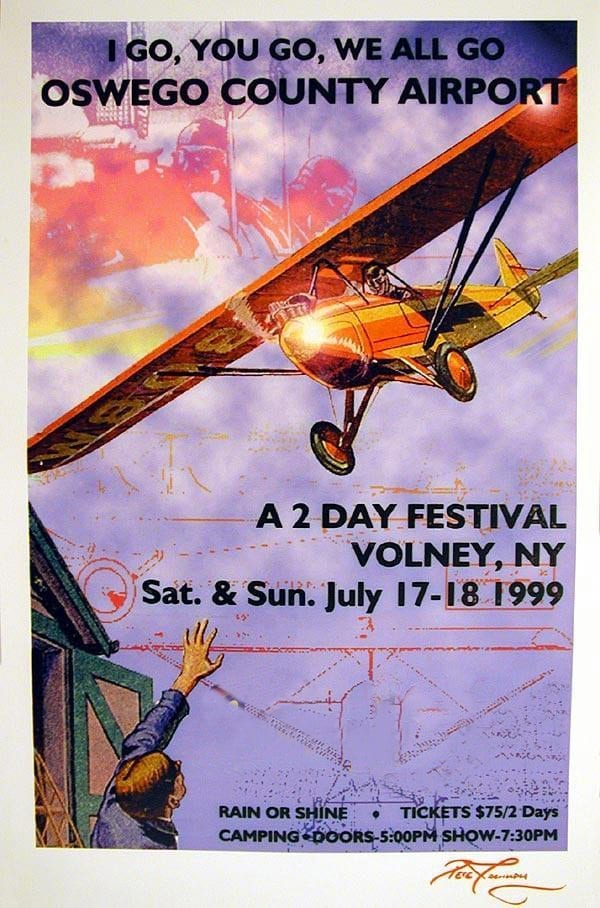
Phish Oswego poster by Pete Tschudy
The Ride in and Arrival
Pete Mason: I happened to have no issues with arrival, and managed to avoid nearly all traffic. I was living in Syracuse, taking summer classes at SU, and proceeded to leave the day before the festival starts, on July 16th, a Friday. We left around 4pm and were at the gates by 5pm. Syracuse to Oswego is about 45 minutes, so getting to the festival, without much traffic, was a pretty nice start to the weekend. We camped about one car length in from the tarmac, about a five minute walk to The Green, where there was a wall of payphones and place to leave messages for friends. Ah, the days before cellphones.
This was also the last time I encountered little to no traffic arriving at a Phish show. 13 hours for Big Cypress was a comeuppance in a way, for dealing with no traffic getting to the Oswego and Lemonwheel festivals
Tim O’Shea: The two hour drive started off just fine with all parties wildly throwing out predictions and wishes for the weekend. Beeps and head nods from other like-minded cars on the road were aplenty and increased in frequency the closer we got. Towards the end of the two hour drive, as festival traffic began to pile up and the sun was at its peak, the bus’ engine temperature began to skyrocket. In an effort to prevent it from overheating and making sure we had a ride back on Monday, we actually wound up pushing the bus for the last half hour of our journey through the stop and go traffic with the engine off. What better way to get stretched out for long weekend of music than with some cardio and light weights? It would certainly not be the last time all weekend that heat played a factor.
The Heat
TO: For anyone who attended Camp Oswego, the first words out of their mouth generally have something to do with the ridiculous temperatures that weekend. To say it was a dry and steady heat would be doing it a disservice. Roasting and oven-like are two of the words that initially come to my mind. Shade was at an ultra premium and there were constantly long lines for the few communal water spigots. If you weren’t staying hydrated, you had no chance. In addition to the blazing temperatures, discovering this communal atmosphere and something that was way bigger(and more fun) than just myself really resonated with me since this was all so new at the time.
PM: The heat was unbearable, oppressive and constant. It was humid and well into the 90s. There was no relief either. We had 3 tents among myself, Madison and Dave. No tarp, no EZ-Up, nothing. Not that that would have helped either, but we did find solace in the air conditioned car, only to walk out into the heat moments later. Hydration was key, and led to little drinking of alcohol that weekend. It was just too damn hot to do much of anything but see Phish, just as the sun was getting lower in the sky and started to cool down.
A week later, I attended Woodstock 99. The weather was almost as bad, but the result of patrons who had to deal with the heat was far different. At Oswego, people were misting you as you walked by, offered water to strangers, my friend Madison used a Supersoaker to hose down random passersby, with a reaction of ‘Whoa WTF?!’ followed immediately by ‘Ah, that feels great! Thanks!’ At Woodstock, it was pure hell. Little running water, expensive bottled water ($4 even then was highway robbery) and patrons were not as kind as you would find at Phish. More than a few late 90s bros found their way to the front of the drinking line without waiting, didn’t take care of their neighbors and more or less let the festival community and vibe go to shit. Phish fans took care of one another – that was my big take away from the two weekends, and one that drew me into the Phish community.
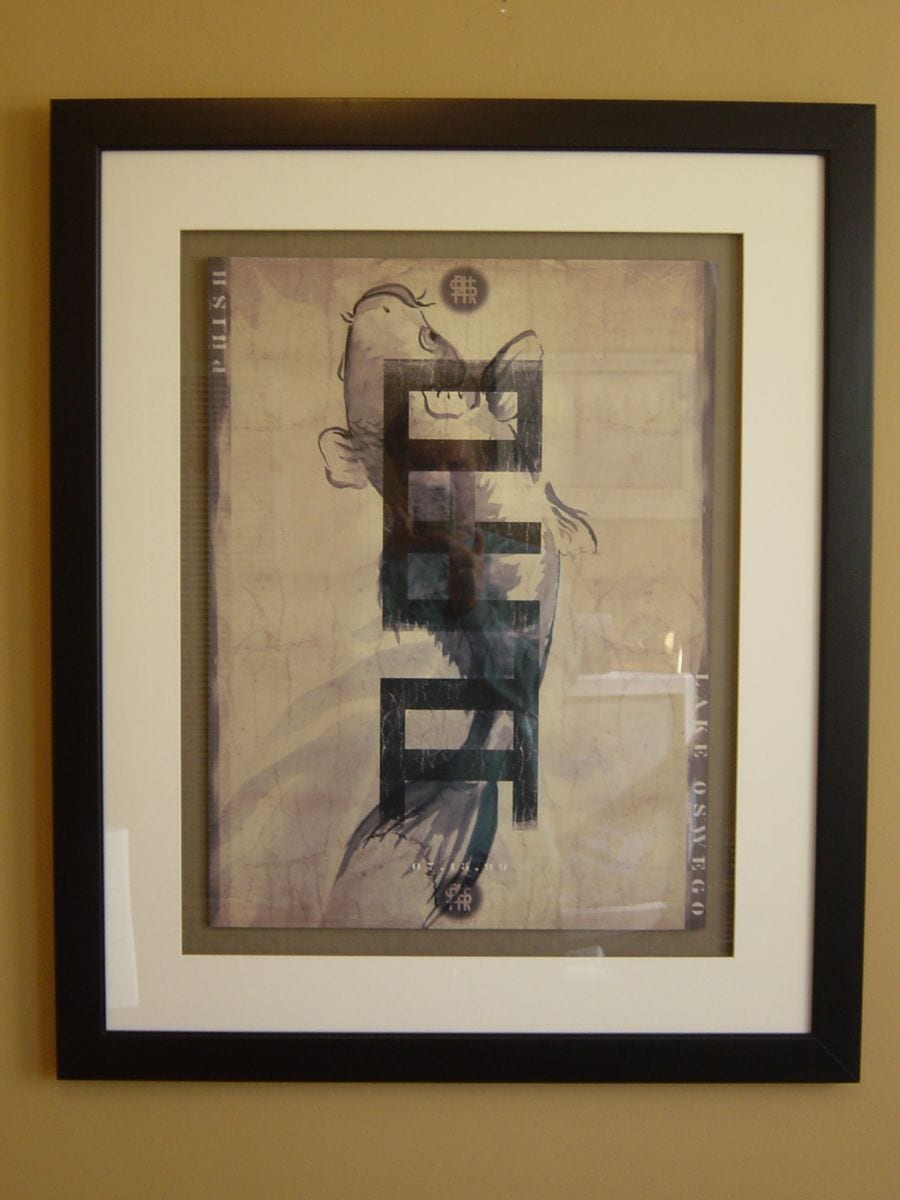
Phish Oswego inspired art by Alfred Sohn
Day 1 Music
PM: I honestly recall little of the show on the 17th. Two sets, and all I can definitively remember was Son Seals sit-in, which made me wonder if the other guests at The Green stage were going to sit-in the next night. “Down with Disease” was solid, but I was still somewhat new to Phish and hadn’t yet enjoyed the long jams. Beyond that, I became a fan of “Squirming Coil” in the encore. I blame the heat and adult beverages.
TO: While my memory certainly isn’t pristine as it pertains to all the music that weekend, there are certain moments and images that still resonate strong. I remember baking in the sun (literally) as the first night’s sunset was accompanied by a scintillating Tweezer jam and hearing the first of many, many Character Zeros to end the first set. I remember legendary bluesman Son Seals gracing the stage in the second set for ‘Funky Bitch’ and being amazed at how well he was able to manage that Phish song.
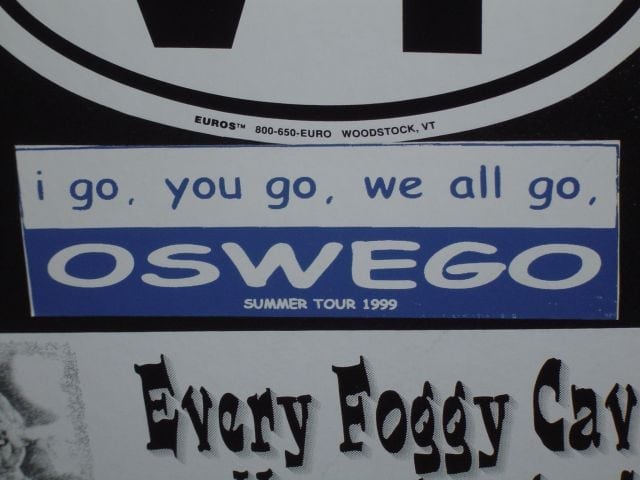
Phish Oswego sticker
Day 2 Music
TO: I remember being delighted at the Del McCoury sit-in the following day and feeling a real strange sense of pride as I danced along to ‘The Meatstick’ in the Guinness Book of World Records attempt that was in vain. And above all else, I remember a mind bending ‘Piper’ in the third and final Sunday set that I still consider one of the best ever played which seemed to seal the proverbial deal for me. Throw in a hilarious ‘Smoke on the Water’ jam/banter and the ever whimsical ‘Icculus’, and you’ve got a set for the ages.
PM: I could write a book on the music from Sunday, but I’ll keep it short. Set 1 was pretty solid, with the sun setting and a ‘Punch’ opener. I was still a noob back then, so “Farmhouse, Water in the Sky, Bathtub Gin” were all familiar and made me happy. I was far more focused and rested than the night before, and recall a great deal of the show to this day. When Del McCoury and sons came on stage, I smiled because I sort of predicted that, heard a bunch of bluegrass songs, which I credit to my initial interest in bluegrass music, and a sweet ‘Reba’ that was a highlight of the set for me.
Second set was fun because “Runaway Jim > Free” meant more music I knew, then finally, this ‘Meatstick” song that I had heard about, which had a dance. Complicated music interests me, and dancing to such music was just feeding the addiction. I danced around with what I thought was the Meatstick dance and loved every second. The rest of the set I was just smiling like I never had before.
Third set, which I had no idea was happening – I thought second set was it – started out with more music I knew, “My Soul > Piper”, the latter of which went on for a while, and had the slow start. “Prince Caspian” was kinda cool to me back then, and then shit got weird. “Wilson > Catapult > Smoke on the Water > Icculus” and “Quinn the Eskimo” were pretty mindblowing, for the banter alone. Whatever was going on onstage, I wanted more of. Fluffhead finale and Hood encore as we walked back to the car, beating all traffic, I was in my apartment by 2am, learning of David Cone’s perfect game earlier that day.
Takeaways from the Festival
PM: Oswego was simply the best Phish festival experience I have had, after Big Cypress of course. It was the right time and place for me, right mindset, friends, and music, all in one place. I go back there every so often and find that same giant smile, every time.
TO: 111 shows later, I guess you can say I took a shining to this band and all they can deliver. But for me, Oswego will always hold a special place in my heart not only because it was my first Phish festival in my first string of shows, but because it was my first large scale festival of any kind which opened my eyes to a whole new way of experiencing music. After Camp Oswego, I knew what I wanted to do every summer for the rest of my life. And how to do it in frying pan-like conditions.
Download both nights of Oswego here (July 17/July 18) – recording by Lenny Stubbe
It was hot and muggy in Western New York on July 16, 1990. Crosby, Stills and Nash were opening up for the Grateful Dead at Rich Stadium, and Brent Mydland was amid his final tour with the Dead.
The Grateful Dead played Buffalo a total of 12 times in their storied career, including May 9, 1977 at Buffalo Memorial Auditorium (a day after the famed Cornell 77 show) a show at Kleinhan’s Music Hall on March 17, 1970, and six total shows at Rich Stadium, including this show in 1990. A typical summer stop from 1986-1993, Orchard Park’s Rich Stadium had far more space for fans, after the band outgrew the Memorial Auditorium, The Rich shows becoming part of Deadhead lore.
Playing in Foxboro, MA the night before, fans trekked overnight from Eastern Massachusetts to Western New York, a seven hour drive (not factoring in stops, switching drivers and catching sleep at rest stops along the way). With a capacity of more than 70,000, Rich Stadium was ready to welcome more than Foxboro held by a margin of 10,000, plus plenty of fans arriving from across the Empire State who would call this their first Grateful Dead show.
On the NYS Thruway, traffic crawled in the heat, with fans walking along the highway, slow cars filling the breakdown lane, with fans looking for Miracles via hand-lettered signs as you filed into the Rich Stadium lot. The traffic was so bad getting from the Thruway to Orchard Park, fans were pulling into the lot as the opener, Crosby, Stills and Nash, were beginning to play, the songs trickling over the top of Rich Stadium.
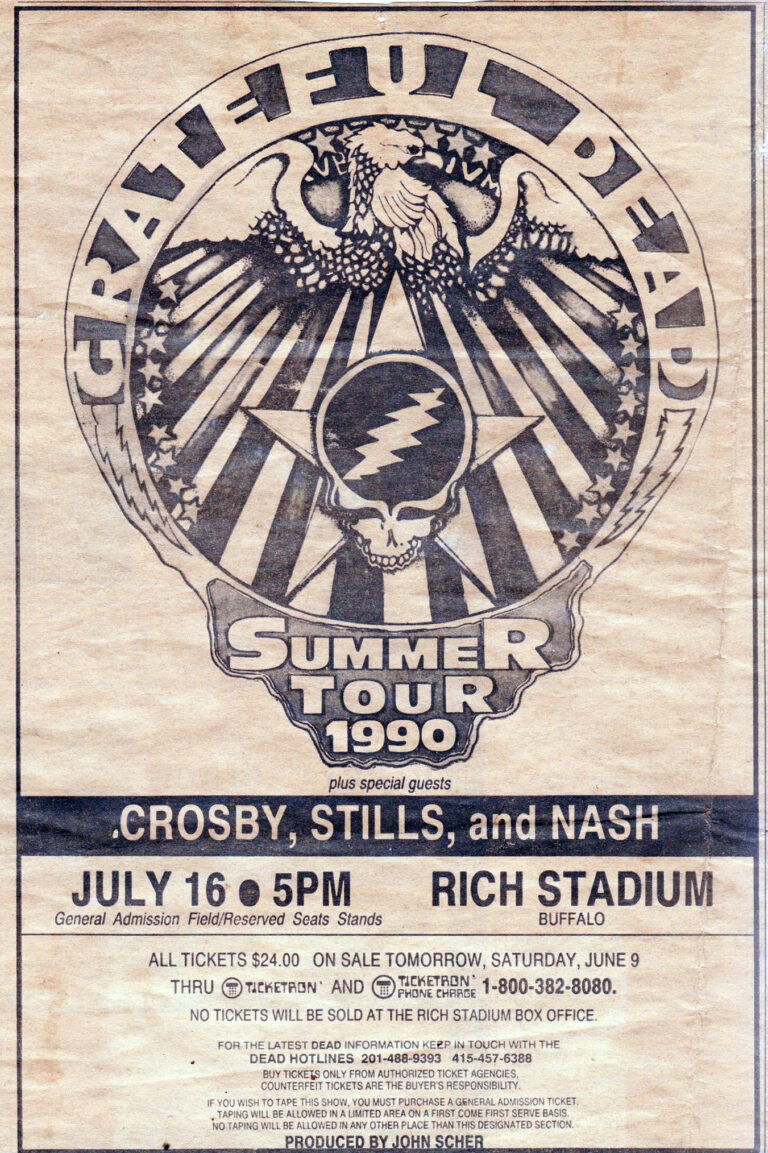
Ticket to the Grateful Dead at Rich Stadium, July 16, 1990
Part of their “Live It Up Tour,” Crosby, Stills and Nash toured off the album Live It Up, the first album the trio recorded since 1983. The album came together when Crosby and Nash began working on a new album as a pair, but following the trio performing at the collapse of the Berlin Wall in 1989, Stills became involved in the Crosby and Nash project, as noted in Dave Zimmer’s Crosby, Stills and Nash: The Authorized Biography (The Definitive Inside Story of the Super Group).
View this and more Grateful Dead shows from across the years in New York State with our interactive map below!
Playing a set that was mostly unchanged for the entire tour, CSN made sense as an opener – both bands were part of the late 60s music explosion on the west coast, and with Crosby from Los Angeles and the Dead based in San Francisco and many festival and show billings together, the two bands shared a long history together. Crosby even recorded and performed live with members of the Grateful Dead, billed as David and the Dorks for three shows in 1970. So an opening slot or two on their summer tour was a natural fit, especially with large stadiums like Foxboro and The Rich on the tour schedule.
David and a dork
However, CSN did not mix up their setlist and did not factor in the Grateful Dead shows on their tour, where fans would see more than one night of the tour and catch onto repeats a bit faster. Fans not engaged in the July 16th opening set led to Graham Nash saying to the audience something to the effect of “show us you deserve to wear those tye-dyes and get into it,” reacting to fans non-reaction of the milquetoast opener. One fan recalled that at both shows they saw on the tour, CSN said both times “So, this is what a Grateful Dead audience looks like” with the same banter factored into the set.
This show at Rich Stadium for the Grateful Dead would also be the final tour for Brent Mydland, although that may not have been apparent to many fans at the time. A week later, Mydland would play his final show with the Dead, and die three days later from an overdose. There are points of the show between tunes where the band is enjoying themselves and Brent takes a moment to play a few bars of George M. Cohan’s “Over There” and the “Mickey Mouse Clubhouse,” keeping it playful and fans on their toes during these brief interludes.
It was unmistakable though, the presence of Mydland on this short, Midwest/east-coast 12-show summer tour, that made his death harder on many. His talent and boisterous vocals on “Man Smart, Women Smarter” and originals like “Blow Away,” the last of which was played this evening in Orchard Park, were unmistakable, clearly identifying shows with his raspy, soulful voice and precision work on the keys.
Following a breezy afternoon, the stadium climate was muggy yet the Grateful Dead were dialed in from the start, opening with “Hell in a Bucket” and following up with an early highlight of the set, “Mississippi Half-Step Uptown Toodeloo.” “Blow Away” had all the emotion Brent ever put into any of version, and featured a “Mind Left Body” jam, standing out as the final performance of the song.
A pair of cowboy songs – “Mama Tried” and “Mexicali Blues” flowed seamlessly together with Bob Weir on vocals, with a fresh off-the-shelf “Loose Lucy” following, fans cheering in gratitude to hear a song not played since 1974 that made its return in March of 1990. The Rolling Stones “It’s All Over Now” fit in nicely with the flow of this stimulating first set, with “High Time,” and a thoroughly enjoyable “Let It Grow” following, with the Brent-heavy “Don’t Ease Me In” closing out the first set.
The second set would feature a unique “Sugar Magnolia” / “Sunshine Daydream” sandwich, the show opening with the first stanza of “Sugar Magnolia” before dissolving into a smooth and unexpected segue onto “Scarlet Begonias” after only three minutes. The crowd reaction when “Scarlet Begonias” is realized by thousands is a sound to behold and embrace. Not stopping, the Dead moved into “Man Smart, Woman Smarter,” the lyrics in unison from Garcia, Weir and Mydland driving the song.
“Ship of Fools” served as a bridge to the obligatory and long-awaited “Truckin’,” with the “Truckin’, up to Buffalo” lyrics eliciting the largest cheers of the night, the jam meandering but finding itself in the final minutes before “Drums.” If you’re looking to revisit the show or listen for the first time, “Drums” is a percussive trip, with “Space” having a creepy laugh track in the background during the first half, a fun (maybe?) accent to the night for those in attendance.
Ticket to the Grateful Dead at Rich Stadium, July 16, 1990
Jumping out of “Space” were short versions of “The Wheel” and “Gimme Some Lovin’” and a somber “Wharf Rat” to balance them out. “Around and Around” found its place coming out of “Wharf Rat,” diving into “Sunshine Daydream” to an enthusiastic crowd hearing a fantastic full set sandwiched inside a classic Grateful Dead song.
“When the 2nd set ended, I remember experiencing an exaggerated exhilarated feeling that I’ve never felt from any show before. Obviously others felt the same because when the Sunshine Daydream reprise finally ended, we were jumping up and down and even the people behind us were so amped that we all just stood there hugging each other. It was ridiculously intense. No other show has lifted me to such heights before and I am so glad I was here.”
The encore of “Brokedown Palace” fit in perfectly to close the night, capping a day for the fans, and Brent Mydland as he performed his final show in New York.
Crosby Stills and Nash – Rich Stadium, Orchard Park, NY – July 16, 1990
Setlist: Love the One You’re With, Chicago, Drive My Car, Live It Up, Got It Made, Just a Song Before I Go, Night Time for the Generals, For What It’s Worth, Wasted on the Way, Our House, Almost Cut My Hair, Helplessly Hoping, Déjà Vu, (Got to Keep) Open, Southern Cross, Wooden Ships, Teach Your Children, Woodstock
Grateful Dead – Rich Stadium, Orchard Park, NY – July 16, 1990
Set 1: Hell in a Bucket, Mississippi Half-Step, Blow Away, Mama Tried > Mexicali Blues, Loose Lucy, It’s All Over Now, High Time, Let it Grow > Don’t Ease Me In
Set 2: Sugar Magnolia > Scarlet Begonias > Man Smart/Woman Smarter, Ship of Fools, Truckin’ > drums > space > The Wheel > Gimme Some Lovin’ > Wharf Rat > Around and Around > Sunshine Daydream
Saratoga Springs welcomes dozens of bands each summer, with the biggest names making it to the stage of Saratoga Performing Arts Center. In 1990, one of the biggest names in rock n roll history, David Bowie, performed his one and only show at SPAC, with a Saturday night performance on July 7.
Wow, remember Record Town?
For the “Sound+Vision” Tour, Bowie opted for a smaller band and suggested he was looking for a smaller sound, saying in an interview with Q Magazine, “It’s a much smaller sound. It’s not quite as orchestrated as any of the other tours. The plus of that is that there is a certain kind of drive and tightness that you get with that embryonic line-up, where everybody is totally reliant on the other two or three guys, so everybody gives a lot more.” Read the full interview with Paul Du Noyer here.
Q magazine from April 1990
This tour was not in support of a new album, as the latest release from Bowie was 1987’s Never Let Me Down which launched the “Glass Spider” tour. This was instead billed as a greatest hits tour, with Bowie planning to retire his catalogue of hit songs from live performance, a move that would draw millions of fans worldwide to see him on the “Sound+Vision” tour. With two albums having flopped in the mid-80s (hello 1984’s Tonight), he was looking to give himself a creative and artistic boost, and shedding his old hits became the drive behind “Sound+Vision.”
Bowie was also playing with Tin Machine at this time, and told the band he was contractually obligated to embark on this greatest hits tour, inviting guitarist Reeves Gabrels to join him on the road. The Tin Machine guitarist declined, but suggested Adrian Belew, giving him a phone call and putting Bowie on the phone.
It’s time to put about 30 or 40 songs to bed and it’s my intention that this will be the last time I’ll ever do those songs completely, because if I want to make a break from what I’ve done up until now, I’ve got to make it concise and not have it as a habit to drop back into. It’s so easy to kind of keep going on and saying, well, you can rely on those songs, you can rely on that to have a career or something, and I’m not sure I want that.
David Bowie, interview with Music Express Magazine, March 1990
Bowie went on discussing his clean break from his past catalog, adding, “I’ve never done a show where I’ve just done songs that over the years have proved to be popular with the audience in that way. It’s always been about 50/50. I’ve done enough that they know to keep their attention on the show and the rest of the of it – I can do the stuff that I want to do in between – but I’ve never actually almost allowed them to choose the show for me, which is in fact, what we’re going to do.”
Music Express Magazine, March 1990
Thus, the personnel for Bowie’s 1990 tour were the Thin White Duke himself (guitar, saxophone, vocals) Adrian Belew (guitar, backing vocals and also serving as music director), Erdal Kızılçay (bass guitar, backing vocals), Rick Fox (keyboards, backing vocals) and Michael Hodges (drums.) Canadian dance choreographer Édouard Lock of the Québécois contemporary dance group La La La Human Steps co-conceived the tour with Bowie, and served as artistic director for this tour.
It had been reported there was tension among the band during the tour, as Kızılçay, who recalled that Bowie “wasn’t very happy“ and when they were in South America by the end of the tour, Bowie was not coming to soundchecks.
As noted in Chris O’Leary’s Ashes to Ashes The Songs of David Bowie 1976-2016, keyboardist Rick Fox was not invested in the Sound+Vision tour, going so far as to eat dinner on stage, and at least once turned off his own keyboards and played his own songs while sampled parts of Bowie’s songs were playing.
In total, Bowie spent seven months on the road at five continents, performing 108 times in 27 countries. Discover more about the Sound+Vision tour here.
So with a greatest hits tour and only so much drive in the tank after a pair of commercial failures, David Bowie gave it a go on a global tour, and his performance at SPAC was full of the hits he promised and a notable moment following “Young Americans” where he spoke out in defense of free speech and expression.
Fans recalled the venue was packed, as this sold out show had the SPAC lawn filled, even with KISS performing 30 minutes south in Albany at the Knickerbocker Arena that same night. One fan who was not a fan of Belew’s noted the difference, saying “Belew, while a great instrumentalist, did not have the style and flash or sound of Spiders from Mars guitarist Mick Ronson. Sure enough, after a few songs I knew I’d made the wrong choice! The comparatively subdued band to the Spiders couldn’t give any authentic glitter and sleeze to those songs and they fell flat for me. I stayed but wished I was at the KISS show seeing their over the top excess.”
Bootleg album cover art
A Times Union review of David Bowie at SPAC, written by Michael Eck, referred to the concert as “the most breathlessly awaited show of the summer” and called the show “one of the best things in life – the kind of performance that could breathe life into a tired soul.”
During the performance, Bowie utilized multiple screens and the best video effects of the early 90s to capture his movement, performance and engagement on stage. Watch below and you’ll be able to see Bowie singing duets with a 20-foot projection of himself, dancing with an androgynous look-alike, and thin screens housing projections of Bowie over the stage. Providing fans these visuals in conjunction with his greatest hits showed the tour name “Sound+Vision” was more than a song or box set, and allowed Bowie to find balance in this extensive tour. Bowie was, after all, going through the motions of playing these songs live for the final time, relieved for sure, and as the tour wore on, surely experiencing wistfulness of the occasion.
The show is a greatest hits show from one of the greatest musicians, and having listened to this show numerous times, its a crowd pleaser for any Bowie fan. Of note, and tied to the politics of the era, is Bowie’s aside during “Young Americans,” where Bowie took a moment to offer supportive commentary towards 2 Live Crew – whose album As Nasty As They Wanna Be was declared obscene by a judge and was the focus of ire against lyrics, particularly rap and hip-hop.
While stretching out “Young Americans” with a blues riff that Belew and Bowie smoked, Bowie said, “This is the unnecessary portion of the show,” and began to talk about growing up in London, listneing to American music, especially the blues. He mentioned listening to Ray Charles, Stevie Wonder, and James Brown, and then shifted gears to authors he read: Kerouc and Ginsberg, who wrote about what they felt and were going through. And with a captive audience in a seemingly ‘off script’ moment, Bowie said:
“Do you know that they’re banning Hemingway in libraries these days? You don’t know do you? Does anybody here hear that they’re banning Hemingway? Fahrenheit 451 is now on the restricted borrowing at some libraries. You don’t care do you?”
David Bowie, to the SPAC audience, during “Young Americans”
Sensing the crowd was drifting away, Bowie reeled them back in, saying “That’s why I went out and bought my 2 Live Crew album” which was followed by enthusiastic applause from the audience. Bowie continued on, saying that “You don’t have to like the stuff but my god I support any right for anybody to write a song without going to jail for it, motherfuckers.”
Despite the injection of what some would call ‘politics’ in a rock concert (gasp!), David Bowie brought the SPAC audience full circle, revisiting the roots of one of his greatest hits, tying it to his youth and that of the crowd, then to present day, with a supportive pro-free speech statement.
As Michael Eck noted in his review, the reunion tours that took place in 1989-90 – the Rolling Stones “Steel Wheels” tour, The Who 25th anniversary tour, and Paul McCartney embarking on his first solo tour – it was Bowie who stood alone among them. “Saturday night Bowie took his past in his hands and gloriously threw it all away while we watched. Those other tours were history shaking with age, Saturday’s was history shaking with life. It was simply one of the greatest spectacles I have ever witnessed.”
David Bowie – Saratoga Performing Arts Center (SPAC) – Sound+Vision Tour – July 7, 1990
Setlist: Space Oddity, Rebel Rebel, Changes, Ashes to Ashes, Life on Mars?, Pretty Pink Rose (Adrian Belew cover), Stay, Blue Jean, Let’s Dance, Sound and Vision, Ziggy Stardust, China Girl, Station to Station, Young Americans, Suffragette City, Fame, Heroes Encore: White Light/White Heat, Baby What You Want Me to Do, The Jean Genie, I’m Waiting for the Man, Gloria
The Who had bid farewell to fans in 1982 after nearly 20 years together as a band, and after seven years had passed, it was time for a music industry tradition – the Reunion Tour. And where else to warm up for a major comeback tour than with a show at Glens Falls Civic Center, on June 21, 1989
Returning to the stage after seven years was no simple feat. Personalities and egos had clashed, drug use became endemic within the band, and members were itching to quit. Guitarist Pete Townshend had fallen into a depression, wanted to do more than play the hits on the road, leading him to eventually quit the band in 1983. Bassist John Entwistle nearly quit as well, but he hoped to stay on the road. Singer/guitarist Roger Daltrey shed some light on this time period, telling Record Collector,
I think Pete knew he’d made a mistake around 1980. He was going downhill with substance abuse and all that kind of stuff. And I decided at the beginning of that (1982) tour to pull the plug on the band and for it to be our last, because I was really frightened at the time of finding him dead on the bathroom floor, or dead in bed in the hotel room. It was one of those situations. I thought the only way to stop this is to come off the road. It was a difficult decision, but I felt it was the only way forward. We’d gone backwards.
Roger Daltrey, on The Who breaking up in 1982
Coinciding with their 25th Anniversary Tour, the 1989 The Who tour was also the 20th anniversary of the rock opera Tommy. On March 24th, Townshend, Daltrey and Entwistle appeared together at a press conference at Radio City Music Hall to announce they would once again tour as The Who that summer. Townshend, who had announced in 1987 he suffered from tinnitus, told the press that he still experiences hearing problems, garnering a laugh, saying “we will play very, very quietly.”
Skip ahead to June, and The Who were bound for Upstate New York, to perform a warm up show for the tour at Glens Falls Civic Center on June 21, 1989. The Kids Are Alright Tour: 1964-1989 kicked off with a career overview of their work and an unusual connection of songs that led the shows to lasting nearly three and a half hours at some venues. With a variety of songs from across a quarter century, including a great deal of new ones from Townshend’s Iron Man soundtrack (released earlier that year), some songs would be cut from the show, making this performance in Glens Falls full of rarities and popular tracks, side-by-side. Audiences in New York and Los Angeles featured full-scale presentations of Tommy.
The first half of the show featured a great deal of songs from Tommy, including an extended “Overture” which was uplinked to the BBC to be broadcast live in England, as well as aired locally, and uninterrupted, on WTEN in Albany.
Beyond Tommy songs, a fair amount of Townshend’s solo work appeared in the show, including “I Won’t Run Anymore,” “All Shall Be Well” and “A Friend Is a Friend” from Iron Man, a rarity “Trick of the Light” that had not been played since 1979, “A Little Is Enough” and “Give Blood.” Townshend would play acoustic guitar during Tommy and his solo songs, then switched to electric guitar for the second act.
The solo Entwistle song, “Too Late the Hero” stands out as well, in addition to covers of “Hey Joe” (The Leaves), “Summertime Blues” (Eddie Cochran), “Love Hurts” (The Everly Brothers) and a show stopping “Twist and Shout.”
Joining Daltrey, Townshend and Entwistle was Simon Philips on drums, filling the void left by the untimely passing of Keith Moon in 1978. The Who also brought in a large number of musicians to accompany them for each performance, including Steve ‘Boltz’ Bolton (Guitar), John Bundrick (Piano, Keyboards), Chyna (Backing Vocals), Simon Clarke (Brass Section), Simon Gardner (Brass Section), Jody Linscott (Percussion), Roddy Lorimer (Brass Section), Billy Nicholls (Backing Vocals), Tim Saunders (Brass Section), Neil Sidwell (Brass Section) and Cleveland Watkiss (Backing Vocals). When asked why such a large number of musicians, Townshend replied on Good Morning America, “The more musicians you have, the quieter you can play. It’s a bit difficult to make a big sound with an electric guitar unless it’s quite loud. I’m paying the price now for playing too much loud guitar.”
While their record breaking performance in Buffalo in 1982 with The Clash was a sign fans were still hungry for punk in all its forms (godfathers optional), The Who of 1989 were looking for something a bit more dialed back. Speaking to David Gates of Newsweek, Townshend said, remarking on what audiences expect of The Who at this point of their career.
They expect us to be present. We’re just supposed to be there. It’s not that it’s unimportened what we play or how we play, but it’s importent that we’re present and that we want to be present. You don’t invite people to celebrate your work and then look like you don’t want to be at the party.
Pete Townshend
Fans of The Who were certainly enjoying this first chance to see a band that had bid farewell seven years prior. Daltrey, at age 45, still swung his microphone on its cord like it was a lasso, and Townshend (44), continued to leap in the air on cue, in addition to his trademark guitar windmill, which was now adorning t-shirts for sale at the show. Newsweek would say the night was “a hell of a show for the money.”
The Kids Are Alright Tour: 1964-1989 would first be seen in Glens Falls, but the official start was in Toronto on June 23 and 24, the city where the band played their final show in 1982.
Rehearsal Setlist: Sister Disco, You Better You Bet, Who Are You, Baba O’Riley, Behind Blue Eyes, Won’t Get Fooled Again, Hey Joe
Setlist: Overture, 1921, Amazing Journey, Sparks, The Acid Queen, Pinball Wizard, Do You Think It’s Alright, Fiddle About, I’m Free, Tommy’s Holiday Camp, We’re Not Gonna Take It, I Won’t Run Any More, All Shall Be Well, A Friend Is A Friend, I Can’t Explain, Substitute, I Can See For Miles, Trick Of The Light, Boris The Spider, Hey Joe, Who Are You, Naked Eye, Summertime Blues, Too Much Of Anything, Baba O’Riley, My Generation, A Little Is Enough, 5.15, Love Reign O’er Me, Love Hurts, Too Late The Hero, My Wife, Sister Disco, Give Blood, Join Together, You Better You Bet, Behind Blue Eyes, Won’t Get Fooled Again
Encore: Pictures Of Lily, Twist And Shout
Watch videos and recordings from June 21, 1989 at Glens Falls Civic Center below.