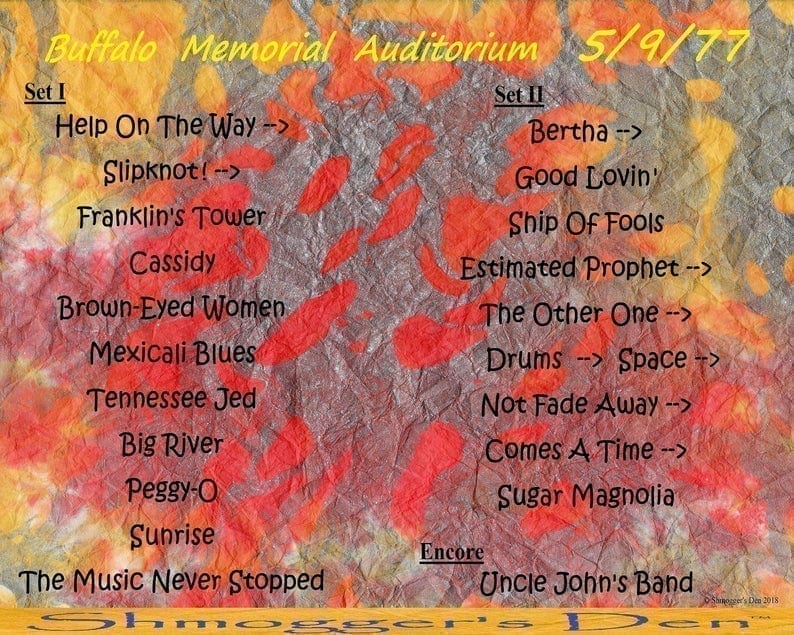
Fresh on the heels of the much loved Barton Hall show, the Grateful Dead followed up that evening with a show at Buffalo Memorial Auditorium the next night. Some consider this show to be superior to 5/8/77, one that is overshadowed by years of hype and adoration for the Cornell performance. While the debate will continue, we offer up for your consideration May 9, 1977 as a potentially equal if not better show than the night prior.
Starting with a “Help on the Way” > “Slipknot” > “Franklin’s Tower” opening trio, the energy takes off over more than 30 minutes to start the show. From there, stand out versions of “Cassidy,” “Tennessee Jed” and a set closing “The Music Never Stopped.” This first set stand out on its own as one of the best you’ll find among 70s Dead shows.
The second set kicks off with “Bertha” and The Rascals’ “Good Lovin,” before impressive versions of “Ship of Fools” and “Estimated Prophet.” With Donna and Keith Godchaux on board for this journey, the show features a pair of “Not Fade Away” and “Comes a Time” that stand up to any pairing from the previous night in Ithaca.
Including the shows on May 5 in Boston and May 6 in New Haven, May 1977: Get Shown The Light covers all four incredible shows, a stellar component of one of the Dead’s best years. Enjoy these two shows from Ithaca and Buffalo, a true sign that the Grateful Dead perform with the highest caliber when in the Empire State.
For a band with such a rich and vast musical archive like the one belonging to The Grateful Dead, when a search for a show recording comes up completely empty, it’s almost hard to fathom. But that appears to the be the case for a Grateful Dead show on March 17, 1970 with the Buffalo Philharmonic Orchestra which has a legacy that seems to grow with each passing year, as pleas for any video or audio recordings continue to go unanswered. In a tragic case of irony, this particular show seems to feature some of the most avant-garde music and experimental visuals of the band’s still fledgling touring career. All we’re left with is a scant trail of news clippings, the recollections of those who were present, and a pretty valid reason as to why any media will never surface.
This performance, which was billed as a benefit for the Orchestra called the Philharmonic Rock Marathon, took place at Kleinhans Music Hall, where the Buffalo Philharmonic Orchestra still plays to this day. This particular gig in 1970 was billed as a collaboration between the worlds of classical and rock music and the first of its kind. After a cancellation by The Byrds, who were originally scheduled to appear, the Grateful Dead swooped in and would seem to serve as more than an adequate replacement for this type of experimentation. The band even waived their normal appearance fee, jumping at the chance to work with Lukas Foss, a renowned German-American pianist and conductor who was musical director of the Buffalo Philharmonic at the time.
‘The Dead’ are accepting expenses but waiving their usual huge fee, to help the Philharmonic benefit and for the ‘privilege and delight,’ as they put it, ‘of working with Lukas Foss.’ It will be a four-hour concert in six parts, any one of them a major event. The whole program, in fact, is history-making as the first fully-shared concert by a rock group and symphony orchestra.
Buffalo Evening News, March 17, 1970
As promised, the performance offered a myriad of musical collaborations that were no doubt enhanced with a state-of-the-art $4000 light rig that was brought in, with a laser beam shone through a prism bathing the music hall walls in color. Between this and a motorized lift platform in the orchestra pit that the band played on, which at one point would rise when they played and lower when the orchestra took over, the Grateful Dead’s fingerprints on the modern day jam scene only grow more evident.
Finally, the merging of two musical forms, the Dead and the Philharmonic in an old-time jam session. Also on the program will be a new concept in light shows. Laser beams!
Joe Fernbacher, from the Spectrum, University at Buffalo, March 13, 1970
The Grateful Dead and Buffalo Philharmonic Orchestra were joined by another band on stage as well, The Road. All three outfits, under the stewardship of Lukas Foss, combined to produce a night full of incredible music that, sadly, seems to have gone unrecorded. The first portion of the evening saw Lukas Foss at the piano, backed by members of all three groups, playing his own piece called “Non-Improvisation,” a 1967 composition for four players (clarinet, violincello, piano & percussion), based on the first movement of Bach’s concerto for harpsichord in D minor. The aim was for all the musicians to create a rhythmic and electronic counterpoint to the piano, which seemed to be a much easier hurdle for The Dead to clear than The Road.
As conductor Foss played his Bach non-improvisation, the Road came in around him with their wall of sound, providing a bit too much rhythm & shout and not enough freeform experimentation. The Dead worked their wave of music more adeptly around this freeform style.
Deadbase Review
The Road did get a set of their own at some point afterwards, though the few reviews found online seem to focus more on the Dead Head-heavy crowd vocally urging them off the stage, clamoring for their band to return. Naturally, with no known recordings, the song selections for the Dead’s set that followed are sparse at best. But we do know “Dark Star” was prominently involved, a song in its full experimental glory in 1970. And in the night’s sense of collaboration, the band even brought on a third drummer to join in the musical fray.
The Dead uses two drummers, Mickey Hart and Billy Kruetzmann, to form a ‘figure 8’ of sound around the guitars and organ. This duo broke from the set rhythm of ‘Dark Star’ into a ping-pong drumming contest, adding a new beat with each volley. They closed the match with a duet synchronizing move for move. Lynn Harbold, Philharmonic percussionist, joined in this number on Hart’s drums doing a fine job.
James Brennan, from the Buffalo Evening News, March 18, 1970
After the first of two billed sets of standalone Grateful Dead music, Foss returned to the stage with a battery of sub-conductors to lead the orchestra in the American premiere of his “Geod,” where the laser show with the aforementioned prism and laser beam seem to have been prominently involved. “Geod” required five conductors to give cues to play audibly and inaudibly. Most of the music was said to be very quiet, familiar tunes played against a soft curtain of sustained tones, with snippets of wind phrases added for context. “Taps,” “Battle Hymn of the Republic,” “Going Home” and a very slow “Merrily We Go Along” were just some of the tunes heard in this sequence which even had the audience participating as well.
Sounds included gentle singing from the orchestra, organ, harmonica, percussion & mandolin. The audience joined in clapping at once point, and by the end of the performance was making knocking, popping mouth sounds that seemed to fit quite well.
Thomas Putnam, from the Buffalo Courier Express, March 18, 1970
The Grateful Dead then played their second set of the evening, though few details are available. The only other known song selections from this evening appear to be a “Saint Stephen,” which saw firecrackers thrown on stage at one point, and a set closing “Turn on Your Lovelight” helmed by Pigpen. Reviews of the show seem to pay more attention to the crowd’s palpable love of the band and the energy present at Kleinhans Music Hall this evening.
When the Dead got warmed up, it seemed the audience would not be content with anything less than having the Dead finish the concert by themselves. Speaker fuzziness spoiled the first number, but after the sound system was improved the group went through several numbers with good effect, including a long performance in which the beat had most of the audience clapping and dancing.”
Deadbase Review
After a second set of Dead music, the Buffalo Philharmonic returned to the stage, conducted by Foss for two John Cage pieces titled “Variations II” and “Variations III.” This reportedly featured tuxedoed members of the Orchestra walking down the aisles, all playing small triangles in time, creating an eerie, funereal-like atmosphere that surely was a sharp juxtaposition from the euphoria that seemed to be present earlier.
The final segment of the Philharmonic Rock Marathon gave the musicians one last chance to produce this revolutionary blend of rock and orchestral music. Both The Road and The Dead were brought back on stage to join the Buffalo Philharmonic with half of the Orchestra assigned to each. Another conductor led The Road’s section at one end of the hall and Foss conducted the Grateful Dead and its half of the Orchestra at the other end. With conductors issuing verbal instructions on how and when to play, the two sides went back and forth in a musical free for all, closing out the evening in grandiose fashion.
The closing rock-Philharmonic challenge is the most exciting new concept of contemporary music. As the groups and orchestras jammed, the atmosphere was intensified with a laser-beam light show. Rapid patterns and curves of pure light chased along the walls in time with the music like frantic balls of yarn…As an evening of rock and symphony avant-garde it was not only entertaining and often exciting, but carved new territory for players and listeners in both styles.
James Brennan, from the Buffalo Evening News, March 18, 1970
Unfortunately, this magic doesn’t seem to have been captured anywhere except in the minds of those who were present. Monetary rewards have even been offered at this point for anyone who may have a recording of this hidden somewhere among their stash. But there appears to be a logistical reason as to why this will never appear. According to the Philharmonic archivist, union rules made taping impossible, and recordings of live symphonic concerts without recording fees were forbidden. Add in the factor of the sheer size of taping equipment in 1970 and it’s no wonder that there wasn’t much of a Tapers Section at this show.
That being said, if anyone does happen to stumble upon any possible leads of a recording of this show featuring the Grateful Dead and the Buffalo Philharmonic Orchestra, they are eagerly encouraged to contact NYS Music or Chris Foss, son of Lukas, at fosscb@gmail.com.
Discover Grateful Dead shows from over the years across New York State with our interactive map below
Far above Cayuga’s Waters stands Barton Hall, a fieldhouse on Cornell University‘s campus where the Grateful Dead performed one of their most revered concerts, one reared against the arch of heaven. Dead & Company has been keeping the Dead’s flame alive with several tours since its 2015 debut, though sadly retiring following their upcoming Summer 2023 tour.
Quite a buzz was created by a simple graphic posted on Dead & Company’s Facebook, Instagram, and Twitter feeds on Feb. 28 where Deadheads quickly caught on to its nod to the May 8, 1977 Barton Hall show and what it alludes to.
The graphic, emblazed with Cornell’s signature red and white colors with the Dead’s lightning bolt set inside the university emblem’s border with “C23” styled in Cornell’s traditional block text. If that wasn’t a strong enough hint at something special in 2023, the text in the post reads “5.8.23 ,” the anniversary of the May ’77 Barton Hall show.
On Friday, March 3, Dead and Company confirmed they would be playing Barton Hall, responding by saying, “There’s a lot of excitement brewing about what’s to come at Cornell University. Yes–it’s true–Dead & Company will be playing a benefit concert at Cornell University.”
All proceeds raised from ticket sales will benefit MusiCares, a nonprofit organization that provides the music community with a network of critical health and welfare services. In addition, the show will support The 2030 Project, Cornell University’s climate change initiative.
Cornell University’s Barton Hall. Photo by Steve Malinski 2016
On the 40th anniversary of the May 8, 1977 show in 2017 the Cornell Chimes played a special tribute to the occasion with a concert comprised of arrangements of Grateful Dead songs, which can be seen below and read about in our article about that special event.


 ,” the anniversary of the May ’77 Barton Hall show.