The Bug Jar, in Rochester, is “Your Bar on Earth” as the sign on the door proclaims. But what happens when five purveyors of deep psychedelia visit from Japan and launch it and everyone inside out into the cosmos? Such was the case on May 10, and for one evening, the Bug Jar became the Acid Mothers Temple.
Acid Mothers Temple & the Melting Paraiso U.F.O, opened their set in cacophony, a deep unsettling rumble that announced the journey was about to begin. They settled into a Morricone-esque sound, a languid slow-motion trek, samurais navigating a desolate landscape. By journey’s end, the band was engaging in some supremely intense rocking, and from there we were off.
No matter where the music started, guitarist Kawabata Makoto carved out space for some ridiculous shredding. Whether it was full-throttle metal, rhythmic rock, electric Miles Davis-style fusion, slow and spacey drone, or avant arhythmic weirdness, it all wound around to some showcase-level soloing from Makoto.
Synthesizer shaman Higashi Hiroshi meanwhile was twisting and turning knobs, eliciting otherworldly whistles and squonks from his equipment. He kindly turned back a shot offered from the audience to grease his wheels, but he did use WD-40 to liberally grease up his keyboard throughout the set.
Jyonson Tsu added vocals and rhythm guitar and bouzouki and Ron Anderson held down the low-end. Satoshima Nani sat behind it all, holding it together and driving it ever onward with masterful drumming and boundless energy.
Repetitive grooves broke down slowly into weird nether regions, or otherwise built up to gloriously locked-in hyper-funk. It was music to get lost in. Then Makoto would light a fuse and the eventual explosion jarred you back to consciousness. In a final flourish, Acid Mothers Temple engaged an unadulterated full-band chaos, with Nani and Makoto reaching for new levels of craziness. It culminated in Makoto hanging his guitar from the ceiling, the burning embers of his last solo still glowing as the Bug Jar landed back home, one again “Your Bar on Earth.”
My Education, a six-piece out of Austin Texas got things warmed up nicely. As the band tuned up on stage, it started to take shape into something more. Had the set started? The dissonance swelled and eventually congealed into a singular force. What followed was a set filled with rhythmic cinematic post-rock. Drummer Earl Bowers was the centerpiece, though as they locked into a rhythm, when they were all playing the role of drummer, was when the music shined brightest.
On May 9th, the Opera House in Toronto hosted an unforgettable performance by GoGo Penguin, the instrumental trio hailing from Manchester, England. Since 2013, Chris Illingworth (piano), Jon Scott (drums), and Nick Blacka (double bass) have been praised for their originality and inspiration in the music industry.
Jazz singer Melanie Charles opened the evening, captivating the audience with her soulful voice. Being a one person band for the evening , along with singing she played flute, piano and used backing tracks and a loop pedal. The near capacity crowd seemed to enjoy her performance.
Melanie Charles
As GoGo Penguin began their set, the room was filled with the jazz trio’s mesmerizing sound, beginning with “An Unbroken Thread of Awareness.” The group’s chemistry was undeniable, with Illingworth’s intricate piano playing complementing Blacka’s grooving bass lines and Scotts’s powerful drumming.
GoGo Penguin’s setlist was a masterful blend of their original compositions, including “Signal in the Noise,” “We May Not Stay,” “Glimmerings,” “Wave Decay,” “Lost In Thought”, “The Antidote Is in the Poison,” “Friday Film Special,” “Saturnine,” “Soon Comes Night,” “Everything Is Going to Be OK,” “Ascent,” “Murmuration,” “Transient State,” “Hopopono,” and “Protest.”
GoGo Penguin
Despite the minor setback of the pedal on the grand piano breaking, causing a delay of about 20 minutes, GoGo Penguin remained professional and improvisational. This unplanned interlude allowed the audience to witness the trio’s skills of repairing a piano quickly.
As the night progressed, GoGo Penguin’s performance reached new heights with each song. The highlight of the evening was undoubtedly their encore, consisting of “You’re Stronger Than You Think” and “Parasite.” The trio poured their hearts into these final songs, leaving the audience breathless and wanting more.
Jon Scott
GoGo Penguin’s performance was a testament to their talent and musicianship. Their music was complex, thought-provoking, and emotive, leaving the audience in awe. The trio’s ability to seamlessly blend their individual styles and create a sound that was uniquely their own was truly remarkable.
Nick Blacka
As the crowd left the Opera House, there was a sense of collective elation and satisfaction. GoGo Penguin had once again proven why they are one of the most exciting and original bands in the world of instrumental music. Their performance was a true masterpiece, and one that will be remembered for years to come. They last played the Western New York area in 2018 at the Rochester Jazz Festival.
Talking to a GoGo Penguin Fan
After the concert, we had the opportunity to speak with a GoGo Penguin fan named Shari who was completely blown away by the performance. “Emotionally, the band’s music splits my mind into millions of pieces,” she shared. “In the moments of listening, I do not want anything, being in meditation synchronization with all the moments of the past and the future at once. Incredible energy. I am grateful to them”
It was clear that this Shari was moved by the music and had a deep appreciation for the trio’s unique sound. She went on to explain that they had been following GoGo Penguin for several years and had never seen them perform live before. “It was everything I hoped it would be and more,” she exclaimed. “Their music takes you on a journey, and you never want it to end.”
When asked about their favorite moment of the concert, the fan had a hard time choosing just one. “It’s hard to pick just one moment because the whole concert was incredible,” she said. “But I think the encore was definitely a highlight. ‘You’re Stronger Than You Think’ and ‘Parasite’ were the perfect way to end the show. I felt like I was part of something really special.”
As our conversation came to a close, it was evident that this GoGo Penguin fan had been deeply impacted by the concert. “I’m already looking forward to the next time they come to town,” she said. “Their music has a way of bringing people together and creating an unforgettable experience. I feel lucky to have been a part of it.”
GoGo Penguin’s music is a unique blend of break-beats, minimalist piano melodies, powerful basslines, and drums inspired by electronica, combined with anthemic riffs. They compose and perform together as a unit, resulting in a cohesive sound that is both powerful and mesmerizing. Their music draws from a wide range of influences, including electronica, trip-hop, jazz, rock, and classical music.
Chris Illingworth
Music critics have praised GoGo Penguin’s sound, comparing it to other acclaimed artists such as Esbjörn Svensson Trio, Aphex Twin, Squarepusher, and Massive Attack. Additionally, they have been likened to renowned composers such as Brian Eno, as well as modern classical composers like Shostakovich and Debussy, or contemporary minimal music composers such as Philip Glass. These comparisons attest to the diverse range of influences that GoGo Penguin draws upon to create their unique sound.
On Saturday, May 6, Pink Talking Fish celebrated two iconic rock albums at The Wellmont Theater in New Jersey by performing them in their entirety. The albums being celebrated were Pink Floyd’s iconic Dark Side of the Moon & Talking Heads’ Stop Making Sense. One Eyed Jack joined the party to open up the night.
Pink Talking Fish played Dark Side of the Moon in its entirety for the first set. Highlights included “Money”, “Great Gig in the Sky” and the sheer funk of “Any Color You Like”.
The band took a break and proceeded to burn down the house with a faster paced, very funky Talking Heads album. Highlights included “Psycho Killer”, “Girlfiend is Better”, & of course a crowd favorite “Crosseyed & Painless”.
The band encored with a thumping “Carini” & groovy “2001” filling the void of Phish covers of the night. Uncle Ebenezer performed many tasteful Phish covers at the afterparty.
Electro-funk duo Chromeo has announced their “Funk Yourself” tour, and released their latest track “Replacements.” The thumping, synth-laden track features artist La Roux, who also made a surprise appearance during Chromeo’s Coachella sets. On October 13, the band will stop at Brooklyn Steel in New York.
Chicago rapper Ric Wilson, identical twin DJs Coco & Breezy and the rising New York star May Rio will support on select dates. The tour follows the band’s fifth appearance at Coachella which featured an all-new stage design, including four custom chrome modular synth towers. Chromeo celebrated the bangers throughout their career and music from a forthcoming new project debuted live for the first time. The Rolling Stones showed Chromeo appreciation by saying “Chromeo proved once again that nobody does it like the Funklordz.”
Chromeo is a Canadian dance rock band that was formed in 2002. The musicians David “Dave 1” Macklovitch and Patrick “P-Thugg” Gemayel united to create a blue-eyed soul, dance music, rock, synth-pop, disco and funk sound. The band has released five albums with three of them hitting the Billboard 200 charts. The duo were high school best friends and met in the mid 90s. They connected over different ethnic backgrounds and joked about being “the only successful Arab/Jewish partnership since the dawn of human culture.”
Dave 1 and P-Thugg rose to prominence with their seminal 2007 release, FancyFootwork. In 2014 Chrome increased their mainstream appeal with their chart-topping album, WhiteWomen, and 2018’s Grammy-nominated, HeadOverHeels. Chromeo’s five LPs have been hailed as modern funk masterworks, and they have toured the world over for two decades.
We’re an ELECTRO-funk band after all, and this record contains little nods to the 2000s indie dance sound that’s so dear to us. The idea was to combine sweaty dance floor energy with sincere emotions. It’s the duality in our name: Chrome, the shimmery electronics, and Romeo, the heartfelt romantics.
Dave 1
Mixed by disco and house legend Morgan Geist, “Replacements” follows Chromeo’s first official single since 2018, “Words With You”. Consequence raved that the song is “just as smooth as it is catchy,” while Stereogum added that “the contagious groove, effortless hooks, the abundance of immaculate flourishes.”
On a delightful Monday evening in Albany, the Drive-By Truckers played The Egg Performing Arts Center. The show was their fourth-straight stop in the state of New York on their spring tour. The band hit Levon Helm Studios and played Bowery Ballroom twice last week. And it wasn’t the first time the band played The Egg, having played the venue in 2014 and 2017.
While nearly all of the shows on this leg of the tour featured Lydia Loveless as the opener, she was not on the bill for this one. That made it an evening with the Truckers, who took the stage shortly after 7:30 PM and wasted no time getting into their set. Over the course of two hours, the band played eighteen originals and impressively drew upon songs from ten of their albums—plus a cover of Bruce Springsteen’s “State Trooper.” The entire set was great, and the band sounded best on the songs it jammed out, especially the final few minutes of “Pauline Hawkins.”
If you missed this leg of the tour and want to catch the Drive-By Truckers in New York, fear not. They’re set to play at Water Street Music Hall in Rochester and the Paramount in Huntington in September.
Setlist: Carl Perkins’ Cadillac, The New OK, Surrender Under Protest, The Opening Act, Women Without Whiskey, The Driver, A Ghost To Most, Pauline Hawkins, Sounds Better In The Song, Wilder Days, Every Single Storied Flameout, Puttin’ People On The Moon, Gravity’s Gone, Heathens, Marry Me, Buttholeville, State Trooper (Bruce Springsteen cover), Made Up English Oceans, Angels And Fuselage
On Tuesday, May 2nd Lizzy McAlpine returned to New York City and sold out the west side’s beloved Terminal 5. Only a week prior, Lizzy sold out Brooklyn Steel. One night in the big city just wasn’t enough for McAlpine on her “The End of The Movie Tour.” Her debut in the past couple of years has been one to witness. She has accumulated superfans who worship her relatable lyrics and sweet sound-blend of it-girl pop with classic grunge. The success of this tour has been a testament to her talent.
Photograph by Caroline Zeeman
Opener, Olivia Barton, kicked off the night and made the warehouse stage her own. Emanating a similar sound to artists like Lizzy McAlpine, HAIM, Lucy Dacus, and so on – Barton culminated her own stage presence with her innocently raw lyrics. Her own sound. The crowd volleyed Olivia’s lyrics back to her from the pit and the balconies, and her excitement became a tangible energy. The set flew by, and when it came time for Barton to say her goodbyes, it was bittersweet.
In between Olivia Barton’s opening set and Lizzy’s second show-face in New York City, the crowd hummed in a unified frenzy. The speakers were blasting popular Y2K pop-hits and nostalgic Disney songs by artists like Hannah Montana and Demi Lovato. Friends, couples, fathers and daughters, and solo-fans were conviving to belt the universally appreciated lyrics. Later in Lizzy’s set, she praised Olivia: “She really gets it. Her writing is so human. She’s so special, and I’m so grateful to have her on tour. I listen to her backstage, and I’m in tears!”
Photograph by Caroline Zeeman
Fifteen past nine o’clock, the lights cut and the bass rose to a body-shaking intensity. The infrastructure of Terminal 5 holds sound so impressively, but the deafening screams echoed riotously. Blue and purple lights slowly expanded their coverage across the stage to reveal a bedroom set-up. Framed posters and window panes clung to the back of the stage. The setting felt familiar, like the space that held so much of one’s life. The love, the heartbreak, the friendships, the sleepovers, the daydreams.
After a lengthy instrumental introduction, followed behind her band, Lizzy skipped out onto the stage. Her outfits on tour have been widely complimented, and on Tuesday she did not disappoint. Adorned in a denim corset and casual blue jeans, she stood in pure happiness as she grinned out towards the crowd. “I’m gonna play some songs for you, and it’s going to be great! We’re gonna have a great time!”
As Lizzy progressed through her setlist, she took intentional time to explain the story behind each song. The crowd bent their ears to listen to every detail she shared. “This song is about slurpees!” A roaring applause. “This song is about ignoring red-flags.” Friends grabbed onto their neighbor’s shoulder to shake in emotional duress. The entire show was a story-telling narrative, full of personal details of precious moments of muse.
Photograph by Caroline Zeeman
Her lyrics were something to hold onto and sit with. Such a fast-paced show left the crowd wanting more time with her music. All of Lizzy’s songs held a cruel casualness to them. I have no choice in the matter // Why would I, it’s only the death of me. It was jarring, quite surreal, to hear such a youthful and kind crowd shouting such intense lyrics. And the funny thing is I would have married you if you had stuck around. Nearby in the crowd, a father watched as his thirteen year old daughter belted the lyrics, clutching her chest as if she’d been wounded.
There is an archetype on the rise in the realm of female artists. Singer/song-writers fanning out under the music industry umbrella of artists like Taylor Swift are leaning into the superpower that is vulnerability. Honesty is celebratory, and young women are writing about having their hearts ripped out, leaving their hometown, stepping into their strength, growing up, and existing as more than empathetic vessels but as a beacon of feminine independence. Barton and McAlpine have branded their names into this visionary artist-type. The influence the music produced by these experimental and brave artists has is unignorable and unifying.
Photograph by Caroline Zeeman
Half way through the set, the Terminal 5 stage setting changed from day to night, and the New York City sun casting through the windows on stage, turning to raindrops streaking down the panes. The familiar chords of Lizzy’s hit “Ceilings” strummed across the venue, and something shifted. The collective crowd voice overpowered Lizzy’s as she sang the notorious lyrics. Fans jumped and wept and sang with their hearts. Tears streamed into wide smiles, as the live performance of “Ceilings” seemed to change lives.
Terminal 5 was blessed with Lizzy’s generosity, for she played two unreleased songs for the Manhattan crowd. The first song was titled “Broken Glass,” which Lizzy explained was about only ever being able to see someone when they’re at the bar. The other song was “I Guess.” Lizzy informed the crowd, “this one is one of my favorites!” While the unreleased songs were showcased, it was the only moment the crowd was silent. The audience wanted to hear every lyric, every note-change, every melody.
The rest of the show rolled out with the same energy. The crowd savored every moment they shared with Lizzy, and when it came time to part, fans had a difficult time leaving. Hands waved goodbye from the packed balconies, and cheers overpowered Lizzy’s own departure. Manhattan seemed to have an impact on her as she left the stage. It was the end of the “The End of The Movie” show in New York City.
Conway The Machine just released his new full album Won’t He Do It? The album was released via Drumwork Music Group and EMPIRE.
Features on this project include Westside Gunn, Benny The Butcher, Juicy J, Fabolous, 7xvthegenius, Dave East, Sauce Walka and Jae Skeese. Production includes acclaimed hip-hop producers Daringer, Justice League, Juicy J, and Khyrysis. The production on Won’t He Do It is top-level, with standout tracks like “Super Bowl” and “The Chosen” featuring guest appearances from Sauce Walka and Jae Skeese respectively.
Throughout the album, Conway The Machine showcases his impeccable wordplay and storytelling ability. On “Brucifix” featuring Westside Gunn, Conway spits gritty bars over a hard-hitting beat, while Gunn delivers a standout verse that perfectly complements Conway’s style.
One of the standout tracks on the album is Brooklyn Chop House featuring Fabolous and fellow Griselda member Benny The Butcher. The two rappers trade bars over a haunting instrumental, with Conway showcasing his storytelling abilities as he weaves a tale of drug dealing and violence. Overall, Wont He Do It is a powerful, introspective project that showcases Conway the Machine’s talent as a rapper and storyteller.
To celebrate the album’s release, Conway held a record release party at Ludlow House in New York City. Guests in attendance included Westside Gunn, Armani Caesar, Nems, Statik Selektah, and 38 Spesh, among others. The event was a celebration of Conway’s success and a testament to the impact he’s had on the rap game.
There is also an upcoming tour to support the new album. There will be a show at Brooklyn Steel on June 24th. All of the other tour dates can be found here.
On Friday, May 5, Goth Babe’s performance at Pier 17 catapulted New York City into summer. On the East River below the FiDi skyline, the Brooklyn Bridge-facing venue hosted Goth Babe’s “The Lola Tour” with Yoke Lore. The outdoor venue could not defend against the on and off rain showers, but the risk of weather was made worth it when sunset rolled around.
The sky turned into something of pink brilliance, and a rainbow casted over the river. The colorful streak of spring arched over the stage to turn the evening into the ultimate setting for Goth Babe’s sound – light, natural, and vibrant.
Photograph by Emma Dowd
The crowd spilled onto the Pier 17 rooftop hours before Goth Babe’s show to see the opener, Yoke Lore. A renowned artist in the alternative/indie realm, singer Adrian Galvin attracted fans of his own and collected some new ones as he gave a dynamic performance. He spun around on stage in between verses and communed with the audience kindly. Yoke Lore’s sound strikes a comforting chord in the musical soul. With only raw vocals, percussion, and a banjo to seal his sound, he successfully composes a unique warmth with his music.
Photograph by Emma DowdPhotograph by Emma Dowd
The sun continued to set over the enthusiastic crowd, and an unbelievable flower moon took its spot in the sky. Its massivity attracted a volley of OOOs and AAAhhhs as everyone waited eagerly for the party to start. Eventually the twin screens on either side of the stage darkened, and blues and whites flashed in lengthy strobes over the crowd. The indie-electronic vocalist, Griffin Washburn, and his two touring bandmates on percussion, keys, and strings made their way onto stage. Washburn seemed to talk to himself in happy disbelief as a response to seeing Pier 17 crowd, “This is f*cking nuts! So cool! This is insane, it’s going to be awesome.”
Photograph by Emma Dowd
Griffin Washburn is a known nomad. He lives in and out of sailboats and tiny homes in the mountains of Washington, hence his new single “Alone in the Mountains.” His free-spirit is a light in the music industry, for he cares more about the connections and differences he can make with his music rather than his profits and status. The day of the show, he posted on his instagram story to invite fans to participate in a pre-show run club. Connecting with his fans who he sees as friends has been a tour priority. His kind and mellow persona shines through his music and could be felt throughout the show.
After getting the crowd warmed up with some songs, he asked for a volunteer to crowd surf. Once a member of the audience was elected, the stage crew brought out a watermelon slice pool-floatie. The fan was released to surf the hands of her fellow Goth Babe listeners. Griffin sent her off with a wave, “Be kind to her, and be safe with her!” She totally rocked the role, fist-bumping and belting song lyrics in a spell of pure joy.
Photograph by Emma Dowd
Goth Babe established a friendly community from the start. He encouraged the crowd to participate in dance-offs and sing-alongs, insisting “you’re all not too old for sing-alongs!” His stage presence consisted of audible yipping, head-banging, and epiphanic gratitude. It was impossible not to dance. The music seemed to lift the crowd into movement.
Photograph by Emma Dowd
Electronic music gets wrapped with the stigma of being synthetic and repetitive. Goth Babe’s sound strongly defies this tired narrative. The blend of guitar strings, light chimes, and seemingly element-inspired melodies composes a natural almost healing sound. Combined with relatable and celebratory human lyrics, Goth Babe has created something unique and informative of a lifestyle – unbound and transient.
Photograph by Emma Dowd
Towards the end of the show, Griffin spun around to take in the glory of New York City. The skyline lights shimmered on the water, and the traffic on the bridge strung red ribbons of light across the storm clouded sky. He encouraged everyone to introduce themselves to a stranger and tell them why they live in New York City, and why they love it so much. A minute from the show was sacrificed to organic conversation. The crowd seemed more tightly knit for the remainder of the show.
Photograph by Emma Dowd
Griffin and his fellow performers put on silly hats for the remainder of the show. He adorned a shark hat, the percussionist wore a disco helmet, and the keys player wore a cow-print cowboy hat. The last few songs rolled by too easily. Griffin conducted the gold-star concert move of commanding the crowd to get really low and jump up on the beat. He sang a crowd favorite, and what he deemed his favorite song, “Taking Over The Sun.” The crowd was electric.
“We try to make this more than a normal concert you’d come to for an hour. We want to make you a part of something and leave feeling better than you came!” That they did. When the show came to a close, the party did not. Fans poured out from Pier 17 and continued to dance and sing in the Manhattan streets. Goth Babe set the summer tone for New York City.
In his new book, Saxophone Colossus: The Life and Music of Sonny Rollins, author Aidan Levy has created a work nearly as sprawling and monumental as the seven-decades of sounds crafted by a man widely considered “jazz’s greatest living improviser.”
Levy devoted seven years to the task of capturing Rollins – the musician, the myth, the civil rights activist, environmentalist and wandering spiritualist – in a whopping 750 very readable pages. The book is based on more than 200 interviews with Rollins, his family members, friends and collaborators, as well as the artist’s personal archive of letters, journals, photos and press clippings accrued over a career in which he has taken a few notable sabbaticals and sharp stylistic turns. It pretty much traces every recording session and gig that the Saxophone Colossus participated in. The depth of Levy’s astounding research is furthered by the more than 400 pages of footnotes available only online (including my story for NYSMusic on his legendary concert at Opus 40 in Saugerties).
I’m a pretty fast reader but I spent close to three months with Levy’s book. It was devoted to toggling between deep reading and deeper listening to the many corners of Rollins’ 60 solo and live albums, and the multitude of classics on which he guested with Miles Davis, Thelonious Monk, Clifford Brown and the like.
Rollins was a child of the Harlem Renaissance. Inspired by his Sugar Hill neighbor, tenor great Louis Jordan, he picked up the sax at 8 and landed, beginning as a teenager, on the bandstand and in the recording studio with greats like Bud Powell, Charlie Parker, Miles Davis and Dizzy Gillespie. His youthful exposure to the Calypso music of his familial roots in the West Indies and love of classic Hollywood movies would bear fruit later in his career in respective classics like “St. Thomas” and “I’m An Old Cowhand.” With drawn-on moustaches, he and his original band formed while attending Franklin High, the Counts of Bop featuring Art Taylor, Walter Bishop, Jackie McLean and Kenny Drew, would head to Minton’s or the phalanx of jazz clubs on 52nd St to watch and hopefully be invited to sit-in with idols like Coleman Hawkins.
Sonny Rollins with Don Cherry and Henry Grimes at the Stockholm Concert Hall, January 17, 1963. Not pictured: Billy Higgins. Ove Alström. Courtesy of The Centre for Swedish Folk Music and Jazz Research and Inger Stjerna
Sonny’s passion for civil rights and justice was shaped by two early events. The first was his military-lifer father’s court martial and jailing for the crime of “teaching a white woman to dance” at an officer’s party he was managing, an event that made national headlines. The second was his own experiences in the criminal justice system. This latter was the result of his and his musician pals’ heroin addictions, something plied in a Harlem park they called “Goof Square.” Rollins would do two stretches on Riker’s Island for pickpocketing and a gun charge. It was during a stint at that jail in 1954, while playing in the Protestant chapel band, that Rollins penned three of his much-covered classics, “Airegin,” “Doxy” and “Oleo.”
In 1955, Rollins turns his life around by starting to kick junk after a stay in Lexington, the famous prison/rehab facility, and a move to Chicago and legendary collaboration with the Max Roach/Clifford Jordan. He would stay clean working day jobs as a porter, door-to-door salesman and janitor in Chicago. It’s also the city where he would meet his second wife and manager Lucille.
In 1956, Rollins begins what may be one of the most critically acclaimed and productive runs in jazz history, waxing ten astounding classic albums, six as leader including his twin masterworks, “Tenor Madness” and “Saxophone Colossus.” He would conjure nine additional solo classics in 1957 and 1958 including “Way Out West,” “Newk’s Time” and “Freedom Suite.”
For these and the dozens of albums that followed, Levy gives a blow-by-blow on the sessions. He details the careful selection of sidemen and the sometimes dozen-plus takes Rollins would record before hitting on something that met, maybe, his insanely perfectionist standards.
While by this time he was finally being accorded the acclaim he deserved, the revelation in Levy’s book is how savagely he was treated by critics like Leonard Feather in earlier solo discs and in sessions with Miles Davis and others.
A great deal of the myth around Sonny Rollins has been predicated on his sabbaticals from the world of music, ones taken because he didn’t think he was “good enough.” The most legendary was the one from 1959 – 1961 when Rollins would walk from the apartment he shared with Lucille on Grand Street to the Williamsburg Bridge, where he would play for 15 hours – day and night – to the skyscrapers and ships passing in the harbor below. This sabbatical, and another in India in 1968, weren’t only about music. During these times, Rollins explored various religions like Rosicrucianism, anthropology and sociology. He also became deeply committed to nutrition and fitness, practicing Hatha Yoga, juicing and vegetarian diets and weight lifeting. Later on, Rollins would travel the world with a suitcase full of dumbbells, something that was impossible for any of his bandmates to lift. Rollins’ devotion to fitness even earned him a place on JFK’s Fitness Committee.
Great light is shed on Rollins’ methodology and inner thoughts, and those of his Swife/manager Lucille, in the many diaries and letters Levy was granted access too. Sonny seemed to forever be trying to commit his practice methodology, mixed with life and spiritual lessons, in a never-finished book he sometimes titled “Saxophone Energy & Health.”
A scourge that returned repeatedly to hamper Rollins’ playing and career were his dental problems, which made playing his marathon live sets nearly impossible. On many nights, he just played through the pain, creating a brand of improvisatory ecstasy that he may never have felt was properly captured on disc.
Sonny Rollins on the Williamsburg Bridge, October 7, 1961. Atsuhiko Kawabata. Courtesy of Hanako Kawabata
Another thing that is evident in Levy’s book is Rollins never-ending quest for the right group of musicians. Sonny would fire folks in the middle of sets, actually firing his whole band, one by one, during the opening night of a run at the Village Vanguard. It wasn’t personal; he was always looking for the right mix, and players who were fired, would often be asked to return.
Levy devotes a great deal of time to Sonny’s classic eras like his return in 1961 in a quartet, donning a Mohawk haircut, with guitarist Jim Hall, a configuration which yielded albums like “The Bridge.” Levy also discusses Sonny’s writing and recording of the soundtrack to the classic British film, “Alfie.”
As someone who has seen Sonny live numerous times and listened to a lot of his discography, I, like many, kind of brushed aside Rollins’ so-called fusion period of 1970s. Levy’s book made me come to appreciate a lot of the great work on these later albums, the Herbie Hancock Headhunters-inspired “Nucleus” and “Next Album.” The author also sheds light on Rollins’ guesting with The Rolling Stones on “Tattoo You.” He didn’t know who they were and didn’t really want to be a part but Lucille insisted, knowing it would heighten his profile with younger music fans. He made the overdub session, waxing ballsy one-take solos on tracks including “Waiting On A Friend” and the blazing jam “Slave.” But when they came with a cool million in hand asking him to join them on the road, Sonny said “nyet” because rock was “below jazz.”
Levy takes us up to the present with Sonny’s story. In the beginning on the 2000s, he sees many of his contemporary and collaborators – Miles, Monk, Dizzy, etc. – slip the mortal coil. We hear all about the legendary gig at Opus 40 where he breaks a heel jumping off the stone monument stage then continues to finish the concert, drama immortalized in the “Saxophone Colossus” documentary. I had the pleasure of seeing Sonny on his next gig on a Hudson River cruise boat, where he played a steaming, three-hour set seated in a lounge chair with his wounded foot elevated. It was one of the top three gigs of my lifetime. I was also lucky enough to catch another gig detailed in the book, Sonny’s 80th Birthday show at the Beacon Theater. Here he reunited with past collaborators like Jim Hall and Roy Haynes and played, for the first-time on stage, with Ornette Coleman.
Ahh, the interesting sidebars and detours. While not central to the story, Levy shares reams of gee-whiz history/trivia. In a discussion of Rollins’ island-inspired classics, he shares how Nation of Islam leader Lewis Farrakhan and novelist Maya Angelou first gain notoriety. It was as calypso singers, The Charmer and Miss Calypso respectfully. We hear how Dave Brubeck’s sax man Paul Desmond turns Sonny on the wonders of Pepto-Bismol and of the multi-faceted life of Babs Gonzales. Babs was a vocalist/poet/author/promoter/proto-hipster and global playboy with whom Sonny made his recording debut in 1949.
Sonny finds peace with a move to a farm in Germantown, N.Y, where he will take only the best live gigs, with Lucille minding the business, including touring and record production. In 2001, he will finally win a Grammy for Best Jazz Instrumental album.
Also in 2001, Sonny becomes another victim of 9/11. Rollins was in his pied-a-terre six blocks from the World Trade Center at the time of the tragedy. Possibly due to his inhalation of toxic dust from the site in the day it took him to evacuate, Sonny develops pulmonary fibrosis. In 2004, Sonny’s wife Lucille passes. In 2012, he plays his last concert in Barcelona. Also, that year, he moves to Woodstock, where he remains being looked in on by friends like drummer Jack DeJohnette and his wife.
In 2014 due to his lung condition, Sonny totally quits playing sax. He stays busy with his reading and study of things maybe far greater than jazz. He believes in reincarnation and tells his dying collaborators that he will just catch them at the next gig in whatever world comes next.
Levy’s book is a wonderful detailed and insightful journey through the life of an incredible artist and thinker. It is unlikely anyone will pen anything about Rollins, and maybe any other jazz musician, that will be its equal.
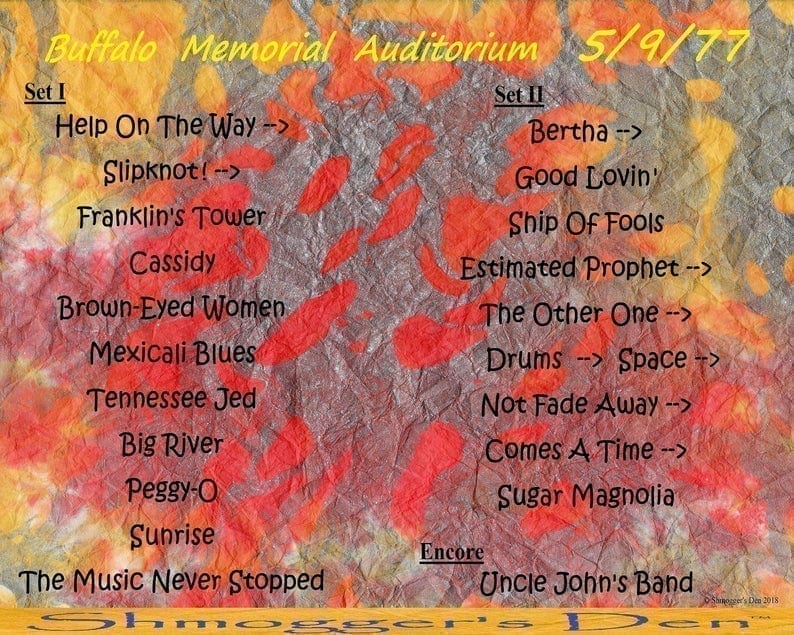
Fresh on the heels of the much loved Barton Hall show, the Grateful Dead followed up that evening with a show at Buffalo Memorial Auditorium the next night. Some consider this show to be superior to 5/8/77, one that is overshadowed by years of hype and adoration for the Cornell performance. While the debate will continue, we offer up for your consideration May 9, 1977 as a potentially equal if not better show than the night prior.
Starting with a “Help on the Way” > “Slipknot” > “Franklin’s Tower” opening trio, the energy takes off over more than 30 minutes to start the show. From there, stand out versions of “Cassidy,” “Tennessee Jed” and a set closing “The Music Never Stopped.” This first set stand out on its own as one of the best you’ll find among 70s Dead shows.
The second set kicks off with “Bertha” and The Rascals’ “Good Lovin,” before impressive versions of “Ship of Fools” and “Estimated Prophet.” With Donna and Keith Godchaux on board for this journey, the show features a pair of “Not Fade Away” and “Comes a Time” that stand up to any pairing from the previous night in Ithaca.
Including the shows on May 5 in Boston and May 6 in New Haven, May 1977: Get Shown The Light covers all four incredible shows, a stellar component of one of the Dead’s best years. Enjoy these two shows from Ithaca and Buffalo, a true sign that the Grateful Dead perform with the highest caliber when in the Empire State.