New York City based arts organization Arts for Art is celebrating the return of live music by presenting free outdoor concerts on June 12 and 13. The concerts will take place from 3-5 PM at the First Street Green Cultural Park located on the Lower East Side of Manhattan.
The event will be in compliance with CDC and New York City Covid-19 guidelines. Notable performers include William Parker, Sam Newsome, Darius Jones, Steve Swell and many more. You can see the full schedule for the weekend below.
William Parker, photo by Jimmy Katz
Arts for Art was founded in 1996 and its “work is rooted in a commitment to social justice as equity and the promotion and advancement of FreeJazz, an African American indigenous art form in which improvisation is principle.” This upcoming outdoor concert series is supported by the New York State Council on the Arts, the New York City Department of Cultural Affairs and City Council Member Carlina Rivera. You can learn more about Arts for Art on their website.
SCHEDULE:
Saturday, June 12
3:00 Sam Newsome Trio: Sam Newsome – soprano sax / Hilliard Greene – bass / Reggie Nicholson – drums
3:40 Darius Jones/ Francisco Mela: Darius Jones – alto saxophone / Francisco Mela – drums
4:20 Behroozi / Parker / Thompson: Daro Behroozi – tenor saxophone / William Parker – bass / Michael T.A. Thompson – drums
Sunday, June 13
3:00 Trombone Insurgency: Steve Swell – trombone / Joe McPhee – trombone / William Parker – bass / Gerald Cleaver – drums
3:40 Marcelo & Carter x 2: Alexis Marcelo – keyboard / Rashaan Carter – bass / Russell Carter – drums
Some songs are written with such great embodiment of the human spirit that they become far bigger than a simple, melodic hook you whistle in the shower. They are the songs that represent a period in time for a group of oppressed people and epitomize the challenges they faced on a daily basis. Unlike other songs that come and go as life drifts on, these anthems leave such an impact that they are still read about in history books years later. For the Civil Rights Movement in the 1960s, the protest song “We Shall Overcome” was sang far and wide in tribute to peaceful protest. While the song was influential to many groups in the 1960s, its significance in the LGBT movement came after the Stonewall riots of New York in 1969.
Most people know that Pride Month is in June, however, many don’t realize that’s because on June 28, 1969, the catalyst for the LGBT movement occurred in riot form at the Stonewall Inn in Greenwich Village. The Stonewall Inn was a well-known, mafia-run gay night club which hosted an array of illegal activities from an absent liquor license and prostitution to dealing drugs. While the bar owners were normally tipped off about police raids, on the night of the 1969 riot, they weren’t told anything would be happening. The police barricaded the 200+ patrons and employees in the bar and began to arrest all the transvestites they could find.
As the cops were arresting patrons, to their surprise, bystanders began to push back against the heavy police presence in the form of verbal taunts and thrown bottles. At that point, raids on gay bars were becoming routine and, for the LGBT community, the raid on the Stonewall Inn was the last straw. As police were dragging people into their paddy wagon, the crowd began to boil and violence soon erupted. Bricks and bottles were being thrown at the cops as more people from around the neighborhood began to join in on the protest, forcing the police into a rare retreat. While some of the crowd turned violent, many others committed to nonviolence in the form of jokes, kick-lines and songs.
As an unstable riot occurred all around, the protest hymn “We Shall Overcome” echoed through the streets long into the night. For days following the Stonewall riot, more protests, mostly nonviolent, began to pop up all around the city. A gay community began to form and within six months two gay activist organizations were established in New York. The movement was given legs, and by June 28 of the following year, the first gay pride marches took place in New York, Chicago, Los Angeles and San Francisco to commemorate the anniversary of the riots. “We Shall Overcome” was a vital tool used to demonstrate nonviolence throughout each protest.
Originally written as a hymn titled “I’ll Overcome Someday” by Charles Albert Tindley in 1900, the song was warped multiple times throughout history before it became the protest anthem we know today. It was sang by tobacco workers, vagabond travelers, and eventually political activists. It became associated with the Civil Rights Movement in 1959 when Guy Carawan sang his and Pete Seeger’s version of the song at a nonviolent civil rights protest. From there, other artists began using it as a protest tool, playing it at rallies, folk festivals and other demonstrations to make it clear to the world that oppression will not be tolerated.
‘We Shall Overcome’ Lyrics:
We shall overcome
We shall overcome
We shall overcome some day
CHORUS:
Oh, deep in my heart
I do believe
We shall overcome some day
We’ll walk hand in hand
We’ll walk hand in hand
We’ll walk hand in hand some day
CHORUS
We shall all be free
We shall all be free
We shall all be free some day
CHORUS
We are not afraid
We are not afraid
We are not afraid some day
CHORUS
We are not alone
We are not alone
We are not alone some day
CHORUS
The whole wide world around
The whole wide world around
The whole wide world around some day
CHORUS
We shall overcome
We shall overcome
We shall overcome some day
CHORUS
Samuel E Wright, found of the Hudson Valley Conservatory, voice of Sebastian the crab in 1989’s The Little Mermaid, and Tony Award nominated actor has died at age 72. A longtime resident of Walden, NY, Wright passed away peacefully after a three-year battle with prostate cancer.
Born on November 20, 1948 in Camden, SC, Wright moved to New York City in 1968 to begin his acting career. After a few years in London, Wright returned to perform in 18 Broadway productions, beginning with Jesus Christ Superstar in 1971. He later landed the role of Pippin in 1972, replacing Ben Vereen as the lead.
In 1983, Samuel Wright received his first Tony Award nomination for The Tap Dance Kid, which found Wright as the unsympathetic father of a young boy (Alfonso Riberio). More recently, he originated the role of Mufasa in Disney’s The Lion King, which garnered him his second Tony nomination, and a Drama Desk Award.
“Look at the stars. The great kings of the past look down on us from those stars.” Rest In Peace, Samuel E. Wright | 1946 – 2021 Original Broadway Cast, Mufasa. pic.twitter.com/MDuQAZJalZ
— The Lion King – Musical (@TheLionKing) May 25, 2021
Wright acted in several films, including Clint Eastwood’s 1988 Bird, playing the role of Dizzy Gillespie to Forest Whitaker’s Charlie “Bird” Parker. In the 1995 Apollo Theater revival of The Wiz, he played the Scarecrow in alongside Whitney Houston, Keith David and Cedric the Entertainer.
In 1989, he earned Grammy, Oscar and Golden Globe Awards for Best Original Song for “Under the Sea,” from The Little Mermaid. The song would achieve RIAA certification and double platinum status, leading to parodies from Saturday Night Liveto The Simpsons. With his new success, he moved north from New York City to Walden in Orange County. Here, he would continue to commute for the role of Mufasa, while creating a legacy in support of the arts.
Founded in 1994, the Hudson Valley Conservatory (HVC) is the first performing arts school in the Hudson Valley offering classes in acting, music and dance, to ages 3 and up. Started by Samuel E. Wright, Amanda A. Wright and Pamela A. Murphy in 1994, HVC is a place for children to learn and grow in the arts.
Per their mission statement, HVC pride themselves on offering a well-rounded arts education and helping children develop not just as artists, but confident, competent young adults. Students at HVC have the opportunity to take part in productions throughout the year in HVC’s black box theatre, The New Rose Theatre.
Notable fans of Samuel Wright include Hamilton creator Lin-Manuel Miranda, who named his oldest son after Sebastian.
Wright is survived by his wife, Amanda, and their three children, Keely, Dee and Sam.
To honor the life of Samuel E. Wright and continue their mission, the New Rose Theatre Group will be starting The Samuel E Wright Scholarship Fund. This fund will be used to support the children, school and community of young artists he created at the Hudson Valley Conservatory. If you would like to make a contribution to the fund, checks can be mailed to:
Samuel E Wright Scholarship Fund Via New Rose Theatre Group PO Box 702 Walden NY 12586 or donate directly to New Rose Theatre Group by Venmo @Rose-Group
The East Village of Manhattan has been home to immigrants, the working class, Beatniks, hippies and artists over the last 300 years. Originally home to the Lenape tribe before the arrival of Europeans, the East Village today is comprised of Alphabet City (the setting for the musical RENT), Ukrainian Village and the Bowery (home to CBGB). In the early to mid-20th century, it would be home to Jewish gangsters and Dixieland jazz at the famed Stuyvesant Casino.
The name Stuyvesant has roots in America dating back to the 17th century, with the arrival of the Dutch in New York Harbor in 1624. Peter Stuyvesant would serve as Governor in Chief of Amsterdam in New Netherland, later named New York after surrendering the city to the British in 1664.
While he was effective with trade in New Amsterdam and created a sense of law and order for a diverse colony, Stuyvesant was intolerant of full religious freedom in the colony. In 1657 he refused to allow Lutherans the right to organize a church, and later refused to allow the permanent settlement of Jewish refugees from Dutch Brazil in New Amsterdam, joining Jewish traders already there.
Ultimately, directors of the Dutch West India Company needed to pressure Stuyvesant to allow Jewish immigrants to stay in the colony as long as their community was self-supporting. Still, Stuyvesant and the company would not allow them to build a synagogue, leading them to worship at a private house instead.
The name Stuyvesant would end up having a negative connotation, as he did few favors in his life to gain support of those he was placed in charge of. Upon turning over New Amsterdam to Britain after no one would defend the city, his name was tarnished. He would eventually settle on a farm, a bouwerie, until his death in 1672.
Two and a half centuries later, the name Stuyvesant would be fading as a surname, but was the given name of an East Village casino with a rich 20th century history.
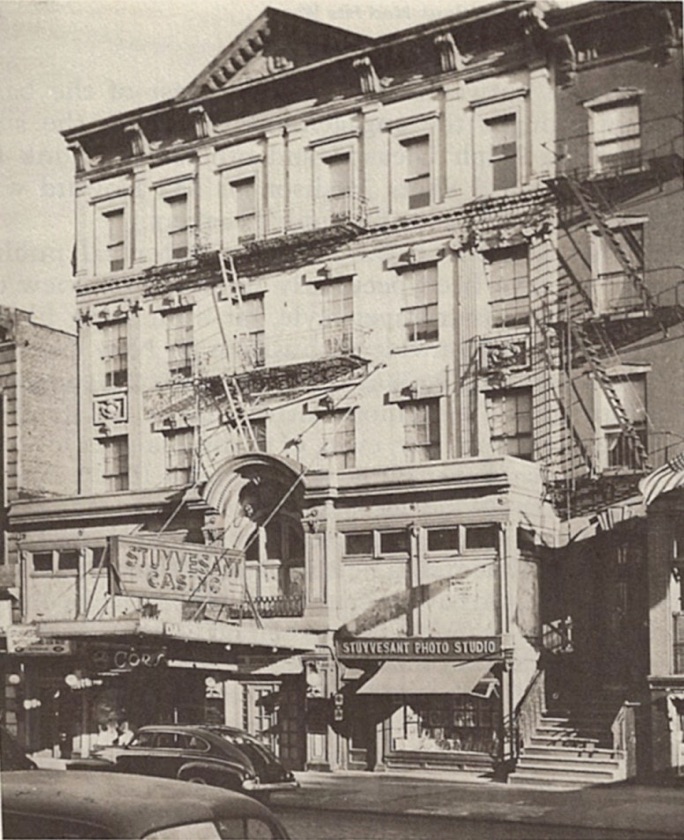
140-142 Second Avenue are indicated by the red arrow, and 138 Second Avenue is indicated by the orange one. Image via VillagePreservation.org
The Bowery attracted Irish and German immigrants starting in the 1850s, Poles and Ukrainians arrived in the 1880s, and by the early 1900s, Italians and Eastern European Jews arrived.
Originally a German YMCA beginning in 1881, the building was a pair of late federal-style houses, dating back to around 1830 when the area was known as “Little Germany.” The building stayed intact and in its original form, with sloped peaked roofs and dormers at the top, meaning the YMCA had not changed much of the exterior, and perhaps the interior as well.
Around the late 1800s, this area of Manhattan’s Lower East Side became the center of Jewish life in America. Crowded and culturally vibrant, a rise in crime would lead to gangs forming by the end of the century. Second Avenue was a main road, bustling with theaters, cafes, nickelodeons, bars, and vaudeville houses, making the region a draw beyond its residents.
Stuyvesant Casino
In 1910, Stuyvesant Casino opened at 140-142 2nd Avenue, owned and operated by Gerson Schmidt, an Eastern Europe immigrant from Galicia (now located in Ukraine). This stretch of 2nd Avenue encompassed part of Stuyvesant’s farm, and thus the name was given to the business.
The Stuyvesant Casino offered sumptous food, dazzling decor, and a first-class house band. High rollers and hitmen were among the clientele, particularly Big Jack Zelig, head of the Eastman Gang after the death of “Kid Twist” Max Zwerbach, in 1908.
Big Jack Zelig
During a party on December 2, 1911, Zelig lured a drunk “Julie” Morrello, an Italian gangster called “one of the most notorious gun and knife fighters on the east side, to Stuyvesant Casino. Around 1am, the lights went out and four shots rang out. As the lights flickered on moments later, Morrello was lying prone on the dance floor, filled with bullets.
In post-World War I New York City, Stuyvesant Casino would be a notorious hangout for Jewish gangsters, but by World War II, the venue became known for music producing the hits.
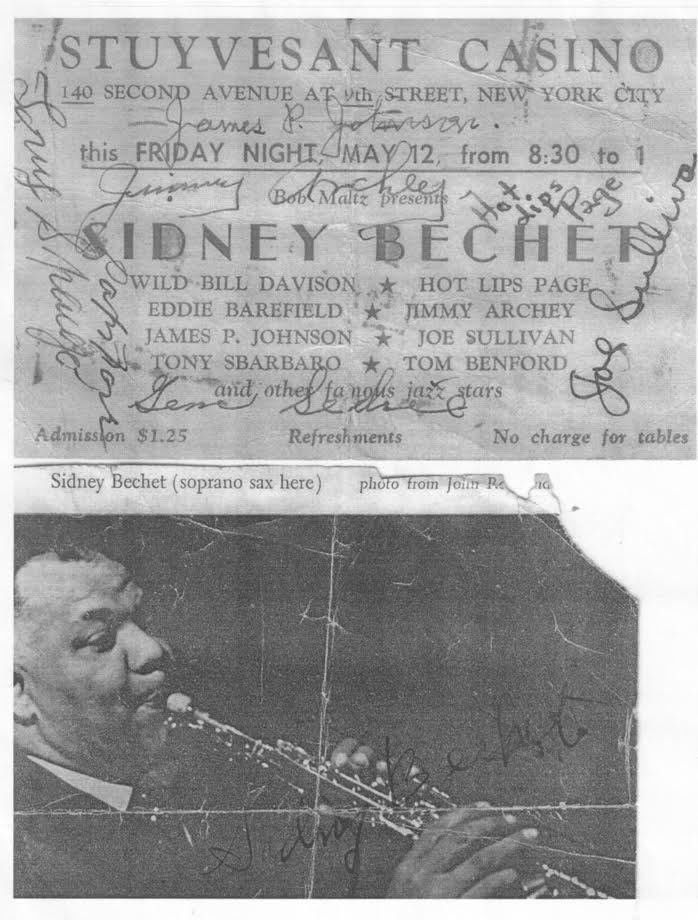
In the 1940s and into the 1950s, Stuyvesant Casino became a popular destination thanks to the arrival of New Orleans and Dixieland jazz artists. Big names such as Sidney Bechet, Wild Bill Davison, Rex Stewart, James P. Johnson, Georgie Lewis, Joe Sullivan, the great Bunk Johnson, and the Conrad Janis Tailgate Jazz Band could be heard for the low cost of $1.25.
Owner Gerson Schmidt was at one point encouraged by the Stuyvesant’s head waiter to allow a band consisting of his three sons to perform at the Casino. The three Perelmuth Brothers – Pinchas (violin/vocals), Michoyl (piano) and Sender (bass) – were a hit, leading to partygoer and movie theater impresario Samuel Lionel “Roxie” Rothafel, to discover Pinchas’ voice and recognize his potential. When Roxie asked why he was only singing in a “mere catering hall,” Perelmuth responded, “I would love to be an opera singer, but don’t have the money for a vocal coach.”
Opera legend Jan Peerce got his start at Stuyvesant Casino as a child
Roxie would take Pinchas under his wing and helped him get his break, helping him study voice and making his name among the opera elite of New York City. Perelmuth would make his debut at the Metropolitan Opera in 1933, under a new name, Jan Peerce. He would make his Broadway debut in 1971 in Fiddler on the Roof, a far distance for the son of Russian immigrants to travel from the Lower East Side.
As noted in the book The Jews of Capitol Hill, Gerson had a son, Mordechai, who married Myra Bank, the daughter of Galician immigrants. The two would have a son, Lawrence Jack Smith, a Democrat from Florida who served five terms in the House of Representatives from 1983-1993. Smith, whose parents ran catering establishments in the New York kosher catering scene, would work for their business and at Stuyvesant Casino from an early age.
When the Dixieland jazz made its way north, Gerson’s Stuyvesant Casino was the natural stop for an eclectic melting pot of music. Saxophone great Steve Lacy hung around the Casino as a teenager was exposed to early Dixieland Jazz greats, some of whom he would join there on a regular basis, including Henry Red Allen, Pee Wee Russell, Buck Clayton, and his teacher, Cecil Scott.
New Orleans bandleader Bunk Johnson would frequently perform at Stuyvesant Casino, occasionally joined by Louisiana-born bluesman Huddie “Leadbelly” Ledbetter, who lived on nearby East 10th Street. Trumpeter Hot Lips Page recorded a version of the 1924 classic “When My Sugar Walks Down the Street” at the Casino, and would later open rival venue Birdland with Charlie Parker, who lived nearby on Avenue B, in 1949.
Portrait of Bunk Johnson, Leadbelly, George Lewis, and Alcide Pavageau, Stuyvesant Casino, New York, N.Y., ca. June 1946
Robert Thompson, a Dixieland drummer known for his group The Red Onion Jazz Band, recalled Bob Maltz as an organizer of jam sessions at Stuyvesant Casino that attracted well paid world class musicians. The Red Onion Jazz Band served as legendary Dixieland revivalists, borrowing the name from Clarence Williams’ traditional New Orleans supergroup Red Onion Jazz Babies, which included Sidney Bechet and Louis Armstrong playing together for the first time in studio.
via Jazz Lives
The Red Onion Jazz Band would perform into the 1960s, just as folk music made its way through Greenwich Village. In the Traditionwould bring together folk musicians by way of Dave Van Ronk and his Prestige label, along with jazz musicians for a unique album. Vocalist Natalie Lamb would perform with The Red Onion Jazz Band and in 1972, married Thompson. A few years later, the group’s long-time trombonist, Dick Dreiwitz and his wife Barbara – a Hunter College alumnus who switched from French horn to tuba so she could play Dixieland jazz – would welcome a son, Dave. Now the bassist for Ween and Joe Russo’s Almost Dead, Dave Dreiwitz continues a tradition forged in the East Village confines of Stuyvesant Casino. The Red Onion Jazz Band would continue to perform until Thompson’s death in 2010.
From: A Pictural History of Jazz by Keepnews and Brauer. L to R, Buster Bailey, Vic Dickenson,Wilbur deParis, Omer Simeon, Hot Lips Page, Rex Stewart.
A first hand account of Stuyvesant Casino from Mr. Madison Arnold, as shared with Jazz Lives:
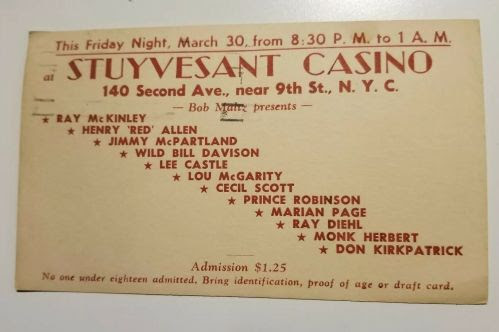
I was one of the steady jazz loving week-end customers at the Central Plaza and Stuyvesant Casino from around 1950 to 1952 and got these post cards weekly. This is the only one I kept. I started when I was still in Erasmus Hall H.S. (they didn’t card in those days). My favorites were Bechet & Wild Bill but I loved them all. Among my memories: I helped Pops Foster put his bass in a cab one night and we went to the Riviera on Sheridan Sq., Red Allen pulled me up on stage once and we sang “The Saints Go Marching In” together. I became friendly with Baby Dodds and invited him over for dinner one evening to our apartment in Brooklyn. I also visited his place in Harlem. I have a Xmas card he sent me, written, I think, by his lady friend as I don’t think he could write. My personal Louis Armstrong stories are even better! (at least to me). He was a wonderful guy.
Mr. Madison Arnold
An autographed show promo from Stuyvesant Casino
By the mid-1950s, due in part to restrictive immigration laws and a rise in crime and building abandonment, Stuyvesant Casino would close its doors. A home for Eastern European refugees since the late 1800s, new immigrants from Poland and Ukraine headed to the East Village for an escape from communism in the mid-20th century, in addition to Puerto Ricans who had U.S. citizenship.
Stuyvesant Casino also contained the Ukrainian National Home, a community center that opened in 1958, an effect of the change in neighborhood demographics. Offering cultural and social services to the East Village’s Ukrainian population, an area now known as Ukrainian Village, the “Ukie Nat” hosted a diverse array of artists in the 1980s including Elvis Costello, New Order, and the Misfits, as well as balalaika music filling the Ukrainian Home Restaurant.
New Order would perform their first American show at Ukrainian National Home, testing out new material that built off Joy Division’s sound. During the 80s post-punk era, synth-based freestyle and electro could be heard at downtown clubs – a melding of white, Latino and Black artists who were mixing in the same area where punk rock inspired New Order’s early sounds.
Looking back on Stuyvesant Casino’s heyday, jazz music from beyond New York would find a home in this region of the city that so many others had sought refuge in for centuries prior. Home to Germans, Jews, African-Americans, Ukrainians and many more, the area at 140-142 Second Avenue has been a bustling center of cultural diffusion and artistic growth for nearly two centuries, and continues to be so today. The original Stuyvesant Casino building burned down in 1985.
In January 2023, Ev Grieve shared news that during renovations at 132 Second Ave, a flyer for Stuyvesant Casino was found on a pole, decaying but clearly showing an event on a Saturday night.
photo by Kevin Goodman
As we close out this look at Stuyvesant Casino, listen to a WMGM broadcast from Friday, March 14, 1952, via Jazz Lives, featuring Master of Ceremonies Aime Gauvin, joined by Jimmy McPartland (cornet), Ziggy Elmer (trombone), Bud Freeman (tenor saxophone), Bob Wilber (clarinet), Kenny Kersey (piano) and Don Lamond/George Wettling (drums). They perform a medley including “Saints, “Lady Be Good,” “Coquette,” and “The World is Waiting for the Sunrise.”
One of rock journalism’s most experienced, insightful and productive writers, Joel Selvin, has created a fresh take on the telling of the birth of L.A. pop and the California dream of the ‘60s with his latest book, Hollywood Eden: Electric Guitars, Fast Cars and the Myth of the California Paradise.
When it comes to writing about rock music, and writing about it very well, few can match Selvin. From 1969 – 2009, he was a rock music critic for the San Francisco Chronicle, as well as a contributor to Rolling Stone, Melody Maker, the Los Angeles Times and many more. He has written or co-written excellent books on artists like Ricky Nelson, The Grateful Dead, Sly and the Family Stone and Sammy Hagar, events like Monterey Pop, The Summer of Love, Altamont and the birth of the dance craze The Peppermint Twist at one of the pioneering NYC club scenes, The Peppermint Lounge.
Joel Selvin, author.
With his masterful 2014 book, Here Comes the Night: The Dark Soul of Bert Berns and the Dirty Business of Rhythm and Blues, Selvin rescues from obscurity one of the most innovative producers/songwriters of the ‘60s, a man who was largely forgotten after his death in 1967 at age 38. Berns was the man who brought Latin swing to rock with his first hit production, “A Little Bit of Soap,” in 1961, as well as the architect of many of Atlantic Records’ early hits for R&B stars like Solomon Burke, Esther Phillips, Ben E. King and Wilson Pickett. Berns was also the writer of classics like “Twist and Shout,” “Piece of My Heart,” “Cry Baby” and “Hang on Sloopy,” and the producer of mega-hits like the Drifters’ “Under the Boardwalk,” Barbara Lewis “Baby I’m Yours” and Van Morrison’s “Brown Eyed Girl.”
If all his books have one thing in common, it is Selvin’s skill as a storyteller. His books read like someone spinning a long yarn around a campfire. They are incredibly rich in fact and scene-setting details, and compulsively readable. Hollywood Eden is cut from the same mold.
Selvin’s latest tells the story of a group of young musicians who came together at the dawn of the ‘60s to create the lasting sound that powered the myth of the California dream. Central to the saga is a group of sun-kissed teens from the University High School (Uni High) Class of ’58, which included surf music pioneers Jan and Dean, bizarro rock impresario Kim Fowley, drummer Sandy Nelson, Nancy Sinatra, the Beach Boys’ Bruce Johnston and Kathy Korner, the petite teen surfer who inspired the book and movie Gidget. They came of age in Southern California at the dawn of a new era when anything seemed possible. These were the kids who created the idea of modern Southern California, complete with surf music, hot-rods and electric guitars, that the rest of world saw as a teenage paradise on earth.
The forward to the book sets the Rock-n-Roll high school scenario by also listing the alumni of other schools, like Hawthorne High (Brian Wilson) and Fairfax High (Phil Spector, Herb Alpert, Wrecking Crew sax man Steve Douglas and songwriters P.F. Sloan and Steve Barri), sound-obsessed youngsters who would go on to revolutionize pop music. Some of the Angeleno legends referenced were native New Yorkers or had Big Apple connections, like the Mamas and the Papas and Phil Spector. With all their glorious accomplishments, some of the stories here end with the characters getting burned, for flying too close to the sun or driving too fast and crashing. The latter was the case for Sandy Nelson, who had a smash hit with the drum solo-driven instrumental “Teen Beat” and especially Jan Berry of Jan and Dean.
Berry is the worthy centerpiece of the story, another legend whose accomplishments are getting lost with the passing of time. Tall, blonde, handsome, athletic and with a magnetic personality, Berry’s adventures in music started in the late ‘50s, when he formed a doo-wop group called The Barons, which included folks like Sandy Nelson, Bruce Johnston, actor-to-be James Brolin and, of course, his partner-to-be Dean Torrence.
With his father’s gift of an upright piano and two Ampex reel-to-reel tape recorders, Berry set to experimenting in his garage. He started bouncing tracks and stacking vocals to create a sound that would become the signature of the sunny California dream, it would also serve as the template for a legendary musician he would come to work closely with, Brian Wilson.
When Torrence was conscripted into the army, Berry teamed up with Arnie Ginsburg and scored a hits, including “Jennie Lee” and “Gas Money” as Jan and Arnie. By 1959, he was back in business with Dean scoring a Top 10 hit with the Herb Alpert-produced “Baby Talk.” Even though he was attending medical school, Berry also had the energy to write and produce for other artists like The Rip Chords, The Matadors and actress-turned-singer Shelley Fabares.
Jan and Dean’s commercial peak was from 1963 – 1966, when they scored sixteen Top 40 hits, many in collaboration with Brian Wilson like the Wilson-Berry penned “Surf City,” along with “Drag City” and “The Little Old Lady from Pasadena.” Berry’s fate would be presaged with his #8 hit from 1964, “Dead Man’s Curve.” In April 1966, he would crash his speeding car right near this very curve and suffer serious brain damage and paralysis that would essentially put an end to his creative career.
Also noteworthy in Hollywood Eden is the fascinating career of Bruce Johnston. A child of privilege from Bel-Air, Johnston also made some major strides while still in high school, playing with Richie Valens, The Everly Brothers and Eddie Cochran and producing and playing on Sandy Nelson’s “Teen Beat.” He also produced the Rip Chords and his own string of surf and car singles, with future Byrds producer Terry Melcher. In 1965, he joined the Beach Boys and was featured on some of their classic albums like Pet Sounds, Sunflower and Surf’s Up.
Drummer Sandy Nelson’s story is another interesting one that was, like his good friend Berry’s, derailed by driving too fast. Nelson served as a session drummer on early hits by Phil Spector and the Hollywood Argyles, before scoring a million-selling, Billboard Top 5 hit with the drum solo driven “Teen Beat” in 1959. Nelson pounded out two more Top 10 hits, including “Let There Be Drums,” before a 1963 motorcycle accident led to the amputation of his leg.
Readers will also be intrigued by Selvin’s telling of the story of Nancy Sinatra. He tells how Ol’ Blue Eyes’ little girl went from nowhere in her singing career by playing the “good girl” before scoring a worldwide #1 as the “bad girl” who snarled “These Boots Are Made for Walkin’.”
Selvin’s latest provides tons of enlightenment on the careers of more L.A. legends like performer/record company head Herb Alpert, the Mamas and the Papas and their producer Lou Adler, Phil Spector, Kim Fowley and, of course, Brian Wilson and the Beach Boys. The book ends with the release of Wilson’s crowning achievement, “Good Vibrations,” and beginning of his decline with the commercial failure of Pet Sounds and its abandoned follow-up Smile.
With America hopefully finally coming out of the long Covid-19 quarantine, Selvin’s Hollywood Eden will be a great summer read for music-lovers who want to experience the sunshine sounds and some California dreamin’.
Trey Anastasio will return to the Beacon Theatre on June 22nd and 23rd for two solo acoustic performances, this time with a full capacity audience. The shows will mark the first time the Beacon has had a crowd since March 2020.
After 8 weeks of Beacon Jams in Fall 2020, which found Anastasio performing with TAB and assorted guests, including the Rescue Squad Strings, he returns this June for two nights solo. All guests over the age of 16 will need to be fully vaccinated for this event and provide proof upon entry.
Tickets for the shows will go on sale Thursday, May 27 at Noon ET, here. Note – there is no pre-sale for these shows.
Update – these shows are now both sold out. James Dolan, Executive Chairman and CEO of MSG Entertainment said the following in a statement:
Trey was the only artist to play live at The Beacon during the pandemic, so we’re honored that he’ll be the first artist back on our stage playing for a packed house. There’s no question people are eager to start gathering to once again experience events they love — and are more than willing to get vaccinated to do so. We’re focused on opening up all our venues to not just usher in the return of live entertainment, but of New York.
James Dolan
For anyone looking to request to purchase a taper ticket for the shows at the Beacon Theatre, please email tapertickets@gmail.com by 9pm ET on Wednesday, May 26th. Access to taper tickets is extremely limited and not guaranteed.
The Beacon Theatre venue vaccination policy and stipulations are as follows:
Guests will need to be fully vaccinated for Two Evenings with Trey Anastasio at the Beacon Theatre, meaning the event must be at least 14 days after your second dose of the Pfizer-BioNtech or Moderna COVID-19 vaccine or at least 14 days after your single dose of Johnson & Johnson’s Janssen COVID-19 vaccine. The only exception is for children under the age of 16, who may provide proof of a negative antigen COVID-19 test, negative PCR COVID-19 test or full vaccination and are accompanied by a vaccinated adult. For more information, please visit beacontheatre.com/faqs.
First Generation, born in America, and sitting in the back of her Iranian parent’s car, coasting through Northern Virginia as they all sing along to “How can you mend a Broken Heart” by the Bee Gees.
Moments like these are when Susan Darvishi started to feel connected with the music that surrounded her. And with her debut album 14th and 4th, releasign on May 26th, she is able to take her relationship with music and tell the stories of the past five years living in New York City on 14th and 4th, before moving out to California.
Susan Darvishi
Of the album’s eight songs, she is able to cover five years of emotions from living in the constantly loud pumping heart of New York City. Whether it is falling in love in the city (“Polaroid” or “Dance With You”), keeping with girl code and internal struggles with heart break (“Him” and “No Choice”), or the bitter sweet goodbyes you have to make in order to start a new chapter (“New Salvation” and “Drift Away”), Davishi is able to tell her stories beautifully through songs on this album.
Darvishi’s strong voice pairs appreciably well with the beats, giving most of her songs a fun upbeat electronic pop sound to them. That is said with the exception of “No Choice” and “Drift Away” where she is able to pull away from her other songs and use a slower electric sound to really show off her strong vocals and meaningful lyrics.
From her “love [of] Latin music, I listen to in my free time” and then the “Persian music I listen to with my family” she says “sometimes those two blend. They love fast beats.” These influences of music can especially be heard in songs such as “Him” that is a very upbeat song with almost a Persian music sound to it.
This album has a very good mix between upbeat songs that make you want to get up and dance to songs that give you time to reflect on some of your past chapters. Her sound is with similar likes to artists such as Robyn and the sky seems to be the limit for her musical career.
The stories from her songs about her time in NYC still feel as though they are about a time in your life and manage to still be very relatable. Since she left her job in NYC to pursue her career in music right before covid hit she hasn’t been able to perform live but she is just as excited as her listeners for her to start performing on stage in front of a covid free audience.
New York City native Des Rocs has announced his first headline tour, Des Rocs Alive, consisting of more than 20 shows and kicking off on September 23 at Firefly Music Festival. The tour concludes on November 4 with a hometown show at the Bowery Ballroom in Manhattan.
Graphic from “This is our Life” Music Video
The tour will make stops at iconic venues around the country like Los Angeles’ The Troubadour, Minneapolis’ The Turf Club and Austin, TX’s Antone’s Nightclub. Des Rocs will also make stops at the Firefly Festival and the sold-out Aftershock Fest.
Des Rocs is a fourth-generation New Yorker as well as a rock-and-roll musician. He’s shared stages with The Rolling Stones, Muse, K Flay, Fall Out Boy, Weezer and Grandson.
“I feel like I was put on this earth to play shows,” Des Rocs said. “Since I was 13, I’ve played my guitar in basements and dive bars to anyone who’d listen.”
Des Rocs has released three EPs to date, including Let the Vultures In, Martyr Parade, and This Is Our Life, released in December 2020. The album’s title track hit top 20 at Active Rock radio and top 40 at Alternative radio. Fans can expect new music to be released later this year.
Des Rocs’ song “POS” from his album This is Our Life
“This tour is a lifetime in the making,” Des Rocs said. “I can’t wait to finally put all these songs on a stage after dreaming about it for a year in isolation.”
Tickets go on sale May 21, and can be purchased on Des Rocs’ website.
Des Rocs 2021 Tour Dates:
September 23-26 – Dover, DE @ Firefly Music Festival
September 28 – Detroit, MI @ El Club
September 30 – Columbus, OH @ The Basement
October 1 – Chicago, IL @ Beat Kitchen
October 2 – St. Paul, MI @ Turf Club
October 5 – Denver, CO @ Larimer Lounge
October 8 – Sacramento, CA @ Aftershock Festival
October 10 – Seattle, WA @ Sunset Tavern
October 11 – Portland, OR @ Mississippi Studios
October 13 – San Francisco, CA @ Rickshaw Stop
October 14 – Los Angeles, CA @ The Troubadour
October 16 – San Diego, CA @ Soda Bar
October 19 – Austin, TX @ Antone’s
October 20 – Dallas, TX @ Three Links
October 21 – Houston, TX @ The Secret Group
October 23 – Nashville, TN @ The End
October 25 – Carrboro, NC @ Cat’s Cradle Backroom
October 26 – Virginia Beach, VA @ Elevation 27
October 27 – Washington, DC @ Songbyrd
November 2 – Boston, MA @ The Middle East (upstairs)
Closing out Season 46 of Saturday Night Light, musical guest Lil Nas X worked through a wardrobe malfunction as The Queen’s Gambit star Anya Taylor-Joy hosted flawlessly on an emotional finale.
The episode began with a full cast cold open looking back on the ups and downs of the past year, including an appearance by the host of the first episode of the season, Chris Rock. This also marked the first time all season that SNL had full (and vaccinated) in-studio audience.
Just over a week before the start of Pride month, Nas appeared in a pre-recorded take on Madonna’s “Holiday” with Kate McKinnon, Bowen Yang and Punkie Johnson all looking forward to all things Pride – parades, brunch, clubs, drama – that were missed due to COVID-19 in 2020.
For his first song, Lil Nas X performed “Montero (Call me by your Name),” the music video for which he received criticism from the religious right for twerking with Satan. On the stage in Studio 8H, Lil Nas X used a stripper pole while flanked by dancers, and with 30 seconds left in the song, split his pants. Seamlessly, Lil Nas X continued to perform with his hand covering his crotch, ending with a striking image of himself with giant wings projected behind him. He didn’t let on about the malfunction until a Tweet a few minutes later.
The second performance of the night featured the just released track “Sun Goes Down.” The more vulnerable turn finds Lil Nas X wearing a white suit and reflecting on the suicidal thoughts he had while growing up gay and in the closet. With lyrics “Since ten, I’ve been feelin’ lonely / Had friends but they was pickin’ on me / these gay thoughts would always haunt me / I prayed God would take it from me,” “Sun Goes Down” elaborates on why he was so bold about trolling conservatives with more vulnerability than we’ve seen yet.
That’s all for Season 46 of Saturday Night Live. Stay tuned for Season 47 starting in September/October 2021. What was your favorite musical guest of the season? Share in the comments below.
Radio City Music Hall announced plans to reopen with 100% capacity for vaccinated audiences, in response to Governor Andrew Cuomo pulling back on COVID-19 restrictions in his announcement on Monday May 17. New York State is now following the Centers for Disease Control and Prevention’s guidance to allow vaccinated New Yorkers to forgo wearing masks in most indoor settings which changes the game for venues across New York State.
Radio City Music Hall originally opened back in December of 1932 and is known for being one of the staple venues in New York City. It’s home of the Rockettes which are a widely known and respected precision dance company. It currently has a capacity of 6,015 people which means it can now hold performances for vaccinated crowds of that caliper.
James Dolan, owner of Radio City Music Hall accompanied Cuomo during the press conference announcing the roll back on mask restrictions and what that could mean for his venue. All sorts of plans for the venue were mentioned including the 20th anniversary of the Tribeca Film Festival which will take place on July 19th, the city’s NBA playoffs (being held at Madison Square Garden), and Radio City Music Hall offering 100% capacity future shows only for fully vaccinated audiences. The fully vaccinated 100% capacity shows will start to take place after the Tribeca Film Festival comes to a close.
While unsure how the venue will incorporate checking vaccination statuses of ticket holders for upcoming events but Robert Mujica, senior advisor to Cuomo, has said that people could use their CDC vaccination cards, or the Excelsior Pass in either its app form or a printout from the Excelsior Pass website to prove their vaccination status.
For more information visit Radio City Music Hall’s website.