Central New York-based band Harmonic Dirt is back with their newest album, Rhode Island Street, released earlier this year.
Husband and wife team Mike Gridley and Susan Coleman first established Harmonic Dirt back in 2016. Both songwriters, Gridley created instrumental tracks while Coleman took to writing lyrics. Their debut album, Anthracite, was released in 2018. Live at the Ridge was released in 2020 and won the Syracuse Area Music Award (SAMMY) for best Americana Recording.
Since Anthracite, Gridley (lead vocals, guitar, mandolin) and Coleman (bass) have joined forces with a fuller band, composed of close friend Taylor Bucci on banjo and vocal harmonies and James DaRin on percussion. Rhode Island Street contains 9 original tracks and marks Harmonic Dirt’s first release as an official quartet.
Photo from Harmonic Dirt’s website
The album was recorded at Greywood Studio in Jamesville, NY and features some special musical guests (Bob Gaus, Joe Plessas, Tami Schutt, Scott Ebner and Ericka Longo). The bluesy, Americana sound that Harmonic Dirt has come to play so well stands strong on Rhode Island Street, but there is even more cohesion and jam-band-like qualities present in the instrumentation.
Each track, while unique, showcases the steely guitar, banjo chirps and powerful vocal harmonies that have become signature for the band. The title track, “Rhode Island Street”, tells the imagery-laden story of a house burning down on–you guessed it–Rhode Island Street. This visual is even pictured on the album artwork, giving listeners a clear face to the lyrics as they enjoy this track’s laid-back instrumentation.
It is undeniable that these tracks will be incredibly fun to hear as Harmonic Dirt continues to play live shows and tour the album. Though some tracks are softer and more emotional (“Rhode Island Street”, “Grief Is A Canyon”, “Ashes”), others bring a danceable energy (“Comfort Me”, “Catch Me”, “What Did You Take?”). There is something for everyone and for every mood on Rhode Island Street, especially for fans of 60s and 70s Americana with a bluesy punch.
You can learn more about Harmonic Dirt on their website and connect with the band on Facebook, Twitter and Instagram. Rhode Island Street is available for purchase and streaming now and you can listen below!
Acclaimed Utica-based guitarist and songwriter Joe Bonamassa has announced an extensive 33 tour dates for fall 2021. Bonamassa’s latest project, a live album entitled Now Serving: Royal Tea Live From The Ryman, comes out Friday, June 11.
Photo by Robert Sutton
Bonamassa will stop in New York twice on his fall tour. He is set to play the Capitol Theatre in Port Chester on November 22 and the Rochester Auditorium Theatre in Rochester on November 24. The full list of tour dates is listed below.
Bonamassa is one of the biggest modern names in blues-rock and was even named “the world’s biggest blues guitarist” by Guitar World Magazine. He, like other live musicians, is marking his return to the stage in over a year. The fall tour kicks off October 8 at the Ryman Auditorium in Nashville, where Bonamassa recorded his latest live album.
Throughout the pandemic and during the pause of live music, Bonamassa focused on raising money for his non-profit Keeping the Blues Alive Foundation through the Fueling Musicians Program. The nonprofit centers on providing financial assistance to touring musicians who had their income streams cut off in this tumultuous time.
Now Serving: Royal Tea Live From The Ryman comes out Friday and tickets for the fall tour will be available on the same day. Links for purchase can be found here.
TOUR DATES
October 8-9: Nashville, TN – Ryman Auditorium
October 11: Little Rock, AR – Robinson Performance Hall
October 13: Shreveport, LA – Shreveport Municipal Auditorium
October 15: San Antonio, TX – Majestic Theatre
October 16: Sugar Land, TX – Smart Financial Centre
October 17: Grand Prairie, TX – Texas Trust CU Theatre
October 19: Fayetteville, AR – Walton Arts Center
October 21: Tulsa, OK – Tulsa Theater
October 22: Memphis, TN – Cannon Center for the Performing Arts
October 23: Louisville, KY – The Louisville Palace
October 25: Evansville, IN – Old National Events Center
October 27: Fort Wayne, IN – Embassy Theatre
October 29: Indianapolis, IN – Murat Theatre at Old National Centre
October 30: St. Louis, MO – Stifel Theatre
October 31: Cincinatti, OH – Taft Theatre
November 19: Springfield, MA – Symphony Hall
November 20: Providence, RI – Providence Performing Arts Center
November 22: Port Chester, NY – The Capitol Theatre
November 24: Rochester, NY – Rochester Auditorium Theatre
November 26: Detroit, MI – Fox Theatre
November 27: Youngstown, OH – Covelli Centre
November 28: Columbus, OH – Palace Theatre
November 30: Easton, PA – State Theatre
December 1: Reading, PA – Santander Performing Arts Center
December 3: Roanoke, VA – Berglund Performing Arts Theatre
December 4: Baltimore, MD – The Lyric
December 5: Richmond, VA – Dominion Energy Center
December 7: Savannah, GA – Johnny Mercer Theater
December 8: Sarasota, FL – Van Wezel Performing Arts Hall
December 10: St. Augustine, FL – The St. Augustine Ampitheatre
With live music returning to Capital Region venues, Saratoga’s historic Caffe Lena is in a position to assist a popular jazz festival in a part of the world that is still restricted by COVID-19. With American musicians unable to cross the border for their gigs at Quebec Jazz In June, Caffè Lena will instead be producing the shows at its location in Saratoga and making it available to the Quebec Audience via livestream.
Quebec Jazz in June, a ten day festival that ushers jazz music to the streets of Quebec City has pivoted to a hybrid online, and in-person model as Canada keeps its southern border closed.
“This legendary venue has stepped up to ensure that world class American musicians will once again be a part of our annual festivities – this time through the magic of live streaming.” Says Simon Couillard, the Festival’s General Manager.
Three nights of the festivals headline artists will be live streamed from Caffe Lena to the Festival’s social media platforms. Capital Region audiences can also attend the concerts in-person, in the intimate listening room located in downtown Saratoga Springs.
“Standing in as Quebec’s USA Stage is a win-win-win. The artists get to play for the festival’s audience; Quebec Jazz can hang onto their American line-up; and Saratoga gets to experience the festival’s mainstage musicians in person,” says Caffe Lena’s Executive Director Sarah Craig.
The collaboration between Caffe Lena and Quebec Jazz in June is one to look forward to, and is a positive thing as a result of the pandemic. The historic venue has been regularly sharing their stage and live stream capabilities with a number of venues and organizations from around the region, including 2020’s Freihoffer’s Jazz Festival.
Producing more than 200 shows during 2020, the venue’s audience has expanded far beyond its 110-seat listening room, while providing more than $100,000 in income to musicians who were not able to play live shows in over a year.
“This event is a perfect example of the growth of the independent music world that happened over the past year. There was pain while it was happening, but the end result–greater access for all–is exciting for artists and audiences. This international collaboration with Quebec Jazz In June is truly exhilarating,” says Craig.
The American artists performing at Caffe Lena for this series will include Manuel Valera New Cuban Express on Thursday, June 17th, Sheila Jordan on Friday, June 18th, and the Chuck Lamb Trio featuring Chuck Lamb, Jay Anderson and Harvey Sorgen on Sunday, June 20th.
Grammy-nominated pianist and composer Valera, who has played with Paquito D’Rivera and Arturo Sandoval, begins a three-night run with a scaled-down version of his New Cuban Express Big Band. Inspired by famed Cuban writer and independence hero José Martí, Valera has created a song cycle using traditional Cuban styles merged with contemporary Latin jazz. Valera, who lost his wife in 2020, repurposed Martí’s powerful poems as a personal cry for freedom, justice and passion for life. Valera will be joined by Felipe Lamoglia on saxophone, Ricky Rodriquez on bass and Jimmy McBride on drums.
National Endowment for the Arts Jazz Master Sheila Jordan follows the next night. Widely regarded as one of the great jazz vocalists, she remains innovative and passionate, at the youthful of 92. Always eager to forge new connections, Jordan will be accompanied by Capital Region jazz artists Dylan Perrillo on bass, Nick Anderson on drums, and Tyler Giroux on piano.
Saratoga’s own Chuck Lamb closes out the festivities on Sunday with a trio featuring Harvey Sorgen on drums and Jay Anderson on bass. Lamb, best known as the pianist for the Brubeck Brothers Quartet, is the artist-in-residence for the acclaimed monthly “Jazz at Caffe Lena” music series. Each musician brings a wealth of talent and experience to the stage ranging from all corners of jazz music.
Caffe Lena offers a state of the art live stream experience with professional sound engineering and a multi-camera broadcasting system. Throughout the COVID-19 shutdown, the Caffe’s live stream capabilities became a lifeline for the organization as they shifted their programming to an entirely virtual experience. Now they are open for limited capacity live audiences, while also continuing to stream its nightly performances as a way to stay connected with music lovers far and wide.
Founded in 1960, Caffè Lena is a premiere concert venue located in Saratoga Springs, NY. Known around the world for fostering the preservation and growth of independent music rooted in tradition, Caffè Lena is the oldest continually running coffee house in the United States.
In person or virtually, Caffe Lena provides an unparalleled listening experience for renowned artists and breakout bands nearly every night of the week. The Caffe offers homemade desserts, locally sourced light fare, coffee, wine and beer to enjoy during the show. To buy tickets, live stream a concert and view our schedule please visit www.caffelena.org
Summary of Events Thursday, June 17, 7 PM – Manuel Valera New Cuban Express Friday, June 18, 8 PM – Sheila Jordan Trio Sunday, June 20, 7 PM – Lamb-Sorgen-Anderson
New York City based arts organization Arts for Art is celebrating the return of live music by presenting free outdoor concerts on June 12 and 13. The concerts will take place from 3-5 PM at the First Street Green Cultural Park located on the Lower East Side of Manhattan.
The event will be in compliance with CDC and New York City Covid-19 guidelines. Notable performers include William Parker, Sam Newsome, Darius Jones, Steve Swell and many more. You can see the full schedule for the weekend below.
William Parker, photo by Jimmy Katz
Arts for Art was founded in 1996 and its “work is rooted in a commitment to social justice as equity and the promotion and advancement of FreeJazz, an African American indigenous art form in which improvisation is principle.” This upcoming outdoor concert series is supported by the New York State Council on the Arts, the New York City Department of Cultural Affairs and City Council Member Carlina Rivera. You can learn more about Arts for Art on their website.
SCHEDULE:
Saturday, June 12
3:00 Sam Newsome Trio: Sam Newsome – soprano sax / Hilliard Greene – bass / Reggie Nicholson – drums
3:40 Darius Jones/ Francisco Mela: Darius Jones – alto saxophone / Francisco Mela – drums
4:20 Behroozi / Parker / Thompson: Daro Behroozi – tenor saxophone / William Parker – bass / Michael T.A. Thompson – drums
Sunday, June 13
3:00 Trombone Insurgency: Steve Swell – trombone / Joe McPhee – trombone / William Parker – bass / Gerald Cleaver – drums
3:40 Marcelo & Carter x 2: Alexis Marcelo – keyboard / Rashaan Carter – bass / Russell Carter – drums
Phil DiRe, founder of the Buffalo Jazz Ensemble, died on May 26 at the age of 80. Influencing the lives of many, the years 1972 to 1980 represent some of the most momentous years in Phil’s life, as well as the lives of others during that timeframe. Tony Zambito from JazzBuffalo shares the following remembrance of Phil.
It is not to say other years did not matter and did not become pillars in Phil’s life. But it to say that Phil, as a musician, influenced the lives of many musicians and the history of jazz in Buffalo during this time.
Sabu Adeyola and Phil DiRe
In November of 1972, Phil led the first edition of the Buffalo Jazz Ensemble in a concert at the Buffalo Central Public Library to a standing-room-only audience. The ensemble went on to perform concerts at such venues as Artpark, Studio Arena, Keenan Center, and others. Including gig dates at the old Bona Vista Lounge on Hertel Avenue as well as the Student Union Social Hall at Buffalo State College.
A poster used in 1976 for the funded city-wide program
The Buffalo Jazz Ensemble, led by Phil, helped launch a journey of performing for several prominent musicians with Buffalo heritage. Notable performers included pianist Al Tinney, bassist Sabu Adeyola, saxophonist Joe Ford, drummer Lou Marino, pianist Jimmy Calire, drummer Tommy Walsh, drummer Naser Abeday, guitarist James Clark, keyboardist Jeremy Wahl, and saxophonist Jay Beckenstein. Beckenstein, who was a private student of Phil, along with Wahl formed the nucleus of what became one of the most famous jazz fusion bands in history – Spyro Gyra.
Albright-Knox Art Gallery Outdoor Concert – Buffalo Jazz Ensemble is center right
In 1975, Buffalo was the center of a pioneering concept in the country. It was one of the firsts to receive city, state, and federal funding for jazz performances. Phil negotiated a unique arrangement with the City of Buffalo under Mayor Makowski, the NY State Council on the Arts, the National Endowment for the Arts, the local Musician’s Union, and the newly formed non-profit created by Phil – Association for Jazz Performance, which would launch an ambitious program to fund an ongoing series of concerts in every park, cultural center, and school in the city.
The Buffalo Jazz Ensemble performed in these concerts and exposed many youths to the music of jazz. Their very first event took place at the steps of the Albright-Knox Art Gallery, becoming a weekly event in summer, and continuing with sponsorship from the Buffalo News and Editor Stan Lipsey post-1980 starting with the Buffalo Jazz Workshop, led by Sam Falzone.
The funded program at Buffalo Public Schools
Prior to these pivotal years, Phil was assigned, while serving in the Marines, to the White House, where he led the White House Jazz Quartet during the overlapping Johnson and Nixon administration years. This put Phil next to the likes of Duke Ellington, Stan Getz, Gerry Mulligan, Dizzy Gillespie, and Billy Taylor and enabled him to perform with one of his best friends in life, the legendary drummer, composer, and arranger Justin DiCioccio.
At the steps of the AKG. Left to right: Tommy Walsh, Al Tinney, Phil DiRe, Joe Ford, Sabu Adeyola, James Clark, Jay Beckenstein, Naser Abeday, and Jeremy Wahl
At the end of the 1970s, Phil accepted an invitation to move out to Las Angeles to make a living as a studio musician. Before leaving, he turned the jazz ensemble over to Sam Falzone, where it eventually became known as the Buffalo Jazz Workshop, and operating on a smaller budget and scale.
Phil DiRe to the left in military style jacket playing saxophone
Feeling unfulfilled in his role as a studio musician, Phil took up a friend’s request to join him at a recently opened club in Palm Springs. The club was owned by the famous singer Keely Smith. Phil quickly made an impression on Smith and became her music director, arranger, and conductor. This Keely Smith ensemble, which also featured noted saxophonist Sam Butera, went on to become one of the most popular bands to ever tour the Las Vegas and Atlantic City circuit. The band was the follow-up act to the great Louis Prima band of the 1950s, which featured Keely Smith as their singer. As the music director of the band, Phil found himself performing with greats such as Frank Sinatra, Sammy Davis, Jr., Billy Eckstine, Tony Bennett, and other legends in jazz as well as American popular music.
Singer Keely Smith
By 1982, the constant touring, time away from family, and the tragic loss of his son Michael at an early age, brought Phil back home to the Buffalo region. In 1994, Phil founded the company SuccessWare as a way to help run his family’s HVAC business that his father began, Sunbeam Heating and Cooling. Phil persevered and wrote the core of the computer program for SuccessWare without any formal training.
At Jazz at Chandlerville in 2019 with Joe Calabrese, Chuck Buffamonte, Jack Kulp, and Gary Sterlace
The calling for jazz and blues music never left Phil. In his later years, he took up performing with fervor again locally as well as in Florida, playing alongside friends and in special reunions. He relished the roles of serving as an advisor and mentor, taking a strong interest in seeing the revival of jazz locally and offering support.
His later years served as a bookend, in many ways, to the first stone that caused a ripple effect in November of 1972. The circling waves of the ripple effect continue to expand, touching and influencing the lives of jazz fans and musicians in the Buffalo region and beyond.
At Giancarlos 2019 with Preston Brown, Chuck Buffamonte, Jerry Livingston, George Caldwell, and Brendan Lanighan
Phil is survived by his beloved wife of 57 years Geraldine “Gerri” DiRe. He was a devoted father of Maria, Michelle, Deanne, and the late Michael J. DiRe. He was affectionately known as “Papa” to his many grandchildren and great-grandchildren. To Phil, the love of family rose above all in life.
The East Village of Manhattan has been home to immigrants, the working class, Beatniks, hippies and artists over the last 300 years. Originally home to the Lenape tribe before the arrival of Europeans, the East Village today is comprised of Alphabet City (the setting for the musical RENT), Ukrainian Village and the Bowery (home to CBGB). In the early to mid-20th century, it would be home to Jewish gangsters and Dixieland jazz at the famed Stuyvesant Casino.
The name Stuyvesant has roots in America dating back to the 17th century, with the arrival of the Dutch in New York Harbor in 1624. Peter Stuyvesant would serve as Governor in Chief of Amsterdam in New Netherland, later named New York after surrendering the city to the British in 1664.
While he was effective with trade in New Amsterdam and created a sense of law and order for a diverse colony, Stuyvesant was intolerant of full religious freedom in the colony. In 1657 he refused to allow Lutherans the right to organize a church, and later refused to allow the permanent settlement of Jewish refugees from Dutch Brazil in New Amsterdam, joining Jewish traders already there.
Ultimately, directors of the Dutch West India Company needed to pressure Stuyvesant to allow Jewish immigrants to stay in the colony as long as their community was self-supporting. Still, Stuyvesant and the company would not allow them to build a synagogue, leading them to worship at a private house instead.
The name Stuyvesant would end up having a negative connotation, as he did few favors in his life to gain support of those he was placed in charge of. Upon turning over New Amsterdam to Britain after no one would defend the city, his name was tarnished. He would eventually settle on a farm, a bouwerie, until his death in 1672.
Two and a half centuries later, the name Stuyvesant would be fading as a surname, but was the given name of an East Village casino with a rich 20th century history.
140-142 Second Avenue are indicated by the red arrow, and 138 Second Avenue is indicated by the orange one. Image via VillagePreservation.org
The Bowery attracted Irish and German immigrants starting in the 1850s, Poles and Ukrainians arrived in the 1880s, and by the early 1900s, Italians and Eastern European Jews arrived.
Originally a German YMCA beginning in 1881, the building was a pair of late federal-style houses, dating back to around 1830 when the area was known as “Little Germany.” The building stayed intact and in its original form, with sloped peaked roofs and dormers at the top, meaning the YMCA had not changed much of the exterior, and perhaps the interior as well.
Around the late 1800s, this area of Manhattan’s Lower East Side became the center of Jewish life in America. Crowded and culturally vibrant, a rise in crime would lead to gangs forming by the end of the century. Second Avenue was a main road, bustling with theaters, cafes, nickelodeons, bars, and vaudeville houses, making the region a draw beyond its residents.
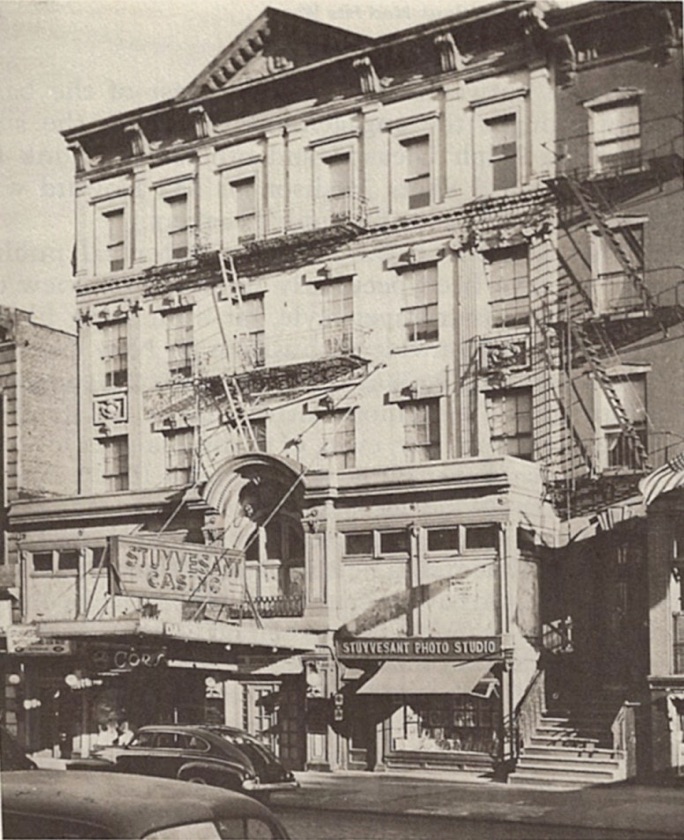
Stuyvesant Casino
In 1910, Stuyvesant Casino opened at 140-142 2nd Avenue, owned and operated by Gerson Schmidt, an Eastern Europe immigrant from Galicia (now located in Ukraine). This stretch of 2nd Avenue encompassed part of Stuyvesant’s farm, and thus the name was given to the business.
The Stuyvesant Casino offered sumptous food, dazzling decor, and a first-class house band. High rollers and hitmen were among the clientele, particularly Big Jack Zelig, head of the Eastman Gang after the death of “Kid Twist” Max Zwerbach, in 1908.
Big Jack Zelig
During a party on December 2, 1911, Zelig lured a drunk “Julie” Morrello, an Italian gangster called “one of the most notorious gun and knife fighters on the east side, to Stuyvesant Casino. Around 1am, the lights went out and four shots rang out. As the lights flickered on moments later, Morrello was lying prone on the dance floor, filled with bullets.
In post-World War I New York City, Stuyvesant Casino would be a notorious hangout for Jewish gangsters, but by World War II, the venue became known for music producing the hits.
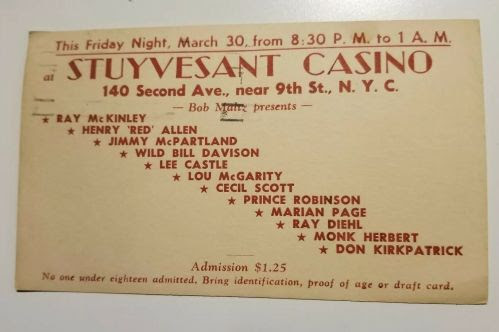
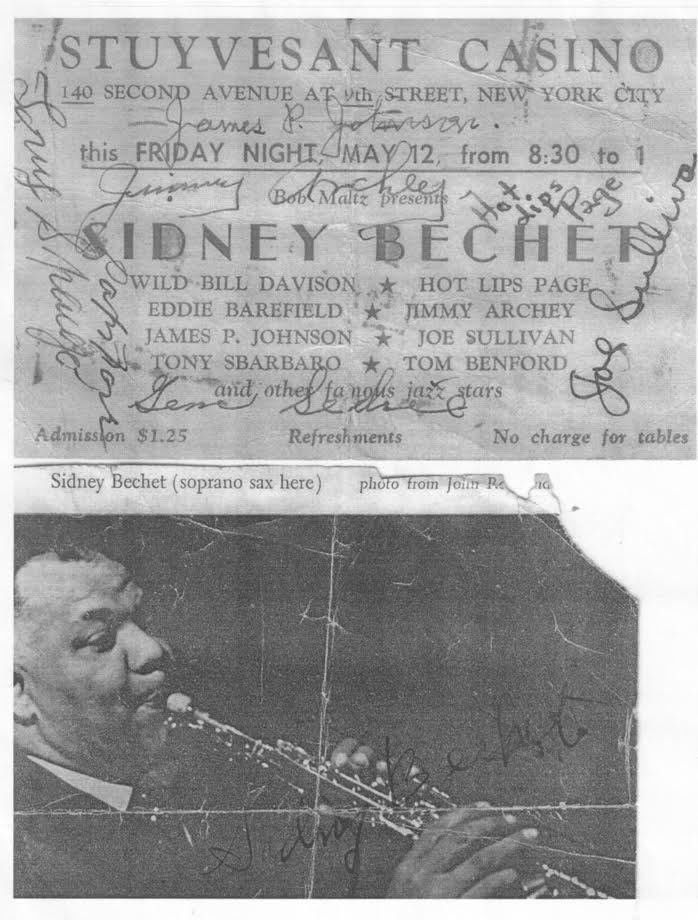
In the 1940s and into the 1950s, Stuyvesant Casino became a popular destination thanks to the arrival of New Orleans and Dixieland jazz artists. Big names such as Sidney Bechet, Wild Bill Davison, Rex Stewart, James P. Johnson, Georgie Lewis, Joe Sullivan, the great Bunk Johnson, and the Conrad Janis Tailgate Jazz Band could be heard for the low cost of $1.25.
Owner Gerson Schmidt was at one point encouraged by the Stuyvesant’s head waiter to allow a band consisting of his three sons to perform at the Casino. The three Perelmuth Brothers – Pinchas (violin/vocals), Michoyl (piano) and Sender (bass) – were a hit, leading to partygoer and movie theater impresario Samuel Lionel “Roxie” Rothafel, to discover Pinchas’ voice and recognize his potential. When Roxie asked why he was only singing in a “mere catering hall,” Perelmuth responded, “I would love to be an opera singer, but don’t have the money for a vocal coach.”
Opera legend Jan Peerce got his start at Stuyvesant Casino as a child
Roxie would take Pinchas under his wing and helped him get his break, helping him study voice and making his name among the opera elite of New York City. Perelmuth would make his debut at the Metropolitan Opera in 1933, under a new name, Jan Peerce. He would make his Broadway debut in 1971 in Fiddler on the Roof, a far distance for the son of Russian immigrants to travel from the Lower East Side.
As noted in the book The Jews of Capitol Hill, Gerson had a son, Mordechai, who married Myra Bank, the daughter of Galician immigrants. The two would have a son, Lawrence Jack Smith, a Democrat from Florida who served five terms in the House of Representatives from 1983-1993. Smith, whose parents ran catering establishments in the New York kosher catering scene, would work for their business and at Stuyvesant Casino from an early age.
When the Dixieland jazz made its way north, Gerson’s Stuyvesant Casino was the natural stop for an eclectic melting pot of music. Saxophone great Steve Lacy hung around the Casino as a teenager was exposed to early Dixieland Jazz greats, some of whom he would join there on a regular basis, including Henry Red Allen, Pee Wee Russell, Buck Clayton, and his teacher, Cecil Scott.
New Orleans bandleader Bunk Johnson would frequently perform at Stuyvesant Casino, occasionally joined by Louisiana-born bluesman Huddie “Leadbelly” Ledbetter, who lived on nearby East 10th Street. Trumpeter Hot Lips Page recorded a version of the 1924 classic “When My Sugar Walks Down the Street” at the Casino, and would later open rival venue Birdland with Charlie Parker, who lived nearby on Avenue B, in 1949.
Portrait of Bunk Johnson, Leadbelly, George Lewis, and Alcide Pavageau, Stuyvesant Casino, New York, N.Y., ca. June 1946
Robert Thompson, a Dixieland drummer known for his group The Red Onion Jazz Band, recalled Bob Maltz as an organizer of jam sessions at Stuyvesant Casino that attracted well paid world class musicians. The Red Onion Jazz Band served as legendary Dixieland revivalists, borrowing the name from Clarence Williams’ traditional New Orleans supergroup Red Onion Jazz Babies, which included Sidney Bechet and Louis Armstrong playing together for the first time in studio.
via Jazz Lives
The Red Onion Jazz Band would perform into the 1960s, just as folk music made its way through Greenwich Village. In the Traditionwould bring together folk musicians by way of Dave Van Ronk and his Prestige label, along with jazz musicians for a unique album. Vocalist Natalie Lamb would perform with The Red Onion Jazz Band and in 1972, married Thompson. A few years later, the group’s long-time trombonist, Dick Dreiwitz and his wife Barbara – a Hunter College alumnus who switched from French horn to tuba so she could play Dixieland jazz – would welcome a son, Dave. Now the bassist for Ween and Joe Russo’s Almost Dead, Dave Dreiwitz continues a tradition forged in the East Village confines of Stuyvesant Casino. The Red Onion Jazz Band would continue to perform until Thompson’s death in 2010.
From: A Pictural History of Jazz by Keepnews and Brauer. L to R, Buster Bailey, Vic Dickenson,Wilbur deParis, Omer Simeon, Hot Lips Page, Rex Stewart.
A first hand account of Stuyvesant Casino from Mr. Madison Arnold, as shared with Jazz Lives:
I was one of the steady jazz loving week-end customers at the Central Plaza and Stuyvesant Casino from around 1950 to 1952 and got these post cards weekly. This is the only one I kept. I started when I was still in Erasmus Hall H.S. (they didn’t card in those days). My favorites were Bechet & Wild Bill but I loved them all. Among my memories: I helped Pops Foster put his bass in a cab one night and we went to the Riviera on Sheridan Sq., Red Allen pulled me up on stage once and we sang “The Saints Go Marching In” together. I became friendly with Baby Dodds and invited him over for dinner one evening to our apartment in Brooklyn. I also visited his place in Harlem. I have a Xmas card he sent me, written, I think, by his lady friend as I don’t think he could write. My personal Louis Armstrong stories are even better! (at least to me). He was a wonderful guy.
Mr. Madison Arnold
An autographed show promo from Stuyvesant Casino
By the mid-1950s, due in part to restrictive immigration laws and a rise in crime and building abandonment, Stuyvesant Casino would close its doors. A home for Eastern European refugees since the late 1800s, new immigrants from Poland and Ukraine headed to the East Village for an escape from communism in the mid-20th century, in addition to Puerto Ricans who had U.S. citizenship.
Stuyvesant Casino also contained the Ukrainian National Home, a community center that opened in 1958, an effect of the change in neighborhood demographics. Offering cultural and social services to the East Village’s Ukrainian population, an area now known as Ukrainian Village, the “Ukie Nat” hosted a diverse array of artists in the 1980s including Elvis Costello, New Order, and the Misfits, as well as balalaika music filling the Ukrainian Home Restaurant.
New Order would perform their first American show at Ukrainian National Home, testing out new material that built off Joy Division’s sound. During the 80s post-punk era, synth-based freestyle and electro could be heard at downtown clubs – a melding of white, Latino and Black artists who were mixing in the same area where punk rock inspired New Order’s early sounds.
Looking back on Stuyvesant Casino’s heyday, jazz music from beyond New York would find a home in this region of the city that so many others had sought refuge in for centuries prior. Home to Germans, Jews, African-Americans, Ukrainians and many more, the area at 140-142 Second Avenue has been a bustling center of cultural diffusion and artistic growth for nearly two centuries, and continues to be so today. The original Stuyvesant Casino building burned down in 1985.
In January 2023, Ev Grieve shared news that during renovations at 132 Second Ave, a flyer for Stuyvesant Casino was found on a pole, decaying but clearly showing an event on a Saturday night.
photo by Kevin Goodman
As we close out this look at Stuyvesant Casino, listen to a WMGM broadcast from Friday, March 14, 1952, via Jazz Lives, featuring Master of Ceremonies Aime Gauvin, joined by Jimmy McPartland (cornet), Ziggy Elmer (trombone), Bud Freeman (tenor saxophone), Bob Wilber (clarinet), Kenny Kersey (piano) and Don Lamond/George Wettling (drums). They perform a medley including “Saints, “Lady Be Good,” “Coquette,” and “The World is Waiting for the Sunrise.”
Mountain Jam is the largest annual and longest running music and camping festival in the Northeast. Today they have announced that the “Best of Mountain Jam,” an exclusive virtual music experience, will air this Memorial Day weekend.
Mountain Jam 2013
On Saturday, May 29th and Sunday, May 30th fans of the festival can tune in to “The Best of Mountain Jam” for a full day of past performances and backstage artist interviews exclusively on Woodstock 100.1 WDST and on Woodstock’s live stream via the iHeart radio app, and on RadioWoodstock.com.
On Saturday, May 30th Radio Woodstock will stream the entire Nathaniel Rateliff & The Night Sweats set from MJ2016. The live-streamed performance will begin at 8 PM EDT on both Woodstock and Mountain Jam’s Facebook pages and YouTube channels.
A live performance from Nathaniel Rateflii & The Night Sweats, with special guest The Marcus King Band will take place at Belleayre Mountain in Highmount New York on July 31, 2021. Tickets are available here.
Listeners can expect to hear performances from past Mountain Jam artists including Robert Plant, The Allman Brothers, The Black Keys, Willie Nelson & Family, Gov’t Mule, Alabama Shakes, Bob Weir and Ratdog, Phil Lesh & Friends, Levon Helm, Jack Johnson, The Lumineers, Michael Franti & Spearhead, Tedeschi Trucks Band, The Avett Brothers, Joe Russo’s Almost Dead, Grace Potter, My Morning Jacket, Beck, Jason Isbell, Steve Winwood, Les Claypool, The Revivalists, Umphrey’s McGee, Wilco, Peter Frampton, Gary Clark Jr., Lukas Nelson & Promise of the Real, Chris Robinson Brotherhood, Dave Mason, Mavis Staples, Lake Street Dive, Ben Folds, Robert Randolph, Nathaniel Rateliff, Dispatch, The Head & The Heart, Houndmouth, Martin Sexton, G.Love, Shakey Graves, Amy Helm, Ray Lamontagne, Sharon Jones & The Dapkins, St Paul & The Broken Bones, Lucius, Trombone Shorty, Courtney Barnett, Rag’n’Bone Man, Sister Sparrow, Toots & The Maytals, Twiddle, Marco Benevento, Valerie June, Andy Frasco, Strumbellas, Nicki Bluhm, Dawes, Jade Bird and more.
The new album by The Tragically Hip, Saskadelphia, is a compilation of songs recorded by the band back in 1990. Recorded in New Orleans in an old mansion that looms over the neighborhood called Vieux Carré, better known as the French Quarter.
Saskadelphia album cover
The Canadian band that has gathered a large following over the years no longer put out new music after the sad death of their front man, Gord Downie. But the band is happy that they were able to put out a ‘new’ album for all of their fans.
With the only exception of ‘Montreal-Live’- you are able to feel the soul of New Orleans come out whether it be strong vocals or the instrumentals that seem to have a southern twist to them. This entire album comes out in perfect time for the summer one that can be played in the car with windows down and playing the drums on the steering wheel while listening to it.
Songs that stand out are “Ouch” and “Just As Well” that have vocals that could fit any country instrumental but are instead met with a harder rock sound that make them unique and frankly better than a lot of other bands. Then it transitions to “Reformed Baptist Blues” that keeps the country undertone but has a heavy classic rock sound.
Just two songs in, “Not Necessary,” is the best song on the album. This song brings back the angst of the early ’90s and late ’80s to now. This song could not only follow along with the trend of playing it in the car on a summer’s day but also could easily be the end to any classic high school movie.
The Tragically Hip’s album Saskadelphia is not only a blast from the past but has turned into a pleasant surprise that will be being played by all fans and hopefully some non-fans alike.
Key Tracks: Ouch, Not Necessary, Reformed Baptist Blues
Flushing Town Hall announced their Virtual Jazz Jam for the month of June in celebration of Pride month and the LGBTQ+ community. The celebration will highlight works for LGBTQ composers and performers and will take place on Wednesday, June 9 at 7PM EST.
Flushing Town Hall’s monthly Jazz Jam is supported by the Louis Armstrong Educational Foundation and has been led since 2016 by Astoria resident Carol Sudhalter. The house band members include illustrious musicians Joe Vincent Tranchina, Scott Neumann, and Eric Lemon. Since the COVID-19 pandemic hit the Jazz Jams have taken place virtually. On the second Wednesday of each month, the Jazz Jams embrace a theme, and this June will be no exception. The Jazz Jams will bring together both novice and professional jazz artists from near and far to celebrate the diversity and breadth of LGBTQ performing artists.
Carol Sudhalter who is Flushing Town Hall’s Jazz Band leader spoke on this upcoming month’s celebration saying, “The LGBTQ communities have had a strong influence in the history of jazz. This month’s Jazz Jam is a moment to celebrate the works of artists and composers who broke barriers in ways big and small, who were leaders in the fight for equality, and who have inspired – and continue to inspire – us to become a more accepting and compassionate global community.”
Musicians interested in participating in the celebration on June 9 should email education@flushingtownhall.org with a suggested three- to four-minute tune they intend to play in line with this month’s theme. The performance can be live or a pre-recorded audio or video (but not a professional, edited recording such as a CD or YouTube video). Musicians who performed in 2020 are now welcome to return. Each month, up to five returning musicians and up to 15 new musicians can participate. Selection is on a first-come, first-served basis.
The LGBTQ+ celebration will be streamed for free on Flushing Town Hall’s Facebook page or Zoom on Wednesday, June 9 at 7PM EST. For more information on Flushing Town Hall and the event visit their website.
The Northeast’s largest free blues festival, NYS Blues Fest, has announced its comeback with a new location and a lineup that will bring Central New York to its feet. This year’s New York State Blues Festival will be held at Chevy Court inside the New York State Fairgrounds in Syracuse, and will run from June 24 through June 26.
The free three-day event kicks off on Thursday, June 24 at 5 p.m. on the ProAct Main Stage with the Gabe Stillman Band. Capping off the first night will be Robert Randolph & the Family Band, who is celebrating their Grammy nominated 2019 release, Brighter Days.
Larkin Poe closes out the 2021 NYS Blues Festival on Saturday, June 26. This talented sister act was the Thursday night headliner for the fest in 2018.
Larkin Poe performing “Black Echo” at the 2018 NYS Blues Fest
Moving the festival from Clinton Square to the NYS Fairgrounds allows for greater capacity with vaccinated and unvaccinated sections. A COVID-19 vaccination will not be required to attend this event, but proof of a vaccination must be shown upon entry to the festival grounds.
Non-vaccinated attendees are required to register for a free ticket, available on EventBrite. Alongside the ticket, non-vaccinated attendees will be required to wear a mask and practice social distancing as per New York State reopening guidelines.
The NYS Blues Fest is offering a VIP package for vaccinated attendees. The package will include a boxed meal from one of the festival vendors, access to the VIP tent and preferred seating in front of the stage. VIP ticket prices can be found on the NYS Blues ticket portal.
Parking will be available in the fairgrounds’ Brown Lot for $10 per vehicle and motorcycles can park in a designated area of the lot at $5 per bike. ADA parking will be available in the Emerald Lot for $10 as well.
Visit the New York State Blues Fest website for full artist bios and ticket information.