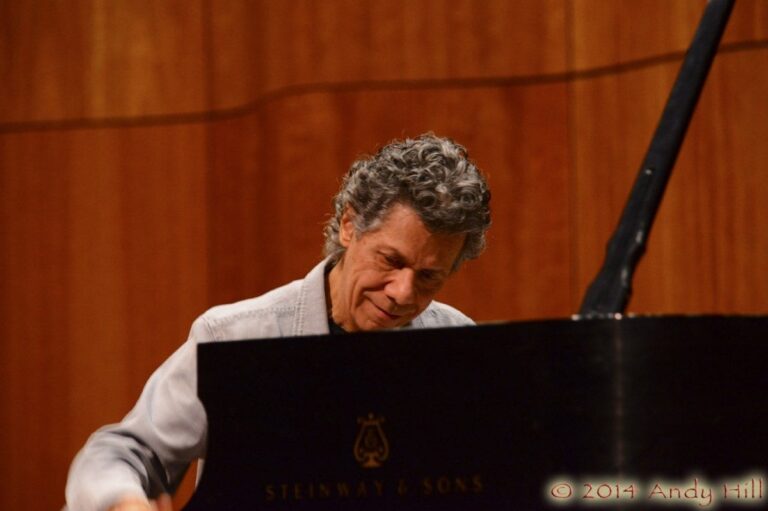
Chick Corea, a legend behind the keys, who fused jazz piano with numerous styles of music, has died. He was an innovator of jazz-rock fusion in the 1970s. Corea died at his home in Tampa, FL on Tuesday at the age of 79.
photo by Andy Hill
Best known for playing acoustic piano, Corea had a crispness to his sound, one that was easily identifiable, regardless of the genre. Whether he played classical, jazz, Latin or funk, Corea broke new ground throughout his career, especially with Return to Forever, his best-known band.
Corea played with Miles Davis and Herbie Hancock, met Stevie Wonder in the early 1970s at The Bitter End in New York City, and recorded an album with banjo virtuoso Bela Fleck, a testament to his dexterity as a musician. Additionally, Chick would use the strings inside the piano as a percussion instrument, influenced from his early years playing drums as a child. Corea also collaborated with Gary Burton, Pat Metheny, Al Di Meola, Christian McBride, a small sampling of an extensive list of musical peers.
photo by Andy Hill
Chick Corea wrote “Spain,” “500 Miles High,” “La Fiesta,” “Armando’s Rhumba” and “Windows,” all of which have become jazz standards. Corea was nominated for 60 Grammy Awards, taking home 23 over the course of his career.
Born Armando Anthony “Chick” Corea on June 12, 1941 in Chelsea, MA, he was introduced to piano by his father, a jazz trumpeter. In high school he performed in New York City, before attending music school at Columbia University and Juilliard, both of which he stayed at for only a short time. Corea remained in NYC to begin his music career.
Corea lived in Cambria Heights, Queens at 114-73 227th Street, and can be found on The Queens Jazz Trail Map, which was created as a part of Flushing Town Hall‘s Queens Jazz Trail Tour.
Corea’s technical facility on the piano was unparalleled and astonishing. He played together with other greats like Cab Calloway, Mongo Santamaria, Willie Bobo, Blue Mitchell, Herbie Mann, and Stan Getz, and he recorded with Donald Byrd and Dizzy Gillespie.
In 1967 he accompanied Sarah Vaughan with Miroslav Vitous and drummer Roy Hanes and in 1968 replaced pianist Herbie Hancock to play in The Miles Davis Band with bassist Ron Carter, saxophonist Wayne Shorter, and drummer Tony Williams — one of the best jazz ensembles of all time. He can be heard on Miles Davis’ iconic album “Bitches Brew.”
He formed Return To Forever and The Elektric Band, two groups that were on the cutting edge of the jazz fusion era that performed some intricate and memorable music. Corea was one of jazz’s great pioneers, helping to establish the synthesizer in fusion jazz. He received the NEA’s Jazz Master endowment in 2006.
https://www.youtube.com/watch?v=-R3RqcVKVB0
The family of Chick Corea shared the following statement on his Facebook page:
It is with great sadness we announce that on February 9th, Chick Corea passed away at the age of 79, from a rare form of cancer which was only discovered very recently.
Throughout his life and career, Chick relished in the freedom and the fun to be had in creating something new, and in playing the games that artists do.
He was a beloved husband, father and grandfather, and a great mentor and friend to so many. Through his body of work and the decades he spent touring the world, he touched and inspired the lives of millions.
Though he would be the first to say that his music said more than words ever could, he nevertheless had this message for all those he knew and loved, and for all those who loved him:
“I want to thank all of those along my journey who have helped keep the music fires burning bright. It is my hope that those who have an inkling to play, write, perform or otherwise, do so. If not for yourself then for the rest of us. It’s not only that the world needs more artists, it’s also just a lot of fun. “And to my amazing musician friends who have been like family to me as long as I’ve known you: It has been a blessing and an honor learning from and playing with all of you. My mission has always been to bring the joy of creating anywhere I could, and to have done so with all the artists that I admire so dearly—this has been the richness of my life.”
Chick’s family will of course appreciate their privacy during this difficult time of loss.
It’s always been my mission to keep the music fires burning bright for myself, my family and friends and people everywhere. It’s the reason why I continue to travel and play. I think it helps bring the quality of the environment up a notch – helps remind us who we really are and that life can be creative and therefore pleasurable.
Singer-songwriter and multi-instrumentalist Janani Shankar is set to release her new single, “I Wanna Know.”
In this track, Shankar speaks about deeply emotional issues such as abandonment, and pays tribute to her late grandmother Viji Shankar who she never met, and her late great grandmother Lakshmi Shankar.
Janani’s “I Wanna Know” touches on personal issues she has faced in her life. Shankar attributes these issues, such as loss and estrangement from close family members, to greed, jealousy, and death.
“I Wanna Know” is written from the perspective of a little girl longing for her family, asking why they left. By the end, the track speaks to a less empathic, more emotional feeling, driven by the accelerated drumbeat.
A singer, multi-instrumentalist and songwriter, Shankar started learning classical Indian vocals and violin at the age of three. Later on she picked up guitar, bass, and keys.
She began gigging in New York at the age of sixteen and went on to play in London, Los Angeles, and other cities around the world. Her style combines the nineties with folk, jazz, and indie influences.
Janani’s songs “Wanderer,” “Forgettable,” and “Get Up” have been played on BBC Radio: The Asian Network. Her most recent single, “The World is on Fire,” has been featured on radio stations and music blogs worldwide.
The track features Gingger Shankar on the double violin, Patrick Adams on trumpet, Mike Frazier (Brooklyn Tabernacle Choir, Escarioka) on drums, Nataliya Zaytseva on keys, Trevor Brown on bass, and Michael “Bull” LoBue on electric guitar.
Janani Shankar released “I Wanna Know” on February 9th, the day her grandmother Viji passed away, in her honor. Visit her on Facebook, Twitter and Instagram.
Jazz musicians from around the world will celebrate Valentine’s Day with Flushing Town Hall’s band leader Carol Sudhalter for a Virtual Jazz Jam.
Even though doors are closed to auditoriums everywhere, Flushing Town Hall will still perform this year with its popular Virtual Jazz Jam: Celebrating the Legacy of Louis Armstrong. Their dynamic online entertainment program FTH At Home! will have Let Love Reignon February 10th 2021 at 7:00PM (EST). Jazz musicians from New York City and around the world will play love songs and funny valentines that embrace the theme.
Flushing Town Hall at Home has been a resilient force in an environment in which live music cannot exist. Each month, musicians come together to play songs reflecting each month’s theme, showing the power of art and music even in this time. The February Jazz Jam will include 15 love songs, and participants are invited to jam or simply watch with their significant other, perhaps share champagne or heart-shaped chocolates as they watch from the comfort of their homes.
Since April 2020, Flushing Town Hall’s monthly Jazz Jam has brought thousands of people together, not only from new york but places such as Germany, Italy, and Australia where viewers watch the beautiful performances in the early hours. The number of viewers has surpassed the capacity of the in-person venue!
Flushing Town Hall’s monthly Jazz Jam is supported by the Louis Armstrong Educational Foundation and has been led by Astoria resident Carol Sudhalter. House band members include incredibly talented musicians such as Joe Vincent Tranchina, Scott Neumann, Joe Vincent Tranchina, and Eric Lemon, who pay tribute to the great Louis Armstrong, performing songs associated with the legendary trumpeter/vocalist each month of the year.
Anyone who wishes to experience the monthly Jazz Jam is welcome to, free of cost, on February 10th, 2021 at 7:00PM EST. The links are here for Zoom and Facebook.
To participate, email education@flushingtownhall.org and identify the three- to four-minute tune you intend to play. Only 15 musicians will be selected on a first-come, first-served basis. Flushing Town Hall’s Jazz Jams are every second Wednesday of each month, and details can be found on the Flushing Town Hall website.
In efforts to rescue the legendary New York jazz club, Birdland, a virtual concert will take place with many celebrity appearances on Jan. 24. This is the final attempt to save the iconic venue.
Photo from Theater Mania
Birdland is named after and inspired by famous Jazz artist Charlie “Yardbird” Parker, opened in 1949. It was located on Broadway and 52nd which was the hotspot for jazz during that time. As inspiration for the club, Parker was the headliner. Several notorious jazz artists performed there, causing 1.4 million people to attend within the first five years of its opening. It attracted the likes of locals and celebrities and continued to do so throughout the years.
The club closed in 1965 and reopened and relocated Uptown to 2745 Broadway in 1986. While Birdland was able to discover about 2,000 rising artists, the Uptown location didn’t last for long. It moved back to Midtown at 315 West 44th St. in 1996. Since it returned to the area it gained even more popularity for the music and the menu.
Although the club is a staple in the jazz world, the pandemic’s restrictions recently took a toll. First, the shut down of indoor dining became a setback and caused them to rely on a concert series called Radio Free Birdland. At first, the series took place in the club but as COVID-19 became more unpredictable, there were more restrictions. Producers Tom D’Angora and Tim Guinee created a GoFundMe that raised over $200,000 in hopes of saving it. The virtual concert “Save Birdland: A Celebration of Music, History, and Community” was created in order to call more attention to the GoFundMe. It will stream on the website “Save Birdland”.
This concert will be a star-studded event with appearances and performances from many celebrities of different backgrounds. Former President Bill Clinton, Michael Broderick, Leslie Odom Jr, Chita Rivera Giancarlo Esposito, and many more are a part of the lineup. With the hopes that “Save Birdland” will bring enough awareness, this is the final effort to save the renowned jazz club.
Charlie Parker (as), Fats Navarro (tp), Bud Powell (p), Curly Russell (b), Art Blakey (d). Birdland New York, June 30, 1950
Universal Preservation Hall will present a live-streamed concert of Misty Blues on February 12 at 8 p.m. This serves as a celebration of their 10th album, None More Blue, and over two decades together.
After the performance of their new album, the band will perform the “Queens of the Blues” soundtrack as a Black History Month celebration. The Queens of the Blues movie shows the lives of four African-American female blues artists: Bessie Smith, Big Mama Thornton, Ruth Brown, and Koko Taylor. All four of these women made an undeniable impact on blues, jazz, and popular music throughout the twentieth century and beyond.
All compositions on None More Blue were written during the pandemic and show the connections the band was able to maintain despite a remote environment. The album release date is February 14.
Misty Blues, led by lead singer/band founder Gina Coleman, was a 2019 International Blues Challenge finalist. The band has performed original and traditional blues with hints of jazz, soul, funk and tent revival gospel since 1999. They have recorded and shared the stage with Charles Neville and opened for contemporary blues artists like Tab Benoit, John Primer, Albert Cummings and Michael Powers. The band recently earned an Independent Blues Music Award nomination for the best contemporary blues song. The band’s original recordings have wide radio airplay in the U.S. and U.K.
Howard Johnson, renowned tuba player, founder of the original Saturday Night Live Band and a musical mainstay of New York’s jazz community for more than half a century, has died at age 79. A muse to Charles Mingus, Gil Evans, and Carla Bley, Johnson was an inspiration to multiple generations of players.
photo by Nancy Olewine
Johnson died at home in New York on Monday, Jan. 11 following a long illness, according to his longtime partner, Nancy Olewine.
An accomplished player, composer, arranger and raconteur, Howard gigged on tuba, baritone saxophone, bass clarinet, flugelhorn, electric bass and pennywhistle. For more than 50 years he was an important fixture in multiple scenes, moving fluidly among genres. In addition to working with a litany of NEA jazz masters including Quincy Jones, Dizzy Gillespie, Gil Evans, Charlie Haden, Carla Bley, Jack DeJohnette, and Randy Weston, Johnson also played with pop and rock icons such as John Lennon, Paul Simon, James Taylor, Carly Simon, Taj Mahal, Levon Helm and scores of others.
Johnson played an important role in forming and shaping the sound of the Saturday Night Live band during the show’s first five years, 1975-1980. Donning an Egyptian headdress or nurses’ uniform in some of the most beloved early sketches featuring Steve Martin and Lily Tomlin, his weekly SNL appearances lent Howard visibility rare for a jazz musician or in-demand sideman.
He appeared in Martin Scorsese’s 1978 documentary The Last Waltz, was featured in a Miller Lite beer commercial in 1984, and made a Sesame Street appearance with James Taylor (in the decades since, it wasn’t uncommon for excited kids to point at Howard and shout “Jelly Man Kelly!”)
Howard would leave SNL, telling musical director Howard Shore that having a too-steady job leads to complacency, resulting in bad music. Musicians in that situation “start defending their turf, they start feeling like they have something to lose, and they keep narrowing and narrowing their perspective. I don’t want to get caught up in stuff like that.” In several interviews, Johnson recalled Shore’s reply: “Well, if you feel that way about it, then you’re the man for the job. Get me a bunch of other troublemakers like you and we’ll have a great band.”
Complacency was never a possibility for Johnson. In fact, from his earliest years in New York, the breadth of his capabilities led some critics and audiences to believe there must be more than one Howard Johnson: It was just too hard to imagine that in an often highly compartmentalized music scene that the same guy could be appearing with the avant-gardist Archie Shepp, hard-swinging drummer Buddy Rich, and sitting in with bluesman B.B. King.
In fact, Johnson crossed paths with legendary guitarist Jimi Hendrix at a B.B. King gig. He and fellow tubist Bob Stewart took their instruments up to Ungano’s [an Upper West Side club] to jam with B.B. King. Just the presence of that much low brass was enough to cause a stir, and right before they went on, Jimi Hendrix arrived with a group of women. The audience was distracted, buzzing and cracking jokes, not knowing what to expect from a couple of tuba players.
Howard and Bob took to the stage, one on either side of B.B., and showed everyone they know their way around the blues. Though there were no mics, they made themselves heard, with power to spare. Afterward, Jimi sought out Howard to congratulate him, saying, “You brothers just did the god-damnedest shit I ever heard! Ain’t nobody laughin’ now!”
Johnson appeared on hundreds of recordings spanning Gato Barbieri, McCoy Tyner, Muddy Waters, Roswell Rudd, Phoebe Snow, David Sanborn and Freddie Hubbard. He backed vocalists as diverse as Ray Charles, Marvin Gaye, Ella Fitzgerald, Yoko Ono and Albert King. Johnson can be heard on many movie soundtracks, especially those of Spike Lee; he spent several years with the NDR Big Band in Hamburg; and released four albums as a leader, including three with his multi-tuba brass choir Gravity.
While he played an arsenal of instruments, the tuba was his greatest love.
photo by Albie Mitchell
A tuba can be thunderous, it can be a rough-and-tumble instrument. People don’t think of it as anything delicate. I never thought there was anything the tuba couldn’t do, and I’ve been pretty satisfied with what I can do with a tuba.
By 2006, when New York Times critic Nate Chinen declared Howard Johnson “the figure most responsible for the tuba’s current status as a full-fledged jazz voice,” the life’s work of the multi- instrumentalist had been in progress for more than four decades. Johnson burned with the fire of bass-clef innovation since well before 1963, when he took an offhand remark from Eric Dolphy as a call to action to move to New York.
As a teen, Howard had discovered that he could push the tuba’s range to previously unheard heights—more than six octaves—surpassing the trombone on the high end and edging into trumpet territory. In a 2000 interview, Johnson noted that he was motivated to excel by a pecking order among high school band members, with those who took private lessons outranking those who learned at school, and the self-taught—like Howard—at the bottom.
When one of the private students asked him how high the tuba could go, “I was very embarrassed that I didn’t know,” he recalled. Thus, he began to experiment, noticing some of the highest notes were “very pretty; they sounded like they had kind of a French horn quality. So I added that new octave to my warm-ups.” He was surprised to discover that none of his bandmates could play anywhere near that high. “At that point, I’d probably been playing about six or eight weeks. I was highly motivated. I didn’t want to look like a fool,” Johnson said. “It was at that point that I decided not to let anybody tell me what the limitations were of the tuba or of the music.”
He was never a novelty act who would occasionally blast notes into the stratosphere to excite an audience. Rather, he played melody lines and solos fluidly and fluently, maintaining tonal integrity and feeling. Though there was no existing repertoire in the early 1960s for his then-groundbreaking low-brass range, once in the Big Apple Johnson caught the ear—and piqued the imagination—of Charles Mingus.
The iconic bassist/composer wrote adventurous parts for him in such a high register that “even trombonists wouldn’t welcome seeing those notes on the page,” Johnson recalled in 2017, for the liner notes of Testimony, his last release fronting his multi-tuba band Gravity.
Johnson became the muse of other composers, including Carla Bley and Gil Evans, establishing relationships lasting decades. Howard almost had a second encounter with Hendrix, in a project with the great Gil Evans, who had made plans to record with Hendrix and told Howard Johnson he wanted him in the studio, too. Unfortunately, Jimi didn’t live long enough to make the gig. But Howard eventually got to have his say on one of Jimi’s greatest tunes, “Voodoo Chile,” on Gil Evans’ recordings, and was also known to play a lovely, tender version of “Little Wing” on pennywhistle.
Tuba players are challenged by the standard Johnson set. He believed the tuba is capable of a virtually unlimited sonic and emotional range, based on a player’s abilities. By demonstrating his skills, Howard single-handedly moved the instrument out of its traditional place in the rhythm sections of large ensembles into featured roles in small bands. Recognizing his impact on the tuba’s changing role in music, in 2008 the instrument-maker Meinl Weston released the HoJo Gravity Series tuba, designed to the player’s specifications.
Johnson influenced musicians by expanding their ideas of the possibilities of the instrument, and demonstrated enormous generosity of spirit, mentoring tuba players, past, present and future. He influenced jazz (and pop) composers and arrangers by bringing a heretofore ignored instrument to the front line of soloists, and changed jazz overall by altering the direction of how jazz used the bass clef—no more oom-pah-pah, but pure linear bop, swing and rock phrasing that could stand on its own against any other “typical” jazz solo instrument.
At a time when jazz-rock fusion was gaining traction, Johnson opened up the music without diluting the tradition, performing with an unwavering jazz sensibility as a founding member of the Saturday Night Live band. His writing, arranging and playing captured the attention and imagination of such pop culture icons as John Lennon, Paul Simon, Levon Helm and Taj Mahal; Johnson never dumbed it down, never resorted to spoon-feeding anyone “Jazz 101” level music. He has always been “The Real Thing,” as Taj Mahal dubbed the 1971 CD that debuted Johnson’s innovative multi-tuba brass choir, Gravity.
Even as he approached his 75th birthday, Johnson declared that he still had the fire in his belly to solo, to increase awareness of the versatility of often-underutilized horns, and to continue to have his say on the definitive way to play them. After the music master no longer made a practice of hoisting the 20-plus pound instrument to his lips—his last gigs were in 2017—he continued to feel he had much to offer as a mentor and advisor.
There’s a wonderful accessibility to Howard Johnson’s artistry. Whether playing a standard from a Broadway show, taking the lead on Hendrix’s “Voodoo Chile” with the Gil Evans Orchestra, or evoking early R&B beats on Don Pullen’s “Big Alice” with Gravity, his music could get under your skin and quicken your steps for days to come.
Howard’s talent, determination, and no-limits viewpoint were irreplaceable ingredients in his recipe for artistic fulfillment and professional success, and his music will continue to inspire for years to come.
Howard Johnson is survived by his longtime life partner, Nancy Olewine; his daughter, musician Nedra Johnson; and two sisters, Teri Nichols and Connie Armstrong. He was predeceased by his son, David Johnson, a musician and artist, in 2011. A memorial service will be held in 2021.
In lieu of flowers or other tributes, it was Howard’s wish that to honor his memory and support his legacy as a master of the bass clef, memorial donations be made to benefit The Howard Johnson Tuba Jazz Program Fund at Penn State.
Jazz at Chautauqua is held periodically and has served as host to numerous jazz legends, including Wynton Marsalis and Jazz at Lincoln Center, among many others. Jazz lovers have flocked to the western-most county of New York State to watch jazz performances on the shores of Chautauqua Lake
At the Chautauqua Institution, a blend of arts programming, educational and religious opportunities and recreational activities are available to those who visit the grounds during the year.
The Institution, originally the Chautauqua Lake Sunday School Assembly, was founded in 1874 as an educational experiment in out-of-school, vacation learning. It was successful and broadened almost immediately beyond courses for Sunday school teachers to include academic subjects, music, art and physical education.
Thanks to Jazz Lives, we feature a selection of performances from 2007, 2008 and 2009 at Chautauqua.
From the informal Thursday-night sessions at Jazz at Chautauqua on September 14, 2007, featuring Duke Heitger (trumpet), Randy Reinhart (cornet), John Sheridan (piano), Pete Siers (drums) and Frank Tate (string bass), and featuring “the Emperor of Chautauqua,” Joe Boughton, who was involved and yet deplored the aimlessness sometimes prevalent at “jam sessions,” which would lead to his strongest aversion — musicians playing over-familiar repertoire. Featuring “Jazz me Blues,” “I’ve Got the World on a String,” “I Found a New Baby,” “A Brief Etude,” and “Just You Just Me.”
On September 21, 2008, festival director Joe Boughton had the idea to recreate the Bechet-Spanier Big Four of Blessed Memory (1940, Hot Record Society: Sidney Bechet, Muggsy Spanier, Carmen Mastren, Wellman Braud) with living Masters Bob Wilber (clarinet and soprano), Jon-Erik Kellso (trumpet), Marty Grosz (guitar) and Vince Giordano (string bass).
Enjoy Fats Waller’s “The Boy in the Boat” and “Squeeze Me” as performed by Bob Wilber (soprano saxophone), Jon-Erik Kellso (trumpet), Marty Grosz (guitar), and Vince Giordano (string bass).
From September 19, 2009, this performance was sparked by Jon-Erik Kellso’s idea of changing the key for every chorus (Jazz Lives believes between C and Eb). Trumpeter Jon is joined by Tom Pletcher (cornet), Bob Havens (trombone), Bob Reitmeier (clarinet), Dan Block (tenor saxophone), Ehud Asherie (piano), Howard Alden (guitar), Vince Giordano (string bass) and Pete Siers (drums).
From the third weekend of Jazz at Chautauqua 2009, here is a segment featured ballad medleys. Performing “Memories of You,” “Stardust,” “Prelude to a Kiss,” “Old Folks,” and “If I Had You” are Duke Heitger (trumpet), Andy Schumm (cornet), Dan Barrett (trombone), Scott Robinson (tenor saxophone), Bob Reitmeier (clarinet), Ehud Asherie (piano), Marty Grosz (guitar), Frank Tate (string bass) and Pete Siers (drums).
From September 17, 2009, a Thursday-night informal session at Jazz at Chautauqua, watch Jon-Erik Kellso (trumpet) Scott Robinson (tenor saxophone), Ehud Asherie (piano), Andy Brown (guitar) and Arnie Kinsella (drums) perform “Runnin’ Wild.”
Flushing Town Hall announced it’s jazz inspired “Martin Luther King, Jr. Celebration.” The performance will be a live virtual performance led by band leader Carol Sudhalter on January 13, 2021.
The performance will be part of their Jazz Jams series hosted by Flushing Town Hall. The series premieres monthly and features artists from across the globe. Jazz musicians come together to play their tunes reflecting each month’s theme. This month’s theme is Martin Luther King, Jr. Celebration. The performance will take place on Wednesday, January 13, 2021 at 7PM EST and will feature jazz musicians from New York City and across the world will play tunes reflecting the pursuit of racial justice in honor of Martin Luther King, Jr.
Dr. Martin Luther King Jr.’s deep appreciation of music as an “instrument of change” is one of the main inspirations for it being the muse of January’s Jazz Jams. As The International Musician once noted that Dr. Martin Luther King Jr considered jazz to be “triumphant music” and had once written that, “Jazz speaks for life. The blues tell the story of life’s difficulties, and if you think for a moment, you will realize that they take the hardest realities of life and put them into music, only to come out with some new hope or sense of triumph.”
The interesting thing about the Jazz Jams programming is that Flushing Town Hall opens it up to the public for performance slots. Musicians interested in participating on January 13, 2021 should email education@flushingtownhall.org with their suggested three- to four-minute tune they intend to play. The performance can be live or a pre-recorded audio or video (but not a professional, edited recording such as a CD or YouTube video). Musicians who previously performed are now welcome to return. Each month, up to five returning musicians and up to 15 new musicians can participate. Selection is on a first-come, first-served basis.
The performance will be free to the public and available to watch live on Flushing Town Hall’s Facebook or Zoom.