Brooklyn-based electronic dream-pop duo Corbu has released their Lost & Found EP. The EP reimagines the title track with five new remixes, along with the original version.
Corbu, comprised of Amanda Corbu and Jonathan Graves, focuses on bringing an ethereal, even other-worldly sound to their psychedelic and ambient pop tracks. They have previously toured with Bloc Party, performed with Goldfrapp and played both Austin City Limits and Electric Forest festivals. Last year, Corfu released their debut album Crayon Soul, featuring mixing by Tame Impala and MGMT collaborator Dave Friedman.
[Corbu is] trying to lure their audience deeper into their own subconscious while giving them something to sing along to.
Corbu
On the original single version of “Lost & Found”, Corbu collaborated with Doves frontman Jimi Goodwin. Goodwin produced the track and added reggae and electronic flares, creating a laid-back yet energized soundscape.
The EP features “Lost & Found” redone five times over and explores new genres and sounds. On the “Seaside Version”, the track goes vintage and utilizes upbeat 80s synth to create a sound that could easily fit into an episode of Stranger Things. On the “JKriv Remix”, Brooklyn DJ JKriv remixed the track to fit a more booming club sound evocative of traditional house music and drum loops. The EP as a whole is perfect for the summertime.
The trappings of inner-city life are evident in many of those who have had to experience it. To the end that growing up in or near a housing project can lead to many tumultuous situations. The terrain of public housing is a breeding ground for congregation. Factor in the extreme poverty, and public housing projects have become hubs for all kinds of illegal drug and gang activities.
Stack Bundles (left) and Max B (right)
It doesn’t take much to falter in those conditions and for some, making it out without succumbing to the influences of the streets can feel like walking in quicksand. With that in mind, when someone has a chance to escape the repetitive cycle of implodement, there are contrasting feelings and behaviors from peers. Some live vicariously through the impending defect-ee, while it breeds contempt within others.
Such was the case for up-and-coming rap star, Stack Bundles. Hailing from Redfern Houses in Far Rockaway, Queens, one of the most dangerous housing projects in New York, where death had become the norm, according to the New York Times.
Mourning the murdered has become a familiar routine at the Redfern Houses in Far Rockaway, Queens. First there are the makeshift memorials, with flowers and candles and a smattering of personal items. Then, the dead often get more permanent epitaphs scrawled on the walls of the apartment house they called home.
Who Was Stack Bundles?
Jim Jones (left) and Stack Bundled (right)
Born Rayquon Elliott, the slain rapper had made a name for himself with his “compelling raps, magnetic personality, and unique fashion sense.” Which gave him the attention of Dipset general, Jim Jones. Along came ByrdGang (Jones’ crew) affiliation and a prominent feature on Jim Jones’ “Weatherman,” with Lil Wayne.
The record’s success meant Stack Bundles had enough gravitas to go on tour with Lil Wayne, where he began to cultivate relationships with Wayne and other important figures in the music industry. Moreover, he already had strong ties with Jones, Wayne, DJ Clue, Lupe Fiasco and Funk Flex, amongst others. It seemed as though a record deal and a major-label debut was inevitable.
Unfortunately, not every rags-to-riches tale comes to fruition and on June 11, 2007, a 24-year-old Stack Bundles was fatally shot as he was heading into his apartment building in the morning’s wee hours. In detail, Stack spent the night out with friends at a Manhattan nightclub, he was approached by an unknown number of assailants and shot in his head and neck as he entered his building, according to relatives and acquaintances.
Per routine, Stack’s friends and family celebrated his life with a small memorial outside of his building, with candles, copies of his CD’s and a White Castle bag from the fatal night he killed.
All in all, Stack Bundles is a Far Rockaway legend. However, his legend serves as a harrowing reminder that no matter how close one is to making it out, the drawbacks of the inner-city wait for no one.
Central New York-based band Harmonic Dirt is back with their newest album, Rhode Island Street, released earlier this year.
Husband and wife team Mike Gridley and Susan Coleman first established Harmonic Dirt back in 2016. Both songwriters, Gridley created instrumental tracks while Coleman took to writing lyrics. Their debut album, Anthracite, was released in 2018. Live at the Ridge was released in 2020 and won the Syracuse Area Music Award (SAMMY) for best Americana Recording.
Since Anthracite, Gridley (lead vocals, guitar, mandolin) and Coleman (bass) have joined forces with a fuller band, composed of close friend Taylor Bucci on banjo and vocal harmonies and James DaRin on percussion. Rhode Island Street contains 9 original tracks and marks Harmonic Dirt’s first release as an official quartet.
Photo from Harmonic Dirt’s website
The album was recorded at Greywood Studio in Jamesville, NY and features some special musical guests (Bob Gaus, Joe Plessas, Tami Schutt, Scott Ebner and Ericka Longo). The bluesy, Americana sound that Harmonic Dirt has come to play so well stands strong on Rhode Island Street, but there is even more cohesion and jam-band-like qualities present in the instrumentation.
Each track, while unique, showcases the steely guitar, banjo chirps and powerful vocal harmonies that have become signature for the band. The title track, “Rhode Island Street”, tells the imagery-laden story of a house burning down on–you guessed it–Rhode Island Street. This visual is even pictured on the album artwork, giving listeners a clear face to the lyrics as they enjoy this track’s laid-back instrumentation.
It is undeniable that these tracks will be incredibly fun to hear as Harmonic Dirt continues to play live shows and tour the album. Though some tracks are softer and more emotional (“Rhode Island Street”, “Grief Is A Canyon”, “Ashes”), others bring a danceable energy (“Comfort Me”, “Catch Me”, “What Did You Take?”). There is something for everyone and for every mood on Rhode Island Street, especially for fans of 60s and 70s Americana with a bluesy punch.
You can learn more about Harmonic Dirt on their website and connect with the band on Facebook, Twitter and Instagram. Rhode Island Street is available for purchase and streaming now and you can listen below!
In continuation of NYS Music’s series celebrating the Harlem Renaissance in its centennial years, it is important to highlight the Cotton Club which was instrumental in displaying Black talent.
Before it was the Cotton Club, the venue was owned by the first Black heavyweight boxing champion, Jack Johnson. It was called the Club Deluxe, a nightclub with 400 seats in 1920. It was located in the core part of Harlem, at 142nd Street and Lenox Avenue. About two years later in 1922, Owen “Owney” Madden, a leading figure of the underworld, purchased the venue while doing time in Sing Sing Prison. Under his leadership, the Cotton Club developed and expanded into a venue with 700 seats. The venue gained fame through radio broadcasts on a national level.
The Cotton Club was founded during the prohibition era, a time when selling alcohol was illegal. Madden used the club to sell his beer despite the restrictions. The club temporarily closed in 1925 due to the illegal sales but quickly reopened with no issues. After the reopening, a man named Herman Stark took over.
Black Performers for White Audience
In alignment with the time period, Cotton Club was a whites-only establishment, however, the performers and staff were Black. The Black staff members weren’t allowed to mingle with the all white-audience. The girls in the chorus were required to be tan or of a light complexion, tall, and under 21 years old and presented in scantily clad and revealing attire. The requirements for the male performers were less restricting and their skin tones were more diverse. After finishing the shows, the performers convened in the basement in the building next to the club.
Overall the Cotton Club reproduced stereotypical imagery of Black people which dehumanized them. Oftentimes the performers were portrayed as savages in the jungle or with themes of being on a plantation. While the conditions of their work was compromising and not ideal, the high profile clientele that they attracted resulted in high wages.
The venue’s theme of a white audience consuming Black talent, launched the careers of many legendary Black musicians. In 1927, famous jazz composer and bandleader, Duke Ellington, took the Cotton Club to another level. Ellington’s band became the house band, and they were expected to produce “jungle music”. His first revue was titled “Rhythmania” and featured jazz singer, Adelaide Hall, who also recorded several songs with Ellington during that time; including their hit “Creole Love Call”. During his time at the Cotton Club, he recorded over 100 compositions and experimented with creating arrangements. Just like radio broadcasts helped the venue gain attention, it did the same for Ellington and his work.
In 1931, jazz singer and bandleader Cab Calloway’s orchestra replaced Ellington’s as the house band. They began with their Brown Sugar revue and continued to make more contributions to the Cotton Club’s success. In 1933, Lena Horne began her professional career as a chorus girl and was a part of the Cotton Club Parade. Many other musicians have found success and have grown at the Cotton Club including Louis Armstrong, Dorothy Dandridge,Sammy Davis Jr., The Nicholas Brothers, Ethel Waters and more. Jimmie Lunceford’s band replaced Calloway’s in 1934, which was the same year of the highest grossing show at the Cotton Club, called “The Cotton Club Parade 1934.”
From Harlem to Broadway and Beyond
Due to race riots, the venue closed in 1936 and the location changed when it reopened. There were complaints and threats of boycotting because of the segregation that was upheld there. When the Cotton Club reopened, the newer site was in the Broadway Theatre District, specifically at Broadway and 48th St. In the same year, Calloway returned for the opening night and headed a roster of over 100 performers. Stark paid tap dancer Bill “Bojangles’ ‘ Robinson $3500 a week which was the highest amount that a Black performer was paid on Broadway and the highest any nightclub performer had been paid.
The Cotton Club closed indefinitely in 1940 from issues spanning from rises in rent and investigations looking into tax evasion from nightclub owners. Since its closing, variations of the site have opened around the country including Las Vegas, Chicago, California and more. According to Harlem World Magazine, in the late 1970s, a new Cotton Club opened in Harlem on 125th Street. The name is the same and it also revolved around jazz, however it was not made in affiliation with the original.
Bardavon Presents has announced it will reopen this August after being closed for 14 months during the COVID-19 pandemic. Four new shows will join a number of previously scheduled performances postponed and rescheduled in 2020. More shows and available sales will be announced in the coming weeks.
Erected in 1868 by British immigrant James Collingwood, the Collingwood Opera House featured a plethora of various performances throughout the 19th and 20th centuries. In 1923, the opera house became known as The Bardavon. Since then, the building continues to serve as a focal point for the performing arts, evolving and thriving throughout the years.
Upcoming Shows For Reopening
The following four shows will go on sale to Bardavon members on Tuesday, June 8 at 11am, and to the general public on Friday, June 11 at 11am:
Trombone Shorty & Orleans Avenue – Sunday, August 22 at 7pm at UPAC: Multi-instrumentalist Troy “Trombone Shorty” Andrews brings his R&B, rock, rap, and funk brass band to UPAC for the very first time. Tickets start at $50.
Dispatch (Acoustic) – Saturday, September 25 at 8pm at Bardavon: One of the country’s most successful indie/roots bands, Dispatch, brings its politically progressive acoustic rock to the Bardavon for an intimate show. Tickets start at $45.
David Sedaris – Saturday, October 16 at 8pm at Bardavon: Sedaris returns to the Bardavon to read stories spanning his remarkable career followed by a Q&A and book signing. All Tickets $49.
Words & Music: An intimate evening with Patti Smith – Saturday, November 13 at 8pm at UPAC: Pioneering artist and punk icon Patti Smith performs a set of original spoken-word stories from her life, interspersed with songs, and will take questions from the audience. Tickets start at $49.
The four shows above join the following performances postponed in 2020 that are on sale now at Bardavon.org
Brit Floyd Aug 29 at UPAC Frankie Valli & the Four Seasons Oct 24 at UPAC Mavericks Dec 18 at UPAC Celtic Woman March 20 at UPAC Stomp May 26 at UPAC
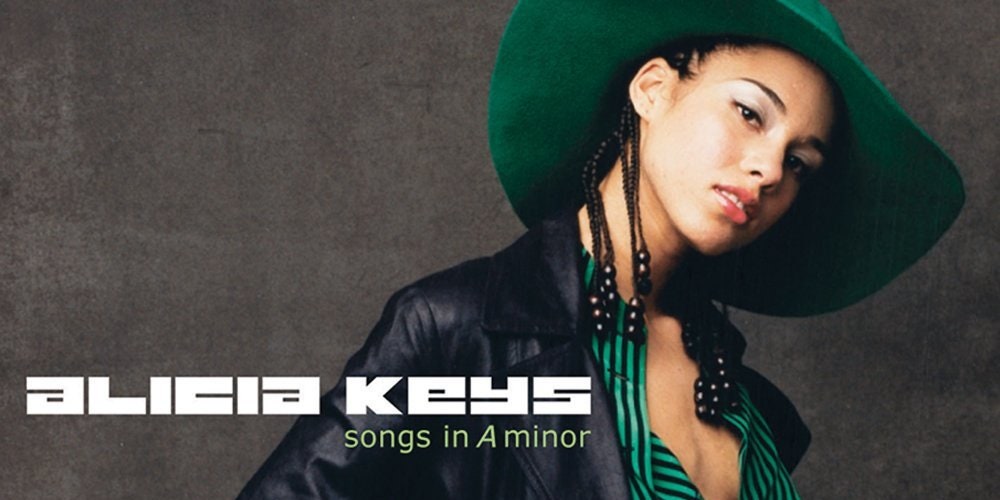
On this day in 2001, Alicia Keys released her debut album, Songs in A Minor. Bolstered by the success of lead single “Fallin’,” it became an instant neo-soul classic and propelled Keys to R&B superstardom.
After the past half-decade defined by image-based teen pop acts such as Britney Spears and the Backstreet Boys, 20-year-old Alicia Keys carved out a space on the charts once more for scaled-back production and soulful vocals. Discovered by Clive Davis, Keys melded her classical piano background with modern hip hop beats. The gospel-influenced lead single “Fallin’” did it best: built on a simple two-chord riff, it feels timeless while foreshadowing the decade’s future in R&B. Keys has since surpassed the success of “Fallin’” with 2007’s “No One,” but her debut single remains her best.
Other highlights on Songs in A Minor include follow-up singles “A Woman’s Worth” and “Girlfriend.” Despite the album’s title, only one song here is written in the key of A minor: the Kandi Burruss-produced “Jane Doe.” That said, if the A is to stand for Alicia, Songs in A Minor delivers on its promise and more. From the Moonlight Sonata-interpolating opener “Piano & I,” it’s a moody young adult record that shares more in common with Jill Scott and Mary J. Blige than Keys’ same-age peers in Destiny’s Child.
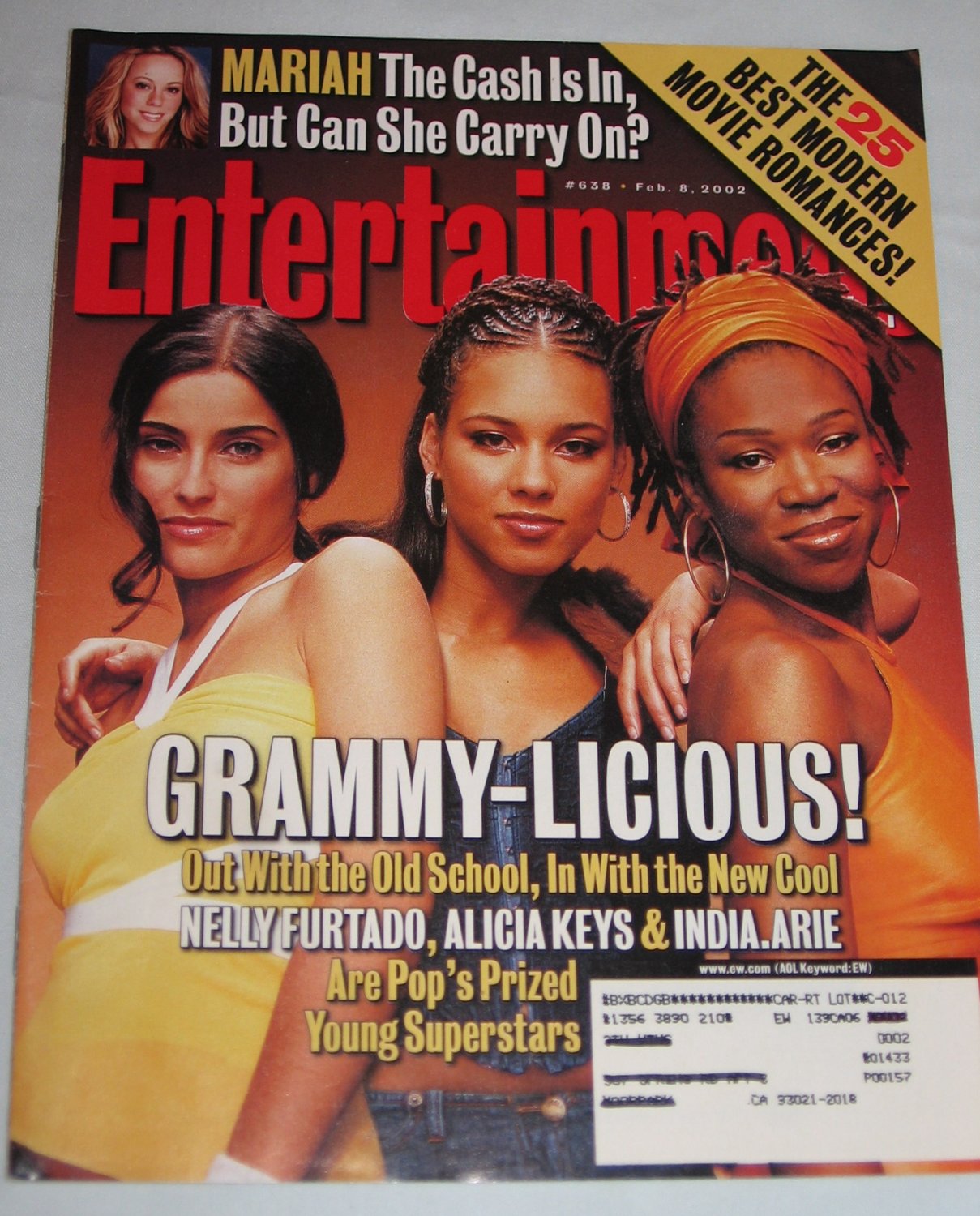
Songs in A Minor went on to be a major commercial and critical success. It debuted at #1 on the Billboard 200 albums chart, and nearly doubled its sales in the second week. Taking home five awards at the 2001 Grammys, including Best New Artist and Song of the Year, Keys became the second female solo artist to win that many in a single night after Lauryn Hill in 1999. As the initial wave of Max Martin-produced pop acts fell out of favor, she ushered in a new era of female singer-songwriters like Norah Jones, Nelly Furtado and India.Arie, blending pop with jazz, folk and soul and emphasizing talent first and foremost.
Nelly Furtado, Alicia Keys and India.Arie covering a 2002 issue of Entertainment Weekly.
Keys went on to release her arguably better sophomore effort, The Diary of Alicia Keys, in 2004, and eventually scored more hits with “No One,” “Girl On Fire,” and Jay-Z’s “Empire State of Mind.” But still, “Fallin’” and Songs in A Minor remain her signature song and album.
In honor of the album’s 20th anniversary, an expanded edition of Songs in A Minor is available for streaming. It includes four previously unreleased songs, one being a new version of “Fallin’.”
The East Village of Manhattan has been home to immigrants, the working class, Beatniks, hippies and artists over the last 300 years. Originally home to the Lenape tribe before the arrival of Europeans, the East Village today is comprised of Alphabet City (the setting for the musical RENT), Ukrainian Village and the Bowery (home to CBGB). In the early to mid-20th century, it would be home to Jewish gangsters and Dixieland jazz at the famed Stuyvesant Casino.
The name Stuyvesant has roots in America dating back to the 17th century, with the arrival of the Dutch in New York Harbor in 1624. Peter Stuyvesant would serve as Governor in Chief of Amsterdam in New Netherland, later named New York after surrendering the city to the British in 1664.
While he was effective with trade in New Amsterdam and created a sense of law and order for a diverse colony, Stuyvesant was intolerant of full religious freedom in the colony. In 1657 he refused to allow Lutherans the right to organize a church, and later refused to allow the permanent settlement of Jewish refugees from Dutch Brazil in New Amsterdam, joining Jewish traders already there.
Ultimately, directors of the Dutch West India Company needed to pressure Stuyvesant to allow Jewish immigrants to stay in the colony as long as their community was self-supporting. Still, Stuyvesant and the company would not allow them to build a synagogue, leading them to worship at a private house instead.
The name Stuyvesant would end up having a negative connotation, as he did few favors in his life to gain support of those he was placed in charge of. Upon turning over New Amsterdam to Britain after no one would defend the city, his name was tarnished. He would eventually settle on a farm, a bouwerie, until his death in 1672.
Two and a half centuries later, the name Stuyvesant would be fading as a surname, but was the given name of an East Village casino with a rich 20th century history.
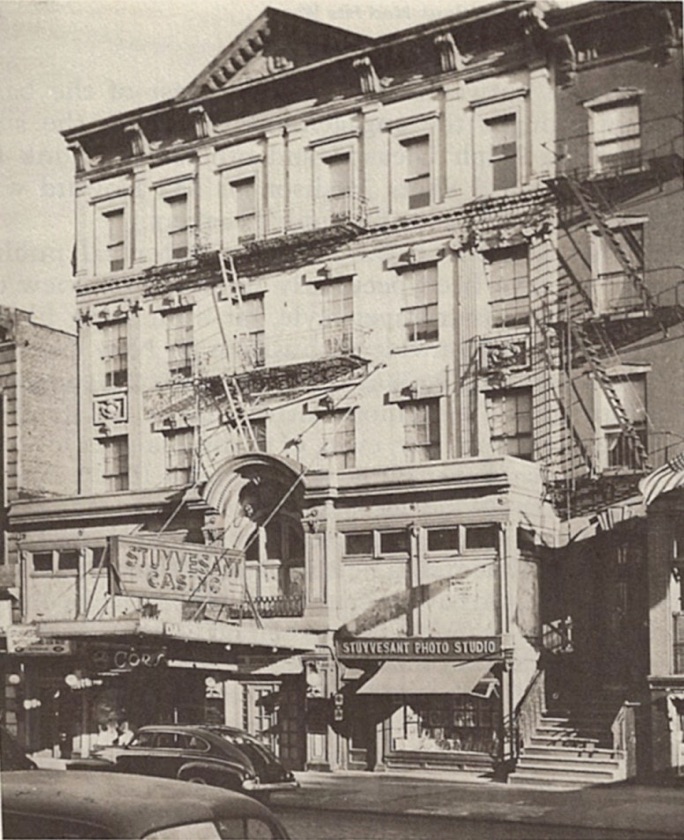
140-142 Second Avenue are indicated by the red arrow, and 138 Second Avenue is indicated by the orange one. Image via VillagePreservation.org
The Bowery attracted Irish and German immigrants starting in the 1850s, Poles and Ukrainians arrived in the 1880s, and by the early 1900s, Italians and Eastern European Jews arrived.
Originally a German YMCA beginning in 1881, the building was a pair of late federal-style houses, dating back to around 1830 when the area was known as “Little Germany.” The building stayed intact and in its original form, with sloped peaked roofs and dormers at the top, meaning the YMCA had not changed much of the exterior, and perhaps the interior as well.
Around the late 1800s, this area of Manhattan’s Lower East Side became the center of Jewish life in America. Crowded and culturally vibrant, a rise in crime would lead to gangs forming by the end of the century. Second Avenue was a main road, bustling with theaters, cafes, nickelodeons, bars, and vaudeville houses, making the region a draw beyond its residents.
Stuyvesant Casino
In 1910, Stuyvesant Casino opened at 140-142 2nd Avenue, owned and operated by Gerson Schmidt, an Eastern Europe immigrant from Galicia (now located in Ukraine). This stretch of 2nd Avenue encompassed part of Stuyvesant’s farm, and thus the name was given to the business.
The Stuyvesant Casino offered sumptous food, dazzling decor, and a first-class house band. High rollers and hitmen were among the clientele, particularly Big Jack Zelig, head of the Eastman Gang after the death of “Kid Twist” Max Zwerbach, in 1908.
Big Jack Zelig
During a party on December 2, 1911, Zelig lured a drunk “Julie” Morrello, an Italian gangster called “one of the most notorious gun and knife fighters on the east side, to Stuyvesant Casino. Around 1am, the lights went out and four shots rang out. As the lights flickered on moments later, Morrello was lying prone on the dance floor, filled with bullets.
In post-World War I New York City, Stuyvesant Casino would be a notorious hangout for Jewish gangsters, but by World War II, the venue became known for music producing the hits.
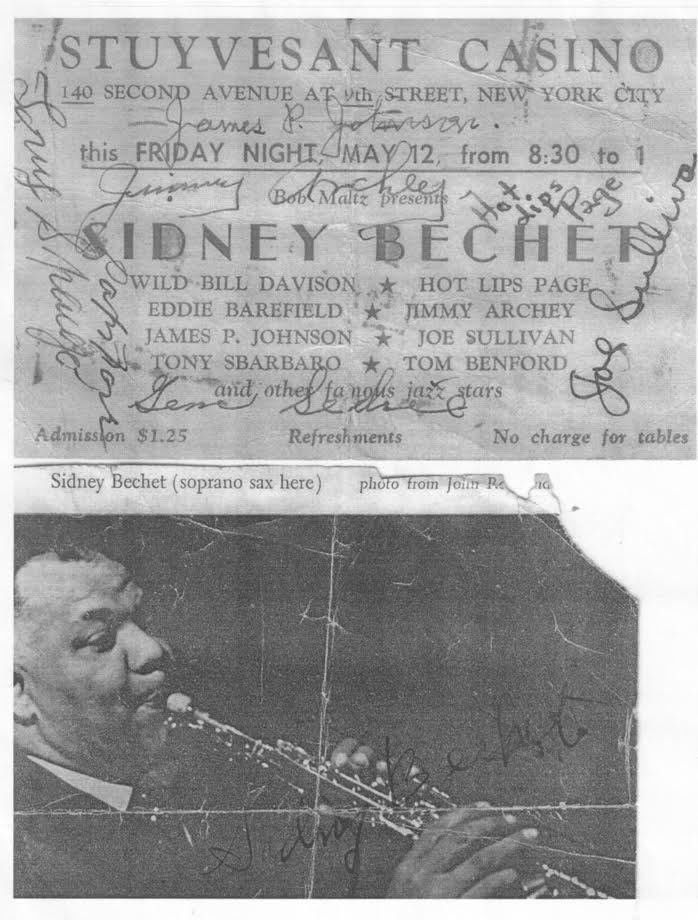
In the 1940s and into the 1950s, Stuyvesant Casino became a popular destination thanks to the arrival of New Orleans and Dixieland jazz artists. Big names such as Sidney Bechet, Wild Bill Davison, Rex Stewart, James P. Johnson, Georgie Lewis, Joe Sullivan, the great Bunk Johnson, and the Conrad Janis Tailgate Jazz Band could be heard for the low cost of $1.25.
Owner Gerson Schmidt was at one point encouraged by the Stuyvesant’s head waiter to allow a band consisting of his three sons to perform at the Casino. The three Perelmuth Brothers – Pinchas (violin/vocals), Michoyl (piano) and Sender (bass) – were a hit, leading to partygoer and movie theater impresario Samuel Lionel “Roxie” Rothafel, to discover Pinchas’ voice and recognize his potential. When Roxie asked why he was only singing in a “mere catering hall,” Perelmuth responded, “I would love to be an opera singer, but don’t have the money for a vocal coach.”
Opera legend Jan Peerce got his start at Stuyvesant Casino as a child
Roxie would take Pinchas under his wing and helped him get his break, helping him study voice and making his name among the opera elite of New York City. Perelmuth would make his debut at the Metropolitan Opera in 1933, under a new name, Jan Peerce. He would make his Broadway debut in 1971 in Fiddler on the Roof, a far distance for the son of Russian immigrants to travel from the Lower East Side.
As noted in the book The Jews of Capitol Hill, Gerson had a son, Mordechai, who married Myra Bank, the daughter of Galician immigrants. The two would have a son, Lawrence Jack Smith, a Democrat from Florida who served five terms in the House of Representatives from 1983-1993. Smith, whose parents ran catering establishments in the New York kosher catering scene, would work for their business and at Stuyvesant Casino from an early age.
When the Dixieland jazz made its way north, Gerson’s Stuyvesant Casino was the natural stop for an eclectic melting pot of music. Saxophone great Steve Lacy hung around the Casino as a teenager was exposed to early Dixieland Jazz greats, some of whom he would join there on a regular basis, including Henry Red Allen, Pee Wee Russell, Buck Clayton, and his teacher, Cecil Scott.
New Orleans bandleader Bunk Johnson would frequently perform at Stuyvesant Casino, occasionally joined by Louisiana-born bluesman Huddie “Leadbelly” Ledbetter, who lived on nearby East 10th Street. Trumpeter Hot Lips Page recorded a version of the 1924 classic “When My Sugar Walks Down the Street” at the Casino, and would later open rival venue Birdland with Charlie Parker, who lived nearby on Avenue B, in 1949.
Portrait of Bunk Johnson, Leadbelly, George Lewis, and Alcide Pavageau, Stuyvesant Casino, New York, N.Y., ca. June 1946
Robert Thompson, a Dixieland drummer known for his group The Red Onion Jazz Band, recalled Bob Maltz as an organizer of jam sessions at Stuyvesant Casino that attracted well paid world class musicians. The Red Onion Jazz Band served as legendary Dixieland revivalists, borrowing the name from Clarence Williams’ traditional New Orleans supergroup Red Onion Jazz Babies, which included Sidney Bechet and Louis Armstrong playing together for the first time in studio.
via Jazz Lives
The Red Onion Jazz Band would perform into the 1960s, just as folk music made its way through Greenwich Village. In the Traditionwould bring together folk musicians by way of Dave Van Ronk and his Prestige label, along with jazz musicians for a unique album. Vocalist Natalie Lamb would perform with The Red Onion Jazz Band and in 1972, married Thompson. A few years later, the group’s long-time trombonist, Dick Dreiwitz and his wife Barbara – a Hunter College alumnus who switched from French horn to tuba so she could play Dixieland jazz – would welcome a son, Dave. Now the bassist for Ween and Joe Russo’s Almost Dead, Dave Dreiwitz continues a tradition forged in the East Village confines of Stuyvesant Casino. The Red Onion Jazz Band would continue to perform until Thompson’s death in 2010.
From: A Pictural History of Jazz by Keepnews and Brauer. L to R, Buster Bailey, Vic Dickenson,Wilbur deParis, Omer Simeon, Hot Lips Page, Rex Stewart.
A first hand account of Stuyvesant Casino from Mr. Madison Arnold, as shared with Jazz Lives:
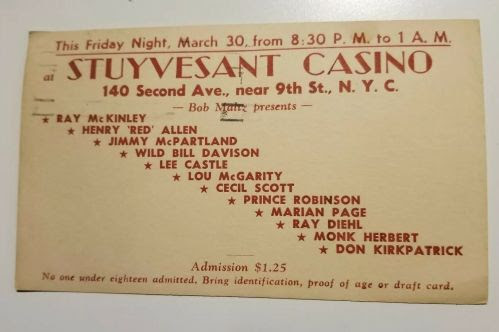
I was one of the steady jazz loving week-end customers at the Central Plaza and Stuyvesant Casino from around 1950 to 1952 and got these post cards weekly. This is the only one I kept. I started when I was still in Erasmus Hall H.S. (they didn’t card in those days). My favorites were Bechet & Wild Bill but I loved them all. Among my memories: I helped Pops Foster put his bass in a cab one night and we went to the Riviera on Sheridan Sq., Red Allen pulled me up on stage once and we sang “The Saints Go Marching In” together. I became friendly with Baby Dodds and invited him over for dinner one evening to our apartment in Brooklyn. I also visited his place in Harlem. I have a Xmas card he sent me, written, I think, by his lady friend as I don’t think he could write. My personal Louis Armstrong stories are even better! (at least to me). He was a wonderful guy.
Mr. Madison Arnold
An autographed show promo from Stuyvesant Casino
By the mid-1950s, due in part to restrictive immigration laws and a rise in crime and building abandonment, Stuyvesant Casino would close its doors. A home for Eastern European refugees since the late 1800s, new immigrants from Poland and Ukraine headed to the East Village for an escape from communism in the mid-20th century, in addition to Puerto Ricans who had U.S. citizenship.
Stuyvesant Casino also contained the Ukrainian National Home, a community center that opened in 1958, an effect of the change in neighborhood demographics. Offering cultural and social services to the East Village’s Ukrainian population, an area now known as Ukrainian Village, the “Ukie Nat” hosted a diverse array of artists in the 1980s including Elvis Costello, New Order, and the Misfits, as well as balalaika music filling the Ukrainian Home Restaurant.
New Order would perform their first American show at Ukrainian National Home, testing out new material that built off Joy Division’s sound. During the 80s post-punk era, synth-based freestyle and electro could be heard at downtown clubs – a melding of white, Latino and Black artists who were mixing in the same area where punk rock inspired New Order’s early sounds.
Looking back on Stuyvesant Casino’s heyday, jazz music from beyond New York would find a home in this region of the city that so many others had sought refuge in for centuries prior. Home to Germans, Jews, African-Americans, Ukrainians and many more, the area at 140-142 Second Avenue has been a bustling center of cultural diffusion and artistic growth for nearly two centuries, and continues to be so today. The original Stuyvesant Casino building burned down in 1985.
In January 2023, Ev Grieve shared news that during renovations at 132 Second Ave, a flyer for Stuyvesant Casino was found on a pole, decaying but clearly showing an event on a Saturday night.
photo by Kevin Goodman
As we close out this look at Stuyvesant Casino, listen to a WMGM broadcast from Friday, March 14, 1952, via Jazz Lives, featuring Master of Ceremonies Aime Gauvin, joined by Jimmy McPartland (cornet), Ziggy Elmer (trombone), Bud Freeman (tenor saxophone), Bob Wilber (clarinet), Kenny Kersey (piano) and Don Lamond/George Wettling (drums). They perform a medley including “Saints, “Lady Be Good,” “Coquette,” and “The World is Waiting for the Sunrise.”
Pencildive, an indie rock band that has been aptly described by fans as “a post-punk visual nightmare” is gearing up to release their debut full-length record, Grown-Ups, out May 28th via Albany startup, Paintbox Records.
Pencildive is a name that may ring familiar to Capital Region music fans. The band has been active since 2018, releasing their debut EP When I Go Outside, in 2019, which was recently reissued by Paintbox Records this past April. Pencildive released a short video to accompany the release of their song “Cricket Man,” which was awarded an Eddies nomination for the best music video category in 2019.
Gina De Nardo, the songwriter of the group, graces the mic with her haunting vocals and a lyrical focus centered around losing love, sleepless nights, and the overall human condition, all composed into the group’s wild, electric arrangements in an eclectic frenzy of gloomy post-punk.
Since the first EP we’ve all become more comfortable with the recording and production process which I think shows in Grown-Ups. Creating a full-length also gave more of an opportunity to tell a story through the songs and explore sounds more conceptually.
Gina De Nardo on the Grown-Ups recording process
Grown-Ups was written by De Nardo over the course of a decade, the first full-length album the Upstate rocker has written on her own and that sense of growth is felt throughout the entirety of the project. Grown-Ups was safely recorded in October 2020 in a cabin in the Adirondacks. The ten-track album features strings, noise improvisations, and haunting cries from the insides of a vintage Leslie speaker.
Born Leonard Albert Kravitz, the multi-faceted artist from New York City, celebrates his 57th birthday today. Known for his contributions to the world of music and acting, birthday boy Lenny Kravitz is known for his flashy style that translates into all areas of his creative endeavors.
Born of bi-racial parents, actress Roxie Roker (The Jeffersons), and television producer Sy Kravitz, Lenny experienced several racial barriers at the start of his career. Often being told that his music was neither black or white enough to appeal to labels’ audiences, Kravitz took the initiative to put out his debut record, Let Love Rule, on his own. While his debut release only reached moderate success in the states, Kravitz used the momentum to land him the position of audio producer for the hit Madona single “Justify My Love” in 1990.
His contributions to the world of record production combined with his 1991 hit ” It Ain’t Over ’til its Over” skyrocketed Kravitz to fame. Throughout his musical discography, Kravitz has shown his ability to blend influences ranging from blues, jazz, contemporary R&B and psychedelia. While collaborating with artists such as Steven Tyler of Aerosmith and even Jay-Z, Kravitz has well proved that his music transcends racial barriers and appeals to audiences of various backgrounds.
Kravitz has several awards under his belt. He is the winner of two Grammy Awards for ‘Best Male Rock Vocal Performance,’ back to back for “Fly Away” and cover of The Guess Who’s “American Woman,” in 1999 and 2000, respectively. You may remember Kravitz stunning performance at the Pepsi Super Bowl XLIX Halftime Show alongside Katy Perry during which he performed a handful of hits. Also making a name for himself in the world of cinema, Kravitz has most recently featured in the Hunger Games trilogy playing the role of Cinna, a luxurious fashion designer. Ironically enough, Kravitz also is the founder of Kravitz Design which focuses on residential and commercial creative direction and design working with clients such as Swarovski Crystal.
Kravitz keeps his home close to heart. Known for spontaneously busking on the surrounding streets of Manhattan and shooting several of his music videos in Times Square, Kravitz is certainly a celebrated New Yorker.
Trevor George Smith Jr., better known by his stage name, Busta Rhymes, celebrates his 49th birthday today.
Born in Brooklyn in 1972, Busta Rhymes later moved with his family to Uniondale, Long Island where he and fellow MCs’ Charlie Brown, Dinco D, and others formed the hip hop group Leaders of The New School who released their first album, A Future Without a Past, in 1991.
It wasn’t until 1995 when Busta’s solo career kicked off. With the release of his debut album, The Coming in 1996 which was highly praised by the hip hop community at the time. Lead singles such as “Woo Hah!! Got You all in Check” ( which was later remixed featuring Ol’ Dirty Bastard) brought Busta Rhymes into the public eye, securing a #8 spot on the Billboard Hot 100.
Busta’s work carried into the 21st century, collaborating with famed hip hop producer Dr. Dre on his fifth studio album Genesis released in 2001. Instead of making a quiet exit from the scene like other MCs from the golden era of hip hop, Busta stayed relevant by continuing to work and collaborate with trending artists of the 2000s.
Continuing to keep the music interesting in 2020, Busta Rhymes delivered his 9th studio album Extinction Level Event 2: The Wrath of God which featured the single “Look Over Your Shoulders’ ft. Kendrick Lamar. For hip hop enthusiasts, “Look Over Your Shoulders” might be the perfect balance of old-school meeting new-school, and it never sounded so good.
2021 marks the 25th anniversary of Busta Rhymes’s debut full-length album, The Coming, which recently received a deluxe reissue.