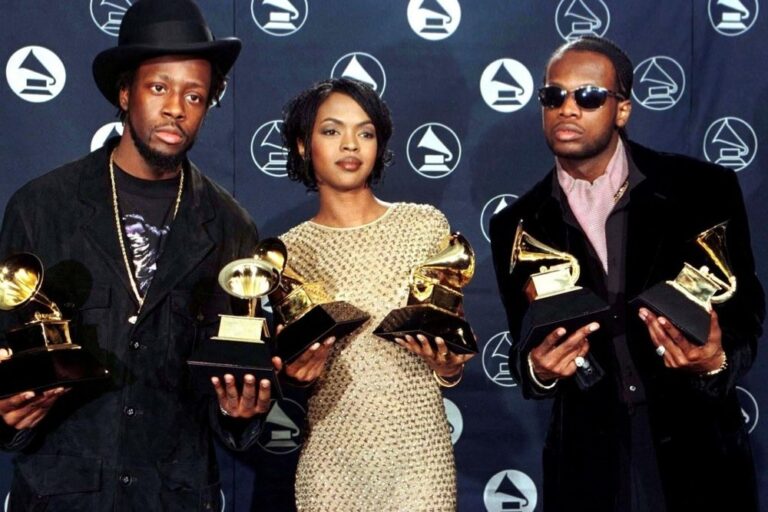
Lauryn Hill has not released an album in nearly two decades (2002’s live album, MTV Unplugged No. 2.0). Yet, her presence within pop culture remains. Much of it can be accredited to her work as a member of the Fugees — whose sophomore album, The Score, has been certified 6X platinum in the United States by the RIAA, with 22 million copies sold worldwide — as she garnered her first top 10 hit with her rendition of Roberta Flack’s “Killing Me Softly,” earning her and group-mates Wyclef and Pras the top spot on the Billboard 100.
ooh la la la
Piggybacking off of the success of The Score, the artist now known as Ms. Lauryn Hill, reached folklore status when on August 25, 1998, The Miseducation of Lauryn Hill hit record stores. Distributed by Columbia records, the album was primarily recorded at the late Bob Marley’s Tuff Gong studios in Kingston, Jamaica. Hill had developed a romantic relationship with Rohan Marley, son of the legendary Reggaeton artist, and the family-oriented nature of the Marley’s was her respite, as she recorded what is now considered her magnum opus.
Classified primarily as a neo-soul and R&B album, The Miseducation also includes elements of hip hop and reggae, while implementing plenty of live instrumentation — some notable names include: a young pianist by the name of John Legend, R&B superstar D’Angelo, along with famed guitarist Carlos Santana. Accompanying the excellent musical composition was Hill’s heartwarmingly soulful voice, as the album’s contents served as inspiration for a generation of men and women. She didn’t pretend to be perfect, as the scathing Wyclef Jean aimed diss track –“Lost Ones” — showed, she was capable of animosity. She shared stories of desperate attempts to save her relationship on “Ex Factor,” while the Billboard charting single “Doo Wop (That Thing)” shared messages of self-worth (“how you gon’ win if you ain’t right within” has become one of the more transcendent lyrics in music).
From tales of newfound love on “Can’t Take My Eyes Off of You” to the fulfillment one finds in their child on “To Zion,” Lauryn Hill’s wide range of emotions on The Miseducation captured the hearts of fans worldwide. Add in the many biblical idioms she drops on records like “Final Hour” and “Forgive Them Father” and you have the makings of a God-fearing woman whose romantic struggles have left her scorned for the better, finding love within her religion, her children and newfound romance. What’s not to like about that? Apparently nothing, as The Miseducation went on to sell over 8 million copies in the United States, as she cleaned up at the 1999 Grammy awards, winning 5 and being nominated for 10.
She wrote her opus to reverse the hypnosis, the awards just came along
So, today, we celebrate Lauryn Hill for her contributions to music, and if she never drops another album, we can be happy with the fact that she was open enough to share all of herself on The Miseducation.
In the final installment of NYS Music’s interview with Street Pharmacy‘s Ryan Guay and Giant Panda Guerilla Dub Squad‘s James Searl, the pair take the time to dig deep on their relationship to modern progressive activism in Canada and America, and the inspiration for “They Don’t Give A $$$.” Ryan reveals the dark past of Canada while James shares his family history with the abolitionist movement. Catch up with parts one and two.
Thomas Lent: You know, we’ve been talking about a wide variety of different crises here, but you know this track is about activism. Emphasis on the active. To promote the causes that your groups stand for, what specific causes would you like your listeners to contribute to?
Ryan Guay: Well, I think, first and foremost, looking from the Canadian perspective. The indigenous people have received the worst brunt of what it is to be Canadian but not be Canadian because they aren’t acknowledged that they are Canadian. Something I would like to bring up to an Americans attention is the Truth and Reconciliation Document that was written in 2015 where the federal government in Canada formally apologized, to make reparations for certain indigenous populations of Canada. If you want to read about what actually happened here and how terrible it was for all indigenous people, especially young people being shipped off to residential schools and being raped by Catholic priests, and you know going back to their, to the tribes, back to the “rez” and not being accepted because they lost their culture. Looking into the highest suicide rate in Canada and who that belongs to, and why.
I think it will be mind-blowing for a lot of people that have this perception of Canada as being this very apologetic, say sorry all the time, nice people. Just read that it will definitely open your eyes to the situation here that needs more attention being brought to it. That the people who die the most from murder in Canada are indigenous women who are in prostitution rings. Why? How did that happen? We had such a strong attempt at, quote-unquote, “assimilating” their culture into Europeanized society, why is this a thing? Obviously, the whole story has not been told. Apologies are one thing but actual action is a different thing, and theirs is definitely not enough and the situation with the pipeline being built says that. The fact that the RCMP exists for the sole purpose of keeping the indigenous population in check, to quote Sir Francis Bonhead, who created the Indian act. I think there’s a lot of work to be done here. That’s something that’s important for the song and that why those clips were included in the video. For me as a Canadian, as a person who is of mixed blood, it’s a story that should be told and should be told world-wide. James could probably speak more about the Black Lives Matter movement and other groups that we want to support as well.
James Searl: If the listener had reservations about being active or for like how to get active in the movement for the good, ha, that’s so cliche. But they should seek out who the groups that are in their communities that are representing the most marginalized people. Whether it’s Black Lives Matter, the Movement for Black Lives, or other groups that are working to bring all sorts of services to the indigenous community and also money and representation. They should be trying to find out who those organizations are in their community and listening to what their platforms are and what is important to them. If you have reservations about it, take a step back and realize what these people who are not you and come from a different situation are trying to say and to, you know, support that. Even if it doesn’t resonate with who you are, kind of have the faith that these people are doing all the work and they know what they are talking about. Let people represent themselves and support them when they do. Learn how to be a good ally and lend your body. Especially if you’re young and don’t have a family and you don’t have much to do. Show up, wear your mask, and be supportive. There are people that are being beaten up and killed out there. The more people that are there the less that will happen.
One of the greatest things that I heard about from some of these protests in New York was the young white women, when the cops would come up and start to rough up some young black men and women or teenagers in the protests they would yell out, “White Shield” and all these little white girls would run up to the cops and be the ones there to get beaten and they would stop. It was like, “Wow,” when I was 20-21 that is not what the young white girls I knew were doing. So be part of these movements. Again the situation in the United States, the plight of the indigenous folks here, and the plight of enslaved Africans that were brought over, are very different stories but they all come to the same place and what was done to them was done by the same people. I think its important to recognize what that common denominator is, and that’s “American Empire.” Our tax dollars are used for that all over the world. Even now, there’s more people enslaved now around the world than there were during the trans-Atlantic slave trade.
TL: Right! In Liberia and North Africa right?
JS: Well, in the Congo, with mining the lithium for our batteries in our phones. I think it’s important to acknowledge that there’s always been abolitionists. We don’t hear about them. That’s kind of what this argument about the founding fathers is about right now. Why are we learning about these guys, Thomas Jefferson for example, who raped his wife’s half-sister who was given to him as a wedding present because she was enslaved and was the product of a rape her father committed. Thomas Jefferson then took that wedding gift, that was a person, and his wife’s half-sister, to France, where he started to sleep with her and made babies. Why are we learning about him and not about that part of him and not about the abolitionists that were around at the time and we’re calling them out for it?
There’s always been people who knew the wrong thing was happening so it’s hard to live in 2020 and know that, “Oh we’ve come so far, we eradicated slavery, it’s been over for so long.” Well really because we’re all on our cellphones. While we can’t yell at every individual cell phone owner we can all as cell phone owners, you know, make it loud to Apple and Google, who make these technologies, or our governments, to pass laws that make sure people are working in safe conditions, and are paid a reasonable wage. It all comes down to “Workers of the world unite.” It’s all part of the same call. It’s been happening for hundreds of years. This is not a new moment this is part of a long moment. Additionally, the education part of that is important and I’d like to recommend books to people for people to read.
TL: What books would you recommend?
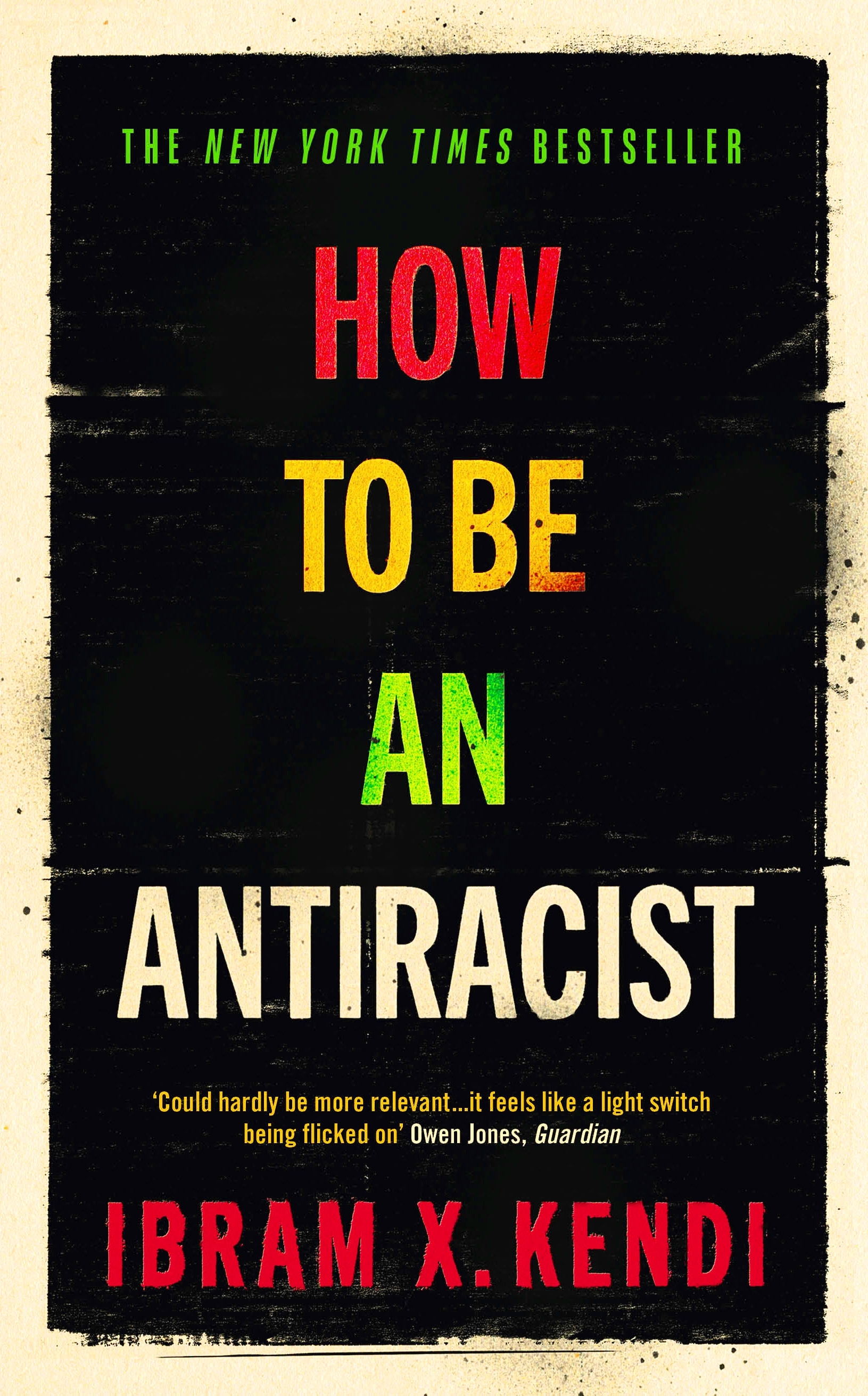
JS: The New Jim Crow by Michelle Alexander is super eye-opening about everything from the trans-Atlantic slave trade to the drug war and the prison industrial complex. It’s one line, and white America has been doing this to black America since before the founding of the country and its nation’s wealth is built on. We wouldn’t have what people call “American Exceptionalism” without it. Of course “American Exceptionalism” is also a flawed term, highly flawed. But, the more you see, the more you know, the more you see and if you can be anti-racist, and that refers to Ibram X. Kendi’s book How to Be an Antiracist. People talk about how this book is sold out in some places but it’s in audiobook form so it will never sell out in theaudio form. They can just keep giving it to you. He reads it himself, again I’ve been pretty devoted to studying, because of reggae and hip-hop, I’ve been devoted to learning about, what Bob Marley called “The real situation” and the line that he says in “So Much Things to Say”: “Never forget who you are and where you stand in this struggle.” It means something different when Bob Marley says it that when I say it because I’m coming from a different place.
I’ve been devoted to learning about this stuff and the history of racism in America and the history of the political economy of the United States and the world, for like since I was 17-18 years old. The things I’ve learned from The New Jim Crow and How To Be An Antiracist are things that I had never thought about before up until a year or two ago. So I think that being an antiracist is something that is gonna legitimately take everybody their entire life to work on, including their children’s life, and maybe even some generations after that. It’s not a small calling so the time to start is now and you can start by educating yourself about it and there’s great resources out there. People have done the work. People don’t want to do that, that’s why it was so amazing to see that show Watchmen on HBO, like I sorta knew about the Tulsa Bombing, and I’ve been trying to know about this stuff for a long time, and I’ve been trying to wrap my head around this history. But even now it was like, “Oh what happened in Tulsa? Oh ya, black Wall Street was bombed, firebombed by planes, and women and children were killed.” Now we all know about it and that’s because artists have with movies, shows, books, and plays, that’s always how I’ve really learned about that stuff. As much as I want education and school and books to inform me, more entertaining media has done a good job for me.
TL: I agree, modern media has been doing a much better job of representing these untold stories.
JS: Hey man, you’re from East Aurora, do you mind if I tell you a small family story?
TL: Sure go ahead!
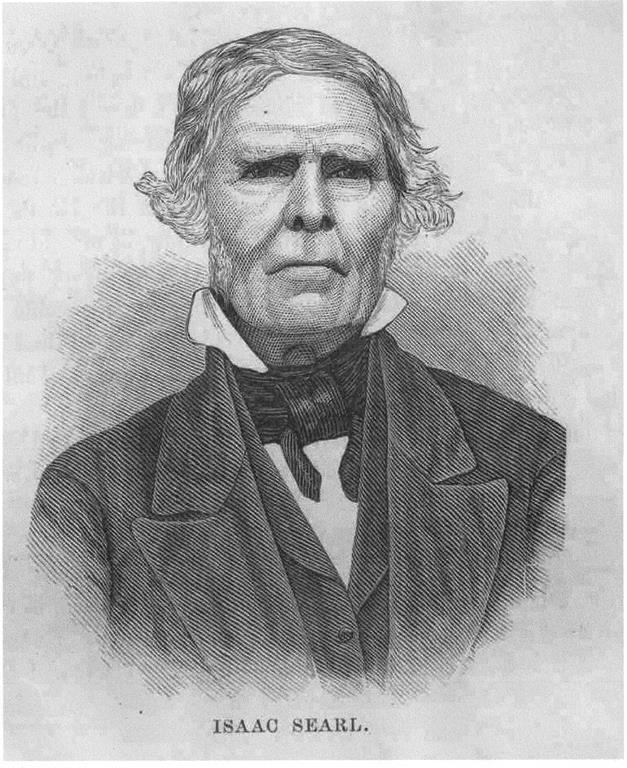
JS: My dad’s from East Aurora and the way that my family got to East Aurora was in the 1800s, I had a relative named Isacc Searl who moved his family from Vermont after he lost everything in a drought, he was a farmer and they were suffering so he moved his family and they ended up in Cattaraugus county. We didn’t really know about who he was but my dad got into genealogy when I was a little kid and he found a picture of him at the time and started putting it on shirts for our family reunion every year. All the family from East Aurora, Buffalo, and Rochester would come hang with us and we would celebrate the family of Isaac Searl. The picture was from the eighteen hundreds and he looked like an “Old Searl” and just a couple years ago some history was unearthed that a person who was on their death bed in the late 19th century told a secret.
He told a secret about, “Hey listen in the 1820’s and 30’s the Underground Railroad was really happening around here and these were the people that were involved.” They’re all dead now so they can’t go to prison, but Isaac Searl used to hide people who were traveling on the Underground Railroad in his house and then get them to the boat that would take them to Canada. So like, it’s amazing, and it made me proud to know that my family, the white part of my family came to the United States in around 1632, a long time ago, and I’m sure a lot of them were involved in all sorts of terrible shit but it’s nice to know that is a guy who had already lost everything risked his life and his family, and losing everything again, to do what he knew was right. It’s important to me to remember that even in those times people knew what the right thing to do was and you can be like those people now. You can always be one of those people. I’m really proud of all my young cousins from East Aurora that are in their teens and twenties, it’s like, “Wow, you’re so cool. I’m so glad I don’t have to like, be arguing with you guys about this stuff, it gives me a lot of hope.”
TL: That’s fantastic, do you have any other points you would like to communicate too the listeners?
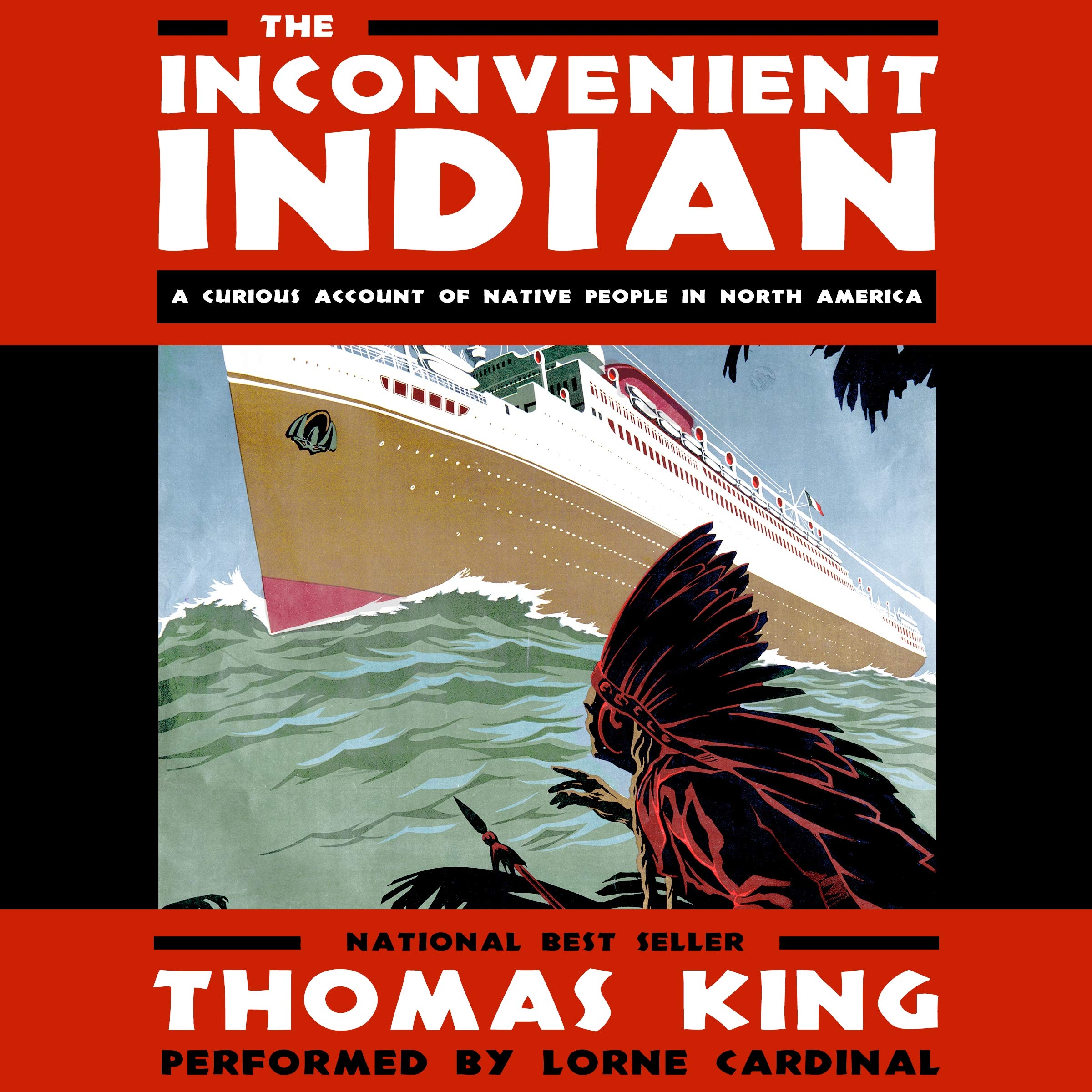
RG: For books, I would say that The Inconvenient Indian: A Curious Account of Native People in North America by Thomas King is a great book for people to check out who are interested in the real history about the relationship between North American Natives and non-natives, what that looks like from the perspective of the indigenous people when they first met. It’s a unique account. I think I just told James to check out The Indian Horse by Richard Wagamese.
JS: I just bought both of those books from my local female black-owned book store. She’s ordering them for me thanks for the recommendation.
RG: No problem, I think those are the books I would recommend.
TL: Do you guys have any closing statements that you want to add for the track?
JS: Ryan has got an incredible team up there and it would be a great honor for me to do more stuff like this.
RG: It’s amazing that a random fan was able to connect us and we were able to hit it off so well. James is such an enormous talent and he’s such a good person, his heart is in the right place, and I really hope that we continue to work together to make music that creates change and helps people realize what’s up in the world and makes people feel good and positive and that we’re moving forward in the right way. I feel very lucky, the invisible line is a lot more significant to Canadians trying to get into the United States to tour and make music. You don’t know what’s going to happen when you get over there, but to find a kindred spirit in James and to make music with James, and Eli played on the track, he did fantastic I forgot to mention that. I just feel really lucky James and all of Giant Panda Guerilla Dub Squad are some of the best musicians I’ve ever worked with for any genre and it’s been amazing to work with them.
JS: And enjoying music and talking about activism and talking about what’s right and what’s wrong it all happened at the same time. Friends, family, while your cleaning in the kitchen, making love in the bedroom, all this stuff you don’t have to separate this stuff as different parts of your life, they’re all part of your life.
RG: Yeah, we want people to get out there and do something. The last line that in the verse that James wrote: “It’s not what you say it’s what you do.” It’s important to not only have these conversations but also to do something that can affect change. That’s what this song is really about, it’s a call to action. Before we leave there’s one more thing I wanted to add to another question you had asked, something that was really disturbing to me while we were working on this song. In Toronto, on July 2nd and 3rd, there were some riots for an African-Canadian woman who was tossed out of a balcony by a police officer who was called to interview for some sort of domestic call. There were protests in my neighborhood in Welland, which is about 80 minutes outside of Toronto. There was a person from that group that I was discovering before, trying to pay young men to go into Toronto to break things and cause a riot rather than a peaceful protest. That to me, if there isn’t a reason to get up and say something, if that isn’t a reason I don’t know what is gonna be. If you have somebody like that who goes into a neighborhood and pays broke college kids to go and break things in Toronto for $200 a day each, there’s the issue. It was scary to see that.
JS: Don’t be that guy!
RG: Don’t ever be that guy!
TL: Don’t take money to go destroy another community, got it!
RG: Ha ha, yeah, I just wanted to add that to your previous comment about what was going through our heads while we were writing it. I called the police who interviewed and they were aware of the situation and had marked the group as a terrorist organization which is positive. In Canada, that’s what the situation is.
JS: That’s the way that the KKK over here is.
RG: I noticed that actually. As a matter of fact, the KKK in Canada actually started in my home town in 1908, so yeah.
JS: The grand wizard lives a town away from me.
RG: Wow that’s close
JS: And people know that that’s what’s crazy to me, everybody knows him. I guess I’m not gonna try anything.
Mariah Carey announced her upcoming compilation album, The Rarities, out on October 2. While the Songbird Supreme has previously released seven compilation albums, The Rarities is the first to feature new material instead of past hits. The album’s lead single, “Save The Day,” features vocals from Ms. Lauryn Hill and samples The Fugees’ cover of Roberta Flack’s “Killing Me Softly With His Song.”
Mariah started recording “Save The Day” back in 2011, but scrapped it for unbeknownst reasons. Co-written by frequent collaborator Jermaine Dupri, it was originally meant to be a charity single. Thankfully, its message of hope and unity is even more relevant in 2020 than when it was first conceived. The only disappointment is that Lauryn Hill fades into the background: she doesn’t have a solo or new lines beyond the iconic sample.
The Rarities has 32 tracks and two discs: one with unreleased music from every era of her career, another with live performances from Mariah’s Tokyo Dome show in 1996. The album coincides with her memoir, The Meaning of Mariah Carey, out on September 29. Mariah first teased The Rarities back in June to celebrate the 30th anniversary of her debut album, but postponed its release to focus on the Black Lives Matter movement. Now, she’s devoting the rest of the year to #MC30 festivities for her fans.
Flushing Town Hall is joining Global Music Month with a virtual concert series. A collective of world music festivals and events across the U.S. and Canada, GMM 2020 consists of 19 presenting organizations. Throughout September, the historic arts landmark in Queens will showcase archived “Global Mashup” concerts as well as live Latin and Korean music.
No two Global Music Month events are the same, and each concert offers a unique blend of sounds and cultures. The Town Hall is kicking off the festivities with replays of their 2018 Global Mashups, where two types of international music come together. Each band performs a solo set, then they combine their talents and jam out together.
The first such concert, “Latin Boogaloo Meets Afrobeat,” technically isn’t part of Global Music Month because of its pre-September date, but it airs at 7:00 p.m. EDT on Tuesday, August 25. After that, the series will continue weekly at the same time through September 22. Subsequent mashups include “Egypt Meets Haiti,” “Mexico Meets Guinea,” “Balkans Meet El Barrio,” and “Texas Meets Peru.”
Besides the archived 2018 mashup series, Flushing Town Hall has assembled two nights of live music.
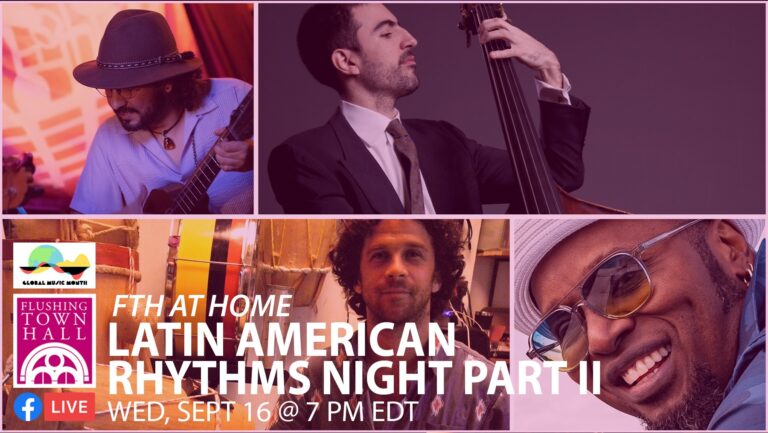
Latin American Rhythms Night starts at 7:00 p.m. on Wednesday, September 16, exploring New York City’s colorful Brazilian, Mexican, and Argentinian artists. The night features live and pre-recorded performances from David Vieira, Sinuhe Padilla, and Pedro Giraudo. The show is hosted and curated by Martin Vejarano of the Cumbia River Band, and also features “Spanglish” stories and interviews.
Finally, psychedelic Korean folk band Coreyah is closing out Global Music Month at 7:00 p.m. on Tuesday, September 29. Since 2010, the band has melded a contemporary pop sound with traditional Korean music.
“As a cultural institution whose mission is to bring people together by presenting global arts for a global community, we couldn’t be more thrilled to be a part of this unique and diverse consortium and to participate in the Global Music Month 2020 online festival,” says Ellen Kodakek, Flushing Town Hall’s Executive & Artistic Director. “The fact of it being virtual means audiences throughout the country and around the world can enjoy our content and not just those in New York, where our venue is located. We are especially proud to present this programming free of charge.”
While all Global Music Month shows are free, Flushing Town Hall still encourages donations. The full Flushing Town Hall Global Music Month lineup is available on their website.
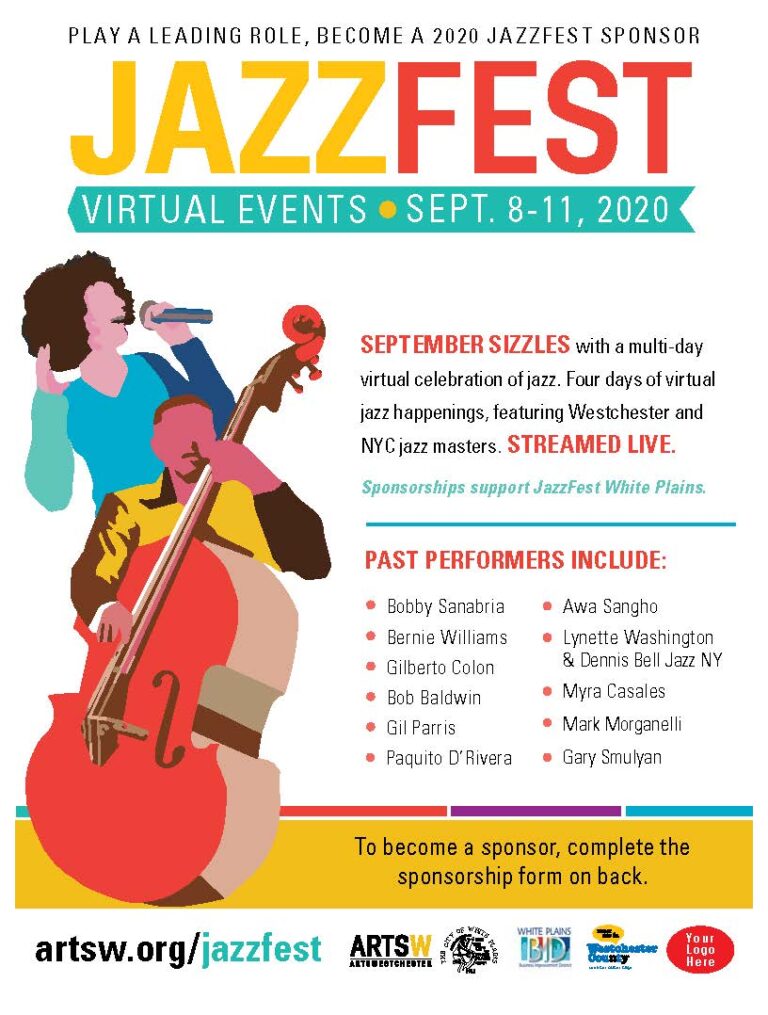
JazzFest White Plains announced virtual festival dates. The virtual festival will take place September 8-11 and will host a variety of artists. The 9th annual JazzFest White Plains will be streamed on Zoom and on Facebook.
The four days of Jazz will include not only performances but conversations as well. It will feature a mixture of artists at the forefront of jazz and rising stars. From Westchester jazz talent to jazz masters the festival will be something spectacular for Jazz enthusiasts. JazzFest White Plains are teaming up with the spirit of Arts Westchester’s annual ArtsBash.
The festivities will start at 4:30 – 5:30PM on September 8 with the “ArtsBash Virtual Mixology” event making Jägermeister cocktails and live jazz music by The Rico Jones Trio. Then at 6PM there will be a “presenting Jazz in the time of COVID-19” conversation. At 8PM the night will wrap up with “Westchester Jazz: Then and Now” featuring Art Bennett on sax, Kathryn Farmer on piano and vocals, Kenny Lee on trumpet, and Rocky Middleton on bass.
The second day will start at noon on September 9 with a performance form “Isabella Mendes & Flavio Lira Duo.” At 6PM there will be “Jazz Education in Westchester” conversation. Wrapping up at 8PM the “Jazz, From One Generation to the Next” event will happen featuring conversations and performances by Alexis Cole and Lucy Wijnands, Bobby Sanabria and Gabrielle Garo, and Ulysses Owens Jr. and Aaron Jennings.
On the third day September 10 the fun will start bright and early at 8AM with “Jazz at the Intersections” performances featuring Amir ElSaffar with an Arabic music and jazz combination, Jomion & the Uklos with a West African/Carribean music and jazz combination, and Pablo Mayor with a Columbian music and jazz combination.
On the last day September 11 the festival will wrap up at 8PM with “Jazz’s Rising Stars” featuring performances of Connie Han on piano, Matthew Whitaker on piano, Veronica Swift on vocals, and Alicia Olatuja on vocals. There will also be a moderated discussion about what it’s like to be a young rising star in jazz today which will be moderated by Keanna Faircloth, WBGO.
The festival is free to the public but is accepting donations online here. People wanting to register for certain events to get the zoom link can do so on JazzFest White Plains’ website. The events will also all be live streamed on Arts Westchester’s Facebook Page.
For more information visit JazzFest White Plains’ website.
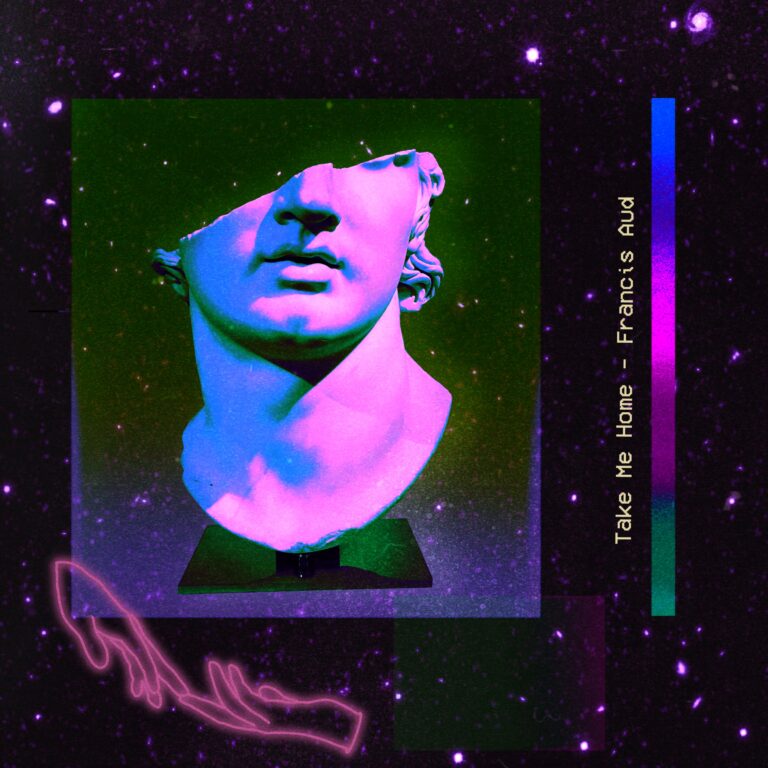
Brooklyn electro-pop funk artist Francis Aud recently released his newest single “Take Me Home,” blending bittersweet lyrics with an upbeat and unique electric funk.
Francis Aud started out as a retro-soul artist and released his debut EP Tender Things in July 2017. Since then, his music has evolved into what he calls ‘FONK,’ his own original blend of electro-pop and funk. This refreshing mix gives his music personality and makes his sound memorable. Francis tells NYS Music:
My biggest inspirations are Al Green, Marvin Gaye, and Sam Cooke. From listening to those guys, I then found Jackie Wilson, James Brown, and then followed the thread of musicians they influenced all the way up to contemporary pop artists like Bruno Mars and Parcels.
Francis Aud
What he listened to as a child has been “carried in his psyche,” and he says that listening to “super romantic Spanish crooner music or The Commodores” all the time as a kid still influences his own writing style today. “I almost exclusively write about love, relationships, and desire and I still try to phrase the lines I sing like how a crooner would…old habits die hard I guess!” He’s been releasing several FONKY singles since 2018 in preparation for a bigger release in the future.
“Take Me Home” looks back on a past relationship with bittersweet nostalgia. “When it comes to lyric-writing,” Francis says, “I’m always trying my best not to write lyrics that aren’t devoid of meaning (if that makes sense.) I think lots of the time when people hear the words ‘pop music’ their mind immediately jumps to this idea of extremely surface level and superficial lyrics that come from lazily relying on overused tropes and clichés. I think good pop music doesn’t have to be devoid of a deeper meaning and there’s lots of proof around me of that.”
Photo courtesy of Amanda Blide
Despite its somewhat sad message, the single is in no way a downer. It’s upbeat and dancey. “That comes from my shameless love of 80’s music,” the artist admits. “I seriously, positively, TRULY, love music from the 80’s, especially the movie soundtracks where the arrangements were super over the top and used cheesy keyboard sounds on everything. Because that music makes me happy, I think it’d be worth exploring the juxtaposition between that music and the lyrics and I’m just lucky to call it a success!” The 80’s vibes in “Take Me Home” are clear, but with an original and modern spin that is lacking in some other “cheesy” pop.
Francis Aud’s music and website both shine with his positivity and humor. “I don’t think I can ever remember a time where I wasn’t blatantly making terrible dad jokes and puns,” he says about his ever-present humor. “In terms of positivity,” he notes, “I think it comes from both my parents and also comes with the territory of being a musician. With my parents being immigrants and coming to this NYC during the really rough 80s’-90’s, they had to work their asses off to make things happen and they had to have an optimism that things would work out. I think I naturally picked up on that. ALSO, when it comes to being an artist, you almost have to force train yourself to become more positive on a daily basis because there really is no guarantee that your art will be heard or even enjoyed.”
Despite the global halt brought by the Coronavirus, Francis has been keeping busy working on music: “I’ve been spending most of the quarantine teaching myself more about music production and trying my best to ‘level up’ my home recording set-up,” and “I’ve been working with more getting more comfortable using synthesizers and more of the electronic aspects of music production,” he says, as he can’t record in a full studio with a band right now due to the quarantine. “Aside from that, I’m always trying to hone my writing and working to finding that distinct balance between saying something meaningful and being catchy.”
Bronx Music Heritage Center is bringing viewers the Bronx Blast on their Facebook page. The Bronx Blast are mini-performances that will be presented in front of the Bronx Music Hall. The theater is currently under construction and will be a future home to the Bronx Music Heritage Center.
In July, Martha Zarate and Pilar Maez of Mazarte Dance Company danced to “El gavilancito,” a song from the son jarocho tradition from Veracruz, Mexico. “Jarocho” describes the people and culture of the southern coastal plain of Veracruz. The song, dance and costumes represent the Indigenous, Spanish and African influences on the cultural tradition. Watch the video on Facebook.
For episode two, the Bronx Music Heritage Center brought in Carmelo Soto, Jorge Vazquez, Bobby Sanabria, and Carlos Espada to demonstrate Plena. Plena is one of the traditional forms of music from Puerto Rico, often referred to as the “periódico cantado” or “sung newspaper” as many times the lyrics relate incidents from daily life or commentary on local events. The lyrics to plena was written by Carlos Espada and can be seen below.
Que bien yo me siento, en esta occasión la gran apertura el Bronx Music Hall.
Oyeee, finalmente, les presento yo, este gran proyecto aquí en el Bronx
Y muchos no saben, fue la visión, de Elena Y Bobby, que se construyó
Que viva, que viva, la diversidad, de toda la gente, nuestra hispanidad.
English Translation: How good I feel on this occasion of the grand opening of the Bronx Music Hall.
Finally I present to you this great project here in the Bronx
And many don’t know, it was through Elena and Bobby’s vision that it was built.
Long live the diversity of everyone, our Latino community.
In their latest episode, Nélida Tirado returns home to the neighborhood where she grew up to perform some rumba flamenca in front of the future Bronx Music Hall. Watch the performance here.
Check out NYS Music’s coverage of The Bronx Music Heritage Center’s concert series that occured this past June.
The estate of the late Tom Petty has released the solo demo version of his classic track “Wildflowers (Home Recording).” The video premieres alongside a video featuring never before seen footage of Tom at his home, shot by Martyn Atkins during the recording of Wildflowers.
Thanks to commitment from his family, bandmates and collaborators, many who helped unearth previously unheard gems, help to fulfill Tom’s vision of this project is becoming a reality.
You can pre-order the long-awaited reissue and comprehensive collection Wildflowers & All The Restnow, which will be released on October 16.
Petty Legacy – Adria, Annakim and Dana Petty – shared the following statement upon the announcement of the album’s reissue:
We are so excited to announce that we will finally be releasing Wildflowers and its long anticipated second album All The Rest, Tom’s solo masterpiece and first collaboration with Rick Rubin as co-producer.
Curating this project was a beautiful experience for us. We’re releasing the collection as Tom envisioned along with a number of additions exploring the two year writing and recording process and live performances of songs from Tom and the Heartbreakers over the years.
We found so many incredible unreleased demos, versions of songs, notes, lyrics, and film reels in our archives. We look forward to sharing a number of special goodies with you all.
In this intimidating endeavor we continued to work alongside Tom’s trusted bandmates and team: Mike Campbell, Benmont Tench, Rick Rubin and Ryan Ulyate as well as Mary Klauzer and Alan “Bugs” Weidel, to lovingly curate each disc and keep it as close to what we believe “rings true” to what Tom would have wanted. We are so grateful to them for their unique knowledge. We hope you find joy and inspiration in this music and the magical world Tom created.
We are honored to steward the warmth he shared through his music and relationship with fans.
We hope you find it uplifting and love it as much as we do.
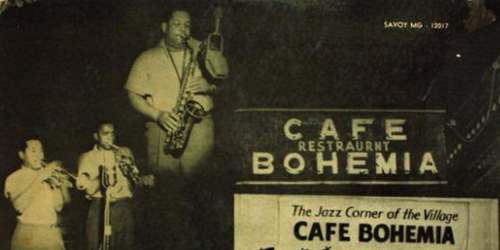
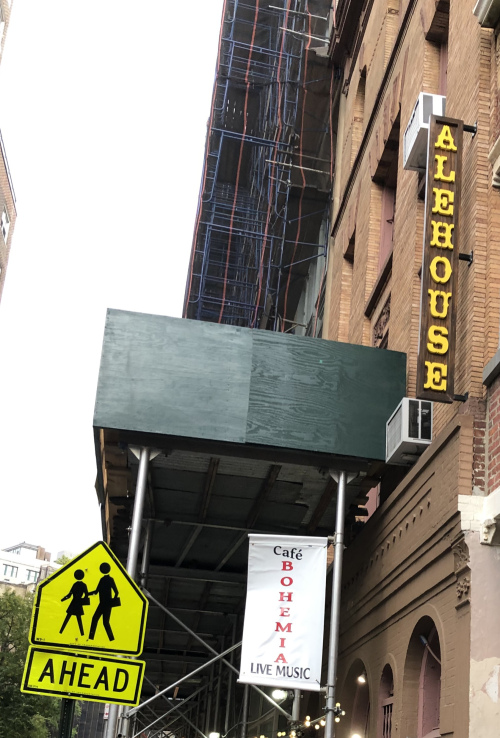
Located in Manhattan’s West Village on Barrow Street, Cafe Bohemia originally opened in 1955 and is an historic landmark and jazz club. Frequented by music legends the likes of Miles Davis, Charles Mingus, Canonball Adderley and many others, the venue closed in 1960, and was revived at its original location in October 2019.
One notable story about Cafe Bohemia comes from June 19, 1955, when Julian and Nat Adderley arrived in New York on a trip as Julian was to work on his Master’s Degree at New York University. That first night in the city the brothers went to the Café Bohemia to hear the Oscar Pettiford band, the house band at the time. The night would prove to be a turning point in Nat’s career.
Jerome Richardson, the group’s regular saxophonist was unavailable that evening due to a recording session. Pettiford asked Charlie Rouse – who was in the audience – if he would sit in, but Rouse did not have his saxophone with him. Pettiford then noticed another audience member, Adderley, who had a saxophone case with him and told Rouse to ask this unknown man if he could borrow his horn.
Instead, Rouse asked “Cannonball” Adderley if he would like to sit in with the group. Reluctantly, the leader complied and allowed Adderley to play. Overnight Adderley rose to prominence on the New York jazz scene, and on June 21 he played his first official show at Cafe Bohemia. By October 1957, he was a member of the Miles Davis Sextet.
More recently, the late Eddy Davis (banjo), Conal Fowkes (bass, vocals), Jon-Erik Kellso (trumpet) and Evan Arntzen (tenor saxophone) performed “My Monday Date?,” by Earl Hines, on December 26, 2019. Video performances below are available thanks to Michael Steinman for his blog JAZZ LIVES.
Watch Eddy Davis and friends – Jon-Erik Kellso (trumpet), Evan Arntzen (clarinet) and Conal Fowkes (string bass) – pay tribute to the great Jelly Roll Morton with “Good Old New York.”
“The Intimacy of the Blues,” is a haunting piece composed by Billy Strayhorn and an album of the same name for Duke Ellington. Performing at Cafe Bohemia on November 14, 2019, JAZZ LIVES shares video of this pre-Thanksgiving performance in Greenwich Village by Jon-Erik Kellso (trumpet), Evan Arntzen (clarinet), Neal Miner (string bass,) and Chris Flory (guitar).
On February 6, 2020, Mara Kaye was joined by friends and musical family Tim McNalley (guitar), Jon-Erik Kellso (trumpet) and Brian Nalepka (string bass).
Mara Kaye is joined this time for “Me and MY Chauffeur” by Tim McNalley, (guitar), Albanie Falletta (resonator guitar), Jon-Erik Kellso (trumpet) and Brian Nalepka (string bass).
From January 16, 2020, “A Shanty in Old Shanty Town” features Tal Ronen (string bass), Matt Munisteri (guitar), John Allred (trombone), and Jon-Erik Kellso (trumpet). “In a Shanty in Old Shanty Town,” written by Ira Schuster and Jack Little with lyrics by Joe Young, was published in 1932. Ted Lewis and His Band performed it in the film The Crooner in 1932. His version was later released as a single and it went to #1, where it remained for 10 weeks.
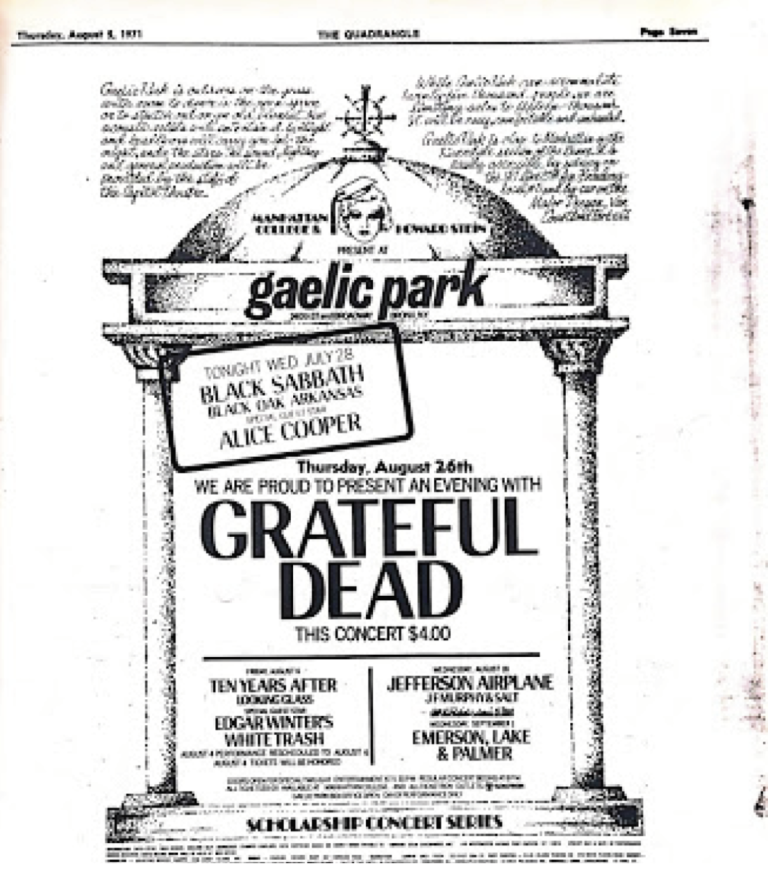
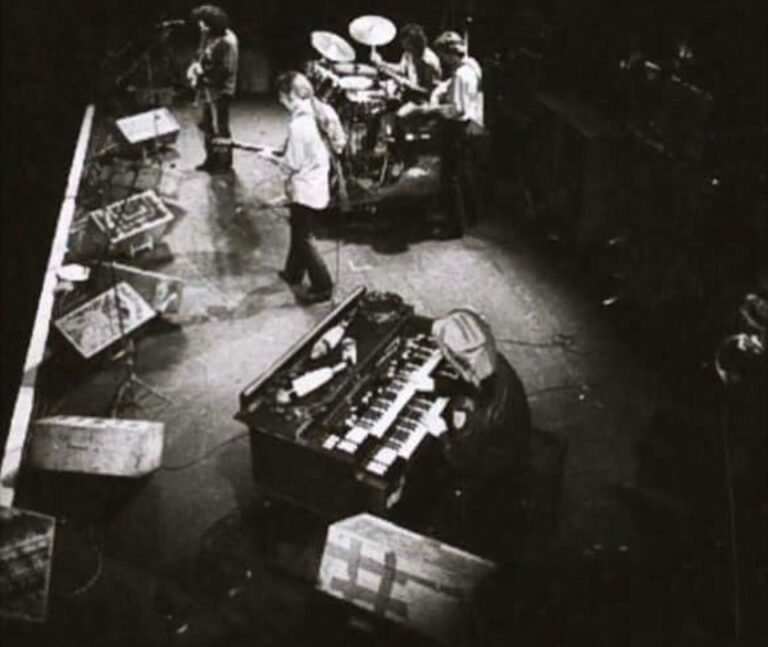
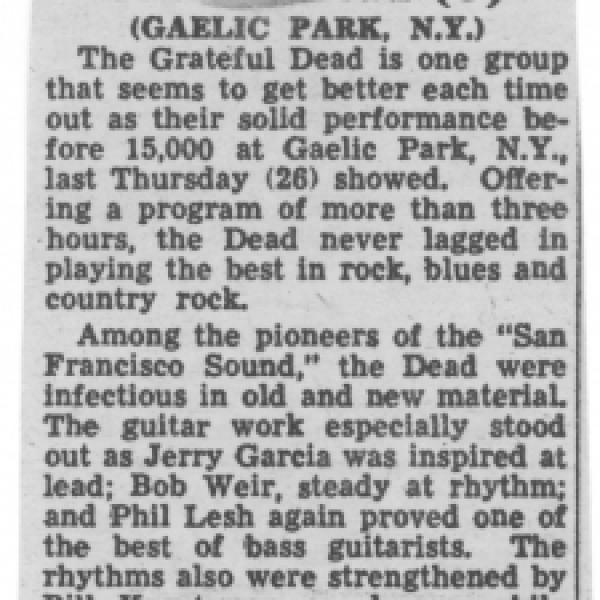
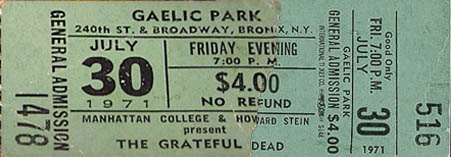
Although the Grateful Dead‘s track record with New York State is vast and varied, there’s one borough in particular that doesn’t get much love. And that’s The Bronx. Mainly because there’s only one show that was truly ever played there – Gaelic Park on August, 26 1971.
stub courtesy of Wayne Eichen
The performance is billed as a two-set show that really plays as three. A noticeably extended first set showcases some of the band’s newer original songs at time blended with a flurry of classic cover selections. Included in all this is a song the Dead would only play twice ever. And as for historical significance, this would be the last show featuring only the five founding members of the band. Seemingly aware of this, they collectively deliver a show for the ages that more than aptly serves as a figurative “passing of the torch” from one era to another.
This show opens with a crisp yet standard version of “Bertha,” a Dead original still in its nascent stages at the time. The early wave of originals would continue with a “Playin’ In The Band” that had just made its debut earlier this year at The Captiol Theatre in nearby Port Chester. Even though this would be a regular selection at Grateful Dead shows for years to come, seeing it so early in the first set like this is a verifiable treat.
Pigpen gets his first chance to shine on vocals with a first set “Mr. Charlie,” another new song that debuted just last month. Even though he was beginning to take on a lesser role in the band by this point in time, Pig’s vocals are effusive and strong throughout this recording. This would be the last show before Keith Godchaux joined the band and assumed keyboard duties. So, fittingly, they give Pigpen plenty of the spotlight at this show and he takes it and runs with it.
The run on cover songs then begins with “El Paso,” a country-western ballad by Marty Robbins, sung smoothly by rhythm guitarist Bob Weir. “Big Boss Man” follows, a longtime Dead cover that was originally recorded by Jimmy Reed in 1960 and later popularized by Elvis in 1967. This gives Pigpen the chance to lead again and his blues-infused vocals ring loud and true throughout this one.
This first set also features a typically stirring “Hard to Handle,” the Otis Redding tune that was one of staples of the Pigpen songbook and, perhaps, his signature song. Aside from a mild snafu with the recording, this version is terrific and sees the band fully locked in during an escalating funk-like jam before Pigpen’s wailing vocals reenter. Sung with all of the soul and swagger he would always bring to this song, sadly, this would be the last one ever played with him on stage.
The set could have ended right there and few would take issue, but instead the band continues to motor on with “Beat It On Down The Line,” yet another cover. Jerry Garcia then takes the reigns courtesy of “Loser” and his customary hauntingly beautiful guitar solo that goes with it.
Courtesy of Bronx Music Heritage Center
Soon after is one of the true gems of this show – the second and final performance ever of “Empty Pages,” a song written and sang by Ronald “Pigpen” McKernan himself. It pairs his traditional crooning style with a slow blues jam that’s nicely peppered with fiery guitar licks from Garcia. It’s a true rarity and a shame that the band wouldn’t be able to further develop this one.
The other first set highlight immediately follows with a smoking cover of The Rascals’ “Good Lovin’.” Pigpen remains strong on lead vocals as both he and the band get into some heavy improvisation on this one. Only the Dead can take a three-minute pop song like this and stretch it out to an almost ten-minute psychedelic journey.
They had such a fun time playing the first set that the second one begins with a rare “Me and My Uncle” placement, as if to keep the opening vibes going strong. Immediately afterwards, reality sets in with a joyous “China Cat Sunflower” that soon effortlessly blends into to its traditional running partner, “I Know You Rider.” Bassist Phil Lesh, turned up particularly high in this mix, gets his turn to show off as he steers the band through the seamless transition.
There would be no extended “Drums” section this evening. Instead, the band collectively rips into the opening of “The Other One,” fueled predominately by drummer Bill Kreutzmann. After a rip-roaring opening sequence, the jam composition quickly devolves into a meeting of the minds between Garcia and the rhythm section. Seemingly out of the blue, Weir interjects with his vocals right on point and the song is off and running.
For a quality listen to the transition into the opening of “The Other One,” alongside some backstage photos, check out this great video courtesy of Sam Cutler, one of the band’s early tour managers:
The powerhouse second set continues with a tidy version of “Uncle John’s Band” and one of the last performances of “Saint Stephen” before it would be shelved for nearly five years and rearranged. The jam progresses into something that almost resembles “The Eleven” before immediately settling back down into the ending of “Saint Stephen.”
And then, right on cue, the rhythm section is back in action with the opening drumbeat of “Not Fade Away,” a Buddy Holly cover that the band had completely appropriated at this point in time. The Dead take one last swing and develop a passionate collective effort that once again flows right into “Goin’ Down The Road Feeling’ Bad” without batting an eye.
This closing sequence serves as the cap to a phenomenal show that’s rich in both quality and legacy significance. It can be argued that the end of the Pigpen Era happened here. Amazingly, the only time the Grateful Dead would ever grace the “Boogie Down” Bronx. But talk about making the most of a single opportunity.
Set 1: Bertha, Playing In The Band, Mr. Charlie, Sugaree, El Paso, Big Boss Man, Big Railroad Blues, Hard To Handle, Beat It On Down The Line, Loser, Sugar Magnolia, Empty Pages, Good Lovin’, Casey Jones
Set 2: Me And My Uncle, China Cat Sunflower -> I Know You Rider, Deal, Cumberland Blues, Truckin’ -> Drums -> The Other One, Next Time You See Me, Me And Bobby McGee, Uncle John’s Band, Saint Stephen -> Not Fade Away -> Goin’ Down The Road Feeling Bad -> Not Fade Away