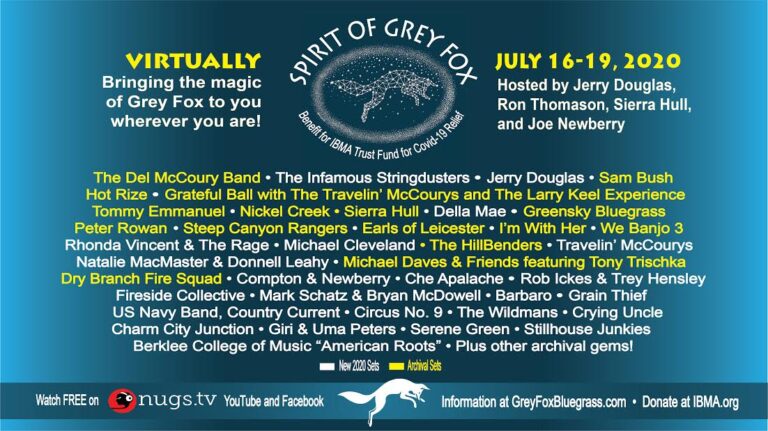
Grey Fox Bluegrass Festival announced plans to put on a Virtual Festival. The “Spirit of Grey Fox” will take place on July 16-19. There will be never-seen-before footage of original 2020 artists for the festival. The festival will be a benefit fundraiser for COVID-19 relief for artists.
The festival will include archived performances from past years on top of the performances from the original lineup. Some of the highlighted 2020 lineup includes The Infamous Stringdusters, Jerry Douglas, and Delle Mae. Some of the highlighted archived lineup includes the Del McCoury Band, Sam Bush, and Hot Rize.
The festival will benefit the IBMA Trust Fund COVID-19 Relief Fund to help artists crushed by the pandemic. This Fund is specifically trying to help the bluegrass community. The Board of Trustees set aside up to $150,000 for COVID-19 crisis assistance and has established an account specifically for COVID-19 Relief. Musicians can be awarded up to $500 of relief pay. People will be able to donate by going to IBMA Trust Fund COVID-19 Relief Fund’s website.
The festival will stream for free on nugs.tv and Grey Fox’s YouTube and Facebook Page. For more information the “Spirit of Grey Fox please visit Grey Fox’s website.
Check out this stream and more through our series NY Stream and Support, where you’ll discover artists around the Empire State streaming nightly, and ways to support musicians and charitable groups close to home!
The Rust Belt Brigade began as an acoustic punk duo from Buffalo that has since become a 4 piece Alt-Country/Americana outfit carving out their own niche in and around the Buffalo area. Coming Sept. 18th, the album, Howdy Hallelujah, Here’s the Thing, is a timestamp from the last two years as a 4-piece band composed of songwriters Victor Castilo, Jeremiah Franco, and Brandon Mueckle with Trevor Jennings on cajon/percussion. The album also differs from the normative live experience through full band-electric recordings composing roughly half the record and guest Sally Schaefer on Violin for the more traditional high energy bluegrass tracks.
The first single off of Howdy Hallelujah, Here’s the Thing, “Roll Call” is a fast-paced piece that instills a feeling of paranoia and urgency. From the get-go, the instrumental portion builds into an attention-grabbing and heart-pounding pace. The story told within “Roll Call” is one that encourages you to try anyway, even if you’ve hit rock bottom. This lesson is communicated after the ballad describes a life of someone who is truly desperate, with the final few lyrics informing the listener to “Roll the dice man, see if your lucks ran, lucks ran dry.”
“Love Is A House” slows the pace down from “Roll Call” and describes love through a series of touching metaphors. The lyrics “tell me what’s wrong, so I can fix it, fore winter comes, won’t let the cold get the best of us” exemplifies the importance of communication in relationships and serves as just one of the wholesome lessons that can be drawn from the track.
These two tracks serve as just a taste of Howdy Hallelujah, Here’s the Thing. Two more tracks from the album will be released on The Rust Belt Brigade’s Bandcamp titled “Kentucky Rain Dance” and “Buried in the Ground.” on July 24 with the full album releasing Sept. 18.
Unfortunately, this will be the last album produced by the band with songwriter Victor Castillo for the foreseeable future, as the band revealed through a Facebook post that Victor would be pursuing his career in Colorado without the group.
While the group will be decreasing their level of actively greatly the brigade isn’t disbanding, stating that “We still plan to release new music down the road and play shows in Buffalo when we can all get together but this is indeed an end to era.”
Milton Glaser, the master artist who created many of the most popular images of our times, from logos for IBM, DC Comics, UPS, Brooklyn Brewery, and ABC, to the iconic “I ♥ NY,” has passed away at 91. For we devotees of music, and especially New York State music, Glaser also holds an interesting place, as the man who inadvertently helped bring Bob Dylan and many figures of Sixties music and beyond to Woodstock.
According to Barney Hoskyns must-read history of Woodstock and its music scene, Small Town Talk, it was Glaser who we may largely have to thank for Dylan’s relocation to Woodstock.
As told in Hoskyns’ book, Manhattanite Glaser and his wife Shirley owned a second home in Woodstock since the 1950s, where they often entertained city friends, including Dylan’s famed manager Albert Grossman. It was natural for Milton Glaser to be drawn to the town since it has a history in art going back to the founding of the still-going strong Byrdcliffe, America’s first art colony in 1903.
When a large property with 60 acres of land became available in 1962 in adjacent Bearsville, for the then princely sum of $50,000, Glaser immediately thought of Grossman. As quoted by Hoskyns’, “We didn’t know a single person with $50,000 except Albert,” said Glaser. The fact that Grossman resembled a bear may have also played a role in his choice of location, according to Glaser.
Though Dylan first came to Woodstock in 1961 to stay at a cabin owned by the family of Peter Yarrow of Peter Paul and Mary, another Grossman-managed act, it was the comfort and protection of Grossman and his wife Sally that finally made him settle, as a way to escape the crazed demands of his stardom. Dylan lived in several homes in the area and was followed up by his backing band, The Band, who took up residency and created a musical workshop at the famed but decidedly humble Big Pink in West Saugerties, from whence the famed Basement Tapes emerged.
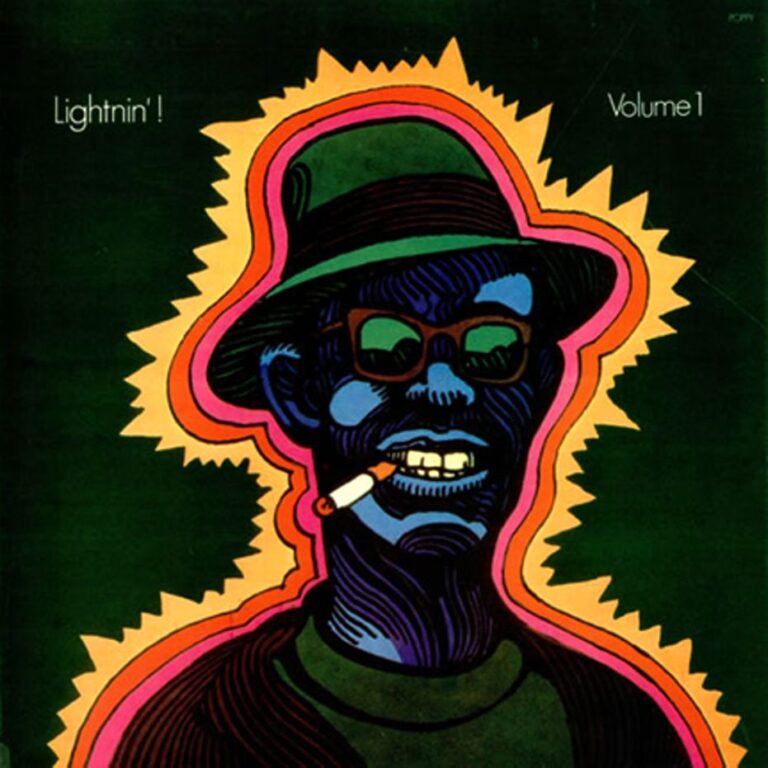
Lightnin Hopkins album cover by Milton Glaser
In time, many more would follow to become full and short-time residents including Van Morrison, Jimi Hendrix, Paul Butterfield and Janis Joplin, another Grossman-managed artist, and more recent names like David Bowie, B-52 Kate Pierson, King Crimson bassist Tony Levin, jazzers Jack DeJohnette and Pat Metheny, to name a few. Goldman went on to expand the musician attraction offerings in Woodstock by creating Bearsville Recording Studios and the soon-to-reopen Bearsville Theater.
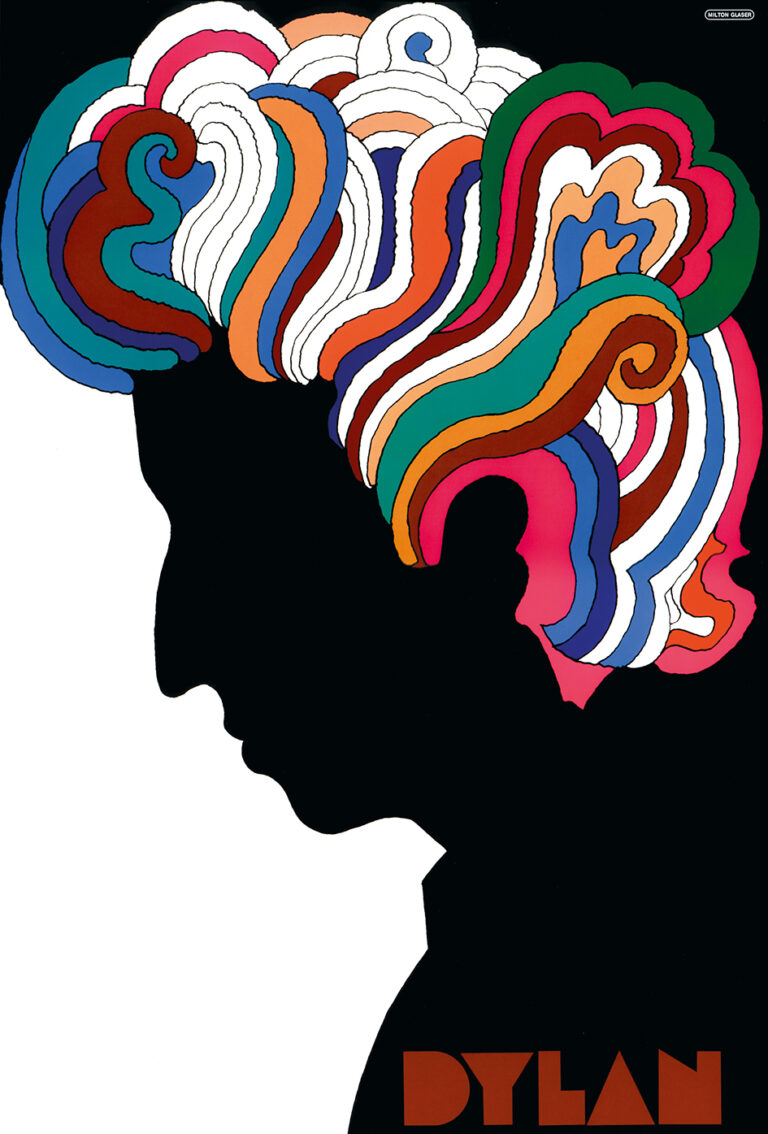
Glaser was also famed for his poster art, creating more than 400 at his Push Pin Studios. One of his most famous was one he created for the 1967 album, Bob Dylan’s Greatest Hits. Here, he drafted a simple outline of the singer’s head, based on a black-and-white self-portrait silhouette by Marcel Duchamp, and added thick, wavy bands of color for the hair, forms he imported from Islamic art. Nearly 6 million copies made their way into homes in America, making it one of the most popular wall hangings on the bedrooms of young people in the Sixties. Glaser also produced a slew of album covers for artists including Paul Simon, Peter, Paul and Mary, Doc Watson and Townes Van Zant.
For more on Woodstock music history, pick up Barney Hoskyns’ Small Town Talk, which features a handy map to many of the former homes of the music stars. For more on Glaser and his art career, read today’s obit in the New York Times.
Capital One City Parks Foundation Summerstage is virtually celebrating the 155th anniversary of Juneteenth, a day commemorating the end of slavery in the United States. The New York City concert series, now known as Summerstage Anywhere, is having a digital day of dance on Friday, June 19, with hourly tribute performances starting at 12:00 p.m. EST leading up to a panel discussion at 7:00 p.m. Originally planned to be held in-person, the Juneteenth event will be free and fully virtual on Summerstage’s Instagram and YouTube channels.
https://www.instagram.com/p/CBiim-5npb4/
Performers include RudduR Dance, who will perform an excerpt of their three-part contemporary ballet “Witness” at 6:00 p.m. “Witness” intertwines art and activism to depict the past, present, and future of race in America. During his candidacy, current French president Emmanuel Macron visited a rehearsal. RudduR Dance was founded in 2015 by Guggenheim fellow Christopher Rudd.
At 7:00 p.m., Hope Boykin of the Alvin Ailey American Dance Theater will host a panel discussion called “Reflecting the Times.” Boykin, an alumna of Howard University, is a three-time recipient of the American Dance Festival’s Young Tuition Scholarship. Following the panel, there will be a tribute performance of “Hanging Tree” featuring Jamel Gaines Creative Outlet (JGCO) Dance Theatre, vocalist Marcelle Davies-Lashley, and poet Carl Hancock Rux. For almost 25 years, JGCO has performed across the United States as well as internationally.
Observed annually on June 19, Juneteeth celebrates the end of slavery in Texas in 1865. Following the U.S. Civil War, Abraham Lincoln’s 1863 Emancipation Proclamation still had yet to be enforced in Texas until Union general George Granger issued an order in Galveston freeing the last remaining slaves in the Confederacy.
“As a Black woman in America, I am a direct beneficiary of the struggles and battles for justice and I stand on the shoulders of those who fought and continue to fight for my freedom,” said Danni Gee, Dance Curator and Music Programming Associate for SummerStage. “I am honored to be able to celebrate this important anniversary of Juneteenth in our country’s history on SummerStage Anywhere. I am proud to present this program even more so in light of current events and it is crucial to me that the communities we serve know that we stand with them.”
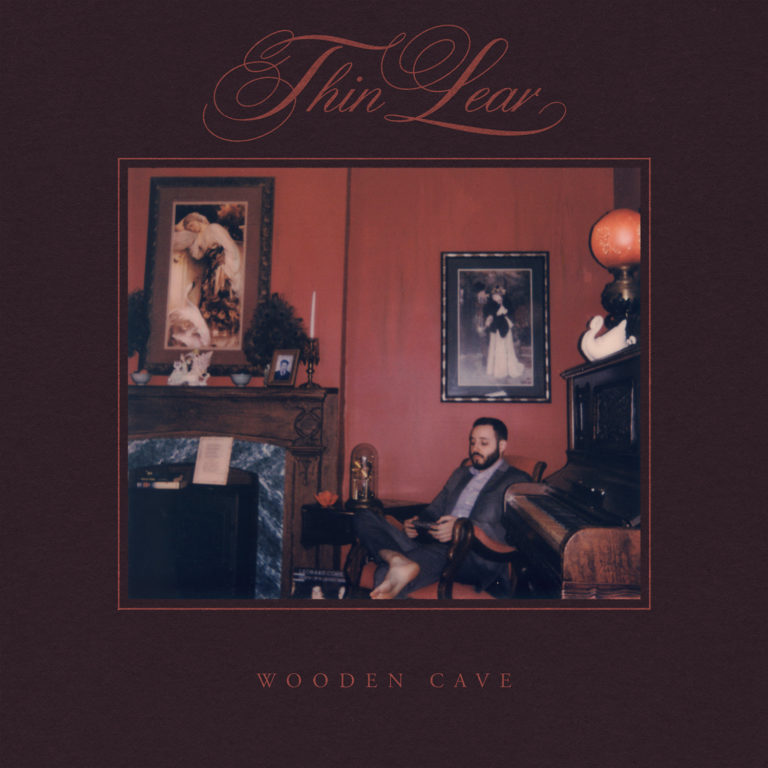
Thin Lear, an indie folk-rock singer-songwriter from Queens, just released his new single “A Simple Phrase” from his debut album Wooden Cave, which will be released on July 24, 2020.
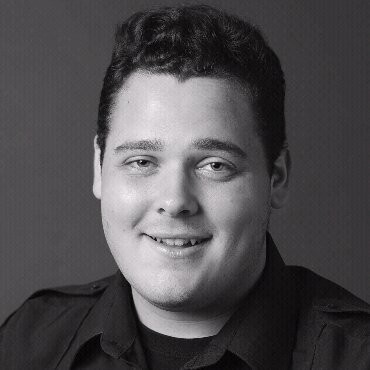
Photo by Shervin Lainez.
This dream-like ballad premiered on GoldFlakePoint, who called it “delicate and hypnotic.” The song is deeply emotional and moving, and the instrumentals deliver this same intensity as well as the lyrics do. The song has a somber tone while still maintaining a beautiful arrangement. This is Thin Lear’s fourth single of this year, and will be featured on his upcoming album Wooden Cave.
The track’s ethereal feel may come from Thin Lear’s inspiration: a dream. “I woke up with the whole thing one day, ideas for arrangement and all,” says Thin Lear, also known as Matt Longo. He expresses that “before [he] slept, [he] was thinking a lot about how insecurity operates,” and when he woke the “chorus was just ringing in [his] ears.” Although the song is about something so upsetting, the instrumentals are hauntingly beautiful, disconnecting the listener from the song’s negativity.
Longo’s inspiration for Wooden Cave came from the story of Netta Fornario, a woman who left all she knew to pursue magic and healing on a small island in Scotland, where she died inexplicably. Longo wanted his album to be “a set of songs existing on a sonic and lyrical island of their own” that would be for outcasts like Netta. He recorded the tracks at different studios around the city with various artists, making each song even more of its own personal island. The album took him two years to complete and has been a complete “labor of love.”
Wooden Cave is set to release on July 24 by EggHunt Records. Preorder the album on Bandcamp here, and follow Thin Lear on Instagram.
One of the greatest blessings we have in life is the ability to use our voice; Shawn Wodraska, a 21-year-old singer/songwriter from the small town of Wingdale, NY recently used his to represent his passion for the Black Lives Matter Movement and overall peace between those with different backgrounds and beliefs.
Shawn took to Facebook to portray a message of hope with a beautiful cover of “If I Can Dream” by Elvis Presley. “As I was scrolling through social media, I noticed that news coverage and posts were almost exclusively negative,” he said, “I decided that I had to do something; we all have to play our role to make a change, so I chose to sing, the only thing I know how to do.”
His video generated an exceptional amount of positive feedback with more than one thousand views. Prior to posting, Shawn said, “I was worried about negativity or that people would think I was using the Black Lives Matter Movement to further my career.” He continued, “I knew I had to do something to play my role in restoring peace, likes and views were the last thing on my mind.”
Philosopher Aleksandr Solzhenitsyn and his belief that “the line between good and evil passes through every human heart” was one of the driving forces in Shawn’s decision to post on social media. “I want to do what I can to help bring peace to all corners of life by inspiring people to find the humanity in who they perceive to be their enemies,” he continued, “I am one voice of the many needed to bring about unity, but it’s important to remember that we are all human and we have to work together.”
https://www.youtube.com/watch?v=9jntQW9XOxQ
The passion inside of Shawn is evident in his original music as well. Although he doesn’t mind if he never makes it big, he said, “I want to use the platform I build to promote positivity. We can always do better. I want to highlight that in my music.”
Typically accompanied by the piano, his content ranges from story-telling folk tunes that draw inspiration from Marty Robins to easy-listening ballads without lyrics. While some of his songs have a theme, many of them are left open to interpretation. “Mediums like music tend to reach people on a spiritual level – there’s a reason why they call it soul – the music we write should be inspirational and bring people together,” he continued, “We can all unite and enjoy a good song, regardless of the differences that polarize us.”
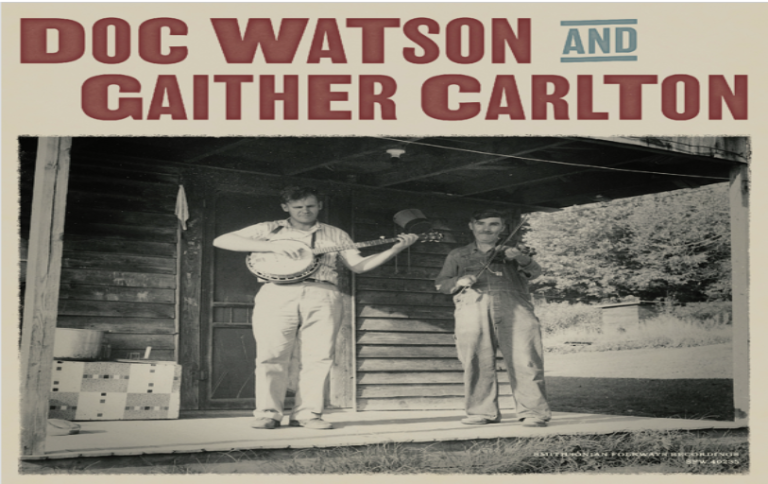
Smithsonian Folkways has released an album of recordings from legendary bluegrass musician Doc Watson and fiddle player Gaither Carlton. The recordings on Watson and Carltoncome from two concerts in New York City in October 1962; one concert at the NYU School of Education and the other at Blind Lemon’s (a folk club in the West Village that was gone the next week).
In the early 1960s, Watson was playing rockabilly tunes on his electric guitar near his home in tiny Deep Gap, NC when he was discovered by folklorist Ralph Rinzler. Watson became known for his heartfelt, powerful singing and the distinctive sound of his acoustic guitar.
Ralph Rinzler set up the concerts as Watson’s debut in New York, but it was a young PeterSiegel, who recorded both concerts in New York. Siegel still lives in New York, and founded the Nonesuch Explorer Series. He went on to produce music with Watson, and other talented artists such as Paul Siebel, Tom Paxton, Roy Buchanan. Peter Siegel shared his thoughts on how Doc Watson influenced future guitarists:
Today there are all these great flatpicking guitarists we know about. Clarence White, Tony Rice, all kinds of people. Billy Strings too now. At that time, nobody had ever heard a folk guitar player play like that! In folk music, the guitar was an accompanying instrument, which was usually strummed in a specific way. So when Doc showed up, it blew my mind. It blew everyone’s mind!
The music that is played on these recordings is not the virtuosic guitar style Watson is known for. Throughout the album are songs like “Double File” and “He’s Coming to Us Dead” that are comprised of the fiddle, guitar, and banjo to demonstrate the roots of Scottish and Irish music.
With divisions across the country on display through peaceful protest and violence, songs of unity and calm are not the first thought, but can provide an escape, even if briefly, giving pause amid the chaos in cities throughout the state and America. One of those songs is “My Sisters and Brothers”
Originally written by Charles Johnson of The Sensational Nightingales, Jerry Garcia Band would perform “My Sisters and Brothers” numerous times from the 1970s through the 1990s, and is featured on Jerry Garcia Band. The version below is the encore of the October 28, 1987 (late) show from the Lunt-Fontanne Theatre in Manhattan.
With his recovery from COVID-19 complete, guitarist Larry Campbell was joined by his wife and creative partner, Teresa Williams, as the pair took to Facebook to perform the upbeat and refreshing “Let Us Get Together Right Down Here.”
Campbell experienced symptoms 43 days prior, but recently tested negative for coronavirus, and is now reunited with Willams at their Upstate home. The two were separated for nearly a month while Campbell was quarantined alone Upstate and Williams remained in New York City.
Campbell says of the experience “This thing is vicious, it doesn’t follow any rules. Be vigilant if you get this and try not to get it,” with Williams adding, “Wear your mask!”
The duo looks forward to playing music again together soon, and hinted at a livestream concert in the near future.
Caffe Lena, the storied venue for folk and indie music in Saratoga Springs will celebrate its 60th anniversary on Thursday, May 21 with festivities adapted for social distancing guidelines.
Early in the day from 12-1pm, a two-part event will include Bonacio Construction’s flatbed trucks as they roll around Saratoga Springs with bands playing music on the back. These artists include gypsy jazz group Hot Club of Saratoga, soul singer Garland Nelson and jam band Let’s Be Leonard on a route that includes Broadway, Lake Avenue, and Circular Street in Saratoga Springs. Attendees are encouraged to park along the route, decorate their cars, and cheer out the window as the parade rides along.
In the evening starting at 7pm, there will be a live stream at CaffeLena.org, featuring stories, songs, and photos from the Caffè Lena community.
The evening broadcast will feature artists such as humorist Christine Lavin, Vermont folk duo Steve Gillette and Cindy Mangsen, celebrated blues guitarist Rory Block, singer-songwriter Don Armstrong and Colorado folksinger John Winn, who joined the venue’s roster in 1960.
“Each of these performers have played the Caffè Lena stage many times and represent the breadth of our programming,” said marketing manager Carolyn Shapiro.
The celebration marks six decades of Caffè Lena, which opened its doors on May 21, 1960. Actress Lena Nargi Spencer opened the doors of a new coffeehouse at 47 Phila Street in Saratoga Springs with a goal to create a venue with a “continental atmosphere,” complete with espresso, folk music, poetry, fine art, and plays.
Artists and curious customers made their way to the top of Lena’s narrow stairs and the venue quickly became an off-the-beaten-path mainstay in the burgeoning world of folk music. Lena passed in 1989, but not before making her venue a landmark.
When COVID-19 collided with Caffè Lena’s spring season, the venue, recognized as the longest continuously operating venue of its type, pivoted almost immediately to an online schedule of “Stay Home Sessions” that have reached thousands of YouTube viewers across the globe with nightly live or pre-recorded performances. Tips donated by viewers have put more than $25,000 into the pockets of these musicians since March 14.
Viewers may make donations during the broadcast to sustain Caffè Lena through the shutdown.
In addition, the nonprofit organization is using the occasion to launch the Lena Legacy Society, a new endowment fund that is expected to grow over the coming years.