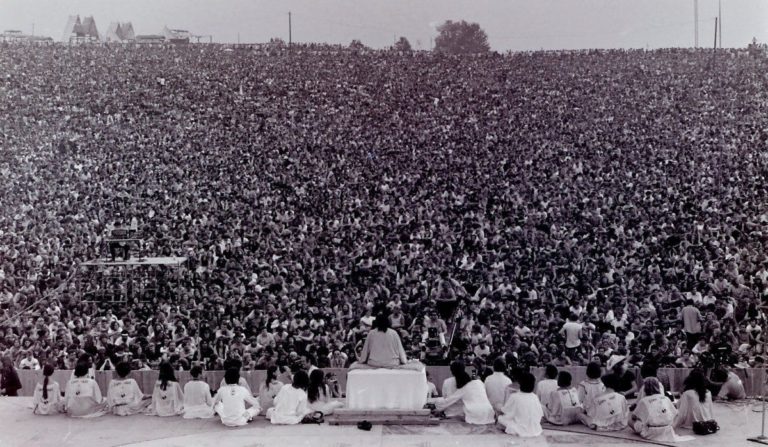
The historic Woodstock Music and Art Festival took place 51 years ago this weekend in Bethel, NY in 1969. Billed as “an Aquarian Exposition: 3 Days of Peace & Music,” promoters Michael Lang and Artie Kornfeld brought together an all-time classic lineup of artists that spanned genres and put an exclamation point on a decade of change.
Much has been written on the festival, and the (pre-COVID) thriving music festival scene in America owes a debt to the original Woodstock, adding a festival (and city name) to our collective lexicon and providing a template by which to measure all future music festivals.
With today marking the anniversary of the first day of Woodstock, revisit performances from the eight artists who took the stage, including Richie Havens, who hurriedly took to the stage when Sweetwater was held up arriving to the site by helicopter.
When asked by Lang to perform earlier than planned, Havens was initially resistant, thinking that he couldn’t get ready in time. With encouragement from John Morris, and learning that Tim Hardin was “scared shitless” to open the festival, Havens laughed and said,
What can I say? OK, give me a couple minutes to get ready and to round up the rest of the group. I’ll do it.
Richie Havens
The stage crew was alerted and at 5:01pm, and once sound was set, Morris strode to the stage and announced,
Well, it’s time for the music to begin. Let’s welcome, Mr. Richie Havens”
John Morris
And with that, the greatest music festival ever was off and running into the history books. Watch a performance from each of the eight artists who performed at Woodstock on August 15, 1969
Richie Havens
Sweetwater
Bert Sommer
https://www.youtube.com/watch?v=CA-NPCq_Jd8
Tim Hardin
Ravi Shankar
Melanie
https://www.youtube.com/watch?v=Qr2l9inAryQ
Arlo Guthrie
Joan Baez
Watch performances from every Woodstock artist with our full playlist
Follow The Light virtual music festival was announced by We Banjo 3 in celebration of Irish traditions. The festival will take place on August 29, 2020 at 5PM EST. Festival Tickets, Artist Meet & Greets and Exclusive Festival Merchandise are on Sale Now at We Banjo 3’s website.
Follow The Light virtual music festival will work as an ode to the We Banjo 3’s Irish heritage. The festival will feature an evening of musical performances by Gaelic Storm, Sharon Shannon, Nathan Carter and The East Pointers, on top of We Banjo 3. The festival will also host non-music features throughout the evening.
We Banjo 3 debuted in the U.S. in 2012 and are Billboard Bluegrass chart-toppers. We Banjo 3 create a fusion of shared and varied traditions of Americana, Bluegrass, and Celtic music with pop-sensible songcraft to create a unique signature sound. The quartet is made up of Ireland and Nashville sounds and is composed of two sets of brothers Enda & Fergal Scahill and Martin & David Howley.
We Banjo 3 has deep-dived into exploring alternatives to physically taking the stage due to the COVID-19 pandemic. They find connecting with fans through various online performances, fan Q&A’s, live interviews, poetry and book excerpt readings, general banter about topics of interest, and more, gives them a personalized approach to creating fan experiences. Their hope with Follow The Light is to create this immersive experience to a wider audience while shedding the light to the rich Irish culture that they were founded upon.
https://youtu.be/qc9GvnGR3wc
General Admission Tickets, Artist Meet & Greets Upgrades, and Festival Ticket/Exclusive Merchandise bundles are available now on We Banjo 3’s website. The ticket purchase will give the buyer access to the stream for the festival. The stream will be supported on Chromecast, Apple TV, Amazon Fire Stick.
https://youtu.be/YzdNABunUvk
For more information on the Follow The Light Virtual Music Festival visit We Banjo 3’s website.
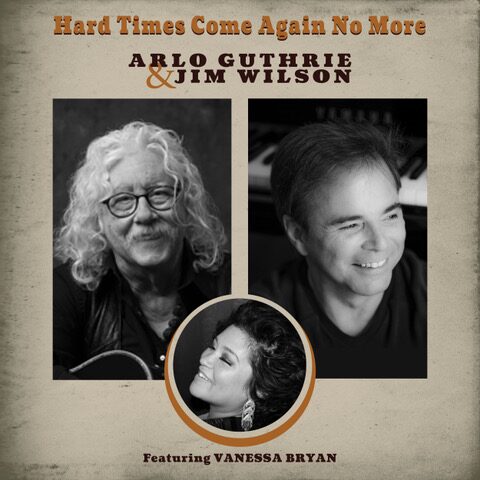
Protest-folk music icon of the sixties, Arlo Guthrie, collaborated with Solo Pianist, Jim Wilson, to release, “Hard Times Come Again No More.”
Arlo Guthrie, Jim Wilson and Vanessa Bryan create a stunning, folk rendition of, “Hard Times No More.”
The single is a rendition of the Stephen Collins Foster Song, which originated in 1854. The original was Foster’s, “empathetic look at the increasingly dire, pre-Civil War world around him,” according to Rolling Stone.
Guthrie has been a staple for the political movement in music since the 1960s. His idea came from the current state of the world. The global pandemic and the Black Lives Matter Movement inspired him to create this rendition. He wanted to remind everyone to pay attention and to help everyone to be equal as one.
“I grew up in a family that cared about the hardships of others. My father was well known for writing and performing songs to offer hope. ‘Hard Times Come Again No More’ resonates with me, and I know it did as well with Woody. Though it was first released around 1900, the message endures with the calamities of today being utterly unjustifiable. We must come together not only as a country, but all across the globe in this dire moment.”
Arlo Guthrie
Guthrie and Wilson collaborated remotely due to COVID-19. They have never met. but this didn’t stop them from creating a beautiful tune.
Along with Guthrie and Wilson, many musicians, like Vanessa Bryan and Stanley Clarke came together for this rendition.
Together, the musicians composed a touching outlook on why everyone needs to unite in hard times, such as these.
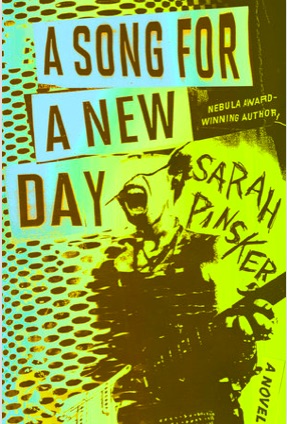
If anyone can lay claim to the title of “Rock and Roll Nostradamus,” it’s Sarah Pinsker. Born in New York City and a present-day driver of the fertile culture scene in hip Baltimore, Pinsker is a true multi-hyphenate. First off, she’s a singer/songwriter who has released a number of noteworthy albums with her band, Stalking Horses. More prominently, she can now lay claim to being the hottest rising star in the world of science fiction, whose eerily prescient debut novel, A Song for A New Day, just won the milieu’s highest honor, The Nebula Award, putting her in the company of legends like Isaac Asimov, Arthur C. Clarke, Ursula Le Guin, William Gibson and Neil Gaiman.
I stumbled across Pinsker’s book right as it came out in September 2019, drawn by the cool cover art, her background as a musician and its seemingly far-off but maybe too near premise, one steeped in the world of indie music making, technology and, one of my guilty pleasures, future dystopia!
In Pinsker’s novel, a deadly virus/pandemic unleashed by a terror attack that brings society to its knees. All public gatherings are prohibited for two decades, and everyone hunkers down quarantined in their homes, working and entertaining themselves via VR-equipped hoodies, and receiving most of their necessaries via drone from one mega corp. As gatherings are banned, so, too, are live musical performances. But, don’t worry, there are still shows, not in crowded bar and venues but streamed hologram performances of only the most visually appealing of acts coming from the HQ of mega promoter, StreamHoloLive, straight into your hoodie.
Starting to sound familiar yet?
Pinsker’s novel revolves around two women. First is Luce Cannon, an emerging indie artist on the cusp of a big mainstream breakthrough when the virus takes down the world (best character name for a rocker ever, right?). Then there is Rosemary Laws, a 20-something woman who doesn’t remember the time before the fictional quarantine who becomes a roving A&R person for StreamHoloLive. Her mission? To infiltrate the small underground network of clubs that still run live shows, illegally and until they are busted, to find new talent to holo-stream.
Musicians will love this book because it’s written by one of her own. Pinsker is someone who brings spot-on descriptions to the power of a kick drum, a power chord and the day-to-day lives of musicians, especially those who are scuffling to create and survive in both the old IRL and the new post-performance world.
How did Pinsker go from indie rocker to sci-fi darling? What commonalities does she see in her two creative lives? NYS Music gave Pinsker the chance to elaborate in the following Q&A.
Author and musician Sarah Pinsker
Sal Cataldi: I understand your debut novel, A Song for A New Day, is an elaboration of a novelette you wrote five years back. What, from what you have witnessed as a musician and as someone who reads the headlines, made you conjure such a premise?
Sarah Pinsker: My memory of the seed for the initial novelette was that I had passed the “Our Lady of the Highways” shrine on I-95 again, and I was thinking about all of my touring friends who had written songs based on that lovely title. I think I had “Our Lady of the Open Road” before I had a story, and then I started thinking about a band on the road long after everyone else had exited that life, and what would have put a stop to it. I worked backward from there, thinking about the things that might be societal roadblocks, and the technological advances that would reinforce the changes.
SC: How does it feel to be the woman who predicted our socially distanced, outlawed gathering present? How did it feel when you started to see this fantasy of yours beginning to come true in headlines?
SP: Most near fiction SF writers I know don’t set out to be predictive, so it’s a dubious celebration. I’d wanted to talk about things I *didn’t* want to see come true, and head them off at the pass. When people ask how I got so close in my “predictions,” it just feels like common sense to me. Humans are sadly predictable.
It’s been frustrating to see people say that my book is anti-social distancing. It doesn’t glorify flouting restrictions on gatherings during a pandemic; the problem in the book is that the country stays that way long after the threats are gone. I think there are opportunities right now to create a new and better normal, but we also have to do active work to make sure that we still have music and arts and venues when all of this is past.
SC: How much of you is in the Luce character?
SP: Hers is an easy voice for me to write, but she’s not me. She’s an amalgam of a whole bunch of musicians I adore. I guess the part of her that’s me is the way she feels on stage; I took that from my own experience. And I guess I tend to be skeptical of new technologies.
SC: Sounds like you’re a diehard DIY indie musician. What’s the worst part of the corporate music business that is in this book, and actually just out in the world as a musician. Seems like MTV on steroids, with the accent on looks.
SP: I think I’d spoil the book in saying what I think are the worst parts of the corporate music business I wrote. If you look at what’s happening right now, the corporate venues will get loans, the arenas will make it, but the small clubs are drowning. Big musicians are doing fine, but the indies who depend on touring are struggling, as are the musicians who play senior centers and restaurants and libraries, and the people who run sound, the roadies and techs, the indie venue owners and staff… Some of my friends are doing online shows with tip jars, which is actually an opportunity to reach their largest audiences ever, but I can still easily see that access getting throttled. There are already corporations looking to take advantage of this situation, even while musicians try to do their best to survive. In the best of times it’s difficult to make a living at music, and it doesn’t need to be that way, but the system is set up to elevate a very small percentage of the musicians out there and not necessarily to make access easier for all.
SC: Now that we are in the midst of a streaming music present, what do you think about it? Any artists that particularly inspire you in what they are doing in the medium? Like your character, do you lament the loss of live performance?
SP: Right at this moment, I am extremely grateful for the musicians who are streaming shows (and the theaters, and the museums, and the national park cams…) It’s not like in my book, in that we are still in the moment where this is necessary and appreciated. I like clicking into a show and seeing people I know are also there in the comments. I like sitting on my porch at sunset and listening to musicians I adore.
There’s a folk musician named Susan Werner who has been playing Sunday night shows online. Sometimes she invites friends, sometimes she has a theme, but she’s always been good at mixing a fun stage presence and quick wit with her songs. She often has a sponsor or a charity getting some of the money, and donations/tip jar are encouraged but not mandatory.
A lot of folk and acoustic musicians are doing similar things. Rufus Wainwright was doing a song a day in his bathrobe — I haven’t checked in a few weeks to see if he’s still going. LEA, thisislea on most sites, is a DC-area musician who always did cool community-oriented stuff. I played at an album release of hers a few years ago, where she invited people to play a song of theirs that was in conversation with a song of hers, and then she would play the connected song. She’s done some virtual choir stuff since this started. I’ve seen some Baltimore bands like Gingerwitch and Manners Manners and Santa Librada do triple bills online where each band does a set, and at the end gives you the address to find the next set. And I know a couple of venues here have offered to open for a band to record a show without an audience.
So yes, I think musicians are making the best of it, and while I lament the loss of live performance where I’m in the room where it happens, these shows are still special and appreciated. They feel intimate, and I love seeing some of these performers that I haven’t had a chance to see in a long time, either because schedules don’t align, or they haven’t been touring in my area.
SC: Which came first, your music or your writing career? Tell us a bit about both, and how they inform each other.
SP: Career-wise, music, though I had written and submitted short stories for publication before that. They’re both forms of storytelling to me, with their own advantages and disadvantages and tropes to explore. In my twenties my stories got shorter and shorter, and I found myself telling stories in song form. I loved the immediacy of playing, and the collaborative nature of performance; even when you’re on stage alone, you’re engaged in a conversation with your audience. I can’t say why I switched horses back to fiction at the moment I did. I struggle a little with doing both at the same time, so my music has suffered for my success in fiction. I have a fourth album completed that I really need to get out into the world, but that just feels like too much.
SC: Who are your three big inspirations in each of these areas?
SP: I hate answering those questions, because I always feel like for every name I mention, there are a hundred more. In fiction, I guess I’d say Ursula K. Le Guin, Octavia Butler, and Karen Joy Fowler, in terms of the way reading their fiction makes me want to up my game. In music? Argh. Um, I’ll just name one. My friend SONiA, from the band disappear fear, has been my model for what an ethical life in music looks like from the beginning. She’s a wonderful songwriter, a dynamic performer, and she’s comfortable with a band or solo and with adapting songs to both.
SC: You just received the Nebula Award for the book, which is the highest honor in science fiction. Did you at all expect it? What does it mean to your future as a writer? Are you the first musician/writer to win?
SP: I didn’t actually expect to win the Nebula. There were amazing books on the list, and I had assumed that one of those books was going to win. Getting onto finalist lists is always a tremendous honor in itself, and I don’t think it’s ever healthy to assume the top honor is yours, so I like to choose a book to root for that isn’t my own. That way, I’m happy if they win and surprised if I do. I think there have actually been other musicians who have won — Nicola Griffith and Catherine Asaro, among others, I believe.
SC: As an expert prognosticator and musician, what do you think the future holds for indie musicians and live music venues? Will this ever go back to what it was, or will there be a new normal based somewhat on what you created?
SP: I’m not an expert prognosticator, but I think what the future holds will very much depend on what we do right now. We should be helping venues pay their rent while they are closed, so they still exist when this is over. We should be giving basic income to everyone to encourage people who can stay home to stay home and allow those who can’t to do their jobs more safely. If we do those things now, we’ll have venues when this moment is over.
I do think there’s a lot we can learn from this, and there are things I’d like to see in a new normal.
There’s an accessibility in this moment: people who use wheelchairs and couldn’t get down the steps into basement venues get to see bands. Ditto people who couldn’t afford big ticket prices or didn’t have a way to get to a show, or didn’t have childcare, or whose health is too fragile even when we’re not in a pandemic to risk being in a crowd. We can definitely come back to a mix of both if we choose to.
We can encourage seeking out smaller bands, who may be playing to smaller crowds, rather than giant stadiums. We can normalize staying home when you’re sick, and we can normalize wearing a mask in a crowd if that’s what it takes to bring back live music. Music is about community, and we can continue to forefront that community-mindedness. But above all, we need to help musicians and techs and venues weather this with actual financial help, as they have in other countries. I’d rather wait longer in order to come back safely than rush it and risk the health of everyone involved, no matter how much I’d like to go to shows again.
Taylor Swift announced her new album, Folklore, to be released at midnight on July 24. This comes as a surprise to virtually everyone: no one, including her fanbase (the Swifties) who are known for their outlandish conspiracy theories, expected the move, and nothing leaked ahead of time. Folklore is arriving less than a year after Taylor Swift’s last album Lover, breaking her schedule of releasing an album every two to three years.
Surprise 🤗 Tonight at midnight I’ll be releasing my 8th studio album, folklore; an entire brand new album of songs I’ve poured all of my whims, dreams, fears, and musings into. Pre-order at https://t.co/zSHpnhUlLbpic.twitter.com/4ZVGy4l23b
Although her last three efforts have been fully pop, Folklore appears to be taking a more acoustic direction. Whereas Lover’s color scheme was pastel pink and blue with fantastical Wonka-esque music videos, all of Folklore’s visuals are black-and-white. The album’s only featured artist is Bon Iver on the song “Exile,” and Aaron Dessner of The National co-wrote 11 out of 16 songs.
Taylor Swift previously explored a stripped-back folk sound on “Safe and Sound,” her single with The Civil Wars for the first Hunger Games soundtrack in 2012, as well as on her album Red released later that year. Fans have begged for a Stevie Nicks or Joni Mitchell-inspired album for years, and they may have finally gotten their wish. While not a New York native, Taylor Swift moved to the city before the release of 1989 in 2014. That album’s opening song was “Welcome To New York,” and she revisited the city on Lover’s “Cornelia Street” and “Daylight.”
While Folklore hasn’t had an accompanying lead single announcement, Taylor Swift is releasing a music video for the song “Cardigan” alongside the album. There are eight collectible CD and vinyl covers in total, reminiscent of the four different diaries she released alongside Lover last year.
The music video for “cardigan” will premiere tonight, which I wrote/directed. A million thank you’s to my brilliant, bad ass video team – Cinematographer Rodrigo Prieto, producer Jil Hardin, executive producer Rebecca Skinner, AD Joe ‘Oz’ Osbourne pic.twitter.com/2hNXnzFbwY
Taylor Swifts’s last six albums, including Red and 1989, all debuted at #1 on the Billboard 200 chart. This time around, she’s facing competition from longtime rival Kanye West, who’s also releasing an album this week called Donda: With Child. Folklore has already sold 250,000 copies in China, and time will tell if she continues her #1 streak in the U.S.
For more information visit Taylor Swift’s website.
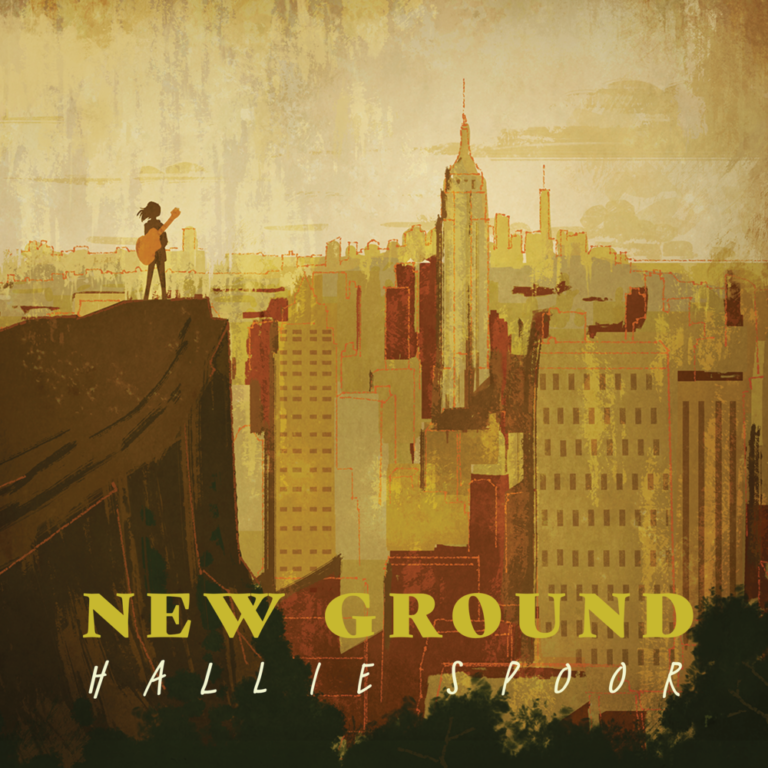
Spoor’s song “City Angels,” promotes a feel good attitude, during a time that many of us are struggling emotionally because of the pandemic.
“The idea I had was that during this time of isolation and separation, I thought we could use more joy,” Spoor said.
Growing up in Denver, the young musician is now based out of Brooklyn. She has played at several famous music venues like, Sunny’s Bar in Red Hook and Rockwood Music Hall.
Spoor completed her first national tour last fall through playing small performances in unique locations with the well known music events start-up, Sofar Sounds.
Spoor’s website describes her as an “old soul,” who possesses similar sounds to Joni Mitchell. That part of her personality comes out in the music video where she created a collage of pictures and video clips sent to her by friends and family. The collage promotes memories and a cheerful outlook on life in the city.
According to her Youtube page, Spoor wrote “City Angels,” after experiencing a lonely day in NYC. Her mood changed after running into a few, “New York characters.”
“All these very human moments made me feel like I might belong after all. So, this video is dedicated to them- the city angels that make us feel like we’re home in this exciting, scary, beautiful place called New York,” Spoor wrote.
Hallie Spoor asked her friends and family to send her nostalgic pictures and video clips.
Upstate’s new live EP, Live at ArtsRiot is the quarantine album we all need right now. This group, formerly known as Upstate Rubdown, has soared through the Hudson Valley region since their debut release in 2015, and in an effort to cure our isolation blues, they have released this live EP to bring us back to the comforting clamor of live shows.
This new release is familiar territory, featuring four songs from their 2019 studio album Healing. The new EP promises the same tight vocal harmonies, intricate lyrics, tight rhythmic strumming, and swirling energy from the first release of these songs. What you may not expect from Live at ArtsRiot is its production value – besides the excellent mixing and mastering, this live performance has eight performers, each with an interesting color to weave in and out of this picture. One of the best examples can be heard in “Who Knows”. The album version tends to rely on the folk-timbred acoustic guitar and standup bass, but the live version is daring in its switch to electric. In one song, a group that was once under the folk umbrella becomes a southern blues band. In the final song of the Live EP “Healing”, the band ditches the honky tonk-style piano solo and tosses in a keyboard for the solo section, marrying folk with almost a jam band timbre to support the blazing sax solo and keep the energy trailing right until the end of the performance.
More than its musical intricacies, this live EP is a reminder of the comradery needed to put on a great show. In addition to having top notch songs, this band has a responsive following, which you can hear cheering throughout the entire EP. The vocalists have audible excitement in their voices, and with so many musicians on stage, you’re able to hear the push and pull of instruments to provide a strong and creative backdrop for the tight vocal harmonies that push centerfold. This is a sound you can only get from a live show, and with performances few and far between these days, we can’t help but thank Upstate for reminding us of the live show vibes we miss so much.
p.s., Upstate is headed to Rochester on October 16, and will hopefully visit ArtsRiot again this year, but check their website and Facebook to be sure.
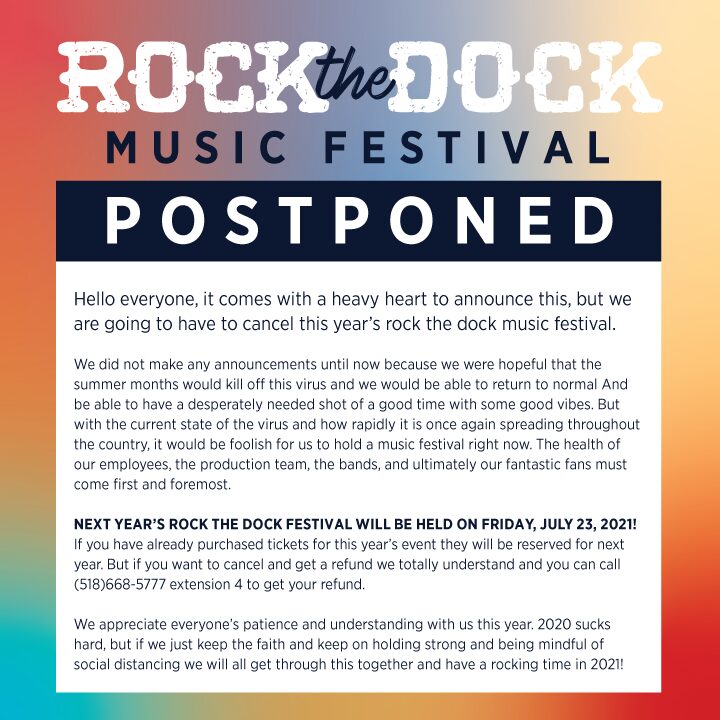
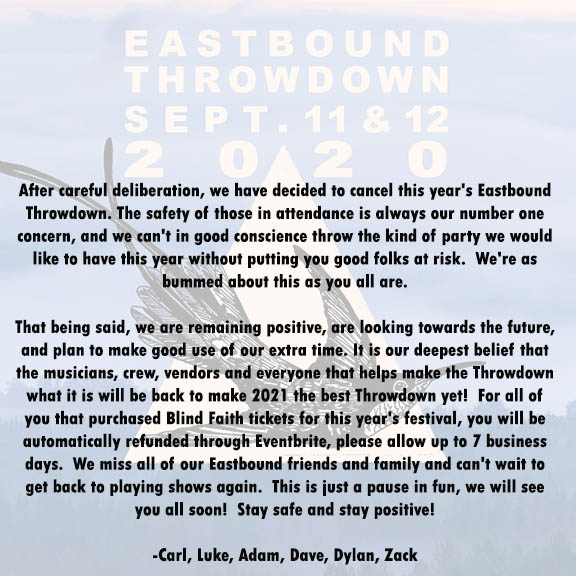
Two beloved music festivals in the 518 will not return until 2021 due to COVID-19. Rock the Dock, held in Lake George, and Eastbound Throwdown, held in Salem, have each postponed their scheduled events until next year
Originally scheduled for July 17, then rescheduled for August 14, the festival was looking forward to their fourth year at Lake George Steamboat Company, but have made plans for July 23, 2021 to hold the annual event.
Founded by Formula 5 in 2017 as a way to celebrate the 200th anniversary of the Lake George Steamboat Company, the band played their final show on July 12, 2019 at Rock the Dock. The festival hosts regional and national acts with a stage on the pier of the Lake George Steamboat Company, with three steamboats framing the event.
Keyboardist Matt Richards of Formula 5 was slated to return with Annie in the Water for this year’s installment, but that will have to wait another year. Other announced artists included Dogs in a Pile, Raisinhead, and Big Time Kitty.
Eastbound Throwdown, hosted by beloved Northern rock outfit Eastbound Jesus, was scheduled to take place September 11-12, 2020. New dates have not been announced, and only Eastbound Jesus was announced for the lineup this year. Past lineups have included The Mallett Brothers Band, Girl Blue, Driftwood, Formula 5, The Ghost of Paul Revere, among many others.
For the past 18 years the Northwest String Summit has been a festival catering to all things string. Country, folk and bluegrass artists, well-known and just discovered, would descend upon Horning’s Hideout. Festival-goers can listen to the music and enjoyed a myriad of activities including but not limited to arts and crafts, glamping, yoga, and instrument building.
Unfortunately, COVID-19 has created the conditions in which having a traditional festival would be dangerous. In the interest of public safety, the event has closed its on-site activities. Even though the physical festival is no longer possible, the lockdown has not stifled the creativity of the artists that were slated to attend the summit this year.
To connect fans to artists, the Northwest String Summit has gone virtual.
Over 28 different artists will be streaming their performances live or remote this July 17-19 on LiveXLive. Archival footage spanning the history of the event will be sprinkled in-between sets. Thirty hours of never-seen-before footage will be shown. All of the proceeds will go back to the artists, crew, and industry. The Early Bird special pricing of $29.99 will be available until July 7 for this three-night event.
Check out this stream and more through our series NY Stream and Support. You’ll discover artists around the Empire State streaming nightly, with ways to support musicians and charitable groups close to home!
WEQX has long been the preeminent independent station in the Capital Region of New York, broadcasting from Southern VT to a ever-expanding listening audience. Each Sunday evening from 7-9pm on 102.7 FM, you’ll find EQXposure on WEQX, featuring two hours of local music from up and coming artists. NYS Music will bring you a preview of artists to discover each week, just a taste of the talent waiting to be discovered by fans like you.
Warden & Company is a three piece band from Saratoga made up of Seth Warden, Doug Moody, and Brian Melick. They have been playing together since 2011, having started off as the backing band for local Irish music legend Kevin McKrell. The trio have also performed together as Seth and the Moody Melix, playing children’s songs written by Warden who is also a teacher. Warden & Company showcases the trio’s more ‘adult’ sound.
Jay was born and raised in Vermont and currently lives in Burlington. He says he’s been a fan of EQX since he was a teenager. “Grow Again” is his latest single, find him on Facebook and listen to more of his songs on Soundcloud.This is his latest.