Sure to delight English teachers everywhere, Taylor Swift has released a literary analysis of her “Cardigan” music video. A Vevo Footnotes exclusive, the singer long known for her hidden Easter eggs revealed them all at once. She also shared how she prevented the song from leaking, a rare feat for a pop star of her stature.
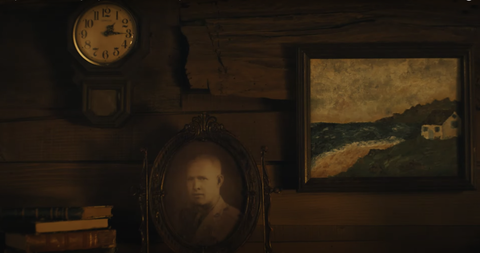
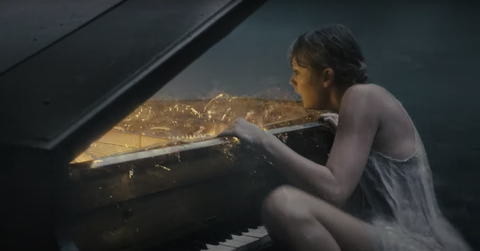
The video begins in a dark cottage, with Swift sitting at a piano containing a C. S. Lewis-style magical woodland inside. Two pictures are hanging on the cottage walls, both of which she explained to Vevo Footnotes. The man in the photograph on the left is her grandfather, Dean, who landed on the beaches at the Battle of Guadalcanal in World War II. Later on in the album, Taylor tells his story on “Epiphany.” As for the painting of a white house on the right, Swift worked on it herself in the first week of quarantine. Also, the clock’s hands point to 1 and 3, representing her famed lucky number, 13.
Swift wrote and directed the video herself, playing the song solely through an earpiece so the crew wouldn’t be able to hear it during filming. Highly discreet about the entire project, she didn’t add the “folklore” logo to the central piano’s fallboard until release day via special effects.
Speaking on the album as a whole, Taylor said, “I view Folklore as wistful and full of escapism. Sad, beautiful, tragic. Like a photo album full of imagery, and all the stories behind that imagery.” Of course, “Sad, Beautiful, Tragic” is also a song from her 2012 album Red.
In addition to spilling the secrets of “Cardigan,” Taylor released a lyric video for Folklore’s bonus track, “The Lakes.” The song references Romantic poet William Wordsworth, and partially grapples with being a public figure in the social media age. The themes and lyrics mirror those explored in her 2017 Reputation album, except softer and less embittered.
“Cardigan” is the first single off of Swift’s eighth studio album Folklore. Both the single and album debuted at #1 on the Billboard charts to critical acclaim, with praise citing their lyricism, atmosphere, and mature direction. Folklore, including “The Lakes,” is now available for streaming on Spotify and Apple Music.
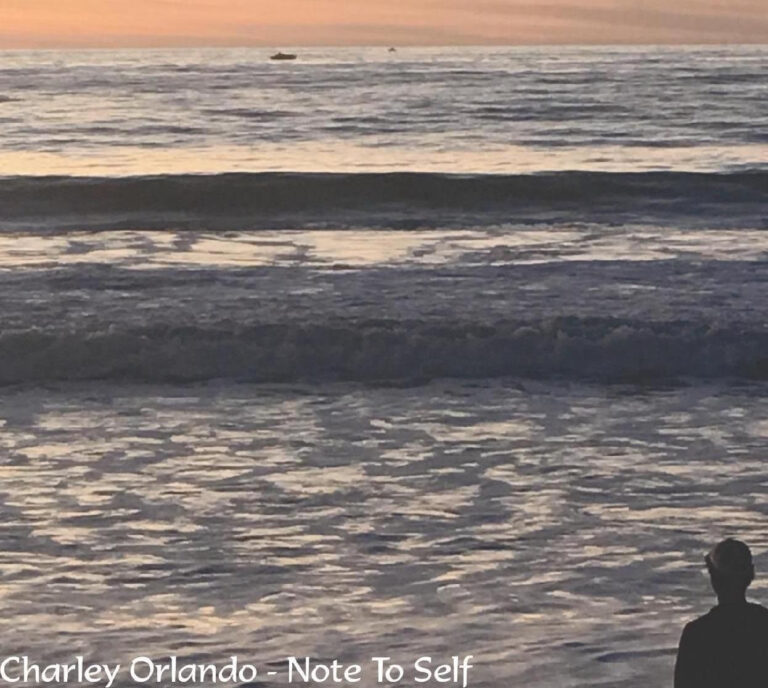
Syracuse‘s Charley Orlando will release his newest album, Note to Self on October 30. The songs on the album reflect the last eight years of Orlando’s life through music.
The origins of Note To Self are found in 2013, when Orlando stopped touring as a musician and became a talent buyer in Syracuse. Without touring to back up releases, he was dropped from his record label and stopping playing and writing music for a bit.
Orlando recorded the audio for Note To Self in 2019, then in April and May of 2020 he recorded new versions of each song live on video, with a 2020 mind set. The result: a video album and audio album that have different takes on the same songs. Videos are released weekly, one song at a time, with the full album available on October 30.
“Ascent” started its life under a different name. I was asked to write by my buddy Big Daddy who was deep into the 99% movement, one that I believe in. So I wrote the tune for that situation but while I was on tour.
I pulled off the side of the road in NoCal in the redwoods and wrote the tune and did a little video on my phone and sent it off to him. I hadn’t played the song since it was written and I came across it one day and thought “this one fits today with a little work.” So I rewrote some lyrics and it became “Ascent.”
Charley Orlando
“River Rollin’” is a brand new song. I needed a happy tune at the time and that is what popped out. It’s an everyday life song to make me smile
Charley Orlando
“Take Cover” was written right after POTUS was elected in 2016 but it wasn’t a finished product until the album really. Basically it’s a plea for all of us to stop beating up on each other so hard.
Charley Orlando
Orlando’s latest videos, “All it Can Be,” “Torch” and “Surreal” have just been released.
“All it Can Be” is a mellow tune that deals with the grey areas that use to exist being more black and white than ever.
Charley Orlando
On “Torch,” I wanted a kicking bluegrassy tune in there so I whipped up this tune. It’s folk by nature but designed to be up and fun.
Charley Orlando
This tune just materialized out of the air and I grabbed it and gave it some form. It was a surreal moment while writing this song so I gave it that name. Sometimes things are that simple. Enjoy!
Premiering on October 2, “Pure Sunshine” is the first of Orlando’s videos in color. “I made a point of making all my videos for this album in black and white to get the point across that the grey area is gone!” Orlando wrote this song three years ago following his father’s passing. “He was the biggest influence in my life and this song was my way of continuing the conversation with him in song.”
“Note to Self” is the title Track and final song that Charley shares in advance of the release of Note to Self.
It is my most honest song about emotion and depression that can sneak into all of our lives over various events or moments that are just really hard to shake. It made me breathe easier once I wrote this song. I truly hope it works the same for everyone else.
Note To Self was recorded at Lion’s Den in Memphis, NY by Brian Lauri, produced by Charley Orlando, and mixed and mastered by Andrew Graecen at Moresound in Syracuse. Pre-save the album here
Jimkata, to the excitement of their fans, debuted their new single “Wait For You” on August 13, 2020. The band recently came out of the woodworks last month dropping their single “Wanna Go” after the band went on an indefinite hiatus back in 2017.
The new single focuses on the feeling of being in limbo. It narrates the feeling of sitting around waiting and feeling restless while navigating uncertainty which is a feeling many can relate to during the pandemic era. The music video accompanying the song was created by animator Ben Clarkson. His animation brings further depth and dimension to the notion of waiting and being in limbo. “Wait For You” isn’t just a heartbreak inspired pop song, it is also a commentary on helplessly waiting and hoping for the world to get itself together.
Frontman of Jimkata Evan Friedell shared some of his insights behind the new single saying, “I didn’t realize at the time I wrote it how prescient and universal that feeling would become as we experience a global pandemic and a world in chaos.”
The band Jimkata is a three-piece anthemic, synth-washed, electro-rock band that is based out of Ithaca, NY and Los Angeles, CA. Jimkata is known for their swirling analog synths, infectious pop hooks and candid lyrics. The band has built a distinct sound which has been resonating with listeners across the country. The band has a strong and loyal grassroots fanbase created by their relentless performing across the country before their Hiatus.
For more information on Jimkata and to check out “Wait For You” visit their website.
Even now, 51 years to the day, the performance by Grateful Dead at the legendary Woodstock Music Festival still leaves a mark. Although, for a variety of reasons, it’s a mark that the band and any eyewitnesses that evening may not wish to remember fondly. Weather, electrical and all the other ever-sprouting issues that arose during Woodstock all played factors that resulted in what many deem a less than memorable performance put forth by the Western newcomers that many had heard of but few had seen before.
Due to scheduling issues and incessant rain, the band’s set on August 16, 1969 had already been pushed back from Saturday late afternoon to a 10:30 pm start time. By then, rain and the resulting mud had conquered the Bethel, NY festival grounds. The giant throng of spectators splayed across the hillside were getting soaked and restless waiting for the next act to start. Up until this point, the Grateful Dead were still only a band “on the rise” that was very much new to an East Coast crowd, by and large.
The inauspicious start began when the band’s notoriously heavy gear caused the rotating stage that was being used to sink completely into the mud – something they had warned the event staff about beforehand. Phil Lesh’s bass monitor was somehow picking up the on-site helicopter’s radio signal. And the Dead’s sound technician, Owsley “Bear” Stanley, was making alterations to what he considered an inadequate in-house PA system. It resulted in him improperly grounding the stage equipment and giving new meaning to the term “electric rock.”
Band members recall feeling a “light tingle” whenever they would touch their instruments. This all culminated with a now famous story about guitarist Bob Weir being thrown across the stage, supposedly during the “Saint Stephen” that began the show.
It was raining toads when we played. The rain was part of our nightmare. The other part was our sound man, who decided that the ground situation on the stage was all wrong. It took him about two hours to change it, which held up the show. He finally got it set the way he wanted it, but every time I touched my instrument, I got a shock. The stage was wet, and the electricity was coming through me. I was conducting! Touching my guitar and the microphone was nearly fatal. There was a great big blue spark about the size of a baseball, and I got lifted off my feet and sent back eight or 10 feet to my amplifier.
~ Bob Weir, Rolling Stone interview
Audio recordings only contain the first two minutes of the opening number, likely a result of this mishap. Things immediately lighten up a little afterwards with “Mama Tried,” a Merle Haggard song that the Dead had started covering earlier that year.
The awkward start-and-stop rhythm of the show then rears its ugly head again thanks to another ten minutes of delay in order to deal with the sound setup. A “spirited” Ken Babbs from the Merry Pranksters takes to the MC role during this part of the show as he tries his best to entertain a crowd of hippies growing increasingly damp and restless. This also gives Country Joe McDonald the chance to pop up onstage and warn everyone about the “green acid” that was going around.
After all the sound issues are resolved, the band launches into a moody “Dark Star” that serves as one of the musical highlights of the night. The near 20-minute rendition stretches out and descends into near ambience before rounding back into form. It features wonderful fills and textures provided by early keys player Tom Constanten who seems to be turned up abnormally high in this recording.
Once the “Dark Star” burned out, the band trotted out another new number with “High Time” – a sentiment that was no doubt shared by many this evening. Garcia’s vocals come through aptly but this isn’t exactly a song to get a crowd up and dancing. The slow, drab composition seemed to be reflective of the current atmosphere.
The band seems to cut their losses and ends theit set with a “Turn On Your Lovelight” that stretches out to almost 40 minutes. However,it starts with even more mayhem thanks to another “spirited” individual who jumps on stage and exclaims to everyone about “seeing the sun rise over the lake” and a “third Coast.” All this while the band is quietly playing the instrumental open to the song underneath it all.
While it does seem to finally inject some life into the set, not even a Pigpen rap would be enough to save this show. The extensive jam meanders and shifts from pscychedelia to blues and back with little direction in between. It marked the end of a set that had high hopes at first but falls flat in its delivery thanks to the weather, sound issues, lucid ramblings from MCs and stage crashers alike, and one of the guitarists getting visibly electrocuted on stage.
Grateful Dead Woodstock Music Festival Bethel, NY 8/16/69 St. Stephen (cut), Mama Tried -> High Time (false start), Dark Star ->High Time, Turn On Your Love Light
Jazz at Chautauqua is held periodically and in 2016 hosted Wynton Marsalis and Jazz at Lincoln Center during one week of the nine-week long program.
Located in southwestern New York, near the Pennsylvania border, Chautauqua Lake is home to the Chautauqua Institution. There, a blend of arts programming, educational and religious opportunities and recreational activities are available to those who visit the grounds during the year.
The Institution, originally the Chautauqua Lake Sunday School Assembly, was founded in 1874 as an educational experiment in out-of-school, vacation learning. It was successful and broadened almost immediately beyond courses for Sunday school teachers to include academic subjects, music, art and physical education.
On September 21, 2012, a late-night set with Duke Heitger’s Swing Band at Jazz at Chautauqua featured the amazing voice of singer Rebecca Kilgore. Performing worldwide at jazz festivals, jazz parties, and on jazz cruises, Kilgore has been a frequent guest on National Public Radio’s ‘Fresh Air’ with Terry Gross, has appeared on ‘A Prairie Home Companion,’ and with Michael Feinstein at Carnegie Hall.
Here is Rebecca Kilgore with Dan Block (tenor saxophone), Rossano Sportiello (piano), Frank Tate (string bass) and Pete Siers (drums) performing “I’m Thru with Love” at Jazz at Chautauqua weekend in 2011
The Rebecca Kilgore Quartet (formerly known as BED) was a popular favorite on the jazz festival circuit: with Eddie Erickson (guitar/banjo/voice), Dan Barrett (trombone), and Joel Forbes (bass). Writer Bucky Pizzarelli says of Kilgore, “If Benny Goodman were alive today, he’d hire Becky to sing in his band.”
The next night, September 22, Becky performed “It’s Always You” with Keith Ingham. The 1941 Jimmy Van Heusen/Johnny Burke song from The Road to Zanzibar, was originally sung by Bing Crosby and Dorothy Lamour. Other members of Kilgore’s band include Dan Barrett (trombone), Dan Block (alto saxophone), Scott Robinson (tenor saxophone), Mike Greensill (piano), Howard Alden (guitar), Kerry Lewis (string bass) and Bill Ransom (drums).
And from September 2009, here are Duke Heitger, Andy Schumm, Dan Barrett, Scott Robinson, Bob Reitmeier, Ehud Asherie, Marty Grosz, Frank Tate, and Pete Siers swinging around on “Linger Awhile.”
From Jazz at Chautauqua in September 2009, featuring the late Tom Pletcher (cornet), Dan Barrett (trombone), Bob Reitmeier (clarinet), the late Jim Dapogny (piano), Frank Tate (string bass) and Pete Siers (drums).
From 2014 Jazz at Chautauqau, Kurt Weill performs a gorgeous “September Song” with a trio of Dan Levinson (tenor saxophone), Bob Havens (trombone), and Keith Ingham (piano).
Anyone who can spell the word “guitar” likely knows of the formidable Spaniard of the gut string, Andrés Segovia. But too few know enough about the Brit who cast just a smidge less of a shadow in the world of classical guitar and lute, and maybe a far more progressive one at that. Julian Bream passed away this week at the age of 87.
Bream was regarded as one of the instrument’s most formidable, influential and soulful players, a flawless technician with incomparable tone and technique on guitar and, later, the lute. Unlike the traditionalist Segovia who was his inspiration, Bream worked to push classical guitar beyond its Spanish roots by commissioning dozens of works from major composers like Malcolm Arnold and Benjamin Britten, whose “Nocturnal” (1963) is one of the most popular pieces in the modern guitar repertoire. On the traditionalist front, he was the first to revive major works of Spain’s Fernando Sor and Mauro Giuliani of Italy, two important 19th century guitarist-composers, and to serve as the prime interpreter of the lute works of the legendary John Dowland. His painstaking transcriptions, which are a key parcel of the classical teaching lexicon today, included Bach suites and Scarlatti sonatas, as well as works by Purcell, Cimarosa, Diabelli and Schubert.
Julian Bream: Benjamin Britten’s Noctural
https://www.youtube.com/watch?v=Bk8VfE-Gzoo
Bream’s initial interest in guitar came about not through the classics but the gypsy jazz of Django Reinhardt. After receiving his first gut string guitar from his father on his 11th birthday, Bream quickly became a child prodigy. He won a guitar competition the following year which enabled him to study at the Royal College of Music (piano not guitar), before making his debut guitar recital one year later in 1947.
By the mid-1950s, Bream’s career was in full swing, with many tours in Europe, Asia, Australia and North America, as well as a busy slate of recordings. Bream has a massive discography on the RCA Victor and EMI Classics labels, recordings which earned him four Grammys among other honors.
What cannot be underestimated is Bream’s impact of reviving interest in that hard to handle, many stringed medieval cousin of the guitar, the lute. Bream took up the Renaissance lute in 1950 in order to play 16 century works by Thomas Morley, John Dowland and other Elizabethan composers. In 1959, he formed the Julian Bream Consort, a string, wind and lute ensemble, to perform and record Elizabethan ensemble music, which he also did in a popular duo partnership with singer Peter Pears. Bream’s success as a lutenist inspired a generation of young musicians, including Paul O’Dette, Stephen Stubbs and Hopkinson Smith, to set aside the modern guitar and concentrate on the lute and other early stringed instruments.
Julian Bream Plays Dowland
Bream’s influence as a musician went far beyond the world of classical music and into the world of rock and jazz, where appreciation of his skill and soul transcended the genre.
One of his most fervent admirers is the astounding Dutch guitarist Jan Akkerman. Voted Best Guitarist in the World in 1973 over Eric Clapton, Jimmy Page, and others by that British bible of rock, Melody Maker, Jan is a man with a wide stylistic discography. He’s perhaps best known for the pioneering shred and yodel classic, “Hocus Pocus,” by his former band Focus.
“I was recording with Focus in Chipping Norton in Oxfordshire and got fed up with the whole scene so I jumped in my car to escape it all,” begins Akkerman. “I wound up in The Tews, in a little village near the Rollright Stones, a beautiful spot in a valley full of 12th Century houses, real Robin Hood style.”
“When I switched on the radio, what I heard was The Julian Bream Consort on BBC1, playing lovely Elizabethan lute music, which really ran my bell,” he continues. “You look at ten Dutch paintings and seven of them will have a lute in them. It really struck a chord with me, emotionally and musically, and I became slavishly devoted to locating old sheet music and practicing the instrument, so much of it the music that Bream performed.”
“At that time, Focus was touring like crazy, so I would bring the lute along with me and woodshed on flights, in limos, like a madman. I used some of Julian’s concepts on my album Tabernakel, but with my own rock-style twist.”
Jan Akkerman – Tabernakel “Brittania” John Dowland
https://www.youtube.com/watch?v=WAUVbzDNYnY
“What made Julian a great player for me is he played the lute in a classical guitaristic way, with a much cleaner sound which I happen to love,” continues Akkerman. “I saw him in concert once in the Netherlands and what occurred to me was he possessed an ungodly fluidity and lyricism and a sort of sense of humor from the guitar faces he threw too as he played, which I like to do. I would say, along with Django, he is my all-time favorite. If you want to hear what classical guitar is all about, just listen to his album, Julian Bream: 20th Century Guitar.
Boo Riley, a Manhattan-based indie artist, has released a new music video for recent self-titled single “Boo Riley!” The video follows the band through the subway, Tompkins Square Park, and into a gig at Arlene’s Grocery. This rambling video tour of some of New York’s timeless places serves as a little reminder of what New Yorkers can look forward too once the lockdowns end.
This fun yet complex track possesses the detectable influences of the group’s sound. Classic rock, 80’s pop, and indie all blend together for a lovely and uplifting tune.
On the video, Austin Lesch of Boo Riley shares, “I was listening to Wilco’s ‘Wilco (The Song)’ and loved the lyric ‘this is aural arms open wide, a sonic shoulder for you to cry on.’ I wanted to write a song inspired by that line, but with Boo Riley’s perspective. The video is an extension of this. We wanted to visualize what we were trying to do sonically.”
Nyack duo ShwizZ slams you against the blackboard in awe that all your basic math skills have fleeted. Not only does ShwizZ explore a multi-level, mixed-meter halfway house of genres, but also bulldoze your ear to the other end of the record collection with their latest Big Things. No algorithm can compute this formula. Not from two people.
It’s hard to believe Big Things can lead you through all eight compositions without losing sight of what’s ahead. Something doesn’t add up. The duo – Ryan Liatsis and Andy Boxer – stab you with the sharp pain of “Splinter,” opening with an off the cuff funk tag. The tune walks on with staccato chunks of its bassline before Liatsis shoots out jarring guitar pads.
These guys look bored amid a musical Mortal Kombat where nobody breaks a sweat. Boxer is collected behind the kit, unleashing cool six-stroke rolls and collapsing tom fills in-between Liatsis’ ever-changing soundscape. Liatsis begins to crack a smile as he waves through his solo, far beyond the musical speed-limit. Boxer listens and instigates. The strings are not phased.
The albums second track “Khoi Khoi,” aides to more textured side of the duo. They explore a more mysterious side of scale that is oddly cathartic. That is until you’re stunned unexpectedly from your dream.
ShwizZ gets creative with “Your Call is Very Important Us,” in a meter that seemingly races ahead of the ear. Boxer’s cymbal work is airy and effortlessly hangs with Liatsis on Guitar. The meter does not exist.
There is no explaining how ironically calming this journey is. It’s the movie you can’t watch but inch closer to the screen. Liatsis has you on the hook with these roaring solos never loosing sight of the songs motif.
An album favorite for the die hard rocker is “The Shwizzard.” A chunky lead and solid back beat make the track stand out gritty. Liatsis shoves the lead right in your face. The track embarks on short epics with classic rock feel.
New York State’s theme of a “hearing aide” is unmasked by ShwizZ and their June release of Big Things. The album tunes the ears of the most complex listener and holds them to a higher standard.
Brooklyn band Turkuaz refuse to not give fans new content during the COVID pandemic. On August 4 they returned with the second episode of the new series from Turkuaz, “Hey You, Stay Tuned.” The recurring variety show included an arrangement of segments and a slew of special guests.
Opening with a “pop-up-video” of the band’s official 2015 music video for ‘Doktor Jazz,’ viewers were also treated to another round of the Hollywood Squares parody that the band has appropriately dubbed “Turkuaz Squares.” This round of “Turkuaz Squares” featured special guest contestants including Ivan Neville and Robert Randolph. Eddie Roberts and Alan Evans were also on the scene, revisiting performances from Turkuaz’s 2016-2017 co-headlining tour with The New Mastersounds.
Episode two also featured a comically unconventional makeup tutorial, a never before comedy scene from the vault and much more. Brett Siddell returned as the announcer and Ari Fink from Sirius XM remained the host.
Turkuaz has also released a performance of Beatles songs “Rain” and “Here Comes the Sun,” paying homage to a major influence for the nine-piece ensemble. “Rain” is part of a larger unreleased Beatles cover set that the band originally performed at Live From Out There. Turkuaz plans on releasing other covers from this set in the future.
According to the band’s press release “Rain” seemed appropriate to start of with during the confusing and unknown times we currently live in. Turkuaz adds, “But don’t worry, the sun will be coming out soon.”
Don’t miss additional Beatles covers from Turkuaz, and their variety special, “Hey You, Stay Tuned” by following them on Facebook and YouTube.
The third video from Turkuaz’ selection of Beatles’ covers featured “You Never Give Me Your Money” and shows the lasting influence of the second side of 1969’s Abbey Road. A favorite of both Dave Brandwein and Taylor Shell, and what Brandwein calls part of The Beatles’ “last burst of magic as a band,” the track is honest as it discusses the struggles and ultimate demise of the legendary English rock band.
“This song being third might represent the inevitable complications that arise in life, even after a sunny period. There’s always more. Things are always changing and evolving and this represents some of that.”
DAve Brandwein, Turkuaz
Staying true to the original arrangement of the song allowed bassist Shell to gain a deeper understanding of what makes The Beatles so incomparable. Through this rendition, his goal was to capture some of what he refers to as the greatest bass-playing of all time.
“This song really does it all. It unfolds with elegant mystery, it’s super catchy and the rhythm section parts are amazing. It’s really just a bold statement at the end of their amazing run.”
Taylor Shell, Turkuaz
Turkuaz will release their full Beatles set, as performed on Live From Out There, in the coming weeks, so stay tuned for more information.
It felt good to see music performed live, on stage, once again. On Tuesday, August 11, host of The Tonight Show, Jimmy Fallon, welcomed Phish’s Trey Anastasiointo the studio where he performed “I Never Needed You Like This Before” off his new quarantine-written and produced album Lonely Trip.
This was also the first time The Tonight Show house band The Roots had performed together since in-studio production was halted in March due to COVID-19. Anastasio spent that time writing in his Upper West Side apartment, where he recorded over a dozen songs which he shared on his Instagram. Among these would be the tracks that appeared on the raw, low-fi Lonely Trip, written with longtime collaborators Tom Marshall and Scott Herman.
According to Rolling Stone, Anastasio arrived at New York’s Rockefeller Center alone with just his amp and guitar. Once he took a COVID-19 test and tested negative, he took the elevator upstairs to play with The Roots in Studio 6A, Conan O’Brien’s old studio, where the band members and Anastasio could better socially distance.