The Woodstock Byrdcliffe Guild will present BIO-SPHERE, a unique sonic collaboration between environmental sculptor Ian Laughlin and renowned composer/percussionist David Van Tieghem. This free performance will take place Sunday, August 4 and 2pm in front of the Woodstock Byrdcliffe Guild’s Office Complex located at 34 Tinker Street in Woodstock.
David Van Tieghem is an American composer and sound designer known for his philosophy of utilizing any available object as a percussion instrument. In his long career, Van Tieghem has performed and composed for numerous films and productions as well as collaborating with Steve Reich, Laurie Anderson, Brian Eno, Talking Heads, David Byrne, Deborah Harry and Chris Stein of Blondie, Adrian Belew, Jerry Marotta, John Zorn, Sylvia Bullett and Happy Traum. Along with many other awards, Van Tieghem was the recipient of a Guggenheim Foundation Fellowship for Music Composition (2007).
Originally from New Zealand, Ian Laughlin is a multi-media eco-artist who first achieved notoriety in New York City’s Lower East Side in the 80s. A resident of the Hudson Valley since 1990, Laughlin has been dedicated to exploring injustices and finding solutions to the many challenges facing the planet through his many notable art installations and acoustic sculptures. His work can be found at his website.
BIO-SPHERE is the latest Laughlin-Van Tieghem collaboration and it’s sounding the alarm about PFOS, the so-called ‘forever chemicals,’ endangering our species and planet.
“My sculpture utilizes tanks and piping to present a model for water purification of carcinogenic ‘forever chemicals’,” says Laughlin. “It is sonically designed for composer/percussionist David Van Tieghem to signal that alarm in a bold musical way.”
Recent Laughlin and Van Tieghem works have included Chilling Effects and Glacial Survival Instincts (2023) and Lunasa and Pitchfork Chamber Music (2021), the former of which also included collaboration with Laughlin’s partner, the singer/songwriter Sylvia Bullett. Laughlin created the cover art for Bullett’s latest album, All Knowledge There Transcending. Videos of these works can be found here.
Founded in 1902, the Woodstock Byrdcliffe Guild is a regional center for the arts located in Woodstock. From its 250-acre mountainside campus and its arts and performance center in the village of Woodstock, it offers an integrated program of exhibitions, performances, workshops and artists’ residencies. For info, visit here.
San Diego’s very own almost monday is an electrifying trio making waves in the alt pop scene. Comprised of the ever-charismatic lead vocalist Dawson Daugherty, guitarist Cole Clisby, and bassist Luke Fabry, the guys have perfected the art of blending surf rock, indie pop, and 80s new wave into a sound that’s as catchy as it is unique.
Since dropping their debut EP don’t say you’re ordinary, almost monday has been on an unstoppable ascent. Their music captures the essence of youthful exuberance, heartbreak, and the rollercoaster of life, all wrapped in upbeat, danceable tunes.
almost monday rocked Madison Square Garden on July 27th as they opened for AJR. Dawson, wearing an “I ❤️ NY” shirt, set a high-energy tone for the night.
The set started off with “is it too late?”, immediately grabbing the crowd’s attention with an upbeat rhythm. Dawson’s boundless energy was on full display as he bounded across the stage, throwing in some impressive martial arts kicks and slices at the climax of each song. The fans couldn’t get enough, cheering louder with each jump.
Following up with “cough drops” and “can’t slow down,” the band kept the momentum going, and the energy in the room only grew. The highlight came during “tidal wave,” when the anthemic chorus had the entire audience singing along, their voices echoing through the legendary arena.
With “sunburn” and “only wanna dance,” the band showcased their talent for crafting feel-good tunes that make you move. The chemistry between Dawson, Cole, and Luke was undeniable. Their playful stage interactions added extra charm to their performance. “sun keeps on shining” had a perfect summer vibe, bringing a touch of their sunny Californian roots to New York City.
Closing with “life goes by,” almost monday left everyone on a high note. The crowd’s response was nothing short of enthusiastic, with cheers and applause ringing out long after the final chord. It was clear that almost monday had won over many new fans that night.
Their dynamic performance, featuring Dawson’s karate kicks and infectious tunes, left everyone smiling and with a new favorite band.
almost monday isn’t just a band to watch; they’re a band you can’t afford to miss.
Setlist: is it too late?, cough drops, can’t slow down, tidal wave, sunburn, only wanna dance, sun keeps on shining, life goes by
Brooklyn alternative band, The Giraffes, released their new single “The Shot” off their eighth studio album Cigarette coming out Sept. 27.
The psychedelic single starts out slow, with minimal instrumentation exposing frontman Aaron Lazar’s vocals and harmonies from the band. “The Shot,” a nearly six minute song, has a trippy 60’s meets jam-band sound.
According to Lazar, the song is about Generation X. “We have limited desires and, as a result, we tend to see limited returns. This is a song about millennialism I suppose, where we are doomed to fail, but forced to race nonetheless,” he said.
Formed in 1996, The Giraffes are known for curating their loud, punk alternative music. You can still hear the 90’s rock influence, even with their recent discography. Along with Lazar, the band is made up of Damien Paris on guitar, Andrew Totolos on drums and Hannah Moorhead on drums. On previous work, Lazar would write exclusively, but now Moorhead is joining in on writing and backup vocals.
Since 1998, they’ve released seven albums and toured nationally multiple times. In 2011 Lazar left the band and although that year was thought to be the ending of The Giraffes, Lazar returned in 2014 with sold out reunion concerts.
You can stream “The Shot” on Bandcamp and keep an eye out for Cigarette on Sept. 27.
It was almost 9pm and the crowd was enraptured by an ecosystem of hundreds of tiny radiant lights sparkling from the Brooklyn Bridge. Yet, as soon as Amber Bain stepped on the stage, it was clear that she was the most incandescent star amongst them all, and she was here to deliver an utterly transcending performance of a lifetime. English synthpop and folktronica artist Amber Mary Bain, professionally under the moniker The Japanese House, performed at her sold-out show on The Rooftop at Pier 17 on July 27 – gloriously guiding her audience through a journey heartache, loneliness, yearning and unfulfilled desires.
Photo by Alisha Goel
The night started with one of her most popular songs “Touching Yourself” from her sophomore album In the End It Always Does. While the guitar and sax in the background make it sound like a fun lightweight pop song, the verses harrowingly grappled with the isolating feeling of not being able to forge a connection with someone no matter how hard you try to.
Photo by Alisha Goel
The set featured artists vocals from artists like Matty Healy from The 1975, Charlie XCX and members from MUNA and Bon Iver, perfectly complementing Bain’s signature layered vocals, experimental guitar riffs and electronic pop instrumentals. Her music fluidly infuses intimately confessional songwriting, potent storytelling and tender vocals, creating a highly nuanced and immersive listening experience.
Photo by Alisha Goel
A perfect example of this was her performance of “Sad to Breathe,” which started out as a gentle instrumental exploration on heartbreak, and then completely mutated into a catchy upbeat pop song. Bain also played “Boyhood,” a song about trying to embrace and find oneself amidst all the chaos, while also leaving the listener contemplating and reflecting on their alternate paths and experiences that brought them to this point in time.
The stage was decorated with colorful orbs, and the lights beautifully contrasted the gorgeous NYC skyline and the East River in the backdrop.
Photo by Alisha Goel
The encore section of the concert featured four songs, including a country acoustic guitar rendition of “Boyhood.” Bain played her latest single “:)” and prefaced it by saying, “It’s about being in love, about being gay. It is my favorite song to play,” which gained a lot of head nods and laughs from the audience.
Photo by Alisha Goel
Before bidding the crowd farewell with fan-favorite “Sunshine Baby,” Bain expressed her gratitude and emotionally declared that this was her favorite show she had ever played. Then the lights dimmed, and the whole venue screamed the lyrics “Sitting in the back seat/ Driving with my sunshine baby” – creating an ethereally cathartic moment of casual magic.
Photo by Alisha Goel
The Japanese House – The Rooftop on Pier 17 – July 27, 2024
Setlist: Touching Yourself, Sad to Breathe, Something Has to Change, Morning Pages, Follow My Girl, Boyhood, Baby goes again, You Seemed So Happy, Over There, Friends, Worms, Chewing Cotton Wool, Saw You In a Dream, Dionne Encore: Still, :), Boyhood(Acoustic Version), Sunshine Baby
Photo by Alisha GoelPhoto by Alisha GoelPhoto by Alisha GoelPhoto by Alisha GoelPhoto by Alisha GoelPhoto by Alisha GoelPhoto by Alisha Goel
On July 24th, Searchlight Pictures released the first trailer for A Complete Unknown. The Bob Dylan biopic follows the legendary singer-songwriter through his early career up to his electric Newport Folk Festival set.
Throughout this period of the early 1960s, Bob Dylan made a name for himself in Greenwich Village’s folk scene, growing to become one of the most consequential musicians in history. Throughout A Complete Unknown’s trailer, many famous New York venues and figures can be seen, shining a spotlight on New York’s rich musical history.
Timothee Chalamet as Bob Dylan in A Complete Unknown
Hotel Chelsea (0:14)
One of the first sites seen in the trailer is the historic Hotel Chelsea. Opened in 1884, the hotel’s 11-story gothic structure looms large over Manhattan’s Chelsea neighborhood. From its beginnings, the hotel’s identity was deeply intertwined with New York’s art scene. Architect Philip Hubert envisioned a housing cooperative that would house a diverse artists’ community. At its opening, the building attracted many well-off professionals, making it “the most profitable and popular of [Hubert’s] enterprises” per the New York Times.
Despite its early success, economic pressures like the crash of 1893 made this model unsustainable. As a result, the Hotel Chelsea was transformed into hotel apartments. In the following decades, the hotel went through a revolving cycle of bankruptcy, buyouts, and renovations. The one constant was its appeal to New York’s artists. Partially due to low rents and close atmosphere, artists of all kinds made the Hotel Chelsea their home during the 40s and 50s. Painters like Jackson Pollock, and writers including Dylan Thomas all inhabited the hotel during this period.
The Hotel Chelsea’s sign, Photo by Chadd Scott
This artistic draw continued into the 1960s, with the hotel becoming home to countless legendary musicians. Of course, Bob Dylan made the hotel home upon his arrival in New York City. Throughout the early 60s, Dylan penned many of his classic songs in the confines of his Chelsea apartment, where he lived alongside his then-girlfriend Sara Lownds. Many tracks off his 1966 magnum opus Blonde on Blonde originate from the Hotel Chelsea. During the blackout of 1965, Dylan penned “Visions of Johanna,” which referenced the atmosphere of the hotel. “Lights flicker from the opposite loft. In this room the heat pipes just cough.” Also said to be written in the hotel are “Sad Eyed Lady of the Lowlands,” and “Sara.”
Throughout the 1960s and 70s, the hotel increasingly became home to rockers and punks. Much of this draw stems from one of the hotel’s most famous residents: Andy Warhol. The hotel acted as Warhol’s muse, inspiring his 1966 avant-garde film Chelsea Girls. The release of this film only increased the hotel’s fame among artists. Throughout the 1960s, psychedelic legends like Jimi Hendrix and Janis Joplin rented rooms in the hotel.
Andy Warhol filming Chelsea Girls in 1966
By the 1970s, the hotel’s fame and rent control made it a hub for New York’s punk rockers. By this point, however, the hotel was in decline. Cockroaches infested the rooms, and graffiti covered much of the building’s walls. As a result, some paid as little as $155 a month on rent. Punks like Patti Smith, Iggy Pop, and Johnny Thunders were all drawn to the hotel during this period. In one of its darkest episodes, Nancy Spungeon was murdered in the hotel, with her boyfriend Sid Vicious of the Sex Pistols charged for the crime. Only a year later, Vicious died of a heroin overdose in the building.
Following years of corporate takeovers and renovations, the Hotel Chelsea was converted into a luxury hotel.
Cafe Wha? (0:21, 1:00)
One of the most pivotal sites in the trailer is Greenwich Village’s Cafe Wha?. In 1959, Manny Roth bought an abandoned horse stable in the heart of Manhattan. Upon seeing the site’s dark basement with horse troughs and dung piles, he knew it was a prime location for his new cafe. After renovations, which involved Roth painting and tiling the building himself, the cafe was ready to open. The cafe was advertised as “Greenwich Village’s swingingest coffee house” and quickly became a haven for Manhattan’s Beatniks.
Cafe Wha? in 1967
From its start, Roth envisioned Cafe Wha? as a forum for aspiring musicians. The cafe regularly hosted “hootenanny” nights akin to an open-mic night. Roth invited the public to come and perform a couple songs, showcasing their talents to the village’s residents. On January 24th, 1961, a hitchhiker from Minnesota entered the cafe, asking Roth if he could perform at Hootenanny night. The young musician, Bob Dylan, was a smash success at the cafe, kicking off his musical career in New York City.
Throughout the remainder of the 1960s, the cafe became a mecca for future stars of music. In the mid-1960s, Roth hired the Blue Flames as the house band. Led by frontman Jimmy James, the band played 5 sets a night, 6 days a week for next to no money. Chas Chandler, bassist for the Animals, noticed James and believed he had potential for stardom. The two traveled together to England, where James renamed himself Jimi Hendrix, and ascended to rock stardom. Following, the Blue Flames, Roth hired the Castiles to play afternoon sets in 1967. The band, led by their frontman Bruce Springsteen, quickly became a local hit.
Jimmy James and the Blue Flames
Even those who weren’t performing played a major role in music history. One of the cafe’s waitresses was Mary Travers, future member of folk trio Peter, Paul, and Mary. Of special note was Manny Roth’s nephew, David Lee Roth who frequented the cafe. Gaining a love for live music, he went on to found the pioneering hair metal band Van Halen in 1973.
In 1968, Roth ceded control of the cafe to Menachem Dworman. Dworman converted it into Cafe Fenjoon, a venue focusing on Middle Eastern music. In 1987, Dworman reverted the club back to its original Cafe Wha? name. To this day, it remains as one of New York City’s most storied live music venues, hosting daily musical performances.
The Town Hall (0:29)
At the center of the trailer is Dylan’s performance of “A Hard Rain’s a-Gonna Fall” at The Town Hall. The hall began as a headquarters for New York’s suffragist movement in the leadup to the 19th Amendment. The League for Political Education envisioned the site as an egalitarian meeting space where they could educate the public on women’s rights. As a result, upon its opening in 1921, the hall featured no box seats, and no obstructed views, making sure all in attendance were equal.
The Town Hall’s interior in 1923
Throughout the 1920s, the venue housed countless classical recitals. Among its first events was Richard Strauss’ presentation of three operatic pieces in December 1921. For the rest of the decade, the Town Hall featured recitals by musicians like Pablo Casals and Andres Segovia, and dancers like Ruth St. Denis. Possibly more important was the venue’s dedication to social progress. It frequently presented public meetings discussing the pressing issues of the day. Whether it was Margaret Sanger’s lectures on birth control or a memorial to Sacco & Vanzetti, the Town Hall remained dedicated to its progressive ideals.
Across the coming decades, the Town Hall sat at the heart of New York’s jazz scene. It regularly hosted performances by legends, including Duke Ellington, Thelonious Monk, and Dizzy Gillespie. During this period, the venue’s public forums elevated it to national fame. In 1935, George V. Denny began to broadcast the Town Hall’s discussions on radio. The program titled America’s Town Meeting of the Air featured discussion of the hot-button issues of the day, highlighting all sides of the argument. The program, intended to continue the hall’s dedication to public education, became one of the first radio talk shows in history. NBC soon syndicated the program, receiving widespread acclaim.
The Town Hall’s importance in A Complete Unknown comes on April 12th, 1963. On that date, Bob Dylan made his first large-concert debut, playing to a crowd of over 1,000. During his 24-song set, Dylan played many self-written pieces, introducing the world to classics like “Don’t Think Twice, It’s All Right” and “Masters of War.” Included in this performance was a rendition of “A Hard Rain’s a-Gonna Fall” off The Freewheelin’ Bob Dylan, which soundtracks the trailer.
The Program for Bob Dylan’s historic performance at the Town Hall
This concert was a smash success that helped cement Dylan as one of the era’s premier songwriters. On April 13th, the New York Times reported on it, stating “He plays excellent guitar and one of the most inventive harmonicas to be heard these days. His voice is small and homely, rough but ready to serve the purposes of displaying his songs. The songs are among the best written in this country’s folk vein since Woody Guthrie stopped composing.”
This period also featured a legendary performance by folk singer Pete Seeger, who is key to A Complete Unknown’s plot. In 1963, performed a children’s concert at the venue, which was later nominated for “Best Recording for Children” at the Grammys.
Throughout the 1970s and 80s, economic uncertainty marked the Town Hall. In 1980, a lack of funding effectively closed the venue. However, a mix of government grants, NYU funding, and individual donations soon provided enough money to renovate and reopen the Town Hall. In 1984, the venue reopened for good. Since its reopening, the Town Hall has continued as a beacon for live music. Everyone from Elvis Costello to Celine Dion has performed at the venue since.
Riverside Church (1:08)
The trailer briefly features Bob Dylan’s performance at an “All-day hootenanny” hosted at the Riverside Church. The church traces its origins to legendary financier and philanthropist John D. Rockefeller Jr. Rockefeller wished to join a church that shared in his progressive social values, so donated $500,000 to Morningside Heights’ Cathedral of St. John the Divine. Soon, the church’s congregation expanded by the hundreds, leaving the facilities too small to accommodate them.
As a result, Rockefeller financed the construction of a new church on Manhattan’s Riverside Drive. Following three years of construction and over $4 million in funding, Riverside Church opened on October 5th, 1930. At its completion, the church was an architectural marvel. It featured gothic elements, like spires, flying buttresses, and slender windows, resembling the monumental cathedrals of France and Spain. Additionally, it remains the tallest church in the US, with its 392-foot tower dwarfing its surroundings.
For the next 20 years, the church welcomed 10,000 visitors a week for religious and social events. During the 1950s, Riverside Church began renovations, including a 15-foot radio tower. Starting in 1961, the church operated its radio station WRVR, which continued operations until 1978.
1961 marks another key moment for the church and for music history. On July 29th, Bob Dylan performed at a hootenanny event hosted by WRVR at Riverside Church. The then-unknown Dylan shrouded himself in mystery, claiming he came from Gallup, NM – in fact he was from Minnesota. During the hootenanny, he played a short five song set. Unlike later performances, none of the songs were written by Dylan himself. Among them were three traditional folk tunes, and two modern pieces written by Danny Kalb and Eric Von Schmidt. WRVR broadcast the performance live as part of a 12-hour music marathon. Luckily for posterity’s sake, a listener taped the live performance, preserving this early moment in Bob Dylan’s career.
The performance features a young Dylan still finding his musical footing. His iconic voice is quiet, sometimes to the point of mumbling. Throughout the recording, his guitar goes out of tune, requiring constant adjustment between songs. This matched with some guitar flubs at the beginning of songs creates a lot of empty space. While listening to the heavily distorted recording, you can hear a musician still anxious at the beginning of his career, but with the seeds of greatness present.
Gerde’s Folk City (1:14)
The trailer features performances by Dylan and Joan Baez at the legendary Gerde’s Folk City. Mike Porco founded Gerde’s foremost as a restaurant, which featured occasional musical performances. This all changed on June 1, 1960, when promoters Izzy Young and Tom Prendergast convinced Porco to rebrand the business as Gerde’s Folk City, a full-fledged music venue. A performance by poet Logan English and singer Carolyn Hester inaugurated the new venue.
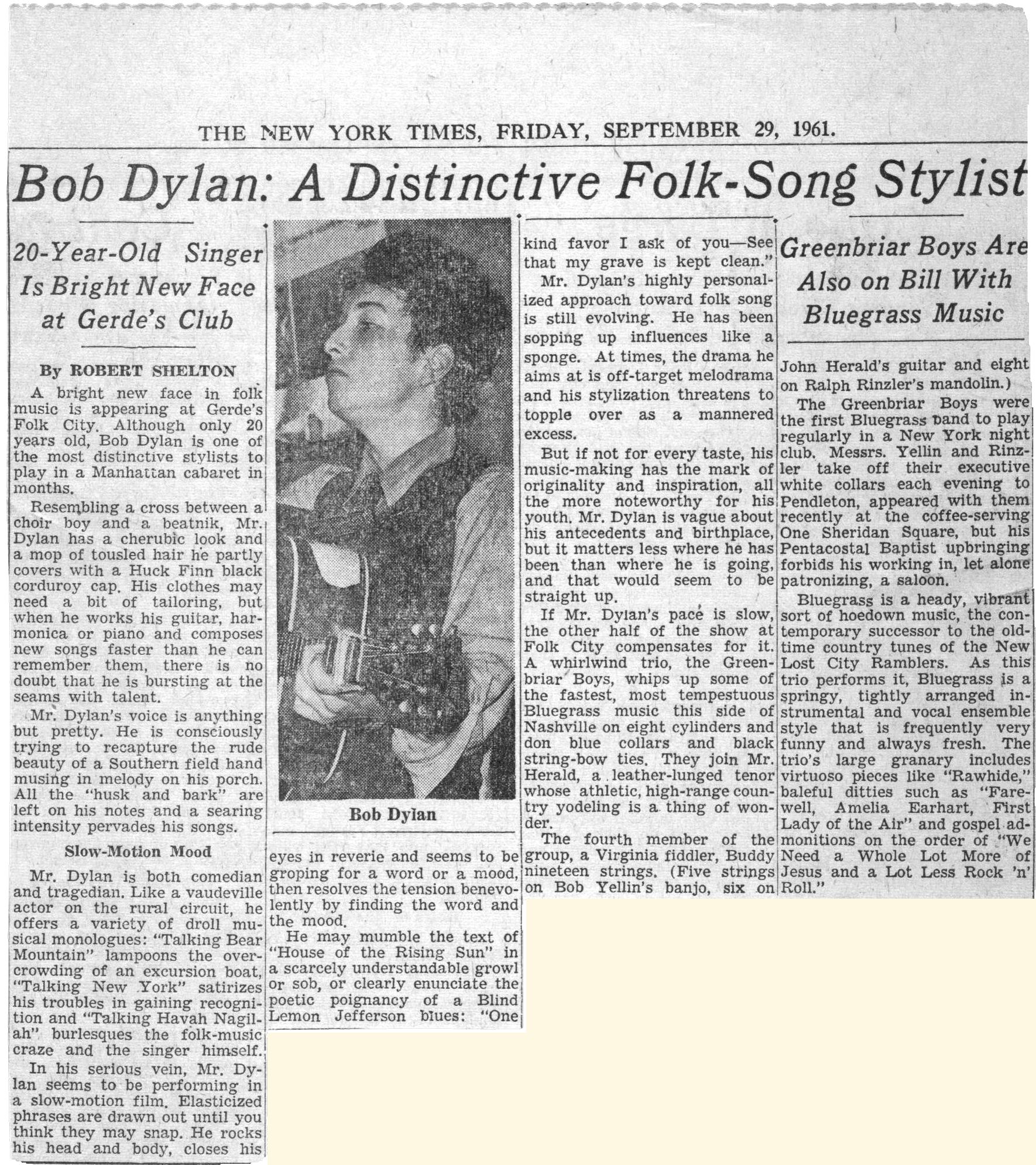
Gerde’s quickly became a haven for Manhattan’s Bohemian crowd and writers for Village Voice who flocked in to hear up-and-coming folk artists. On April 11th, 1961, Bob Dylan performed his first professional set at Gerde’s. The unknown Dylan opened for the legendary blues virtuoso John Lee Hooker. This performance marked one of Dylan’s first chances to display his original pieces. By all definitions, this performance was a success for Dylan, prompting additional shows by Dylan and Hooker. The New York Times reported on these shows in September 1961, stating while Dylan’s outfit and voice were far from pretty, his originality and stage presence marked him for stardom.
Throughout the 1960s, Gerde’s was a necessary stop for any folk singer in New York City. It frequently featured legends like Pete Seeger, the Byrds, Simon and Garfunkel, and Joan Baez. Following a decade of success, Gerde’s moved to West 3rd street, where it continued operations until 1987. In that year, rent tripled, leaving no choice but to close the doors. Although Gerde’s has been closed for almost four decades, it holds a special place in popular memory. In its “Book of Lists,” Rolling Stone ranked it within the top three venues on Earth for its impact on Greenwich Village’s folk scene. Today, Hebrew-Union College inhabits the original location of Gerde’s Folk City.
Pete Seeger
One of the major figures in A Complete Unknown is Pete Seeger, played by Ed Norton. Throughout his career, Seeger cemented himself as the foremost folk musician of his day, as well as an activist. Seeger was born in New York City on May 3rd, 1919. From his birth, Seeger was surrounded by both music and political activism. His father was an ethnomusicologist forced to resign his position at UC Berkeley for his outspoken pacifism during WWI. His mother was just as musical, working as a concert violinist and teacher at Juilliard.
Seeger gravitated towards music at a young age, first picking up the ukulele while at boarding school. His focus soon shifted to the banjo, after visiting a square dance festival with his father in Asheville, North Carolina. In 1938, Seeger enrolled at Harvard, where he consequently joined the Young Communist League. However, he later dropped out to work with Alan Lomax to catalog American folk music. This early job began a lifelong dedication of Seeger’s to preserve America’s folk tradition.
Alan Lomax and Peter Seeger in 1950, Photo source: John Cohen
Seeger’s career truly began in 1940, when he embarked on a cross-country tour with Woody Guthrie. On this tour, Seeger and Guthrie performed a plethora of folk tunes to benefit workers and unions across the nation. The 1940s and the start of WWII also began Seeger’s focus on antifascist efforts. Alongside his first band The Almanac Singers, Seeger recorded the 1940 album Songs of the Lincoln Brigade. This album featured songs of anti-fascist fighters in the Spanish civil War. His career briefly paused, as Seeger was drafted into 1942.
Upon his return to the US, Seeger made two fateful decisions. Firstly, he bought a property in Beacon, NY, along the Hudson river. This began a lifelong mission to clean the heavily polluted river. For decades, Seeger raised public awareness of environmental destruction through the annual Clearwater music festival. Additionally, following years of fighting for legislation and corporate accountability, General Electric agreed to dredge the river to help clear it of contaminants.
The second of Seeger’s decisions was the founding of his new group: The Weavers in 1948. After signing to Decca Records, the Weavers became one of the most popular groups in America. During their heyday, the group sold over four million records, buoyed by hits like “Kisses Sweeter than Wine” and “So Long (It’s Been Good to Know Yuh).” In addition, they remained true to Seeger’s mission of musical preservation, recording folk songs from not only the US, but also South Africa and Israel.
The Weavers’ fame came to a sharp halt in the early 1950s. Leaks to the House Un-American Activities Committee (HUAC) claimed that the Weavers members were communists. These accusations and a subsequent sedition investigation forced the group underground. These tensions came to a head on August 18th, when HUAC subpoenaed Seeger. Seeger refused to answer any questions, leading to a 1961 conviction on 10 counts of contempt of Congress.
Dylan and Seeger at the 1963 Newport Folk Festival
Bob Dylan entered Pete Seeger’s life around this point. In 1961, Seeger introduced Dylan to John Hammond, who went on to produce Dylan’s self-titled debut. Four years later, Seeger made the consequential decision to invite Dylan to the 1965 Newport Folk Festival. Instead of playing a traditional acoustic set, Dylan brought in amplifiers and electric instruments. The crowd booed and heckled Dylan throughout the set, and according to some accounts, Seeger was just as disappointed. In a 2001 interview, Seeger recalled hating the live mixing, because he could not hear Dylan’s lyrics. He also recalled telling the sound engineer “Damn it, if I had an ax, I’d cut the cable right now.”
For the remainder of his life, Seeger remained dedicated to music and activism. He continuously used his platform to fight for environmental protections and civil rights for African Americans. Throughout his later years, he continued to perform at massive shows, including MSG, Farm Aid, and Newport Folk. After nearly seven decades of musical performance, Seeger passed away on January 27th, 2014.
Bethel, New York, once the iconic site of the original 1969 Woodstock Festival, was transformed into a haven of nu-metal nostalgia on Friday, July 26th when Limp Bizkit brought their Loserville Tour to Bethel Woods.
Notorious for their unforgettable set at Woodstock ’99, where their intense energy contributed to the festival’s infamous chaos, it took 25 years for Limp Bizkit to successfully rewrite the script. Now older and wiser and out for redemption, the band delivered a high-octane, testosterone-fueled performance that both honored and deviated from their controversial past.
Limp Bizkit performing at Bethel Woods on 7/26/24.
From the moment Fred Durst strutted onto the stage, sporting a backwards Yankees cap and a pinstriped Shohei Ohtani Japanese jersey, the audience—an eclectic mix of die-hard fans from the late ’90s and early 2000s and curious new listeners—erupted in a frenzy. The setlist, a deliberate nod to their greatest hits, had the crowd singing and headbanging along to former chart-toppers like “Nookie,” “Rollin’,” and “My Way.” Along with frontman Durst, all the OG members of Limp Bizkit were present and accounted for in Bethel.
Limp Bizkit’s Sam Rivers performing in Bethel, NY 7/26/24.
Bassist Sam Rivers was looking particularly dapper performing in all white suit and shades, while DJ Lethal and drummer John Otto confidently held things down from the risers in the back. Guitarist Wes Borland, the band’s enigmatic and theatrically dressed master of disguise, was truly a sight to behold. Wearing a gold battle helmet and a pseudo samurai gi, he resembled something of a cross between the Predator and a character straight out of the Warhammer games.
His dark black eyes barley visible as the iconic axman thrashed circles around the stage to songs like “Eat You Alive” and “Hot Dog.” After showing off some tasty Pantera and Metallica licks between songs, Borland would then break into a signature riff almost anyone can play, having a field day on an extended version of “Break Stuff,” the same song that became the scapegoat for the way things spiraled out of control at Woodstock ’99. This time, however, when the song kicked in, the people didn’t kick in nearly as hard. There were no fires set or crowd surfing on plywood the entire night.
Master of Disguise: Wes Borland shows off his latest look on 7/26/24.
The audience itself was a fascinating mix. There were those who had been at Woodstock ’99, now older but still wearing their vintage band tees and reliving the glory days. Alongside them were younger high school-aged fans, some experiencing the raw energy of Limp Bizkit live for the first time. Eavesdropping on a stranger’s conversation, I almost spit my drink out when a guy asked his friend if they’d ever seen Limp Bizkit before and she responded, “No, but I’ve heard a lot about him.” This blend of generations created a unique atmosphere, one where nostalgia met the present day in a powerful collision of sound, emotion and hormones.
Limp Bizkit’s in the house, yall. 7/26/24.
The history of Woodstock 1969 loomed large over the performance. Bethel, the birthplace of the peace and love movement, juxtaposed sharply with the aggressive, rebellious energy that Limp Bizkit embodied. Yet, this contrast seemed to be exactly what the crowd craved—a raw, unfiltered experience that tapped into the cathartic power of music. The resurgence of nu-metal, a genre that blends heavy metal with elements of rap and hip-hop, continues to captivate audiences. Fred Durst, as always, remained a polarizing figure and central to it all. Now in his 50’s and rocking a full silver beard, some see him as the quintessential anti-hero of the nu-metal era, a symbol of defiance and non-conformity.
Others, however, view him as a relic of a dark time in music history, often citing his vulgar and childish lyrics as the bands biggest handicap. Regardless, there is no denying Durst’s ability to command a stage and connect with an audience, even decades into his career. His provocative personality and off-the-cuff remarks kept the crowd at Bethel Woods on their toes all evening long as he clearly still resonates with a massive amount of fans. During the song “Livin’ it Up,” Durst would become one with the people by leaving the stage and performing while walking through the crowd. Later during “Full Nelson,” Durst would invite a bunch of kids up to sing with him and take selfies, a tender moment they will likely never forget.
Fred Durst performing with Limp Bizkit in Bethel, NY 7/26/24.
On the wheels of steel, DJ Lethal had his hands full all night playing samples of songs between songs. Touching on everything from Bon Jovi’s “Livin on a Prayer,” and Creedence Clearwater Revivals’ “Proud Mary” to the Beastie Boys “Fight For Your Right” and Cypress Hill’s “Insane in the Brain,” perhaps his most surprising selections were snippets from Britney Spears “Baby One More Time,” and George Michael’s song “Careless Whisper,” which Fred encouraged everyone to slow dance to.
DJ Lethal had his hands full in Loserville on 7/26/24.
After working their way through “Boiler.” Fred wound pander to the crowd some more, asking “How many people have been in a shitty relationship before and how many are in a shitty one right now? You can’t say it, because you’re with them tonight and your fucking miserable because you had to come to the Limp Bizkit concert with them, I understand.” Without missing a beat, the band would then drop into the song that started it all for the LB, their cover of George Michaels “Faith.” It was the only song played from the band’s 1997 debut album, Three Dollar Bill, Y’all$.
Limp Bizkit performing in Bethel 25 years after their infamous Woodstock ’99 performance 7/26/24.
Introducing its follow-up by saying, “This next song seriously chaps my nads,” the familiar riff of Mission Impossible had the crowd roar with delight when the band kicked into “Take a Look Around.” Getting a bit introspective in the middle of it, Durst would talk to the crowd once again. Using the opportunity to express his opinions on the current political climate, he would go on to suggest that politicians are using technology, cell phones in particular, to turn people against each other.
Declaring that it should always be “us against them” and that he will always be on the side of the people, he thanked everyone for coming out and rocking to some heavy music peacefully. Encouraging people to take a look around and hug their neighbors, Durst seemed genuinely appreciative for the strong turnout and that people still remember who they are. It was a clear sign of maturity for a group who, at one time, were considered the biggest and most juvenile band on the planet.
Limp Bizkit keeps rollin’ in Bethel, NY 7/26/24.
Prior to Limb Bizkit’s headlining set, Loserville kicked off with a diverse bill of opening acts that had a little something for everyone. Highlighted by underground rappers Bones featuring Eddy Baker and Xavier Wulf, their set had some of hardest rhymes and loudest bass I’ve ever heard in person. Before them was a dynamic synthpunk set from the one-man-band known as N8NOFACE. Mesmerizing the early attendees with his bizarre stage presence, guttural screams, and by slamming the microphone into his head to create drum beats, he openly discussed his struggles with crystal meth addiction, saying that for “anyone else who might be struggling, it doesn’t get easier, but it does gets better.”
Thanking Fred Durst from the bottom of his heart for taking him out on this tour, “Already Hate Your Next Boyfriend” was perhaps the song that stuck out most. Adding even more nostalgia to the festivities, actor Corey Feldman (yes that Corey Feldman) kicked off Loserville with a brief set of original music and over the top dance moves. A long-time friend of Durst, the two most recently collaborated on the music video for Feldman’s latest single “The Joke.”
Man of the People: Fred Durst reads the crowd in Bethel, NY 7/26/24.
As the night drew to a close, it was clear that Limp Bizkit’s performance in Bethel was more than just a concert. It was a testament to the enduring legacy of both the band and the historic site. It reminded everyone in attendance of the transformative power of music, capable of bridging gaps between eras, generations, and even differing personal tastes. For one night, Bethel and Limp Bizkit were once again at the center of a musical revolution, proving that while times change, the spirit of rock and rebellion is eternal.
Watch fan footage of Limp Bizkit performing “Faith” on 7/26/24.
Limp Bizkit | July, 26, 2024 | Bethel Woods | Bethel, NY
Setlist: Out of Style, Rollin’ (Air Raid Vehicle), Break Stuff, Hot Dog, Trust? My Generation, Livin’ It Up, My Way, Eat You Alive, Nookie, Full Nelson, Boiler, Faith, Take A Look Around, Break Stuff (Reprise).
The Bell House, a celebrated entertainment venue in Brooklyn’s Gowanus neighborhood, has been bought out by Live Nation. The venue has hosted and supported many independent artists throughout the years, having opened in 2008.
Located in an old printing press warehouse, The Bell House has since served the community as an outlet for creatives around the city. Upon its opening, The Bell House was involved in the NYC Comedy scene, drawing the public to the industrialized neighborhood. The venue also racked up its fair share of bands, parties, burlesque, and a variety of other social events.
Because of the opportunities and shameless fun offered to artists and attendees, The Bell House acted as a safe space for people to express themselves. Since 2008, the space has been independently run by the same team responsible for Park Slope’s Union Hall. The two similar, close-by venues, along with other BK establishments gave access to an underground circuit of up-and-coming artists.
Recently, however, The Bell House has experienced a transition as Live Nation quietly purchased it. While the process of it becoming an evident Live Nation venue with mainstream acts is slowly coming into place, the community continues to raise concerns about the future of its beloved sanctuary.
Live Nation, which is in the midst of a federal antitrust suit due to its monopoly over the live entertainment industry, already dominates NYC music venues. Over the years the music industry giant has racked up rooms like the Gramercy Theatre, Irving Plaza, and Brooklyn Paramount.
The new addition of The Bell House has generated a lot of concern and questions from the community. Because the venues immensely support independent artists, people are questioning the risk of Live Nation trading in the smaller artists for bigger names. The possible exclusion of talented yet generally unknown musicians and comics contradicts the venue’s purpose and community. It also risks eliminating the proud diversity and public accessibility the venue has to offer.
The booker and the marketing team do such a great job taking chances on emerging artists and concepts, and giving them the best possible chance to succeed. My big fear is that as it’s engulfed into the bigger Live Nation fold, the venue will lose a little of its cozy Brooklyn familiarity for artists.
Frequent Bell House Performer for The Groove
So far, the lineup has yet to reflect any drastic changes from regular shows. While most people are anticipating mainstream acts, the calendar remains full of smaller, yet still notable acts and bands. They still have classic Bell House-style events such as an ABBA Glitter Disco and a Moulin Rouge Drinking game.
It’s unknown when Live Nation finalized the sale, and therefore, when their booking comes into play. The common fear among the public is how the company will decide to move forward with The Bell House’s trajectory.
On Thursday, July 18, Cola and Galene gave us a night to remember at NO FUN in Troy. They played the perfect show for local indie rock fans.
NO FUN is a live music venue on river street in Troy, an amazing place to hear live music and enjoy some drinks. NO FUN has a full schedule of upcoming concerts, so despite the name there’s lots of fun to be had.
Galene opened the night with tons of energy that they kept thought their whole set. Cola followed close behind and ended the night leaving us all searching for their next congratulations . Be sure to visit NO FUN when you’re in need of good music or a new favorite song.
Upcoming Shows at NO FUN
August 1: Joyer, Shower Curtain, Stroma, and Cooper’s Hawk at 7 PM
August 2: Nailed Shut, Frozen Sun, Torpedo Lane, and Greyfleshtethered at 7 PM
August 3: Planetarium Party (Virgo SZN) at 8 PM
August 4: Coquette, Trepidation, Vaexus, and Beasteliaphiliac at 7 PM
August 8: The Thing, Native Sun, and Attack Dogs at 7 PM
August 16: Big Scary Indian, Adequate Phil, and Otobo from 7–11 PM
The Double Bass Experience was in Syracuse on July 11th as part of the Jazz in the City Series.
The explosive Jazz Double Bass experience featuring Jacob Webb and Phylicia Rae takes an audience to a place where they’ve never been before. The combination of these two stars in contemporary jazz have obtained seven number one Billboard records under their belt.
As a matter of fact, Phylicia Rae is the first female lead bassist to ever obtain a number one record on Billboard’s smooth Jazz National Airplay Chart in the history of this genre. Her history making single “Now or Never,” featuring Marcus Anderson, has granted the opportunity for female bassists to thrive in this genre.
In addition to his bass skills, Jacob Webb founded Next Paradigm Records, a nine artist contemporary jazz roster of fresh talent acclaiming multiple number one hit Billboard singles. Today, Billboard has recognized Next Paradigm as the number four label in smooth Jazz.
With all this success, Jacob and Phylicia brough their show to Syracuse and created a night of great music. From their chart topping hits to covers of Earth Wind & Fire and more. Switching back and forth as the lead bass player Jacob & Phylicia created a magical evening of jazz.
Saturday, July 27 saw Andrew Hozier-Byrne, better known as Hozier, play a sold out show at the historic Bethel Woods Center for the Arts. Hozier is currently touring across North America with opener Allison Russell to celebrate the release of his Unreal Unearth album.
Hozier, photographed by Sarah Hyun
Hozier, born in Ireland but popular worldwide for his songs, “Take Me to Church” and “Too Sweet,” has made many stops in NY while on tour. He recently played four nights at Forest Hills Stadium in June. Hozier is well known for his powerful voice and honest songwriting, touching on themes of heartbreak, abuse, love, and humanity through his deeply personal and self-aware lyrics.
Hozier, photographed by Sarah Hyun
Fans flocked to the concert in the early afternoon, tailgating with friends and family in white skirts, floral tank tops, and Hozier merchandise. While the majority of people sat on the lawn, those who were lucky enough to snag good seats in the 20 minute period before completely selling out the show sat under the pavilion, with a clear view of Hozier and the stage. During the concert, friends, family, and couples danced freely, truly taking in the night. Hardly any phones were present—people were truly living in the moment.
Hozier, photographed by Sarah Hyun
During his song, “Like Real People Do,” Hozier experienced a guitar malfunction and quickly moved on to the next song on his setlist. He stated, “This is how you know I’m playing live,” followed by a few laughs from him and the crowd. He recognized a familiar face and shared a sweet interaction with the fan, stating, “Is that you? Yeah, yeah! Good to see you again… I love you too.”
Hozier, photographed by Sarah Hyun
Finally, he wrapped up the night with a surprisingly long, yet beautiful encore. He left the stage after “Take Me to Church” and snuck off to a separate makeshift area closer to the people in the nosebleeds, and performed a beautiful rendition of his song, “Cherry Wine.” Fans waved their phone flashlights in the air, looking up in awe, crying, and swaying peacefully to the eclectic music as Hozier entranced the crowd with his gentle vocals and intricate guitar playing.
Crowd, photographed by Sarah Hyun
Finally, to finish off the encore, he stopped to talk to the audience about the current social and political issues affecting the world. Hozier has always been vocal about his support of the LGBTQ+ community and in the importance of voting, protesting, and recognizing the violence that is happening in other countries. He stated, “I’d only like to see Palestine free from occupation, free from violence,” before leading into song, “Nina Cried Power.” Although Hozier does not have any more New York dates scheduled for the rest of his tour, he is sure to return in the future.
Hozier – Bethel Woods Center for the Arts – Saturday, July 27, 2024
Setlist: De Selby (Part 1), De Selby (Part 2), Jackie and Wilson, From Eden, Angel of Small Death and the Codeine Scene, Dinner & Diatribes, Francesca, It Will Come Back; I, Carrion (Icarian); Abstract (Psychopomp), Like Real People Do, Wildflower and Barley (with Allison Russell), Would that I, Too Sweet, Almost (Sweet Music), Eat Your Young, Movement, Take Me to Church
Encore: Cherry Wine, Unknown / Nth, Nina Cried Power, Work Song (with Allison Russell)