Former Creedence Clearwater Revival leader, John Fogerty will perform at Tanglewood Music Festival on June 20, 7 p.m. on the coveted Koussevitzky Music Shed stage.
Fogerty is a Grammy award winning musician and Rock and Roll Hall of Fame Inductee that has shaped rock music with his distinctive country, folk, pop style. He was not only the founder of CCR but also wrote their greatest hits like “Susie Q” and “Proud Mary.” He released his first self-titled solo album in 1975. Additionally, in 1985 Fogerty released his third studio album with Warner Bros. Records, Centerfield.
In November of 2019, his “My 50 Year Trip” performance at the Red Rocks Amphitheatre in Colorado was recorded for public broadcast but his tour was cut short due to Covid. Now he’s back on his “Celebration Tour,” playing at venues across the country including Tanglewood. This festival is the summer home of the Boston Symphony Orchestra and is located in the Berkshire Hills of Western Massachusetts.
George Thorogood and The Destroyers will make an appearance at the performance as well. Thorogood is a rock and roll artist known for his song “Bad To The Bone.” Another special guest will be Hearty Har, a band from Los Angeles formed in 2012 by Shane and Tyler Fogerty, the two sons of John Fogerty himself. To Purchase Tickets to the show you can visit the Tanglewood website here.
Following a landmark performance at the Hard Rock Singapore, NYC’s own Noah Lehrman announces a tour with FlowPoetry coming this summer. With FlowPoetry, Noah Lehrman brings immersive, exciting performances to numerous festivals and concert series, including three shows in New York.
Noah Lehrman – official website
Noah Lehrman is a multi-instrumentalist and multilinguist born and raised in New York City. For the last decade, Lehrman has brought creative storytelling and poetry through a mix of genres such as funk, jazz, country, and psychedelic rock. Throughout the years, Lehrman has performed all over the world, both as a solo and group artist.
When he first emerged onto the music scene, he served as the drummer of the jam band The Grove. Since then, he has performed in national and international festivals and concerts. Lehrman’s latest tour as a solo artist brought him across several continents, jumping back and forth between North America, Europe, and Asia. Before his return for the US leg of the tour, Lehrman lit up the Hard Rock Singapore, where he stunned crowds with a spontaneously debuted new upcoming single, “Marx & Spenser.”
For the rest of the tour, Noah Lehrman is joined by special guest FlowPoetry, a performative spoken word group based in Wisconsin. Lehrman will be accompanying the group as a drummer and percussionist. In addition to the FlowPoetry tour on drums, Noah will also be performing solo acoustic at Weekends at Bertha’s and at the 10th Year Anniversary Froggy Daze in Narrowsburg, NY.
Tour dates are listed below. For more information, fans can visit here.
Looking back into history, the 1920s was a time marked by intense racial and sexual discrimination. In the South, Jim Crow laws were in full effect, leaving African-Americans as second class citizens. Throughout the country, KKK membership expanded to almost 4 million, only worsening racist violence. LGBTQ Americans also faced similar discrimination, with homosexuality being labeled as a mental illness, and the media spreading homophobic stories of sensationalized sex crimes.
During this period of intense discrimination, blues singer Gladys Bentley, a queer African-American woman, managed to overcome these obstacles and become one of the most popular entertainers of Harlem. In doing so, Bentley not only made a name for herself, but also paved the way for future generations of LGBT artists to succeed.
Gladys Bentley was born in 1907 in Philadelphia, PA to an African-American father, and Trinidadian mother. From a young age, Gladys pushed the constraints of gender expectations, often wearing her four younger brothers’ suits to school. As she recalled to Ebony Magazine later in her life: “It seems I was born different. At least, I always thought so…From the time I can remember anything, even as I was toddling, I never wanted a man to touch me…Soon I began to feel more comfortable in boy’s clothes than in dresses.”
Sexual discrimination marked Gladys’ childhood in Philadelphia. Her classmates often mocked her for being overweight, and dressing too masculine. In addition, following a crush on a female teacher, her parents forced Gladys to see doctors in failed attempts to “cure” her lesbianism. Gladys’ way of dealing with this childhood trauma was writing and performing songs. Wanting to seek freedom from this discrimination and true expression, Gladys ran away to New York City at age 16.
Harlem’s Gay Club Scene
Following the passage of the 18th Amendment in 1919, which prohibited the sale of alcohol, Harlem’s clubs went underground. Venues like the Cotton Club, Connie’s Inn, and the Savoy Ballroom became hubs for entertainment, African American arts, and stigmatized activities. Vendors sold crab, peanuts, and cannabis, and everybody – including the neighborhood police – were engaged in illicit lotteries. In these Harlem nightclubs, the Harlem Renaissance truly blossomed. Soon, entertainers like Cab Calloway and Ethel Waters became some of the most well known celebrities not only in New York, but the whole country.
A map of Harlem’s Night Clubs illustrated by E. Simms Campbell in 1932
This flourishing of the nightclub scene came with a public fascination with the LGBT community in New York City. During the “Pansy Craze” of the 1920s and 30s, queer performers were more visible and successful than ever before. Throughout Harlem, Greenwich Village, and Times Square, drag balls captivated audiences. At these events, women could be found in tuxedos, and men in stockings and makeup. As the African-American newspaper The New York Age reported, “Wigs, where necessary, were in evidence.”
While homophobic discrimination did exist, Manhattan was much more tolerant of the LGBT community than much of the country. While some identified publicly as queer, many people did not associate with any identity at all. As Harlem Renaissance artist Richard Bruce Nugent said “You just did what you wanted to do. Nobody was in the closet. There wasn’t any closet.”
Career in New York
The active club scene, and more widespread acceptance of openly queer lifestyles allowed Gladys Bentley to rise to stardom in Harlem. Following her arrival in New York, Bentey made a name for herself at rent parties across the city. At these rent parties, artists would perform and pool proceeds made to help low-income tenants pay their rent. These parties provided African-American New Yorkers a forum to dance, enjoy Black art, and form a sense of community. It was at these rent parties that Bentley built the connections that forged her later career. At one such party, Bentley got the chance to audition for 133rd Street’s Mad House, which needed a male pianist. This position would launch her career into New York’s nightclub scene.
An invitation to a NYC Rent Party, preserved by Langston Hughes
Bentley soon found work as a performer at Harry Hansberry’s Clam House on 133rd Street. The Clam House – one of the city’s most visible gay speakeasies – allowed Bentley’s career to flourish. She made a name for herself with her deep alto voice, and piano skills, which she used to cover classic songs. What made Bentley stand out was the raunchy lyrics she would add to these classic covers, which both enthralled and shocked audiences. One such example was her cover of “My Alice Blue Gown” from the Broadway musical Irene, which referenced anal sex.
“And he said, ‘Dearie, please turn around’ And he shoved that big thing up my brown. He tore it. I bored it. Lord, how I adored it. My Sweet Little Alice Blue Gown”
– Gladys Bentley’s cover of “My Alice Blue Gown”
These racy lyrics, as well as the spectacle of Bentley’s live performances made her famous among Harlem’s performers. Bentley’s 250-pound figure, dressed in an iconic black tuxedo and hat, enamored audiences regardless of race of sexuality. During performances, Bentley would often flirt with women in the audiences in her deep gruff voice. For many, the illicit nature of her lyrics and performances played into the underground nature of the club scene during prohibition.
Throughout her heyday in the early 1930s, Bentley enjoyed performances across New York, and record releases. In 1933, Bentley headlined the Cotton Club, and Apollo Theater, some of the most famous in New York City. In the early 1930s, Bentley also released eight singles on record, and hosted her own weekly radio program.
With Bentley’s success also came scandal. She shocked the public with the announcement of the marriage to her white female lover in a New Jersey civil union. While there is no official documentation confirming this marriage, it speaks to Bentley’s openness about her sexuality and ability to control public attention.
“An amazing exhibition of musical energy—a large, dark, masculine lady, whose feet pounded the floor while her fingers pounded the keyboard—a perfect piece of African sculpture, animated by her own rhythm.”
– Langston Hughes
The pinnacle of Bentley’s Career however, was her residency at the Harlem’s Ubangi Club from 1934-37. A former speakeasy, the club was rechristened following the repeal of prohibition in 1933. The club’s name evoked voodoo, marketing it as a place both exotic and mysterious. At the club, Bentley performed her self-produced musical revue, backed by eight male dancers in drag. This success, however, began to wane following the end of prohibition. Soon, as queer acts fell further out of favor, police raids and harassment became more commonplace.
An Ubangi Club advertisement featuring Gladys Bentley’s music revue
Wanting to escape homophobic harassment in New York City, Bentley relocated to Los Angeles to live with her mother in 1937.
Later Life
Bentley’s career in California had a brief resurgence, first in Los Angeles then San Francisco. In the 1940s, the West Coast was marginally more tolerant of queer lifestyles than the rest of the country. Following her relocation, Bentley continued to record music, and perform at gay and lesbian bars in San Francisco. These performances, were often toned down versions of her explicit acts from the 1930s.
Part of the reason for this self-censoring was the influence of McCarthyism in the 1940s and 50s, which saw increased targeting of LGBT performers. California, while more tolerant, was not devoid of homophobic harassment. In one case on August 8, 1947, Bentley was prevented from performing at Los Angeles’ The Jade due to a police raid.
A letter from the Musician’s Protective Association regarding the cancelation of Bentley’s Show on August 8, 1947
By the late 1950s, Bentley had almost completely disavowed her previous life and sexuality. In 1952, Bentley married Charles Roberts, a cook from Santa Barbara, and claimed to have previously married and divorced two men. Also in 1952, Bentley in an interview with Ebony magazine declared, “I am a woman again.” She claimed, “like a great number of lost souls, I inhabited that half-shadow no man’s land which exists between the boundaries of the two sexes,” stating she underwent hormone therapy to “cure” her lesbianism. In public, Bentley began wearing dresses, and decorated her hair with flowers. Many view this either as a reinvention to survive the homophobic tides of McCarthyism, or an attempt to conform to the heteronormative attitudes of the US.
Following a final 1958 performance on the Groucho Marx show “You Bet Your Life,” Bentley succumbed to illness, eventually passing away of pneumonia in 1960. At the time of her passing, Bentley was only 52 years old.
Gladys Bentley in 1932
Legacy
Bentley, while often overlooked, paved the path for many African-American and LGBT artists in the decades since her passing. One artists in particular who has taken influence from Bentley’s work and image has been Janelle Monae. Following the release of her 2010 debut The ArchAndroid, Monae sported an androgynous black and white tuxedo, a public image highly reminiscent of that which propelled Bentley to Stardom almost a century earlier.
Gladys Bentley, while being one of the most popular performers of the Harlem Renaissance, was so much more than just a musician. Through her performances and public image, Bentley defied the heteronormative standards of 1920s America, paving a path for future queer artists to succeed in the music industry. As a singer, pianist, dancer, and provocateur, Bentley was a true “Renaissance man” of the Harlem Renaissance.
Enjoy an interview and performance by Gladys Bentley on “You Bet Your Life” from 1958.
Mohawks, makeshift stages and mosh pit enjoyers of all ages took over Randall’s Island this past Saturday for Punk Island’s sixteenth anniversary. The festival returned to Randall’s Island for the first time since the pandemic, and the day could not have been more perfect for blaring guitars and screaming singers with a view of the East River and Manhattan’s skyscrapers.
The six stages had everything from hardcore rock and screamo to indie, alt rock and pop rock. Crush Fund and its passionate rage to the nostalgic sounds of the band Car Becomes Airplane filled the field with all sorts of different sounds. The event featured not only old school bands to reassure the older punkheads that the scene was still alive, but also actively catered to its newer audiences and worked hard to stay up to date with the current culture.
Every stage had a decent audience, but there was plenty of room for more to join at each stage. The festival was a wonderful opportunity to discover new music, and it also was the perfect place for bands and show organizers to get experience putting on shows in front of a lively audience. Tall neon mohawks, plaid pants, extravagant makeup and everything in between filled the bus to Randall’s Island.
Punk Island began in 2008 when Chloe Anderson, an NYU undergraduate student with an interest in punk was interning at Make Music New York (MMNY), a non-profit that supports free, outdoor music events. When MMNY received its first large grant for an outdoor summer festival, the intern was determined to make a punk festival happen.
After a few years, Aaron Friedman, the founder of MMNY, asked ABC No Rio, a punk collective, to take over as organizers of the festival. Joey Steele, a member of ABC No Rio, took the lead. “I love that event,” he told me. “I love the idea of there being an all day, all free, all ages punk show that people just show up to and go to like ten different bands all at once.”
He was also a member of the band Cop Out, and he worked hard to make sure the festival accurately depicted New York’s ever changing punk scene. “We organized it on the principle that we are all different but we all work together, and we want to empower and support each other,” he said.
Antonio Rodriguez, the current lead organizer, said that this event has remained an all free event, due to the support of the Punk Island Collective and the fiscal support of MMNY. Punk Island raises money year-round through benefit shows, selling merch, and more, while MMNY pays for the logistical aspects — permits, porta-potties and dumpsters, etc — for the event. “Their funding is crucial in making this work,” Rodriguez said, “and you know that’s true of all public arts funding; it’s crucial.”
Punk Island has persevered through the difficulties of the pandemic and general disorganization, but maintained their long-term efforts towards sharing this inclusive community.
Now, sixteen years and many organizers since being founded, punks from across the city still come together to put on huge free punk festivals, working hard, not for the profit, but for the community. It’s put simply in the collective’s motto: “We aim to support a philosophy of creativity, rebellion and work to feed those who are hungry for a world where passion is valued over profit. We promote a counter-culture through our collective, art, music, writing and events.”
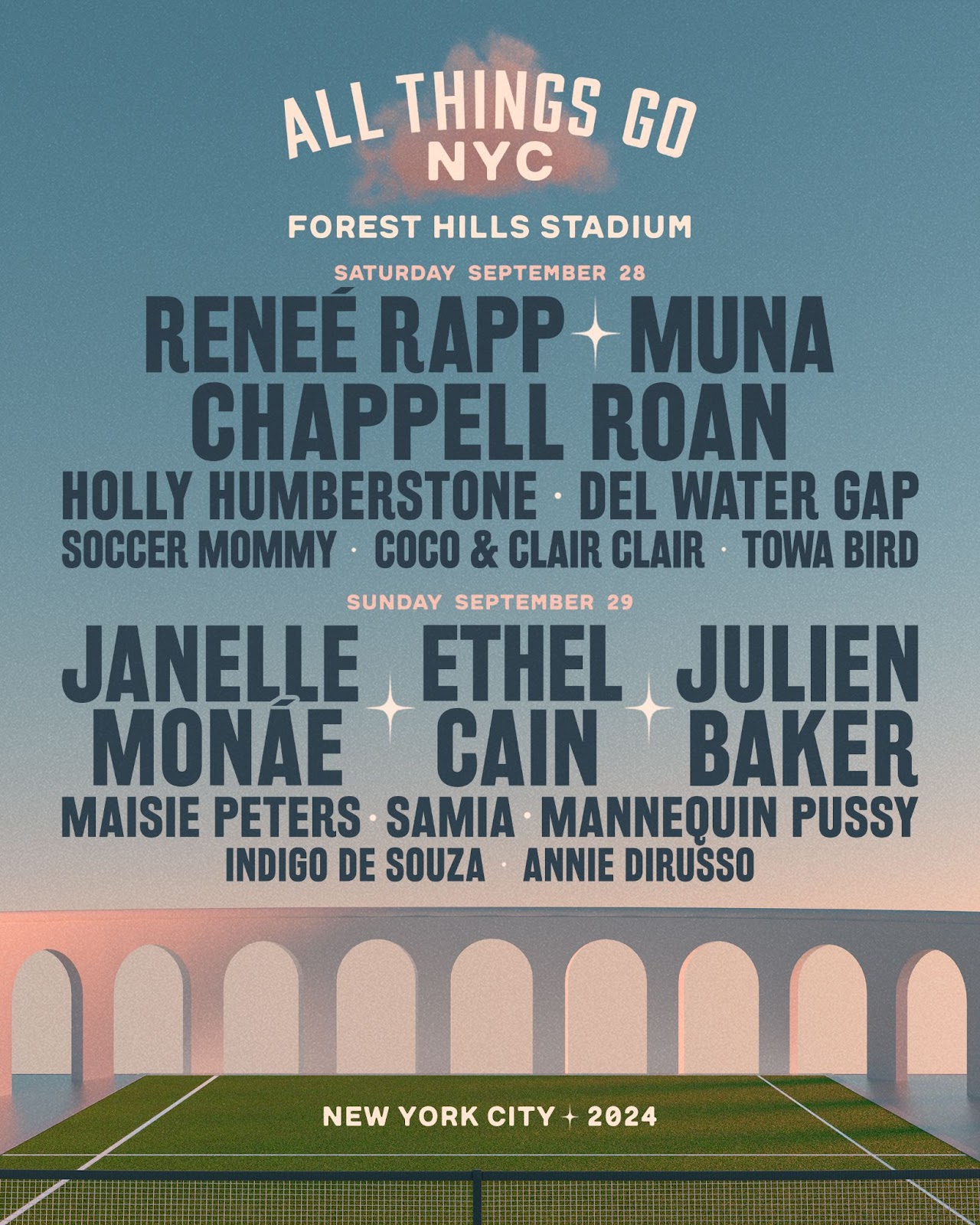
The All Things Go music festival is making its NYC debut in 2024, adding to its already impressive legacy with an inaugural event at Forest Hills Stadium. Taking place on September 28th – 29th, this marks the festival’s expansion beyond its DC-area roots, where it will celebrate its 10th anniversary.
Stellar Lineup for All Things Go NYC
Headlining this year’s New York lineup are powerhouse performers Reneé Rapp, Janelle Monáe, Chappell Roan, MUNA, Ethel Cain, and Julien Baker. The festival continues its tradition of showcasing a diverse and inclusive range of artists, with performances from Holly Humberstone, Del Water Gap, Towa Bird, and more. This female and non-binary-focused lineup underscores All Things Go’s commitment to fostering diverse and inclusive spaces within the music community.
boygenius 2023
A Festival for the Forward-Thinking
All Things Go has always been more than just a music festival. Since founding in 2011 in Washington, DC, it has dedicated itself to creating forward-thinking digital and live music experiences. The festival has collaborated with a slew of innovative artists, including Billie Eilish, boygenius, Lana Del Rey, Lorde, Mitski, HAIM, Janelle Monáe, Charli XCX, MUNA, Lizzy McAlpine, Carly Rae Jepsen, Bleachers, and Tove Lo, among others.
Lana Del Ray 2023
A Celebration of Inclusivity and Community
All Things Go has cultivated a renowned community of devoted fans who embrace inclusivity and diversity, embodying the festival’s ethos. This spirit of community and celebration of underrepresented voices has earned the festival accolades and recognition over its 10 year history.
Maggie Rogers 2023
Tickets and More
For eager fans looking to secure their spots, tickets for the New York edition of All Things Go will go on sale on Friday, June 14th, at 10 AM ET. Purchase tickets through the festival’s official website at allthingsgofestival.com. Given the festival’s history of rapid sell-outs and the stellar lineup, we highly recommend early ticket purchases.
Muna 2023
As All Things Go prepares to launch its first New York festival, anticipation is high for what promises to be an unforgettable weekend. With a lineup featuring both heavy-hitters and emerging talents, and a continued commitment to creating inclusive and forward-thinking music experiences, All Things Go NYC is set to become a staple in the city’s vibrant festival scene. Stay tuned to your favorite music news sources for more updates and get ready to be part of music history this September at Forest Hills Stadium.
We’re coming up on Father’s Day Weekend, and in Syracuse, join the Westcott Community Center for live music, visual arts, and William’s Shakespeare’s Hamlet in the Thornden Park Amphitheater and more on Friday, Saturday, and Sunday June 14th-16th.
Shakespeare in the Park – Kick off the summer with the 22nd season featuring Hamlet in the beautiful Thorden Park Amphitheater! Pack a picnic, bring our friends, and prepare for laughter, love, existential crisis, concern for family, romance, and classic comedy from Friday, June 14th, Saturday the 15th at 5:30PM and Sunday, June 16th at 2:30PM.
Westcott Art Trail – Celebrating it’s 23rd season, enjoy a self-guided tour and explore 70 local artists in their front yards! Pick up your map at the Westcott Community Center and Petit Library on Saturday, June, at 10AM – 6PM.
Rose Day 2024 – Celebrate the 100th Anniversary of the EM Mills Rose Garden with Syracuse Rose Society located at the Ostrum Ave entrance of Thornden Park. Garden walking tours and skilled demonstrations (rose corsage making, insect and rose disease identification, rose pruning, and more) will be available Saturday June 15th, 11AM-3PM
Strings in the Garden – Enjoy a free concert performed by the Syracuse Orchestra String Quartet featuring your favorite 1960’s musical selections in the beautiful EM Mills Rose Garden Gazebo located at Ostrum Avenue (entrance to Thornden Park). Enjoy a father’s day weekend full of arts and live music on Sunday, June 17th between 12PM-1PM.
The three-day Old Songs Festival of Traditional Music and Dance on the Altamont Fairgrounds outside of Albany will be held at the end of the month on June 28-30.
The 44th festival celebrates traditional music from around the world. This includes North American music from Appalachia, New England and Quebec as well as music from Ireland, West Africa and South Africa. In other words, “music with roots”.
The Main Stage performances are on June 28 and 29 from 6:30 to 11 p.m. and on June 30 3:30 to 7 p.m. There will be arts and crafts vendors, workshops, call and responses, traditional dance classes and open mics as well as concerts from various artists.
Old Songs uses the barns, a dance building and historical buildings on the property for the events and has a smaller family stage used for children’s performances. Local kids will also have a chance to participate in the festival with the “Great Groove Band.” Any child who plays an instrument can play with the band with the help of musical coaches.
Great Groove Band’s goal is to inspire the next generation of musicians. They invite any child aged 5 to 18 to perform in a professional setting. Donna Hébert created the band in the late 90’s at Old Songs Festival and in 2018, her daughter Molly Hebert-Wilson, became the director. On June 30, the band has a performance on the main stage at 2:30.
Other performances include those of Sharon Katz & The Peace Train, Robin & Linda Williams, The Ebony Hillbillies and more.
To purchase tickets and for more information you can visit the website here.
Fresh off of their resounding and successful Blackout Tour, rousing alt-metal outfitFrom Ashes to New announced that they will officially join fellow metal band Set It Off on a full U.S. tour this fall.
The tour will take the duos nationwide, with three shows in New York. They will be joined by metal powerhouses New Years Day and If Not For Me.
Following the end of From Ashes To New’s current 2024 tour, “The Deathless Tour Part Two” will begin on Saturday, September 21, in Johnstown, PA. The tour starts just as From Ashes to New and Set It Off complete their joint supporting tour dates with Nothing More. The co-headlining jaunt will make its way across both coasts before ending in Wantagh, on November 2.
The official tour dates are listed below. Fans can visit here for more information on the tour, music, and merch.
“THE DEATHLESS TOUR PART TWO” TOUR DATES with Set It Off + FROM ASHES TO NEW w/ support from New Years Day & If Not For Me 9/21 Johnstown, PA – Frank J. Pasquarella Conference Center & 9/25 Grand Rapids, MI – The Intersection 9/28 Belvidere, IL – The Apollo Theatre 9/29 Omaha, NE – The Admiral 10/1 Albuquerque, NM – El Rey Theater 10/2 Tucson, AZ – Rialto Theatre 10/5 Fresno, CA – Tioga Sequoia Brewery 10/7 Portland, OR – Roseland Theater 10/8 Boise, ID – Knitting Factory 10/9 Seattle, WA – Showbox Sodo 10/11 Bend, OR – Midtown Ballroom 10/15 Grand Junction, CO – Mesa Theater 10/17 Wichita, KS – Cotillion 10/19 Davenport, IA – Capitol Theater 10/22 Green Bay, WI – EPIC Event Center 10/23 Indianapolis, IN – Egyptian Room 10/25 Syracuse, NY – Sharkey’s Stage 10/26 Montclair, NJ – The Wellmont Theater 10/27 Worcester, MA – The Palladium 10/29 Albany, NY – Empire Live 10/30 Portland, ME – Aura 11/1 Stroudsburg, PA – The Sherman Theater 11/2 Wantagh, NY – Mulcahy’s Concert Hall
The Buffalo music scene is a prominent part of the nightlife in Western New York. Locals have numerous venue and genre choices when attending a live show.
In a unique rock nâ roll and pop genre mix, akloh. brought Electric Avenue Cafe to life on Monday, June 3. After the show, akloh. sat down and shared some insight on Buffalo, the music scene, and himself.
Alexandra Clark: Who would you say is your main inspiration or influence currently?
akloh.: Rock bands that truly value the art of quality songwriting have always been at the top of my list – Green Day, Foo Fighters, Nickelback, Switchfoot, etc. Those really haven’t changed for quite some time now because that “brand” of larger-than-life rock ‘n roll has never ceased to light a fire in me. With that said, I also draw a hefty amount of inspiration from more pop-based acts such as Jonas Brothers, The Struts, Twenty One Pilots, etc. as well as a variety of local acts.
AC: What do you love about performing live?
akloh.: I truly believe that I shine in a live-performance setting, especially considering the fact that all of my performances thus far have been delivered as a solo acoustic act. In an era when so many artists focus solely on releasing music and racking up streams/likes/views; when so many bands rely more on backing tracks than their own talents to put forth an engaging live experience; when the human-connection component of being a musician has been lost on so many, it’s a feeling unlike any other when I’m able to get up in front of a crowd armed with nothing more than an acoustic guitar and deliver a performance that’s just as if not more captivating than that of a full band.
And while I do have a live band in the works that I hope to perform with on occasion as sort of “special events,” I’m going to continue riding this solo-acoustic wave for as long as I possibly can. As a local-level artist beginning to breed notable success without having released any music or performed with a full band, I think it’s safe to say that there’s something special about the atmosphere I’m able to create with that acoustic guitar.
AC: What’s your favorite aspect of the Buffalo music scene? What about Buffalo as a whole?
akloh.: My favorite aspect of the Buffalo music scene has to be the musical diversity present within it – you can truly find acts of nearly every genre that both have originated in and perform around WNY. It’s often relatively easy to pinpoint the most prominent genre coming out of a given city, but with this city that’s simply not the case.
Otherwise, I’m an absolute sucker for Buffalo summers. While I’m not much of a fan of our winters, the way in which they create a shared sense of excitement and eagerness to be outside experiencing nature when the weather does (finally) change creates an environment unlike any other.
AC: What is your dream and or goal for your music career?
akloh.: My goal – while lofty – is to be the next artist on the forefront of the anthem and arena-rock sounds. I want to continue creating music that is not only true to myself, but that also carries with it a tangible sense of empowerment and vitality that lights the fire in others’ souls and allows them to share in that collective energy – music that 50,000+ people in an arena could relate to individually while singing and dancing along as one.
New York City-based trans pop artist Ellie will release her upcoming EP, Forbidden Fruit, on June 14. She will release her newest single, “Not Like Other Girls,” on Tuesday, June 11.
Along with the release of her EP, Ellie will be hosting a free release show at Rockwood Music Hall, located in the Bowery neighborhood of Manhattan. The show will take place on Thursday, June 13, at 9 pm.
As a trans woman, Ellie uses “Not Like Other Girls” as a response to the nationwide increase of transphobic rhetoric. The idea of her being “not like other girls” plays a cheeky spin on the popular phrase used to tear women down.
In the song, Ellie jokes, “I’m not like other girls, I’m worse.” With the chorus, she manages to send a sarcastic message to everyone with strict and bigoted expectations of women and trans people.
So many people (the majority of which are cis) have LOTS to say about trans people. So, why not talk back for once?
Ellie
The tense themes that are in “Not Like Other Girls” extend throughout the EP. The single discusses the expectations of what women should be, which are oftentimes exclusionary of transgender women.
One of the most eye-opening lyrics is actually one of Ellie’s favorites: “Make all your friends turn to envious wrecks as they question the dogmas they bark.” The line implies that by defying society’s expectations, people will begin to wonder why they exist in the first place. Questioning society is exactly the point.
With the help of fast-paced, energetic pop-rock, Ellie’s single and EP send a relatable, funny message anyone could enjoy. The heavy rock music behind Ellie’s vocals emphasizes the intensity and frustration of the song’s message.
Join Ellie on June 13 at Rockwood Music Hall in Bowery, Manhattan, for a free release party! The venue is located right off the F train stop on 2 Av.
Ellie’s Forbidden Fruit will be available on all streaming platforms starting June 14th. For the full EP, fans can visit here.