On Oct. 3, Brooklyn-based rock project sweet93, fronted by lead vocalist Chloe Kohanski, released their latest single, “what’s true?”
The titular question drives the melancholy track to a desolate dreamscape in three-quarter time. “what’s true?” represents a foray deep into Dream Pop. Drawing inspiration from notable groups such as Beach House, sweet93 moves away from the angst-ridden, rougher sound of previous singles (“Stars Above” and “Be My Best“) and continue down that path of introspection, getting tighter more straightforward in their songwriting.
The loss of hope conveyed so clearly in “what’s true?” is most recognizable in Kohanski’s 2023 OurVinyl Sessions Acoustic EP. However, sweet93’s newest effort delivers layers of ambient noise, reverberated into oblivion, creating a sound that holds up on all fronts. On the acoustic live EP, Kohanski’s vocals shine brilliantly, proving beyond any shadow of a doubt that she’s a talented singer. Yet, the professional-grade production on their newest song only adds to the list of factors that make sweet93 a standout listen.
The best thing about sweet93 is they’re a new act that’s still trying to find their sound. When every sound they try sounds great, you know you have a special group on your hands, especially when Kohanski’s vocals sound like a young, mellow Janis Joplin.
Since 2021, sweet93 has been apart of the NYC music scene collaborating with friends like Porches and playing shows with Ovlov and untitled (halo). sweet93 opened for Porches, at their most recent gig at Brooklyn Steel on Nov. 20, and contributed vocals to his latest album Shirt, on the song “Bread Believer.”
sweet93 informs us “There’s more music on the way, they’re constantly trying new things and experimenting in the studio.”
In the fall of 2010, I became acutely aware of a ringing and slight pain in my ears. I ignored it yet it persisted the next few days as well. Over the next week, the ringing faded to non-existence, but a week later at a club show, I found myself taking pictures near a speaker and later that night, I felt the ringing come back, quite strongly. The ringing this time did not go away and I continued to see live music but kept away from speakers.
In December of that year I contacted an ear/nose/throat specialist and he informed me that I likely had tinnitus, the constant ringing sensation in my ears that would not go away, and was noticeable, especially in the silence before I went to sleep each night. Earplugs were in order.
This is when I decided it was time to invest in a good pair of ear plugs. For nearly every show since December 2010, I have worn earplugs and not missed a note of music and as a result, the ringing has subsided somewhat. While I have a couple of pairs of ear plugs that work well, I continue to notice, more than four years later that many of my friends and regulars at shows do not wear earplugs. The typical response is because they didn’t want to miss the sound of the show. The benefits of earplugs cannot be understated, as they filter out some of the unnecessary noise and improve the quality of the live music experience rather than hamper it. Around the time of this diagnosis, I sought out different styles and brands of earplugs to test which ones worked best and to share the benefit of earplugs with others so that fewer do not succumb to tinnitus, or worse, hearing loss. Four years later and I still have tinnitus but my hearing is no worse than it was in late 2010, but it would be a different story without a small investment in earplugs.
For parents who wish to bring their children to concerts and live music events, hearing protection is of paramount concern, as younger ears are more easily susceptible to damage. Doctors advise choosing to protect children’s hearing especially, noting “Had I not been educated as to how fragile a child’s hearing was, I may have not protected both my kids early enough to ensure they won’t have hearing loss. Now, they wear them to fireworks, music, anything loud. My son even has them on right now while doing his homework in his bedroom.” For parents looking into hearing protection for their children, a variety of earmuffs are compared here.
However, musicians are in a precarious position, especially bands that are just starting out, because they are faced with three choices – earplugs (affordable), in ear monitors (expensive) or no hearing protection at all (expensive in the long run). Each musician is different, where in ear monitors work for one, earplugs work for another. In the case of some musicians, needing to hear the subtleties of every note played is necessary and can be an issue when playing on stage, but still carry the side effects of being subjected to loud decibel levels of music for hours at a time, both in practice and during a performance. The dilemna for musicians is real.
I spoke with Dr. Michael Devito, an ENT specialist, or Otolaryngologist, practicing in the Capital District of New York regarding hearing protection, the benefits of earplugs and what can happen without proper hearing protection.
“Tinnitus is a subjective noise that some people describe as a motor running, a high pitch, etc…, but because it is subjective, there is no real objective way to solve it, and thus, treatment is difficult. It was originally thought Tinnitus came from the ear cells in your inner ear as they get floppy and move around, which gives a neural impulse to the brain and the sound is then interpreted as a ringing. However, instead it may originate in the auditory cortex of the brain.”
Dr. Devito notes that the hazards associated with lack of hearing protection are quite severe.
“If it is continuing to ring for a month, then the ringing might not go away at that point. Hearing loss is the other concern for protracted, long-term noise exposure. Depending on the music, artists and your proximity to the speakers, the sound can greatly impact you. The more decibels, the worse it can be on unprotected ears.”
With that in mind, let’s talk ear plug basics:
Attenuation
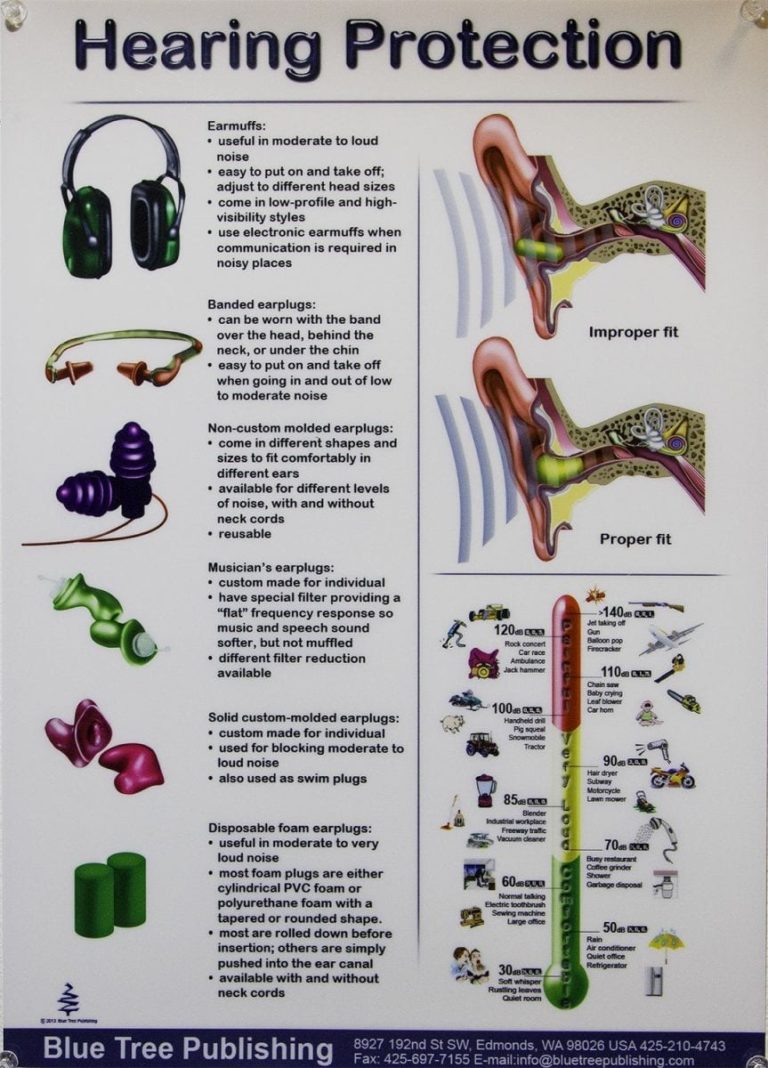
When looking at earplugs, the most important thing to look for on a package or website is the Mean Attenuation. This refers to how many decibels (dB) the hearing protection will reduce the sound, or how much the sound will be dampened based on quality of hearing product. If a given earplug gives you 20 db of attenuation, it will make 100 dB sound like 80 dB, without lessening the sound.
Proper insertion
Make sure to insert all earplugs properly. This is done by putting your left arm behind your back and pulling your right outer ear backwards from the lobe. Gently insert the earplug with a light twist with your left hand. Repeat with the opposite hand for the other ear. This is sometimes called the ‘monkey grip’ (per KillNoise). Do not over-insert into the ear, only to the point where you can remove them successfully.
Proper care
Keep earplugs in a case (most of those sampled below come with cases) and gently wash with soap and water – earplugs do need to be cleaned from time to time. If you use disposable ear plugs you can wipe them off, but they don’t need to be washed since they are designed for single use.
Brands
Of the brands surveyed below, none of these will fall out or feel like they might slip, provided they are properly inserted. Dance, rock out, rage proper and the earplugs will stay securely in your ear.
Matrix Orange (single use), made by HowardLeight.com. This pair is firmer and may be tough to get into your ear but once in, they do not dull the music much and it feels almost the same as not having them in.
Mean Attenuation at 2000 hertz: 36 db
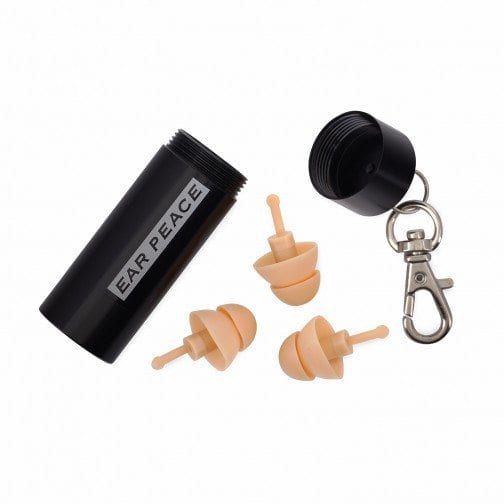
Ear Peace: These are the smallest pair sampled for this article and very light. They can hide in your ears so well that no one can see them at all and it can feel like you are seeing a show without earplugs inserted. Being so small, they can be a bit weird to remove, as there is a tiny rubber end that allows you to pull the entire plug out at once. Removal becomes easier the more you use them. Bonus – these come with an awesome case on a small key chain. One size fits all.
Mean Attenuation at 2000 hertz: 22 db
HEAROSHigh Fidelity for small ear canals: It’s not the size of your ear canal that matter – get what feels best and fits best. These earplugs can be angled at three depths, denoted by soft ridges on the plugs. Comes with a case
Mean Attenuation at 2000 hertz: 22.5 db
Etymotic High-definition Earplugs: This pair of earplugs comes with a cord that attaches the two earplugs together, so that you can put them in and take them out and let them hang around your neck when the music isn’t playing. They fit in nicely, much like the HEAROS mentioned above (Etymotic also makes HEAROS) and keep the static out evenly without lessening the music experience.
Mean Attenuation at 2000 hertz: 20 db
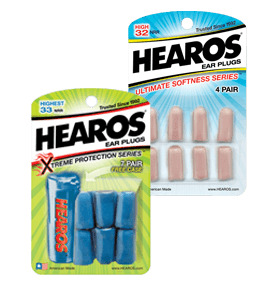
HEAROS Xtreme Protection: Made out of soft squishy foam, these make music easier to tolerate close up, without making it quieter; they simply take away the bass and static that you wouldn’t recognize otherwise. When away from the music, it can be difficult to hear so you may have to take them out and reinsert them. They also roll up nicely, fit tight and are soft to touch. No case, but they fit easily into a wallet or purse.
Mean Attenuation at 2000 hertz: 38.6 db
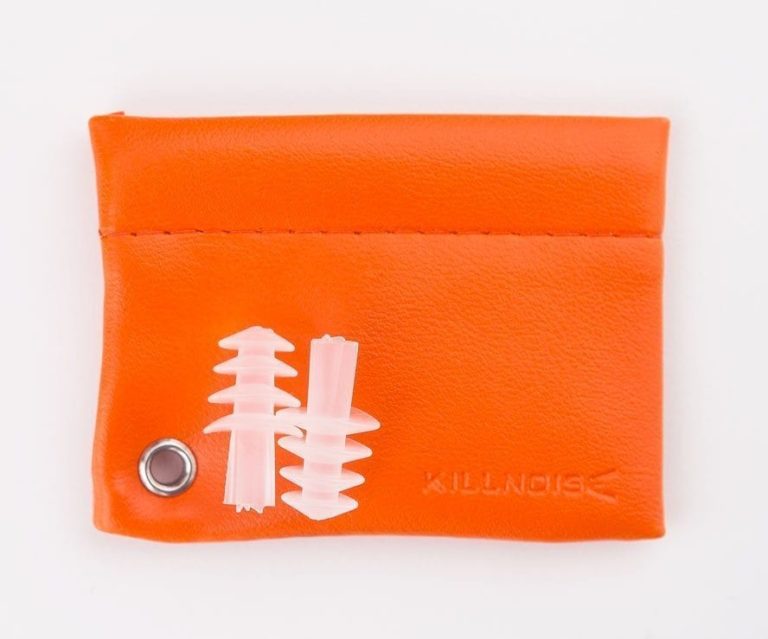
Kill Noise: Developed in Sweden, these small rubbery earplugs fit in easily with four depth levels and a rubber disc to stop them from going in too far. They definitely kill the noise, but only the bad stuff; the music gets through cleanly and clearly. It may take a few tries to get them in right, since they are a bit flexible and could have more rigidity but once they are in, they fit just right. They come with flat a snap-shut case.
Mean Attenuation at 2000 hertz: 23 db
Keep a pair in your backpack for a festival, your glovebox for club and theater shows, and a pair in your purse or wallet – cover all your bases. Don’t see live music without them if you want to continue hearing live music for many years to come. Taking care of your hearing is the most important thing live music fans should do for themselves, to ensure that the music never stops.
Time Limits For Hearing DamageBelow are the accepted standards for recommended permissible exposure time for continuous time weighted average noise, according to NIOSH (National Institute for Occupational Safety and Health) and CDC (Centers for Disease Control and Prevention), 2002. For every 3 dBs over 85dB, the permissible exposure time before possible damage can occur is cut in half.
Brooklyn-based Indie Pop artist Ski Team (Lucie Lozinski) has announced Dec. 3. as the release date for the music video of “Me”.
“Me” is about “the struggle of adjusting someone’s role in your life, or your own role to them, and giving up control in that process,” shares Lucie Lozinski, otherwise known as Ski Team. “It’s about realizing if you have to assign roles, maybe it’s not as special as you think. And, like, challenging this idea of roles being the whole of someone’s identity. It’s scary to not know who’s on your roster, or who you are without a particular person/job/trait/whatever, and just go forth into life’s abyss as a human, but it’s often better for everyone involved to get on with it.”
While the song is classified as experimental, there is enough common elements to make the song relatable to the average listener. The saxophone that begins the song is a nice touch and each time the sax makes an appearance in the mix it is always a welcome addition. The lyrics take the song to a personal level that gives the feeling of listening to a journal entry.
The video reflects the isolation and mundanity of the roles we play in everyday life by the use of the grey office space, escalators, and packed public transportation. Lozinski wears her hair pinned back as tight as can be and an all-white suit and tie combined with a long flowing skirt and a fo-leather jacket. All this draws stark connections to Apple’s famous “1984 Macintosh” commercial in the sense of routine and technology controlling life. With fantastic editing and shots that beautifully depict the liminal, the music video is an incredibly impressive achievement.
Lozinski found the saxophone player on Hinge. He had a bunch of videos of him playing sax, and she reached out saying, “hey I don’t want to date each other, but can you come put down some saxophone on this song?” And he did. Ski Team collaborated with popular producer Daniel Knowles (Sharon Van Etten, Cigarettes After Sex) on the new single. Ski Team has received praise from the likes of American Songwriter, Atwood Magazine and more.
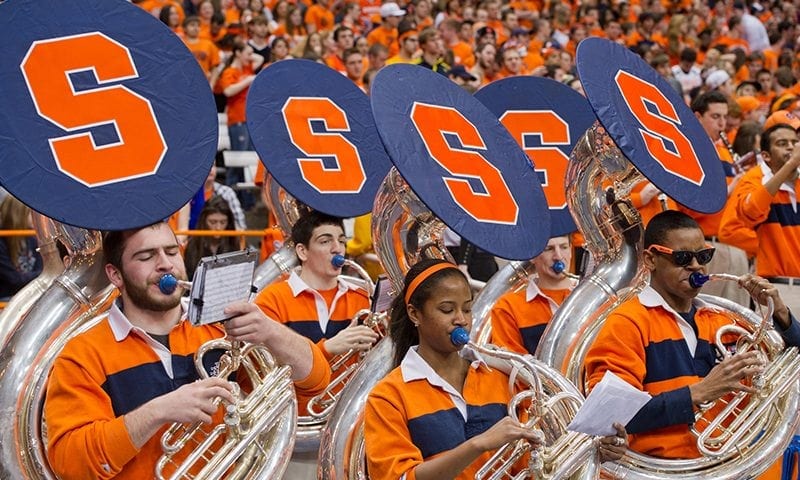
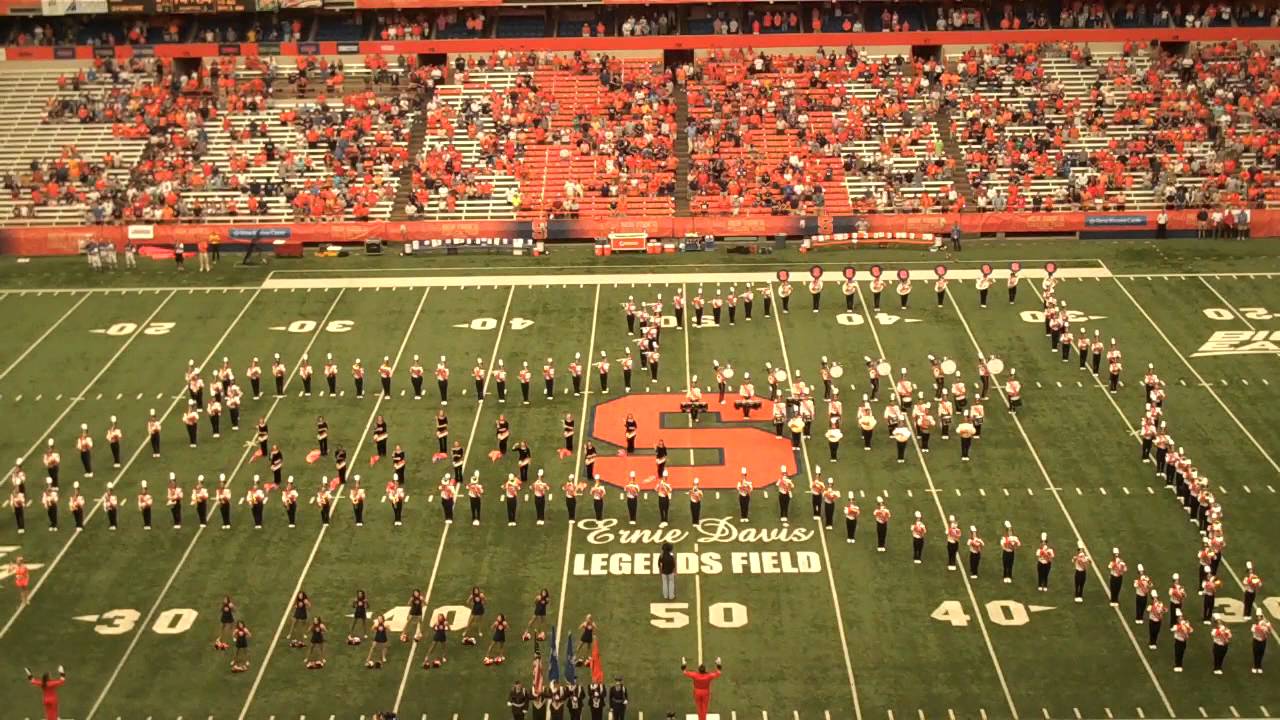
Originally profiled in 2018, we take a look at the Syracuse Fight Song “Down the Field,” its origins and place in Syracuse University history.
The month of March signifies the end of winter, and the hope that Spring brings. It reintroduces the world to sunlight after 6 pm, walking around in a single layer of clothing, and the occasional bunny in your backyard. While some people look forward to eating lamb on Easter Sunday or drinking their weight in green beer on St. Patrick’s Day, there is only one thing on the minds of people from Syracuse during the month of March: Basketball.
The 2018 NCAA Tournament is set to begin, and features Syracuse playing Arizona State in a First Four Midwest Region game at 9:10 pm on March 14 in Dayton, Ohio. There you will hear buzzers buzzing, fans cheering, and the infamous Syracuse fight song ‘Down the Field’ played by the Sour Sitrus Society.
Originally written in 1914 by Ralph Murphy (Class of 1916) and composed by Harold Lewis (Class of 1915), Syracuse University’s fight song has stood the test of time.It’s used as a device to pump up the crowd and draw support for the team, and something every Syracuse University student and alumni has etched in their brains for life.
Katie Canete, Drum Major of the Syracuse University Marching Band (SUMB) in 2017, was one of three who conducted/lead the band through every rehearsal and performance. The marching band consists of approximately 200 members, and is one of the oldest collegiate bands in the nation.
“’’Down the Field,’ or better known as Syracuse University’s fight song, is played and sung by the Syracuse University Marching Band at every home football game and Sour Sitrus Society at every home basketball game,” Canete said. “A lot of the fans don’t know all of the words, but the entire crowd always claps along once they hear the tune! It’s infectious!”
The SUMB’s home turf is the Carrier Dome, a domed sports stadium located on Syracuse University’s campus in the University Hill neighborhood. It holds nearly 50,000 people for football games, 35,446 for basketball games, and 56,250 for concerts. Additionally, the SUMB can be see playing local parades and other assorted performances throughout the year. As March Madness begins, you can be sure to hear the Rah! Rah! Rah’s of ‘Down the Field’ when Syracuse scores some big points.
‘Down the Field’ Lyrics
Down, down the field goes old Syracuse, Just see those backs hit the line and go thro’. Down, down the field they go marching, Fighting for the Orange staunch and true.
Rah! Rah! Rah!
Vict’ry’s in sight for old Syracuse, Each loyal son knows she ne’er more will lose, For we’ll fight, yes, we’ll fight, and with all our might For the glory of Syracuse.
On Monday, November 18, the New York City Council passed a resolution designating every November 30 as “Shirley Chisholm Day,” honoring the longtime Bedford-Stuyvesant resident, political pioneer, as well as the first Black woman elected to Congress and first woman to run for President.
Chisholm speaking at the 1972 Decmocratic National Convention – photo via Library of Congress
The honor arrives a week that would have ended with Chisholm’s 100th birthday, on Saturday, November 30.
“This legislation is … an affirmation of the contribution of Shirley Anita Chisholm, who unlocked and opened doors for generations of political leaders who were excluded simply for being Black.”
Brooklyn Councilmember Farah Louis – regarding “Shirley Chisholm Day”
Earlier this year, breakout vocalist Samara Joy released an original single, “Why I’m Here,” a song so triumphant it was chosen for the Netflix film Shirley, starring Oscar winner Regina King as the title character.
Co-written with GRAMMY winner PJ Morton, “Why I’m Here” captures the inspiring drive of Chisholm. with Joy noting, “For me, this song was a representation of how Shirley Chisholm’s commitment to pursuing her purpose has affected us all, whether we realize it or not.”
The song further establishes Samara Joy as a voice to be reckoned with, both in the world of jazz and beyond. Likewise, Chisholm was a force to be reckoned with, and a passionate leader for decades.
Born in 1924 in Brooklyn as Shirley Anita St. Hill, Chisholm noted in her 1970 memoir “Unbought and Unbossed” that she was taken to Barbados at an early age to live with her grandmother, later returning to Brooklyn when she was 10. There, she lived with her parents and siblings in an “unheated, four-room, cold-water railroad flat” in Brownsville, a mostly-Jewish neighborhood at the time.
Chisholm graduated from Brooklyn College and in 1951 received a master’s degree in early childhood education from Columbia University before eventually joining the League of Women Voters and the NAACP. In 1964, she became the second African American in the New York State Legislature and in 1968 she won a seat in Congress, advocating for early childhood education, among other causes.
Chisholm represented Brooklyn’s 12th Congressional District, which covered much of Bed-Stuy, for seven terms from 1969 to 1983. In recent years her legacy has been celebrated with various honors, including a posthumous Presidential Medal of Freedom in 2015 and a statue in Prospect Park approved by city officials.
In the lead up to her run for the Democratic nomination for president in 1970, Chisholm argued, “Our representative democracy is not working, because the Congress that is supposed to represent the voters does not respond to their needs. I believe the chief reason for this is that it is ruled by a small group of old men.” Chisholm’s words from more than a half-century ago echo loudly today in the wake of the most recent presidential election.
The lyrics to “Why I’m Here” follow the course of Chisholm’s trailblazing career, with the chorus, “An easy road was never promised, and so much has been from taken from us, but I won’t stop no matter how much I have to go through, I won’t shed one tear, I know why I’m here,” solidifying the icon’s tenacity in the face of oppression, racism and sexism.
Photo by Ambe J. Williams
In February 2024 at the 66th GRAMMY Awards, Samara Joy added to her accolades by taking home Best Jazz Performance for her single “Tight.” Self-produced, the winner features Joy with her working band – pianist Luther Allison, bassist Mikey Migliore and drummer Evan Sherman – recorded at the legendary Electric Lady Studios in NYC.
Samara Joy is currently on tour, with a few upcoming New york performances, before heading to Europe to start 2025.
December 13 – United Palace, New York, NY
Decemeber 16 – Hart Theatre at The Egg, Albany, NY
December 17 – “A Joyful Holiday” Feat. The McLendon Family – UB Center for the Arts – Mainstage Theatre, Buffalo, NY
Shirleycan be seen on Netflix, starring Regina King as Chisholm and directed by Oscar winner John Ridley (“12 Years a Slave,” “Jimi: All Is By My Side”). Shirley follows Chisholm’s 1972 presidential campaign and the impact she left on modern culture.
Samara Joy “Why I’m Here” Lyrics Fight! Fight! Bending but never broken Knocked down but I keep going I’ve decided to stand my ground I will not be moved And I have no fear I know why I’m here
An easy road was never promised And so much has been taken from us But I won’t stop no matter how much I have to go through I won’t shed one tear I know why I’m here
The future is in our hands Now’s the time to stand Together we’ll pave the way Those who walk by faith With their heads held high Have the power to change the world
Bending but I can’t be broken I’ve been knocked down But I choose to keep going I’ve decided to stand my ground I will not be moved And I have no fear So don’t you shed one tear Cause I know why I’m here
Former frontman of Antibalas and Afrobeat pioneer Amayo has released “Black Magic Sister” ahead of his debut solo album, Lion Awakes.
Photo: Kory Thibeault
Known best as the former frontman of Antibalas, it’s nearly an understatement to describe Amayo as a legend in the Afrobeat scene. Often credited with the globalization of Afrobeat and contributing to the sound becoming a genre of itself, Amayo moved to New York City in 1995 from Nigeria.
Having attended Howard University, Amayo eventually moved to Brooklyn and found his niche in designing clothing and teaching Kung Fu out of his Afrospot Temple.
While there, Amayo was approached by two of his future bandmates with an invitation to join their new band named Antibalas- and the rest is history. Over the course of 23 years, Amayo became the face of the band while lending his voice and songwriting skills to the group.
Parting ways with Antibalas to pursue his solo career, Amayo has returned to the public eye with the announcement of his debut album Lion Awakes and the release of its first track, “Black Magic Sister”.
Dedicated to his rich Nigerian heritage and Chinese martial arts teachings, Lion Awakens is a testament to Amayo’s boundless creative vision and deep love for his craft. Opening the five track album with “Black Magic Sister,” he makes a vibrant first impression.
Just under six and a half minutes in length, “Black Magic Sister” is a rich soundscape of percussion, keyboard, horns, and vocals- both Amayo’s own and a chorus of supporting voices.
“[Black Magic Sister is] about offering Blessings for an abundant mindset. It’s also a prayer for twins and a wish for those who lost close ones.”
– Amayo
Amayo’s debut solo album Lion Awakes is slated for release on January 17, a set of fierce afrobeat tracks that promises listeners a sonic adventure through myth and reality. In anticipation for the release an official album release party to be held at the Brooklyn Bowl on January 29.
To learn more about Amayo, find out how to attend the official Lion Awakes listening party, and keep up to date on his latest ventures, be sure to check out his official Facebook page here.
After the original Woodstock Music Festival in 1969, there were many people who wanted to replicate the magic of peace, love and rock n roll. But not all future endeavors were destined for success. Two music festivals in particular, the Bach to Rock Festival in 1970 and the Hamlet of Hurleyville Music Festival in 1979, were both little-known festivals in small New York State towns that ultimately failed and were mostly forgotten with the passage of time. Today we look back on these festivals that were doomed from the start.
The “Bach To Rock” Fiasco
The Bach To Rock Festival was set to take place near the Catskills in Sullivan County in the hamlet of Mountaindale. This was only about 25 miles away from Bethel, NY where Woodstock was first held. It was envisioned as a summer long cultural series with a mixture of opera, broadway music, dance and rock. The promoters hoped to attract 50,000 patrons and host events six days a week from July through August.
The small hamlet of Mountaindale – Photo from Wikimedia Commons
The ambitious festival was contentious from the start. After last year’s wild festivities at Woodstock, many locals in Mountaindale were opposed to the sex, drugs and other “unsavory” activities that would likely occur during the event. The disaster at the infamous Altamont festival back in December was still fresh in many minds as well.
Nevertheless, the festival site continued to be developed as a land deal was struck and $250,000 was put into the groundwork. The bill originally boasted acts like Joe Cocker, Grand Funk Railroad, Jethro Tull. However a concert on Randall’s Island that was occurring that same summer left many of the bands legally tied up and unable to perform again in such close proximity.
A flyer from the festival – Photo via Reddit
New bands were booked including the Grateful Dead, Van Morrison and The Band.
Then in early July, days before the start of the festival, a restraining order was issued against the Mountaindale Music Festival, prohibiting large public gatherings. The decision was later upheld on by the Sullivan County Supreme Court, one day before the concert was set to take place.
Promoter Budd Filippo pictured on the festival grounds in Mountaindale. (Photo originally appeared in NY Daily News).
On that day, July 7, the New York Times covered the ruling with an article titled “Court Order Delays Mountaindale Rock Festival.” The Times said the following:
“A borscht circuit of rock musicals that seemed to be developing in the Catskills after last August’s Woodstock Festival suffered a new setback yesterday,” the Times reported, alluding as well to a 54-hour long rock festival that had just concluded, drawing 2,000 people to Saugerties. “A temporary restraining order against the Mountaindale Music and Arts Festival, scheduled to open tonight on its own 700-acre tract in eastern Sullivan County, was upheld by Appellate Justice Michael E. Sweeney.”
But by then over 10,000 people were already on the way to to the small town of Mountaindale. The train was already in motion.
Hippies gather in Mountaindale – Photo from the New York Daily News
The New York Daily News reported, “Bands of hip mountaineers roamed the Catskills today in a nomadic search for a rock festival that was canceled at the 11th hour by a politician on the other side of the generation gap.”
While the festival was officially canceled, the masses of people threw together a free concert at hotel in South Fallsburg about ten miles from Mountaindale. There were rumors that the Grateful Dead would make an appearance, but besides some local bands the only major act who showed was Richie Havens. Havens had famously been the opener at the original Woodstock festival the year prior.
Richie Havens, famed musician who opened at Woodstock and was the only performer at the failed Mountaindale festival -Photo: Gunter Zint/K & K Ulf Kruger OHG/Redferns
After the fact, the county’s rulings were upheld in the higher courts establishing a precedent for future mass gatherings, which greatly affected proposals for other music festivals to come.
The Hamlet of Hurleyville Music Festival
Ten years after the original Woodstock, and 9 years after the failed “Bach To Rock”, Sullivan County was once again abuzz with the hopes of music. A three-day festival was set in the Hamlet of Hurleyville with a lineup that included Joni Mitchell, Hall & Oats, Cheap Trick and REO Speedwagon, among others. Promoters expected to sell around 250,000 tickets. Tickets were priced at $37.50 for all three days. There were also plans to make an album and documentary film of the festival.
The Hamlet of Hurleyville – Photo from Visithurleyville.org
The hopes with this festival was to kick off a new permanent music venue in the area with the hopes of improving the local economy. The festival was envisioned by a local promoter Leon Greenberg who had previously managed to revitalize the Monticello Raceway.
A photo of Leon Greenberg in the 70’s – Photo via New York Almanac
A brief snippet in the New York Times described plans for the Hamlet of Hurleyville Music Festival – Photo from New York Times TimesMachine Archive
Previous laws against mass gatherings established in Bach to Rock made a large number of hurdles and many locals were opposed to the festivities. A public relations campaign was launched to turn people’s sentiment, with the tagline “Success is a Traffic Jam,” which appeared on buttons and bumperstickers around town.
Ultimately, Greenberg was unable to sway the tides and the town board voted unanimously to deny a permit. The envisioned music venue which was meant to repurpose the site of the old Columbia Farm Hotel remains unused to this day.
The Columbia Farm Hotel circa 1940. It closed in 1969 and burned in a massive fire on Christmas Eve, 1971. – Photo via New York Almanac
On a positive note, the Hamlet of Hurleyville now hosts an annual Hurleyville Music Festival through the Hurleyville Performing Arts Center which engages local artists and the community in a weekend of arts, music and culture.
Brooklyn-based soft rock/indie artist Harrison Lipton has released his latest single “On My Own” which masks post-breakup sadness with cheeky humor.
Musical jack-of-all-trades Harrison Lipton releases his cheeky new breakup anthem “On My Own” via Amuse. The facetious, 70s-inspired dad rock song uses the all too familiar coping mechanism of poking fun at inherent sadness to make it through the day. His voice full of smooth earnestness, Lipton ushers listeners towards the greener grass on the other side. Harrison Lipton is a 30-year-old singer, songwriter and producer. The Brooklyn artist’s musical flair resides in the intersection of indie, R&B and 70s soft rock.
Now with the focus shifted to his own releases, Lipton unveiled “Synchronized Swimming,” with its captivating accompanying music video, back in September. Exploring romance coyly nestled within the metaphor of synchronized swimming, listeners witness Lipton’s proven songwriting and production talent in raw form. Complete with dusty piano, laid-back Khruangbin-like drums, and an underwater guitar solo, the final touch is the perfect pairing of background vocals from MICHELLE’s Layla Ku. “On My Own” keeps building the world “Synchronized Swimming” started, putting forth a distinctly clean and modernized late 70s aesthetic.
Lipton prides himself on fully realizing a track from start to finish, leading the charge with songwriting, producing, and mixing, as well as creative direction. Lipton’s music is a product of his singular imagination, presenting a style that is sincere, authentic and all his own.
His music has been featured in NPR and Early Rising as well as on numerous editorial playlists such as Apple Music’s Late-Night Menu and Spotify’s Fresh Finds and Chill Vibes. Now focusing on new singles leading toward a larger project, Lipton emerges as a promising and unique voice, blending soulful vocals with singular and catchy production.
For more information on Harrison Lipton and to lend an ear to some of his recent works, click here.
Rock unit Louisiana Child has released their debut single, a gritty Old West and rock ‘n roll fusion track titled “Cocaine Cowboy”.
Louisiana Child is a gritty powerhouse of a rock unit based out of Toronto that blends the kick of southern rock, the swing of blues, and the tone of country into a dynamic sound of foot-stomping and head-banging that leaves a long-lasting impression full of raw energy.
Comprised of Daniel Theriault on vocals and guitar, Ricky Theriault on drums and backup vocals, Jean-Marc Lanteigne on lead guitar, and Chris Moore on bass, Louisiana Child is currently working away on their debut EP in collaboration with seasoned producers and mixing engineers George Panagopoulos and Mark McCaster, the former being widely recognized for his work with Audioslave, Red Hot Chili Peppers, and the legendary producer Rick Rubin. These music industry powerhouses bring a wealth of expertise and experience to Louisiana Child’s already promising sound.
The first product of the project to go public and Louisiana Child’s debut single comes in the form of “Cocaine Cowboy,” a hauntingly gritty track that follows the internal battle of a man facing his demons.
Painting the image of a haunting Old West setting through rounded blues-y guitar tones, a sharp country-tinged vocal punch, and lyrics that tell the tale of a lone vagabond, Louisiana Child explores the concepts of temptation towards things that are inherently destructive, namely drugs and alcohol.
Mastered by Ted Jensen of Sterling Sound, “Cocaine Cowboy” marks a promising beginning for Louisiana Child, establishing a distinct sense of storytelling and carefully crafted sound as they enter the rock scene with a bang.
This track is just the beginning for the band- to learn more about Louisiana Child, stay up to date with their latest endeavors, and keep an eye out for future shows, follow their official Instagram and Facebook pages.
Math-rock trio Peaer has announced their return to music after five years with the release of single “Just Because.”
NYC-based math rock trio Peaer return with their new single, “Just Because.” It’s their first new offering since 2019’s A Healthy Earth, which earned raves from fans and media alike. A drop-tuned, four-on-the-floor thumper that crescendos with a moment of headbanging catharsis, the track is a perfect blend of Wish-era The Cure’s glittery rhythms and the melancholic post-rock emo of American Football.
The band will also be making its live return with their first show in nearly a year this Saturday, November 16, in Brooklyn at Baby’s All Right alongside Pet Fox. “Just Because” is the fruit of their focus — a soaring introduction to Peaer’s new era and a tantalizing promise of what else lies ahead.
Peaer began in earnest in 2014, when Katz sought to blend his love of windy math rock with contemplative slowcore. From this sprang 2014’s lo-fi, home-recorded album the eyes sink into the skull, released digitally via Bandcamp with Katz taking on all of the instrumentation himself. From there the idea of Peaer evolved, and while touring on 2016’s self-titled LP (Peaer), Katz joined forces with now long-term close-collaborators Jeremy Kinney (drums, engineering) and Thom Lombardi (bass, vocals).
The trio came together to write and produce 2019’s aforementioned, critically acclaimed A Healthy Earth, which they quickly followed up with The Hands and Feet Turn Blue (2019) — an Eyes companion album featuring reworked songs, demos, and remixes.
For more information on Peaer and to hear their new single “Just Because” click here.

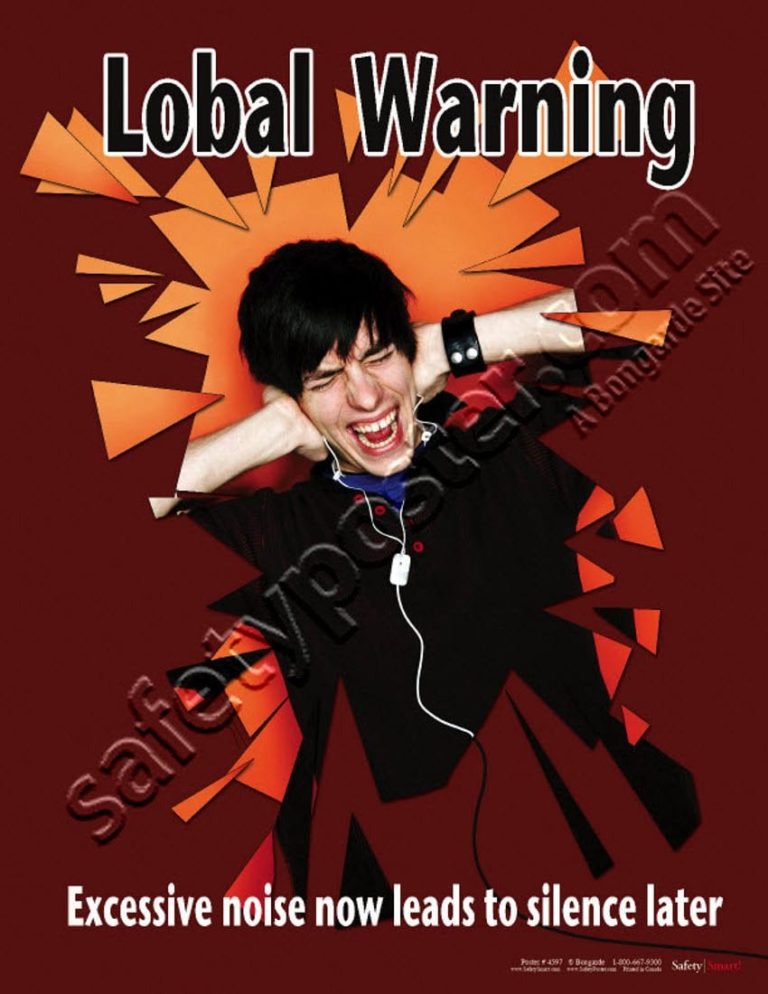 This is when I decided it was time to invest in a good pair of ear plugs. For nearly every show since December 2010, I have worn earplugs and not missed a note of music and as a result, the ringing has subsided somewhat. While I have a couple of pairs of ear plugs that work well, I continue to notice, more than four years later that many of my friends and regulars at shows do not wear earplugs. The typical response is because they didn’t want to miss the sound of the show. The benefits of earplugs cannot be understated, as they filter out some of the unnecessary noise and improve the quality of the live music experience rather than hamper it. Around the time of this diagnosis, I sought out different styles and brands of earplugs to test which ones worked best and to share the benefit of earplugs with others so that fewer do not succumb to tinnitus, or worse, hearing loss. Four years later and I still have tinnitus but my hearing is no worse than it was in late 2010, but it would be a different story without a small investment in earplugs.
 For parents who wish to bring their children to concerts and live music events, hearing protection is of paramount concern, as younger ears are more easily susceptible to damage. Doctors advise choosing to protect children’s hearing especially, noting “Had I not been educated as to how fragile a child’s hearing was, I may have not protected both my kids early enough to ensure they won’t have hearing loss. Now, they wear them to fireworks, music, anything loud. My son even has them on right now while doing his homework in his bedroom.” For parents looking into hearing protection for their children,
 Etymotic High-definition Earplugs
 HEAROS Xtreme Protection
 Kill Noise: