Category: Venue Profile

  • Inside the Historic Earlville Opera House of Central New York

    New York State is home to hundreds of theaters and music venues both big and small. Each building has their own unique history and character. The Earlville Opera House, located between Madison and Chenango County, in Central New York, is no exception. 

    The Earlville Opera House in Present Day - Photo Courtesy of Earlville Opera House
    The Earlville Opera House in present day – Photo courtesy of Earlville Opera House

    The original Earlville Opera House was constructed back in 1892. It was destroyed by fires twice in its early years, but the current building has stood strong for over 125 years. As of 1974, the Opera House is listed on the National Register of Historic Places. Although the village Earlville has a population of less than 800 people, the Opera House makes this small town a stunning cultural landmark.

    Over the years, the Opera House has served many roles within the community. In the late 1800s and all the way to the Roaring Twenties, the venue was a stage for vaudeville acts, three-penny operas and traveling medicine shows. At one point, it became a silent movie house and at another served as a public auditorium for town meetings and even high school graduations.

    While the Opera House is now a wholly unique feature of Earlville, it wasn’t always that way. In the late 1800s when these sorts of theaters were widely popular, there were as many as six other opera houses in the adjacent towns, including Waterville and New Berlin. Over the years, they became relics of the past and faded from memory both metaphorically and literally. In Central New York, one was torn down to become a parking lot and another in Hamilton was rebuilt into apartments, while another in Oriskany Falls was destroyed by a fire. 

    The Earlville Opera House in 1892 - Photo Courtesy of Earlville Opera House and Tim Carey
    The Earlville Opera House in 1892 – Photo Courtesy of Earlville Opera House and Tim Carey

    The Earlville House experienced nearly all of these fates at one point or another. The theater first closed its doors during the Great Depression. Though it re-opened in 1937 as a theater showing “talking movies,” the Opera House closed once again in 1952 and wouldn’t see the light of day until 1971. It was bought by Joey Skaggs, an artist, activist educator and self-proclaimed “media prankster.” Before he bought the place, it was slated to be torn down into a parking lot just as the Sherburne Opera House had met its end that same year.

    Skaggs proved to be the defining difference between the two theaters. He stopped the motion to turn Earlville’s Opera House into an empty lot and instead placed the theater in the hands of a volunteer board of directors called Earlville Opera House, Inc. He sold them the theater for the grand price of $1.

    Michelle Connelly is now Executive Director of the Opera House and she says she is grateful for Joey Skaggs’ investment in the theater and community.

    “We kind of live off of inspiration and good vibes and that gains momentum when people believe in what you do and support you and it’s inspiring,” she said. “Joey’s mission and vision we keep alive … Our mission is to enrich the Central New York and Southern tier regions through the visual and performing art but also to help maintain our building here for future generations to use.”

    The interior of the Earlville Opera House

    A great deal of restorative work was needed after the theater’s 15 year hiatus. Although the building was updated in many ways, it was merely restored, not changed. The theater remains pretty much the same as when it was first built. It may not have air conditioning, but Connelly said that just adds to the old-school charm. 

    “We have a beautiful venue where we can create events that provide for shared experiences between people that create memories and form community bonds,” she said. “You can’t really articulate the worth of that… it’s absolutely priceless …  It’s an intangible thing, but that’s a byproduct of what we do.”

    According to Connelly, the theater also boasts one of the only remaining horseshoe balconies in the U.S. 

    “It’s sloped and our stage is raked which means it has a slight downward lean to it, so when the balcony also does that, it kind of meets in the middle and the acoustics are incredible in that theater,” Connelly explained.

    The horsehoe shaped balcony inside the Opera House - Photo Courtesy of Earlville Opera House
    The horsehoe shaped balcony inside the Opera House – Photo Courtesy of Earlville Opera House

    In 1976, five years after it was purchased by Skaggs, the Opera House had its first live performance in more than fifty years. It hasn’t looked back since.

    In the past, performing artists have included David Bromberg as well as Heritage Blues Orchestra, Los Blancos, Martha Redbone and Savoy Brown. This year, singer-songwriter and blues musician Carolyn Wonderland will grace the stage. Other notable acts coming to the Opera House include Hazmat Modine and Marcia Ball. For a full list of upcoming performances, click here.

    The theater is largely sustained through grants and other funding. It is well off enough that it actually administers grants of its own to artists and arts organizations in three counties: Broome, Chenango and Oswego. This year the Opera House will re-grant over $230,000 for cultural initiatives and supporting the performance arts. 

    Center stage at the Opera House

    The Opera House continues to be a fixture of the small community in more ways than one.

    In addition to the main stage, an arts cafe and outdoor courtyard allow local and emerging musicians to perform. They also have a free art gallery on site, featuring the works of local artists. There is currently a gallery on display from March 18th until April 22nd featuring painting and photography from three regional artists: Tom Schmitt, Frank Vlossak and Bill Baburchak.

    Workshops are also hosted and open to all, for a small fee. Gary Talley, lead guitarist of the Box Tops, will teach a masterclass guitar course at the theater in July as part of an Earlville guitar workshop weekend hosted by the Opera House from July 28-30th. Talley will then be doing a public performance that weekend on the 29th at 7pm.

    Connelly said being a source of community support like this ties directly into Skaggs original mission to enrich the arts of the surrounding area.

    “If you can make any kind of impact or difference in a positive way, we should,” Connelly said. “That’s the role of the arts. Arts are used to express and help people in many different ways as an avenue of expression.”

  • It Sounds Better in the Basement: The Byrdhouse in Albany

    Since the 1970s, Do-It-Yourself (D.I.Y.) concerts proved to be a vital part of generational music culture, stemming from the thriving underground punk movement in cities like London and New York. The D.I.Y. scene brings local bands, artists, and other like-minded creatives together to build accessible, open environments for the community to enjoy music in safe and inviting spaces.

    Our very own Albany has served as an epicenter of the underground music scene for generations, through informal gatherings of college garage bands and local talent. Passing the torch from venue to venue over the years, our generation’s leading venue can be recognized as The Byrdhouse.

    byrdhouse washington park

    Named for a stack of birdhouses in Washington Park and spelled with a “Y” instead of an “I” to make the brand more recognizable, Rachel and Adam founded The Byrdhouse in 2018 while attending undergraduate courses at University at Albany and the College of Saint Rose, respectively.

    Rachel recalls attending basement shows at former Saint Rose venues called the Rice House and the Orange Peel as her “rite of passage,” while Adam performed locally in a band called Delphino. Upon the closure of these venues after their founders graduated, the duo partnered with other friends to create their own space to enjoy live music. The Byrdhouse first opened the doors to their basement in October of 2018 for a Halloween show.

    The Byrdhouse
    A show at the Byrdhouse basement. / Photo Credit: Peter Herrick

    “[The Rice House and The Orange Peel] always got really great acts and made a good atmosphere,” Rachel said. “Sort of what I wanted to base Byrdhouse off of.”

    The early days of Byrdhouse focused on music and experience, with a tight knit community crew putting on and attending shows. Converting a rental house in downtown Albany into a small concert venue by building a makeshift stage, pitching in to collect speakers and other equipment – all while on a college student budget.

    “We were cutting up mattresses, insulating, and making it noise proof,” Rachel said of preparing the rental house basement. “We even deconstructed a bunch of walls in the basement to construct an audience viewing area.”

    “We did a lot of work to try to insulate to make sure that things weren’t too loud outside,” Adam said. “We never got a noise complaint, and you know, we were running a pretty tight ship. So that house was never really in disarray, at least not from the shows.”

    As the years went on, Byrdhouse began to expand both their reach and notoriety among the Albany music community. Rachel found a passion in formulating setlists of acts of a similar genre for theme night events, and began to popularize amongst music-loving Capital Region college students as a weekend go-to.

    The Byrdhouse
    Adam and Rachel of Byrdhouse (left-to-right). / Photo Credit: Josh Reedy

    “We started off as a venue that was free to everyone…bands that we knew and people that were cool with that and it was fine. But as we started to charge and I started to get bigger acts, I started to formulate shows based on similar genre and theme…if I was doing a theme show…for goth night…I would be looking for all Gothic-esque bands and I would search from different cities” Rachel said.

    While Rachel took on promoting and organizing shows, Adam served as what he calls the “technical hand.” What set Byrdhouse apart from other venues was their commitment to sound quality. Eddie, who joined the team later on, took over the sound technology.

    “That’s a big deal for me, you have to take care of people’s ear health,” Eddie said. “Some venues now don’t even have a tech person… we were one of the few that had someone, either me or Adam, dedicated to it.”

    Byrdhouse kept a consistent lineup of shows up until March 2020, when all events shut down as a result of the COVID-19 pandemic.

    “When COVID had hit it had blew out all of my plans. We had thought about doing live streams and stuff, but it just seemed too much at the time for everyone, I think, and after COVID had cooled down a bit…I had talked to some other friends of ours who wanted to keep the Byrdhouse spirit alive,” Rachel said.

    The Byrdhouse returned on Aug. 21, 2021 to fans, bands, and artists alike welcoming them back – craving the sense of togetherness underground music once brought. The Byrdhouse returned with the same vibrant energy, and basic health precautions, to ensure locals had fun and bands could get back out into the scene.

    “We had a good reputation with people, you know, people would come back and spread the word,” Adam said. “If you see a band that you love play live for you and they tell you that this is our favorite show or one of our favorite places to play, that’s awesome… that’s hard to beat”

    Though “covers” were charged at the door, varying from about $5 for entry, the Byrdhouse organizers never took any profit. At the end of the night, the money was counted up and equally distributed to each of the performing acts as payment.

    “Basement venues are like nonprofits…you’re working to not make profits…the profit is the community coming together,” Eddie said. “You can tell that bands wanted to play there…it was all focused on the music.”

    Guitarist joins the crowd. / Photo Credit: Peter Herrick

    After four years, three houses, and one global pandemic, The Byrdhouse held their last two shows at the end of Phoenix Fest, a D.I.Y. festival, in April of 2022.

    “Graduating from college I felt like it might be a better time for younger generations to start their own basement venues and pass it along…pass along the torch to the younger generation so they can experience what I did” Rachel said.

    Today, Rachel still plays a role in the Albany music scene with the transition of The Byrdhouse to D.I.Y. booking and management group Byrdhouse Records. She says it will “continue with doing shows and booking tours” through above ground venues like No Fun in Troy.

    “My heart is in the D.I.Y. scene, but as I’ve gotten older with it, I want to make it into something bigger and more versatile,” Rachel said. “[Opening] an actual established concert venue is something that I dream of.”

    *This article originally appeared in a series created by the Albany Student Press, University at Albany’s student-run newspaper.

    It Sounds Better in the Basement” is a developing series playing off of punk band The Devil is Electric’s 2001 release of the same name. The song represents the soul of basement shows and its importance in providing a platform for local bands. As Albany college students, we strongly believe in archiving the student culture of the Capital Region for generations to look back on. As part of UAlbany’s independent student newspaper, it is our mission to tell stories while protecting those who live them – which is why we have chosen to refer to sources on a first-name basis (unless receiving permission otherwise). This series will continue with features of other local venues, bands, and notable figures.

  • The Action House: Long Island’s Forgotten Music Venue

    New York City is home to dozens of iconic music venues, from the Apollo Theater to Radio City Music Hall. But while these glamorous theaters continue to stand the test of time, others live on in memory rather than physical form. 

    Take CBGB, which closed in 2006. The dark and dingy space nurtured the emerging NY punk scene throughout the 70s, hosting the Ramones and Blondie among others. Now, the punks might be saddened to find, it is home to a high-end Italian art gallery

    But there is one venue, located in Island Park, NY that is even less talked about –The Action House – perhaps Long Island’s premier music venue in the 60’s and 70’s. It was the epitome of cool and a nurturing force for the local music scene, yet it was often overshadowed by New York City’s powerful glow.

    The Action House, located in Island Park, NY – Photo from mindsmokemusic.com

    But the Action House had its own unique vibe. It had grit, grime and a rebellious streak all its own. Part dance hall, part club (a common configuration of the time), the venue was also capable of pulling in big name acts like the Doors and Canned Heat. 

    In perhaps one of the Action House’s most infamous shows, the Doors took the stage for a two night performance on June 16 and 17th, 1967. Legend has it that on the first night, Jim Morrison slugged 15 shots of Jack Daniels whiskey back to back before taking the stage. He would attempt it again once more mid-set. While the first night was certainly one for the ages, the second night was perhaps the Door’s shortest and most lackluster performance ever. The hungover Morrison didn’t sing much, instead moaning into the microphone until his bandmates decided to drag him off the stage.

    Jim Morrison Performs at the Action House in Island Park, NY - Photo from Mild Equator
    Jim Morrison Performs at the Action House in Island Park, NY – Photo from Mild Equator

    Adding to the intrigue, the Action House was also owned by Phil Basile, a known associate of the Lucchese crime family mob. This wasn’t necessarily out of the ordinary for the era, but it did invite a world of chaos and an interesting crowd into the fold of the Action House. 

    Mike Ricciardella, drummer for The Illusion, described it like this:

    “The Action House was a wild place back then. The bouncers were nuts and very wild! The drug scene was wild! The chick scene was wild! The parking lot scene was the wildest, though. Really nuts. The parking lot was the place where the crowd hung out and got high. Inside was rock’n’roll, outside was Fantasyland.”

    – Mike Ricciardella

    Frequent performers included the Vagrants, featuring guitarist Leslie West who would eventually co-found the band, Mountain. The Hassles featured a young Billy Joel. And then there was the Vanilla Fudge. The band was actually managed by Basile, who in addition to owning the club and his various other escapades also served as an artist and tour manager.

    An Action House flyer with the Vagrants and the Vanilla Fudge on the lineup - Photo from mindsmokemusic.com
    An Action House flyer with the Vagrants and the Vanilla Fudge on the lineup – Photo from mindsmokemusic.com

    But this relationship led to some “interesting scenarios,” to put it mildly, as reported by the Long Island Press:

    “The mob-connected Action House was paying The Vagrants an exorbitant $1,500-a-night fee for a grueling 28-day-a-month schedule. This led the garage rockers to get creative with their performances. They incorporated pyrotechnics into their act, having fireworks explode as one of their songs reached its peak. One night after a performance, however, a leftover explosive wound up torching the stage along with all of the band’s instruments. This somehow did not throw them off schedule; the booking agency had them equipped with new instruments and ready to play the very next day.”

    A playbill for the Grateful Dead and The New Riders of The Purple Sage at the Action House on Nov 9-10, 1970 - Photo via concertarchives.org
    A playbill for the Grateful Dead and The New Riders of The Purple Sage at the Action House on Nov 9-10, 1970 – Photo via concertarchives.org

    Other notable performers included the Yardbirds in ‘68 and the Grateful Dead alongside The New Riders of the Purple Sage in November of 1970. (You can listen to parts of the set here)

    Shortly after the Dead’s performance in 1970, the Action House featured a series of name changes. It was briefly known as the Rock Pile, as documented on this short feature piece by the New York Times back in 1971.

    A New York Times article from 1971  when it was known as the Rock Pile.
    A New York Times article from 1971 about the Action House, when it was known as the Rock Pile.

    The club declined further in the 80’s as DJs and dance clubs began to grow in popularity

    It is unclear when the Action House officially closed its doors. As for the present, according to the blog Mind Smoke Music, The Action House was torn down over a decade ago. Back in 2018, the author of the blog found it had since been rezoned for condo development. The parking lot across the street was at the time a self-storage facility.

    Now, the Action House, a relic of a bygone area, lives on only in memory of the lucky and the damned that got to experience it in its heyday. Further tales and legends of the venue can be found in the comment sections on blog sites like Streets You Crossed, where patrons of the Action House fondly recall their own memories of the club. 

    Based on these accounts, the venue lives up it name –  a place where a lot of action went down.

  • Chris Ristau, Director of The Park Theater Foundation in Glens Falls, Discusses Launch of Music and Technology Program

    Glens Falls’ The Park Theater Foundation has announced the launch of their first education initiative, Music & Technology Program, through regional high schools this year, beginning with Glens Falls City School District, part of Music In Our Schools Month. (March 2023). 

    The program will offer middle and high school students of Glens Falls City School District and Lake George Central School District who are enrolled in general music, band or orchestra classes, to work alongside artists and audio-visual engineers. 

    Rob Lindquist (piano), Steven Kirsty (bass), Matt Niedbalski (drums) – Erin Reid Coker (Gallery Nine North)

    Included in the program are performances, workshops and collaboration with various jazz artists that are regularly featured in the Foundation’s ‘Third Thursday Jazz’ series. The Park Theater Foundation’s Executive Director, Chris Ristau, shared his thoughts on the Music and Technology Program:

    The Music & Technology Program is the latest foray for the Foundation, and one that is near and dear to my heart. In an effort to support arts education in our community, this program is only the beginning of what we hope will become a much more regular, robust offering that expands to various local school districts. I would have never found myself in the position I am today if not for the opportunities I had throughout my educational career. I hope this program, and future outreach initiatives, inspire more students to get involved in the arts in our community, and to develop their skills and self-confidence.

    Chris Ristau, The Park Theater Foundation’s Executive Director

    Students taking part will engage in workshops that focus on music appreciation and cultural education, in addition to audio and visual technology comprehension. Guest artists will explain the history of their genre, as well as provide a demonstration of their instrument(s) to further showcase their musical style. Guest audio-visual engineers will demonstrate various audio and lighting effects, and how they influence and affect both the artists and show experiences. 

    Through this program, we want to introduce students to a genre of music they might not have otherwise been exposed to, and hopefully spark further interest in those who are familiar with it or who already perform. There isn’t much opportunity available for students to learn general knowledge and gain hands-on experience about how a show comes together. We want them to experience running a venue behind the scenes – from the audio-visual component to booking the artists. There’s so much that happens off the stage before the performer takes the stage!

    Chris Ristau, The Park Theater Foundation’s Executive Director

    A Lake George High School graduate himself (2004), Ristau saw the potential to introduce gear that was professional so that anyone looking to go down that career path was using the best tools of the trade possible.

    Ristau had previously worked at the Glens Falls Music Academy (GFMA) for five years, before heading to the nonprofit world, and finally The Park Theater. Getting to know music teachers from Bolton, North Creek and other regional schools, Ristau saw GFMA as a perfect spot for him to land out of college, where he could work within a recording studio as a studio manager, befriending teachers in the process. Ristau’s experience in working with schools and supplying music programs with items via the storefront aspect of GFMA made it possible for him to identify needs throughout the region.

    Thus, when Ristau came to work for The Park Theater, he looked to develop educational programming, in addition to the jazz series each Thursday.

    Part of the mission of the Foundation is to bring performing arts opportunities to the community. The Foundation itself runs primarily out of The Park Theater building, a state-of-the-art entertainment facility, which has become part of its identity. When it came time to develop the program, we wanted to find a way for students to experience the space – an operating venue with a full stage and high end sound production equipment.

    Chris Ristau, The Park Theater Foundation’s Executive Director

    Utilizing The Park Theater venue space allows the Foundation to connect the performance and technical side of things. Ristau notes “The Music and Technology Program was developed considering what we do here and how that, presented to the student body, will be useful to them.” This program will showcase the venue to the students and introduce them to some of the ‘Third Thursday Jazz’ series musicians – many who are educators themselves. The goal is to have the musicians on the stage, performing and talking about how they got into playing music.

    Funding was made possible to get a pilot program off the ground and develop it with other schools in the area, to determine the size and scope of the program. A grant from the Glens Falls Foundation was received for Glens Falls High School programming taking place this March. In Fall 2022, they received additional funding for the Lake George High School programming taking place later this year. 

    the park theater park theater glens falls music and technology program chris ristau

    Working with Krislynn Dengler, superintendent at Glens Falls City School District, and John Luthringer, superintendent at Lake George, who both started their respective positions in July 2022, led to Ristau’s initial outreach. Said Ristau, “From there we sat down with teachers in the music program who helped shape the program into something that will complement the music and general curriculum already in place.”

    Jazz music history will also be learned throughout the program. We will give insight on how to book a show, the technical aspects behind the scenes, how to run sound and lights well to complement what is on the stage, and demonstrate the effects on the board, highlighting the capabilities that lead to a good night of tech, as opposed to a bad one.

    Chris Ristau, The Park Theater Foundation’s Executive Director

    Drummer Matt Niedbalski, who met Ristau at Parkway Music in Clifton Park, learned of his vision to bring more jazz to Downtown Glens Falls, and has become a key part of the once-a-month series, Third Thursday Jazz. Getting additional musicians from around the area on board was easy for the jazz drummer, given his proximity to The Park Theater, and his background teaching drumming made for a great role in developing the series and onstage portion of the educational program. 

    park theater glens falls music and technology program chris ristau
    Erin Reid Coker (Gallery Nine North)

    Chris Reed Jr, a Crane School of Music at SUNY Potsdam graduate opened the Glens Falls Music Academy with his wife, Meredith, a teacher at Glens Falls. Reed now handles sound tech at most of the Foundation’s performances, and was previously Chris’ supervisor at GFMA. 

    Ristau further explained how the educational portion of the Music & Technology Program comes together: “The initial performance will be for the full student body in the arts wing, then they break it down for a more hands on, in depth portion for the older kids who may be looking into this as a career. They then reconstruct things back so they have a full performance with students who are able to play with the gear to experience it first hand.”

    For more information on the Park Theater and the Park Theater Foundation, please visit their website.

    Upcoming Events in March

    March 1: The Park Theater Foundation hosts Rochmon Record Club for a series of listening parties. Hosted by Chuck Vosganian, this listening party will focus on Paul & Linda McCartney’s “Ram” (1971). Tickets: $12.00. Doors: 6:30pm | Showtime: 7:00pm.

    March 9: The Park Theater Foundation presents ‘Live & Local’ featuring indie-folk group, Cricket Blue. Dubbed one of the “10 Vermont Bands You Should Listen To Now,” Cricket Blue have taken their music and storytelling to stages and folk festivals across the United States and Canada. Tickets: Early Bird – $15.00 | Day Of Show – $20.00. Doors: 6:30pm | Showtime: 7:00pm.

    March 16: The Park Theater Foundation presents ‘Third Thursday Jazz’ with The Matt Niedbalski Trio featuring The Dylan Canterbury Quintet. Experience some of the best jazz music in the Capital Region! Tickets: $10.00. Doors: 7:00pm | Showtime: 7:30pm

    March 17: ‘The Park Presents:’ St. Patrick’s Day Dinner & Show ft. Cassie & Maggie: In partnership with Park Street Hospitality, The Park Theater Foundation presents St. Patrick’s Day Dinner & Show on March 17th, 2023! This event features a special ‘The Park Presents’ performance by award-winning Celtic duo, Cassie & Maggie, and includes a delicious Irish-inspired 3-course prix fixe menu curated by Park Street Hospitality’s executive chef, Matthew J. Delos. Nova Scotian sisters, Cassie and Maggie, have been lighting up the world with their unique blend of traditional and contemporary Celtic instrumentals and vocals. Appearing on stages across North America, the UK, and Europe the sisters have enchanted audiences far and wide with lively fiddle, piano and guitar arrangements, stunning sibling vocal harmonies in both English and Gaelic, all complemented by their intricate and percussive stepdancing style. View the full menu at parktheatergf.com. Tickets: $65.00 (includes tax and service fee). Doors: 5:30pm | Dinner: 6:00pm | Showtime: 7:30pm. 

    March 23: The Park Theater Foundation presents ‘Live & Local’ featuring world music band, HEARD. Heard is a collective of musicians that bring their skills and passion for world music, jazz and improvising together to create irresistible grooves set in a unique sonic tapestry. Energetic and upbeat, HEARD will open your ears and hearts! Tickets: Early Bird – $15.00 | Day Of Show – $20.00. Doors: 7:00pm | Showtime: 7:30pm.

    March 29: The Park Theater Foundation hosts Rochmon Record Club for a series of listening parties. Hosted by Chuck Vosganian, this listening party will focus on Rod Stewart’s “Every Picture Tells A Story” (1971). Tickets: $12.00. Doors: 6:30pm | Showtime: 7:00pm.

    March 31: The Park Theater Foundation presents ‘Comedy After Dark’ featuring highly-acclaimed New York City stand-up comedian, Adam Mamawala. He has appeared on Comedy Central, MTV, BET, and SiriusXM. Adam has been a freelance contributor to Saturday Night Live’s Weekend Update and Someecards and currently co-hosts podcasts Away Games and HORSE, as recently featured in the New York Times. Enjoy an evening of laughter and fun with family and friends! Tickets: Early Bird – $22.00 | Day Of Show – $25.00. Doors: 7:30pm | Showtime: 8:00pm.

  • MVP Arena in Albany Sets new Record for net Operating Profits in 2022

    MVP Arena in Albany ended 2022 with a record breaking net profit of $2,321,245, the most since the venue opened in 1990, then named the Knickerbocker Arena.

    MVP Arena
    Greta Van Fleet, photo by Csilla Kajtar for NYS Music.

    Albany County officials announced the record breaking net profits for the venue last week, with the previous record being in 2000 with a profit of $2,188,761. In 2022, MVP Arena presented 106 events with an attendance of 434,277. Some of the top acts that came to the venue include John Mayer, Journey, Korn, Slipknot, Roger Waters, Cody Johnson, My Chemical Romance, Luke Combs, Greta Van Fleet, Judas Priest, and more. Family favorite events included Disney On Ice and the Harlem Globetrotters, and for the first time ever, AEW made their Albany debut to a crowd of professional wrestling fans.

    The pandemic may have knocked us down, but MVP Arena has come back stronger than ever. The proof is in the numbers as we set a new record for net operating profits since Sinatra played the first show in 1990 and after welcoming some of the biggest names in music, comedy and more to Downtown Albany this year. Additionally, we’ve now invested $43 million into arena enhancements over the last four years alone with the NCAA March Madness and other great events scheduled for 2023. In the words of the great Frank Sinatra: ‘The best is yet to come.’

    Albany County Executive Daniel P.McCoy

    Once COVID-19 restrictions were lifted, those from Upstate New York, Western Vermont and Massachusetts attended the venue and enjoyed a slew of events. The annual economic impact derived within the capital region from those events at MVP Arena is estimated to be over $100 million. New technology to immerse fans further into the event going experience is helping the venue be so successful and helps the Albany area as a whole, according to ASM Global Executive Vice President Doug Thornton.

    For the 2023 season, the MVP Arena will be hosting a wide variety of events. Coming this year are Bruce Springsteen and The E Street Band, Old Dominion, For King + Country, Zach Bryan, and Thomas Rhett with Cole Swindell. Other events include the NCAA Men’s DI Men’s Basketball 1st and 2nd Rounds, the NYSPHSAA Wrestling Championships, Jeff Dunham and Friends, Siena Saints men’s basketball, and the Albany FireWolves. For more information about the venue and to see the full schedule of events, visit here.

  • Westchester Guitar Shop Sells Vintage Guitars to the Stars

    At the heart of every music town is a guitar shop; Division Street Guitars in Peekskill is no exception. Located right on – you guessed it – North Division Street, the guitar store is a prime attraction in a city bustling with music-goers and artists.

    Just a block away from the Paramount Hudson Valley Theater, the small shop, nestled in between a row of restaurants, is a much needed pit stop for traveling musicians looking to add some vintage flair to their collection.

    Joe Bonamassa shows off his newly bought '57 Strat alongside Division Street Guitar employees. From left to right, Paulie Beladino, Joe Bonamasssa, owner Paul DeCourcey and Matt Labozza
    Joe Bonamassa shows off his newly bought ’57 Strat alongside Division Street Guitar employees. From left to right, Paulie Beladino, Joe Bonamassa, owner Paul DeCourcey and Matt Labozza

    Over the years, owner Paul DeCourcey has sold his high-end wares to the likes of Joe Bonamassa, Boz Scaggs, Melissa Etheridge, and “that guy who made the coexist bumper sticker,” the shop employees chime in with a humble brag.

    An average day is a little less star-studded, but the shop maintains a steady stream of customers from the casual browser to inquisitive sellers and local musicians just stopping by for a chat. No matter the customer, Paul said he brings the same dedication to his craft. 

    “You’ve got to have a certain knack for it and I’ve had that,” DeCourcey said plain and simple.

    DeCourcey’s journey to becoming a luthier (a maker of stringed instruments) started when he was 19 and living in the nearby town of Ossining. There he worked at a local music shop and was mentored by the owner before moving on to become head luthier at Southside Guitars in Brooklyn.

    After a few years commuting to the city, DeCourcey decided to settle down a bit closer to home, opening Division Street Guitars in 2014. Initially, he operated the place mainly as a repair shop but gradually transformed the space into a full-fledged guitar store.

    Unlike chain guitar stores like Sam Ash or Guitar Center, DeCourcey specializes in buying, refurbishing, and selling vintage guitars. And after 20+ years in the biz, he has a pretty good eye for them

    “I just like the older stuff… It’s what I know better,” DeCourcey said. “I think it’s more when you pick it up, you feel right away how it’s made and it kind of speaks to you.”

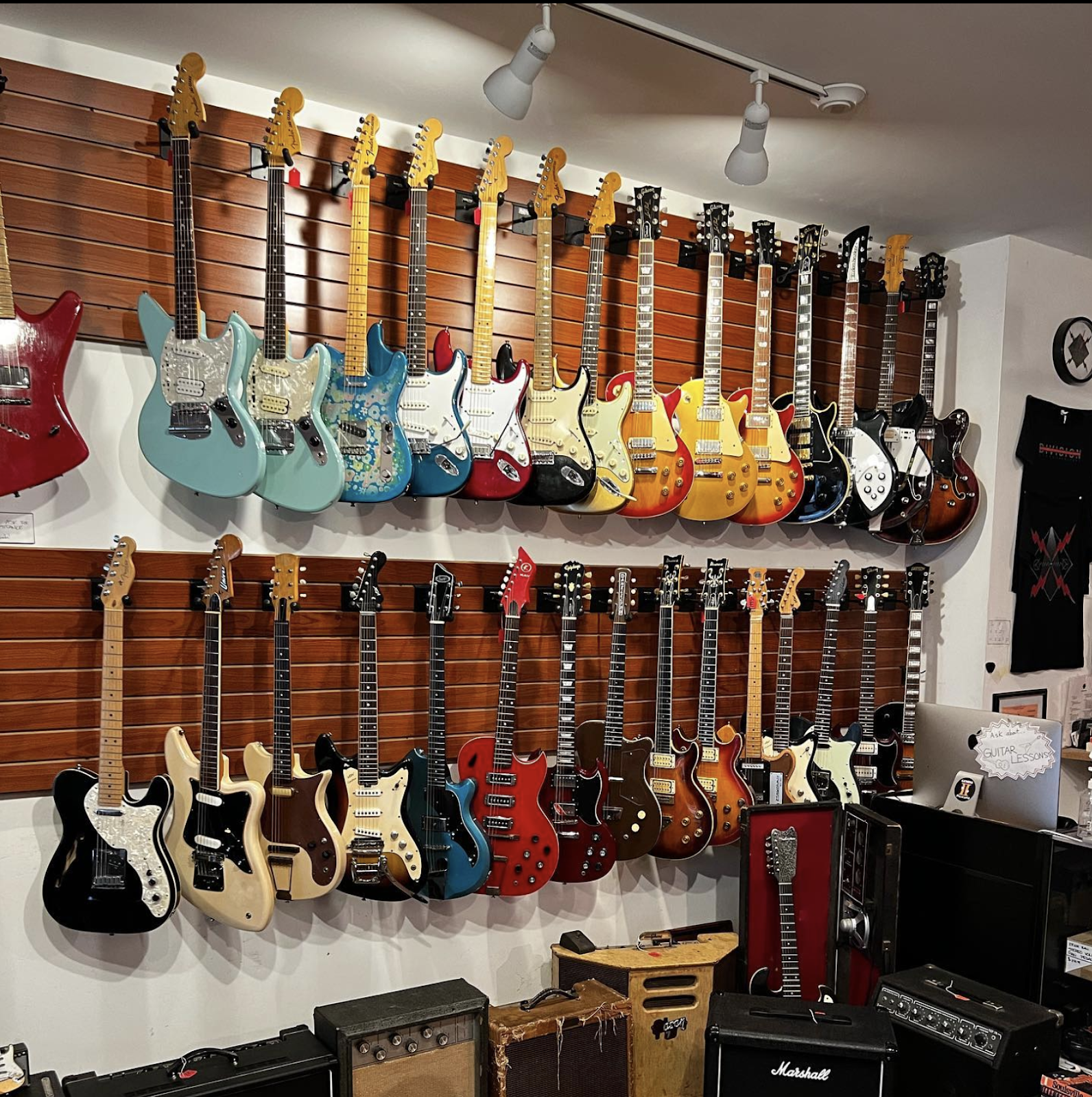
    At any given time the shop is home to 75-100 guitars as well as a colorful array of used pedals, amps and assorted gear. DeCourcey also sells guitars at trade shows as well as online at reverb.com, an online marketplace for musicians.

    Currently in stock is a 1979 Gibson Les Paul Deluxe, a 1963 Fender Duo Sonic and a 1947 Martin 00-21, as well as plenty of other models from a range of brands.

    Owner Paul DeCourcey keeps Division Street Guitars stocked with anywhere from 75-100 used guitars at any given time
    Owner Paul DeCourcey keeps Division Street Guitars stocked with anywhere from 75-100 used guitars at any given time

    Interestingly enough, DeCourcey said he isn’t a big musician himself, or maybe he’s just being humble. DeCourcey co-wrote Grouplove’s hit song “Colours” when he toured with the band’s frontman Christian Zucconi who also fronted for DeCourcey’s own band Aloke.

    Despite the large quantity of guitars in shop, DeCourcey currently only has two bass guitars (his instrument of choice) at home, a shockingly low-number for a musician of any caliber. Still, the modest guitar store owner said he gets more joy working on guitars than from playing them. Indeed, it’s clear by the way his face lights up when he talks about guitar repairs, that being a luthier is where DeCourcey is most at home. 

    “It’s nice to just get in the zone and work on guitars,” he said.

    DeCourcey has also served as an unofficial mentor to aspiring musicians in the community. His shop is currently staffed by two Peekskill locals, who he trained himself. Paulie Beladino, a local musician has worked the front of house at the shop since he was 19, when he asked Paul to take him under his wing. The gig allows Beladino to rehearse and travel with his band while also maintaining a more steady source of income.

    “Every part of my day is music related and everything I do to make money has to do with music and that sounds like success to me,” he said. “Just rocking and rolling over here.”

    Division Street Guitar's own Paulie Beladino poses for the shop's instagram page
    Division Street Guitar’s own Paulie Beladino poses for the shop’s instagram page

    While Beladino admits to being more of musician than a repairman, he said he still gets the child-like excitement when a new vintage guitar finds its way to the shop.

    “There’s nothing more exciting when you see the case and you know what it could be but you don’t know what it actually is and you open it and it’s like ‘oh my god,’” he said. “Every single one of these guitars has years and years of stories and experiences.”

    Another shop employee, Matt Labozza has a similar story to Beladino. He too has been at Division Street since the beginning and learned under the guiding hand of DeCourcey. While audio engineering is his main passion after hours, Division Street Guitars provides a similar safe haven for learning and enjoying music.

    “Before I worked here, I brought all of my shit to Paul, even basic restrings,” Labozza says, as he now casually restrings a guitar during the interview. “Pretty much everything you see me doing here is thanks to that man.”

    In the eight years the shop has been open, DeCourcey said he hasn’t changed much about the store. From the beginning to now it’s still familiar faces, beautiful guitars and good vibes all around. 

    Division Street Guitars is located at 36 North Division St, Peekskill, NY 10566 and is open Tuesday-Saturday from 12-6pm and Sundays from 12-4 for the holiday season.

    Call them at 914-737-2630 or check out their inventory on Reverb.com