The anticipated posthumous album — Exodus — from recently deceased rap legend, DMX, has arrived. Executive produced by longtime collaborator and friend — Swizz Beats — the 13-track project features a myriad of prominent entertainers past and present.
The likes of Jay – Z, Alicia Keys, Nas, Snoop Dogg, Lil Wayne, Usher, the Lox and Swizz Beats himself all grace the album, giving it a nostalgic feel as DMX’s former contemporaries share the stage with him one last time. And while the rumored Pop Smoke record didn’t make the final cut, there is still fresh energy from the likes of Memphis-bred, Moneybagg Yo and Griselda trio, Conway the Machine, Westside Gunn and Benny the Butcher.
While DMX confirmed an upcoming album several months before his death, the record’s prominence grew after the rapper’s untimely passing at age 50, after suffering from a heart attack on April 2. With his death not being confirmed until a week later, it gave fans a chance to appreciate DMX’s unique contributions to the genre of hip hop. From his raw and grizzly delivery, to his brutally honest dissertations on his battles with addiction and his troubled upbringing.
Alas, his fans can rejoice in the fact that DMX gave his all on his final effort.
It’s not an album that was pieced together after he passed, revealed Swizz Beats. We had plans to do a two-month cleansing and workout [program] before we came with the album. He was going to rebrand himself with new photos of him looking the best that he could look … But unfortunately we didn’t get to that part.
Exodus may also serve as closure for supporters of the oft-embattled rap legend. DMX lived a troubled life, and after superstardom, he began to make headlines for his legal troubles and his addictions as often as he did for his music.
I can at least listen to a song now without breaking down. I’m making it look strong, but I’m crushed, I’m destroyed, I’m hurt. But I had to pull this through for him and his family and for his legacy, shared Swizz Beats.
With a near decade-long hiatus in between albums, ‘X took time to get clean and refocused and after his Verzuz battle with Snoop Dogg, he was humbled and excited to know that he still held a place in the fans heart. On Exodus, we hear — for maybe the last time — what a focused and motivated DMX sounds like.
Brooklyn-based Wild Yaks have announced Live at Rippers, their fifth LP and first live album, due July 16, 2021. Alongside its digital release, Live At Rippers will be available in a run of 500 LPs with jackets hand-screened in Rockaway Beach, NY. Wild Yaks are proud to be the first band back at the venue in 2021, setting a performance there for July 17.
For Wild Yaks, music is the ability to take the horrible parts of life, and elevate them into a sacred, firey riot.
I think my chief interest is to transform despair into moments for celebration. What I’m trying to do is rejoice in what’s fragile, and rejoice in what’s already broken. The only thing that I will accept is being fully abandoned. It’s about moving and singing with no concern for the consequences.
Wild Yaks’ frontman and songwriter Rob Bryn.
Live at Rippers presents this vision and the band’s “sense-clobbering” performance better than any album to date. It was recorded at the Rockaway Beach punk-rock-beach-burger-joint Rippers in October of 2019. Bryn again:
Almost all of the songs grew out of moments that happened in Rockaway. And to perform them at Rippers on the altar of blood from which so many of these things sprang is strange and amazing.
Wild Yaks play an ecstatic fusion of punk rock and big-city folk reinforced with passionate vocals (often delivered in unison by the full membership). The band was formed in the fall of 2007 in Brooklyn, New York by singer/guitarist Rob Bryn and drummer/vocalist Martin Cartagena.
While many players have made their way through the Yaks’ over the years, today’s lineup is Jose Aybar (bass), Patsy Carroll (guitar), Giovanni Kincade (Farfisa), Matt Walsh (guitar), plus Cartagena and Bryn. The Yaks’ discography also includes the EP 10 Ships (Don’t die yet, 2009), and full-length albums Million Years(2012), Rejoice! God Loves Wild Yaks (2015), and Great Admirer (2019). The band’s music has been featured in numerous television shows and films, most notably their live performance in an episode of Law and Order SVU.
Independent Venue Week returns July 12 – 18, 2021, bringing together venues from all across the country for a series of shows and programming in celebration of the spirit of independence.
The venue-curated programming will be combined with the return of #IVWTalks, a virtual conference series that discusses current live music industry issues and includes Get Schooled, a full day dedicated to student participants interested in a career in live music to take place on Thursday, July 15.
Among the more than 450 shows to take place as part of Independent Venue Week are performances by hip-hop icon Snoop Dogg at Phoenix’s Celebrity Theatre,roots music icons Steve Earle & The Dukes at Ram’s Head On Stage in Annapolis, midwest indie-pop sensation Beach Bunny at Milwaukee’s The Cooperage, world-class Afro-Cuban percussionist Pedrito Martinez at NYC’s DROM, New Jersey DIY favorites Long Neck, Whiner and PYNKIE at WhiteEagle Hallin Jersey City, legendary rock’n’rollers The Marshall Tucker Band at Missoula’s KettleHouse Amphitheater,and bass virtuoso George Porter Jr. for his reopening run at Garcia’sin Port Chester.
Getting ready for this year’s event feels particularly meaningful. For the past 14 months, independent venues and promoters have collectively fought for their very survival and this feels like the turning point that we’ve all been working for. We were happy and proud to grow Independent Venue Week last year—to even have it, under the circumstances. This year, we hope and believe that fans will return with a renewed appreciation for these uniquely important spaces.
Cecilie Nielsen, Director of Special Projects at Marauder, the firm that runs Independent Venue Week in the US.
The team behind Independent Venue Week has released the first episode of its new podcast series, Independent Venue Speak. Like its namesake, Independent Venue Speak will celebrate the spirit of independence, through the vehicle of deep-diving conversations. The series will be hosted by a different guest artist each episode and focus on how a specific independent venue has shaped the narrative in their music community.
For its inaugural episode, Independent Venue Speak invited the Grammy-nominated, Brooklyn-based artist and songwriter J. Hoard to tell the tale of the iconic Lower East Side room Arlene’s Grocery and its ties to The Lesson, a world-renowned hip-hop jam ensemble that forged an entire music culture.
To truly make Independent Venue Speak as incredible in execution as it was in concept, we enlisted the artists and venue operators to tell these stories themselves. These stories are about extraordinary people who helped inspire prolific music movements and about the venues that offered these movements not just a stage, but a home.
Cecilie Nielsen, Director of Special Projects at Marauder
#IVW21 PARTICIPATING VENUES (So Far!)
Princess Theatre Center for the Performing Arts (Decatur, Alabama)
Theatrikos (Flagstaff, Arizona)
Jeremy’s Juke Joint (Lake Havasu City, Arizona)
The Neighborhood Comedy Theatre (Mesa, Arizona)
The Nile Theater (Mesa, Arizona)
Last Exit Live (Phoenix, Arizona)
The Rebel Lounge (Phoenix, Arizona)
Club Congress (Tucson, Arizona)
Groundworks Tucson (Tucson, Arizona)
The Wayfarer (Costa Mesa, California)
T-Bar Social Club (June Lake, California)
Marvyn’s Magic Theater (La Quinta, California)
1720 (Los Angeles, California)
Globe Theatre (Los Angeles, California)
The Paramount LA (Los Angeles, California)
The Sardine (Los Angeles, California)
The Glass House Concert Hall (Pomona, California)
Crest Theatre Sacramento (Sacramento, California)
Harlow’s (Sacramento, California)
Sacramento Comedy Spot (Sacramento, California)
Belly Up (San Diego, California)
The Casbah (San Diego, California)
Soda Bar (San Diego, California)
Spin Nightclub (San Diego, California)
Amado’s (San Francisco, California)
Bimbo’s 365 Club (San Francisco, California)
Great American Music Hall (San Francisco, California)
The Riptide (San Francisco, California)
Center Stage Theater (Santa Barbara, California)
Kuumbwa Jazz (Santa Cruz, California)
Boulder Theater (Boulder, Colorado)
Fox Theatre (Boulder, Colorado)
The Black Sheep (Colorado Springs, Colorado)
Monkey Barrel (Denver, Colorado)
Roxy on Broadway (Denver, Colorado)
Aggie Theatre (Fort Collins, Colorado)
Ridgway Chautauqua Society / The Sherbino & The Courtyard at 610 (Ridgway, Colorado)
Bijou Theatre (Bridgeport, Connecticut)
The Midpoint (Hartford, Connecticut)
Arden Concert Gild (Arden, Delaware)
9:30 Club (Washington DC, District of Columbia)
The Anthem (Washington DC, District of Columbia)
DC9 Nightclub (Washington DC, District of Columbia)
Lincoln Theatre (Washington DC, District of Columbia)
Pearl Street Warehouse (Washington DC, District of Columbia)
Pie Shop (Washington DC, District of Columbia)
Songbyrd Music House (Washington DC, District of Columbia)
High Dive (Gainesville, Florida)
Murray Hill Theatre (Jacksonville, Florida)
North Beach Bandshell (Miami Beach, Florida)
Van Wezel Performing Arts Hall (Sarasota, Florida)
The Village Theatre (Atlanta, Georgia)
The Blue Door (Brunswick, Georgia)
Grant’s Lounge (Macon, Georgia)
Hargray Capitol Theatre (Macon, Georgia)
Hilo Palace Theater (Hilo, Hawaii)
Hawaii Theatre Center (Honolulu, Hawaii)
ProArts Playhouse Maui (Kihei, Hawaii)
Hey Nonny (Arlington Heights, Illinois)
Annoyance Theatre & Bar (Chicago, Illinois)
Beat Kitchen (Chicago, Illinois)
The Lincoln Lodge Theater (Chicago, Illinois)
The Promontory (Chicago, Illinois)
Reggies (Chicago, Illinois)
Subterranean (Chicago, Illinois)
The Wild Hare & Singing Armadillo Frog Sanctuary (Chicago, Illinois)
Winter’s Jazz Club (Chicago, Illinois)
Egyptian Theatre (DeKalb, Illinois)
Skooter’s Roadhouse (Shorewood, Illinois)
Buskirk-Chumley Theater/BCT Management, Inc. (Bloomington, Indiana)
Mojo’s BoneYard (Evansville, Indiana)
Hi-Fi (Indianapolis, Indiana)
Hoyt Sherman Place (Des Moines, Iowa)
Wooly’s (Des Moines, Iowa)
xBk (Des Moines, Iowa)
East Of Omaha (Griswold, Iowa)
The Englert Theatre (Iowa City, Iowa)
Hutchinson’s HIstoric Fox Theatre (Hutchinson, Kansas)
Liberty Hall (Lawrence, Kansas)
Stiefel Theatre for the Performing Arts (Salina, Kansas)
The Warehouse at Mt Victor (Bowling Green, Kentucky)
Alhambra Theatre (Hopkinsville, Kentucky)
Headliners Music Hall (Louisville, Kentucky)
Old Forester’s Paristown Hall (Louisville, Kentucky)
Renfro Valley Entertainment Center (Mount Vernon, Kentucky)
The Southgate House Revival (Newport, Kentucky)
Texas Club (Baton Rouge, Louisiana)
Carnaval Lounge (New Orleans, Louisiana)
Howlin Wolf (New Orleans, Louisiana)
The Grand (Ellsworth, Maine)
Regent Theatre (Arlington, Massachusetts)
Narrows Center for the Arts (Fall River, Massachusetts)
Atac: Downtown Arts + Music (Framingham, Massachusetts)
Soundcheck Studios (Pembroke, Massachusetts)
Electric Haze (Worcester, Massachusetts)
Pyramid Scheme (Grand Rapids, Michigan)
Kalamazoo State Theatre (Kalamazoo, Michigan)
7th St Entry (Minneapolis, Minnesota)
Fine Line (Minneapolis, Minnesota)
First Avenue (Minneapolis, Minnesota)
The Parkway Theater (Minneapolis, Minnesota)
TAK Music Venue Inc (Moorhead, Minnesota)
The Fitzgerald Theatre (St. Paul, Minnesota)
Palace Theatre (St. Paul, Minnesota)
Turf Club (St. Paul, Minnesota)
RecordBar (Kansas City, Missouri)
Uptown Theater (Kansas City, Missouri)
Kettlehouse Amphitheater (Bonner, Montana)
The Music Hall (Portsmouth, New Hampshire)
Crossroads (Garwood, New Jersey)
Hopewell Theater (Hopewell, New Jersey)
White Eagle Hall (Jersey City, New Jersey)
The Newton Theatre (Newton, New Jersey)
Township Theatre (Township of Washington, New Jersey)
Beau Fleuve Music & Arts has announced the date for its 5-year anniversary event, celebrating years of diverse musical and artistic talents, including performances, art installations, a silent disco, food vendors, and more.
Beau Fleuve Logo
Now that New York is opening up more, Beau Fleuve will hold their celebration event in person on Sunday, August 29th, 2021 at the historic landmark of the Buffalo Central Terminal. Beau Fleuve has held national touring acts in past years from Benny The Butcher, Eric Van Houten, Zuri Appleby, Venzella Joy, Jae Skeese and more. The 2021 lineup for the one-day festival-style event will be announced later in June.
We are excited to return to in-person events and bring some excitement to our community but first and foremost ensuring that we provide a safe event for everyone to enjoy by following all guidelines.
Lindsey Taylor, Director of Beau Fleuve Music & Arts
The celebratory event will be following all New York State and Erie County COVID-19 Guidelines, rules, and regulations. It will be a limited capacity, social distancing event. You can find more information here.
Phil DiRe, founder of the Buffalo Jazz Ensemble, died on May 26 at the age of 80. Influencing the lives of many, the years 1972 to 1980 represent some of the most momentous years in Phil’s life, as well as the lives of others during that timeframe. Tony Zambito from JazzBuffalo shares the following remembrance of Phil.
It is not to say other years did not matter and did not become pillars in Phil’s life. But it to say that Phil, as a musician, influenced the lives of many musicians and the history of jazz in Buffalo during this time.
Sabu Adeyola and Phil DiRe
In November of 1972, Phil led the first edition of the Buffalo Jazz Ensemble in a concert at the Buffalo Central Public Library to a standing-room-only audience. The ensemble went on to perform concerts at such venues as Artpark, Studio Arena, Keenan Center, and others. Including gig dates at the old Bona Vista Lounge on Hertel Avenue as well as the Student Union Social Hall at Buffalo State College.
A poster used in 1976 for the funded city-wide program
The Buffalo Jazz Ensemble, led by Phil, helped launch a journey of performing for several prominent musicians with Buffalo heritage. Notable performers included pianist Al Tinney, bassist Sabu Adeyola, saxophonist Joe Ford, drummer Lou Marino, pianist Jimmy Calire, drummer Tommy Walsh, drummer Naser Abeday, guitarist James Clark, keyboardist Jeremy Wahl, and saxophonist Jay Beckenstein. Beckenstein, who was a private student of Phil, along with Wahl formed the nucleus of what became one of the most famous jazz fusion bands in history – Spyro Gyra.
Albright-Knox Art Gallery Outdoor Concert – Buffalo Jazz Ensemble is center right
In 1975, Buffalo was the center of a pioneering concept in the country. It was one of the firsts to receive city, state, and federal funding for jazz performances. Phil negotiated a unique arrangement with the City of Buffalo under Mayor Makowski, the NY State Council on the Arts, the National Endowment for the Arts, the local Musician’s Union, and the newly formed non-profit created by Phil – Association for Jazz Performance, which would launch an ambitious program to fund an ongoing series of concerts in every park, cultural center, and school in the city.
The Buffalo Jazz Ensemble performed in these concerts and exposed many youths to the music of jazz. Their very first event took place at the steps of the Albright-Knox Art Gallery, becoming a weekly event in summer, and continuing with sponsorship from the Buffalo News and Editor Stan Lipsey post-1980 starting with the Buffalo Jazz Workshop, led by Sam Falzone.
The funded program at Buffalo Public Schools
Prior to these pivotal years, Phil was assigned, while serving in the Marines, to the White House, where he led the White House Jazz Quartet during the overlapping Johnson and Nixon administration years. This put Phil next to the likes of Duke Ellington, Stan Getz, Gerry Mulligan, Dizzy Gillespie, and Billy Taylor and enabled him to perform with one of his best friends in life, the legendary drummer, composer, and arranger Justin DiCioccio.
At the steps of the AKG. Left to right: Tommy Walsh, Al Tinney, Phil DiRe, Joe Ford, Sabu Adeyola, James Clark, Jay Beckenstein, Naser Abeday, and Jeremy Wahl
At the end of the 1970s, Phil accepted an invitation to move out to Las Angeles to make a living as a studio musician. Before leaving, he turned the jazz ensemble over to Sam Falzone, where it eventually became known as the Buffalo Jazz Workshop, and operating on a smaller budget and scale.
Phil DiRe to the left in military style jacket playing saxophone
Feeling unfulfilled in his role as a studio musician, Phil took up a friend’s request to join him at a recently opened club in Palm Springs. The club was owned by the famous singer Keely Smith. Phil quickly made an impression on Smith and became her music director, arranger, and conductor. This Keely Smith ensemble, which also featured noted saxophonist Sam Butera, went on to become one of the most popular bands to ever tour the Las Vegas and Atlantic City circuit. The band was the follow-up act to the great Louis Prima band of the 1950s, which featured Keely Smith as their singer. As the music director of the band, Phil found himself performing with greats such as Frank Sinatra, Sammy Davis, Jr., Billy Eckstine, Tony Bennett, and other legends in jazz as well as American popular music.
Singer Keely Smith
By 1982, the constant touring, time away from family, and the tragic loss of his son Michael at an early age, brought Phil back home to the Buffalo region. In 1994, Phil founded the company SuccessWare as a way to help run his family’s HVAC business that his father began, Sunbeam Heating and Cooling. Phil persevered and wrote the core of the computer program for SuccessWare without any formal training.
At Jazz at Chandlerville in 2019 with Joe Calabrese, Chuck Buffamonte, Jack Kulp, and Gary Sterlace
The calling for jazz and blues music never left Phil. In his later years, he took up performing with fervor again locally as well as in Florida, playing alongside friends and in special reunions. He relished the roles of serving as an advisor and mentor, taking a strong interest in seeing the revival of jazz locally and offering support.
His later years served as a bookend, in many ways, to the first stone that caused a ripple effect in November of 1972. The circling waves of the ripple effect continue to expand, touching and influencing the lives of jazz fans and musicians in the Buffalo region and beyond.
At Giancarlos 2019 with Preston Brown, Chuck Buffamonte, Jerry Livingston, George Caldwell, and Brendan Lanighan
Phil is survived by his beloved wife of 57 years Geraldine “Gerri” DiRe. He was a devoted father of Maria, Michelle, Deanne, and the late Michael J. DiRe. He was affectionately known as “Papa” to his many grandchildren and great-grandchildren. To Phil, the love of family rose above all in life.
Joey Calfa of Cousin Earth drops his exhilarating new solo EP, Baby Kangaroo Baby Cow, Part II, bringing spring into summer with his vibrant sound.
Baby Kangaroo Baby Cow Part II Album Artwork
The EP opens with the track “Brain Lehrer” and is immediately funky with its building guitar grooves. This track can be easily imagined in a bar, feeding the room with its danceable beat. As a tribute to the legendary WNYC/NPR host, “Brian Lehrer” is an ebullient song that deserves a listen.
The second track “Double Whammy” opens with harmonic, virtuosic guitar lines. The shredding and the funky bassline intertwine for a sublime groove. Inspired by video game music, its technical prowess is shared with an ensemble put together by Calfa, including Frankie Coda and Ryan Liatsis (SchwizZ).
The third song on Baby Kangaroo Baby Cow Part II is “Small Hands,” which draws inspiration from Frank Zappa, as well as features an FDR snippet from 1941 that eerily parallels the politics of today. The guitar work is once again wildly funky, interspersed with 80s-inspired synths. Calfa’s vocals interacting with the vocal sample is creative and catchy.
Baby Kangaroo Baby Cow Part II is a solid EP, full of songs that become earworms after the first listen. Members included throughout the EP range from members of his main band Cousin Earth, as well as long time high school friends of Joey Calfa. The quirky, funky release is out now! You can listen here and find more information about Cousin Earth here.
The Museum of the City of New York has announced plans for a brand new exhibit that will feature an extensive look at the city’s music scene in the ’80s. New York, New Music: 1980-1986 will open on June 11 at the museum and promises to examine this transformative era through the lens of emerging pivotal music genres and the influence they played on New York’s broader cultural landscape.
The exhibit will be previewed at the museum’s upcoming Spring Gala on Wednesday, June 9 where LL Cool J, Cyndi Lauper and Kevin Liles will be honored with Gotham Icon Awards.
The reimagined version of the 2021 Spring Gala promises to safely create an intimate outdoor event with dinner and performances along with a preview of New York, New Music: 1980-1986. The exhibition highlights diverse musical artists—from Run DMC to the Talking Heads, from Madonna to John Zorn— to explore the broader music and cultural scene, including the innovative media outlets, venues, fashion, and visual arts centered in the city during that time.
The early 1980s were a time of significant transition in New York, with the city facing crime, urban decay, and homelessness. And yet, despite those challenges, it was also a particularly fertile time for music and other creativity in New York City. The musical innovations of this time period are a great example of the resilience of the city and the importance of art and creativity as forces of transformation.
Whitney Donhauser, Ronay Menschel Director and President, Museum of the City of New York.
This new exhibit will focus on certain performances and moments that occurred during this extremely fertile era of music in the city. “During the ’80s, there was a community-driven musical renaissance in New York City. It was an era of creativity and genre-defying performance that, in my mind, stands as one of the most influential in musical and cultural history,” says Sean Corcoran, curator of prints and photography, Museum of the City of New York.
The 14 featured moments that the exhibit will showcase are:
KID CREOLE and the COCONUTS @ DANCETERIA (1980)
In 1980, Kid Creole and the Coconuts led a revue of nearly a dozen musicians to perform their danceable genre-bending music at Danceteria, appealing to the still-dancing disco denizens, die-hard New Wavers, and everyone in between.
DNA and GRAY @ CBGB (MARCH 22, 1980)
The pairing of these two influential groups was emblematic of that pivotal moment in the downtown No Wave scene.
TALKING HEADS @ CENTRAL PARK (AUGUST 27, 1980)
Five years after first taking the stage at CBGB (opening for the pioneering punk rock group the Ramones), the Talking Heads played a sold-out concert at Wollman Rink in Central Park. For the first time, the band expanded beyond the classic quartet of David Byrne, Chris Frantz, Jerry Harrison, and Tina Weymouth, bringing in an array of musicians.
FUNKY 4 + 1 @ SATURDAY NIGHT LIVE (FEBRUARY 14, 1981)
Marking the very first time a hip-hop group performed live on national TV, Funky 4 + 1– including hip hop’s first female MC, Sha Rock–was invited to perform on SNL by that evening’s host and musical guest, Debbie Harry of Blondie.
BEYOND WORDS @ MUDD CLUB (APRIL 9, 1981)
This graffiti art exhibition and performance by DJ Afrika Bambaataa, the Cold Crush Brothers, and the Fantastic Five helped propel a new era in New York’s new music. Fred Brathwaite (aka Fab 5 Freddy) curated the show along with the artist Futura 2000.
NOISE FEST @ WHITE COLUMNS (JUNE 16–24, 1981)
In the early 1980s, an expansive cohort of musicians was still exploring the possibilities of “noise.” Sonic Youth’s Thurston Moore curated a lineup around the theme, and what was envisioned as a one-day program quickly snowballed into a nine-day watershed event.
KONK vs LIQUID LIQUID @ TOMPKINS SQUARE PARK (AUGUST 9, 1981)
Liquid Liquid and Konk both formed in New York City in 1980, and they quickly developed reputations for their slightly off-kilter music, driven by groove-based, danceable funk rhythms. The friendly rivalry between the groups and the marketing genius around it turned this concert into a sensation.
MADONNA @ DANCETERIA (DECEMBER 16, 1982)
An ambitious 24-year-old using just her first name took to the second-floor stage at Danceteria on December 16th, 1982 to publicly perform her own music for the first time. Madonna’s debut appearance, and the single for Sire Records, served as a springboard to fame; the release of her self-titled album quickly followed in 1983.
NEXT WAVE FESTIVAL @ BROOKLYN ACADEMY OF MUSIC (1982–83)
An important springboard for new music in the 1980s came from the venerable Brooklyn Academy of Music’s (BAM) second edition of its Next Wave series. The season-long festival featured an unprecedented number of artists, including Steve Reich, Glenn Branca; Laurie Anderson; Max Roach and the dance team of Bill T. Jones and Arnie Zane, a milestone of innovation and interdisciplinary performance.
KEITH HARING’S PARTY OF LIFE @ PARADISE GARAGE (MAY 16, 1984)
Artist Keith Haring’s (with DJ Larry Levan) first Party of Life, a birthday celebration that was a rapturous convergence of art, music, and performance, featured a star-studded guest list with performances by Madonna and John Sex.
RUN-DMC and THE TREACHEROUS THREE @ GRAFFITI ROCK (JUNE 29, 1984)
History was made in June of 1984 when the first syndicated hip-hop TV show was recorded on a soundstage in Midtown Manhattan. The show featured groundbreaking acts, including Run-DMC’s performance of their hit single, “Sucker MCs,” as well as Kool Moe Dee and Special K, two MCs from the veteran trio The Treacherous Three. The MCs provided the show’s introduction, breaking down the elements of hip hop, including breakin’, DJing, and the verbal stylings of MCs, all on a graffiti-laden set.
JOHN ZORN @ ROULETTE (OCTOBER 13, 1984)
One of avant-garde composer John Zorn’s most influential “game pieces” –genre-defying musical compositions designed for controlled improvisation– Cobra was presented at Roulette, the TriBeCa alternative art space.
FORT APACHE BAND @ MICKELL’S (DECEMBER 31, 1985)
On New Year’s Eve 1985, the Bronx-based Fort Apache Band played multiple sets at Mikell’s, a jazz club on the corner of 97th Street and Columbus Avenue. The music that evening embodied the group’s animating project: to explore the creative intersection of Afro-Cuban and Puerto Rican musical traditions with jazz.
ARTHUR RUSSELL @ EXPERIMENTAL INTERMEDIA FOUNDATION (SEPTEMBER 22, 1985)
A groundbreaking moment in the New York experimental music scene came in the fall of 1985, when Arthur Russell staged several performances at the Experimental Intermedia Foundation in SoHo.
Viewed together, these examples provide a sense of the innovation, energy, and cross-pollination of musical ideas that was happening across the city at the moment of openness and creativity. Visitors will also have the opportunity enjoy some of the quintessential moments in a retro-feeling suburban rec room-inspired space. The lounge installation features a mix of found footage, video art, and their own archival film of downtown musicians like the Dead Boys, Heartbreakers, and Bush Tetras; along with rare early MTV interviews with New York-based artists such as David Johansen, Madonna, and RUN DMC, and footage from “The Scott and Gary Show,” a Brooklyn-based public access program, including early performances by Beastie Boys, Butthole Surfers, and R Stevie Moore.
The Spring Gala, which will offer a sneak peak of all this, is one of the largest annual fundraisers for the museum’s exhibitions, public programs, and education programs which serve over 50,000 students and teachers throughout the city’s five boroughs. After a challenging year for the entire arts and culture sector, the Spring Gala is also crucial for the Museum’s recovery, ensuring that New York’s stories can be told for generations to come.
This year’s gala will fete GRAMMY award-winning rapper, actor, CEO & founder of Rock The Bells LL COOL J; mother, activist, award-winning songwriter and artist Cyndi Lauper; and Kevin Liles, CEO and co-founder of 300 Entertainment (and former president of Def Jam Records).
The Museum of the City of New York fosters understanding of the distinctive nature of urban life in the world’s most influential metropolis. It engages visitors by celebrating, documenting, and interpreting the city’s past, present, and future.
Samuel E Wright, found of the Hudson Valley Conservatory, voice of Sebastian the crab in 1989’s The Little Mermaid, and Tony Award nominated actor has died at age 72. A longtime resident of Walden, NY, Wright passed away peacefully after a three-year battle with prostate cancer.
Born on November 20, 1948 in Camden, SC, Wright moved to New York City in 1968 to begin his acting career. After a few years in London, Wright returned to perform in 18 Broadway productions, beginning with Jesus Christ Superstar in 1971. He later landed the role of Pippin in 1972, replacing Ben Vereen as the lead.
In 1983, Samuel Wright received his first Tony Award nomination for The Tap Dance Kid, which found Wright as the unsympathetic father of a young boy (Alfonso Riberio). More recently, he originated the role of Mufasa in Disney’s The Lion King, which garnered him his second Tony nomination, and a Drama Desk Award.
“Look at the stars. The great kings of the past look down on us from those stars.” Rest In Peace, Samuel E. Wright | 1946 – 2021 Original Broadway Cast, Mufasa. pic.twitter.com/MDuQAZJalZ
— The Lion King – Musical (@TheLionKing) May 25, 2021
Wright acted in several films, including Clint Eastwood’s 1988 Bird, playing the role of Dizzy Gillespie to Forest Whitaker’s Charlie “Bird” Parker. In the 1995 Apollo Theater revival of The Wiz, he played the Scarecrow in alongside Whitney Houston, Keith David and Cedric the Entertainer.
In 1989, he earned Grammy, Oscar and Golden Globe Awards for Best Original Song for “Under the Sea,” from The Little Mermaid. The song would achieve RIAA certification and double platinum status, leading to parodies from Saturday Night Liveto The Simpsons. With his new success, he moved north from New York City to Walden in Orange County. Here, he would continue to commute for the role of Mufasa, while creating a legacy in support of the arts.
Founded in 1994, the Hudson Valley Conservatory (HVC) is the first performing arts school in the Hudson Valley offering classes in acting, music and dance, to ages 3 and up. Started by Samuel E. Wright, Amanda A. Wright and Pamela A. Murphy in 1994, HVC is a place for children to learn and grow in the arts.
Per their mission statement, HVC pride themselves on offering a well-rounded arts education and helping children develop not just as artists, but confident, competent young adults. Students at HVC have the opportunity to take part in productions throughout the year in HVC’s black box theatre, The New Rose Theatre.
Notable fans of Samuel Wright include Hamilton creator Lin-Manuel Miranda, who named his oldest son after Sebastian.
Wright is survived by his wife, Amanda, and their three children, Keely, Dee and Sam.
To honor the life of Samuel E. Wright and continue their mission, the New Rose Theatre Group will be starting The Samuel E Wright Scholarship Fund. This fund will be used to support the children, school and community of young artists he created at the Hudson Valley Conservatory. If you would like to make a contribution to the fund, checks can be mailed to:
Samuel E Wright Scholarship Fund Via New Rose Theatre Group PO Box 702 Walden NY 12586 or donate directly to New Rose Theatre Group by Venmo @Rose-Group
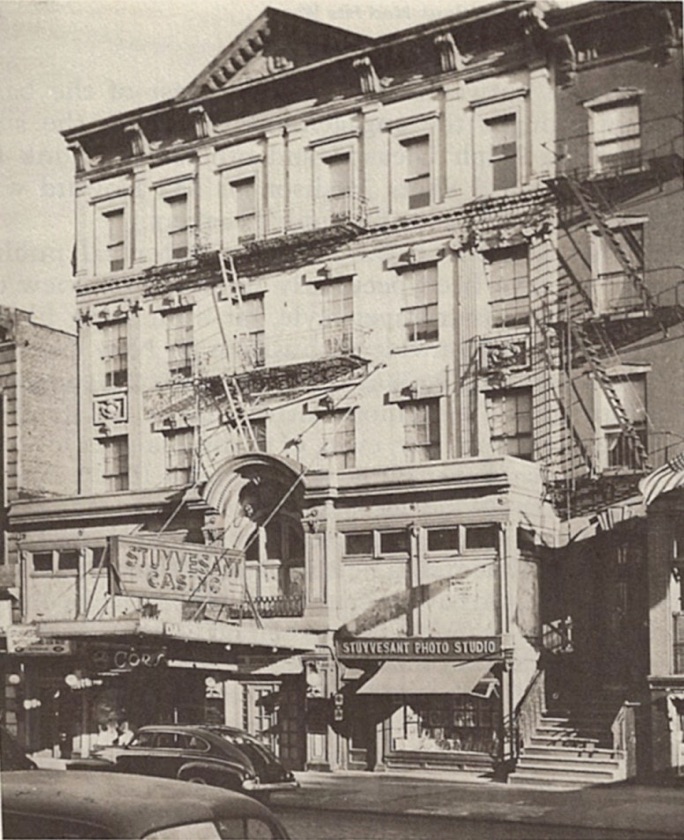
The East Village of Manhattan has been home to immigrants, the working class, Beatniks, hippies and artists over the last 300 years. Originally home to the Lenape tribe before the arrival of Europeans, the East Village today is comprised of Alphabet City (the setting for the musical RENT), Ukrainian Village and the Bowery (home to CBGB). In the early to mid-20th century, it would be home to Jewish gangsters and Dixieland jazz at the famed Stuyvesant Casino.
The name Stuyvesant has roots in America dating back to the 17th century, with the arrival of the Dutch in New York Harbor in 1624. Peter Stuyvesant would serve as Governor in Chief of Amsterdam in New Netherland, later named New York after surrendering the city to the British in 1664.
While he was effective with trade in New Amsterdam and created a sense of law and order for a diverse colony, Stuyvesant was intolerant of full religious freedom in the colony. In 1657 he refused to allow Lutherans the right to organize a church, and later refused to allow the permanent settlement of Jewish refugees from Dutch Brazil in New Amsterdam, joining Jewish traders already there.
Ultimately, directors of the Dutch West India Company needed to pressure Stuyvesant to allow Jewish immigrants to stay in the colony as long as their community was self-supporting. Still, Stuyvesant and the company would not allow them to build a synagogue, leading them to worship at a private house instead.
The name Stuyvesant would end up having a negative connotation, as he did few favors in his life to gain support of those he was placed in charge of. Upon turning over New Amsterdam to Britain after no one would defend the city, his name was tarnished. He would eventually settle on a farm, a bouwerie, until his death in 1672.
Two and a half centuries later, the name Stuyvesant would be fading as a surname, but was the given name of an East Village casino with a rich 20th century history.
140-142 Second Avenue are indicated by the red arrow, and 138 Second Avenue is indicated by the orange one. Image via VillagePreservation.org
The Bowery attracted Irish and German immigrants starting in the 1850s, Poles and Ukrainians arrived in the 1880s, and by the early 1900s, Italians and Eastern European Jews arrived.
Originally a German YMCA beginning in 1881, the building was a pair of late federal-style houses, dating back to around 1830 when the area was known as “Little Germany.” The building stayed intact and in its original form, with sloped peaked roofs and dormers at the top, meaning the YMCA had not changed much of the exterior, and perhaps the interior as well.
Around the late 1800s, this area of Manhattan’s Lower East Side became the center of Jewish life in America. Crowded and culturally vibrant, a rise in crime would lead to gangs forming by the end of the century. Second Avenue was a main road, bustling with theaters, cafes, nickelodeons, bars, and vaudeville houses, making the region a draw beyond its residents.
Stuyvesant Casino
In 1910, Stuyvesant Casino opened at 140-142 2nd Avenue, owned and operated by Gerson Schmidt, an Eastern Europe immigrant from Galicia (now located in Ukraine). This stretch of 2nd Avenue encompassed part of Stuyvesant’s farm, and thus the name was given to the business.
The Stuyvesant Casino offered sumptous food, dazzling decor, and a first-class house band. High rollers and hitmen were among the clientele, particularly Big Jack Zelig, head of the Eastman Gang after the death of “Kid Twist” Max Zwerbach, in 1908.
Big Jack Zelig
During a party on December 2, 1911, Zelig lured a drunk “Julie” Morrello, an Italian gangster called “one of the most notorious gun and knife fighters on the east side, to Stuyvesant Casino. Around 1am, the lights went out and four shots rang out. As the lights flickered on moments later, Morrello was lying prone on the dance floor, filled with bullets.
In post-World War I New York City, Stuyvesant Casino would be a notorious hangout for Jewish gangsters, but by World War II, the venue became known for music producing the hits.
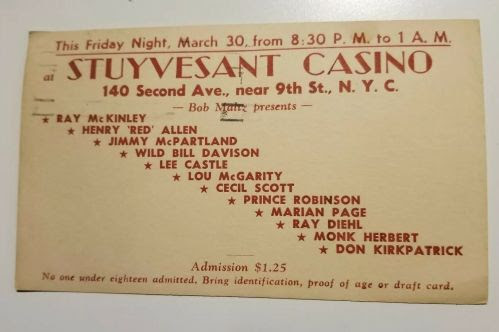
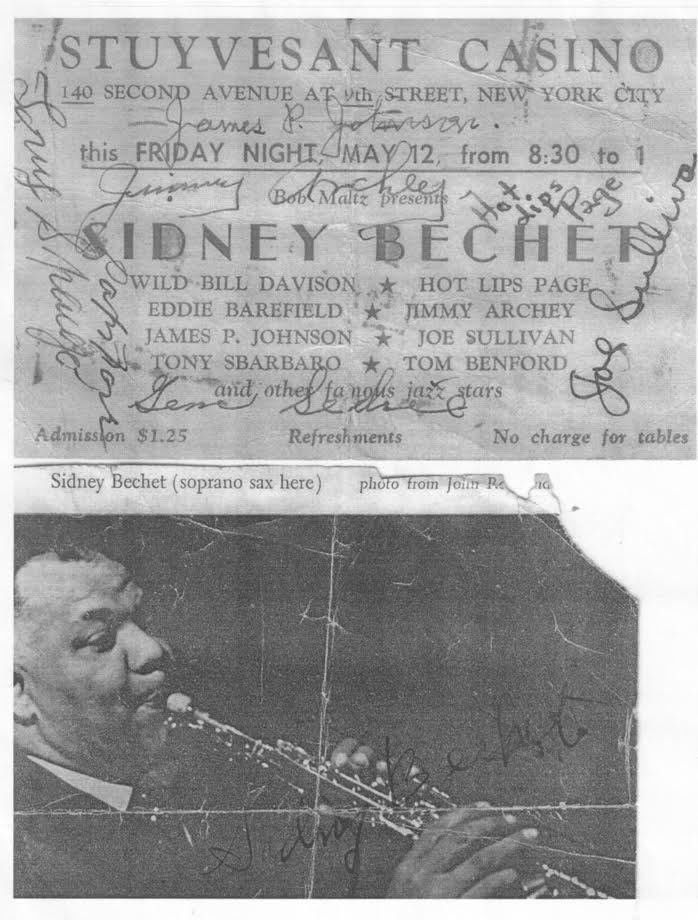
In the 1940s and into the 1950s, Stuyvesant Casino became a popular destination thanks to the arrival of New Orleans and Dixieland jazz artists. Big names such as Sidney Bechet, Wild Bill Davison, Rex Stewart, James P. Johnson, Georgie Lewis, Joe Sullivan, the great Bunk Johnson, and the Conrad Janis Tailgate Jazz Band could be heard for the low cost of $1.25.
Owner Gerson Schmidt was at one point encouraged by the Stuyvesant’s head waiter to allow a band consisting of his three sons to perform at the Casino. The three Perelmuth Brothers – Pinchas (violin/vocals), Michoyl (piano) and Sender (bass) – were a hit, leading to partygoer and movie theater impresario Samuel Lionel “Roxie” Rothafel, to discover Pinchas’ voice and recognize his potential. When Roxie asked why he was only singing in a “mere catering hall,” Perelmuth responded, “I would love to be an opera singer, but don’t have the money for a vocal coach.”
Opera legend Jan Peerce got his start at Stuyvesant Casino as a child
Roxie would take Pinchas under his wing and helped him get his break, helping him study voice and making his name among the opera elite of New York City. Perelmuth would make his debut at the Metropolitan Opera in 1933, under a new name, Jan Peerce. He would make his Broadway debut in 1971 in Fiddler on the Roof, a far distance for the son of Russian immigrants to travel from the Lower East Side.
As noted in the book The Jews of Capitol Hill, Gerson had a son, Mordechai, who married Myra Bank, the daughter of Galician immigrants. The two would have a son, Lawrence Jack Smith, a Democrat from Florida who served five terms in the House of Representatives from 1983-1993. Smith, whose parents ran catering establishments in the New York kosher catering scene, would work for their business and at Stuyvesant Casino from an early age.
When the Dixieland jazz made its way north, Gerson’s Stuyvesant Casino was the natural stop for an eclectic melting pot of music. Saxophone great Steve Lacy hung around the Casino as a teenager was exposed to early Dixieland Jazz greats, some of whom he would join there on a regular basis, including Henry Red Allen, Pee Wee Russell, Buck Clayton, and his teacher, Cecil Scott.
New Orleans bandleader Bunk Johnson would frequently perform at Stuyvesant Casino, occasionally joined by Louisiana-born bluesman Huddie “Leadbelly” Ledbetter, who lived on nearby East 10th Street. Trumpeter Hot Lips Page recorded a version of the 1924 classic “When My Sugar Walks Down the Street” at the Casino, and would later open rival venue Birdland with Charlie Parker, who lived nearby on Avenue B, in 1949.
Portrait of Bunk Johnson, Leadbelly, George Lewis, and Alcide Pavageau, Stuyvesant Casino, New York, N.Y., ca. June 1946
Robert Thompson, a Dixieland drummer known for his group The Red Onion Jazz Band, recalled Bob Maltz as an organizer of jam sessions at Stuyvesant Casino that attracted well paid world class musicians. The Red Onion Jazz Band served as legendary Dixieland revivalists, borrowing the name from Clarence Williams’ traditional New Orleans supergroup Red Onion Jazz Babies, which included Sidney Bechet and Louis Armstrong playing together for the first time in studio.
via Jazz Lives
The Red Onion Jazz Band would perform into the 1960s, just as folk music made its way through Greenwich Village. In the Traditionwould bring together folk musicians by way of Dave Van Ronk and his Prestige label, along with jazz musicians for a unique album. Vocalist Natalie Lamb would perform with The Red Onion Jazz Band and in 1972, married Thompson. A few years later, the group’s long-time trombonist, Dick Dreiwitz and his wife Barbara – a Hunter College alumnus who switched from French horn to tuba so she could play Dixieland jazz – would welcome a son, Dave. Now the bassist for Ween and Joe Russo’s Almost Dead, Dave Dreiwitz continues a tradition forged in the East Village confines of Stuyvesant Casino. The Red Onion Jazz Band would continue to perform until Thompson’s death in 2010.
From: A Pictural History of Jazz by Keepnews and Brauer. L to R, Buster Bailey, Vic Dickenson,Wilbur deParis, Omer Simeon, Hot Lips Page, Rex Stewart.
A first hand account of Stuyvesant Casino from Mr. Madison Arnold, as shared with Jazz Lives:
I was one of the steady jazz loving week-end customers at the Central Plaza and Stuyvesant Casino from around 1950 to 1952 and got these post cards weekly. This is the only one I kept. I started when I was still in Erasmus Hall H.S. (they didn’t card in those days). My favorites were Bechet & Wild Bill but I loved them all. Among my memories: I helped Pops Foster put his bass in a cab one night and we went to the Riviera on Sheridan Sq., Red Allen pulled me up on stage once and we sang “The Saints Go Marching In” together. I became friendly with Baby Dodds and invited him over for dinner one evening to our apartment in Brooklyn. I also visited his place in Harlem. I have a Xmas card he sent me, written, I think, by his lady friend as I don’t think he could write. My personal Louis Armstrong stories are even better! (at least to me). He was a wonderful guy.
Mr. Madison Arnold
An autographed show promo from Stuyvesant Casino
By the mid-1950s, due in part to restrictive immigration laws and a rise in crime and building abandonment, Stuyvesant Casino would close its doors. A home for Eastern European refugees since the late 1800s, new immigrants from Poland and Ukraine headed to the East Village for an escape from communism in the mid-20th century, in addition to Puerto Ricans who had U.S. citizenship.
Stuyvesant Casino also contained the Ukrainian National Home, a community center that opened in 1958, an effect of the change in neighborhood demographics. Offering cultural and social services to the East Village’s Ukrainian population, an area now known as Ukrainian Village, the “Ukie Nat” hosted a diverse array of artists in the 1980s including Elvis Costello, New Order, and the Misfits, as well as balalaika music filling the Ukrainian Home Restaurant.
New Order would perform their first American show at Ukrainian National Home, testing out new material that built off Joy Division’s sound. During the 80s post-punk era, synth-based freestyle and electro could be heard at downtown clubs – a melding of white, Latino and Black artists who were mixing in the same area where punk rock inspired New Order’s early sounds.
Looking back on Stuyvesant Casino’s heyday, jazz music from beyond New York would find a home in this region of the city that so many others had sought refuge in for centuries prior. Home to Germans, Jews, African-Americans, Ukrainians and many more, the area at 140-142 Second Avenue has been a bustling center of cultural diffusion and artistic growth for nearly two centuries, and continues to be so today. The original Stuyvesant Casino building burned down in 1985.
In January 2023, Ev Grieve shared news that during renovations at 132 Second Ave, a flyer for Stuyvesant Casino was found on a pole, decaying but clearly showing an event on a Saturday night.
photo by Kevin Goodman
As we close out this look at Stuyvesant Casino, listen to a WMGM broadcast from Friday, March 14, 1952, via Jazz Lives, featuring Master of Ceremonies Aime Gauvin, joined by Jimmy McPartland (cornet), Ziggy Elmer (trombone), Bud Freeman (tenor saxophone), Bob Wilber (clarinet), Kenny Kersey (piano) and Don Lamond/George Wettling (drums). They perform a medley including “Saints, “Lady Be Good,” “Coquette,” and “The World is Waiting for the Sunrise.”
While it may be Memorial Day Weekend, it’s also the ten-year anniversary of the one and only Phish run at the Bethel Woods Center for the Arts. In 2011, the band was still very much trying to gather its collective footing after reuniting only two years earlier. For some, these shows represent the first true “return to glory” moments for the band and fans alike. It’s only fitting that it took place on the hallowed grounds of Bethel, NY, the same ones that served as host for one the most influential music events of all time, Woodstock. Even though it was only Phish performing in Bethel this weekend, there were still plenty of magical moments to be had.
An argument can be made that some of the most passionate and inspired music of the entire weekend never even made its way to the public. On the night before the run was set to begin, Phish blessed their sound check with what many consider to be one of the best “Waves” of all time. It’s a version that stretches out to nearly a half hour, diving way beneath the surface without coming back up for air.
Night One – May 27, 2011
The first night of this memorable run also served as the 2011 summer tour opener. The only other show Phish had played this year to date was their 1/1/11 gig at Madison Square Garden to cap off the New Year’s run. Some rain leading up to this evening wreaked havoc on the fertile and lush grounds of Bethel Woods. But that certainly wasn’t going to deter anyone.
The rain had left some parts of the lower lawn in a treacherous state, to say the least. So boots, tarps and blankets were en vogue. But rather than play it safe and ease into the show, Phish instead opened night one of Bethel Woods with a raging “Tweezer” that caught everyone off guard, in a good way. Summer tour and the band’s third year since returning from a self-imposed breakup were now officially underway.
Considered tame by today’s standards, the show opening “Tweezer” doesn’t stray too far and elicits a mild jam. But the joy of it opening the show, and the tour, was never in doubt. Instead of stretching it out, they immediately transition into “My Friend, My Friend” and night one is off and running.
The rest of the first set is comprised of multiple covers that paint a clear picture of what influences Phish musically. First is their take on Ween’s “Roses Are Free,” a song forever immortalized in Todd Phillips’ Bittersweet Motel documentary. Next, keyboardist Page McConnell shines on his solo on Son Seals’ “Funky Bitch.” The first set also features a take on James Gang’s “Walk Away” that’s properly fueled by Trey Anastasio on guitar and it finishes with a splendid cover of Jimi Hendrix’s “Bold As Love.”
Aside from an earlier “Wolfman’s Brother,” some of the more exploratory work from the band in the first set came during “Stash.” A jam that starts from near ambience quickly picks up speed while never quite shaking the framework of the song. It provided a nostalgic glimpse of a song that used to be a first set powerhouse for a band still very much rounding into form.
With one set under their belt, Phish opens up the second with another rager, “Carini.” Those who called that and “Tweezer” both as set openers should be commended. Again, compared to modern day versions, this “Carini” doesn’t veer too far off the path, but rather sets the table nicely for the crescendo-building “Get Back On The Train” that succeeds it.
The second set also contains a “Waves” that has its moments but doesn’t come close to the majesty and weirdness offered up in the one from yesterday’s soundcheck. And, of course, more choice cover selections. This included the always popular “Boogie On Reggae Woman” (Stevie Wonder), with Mike Gordon and his signature bass line/effect leading the way. The set picks up in a major way, and possibly peaks, with a deep dive of the Talking Heads’ “Crosseyed and Painless.”
Once drummer Jon Fishman finishes leading the group through a funkified version of this cover, the rest of the set plays out in somewhat traditional fashion. “The Squirming Coil,” replete with an enchanting, set-ending piano solo from McConnell closes out the set before “Julius” and its infectious “don’t take another step” mantra closes the book on the first night of Bethel.
Phish – Bethel Woods Center For The Arts – Bethel, NY 5/27/11
Set 1: Tweezer > My Friend, My Friend, Poor Heart, Roses Are Free > Funky Bitch, Wolfman’s Brother -> Walk Away, Stash, Bouncing Around The Room, Kill Devil Falls, Bold As Love
Set 2: Carini >Back On The Train > Boogie On Reggae Woman > Waves > Prince Caspian > Crosseyed and Painless > Wading In The Velvet Sea > Possum, The Squirming Coil
Encore: Julius
Wolfman’s contained a Streets of Cairo tease from Trey. Before Stash, Trey teased The Fish (Schindleria Praematurus) by Yes.
Listen to the complete show on YouTube, or track-by-track at PhishTracks.
The second night of the Bethel Woods run began as so many Phish shows do, with people scurrying everywhere to secure their spots as notes from the opening song rain down. In this instance, the selection is “Theme From The Bottom” while plenty of viable spots on the lawn are still being secured.
Traditional first set stalwart “NICU” then follows, with McConnell wasting no time getting down to business on the Hammond organ. A super funked out take of another Talking Heads cover, “Cities,” then gives those on the lawn and everywhere else more than enough reason to get down and dance. The “outro” jam lasts well longer than it should and serves as a legitimate highlight of the weekend.
The rest of the night two’s first set is best encapsulated by a couple of song pairings. “Halley’s Comet” picks up on the experimental vibe and takes it the distance, fomenting a certifiable Type II jam momentarily. But before it can explore any further, the opening chords of “Runaway Jim” enter the fray, serving as the back end of a powerful two-song sequence whose jam gets the full on ‘Plinko’ treatment. The first set then later wraps up with another Phish staple, “Bathtub Gin” that gets a taste of “Manteca” and a distinct “Golden Age”-type jam midway through before rounding back into form.
Like most Phish shows, much of the heavy lifting takes place in the second set tonight. An explosive “Down With Disease” starts things off nicely, with Jon Fishman providing one intricate drum fill after another in a jam that comes to an early vigorous peak. Instead of returning to finish “Disease,” the jam meanders for a while until Anastasio signals for a wonderfully patient “Free” to begin.
As the second set progresses, Phish continues to show their mastery of juxtaposition. A zany “Makisupa Policeman” immediately goes off the rails, with mentions of spliff smoking and imaginary trips to Mike and Page’s respective “houses” that eventually sends the Bethel Woods crowd into an uproar, along with a healthy clav-driven, mini-funk jam. But instead of going to Fish’s “house” and carrying on with the silliness, the band turns on a dime and crafts an emotional “Harry Hood.”
The set later concludes with another Phish classic, “David Bowie.” And another longtime cover favorite, The Beatles’ “A Day In The Life” puts the finishing touches on night two in Bethel. With two nights now in the books, only the Sunday show remained. And, as the saying goes, those are not to be missed.
Phish – Bethel Woods Center For The Arts – Bethel, NY 5/28/11
Set 1: Theme From The Bottom, NICU, Cities, Halley’s Comet > Runaway Jim, Gumbo > Quinn The Eskimo > Limb by Limb, Horn, Bathtub Gin -> Manteca > Bathtub Gin
Set 2: Down With Disease > Free > Backwards Down The Number Line > Makisupa Policeman > Harry Hood > Cavern > David Bowie
Encore: A Day In The Life
Gin included a mash-up jam of Golden Age and Manteca and later closed with a Manteca quote from Trey. Disease was unfinished. BDTNL featured a DEG tease from Mike. Makisupa included lyrics referencing several band members’ houses (and Trey’s favorite show, House).
As to be expected, Phish closes out the Memorial Day Weekend in fine fashion. The “AC/DC Bag” opener “gets the show on the road” in a major way and Phish coasts from there. “Ocelot,” still a fairly new tune at the time, gets a surprisingly monstrous jam attached to it. The “Ya Mar” and “Timber” that follow serve as a nostalgic throwback of sorts, giving the set a temporary old school vibe.
“Suzy Greenberg” makes a first set appearance and then instantly morphs into a rowdy “46 Days.” And the quality cover selections continue as well, with Lynyrd Skynyrd’s “Ballad of Curtis Loew” getting the call tonight. Just like old times (again) the opening set then concludes with a “Run Like An Antelope” that does just that.
For their last Bethel set, Phish decides to maintain the traditional feel and opens it with a vintage “Mike’s Song” > “Simple” -> “Weekapaug Groove” trifecta. “Simple” yields an especially spacey, ambient-type jam before the rhythmic law firm of Fishman & Gordon kickstart the “Groove.” Afterwards, the band takes some time to reintroduce a certain dance some may have forgotten.
The second set later comes to a close with another powerhouse trio. “Also Sprach Zarathustra,” aka “2001,” offers one last definitive dose of funk for the weekend before giving way to the newly established jam vehicle that is “Light.” And “Slave to the Traffic Light,” with its customary soaring jam that evolves from near silence is the final emotional stamp.
By the end of the weekend, so much great music had transpired that it was hard to take inventory of everything. That’s why it came as a shock to many when, after “Loving Cup,” the distinct riff of “Tweezer Reprise” rang out, bringing the entire weekend full circle. It’s more than an ideal choice to close out the final chapter of music for the weekend, with the hopes that it won’t be the last one Phish writes here.
Phish – Bethel Woods Center For The Arts – Bethel, NY 5/29/11
Set 1: AC/DC Bag > Sample In A Jar, Rift, Ocelot, Ya Mar, Timber (Jerry) > The Oh Kee Pa Ceremony > Suzy Greenberg > 46 Days > Twenty Years Later, The Ballad of Curtis Loew, Run Like An Antelope
Set 2: Mike’s Song > Simple ->Weekapaug Groove, Meatstick > Fluffhead > Joy, Also Sprach Zarathustra > Light > Slave to the Traffic Light
Encore: Loving Cup > Tweezer Reprise
Ya Mar included Express Yourself (Charles Wright & the Watts 103rd Street Rhythm Band) teases from Mike. Antelope contained a Curtis Loew tease from Trey and Manteca teases from Trey and Page. Page teased Magilla in Simple.