Phil DiRe, founder of the Buffalo Jazz Ensemble, died on May 26 at the age of 80. Influencing the lives of many, the years 1972 to 1980 represent some of the most momentous years in Phil’s life, as well as the lives of others during that timeframe. Tony Zambito from JazzBuffalo shares the following remembrance of Phil.
It is not to say other years did not matter and did not become pillars in Phil’s life. But it to say that Phil, as a musician, influenced the lives of many musicians and the history of jazz in Buffalo during this time.
Sabu Adeyola and Phil DiRe
In November of 1972, Phil led the first edition of the Buffalo Jazz Ensemble in a concert at the Buffalo Central Public Library to a standing-room-only audience. The ensemble went on to perform concerts at such venues as Artpark, Studio Arena, Keenan Center, and others. Including gig dates at the old Bona Vista Lounge on Hertel Avenue as well as the Student Union Social Hall at Buffalo State College.
A poster used in 1976 for the funded city-wide program
The Buffalo Jazz Ensemble, led by Phil, helped launch a journey of performing for several prominent musicians with Buffalo heritage. Notable performers included pianist Al Tinney, bassist Sabu Adeyola, saxophonist Joe Ford, drummer Lou Marino, pianist Jimmy Calire, drummer Tommy Walsh, drummer Naser Abeday, guitarist James Clark, keyboardist Jeremy Wahl, and saxophonist Jay Beckenstein. Beckenstein, who was a private student of Phil, along with Wahl formed the nucleus of what became one of the most famous jazz fusion bands in history – Spyro Gyra.
Albright-Knox Art Gallery Outdoor Concert – Buffalo Jazz Ensemble is center right
In 1975, Buffalo was the center of a pioneering concept in the country. It was one of the firsts to receive city, state, and federal funding for jazz performances. Phil negotiated a unique arrangement with the City of Buffalo under Mayor Makowski, the NY State Council on the Arts, the National Endowment for the Arts, the local Musician’s Union, and the newly formed non-profit created by Phil – Association for Jazz Performance, which would launch an ambitious program to fund an ongoing series of concerts in every park, cultural center, and school in the city.
The Buffalo Jazz Ensemble performed in these concerts and exposed many youths to the music of jazz. Their very first event took place at the steps of the Albright-Knox Art Gallery, becoming a weekly event in summer, and continuing with sponsorship from the Buffalo News and Editor Stan Lipsey post-1980 starting with the Buffalo Jazz Workshop, led by Sam Falzone.
The funded program at Buffalo Public Schools
Prior to these pivotal years, Phil was assigned, while serving in the Marines, to the White House, where he led the White House Jazz Quartet during the overlapping Johnson and Nixon administration years. This put Phil next to the likes of Duke Ellington, Stan Getz, Gerry Mulligan, Dizzy Gillespie, and Billy Taylor and enabled him to perform with one of his best friends in life, the legendary drummer, composer, and arranger Justin DiCioccio.
At the steps of the AKG. Left to right: Tommy Walsh, Al Tinney, Phil DiRe, Joe Ford, Sabu Adeyola, James Clark, Jay Beckenstein, Naser Abeday, and Jeremy Wahl
At the end of the 1970s, Phil accepted an invitation to move out to Las Angeles to make a living as a studio musician. Before leaving, he turned the jazz ensemble over to Sam Falzone, where it eventually became known as the Buffalo Jazz Workshop, and operating on a smaller budget and scale.
Phil DiRe to the left in military style jacket playing saxophone
Feeling unfulfilled in his role as a studio musician, Phil took up a friend’s request to join him at a recently opened club in Palm Springs. The club was owned by the famous singer Keely Smith. Phil quickly made an impression on Smith and became her music director, arranger, and conductor. This Keely Smith ensemble, which also featured noted saxophonist Sam Butera, went on to become one of the most popular bands to ever tour the Las Vegas and Atlantic City circuit. The band was the follow-up act to the great Louis Prima band of the 1950s, which featured Keely Smith as their singer. As the music director of the band, Phil found himself performing with greats such as Frank Sinatra, Sammy Davis, Jr., Billy Eckstine, Tony Bennett, and other legends in jazz as well as American popular music.
Singer Keely Smith
By 1982, the constant touring, time away from family, and the tragic loss of his son Michael at an early age, brought Phil back home to the Buffalo region. In 1994, Phil founded the company SuccessWare as a way to help run his family’s HVAC business that his father began, Sunbeam Heating and Cooling. Phil persevered and wrote the core of the computer program for SuccessWare without any formal training.
At Jazz at Chandlerville in 2019 with Joe Calabrese, Chuck Buffamonte, Jack Kulp, and Gary Sterlace
The calling for jazz and blues music never left Phil. In his later years, he took up performing with fervor again locally as well as in Florida, playing alongside friends and in special reunions. He relished the roles of serving as an advisor and mentor, taking a strong interest in seeing the revival of jazz locally and offering support.
His later years served as a bookend, in many ways, to the first stone that caused a ripple effect in November of 1972. The circling waves of the ripple effect continue to expand, touching and influencing the lives of jazz fans and musicians in the Buffalo region and beyond.
At Giancarlos 2019 with Preston Brown, Chuck Buffamonte, Jerry Livingston, George Caldwell, and Brendan Lanighan
Phil is survived by his beloved wife of 57 years Geraldine “Gerri” DiRe. He was a devoted father of Maria, Michelle, Deanne, and the late Michael J. DiRe. He was affectionately known as “Papa” to his many grandchildren and great-grandchildren. To Phil, the love of family rose above all in life.
Joey Calfa of Cousin Earth drops his exhilarating new solo EP, Baby Kangaroo Baby Cow, Part II, bringing spring into summer with his vibrant sound.
Baby Kangaroo Baby Cow Part II Album Artwork
The EP opens with the track “Brain Lehrer” and is immediately funky with its building guitar grooves. This track can be easily imagined in a bar, feeding the room with its danceable beat. As a tribute to the legendary WNYC/NPR host, “Brian Lehrer” is an ebullient song that deserves a listen.
The second track “Double Whammy” opens with harmonic, virtuosic guitar lines. The shredding and the funky bassline intertwine for a sublime groove. Inspired by video game music, its technical prowess is shared with an ensemble put together by Calfa, including Frankie Coda and Ryan Liatsis (SchwizZ).
The third song on Baby Kangaroo Baby Cow Part II is “Small Hands,” which draws inspiration from Frank Zappa, as well as features an FDR snippet from 1941 that eerily parallels the politics of today. The guitar work is once again wildly funky, interspersed with 80s-inspired synths. Calfa’s vocals interacting with the vocal sample is creative and catchy.
Baby Kangaroo Baby Cow Part II is a solid EP, full of songs that become earworms after the first listen. Members included throughout the EP range from members of his main band Cousin Earth, as well as long time high school friends of Joey Calfa. The quirky, funky release is out now! You can listen here and find more information about Cousin Earth here.
Samuel E Wright, found of the Hudson Valley Conservatory, voice of Sebastian the crab in 1989’s The Little Mermaid, and Tony Award nominated actor has died at age 72. A longtime resident of Walden, NY, Wright passed away peacefully after a three-year battle with prostate cancer.
Born on November 20, 1948 in Camden, SC, Wright moved to New York City in 1968 to begin his acting career. After a few years in London, Wright returned to perform in 18 Broadway productions, beginning with Jesus Christ Superstar in 1971. He later landed the role of Pippin in 1972, replacing Ben Vereen as the lead.
In 1983, Samuel Wright received his first Tony Award nomination for The Tap Dance Kid, which found Wright as the unsympathetic father of a young boy (Alfonso Riberio). More recently, he originated the role of Mufasa in Disney’s The Lion King, which garnered him his second Tony nomination, and a Drama Desk Award.
“Look at the stars. The great kings of the past look down on us from those stars.” Rest In Peace, Samuel E. Wright | 1946 – 2021 Original Broadway Cast, Mufasa. pic.twitter.com/MDuQAZJalZ
— The Lion King – Musical (@TheLionKing) May 25, 2021
Wright acted in several films, including Clint Eastwood’s 1988 Bird, playing the role of Dizzy Gillespie to Forest Whitaker’s Charlie “Bird” Parker. In the 1995 Apollo Theater revival of The Wiz, he played the Scarecrow in alongside Whitney Houston, Keith David and Cedric the Entertainer.
In 1989, he earned Grammy, Oscar and Golden Globe Awards for Best Original Song for “Under the Sea,” from The Little Mermaid. The song would achieve RIAA certification and double platinum status, leading to parodies from Saturday Night Liveto The Simpsons. With his new success, he moved north from New York City to Walden in Orange County. Here, he would continue to commute for the role of Mufasa, while creating a legacy in support of the arts.
Founded in 1994, the Hudson Valley Conservatory (HVC) is the first performing arts school in the Hudson Valley offering classes in acting, music and dance, to ages 3 and up. Started by Samuel E. Wright, Amanda A. Wright and Pamela A. Murphy in 1994, HVC is a place for children to learn and grow in the arts.
Per their mission statement, HVC pride themselves on offering a well-rounded arts education and helping children develop not just as artists, but confident, competent young adults. Students at HVC have the opportunity to take part in productions throughout the year in HVC’s black box theatre, The New Rose Theatre.
Notable fans of Samuel Wright include Hamilton creator Lin-Manuel Miranda, who named his oldest son after Sebastian.
Wright is survived by his wife, Amanda, and their three children, Keely, Dee and Sam.
To honor the life of Samuel E. Wright and continue their mission, the New Rose Theatre Group will be starting The Samuel E Wright Scholarship Fund. This fund will be used to support the children, school and community of young artists he created at the Hudson Valley Conservatory. If you would like to make a contribution to the fund, checks can be mailed to:
Samuel E Wright Scholarship Fund Via New Rose Theatre Group PO Box 702 Walden NY 12586 or donate directly to New Rose Theatre Group by Venmo @Rose-Group
The East Village of Manhattan has been home to immigrants, the working class, Beatniks, hippies and artists over the last 300 years. Originally home to the Lenape tribe before the arrival of Europeans, the East Village today is comprised of Alphabet City (the setting for the musical RENT), Ukrainian Village and the Bowery (home to CBGB). In the early to mid-20th century, it would be home to Jewish gangsters and Dixieland jazz at the famed Stuyvesant Casino.
The name Stuyvesant has roots in America dating back to the 17th century, with the arrival of the Dutch in New York Harbor in 1624. Peter Stuyvesant would serve as Governor in Chief of Amsterdam in New Netherland, later named New York after surrendering the city to the British in 1664.
While he was effective with trade in New Amsterdam and created a sense of law and order for a diverse colony, Stuyvesant was intolerant of full religious freedom in the colony. In 1657 he refused to allow Lutherans the right to organize a church, and later refused to allow the permanent settlement of Jewish refugees from Dutch Brazil in New Amsterdam, joining Jewish traders already there.
Ultimately, directors of the Dutch West India Company needed to pressure Stuyvesant to allow Jewish immigrants to stay in the colony as long as their community was self-supporting. Still, Stuyvesant and the company would not allow them to build a synagogue, leading them to worship at a private house instead.
The name Stuyvesant would end up having a negative connotation, as he did few favors in his life to gain support of those he was placed in charge of. Upon turning over New Amsterdam to Britain after no one would defend the city, his name was tarnished. He would eventually settle on a farm, a bouwerie, until his death in 1672.
Two and a half centuries later, the name Stuyvesant would be fading as a surname, but was the given name of an East Village casino with a rich 20th century history.
140-142 Second Avenue are indicated by the red arrow, and 138 Second Avenue is indicated by the orange one. Image via VillagePreservation.org
The Bowery attracted Irish and German immigrants starting in the 1850s, Poles and Ukrainians arrived in the 1880s, and by the early 1900s, Italians and Eastern European Jews arrived.
Originally a German YMCA beginning in 1881, the building was a pair of late federal-style houses, dating back to around 1830 when the area was known as “Little Germany.” The building stayed intact and in its original form, with sloped peaked roofs and dormers at the top, meaning the YMCA had not changed much of the exterior, and perhaps the interior as well.
Around the late 1800s, this area of Manhattan’s Lower East Side became the center of Jewish life in America. Crowded and culturally vibrant, a rise in crime would lead to gangs forming by the end of the century. Second Avenue was a main road, bustling with theaters, cafes, nickelodeons, bars, and vaudeville houses, making the region a draw beyond its residents.
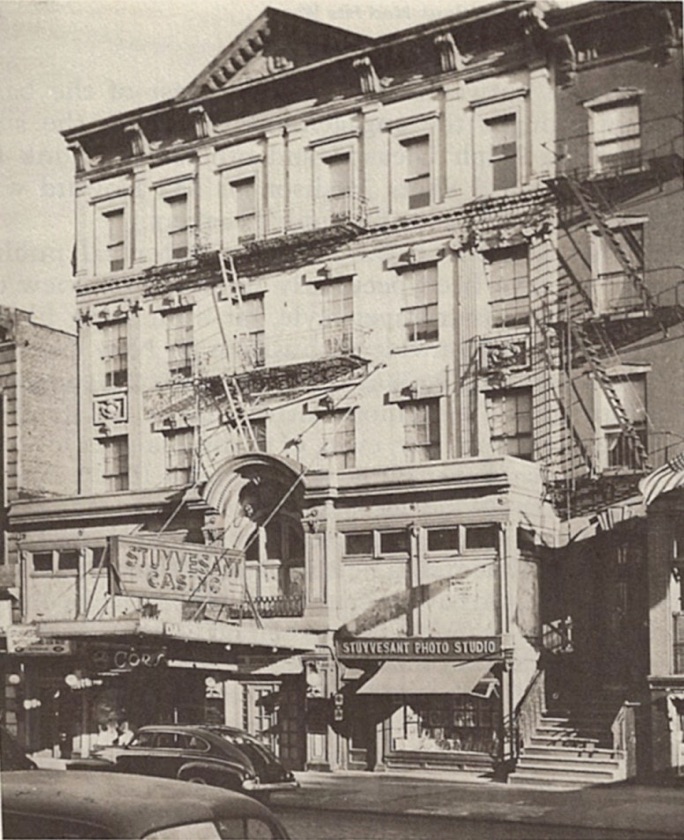
Stuyvesant Casino
In 1910, Stuyvesant Casino opened at 140-142 2nd Avenue, owned and operated by Gerson Schmidt, an Eastern Europe immigrant from Galicia (now located in Ukraine). This stretch of 2nd Avenue encompassed part of Stuyvesant’s farm, and thus the name was given to the business.
The Stuyvesant Casino offered sumptous food, dazzling decor, and a first-class house band. High rollers and hitmen were among the clientele, particularly Big Jack Zelig, head of the Eastman Gang after the death of “Kid Twist” Max Zwerbach, in 1908.
Big Jack Zelig
During a party on December 2, 1911, Zelig lured a drunk “Julie” Morrello, an Italian gangster called “one of the most notorious gun and knife fighters on the east side, to Stuyvesant Casino. Around 1am, the lights went out and four shots rang out. As the lights flickered on moments later, Morrello was lying prone on the dance floor, filled with bullets.
In post-World War I New York City, Stuyvesant Casino would be a notorious hangout for Jewish gangsters, but by World War II, the venue became known for music producing the hits.
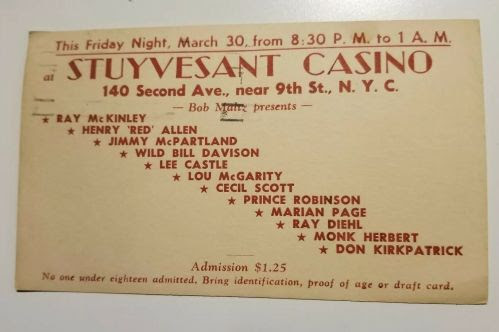
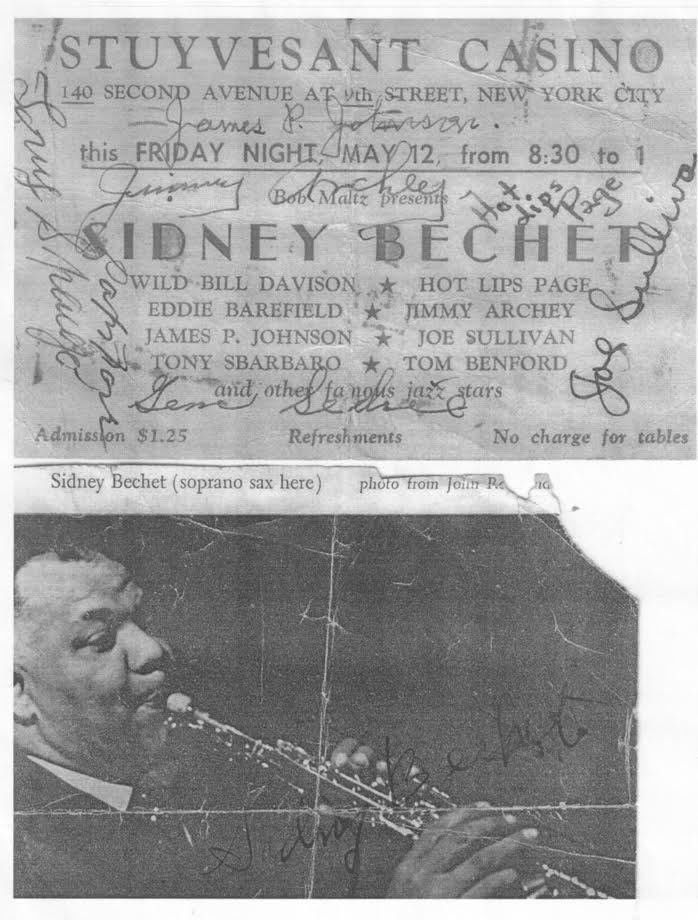
In the 1940s and into the 1950s, Stuyvesant Casino became a popular destination thanks to the arrival of New Orleans and Dixieland jazz artists. Big names such as Sidney Bechet, Wild Bill Davison, Rex Stewart, James P. Johnson, Georgie Lewis, Joe Sullivan, the great Bunk Johnson, and the Conrad Janis Tailgate Jazz Band could be heard for the low cost of $1.25.
Owner Gerson Schmidt was at one point encouraged by the Stuyvesant’s head waiter to allow a band consisting of his three sons to perform at the Casino. The three Perelmuth Brothers – Pinchas (violin/vocals), Michoyl (piano) and Sender (bass) – were a hit, leading to partygoer and movie theater impresario Samuel Lionel “Roxie” Rothafel, to discover Pinchas’ voice and recognize his potential. When Roxie asked why he was only singing in a “mere catering hall,” Perelmuth responded, “I would love to be an opera singer, but don’t have the money for a vocal coach.”
Opera legend Jan Peerce got his start at Stuyvesant Casino as a child
Roxie would take Pinchas under his wing and helped him get his break, helping him study voice and making his name among the opera elite of New York City. Perelmuth would make his debut at the Metropolitan Opera in 1933, under a new name, Jan Peerce. He would make his Broadway debut in 1971 in Fiddler on the Roof, a far distance for the son of Russian immigrants to travel from the Lower East Side.
As noted in the book The Jews of Capitol Hill, Gerson had a son, Mordechai, who married Myra Bank, the daughter of Galician immigrants. The two would have a son, Lawrence Jack Smith, a Democrat from Florida who served five terms in the House of Representatives from 1983-1993. Smith, whose parents ran catering establishments in the New York kosher catering scene, would work for their business and at Stuyvesant Casino from an early age.
When the Dixieland jazz made its way north, Gerson’s Stuyvesant Casino was the natural stop for an eclectic melting pot of music. Saxophone great Steve Lacy hung around the Casino as a teenager was exposed to early Dixieland Jazz greats, some of whom he would join there on a regular basis, including Henry Red Allen, Pee Wee Russell, Buck Clayton, and his teacher, Cecil Scott.
New Orleans bandleader Bunk Johnson would frequently perform at Stuyvesant Casino, occasionally joined by Louisiana-born bluesman Huddie “Leadbelly” Ledbetter, who lived on nearby East 10th Street. Trumpeter Hot Lips Page recorded a version of the 1924 classic “When My Sugar Walks Down the Street” at the Casino, and would later open rival venue Birdland with Charlie Parker, who lived nearby on Avenue B, in 1949.
Portrait of Bunk Johnson, Leadbelly, George Lewis, and Alcide Pavageau, Stuyvesant Casino, New York, N.Y., ca. June 1946
Robert Thompson, a Dixieland drummer known for his group The Red Onion Jazz Band, recalled Bob Maltz as an organizer of jam sessions at Stuyvesant Casino that attracted well paid world class musicians. The Red Onion Jazz Band served as legendary Dixieland revivalists, borrowing the name from Clarence Williams’ traditional New Orleans supergroup Red Onion Jazz Babies, which included Sidney Bechet and Louis Armstrong playing together for the first time in studio.
via Jazz Lives
The Red Onion Jazz Band would perform into the 1960s, just as folk music made its way through Greenwich Village. In the Traditionwould bring together folk musicians by way of Dave Van Ronk and his Prestige label, along with jazz musicians for a unique album. Vocalist Natalie Lamb would perform with The Red Onion Jazz Band and in 1972, married Thompson. A few years later, the group’s long-time trombonist, Dick Dreiwitz and his wife Barbara – a Hunter College alumnus who switched from French horn to tuba so she could play Dixieland jazz – would welcome a son, Dave. Now the bassist for Ween and Joe Russo’s Almost Dead, Dave Dreiwitz continues a tradition forged in the East Village confines of Stuyvesant Casino. The Red Onion Jazz Band would continue to perform until Thompson’s death in 2010.
From: A Pictural History of Jazz by Keepnews and Brauer. L to R, Buster Bailey, Vic Dickenson,Wilbur deParis, Omer Simeon, Hot Lips Page, Rex Stewart.
A first hand account of Stuyvesant Casino from Mr. Madison Arnold, as shared with Jazz Lives:
I was one of the steady jazz loving week-end customers at the Central Plaza and Stuyvesant Casino from around 1950 to 1952 and got these post cards weekly. This is the only one I kept. I started when I was still in Erasmus Hall H.S. (they didn’t card in those days). My favorites were Bechet & Wild Bill but I loved them all. Among my memories: I helped Pops Foster put his bass in a cab one night and we went to the Riviera on Sheridan Sq., Red Allen pulled me up on stage once and we sang “The Saints Go Marching In” together. I became friendly with Baby Dodds and invited him over for dinner one evening to our apartment in Brooklyn. I also visited his place in Harlem. I have a Xmas card he sent me, written, I think, by his lady friend as I don’t think he could write. My personal Louis Armstrong stories are even better! (at least to me). He was a wonderful guy.
Mr. Madison Arnold
An autographed show promo from Stuyvesant Casino
By the mid-1950s, due in part to restrictive immigration laws and a rise in crime and building abandonment, Stuyvesant Casino would close its doors. A home for Eastern European refugees since the late 1800s, new immigrants from Poland and Ukraine headed to the East Village for an escape from communism in the mid-20th century, in addition to Puerto Ricans who had U.S. citizenship.
Stuyvesant Casino also contained the Ukrainian National Home, a community center that opened in 1958, an effect of the change in neighborhood demographics. Offering cultural and social services to the East Village’s Ukrainian population, an area now known as Ukrainian Village, the “Ukie Nat” hosted a diverse array of artists in the 1980s including Elvis Costello, New Order, and the Misfits, as well as balalaika music filling the Ukrainian Home Restaurant.
New Order would perform their first American show at Ukrainian National Home, testing out new material that built off Joy Division’s sound. During the 80s post-punk era, synth-based freestyle and electro could be heard at downtown clubs – a melding of white, Latino and Black artists who were mixing in the same area where punk rock inspired New Order’s early sounds.
Looking back on Stuyvesant Casino’s heyday, jazz music from beyond New York would find a home in this region of the city that so many others had sought refuge in for centuries prior. Home to Germans, Jews, African-Americans, Ukrainians and many more, the area at 140-142 Second Avenue has been a bustling center of cultural diffusion and artistic growth for nearly two centuries, and continues to be so today. The original Stuyvesant Casino building burned down in 1985.
In January 2023, Ev Grieve shared news that during renovations at 132 Second Ave, a flyer for Stuyvesant Casino was found on a pole, decaying but clearly showing an event on a Saturday night.
photo by Kevin Goodman
As we close out this look at Stuyvesant Casino, listen to a WMGM broadcast from Friday, March 14, 1952, via Jazz Lives, featuring Master of Ceremonies Aime Gauvin, joined by Jimmy McPartland (cornet), Ziggy Elmer (trombone), Bud Freeman (tenor saxophone), Bob Wilber (clarinet), Kenny Kersey (piano) and Don Lamond/George Wettling (drums). They perform a medley including “Saints, “Lady Be Good,” “Coquette,” and “The World is Waiting for the Sunrise.”
While it may be Memorial Day Weekend, it’s also the ten-year anniversary of the one and only Phish run at the Bethel Woods Center for the Arts. In 2011, the band was still very much trying to gather its collective footing after reuniting only two years earlier. For some, these shows represent the first true “return to glory” moments for the band and fans alike. It’s only fitting that it took place on the hallowed grounds of Bethel, NY, the same ones that served as host for one the most influential music events of all time, Woodstock. Even though it was only Phish performing in Bethel this weekend, there were still plenty of magical moments to be had.
An argument can be made that some of the most passionate and inspired music of the entire weekend never even made its way to the public. On the night before the run was set to begin, Phish blessed their sound check with what many consider to be one of the best “Waves” of all time. It’s a version that stretches out to nearly a half hour, diving way beneath the surface without coming back up for air.
Night One – May 27, 2011
The first night of this memorable run also served as the 2011 summer tour opener. The only other show Phish had played this year to date was their 1/1/11 gig at Madison Square Garden to cap off the New Year’s run. Some rain leading up to this evening wreaked havoc on the fertile and lush grounds of Bethel Woods. But that certainly wasn’t going to deter anyone.
The rain had left some parts of the lower lawn in a treacherous state, to say the least. So boots, tarps and blankets were en vogue. But rather than play it safe and ease into the show, Phish instead opened night one of Bethel Woods with a raging “Tweezer” that caught everyone off guard, in a good way. Summer tour and the band’s third year since returning from a self-imposed breakup were now officially underway.
Considered tame by today’s standards, the show opening “Tweezer” doesn’t stray too far and elicits a mild jam. But the joy of it opening the show, and the tour, was never in doubt. Instead of stretching it out, they immediately transition into “My Friend, My Friend” and night one is off and running.
The rest of the first set is comprised of multiple covers that paint a clear picture of what influences Phish musically. First is their take on Ween’s “Roses Are Free,” a song forever immortalized in Todd Phillips’ Bittersweet Motel documentary. Next, keyboardist Page McConnell shines on his solo on Son Seals’ “Funky Bitch.” The first set also features a take on James Gang’s “Walk Away” that’s properly fueled by Trey Anastasio on guitar and it finishes with a splendid cover of Jimi Hendrix’s “Bold As Love.”
Aside from an earlier “Wolfman’s Brother,” some of the more exploratory work from the band in the first set came during “Stash.” A jam that starts from near ambience quickly picks up speed while never quite shaking the framework of the song. It provided a nostalgic glimpse of a song that used to be a first set powerhouse for a band still very much rounding into form.
With one set under their belt, Phish opens up the second with another rager, “Carini.” Those who called that and “Tweezer” both as set openers should be commended. Again, compared to modern day versions, this “Carini” doesn’t veer too far off the path, but rather sets the table nicely for the crescendo-building “Get Back On The Train” that succeeds it.
The second set also contains a “Waves” that has its moments but doesn’t come close to the majesty and weirdness offered up in the one from yesterday’s soundcheck. And, of course, more choice cover selections. This included the always popular “Boogie On Reggae Woman” (Stevie Wonder), with Mike Gordon and his signature bass line/effect leading the way. The set picks up in a major way, and possibly peaks, with a deep dive of the Talking Heads’ “Crosseyed and Painless.”
Once drummer Jon Fishman finishes leading the group through a funkified version of this cover, the rest of the set plays out in somewhat traditional fashion. “The Squirming Coil,” replete with an enchanting, set-ending piano solo from McConnell closes out the set before “Julius” and its infectious “don’t take another step” mantra closes the book on the first night of Bethel.
Phish – Bethel Woods Center For The Arts – Bethel, NY 5/27/11
Set 1: Tweezer > My Friend, My Friend, Poor Heart, Roses Are Free > Funky Bitch, Wolfman’s Brother -> Walk Away, Stash, Bouncing Around The Room, Kill Devil Falls, Bold As Love
Set 2: Carini >Back On The Train > Boogie On Reggae Woman > Waves > Prince Caspian > Crosseyed and Painless > Wading In The Velvet Sea > Possum, The Squirming Coil
Encore: Julius
Wolfman’s contained a Streets of Cairo tease from Trey. Before Stash, Trey teased The Fish (Schindleria Praematurus) by Yes.
Listen to the complete show on YouTube, or track-by-track at PhishTracks.
The second night of the Bethel Woods run began as so many Phish shows do, with people scurrying everywhere to secure their spots as notes from the opening song rain down. In this instance, the selection is “Theme From The Bottom” while plenty of viable spots on the lawn are still being secured.
Traditional first set stalwart “NICU” then follows, with McConnell wasting no time getting down to business on the Hammond organ. A super funked out take of another Talking Heads cover, “Cities,” then gives those on the lawn and everywhere else more than enough reason to get down and dance. The “outro” jam lasts well longer than it should and serves as a legitimate highlight of the weekend.
The rest of the night two’s first set is best encapsulated by a couple of song pairings. “Halley’s Comet” picks up on the experimental vibe and takes it the distance, fomenting a certifiable Type II jam momentarily. But before it can explore any further, the opening chords of “Runaway Jim” enter the fray, serving as the back end of a powerful two-song sequence whose jam gets the full on ‘Plinko’ treatment. The first set then later wraps up with another Phish staple, “Bathtub Gin” that gets a taste of “Manteca” and a distinct “Golden Age”-type jam midway through before rounding back into form.
Like most Phish shows, much of the heavy lifting takes place in the second set tonight. An explosive “Down With Disease” starts things off nicely, with Jon Fishman providing one intricate drum fill after another in a jam that comes to an early vigorous peak. Instead of returning to finish “Disease,” the jam meanders for a while until Anastasio signals for a wonderfully patient “Free” to begin.
As the second set progresses, Phish continues to show their mastery of juxtaposition. A zany “Makisupa Policeman” immediately goes off the rails, with mentions of spliff smoking and imaginary trips to Mike and Page’s respective “houses” that eventually sends the Bethel Woods crowd into an uproar, along with a healthy clav-driven, mini-funk jam. But instead of going to Fish’s “house” and carrying on with the silliness, the band turns on a dime and crafts an emotional “Harry Hood.”
The set later concludes with another Phish classic, “David Bowie.” And another longtime cover favorite, The Beatles’ “A Day In The Life” puts the finishing touches on night two in Bethel. With two nights now in the books, only the Sunday show remained. And, as the saying goes, those are not to be missed.
Phish – Bethel Woods Center For The Arts – Bethel, NY 5/28/11
Set 1: Theme From The Bottom, NICU, Cities, Halley’s Comet > Runaway Jim, Gumbo > Quinn The Eskimo > Limb by Limb, Horn, Bathtub Gin -> Manteca > Bathtub Gin
Set 2: Down With Disease > Free > Backwards Down The Number Line > Makisupa Policeman > Harry Hood > Cavern > David Bowie
Encore: A Day In The Life
Gin included a mash-up jam of Golden Age and Manteca and later closed with a Manteca quote from Trey. Disease was unfinished. BDTNL featured a DEG tease from Mike. Makisupa included lyrics referencing several band members’ houses (and Trey’s favorite show, House).
As to be expected, Phish closes out the Memorial Day Weekend in fine fashion. The “AC/DC Bag” opener “gets the show on the road” in a major way and Phish coasts from there. “Ocelot,” still a fairly new tune at the time, gets a surprisingly monstrous jam attached to it. The “Ya Mar” and “Timber” that follow serve as a nostalgic throwback of sorts, giving the set a temporary old school vibe.
“Suzy Greenberg” makes a first set appearance and then instantly morphs into a rowdy “46 Days.” And the quality cover selections continue as well, with Lynyrd Skynyrd’s “Ballad of Curtis Loew” getting the call tonight. Just like old times (again) the opening set then concludes with a “Run Like An Antelope” that does just that.
For their last Bethel set, Phish decides to maintain the traditional feel and opens it with a vintage “Mike’s Song” > “Simple” -> “Weekapaug Groove” trifecta. “Simple” yields an especially spacey, ambient-type jam before the rhythmic law firm of Fishman & Gordon kickstart the “Groove.” Afterwards, the band takes some time to reintroduce a certain dance some may have forgotten.
The second set later comes to a close with another powerhouse trio. “Also Sprach Zarathustra,” aka “2001,” offers one last definitive dose of funk for the weekend before giving way to the newly established jam vehicle that is “Light.” And “Slave to the Traffic Light,” with its customary soaring jam that evolves from near silence is the final emotional stamp.
By the end of the weekend, so much great music had transpired that it was hard to take inventory of everything. That’s why it came as a shock to many when, after “Loving Cup,” the distinct riff of “Tweezer Reprise” rang out, bringing the entire weekend full circle. It’s more than an ideal choice to close out the final chapter of music for the weekend, with the hopes that it won’t be the last one Phish writes here.
Phish – Bethel Woods Center For The Arts – Bethel, NY 5/29/11
Set 1: AC/DC Bag > Sample In A Jar, Rift, Ocelot, Ya Mar, Timber (Jerry) > The Oh Kee Pa Ceremony > Suzy Greenberg > 46 Days > Twenty Years Later, The Ballad of Curtis Loew, Run Like An Antelope
Set 2: Mike’s Song > Simple ->Weekapaug Groove, Meatstick > Fluffhead > Joy, Also Sprach Zarathustra > Light > Slave to the Traffic Light
Encore: Loving Cup > Tweezer Reprise
Ya Mar included Express Yourself (Charles Wright & the Watts 103rd Street Rhythm Band) teases from Mike. Antelope contained a Curtis Loew tease from Trey and Manteca teases from Trey and Page. Page teased Magilla in Simple.
Boston Calling Festival has announced their return to the Harvard Athletic Complex on May 27-29, 2022, with headliners Foo Fighters and Rage Against the Machine.
Foo Fighters and Rage Against the Machine were both set to headline Boston Calling in 2020 with the Red Hot Chili Peppers before the festival was cancelled due to the pandemic. These two iconic rockers will top the bill of a lineup with over 60 performers next year, including an additional headliner, that have yet to be announced.
RATM’s performance will be the band’s only New England show on their 2022 North American tour, where the band will be reuniting for the first time after a decade. Foo Fighters, who are celebrating their 25th anniversary and their induction into the Rock and Roll Hall of Fame, will be performing at Boston Calling as the fourth stop on their 2021-2022 tour.
A limited number of early bird 3-Day General Admission, VIP, and Platinum tickets are on sale now on the Boston Calling website. According to festival coordinators, the early bird period features all three ticket tiers at its lowest pricing for Boston Calling 2022.
Anderson .Paak’s performance at Boston Calling 2019
Aside from musical performances, Boston Calling plans to showcase new forms of entertainment from DJ sets to comedy shows, alongside extensive food and drink offerings from over 35 vendors.
A shot from Boston Calling at City Hall Plaza in 2016
Expanded offerings in the VIP and Platinum tiers in 2022 have also been announced. Fans can expect new viewing areas within the sections, including views of both the Red and Green Stages, and an expanded viewing deck within the Platinum section.
More information will be shared as it is announced. Check out the Boston Calling website for more in-depth details on the festival’s offerings.
https://www.youtube.com/watch?v=dHX72IH79a8
Boston Calling 2022 Teaser Video
Update on 7/14/21: Run the Jewels and Black Pumas join the lineup. This will be Run the Jewels’ third time performing at the festival. Black Pumas are making their Boston Calling debut. A limited number of early bird 3-day tickets are on sale now at www.bostoncalling.com. The early bird 3-Day General Admission tickets ($299.99), 3-Day VIP tickets ($799.99), and 3-Day Platinum tickets ($1,599.99) are on sale now. A special limited 2-pack of early bird 3-Day GA tickets ($549.99) is also available. This early bird period will offer the lowest pricing for 3-Day tickets for Boston Calling 2022.
Mountain Jam is the largest annual and longest running music and camping festival in the Northeast. Today they have announced that the “Best of Mountain Jam,” an exclusive virtual music experience, will air this Memorial Day weekend.
Mountain Jam 2013
On Saturday, May 29th and Sunday, May 30th fans of the festival can tune in to “The Best of Mountain Jam” for a full day of past performances and backstage artist interviews exclusively on Woodstock 100.1 WDST and on Woodstock’s live stream via the iHeart radio app, and on RadioWoodstock.com.
On Saturday, May 30th Radio Woodstock will stream the entire Nathaniel Rateliff & The Night Sweats set from MJ2016. The live-streamed performance will begin at 8 PM EDT on both Woodstock and Mountain Jam’s Facebook pages and YouTube channels.
A live performance from Nathaniel Rateflii & The Night Sweats, with special guest The Marcus King Band will take place at Belleayre Mountain in Highmount New York on July 31, 2021. Tickets are available here.
Listeners can expect to hear performances from past Mountain Jam artists including Robert Plant, The Allman Brothers, The Black Keys, Willie Nelson & Family, Gov’t Mule, Alabama Shakes, Bob Weir and Ratdog, Phil Lesh & Friends, Levon Helm, Jack Johnson, The Lumineers, Michael Franti & Spearhead, Tedeschi Trucks Band, The Avett Brothers, Joe Russo’s Almost Dead, Grace Potter, My Morning Jacket, Beck, Jason Isbell, Steve Winwood, Les Claypool, The Revivalists, Umphrey’s McGee, Wilco, Peter Frampton, Gary Clark Jr., Lukas Nelson & Promise of the Real, Chris Robinson Brotherhood, Dave Mason, Mavis Staples, Lake Street Dive, Ben Folds, Robert Randolph, Nathaniel Rateliff, Dispatch, The Head & The Heart, Houndmouth, Martin Sexton, G.Love, Shakey Graves, Amy Helm, Ray Lamontagne, Sharon Jones & The Dapkins, St Paul & The Broken Bones, Lucius, Trombone Shorty, Courtney Barnett, Rag’n’Bone Man, Sister Sparrow, Toots & The Maytals, Twiddle, Marco Benevento, Valerie June, Andy Frasco, Strumbellas, Nicki Bluhm, Dawes, Jade Bird and more.
Pencildive, an indie rock band that has been aptly described by fans as “a post-punk visual nightmare” is gearing up to release their debut full-length record, Grown-Ups, out May 28th via Albany startup, Paintbox Records.
Pencildive is a name that may ring familiar to Capital Region music fans. The band has been active since 2018, releasing their debut EP When I Go Outside, in 2019, which was recently reissued by Paintbox Records this past April. Pencildive released a short video to accompany the release of their song “Cricket Man,” which was awarded an Eddies nomination for the best music video category in 2019.
Gina De Nardo, the songwriter of the group, graces the mic with her haunting vocals and a lyrical focus centered around losing love, sleepless nights, and the overall human condition, all composed into the group’s wild, electric arrangements in an eclectic frenzy of gloomy post-punk.
Since the first EP we’ve all become more comfortable with the recording and production process which I think shows in Grown-Ups. Creating a full-length also gave more of an opportunity to tell a story through the songs and explore sounds more conceptually.
Gina De Nardo on the Grown-Ups recording process
Grown-Ups was written by De Nardo over the course of a decade, the first full-length album the Upstate rocker has written on her own and that sense of growth is felt throughout the entirety of the project. Grown-Ups was safely recorded in October 2020 in a cabin in the Adirondacks. The ten-track album features strings, noise improvisations, and haunting cries from the insides of a vintage Leslie speaker.
Plans for the CSO’s 2021 season will incorporate necessary changes and procedures to ensure the health and safety of all. Performances will often feature a smaller ensemble, with all musicians distanced and non-wind and -brass players masked.
“Planning for the upcoming season has been challenging but also wholly invigorating — dreaming of how we can make the most of our circumstances and deliver concert experiences that will surprise and delight,” Milanov said. “I’m elated to return to Chautauqua and the Amphitheater, and to take the stage with my incredibly gifted orchestra colleagues to make beautiful music for our wonderful audience.”
The CSO’s 2021 season begins on July 10 with a performance of Beethoven’s Fourth Symphony and a work by composer and pianist Gabriela Lena Frank, “Elegía Andina,” that she says “is one of my first written-down compositions to explore what it means to be of several ethnic persuasions, of several minds.” The closing concert on Aug. 14, with Principal Pops Conductor Stuart Chafetz, will feature returning vocalist Capathia Jenkins performing selections made famous by the inimitable Ella Fitzgerald.
Other season highlights include frequent Chautauqua collaborator, Wynton Marsalis, on July 28 and two movie-nights with orchestral accompaniment, “The Nightmare Before Christmas” and 1991’s “Beauty and the Beast”.
2021 will also feature the return of the Chautauqua Diversity Fellows to the Institution grounds. The program began as an expansion of the Cincinnati Symphony Orchestra and University of Cincinnati College-Conservatory of Music’s (CCM) groundbreaking Diversity Fellowship Program for pre-professional underrepresented musicians. 2021 will feature four fellows from the Cincinnati Diversity Fellowship Program and one Fellow from the Sphinx Organization, the pivotal organization dedicated to transforming lives through the power of diversity in the arts.
All Chautauqua Symphony Orchestra performances are included with the Traditional Gate Pass (TGP). TGP holders will have first access to reserved seating, approximately two weeks prior to the start of each week. Remaining tickets will then be available for sale to Grounds Access Pass (GAP) holders and the general public on a space-available basis approximately one week prior to the start of each week.
“Left Side” is the debut single from Endearments (a.k.a Kevin Marksson). The Brooklyn-based songwriter and multi-instrumentalist began writing and composing by and for himself for the first time in fifteen years following the end of synth-pop duo Saint Marilyn in 2019. “Left Side” is definitely a way to start his single career strong.
Album Cover
The song itself is about how O.C.D. (Obsessive–Compulsive Disorder) affects Marksson and his relationships. The resulting track unspools unanswerable questions over mighty pulses from drummer Jonathan Schmidt and Marksson’s own multi-tracked vocals, which flicker, omnipresent and cool, around the edges of the song’s atmosphere. In this song the low-fi beat with his voice is one where you can just close your eyes and vibe out to.
This single has Marksson leaning into his obsessive tendencies pouring over every sound and lyric, tweaking every riff and arpeggiation to convey the inner workings of his mind: disorder and parallelism.
Photo Cred: Rita Iovine
His chosen name, Endearments, is because “I wanted the name to convey affection, even though I knew the music would almost certainly be sad.” Taking inspiration from auteurs like Peter Gabriel and Justin Vernon, Endearments’ lush sonics and careful songcraft reflect Marksson’s avowed status as a hardware-focused composer. Marksson is a longstanding accomplice in the Brooklyn indie rock scene.