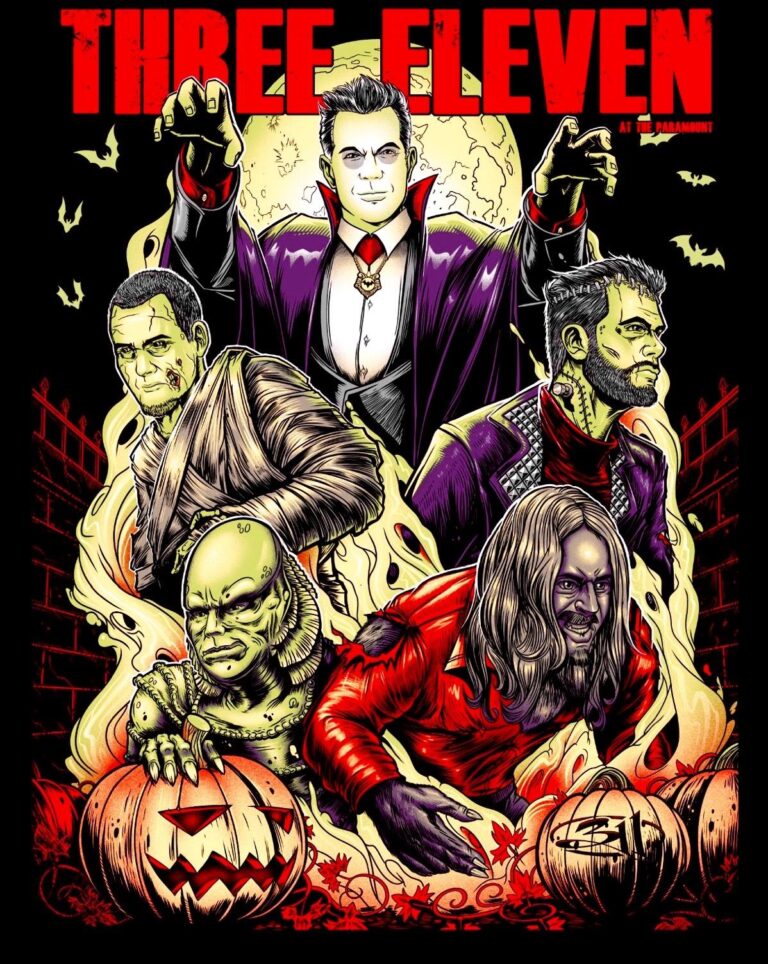
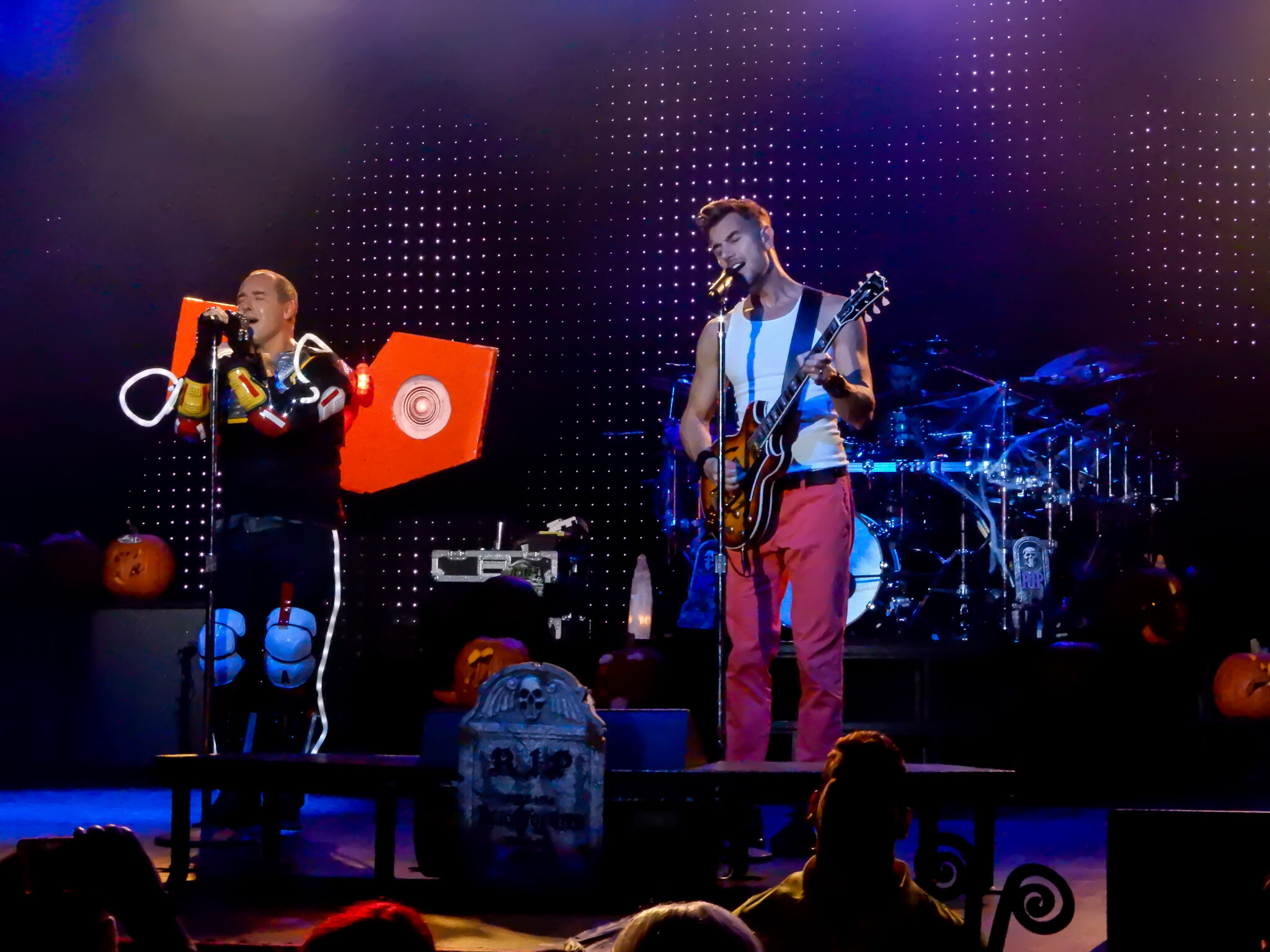
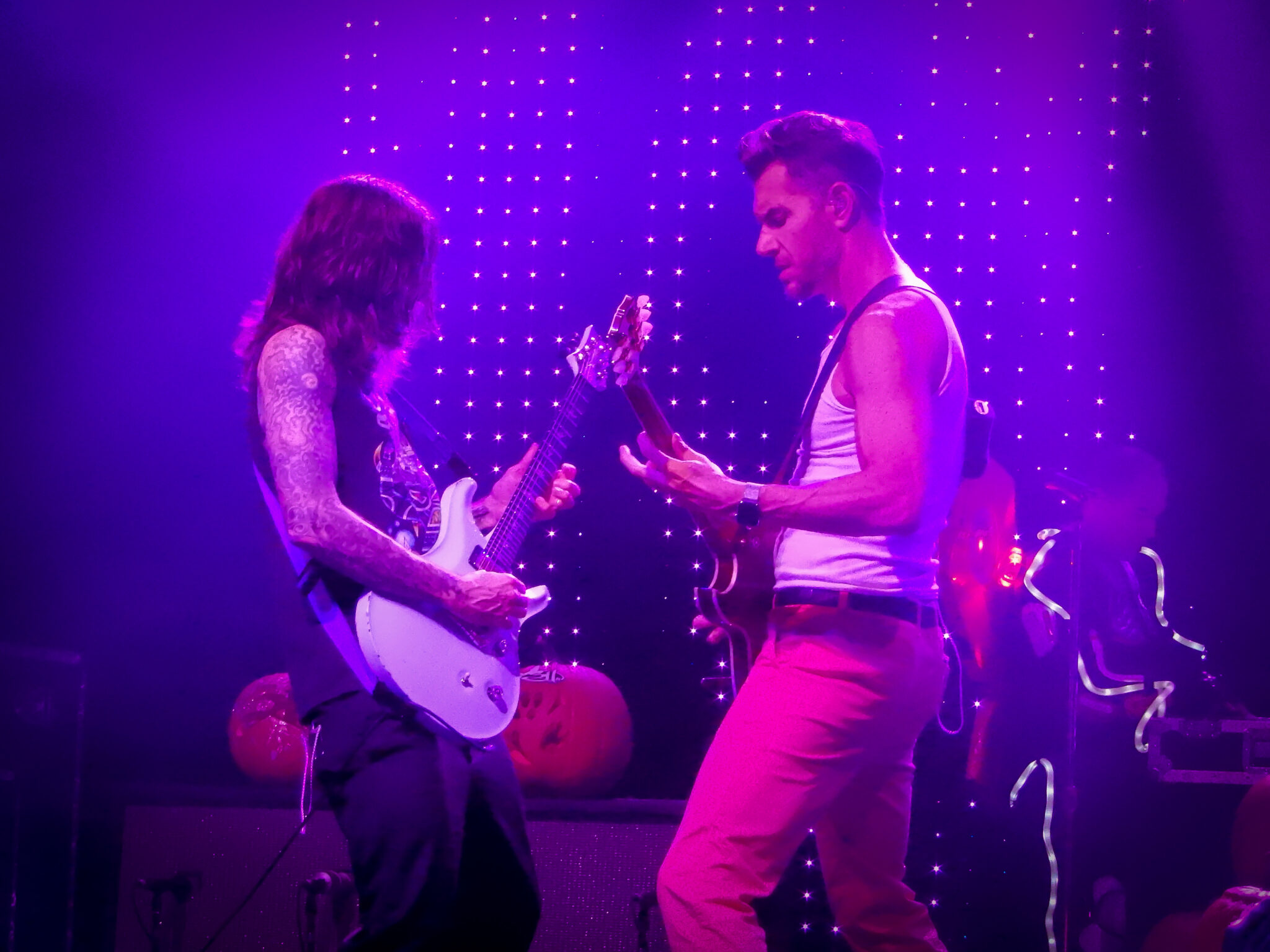
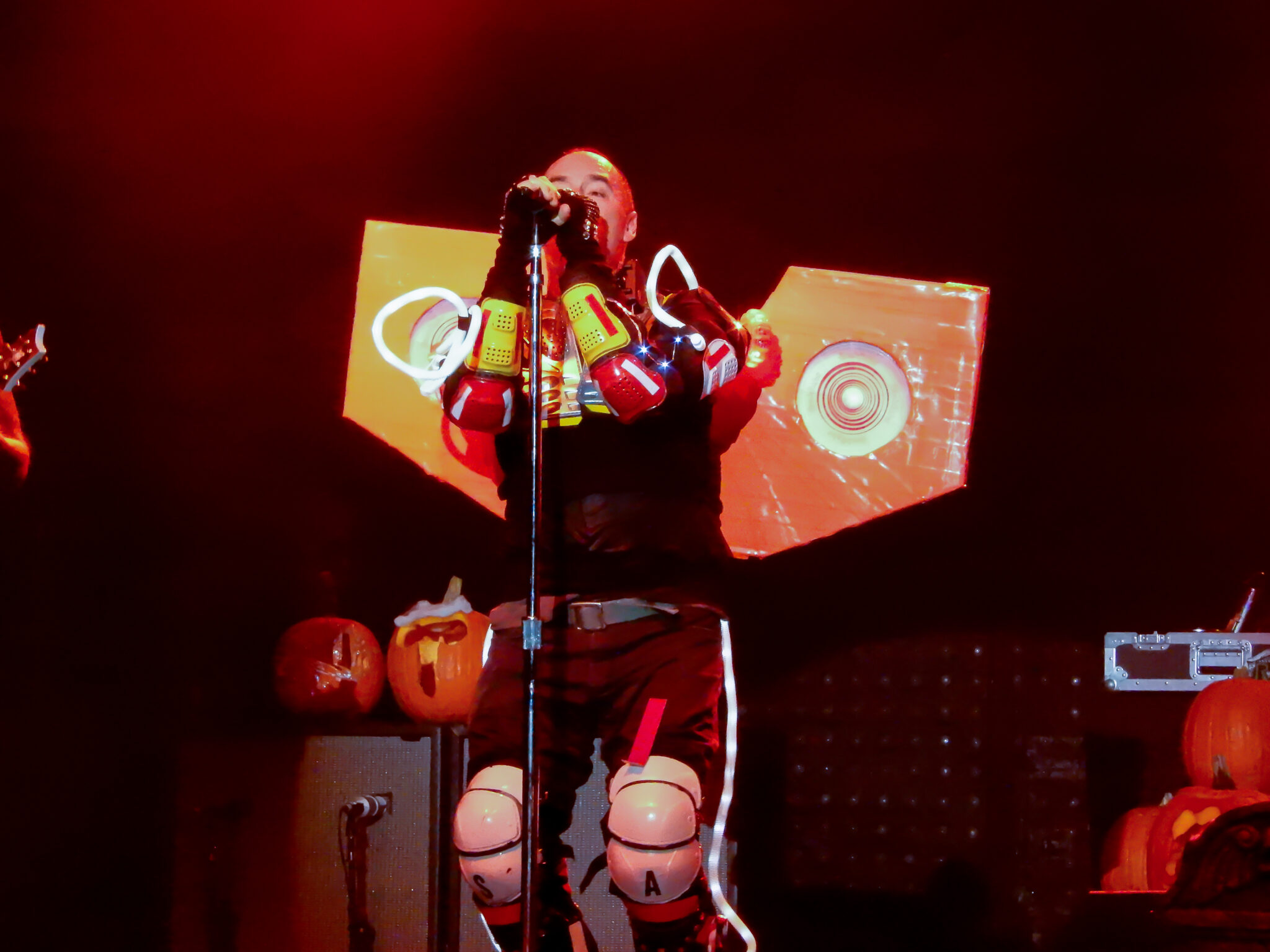
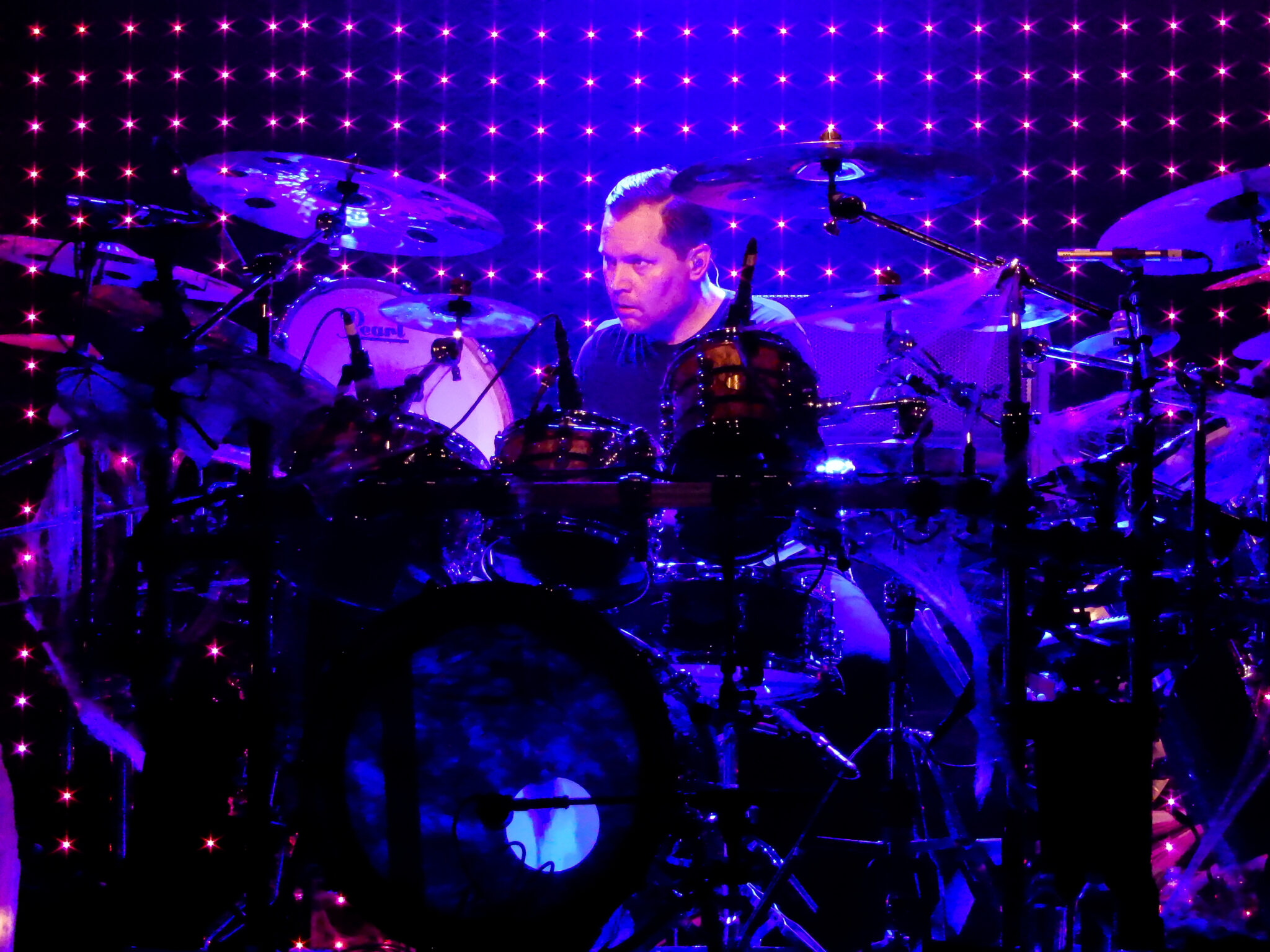
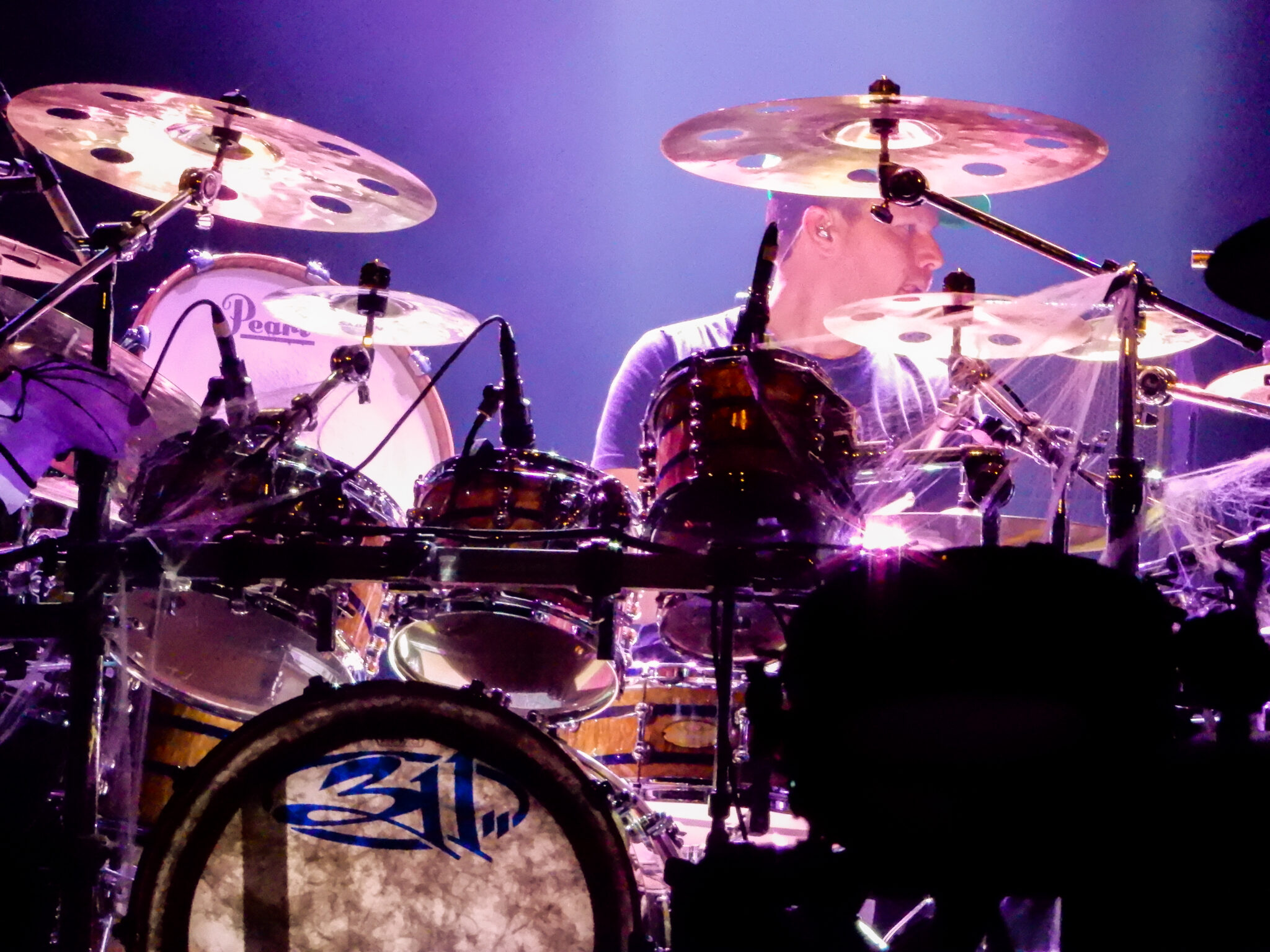
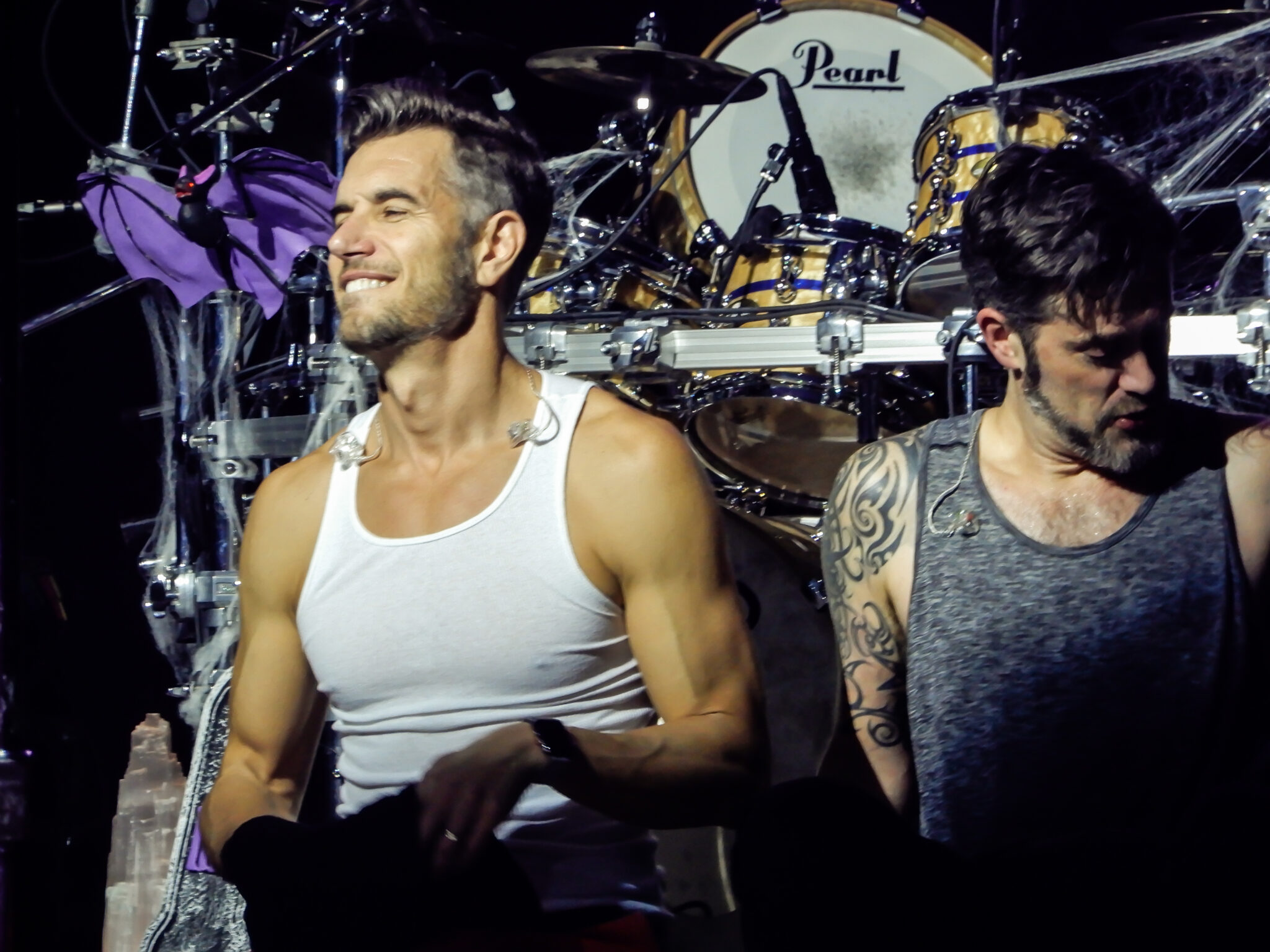
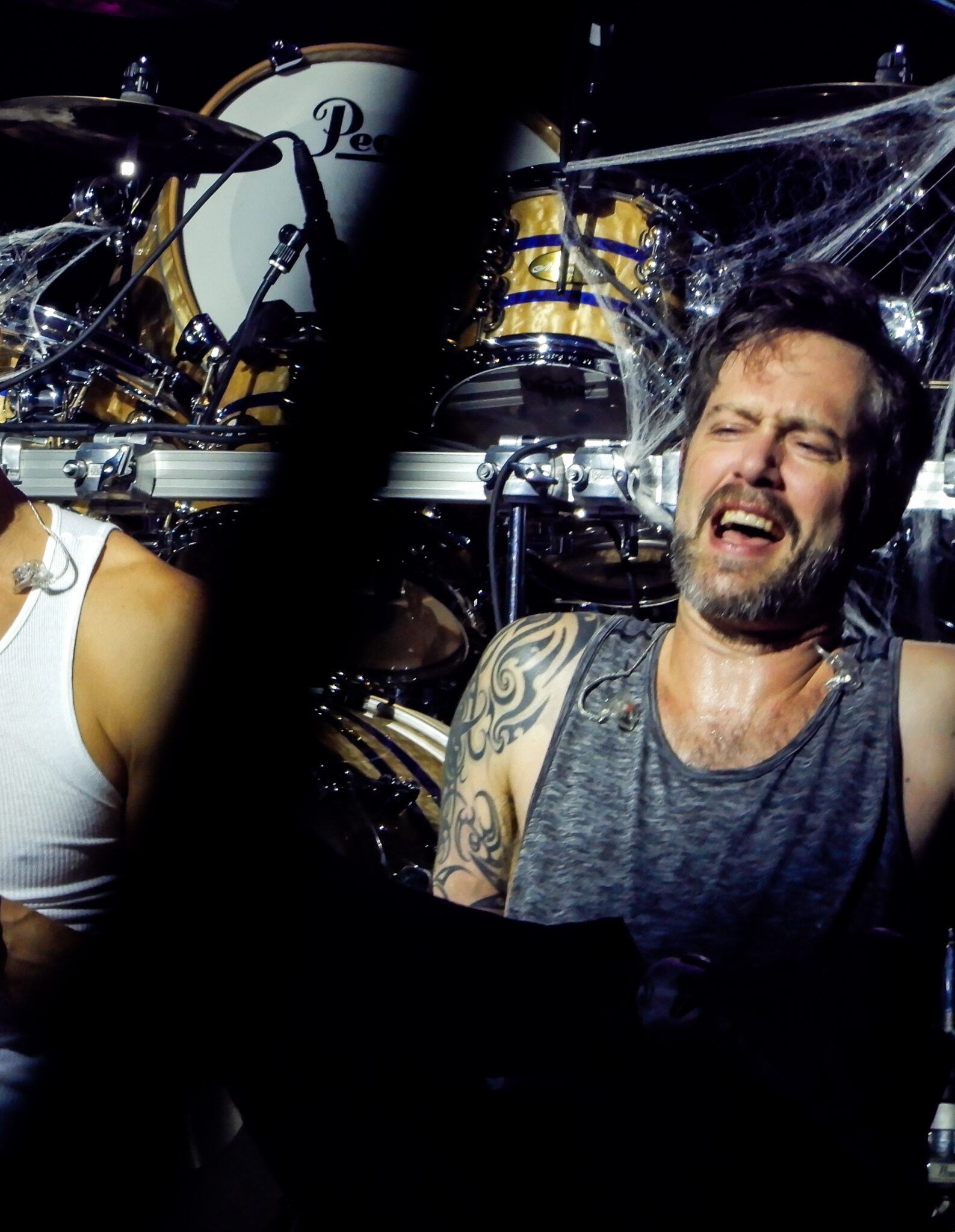
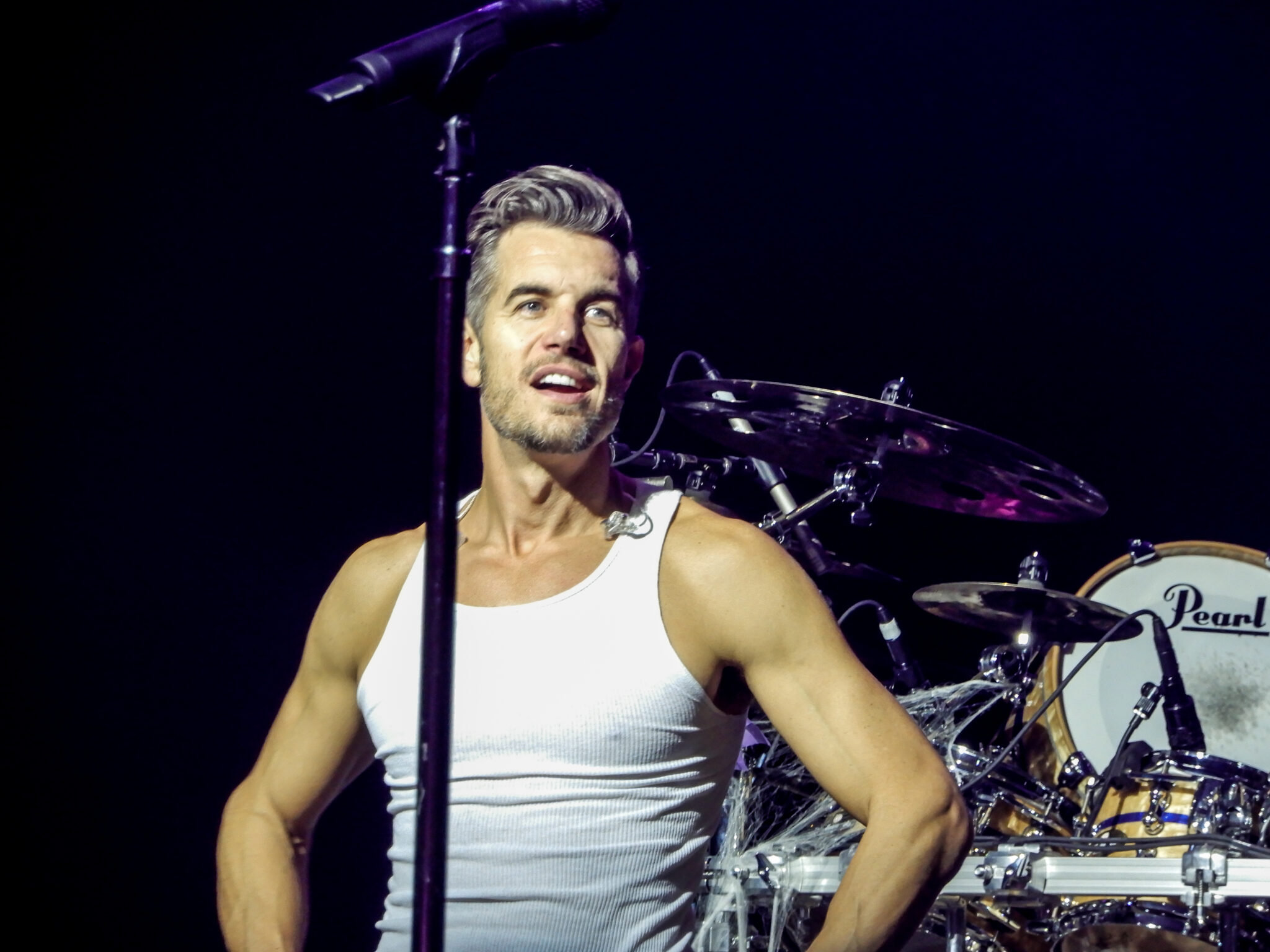
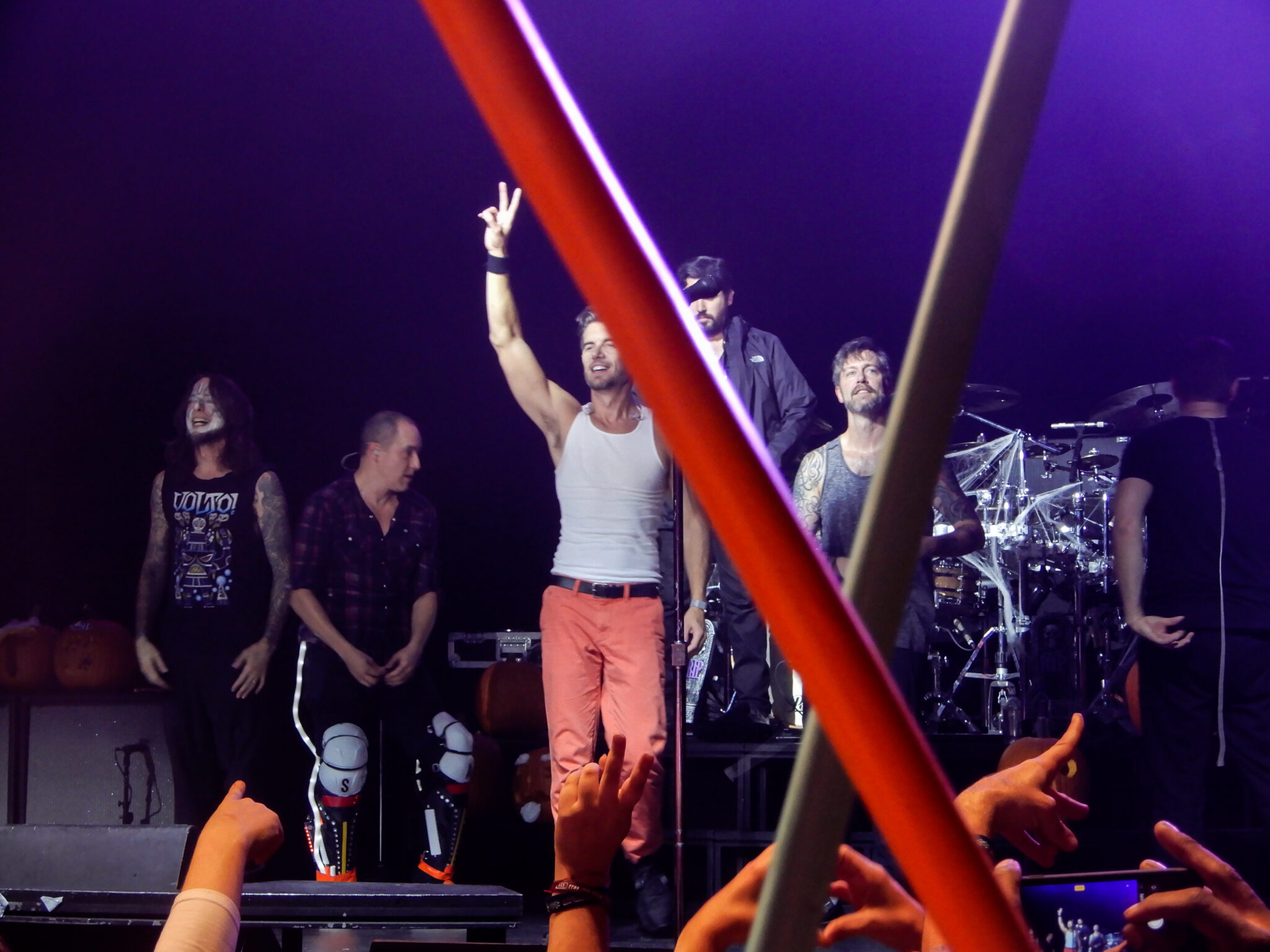
On October 31, 2017, reggae rock band 311 treated their Long Island fans to a special Halloween show at The Paramount in Huntington. They really took the spirit of Halloween seriously with vocalist/turntablist SA Martinez, bassist P-Nut, lead guitarist Tim Mahoney, drummer Chad Sexton and lead vocalist and guitarist Nick Hexum taking the stage in full costume. The event was presented by Long Island radio station 94.3 The Shark. Fellow rap rockers Shinobi Ninja opened the show and were also dressed in costumes.
I have been to many, many 311 shows, but I would say this show in particular had the best old school setlist. Of course it made perfect sense that they opened the show with “Jackolantern’s Weather.” They even pulled some of their more popular songs like “Amber” and “Come Original” and replaced them with deeper cuts for their hardcore fans such as “Visit,” “Unity” and “Hive.”
They also added “Gap” that was featured on their 1996 Enlarged to Show Detail EP. It seems to me whenever the guys come to Long Island they really make an effort to tear the roof off the venue. Growing up the Island I can tell you they have a huge loyal fan base here and they definitely know it.
The set was two-and-a-half hours long and even included some bits of spooky Halloween themed music such as the theme song of Stranger Things and “This is Halloween” from The Nightmare Before Christmas. You can tell they guys were really enjoying themselves as they covered songs from almost every album from Music to Mosaic. The set ended with two more old school songs “Who’s Got the Herb” which I think they have to play at every Long Island show and “F— the Bull—-” which is the best show closing songs ever written.
As part of their 30th anniversary tour, the band was scheduled to co-headline a North American tour with Incubus in the summer of 2020, but it was cancelled because of the Covid 19 pandemic.
Setlist: Transistor Intro, Jackolantern’s Weather, Galaxy, Flowing, Gap, Extension, Light Years, Sick Tight, Visit, Bass Solo, One and the Same, Hive, Inner Light Spectrum, Wildfire, Rock On, Applied Science, Hey Yo, Lose, Transistor, Use of Time, Unity, Hydroponic, Feels So Good
Encore: Livin and Rockin, Who’s Got the Herb, Fuck the Bullshit
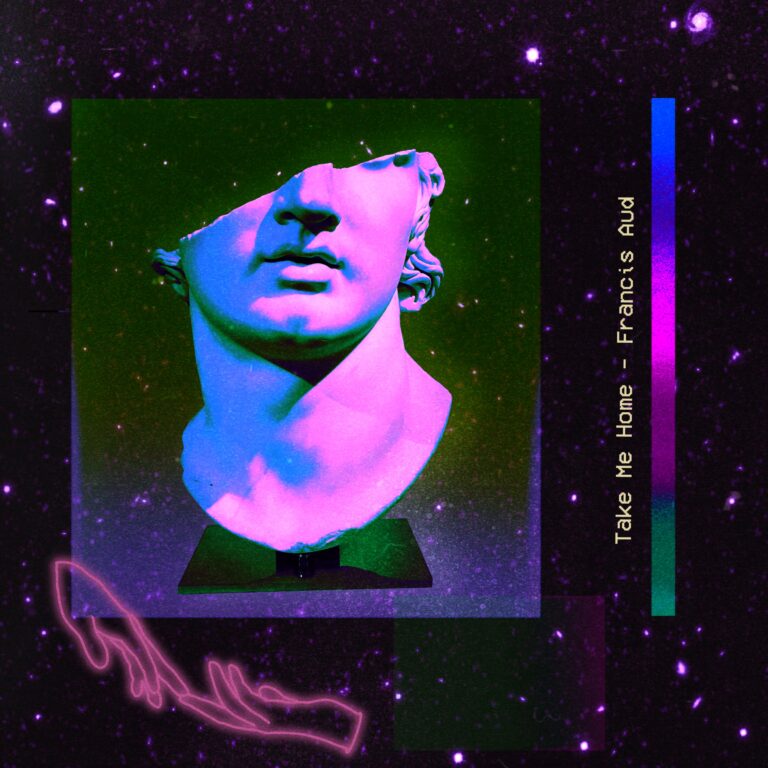
Brooklyn electro-pop funk artist Francis Aud recently released his newest single “Take Me Home,” blending bittersweet lyrics with an upbeat and unique electric funk.
Francis Aud started out as a retro-soul artist and released his debut EP Tender Things in July 2017. Since then, his music has evolved into what he calls ‘FONK,’ his own original blend of electro-pop and funk. This refreshing mix gives his music personality and makes his sound memorable. Francis tells NYS Music:
My biggest inspirations are Al Green, Marvin Gaye, and Sam Cooke. From listening to those guys, I then found Jackie Wilson, James Brown, and then followed the thread of musicians they influenced all the way up to contemporary pop artists like Bruno Mars and Parcels.
Francis Aud
What he listened to as a child has been “carried in his psyche,” and he says that listening to “super romantic Spanish crooner music or The Commodores” all the time as a kid still influences his own writing style today. “I almost exclusively write about love, relationships, and desire and I still try to phrase the lines I sing like how a crooner would…old habits die hard I guess!” He’s been releasing several FONKY singles since 2018 in preparation for a bigger release in the future.
“Take Me Home” looks back on a past relationship with bittersweet nostalgia. “When it comes to lyric-writing,” Francis says, “I’m always trying my best not to write lyrics that aren’t devoid of meaning (if that makes sense.) I think lots of the time when people hear the words ‘pop music’ their mind immediately jumps to this idea of extremely surface level and superficial lyrics that come from lazily relying on overused tropes and clichés. I think good pop music doesn’t have to be devoid of a deeper meaning and there’s lots of proof around me of that.”
Photo courtesy of Amanda Blide
Despite its somewhat sad message, the single is in no way a downer. It’s upbeat and dancey. “That comes from my shameless love of 80’s music,” the artist admits. “I seriously, positively, TRULY, love music from the 80’s, especially the movie soundtracks where the arrangements were super over the top and used cheesy keyboard sounds on everything. Because that music makes me happy, I think it’d be worth exploring the juxtaposition between that music and the lyrics and I’m just lucky to call it a success!” The 80’s vibes in “Take Me Home” are clear, but with an original and modern spin that is lacking in some other “cheesy” pop.
Francis Aud’s music and website both shine with his positivity and humor. “I don’t think I can ever remember a time where I wasn’t blatantly making terrible dad jokes and puns,” he says about his ever-present humor. “In terms of positivity,” he notes, “I think it comes from both my parents and also comes with the territory of being a musician. With my parents being immigrants and coming to this NYC during the really rough 80s’-90’s, they had to work their asses off to make things happen and they had to have an optimism that things would work out. I think I naturally picked up on that. ALSO, when it comes to being an artist, you almost have to force train yourself to become more positive on a daily basis because there really is no guarantee that your art will be heard or even enjoyed.”
Despite the global halt brought by the Coronavirus, Francis has been keeping busy working on music: “I’ve been spending most of the quarantine teaching myself more about music production and trying my best to ‘level up’ my home recording set-up,” and “I’ve been working with more getting more comfortable using synthesizers and more of the electronic aspects of music production,” he says, as he can’t record in a full studio with a band right now due to the quarantine. “Aside from that, I’m always trying to hone my writing and working to finding that distinct balance between saying something meaningful and being catchy.”
It has been over fifty years since the Woodstock Music & Art Festival made its mark in history from August 15-18, 1969 in Bethel, NY, and one year since the festival marked its golden anniversary. The Museum at Bethel Woods displayed a special exhibit throughout the year of Woodstock photographs and artifacts and hosted a weekend of music in their pavilion and throughout their grounds where the historic festival was held.
Throughout that weekend in 2019, Bethel Woods had a meeting spot for 1969 festival attendees at the top of the hill where the original festival was held. There, I was introduced to Lisa Law who, upon noticing my camera, was quick to say, “Here, do you want to take my picture?” We only had a brief introduction at that time with all the hustle and bustle of the festivities that day
Lisa Law is an accomplished photographer and videographer who considers herself to be a historian/documentarian with her camera, capturing candid moments as they happen. In the last five decades she has shot iconic portraits of now legendary musicians (sometimes at major moments in music history) and documented social/cultural changes and the lives and society of indigenous people, through both still and video photography. Her documentary film and book by the same name, Flashing On The Sixties, features her images and videos from that era. More than 200 of her images are also on exhibit in the Smithsonian Museum.
As a member of the Hog Farm Commune (which included Wavy Gravy), she was part of the group flown from Los Angeles to New York to provide the “security” for Woodstock. At the festival, Law was responsible for setting up the Hog Farm kitchen and getting food ready for the festival-goers who wanted it. Even with all of this, she managed to weave in her photography and videography to capture the arrival of the crowds and other scenes at the festival.
Shortly after the conclusion of the 50th anniversary weekend at Bethel Woods, I caught up with Lisa in the Town of Woodstock to hear more of her story. Starting with her early days with a camera, she brings us through her experiences behind the lens over the years, including recent works with establishing a museum in Yelapa, Mexico. Her experience at Woodstock is only a portion of a much greater story.
Lisa Law, showing her photo of Tom Law setting up a teepee before the start of the 1969 Woodstock Music & Art Festival
Steve Malinski: What drew you to photography? What got you into picking up a camera for the first time?
Lisa Law: Well, my father was a 16 millimeter [film] man. He used to make movies of wild boar hunts in Mexico, fishing in Guaymas, the garment industry demonstrations in North Hollywood. So, he was always making movies on 16 millimeter. Besides being a furrier and father of three, he joined the Navy in the second world war. He gave me a little Brownie when I was probably six and I’d go around shooting, you know, kids follow what their parents do. So, I would go around shooting my girlfriends and swimming in the swimming pool. I love horses. I was a horse person – I had my horse in the backyard and a swimming pool in the backyard. I used to go riding at Griffith Park.Griffith Park is where the Greek Theater is. There’s a mountain there. And you have to go around like this to get to the valley. Laurel Canyon is up on top. Mulholland’s on top, and Topanga goes over.
So, the thing about me is that I was always a person who kept their negatives. A lot of people don’t keep their negatives, so I have all the negatives of everything I ever shot. So I was shooting my life story with this little Brownie, and then at the age 15 I moved to San Francisco to live with my aunt. I shot everything there too. And then I went to the College of Marin and I started working for the manager of the Kingston Trio. He was a photographer and gave me a Honeywell Pentax.
I took two classes one in City College in San Francisco and one in College of Marin in portraiture. That’s when I learned to really crop in the camera. Whereas before I didn’t know how to do that, but I was already good at shooting what I was interested in. And I am instantaneous. When I shoot, I see something and I shoot. A lot of photographers wait, la la la, say “smile,” all this stuff, right? I wasn’t like that, I just shot immediately. For example, so I just shot a conversation I had earlier today. She didn’t see me doing it.
I started shooting for Frank Werber, Kingston Trio, Sons of Chaplin, [history trend] and I got some backstage passes to The Beatles. And I shot Sonny and Cher backstage. I went to the Cow Palace, saw The Beatles. And I shot Peter Paul and Mary at a concert and that’s how I ran into their road manager [Tom Law] and ended up marrying him. So we knew everybody on the West Coast and the East Coast in the music business, basically because there weren’t too many people at that point. And so I was shooting Peter, Paul and Mary. And then when I was working for Frank Werber over in Sausalito, there was the Trident Restaurant. It had mostly jazz on the weekends at night.
Well, I heard this other group in Berkeley, called Brazil 65. And I said, “Frank, you gotta get this group. They’re fantastic. And it would be good on a Sunday afternoon. Over on the deck your restaurant on the water there on Sausalito.” And because Sausalito is very popular town, a lot of tourists go there and shop and boat and sailing and everything. So he said, “No, no, no.” And I said “come on you just trust me.” So that’s where the Brazil 65 got their name, basically was playing at the Trident. That’s when they became popular – Sérgio Mendes. Bill Evans played there. You know, it was really great. So I was shooting all the music I could possibly shoot and because I met Tom Law at the Peter Paul and Mary concert and Berkeley, I then moved down to LA. And he had bought a castle with his brother {John Philip Law, the actor] in the Los Feliz area [in LA].
Bob Dylan… because Albert Grossman was Bob Dylan’s manager… He knew Bob and Bob wanted come out to LA to hang out for a while and he rented some rooms from Tom in this castle. And that’s when I shot my famous pictures of Bob at The Castle, because he was staying there and I was living there and he would sit down at the dining room table I would just keep my camera out, start shooting.
The Velvet Underground stayed at the house too, Lou Reed. Andy Warhol came over, I shot them at The Trip. And my pictures are used more than anybody’s from that gig.
Andy Warhol did his screen tests (I guess they’re called) of these people that hung out at the factory with him and he projected them behind the Velvet Underground. So as you’re watching Lou Reed play with his band you’re seeing these videos of the same people, but it was like a screen test projected from the back. As the concerts happening, you’re seeing the projection of Andy Warhol’s screen tests. But other people photographed it too. But they strobed [flashed] it. And because I was then shooting with a Nikon and a fixed lens I was able to get really sharp shots with the projected images of the same people playing doing their screen tests behind, and I was very artistic, was the only time that Andy Warhol did that type of projection behind the group. It was called Andy Warhol and The Velvet Underground, and they only played three nights, and I shot them the first night because they were staying in Tom’s house.
Well, those pictures, if you look at all the books on the Velvet Underground, those are the pictures they used because I was the only one shooting at that time, that was shooting really good pictures. The other people were strobing which just gave a white background.
SM: When you’re in these close settings with Bob Dylan and Lou Reed, did you ever get a sense of shyness or intimidation when you’re taking pictures of them?
LL: Well, Bob kind of made me feel kind of weird. He wasn’t that…friendly? We were friends, but I was his masseuse and cook too. But I’d be sitting there and I have my camera shooting away and he’s sitting there and once in a while, he’d like make a face or something.
So, I was shooting as much as I possibly could. But I probably could have shot more. And I didn’t say, “Okay, stand there I’m going to take your portrait.” I just shot whatever was happening. That’s what I’m known for, is shooting at the moment that something’s happening. But that’s setting up a shot. I take group shots now. I’ll take whole group shots of bands, then I’ll set them all up. And I’ll shoot families and get everybody together. When I was shooting for my book Flashing on the Sixties, most of those pictures are very candid shots. Like Cher backstage at the Cow Palace with Sonny. David Crosby getting ready to go on that same event at the Cow Palace. I shot the Byrds at Hollywood High School in concert. I shot John Lennon running behind the stage with his guitar when the girls are chasing him. And when Dylan was staying at The Castle with us, we went down to the Whiskey a Go Go and saw Otis Redding.
When I was sitting at a table with Bob Dylan, Tom, and a bunch of friends, I just jumped up and went up to the stage and started shooting. Well, Otis was bouncing all over the place. Half the pictures were out of focus because it was too dark. But I was able to get like three or four really good ones. Those were then used by Atlantic Records as his promo shot and album cover after he died.
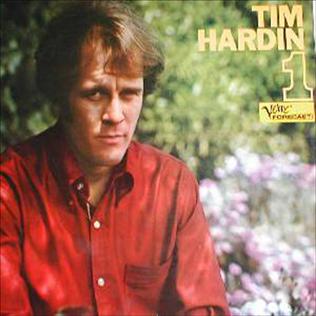
So with Tim Hardin, I shot his first cover and last cover. I shot him behind The Castle in the garden. Then he went to Verve Records, he said he need an album cover. So I went to Verve, and they used it. So I knew how to get to Capitol Records and how to get to Verve Records and Atlantic Records and they used them as their promo shots or album covers.
Album cover of Tim Hardin 1, photographed by Lisa Law
After we moved to Mexico and then back to LA, we went to the Haight Ashbury. So I documented the Haight Ashbury, the human being atmosphere. The Streets of the Haight. Monterey Pop….at Monterey Pop I had a little puppy that I had to feed with a bottle because the mother couldn’t be him. So I missed out shooting Otis Redding and Janis Joplin because I’m holding this baby puppy. I never considered myself a photographer. So, it didn’t matter, just took care of the little puppy dog.
SM: So at that point was photography just a hobby for you? At what point did it to turn into more of a career over hobby?
LL: It was after I divorced my husband in 1978. So all the way up to 1978, even Monterey Pop….that was just documenting my life. I’m very good at documenting my life.
So when I moved to New Mexico, and I’d started shooting the Hog Farm and Ken Kesey and the buses. Then I would print them up and leave them in their office and I was getting to be known as a historian.
When we went to Woodstock…Of course, I shot us getting on the plane [in LA], waiting in the airport, putting the tee pee poles and tee pee on the plane. I didn’t shoot in the plane, which is weird. And it’s probably because I had my two-year-old with me and she was sitting on my lap and I probably didn’t do it because of that. I didn’t shoot one picture inside that plane. But when we got off the plane, as soon as we came around the corner from where you get off… all these cameras were there. And the lights, cameras, rolling and rolling! They sent a jumbo jet to pick us up, empty. Who does that? Do you know how much that costs?
SM: Let’s see, in 1969 dollars….
LL: Expensive. But the airline probably donated it. So the press, they said, “Ah, we hear you’re the security.” Wavy [Gravy] says, “Well, do you feel secure? Yes? Well then it must be working.” “What are you going to use for riot control?” “Seltzer bottles and lemon pies!” So we then got on buses, and we went to the site and the last picture on that first roll [of film] was of my husband putting up the tee pee. So that was the last black and white then I changed to slides (Kodachrome).
But also when I went into town to get the food, I got a camera and some film, and I shot Super 8 . Because I shot Super 8, I was able to document behind the scenes. The same way I document with a still camera, but now with a movie. Because of that all my footage is being used now in every single one of those documentaries you’re seeing on TV, they know who to come to. And a new one that just came out from by Bohemian Films, The Festival That Rocked the World is the new one that just came out and not the American Experience from PBS. It’s a whole other one. It’s I think the best one. It has footage and vocals and stuff like that have never been seen before. It’s got a lot of my footage and me talking about everything. Because I have so much information about the Hog Farm and everything and I’m so talkative. They really liked it, liked working with me. I’ve gotten used to doing it. Before I couldn’t even speak – when my when my book came out and they interviewed me on the radio and I could barely speak.
Lisa Law, with a figurine of Wavy Gravy, at Bethel Woods Aug. 2019
SM: When you were actually at Woodstock, you were running one of the kitchens?
LL: Yes, there was only one kitchen, basically. Our kitchen, the Hog Farm kitchen. There were two but one of them was for serving us while we are setting up everything and the other one was for serving the crowds. I helped design that one, the kitchen and the five food booths that had 10 lines. So, I went and got $3,000 from John Morris and while I was shopping, they were building the kitchen and the serving booths. When I got back they were just finishing that.
So as soon as we got our pots out of the boxes, we started cooking. And I went and took a flatbed truck and went to a farm next door and I said, “I’ll take this row, that row, and that row.” Now that footage of me saying that was filmed by the [Bethel Woods] museum, they did an interview with me. So they used that footage of me saying that in one of their exhibits. When I went to see it recently, I leaned back in the beanbag and then I would talk and the other people around me. They would go “what?” and I’d say, “Well, that’s me over there! That’s me over there!” “That’s you?!” they’d respond. And I would narrate it for them. They liked it. So anyway, that’s what I did. I went and got all the vegetables from farmers locally. And it was August so they had a lot of it. So we’re cooking bulgur wheat and then I bring all that food and then the volunteers would chop it up, stick it in the pot to cook. And so people were waiting in that line. If you were hungry, you could eat. You did never go hungry at Woodstock.
SM: Even with a crowd that large?
LL: I had half the food leftover.
We were cooking non-stop, and people were in line. There were 25 to 30 people per line and there were 10 lines and it was just going: serving, serving, cooking, serving, serving. I bought 160,000 paper plates. I kind of knew what was gonna happen and when I went to town I got another three thousand. I spent $6,000 of their money to buy the stainless steel pots, to buy the cleavers, to buy the trash cans to mix the muesli in. To this day I still have the two cleavers and the stainless steel pot. One’s at my daughter’s show in Santa Fe. She’s got an exhibit up right now. She did a whole thing called “Hail Hail Rock and Roll: Happy 50th Woodstock!”
SM: Was the scene when you arrived at Yasgur’s Farm after travelling up from JFK different than what you expected?
LL: Well, when I got there they were already serving 100 people. The first group arrived by bus and they already set up a kitchen with plywood and two by fours and plastic. This was happening maybe a few weeks before the festival. They were already making the free stage, the little kitchen, and they had brought food with them. And they were they were cooking what they had with them, and [Max] Yasgur had yogurt, milk, eggs. He was selling stuff to us from his farm, and he had brought water and milk trucks over.
And they were fixing a LOT of food. I mean, big plates of food for everybody. Because they were being fed, everybody helped. We needed something done, we’d put them to work. Because otherwise I’m not gonna sit around doing nothing. They all helped. So we had different groups that came in and helped. And then the [crowds] started arriving and I had looked around and I said, “You know, this is gonna be bigger than we think it is.”
And that’s when I went to town and I spent that money. When I went in to get the money from John Morris, I said, “These people are going to starve if we don’t feed ’em.” And the concessions that were up on the hill? Those pointed roof ones… They were out of food the first day. There was no way to get more food because there was no way to get anywhere.
It was solid people and solid cars. And in my footage I stood right in the middle of them coming in. I just stood right there. And today I still shoot that kind of shot during parades and marches. I just stand [still]. And they walk around me. And you can see their faces and chanting in their signs and I shoot demonstrations like that.
SM: How did you find the time to take all of the photos and footage in between making sure the kitchen was up and running?
LL: Because I shoot on the run, I’m always shooting. Like I just finished visiting today and I’ve already shot 100 pictures; I should actually shoot you, too. And I shot at lunch today and shot portraits without even anybody really knowing I was doing it, that’s how I get away with murder. Unfortunately, you know, these ones aren’t as sharp, they’re in focus but they’re just not – they’re pixelated more with the phone. I hope [these cameras] get better. And then next i-Camera. I should be shooting with a camera. But I like to be more candid. If you have a full camera, it’s more intimidating than a phone.
SM: That’s my problem when taking photos. Everyone sees you with this big camera and they’re suddenly aware of your presence and their expression goes from candid to… not natural.
LL: Right. So I was shooting at the Woodstock event at the museum [Arlo Guthrie] and I was sitting there and I turned around and the sun was still shining. And all these kids are dancing like crazy and I get to snap them because that’s where the action is. It’s these people happy, dancing, celebrating. So I think probably I’ve shot over 1,000 pictures the last three days [at the 50th anniversary] and a bunch of the people came to my exhibit [at The Stray Cat].
SM: What was the lasting effect of Woodstock? Did it change your perspective on photography or have a major impact on your life?
LL: Well, what it did show me is that I have to shoot more because I looked at other people’s photographs that were up in the museum – all of those photographers and their best pictures from Woodstock. There are pictures in there of the food booths up on top of the hill and in front of the stage. When I was shooting the movie, I wasn’t shooting much of the stills. So when I consider it, I did a horrible job of shooting my stuff. But I did get some. If you look at my show, you will you will see some good pictures of Wavy coming in and the aerial shots [from a helicopter] and cooking shots and stuff like that. I could have shot 10 times as much. But I didn’t. I did get the movie, which is being used a lot by every single documentary filmmaker. They’re using it, but I didn’t shoot enough stills. And if I was really smart, I would have gotten a bigger camera and really shot the heck out of this year’s anniversary. But I figured that, at 76, do I need to take all those pictures? Because I’m still sitting in my office with thousands of pictures that nobody’s ever seen. So you have to think about that. Do you just keep shooting? Or do you slow down a little bit? Now, I also have Woodstock Three [1999] – and Two [1994] – nobody’s ever seen my Woodstock Three pictures. I’ve documented the heck out of Woodstock Three, for People magazine. I have an entire shop of Woodstock Three, never been seen. So I have all these rooms, slides, and proof sheets, pictures that nobody’s ever seen before. And so that makes me feel bad that I want to share everything that I’ve taken. That’s why I take pictures, it’s for sharing. That’s why people look at pictures. It’s because they want to see what you saw, what happened. And it’s very important – photographer’s work is very, very important because you could tell somebody about what happened but you can’t really describe it unless you show them an image. A photograph is worth 1,000 words, right? So I feel that I owe it to society to be able to share that.
About four years ago, I did a show in Yelapa, Mexico. I didn’t want to bring it home because it belongs down there. So I built a museum to house the pictures. [El Museo de Historia at Arte y Cultura de Yelapa]
There was an old building that used to have a sheriff’s office. We fixed up the sheriff’s office, we fixed up the plaza and we built the museum. I have 108 pictures on the walls. It took five months to build. I was the builder. I was the curator. And then I went and got tables full of artifacts, then I had to write up all the wording go with each one of those things. So there we are cutting the ribbon on the opening day, which was my birthday, March 8, [2019], alongside the guy who gave me his crew to build it the woman with the funding, and all my government people. There were a lot of compliments. I wanted to show the people what Yelapa was like back before there was electricity and plumbing.
We spent a lot of time getting the museum ready. Five months, five days a week.
Lisa Law (center) at the ribbon cutting for El Museo de Historia at Arte y Cultura de Yelapa. Courtesy Lisa Law/Santa Fe Reporter
SM: Back to Woodstock, do you think the 50th anniversary weekend was the celebration that everyone kind of hoped for?
LL: For the people that paid for their ticket and got their passes and came all the way up there to do that? They were very happy. And the ones that went over to Gerald’s [nearby gathering], those guys were happy. Okay, but it wasn’t like a Michael Lang thing. And Michael Lang’s things are too big and too corporate; nine never work. [Woodstock] Two and Three did not work. They did not work. Right. Okay. What happened here was very strict over the at the museum, and kind of loose over at Gerald’s. It worked, because there were two different ones. 100,000 people didn’t show up. Maybe 16,000 over at the museum [Bethel Woods] and 200 or so over at Gerald’s.
Well, this was the big 50th anniversary. Well, Michael Lang was invited to that. They gave him a house near Yasgur’s Farm. And he and Henry [Diltz] and and Bill Hanley and all those guys hung out in that house. So Michael Lang got to celebrate Woodstock, even though he couldn’t put on his event. They brought him over to be at their event to celebrate with those people who celebrate Woodstock every year. That was great for Michael Lang.
On August 14, Brooklyn-based band Gawn will release their debut album, Thee Essence Ov Everything. The band’s newest single, “Pushed Aside,” is available to stream now.
Photo from @g_a_w_n on Instagram
Thee Essence Ov Everything is the perfect mix of soft, indie, and electric rock. Each song is individually interesting but maintains in harmony with the rest of the record. I had the opportunity to talk to Zach Koeing about Gawn, the band’s soul, about the new track and album.
Marilyn Feerick: How did you first get into music?
Zach Koeing: I started playing music probably when I was 10 years old. I grew up in a house with musicians. My dad was a guitar player and songwriter and he taught me to play guitar.
MF: What does “Pushed Aside” mean to you?
ZK: The meaning of the song and the lyrics is kinda just moving on from old friendships that have faded away, maybe because they’re toxic or people change.
MF: I read that it was hard to get one solid group to consistently do shows, so you play with different people almost every night.
ZK: When the project first started, it was more of just a recording project. It was different friends coming to the studio, handing out, laying down some tracks, writing some songs together, and when it kinda came down to shows, it seemed like a lot of people’s schedules were clashing with each other and stuff like that. So, it just seemed to be a lot less stress ad a lot easier to get a group of guys together on the flay than try to rely on just one group of people.
MF: Is having a rotating band more confusing, or does it help you keep everything more fresh?
ZK: I think it sounds like it would be more confusing, but it does feel like it is fresh because every single time that I sit down with a new group of people, it feels like I’m able to come up with something new and something original. With the same group of guys, it would seem like it would be harder to come up with new stuff. There’s definitely different feels. People play differently, and ideas some of the guys will bring to the table will just be kind of on a whim and it’s just like ‘that was it, let’s keep it,’ and if that guy wasn’t there that night, it wouldn’t have happened.
MF: How has COVID-19 and the quarantine affected you creatively? Are you writing anything new?
ZK: Before COVID, we were talking to our publicist about doing PR and all the promotions and everything for [the album], and out of nowhere, the country was shut down and we were kinda just like ‘oh no what are we gonna do? Are we gonna tour, should the record come out, should we go with it?’ And especially during the black lives matter protests, we didn’t want to be shining any light on us when there’s something more important going on. So we decided to basically just put it on the back burner until we started to find out what was going on in the world. During that time I had a little four track recorder at my house that I sat next to, like, every morning and every night just writing new ideas, because we weren’t working or anything so we were just kinda adjusting…to being home all the time. And I had my own little recording setup. So, I recorded about 30 new ideas on a four track during quarantine.
MF: And lastly, do you have any plans for projects once quarantine is over?
ZK: Me and the guys recorded two new songs probably like a month ago, so we plan on releasing probably a seven inch after we do the record and then hopefully next year we’ll be able to tour.
Stream “Pushed Aside” and other singles by Gawn in the meantime before Thee Essence Ov Everything comes out on August 14.
One of the greatest blessings we have in life is the ability to use our voice; Shawn Wodraska, a 21-year-old singer/songwriter from the small town of Wingdale, NY recently used his to represent his passion for the Black Lives Matter Movement and overall peace between those with different backgrounds and beliefs.
Shawn took to Facebook to portray a message of hope with a beautiful cover of “If I Can Dream” by Elvis Presley. “As I was scrolling through social media, I noticed that news coverage and posts were almost exclusively negative,” he said, “I decided that I had to do something; we all have to play our role to make a change, so I chose to sing, the only thing I know how to do.”
His video generated an exceptional amount of positive feedback with more than one thousand views. Prior to posting, Shawn said, “I was worried about negativity or that people would think I was using the Black Lives Matter Movement to further my career.” He continued, “I knew I had to do something to play my role in restoring peace, likes and views were the last thing on my mind.”
Philosopher Aleksandr Solzhenitsyn and his belief that “the line between good and evil passes through every human heart” was one of the driving forces in Shawn’s decision to post on social media. “I want to do what I can to help bring peace to all corners of life by inspiring people to find the humanity in who they perceive to be their enemies,” he continued, “I am one voice of the many needed to bring about unity, but it’s important to remember that we are all human and we have to work together.”
https://www.youtube.com/watch?v=9jntQW9XOxQ
The passion inside of Shawn is evident in his original music as well. Although he doesn’t mind if he never makes it big, he said, “I want to use the platform I build to promote positivity. We can always do better. I want to highlight that in my music.”
Typically accompanied by the piano, his content ranges from story-telling folk tunes that draw inspiration from Marty Robins to easy-listening ballads without lyrics. While some of his songs have a theme, many of them are left open to interpretation. “Mediums like music tend to reach people on a spiritual level – there’s a reason why they call it soul – the music we write should be inspirational and bring people together,” he continued, “We can all unite and enjoy a good song, regardless of the differences that polarize us.”
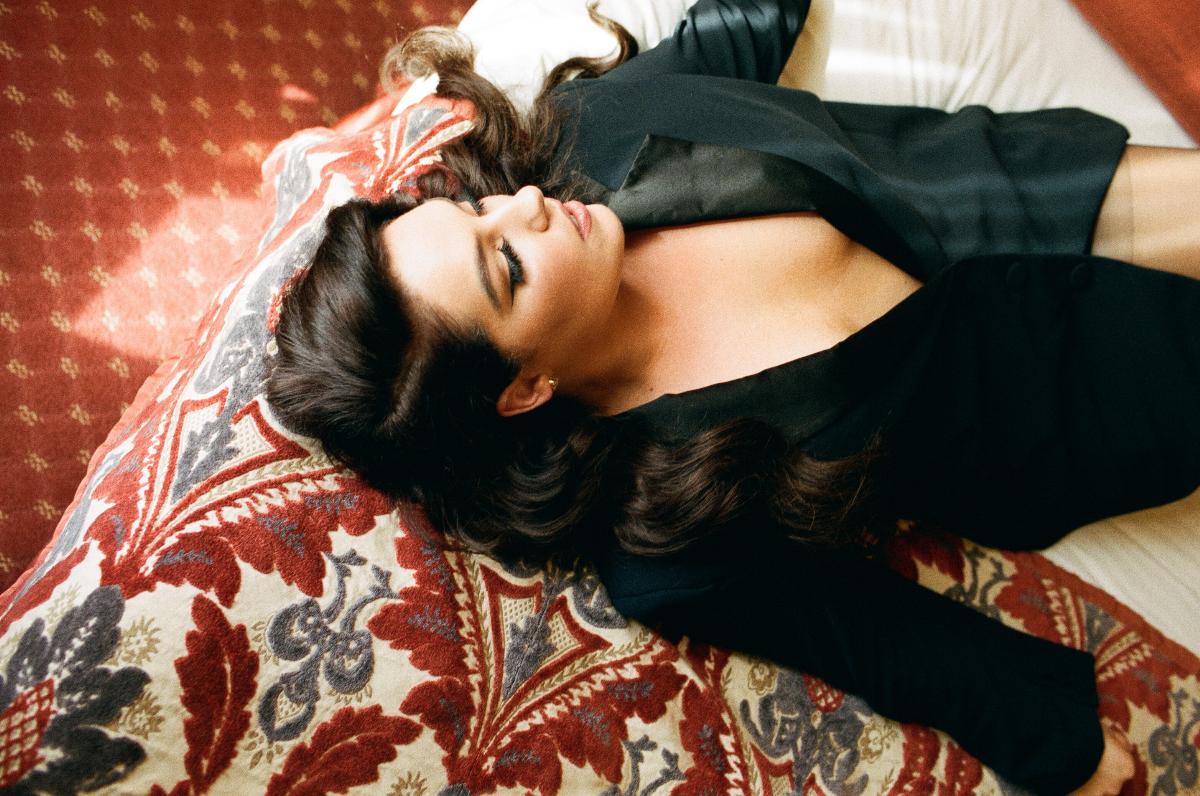
Brooklyn based singer-songwriter Lorelei Rose Taylor released a gift to the world on May 22. Stepping into the studio for the first time to record her music gave light to her debut EP, Versailles, which lyrically navigates her own stream of emotion, intertwined with dreamy baroque-pop sounds. As Taylor explained to NYS Music, she treads on the strong influence of The Cranberries’ Dolores O’Riordan, evident in her flawless singing, which also subtly nods to Florence Welch and Lana Del Rey.
Taylor grew up between Texas and Upstate NY and began exploring music on her own at a young age. But it wasn’t until 2017 when her interests returned to music following her college studies. With the help of the friendship of Robbie Grabowski, she began writing her own music and was given the courage to step into the studio in 2019.
Versailles EP
Taylor recently spoke with NYS Music about her experience bringing her music to the world for the first time and some of the inspirations into her songwriting.
Steve Malinski: The Versaille EP is your debut audio portrait to the public. How would you introduce yourself as a musician/songwriter?
Lorelei Rose Taylor: I would introduce myself as someone that’s very consistent in my message and my sound. I think I’m overall pretty melancholy, as much as I try to fight it that’s kind of just what happens.
SM: One thing I noticed about your sound is that it’s very clean and refined – particularly on one the songs, “If You Love Another,” almost right away I can hear the influence Dolores O’Riordan has on your singing. How has she been an influence on you and your songwriting?
LRT: She’s huge. I mean The Cranberries in general…when I think of my past and you know, out of my experiences in childhood that really shaped my direction, she stands out tenfold and it really comes back to growing up. I felt like it wasn’t a glamorous childhood by any means. So I’m in my room and I had this white boombox and I would like to sneak out to the living room. Remember those rotating CD things with the velvet interior that held the CDs? So I’d go in there and grab all the CDs I could find and shove them in the back of my room.
I would just like sit there for hours listening to all the weird stuff, and everything like that. I was kind of obsessive in that way. That was my outlet. No Need To Argue was that album that stayed with me and never left the rotation and I feel that way because I think Dolores sings like there’s a pain in her voice – that’s definitely her style – but she’s also really strong like you’re safe under her wing, in a way. I just I felt very understood by her.
And then “If You Love Another” was actually inspired by W.B. Yeats who is an Irish poet legend. I love the Irish. But yeah, I feel like it’s twofold, like there were a lot of strengths that I was trying to channel which I found in Dolores.
SM: Now that Versailles been released, what does that milestone – reaching that accomplishment mean to you?
LRT: I feel like I’ve always…this sounds so cliche, but like… dreamed of this moment. And now that it’s here, it feels a little bit like that false beginning, you know, when you’re like watching a show and they tease the beginning, and then they start the bullshit of the intro and the music. And I think it’s like the real show, the real beginning. That’s kind of what it feels like for me. Because I think… I don’t think like I’m doing the Lord’s work here. Like, I love the EP, and I’m so proud of it but I think that there’s so much growth to come and like so much exploratory work that I’d love to do from here. So it’s the beginning, but I don’t think it’s like the big moment for me, but I’m excited to see what happens.
SM: You’ve been exploring music since a young age…so what drew you into eventually writing your own songs?
LRT: So growing up, I spent a lot of it solitary and I feel like when you don’t have an outlet you kind of build your own and I feel like the writing and music that I turn to when I’m alone or whatever I was going through experiencing and it just always stuck with me. I recorded the Robbie Grabowski (from I Can See Mountains, Super American) and he like, kind of pulled the rest out of me.
SM: So the motivation to actually bring your material into the studio was that driven by Robbie?
LRT: Oh, yeah. Before that, I was just fucking around, like I wasn’t really… I mean, I dreamed of recording but I didn’t have that motivation or confidence to do anything with it and then he was like, “put your shoes on, we’re going to the studio today!”
SM: So this being your first recording project, how was the recording experience?
LRT: Oh my god. terrifying. I think it was last August [2019] – was the first time I’ve ever sat down in the studio. I was just right in front of a mic, that’s not my comfort zone. I don’t pretend to be a performer. So it was traumatizing. And I’m really grateful that I recorded with Robbie and Stephen Kellner and Jesse Cannon and Roderick, kind of like this very tight-knit circle which I’m grateful for. So Robbie just became a mentor and he was just like “pick up from the beginning, relax, chill out, it’s gonna be fine,” because I was terrified and it’s really difficult.
And you know, I learned a lot because when you’re singing a cover, for instance, “When You’re Gone,” that came super easy because I was just spinning the musical machine, you know, you have to channel the emotion, the performance, are you on TV?, the lyrics…there’s so much in one moment that you have to articulate and get right and I was just learning a lot the first time. I think “Casanova,” the first track on the EP, was the first song that Robbie and I wrote together, the first one we took to the studio and it took me probably eight months, nearly a year to like come around with that song and say “okay, we can just push it to the public,” because I just hear fear and I hear trauma because I was so scared in the studio. I guess it adds to the vulnerability a little bit.
SM: So now that you’ve learned a lot from that experience, do you think that might influence how you write your songs going forward? Or do you think you’ll still have the same approach?
LRT: Yeah, I’ve learned so much. And I think like, it really comes down to going back to being alone and just alone with my thoughts and not having to worry about any other element. It’s just me and the music and I feel like, especially during quarantine, recording by myself, there’s a different… It sounds very different when I’m writing alone and recording alone. There’s a different confidence. There’s a different way. I’m excited to share what I’ve done now alone in my own little studio to bring that to studio that’s going to be very different.
SM: You’re very introspective with respect to writing your songs and the emotions flow from what you’re feeling in that moment. So, when you go and you listen back to the songs especially in these current times, do they have a different meaning to you?
LRT: Yeah, I definitely think so. I mean, from like a personal standpoint…My favorite piece of was that our job is not to like our own music. It’s just to like keep making it. And I feel like the biggest thing in quarantine and creating (or trying to), removes that element to it. Hearing back the EP there’s so many moments where I’m like, “oh, I wish I did that differently” or “I wish this was scratched completely” but I think that removing that and just living in the moment more… I mean with COVID there’s just so much that we took for granted and I feel like just so lucky to be in a position to keep making music and I’m eager to get back to it. I feel like I’m more grateful for the music that I’ve made and more proud of it. I hope to make… all I have right now is that fucking record, so I hope to make happier ones because everything is very sad right now.
SM: You’ve also had a full length album in the works too?
LRT: Yeah, that was in the works. I mean, I’ve been writing for so long, but with everything that happened I didn’t have time to go back to the studios. I was like, well, I could either release an EP now or just have radio silence for the next… who knows how long. But yeah there’s a full album which will likely be called After Party. And it’s nearly done. It’s just like, you know, the finishing touches. But to your point now that everything has happened, I suppose there’s gonna be a lot of changes that I want to make to it with so much time to think.
SM: Have you been able to create any new content in this quarantine?
LRT: I’ve written one song from beginning to end. I was sad one day about two months ago and I was like, I’m clocked out, I’ve got nothing. So much of what I write is thriving off other people’s energy and people that I meet and see and right now I’ve only seen one human being for a few months now. It’s just very hard to find that inspiration. But I did write one song, a demo I recorded which was really an interesting experience because I wrote the whole track. I bought a MIDI controller and I produced the whole thing which I…that’s not my element… so I sent it to Robbie and he was just like “okay keep going.” It was kind of like a little pat on the back like, “okay this probably sounds like shit but like, I’m not gonna tell you that.” But yeah, great to bounce ideas off of him. Hopefully I have at least one more on the way in this infinite era.
SM: Once this whole thing blows over and you’re finally able to get the album recorded, what do you think you’re gonna be up to as far as live shows? Do you want to go out and perform these or just share them?
LRT: Yeah, definitely performing is on my roster. Especially around New York. New York has been home to me for eight years so there’s like a bond I have here. I’ll probably get back up to Syracuse. I spent a lot of my time there and all my friends are there, having like that space to have the energy to go off of which is very nice to perform to. Looking forward to that, looking forward to the album. My first music video for Versailles will be out soon, waiting for the final cut and my album will be out sooner than later.
You can stream Lorelei Rose Taylor’s EP Versailles below.
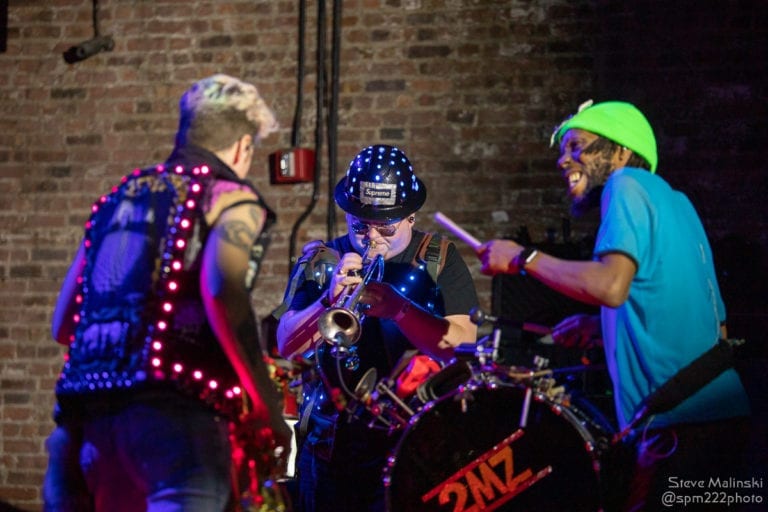
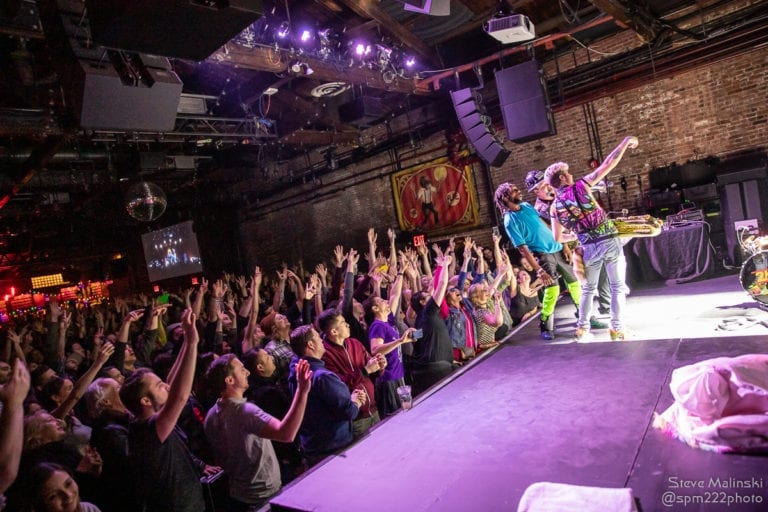
A trio that began busking in the New York City subways more than eight years ago has created a distinct sound that has emerged to stages across the world, a sound that’s been coined “brasshouse.” The incredible talent of those three – Leo P. on bari sax, Matt Doe on trumpet, and The King of Sludge on percussion – form the group Too Many Zooz. The band has reached many fans far and wide with music videos and clips of their live shows emerging on social media outlets, but those short clips don’t do justice to the experience of being in the crowd at their shows.
After kicking off their tour with a Jam Cruise performance, Too Many Zooz returned home to Brooklyn for a packed show at Brooklyn Bowl, and will be hitting The Hollow in Albany this week on Jan. 28, with stops at The Haunt in Ithaca and Buffalo Iron Works on the 29th and 30th, respectively.
We had a chance to speak with Matt Doe about Too Many Zooz,
and he had a lot to say about the band.
Matt Doe, with Too Many Zooz at Brooklyn Bowl, Jan. 24, 2020
Steve Malinski: How was Jam Cruise?
Matt Doe: It was cool, man. I don’t think I’m much of a cruise person to be honest, in the sense of what it is and how it’s formatted. But for what it was I very much enjoyed it
SM: Did you guys have any collaborations?
MD: Yeah, we played with Galactic and Thumpasaurus and a few others.
SM: Going back to the start of Too Many Zooz, how did you guys meet and settle into the style you’re playing now?
MD: We just met in the subway and started playing music.
SM: So, was it totally random?
MD: Well, I went to school with Leo and he met TKOS in a band called the Drumadics, and we got connected with each other after that.
SM: Can you explain a little bit about what brasshouse is?
MD: I don’t really think of music in genres like that, so for me BH is more just about the intent in which you play the music and not necessarily a specific rhythm or sound or harmonic styling. I think a lot of people get put in a position where they feel like they have to tailor to one sort of genre or box and be confined to that box. So brasshouse is more about playing the music you want to play and making it your own. It’s way more about (for me at least) what it is that you’re bringing to it and what your intent is when playing.
SM: Regarding your live shows…how are they different from what people might see on videos on social media?
MD: It depends if they’re watching a video of a live show, or from the subway. I think it’s more of just a question of how live music differentiates from recorded music. There are some obvious differences – on recordings people play shorter songs just because of how that’s formatted. So at shows we open up more. I personally think that our recordings are awesome but live is definitely a different experience.
SM: As a performer, how does the energy of the crowd affect your performance on stage?
MD: You have a crowd in front, not the studio walls. It’s hard to explain, but maybe the crowd gives you some energy to play off of, which you don’t have in the studio. It’s a totally different thing.
SM: How much of your show is structured versus improv?
MD: It very much depends on where we’re playing and who we’re playing for. Generally, I think nowadays, on average, it’s half and half improvised and structured songs.
SM: With social media being popular for musicians, how much do you think Instagram and Twitter has helped you reach new fans, and fans around the world?
MD: Immensely, man. I don’t think we’d be here without it. We’d be somewhere, I’m not saying we wouldn’t be a successful band but there’s something to say about the power of the internet. The benefit of what those things can give you…I wouldn’t credit our success to social media but more to our hard work. But it’s definitely kind of become a part of being an artist today. I see the immediate value for the clout and using it to look cool in using it to promote yourself in certain ways. But…just for daily happiness – the idea of waking up every morning and living my life through a lens….
SM: Do you guys have any new projects in the works?
MD: Yeah, we just put out the Zombies EP which we’re super proud of and I think that’s one of our better projects, if not our best. We have a bunch of other stuff that we’re sitting on. It takes us so long to put music out since we’re on the road all the time and I never get the chance to get to the studio and produce the material. When I do, it’s like six months after the fact. It’s tricky to keep up…it’s tough to make something and say “yeah, this is awesome, this is f*king good, we gotta get this out” and then three months later it’s just sitting on a hard drive and might not see the light of day. So, it’s hard to have a fluid system when you tour as much as we do, especially since we do everything in house. I do the production and we all work on the record in our own way. The only thing we do outside of the three of us is the mixing/mastering.
It’s also a matter of being in different artistic places at different times. We can record six tunes in one style, then we’ll record more tunes a few months later and it sounds totally different. So, then we feel like maybe we should split it into two separate projects released at separate times and not try to force them into one thing. So it’s difficult to get it all out. But yeah, we’re sitting on tons of music and I think we’ll put some of it out in the next few months and more out in the summer. It’s a fluid process every day trying to move forward with it and gain traction.
It’s especially hard, too, when dealing with other artists…we get it because we’re the same way. Everyone’s on tour or working and it’s tough to get everyone in the same room, same studio. Things sometimes happen naturally, but when people are on the road there is a ton of back-and-forth, some discourse on how the tune is going to go. When you’re all in the room together, things can happen very quickly just because you say an idea, I’ll respond to that idea within two seconds and we move forward. Whereas, if I’m doing things remotely, and even in my own personal projects, it’s the same way. I’ve been working on my own album for two and a half years. You send an e-mail with the track, they ask a question two days later, you respond two days later and that one question takes a week to answer. If we’re in the studio that would take ten seconds to answer.
SM: So it sounds like it can a challenge to keep a cohesive focus on a project.
MD: Exactly. Yeah and it’s so much harder without the fluid motion to creativity and thinking. So, that’s a really long answer to a really short question, but yeah we’re working on a bunch of stuff.
SM: For you personally, separate from Too Many Zooz, you were on Saturday Night Live supporting Harry Styles. What was that experience like throughout that day?
MD: It was cool. Harry’s people worked with a friend of mine and he hit me up about it. We had a few rehearsals ahead of time. The day of the show, pretty typical for SNL, we show up around 4:30 for a rehearsal with the artist, then the full rehearsal with everyone. There was also a lot of hurry up and wait. Then around 11:30 there’s the live taping. TV is hard – there is so much that goes into that world aside from the music. So, just like I was saying about our recording process, there are so many moving parts going at once. It was cool to be on the other side of the screen. I grew up watching Chris Farley and Will Farrell. Definitely a bucket list item for me to play there. Harry is the sweetest dude in the world and his team is amazing. Luckily, I was just able to play with some of my best friends and some really wonderful people. I have nothing but great things to say about that entire experience.
SM: Before I let you go, I think you guys have played up in Albany before…
MD: ….Yeah, I think maybe a year ago. We were also at The Haunt in Ithaca and Buffalo Iron Works. To be honest, I sometimes just get in the van and go – I can’t remember the name of the place we played. But I’m looking forward to coming back.
SM: Anything cool in store for this tour? I know you recently hit the road.
MD: Yeah, we’re already on tour, starting on Jamcruise. It’ll be a fun run. We’re taking three months off for the first time in a while. We’ve been a band for almost eight years now… holy crap that’s insane to think about. We’ve pretty much been on tour for the past five years and this will kind of be our first vacation to spend time with families and do some work on our own projects and unwind. It’ll give us a chance to creatively recharge since it’s been a non-stop sprint for a while. Then we’ll be back at it, heading to Europe.
Too Many Zooz is taking the stage at The Hollow in Albany, Tuesday Jan. 28 along with special guest Birocratic. The show starts at 8pm, and tickets are available from the venue and the band’s website here. They’ll also be stopping by The Haunt in Ithaca the following night on Jan. 29 and Buffalo Iron Works on Jan. 30.