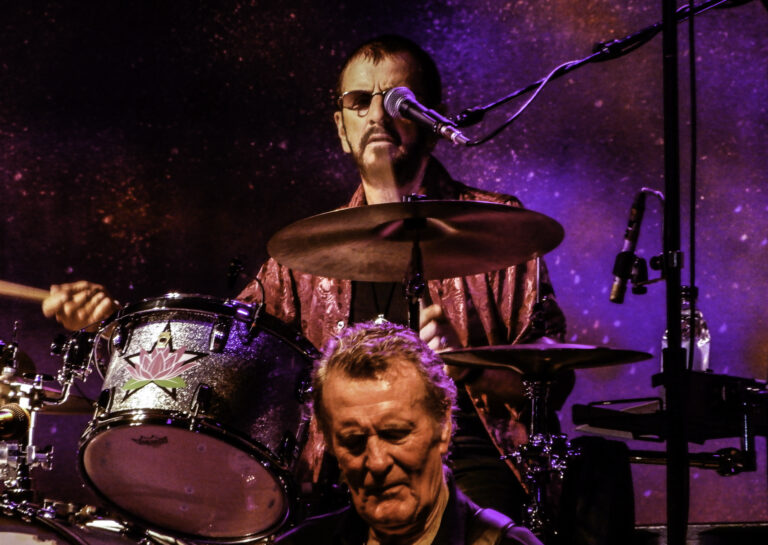
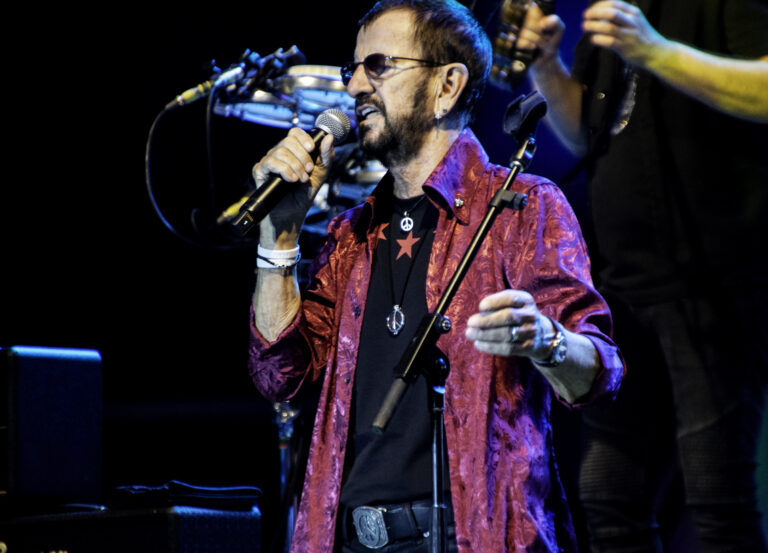
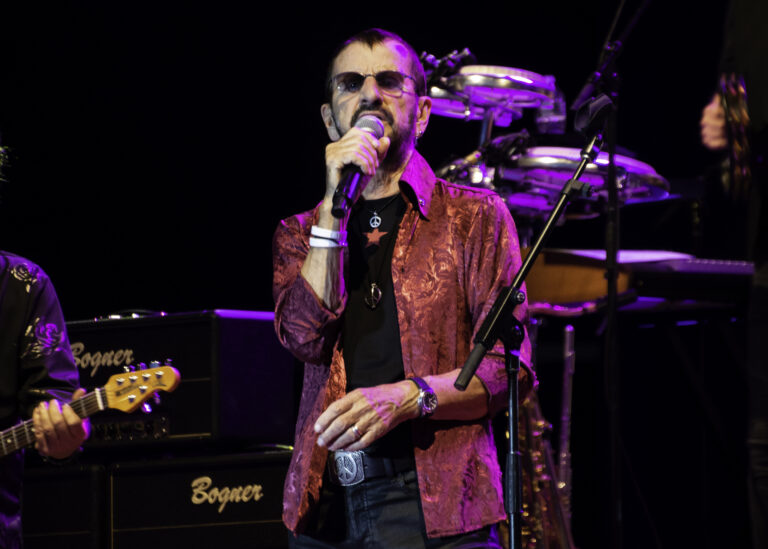
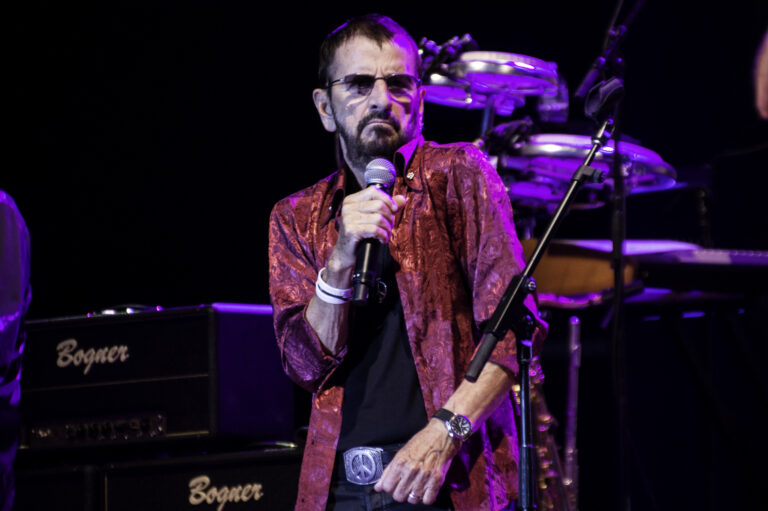
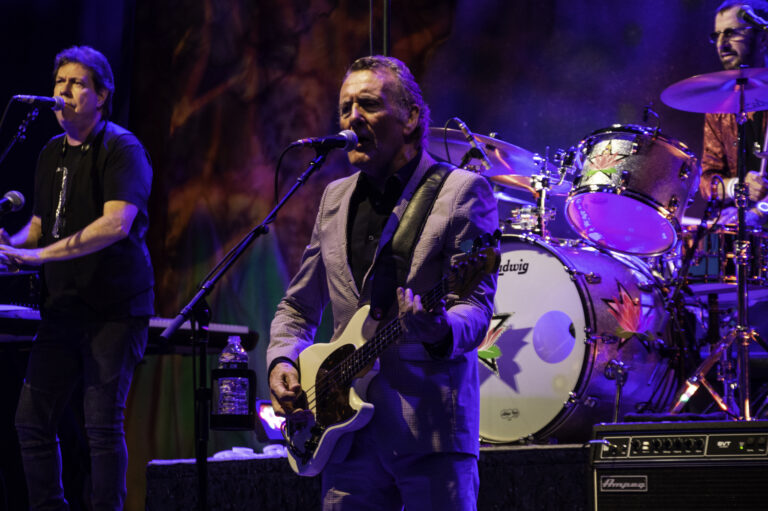
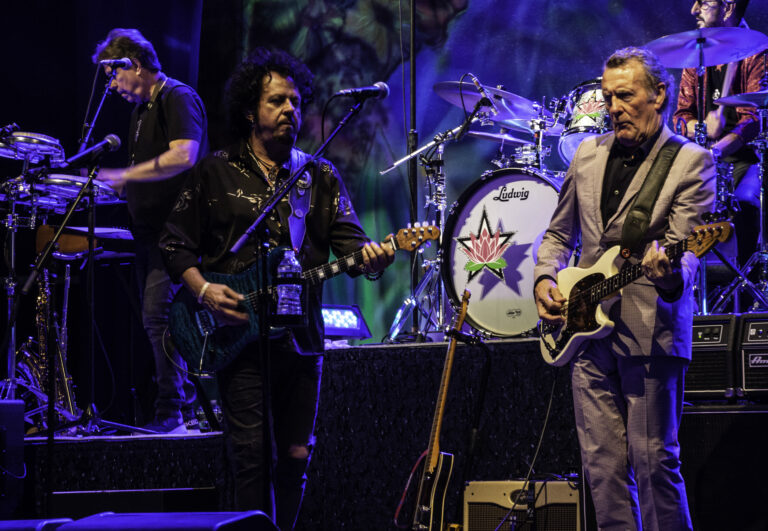
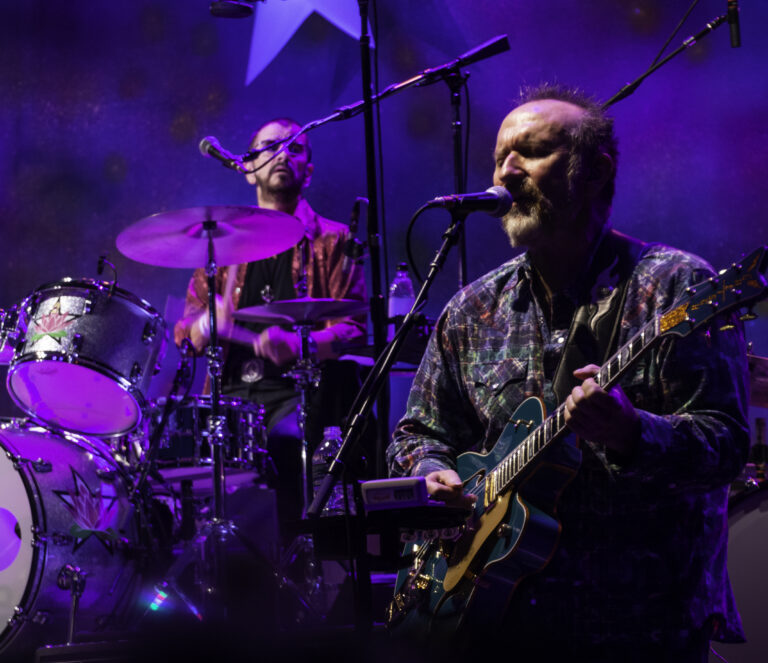
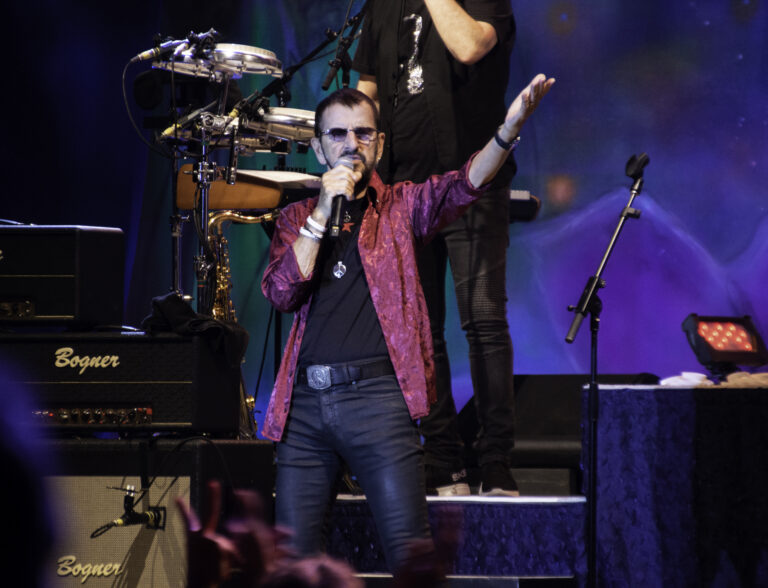
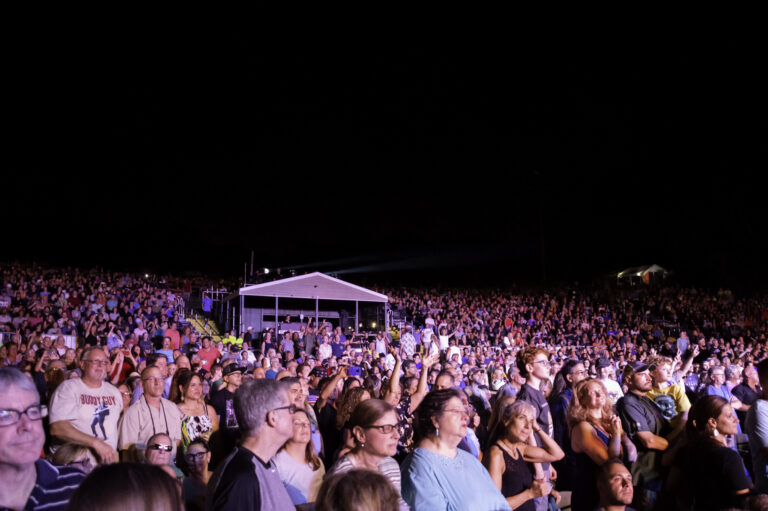
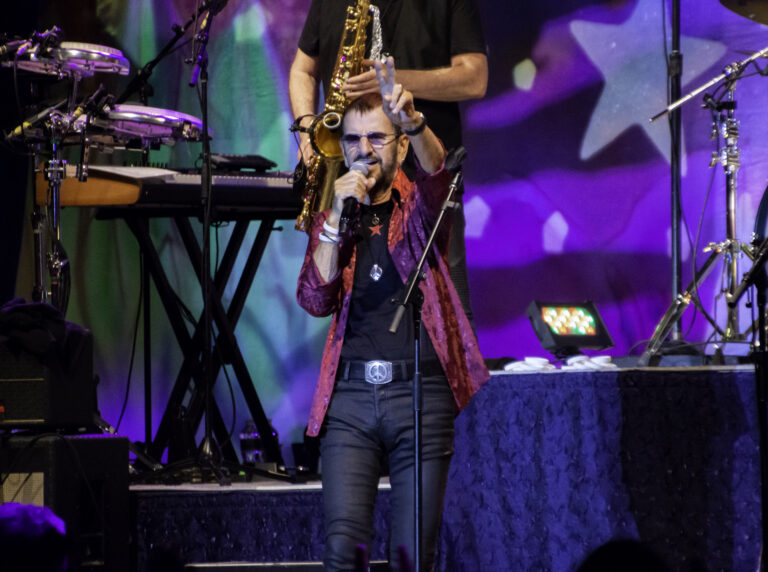
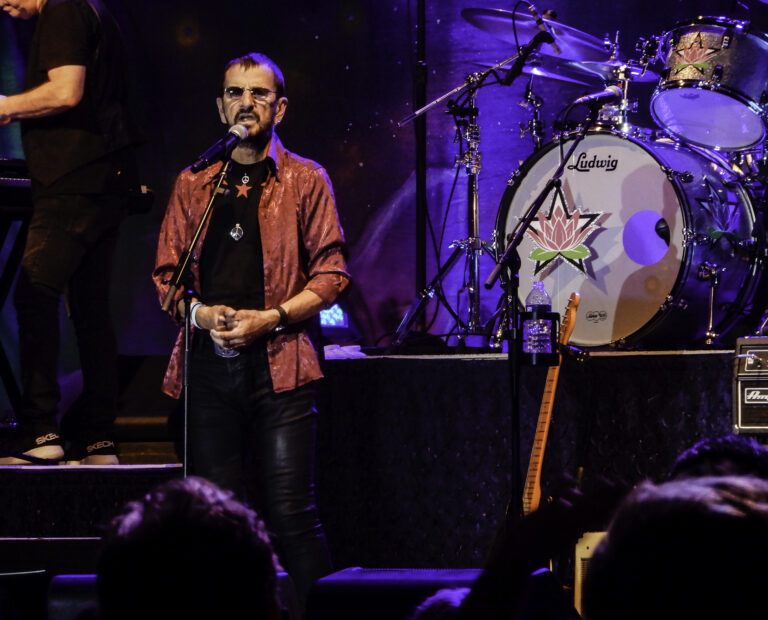
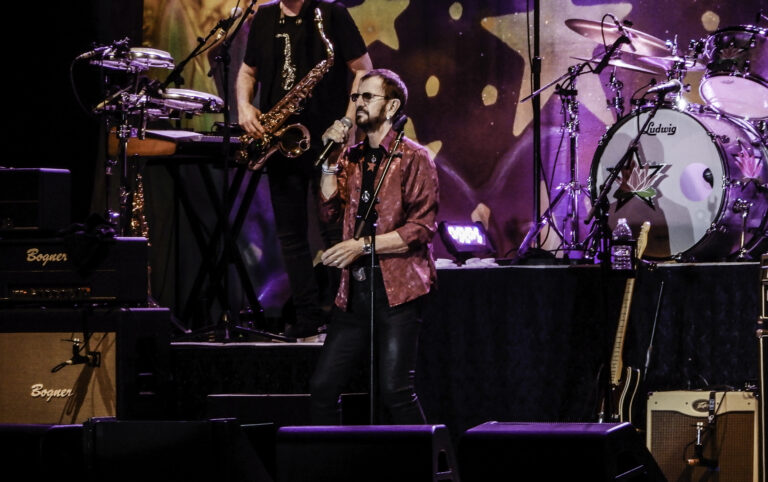
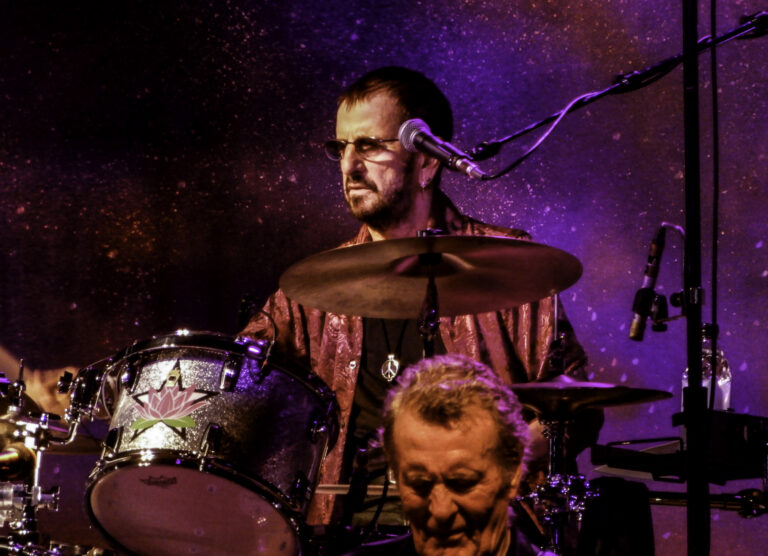
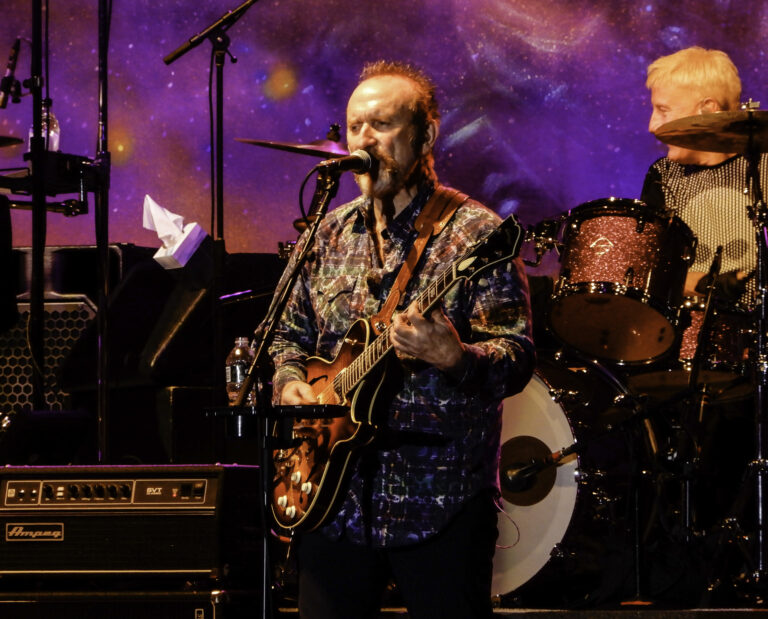
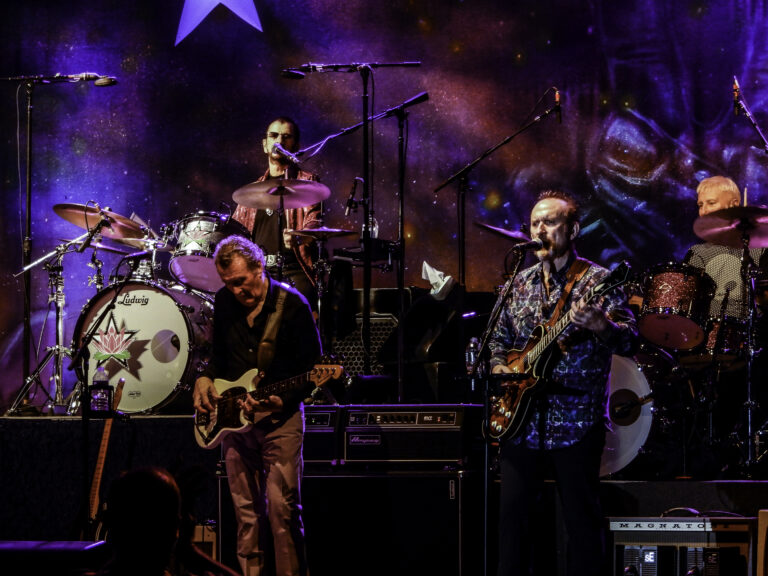
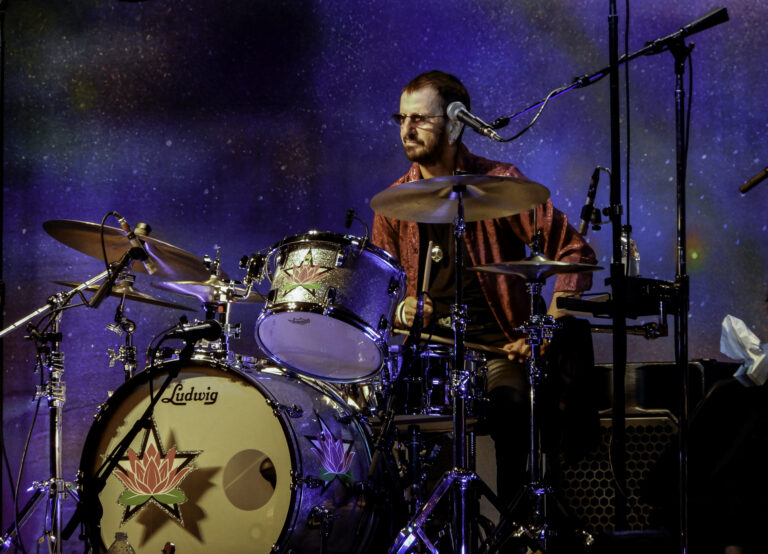
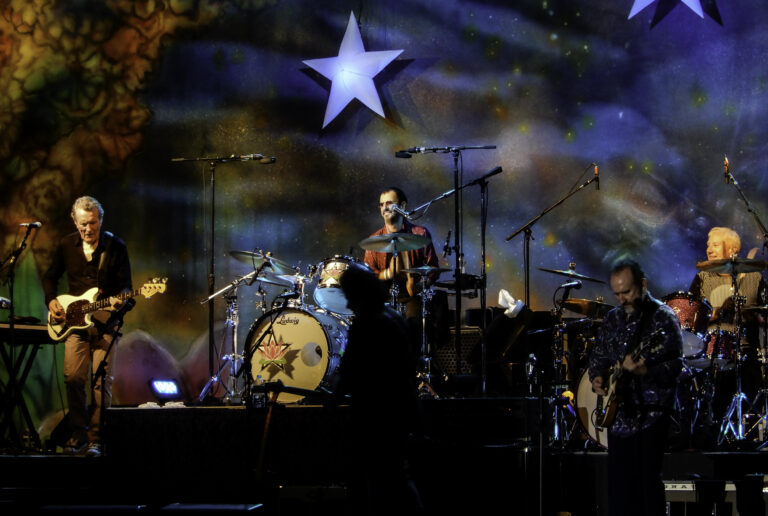
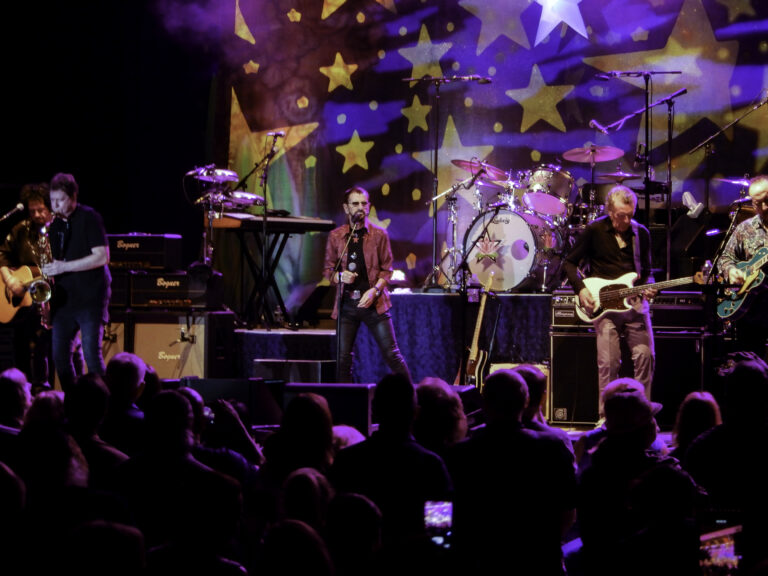
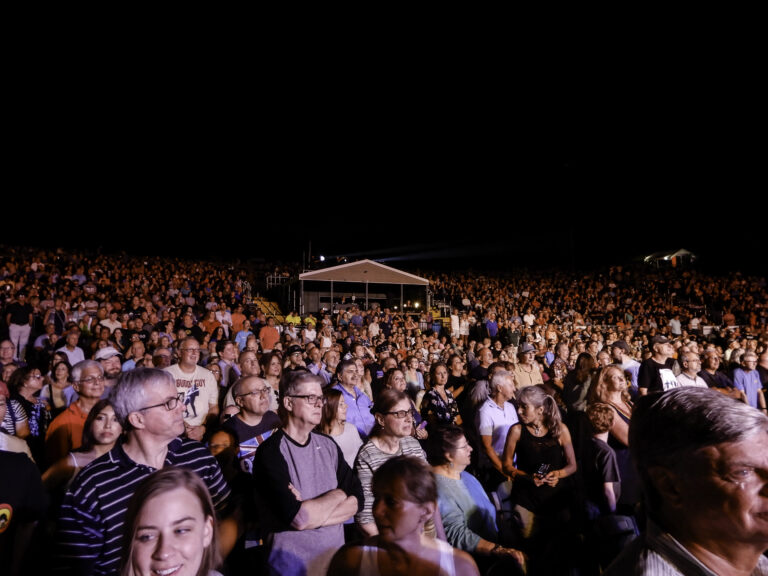
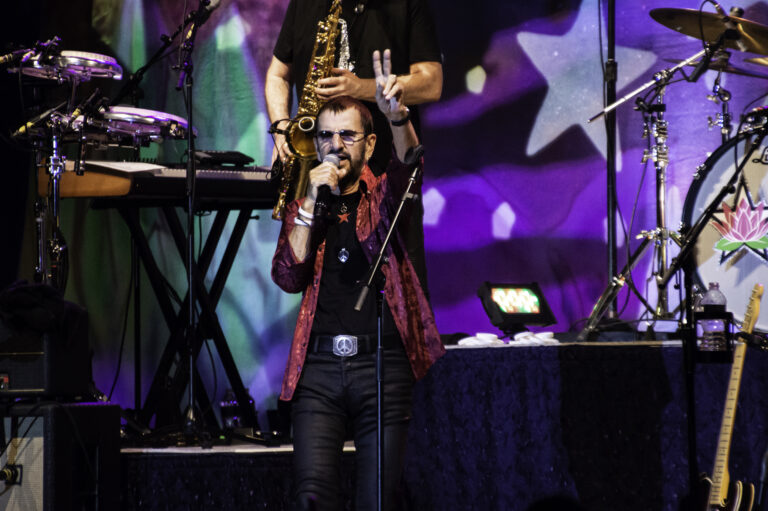
Ringo Starr and his All Starr Band played The Long Island Community Hospital Amphitheater in Farmingville, Long Island, to a sold out crowd on Saturday, August 17, 2019. Although the members have changed throughout the years, 2019 marks the 30th Anniversary of The All Starr Band. The current band consists of Steve Lukather (founding member of Toto), Gregg Rolie (Santana, Journey), Colin Hay (Men At Work), Hamish Stuart (AWB), Gregg Bissonette (David Lee Roth Band) and Warren Ham.
The setlist was a combination of hits from the band members including Men At Work’s “Down Under” and Toto’s “Africa” plus some Beatle songs that Ringo Starr sang lead on including “I Wanna Be Your Man” and “With A Little Help From My Friends.”
Setlist: Matchbox, It Don’t Come Easy, What Goes On, Evil Ways, Rosanna, Pick Up the Pieces, Down Under Boys, Don’t Pass Me By, Yellow Submarine, Cut the Cake, Black Magic Woman / Gypsy Queen, You’re Sixteen, Anthem, Overkill, Africa, Work to Do, Oye como va, I Wanna Be Your Man, Who Can It Be Now?, Hold the Line, Photograph, Act Naturally, With a Little Help From My Friends
Ed. note – we made every attempt to find photo or video footage of moe.s performances on Last Call with Carson Daly, but the only footage we could locate is owned by NBCUniversal.
In the Jam Band scene, fans are aware of a few things about their favorite bands, one; your favorite bands have the best live shows, two; it’s a community that is incredibly accepting even if someone doesn’t get it, and three; you’re going to spend your whole life trying to show people this band and they may have never heard of them, and you know they are not on any popular TV shows they like.
You’re not going to turn on Saturday Night Live this week and see Phish playing “Wilson,” or catch a Umphrey’s McGee song on Fallon anytime soon. Sure the occasional Dead & Company pop up or even Dave Matthews on Kimmel, but for the most part you won’t be able to answer, “Oh, they were on Colbert the other night.”
Not even bands like the Grateful Dead or the Allman Brothers garnered that commercial success that so many bands saw in the 70’s and throughout the rest of their career. We’ve all seen the occasional interviews with Weir and Garcia on Letterman back in the 80’s but for the most part, you had to go out and find that band or you were told about from a friend or heard the show was amazing.
But for one week in television history Upstate New York’s own moe. was “ Call with Carson Daly’s” house band.
That’s right not just a blip in the radar of a one night appearance but an entire week of television exposure for a jam band.
On the heels of announcing their forthcoming album, This is Not, We Are, NYS Music spoke with moe. guitarist and vocalist Al Schnier and drummer Vinnie Amico about their time 15 years-ago as house band for Carson Daly.
For those who don’t remember, Daly was the host of the popular MTV show Total Request Live, a show that ran from 1998 to 2003 and was affectionately known as TRL. The show was born from Daly’s other two show’s Total Request, and MTV Live.
TRL for those who remember was not where you would really find bands like moe. on. the show featured the top 10 videos of the day and Daly interviewed popular celebrities and guests.
But in 2002, Daly was given the final slot of late night that went on after Conan O’Brien. The time slot that was for those up way too late at night or just getting back from a long night out.
“It was the late late show,” says Schnier. “It was the one that came on after Conan. So whoevers watching that show, is probably our demographic anyways.”
In 2005, moe. was at the height of their success, they had been touring for 15 years at this point. Playing shows at venues like the Fillmore in San Francisco, to Red Rocks, to opening for bands like the Grateful Dead and the Allman Brothers.
“We were probably at the top of where we have been (in our career),” said Amico. “We had just released Wormwood and we had just done Conan O’Brien”
“At that point we have 15 years of being a touring band under our belt, we’ve played with bands like the Allman Brothers and the Grateful Dead, you know, played a bunch of festivals and toured all over the place, really had gotten to experience a lot and had been all over the world at this point but to do television is a totally different thing.”
Al Schnier
Daly was going for a completely new spin on what music could be on late night television.
“It was a great concept for his show. They didn’t have a house band,” said Schnier.
Each week would have a completely new band featured for the entire week, playing their own original songs as well as some covers as the ins and outs of guests and into breaks. The idea had never been done before in Late Night and was the launching pad for many bands like the Killers, to Ed Sheeran.
Last Call’s first studio borrowed the set from SNL’s studio 8H, where Daly came out with no monologue, no jokes, just straight into the show with guests interviewed and each week featuring a new house band.
An idea that seemed simple enough, it would give bands a large platform, bigger than just one night on a talk show, exposing them to a new audience. Many of these bands were just cutting their teeth, while moe. were the seasoned vets.
But as any jam fan knows, there is a difference when you bring on a band like moe. something will always follow.
The fans, or in this case the moe.rons followed. For probably the first time in the show’s short history, the audience wasn’t there for the guests or Carson, most of them were solely there to see moe. in the most intimate setting they had been in, in years.
“What I do remember is how loud and into it our fans were. I think the crowd was mostly our fans to see us in that TV setting. It seemed to be shocking even to Carson, like “Holy shit, these guys have a cult following.” I think even Carson was cracking up about it, I mean our fans were pretty rabid.
Vinnie Amico
“The thing was there was a ton of moe. fans in the crowd,” said Schnier “Carson Daly got a kick out of the crowd. Because mostly every show was full of moe.rons. So they got the joke or got a kick out every song we would play.”
The band would often center their sets around which guest was coming out at that time. Schnier remembers the time, a specific guest the band found attractive, was coming out and centered a song around their entrance.
“We specifically chose to play “She Sends Me” for this celebrity as her walk on music”
Schnier couldn’t recall who the guest was but remembers the band and the audience enjoying the poignant song choice. That guest was character actor Aisha Tyler.
In just three days of shooting, moe. would perform as the house band for five different shows. Each time performing sets of their own originals, some more popular tunes like, “Rebubula” for Eva Mendes entrance; to performing the “The Pit,” for Wu-Tang-Clan’s RZA’s entrance.
Even doing a cover of Blue Oyster Cult’s “Godzilla,” for a very humorous entrance of NBA Champion Dennis Rodman.
But the guests on the show weren’t the only memorable experiences for moe. that week, Schnier recalls the time as a surreal moment in their career.
“Wow.. there’s a surreal quality to it.” said Schnier, “The thing that I remember, it’s kind of like when you’re a kid and memory of going to the State Fair or your memory of a graduation, an event, it’s really just one picture in your head. And my memory of being on Carson Daly is from our vantage point, where we are standing on the stage… you look across the sound stage and there’s Carson and where his guest would sit and to the right is where our fans were. The whole experience is just kind of surreal, because it’s like nothing else we have ever done.”
The day to day of working on a show like that can make the average celebrity sighting commonplace, and for Schnier he found that out first hand in an elevator going up 30 Rockefeller Plaza.
I remember riding in the elevator with Sigourney Weaver. I was beside myself that I was in the same elevator as her. It was just wild, I’m just there with my guitar and going to do my thing and she’s just gorgeous going to do whatever she was doing. I was like, “Ok, this is awesome, this probably happens all the time here to everybody but people like me!”
Al Schnier
One of the most appealing aspects of the Jam scene is that working man’s mentality of its artists, the humility of the everyday man or woman that other artists lose along the way to commercial fame. But even now 15 years later, hundreds of shows since, Schnier still looks back on the time with fond memories and feeling lucky to have gotten to do the show.
“It was cool being part of the staff,” said Schnier. “You know you had your name tag and you got to check in everyday, ride up the elevator and then see all of these random people. People who were shuffling through the building, people doing Saturday Night Live, The Today Show, and you were going to work doing your thing.”
That humility came in when asked if they thought they received a boost in fandom or recognition. Both Amico and Schnier saying they weren’t sure if they really ever noticed a growth in crowds, but nearly two years later on New Years Eve of 2006 moe. entered the New Year by playing Radio City Music Hall.
Today, moe. looks back on that time fondly, as they, like the rest of us quarantine and cope with the lost summer of live music. But both Amico and Schnier are staying positive and using this time to hone their crafts.
“I’m playing everyday and practicing on a pad, not even hitting my drums, getting my fundamentals together. I’m not a big woodshedder like a lot of musicians, which means my fundamentals suck, I can go out and play a million songs and play them very well, but my chops aren’t the best. So I’m actually going back to a beginning, getting myself to be a better drummer.”
Vinnie Amico
“To be honest, I’m doing fine. I feel like there are a lot of silver linings to this, in many ways I’m actually taking advantage of the found time,” says Schnier. “I’ve been playing so much music, learning a bunch of songs and teaching. The irony is that I told my wife after New Years, that I am going to make a concerted effort to play music everyday this year and not so much as a resolution but as a sort of lifestyle change. You know, I thought I kind of owed it to myself and my bandmates to be playing music everyday… I never anticipated it to be like this for hours and hours everyday but it’s been amazing.”
The two are even picking up new gigs, Amico as an internet home chef and Schnier playing private house parties over Zoom.
“I’ve been doing some cooking on Instagram live,” says Amico. “So I’ll keep doing those… people seem to like my cooking more than my drumming.”
“Meanwhile, I’ve started doing live lessons online with Lesson Masters,” says Schnier. “Then started doing private house parties, via Zoom and Live Lesson Masters and that thing has exploded and taken off unexpectedly. So I’ve been really busy, I’ve been playing gigs still every weekend.”
Both Amico and Schnier acknowledge moe. has been fortunate to have had such an amazing career in the jam scene, but knows how hard it is to be starting out as a touring live band, especially during this time. NYS asked the two what fans can do, in the meantime while we quarantine, to support artists.
“Really by sending them money,” says Schnier. “There’s a number of ways they can support that, buy their merch, support their online shows… who knows, if there’s a way you can reach out and maybe invest in the band, to actually be a legitimate patron of the arts. It’s like supporting public radio, maybe you’re in a position to just buy a hat or a sticker, all of that really helps. But maybe you’re in a position with disposable income and you want to see a band survive and you can help in that way.”
Schnier went on to talk about the importance of staying connected to friends and fans.
“The thing about this scene and the thing I love about our fan base is if we have one purpose it’s about connection,”says Schnier. “Even more so than the music, it’s just about connecting people. So if I could provide a platform where we are still doing that and we’re staying connected and we’re doing it virtually, it feels pretty good. We can all spend a Friday night together in our own homes, you leave those things feeling pretty recharged much more so than just cruising instagram and Facebook or watching something on Netflix, because you’re seeing people and interacting with them.”
moe. released their long awaited follow up to 2014’s No Guts, No Glory, on June 26. The band will also be celebrating their 30th anniversary this year, and although they may not be touring this year, moe. fans can anticipate some of the best and tightest sounding moe. live shows and albums to come out of this quarantine.
Inclusion Festival announced its plan to be the nation’s first and only sensory-friendly music and wellness festival. The three day festival will broadcast virtually on the Inclusion Festival’s website and will run from August 21-23, 2020.
The festival will be designed to accommodate and include people of all abilities. Believing the concepts of inclusion are fundamental to all experiences and communities. The festival’s fundamentals have grown to spread inclusion as a state of mind past just the festival experience. The festival will have year-round events, experiences, consultation and training, as well as an online magazine.
The festival will host many incredible musicians on top of featuring people of all abilities. In the spirit of inclusion, Matt Butler will conduct Everyone Orchestra with participants Al Schnier (moe.), Aron Magner (The Disco Biscuits), James Casey and Jennifer Hartswick (Trey Anastasio Band), Brandon “Taz” Niederauer, Bridget Law, Kai Eckhardt (Garaj Mahal) and Weedie Braimah. There will also be a very special performance from Paul Hoffman (Greensky Bluegrass) with collaborators Holly Bowling, Lindsay Lou, and Jay Cobb Anderson (Fruition). New sets will be aired from Hayley Jane, Zach Gill (ALO), TIKYRA (Southern Avenue), Peck and Penn (Midnight North), Karina Rykman, Tash Neal (London Souls), and many more.
The festival aims to showcase best practices in online accessibility including continuous closed captioning, American Sign Language Interpretation, and accessibility tools embedded on the streaming site. Inclusion Festival ONLINE will also offer a wide variety of workshops, diverse conversations including an interview with award-winning author and autism advocate Dr. Temple Grandin, and live nightly dance parties. Viewers can log into Zoom rooms to participate and connect from home.
The Festival can be viewed on theInclusion Festival’s website. The event will also be streaming on CashOrTrade Streams. All donations received from the live-stream event will directly benefit the non-profit organization Accessible Festivals, dedicated to ensuring that music and recreation are accessible to all people, in addition to supporting the participating musicians and presenters.
For more information visit the Inclusion Festival’s website.
Jimkata, to the excitement of their fans, debuted their new single “Wait For You” on August 13, 2020. The band recently came out of the woodworks last month dropping their single “Wanna Go” after the band went on an indefinite hiatus back in 2017.
The new single focuses on the feeling of being in limbo. It narrates the feeling of sitting around waiting and feeling restless while navigating uncertainty which is a feeling many can relate to during the pandemic era. The music video accompanying the song was created by animator Ben Clarkson. His animation brings further depth and dimension to the notion of waiting and being in limbo. “Wait For You” isn’t just a heartbreak inspired pop song, it is also a commentary on helplessly waiting and hoping for the world to get itself together.
Frontman of Jimkata Evan Friedell shared some of his insights behind the new single saying, “I didn’t realize at the time I wrote it how prescient and universal that feeling would become as we experience a global pandemic and a world in chaos.”
The band Jimkata is a three-piece anthemic, synth-washed, electro-rock band that is based out of Ithaca, NY and Los Angeles, CA. Jimkata is known for their swirling analog synths, infectious pop hooks and candid lyrics. The band has built a distinct sound which has been resonating with listeners across the country. The band has a strong and loyal grassroots fanbase created by their relentless performing across the country before their Hiatus.
For more information on Jimkata and to check out “Wait For You” visit their website.
Two U.S. senators introduced a new bill, the ENCORES Act, that will provide economic support to struggling live music venues and their workers.
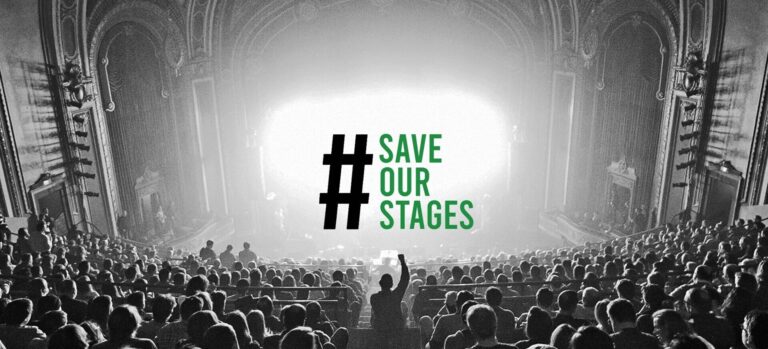
SaveOurStages hopes to get economic relief for struggling music venues.
Senators Tom Carper and John Tester created the Entertainments New Credit Opportunity for relief & Economic Sustainability (ENCORES) Act.
The bill gives a new tax credit to venues with less than 500 employees. The initiative is to help cover the cost of refunded tickets and cancelled concerts.
“Today, I am joining Senator Tester to introduce the ENCORES Act, a bill that will provide much-needed relief for our live music venues by creating a tax credit to help cover refunded ticket costs due to canceled events. Music venues are truly special places that have, for generations, provided our families with priceless memories. It’s on us to do what we can to support this industry now so that we can come out on the other side of this pandemic and ensure that this will not be the day the music died.”
Senator Tom Carper
According to a press release, venues will be eligible if they offered costumers a voucher before they requested a refund.
Many live music venues show their support for the #SaveOurStages Act.
The U.S. is not the only nation protesting in support of live concert venues. England took storm with the #WeMakeEvents and Red Alert Movement. Marches throughout Manchester occurred Aug. 11, according to BBC.
The ENCORES Act credit will allow the venues to redeem losses because of cancelled concerts.
Milton Theater Director Fred Munzert from Delaware expressed his gratitude towards Carper.
“History tells us that for every challenging time the arts persist and comes back even stronger. Art is one of the first things people look to when regaining their sense of normalcy.”
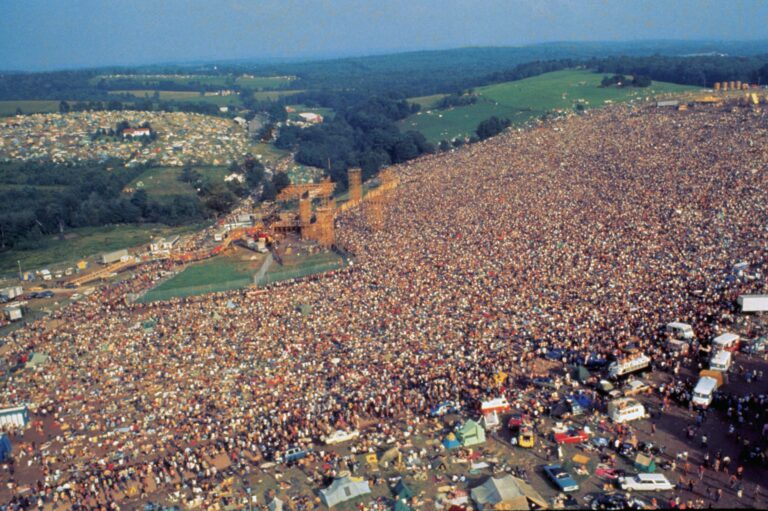
It has been over fifty years since the Woodstock Music & Art Festival made its mark in history from August 15-18, 1969 in Bethel, NY, and one year since the festival marked its golden anniversary. The Museum at Bethel Woods displayed a special exhibit throughout the year of Woodstock photographs and artifacts and hosted a weekend of music in their pavilion and throughout their grounds where the historic festival was held.
Throughout that weekend in 2019, Bethel Woods had a meeting spot for 1969 festival attendees at the top of the hill where the original festival was held. There, I was introduced to Lisa Law who, upon noticing my camera, was quick to say, “Here, do you want to take my picture?” We only had a brief introduction at that time with all the hustle and bustle of the festivities that day
Lisa Law is an accomplished photographer and videographer who considers herself to be a historian/documentarian with her camera, capturing candid moments as they happen. In the last five decades she has shot iconic portraits of now legendary musicians (sometimes at major moments in music history) and documented social/cultural changes and the lives and society of indigenous people, through both still and video photography. Her documentary film and book by the same name, Flashing On The Sixties, features her images and videos from that era. More than 200 of her images are also on exhibit in the Smithsonian Museum.
As a member of the Hog Farm Commune (which included Wavy Gravy), she was part of the group flown from Los Angeles to New York to provide the “security” for Woodstock. At the festival, Law was responsible for setting up the Hog Farm kitchen and getting food ready for the festival-goers who wanted it. Even with all of this, she managed to weave in her photography and videography to capture the arrival of the crowds and other scenes at the festival.
Shortly after the conclusion of the 50th anniversary weekend at Bethel Woods, I caught up with Lisa in the Town of Woodstock to hear more of her story. Starting with her early days with a camera, she brings us through her experiences behind the lens over the years, including recent works with establishing a museum in Yelapa, Mexico. Her experience at Woodstock is only a portion of a much greater story.
Lisa Law, showing her photo of Tom Law setting up a teepee before the start of the 1969 Woodstock Music & Art Festival
Steve Malinski: What drew you to photography? What got you into picking up a camera for the first time?
Lisa Law: Well, my father was a 16 millimeter [film] man. He used to make movies of wild boar hunts in Mexico, fishing in Guaymas, the garment industry demonstrations in North Hollywood. So, he was always making movies on 16 millimeter. Besides being a furrier and father of three, he joined the Navy in the second world war. He gave me a little Brownie when I was probably six and I’d go around shooting, you know, kids follow what their parents do. So, I would go around shooting my girlfriends and swimming in the swimming pool. I love horses. I was a horse person – I had my horse in the backyard and a swimming pool in the backyard. I used to go riding at Griffith Park.Griffith Park is where the Greek Theater is. There’s a mountain there. And you have to go around like this to get to the valley. Laurel Canyon is up on top. Mulholland’s on top, and Topanga goes over.
So, the thing about me is that I was always a person who kept their negatives. A lot of people don’t keep their negatives, so I have all the negatives of everything I ever shot. So I was shooting my life story with this little Brownie, and then at the age 15 I moved to San Francisco to live with my aunt. I shot everything there too. And then I went to the College of Marin and I started working for the manager of the Kingston Trio. He was a photographer and gave me a Honeywell Pentax.
I took two classes one in City College in San Francisco and one in College of Marin in portraiture. That’s when I learned to really crop in the camera. Whereas before I didn’t know how to do that, but I was already good at shooting what I was interested in. And I am instantaneous. When I shoot, I see something and I shoot. A lot of photographers wait, la la la, say “smile,” all this stuff, right? I wasn’t like that, I just shot immediately. For example, so I just shot a conversation I had earlier today. She didn’t see me doing it.
I started shooting for Frank Werber, Kingston Trio, Sons of Chaplin, [history trend] and I got some backstage passes to The Beatles. And I shot Sonny and Cher backstage. I went to the Cow Palace, saw The Beatles. And I shot Peter Paul and Mary at a concert and that’s how I ran into their road manager [Tom Law] and ended up marrying him. So we knew everybody on the West Coast and the East Coast in the music business, basically because there weren’t too many people at that point. And so I was shooting Peter, Paul and Mary. And then when I was working for Frank Werber over in Sausalito, there was the Trident Restaurant. It had mostly jazz on the weekends at night.
Well, I heard this other group in Berkeley, called Brazil 65. And I said, “Frank, you gotta get this group. They’re fantastic. And it would be good on a Sunday afternoon. Over on the deck your restaurant on the water there on Sausalito.” And because Sausalito is very popular town, a lot of tourists go there and shop and boat and sailing and everything. So he said, “No, no, no.” And I said “come on you just trust me.” So that’s where the Brazil 65 got their name, basically was playing at the Trident. That’s when they became popular – Sérgio Mendes. Bill Evans played there. You know, it was really great. So I was shooting all the music I could possibly shoot and because I met Tom Law at the Peter Paul and Mary concert and Berkeley, I then moved down to LA. And he had bought a castle with his brother {John Philip Law, the actor] in the Los Feliz area [in LA].
Bob Dylan… because Albert Grossman was Bob Dylan’s manager… He knew Bob and Bob wanted come out to LA to hang out for a while and he rented some rooms from Tom in this castle. And that’s when I shot my famous pictures of Bob at The Castle, because he was staying there and I was living there and he would sit down at the dining room table I would just keep my camera out, start shooting.
The Velvet Underground stayed at the house too, Lou Reed. Andy Warhol came over, I shot them at The Trip. And my pictures are used more than anybody’s from that gig.
Andy Warhol did his screen tests (I guess they’re called) of these people that hung out at the factory with him and he projected them behind the Velvet Underground. So as you’re watching Lou Reed play with his band you’re seeing these videos of the same people, but it was like a screen test projected from the back. As the concerts happening, you’re seeing the projection of Andy Warhol’s screen tests. But other people photographed it too. But they strobed [flashed] it. And because I was then shooting with a Nikon and a fixed lens I was able to get really sharp shots with the projected images of the same people playing doing their screen tests behind, and I was very artistic, was the only time that Andy Warhol did that type of projection behind the group. It was called Andy Warhol and The Velvet Underground, and they only played three nights, and I shot them the first night because they were staying in Tom’s house.
Well, those pictures, if you look at all the books on the Velvet Underground, those are the pictures they used because I was the only one shooting at that time, that was shooting really good pictures. The other people were strobing which just gave a white background.
SM: When you’re in these close settings with Bob Dylan and Lou Reed, did you ever get a sense of shyness or intimidation when you’re taking pictures of them?
LL: Well, Bob kind of made me feel kind of weird. He wasn’t that…friendly? We were friends, but I was his masseuse and cook too. But I’d be sitting there and I have my camera shooting away and he’s sitting there and once in a while, he’d like make a face or something.
So, I was shooting as much as I possibly could. But I probably could have shot more. And I didn’t say, “Okay, stand there I’m going to take your portrait.” I just shot whatever was happening. That’s what I’m known for, is shooting at the moment that something’s happening. But that’s setting up a shot. I take group shots now. I’ll take whole group shots of bands, then I’ll set them all up. And I’ll shoot families and get everybody together. When I was shooting for my book Flashing on the Sixties, most of those pictures are very candid shots. Like Cher backstage at the Cow Palace with Sonny. David Crosby getting ready to go on that same event at the Cow Palace. I shot the Byrds at Hollywood High School in concert. I shot John Lennon running behind the stage with his guitar when the girls are chasing him. And when Dylan was staying at The Castle with us, we went down to the Whiskey a Go Go and saw Otis Redding.
When I was sitting at a table with Bob Dylan, Tom, and a bunch of friends, I just jumped up and went up to the stage and started shooting. Well, Otis was bouncing all over the place. Half the pictures were out of focus because it was too dark. But I was able to get like three or four really good ones. Those were then used by Atlantic Records as his promo shot and album cover after he died.
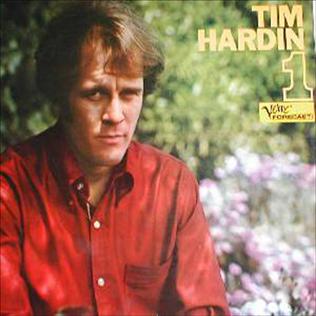
So with Tim Hardin, I shot his first cover and last cover. I shot him behind The Castle in the garden. Then he went to Verve Records, he said he need an album cover. So I went to Verve, and they used it. So I knew how to get to Capitol Records and how to get to Verve Records and Atlantic Records and they used them as their promo shots or album covers.
Album cover of Tim Hardin 1, photographed by Lisa Law
After we moved to Mexico and then back to LA, we went to the Haight Ashbury. So I documented the Haight Ashbury, the human being atmosphere. The Streets of the Haight. Monterey Pop….at Monterey Pop I had a little puppy that I had to feed with a bottle because the mother couldn’t be him. So I missed out shooting Otis Redding and Janis Joplin because I’m holding this baby puppy. I never considered myself a photographer. So, it didn’t matter, just took care of the little puppy dog.
SM: So at that point was photography just a hobby for you? At what point did it to turn into more of a career over hobby?
LL: It was after I divorced my husband in 1978. So all the way up to 1978, even Monterey Pop….that was just documenting my life. I’m very good at documenting my life.
So when I moved to New Mexico, and I’d started shooting the Hog Farm and Ken Kesey and the buses. Then I would print them up and leave them in their office and I was getting to be known as a historian.
When we went to Woodstock…Of course, I shot us getting on the plane [in LA], waiting in the airport, putting the tee pee poles and tee pee on the plane. I didn’t shoot in the plane, which is weird. And it’s probably because I had my two-year-old with me and she was sitting on my lap and I probably didn’t do it because of that. I didn’t shoot one picture inside that plane. But when we got off the plane, as soon as we came around the corner from where you get off… all these cameras were there. And the lights, cameras, rolling and rolling! They sent a jumbo jet to pick us up, empty. Who does that? Do you know how much that costs?
SM: Let’s see, in 1969 dollars….
LL: Expensive. But the airline probably donated it. So the press, they said, “Ah, we hear you’re the security.” Wavy [Gravy] says, “Well, do you feel secure? Yes? Well then it must be working.” “What are you going to use for riot control?” “Seltzer bottles and lemon pies!” So we then got on buses, and we went to the site and the last picture on that first roll [of film] was of my husband putting up the tee pee. So that was the last black and white then I changed to slides (Kodachrome).
But also when I went into town to get the food, I got a camera and some film, and I shot Super 8 . Because I shot Super 8, I was able to document behind the scenes. The same way I document with a still camera, but now with a movie. Because of that all my footage is being used now in every single one of those documentaries you’re seeing on TV, they know who to come to. And a new one that just came out from by Bohemian Films, The Festival That Rocked the World is the new one that just came out and not the American Experience from PBS. It’s a whole other one. It’s I think the best one. It has footage and vocals and stuff like that have never been seen before. It’s got a lot of my footage and me talking about everything. Because I have so much information about the Hog Farm and everything and I’m so talkative. They really liked it, liked working with me. I’ve gotten used to doing it. Before I couldn’t even speak – when my when my book came out and they interviewed me on the radio and I could barely speak.
Lisa Law, with a figurine of Wavy Gravy, at Bethel Woods Aug. 2019
SM: When you were actually at Woodstock, you were running one of the kitchens?
LL: Yes, there was only one kitchen, basically. Our kitchen, the Hog Farm kitchen. There were two but one of them was for serving us while we are setting up everything and the other one was for serving the crowds. I helped design that one, the kitchen and the five food booths that had 10 lines. So, I went and got $3,000 from John Morris and while I was shopping, they were building the kitchen and the serving booths. When I got back they were just finishing that.
So as soon as we got our pots out of the boxes, we started cooking. And I went and took a flatbed truck and went to a farm next door and I said, “I’ll take this row, that row, and that row.” Now that footage of me saying that was filmed by the [Bethel Woods] museum, they did an interview with me. So they used that footage of me saying that in one of their exhibits. When I went to see it recently, I leaned back in the beanbag and then I would talk and the other people around me. They would go “what?” and I’d say, “Well, that’s me over there! That’s me over there!” “That’s you?!” they’d respond. And I would narrate it for them. They liked it. So anyway, that’s what I did. I went and got all the vegetables from farmers locally. And it was August so they had a lot of it. So we’re cooking bulgur wheat and then I bring all that food and then the volunteers would chop it up, stick it in the pot to cook. And so people were waiting in that line. If you were hungry, you could eat. You did never go hungry at Woodstock.
SM: Even with a crowd that large?
LL: I had half the food leftover.
We were cooking non-stop, and people were in line. There were 25 to 30 people per line and there were 10 lines and it was just going: serving, serving, cooking, serving, serving. I bought 160,000 paper plates. I kind of knew what was gonna happen and when I went to town I got another three thousand. I spent $6,000 of their money to buy the stainless steel pots, to buy the cleavers, to buy the trash cans to mix the muesli in. To this day I still have the two cleavers and the stainless steel pot. One’s at my daughter’s show in Santa Fe. She’s got an exhibit up right now. She did a whole thing called “Hail Hail Rock and Roll: Happy 50th Woodstock!”
SM: Was the scene when you arrived at Yasgur’s Farm after travelling up from JFK different than what you expected?
LL: Well, when I got there they were already serving 100 people. The first group arrived by bus and they already set up a kitchen with plywood and two by fours and plastic. This was happening maybe a few weeks before the festival. They were already making the free stage, the little kitchen, and they had brought food with them. And they were they were cooking what they had with them, and [Max] Yasgur had yogurt, milk, eggs. He was selling stuff to us from his farm, and he had brought water and milk trucks over.
And they were fixing a LOT of food. I mean, big plates of food for everybody. Because they were being fed, everybody helped. We needed something done, we’d put them to work. Because otherwise I’m not gonna sit around doing nothing. They all helped. So we had different groups that came in and helped. And then the [crowds] started arriving and I had looked around and I said, “You know, this is gonna be bigger than we think it is.”
And that’s when I went to town and I spent that money. When I went in to get the money from John Morris, I said, “These people are going to starve if we don’t feed ’em.” And the concessions that were up on the hill? Those pointed roof ones… They were out of food the first day. There was no way to get more food because there was no way to get anywhere.
It was solid people and solid cars. And in my footage I stood right in the middle of them coming in. I just stood right there. And today I still shoot that kind of shot during parades and marches. I just stand [still]. And they walk around me. And you can see their faces and chanting in their signs and I shoot demonstrations like that.
SM: How did you find the time to take all of the photos and footage in between making sure the kitchen was up and running?
LL: Because I shoot on the run, I’m always shooting. Like I just finished visiting today and I’ve already shot 100 pictures; I should actually shoot you, too. And I shot at lunch today and shot portraits without even anybody really knowing I was doing it, that’s how I get away with murder. Unfortunately, you know, these ones aren’t as sharp, they’re in focus but they’re just not – they’re pixelated more with the phone. I hope [these cameras] get better. And then next i-Camera. I should be shooting with a camera. But I like to be more candid. If you have a full camera, it’s more intimidating than a phone.
SM: That’s my problem when taking photos. Everyone sees you with this big camera and they’re suddenly aware of your presence and their expression goes from candid to… not natural.
LL: Right. So I was shooting at the Woodstock event at the museum [Arlo Guthrie] and I was sitting there and I turned around and the sun was still shining. And all these kids are dancing like crazy and I get to snap them because that’s where the action is. It’s these people happy, dancing, celebrating. So I think probably I’ve shot over 1,000 pictures the last three days [at the 50th anniversary] and a bunch of the people came to my exhibit [at The Stray Cat].
SM: What was the lasting effect of Woodstock? Did it change your perspective on photography or have a major impact on your life?
LL: Well, what it did show me is that I have to shoot more because I looked at other people’s photographs that were up in the museum – all of those photographers and their best pictures from Woodstock. There are pictures in there of the food booths up on top of the hill and in front of the stage. When I was shooting the movie, I wasn’t shooting much of the stills. So when I consider it, I did a horrible job of shooting my stuff. But I did get some. If you look at my show, you will you will see some good pictures of Wavy coming in and the aerial shots [from a helicopter] and cooking shots and stuff like that. I could have shot 10 times as much. But I didn’t. I did get the movie, which is being used a lot by every single documentary filmmaker. They’re using it, but I didn’t shoot enough stills. And if I was really smart, I would have gotten a bigger camera and really shot the heck out of this year’s anniversary. But I figured that, at 76, do I need to take all those pictures? Because I’m still sitting in my office with thousands of pictures that nobody’s ever seen. So you have to think about that. Do you just keep shooting? Or do you slow down a little bit? Now, I also have Woodstock Three [1999] – and Two [1994] – nobody’s ever seen my Woodstock Three pictures. I’ve documented the heck out of Woodstock Three, for People magazine. I have an entire shop of Woodstock Three, never been seen. So I have all these rooms, slides, and proof sheets, pictures that nobody’s ever seen before. And so that makes me feel bad that I want to share everything that I’ve taken. That’s why I take pictures, it’s for sharing. That’s why people look at pictures. It’s because they want to see what you saw, what happened. And it’s very important – photographer’s work is very, very important because you could tell somebody about what happened but you can’t really describe it unless you show them an image. A photograph is worth 1,000 words, right? So I feel that I owe it to society to be able to share that.
About four years ago, I did a show in Yelapa, Mexico. I didn’t want to bring it home because it belongs down there. So I built a museum to house the pictures. [El Museo de Historia at Arte y Cultura de Yelapa]
There was an old building that used to have a sheriff’s office. We fixed up the sheriff’s office, we fixed up the plaza and we built the museum. I have 108 pictures on the walls. It took five months to build. I was the builder. I was the curator. And then I went and got tables full of artifacts, then I had to write up all the wording go with each one of those things. So there we are cutting the ribbon on the opening day, which was my birthday, March 8, [2019], alongside the guy who gave me his crew to build it the woman with the funding, and all my government people. There were a lot of compliments. I wanted to show the people what Yelapa was like back before there was electricity and plumbing.
We spent a lot of time getting the museum ready. Five months, five days a week.
Lisa Law (center) at the ribbon cutting for El Museo de Historia at Arte y Cultura de Yelapa. Courtesy Lisa Law/Santa Fe Reporter
SM: Back to Woodstock, do you think the 50th anniversary weekend was the celebration that everyone kind of hoped for?
LL: For the people that paid for their ticket and got their passes and came all the way up there to do that? They were very happy. And the ones that went over to Gerald’s [nearby gathering], those guys were happy. Okay, but it wasn’t like a Michael Lang thing. And Michael Lang’s things are too big and too corporate; nine never work. [Woodstock] Two and Three did not work. They did not work. Right. Okay. What happened here was very strict over the at the museum, and kind of loose over at Gerald’s. It worked, because there were two different ones. 100,000 people didn’t show up. Maybe 16,000 over at the museum [Bethel Woods] and 200 or so over at Gerald’s.
Well, this was the big 50th anniversary. Well, Michael Lang was invited to that. They gave him a house near Yasgur’s Farm. And he and Henry [Diltz] and and Bill Hanley and all those guys hung out in that house. So Michael Lang got to celebrate Woodstock, even though he couldn’t put on his event. They brought him over to be at their event to celebrate with those people who celebrate Woodstock every year. That was great for Michael Lang.
Friday left the crowd exhausted, but looking for more. A motionless field was peppered with life around 8AM, hippies making friends with neighbors as they awoke, ahead of the second day of Woodstock.
According to Robert Spitz’s Barefoot in Babylon, Director of Operations Mel Lawrence, would wake the crowd up with a rousing “GGOOOOOD MOOOR-NINGGG” followed by:
Sorry about that. Let’s try that one again. Good Morning. Thank You. Listen, last night was incredible, and we just wanted to let you know that everything’s okay. No hassles. We’re going to have another groovy day today and into the night and tomorrow.
I just need your help with one small favor. We’re going to pass out these bags now so that we can keep our home clean. We’ll hand them out to those of you on this side of the bowl, and I’d appreciate it if all of you over there will toss your junk in and pass the bag on until it gets over to the other side of the field. Some of the guys from the Peace Service Corps will pick them up over there and get rid of that stuff for tyou.
We’ve gotta keep this place liveable so we can prove to the rest of the world that we can make it to together in peace and comfort. And we’re gonna do it too.
Mel Lawrence, with intermittent cheers from a quickly awoken crowd.
A day of heavy-hitters would perform on Saturday, including The Who, Grateful Dead, Jefferson Airplane, Janis Joplin, Creedence Clearwater Revival and Santana among them.
Santana’s appearance has always been regarded as one of the highlights of the festival. According to Spitz, with 92′ heat and 97% humidity, the bowl had turned into a sauna, and emotions, fueled by boredom from early performances from Quill, Country Joe McDonald, John Sebastian, and Keef Hartley Band, were heating up. Santana jolted the crowd to their feet, making his mark on the festival and providing an electrifying bridge to the rest of that day’s performers.
The Who would not perform until 3:30AM on Sunday, playing well into the morning. The set was famously interrupted by activist Abbie Hoffman who stormed the stage to say:
This festival is meaningless as long as John Sinclair’s rotting in prison!
Abbie Hoffman at Woodstock
Hoffman was dispatched from the stage by Pete Townshend, who used his guitar to escort Hoffman into the photographer’s pit.
Jefferson Airplane hit the stage at 8:30AM on Sunday, with a set that paralleed the exhausted corowd. Much of the audience was passed out even as the hits “Volunteers” and “Somebody to Love” rounded out the set. At 10AM on Sunday, the music would take a break, for a few hours.
Watch performances from 13 of the 14 artists who performed at Woodstock on August 15, 1969.
Quill
https://www.youtube.com/watch?v=nfH18WqJuY8
Country Joe McDonald
John B. Sebastian
https://www.youtube.com/watch?v=XnsB4Ck__OE
Keef Hartley Band
Allegedly, Hartleyâs manager demanded payment up front for the rights to record or film the band. Thus, they were never included in any Woodstock footage until 2019, when the full Woodstock set was released.
Even now, 51 years to the day, the performance by Grateful Dead at the legendary Woodstock Music Festival still leaves a mark. Although, for a variety of reasons, it’s a mark that the band and any eyewitnesses that evening may not wish to remember fondly. Weather, electrical and all the other ever-sprouting issues that arose during Woodstock all played factors that resulted in what many deem a less than memorable performance put forth by the Western newcomers that many had heard of but few had seen before.
Due to scheduling issues and incessant rain, the band’s set on August 16, 1969 had already been pushed back from Saturday late afternoon to a 10:30 pm start time. By then, rain and the resulting mud had conquered the Bethel, NY festival grounds. The giant throng of spectators splayed across the hillside were getting soaked and restless waiting for the next act to start. Up until this point, the Grateful Dead were still only a band “on the rise” that was very much new to an East Coast crowd, by and large.
The inauspicious start began when the band’s notoriously heavy gear caused the rotating stage that was being used to sink completely into the mud – something they had warned the event staff about beforehand. Phil Lesh’s bass monitor was somehow picking up the on-site helicopter’s radio signal. And the Dead’s sound technician, Owsley “Bear” Stanley, was making alterations to what he considered an inadequate in-house PA system. It resulted in him improperly grounding the stage equipment and giving new meaning to the term “electric rock.”
Band members recall feeling a “light tingle” whenever they would touch their instruments. This all culminated with a now famous story about guitarist Bob Weir being thrown across the stage, supposedly during the “Saint Stephen” that began the show.
It was raining toads when we played. The rain was part of our nightmare. The other part was our sound man, who decided that the ground situation on the stage was all wrong. It took him about two hours to change it, which held up the show. He finally got it set the way he wanted it, but every time I touched my instrument, I got a shock. The stage was wet, and the electricity was coming through me. I was conducting! Touching my guitar and the microphone was nearly fatal. There was a great big blue spark about the size of a baseball, and I got lifted off my feet and sent back eight or 10 feet to my amplifier.
~ Bob Weir, Rolling Stone interview
Audio recordings only contain the first two minutes of the opening number, likely a result of this mishap. Things immediately lighten up a little afterwards with “Mama Tried,” a Merle Haggard song that the Dead had started covering earlier that year.
The awkward start-and-stop rhythm of the show then rears its ugly head again thanks to another ten minutes of delay in order to deal with the sound setup. A “spirited” Ken Babbs from the Merry Pranksters takes to the MC role during this part of the show as he tries his best to entertain a crowd of hippies growing increasingly damp and restless. This also gives Country Joe McDonald the chance to pop up onstage and warn everyone about the “green acid” that was going around.
After all the sound issues are resolved, the band launches into a moody “Dark Star” that serves as one of the musical highlights of the night. The near 20-minute rendition stretches out and descends into near ambience before rounding back into form. It features wonderful fills and textures provided by early keys player Tom Constanten who seems to be turned up abnormally high in this recording.
Once the “Dark Star” burned out, the band trotted out another new number with “High Time” – a sentiment that was no doubt shared by many this evening. Garcia’s vocals come through aptly but this isn’t exactly a song to get a crowd up and dancing. The slow, drab composition seemed to be reflective of the current atmosphere.
The band seems to cut their losses and ends theit set with a “Turn On Your Lovelight” that stretches out to almost 40 minutes. However,it starts with even more mayhem thanks to another “spirited” individual who jumps on stage and exclaims to everyone about “seeing the sun rise over the lake” and a “third Coast.” All this while the band is quietly playing the instrumental open to the song underneath it all.
While it does seem to finally inject some life into the set, not even a Pigpen rap would be enough to save this show. The extensive jam meanders and shifts from pscychedelia to blues and back with little direction in between. It marked the end of a set that had high hopes at first but falls flat in its delivery thanks to the weather, sound issues, lucid ramblings from MCs and stage crashers alike, and one of the guitarists getting visibly electrocuted on stage.
Grateful Dead Woodstock Music Festival Bethel, NY 8/16/69 St. Stephen (cut), Mama Tried -> High Time (false start), Dark Star ->High Time, Turn On Your Love Light
Jazz at Chautauqua is held periodically and in 2016 hosted Wynton Marsalis and Jazz at Lincoln Center during one week of the nine-week long program.
Located in southwestern New York, near the Pennsylvania border, Chautauqua Lake is home to the Chautauqua Institution. There, a blend of arts programming, educational and religious opportunities and recreational activities are available to those who visit the grounds during the year.
The Institution, originally the Chautauqua Lake Sunday School Assembly, was founded in 1874 as an educational experiment in out-of-school, vacation learning. It was successful and broadened almost immediately beyond courses for Sunday school teachers to include academic subjects, music, art and physical education.
On September 21, 2012, a late-night set with Duke Heitger’s Swing Band at Jazz at Chautauqua featured the amazing voice of singer Rebecca Kilgore. Performing worldwide at jazz festivals, jazz parties, and on jazz cruises, Kilgore has been a frequent guest on National Public Radio’s ‘Fresh Air’ with Terry Gross, has appeared on ‘A Prairie Home Companion,’ and with Michael Feinstein at Carnegie Hall.
Here is Rebecca Kilgore with Dan Block (tenor saxophone), Rossano Sportiello (piano), Frank Tate (string bass) and Pete Siers (drums) performing “I’m Thru with Love” at Jazz at Chautauqua weekend in 2011
The Rebecca Kilgore Quartet (formerly known as BED) was a popular favorite on the jazz festival circuit: with Eddie Erickson (guitar/banjo/voice), Dan Barrett (trombone), and Joel Forbes (bass). Writer Bucky Pizzarelli says of Kilgore, “If Benny Goodman were alive today, he’d hire Becky to sing in his band.”
The next night, September 22, Becky performed “It’s Always You” with Keith Ingham. The 1941 Jimmy Van Heusen/Johnny Burke song from The Road to Zanzibar, was originally sung by Bing Crosby and Dorothy Lamour. Other members of Kilgore’s band include Dan Barrett (trombone), Dan Block (alto saxophone), Scott Robinson (tenor saxophone), Mike Greensill (piano), Howard Alden (guitar), Kerry Lewis (string bass) and Bill Ransom (drums).
And from September 2009, here are Duke Heitger, Andy Schumm, Dan Barrett, Scott Robinson, Bob Reitmeier, Ehud Asherie, Marty Grosz, Frank Tate, and Pete Siers swinging around on “Linger Awhile.”
From Jazz at Chautauqua in September 2009, featuring the late Tom Pletcher (cornet), Dan Barrett (trombone), Bob Reitmeier (clarinet), the late Jim Dapogny (piano), Frank Tate (string bass) and Pete Siers (drums).
From 2014 Jazz at Chautauqau, Kurt Weill performs a gorgeous “September Song” with a trio of Dan Levinson (tenor saxophone), Bob Havens (trombone), and Keith Ingham (piano).
Each Sunday evening from 7-9pm on 102.7 FM, you’ll find EQXposure on WEQX, featuring two hours of local music from up and coming artists. Tune into WEQX.com this Sunday night to hear music from Lucas Garrett, Matt Bosson, Magic Trash Party, and many more!
WEQX has long been the preeminent independent station in the Capital Region of New York, broadcasting from Southern VT to a ever-expanding listening audience. NYS Music brings you a preview of artists to discover each week, just a taste of the talent waiting to be discovered by fans like you.
The singer/guitarist hails from Upstate NY and continues to meld styles like progressive rock, folk, classic rock, and indie with every new song. He’s performed all over the capital region at coffee houses and reputable venues including Strand Theatre in Hudson Falls, Little Theater on the Farm in Fort Edward, Charles Wood in Downtown Glens Falls, and Hudson River Music Hall just to name a few. He’s remained busy recording new material since the release of his debut EP Evening’s Come, But It’s Not Dark and you can expect the same steady output in 2020. This is just one of more songs to come and if you want to know who’s on what, just take a look below.
This is a friend and former classmate of Tred’s. You know. Tred? From Every Other Tuesday With Tred. On Early EQX? Well, anyway they used to hang out in the Berkshires and now Matt Bosson is making sweet, sweet music in Los Angeles California. He’s spent some time as a singer/songwriter in multiple bands ranging in genres like punk and alt country. Most recently he has been releasing his most personal and unusual music as a solo artist.
Magic Trash Party hails from Windham, NY and they are going for a ’40s-’60s classic pop vibe on this one. If you want to find out more about them like I did you can check out their Facebook page where their bio says they are a “Rock and Pop band from Upstate NY.” Yup. That’s all it says. With a name like Magic Trash Party, who needs details? The magic is in the mystery.