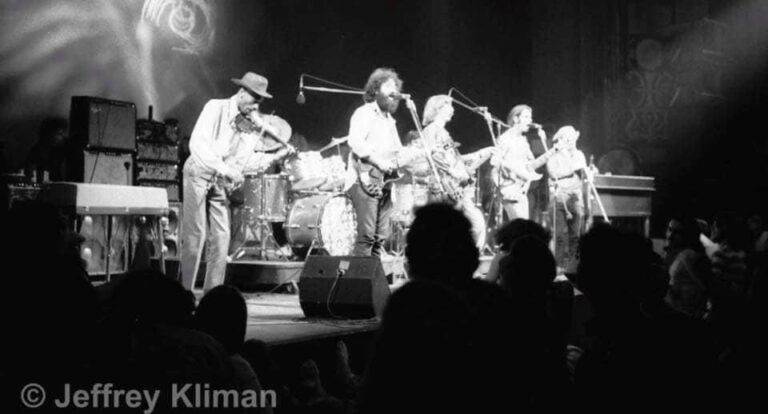
One of the better Grateful Dead shows at the Fillmore East was aided by its surprise attack. Allegedly, two nights before at the same venue, Grace Slick, on behalf of Bill Graham, announced an impromptu “pop-up” show with Jefferson Airplane and the Dead at the same venue that would take place just days later. Since Slick was still pregnant at the time, Jefferson Airplane wound up being replaced as the opener by Hot Tuna. The New Riders of the Purple Sage played an opening set as well as was customary for this tour.
There’s also some previous controversy surrounding this show. For years, it’s been misidentified as an 11/23/70 show at the Anderson Theater in New York City. After a Bill Graham introduction, the band is off and running immediately with a “Casey Jones” that ably motors down the tracks. Next, Bob Weir leads them through the traditional first set stalwart of “Me and My Uncle.”
Oddly, the house PA seems to cut in after this with a recording of Elton John’s take on “Honkey Tonk Women.” This leads into a a cut version “Friend of the Devil.” Despite this lapse, Garcia’s vocals sound pristine in the recording and the band is on point. Then, after essentially a “no huddle” transition, a short yet crisp version of “Cold Rain and Snow” takes place. Afterwards, Pigpen finally gets to take lead for a while as he leads the Dead through a cover of Slim Harpo’s blue standard “I’m A King Bee.” The opening harmonica solo and later interludes between that and guitar solos stretch this one out into a healthy, bluesy jam.
Another classic first set pairing ensues with “China Cat Sunflower,” eventually joined by its traditional partner, “I Know You Rider.” A seemingly quick transition jam later sees the band in full vocal harmony on this spirited take of yet another classic blues cover.
At this point, a special guest joins them on stage in the form of Traffic’s Steve Winwood. The blues sentiment that had been previously established seems to carry right over to the cover of Otis Redding’s “Hard To Handle” that follows. Once again, Pigpen lends his signature vocal prowess to this classic Dead cover. Winwood’s backing on Pigpen’s Hammond organ is immediately felt and can be heard throughout. This one gets into a serious jam with Pigpen taking a backseat and Winwood soloing on top of the groove. Then came the relatively new “Big Railroad Blues,” yet another cover, written by Noah Lewis of Cannon’s Jug Stompers that dates all the way back to 1928.
Right after, the heavily percussive intro of “Not Fade Away” begins with. Chris Wood and Jim Capaldi of Traffic join the band on a half-hearted attempt at the vocals. This eventually evolves into a deep, drum-led jam. More splendid Winwood outbursts later lead into “Goin’ Down The Road Feelin’ Bad” with Garcia and Weir reassuming command. Surprisingly, at its conclusion, this shifts right back into one more quick take of “Not Fade Away,” albeit this time with Weir confidently taking the lead on vocals.
After more than three minutes of a break between songs, Weir once again takes lead on the “Mama Tried” that follows. This is followed by one of the better two-song sequences of the evening. The relatively fresh “Truckin’,” debuted only months earlier at the Fillmore West, follows. Hot Tuna’s Will Scarlet adds a touch of harmonica to this one. Another percussive laden jam follows that seamlessly steers itself into a mesmerizing version of “The Other One.”
The jam that ensues gets spacey midway through before settling back into its normal progression. This is followed with the unofficial encore of “Uncle John’s Band” with more early harmonica fills from Will Scarlet – a near acoustic version until the drums kick in. It’s still fairly new song at this time, but this version is flawless as it continues to build its reputation. This put the cap on the Dead’s “surprise” Fillmore East gig.
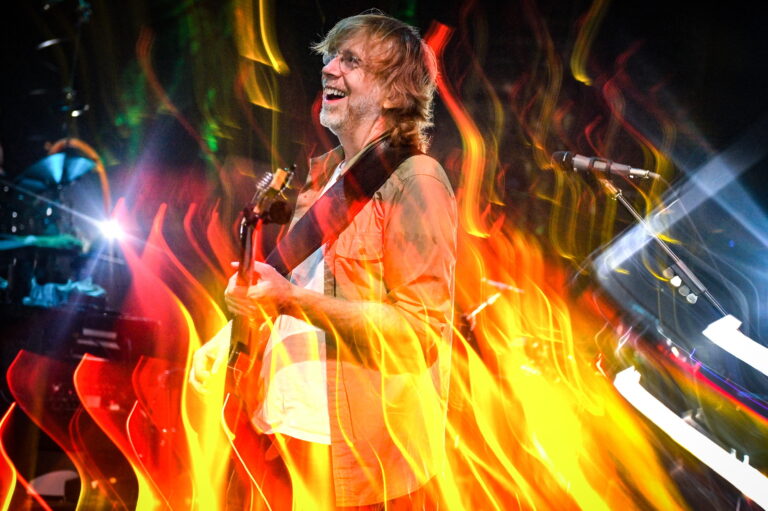
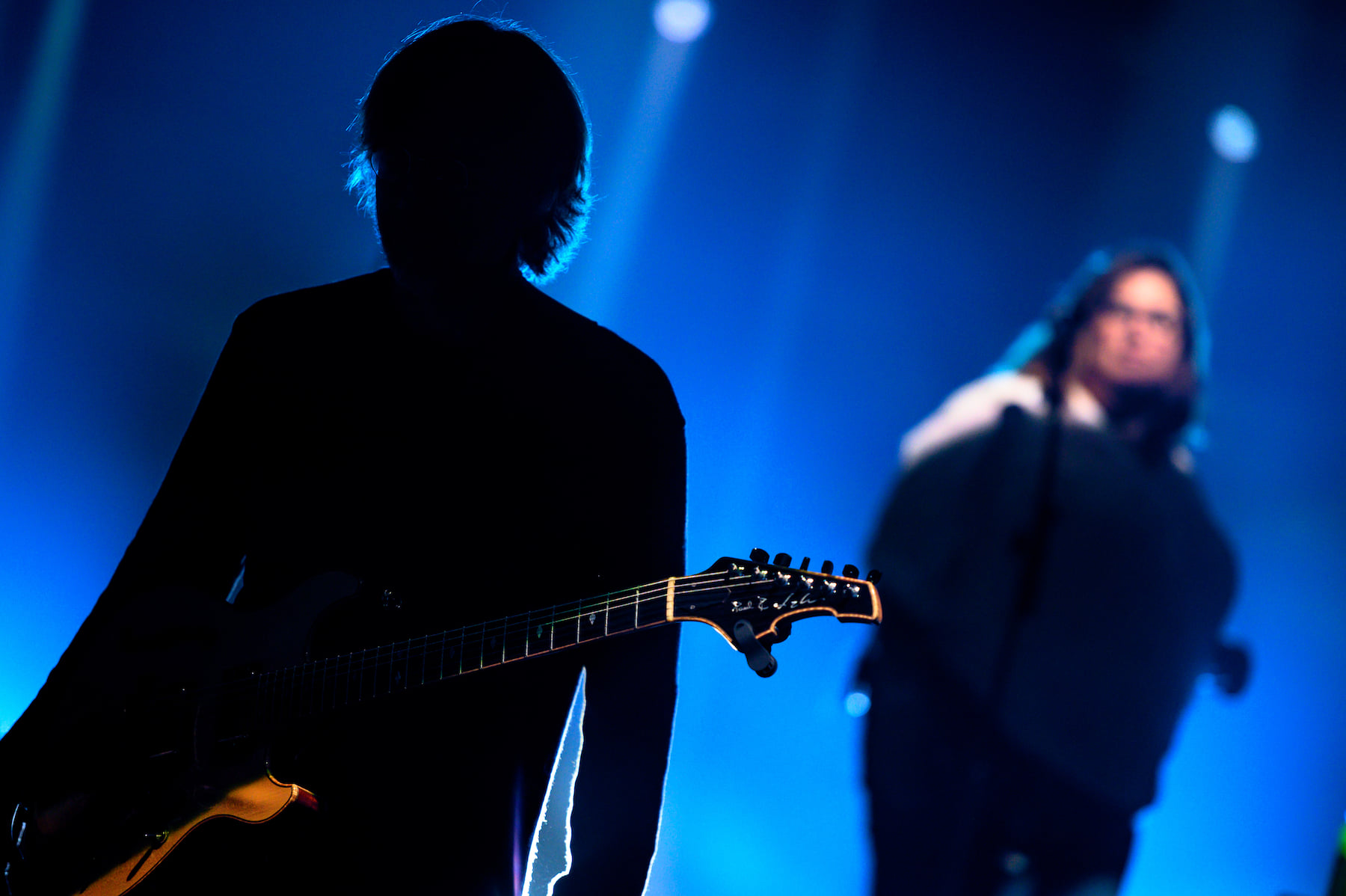
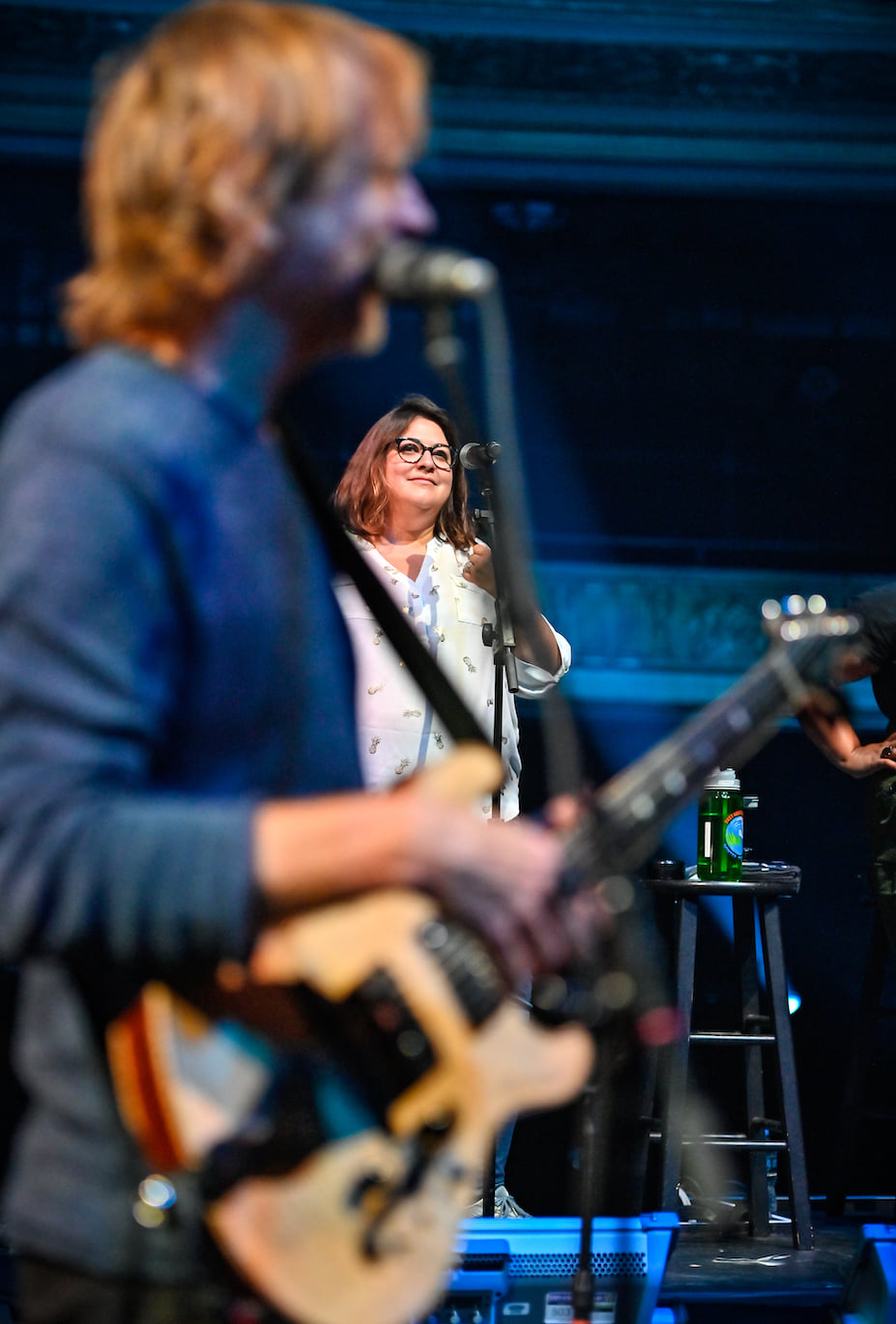
Trey Anastasio returned for another installment of The Beacon Jams last night and delivered another astounding show with a well-crafted setlist that showcased several TAB debuts.
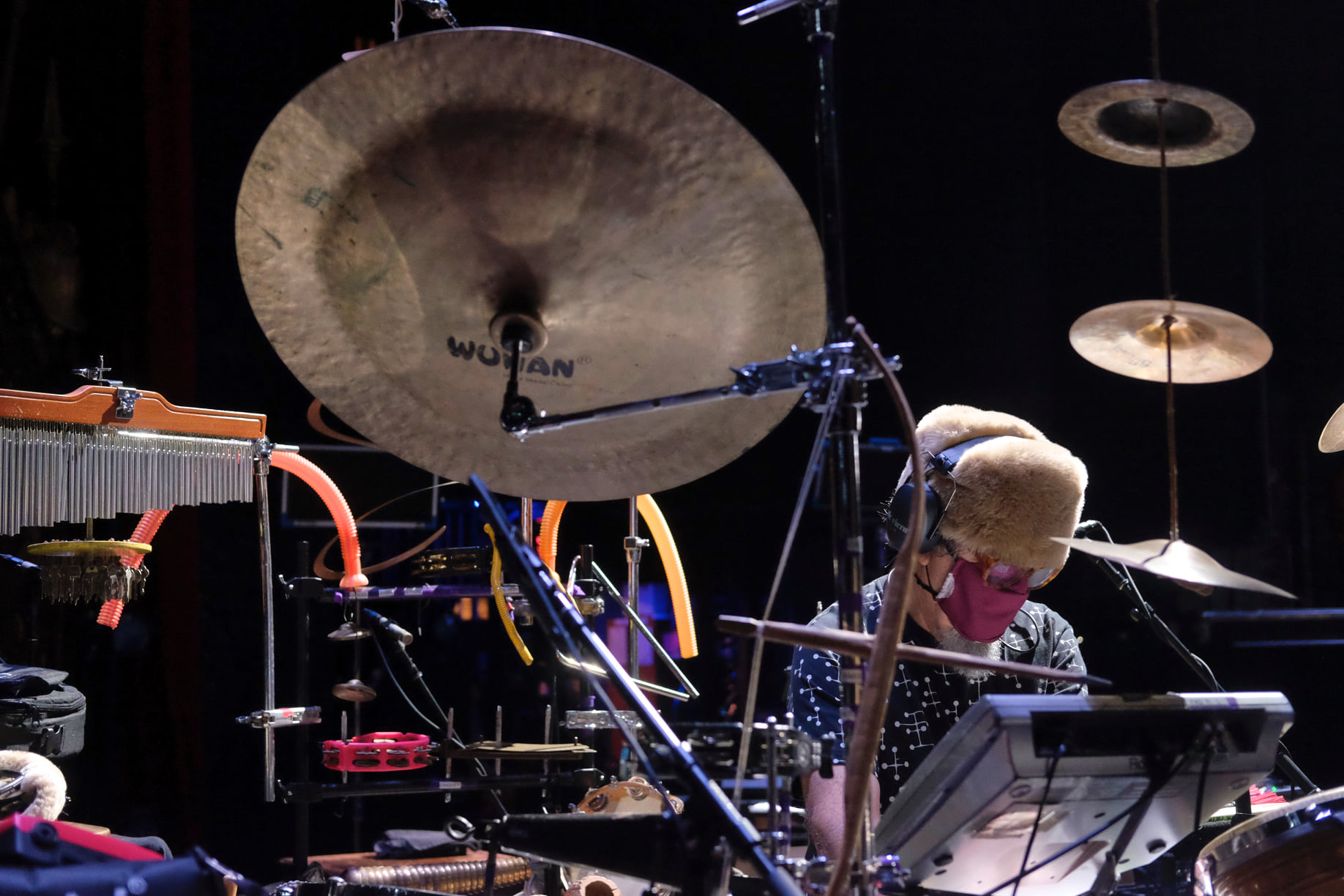
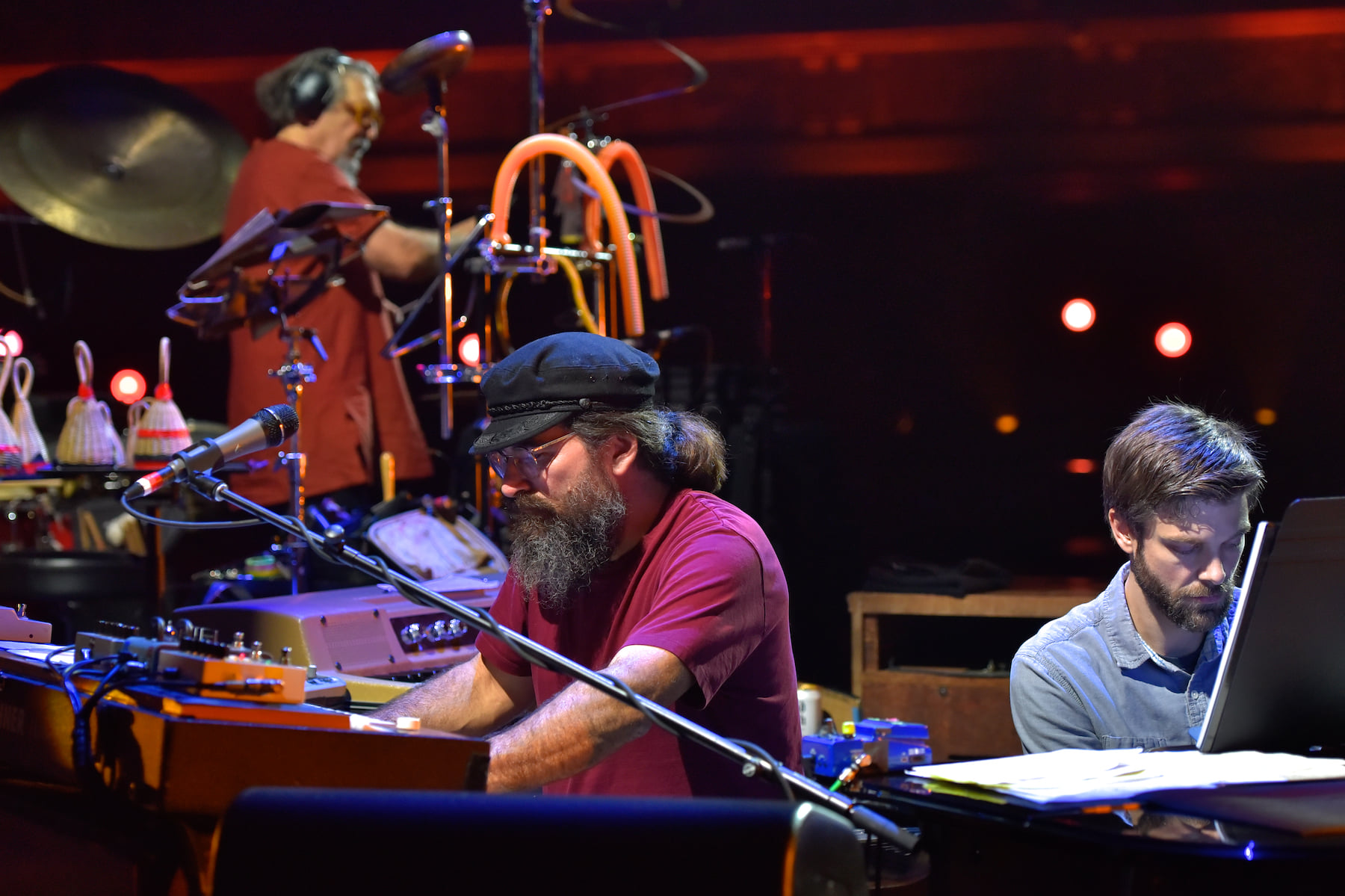
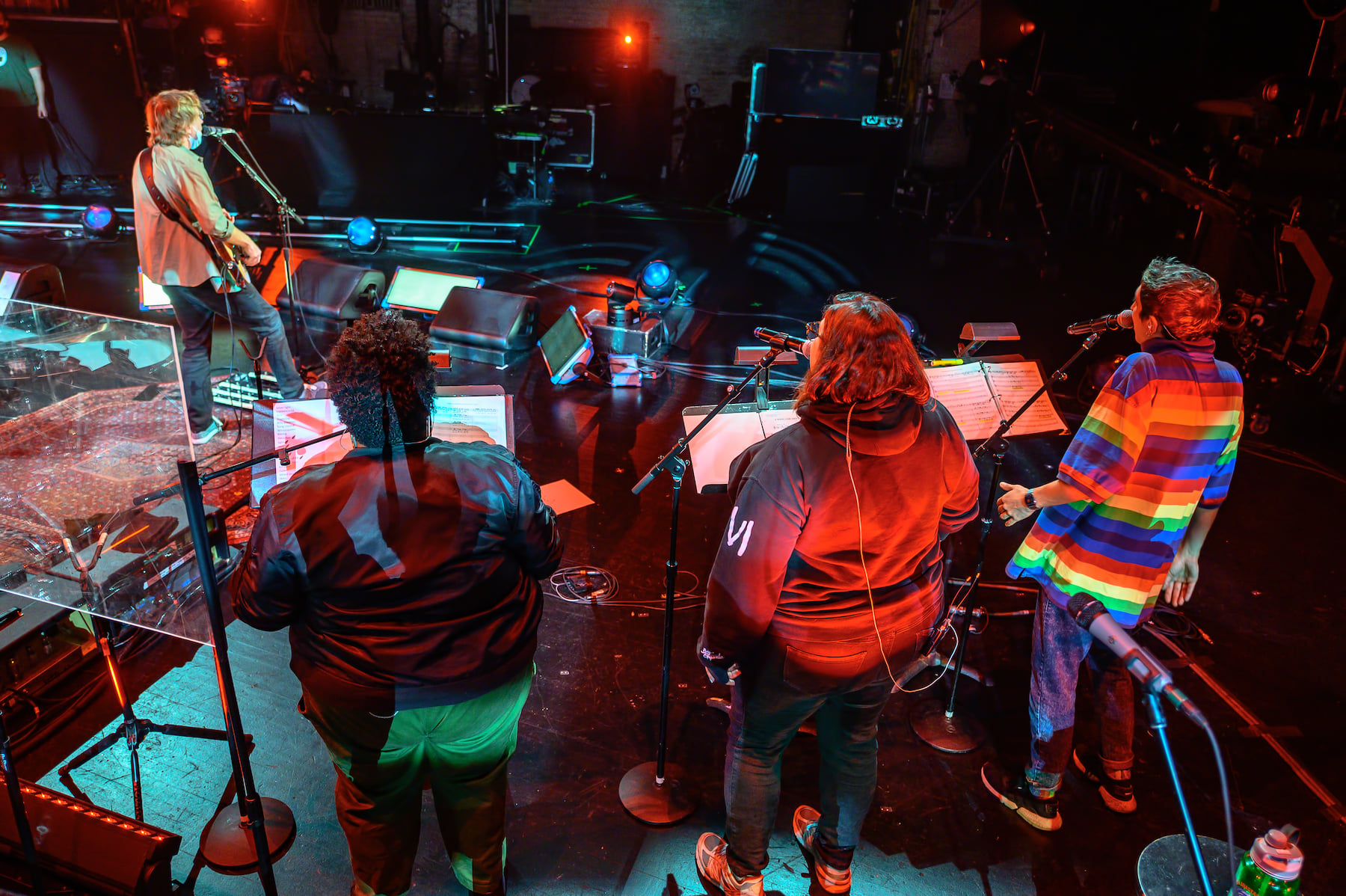
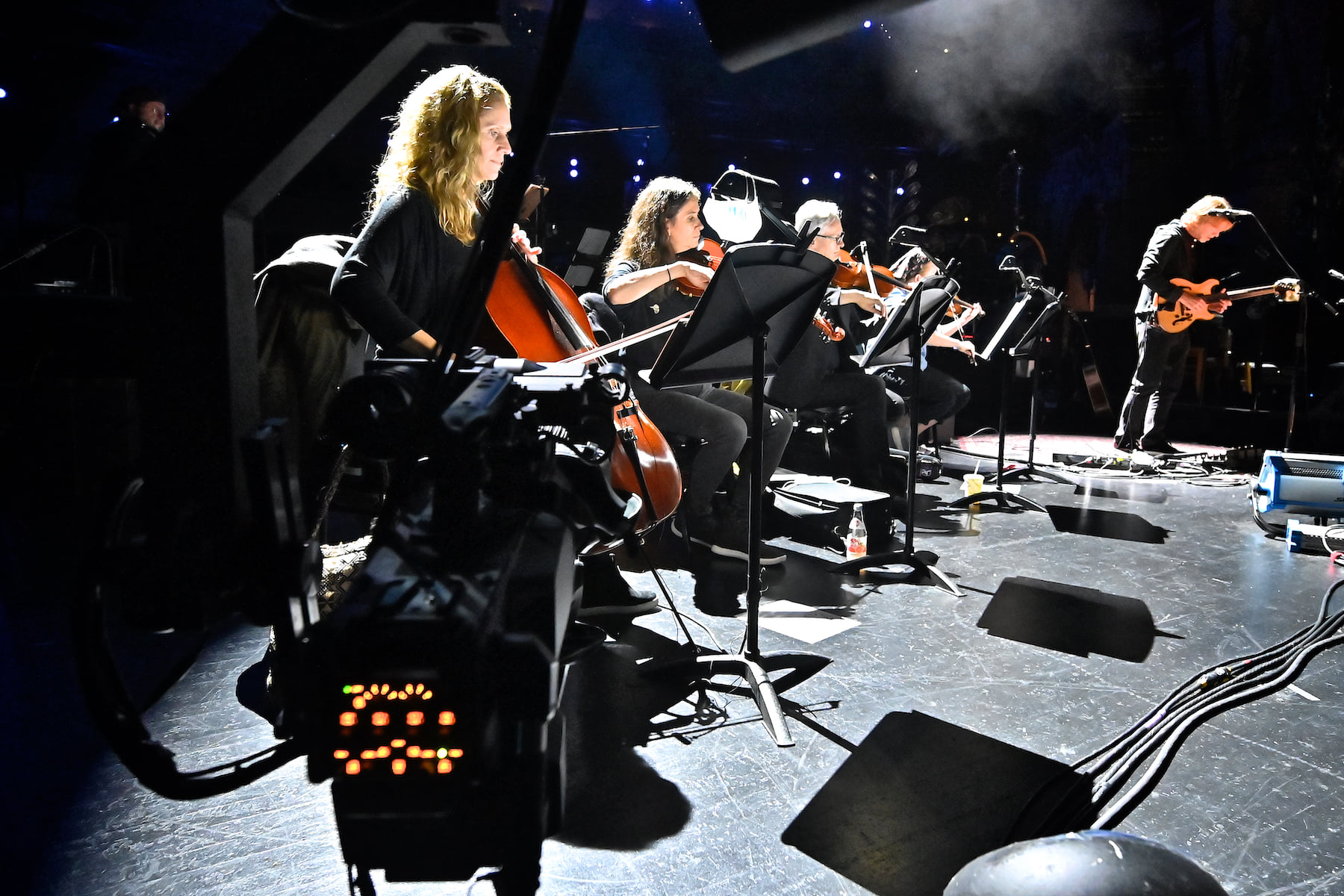
Trey was joined by the usual suspects rounding out his band. This included Ray Paczkowski (keyboards), Tony Markellis (bass), Russ Lawton (drums) and Cyro Baptista (percussion). In addition to his backing band, Trey was also again joined by the Rescue Squad Stings. They were composed of Maxim Moston (violin), Katie Kresek (violin), Rachel Golub (viola), and Anja Wood (cello). Jeff Tanski (piano) also sat in sporadically as well. The band was rounded out by the Angels 3 backing vocalists: Jennifer Hartswick, Celisse Henderson and Jo Lampert.
Trey and company wasted absolutely no time opening up with the Phish staple “You Enjoy Myself,” a TAB debut. The opening sequence of the song featured The Rescue Squad strings adding an elegant touch of flair to the beloved number. After “The Silver Light,” Trey turned to his acoustic guitar for a beautiful version of “Winterqueen” before shifting gears to the heavy-hitter “The Moma Dance.”
One of the highlights of the evening came in the middle of the set. Trey opted for the classic Phish ballad “Billy Breathes,” another full TAB debut, where Trey delivered the song’s signature solo (even though he claimed he “messed up”). Before a percussion-heavy version of “Bouncing Around The Room,” Trey dedicated the song to his longtime friend/co-writer Tom Marshall – who recently celebrated his birthday.
The evening wrapped up with a fitting message of hope and optimism in “Rise/Come Together” which fully embraces the overarching theme of The Beacon Jams as a whole. This week’s show also raised over $100,000 for The Divided Sky Fund which provides quality care and compassionate treatment for those struggling with substance abuse issues. If fans are able to donate they can head over to trey.com/donate. The Beacon Jams will resume next Friday at 8 p.m. on Trey’s personal Twitch channel.
Set: You Enjoy Myself [1], The Silver Light, Winterqueen [2], The Moma Dance [3], Kill Devil Falls[3], Twenty Years Later[3], Mercy [4], Light [5], Summer of ’89 [6], Joy [7], A Song I Heard the Ocean Sing[3], Farmhouse, Tube[3], Billy Breathes[3], Every Story Ends in Stone, Bouncing Around the Room[3], Wading in the Velvet Sea[3], Are You There Colleen? [8], Rise/Come Together
[1] Full TAB debut. Began with just Trey with The Rescue Squad Strings and Jeff Tanski on piano with the rest of the band and Jennifer Hartswick, Celisse Henderson, Jo Lampert joining in on vocals later. Lyrics changed to “boy, woman, god, shit.”
[2] Trey on acoustic guitar with the full band and singers.
[3] Full TAB debut.
[4] Debut; with The Rescue Squad Strings and Jeff Tanski on piano.
[5] With The Rescue Squad Strings.
[6] With just Trey on acoustic guitar and The Rescue Squad Strings.
[7] Full TAB debut; with The Rescue Squad Strings.
[8] Debut.
This performance was part of The Beacon Jams series and featured the debuts of Mercy and Are You There Colleen? and the full TAB debuts of You Enjoy Myself, Moma Dance, Kill Devil Falls, Twenty Years Later, Joy, A Song I Heard the Ocean Sing, Tube, Billy Breathes, Bouncing Around the Room, and Wading in the Velvet Sea. You Enjoy Myself began with just Trey with The Rescue Squad Strings and Jeff Tanski on piano with the rest of the band and Jennifer Hartswick, Celisse Henderson, Jo Lampert joining in on vocals later. The lyrics in You Enjoy Myself were changed to “boy, woman, god, shit.” Winterqueen featured Trey on acoustic guitar with the full band and singers. Trey teased No Men In No Man’s Land in Moma Dance. Mercy through Joy featured The Rescue Squad Strings. Mercy also featured Jeff Tanski on piano. Summer of ’89 featured just Trey on acoustic guitar with the Strings. Trey quoted On the Road Again after Summer of ’89. Trey quoted She Blinded Me with Science in Tube.
The election may be over, but the people and causes that pushed for change are still making their voices heard. “The Ultimate Litmus” was written by Carlos Henriquez and Jenny Hersch, in response to the protests sparked by the May 25 death of George Floyd. The pair have produced an accompanying music video for the song, featuring Jazz at Lincoln Center Managing and Artistic Director Wynton Marsalis on both vocals and trumpet.
https://www.youtube.com/watch?v=H5N6FCNN8X4
Hersch says of the song,
I wrote a verse of poetry on June 2. It just poured out. On June 9, I wrote verses two and three. I have poetic thoughts but I don’t often write them down. Carlos Henriquez (bassist and arranger, Jazz at Lincoln Center Orchestra) and I have worked on several projects together over the past few years involving music for kids. I sent him the lyrics and asked him to write a brass band arrangement.
Jenny Hersch
Using a New Orleans street sound seemed to be the best choice given the circumstances behind the lyrics, with emotion and energy being simultaneously expressed.
I gave the vocals a try in a rhythmic spoken-word style over Carlos’s MIDI file and immediately called Bryan R. Smith, a photographer friend in NYC to ask for the use of the protest pictures he took in New York, Washington D.C. and Minnesota. Carlos then called Dwight Adams (trumpet), Jeffrey Miller (trombone), Ibanda Ruhumbika (tuba) and Ali Jackson (percussion) to record their parts from home.
Jenny Hersch
With the track laid down, Carlos played a rough audio mix of “The Ultimate Litmus” for Wynton Marsalis in early September. Marsalis was moved by the project and offered to recorded the vocal track and a trumpet solo, which he did in early October.
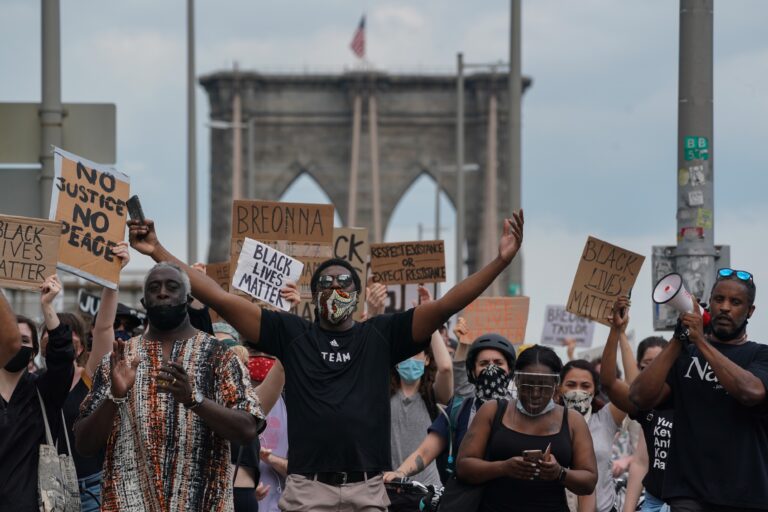
Protesters walk across the Brooklyn Bridge into Manhattan during a demonstration over the death of George Floyd by a Minneapolis police officer on June 6, 2020 in New York. Photo by Bryan Smith
The video was assembled by a team of recent Berklee College graduate Alex Leiva (sound) and Shannon Magnaldi (video), a recent Massachusetts College of Art grad. “The Ultimate Litmus” features Dwight Adams and Wynton Marsalis on trumpet, Jeffery Miller (trombone), Ibanda Ruhumbika (tuba), and Ali Jackson (percussion).
Lyrics for The Ultimate Litmus, by Jenny Hersch
A bottomless pit of pandemonium A breaking point? A tipping point? No quick fix outcome
A state of being? A state of mind? Is it an absence of mind? Where is the presence of mind?
Confusion …. Delusion No illusions No stop gap brawl In it for the long haul
A faction reaction No abstraction Identity …. Integrity Conformity …. Community
Relationships based on tolerance not trust? Is it them or is it US?
Protest No contest 24 7 With no rest
Pros and cons A long list at best Overwhelmed by stress In need of a life vest
Constitution …. Restitution Persecution …. Absolution Abusers …. Accusers For the foreseeable future
Civic values Civic virtue Reeling …. kneeling Rail against the curfew
Fleet of feet Running from a browbeat Bias Is a one way street
Who will bear witness The ultimate litmus A test of wills What values instilled
No justice No peace May wonders NEVER cease
ACTION Is gaining traction Words are not enough Need satisfaction
Lines of questioning Is what we’re expecting Fear of the unknown Will compassion be shown
What is the hold up We’re all thunderstruck No sit down strike Throngs are running amok
Painted into a corner No clear path forward Blurred on the periphery The slope is very slippery
Tears are to be expected We’re so disconnected Celebrate our differences While honoring our preferences
Human rights Are bona fide Like clockwork Like predicting the tides
400 years Of victimization We need a DO-OVER In this nation
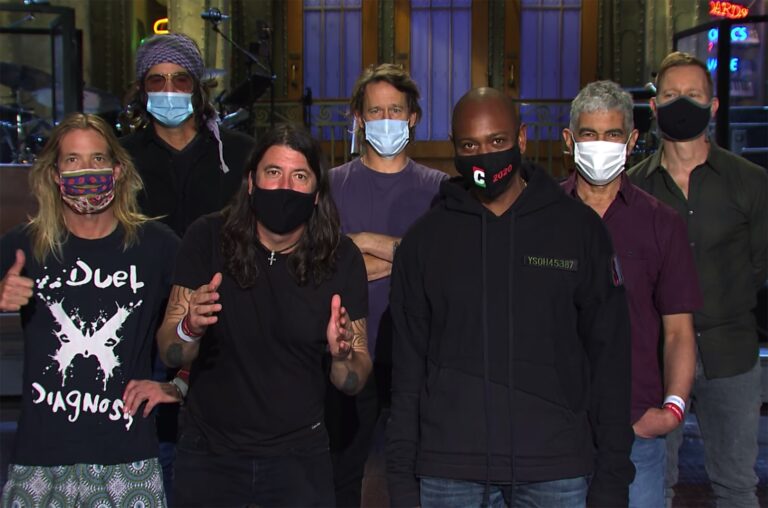
Foo Fighters were the musical guest for the first post-election Saturday Night Live last night, which was also the record sixth consecutive show for the NBC late night institution.
With comedian Dave Chappelle returning for the second time, the first since November 12, 2016, which was also a post-election show but one that had a much more somber tone to it. The tone for the election results this past week would be set by the master comedian, who offered up a lengthy, thought provoking, and hilarious intro monologue.
Foo Fighters have performed seven times prior on Saturday Night Live, and just before the show announced via Pitchfork that they are releasing a new album, Medicine at Midnight, due out February 5, 2021. They performed “Shame, Shame,” a slow rocker that stands out as different than past Foo Fighters songs. Guitarist Chris Shiflett told The Brag, “It’s definitely a little different than anything we’ve ever done before and it’s a little bit different than anything else on the record, although the record has a lot of songs that are, you know, groove-based like this one is.”
https://www.youtube.com/watch?v=Dh_vJ-E337g
For their second song of the night, Foo Fighters went back to their 2002 release One by One for a fitting “Times Like These.” The true-to-the-moment version, with lyrics that are nearly two decades old hold true in the wake of a monumental election, with Dave Grohl notably repeating with increasing emotion, “It’s times like these you learn to live again.”
I—I’m a one-way motorway I’m the road that drives away Follows you back home
I—I’m a street light shining I’m a white light blinding bright Burning off and on
It’s times like these you learn to live again It’s times like these you give and give again It’s times like these you learn to love again It’s times like these time and time again
I—I’m a new day rising I’m a brand new sky To hang the stars upon tonight
But I—I’m a little divided Do I stay or run away And leave it all behind?
The first musical moment of the show, however, came in the cold open, featuring Alec Baldwin’s President Trump, finding the lame duck sitting down at a piano to sing a sad version of The Village People’s “Y.M.C.A.” The musical moment was a nod to the first post-election show in November 2016 that had Kate McKinnon’s Hillary Clinton singing an emotional version of Leonard Cohen’s “Hallelujah,” with Baldwin even saying a line similar to McKinnon’s, “I will never give up, and neither should you.” However, this time the performance by the losing candidate was met with laughs from the audience, and not a somber reception followed by ecstatic applause as was the case in 2016. Jim Carrey’s Joe Biden and Maya Rudolph’s Kamala Harris also closed out their celebration dancing to “Lose Yo Job” as the open wrapped up.
Phish had not yet started their Fall 1997 tour, one that would be dubbed “Phish Destroys America,” yet they were already debuting new tunes for fans. On November 7, 1997, Phish performed on Late Night with Conan O’Brien, giving fans a first taste of “Farmhouse,” despite being there to promote the just-released live compilation Slip Stitch and Pass, before heading west a week later to kick off their Fall Tour in Las Vegas, NV.
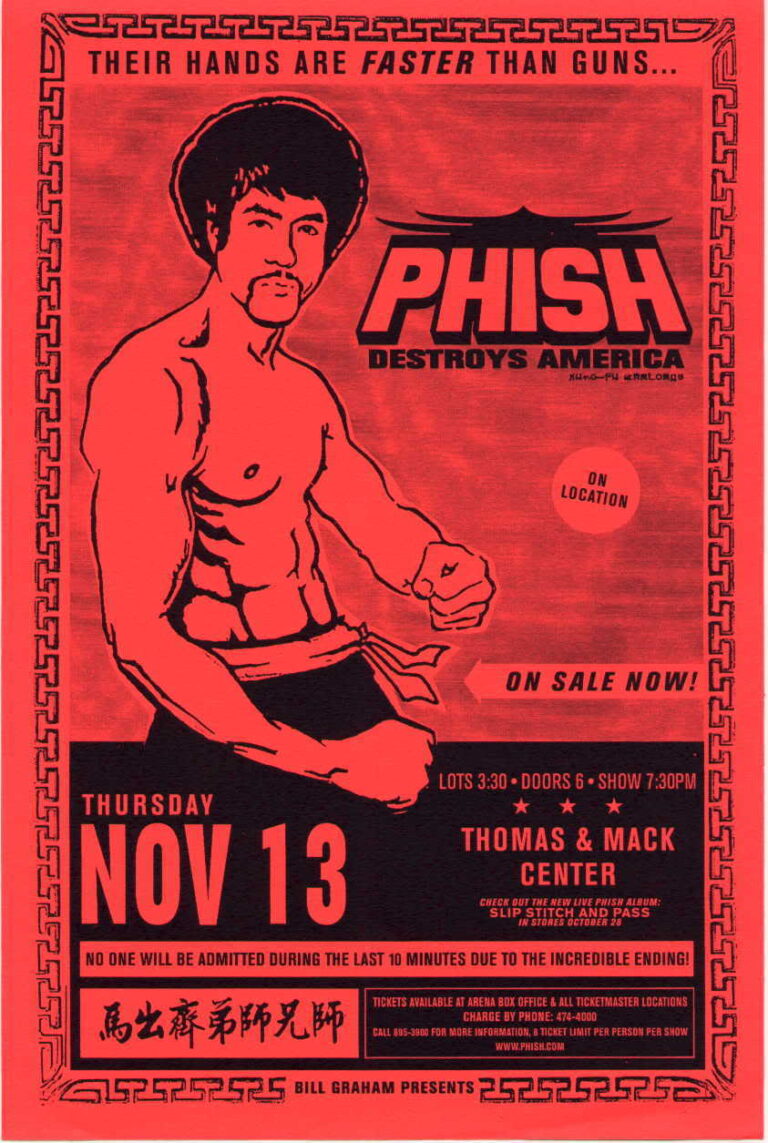
As Glide Magazine points out, Phish was not prone giving names to their tours, but Fall 1997 quickly earned the “Phish Destroys America” moniker by fans, thanks to a controversial Ames Design tour poster used to advertise the tour opener at Thomas and Mack Center, althought the title fits the tour perfectly.
The performance on Late Night featured a stand alone version of “Farmhouse,” a song that lent its name to their May 2000 studio album. The mild reggae vibe brings to mind Bob Marley’s “No Woman, No Cry” and could be found in Phish’s regular rotation beginning in the summer of 1999. Guitarist Trey Anastasio can be seen enjoying the guitar solo thoroughly during the more than four and a half minute version of the song.
Following the performance of “Farmhouse” and Conan coming over to introduce and thank the band, O’Brien said “Take it away guys,” and Phish quickly moved into the intro to “Mike’s Song,” as they might do in live performances, much to the glee of lucky fans in the audience.
Phish would return to Late Night with Conan O’Brien once more on June 27, 2000 to perform “Get Back on the Train,” which would also be featured on the band’s ninth studio album, Farmhouse.
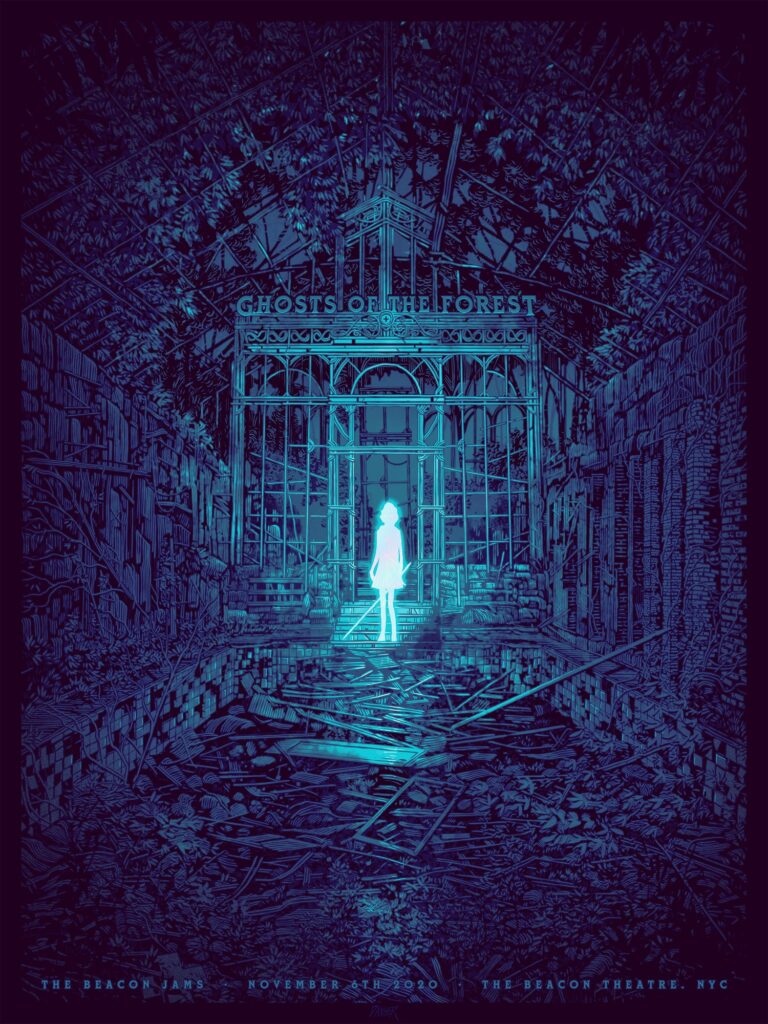
The fifth performance of Trey Anastasio‘s eight-week residency at New York City’s Beacon Theatre took the exact form of one of his many recent side projects. From the opening zoom to the stage that soon showed backup singers and a different looking drummer, it was clear early on that tonight would finally be a variation of the core lineup from the first four weeks of The Beacon Jams. Tonight, Trey took his Ghosts of the Forest side project out for its first run in well over a year. If there was any rust on it, it was minimal.
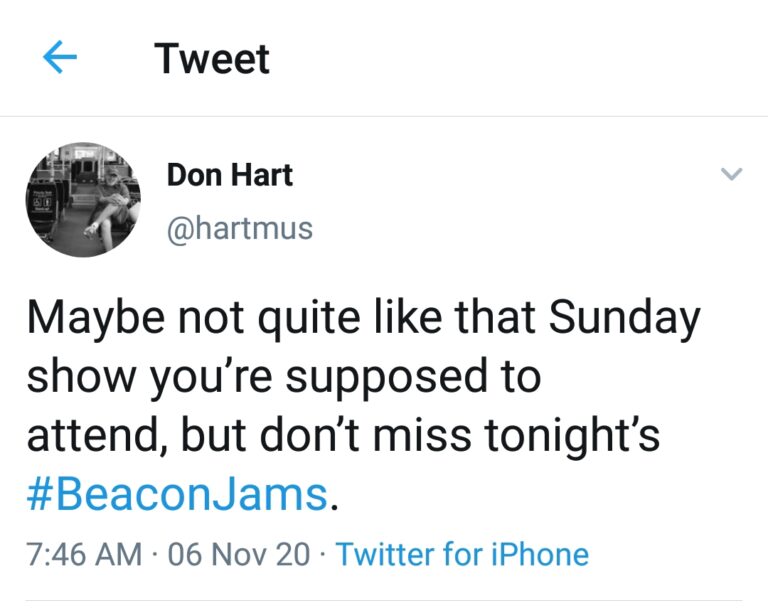
Expectations for this evening started getting a little hyped up early on Friday, thanks to a nondescript Twitter post from Don Hart, Trey’s longtime orchestral and arrangement collaborator. A warning shot like this will rarely go unnoticed within the Phish community.
Immediately, hopes ran high with some sort of orchestral configuration of a Phish song or multiple songs. Perhaps an updated version of “Times Turns Elastic” or an elaborate run through of “You Enjoy Myself”? Apparently, per Trey, Mr. Hart was was still composing arrangements for this evening right up until 20 minutes before showtime, so anything was fair game.
Instead of traditional Phish canon, tonight’s orchestration was directed to one of the more recent Anastasio solo efforts, his Ghosts of the Forest album that was performed a handful of times in early 2019. It’s a complete album with more than 20 songs in all, written by Anastasio in the emotional wake stemming from the death of one his longtime friends, Chris Cottrell.
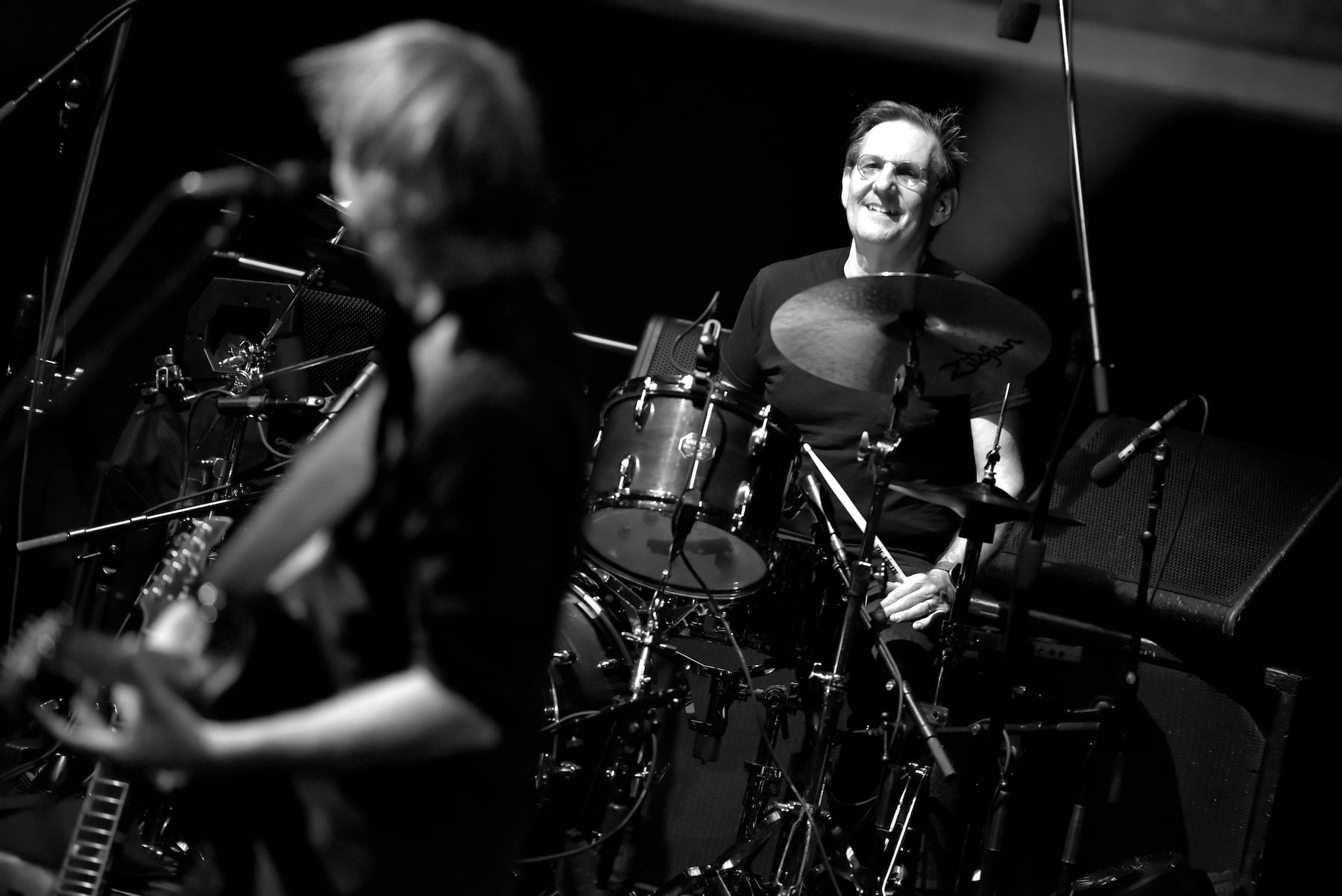
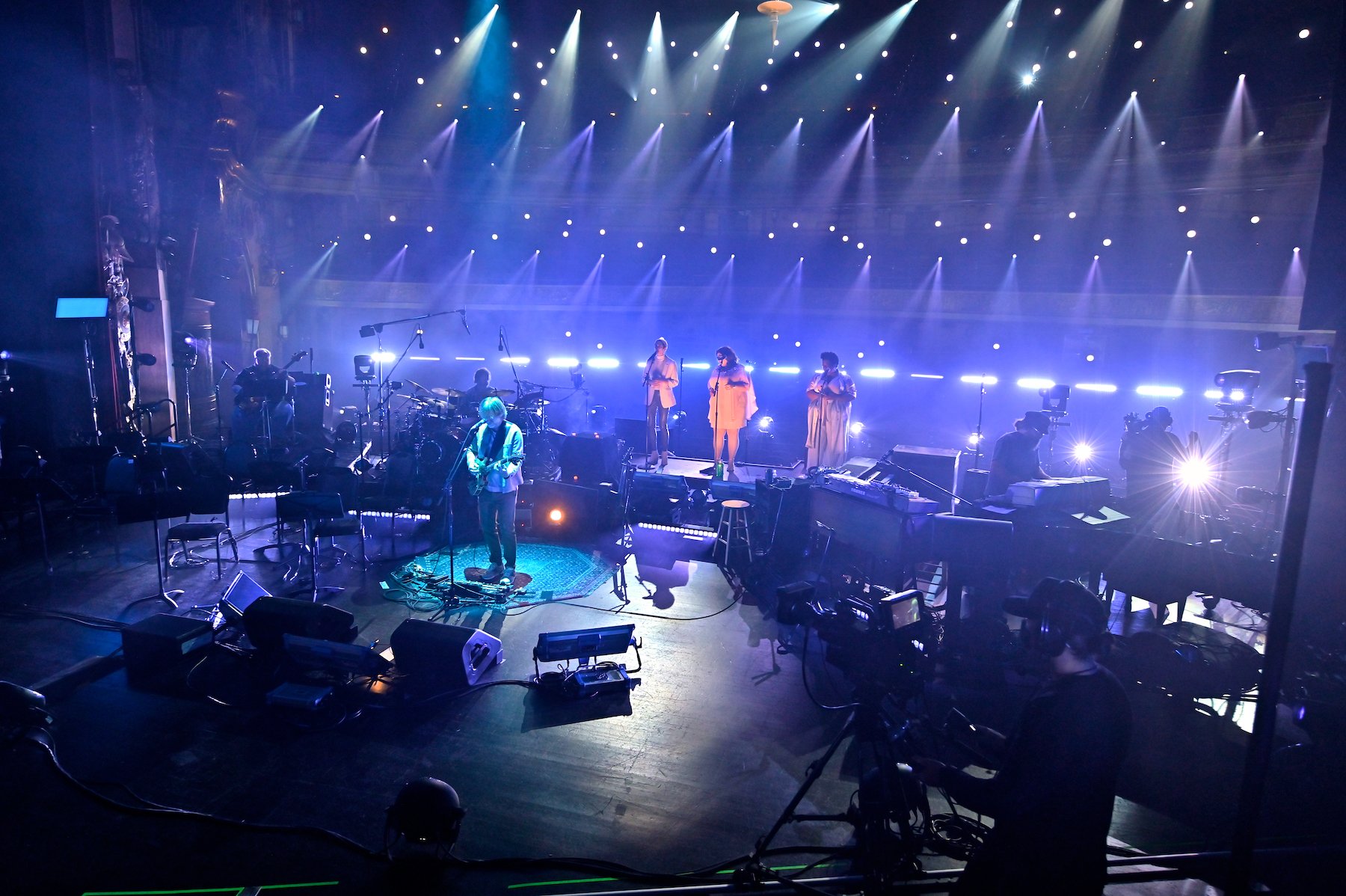
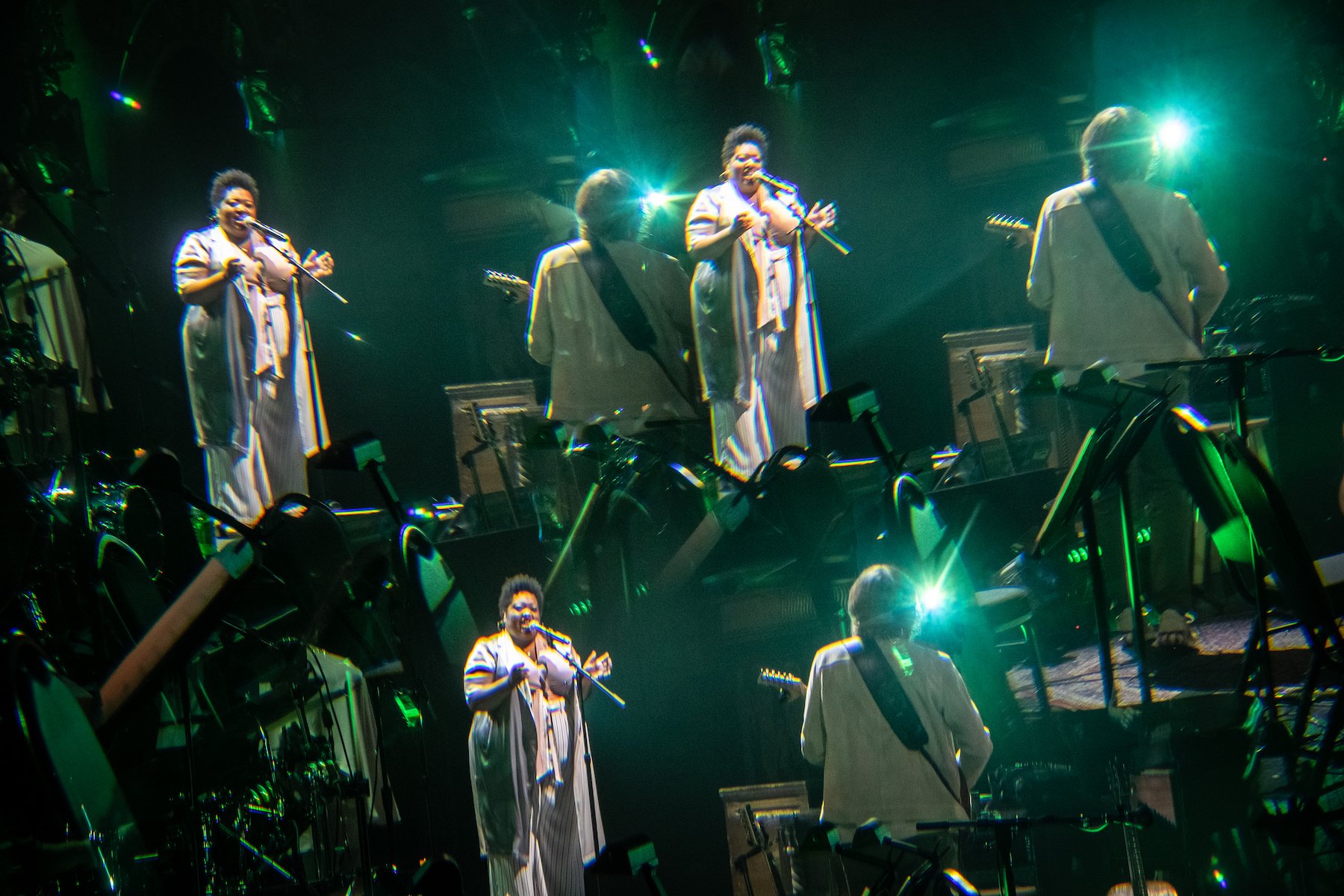
The opening zoom in to the stage immediately revealed a different lineup tonight. There were three backup singers visibly present: Celisse Henderson and Jennifer Hartswick, both from the original GOTF format, as well as “newcomer” Jo Lampert. The other distinct difference was a scruffy-haired Jon Fishman behind the drum kit this evening instead of Russ Lawton who manned it the first four nights. Together, with other Beacon Jam mainstays like Tony Markelis on bass and Ray Paczkowski on keys, this completed tonight’s GOTF ensemble.
With the “new” Ghosts of the Forest lineup established, they wasted no time in going into the outfit’s namesake song. Even though this was only the band and camera crew onstage, the fog and echo effects that accompanied this one were crowd-ready. “Drift While You’re Sleeping” followed, with the backup singers directing the the bulk of the vocal effects this time. Another sophisticated reverb effect introduced the reggae-ish breakdown sequence and it was clear early on nothing was being held back production-wise.
After this impressive opening sequence, Trey took the time for a quick round of band introductions, including one for Fishman, aka “some guy he picked up hitchhiking,” as well as new backup singer Jo Lampert. Trey made sure to remind folks that Lampert not only served as a clone in Phish’s New Year’s show at MSG last year, but also as one of the backup singers for their Ziggy Stardust musical costume from Halloween 2016. So she was certainly no stranger.
It wouldn’t be a “Beacon Jam” without some sort of spatchcock reference and that’s exactly what led into into the next GOTF song, “Friend.” Instead of the traditional four-piece Rescue Squad Strings that had accompanied Trey the previous weeks, this one would be “spatchcocked” into a fuller and doubly richer eight-piece ensemble Trey’s lead solo sounded even richer with the backing of the additional strings on this one.
photo by Jake Silco
After a quick shoutout to the Phish Chicks Facebook group, the backup signers returned and then it was right into “Sightless Escape,” complete with a “No Men In No Man’s Land” tease and a monstrous vocal breakdown from Celisse at the end. Afterwards, Anastasio honestly confided they were “having too much fun” tonight. “Halfway Home” featured a slowly building and ascending jam topped off with another Trey solo and sterling backup vocal harmony. After this, it was a quick switch to the acoustic guitar for “If Again” which sounds like it could be the uptempo cousin of “The Inlaw Josie Wales.”
Trey then took the time to give personal introductions to all eight members of tonight’s Rescue Squad Strings, including one whose friend formerly dated Jon Fishman. The strings added a wonderfully delicate touch to “In Long Lines” as well as “There’s A Path Above.” Afterwards, Trey thanked and mentioned Don Hart’s involvement, confirming arrangements were being completed right up to the last minute. Naturally, this somehow digressed to another spatchcock reference that ended with Trey telling Fish he plays a song quite regularly about this, “Split Open and Melt.” This led into one of the few GOTF numbers that’s seeped into the Phish repertoire, an electric “About To Run” with no strings or singes, just another ferocious Anastasio solo, capped off with an election and a “running for office” pun.
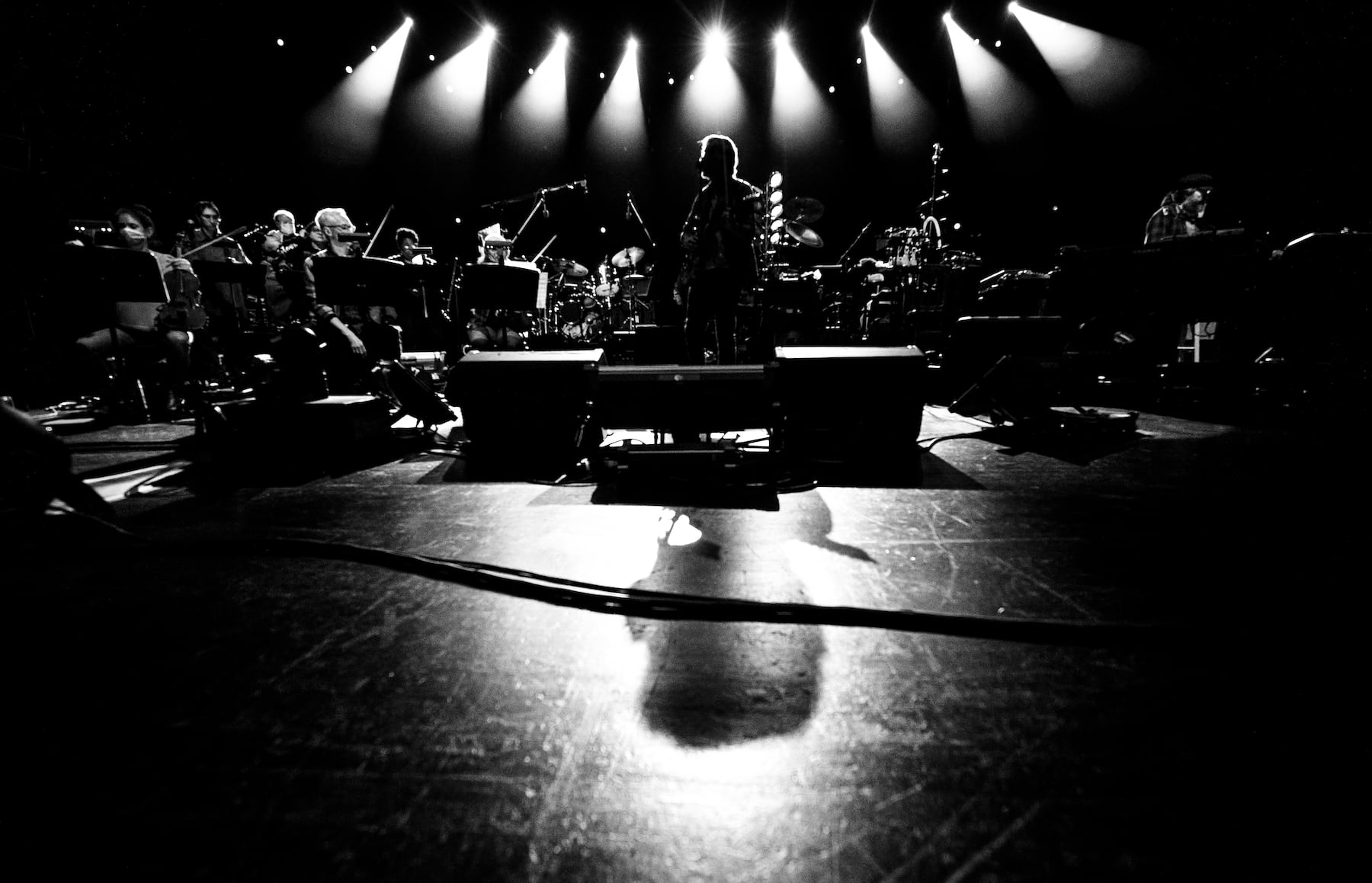
“The Green Truth” saw the backup singers return in a big way as they seemed to dominate the tail end of this one. “Beneath a Sea of Stars Parts 1 & 2” followed and featured a nice, drawn out opening sequence with Fishman taking lead on drums for a while. “The lights are flashing” line seemed to nod to the simple yet highly effective combination of flashing house lights and the minimal light rig used onstage. The Rescue Squad Strings then re-entered before “Mint Siren Dream.” This delicate little number saw Trey in full crooner mode, using only the microphone to sing while being supported by the strings and timely fills from Ray on keys.
“Stumble Into Flight” featured more lively play from Paczkowski, that meshed with a distinct echo effect from Trey and powerful backing vocals to produce a notable jam that contained a “Pigtail” quote at one point. Immediately afterwards, with no hesitation, “Ruby Waves” started up, giving this two-song section of the evening a distinct Phish taste. Although no Alpine Valley version, this “Ruby Wavs” got plenty deep and developed another intriguing jam that grew organically, sounding by far the closest to anything purely Phish from “The Beacon James” so far, including the still impressive lighting display.
The strings ambled back on stage for “Shadows Thrown By Fire,” a brief instrumental number with the backup singers adding airy vocals atop. “Wider” was another highlight of the evening, with heavy bass play from Markelis early on bass and a catchy “Gonna get wider when I die” lyric. More strong play on the clav and organ from Ray added to a bit of an extended jam.
Trey then gave the chat room one more nod, and noted that up to $400K in donations have been made to date towards The Divided Sky Fund. This elicited more heartfelt thanks with Anastasio advising a site for the proposed rehabilitation house has been found, and it’s on track to open in late 2021.
photo by Jake Silco
The strings returned once more for “Life Beyond The Dream,” an appropriate song to follow talk of a rehab house with its “don’t give up hope” lyrics. As expected, the string ensemble took this song to another level in a dazzling display of orchestration towards the end. “In This Bubble” followed, with its wishful “going home” lyrics and a melody once again driven by the backup singers who were all in great form all night. This immediately transitioned to the end of the “Sea of Stars” suite with “Beneath a Sea of Stars Part 3 (blue)” that was appropriately heavy on all available shades of blue house lights.
This effectively ended the set. The encore began with another spooky, echoey effect that bled into the beginning of the hauntingly somber “Brief Time,” with Trey again on acoustic. “Pieces of the Machine” with more “Ghosts of the Forest” vocal teases finished things for the evening – a complete performance of Ghosts of the Forest exactly as it had been played in its handful of performances earlier last year. Or, in other words, just another Friday night at The Beacon for Trey.
photo by Jake Silco
Trey Anastasio “Beacon Jams” Beacon Theatre – New York City, NY 11/6/20
Set: Ghosts of the Forest > Drift While You’re Sleeping, Friend [1], Sightless Escape, Halfway Home > If Again, In Long Lines [1], There’s a Path Above [1], About to Run, The Green Truth, Beneath a Sea of Stars Parts 1 & 2 [1] > Mint Siren Dream [1], Stumble Into Flight > Ruby Waves, Shadows Thrown By Fire [1], Wider, A Life Beyond The Dream [1], In This Bubble > Beneath a Sea of Stars Part 3 (blue)
Encore: Brief Time [1], Pieces in the Machine
Notes: [1] With The Rescue Squad Strings : Katie Kresek, Maxim Moston, Phil Payton, and Mary Jo Stilp on violin, Monica Davis and Rachel Golub on viola, and Eleanor Norton and Anja Wood on cello
With the May premiere of Laurel Canyon, its two-part series dedicated to the California rock of the ‘60s and ‘70s, EPIX proved it might just be TV’s best new source for music documentaries. With its latest effort, By Whatever Means Necessary: The Times of Godfather of Harlem, EPIX is heading East and uptown. The mission here is to spotlight the many musicians and the musical genres they birthed, from soul, funk and jazz to boogaloo and proto-rap, that helped inspire social change during the turbulent 60s, in New York City’s most culturally percolating neighborhood.
This four-part series is the counterpart to Godfather of Harlem, the acclaimed period drama featuring Forest Whitaker and Giancarlo Esposito. This Emmy Award-winning series follows the story of Bumpy Johnson, the notorious Harlem gangster who sought his own version of economic empowerment against the Italian mob, in an era when Black men and women had little power or choices for upward mobility. The action of the series spans the decade and is fueled by a soundtrack featuring the best of this very best era of Black music.
The fascinating story of this golden era is told in interviews with musicians like Martha Reeves, Gladys Knight, Herbie Hancock, Carlos Alomar, Nile Rogers, A$AP Ferg, Chika, Gary Bartz and Joe Bataan, along with the activists who were there pushing forward the drive for civil rights like Al Sharpton. It also contains a remarkable bounty of rarely-seen archival footage, of interviews and live performances by giants like John Coltrane, James Brown, Gil Scott-Heron and many more.
NYS Music speaks here with Keith McQuirter, the series’ Executive Producer and Director about what viewers can expect with the premiere of this series, November 8 at 10 pm ET/PT.
Sal Cataldi: The EPIX dramatic series for which your documentaries are a companion, Godfather of Harlem, is set in the ‘60s in NYC, a time and place of incredible change and musical innovation. Why was music so interweaved with and reflective of the currents of that particular time and place, the civil rights movement and the like?
Keith McQuirter: What drew me to do this series was to examine how music was used as a force for good in the fight for civil rights. There is a long history of Black protest and empowerment music and our series looks at the years, from 1960 – 1969, from the point-of-view of Harlem residents. The scripted series, Godfather of Harlem, is really a civil rights story, told in the criminal underworld. Our series focuses on an entirely different palate – how music impacted culture and politics, and how culture and politics impacted the music. It allows audiences to see the national story of the Black freedom struggle through the personalities, music and activism coming out of Harlem.
Harlem was a very political place in the ‘60s. Many black families fled the south due to racial terrorism and sought better economic opportunities, only to be face racism, discrimination, limited opportunity and segregated schools in the New York City. You had dueling philosophies of Malcolm X and Martin Luther King Jr. and the megawatt influence of Adam Clayton Powell Jr, who was both a Baptist minister and congressman representing the neighborhood. You had the Garveyites, the Black Panthers, the Young Lords and some many others in the fight for civil rights. Not everyone agreed on the approach, but they all agreed that it was time for a change. The freedom songs coming out of the Black church, the jazz of John Coltrane, Charlie Mingus, Max Roach and even Chubby Checker’s Twist spoke to power and change. Our series brings it all together through interviews with eyewitnesses, luminaries and archival that gives a unique look at this part of Black history and culture that is rarely ever told.
SC: The first episode spotlights The Apollo Theater, with comments from performers like Martha Reeves of Martha and the Vandellas and Gladys Knight, and even actor Giancarlo Esposito, one the stars of Godfather of Harlem who saw performances there as a child. What are some of the more interesting things you uncovered about the Apollo in your interviews and research?
KM: The Apollo Theater has been a cultural bedrock in Harlem and America for decades. If you wanted to be a star on the national stage, performing at the Apollo was a rite of passage for many artists. So all the greats performed on the Apollo stage. We spoke with Martha Reeves and Gladys Knight, who told us about her first time performing at the Apollo at a very young age. Both she and Martha talked about how nervous they were because the Apollo audience is known to be a tough crowd. If you get booed off, you might get a tomato thrown at you or other unpleasant things. It was interesting to learn the origin stories of these two legends.
But there is a lesser known story that I appreciated. In the late 1960’s, the Apollo Theater had a mentorship program, where they developed and groomed underprivileged, musically talented teens to be professional entertainers. The teens formed a band under the direction of the theater called Listen My Brother, in which 17-year-old Luther Vandross was a member. We interviewed Carlos Alomar of David Bowie Band fame and Robin Clark, both members of the band. They met as teens during the Apollo program and married before their 20th birthdays. Fifty years later, they are still married! It’s a truly musical love story. Their homework was to go upstairs and watch the Supremes and the Temptations — study their grooming, choreography, stage presence and incorporate it into their rehearsals and their own performances. Can you imagine that type of education? Robin Clark shared about how one day Aretha Franklin came down to the basement where they were rehearsing and talked to the teens about the music business. Robin said she couldn’t believe her idol casually made a surprise visit to their rehearsal. Its apparent that the education and mentorship paid off because both Robin Clark and Carlos Alomar have had illustrious careers in the music business for decades.
SC: The series illustrates how jazz, and especially the new breed of free jazz musicians, were reflecting the civil rights movement. How did the works like John Coltrane’s “Alabama” and Max Roach’s “Freedom Now Suite” energize the drive for equality?
KM: John Coltrane’s “Alabama” is a haunting elegy for the four little girls who died in the Birmingham church bombing in 1963, that was recorded just two months after the tragedy, when grief still weighed heavily on people’s hearts. Coltrane modeled the piece after Martin Luther King’s eulogy to the four girls that was delivered three days after the bombing. The saxophone begins in a tone and cadence of profound mourning, and gradually gains complexity and intensity, expressing the steady resolve to continue the struggle against racist brutality. The message in Coltrane’s piece remains relevant today, with racially-motivated violence still threatening the lives of Black people.
I also interviewed Warren Smith the legendary percussionist, who played with so many greats like Miles David, Aretha Franklin, Janis Joplin, Nina Simone and Max Roach. He says that Coltrane was unafraid to express his emotions in ways that were new at that time. He inspired Smith and others to fully lay into their instruments to express their anger and to say something meaningful.
This was in contrast to when most pop music at that time still avoided addressing political and racial issues, in an explicit way. Many jazz artists were fearless about expressing Black rage and resistance through their music. Jazz was the perfect vehicle for conveying the message of resistance, since the genre is deeply rooted in the historical Black experience. So, Max Roach’s “Freedom Now Suite” was a celebration of emancipation and the years of struggle that followed the end of slavery.
The incredible vocalist Abbey Lincoln expressed the anxiety and anticipation of emancipation against a frenetic avant-garde rhythm section. Roach said in an archival interview we found that, “We could never finish the song because we don’t really know how it feels to be free.” We also interviewed jazz saxophonist Gary Bartz, who played with Roach on the “Freedom Now Suite” and he remembers when he found out that the record was banned in South Africa – clear evidence that music could be a weapon for change.
SC: Curtis Mayfield was especially important, as a musical messenger, a sort of pop music poet of the struggle. What was it about him that connected so strongly with the movement and which resonates today?
KM: Curtis Mayfield had come up in doo wop music, collaborating with his old friends from Chicago’s Cabrini Green housing projects. As an artist, he understood the power of music to uplift and empower. He focused on building a viable music career and began to write songs that sent an implicit message of hope to young Black people hungry for change. His song, “It’s All Right,” speaks directly to the young people:
“When you wake up early in the morning, feeling sad like so many of us do, Hold a little soul, and make life your goal, and surely something’s got to come to you. And you’ve got to say, It’s all right…”
The song launched Mayfield’s career and his band, The Impressions, and it captured the spirit of resistance and hope that characterized the beginning of the decade. He later released “Keep on Pushing” capturing the civil rights movement determination for change. There were many artists providing the soundtrack to the civil rights era, but Mayfield is prominent because his music always deliver the message of empowerment.
By the end of the decade, his music had come a long, long way. His lyrics had become explicitly political, and his sound was funkier and more soulful. He released “(Don’t Worry) If There’s Hell Below, We’re All Going To Go” where he calls out the courts and the police as political actors, talks about the drug epidemic and pollution and how all of this decay and corruption is going to bring us all to our downfall. This message juxtaposed to Richard Nixon’s who was just elected president by an overwhelming white conversative calling for law and order and a return to the old America. It all sounds incredibly familiar.
SC: James Brown is another giant highlight in the series, especially the role he played in black pride, in actually changing the racial terminology from “Negro” to “Black” with his anthem “Say It Loud, I’m Black and I’m Proud.” How powerful an impact did this song have in the community?
KM: In the late 60’s, James Brown released an unexpected anthem, “Say it Loud (I’m Black and Proud).” This song made James Brown one of the most prominent performers to celebrate Black identity. Ever since his historic live album recorded at Harlem’s Apollo Theater in the early 60’s, Brown had personified unadulterated, unapologetic blackness. But his lyrics had always avoided politics, and his personal style still reflected an earlier time – especially his hair, which he kept in a carefully-maintained pompadour. By the time this came out, Brown cut his hair and sported an Afro in message with the changing time.
Brown later complained that “Say It Loud” ultimately cost him record sales, radio play and bookings at white clubs; but, at the moment it came out, it was an instant hit. Brown’s words were also taken up by activists across the country, who were marching in a never-ending series of protests – against the war in Vietnam, inferior schools, irresponsible landlords, unfair practices, and all the other problems the community still faced. His music fueled Black resistance and allowed Black folks to freely celebrate themselves and their culture with pride.
SC: How did The Last Poets and Gil Scott-Heron, the pioneers of the fusion of poetry into music, impact their times and ours today?
KM: In our series, we interview Felipe Luciano who talks about his trajectory into revolutionary culture. He was a kid who grew up in Spanish Harlem of Puerto Rican origin, but he consider East Harlem his homeland – not just his birthplace, but the place that made him who is today.
Luciano says that he felt lost when he got out of prison in 1966, but he found his purpose when he met other young Nuyoricans who were developing a radical new political consciousness, inspired by their Black friends engaged in the freedom struggle. He had studied Puerto Rican history while in prison, read the writings of Pedro Albizu Campos, trying to understand why his parents’ generation gave up on statehood and accepted the humiliation of being ‘colonized’ by the U.S.
Activism gave him hope. He was excited by the emergence of the Black Panther Party for Self Defense on the West Coast, and the bold call for Black Power from Stokely Carmichael, a New York-raised activist of Trinidadian origin. He decided it was time for Latin people to work for radical change too. When he heard about the opening of a New York chapter of the Young Lords, a Puerto Rican organization modeled on the Black Panthers, he got involved immediately.
So by the time Luciano became a member of The Last Poets in the late 60’s, he was already a leader in the Young Lords and was a revolutionary. When you hear the music of The Last Poets, accompanied by African-inspired Congo drums, it make sense they were so incredibly free to express themselves, in ways most people just didn’t at that time. They spoke truth to power, but also they just spoke truth, often in incendiary ways, but it freed people to be able to express themselves without barriers or shame.
In an interview, the jazz saxophonist Gary Bartz said it was like a secret language that he and others understood deeply, but not everyone could relate. Hip Hop can be that way too, in that it is specific to a group or even a neighborhood and is not always inclusionary. Luciano believed poetry was just as important as marching in the streets. You see this same reverence for lyrics in young artists today – Kendrick Lamar, CHIKA, Janelle Monae and so many others — they are reflecting the times, giving empowerment and allowing us to be free to be ourselves. The Last Poets showed us freedom of expression in words, and its fitting that they have the designation as being called “The Fathers of Hip Hop.”
SC: The series doesn’t just focus on Black artists but the Latinos of Harlem who forged their own kind of music of celebration and liberation. Tell us about some of them, especially the pioneers of boogaloo?
KM: East Harlem, nicknamed ‘El Barrio,’ became the capital of Puerto Rican culture in the mainland U.S. And although Puerto Ricans became American citizens in 1917, in the U.S. they were still seen as foreigners.
In the ‘60s Spanish-speaking migrants were the majority of the neighborhood’s population, but many of them struggled with poverty, unemployment, and racial discrimination. The language barrier made it difficult to find decent, well-paid jobs, or navigate government agencies. This generation found comfort in the music from back home, and bandleaders like Tito Puente and Tito Rodriguez reigned supreme at the city’s biggest Latin club, the Palladium Ballroom in midtown.
Miguel “Mickey” Melendez, an East Harlem resident, and a member of the Young Lords who we interviewed in the series, spoke about the American-born children of Puerto Rican migrants were growing up as Harlem teenagers, and their day-to-day experiences – and the music they loved – were completely different from those of their parents. These kids went to school with African-American classmates, hung out with African-American friends and neighbors, and danced to doo-wop, soul, and R & B. They would create a new genre of music that gave voice to the intersection of Black and Latin culture — boogaloo, the soul of El Barrio.
Denise Oliver-Velez, another member of the Young Lords, talks about Joe Cuba’s “Bang Bang,” a song, composed spontaneously at a ‘Black dance’ night at the Palm Gardens Ballroom, was one of the first boogaloo songs to launch the craze that swept New York, and then the world of Latin music. It combined English and Spanglish lyrics with an R & B rhythm on timbales and melodic piano, and immediately inspired a wave-style dance. Within weeks, the Joe Cuba Sextet recorded and released “Bang Bang” as a single, and it became one of the most successful Latin recordings to cross over to mixed audiences, selling over a million copies.
When Joe Bataan got out of prison, he tells the story about how desperate he was to achieve his dream of becoming a musician. He had the reputation of being a gangster at that time and would sneak into a local school to play the piano. One day, he discovered a group of musicians using ‘his’ practice space, so he stuck a knife in the piano and told them that from then on, they would be his band. He wanted to make a name for himself and hoped that music would save him from the cycle of gang violence and incarceration.
After a debut recording that went nowhere, Bataan’s first hit was a boogaloo cover of the Curtis Mayfield ballad “Gypsy Woman,” spiced up with Latin percussion and an irresistible hook. All the band members were shouting “She smokes!”. Bataan remembers how, in 1966 and 1967, you could hear boogaloo echoing throughout the neighborhood – and how proud he was, coming from the streets, to representing his neighborhood in a way everyone could celebrate.
For Felipe Luciano, Boogaloo was more than just party music. It was an expression of Nuyorican identity, giving voice to their generation’s rage against the discrimination their parents had faced, and demonstrating their deep connection to the Black struggle. In its own way, boogaloo was a music of defiance against ghetto life and the elusiveness of the American dream.
SC: The series contains so much remarkable archival footage that is largely unseen. What are some of your own favorite moments of the musicians on film that you unearthed?
KM: For a nerd like myself, archival research is a fascinating, deep dive exploration that can take you on many adventures. Finding archival of Max Roach and Abbey Lincoln performing “Driva’ Man” and “Triptyh: Prayer / Protest / Peace”from the “Freedom Now Suite” is like finding gold. I could not stop watching it over and over again.
I also enjoyed unearthing Apollo performances from Martha and Vandellas and other Motown acts. To see these entertainers as teenagers in archival footage, who I’ve known my whole life to be legends and then getting to interview them too, it was just incredible. Artists like Herbie Hancock and Gladys Knight are of my parent’s generation, so their music was always a part of the soundtrack of my life.
I really love the archival we found of the Last Poets performing “Hey Now” and “Jibero, My Pretty N****. “ New York indie filmmaker Herbert Danska filmed them on a Harlem rooftop for his film Right On! A film that screened at the Director Fortnight in the 1970 at the Cannes Film Festival. It shows three Black men on a rooftop – Felipe Luciano, David Nelson and Gylan Kain – with a percussive accompaniment performing poetry. It’s rough, raw, and a bit strange. It’s truly great stuff.
SC: The ‘60s were a pretty special time, an era where music really helped, as Giancarlo Esposito says in the series, becoming “the force that gave the people strength.” Do you think music has the same impact today?
KM: Every time I visit a Baptist church and sing those old songs that my grandparents and great grandparent sang, I feel uplifted, and some of those songs have been around for hundreds of years.
Music is healing, empowering and motivating. It reenforces the stories of our lives and reflects our dreams, hopes and ambitions. Music is culture. And, culture is inherently political. This year has seen a proliferation of protest music by known and unknown artists. It’s a tradition that has been passed down generationally and young people are making it their own, especially through the use of social media. Most of the musicians I spoke to for this series have expressed how inspired they are by activism happening today in music. The work from the ‘60’s civil rights movement never ended because we still are facing police brutality in our communities, disparities in healthcare, massive incarceration and gun violence – we have so much work to do. The musicians have a role in providing us and generations of activist to follow soundtracks that empowers, uplift, affirms our identity and our humanity.
The anticipation leading up to the fourth week of Trey Anastasio’s Beacon Jams was at an all-time high as there was a palpable energy among fans online. Last week Trey Anastasio rearranged a beautiful rendition of “What’s The Use?” with the Rescue Squad string section and debuted “The Lizards” with TAB, proving that each installment of his virtual residency is not one to be missed.
photo by Jake Silco
Trey kept that momentum in full swing this week and treated fans to another surprise intro. Earlier this summer Page McConnell and Trey recorded a few songs at Trey’s infamous barn in Vermont. Last week the duo shared a recording of Sigma Oasis’ “Evening Song” as well as a personal message from Page congratulating Trey on the success of his residency thus far and especially the newly founded non-profit The Divided Sky Fund, which focuses on delivering quality care and compassionate treatment for those struggling from addiction. This week fans were treated to a recording of Trey and Page playing a tender stripped-down version of “Waste” at the barn before the broadcast.
One of Trey’s many talents outside of playing music is his robust sense of humor and keen sense of the evolving culture among Phish fans. Before the music started, a video showed Trey alone inside an abandoned Madison Square Garden stuck on the same platform suspended in air from the 2019 New Year’s Eve stunt.
Trey played his best Tom Hanks in Cast Away and as he lowered himself to the floor of the arena and started walking around. Trey found himself outside of section 119’s famous spicy chicken sandwiches and holding a plastic bag over his arm recreating a viral candid shot took by a fan of him inside a juice bar (Trey also recreated this exact scene on Halloween 2017 in Las Vegas with TAB). A barefoot Anastasio with long hair and a long beard, wearing his green jumpsuit from NYE, proceeded to walk from MSG to the Beacon where he sat in the audience as the camera panned to live time and the band was on stage.
The band opened up with an instrumental jam based on John Murphy’s “In The House – In A Heartbeat” from the horror film 28 Days Later before moving into “Say It To Me S.A.N.T.O.S.” There were several highlights from this week of the Beacon Jams including a stellar version of “Gumbo,” the first “Quantegy” since May of 2005, and a rousing two-song punch of “My Friend, My Friend” > “Guyute” with the Rescue Squad strings and pianist Jeff Tanski. At the end of “Guyute,” Trey also recited Vincent Price’s narration from Michal Jackson’s “Thriller” since this was the eve before Halloween.
The conclusion of the fourth week of Trey’s virtual residency marks half way through the run and an astonishing 75 total songs played thus far without a single repeat. The energy, thoughtfulness, precision on stage, playful chemistry, and choice song selection makes this run eerily similar to Phish’s iconic Baker’s Dozen residency at Madison Square Garden in 2017. Fans are encouraged to donate to The Divided Sky Fund if they can. Trey and company will continue the Beacon Jams next Friday on his personal Twitch channel.
In the House – In a Heartbeat [1] -> Say It To Me S.A.N.T.O.S., Quantegy, Snowflakes in the Sand [2], Mountains in the Mist[2], Heavy Things > Breath and Burning [3], Gumbo [4] > Lonely Trip [5], Pigtail, My Problem Right There, Till We Meet Again [6], My Friend, My Friend [7], Guyute [8], More[6], Frost [9], Alaska, Bounce > Bug > Architect
[1] TAB debut. [2] Trey solo acoustic. [3] Full TAB debut. Lyrics changed to “rage on the Beacon stage.” [4] Full TAB debut. [5] Debut. [6] Just Trey on acoustic guitar and the Rescue Squad Strings. [7] Just Trey on acoustic guitar and the Rescue Squad Strings and Jeff Tanski on piano. No “MYFE” ending. [8] Just Trey on acoustic guitar and the Rescue Squad Strings and Jeff Tanski on piano. Trey quoted some of Vincent Price’s lines from Thriller. [9] With The Rescue Squad Strings.
This performance was part of The Beacon Jams series and began with a video of Trey finally escaping from his riser from Phish’s December 31, 2019 concert at Madison Square Garden and making it to the Beacon Theater to watch the himself and his band playing the TAB debut of In the House – In a Heartbeat before they segued into Say It To Me SA.N.T.O.S. This show marked the full TAB debuts of Breath and Burning and Gumbo and the debut of Lonely Trip. Ray teased Happy Birthday after wishing his mother a happy birthday. Quantegy was performed for the first time since May 3, 2005. Trey performed Snowflakes in the Sand and Mountains in the Mist solo acoustic. The lyrics of Breath and Burning were changed to “rage on the Beacon stage.” Trey quoted If I Had A Hammer (The Hammer Song) after Pigtail. Til We Meet Again through Frost were performed with The Rescue Squad Strings (Katie Kresek and Maxim Moston on violin, Rachel Golub on viola, and Anja Wood on cello) and with Til We Meet Again and More featuring just Trey on acoustic guitar and My Friend My Friend and Guyute just Trey on acoustic guitar and Jeff Tanski on piano. My Friend My Friend did not contain the “MYFE” ending. Guyute included Trey quoting some of Vincent Price’s lines from Thriller.
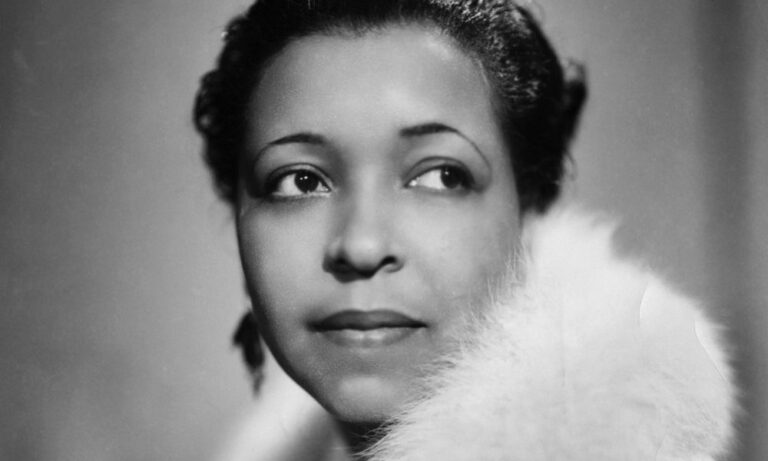
Ethel Waters was born on October 31, 1896 in Chester, Pennsylvania. She was raised in poverty by her grandmother as well as two aunts and an uncle. When asked about her childhood, Waters once said “I never was a child. I never was cuddled, or liked, or understood by my family.” On her 17th birthday, she attended a costume party and sang two songs. Her performance impressed the audience so much that someone immediately offered her a job in Baltimore.
Baltimore
When offered the job at the Lincoln Theatre in Baltimore, she received $10 per week, nearly double what she was making before. Even with her success, she fell on hard times and joined a carnival of freight cars going to Chicago. Soon after, she headed to Atlanta where she worked at the same club as Bessie Smith. Smith demanded that Waters not compete with blues songs, and Waters agreed to sing ballads and popular songs.
Harlem
Waters moved to Harlem in 1919, getting her first job at Edmond’s Cellar, a club that specialized in popular ballads. When she arrived in Harlem, female blues singers were becoming more and more powerful. She became the fifth black woman to make a record, originally joining Cardinal Records, but later switched to Black Swan.
At Black Swan, she was accompanied by Fletcher Henderson. Over the next two years, Waters became the highest paid black recording artist at the time. In 1924, Paramount bought Black Swan and Waters stayed for the year.
https://www.youtube.com/watch?v=tJBI2E_6lFA
She switched to Columbia in 1925 and began working with Pearl Wright. She continued touring, joining with Earl Dancer in what was colloquially called “white time,” the Keith Vaudeville Circuit, performing for white audiences. In Chicago, they earned an unheard of $1,250. Later, in 1926, Waters recorded “I’m Coming Virginia” which was a hit partially due to her performing it on Broadway. In 1929, Waters and Wright arranged “Am I Blue?” which became a hit and later her signature song.
Film, Theater, and Television
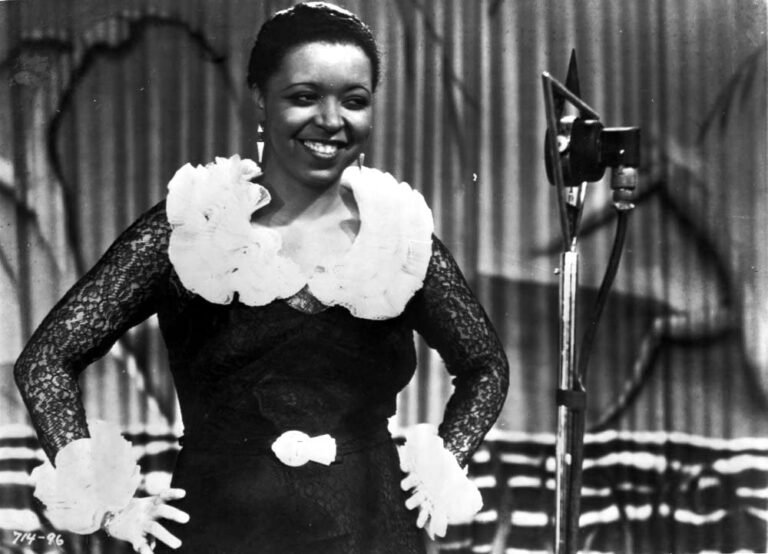
In 1933, Waters appeared in a satirical all-Black film, “Rufus Jones for President”, featuring future star Sammy Davis Jr.. She went on to star at the Cotton Club. Later that year, she stared in the successful Broadway musical, “As Thousands Cheer”.
Waters held three jobs: in “As Thousands Cheer”, as a singer for Jack Denny & His Orchestra on a national radio program, and in nightclubs. Due to these three jobs, she became the highest-paid performer on Broadway. Even with her success she still had difficulty finding work.
Waters moved to Los Angeles in 1942 to appear in “Cairo”. That same year, she starred in “Cabin in the Sky”. In the latter, Waters sang the Academy Award nominated “Happiness is Just a Thing Called Joe”.
In 1939 Waters became the first African American to star in her own television show, The Ethel Waters Show, a 15-minute variety special. She was nominated for an Academy Award for Best Supporting Actress for the film “Pinky”.
In 1950, Waters won the New York Drama Critics Circle Award for her performance in “The Member of the Wedding”. Later that year, she became the first Black actress to star in a television series with “Beulah”.
Awards and Accomplishments
Her recording of “Stormy Weather” was listed in the National Recording Registry in 2003. She became a member of the Gospel Music Hall of Fame (1983). In 2004, she received a star on the Hollywood Walk of Fame. Additionally, three of her recordings have been inducted into the Grammy Hall of Fame: “Dinah” (1998), “Stormy Weather” (2003), and “Am I Blue?” (2007).
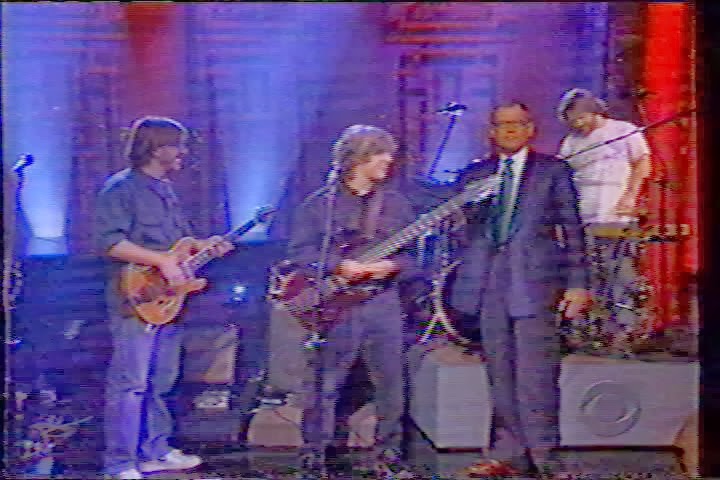
In the fall of 1998, Phish had just released Story of the Ghost, and were just about to start their cross-country Fall Tour, which included not one but two shows covering full albums by The Velvet Underground and Pink Floyd. Before diving into the tour, they’d pay a visit to David Letterman at the Ed Sullivan Theater on October 27, 1998, for the fourth time, performing “Birds of a Feather.”
via just-add-cones.blogspot.com
While Fall Tour started proper on October 29, 1998, Phish had a few performances under their belt already that month. Playing at Farm Aid in Tinley Park, IL and Neil Young’s Bridge School Benefit in Mountain View, CA, the band returned back east for a week of respite before a 30 day/22 show tour.
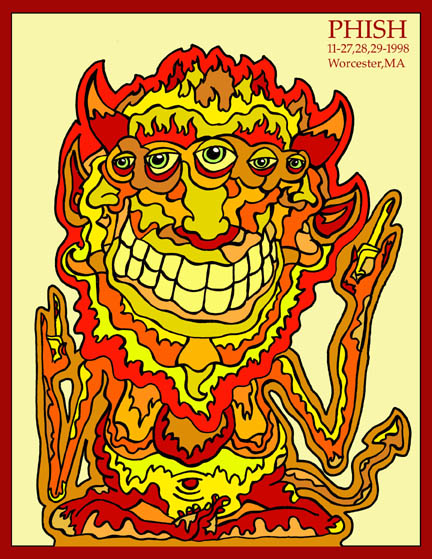
Poster for Louis Arzonico
Following guests Martin Short and Eddie Izzard, Phish served as musical guest that evening, performing the second track off Story of the Ghost, “Birds of a Feather.” Being their fourth time on the show, Letterman introduced the band noting they had their own book (The Phish Book) in addition to their new album.
The less than four minute version of “Birds of a Feather” has a lively audience celebrating not only the introduction of the band, but audibly so when the song breaks into a section where, in a live show environment, the band would venture off into exploring the arena rocker.
Following the performance, Letterman shakes hands with drummer Jon Fishman and says “Its Phish, kids!” The band would not return to the Ed Sullivan Theater until May of 2000, ahead of the release of Farmhouse.
Other individual song performances on Letterman include “Chalkdust Torture” on December 30, 1994, “Julius” on July 13, 1995, “Character Zero” on March 5, 1997, “Heavy Things” on May 15, 2000, “All of These Dreams” on December 19, 2002, a multi-song performance on the Ed Sullivan Theater marquee on June 21, 2004, and “The Line” on June 25, 2014.