Malik B., a founding member of legendary Philadelphia outfit The Roots has passed away. Born Malik Abdul Basit, he was a recognized member of the iconic hip hop band — which includes Ahmir “Questlove” Thompson and Tariq “Black Thought” Trotter — for their first four albums, with his last appearance as a member of the group on 1999’s Grammy-winning Things Fall Apart.
https://www.youtube.com/watch?v=uROfXQML7NY
Malik went on to release a solo album in 2005 titled, Street Assault, and a subsequent album in 2015 titled Unpredictable, with record producer Mr. Green. After several years apart, Malik B. was featured on two additional Roots album, including three tracks on 2006’s Game Theory, as well as two tracks from their 2008 album Rising Down.
The Roots, who currently serve as the house band for Jimmy Fallon’s “Tonight Show,” shared Malik B’s passing through a social media post that reads:
“We regretfully inform you of the passing of our beloved brother and longtime Roots member Malik Abdul Basit,” the group said on Twitter. “May he be remembered for his devotion to Islam and innovation as one of the most gifted MCs of all time. We ask that you please respect his family in our time of mourning.”
We regretfully inform you of the passing of our beloved brother and long time Roots member Malik Abdul Basit. May he be remembered for his devotion to Islam and innovation as one of the most gifted MCs of all time. We ask that you please respect his family in our time of mourning pic.twitter.com/NVHtb2CFWP
Charlie Daniels, legendary American singer-songwriter, died at the age of 83 on July 6 after suffering a hemorrhagic stroke. He was a member of the Country Music Hall of Fame and wrote the hit, “The Devil Went Down to Georgia.”
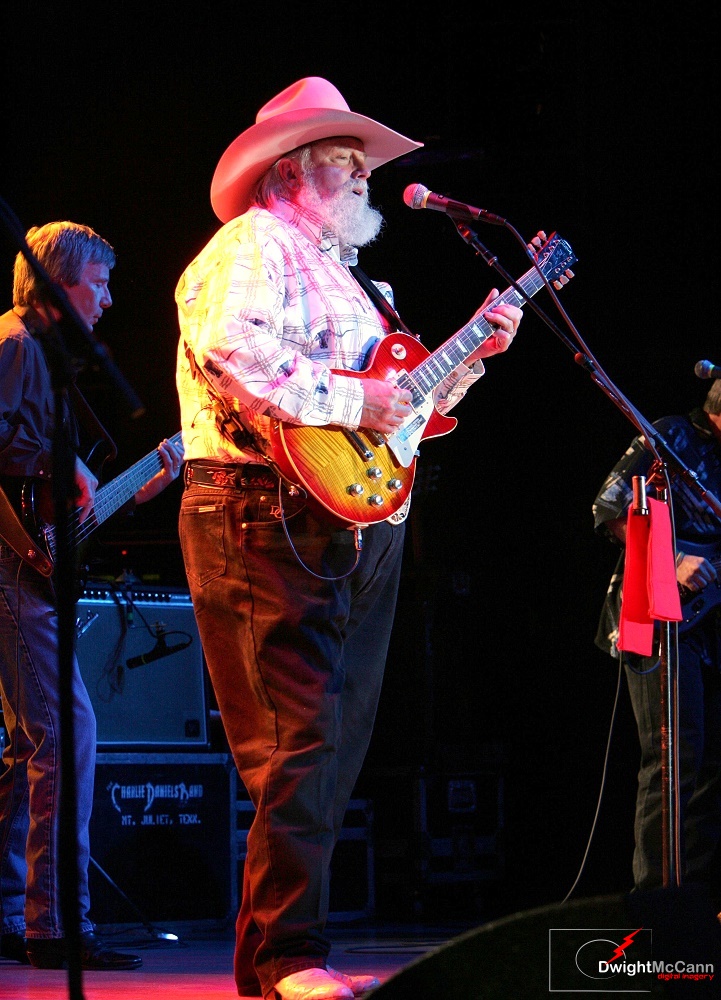
Charlie Daniels in concert at the Chumash Casino Resort in Santa Ynez, California. Photo by Dwight McCann.
Daniels was born on October 28, 1936, in Wilmington, North Carolina. He had a musical background with his father William Carlton Daniels who played fiddle and guitar. Daniels quickly learned both instruments while in school before forming his own group the Jaguars, in the late 1950s.
Daniels started writing his own music after forming Jaguars and ended up writing “It Hurts Me,” which was a collaboration with Joy Byers that ended up being a Top 40 hit for the B-side of Elvis Presley’s album Kissin’ Cousins in 1964. After Jaguars broke up Daniels moved to Nashville in 1967 and teamed up with producer Bob Johnston. Daniels became a well known and successful session musician. He worked on albums like Bob Dylan’s “Nashville Skyline” and Leonard Cohen’s “Songs of Love and Hate.”
Daniels then recorded his first album under his name in 1970. The solo album was titled “Charlie Daniels” and didn’t make much of a splash. He then signed with Kama Sutra label and recorded “Uneasy Rider” before he ended up landing with Epic Records in 1975. Having two dozen hits on the country charts and four then crossed over on to the pop charts including “The Devil” and “In America” Daniels was a house hold name. The hit song, “The Devil Went Down to Georgia,” was written and released on the Charlie Daniels Band’s album Million Mile Reflections in 1979.
Danial received the Pioneer Award by the Academy of Country Music in 1998. He than received the BMI Icon Award at the 53rd annual Country Music Awards in 2005. He joined the Grand Ole Opry in 2008 and was inducted into the Country Music Hall of Fame in 2016.
Daniels will be greatly missed from the music community. We mourn his loss and send our condolences to his family and friends.
The comedy world lost a giant today, as Carl Reiner passed away at age 98. Known for creating The Dick Van Dyke Show and directing comedies including Oh God! and The Jerk, few know that Reiner also dabbled in singing, notably opera music, part of two television performances that bookend his career.
Born in The Bronx to Jewish immigrant parents in 1920, Carl Reiner would go on to serve in the Army Air Force in World War II, before performing in Broadway musicals Inside U.S.A. and Alive and Kicking, among others, as well as the lead role in Call Me Mister. In 1950, he joined the cast of Sid Caesar’s Your Show of Shows, appearing on air in skits while also working alongside writers Mel Brooks and Neil Simon in the early years of their careers.
At 33 years of age, Reiner joined Caesar’s Hour in October 1955, Reiner would perform a selection from Pagliacci, with Sid Caesar in the role of Gallipacci (Canio in the original opera). Gallipacci and wife Rosa (Nedda), played by Nanette Fabray, are traveling in an art troupe, when Rosa falls in love with Emilio (Silvio), played by Reiner. The two make plans to elope, but a jealous Gallipacci discovers their plan. Watch below and listen for a young Don Pardo introducing the sketch.
Now compare a young Reiner, whose career was just getting started, to a 91 year old Reiner on Conan promoting his book “I Remember Me.” The two discussed how he was never able to perform opera for a career choice, and Conan offered him a chance to perform on the show that night. Reiner took the chance and sang from Pagliacci.
Rest in peace Carl Reiner, thanks for the laughs and for shining a light on your potential operatic career.
Milton Glaser, the master artist who created many of the most popular images of our times, from logos for IBM, DC Comics, UPS, Brooklyn Brewery, and ABC, to the iconic “I ♥ NY,” has passed away at 91. For we devotees of music, and especially New York State music, Glaser also holds an interesting place, as the man who inadvertently helped bring Bob Dylan and many figures of Sixties music and beyond to Woodstock.
According to Barney Hoskyns must-read history of Woodstock and its music scene, Small Town Talk, it was Glaser who we may largely have to thank for Dylan’s relocation to Woodstock.
As told in Hoskyns’ book, Manhattanite Glaser and his wife Shirley owned a second home in Woodstock since the 1950s, where they often entertained city friends, including Dylan’s famed manager Albert Grossman. It was natural for Milton Glaser to be drawn to the town since it has a history in art going back to the founding of the still-going strong Byrdcliffe, America’s first art colony in 1903.
When a large property with 60 acres of land became available in 1962 in adjacent Bearsville, for the then princely sum of $50,000, Glaser immediately thought of Grossman. As quoted by Hoskyns’, “We didn’t know a single person with $50,000 except Albert,” said Glaser. The fact that Grossman resembled a bear may have also played a role in his choice of location, according to Glaser.
Though Dylan first came to Woodstock in 1961 to stay at a cabin owned by the family of Peter Yarrow of Peter Paul and Mary, another Grossman-managed act, it was the comfort and protection of Grossman and his wife Sally that finally made him settle, as a way to escape the crazed demands of his stardom. Dylan lived in several homes in the area and was followed up by his backing band, The Band, who took up residency and created a musical workshop at the famed but decidedly humble Big Pink in West Saugerties, from whence the famed Basement Tapes emerged.
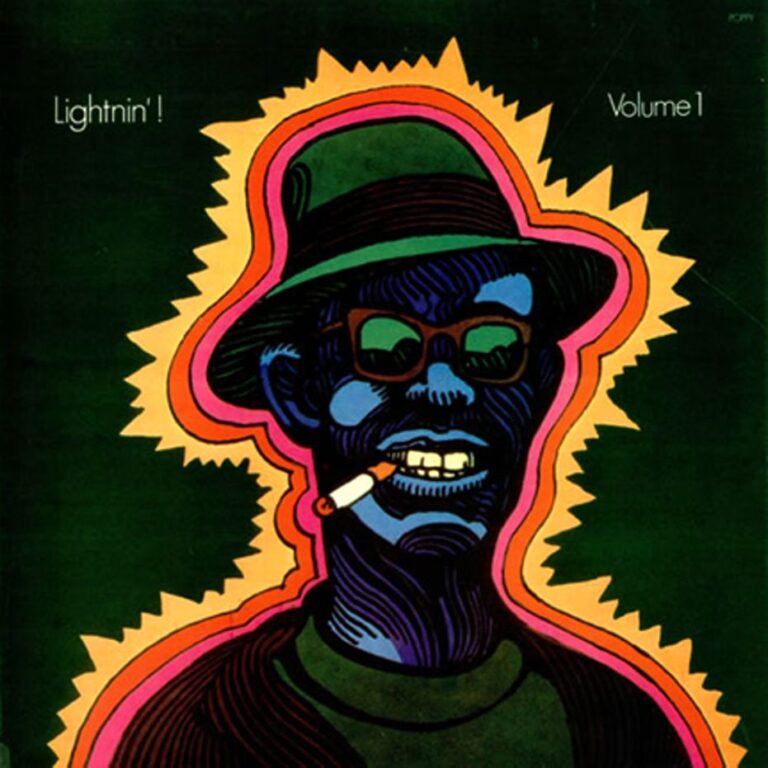
Lightnin Hopkins album cover by Milton Glaser
In time, many more would follow to become full and short-time residents including Van Morrison, Jimi Hendrix, Paul Butterfield and Janis Joplin, another Grossman-managed artist, and more recent names like David Bowie, B-52 Kate Pierson, King Crimson bassist Tony Levin, jazzers Jack DeJohnette and Pat Metheny, to name a few. Goldman went on to expand the musician attraction offerings in Woodstock by creating Bearsville Recording Studios and the soon-to-reopen Bearsville Theater.
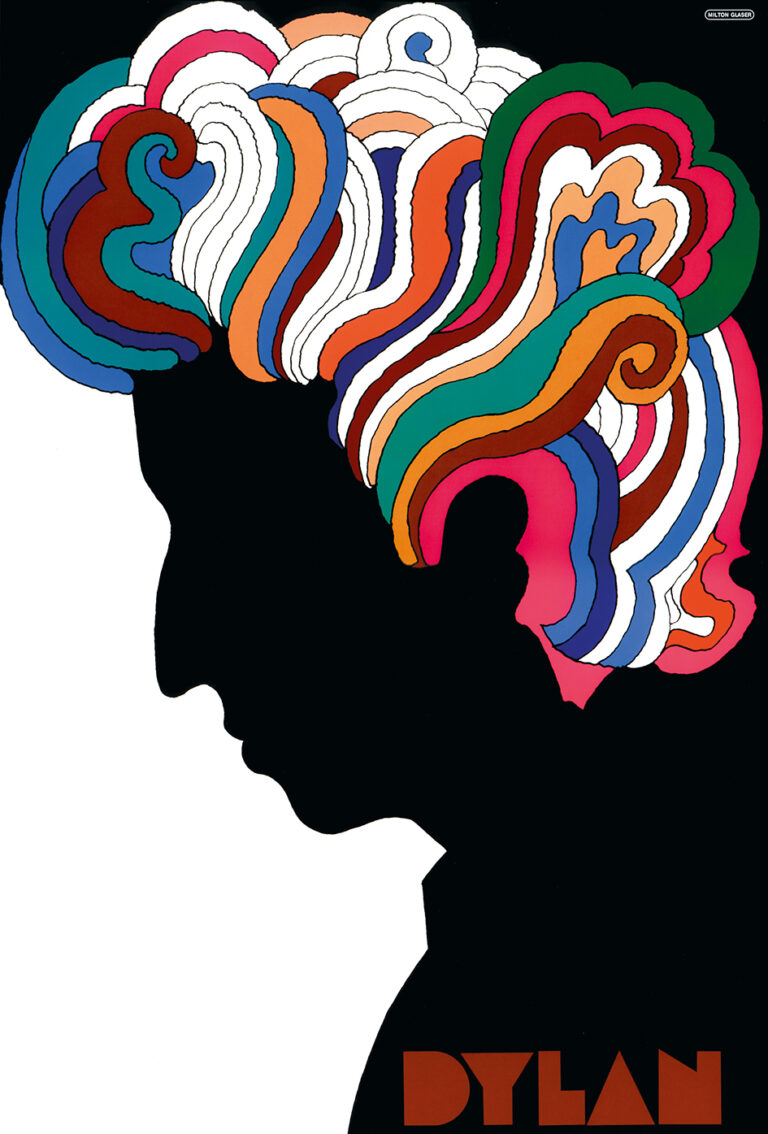
Glaser was also famed for his poster art, creating more than 400 at his Push Pin Studios. One of his most famous was one he created for the 1967 album, Bob Dylan’s Greatest Hits. Here, he drafted a simple outline of the singer’s head, based on a black-and-white self-portrait silhouette by Marcel Duchamp, and added thick, wavy bands of color for the hair, forms he imported from Islamic art. Nearly 6 million copies made their way into homes in America, making it one of the most popular wall hangings on the bedrooms of young people in the Sixties. Glaser also produced a slew of album covers for artists including Paul Simon, Peter, Paul and Mary, Doc Watson and Townes Van Zant.
For more on Woodstock music history, pick up Barney Hoskyns’ Small Town Talk, which features a handy map to many of the former homes of the music stars. For more on Glaser and his art career, read today’s obit in the New York Times.
Rock and R&B legend Little Richard died on May 9th, 2020 at the age of 87. The legend sold more than 30 million records worldwide and was widely recognized as the “architect of rock ‘n’ roll.” Pastor Bill Minson, a close friend of Little Richard’s, told The Associated Press that Little Richard died Saturday morning. The rock icon’s agent Dick Allen later confirmed he was suffering from bone cancer.
Richard Wayne Penniman, more commonly known as Little Richard, was born in Macon, Georgia. He grew up during the Great Depression and was one of 12 children. As a child he didn’t conform to typical gender expression norms and suffered a small deformity where his right leg was shorter than his left, making him a bit of an outcast.
He had multiple successful hits including “Tutti Frutti” which made it into the Top 40 and “Lucille,” “Keep A Knockin’,” “Long Tall Sally” and “Good Golly Miss Molly” which were all foundations of rock music according to the New York Times.
Little Richard was one of the original inductees into the Rock and Roll Hall of Fame, which opened in 1986, alongside Elvis Presley, Chuck Berry, Buddy Holly, Jerry Lee Lewis, Sam Cooke and others. Little Richard is known for saying, “I am the architect of rock ‘n’ roll! I am the originator!” during the 1988 Grammy Awards due in part to being a founding member of the Rock and Roll Hall of Fame.
He announced his retirement from live performing back in August of 2002 but still could be seen performing the occasional show or on commercials like his appearance in a 2006 commercial for GEICO insurance.
Little Richard is known for being an influence on many musicians and claimed he paved the way for Elvis, provided Mick Jagger with his stage moves and conducted vocal lessons for McCartney according to the New York Times. Bruno Mars is known for saying Little Richard was a big influence for him.
We mourn his loss and send our condolences to his family and friends.
Neil Peart, the pioneering drummer and primary lyricist for Canadian progressive rock icons Rush died Tuesday, January 7 following a nearly three-year-long battle with brain cancer. He was 67 years old.
The influential drummer joined Rush, replacing John Rutsy, in 1974 for the band’s second album Fly By Night and immediately changed the musical direction of the band with his Ayn Rand and SciFi-inspired lyrics and technical drumming skills.
Peart was an unassuming and deeply private man with an extraordinary talent for drumming, the man who inspired legions of air-drummers throughout the world. He rarely did interviews, leaving those duties for bandmates Geddy Lee and Alex Lifeson, where he spoke most directly was through his lyrics.
Drawing from science fiction, fantasy and the works of Ayn Rand (which he would later renounce), Peart wrote lyrics that could be fantastical, could be direct but they made the listener think.
The 1982 single “Subdivisions” spoke directly to a generation of young disaffected high schoolers, addressing the loneliness and separation of one trying to fit in.
Subdivisions
In the high school halls
In the shopping malls
Conform or be cast out
Subdivisions
In the basement bars
In the backs of cars
Be cool or be cast out
Rush – “Subdivisions” (1982)
Those lyrics spoke directly to this writer trying to find his way around the halls of Staley Junior High School. It let the disaffected know they weren’t alone in their feelings. And it struck home.
A truly lasting memory associated with Rush is from the winter following the release of the band’s breakthrough 1981 album Moving Pictures. This album was inescapable that year but nowhere more than at the outdoor hockey rink at Franklyn’s Field in my hometown.
My friends and I made the short trek to the park every day, sticks over tiny shoulders, skates dangling behind us. We knew we were in the right place once we heard the lone tinny speaker attached to a light pole overlooking the rink cranking “Limelight,” “Tom Sawyer,” “YYZ.” This was my first real exposure to Rush and the most lasting memory I have of the band. The songs were technical, yet accessible. And the drums. I’d never paid much attention to individual instrumentation as a 12-year-old finding his way in the music world. Peart demanded your attention. And he did just that, for 40 years. A virtuoso in a band of virtuosos.
Peart retired completely from drumming following Rush’s final tour in 2015. The demand put on his body over years of constant performing left Peart unsure of his ability to maintain his precision. The demands of the profession lost out over the desire to spend more time with his family and with his other writing and producing projects.
He leaves behind his wife Carrie Nuttal and a daughter, Olivia along with a legacy few humans can claim.