Category: World/Reggae

  • James Searl of Giant Panda Guerilla Dub Squad and Ryan Guay of Street Pharmacy talk COVID-19 and push-back from Right-Wing Fans

    In an excerpt from a previous interview with Street Pharmacy‘s Ryan Guay and James Searl of Giant Panda Guerilla Dub Squad on their collaborative track titled “They Don’t Give A $$$$.” Released July 2, both artists took the time to reflect on the past few months. The radical adjustments and adaptations both of them needed to make in order to survive the lockdown music industry were foremost in their minds. With the lockdown came an increased online presence for the both of them, which meant more online interactions with right-wing fans that became heated around the release of “They Don’t Give a $$$$,” interactions which both James and Ryan elaborated further upon in the context of a divided political climate.

    Giant Panda Guerilla Dub Squad

    Thomas Lent: COVID-19 has negatively affected a majority of the entertainment industry, but how has each of your group’s plans and strategies around shows and monetization changed?

    Ryan Guay: I’ll let James take this one first.

    James Searl: Well, our situation, I think. In Giant Panda Guerilla Dub Squad, anytime outside conflict has come up with the group we’ve always gotten more efficient and a little bit more communicative about whatever hole we needed to plug previous to that conflict. So when people left the band we didn’t expect to leave. We had to address that. We kind of really get tighter and more trusting of each other, because people who were originally in the band, the founders with me, found that actually, we have to work harder to find what we have now. That turned out to be something that works better. The next example would be any of us having children. Was this gonna, kill our ability to tour or come up with music? We just got more efficient at touring and putting out albums that we’re happy about. With Coronavirus I think we felt pretty good about the time that we have the kind of reflected and work on new material. We’re recording a new album which we’re having a hard time finding the time and money to get that together in a quick manner. Now we have even a bigger block of time. We’re securing news funds, recording music, and working on new songs, because nobody has anything else to do playing live for the next, god knows how long. Because, at least in the states, I don’t know people are really gonna feel how serious this is.

    Giant Panda Guerilla Dub Squad

    TL: Well, I can say that in Buffalo at least, I live in a suburb outside of Buffalo and specifically East Aurora, and we have an elder.

    JS: That’s where my whole family is from!

    TL: Really? Small world! I think about thirty-five people died in that place alone so I would say that people are taking things far more seriously.

    JS: I hope so, that’s not what it’s like where I’m living. I went to get some beer at a store in southern Michigan. I live near the border around there and nobody is wearing a mask and the cashier said something about it and I’m like “I’m wearing this for your protection!”, So I said I didn’t know if masks were required here or not, I know that Michigan has some pretty serious laws right now and they said that “We tell people they don’t have to wear masks because we would lose half our business” and I’m like ok, but really, “Half the people? Really?” you’re selling beer and cigarettes, two products that people are going to be getting anyway. But as far as moving forward goes theirs a different presence online and I don’t like being ultra-online.  I don’t like that idea like everybody being so online, but I also can’t imagine what this would have been like twenty years ago, I just can’t imagine it. Now because we have all these different ways to still be together with apps and to stay in communication with music. I mean, every Tuesday when I’m putting my kids to bed and start to clean the house and stuff and I can find a show for RootFire where I get to listen to classic Reggae tunes, whereas like before, I probably wouldn’t have gotten to see that. Clinton Fearon, one of my heroes, actually plays every Sunday at his house and he’s in his 70’s! So I think it’s nice for him to not have to leave his house to share with his fans all over the world. Could we have done this before? Sure, but nobody did. And we’ve just been accelerated into the future about what live music is gonna look like. What live music is about is connection and that goes back to the fans with the MAGA hats at the front row of the Panda show. I wanna find a way to talk to you because I’m glad you’re listening to the music and I’m glad that we’re connecting with the music but obviously theirs a personal disconnect that probably could be reconciled as well as it could without conflict. It would be easier reconciled just to listen to a song and having your own time to reflect on this stuff. Especially not having to deal with you personally, I’ll say.

    Giant Panda Guerilla Dub Squad

    RG: That’s a good point. I’ve definitely seen some or received some comments from fans that are no longer fans and not supportive of what our video and what our song represents because they’ve interpreted it in a way that they feel almost insulted. That’s not the intent here. We’re trying to communicate with people that need not understand the premise. They quite frankly get the wool pulled over their eyes and were just trying to have a conversation. James says that “Now we’re having good conversation” in the second verse and we want to have good conversation, a positive dialogue. If anything that’s the way that social media has proven that this discourse is anything but civil. As a result of being locked down and everything else that has occurred. I think that probably, other than stuff James already mentioned, as to how this has affected musicians, that is also the same thing with us but being online means you’ve gotta put yourself out there in a way. It can be volatile out there. I experienced this first hand. The first week that this song has been out I’ve had to mitigate these comments where fans have felt betrayed that we have done something like this and my response is “Sorry that you feel that way but this is how we feel about it and you should really look into this because our lyrics over the last 15 years that we’ve been playing, you’ve probably missed some of that.” So it’s yeah it’s kind of like the idea that people are tweeting against Rage Against the Machine that have been fans for 20 some odd years and then realize that they have left-wing values.

    Giant Panda Guerilla Dub Squad

    TL: When I was listening to your track I thought that you weren’t just punching one way or the other. You have clips of Nancy Pelosi in there as well. I don’t think you were particularly going after one side, you were going after one class though. It’s not as if it is a good class, particularly if you’re talking about the one percent there and you know, who’s defending them? Why would you?

    JS: Exactly who in the 1% is listening to this song? Like if this song is about you, if you’re the person that doesn’t give a fuck about us, then there’s only so many people that could be.

    RG: Their probably not hearing this song in reality.

    JS: And ya to be fair, at least Panda, I was thinking about how over the years Ryan would say that he got some pushback on a song, like I’ve been dealing with pushback online just for speaking and trying to change people’s minds about being anti-racist and pro-environment for many many years and it has been incredible to realize how many, I mean, I’m not trying to pigeon hole people but it’s always a white dude. It’s a white young man commenting, “Why don’t you shut up and play music,” “What about black on black crime.”, just you know straw man arguments. Stuff that we just don’t have the time or energy to deal with on that level, but we always try to be there and are open to have conversations but people don’t want to listen. Reggae, Rage Against the Machine, and hip hop all of this is revolution music that has been around since recorded music acts as a pressure valve for people to be more comfortable, and they’ll say “I am tolerant I listen to Bob Marley, and I’m voting for Donald Trump,” and it’s like, well you know what, I think we should have some more detailed dialogue about that stuff.

    Image may contain: 1 person, smiling

    RG: The discourse that were trying to have here is to cut the extraneous bullshit that that people are being fed. This is how we end up with the culture of you know. Young white men that feel disenfranchised. But actually they are a more privileged class, you know- and it’s mind-boggling to me- that some of these lyrics could be misinterpreted. At the end of the day, the purpose of this song is to cut through the bullshit and the same with the video. The video shows that on both sides, that when you’re at the top, those people don’t really don’t give a fuck about you. No matter who you are. They only care about the bottom dollar, the bottom line, just like you said about share prices, people being concerned about yeah reporting, rail blockades because they’re worried about shareholders losing you know a lot of money or losing faith in the company. That is absolutely ridiculous. We’re facing catastrophic climate change that could end humankind as we know it and somebody is worried about stock prices. That seems so wild to me. You know people need to talk about these things, and you need to understand that this is coming from great, and you know I hate to quote Warren Buffet, but I’m gonna do it. You know when people are fearful he says to be greedy when people are greedy he says to be fearful. Right now you know the people at the top of the top are perpetuating this fear in society and it’s resulting in an exorbitant amount of greed. How is the stock market not ya know completely shattered? It doesn’t make any sense!

    TL:  When it comes to the young white men who are you showing up to your shows wearing MAGA hats being obtuse my current hypothesis is that conservatism represents a counter-culture and the youth enjoy rebelling and they enjoy being contrarian. They feel that when all their professors and their teachers are all liberal.  “I’m gonna be conservative because that’s what they don’t like and that’s what they aren’t.” It’s to be contrarian, would you agree with that?

    RG: Yeah. I agree with that yeah that makes sense. I think that a lot of these young white men and other people that are taking the uber-conservative side of things, I think that they lack a spiritual connection with themselves and they’ve lost their sense of identity. This counter-culture is that identity. That search for an identity, where they feel the need to identify with something that looks like them and that’s what I found with having to defend this song.  When I’m looking up their Facebook profile, I’m seeing just “Being lost,” and I’m seeing that they are not being sure of themselves or who they are. That seems to be the case for a lot of these people I’m assuming. I’m Canadian so this might not be as big here so I might not be seeing it as often. James, what do you think of that?

    Image may contain: 1 person, playing a musical instrument, on stage and concert

    JS: I think there’s a good degree of that on both sides and that’s like a bigger conversation about the American psyche or the American identity. When I was growing up all suburban kids listened to hip hop. And it’s like, why is that? Why are they listening to music that is directly about where you’re not from and not made by people in your position? In a lot of ways, it could be really beautiful because that’s one way that some people that are in an oppressed situation are making communication and it is being observed by people on the other side. That would be the call that we would all answer too. I think that that’s been my motivation in my life for my music, doing as good of a job as I can do. I’m not like a, you know, I don’t feel great about everything that I’ve accomplished for human rights since I’ve listened to Rage Against the Machine when I was 11 years old. It’s like, “Oh this is the side that I’m not being told”, “This is what I’m not experiencing” and I feel like it’s my responsibility as a moral person to bring justice and rights and to improve culture by talking about it because if you’re not talking about it then you’re supporting it.

    And that’s from Zack Del La Rocha from his concert in Minnesota that I had a recording of that I was listening to when I was 13 years old. “If you’re not a part of the solution then your apart of the fuckin problem” that was in the middle of the speech in “Wake Up” and I’ve never forgotten that speech. It gave me goosebumps then, it gives me goosebumps now. He was talking about Leonard Peltier from the American Indian Movement in that speech. The thing I wanted to say about the young men who are rebelling and being conservative as apart of rebelling, what troubles me about that is that in the sixties, early seventies, in the eighties, with whatever that rebellion was I’m not sure, or grunge in the 90s was everybody was the, the counter culture was resistant to the greater culture, the hegemony, the mainstream. What’s scary about these guys is that there is already a structure ready to like accept them with this counter-culture and give them the tools to carry out this system. This includes tons of legitimate journals, newspaper writers, college professors, and ya know the money that’s given to colleges.

    GPGDS

    TL: They’re not organizing in garages, they’re being given grants from super PACs.

    JS: Right! When I was in college I studied international relations and, being taught by hip-hop and African music things that I didn’t learn about growing up in the suburbs necessarily, points of perspective. I knew that jobs I would get to try and fix those things, there was no money there. Not even to pay me but not even to exist in a way that was meaningful. My counterparts in college were like, republican conservative people who went on to be funded by the Koch brothers and went on to be the president of not-for-profit groups in Washington D.C. who use 49% of their power to influence politics and 51% to influence culture because that’s what they have to do to be a non-for-profit. These are Koch brother founded organizations. That makes me really scared about these, that was going to have to be dealing with these young people as adults with power that are already coming from privileged places and they’re ready to be moved right along into positions of power.

    Matt Gaetz, the 37-year-old Congressman from Florida, he’s just atrocious. Stephen Miller for instance he’s my age. If you thought these guys were old and dying out you’re wrong they’re being replaced with more young people. In the verses that I wrote in the song with Ryan I think one of the main points is to not be passive about this. Be active. Get on the streets. Sacrifice as much as you can because this is a fight that needs as much energy as possible because the people that don’t give a fuck about you. They also have all the money and a lot of them have all the guns.

    Image may contain: 3 people

    RG: All the guns.

    JS: They have all the guns because we’re non-violent people! We know that if you put a gun in your house you’re twice as likely to die from it. You know it’s like everything points to, I don’t want to have a gun but what am I gonna do when all these crazy people, ya know, it’s all about certain numbers. It feels good to go to a protest. Not on the internet. Actually out on the streets with people who believe in these things as much as you do. Ya know to these young MAGA kids it’s never the way that you see it on the news. It’s never a bunch of violent people (at the protests) its young, old, men, women, non-binary people, everybody’s there at these protests and so many times the cops just come bust it up. In Denver, my friend was in one for the boy Elijah and everybody was playing violins outside and the police came and tear-gassed everybody. This is not a time to be passive. You know Ben Shapiro, Jordan Peterson, they all tell you to watch. Wait and watch and just see what happens all of this is gonna come crashing down. Donald Trump is gonna rid the world of pedophilia, I’ve heard this from so many people, panda fans included. It’s just like “Sit and Watch, Sit and watch other people do this for you”!?! Why aren’t you apart of your movement that you speak so highly of?

  • Ryan Guay of Street Pharmacy and James Searl of GPGDS talk new single “They Don’t Give A $$$$”

    Ryan Guay of Street Pharmacy and Giant Panda Guerilla Dub Squad‘s James Searl have unveiled a passion project collaborative track titled “They Don’t Give A $$$$.” Released July 2, both artists spoke to NYS Music about the inspiration and writing process of “They Don’t Give A $$$$” as well as the experience of working together on the track.

    Thomas Lent: What would you say was the inspiration behind “They Don’t Give a Fuck”?

    Ryan Guay: I had written that chorus in the months before the pandemic and James and I had been in discussion on getting together and collaborating on a song that talked about how the corporate elite sort of use manipulation and tactics to make more money and fill their pockets, and it doesn’t really help anybody but themselves. I thought it would be a really unique chorus to say “they don’t give a fuck” but say it in a way that reflects more what they are actually doing. They don’t want to give up anything to anyone and they will do anything in order to make that happen. So that’s where the initial inspiration for that chorus came from and I sent it in an iPhone memo to James and James and I started writing back and forth with ideas over the phone and I think that’s where James,

    James Searl: Yeah, that’s totally right and one of the cool things about collaborating with another artist on a song is that I think to start with, ya know if you go into the office at like 8:30 a.m. and like we put up a vision board or something and we’re gonna put out a perfect song but in my way. It’s conversational which is how music is, and Ryan and I, we met each other fairly recently. In the past couple of years. We’ve had some nice conversations just about all the things we relate to together and all the things we have in common especially growing up so close to each other but also divided by a national boundary. I feel like this chorus kept making its way into the conversation and what we were talking about things that like, Ryan, forgive me I think you studied history in school?

    RG: Yes, I studied history

    Street Pharmacy

    JS: I studied international relations and we have just like the same interests but different knowledge. We would be telling people different things and be like, “Ya they really don’t give a fuck”. Not only was it the chorus that Ryan had sent to me but it would always keep coming up in our conversations and I feel like that’s a really fun loop to get into creatively was like, it’s a natural, how they bring it all together, especially as musicians in this time, I think it can get a little bit cliché to say, “Oh we’re writing a song that’s relevant to this time”. I think as an artist, it’s our responsibility to kind of talk about what’s always been happening, and until that goes out of style its always going to be in style. It’s not that it’s like for this time or for that time but for all time and talking about the indigenous situation in both the United States and in Canada or Black Lives Matter, it’s just, the common denominator is always that theirs this very rich, mostly white, mostly male, very small population that’s kind of…I wouldn’t say pulling the strings necessarily, but taking advantage of the divisiveness especially. I think another thing that one particular circumstance Ryan had called me and said “hey they’re coming down the street and there’s all of these white supremacy signs being held and all of these alt-right people looking respectable; they don’t look like neo-Nazis like we’re used to seeing, they’re wearing nice shirts and kakis”

    TL: Yeah, they changed their image after Charlottesville

    JS: They did and Ryan was like “I’ve never seen this in Canada before” and it was just funny (it wasn’t funny) but he was earnestly, very concerned. He went and talked to the leader of the right-wing group that was talking about getting rid of immigrants and everything and it was just so wild to be seeing this happening in the States and in Canada. When we were growing up, the first song I wrote in a band was called “A Groove To Kick a Nazis Ass Too” and it was all about not being racist and it was cool to be against that when we were younger so it’s hard to believe that this is a trending thing with young men who would be in our similar positions now. It’s just, “How did this catch on?” I would say that it has a lot to do with how the song came together.

    Street Pharmacy

    RG: That happened in January of 2019 in the dead of winter. These guys were putting up signs on the corner of the street in my hometown of 50,000 people, signs that were encouraging people to kick the immigrants out of Canada. “Not my Canada,” stuff like that. I’ve never seen anything like that before, ever, and the first person I messaged and sent a picture too of this occurrence was James. Because we talked about this boiling point in the United States and I never saw it, I never expected that. They had their polo shirts and they’re eating their double-doubles, just “smiling and waving” The next minute they were putting signs up near my rental property. I live in the basement of one. I rent housing to international students and they were putting signs up on these lawns marking where international students lived saying, “Kick them out”. I had never seen anything like it.

    TL: With the ending of the visa program, they have basically done that at this point

    RG: That’s exactly what they did.

    JS: My wife is a professor and every professor is up in arms because it’s cruel to the students involved and it’s dumb, it just doesn’t make any sense. It’s clearly racist and it’s part of the xenophobic atmosphere that’s in politics right now. Another thing is that when you come across it now, these young men now are reading…oh, why can’t I think of anybody’s name?

    TL: Evola? Marcus Aurelius is often interpreted as one of their heroes.

    JS: Ben Shapiro! When they read Ben Shapiro or even just Jordan Peterson. Whatever powers that be that are trying to pit you against these immigrants, they don’t give a fuck about you. Like these young MAGA guys in their hats. I remember a couple of years ago these young white boys with their MAGA hats came to the front of the stage and know every word to every song so it’s kinda like they’re fans but they know that they’re trolling us and it’s just like, I don’t know why you guys are bringing this attention to yourself. The people that you are supporting, they don’t give a fuck about you. They’re not going to share when it comes time for that. All of the things that we heard before when it comes time for you to reach out to help, there is not gonna be anybody there. Ya know, you can’t eat money and the indigenous people have told us this my whole life. Be wary of these people that are trying to ruin the environment and turn a blind eye to it. In the end they’re trying to kill all of us and they’ll kill all of you too. They don’t care.

    RG:  Yeah, I’m metis and I’ve got family members that grew up on a reserve and, you know, colonial imperialism is….

    TL: I’m sorry, can I interrupt? You said you were metis – can you explain what that is?

    RG: Metis means I’m mixed blood, I have some indigenous background.

    LT: Thank you for the clarification.

    SPHeaderWEB2.jpg

    RG: Yeah, yeah no problem. So yeah, as you know, colonial imperialism is somewhat of a dirty word. The Christianization of indigenous people, you know, is really a disguise for the economic motive of imperialism of exploited resources. You know, that’s Canada’s terrible, dirty secret, really. This attempt to, quote-unquote, assimilate indigenous people openly has left a gaping wound in the culture and indigenous people are, you know, marginalized most in our country. The last residential school closed in 1996, it’s not that long ago. I think a lot of people have this perception that Canada is all hunky-dory, but it’s not, especially when it comes to the treatment of indigenous people and I know that from firsthand experience. We have the pipeline/railroad controversy clip in the first part of the music video, the Wet’suwet’en controversy. It’s a four hundred and sixteen-mile pipeline they protested going through their land for reasons and I’m not sure if you’re familiar with this, but in Canada, almost all the indigenous problems, almost all of the First Nations in Canada and its allies formed a massive national railroad blockade in protest. To stop the trade and they stopped, the C. N. for a month. Around when the coronavirus actually started to take shape.  The RCMP, which is equivalent to U.S. federal police were created for the purpose of controlling the indigenous population in the eighteen hundreds. So they were sent in to do what they were apparently meant to do in stopping the blockade and if the coronavirus didn’t happen they would probably have gotten a lot more got international attention, but that’s what the significance of the whole clip is.

    TL: After finding your inspiration, how would you describe the writing process for “They don’t give a $$$$?”

    RG: Okay, I’ll start with that one James. I pounded out the chorus on an acoustic guitar and just repeated it over and over and over again so I could remember it. I wasn’t near anywhere to recording and it became something. It has been an ongoing theme in our conversations. It always comes back to that. So. I think when music, sometimes theirs just something divine about it.  You know, you are the vessel that music is coming through, and that lyric, melody, just came out and it didn’t change at all. I just sent it to James and said.  “Hey, James what do you think of this?” And then James right away was sending me lyrics. He was inspired by it and I was inspired by what he was sending me. So then I got into a computer and started to produce it and send him some ideas with an electric guitar just some drum tracks on-we did it for the most part electronically. This was in 2019 in the winter/fall when we started to send these ideas back and forth. I remember standing in line somewhere in the mall and James sent me a great idea for what became the second half of that verse. The second half of the second verse. And I just felt that we had something of serious significance because he was able to take my hook and make it mean something.  You can say they don’t give a fuck about you and you know it could be like. Who is it? What does that mean? But James is able to channel that marriage of lyrics and melody to put it together to support the thesis statement. To be fair James drove a very far distance to make this happen. 

    Street Pharmacy

    JS: Ya I drove up to Welland Ontario which is ya know a beautiful place. I wanted to go see where Ryan is from and where Street Pharmacy does their work because since we’ve gotten to know each other it’s like finding old friends that you knew were there but you didn’t know where. So Welland was like a very familiar feeling place. It is only 20-30 minutes over the border from Buffalo. So it’s almost exactly where I’m from. And ya I just went there and I brought my base with me and Ryan had the drums and some guitars went down. I sat down and I played the bass line. The drummer Ivan was also there so it was cool to feel the vibe of the drummer in the room with me while I was playing. It felt very electric to finally sit down. When I figured out what the baseline was going to be I was very excited. That’s not always the situation when you’re with your band. Maybe when you’re alone or just with the producer. This was like with we’re making something fresh, and it was the first time we’ve done that. Ryan, as we were getting on the phone- and it was like the middle of the conference call that I realized he was extremely talented and capable and was engineering everything. He has a special touch and I love the way he mixes these things and makes them sound good.

    That was also very inspiring sonically alone. And then just working on the sonics of the tune. I actually wrote like a book with different verses for the song over time and then on that trip I think I was a little bit exhausted, traveling, just like living my life, which is like trying to balance a lot of things that one time and I didn’t end up getting to lay down the vocals on that trip. I really liked the verses that I had but we kinda delayed the track and then it came time to be like “Hey I think we should really put this together this is a message that people would really like us to sing” ya know were just artists putting music out there but WE want to say it. That’s another part of being an artist. It was the first time that I ever sat in my basement at night and wrote some lyrics, recorded it, and send it to Ryan and Adam to use that track, as a point of pride for myself, to say that “I’m good, we can do this” and I don’t have to leave my house during the quarantine. I can lay down my vocals for Ryan who is in Welland and we can make a song and we can put it out. Like this is using the tools that we have to our advantage. That’s like kind of how it all came together.

    Street Pharmacy Giant Panda Guerilla Dub Squad

    RG: Ya there was a lot of exchanging of material over the internet because the coronavirus made it almost impossible to meet and then the borders closed. So we just used it to the best of our ability. There were a lot of other people involved. My friend Mike who plays in a band called Silverstein was very helpful in getting some of the sounds. He was located here and I was sending the files to him in the latter stages. Our friend Adam was on the track and was really happy with the vocals. I think this is one of the first time James engineered his vocals.

    JS: Ya it was my first time engineering something that normally someone else would do all the time. The thing that keeps me going is working with people who really know how to engineer their sound and be able to engineer my sound as well. For Adam to think that it was useable-

    RG: He (Adam Tune) was really impressed. He’s got a good ear for being able to tell when things are right. And that’s really hard, a lot of people who attempt to engineer, they don’t use their ears. They more or less watch the meters as opposed to listening to the track. A lot of times that’s what people are just starting out do but James’s ear is fantastic. His ability in the studio to capture the moment and put it into a file and record it, especially with his bass tone and his vocal tonality, it was really inspiring for me as an engineer and a producer to be able to pull those takes out fo someone and it was like “WOW let’s try to do some other cool things”. I think at the end we tried some other, Tom Morello Esq, octave, whammy pedal type things with the base where James is going up and down a full octave. It’s almost like a bass solo at the end. That was the most fun part of the process for me, ya know this is something I forgot to mention too. The person who introduced us, who I think wants to remain nameless, came down from Buffalo to meet us and he hand introduced us. I think James has a story about that. It was really cool for him to see the idea that he something that he had sort of an idea, being a fan of Street Pharmacy and then approach me at a show and say “You really need to work with this band their great”. I said “Ok” and the same thing happened to James and it ended up working out.

    TL: It sounds like you guys really enjoy collaborating together. Can listeners expect more collaborations?

    JS: That’s the hope, ya we certainty want to do that.

    RG: Definitely. When you get together in a room with somebody and – I write commercial songs for a living under another name and another company- so I’ve done a lot of co-writing sessions and sessions for corporations and it can be difficult. But James and I have this instant, I think it comes from friendship so, we’re interested in the same things. I don’t think Rochester is too dissimilar from Welland. Because I’m so close to the border I grew up on a lot of American 90’s Alt-Rock, early 90’s late 80’s stuff, and American Punk. James had that background as well, with both of us playing in reggae-oriented bands now and ya know we listen to the same music. 90’s golden age hip-hop, Reggae, Dance hall, and also listening to 90’s alt-rock got us to this place where we can speak the same language. We can play something and be like, “Ya I know what that is it’s giving me a Helmet vibe” and James going “Wow you know Helmet I don’t know anybody who knows Helmet!”. We can talk like that without even really needing to speak. I’m really happy about that, that’s the best thing for me that’s come out of this experience other than having a song that’s very meaningful and I hope that it can help people open their eyes to the seriousness of the situation.

  • Sculpting Sounds at Brooklyn’s Soapbox Gallery

    When COVID-19 hit New York City in March, the music, as Jim Morrison crooned, was over.  But one place it never stopped was at Soapbox Gallery, one of Brooklyn’s most unique and eclectic performance venues.

    Soapbox Gallery is not the brainchild of a veteran promoter, profit-seeking barkeep or musician, but a music-loving sculptor with a true D.I.Y. spirit, Jimmy Greenfield.  

    A native of Poughkeepsie, Greenfield moved to NYC’s SoHo in the mid-1970s to pursue a career in art.  While there, he drank in and was inspired by the loft jazz scene percolating at homey little venues like Sam Rivers’ Studio Rivbea.  Like many visual artists, Greenfield became friendly and collaborated with the adventurous musos on that scene. And like many a SoHo artist, he was eventually priced out of the tony neighborhood and helped pioneer a new scene with a move to Brooklyn in the early 1980s.

    Greenfield came to the street-level space at 636 Dean Street that would become Soapbox in 1996. He utilized it for years as his sculpture studio, with the street frontage being dedicated to installations by visual artists he loved. 

    soap box

    “The gallery was inspired by the idea of a soapbox, the humble stage that one stands upon to deliver a message, a narrative story, that can start a movement that can perhaps change the world,” says Greenfield. “It functioned that way for our art shows and, since 2014, with our escalating program of musical events.”

    Music became a part of Soapbox Gallery in 2014, when Greenfield made his venue the home to periodic shows by critically acclaimed Brooklyn Raga Massive, a collective of world class musicians dedicated to furthering the understanding of Indian classical and Raga forms.  Within a couple of years, Greenfield decided to move his sculpture studio to another location and, over time, convert Soapbox into a full-time performance space.

    “The idea was to create an intimate space, a sanctuary that was almost like a mini-concert hall,” adds Greenfield. “I wanted the best sound and atmosphere, so we completely renovated the space, with soundproofing, a dropped ceiling with acoustic tile, high-end sound mitigation and amplification.  We wanted the room to be a draw, the perfect acoustic environment that would attract the very best musicians.”

    soap box

    It was serendipitous that Greenfield tapped his neighbor, filmmaker Dave Power, and his brother, the sound-painting saxophonist Hayes Greenfield, for advice on cameras and sound, and to execute all the physical labor.

    “Our intention was to create not only a world-class performance space of intimate size, but a top-of-the-line production center as well,” adds Greenfield.  “We designed where the camera drops would be, where the computers and controls would be, even a system to move the sound around the space and the stereo spectrum, all anticipating the era of streaming.  So we were ready for what has, unfortunately, become the performance model of today.”

    Another thing Jimmy did to attract a top-flight coterie of performers was purchase the world-class piano, the lightly used Yamaha C7 that is the physical centerpiece of the space. 

    “My friend Ludwig found that for us, a 1998 Yamaha Grand that was barely used,” continues Greenfield.  “It was another stroke of good luck in the collective, all D.I.Y. effort to build this space and scene.”

    The scene started to gain critical mass in 2019 with Soapbox Gallery’s weekly Piano Hangs, organized with David Berkman, noted pianist, author and director of the Jazz Department at Queens College.

    “Every Saturday, we would invite four to five pianists to perform and discuss their work,” adds Greenfield.  “The series attracted high-caliber talent from the worlds of jazz, classical and beyond, like Fred Hersh, Chano Dominguez and Bruce Barth.” 

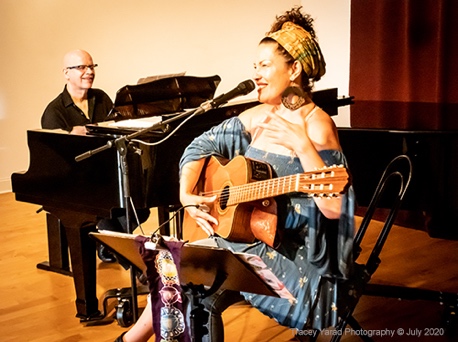
    Into 2020, Soapbox Gallery continued to expand its palate of performances.  Greenfield added small groups like jazz trios, classical quartets, a virtual fest with the New England Conservatory Jazz Lab, and solo performances by notables like electro-jazzer Adam Neely, looping violinist and vocalist Natie, singer/songwriter Tracey Yarad and many more.

    Hayes Greenfield Electro-Acoustic Looping Musician 4 parts from Hayes Greenfield on Vimeo.

    One mainstay of the space has been Jimmy’s renowned musician-brother Hayes Greenfield and his Immersive Surround Sound Experience.  Here, Hayes employs his saxophone, flute, kalimba, harmonica, voice and a plethora of delays, synths, effects pedals and loopers to create meditative sound environments reminiscent of Brian Eno’s ambient works.  With the assistance of Hayes’ sponsor, Eventide, Soapbox Gallery has been outfitted with a system that produces true 3D sound that can be moved around the space and within the heads of stream listeners.

    When COVID-19 closed down NYC’s live performance venues in mid-March, Jimmy and Hayes were quick to provide a sonic salve for the quarantined masses, in New York and wherever there was a broadband connection.

    For weeks after the shutdown, Hayes performed his Sound Meditations nearly every day at 3 pm from the Soapbox Gallery, more than 30 total events and counting.   As soon as WNYC’s Greene Space began streaming in early April, Soapbox Gallery began programming more events, from its space and the homes of some of its coterie of musicians.

    Since May, Soapbox Gallery has been presenting live-stream performances six days a week from Greenfield’s former sculpture studio. Its state-of-the-art, three-camera system provides a great view of the action, and video overlays are increasingly a part of the performance equation, providing a unique multimedia experience. 

    One notable upcoming event that will make the most of the technology is Soapbox’s three-day Sonic-Vision Looping Festival, August 26– 28.   The event will include adventurous performances by noted percussionist Will Calhoun (Living Colour, Pharoah Saunders), Hayes Greenfield and the ambient guitar duo, Guitars A Go Go, who will perform their hypnotic improvisations to fractal videos.  

    2020-07-19 19-15-44 from Soapbox Gallery on Vimeo.

    Also not to missed are the latest installments of its on-going “Couples in Harmony” series, curated and hosted by Tracey Yarad, which presents real-life couples in performance, often for their first artistic collaborations.   On Sunday, August 16, Soapbox Gallery will feature jazz vocalist and bassist Teri Roiger and John Menegon; on August 23, singers/songwriters Lisa St. Lou and Tor Hyams.

    For a list of upcoming performances, visit soapboxgallery.org

  • The Roots Picnic Goes Virtual

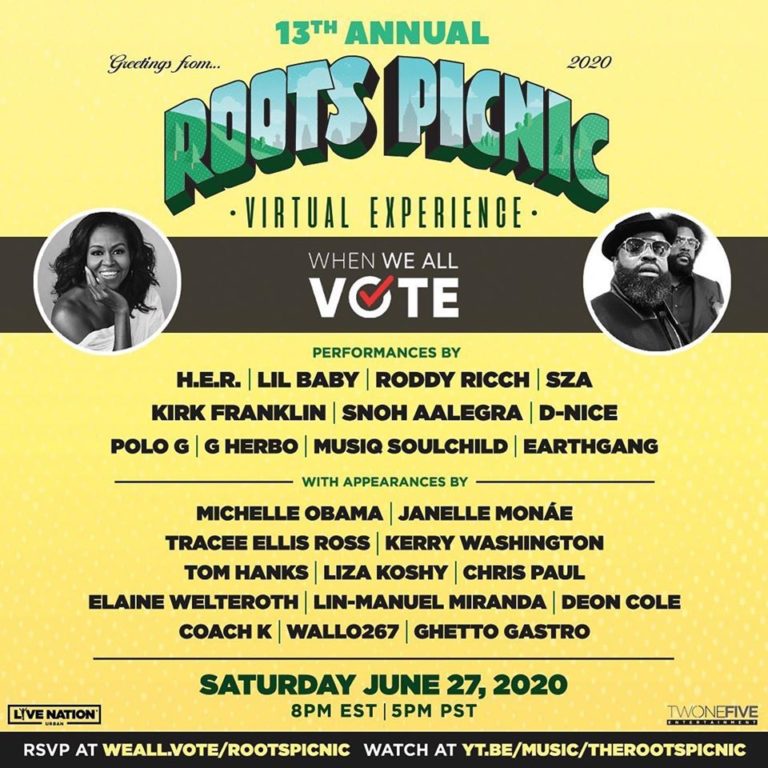
    The 13th annual “Roots Picnic” will be joining , like many other concerts this summer, the virtual experience platform as an attempt to keep everyone as safe as possible while still connecting during COVID-19. The event will take place on June 27 at 8PM EST and will stream on The Roots’ youtube channel. The event will have musical acts along with speakers including Michelle Obama. 

    The Roots Picnic is partnered with Obama’s nonprofit, “When We All Vote” and will be helping people sign up to vote by texting viewers through a platform that targets unregistered voter. This event won’t replace the usual festival, which is still postponed, but will be additional content. Organizers of the festival urge people to, “Please stay tuned for more updates on the 2020 festival.” 

    The musical acts include H.E.R, Lil Baby, Roddy Ricch, SZA, Kirk Franklin, Snoh Aalegra, D-Nice, Polo G, G Herbo, Musiq Soulchild, and Earth Gang. The Speakers include Michelle Obama, Janelle Monáe, Tracee Ellis Ross, Kerry Washington, Tom Hanks, Liza Koshy, Chris Paul, Elaine Welteroth, Lin-Manual Miranda, Deon Cole, Coach K, Wallo267, and Ghetto Gastro. 

    RSVP to the event and for more information in the event visit the Roots Picnic website.

  • Premiere: take an “Unhurried Journey” with world traveling Elena Moon Park

    Having just released the “Unhurried Journey” on May 29, Brooklyn musician Elena Moon Park, current co-Artistic Director of Found Sound Nation, a member of Bang On A Can, and a former player of the Grammy winning Dan Zanes and Friends, today premieres the video for the eponymous single. The world traveling Park, along with artist Lauren Gregory, illustrate what a free spirited world could sound and look like.

    The album Unhurried Journey offers a fresh and dynamic collection of reimagined East and Southeast Asian music and original, Western-style songs that encourage listeners of all-ages to slow down and appreciate each moment, finding the joy in their journey. Park says of the single of the same name:

    The track “Unhurried Journey” is inspired by a serene and beautiful scene of the same name, created by artist Kristiana Pärn, which reminds us to take our time and make space for self-care on this journey of ours. In the song, I celebrate the beautiful things in nature that flow around us, slow and steady, with patience and care. I invited the wonderful musician Elizabeth Mitchell to sing this with me, as her music exemplifies patience and care for me. 

    On the website for the album, Park offers a suggested activity for kids (and adults) that accompanies the song, where you can try to draw a representation of something in the world that moves around you, slow and steady. The website also serves as a gallery dedicated to the collection, sharing the artwork that inspired each song, as well as the lyrics in original languages, translations of songs, stories, videos and more.

    elena moon park

    The video for “Unhurried Journey” was created by Park’s childhood friend Lauren Gregory, an oil painter and animator from Oak Ridge, TN. Park always found herself mesmerized by Gregory’s creations using stop motion oil painting animation. Gregory also created the video for the song “Anta Gata Doko Sa” from Park’s last album, Rabbit Days and Dumplings. Gregory said of her method behind the video:

    When Elena asked me to make an animation for “Unhurried Journey,” I wanted to paint a sort of lullaby experience that was both adventurous and cozy.  The landscape that this little bear family travels through is inspired by the foothills of the Smoky Mountains where Elena and I grew up as neighbors and friends.  The two bears aren’t concerned about getting anywhere fast, they’re just enjoying the journey and getting some good quality time in together.  

    Unhurried Journey was produced by Elena Moon Park and Rob Friedman and was recorded, mixed and mastered by Rob Friedman at littlelife studios and David studios in NYC. The 16 song collection encourages listeners of all-ages to slow down and appreciate each moment, finding the joy in the journey. 

  • SummerStage Anywhere Digital Series Launches

    Capital One City Parks Foundation SummerStage announces the launch of its digital series SummerStage Anywhere. The series will highlight  genres that were born in or deeply represent New York including hip hop, salsa, jazz, global, indie, and contemporary dance. SummerStage Anywhere will start on June 6 at 7PM EST and will feature performances each weekend for the rest of June. 

    Angélique Kidjo photo provided by City Parks Foundations website.

    The series will debut on June 6 with an original performance by New Yorker pop phenom MAX. MAX performing a love letter to New York of sorts. Max has been called a “Young Pop God” by GQ in the past and has been called the “top popstar to watch” by Billboard and was nominated for “Best New Pop Artist” at the 2019 iHeartRadio Music Awards. 

    On June 13 LAMC (Latin Alternative Music Conference) will be taking the stage and highlighting  key voices in the Latino LGBTQ community. Some of the performers include pop singer Kany Garcia, hip hop artist Mabiland, indie electro pop musician Javiera Mena and rock band Circo. The event will be hosted by Los Angeles’ KCRW radio DJ Raul Campos and the Latin Grammy winning artist Cheo, formerly of Los Amigos Invisibles. 

    On June 19 SummerStage Anywhere will be hosting a celebration for the 155th anniversary of Juneteenth. Juneteenth for those unaware is the nationally celebrated commemoration of the end of slavery in the United States. The event will be featuring Jamel Gaines’ Creative Outlet Dance Theatre and poet Carl Hancock Rux, and a panel discussion led by Executive Artistic Director of The Billie Holiday Theatre, Dr. Indira Etwaroo.

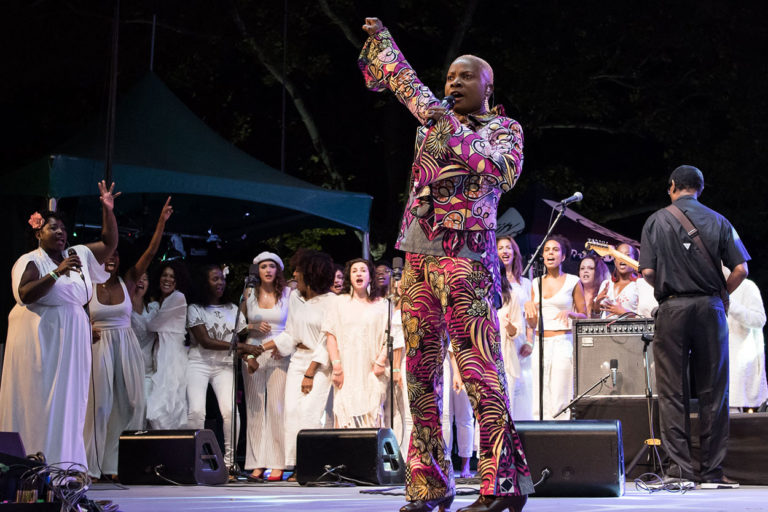
    On June 26 the series will wrap up with an exclusive performance from Angélique Kidjo. Angélique Kidjo is a Grammy Award-winning Beninese singer-songwriter, actress and activist. She will also be doing a live Q&A session after her performance. 

    The series will be available on SummerStage Anywhere’s website and streamed exclusively on the SummerStage’s YouTube channel. SummerStage is an independent, non-profit organization, and relies on donations to make it’s free performing arts festivals possible. Anyone interested in supporting the SummerStage series can donate.

     For a full schedule of upcoming programming and more information please visit SummerStage Anywhere’s website.

  • Dawn: A Celebration of Shavuot with an All-Night Cultural Arts Festival

    Dawn, an all-night cultural arts festival, will take place virtually on May 28 and 29 from 7PM to 6AM PT (10PM-9AM ET) for the celebration of Shavuot. The 11 hour celebration will include three reimagined tracks of the 10 Commandments as well as art, comedy, music, film, and conversation. Shavuot is a Jewish holidays that commemorates both the first harvest of early summer, as well as the giving of the Torah on Mount Sinai following the exodus from Egypt.

    The event will live-stream on Reboot’s website. The festivities will include Yoga, Meditation, Sound Bath, Cooking Class, Music, DJ Dance Party among the many activities.

    One of the main attractions will be an Original Score by Cecil B Demille of the Ten Commandments pt.1 performed by Steve Berlin of Los Lobos, Steven Drozd of the Flaming Lips and Scott Amendola. This reimagining of the silent era film from 1923 will be split into two stories. The first revolving around the Jewish Exodus from Egypt and a present day, or present for 1923, melodrama. The new score will musically follow Moses out of Egypt and into the dessert where he receives the Ten Commandments. 

    The Dawn celebration will also have lots of other appearances. Others on the bill include Jill Soloway, Carl Reiner, Norman Lear, Gabi Moskowitz, Kasher vs. Kasher (Moshe Kasher and Rabbi David Kasher), Michaela Watkins, John Schott, Tiffany Shlain, The Milk Carton Kids, Zackary Drucker, and AJ Jacobs.  

    The festival is being put on by Reboot and the Jewish Emergent Network. Reboot has put on festivals in the past in San Francisco for Shavuot but because of COVID-19 this year’s programming will be a little different. The hope of these organizations is that moving to a digital platform will make them accessible to a larger audience.  

    From more information and program highlights, please visit Reboot’s website.

  • Watch moe., Pigeons Playing Ping Pong, Twiddle and more at Summer Camp Virtual Festival

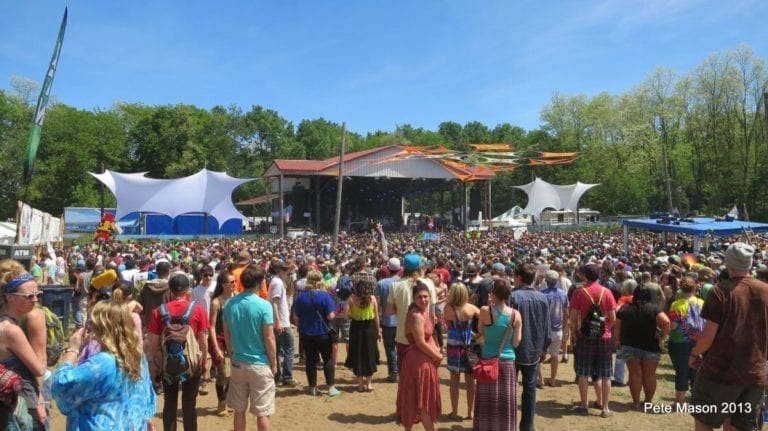
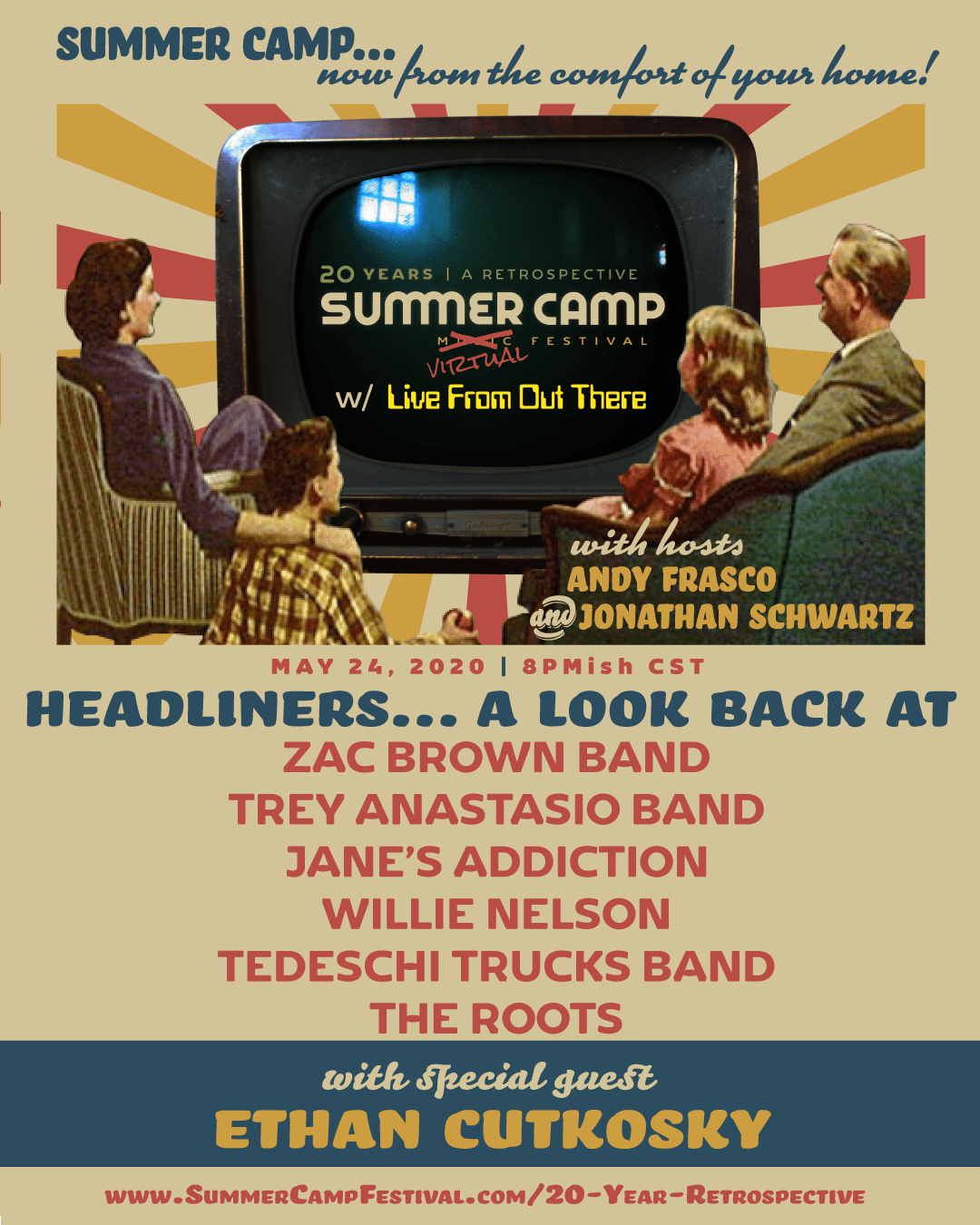
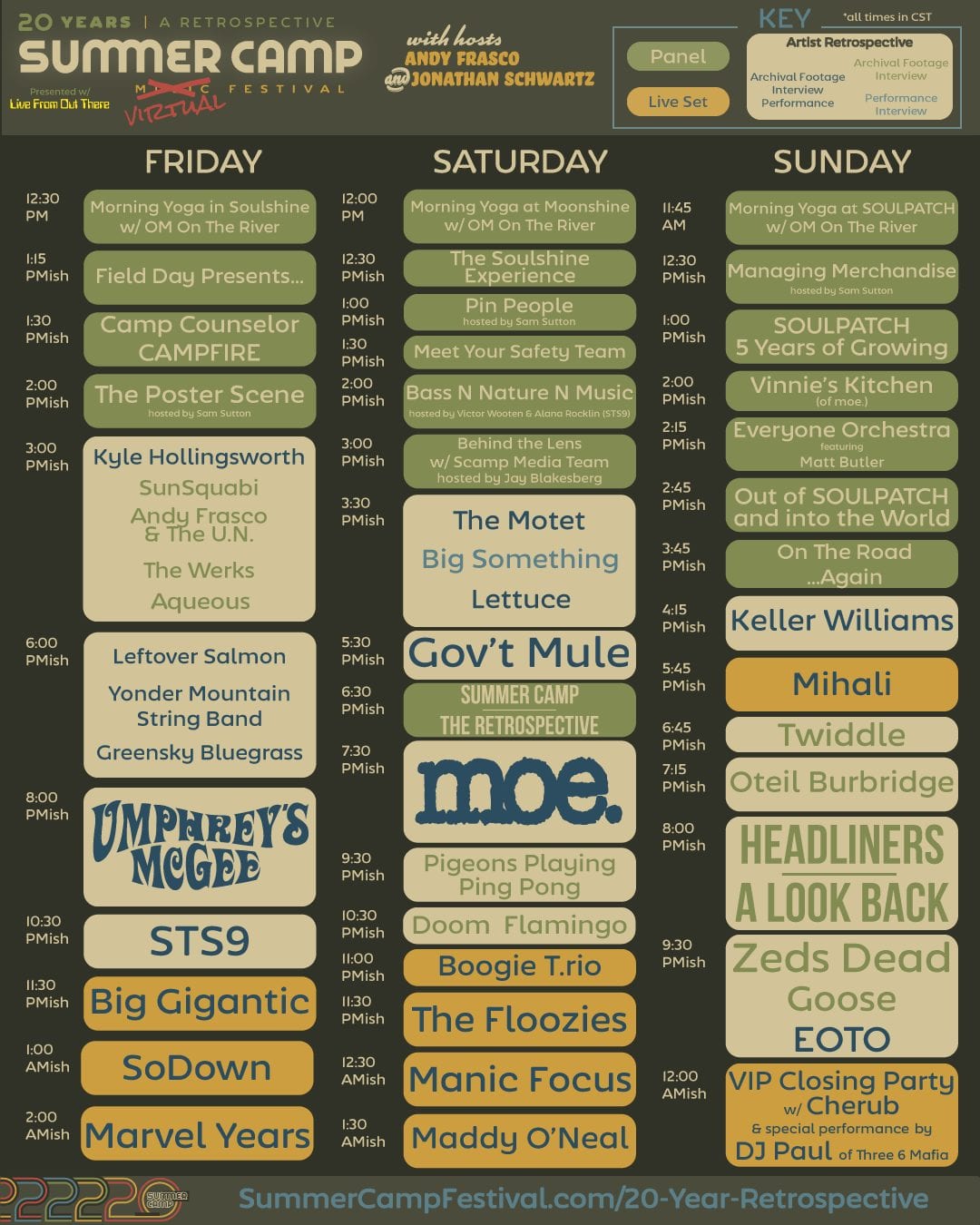
    It’s Memorial Day weekend and typically, you might find yourself at a music festival to kick off summer. With COVID-19, the collective experiences are on hold for the year, but festivals are doing their best to provide fans with a bridge to the experience they look forward to all year. Summer Camp Music Festival, founded by moe. in 2001 is holding a Virtual Festival all weekend, with live performances, throwback highlights, new songs, interviews, panels, and much more to bring Scamp vibes to the Scamp family across the country.

    summer camp virtual festival

    Each day kicks off with OM On The River hosting Yoga. Then Scamp will dive into various panel discussions, artist retrospectives, and close it out with bangin’ late night sets from some of the your favorite performers over the years, including hosts moe., Umphrey’s McGee, Keller Williams, Pigeons Playing Ping Pong, Twiddle, Gov’t Mule and more. As a bonus, Zac Brown Band, Trey Anastasio Band, Jane’s Addiction, Willie Nelson, Tedeschi Trucks Band and The Roots will be making appearances in Headliners: A Look Back segment, on Sunday, May 24.

    summer camp virtual festival

    Get a 3-Day Summer Camp Virtual Festival Pass and you’ll have the ability to rewatch the entire stream through June 17! Each 3-Day Virtual Pass is just $24.99 with a portion of proceeds going towards nonprofits including HeadcountConscious Alliance, and Backline,  plus participating artists and their crew. Get your pass here, and check out the schedule below!

  • Native American Music Association launches new podcast

    The National Native American Music Association (NAMA) has launched a new podcast hosted by Ed Koban (EdKo), a recording artist, multi-instrumentalist and NAMA’s House band Director. The NAMA Podcast will be featured on Anchor.FM and Spotify.

    The monthly 90 minute podcast features live and personal interviews with Award winners along with the latest information on the organization and it’s twenty year history. Listen and hear about upcoming NAMA news like submission dates and updates for the Native American Music Awards Show, new releases and news from Native artists, and intimate interviews with everyone from NAMA Hall of Famers to rising artists and more.

    Host EdKo states, “The official podcast of the Native American Music Ed KobanAssociation will bring you everything NAMA! We hope you will join us!”

    The debut episode features an interview with Ellen Bello, the founder and president of the Native American Music Awards and Association and multi-award winner, Gabriel Ayala.

    Gabriel Ayala of the Yaqui has devoted his life to the mastery and performance of the classical guitar. Ayala is one of the few Native American artists identifying himself solely as a classical performer. He has been awarded Best Instrumental Recording, Best World Music Recording and Artist of the Year.

    The monthly podcast will reach a global audience through Anchor.FM and Spotify as well as is posted on the Native American Music Awards website and is available to its 20,000 registered international members.

    The debut episode of the podcast is airing now. Fans of the podcast can contact NAMA’s EdKo at namapodcast@gmail.com to provide feedback and ideas for the podcast, or to become a guest on the show.

    The Native American Music Association is “devoted to bringing Indigenous music to the world’s consciousness” as noted in the New York Times. The Native American Music Awards & Association, NAMA, is an ultimate celebration of music and entertainment. Founded in 1998, NAMA is the world’s first and largest national professional membership-based organization for the advancement & recognition of contemporary and traditional music initiatives by artists with Native American heritage.

  • The Great South Bay Music Festival Announces 2020 Lineup

    The Great South Bay Music Festival announced their 2020 lineup which will include performances from The Mighty Mighty Bosstones, Joe Russo’s Almost Dead, Rebelution, The Tedeschi Trucks Band, St. Paul & The Broken Bones, and many more. The festival will take place from July 16-19 across five stages and will include 75 performances. 

    The festival will be celebrating its 14th anniversary at Shorefront Park in Patchogue, NY and will consist of classic and contemporary rock, folk, blues, indy, jam-band, pop, prog, Americana, country, reggae, and funk music. The festival also has a new partnership with Blue Point Brewing Co. The new beverage sponsor will be serving up a wide assortment of their most popular brands, as well as some new “Exclusive Festival” brands to watch out for. 

    Both Friday and Saturday have a loose daily theme. Friday is the rock-reggae-ska day with headliner Rebelution, The Mighty Mighty Bosstones (who are returning for their second appearance at Great South Bay), Pepper, Sublime Tribute: Badfish, and Oogee Wawa. And Saturday is the jam band day with headliner one of The Grateful Dead’s most proud and popular tributes: Joe Russo’s Almost Dead, moe. and Vulfpeck guitarist, composer and producer: Cory Wong. Great South Bay will close on Sunday with the highly anticipated Tedeschi Trucks Wheels of Soul Tour, featuring the full 13-piece band playing a rocking two hour set. There will also be performances by St. Paul & The Broken Bones, as well as Nashville-based singer-songwriter and multi-instrumentalist Gabe Dixon.

    The festival opens on Thursday, July 16 at 3 pm and runs until 10 pm. On Friday, July 17, doors open at 3 pm and music will go until 11 pm. On Saturday, July 18, doors open at 1 pm and close at 11 pm. And the festival will wrap up on Sunday, July 19 with doors opening at 2 pm and finishing up at 10 pm. For more information and to purchase tickets visit The Great South Bay Music Festival’s website.