An original review of this show was written for BUZZ Magazine in July of 1990 and can be found below.
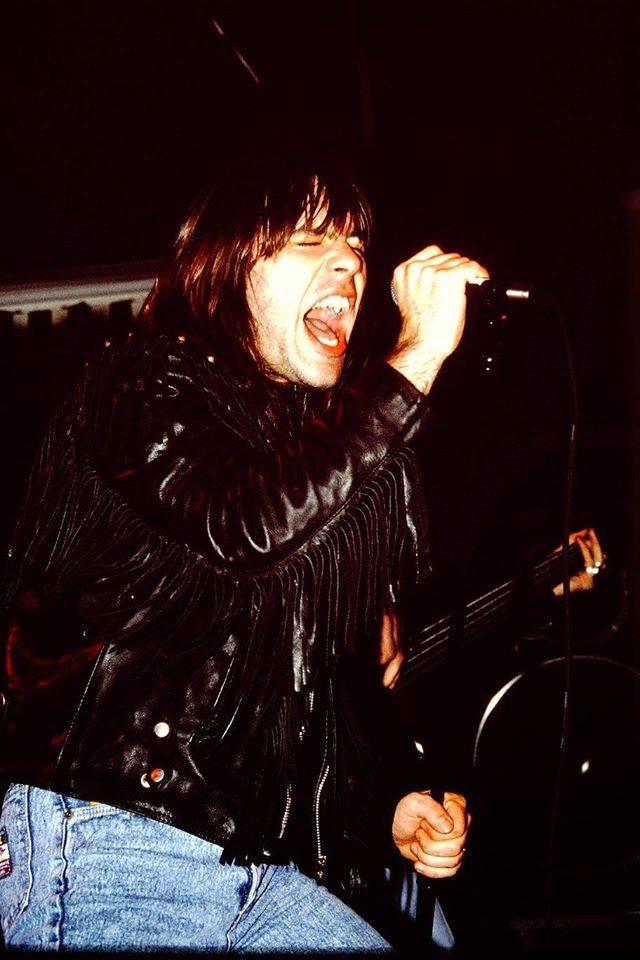
It was 30 years ago tonight, on Wednesday, July 25, 1990, that Iron Maiden front-man Bruce Dickinson and Kings of the Sun took the stage at the legendary Saratoga Winners in Latham, just outside of Albany.
Bruce Dickinson, Saratoga Winners, Latham, NY, July 25, 1990, picture by Mark Kurtzne
This bill also played The Chance in Poughkeepsie, on July 20, 1990. Dickinson was on a break from Iron Maiden, promoting his debut Tattooed Millionaire solo LP. It wasn’t a bad record, although not on par with his better Maiden stuff. He didn’t play any Maiden, unless you count “Bring Your Daughter To the Slaughter,” which at that point was still a Dickinson solo track from a soundtrack; Maiden wouldn’t do record it until their next album.
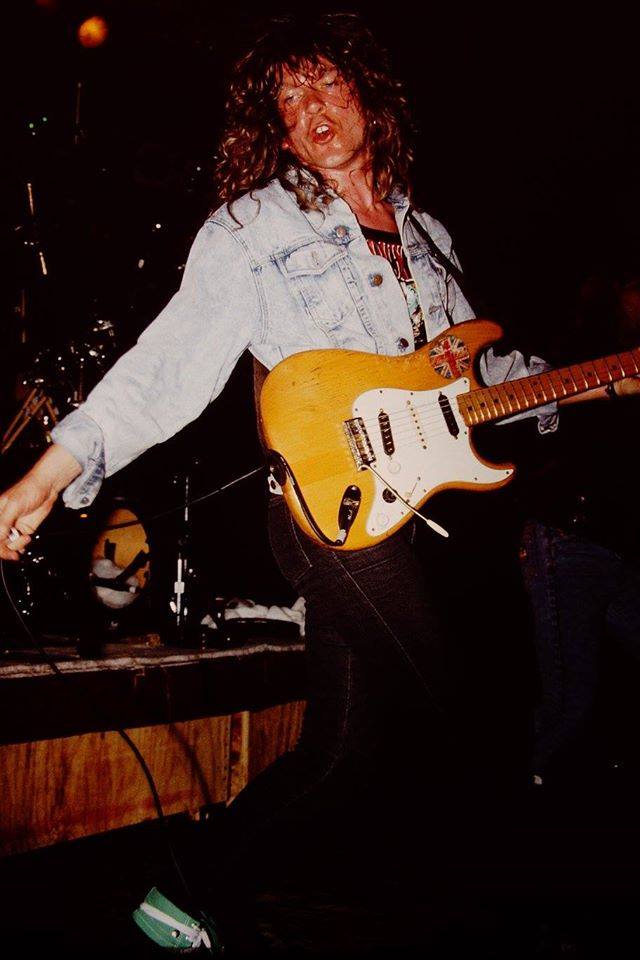
Janick Gers, Saratoga Winners, Latham, NY, July 25, 1990, picture by Mark Kurtzner
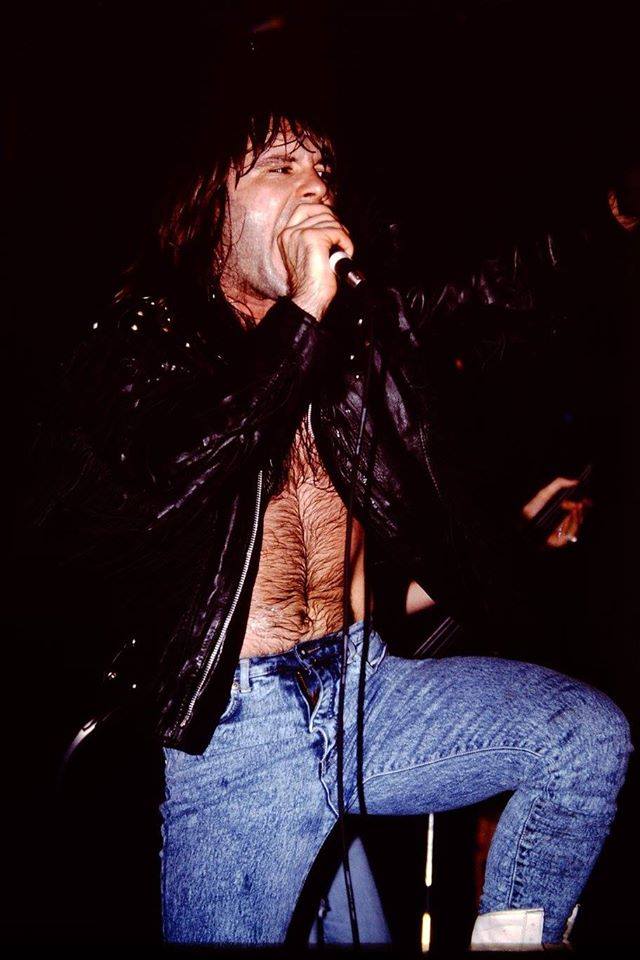
However, Dickinson opened the show with his pre-Iron Maiden band Samson’s “Riding With The Angels,” which rocked, and played a bunch of solo songs and covers. Good shows, both packed, mostly with Iron Maiden fans, and a ton of Iron Maiden t-shirts.
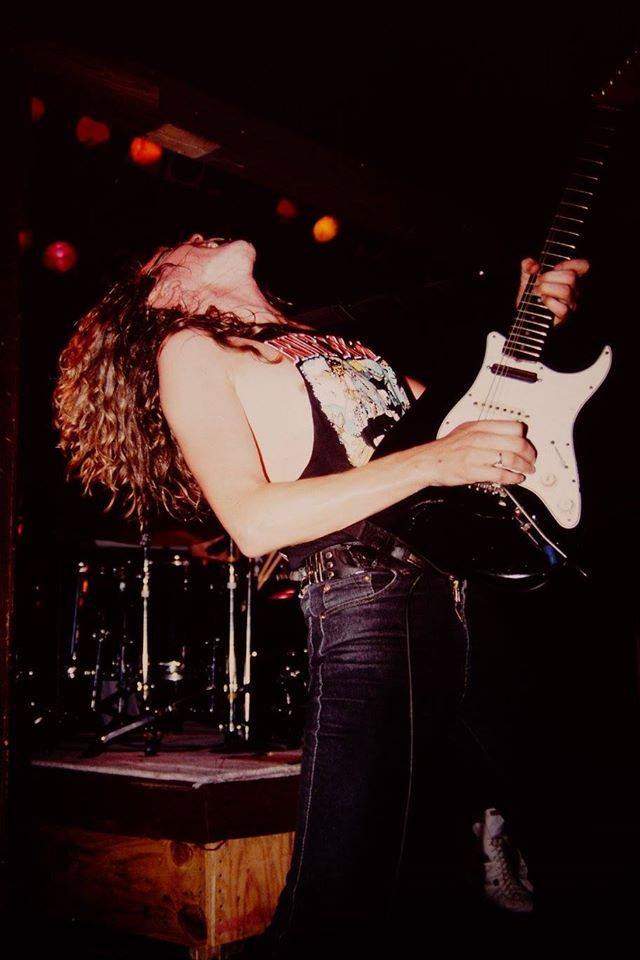
Janick Gers, Saratoga Winners, Latham, NY, July 25, 1990, picture by Mark Kurtzner
Dickinson’s guitarist this night was Janick Gers, who at the time was the former guitarist from Gillian, the early 80s metal band led by Deep Purple member Ian Gillan. He had also been in a new wave of British Heavy Metal band called White Spirit – as a fan of both of those bands, I was excited to see him, and he played great. But soon enough he could become far more well-known when he replaced Adrian Smith in Iron Maiden.
Bruce Dickinson, Saratoga Winners, Latham, NY, July 25, 1990, picture by Mark Kurtzner
The opening band, Kings of The Sun, were great at one show, kind of crap at the other. They were from Australia, a band led by a couple of brothers, playing good heavy rock ’n’ roll in the vein of AC/DC, on the heels of a pretty solid self-titled album out at the time.
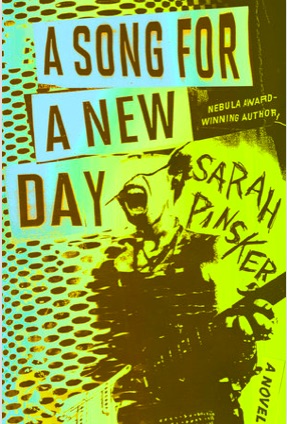
If anyone can lay claim to the title of “Rock and Roll Nostradamus,” it’s Sarah Pinsker. Born in New York City and a present-day driver of the fertile culture scene in hip Baltimore, Pinsker is a true multi-hyphenate. First off, she’s a singer/songwriter who has released a number of noteworthy albums with her band, Stalking Horses. More prominently, she can now lay claim to being the hottest rising star in the world of science fiction, whose eerily prescient debut novel, A Song for A New Day, just won the milieu’s highest honor, The Nebula Award, putting her in the company of legends like Isaac Asimov, Arthur C. Clarke, Ursula Le Guin, William Gibson and Neil Gaiman.
I stumbled across Pinsker’s book right as it came out in September 2019, drawn by the cool cover art, her background as a musician and its seemingly far-off but maybe too near premise, one steeped in the world of indie music making, technology and, one of my guilty pleasures, future dystopia!
In Pinsker’s novel, a deadly virus/pandemic unleashed by a terror attack that brings society to its knees. All public gatherings are prohibited for two decades, and everyone hunkers down quarantined in their homes, working and entertaining themselves via VR-equipped hoodies, and receiving most of their necessaries via drone from one mega corp. As gatherings are banned, so, too, are live musical performances. But, don’t worry, there are still shows, not in crowded bar and venues but streamed hologram performances of only the most visually appealing of acts coming from the HQ of mega promoter, StreamHoloLive, straight into your hoodie.
Starting to sound familiar yet?
Pinsker’s novel revolves around two women. First is Luce Cannon, an emerging indie artist on the cusp of a big mainstream breakthrough when the virus takes down the world (best character name for a rocker ever, right?). Then there is Rosemary Laws, a 20-something woman who doesn’t remember the time before the fictional quarantine who becomes a roving A&R person for StreamHoloLive. Her mission? To infiltrate the small underground network of clubs that still run live shows, illegally and until they are busted, to find new talent to holo-stream.
Musicians will love this book because it’s written by one of her own. Pinsker is someone who brings spot-on descriptions to the power of a kick drum, a power chord and the day-to-day lives of musicians, especially those who are scuffling to create and survive in both the old IRL and the new post-performance world.
How did Pinsker go from indie rocker to sci-fi darling? What commonalities does she see in her two creative lives? NYS Music gave Pinsker the chance to elaborate in the following Q&A.
Author and musician Sarah Pinsker
Sal Cataldi: I understand your debut novel, A Song for A New Day, is an elaboration of a novelette you wrote five years back. What, from what you have witnessed as a musician and as someone who reads the headlines, made you conjure such a premise?
Sarah Pinsker: My memory of the seed for the initial novelette was that I had passed the “Our Lady of the Highways” shrine on I-95 again, and I was thinking about all of my touring friends who had written songs based on that lovely title. I think I had “Our Lady of the Open Road” before I had a story, and then I started thinking about a band on the road long after everyone else had exited that life, and what would have put a stop to it. I worked backward from there, thinking about the things that might be societal roadblocks, and the technological advances that would reinforce the changes.
SC: How does it feel to be the woman who predicted our socially distanced, outlawed gathering present? How did it feel when you started to see this fantasy of yours beginning to come true in headlines?
SP: Most near fiction SF writers I know don’t set out to be predictive, so it’s a dubious celebration. I’d wanted to talk about things I *didn’t* want to see come true, and head them off at the pass. When people ask how I got so close in my “predictions,” it just feels like common sense to me. Humans are sadly predictable.
It’s been frustrating to see people say that my book is anti-social distancing. It doesn’t glorify flouting restrictions on gatherings during a pandemic; the problem in the book is that the country stays that way long after the threats are gone. I think there are opportunities right now to create a new and better normal, but we also have to do active work to make sure that we still have music and arts and venues when all of this is past.
SC: How much of you is in the Luce character?
SP: Hers is an easy voice for me to write, but she’s not me. She’s an amalgam of a whole bunch of musicians I adore. I guess the part of her that’s me is the way she feels on stage; I took that from my own experience. And I guess I tend to be skeptical of new technologies.
SC: Sounds like you’re a diehard DIY indie musician. What’s the worst part of the corporate music business that is in this book, and actually just out in the world as a musician. Seems like MTV on steroids, with the accent on looks.
SP: I think I’d spoil the book in saying what I think are the worst parts of the corporate music business I wrote. If you look at what’s happening right now, the corporate venues will get loans, the arenas will make it, but the small clubs are drowning. Big musicians are doing fine, but the indies who depend on touring are struggling, as are the musicians who play senior centers and restaurants and libraries, and the people who run sound, the roadies and techs, the indie venue owners and staff… Some of my friends are doing online shows with tip jars, which is actually an opportunity to reach their largest audiences ever, but I can still easily see that access getting throttled. There are already corporations looking to take advantage of this situation, even while musicians try to do their best to survive. In the best of times it’s difficult to make a living at music, and it doesn’t need to be that way, but the system is set up to elevate a very small percentage of the musicians out there and not necessarily to make access easier for all.
SC: Now that we are in the midst of a streaming music present, what do you think about it? Any artists that particularly inspire you in what they are doing in the medium? Like your character, do you lament the loss of live performance?
SP: Right at this moment, I am extremely grateful for the musicians who are streaming shows (and the theaters, and the museums, and the national park cams…) It’s not like in my book, in that we are still in the moment where this is necessary and appreciated. I like clicking into a show and seeing people I know are also there in the comments. I like sitting on my porch at sunset and listening to musicians I adore.
There’s a folk musician named Susan Werner who has been playing Sunday night shows online. Sometimes she invites friends, sometimes she has a theme, but she’s always been good at mixing a fun stage presence and quick wit with her songs. She often has a sponsor or a charity getting some of the money, and donations/tip jar are encouraged but not mandatory.
A lot of folk and acoustic musicians are doing similar things. Rufus Wainwright was doing a song a day in his bathrobe — I haven’t checked in a few weeks to see if he’s still going. LEA, thisislea on most sites, is a DC-area musician who always did cool community-oriented stuff. I played at an album release of hers a few years ago, where she invited people to play a song of theirs that was in conversation with a song of hers, and then she would play the connected song. She’s done some virtual choir stuff since this started. I’ve seen some Baltimore bands like Gingerwitch and Manners Manners and Santa Librada do triple bills online where each band does a set, and at the end gives you the address to find the next set. And I know a couple of venues here have offered to open for a band to record a show without an audience.
So yes, I think musicians are making the best of it, and while I lament the loss of live performance where I’m in the room where it happens, these shows are still special and appreciated. They feel intimate, and I love seeing some of these performers that I haven’t had a chance to see in a long time, either because schedules don’t align, or they haven’t been touring in my area.
SC: Which came first, your music or your writing career? Tell us a bit about both, and how they inform each other.
SP: Career-wise, music, though I had written and submitted short stories for publication before that. They’re both forms of storytelling to me, with their own advantages and disadvantages and tropes to explore. In my twenties my stories got shorter and shorter, and I found myself telling stories in song form. I loved the immediacy of playing, and the collaborative nature of performance; even when you’re on stage alone, you’re engaged in a conversation with your audience. I can’t say why I switched horses back to fiction at the moment I did. I struggle a little with doing both at the same time, so my music has suffered for my success in fiction. I have a fourth album completed that I really need to get out into the world, but that just feels like too much.
SC: Who are your three big inspirations in each of these areas?
SP: I hate answering those questions, because I always feel like for every name I mention, there are a hundred more. In fiction, I guess I’d say Ursula K. Le Guin, Octavia Butler, and Karen Joy Fowler, in terms of the way reading their fiction makes me want to up my game. In music? Argh. Um, I’ll just name one. My friend SONiA, from the band disappear fear, has been my model for what an ethical life in music looks like from the beginning. She’s a wonderful songwriter, a dynamic performer, and she’s comfortable with a band or solo and with adapting songs to both.
SC: You just received the Nebula Award for the book, which is the highest honor in science fiction. Did you at all expect it? What does it mean to your future as a writer? Are you the first musician/writer to win?
SP: I didn’t actually expect to win the Nebula. There were amazing books on the list, and I had assumed that one of those books was going to win. Getting onto finalist lists is always a tremendous honor in itself, and I don’t think it’s ever healthy to assume the top honor is yours, so I like to choose a book to root for that isn’t my own. That way, I’m happy if they win and surprised if I do. I think there have actually been other musicians who have won — Nicola Griffith and Catherine Asaro, among others, I believe.
SC: As an expert prognosticator and musician, what do you think the future holds for indie musicians and live music venues? Will this ever go back to what it was, or will there be a new normal based somewhat on what you created?
SP: I’m not an expert prognosticator, but I think what the future holds will very much depend on what we do right now. We should be helping venues pay their rent while they are closed, so they still exist when this is over. We should be giving basic income to everyone to encourage people who can stay home to stay home and allow those who can’t to do their jobs more safely. If we do those things now, we’ll have venues when this moment is over.
I do think there’s a lot we can learn from this, and there are things I’d like to see in a new normal.
There’s an accessibility in this moment: people who use wheelchairs and couldn’t get down the steps into basement venues get to see bands. Ditto people who couldn’t afford big ticket prices or didn’t have a way to get to a show, or didn’t have childcare, or whose health is too fragile even when we’re not in a pandemic to risk being in a crowd. We can definitely come back to a mix of both if we choose to.
We can encourage seeking out smaller bands, who may be playing to smaller crowds, rather than giant stadiums. We can normalize staying home when you’re sick, and we can normalize wearing a mask in a crowd if that’s what it takes to bring back live music. Music is about community, and we can continue to forefront that community-mindedness. But above all, we need to help musicians and techs and venues weather this with actual financial help, as they have in other countries. I’d rather wait longer in order to come back safely than rush it and risk the health of everyone involved, no matter how much I’d like to go to shows again.
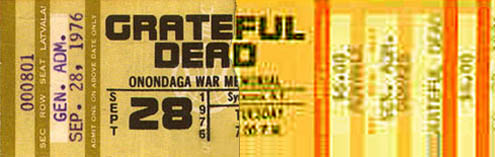
Our look back at the Grateful Dead’s tour history in New York makes a stop in the heart of Central New York, with a trip back to September 28, 1976 and a show so good it deserved placement on a Dick’s Pick release. The latter half of Volume 20 of this particular series of live shows showcases the band at the top of its game as it rolled into Syracuse in late September, after a show at Rochester’s War Memorial the night before.
New York has always served as fertile ground for memorable Grateful Dead shows and this particular one at the Onondaga County War Memorial falls right in line, with the band continuing to break new ground as they explode through this transformative mid ’70s era.
The proceedings start with an upbeat and inspirational “Cold Rain and Snow” that seems to warm the collective hearts assembled in Central New York this evening and gives the band a chance to warm up their harmonies early.
A “Cassidy” that later follows takes the set’s early momentum and runs with it, courtesy of its typically brief yet intense ending progression section. The band then stretches their collective legs a little with a version of “Tennessee Jed” that has a delightful, rambling jam attached to it and a stout version of “Candyman” soon follows. But the real highlight of the opening stanza is an an enthusiastic “Let It Grow” that fosters a jam which meanders effortlessly through the highs and lows provided by a rhythm section in lock step with the vocals of Bob Weir and Donna Jean Godcheaux before it dissolves into psychedelic bliss. This more than helps provide the kindling for a set closing “Goin’ Down The Road Feeling Bad” that easily catches fire, ending the first set in a pristine blaze of glory.
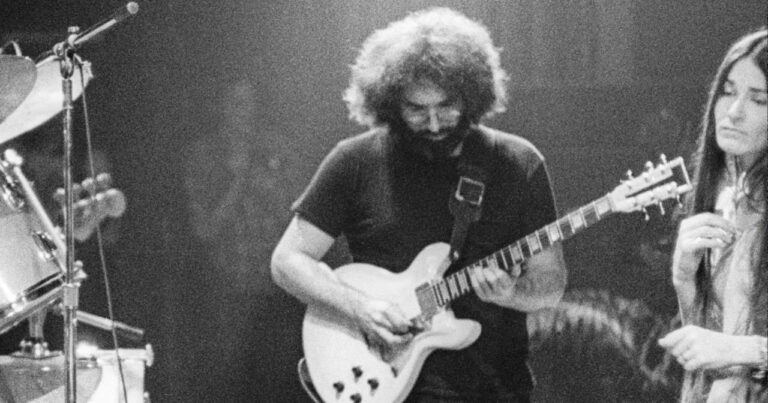
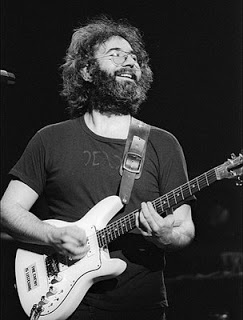
A direct and authoritative “Playing In the Band” opens the second set with Jerry Garcia on lead guitar laying down ferocious melodies atop a bed of intense rhythms fueled drummers Bill Kreutzmann and Mickey Hart and bassist Phil Lesh. The near 11-minute opening salvo is the band at their finest as they collectively finesse through a psychedelic jaunt that eventually makes way for “The Wheel.”
A joyous “Samson and Delilah” follows, which wastes no time after its completion before seguing into another blissful, guitar-driven improvisational jam with Garcia still leading and the rest of the band in hot pursuit.
Much like the first set, the bulk of this show’s punch comes towards the end, in the form of a tidy “Drums” section that gives way to an absolutely blistering “Eyes of the World” that sees the full band in complete cohesion and harmony, in a somewhat speedy version that was not atypical for this era of Dead.
This rapid rendition of “Eyes” then gives way to a loose, ragged collective jam that’s since been dubbed the “Orange Tango Jam,” the only one of its kind and seemingly a nod to the local Syracuse confines. This off-the-cuff jam has flashes of inspiration but eventually peters out and gives way to a rousing “Dancing In The Streets” before the set concludes with a bookending “Playing In The Band.”
Make no mistake. Even through this show might be the second half of Volume 20 of the esteemed Dick’s Picks archival releases, it takes a back seat to very few others from this era. It shows the band playing relaxed and cohesive as a whole, with the ability to shift into unstructured territory at a moment’s notice – a sign of things to come with the band soon entering perhaps the most explosive year of its existence.
Grateful Dead – Onondaga War Memorial Aud., Syracuse, NY – September 28, 1976
Set 1: Cold Rain and Snow, Big River, Bertha, Cassidy, Tennessee Jed, New Minglewood Blues, Candyman, It’s All Over Now, Friend of the Devil, Let it Grow, Goin’ Down the Road Feelin’ Bad
Set 2: Playin’ in the Band > The Wheel >Samson and Delilah > Comes a Time > Drums > Eyes of the World > Dancin’ in the Streets, Playin’ in the Band
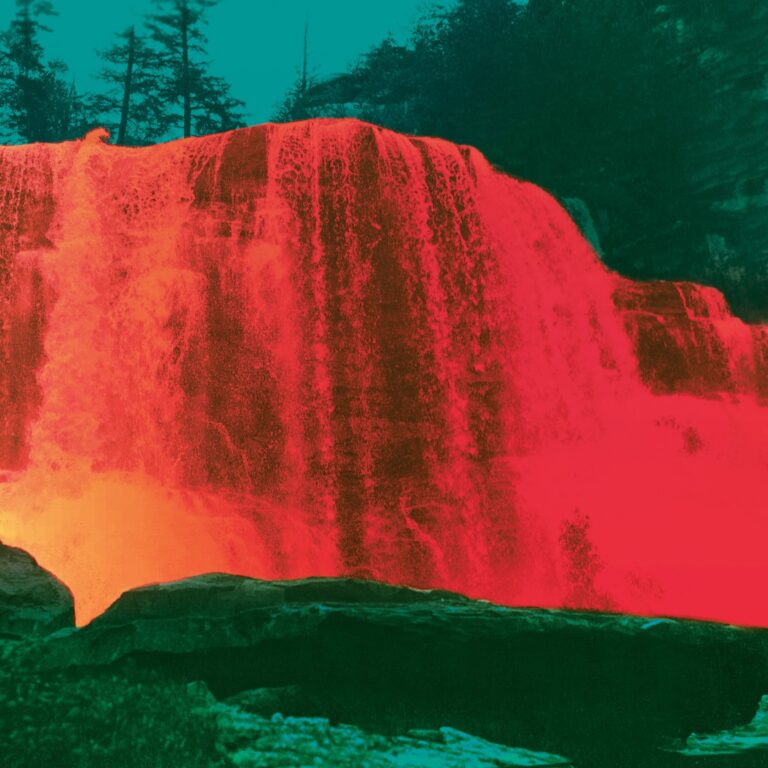
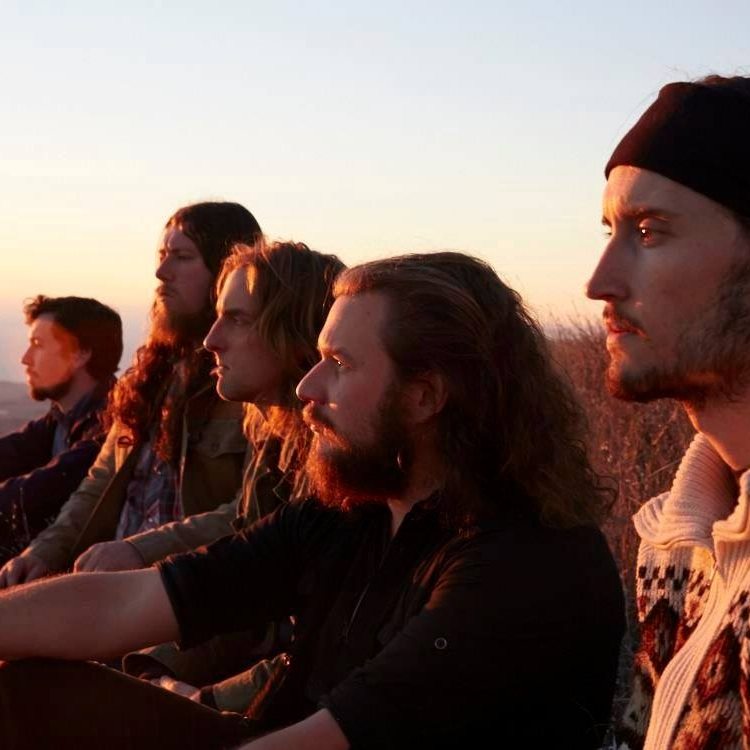
My Morning Jacket announced on Tuesday July 7 that their new record THE WATERFALL II would be released the following Friday with a special live stream the night before. This record had been teased over the last five years since THEWATERFALL was released in 2015, as they recorded enough material for a follow up. The first record was a break up record and THEWATERFALLII continues that theme, enrolling a dreamy southern rock as if the Beach Boys and Allman Brothers birthed a new cosmic force that is the ever evolving style of MMJ from album to album.
This new record was recorded seven years ago in Stinson Beach, CA and though three of the tracks had been heard as part of a Holiday release (“Welcome Home”), a soundtrack (“The First Time”), and a single (“Magic Bullet”), they fit so well into this psychedelic pop record that after 20 years as a band, it continues to showcase and highlight all the members. The back line of Tom Blankenship and Patrick Hallahan are tight and true, letting Jim James explore with his incredible vocal range, while Carl Broemel’s guitar work weaves pattens through the record like birds in flight across a melting Pacific sunset. Bo Koster really shines on these tracks as well with his fantastic work on keys and backing vocals adding a radiant shine over the entire piece of art. Brittany Howard of The Alabama Shakes also lays down back up vocals.
https://www.youtube.com/watch?v=28twddwXhJc
THE WATERFALL II opens with “Spinning My Wheels,” which the band performed on Jimmy Fallon July 15. “Hypnotized from doing the same old thing, It don’t matter where you settle down, It sure don’t matter where they put you in the ground, they only point of things is to break the spell and to love another day and live to tell,” sings James. What a fitting way to start this very hypnotizing track. As mentioned, the theme of breaking up lingers, but in this writer’s opinion, the message is one of peace and tranquility in discovering that change is what you needed most. Track two, “Still Thinkin’,” starts out almost as a bouncy pop song and then delves into a wondrous cave a la Pink Floyd or “Dondante” from MMJ’s album Z 15 years prior. “Climbing The Ladder” has some amazing tempo changes that keep the listener on their toes and remains very upbeat. One could potentially see this as a fun opening song when live music comes back or first encore song.
The second act of the record begins with “Feel You” and this is where the album starts to move into that dreamy phase, with a sentiment sung wonderfully and guitar interludes that drift like wind across the waves. It soars and moves as the band feels so tight but so loose at the same time. This is sure to be a fan favorite. “Beautiful Love (Wasn’t Enough)” hits with biting lyrics and guitar solos, and that dreaminess turns into a locomotor chugging through. One could almost see this track on the Dylan album Blood On The Tracks. That driving force comes through again on “Magic Bullet,” reminiscent of MMJ’s work on Evil Urges’ “Highly Suspicious” or Circuital’s “Holding Onto Black Metal.” If we still had Prince, this might be the music he would be making.
The third act as part of one gorgeous record begins with “Run It.” The song itself is a meditation, a call for self discovery and a call for healing, the perfect song for a global pandemic, a Sunday morning, a drive through the country, and anyone searching for a bit of peace in their life. “If you ain’t to kind, you ain’t my type, I’m gonna run you out the door, Don’t need that, Don’t need ya anymore…” Koster’s keys over the beat, Jame’s warm voice, Broemel’s sly guitar might make this the song of the summer. As the song drifts away, don’t take your eyes off the road because you will get hit by what will most likely become a barnburner at live shows.
The first two minutes of “Wasted” set up a groove that Koster and Blankenship start turning up the dial on until it becomes a full on rocker. Just when you have spent every emotion you have on this record, and being floored by the penultimate track, “Welcome Home,” centers you again. The song is like the last kiss of sun across the ocean as night sets in. The placement of each song on this record will keep it flying off shelves at vinyl stores as it is truly a full album. “Send bad habits on their way, let a new year start today, open arms are saying to you, welcome home, and as the snow glazed all the trees, I let my thoughts flow of the breeze, and the air rushed in my lungs saying to me , welcome home,” sings James with another sentiment of being born again. Everyone is hoping for a new beginning in a new year where all people are welcomed home. The final track, “The First Time,” reminds this writer of THEWATERFALL song “Only Memories Remain” which has found new life as a live track and has become part of some amazing sets these gentlemen put on.
THE WATERFALL II is a breath of fresh air, a surprise in these times of seemingly endless bad news. It serves as a bright spot for fans of the band and also came with an announcement that there is another album entirely done, awaiting a release date, hopefully be followed by a run of shows. New listeners of the band will find a group that has been at it for 20 years, from driving in vans, to playing Madison Square Garden on New Years Eve in their first 9 years, and sometimes having to take a breath for themselves. Though their styles keep evolving, the message has always been clear with My Morning Jacket from Louisville, KY – love always wins and in this case can set your mind free.
Upstate’s new live EP, Live at ArtsRiot is the quarantine album we all need right now. This group, formerly known as Upstate Rubdown, has soared through the Hudson Valley region since their debut release in 2015, and in an effort to cure our isolation blues, they have released this live EP to bring us back to the comforting clamor of live shows.
This new release is familiar territory, featuring four songs from their 2019 studio album Healing. The new EP promises the same tight vocal harmonies, intricate lyrics, tight rhythmic strumming, and swirling energy from the first release of these songs. What you may not expect from Live at ArtsRiot is its production value – besides the excellent mixing and mastering, this live performance has eight performers, each with an interesting color to weave in and out of this picture. One of the best examples can be heard in “Who Knows”. The album version tends to rely on the folk-timbred acoustic guitar and standup bass, but the live version is daring in its switch to electric. In one song, a group that was once under the folk umbrella becomes a southern blues band. In the final song of the Live EP “Healing”, the band ditches the honky tonk-style piano solo and tosses in a keyboard for the solo section, marrying folk with almost a jam band timbre to support the blazing sax solo and keep the energy trailing right until the end of the performance.
More than its musical intricacies, this live EP is a reminder of the comradery needed to put on a great show. In addition to having top notch songs, this band has a responsive following, which you can hear cheering throughout the entire EP. The vocalists have audible excitement in their voices, and with so many musicians on stage, you’re able to hear the push and pull of instruments to provide a strong and creative backdrop for the tight vocal harmonies that push centerfold. This is a sound you can only get from a live show, and with performances few and far between these days, we can’t help but thank Upstate for reminding us of the live show vibes we miss so much.
p.s., Upstate is headed to Rochester on October 16, and will hopefully visit ArtsRiot again this year, but check their website and Facebook to be sure.
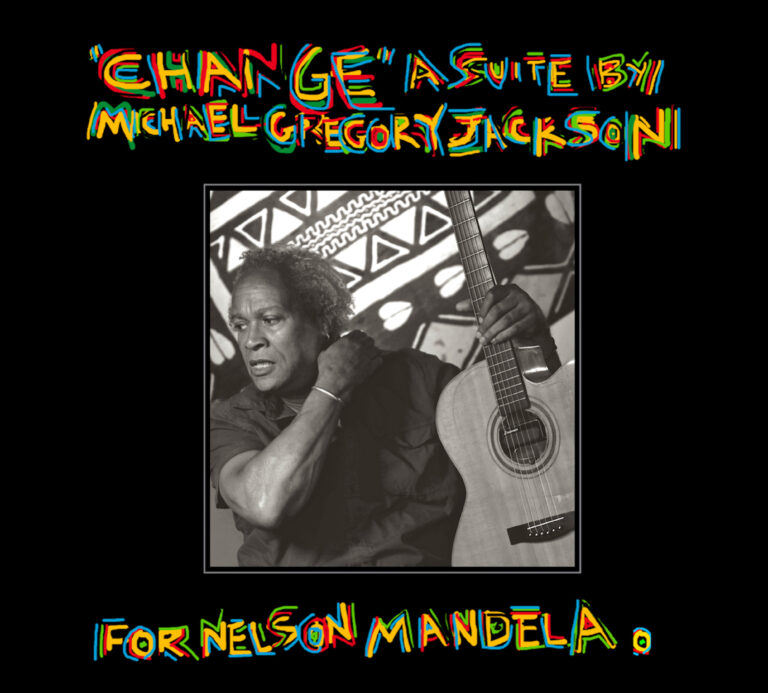
Pat Metheny, Bill Frisell, Vernon Reid, Marc Ribot and Mary Halvorsen. One look at the list of progressive jazz guitar all-stars who have named Michael Gregory Jackson as an influence demonstrates the continued resonance and relevance of his four-decades of exceptionally creative music-making.
Jackson was barely out of his teens when he came to prominence in the adventurous New York City Loft Jazz scene of the 1970s, first with The Oliver Lake Quartet then his own edge-pushing solo albums like “Clarity” and “Gifts.” Over the years, he has crafted a continually evolving, uniquely genre-skipping discography, with a cliché-free musical architecture that is all his own. Jackson has explored everything from the furthest out in free jazz to the Stevie Wonder-inspired R&B popcraft of 80’s releases like the Nile Rodgers-produced “Situation X.” Then there’s the bare-bones singer-songwriter with guitar chops acousticity of his small label CDs of the 90s and early 00s like “The Way We Used to Do” and “Red,” two recent albums he played on and produced for acclaimed trumpeter Wadada Leo Smith and a recent slate of recordings with his Clarity Quartet, cut with his European band during his frequent forays in Denmark.
Jackson’s latest release is something splendid from his archives, a 1994 live recording by a nine-piece unit of an emotional original work, “Change: A Suite for Nelson Mandela.” It’s fuses knotty ensemble melodies and fiery soloing, with a sung poetry that celebrates the end of Apartheid and Mandela’s triumphant journey from political prisoner to President of South Africa.
The peace unfolds quietly, with mournful string chording of keyboardist John Livermore serving as the backdrop for a four-minute solo by trumpeter Stephen Haynes. Here, Haynes travels from quiet loneliness to screaming wails to musically illustrate Mandela’s long struggle. His dramatic and narrative playing, with its many slurs and stabs, brings to mind the late great Lester Bowie of Art Ensemble of Chicago fame.
The main body of the song is a driving, up-tempo swing, with Jackson vocalizing a call for unity, a celebrating of the changes in South Africa and the need for similar movement here in the U.S, aided by a trio of female singers, Tamsen Fynn, Eva Fierstein and Sara Lazare. It’s a heady mix of jazz, soul and sizzling rock reminiscent of some of the pieces from one of my favorite Jackson albums, 1979’s “Heart and Center.”
There’s more hard drive following in a long tenor sax solo by Chuck Langford, in a call and response with Jackson singing the tune’s main refrain “change will grace us all.” Things change up again in the fourth movement, where Jackson showcases his wonderfully avant/blues approach in a long expressionistic solo, over an almost offbeat reggae/funk pulse from drummer Joe Fitzpatrick and bassist Chris Murch. As the solo climaxes, the horns join with stabs and long chords that propel Jackson to more fiery chromatic soloing and chording, before a roar of ensemble screams as Jackson sings out “change.” The piece closes with a reprise of the intro synth chording and the applause of an appreciative audience that experienced this musical journey. It’s something that is sorely needed by all music lovers in these Quarantine times, a reminder of what we miss most – the live music experience.
This new release, and many of his remastered albums and other limited-edition singles and album outtakes (check out the bad-assed wah wah playing on “Miles OG”!) are available at his Bandcamp site and on Spotify.
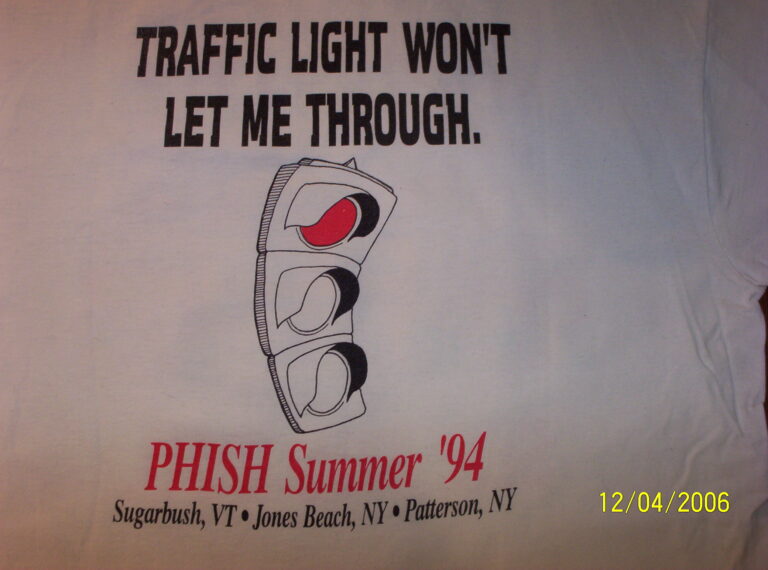
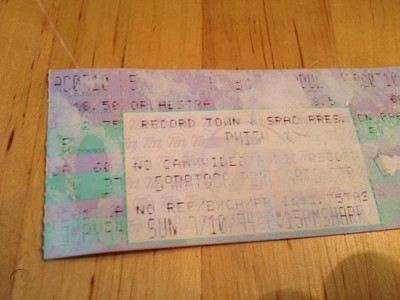
On July 10, 1994, Phish headlined for the first time at Saratoga Performing Arts Center. Two years prior, the Vermont group had opened for Santana at SPAC, one of the few opening slots Phish would perform in their career.
via Brendan McKenna, as published in PhanArt: The Art of the Fans of Phish
The summer of 1994 would feature The Eagles, Peter Gabriel, James Taylor, The Beastie Boys and the debut of Dave Matthews at the classic Upstate amphitheater, in addition to Phish, whose performance was at the tail end of their summer tour.
Of note from the first set is the “Stash,” which appears on Live Bait 10, and fun with the lyrics of “Julius,” adding “I haven’t decided, no no no’ during the chorus, and “Ya Mar” where the band gave shout-outs to Trey’s dog Marley, including “Who is she?” (also their record label’s name) and “Who’s the Mar Mar?”
Tickets were only $18.50 for reserved seats
The middle of the second set held the heat with a strong “Mike’s Groove”, adding in “Low Rider” to the typical three song sequence inside of “Mike’s Song.” At the end of the second set, The Dude of Life came to the stage and sang his composition “Crimes of the Mind” with the band.
Phish – SPAC, Saratoga Springs, NY – July 10, 1994
Soundcheck: Jive Talkin’, The Old Home Place, Nellie Kane, work on Jive Talkin’
Set 1: Chalkdust Torture, Horn > Peaches en Regalia > Rift, Stash, If I Could, My Friend, My Friend > Julius, Cavern
Set 2: Sample in a Jar, David Bowie, Glide, Ya Mar, Mike’s Song -> Low Rider -> Mike’s Song > I Am Hydrogen > Weekapaug Groove, Bouncing Around the Room, The Squirming Coil, Crimes of the Mind
Encore: Golgi Apparatus, Rocky Top
Notes: My Friend included a Purple Haze tease and Julius contained a Buried Alive tease from Trey. The Dude of Life sang vocals on Crimes of the Mind
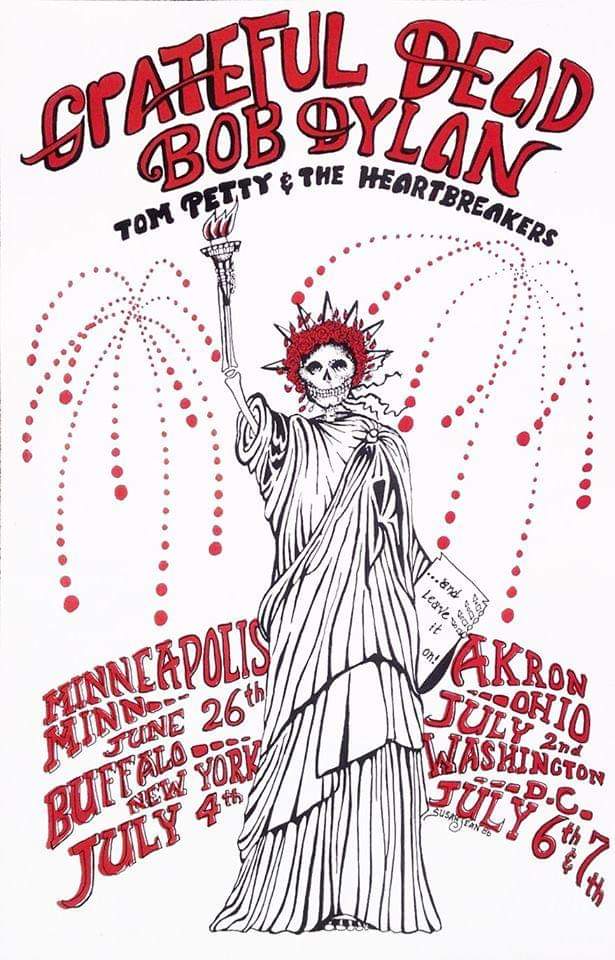
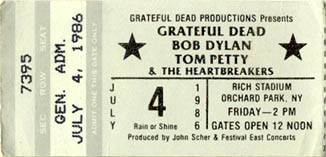
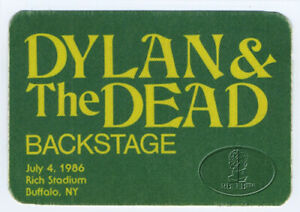
It’s not too often you see the Grateful Deadopening for another band, especially not in the 1980s. But on July 4, 1986, the Grateful Dead linked up with Bob Dylan and Tom Petty and the Heartbreakers for one of only four shows together that summer, performing at Rich Stadium in Orchard Park, NY, home of the Buffalo Bills.
The Pittsburgh Post-Gazette characterized the show on the 4th of July perfect for “The Dead’s vagabond odes and Dylan’s outspoken songs of freedom.” Sweltering heat during the day led to a first set that was cut short, but rain during “Cold Rain and Snow” to start the second set provided respite for the crowd. Perhaps out of exhaustion, fans were reported to have left after the Dead encored with “U.S Blues.”
While the Dead opened, a trio of songs were featured in a satellite broadcast live to Farm Aid 3. Prior to “The Wheel,” Bob Weir said to the crowd “America is an example of an agrarian nation, let’s keep it turning.”
Six days and two shows later, Jerry Garcia slipped into a diabetic coma and was unconscious for a week, but would recover and be back on stage later that year. This show at Rich Stadium would be one of the last times the Dead would perform in New York for nearly a year, before returning to Rochester on July 2, 1987.
Setlist, Grateful Dead, July 4, 1986, Rich Stadium, Orchard Park, NY
Set 1: Jack Straw, Dupree’s Diamond Blues, CC Rider, Tennessee Jed, My Brother Esau, Touch Of Gray
Set 2: Cold Rain & Snow-> Fire On The Mountain-> Samson & Delilah*-> The Wheel*-> I Need A Miracle*-> Uncle John’s Band-> Drums-> Gimme Some Lovin’-> Goin’ Down The Road Feelin’ Bad-> Turn On Your Love Light
Encore: U.S. Blues
*broadcast as part of Farm Aid 3
Dylan and fellow Traveling Wilbury Petty joined up for a tour featuring the Heartbreakers backing Dylan. Dylan played a few solo acoustic songs, while the Heartbreakers played their hits that are still classics today, and all joined together for “Rainy Day Woman # 12 & 35.”
Bob Dylan with Tom Petty and the Heartbreakers, July 4, 1986, Rich Stadium, Orchard Park, NY
Set: So Long, Good Luck And Goodbye, Positively 4th Street, Clean Cut Kid, Emotionally Yours, Trust Yourself, We Had It All, Masters Of War, Straight Into Darkness (Petty & The Heartbreakers), Think About Me (Petty & The Heartbreakers), The Waiting (Petty & The Heartbreakers), Breakdown (Petty & The Heartbreakers), To Ramona (Solo acoustic), One Too Many Mornings, (Solo acoustic), A Hard Rain’s A-Gonna Fall (Solo acoustic), I Forgot More Than You’ll Ever Know, Band Of The Hand, When The Night Comes Falling From The Sky, Lonesome Town, Ballad Of A Thin Man, Bye Bye Johnny (Petty & The Heartbreakers), Make It Better (Forget About Me) (Petty & The Heartbreakers), Spike (Petty & The Heartbreakers), Refugee (Petty & The Heartbreakers), Rainy Day Women # 12 & 35, Seeing The Real You At Last, Across The Borderline
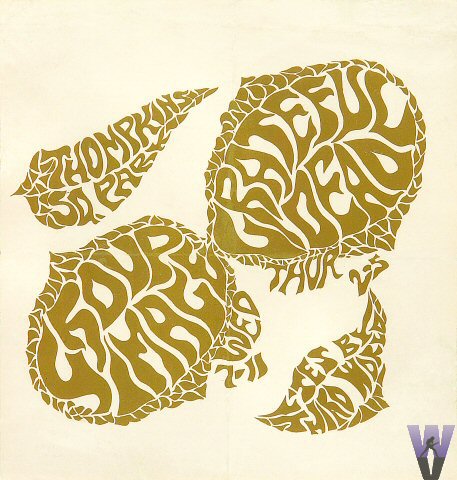
Few bands have a relationship with the state of New York like the Grateful Dead. Performing over 300 shows throughout the Empire State in a span of 28 years, the Grateful Dead made their mark starting with their first New York performance in Tompkins Square Park on June 1, 1967
In some ways, the Grateful Dead’s maiden trip to the East Coast via New York City mirrors the ongoing circumstances we see there and across the country today. The year was 1967, right in the heart of the Civil Rights Era. And, locally, tribal tensions were beginning to boil over as well, stirred by the wrestling of control over the communal jukebox that had become Tompkins Square Park, a public space in the Alphabet City section of the East Village.
Tompkins Square Park 6/1/67
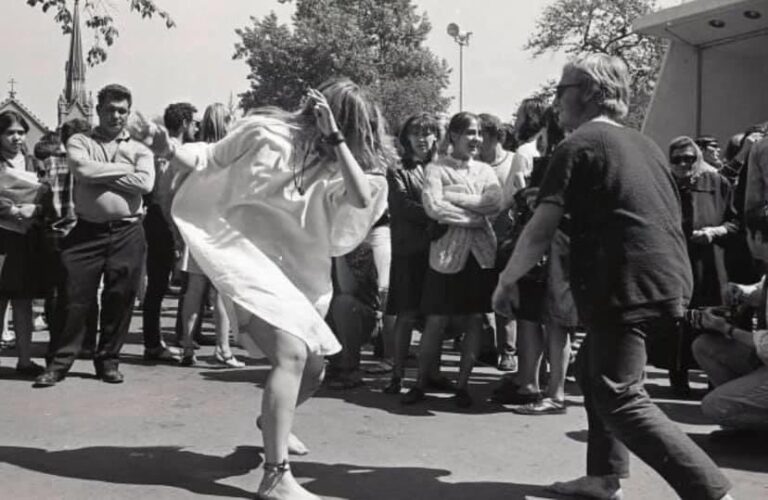
This being the “Summer of Love,” San Francisco was not the only place towards which hippies were flocking. Those that had descended upon Manhattan’s Lower East Side grew fond of playing their congas and bongos at the park. Puerto Ricans, the neighborhood majority, wanted their music to be prevalent and the Black community also fought for control of the musical output. Over the last few weekends, fighting at the park had become rampant.
Most recently, 38 people were arrested at Tompkins Square Park on Memorial Day after being confronted by police for sitting on the grass where they were playing music, both park violations. Per a Village Voice article from June 8, 1967, “A couple of cops went over to the park and told the hippies to shut up and get off the grass. The kids laughed, and kept singing. The cops ordered them to leave. ‘They laughed at us,’ patrolman John Rodd explained. ‘That’s when the trouble began.’”
Throw in all the other issues that the summer of 1967 undoubtedly brought and it becomes clear that local police were in danger of losing their city, as far as popular opinion went, and needed to rethink their tactics. Maybe it was someone on the force who somehow had an early copy of the Grateful Dead’s eponymous first album, released just months earlier. Or maybe it was “Cream Puff War,” the album’s second single that was slowly beginning to garner some radio airplay, that had somehow made it to a patrolman’s ear. Whatever the root cause may have been, the Grateful Dead were about to be met with an interesting quid pro quo from the city in the effort of keeping the peace.
Grateful Dead playing Golden Gate Park, just a few months prior to their first East Coast trip
Although the band was still in its nascent stage, they were definitely on the local radar. This was made evident when they were greeted by two separate welcoming committees upon their arrival to the Big Apple, each with a distinct agenda. According to Rock Scully, one of the band’s early managers, they had drama as soon as they arrived at their hotel. According to his book, Living with the Dead: Twenty Years on the Bus with Garcia and the Grateful Dead, Scully and the band were greeted upon their arrival with one of the oldest tricks in the book.
“I put the briefcase down on the front desk right next to me – it had all of our expense money in it – and the next thing I know somebody comes up and asks a question. I turn around and when I turn back, bang! the money’s gone. ” ~ Rock Scully
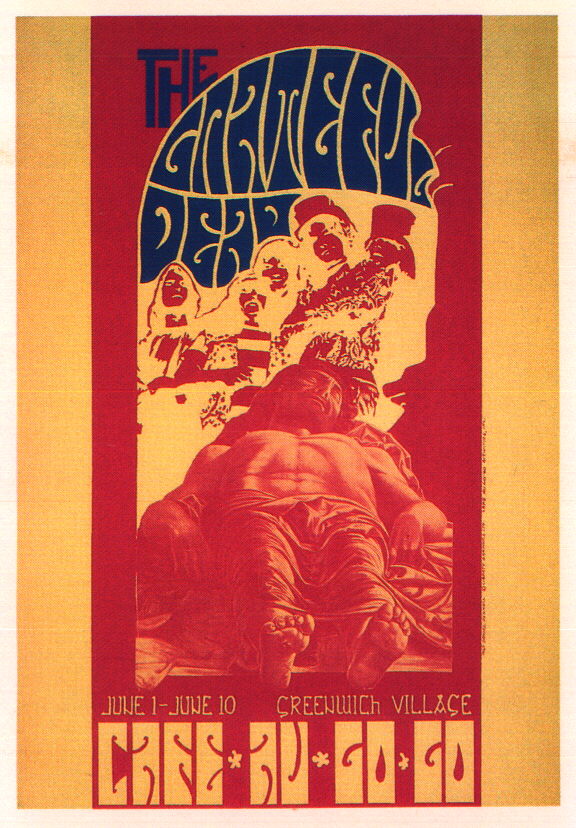
After returning to the hotel later that day, the band is greeted by the NYPD and Thomas Hoving, head of the Parks Department. Unsurprisingly, this was not a follow up for details to the heist from earlier in the day but, rather, a business proposal that would seem to benefit both sides. The Dead is presented with an offer to do the city “an honor” by playing an additional show at the bandshell in Central Park. As it stood, their only planned shows were a series of gigs slated to go down at the Village’s Cafe Au Go Go.
Who would say no to an extra show at such an esteemed locale in the most populated city in America? Surely, there had to be a catch. Well, there was. Now that the band had been buttered up, so to speak, the police then politely asked if they could give them “a hand with this little problem we’ve been having in Tompkins Square Park.”
The Grateful Dead may not have been a worldwide attraction yet, but they were known as a band that had no problems playing outdoors, and to great numbers at that. Word of the “Human Be-In,” a large outdoor show at San Francisco’s Golden Gate Park in January which the Dead were prominently involved in, had clearly reached New York City. A band with mass appeal that played outside and catered to hippies would be just what the doctor ordered. Although, understandably, the band had their concerns about jumping into the local fray.
“We can’t even hang on to our per diems and they want us to sort out a gang war in Alphabet City? They must be desperate.”
Rock Scully, Living with the Dead: Twenty Years on the Bus with Garcia and The Grateful Dead
It became clear to the band that the caveat for being allowed to play Central Park was their assistance in this local matter. After some initial reluctance, they were nudged to accept after lead guitarist Jerry Garcia spoke up, seeing it as a chance for outsiders like them to bring another community together via music. In the name of harmony, the Dead encouraged all local bands and musicians to attend and share the stage with them.
So on June 1, the day after the Memorial Day skirmish, the Grateful Dead went down to Greenwich Village where they were given the royal treatment, hailed as foreign troubadours here to deliver peace. Per a Village Voice article from the following week, “A happy, scruffy parade of 80 marched down St. Mark’s Place, complete with police escort, to present the Dead with a white carnation key to the East Village, graciously accepted by Pigpen. And the Tompkins Square bandshell rocked with San Francisco glory until a noise complaint was lodged in the late afternoon.”
But true to the band’s initial vision, they were only a part of the festivities that drew some 3,000 people to the park over the course of the day. They played from 2 – 5 p.m. and delivered their signature sound of amplified rhythm and blues meshed with psychedelic rock that was being consumed by an East Coast audience for the very first time. A Newsday review claimed the music could be “heard for blocks in every direction.”
Tompkins Square Park video footage from 6/1/67 (no audio first two minutes)
Throughout the course of the day, music of all kinds filled the air in what had to be one of the largest, free musical gatherings in New York to date. The gathering, dubbed a “real-in,” was a successful mass protest of sorts, in response to the events from Memorial Day, signaling to the local authorities that the local community was capable of policing itself.
It was certainly highlighted by the Dead’s first East Coast gig, but they willingly shared the stage with The Fugs, a much more well known local act, as well as local Puerto Rican and Black musicians who had also assembled – a true “pop-up” festival with some San Francisco flair. The Grateful Dead’s collective mindset, especially Garcia’s, is perhaps best summed up by Scully and his take on the day’s proceedings. “ Then other musicians come up with their congas and marimbas and bongos and cowbells, and they see this isn’t a turf thing at all. Music is music as far as the Dead go. African music or Puerto Rican salsa, it don’t make no difference to Garcia.”
And so, the band’s long, strange relationship with the State of New York had begun – dropped into the middle of civil unrest in return for an unexpected show at Central Park. Both those shows and the following string of dates at Cafe Au Go Go went off without a hitch and the Dead had officially stamped New York City as its first East Coast mainstay. They would return many times and wind up playing shows in almost every region of the state – which we look forward to writing about and covering here in New York State Music’s “Golden Road” series.
Setlist: June 1, 1967, Tompkins Square Park – Manhattan, NY (setlist is incomplete and approximate)
The Golden Road (to Unlimited Devotion), Dancin’ in the Streets, In the Midnight Hour, Beat it on Down the Line, Good Morning Little Schoolgirl, Cold Rain and Snow, Morning Dew, Viola Lee Blues
Bonus footage from the band’s performance at the “Human Be-In” in Golden Gate Park 1/14/67
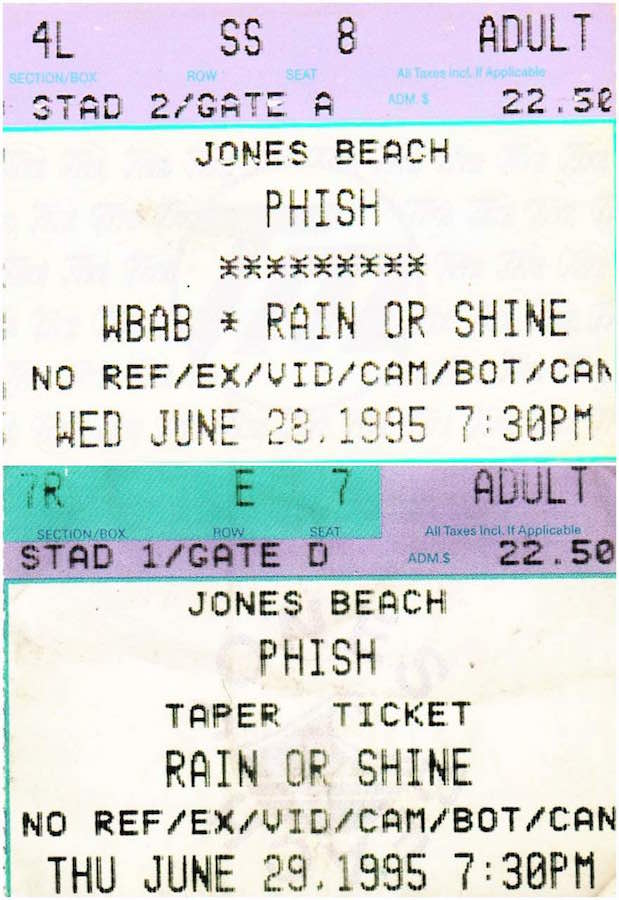
After performing at SPAC and taking a day off to celebrate the release of A Live One, Phish headed to Jones Beach for their first two-night run at the Long Island amphitheater. Growing their following, especially from New York metro area high school and college students with a summer off, was part of Phish’s broadening appeal as they performed in bigger and bigger theaters.
The first show on the 28th featured the retired “Axilla (Part II)” and an 11-minute “Foam” demonstrating the patience of the foursome from Vermont. The rest of the set after “Fast Enough For You” reads like a fantasy setlist, and it was only the first set, including one of two “Fluffhead”‘s from that tour.
Set 2 unleashes a 30+ minute “Tweezer” that is one for the books, so much that it was added to Live Bait 10 (scroll down for video). This experimental version of the jam vehicle included the ever rare “Dave’s Energy Guide” and a jam on The Breeder’s “Cannonball.” If you were still clamoring for more, the “Harry Hood” and “Tweezer Reprise” to close the set are likely to seal the deal.
Soundcheck: Sweet Home Alabama, Jam, Ginseng Sullivan, Red River Valley Jam, Dog Log (slow)
Set 1: Axilla (Part II) > Foam, Fast Enough for You, Reba[1], Punch You in the Eye, Stash, Fluffhead > Chalk Dust Torture
Set 2: Sample in a Jar, Poor Heart > Tweezer -> Dave’s Energy Guide -> Tweezer > Gumbo > Sparkle > Suzy Greenberg, Harry Hood, Tweezer Reprise
Encore: Sweet Adeline, While My Guitar Gently Weeps
[1] No whistling.
Ha Ha Ha was teased before the start of the first set. Reba did not have the whistling ending. Dave’s Energy Guide was played for the first time since March 8, 1991 (479 shows). The secondTweezer included a Cannonball jam with quotes from Trey.
The next day the fans returned to Jones Beach for another round of Phish, and were greeted with “Runaway Jim” -> “Taste.” The straightforward first set was enthusiastic and energetic, and ended with an acapella “Carolina.”
If you were getting your first taste of Phish over these two nights, you might think that nearly half hour versions of songs were the norm, and for a time, they were. Both “David Bowie” and “You Enjoy Myself” topped over the 25 minute mark, with “Bowie” taking chances getting spacey, and “You Enjoy Myself” including a bass and drums section.
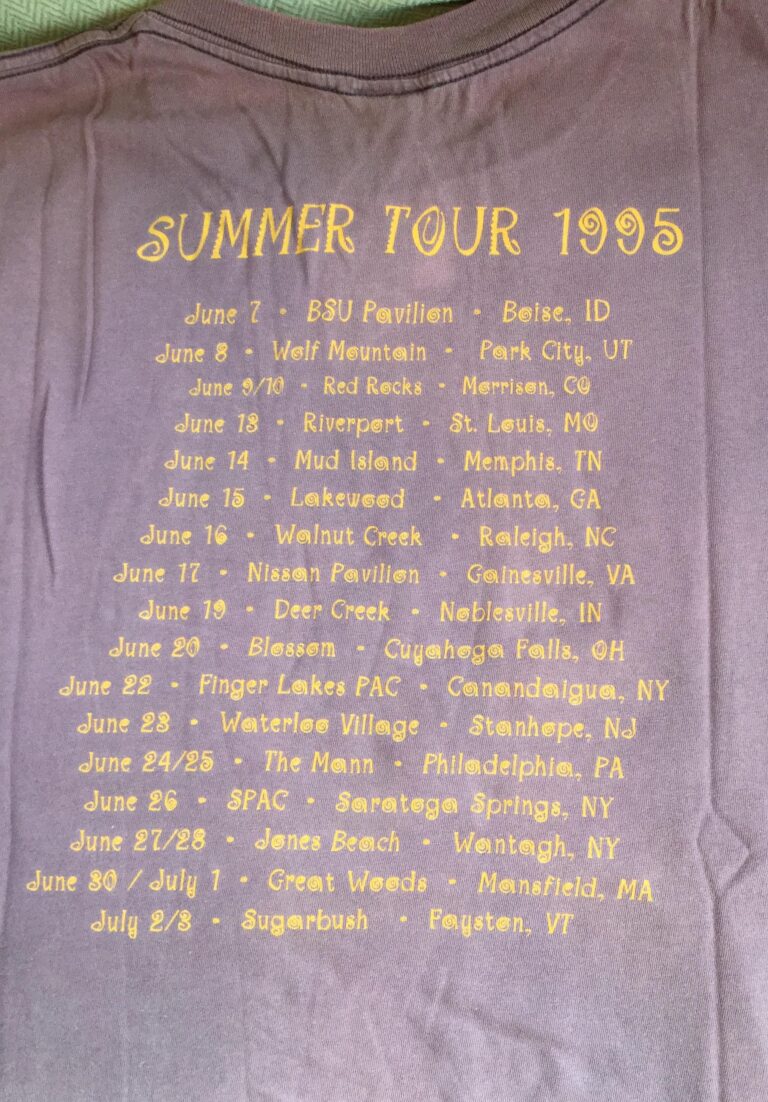
From here, Phish would have two more two-night runs, at Great Woods in Mansfield, MA and two-nights in at Sugarbush in North Fayston, VT