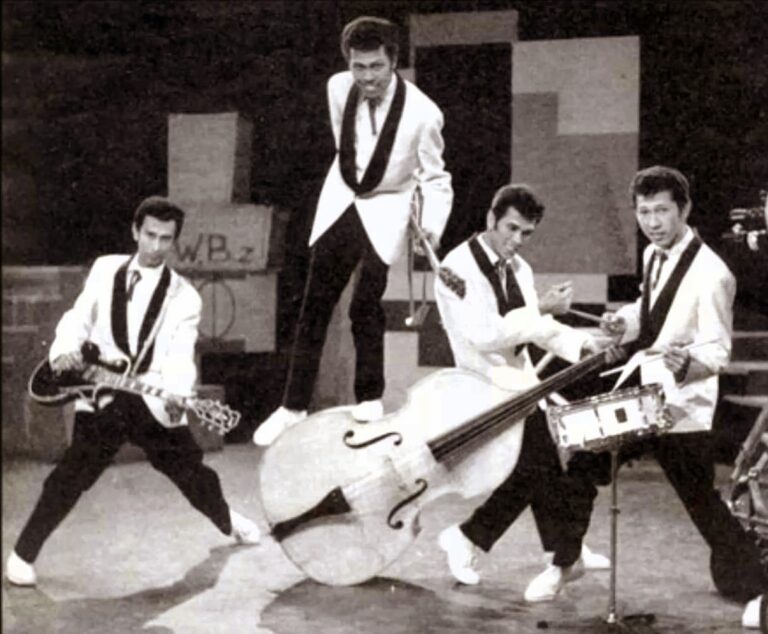
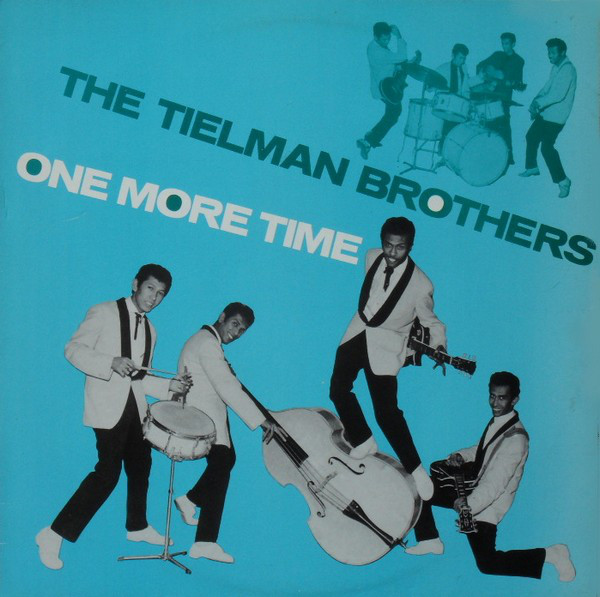
The late, great Edward Van Halen wasn’t the first musician of Indonesian descent to set the world ablaze with his fiery guitar work. That honor goes to The Tielman Brothers, a quartet of Indonesian immigrants to Van Halen’s native Holland, who helped pioneer a new musical genre in the early years of rock-n-roll. It was a fusion of exotic world and American musics – a high energy, theatrical and largely instrumental guitar-driven variety played by Indonesian immigrants to the Netherlands dubbed Indorock. Although it was big in continental Europe for a time, Indorock has remained virtually unknown in the world beyond.
Tielman’s story begins in 1945 in Surabaya, Indonesia, then a Dutch colony. That was when four brothers – Andy, Reggy, Loulou, Ponthon and their sister Jane – were inspired to start performing traditional folks songs and dances at parties by their musically-inclined father, Herman. Within a year and half, they were on tour as The Timor Rhythm Brothers, playing the music and dances of their homeland with costumes and even war-like rituals employing spears and swords. The musical style they played, kroncong, was a fusion of traditional Indonesian music with Portuguese fado and saudade, sounds that came to these islands when European explorers arrived, with their guitars, in the 16th Century.
All that changed in 1951 when the Tielman’s heard the hillbilly rock of “Guitar Boogie” by Arthur Smith. In search of a harder, more American sound like Smith’s, they moved brother Loulou over to the kit drum set. They eventually began to add covers of hits by Les Paul, Elvis, Chuck Berry, Fats Domino and Gene Vincent to their act – all propelled by the ferocious guitar licks and versatile vocals of Andy Tielman.
The Tielman’s joined the wave of more than 300,000 Indonesians who would emigrate to Holland. They brought spice to its culture, cuisine (the famed rice buffet, Rijsttafel) and music. In 1957, the family relocated to Breda, Netherlands where they began playing as The Four T’s. Their big break came in 1958 when they secured a gig in the Hawaiian section of the Dutch pavilion at the World’s Fair in Brussels. Hawaiian music was becoming a global sensation at that time. Naturally, it became another ingredient in their fast-expanding polyglot musical brew, along with a little country & western, rockabilly and their native folk.
The World’s Fair crowds were blown away by their frenetic brand of rock-n-roll. It was a roar of volume and energy complimented with showy antics like tossing their guitars, playing them with their teeth, their toes, behind their backs and heads, and upside down – all without missing a note or beat. It was Hendrix’s bag of tricks, minus the burning guitar, ten years before Monterey Pop. Their electrifying act quickly garnered bookings far and wide, including some in Hamburg’s notorious Reeperbaum red light district, commencing two years before the Beatles’ first stint.
A year later, they would finally be performing as The Tielman Brothers, in Holland and mostly frequently Germany. The year also saw the release their debut single, “Rock Little Baby of Mine,” widely considered the first-ever Dutch rock-n-roll record. Around the same time, brothers Andy and Reggy started playing their signature Gibson Les Pauls. It was something that would influence a host of European guitar heroes-to-be including Jan Akkerman. The blistering technician who led Holland’s most internationally successful Indorock band, Focus of “Hocus Pocus” fame, Akkerman got turned on to the Tielman’s and their Les Pauls at age 12, while watching a performance on German TV.
“Andy’s white Les Paul was cool, but seeing Reggy playing his Black Beauty, I knew that was my guitar and I would have to have one someday,” says Akkerman. “I had played a Gretsch White Falcon in a bunch of bands since my dad bought it for me in 1963. But I had wait around seven more years or so, until my days in Focus, to finally get a black Les Paul Custom. It was an instrument that became a signature of my sound and the bands through the mid-70s.”
The Tielmans stuck with Gibson guitars until the mid-60s when they moved on to Fender Jazzmasters. Lighter axes made their acrobatics easier to perform and became choice for the majority of Indorockers. Interestingly, Andy created a custom 10-string Jazzmaster in order to thicken his sound.
Much of The Tielman Brothers’ notoriety came as a result of high octane performances on Dutch and German television, ones that we can enjoy today thanks to YouTube.
On January 23, 1960, Holland was hit with an earthquake of Indorock sound and sight… when The Tielman Brothers appeared on AVRO TV’s “Weekend” show.
The slim, sharply dressed brothers kicked off their performance with “Black Eyes.” It’s a sleepy Santo & Johnny-esque ballad driven by trills and tremolo at first, which then moves onto a stop-time tango beat, and finally, a Gene Vincent/Cliff Gallup-styled rockabilly rave-up to close. Brother Andy was centerstage with his inspired riffing and cool lounge lizard presence – using bends, slides, muted strings and classical-styled tapping to ring harmonics out of his guitar.
This TV performance also included “Rollin Rock,” six-minutes of the brothers pulling out all stops on their instrumental Indorock prowess and showbiz schtick. Drummer Loulou played Andy’s guitar with his sticks and solos repeatedly. He walked around his kit as he thumped away. Ponthon alternatively runs, rides and slides his big acoustic bass across the stage. Then positioned himself beneath it as he took his solo. Andy swung for the fences as usual – playing his Les Paul with his feet, his teeth and behind his back, the latter while dancing atop Ponthon’s bass.
The Tielman’s performance also included their radical new single, “18th Century Rock.” Could it be they started the whole European classical/prog rock thing with this rockabilly’d-up version of Mozart’s “Piano Sonata No. 16 in C Major?” The stodgier segments of Dutch society were not impressed and criticized the band heavily in media. Interestingly, they would go on to enjoy greater success in Germany, Italy, France, Switzerland and Sweden than Holland.
The first Indorock bands I heard in Holland were the Poetiray Brothers, Electric Johnny and his Skyrockets, The Crazy Rockers and the Tielmans with Andy at the helm, who were the best of the lot. What a great talent he was, a genius in his own right who I had the pleasure to see and play with many times. Andy and the Tielmans were more of an influence on me than the Beatles or the Rolling Stones. I put him right up there in my favorites, with Jimi, Django and Julian Bream.
Jan Akkerman
“I remember seeing them one night in the ‘60s in the Hague at a chic place called Palais de Dance,” Akkerman recalled. “What I heard and saw was unbelievable, as it always was. They played high-energy rock-n-roll, romantic ballads and even instrumental covers of tunes from West Side Story. I heard from Andy that when they played at the Star Club in Hamburg, The Beatles would come listen and watch him play his guitar with his teeth!”
The original band of brothers would stay busy, add some new members and release a steady stream of singles and albums until a serious car accident caused two to leave the band in 1964. The band, then with only Andy aboard, scored their biggest hit in The Netherlands with the Hawaiian-inspired vocal ballad, “The Little Bird,” which reached #7 in the Dutch Top 40 in 1967.
Even after a move to Australia in his later years and the dissolving of the band in 1979, Andy continued to be a popular performer, returning to Europe to play and record and sometimes re-make his hits until his death in 2011.
“After I left Focus in 1976, Andy came to visit me often and we even recorded an album, R&R, Our First Love, which sadly never got released,” adds Akkerman. “A few month before his death, I ran into him at an Indonesian marketplace in the Hague. His daughter was playing violin; she was very good and he was very proud, more proud of that than anything at that moment. Shortly after that, I got the news he was terminally ill, but he kept playing till his last breath. Andy, for me, is still numero uno.”
The Tielman Brothers combined the very best of many good things. They boasted the intricate instrumental guitar stylings of The Ventures, The Shadows, Link Wray and Dick Dale, with rockabilly/pre-punk energy, relaxing South Sea islands folk balladry, some Great American songbook croonery, primitive prog rock with their classical interpretations and much more. It was all delivered with the kind of crowdpleasing antics that may obscure the instrumental brilliance at first glance.
As Akkerman relates, The Tielman Brothers were just the tip of the Indorock spear. Some lesser known groups of Dutch/Indonesian musicians slightly preceded them like The Real Room Rockers; and many more followed, including The Crazy Rockers and The Blue Diamonds. They are all well worth the listen.
Also worth a long listen and look is Akkerman’s work on the spectacular, new 9-CD,2 DVD Focus 50 Years anthology. This elaborate boxed set collects remastered editions of the band’s seven studio albums, plus assorted b-sides, alternative mixes, unreleased outtakes, demos and live and television performances from the Indorock/prog/fusion band’s peak years, 1970 -1976.
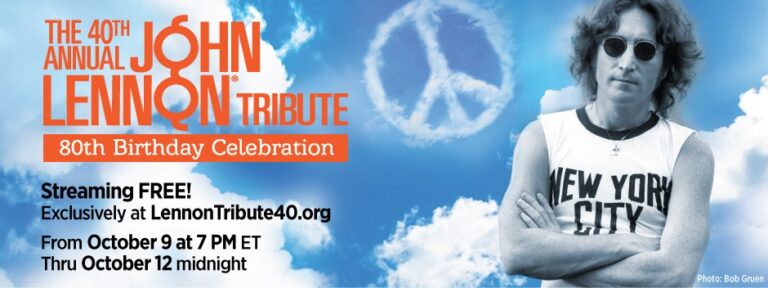
Theatre Within, the non-profit behind the Annual John Lennon Tribute charity concert since 1981, has announced that its milestone 40th Annual John Lennon Tribute Concert will again offer a free livestream exclusively at LennonTribute40.org, from Wednesday, December 23 at 7pm thru Friday, January 1 at midnight ET,
This program, the third installment of music and memories produced in Lennon’s honor, will feature a new performance by Steve Earle, recorded especially for the Tribute’s finale showing. The stellar line-up also includes recent John Lennon Real Love Award Honorees, Patti Smith, Natalie Merchant and Rosanne Cash, plus Jackson Browne, Taj Mahal, Jorma Kaukonen, Martin Sexton, Keb’ Mo’, Joan Osborne, Bettye LaVette, Shelby Lynne, Marc Cohn, Willie Nile, Lucy Kaplansky, Nicki Richards, The Kennedys, Ron Pope, and Music Director Rich Pagano.
In addition, the livestream tribute includes reflections on the music of John Lennon, social impact by rock photographer Bob Gruen, Double Fantasy producer Jack Douglas, radio personality Dennis Elsas, music critic Anthony DeCurtis, and playwright V (formerly Eve Ensler).
In a statement, Yoko Ono said:
John has been a loving spirit now for nearly as long as he was with us on earth, 40 years. Through all that time, Theatre Within has celebrated his music and message with its beautiful annual tribute, which helps makes possible its programs for those impacted by cancer, including the John Lennon Real Love Project songwriting workshop. This is such a wonderful way to honor John and the values he stood for.
This year, in partnership with Gilda’s Club NYC and Gilda’s Club Westchester, Theatre Within has provided 135 free workshops, all available online – in songwriting, art, meditation and much more – for children, teens and adults impacted by cancer.
Theatre Within invites John Lennon fans to make a donation in any amount by texting “TRIB40” to 41444. All proceeds will empower Theatre Within to continue its free programs for NY-metro cancer community through 2021.
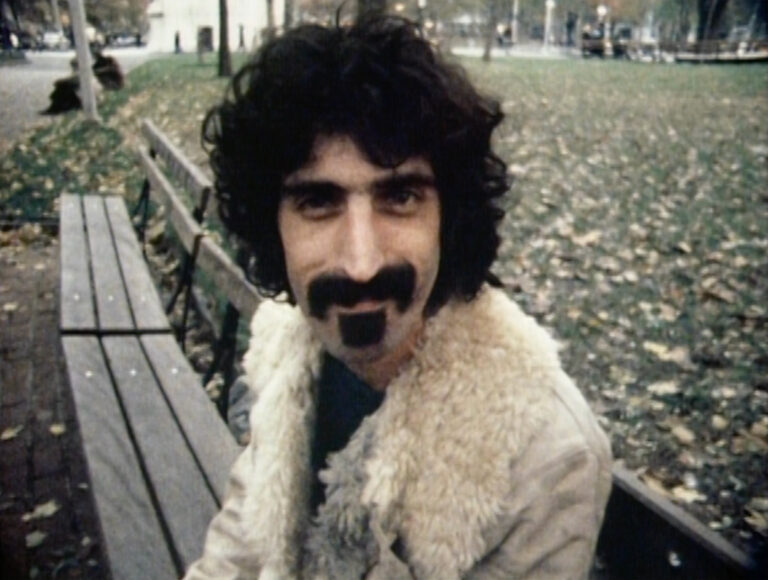
In the gatefold of “Freak Out!,” his stunning double disc debut from 1966, Frank Zappa includes a telling quote from Edgar Varèse, the composer he idolized first and maybe above all others. It’s a creative call to arms in seven words, one he lived virtually round-the-clock for most of his 52 years: “The present day composer refuses to die.”
With Alex Winter’s long in the works documentary ZAPPA, we get an all-access and bravely unvarnished view of the life of this epic American creator and thinker. It’s the story of a man, a composer first and foremost, who would defy any obstacle to get the music dancing in his head out and heard. And the most important audience for it, the only one that really mattered though millions would come to love it, was Zappa himself.
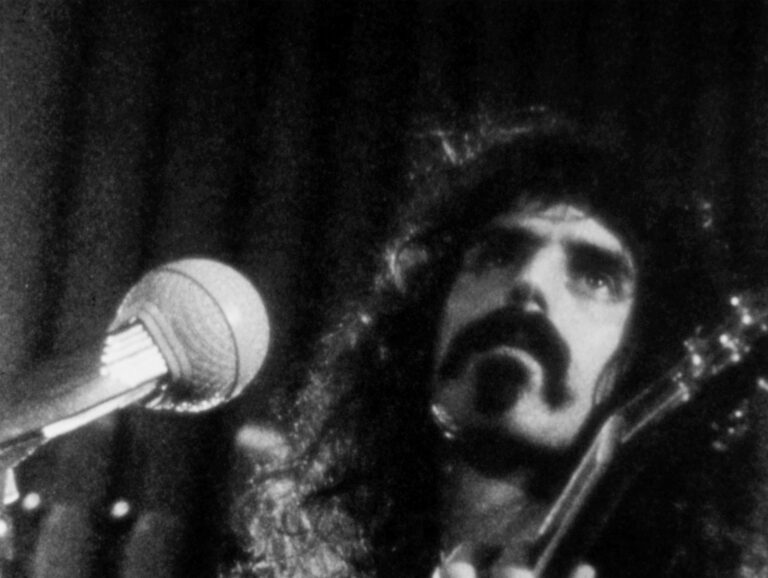
Frank Zappa in ZAPPA, a Magnolia Pictures release. Photo credit Roelof Kiers. Photo courtesy of Magnolia Pictures.
ZAPPA is anything but the formulaic rock doc of “rise-fall-rebirth” pioneered by the likes of VH-1. It’s a comprehensive and surprisingly honest look at a cliché, that holds a hell of a lot of water in this case – the agony and ecstasy of the artist.
Winter’s documentary follows every chapter of Zappa’s struggles and triumphs, from his childhood and teens in Baltimore and the California desert, to the global adoration he was beginning to enjoy at the time of his death in 1993. In the end, Zappa was finally acknowledged as both a serious composer in the grand classical tradition and a singularly eloquent champion of freedom. This was for his almost solitary anti-censorship battle with the Parents Resource Music Council (PMRC) in America and Eastern Europe, where his free-spirited music helped power the “Velvet Revolution” against the Soviets.
Importantly, the doc also spotlights the sacrifices and conflicting emotions of many musicians who worked to bring his challenging music to life, and the family that took a backseat to the ceaseless writing, recording and touring his muse demanded.
Through Zappa’s widow Gail, Winter and his creative partners were granted exclusive access to a voluminous collection of unreleased recordings, concert footage, incomplete films, unseen interviews and home movies. It’s the latter, spanning his childhood through his final days, which really shed a fresh, relatable viewpoint on this genius music giant.
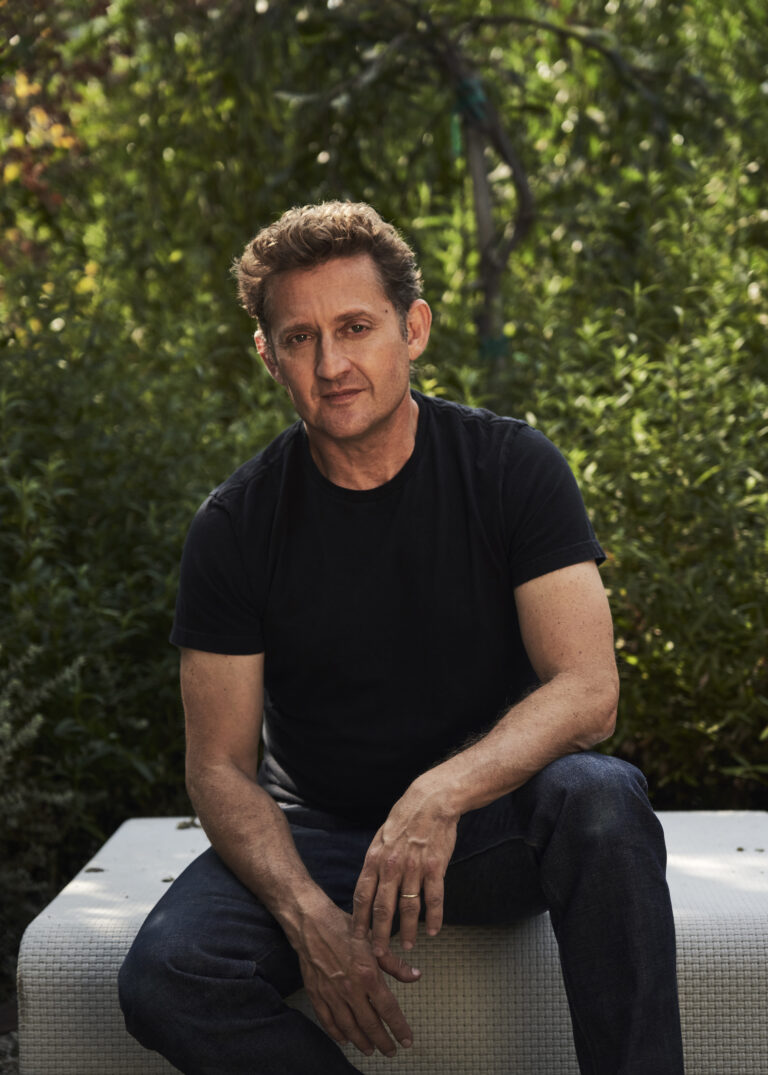
Portrait of Alex Winter. Photo Credit: Philip Cheung
The film begins at the end, with Zappa at his final public performance in Prague in 1991. Here he is playing guitar for the first time in three years to help the Czechs, who had a special love for him and their Zappa superfan President, Václav Havel, celebrate their independence. Then come clips of the many news stories worldwide that marked his passing. Following is a scene of Frank walking the corridors of his vast “Vault,” an archive containing tens-of-thousands of hours of music, film and other artifacts, the entirety of nearly 40 years of his creative labor.
From there, Winter takes us to the beginning, with some remarkable home movies that humanize this larger-than-life figure as a child. There’s young Frank in the kitchen with mom and dad, in the backyard cavorting with brothers and sister. He’s an all-American boy for sure, but one already carrying an all-knowing smirk, even then. There are also scenes from a goofy horror movie he made with his dad’s film camera in 1956. Experimenting with his dad’s 8-millimeter gave Frank a love of editing and splicing, something that would go on to inform much of his musical output. It is the flowing editing of all the unearthed material above smartly juxtaposed with his many eras of diverse music to it, that makes this film such a rewarding and dreamy viewing experience.
Perhaps inspired by his dad’s work as a munitions scientist, Frank developed a love of chemistry. He reminisces in the film about learning how to make gun powder at 6, and his last experiment, when he was suspended for attempting to blow up his high school at age 15.
It was another thing that went boom, the work of Edgar Varèse, that drew Zappa to music. The fun loving Zappa just had to seek out an LP that a magazine claimed was the “ugliest” and “most frightening ”music ever committed to vinyl, Varèse’s 13-percussionist heavy “Ionization.” With this as inspiration, Zappa takes up the drums and states his intention to become a classical composer, just like his idol. Watch for the great footage of a military haired Frank banging away on the trap kit, with pork pie hat on his head and ciggie in mouth, with his first real band, The Blackouts.
The film then proceeds in chronological order through the many chapters that seeded his career, told with a remarkable collection of unseen footage, interviews and sounds.
There’s the teen years in the California desert, where he discovers a love of R&B with his good pal Captain Beefheart. Don’t forget his experimental days with his own recording facility, Studio Z, which he bought with the proceeds from scoring two films. There’s more intriguing footage from a never-completed sci-fi film he worked on with Beefheart. Also, the details of his bust for obscenity, for making a racy audio tape for an undercover cop who wanted to shutter his studio. According to Zappa in the film, “that little escapade was the most informative part of my political training.” There’s also great images of the Mad Magazine-inspired greeting cards Zappa created in his day job as commercial artist, all to supplement his musical aspirations.
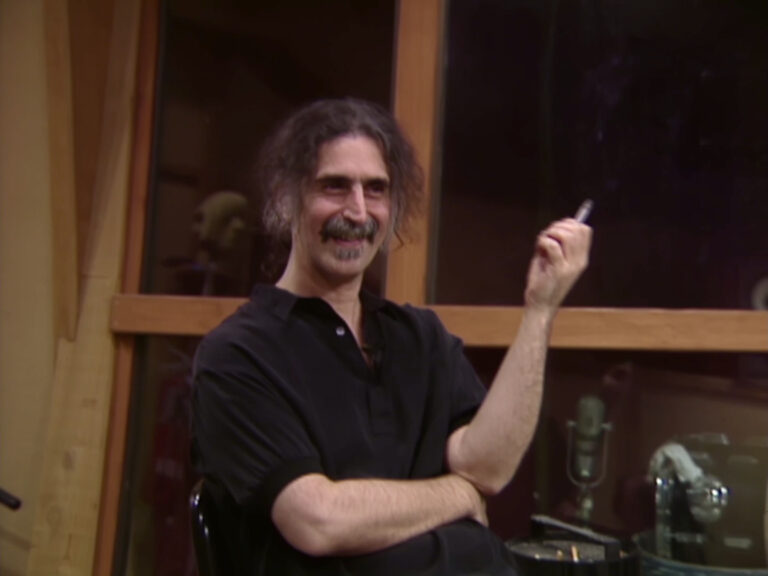
Frank Zappa in ZAPPA, a Magnolia Pictures release. Photo credit Zappa Trust. Photo courtesy of Magnolia Pictures.
“If I was ever going to hear what I wrote, I would have to put a band together”
Zappa
This quote leading to some suitably psychedelicized footage of the early Mothers at the LA’s Whiskey A Go Go and their six-month, nightly stint at the Garrick Theater in New York in 1967. It’s the latter that proved most formative to the non-musical parts of Frank’s oeuvre.
“The Garrick was like the Beatles in Hamburg,” says Zappa’s wife Gail. “The attention to the theatrical side grew because they needed to do a new show, every night. It was like the theater of cruelty… the same people came again and again. But it really helped him perfect what he could get away with on stage.”
Two of the most meaningful interviews in the film come from early Mothers, saxophonist Bunk Gardner and Ian Underwood, Zappa’s musical second through the early ‘70s.
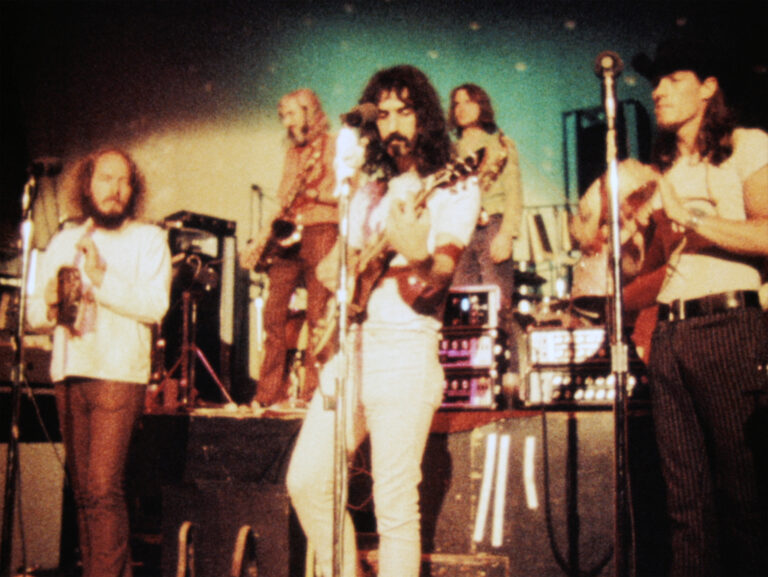
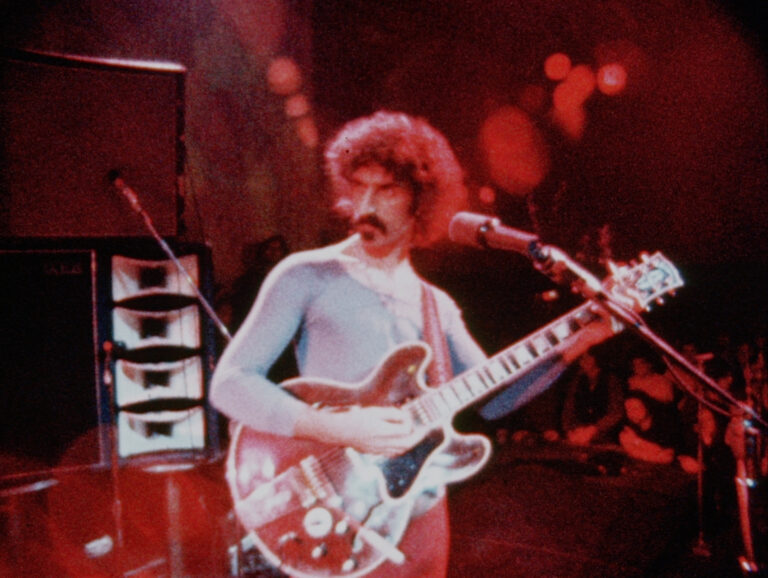
Frank Zappa performing with The Mothers of Invention in ZAPPA, a Magnolia Pictures release. Photo credit Cal Schenkel. Photo courtesy of Magnolia Pictures
“Not too many bands had horns, and no bands were playing Stravinsky, which made me feel good about what we were doing,” says Gardner. “Perfectionism became our duty. We would go in for eight, 12 hours, him drinking black coffee. He didn’t stop. It didn’t matter if it was Christmas or Thanksgiving, we were going to rehearse. He was writing all the time, introducing new stuff.”
“But in the four years I was with him,’ Gardner laments, “he shook my hand and said, ‘good job’ maybe once.”
Underwood states the bottom line: “The band wasn’t anything other than Frank’s ideas, and each show was like a new composition.”
The film tells of Zappa’s decision to break-up the much-loved original Mothers in 1969. He was $10,000 in debt and didn’t want to be responsible for other people. He wanted to make new and varied musical statements and would put together the ideal musicians, often undiscovered virtuosos, to make them happen. It was an ever changing lineup, one that made the careers of new stars like Adrian Belew and Steve Vai along the way.
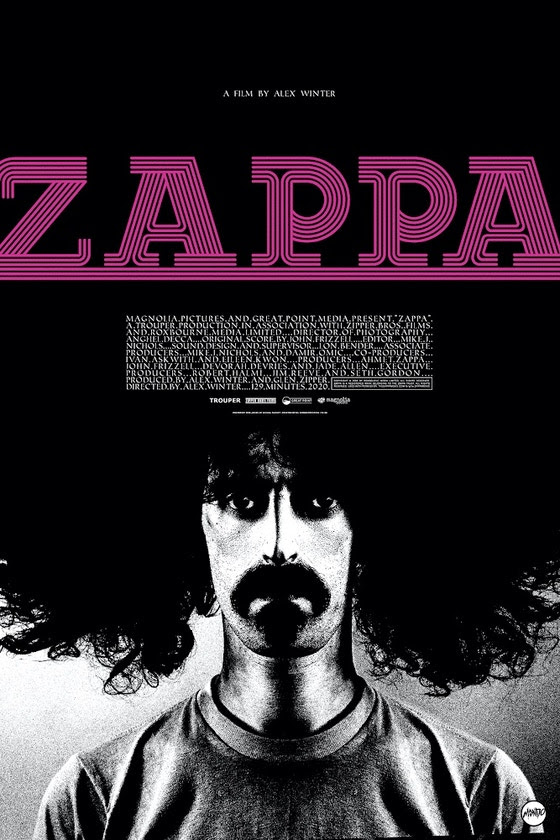
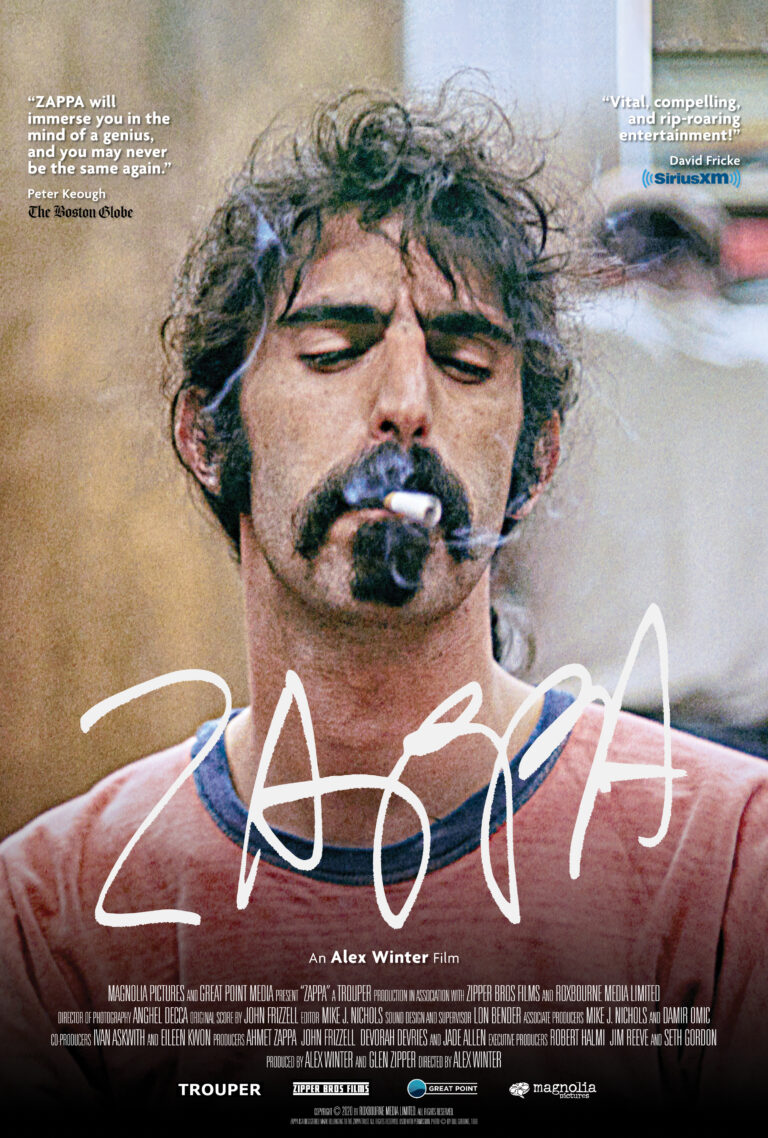
Theatrical one-sheet for ZAPPA, a Magnolia Pictures release. Bill Gubbins. Photo courtesy of Magnolia Pictures
The film closely details the many musical chapters and aggregations that follow. There’s his film “200 Motels” with his band with the Turtle’s Flo & Eddie and their Fillmore East jam with John and Yoko. There’s the “Waka Jawaka” jazz big band, the incredible fusionoid “Roxy & Elsewhere” band with George Duke, Ruth Underwood and the Fowler Brothers thru to his final 1988 ensemble which broke up in the midst of what would be his final tour.
“I was a tool for the composer and (Zappa) used his tools brilliantly. Frank was a slave to his inner ear. He tried to manifest it in a world of limitations, financial and performance limitations. That led to a lot of suffering for his art.”
Steve Vai observes
Ruth Underwood, the brilliant percussionist who was with Zappa on and off from his Garrick days, recalls. “He was a mass of contradictions, but very consistent with them.He had great feelings for us. He was human, at times cruel, but very passionate. He had real love, and the people he loved he kept bringing back.”
ZAPPA is perhaps the first officially sanctioned Zappa content that doesn’t sugarcoat the emotional impact of Frank’s workaholism on his marriage and children.
Frank Zappa in ZAPPA, a Magnolia Pictures release. Photo credit Roelof Kiers. Photo courtesy of Magnolia Pictures
One thing I was clear about is that I married a composer, and you have to be out of your mind to take it on. There’s no guarantee you will earn an income and nobody cares, the odds are pretty fantastic.
Gail Zappa
The film has more unseen home movies and details, provided by super groupie and Zappa family nanny Pamela Des Barres, about Zappa’s time at his famed “Log Cabin” in Laurel Canyon. His home served as the “centrifugal point” for homegrown stars like Jim Morrison and The Byrds and visiting rock royalty like Mick Jagger and Jeff Beck.
Des Barres, Gail and Frank himself confirm what had been kept somewhat mum until now – his horn dog ways as a touring musician. “She didn’t like it, but she knew,” says Des Barres of Frank’s affairs on the road. And in a never-before-seen interview, Zappa says of his time on the road: “I’m a human being, I like to get laid.”
Ruth Underwood observes, “Frank had a polarity of passion. He couldn’t wait to get out of the house and go on road, but he was happy when he got to come home.”
When Zappa was home, he was largely away from his family, working the night shift in his basement studio, then sleeping all day. One poignant chapter in the doc is the genesis of his only Top 40 hit, “Valley Girl.” This came about when his daughter Moon figured that the only way she would get to spend time with him was to suggest they make music together. She slipped a note under his door telling him this, and their collaboration led to mainstream acceptance and a Grammy nomination. Another beautiful scene is of baby Moon being cuddled by her parents and they dance to the strains of a classical favorite that Zappa quoted often, Stravinsky’s “Firebird Suite.”
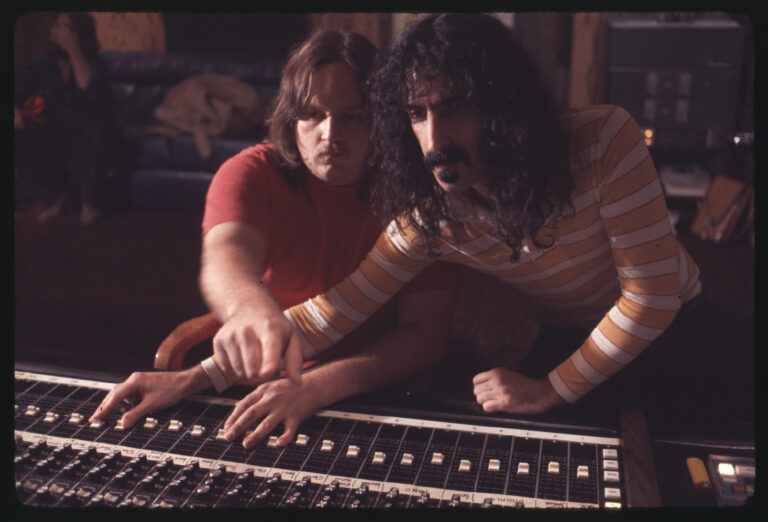
Kerry McNabb and Frank Zappa in ZAPPA, a Magnolia Pictures release. Photo credit Yoram Kahana. Photo courtesy of Magnolia Pictures
The film makes clear Zappa’s true obsession. “My desires are simple. All I want to do is get a good performance and a good recording of everything I ever wrote, so I can hear it. If anyone else wants to hear it, that’s great too. Sounds easy, but it’s hard to do.”
A good portion of the final third chronicles Zappa’s classical works, and the struggles to not only finance their production, but to have them performed on a level that would meet his exacting standards. It spotlights his work with the London Symphony Orchestra and Kronos Quartet, whose David Harrington puts Zappa in league with “American experimentalists like Harry Partch and Sun Ra, who reimagined what music could be.” Also covered is his explorations of doing it all by himself, with the then edge-cutting computer music station, Synclavier, with snippets from the final work released in his lifetime, “Civilization Phase III.”
The film ends with a positively jaw-dropping 13-minute sequence of the Ensemble Moderne performing Zappa’s acclaimed “Yellow Shark,” at his last public appearance in November 1992. With Ensemble Moderne, Zappa felt he had finally nailed it in the classical realm. And here, this remarkable music serves as backdrop for a lengthy montage, where the scenes of his life rewind before viewer eyes in true Hollywood tradition. After a music and dance encore of his treacherously beautiful “G-Spot Tornado,” and a 20-minute standing ovation, Zappa winks to the audience and concludes: “I guess there’s no accounting for taste.”
In the end, whether it was his true feelings or a put-on, Zappa gives this advice to aspiring composers. “Get a real estate license. If you want to be a composer, you must have another job to support your habit.”
I would be remiss not to add a few more important thoughts about this movie. The first is that it is a product supported by the fans, by a two-year crowdfunding campaign that raised more than any other documentary, nearly $900,000 which went to restoring the archival material. And all the fans who put up their hard earned cash up receive mention in the lengthy credits.
Frank Zappa in ZAPPA, a Magnolia Pictures release. Photo credit Dan Carlson. Photo courtesy of Magnolia Pictures
Unlike recent rock documentaries like “Once Were Brothers: Robbie Robertson and the Band,” this film is all the stronger for not being afraid to show Zappa’s missteps and personal failings, the people who also suffered and might’ve felt slighted as he pursued his sonic calling. Unlike the aforementioned documentary, where Robertson does a somewhat dishonest job of PRing his own contributions and sweetening over his massive conflicts with his bandmates, there’s none of that here. And with Frank being the control freak he was, this documentary could’ve only been done in such a way after his passing.
For a Zappa lover like me, this film was a truly rewarding and emotional experience. Zappa’s music was and still is an important soundtrack to my life. It’s the work of a fearless free thinker and experimenter, a self-reliant visionary who inspired me seek out sounds and thoughts from out of the mainstream.
For those not in the know, it’s the perfect primer. It’s an artfully constructed, comprehensive cinematic introduction to a man who made as broad and lasting an impact as any 20th Century musician. It’s also a study of the resourcefulness and fortitude needed to succeed in any creative endeavor, and a salute to a brave and much missed warrior for the causes of creativity and freedom of expression.
AMC’s Mad Men is one of TV’s most critically acclaimed series. It’s a stylish recreation of the martini stoked Madison Avenue advertising world of the 1960s, arguably its most creative era. However, there’s one bizarre chapter I would’ve loved to see this show cover that occurred in 1967. That was when some bold ad agency creatives recruited Frank Zappa to use his unique sonic talents to sell cough drops and electric razors.
This little known chapter of Zappa’s creative life transpired while he was residing in New York to play an extended run at the Garrick Theater with his Mothers of Invention.
Zappa’s most notable venture in advertising came with an animated commercial for Luden’s Cough Drops, one that actually captured a CLIO, the Academy Award of the ad business. The frenetic soundtrack Zappa conjured bears similarity to some of the sped-up, chopped-up vocals, instrumentation and effects that would be featured on We’re Only In It for the Money and Lumpy Gravy, albums he recorded during his New York stay.
Ed Seeman was the award-winning artist who hired Zappa for the project. Here’s how he recalls it in a post on his website.
“In 1967, I hired Frank Zappa for $2,000 to do the soundtrack for this TV commercial that I was animating and producing. It won a CLIO Award for “Best Use of Sound” and was the beginning of a two-year relationship that had me filming 14-hours of footage to be used for a film he called ‘Uncle Meat’.”
The second Zappa advert from this era is even more mysterious. It’s a never-aired one for Remington Electric Razors. It also contains one of the seemingly most oddball collaborations among musicians of the era, with Zappa utilizing the vocal talents of soon-to-be country rock superstar Linda Ronstadt.
This is another item all together, weird as a jingle ever was. It’s remarkable multi-part suite in 60 seconds, a mini-operetta with some cool stop-time sections, a stomping pulse, airy whole tone passages and, once again, sped up instrumentation and vocals. Frank Zappa recalled the ad in an 1980s interview as follow:
“After the CLIO, I got this request from Remington, who were looking for some kind of ‘new sound’ for their commercials. So Linda Ronstadt happened to be managed by Herb Cohen, who was our manager at the time, and they supplied me with this advertising copy, and they wanted music for it. So Ian Underwood and I put the track together and Linda did the vocal on top of it, and we made a demo. They paid $1,000 for the demo, and that was the last I heard of them. They didn’t like what we did.”
One person who reportedly did was The Simpsons’ creator and die-hard Zappa/Beefheart freak, Matt Groening.
When Danny Elfman was hired by Groening to write the theme for The Simpsons, he gave him an ‘inspiration’ tape. It contained The Jetsons theme, Nina Rota’s soundtrack for the Fellini film, “Juliet Of The Spirits,” some easy-listening music for Esquivel, a teach-your-parrot-to-talk record and Zappa’s Remington Electric Shaver jingle, which he got on a bootleg. One listen to both will demonstrate how this never-heard bit of Zappa got into the DNA of one of TV’s most memorable theme songs.
However, this wasn’t Zappa’s first experience in the world of commercial advertising. Before finding fame, he worked as an illustrator for a greeting card company. Some examples of his art, for the cards and more, can be found here and in the forthcoming Alex Winter documentary.
Utica’sall grown up boy wonder guitar god, Joe Bonamassa, has just unleashed another fantastic solo album, Royal Tea. Recorded at London’s iconic Abbey Road Studios. Bonamassa’s latest is a tip of the hat to his British blues rock heroes, Jeff Beck, John Mayall & The Bluesbreakers, Led Zeppelin, Cream and more. It is also as much a showcase for his increasingly progressive and mature songwriting, as is his always sizzling six-stringery.
The 10 originals here were co-written by Joe and Brit notables including former Whitesnake guitarist Bernie Marsden, ex-Cream lyricist Pete Brown and piano man Jools Holland of Squeeze fame. Bonamassa’s long-standing producer Kevin Shirley and his touring band, Anton Fig (drums), Michael Rhodes (bass) and Reese Wynans (keys), flew in for the sessions.
While Royal Tea is a nod to British blues masters, it is not at all about retreading the classics, or the simple but saintly joys of going round and round the 1-4-5 pattern. It’s an album full of songs that are firmly rooted in a blues feel, but with very progressive and surprising leanings. It’s all about the unexpected chordal turnarounds and multi-movements that span epic length, things that owe more than a bit to Brit prog acts of the ‘70s.
Bonamassa sets the tone with the album opener, “When One Door Opens.” It kicks off with baroque strings and brass that could’ve been mustered up by another true Abbey Road legend, Beatles’ producer George Martin. It’s a mournful ballad that feels a bit like Guns N’ Roses “November Rain,” until it shift into a nasty Led Zep-styled groove and then a boogie for a screaming wah-fueled solo. It solo winds down with rhythmic quote from “Beck’s Bolero,” before returning to the mournful orchestral mood for the close. A ballsy move, as this one clocks in at 7:34, making it the longest track on the album.
The title track follows. It’s another hard blues with a thick slamming groove and unexpected descending chordal turnaround, and yet another Beck-era Yardbirds’ quote in the solo. Here and everywhere on the album Joe’s guitar tones are killer, honey thick and biting. And his solos here are kept brief, always in service of the song. And why not? Joe’s got one of the world’s best employed vintage guitar collections to make these varied sounds, a virtual museum that can be viewed here.
“Why Does It Take So Long to Say Goodbye” is another of the many slow grooves here. Joe wrenches every bit of emotion out of the melody, with his guitar playing and his vocals, the latter which gets better in each passing album. This is another blues in a few epic movements over its six and a half minutes, where he complements thick power chording with sweet flourishes on his acoustic.
For a John Lee Hooker-styled boogie, with extra crunch, turn up “High Class Girl;” for a bit of Southern rock and slide, tap into “A Conversation with Alice.” On “Lonely Boy,” Joe and company go for broke, with a sprightly big band jump blues with rocking’ horn parts. Some beautiful soloing from Jools Holland and what must be flashy chromatic runs on a vintage Telecaster from Joe. This is a track that would be totally at home on a Brian Setzer album.
One of my favorites is the offbeat “Lookout Man!” This one combines another Jimmy Page-styled riff with Space Rock sound effects a la Gong/Steve Hillage, with a nasty blues harp and a chorus of female singers that sound like Ike and Tina Turner’s Ikettes. “Savannah” ends the album on an up tempo, with slamming’ country picking and a droney fiddle.
This week Royal Tea made a big splash on the charts, earning Joe Bonamassa his 24th #1 album on the Blues Chart, an incredible feat, more than any other artist in the history of the chart! More importantly, it’s gaining Joe fans beyond the narrow blues niche. He’s #5 on Current Albums, #6 on Indie Albums, #7 in Rock and #7 in Rock charts.
Bands like Cream and Zeppelin were successful because they took to the wonderful foundation of American electric blues and did something new and different with, with each album as their careers progressed. Bonamassa deserves their level of success because he is following in their progressive and bold footsteps.
KeyTracks: When One Door Opens, Why Does It Take So Long to Say Goodbye, Lookout Man!
With the May premiere of Laurel Canyon, its two-part series dedicated to the California rock of the ‘60s and ‘70s, EPIX proved it might just be TV’s best new source for music documentaries. With its latest effort, By Whatever Means Necessary: The Times of Godfather of Harlem, EPIX is heading East and uptown. The mission here is to spotlight the many musicians and the musical genres they birthed, from soul, funk and jazz to boogaloo and proto-rap, that helped inspire social change during the turbulent 60s, in New York City’s most culturally percolating neighborhood.
This four-part series is the counterpart to Godfather of Harlem, the acclaimed period drama featuring Forest Whitaker and Giancarlo Esposito. This Emmy Award-winning series follows the story of Bumpy Johnson, the notorious Harlem gangster who sought his own version of economic empowerment against the Italian mob, in an era when Black men and women had little power or choices for upward mobility. The action of the series spans the decade and is fueled by a soundtrack featuring the best of this very best era of Black music.
The fascinating story of this golden era is told in interviews with musicians like Martha Reeves, Gladys Knight, Herbie Hancock, Carlos Alomar, Nile Rogers, A$AP Ferg, Chika, Gary Bartz and Joe Bataan, along with the activists who were there pushing forward the drive for civil rights like Al Sharpton. It also contains a remarkable bounty of rarely-seen archival footage, of interviews and live performances by giants like John Coltrane, James Brown, Gil Scott-Heron and many more.
NYS Music speaks here with Keith McQuirter, the series’ Executive Producer and Director about what viewers can expect with the premiere of this series, November 8 at 10 pm ET/PT.
Sal Cataldi: The EPIX dramatic series for which your documentaries are a companion, Godfather of Harlem, is set in the ‘60s in NYC, a time and place of incredible change and musical innovation. Why was music so interweaved with and reflective of the currents of that particular time and place, the civil rights movement and the like?
Keith McQuirter: What drew me to do this series was to examine how music was used as a force for good in the fight for civil rights. There is a long history of Black protest and empowerment music and our series looks at the years, from 1960 – 1969, from the point-of-view of Harlem residents. The scripted series, Godfather of Harlem, is really a civil rights story, told in the criminal underworld. Our series focuses on an entirely different palate – how music impacted culture and politics, and how culture and politics impacted the music. It allows audiences to see the national story of the Black freedom struggle through the personalities, music and activism coming out of Harlem.
Harlem was a very political place in the ‘60s. Many black families fled the south due to racial terrorism and sought better economic opportunities, only to be face racism, discrimination, limited opportunity and segregated schools in the New York City. You had dueling philosophies of Malcolm X and Martin Luther King Jr. and the megawatt influence of Adam Clayton Powell Jr, who was both a Baptist minister and congressman representing the neighborhood. You had the Garveyites, the Black Panthers, the Young Lords and some many others in the fight for civil rights. Not everyone agreed on the approach, but they all agreed that it was time for a change. The freedom songs coming out of the Black church, the jazz of John Coltrane, Charlie Mingus, Max Roach and even Chubby Checker’s Twist spoke to power and change. Our series brings it all together through interviews with eyewitnesses, luminaries and archival that gives a unique look at this part of Black history and culture that is rarely ever told.
SC: The first episode spotlights The Apollo Theater, with comments from performers like Martha Reeves of Martha and the Vandellas and Gladys Knight, and even actor Giancarlo Esposito, one the stars of Godfather of Harlem who saw performances there as a child. What are some of the more interesting things you uncovered about the Apollo in your interviews and research?
KM: The Apollo Theater has been a cultural bedrock in Harlem and America for decades. If you wanted to be a star on the national stage, performing at the Apollo was a rite of passage for many artists. So all the greats performed on the Apollo stage. We spoke with Martha Reeves and Gladys Knight, who told us about her first time performing at the Apollo at a very young age. Both she and Martha talked about how nervous they were because the Apollo audience is known to be a tough crowd. If you get booed off, you might get a tomato thrown at you or other unpleasant things. It was interesting to learn the origin stories of these two legends.
But there is a lesser known story that I appreciated. In the late 1960’s, the Apollo Theater had a mentorship program, where they developed and groomed underprivileged, musically talented teens to be professional entertainers. The teens formed a band under the direction of the theater called Listen My Brother, in which 17-year-old Luther Vandross was a member. We interviewed Carlos Alomar of David Bowie Band fame and Robin Clark, both members of the band. They met as teens during the Apollo program and married before their 20th birthdays. Fifty years later, they are still married! It’s a truly musical love story. Their homework was to go upstairs and watch the Supremes and the Temptations — study their grooming, choreography, stage presence and incorporate it into their rehearsals and their own performances. Can you imagine that type of education? Robin Clark shared about how one day Aretha Franklin came down to the basement where they were rehearsing and talked to the teens about the music business. Robin said she couldn’t believe her idol casually made a surprise visit to their rehearsal. Its apparent that the education and mentorship paid off because both Robin Clark and Carlos Alomar have had illustrious careers in the music business for decades.
SC: The series illustrates how jazz, and especially the new breed of free jazz musicians, were reflecting the civil rights movement. How did the works like John Coltrane’s “Alabama” and Max Roach’s “Freedom Now Suite” energize the drive for equality?
KM: John Coltrane’s “Alabama” is a haunting elegy for the four little girls who died in the Birmingham church bombing in 1963, that was recorded just two months after the tragedy, when grief still weighed heavily on people’s hearts. Coltrane modeled the piece after Martin Luther King’s eulogy to the four girls that was delivered three days after the bombing. The saxophone begins in a tone and cadence of profound mourning, and gradually gains complexity and intensity, expressing the steady resolve to continue the struggle against racist brutality. The message in Coltrane’s piece remains relevant today, with racially-motivated violence still threatening the lives of Black people.
I also interviewed Warren Smith the legendary percussionist, who played with so many greats like Miles David, Aretha Franklin, Janis Joplin, Nina Simone and Max Roach. He says that Coltrane was unafraid to express his emotions in ways that were new at that time. He inspired Smith and others to fully lay into their instruments to express their anger and to say something meaningful.
This was in contrast to when most pop music at that time still avoided addressing political and racial issues, in an explicit way. Many jazz artists were fearless about expressing Black rage and resistance through their music. Jazz was the perfect vehicle for conveying the message of resistance, since the genre is deeply rooted in the historical Black experience. So, Max Roach’s “Freedom Now Suite” was a celebration of emancipation and the years of struggle that followed the end of slavery.
The incredible vocalist Abbey Lincoln expressed the anxiety and anticipation of emancipation against a frenetic avant-garde rhythm section. Roach said in an archival interview we found that, “We could never finish the song because we don’t really know how it feels to be free.” We also interviewed jazz saxophonist Gary Bartz, who played with Roach on the “Freedom Now Suite” and he remembers when he found out that the record was banned in South Africa – clear evidence that music could be a weapon for change.
SC: Curtis Mayfield was especially important, as a musical messenger, a sort of pop music poet of the struggle. What was it about him that connected so strongly with the movement and which resonates today?
KM: Curtis Mayfield had come up in doo wop music, collaborating with his old friends from Chicago’s Cabrini Green housing projects. As an artist, he understood the power of music to uplift and empower. He focused on building a viable music career and began to write songs that sent an implicit message of hope to young Black people hungry for change. His song, “It’s All Right,” speaks directly to the young people:
“When you wake up early in the morning, feeling sad like so many of us do, Hold a little soul, and make life your goal, and surely something’s got to come to you. And you’ve got to say, It’s all right…”
The song launched Mayfield’s career and his band, The Impressions, and it captured the spirit of resistance and hope that characterized the beginning of the decade. He later released “Keep on Pushing” capturing the civil rights movement determination for change. There were many artists providing the soundtrack to the civil rights era, but Mayfield is prominent because his music always deliver the message of empowerment.
By the end of the decade, his music had come a long, long way. His lyrics had become explicitly political, and his sound was funkier and more soulful. He released “(Don’t Worry) If There’s Hell Below, We’re All Going To Go” where he calls out the courts and the police as political actors, talks about the drug epidemic and pollution and how all of this decay and corruption is going to bring us all to our downfall. This message juxtaposed to Richard Nixon’s who was just elected president by an overwhelming white conversative calling for law and order and a return to the old America. It all sounds incredibly familiar.
SC: James Brown is another giant highlight in the series, especially the role he played in black pride, in actually changing the racial terminology from “Negro” to “Black” with his anthem “Say It Loud, I’m Black and I’m Proud.” How powerful an impact did this song have in the community?
KM: In the late 60’s, James Brown released an unexpected anthem, “Say it Loud (I’m Black and Proud).” This song made James Brown one of the most prominent performers to celebrate Black identity. Ever since his historic live album recorded at Harlem’s Apollo Theater in the early 60’s, Brown had personified unadulterated, unapologetic blackness. But his lyrics had always avoided politics, and his personal style still reflected an earlier time – especially his hair, which he kept in a carefully-maintained pompadour. By the time this came out, Brown cut his hair and sported an Afro in message with the changing time.
Brown later complained that “Say It Loud” ultimately cost him record sales, radio play and bookings at white clubs; but, at the moment it came out, it was an instant hit. Brown’s words were also taken up by activists across the country, who were marching in a never-ending series of protests – against the war in Vietnam, inferior schools, irresponsible landlords, unfair practices, and all the other problems the community still faced. His music fueled Black resistance and allowed Black folks to freely celebrate themselves and their culture with pride.
SC: How did The Last Poets and Gil Scott-Heron, the pioneers of the fusion of poetry into music, impact their times and ours today?
KM: In our series, we interview Felipe Luciano who talks about his trajectory into revolutionary culture. He was a kid who grew up in Spanish Harlem of Puerto Rican origin, but he consider East Harlem his homeland – not just his birthplace, but the place that made him who is today.
Luciano says that he felt lost when he got out of prison in 1966, but he found his purpose when he met other young Nuyoricans who were developing a radical new political consciousness, inspired by their Black friends engaged in the freedom struggle. He had studied Puerto Rican history while in prison, read the writings of Pedro Albizu Campos, trying to understand why his parents’ generation gave up on statehood and accepted the humiliation of being ‘colonized’ by the U.S.
Activism gave him hope. He was excited by the emergence of the Black Panther Party for Self Defense on the West Coast, and the bold call for Black Power from Stokely Carmichael, a New York-raised activist of Trinidadian origin. He decided it was time for Latin people to work for radical change too. When he heard about the opening of a New York chapter of the Young Lords, a Puerto Rican organization modeled on the Black Panthers, he got involved immediately.
So by the time Luciano became a member of The Last Poets in the late 60’s, he was already a leader in the Young Lords and was a revolutionary. When you hear the music of The Last Poets, accompanied by African-inspired Congo drums, it make sense they were so incredibly free to express themselves, in ways most people just didn’t at that time. They spoke truth to power, but also they just spoke truth, often in incendiary ways, but it freed people to be able to express themselves without barriers or shame.
In an interview, the jazz saxophonist Gary Bartz said it was like a secret language that he and others understood deeply, but not everyone could relate. Hip Hop can be that way too, in that it is specific to a group or even a neighborhood and is not always inclusionary. Luciano believed poetry was just as important as marching in the streets. You see this same reverence for lyrics in young artists today – Kendrick Lamar, CHIKA, Janelle Monae and so many others — they are reflecting the times, giving empowerment and allowing us to be free to be ourselves. The Last Poets showed us freedom of expression in words, and its fitting that they have the designation as being called “The Fathers of Hip Hop.”
SC: The series doesn’t just focus on Black artists but the Latinos of Harlem who forged their own kind of music of celebration and liberation. Tell us about some of them, especially the pioneers of boogaloo?
KM: East Harlem, nicknamed ‘El Barrio,’ became the capital of Puerto Rican culture in the mainland U.S. And although Puerto Ricans became American citizens in 1917, in the U.S. they were still seen as foreigners.
In the ‘60s Spanish-speaking migrants were the majority of the neighborhood’s population, but many of them struggled with poverty, unemployment, and racial discrimination. The language barrier made it difficult to find decent, well-paid jobs, or navigate government agencies. This generation found comfort in the music from back home, and bandleaders like Tito Puente and Tito Rodriguez reigned supreme at the city’s biggest Latin club, the Palladium Ballroom in midtown.
Miguel “Mickey” Melendez, an East Harlem resident, and a member of the Young Lords who we interviewed in the series, spoke about the American-born children of Puerto Rican migrants were growing up as Harlem teenagers, and their day-to-day experiences – and the music they loved – were completely different from those of their parents. These kids went to school with African-American classmates, hung out with African-American friends and neighbors, and danced to doo-wop, soul, and R & B. They would create a new genre of music that gave voice to the intersection of Black and Latin culture — boogaloo, the soul of El Barrio.
Denise Oliver-Velez, another member of the Young Lords, talks about Joe Cuba’s “Bang Bang,” a song, composed spontaneously at a ‘Black dance’ night at the Palm Gardens Ballroom, was one of the first boogaloo songs to launch the craze that swept New York, and then the world of Latin music. It combined English and Spanglish lyrics with an R & B rhythm on timbales and melodic piano, and immediately inspired a wave-style dance. Within weeks, the Joe Cuba Sextet recorded and released “Bang Bang” as a single, and it became one of the most successful Latin recordings to cross over to mixed audiences, selling over a million copies.
When Joe Bataan got out of prison, he tells the story about how desperate he was to achieve his dream of becoming a musician. He had the reputation of being a gangster at that time and would sneak into a local school to play the piano. One day, he discovered a group of musicians using ‘his’ practice space, so he stuck a knife in the piano and told them that from then on, they would be his band. He wanted to make a name for himself and hoped that music would save him from the cycle of gang violence and incarceration.
After a debut recording that went nowhere, Bataan’s first hit was a boogaloo cover of the Curtis Mayfield ballad “Gypsy Woman,” spiced up with Latin percussion and an irresistible hook. All the band members were shouting “She smokes!”. Bataan remembers how, in 1966 and 1967, you could hear boogaloo echoing throughout the neighborhood – and how proud he was, coming from the streets, to representing his neighborhood in a way everyone could celebrate.
For Felipe Luciano, Boogaloo was more than just party music. It was an expression of Nuyorican identity, giving voice to their generation’s rage against the discrimination their parents had faced, and demonstrating their deep connection to the Black struggle. In its own way, boogaloo was a music of defiance against ghetto life and the elusiveness of the American dream.
SC: The series contains so much remarkable archival footage that is largely unseen. What are some of your own favorite moments of the musicians on film that you unearthed?
KM: For a nerd like myself, archival research is a fascinating, deep dive exploration that can take you on many adventures. Finding archival of Max Roach and Abbey Lincoln performing “Driva’ Man” and “Triptyh: Prayer / Protest / Peace”from the “Freedom Now Suite” is like finding gold. I could not stop watching it over and over again.
I also enjoyed unearthing Apollo performances from Martha and Vandellas and other Motown acts. To see these entertainers as teenagers in archival footage, who I’ve known my whole life to be legends and then getting to interview them too, it was just incredible. Artists like Herbie Hancock and Gladys Knight are of my parent’s generation, so their music was always a part of the soundtrack of my life.
I really love the archival we found of the Last Poets performing “Hey Now” and “Jibero, My Pretty N****. “ New York indie filmmaker Herbert Danska filmed them on a Harlem rooftop for his film Right On! A film that screened at the Director Fortnight in the 1970 at the Cannes Film Festival. It shows three Black men on a rooftop – Felipe Luciano, David Nelson and Gylan Kain – with a percussive accompaniment performing poetry. It’s rough, raw, and a bit strange. It’s truly great stuff.
SC: The ‘60s were a pretty special time, an era where music really helped, as Giancarlo Esposito says in the series, becoming “the force that gave the people strength.” Do you think music has the same impact today?
KM: Every time I visit a Baptist church and sing those old songs that my grandparents and great grandparent sang, I feel uplifted, and some of those songs have been around for hundreds of years.
Music is healing, empowering and motivating. It reenforces the stories of our lives and reflects our dreams, hopes and ambitions. Music is culture. And, culture is inherently political. This year has seen a proliferation of protest music by known and unknown artists. It’s a tradition that has been passed down generationally and young people are making it their own, especially through the use of social media. Most of the musicians I spoke to for this series have expressed how inspired they are by activism happening today in music. The work from the ‘60’s civil rights movement never ended because we still are facing police brutality in our communities, disparities in healthcare, massive incarceration and gun violence – we have so much work to do. The musicians have a role in providing us and generations of activist to follow soundtracks that empowers, uplift, affirms our identity and our humanity.
Musicians For Musicians Founder Sohrab Saadat Ladjevardi is the personification of the activist-musician. He’s got the high-energy, super creative foreign import that keeps New York City’s melting pot, eternally percolating.
Born to Iranian parents in Switzerland, Sohrab came to New York in 2008, after living 20+ years in Japan. While there, he honed both his uniquely singular style on the saxophone, while also becoming a 6th–dan master of the samurai sword art of Kendo.
Today, Sohrab is a force not only for the music of his SoSaLa ensemble, but for his tireless advocacy for all music-makers.
In 2015 he founded Musicians For Musicians (MFM), in New York City. MFM is a non-profit dedicated to the realization that: music is a true profession, musicians need to unite if they are ever to be treated fairly and compensated well for their efforts, in live performance and recording.
Through workshops, Meet Ups, a resource rich website, lobbying efforts, Zoom conferences and much more, Musicians For Musicians is helping artists from all genres empower themselves to change the status quo. The group is growing quickly with the addition of a chapter in the Hudson Valley and a forthcoming one in San Francisco. MFM has attracted luminaries like jazz greats Billy Harper, Joe Lovano and David Liebman, Dr. Cornel West and, most recently, The Who’s Roger Daltrey as Board Members and vocal advocate.
Here, we talk to Sohrab about this important work and his latest musical project, a new SoSaLa CD titled Nu World Trashed.
Sal Cataldi: What is MusiciansforMusicians.org? When did you found it and what is its main mission?
Sohrab Saadat Ladjevardi: Musicians For Musicians (MFM) is a 501(c)(6)non-profit musicians’ rights organization which I established in 2015. MFM seeks to elevate the work of all musicians to the level of a true profession, one recognized and appropriately rewarded by society. It’s a membership organization and an association of professional musicians with the right to lobby that exists, alongside but separate from, groups like the American Federation of Musicians.
SC: Networking and education seem to be big parts of the organization. Tell us a little bit about what you do in this area, in terms of your workshops, newsletter and recently launched podcast series.
SSL: During Covid-19, it’s essential that we musicians keep sight of what’s most important in our lives: music! Musical activities, many of which are social, have been dramatically curtailed. There are emotional and financial issues, and the politicization of the virus itself, many of the resources on which we depend have been severely cut back.
We are helping by continuing to run educational ZOOM Webinars with guest speakers in lieu of live events, such as the Online Music Marketing webinar we held in September, while also advising members regarding Unemployment Benefits and other resources available to them. MFM continues its twice-monthly podcast, MFM SPEAKS OUT, with episodes featuring interviews with musicians on their work and the issues that impact them, along with our on-line magazine DooBeeDooBeeDoo NY and via social media. We continue to reach out to pro musicians’ rights politicians and collaborate with other musicians’ rights organizations to improve creators’ lives via legislation.
SC: Your mantra is that musicians have to be treated as professionals, compensated for their talents and time, in live situations and in recordings. Is this situation improving or getting worse? What can be done to fix it?
SSL: Unfortunately, our community is fragmented and we have difficulties to organizing. MFM’s goal is to unite musicians, and musicians of all genres are welcome to join. Unity means real power. Numbers only speak. At the end of the day, we know that the only real way to protect our rights is through legislation. For protecting ourselves against any kind of exploitation of our work, we need to know the business side of making music and have the courage to speak out in an organized form.
The public needs to hear from the musicians themselves that “music has value.” For each work we do, we must be compensated fairly. Musicians must stop playing for free or for donations. MFM is trying to reach out to younger musicians, especially those who tend to play for free, without acknowledging that they’re devaluing their music.
So, answering your question whether the situation for professional musicians will improve or is getting worse, my answer is very simple and short. It depends on the musicians themselves, whether they are willing to do some soul searching, change their attitude towards music and “making music.”
SC: It seems you preach independence and self-help for musicians. How can we do a better job in this area, with musicians helping each other, bookers, journalists etc?
SSL: I’m just talking about facts based on experience and observations made by me, a professional musician and MFM’s president. As musicians, we shouldn’t care about bookers, journalists, etc; we should think of ourselves first. Find out how we can empower ourselves with knowledge and wisdom as a group and as business league. MFM wants to revolutionize musicians’ thinking. Give them some self-respect back. It’s time to do some soul searching…
We should work out a concept and strategy together, how to deal with club owners, bookers, agents, labels, publishers, etc. Becoming equal partners in the forthcoming negotiations. Make them understand that they must compensate musicians fairly. Accept our own contracts with our terms. Musicians don’t depend on them; they depend on us. We bring the food to their table. Musicians are essential workers, essential as doctors and nurses. Music is essential to people’s lives!
SC: With luminaries like Dr. Cornel West, sax greats Dave Liebman and Joe Lovano, legendary jazz man Billy Harper, you have a bunch of heavyweight participants and advisors. How are they active in the organization?
SSL: Yes, we’re lucky to have these heavyweights in our organization. Like any non-profit organization, MFM has three groups running the show: the Membership, the Board of Directors and the Advisory Committee. It’s a very democratic-socialistic organization. All three groups are equal when it comes to making decisions and voting. It’s an organic and active organization.
MFM’s Board includes Billy Harper and the Advisory Committee members consists of educator and activist Dr. Cornel West, Grammy-Award winner Arturo O’Farrill, jazz maestros David Liebman and Joe Lovano, and others with rock, classical and world music backgrounds. All of them have a lot of knowledge, expertise and experience which they share with the organization.
Since 2016, many of them have run workshops and talk events. Billy Harper and I, for example, started the monthly MFM Public Musicians Meet Ups. Board member Roger Blanc has organized mixers at the Zinc Bar. Ken Hatfield, who is a musician’s rights expert, reports regularly about the development of copyright laws and musician’s rights issues in general. Then we have members who are qualified in their respective fields. One of them is Adam Reifsteck, who ran a workshop last year and a recent Zoom Webinar speaking about marketing on Facebook. Another is Dauwoud Kringle, who is a driving force behind our DooBeeDooBeeDoo online magazine and podcast, a great Ethno-jazz electronica musician with his Gods Unruly Friends ensemble. Depending on the topics, we also invited experts from outside to educate our membership. All workshops and talk events are documented on video and uploaded on the membership platform.
Speaking of Dr. West, he has a special position in MFM. He will be our “public bull horn” after the November election. He strongly believes in a musician’s social-political role in society, because he calls them “the avant-garde of the artists.” What he’s saying is that if musicians can get their shit together, the whole artist community, including painters, writers, dancers, and many other artists, will profit from it. So, we musicians have got some heavy responsibility on our shoulders.
SC: With COVID, it seems everyone is moving up to the Hudson Valley! You have a chapter up there. Tell us a little about its history and where you see more chapters developing and your upcoming fundraiser.
SSL: I don’t know whether everyone is moving to the Hudson Valley, but what I have known, for a while, is that many working musicians live in the Hudson Valley, and many of them, world class musicians. One of them joined MFM in March 2019, legendary jazz saxophonist Joe Lovano. But my real interest to reach out to the Hudson Valley musicians started when Kingston’s guitarist/band leader (future350 Nu Bossa Quartet) and music activist Stephen Johnson joined in January 2019. He joined because he strongly believed that the Hudson Valley community needed an organization which would care and speak for them. After MFM Board approval, it was established in October 2019. Since then, several musician joined and he organized Meet Ups and Zoom calls. Joe Lovano actually brought his horn to open up one of those meetings.
SC: Any new chapters planned?
SSL: I think San Francisco could be the next one, because we have two members from there. One of them is Mario Guarneri, who runs two musician non-profit organizations: Jazz In The Neighborhood and Independent Musicians Alliance (IMA). IMA is very active in fighting for musician’s rights in that city. Both of our organizations have many things in common.
One big initiative is our first MFM fundraiser,which started October 20 and will run through November 20. It is a great opportunity for MFM to reach out to its members and musicians outside of MFM with the idea that musicians should help each other out first, before they ask for support from outside sources.
Yes, we’re going through an uncontrollable pandemic, but still we should care for each other with whatever money you can spare. I wasn’t sure whether this will work and whether the membership would participate in this fundraiser. Fortunately, it’s working thus far! We’ve collected more than $1000 in the first week, which is super. And most of those contributions came from the membership.
Special thanks must go to MFM members themselves. First off, Keith Levenson, music director and conductor of The Who, and recording engineer Michael Walsh who created a fundraiser video featuring Roger Daltrey of The Who, Dr. Cornel West, Arturo O’Farrill and many other MFM members. The video describes beautifully what MFM stands for.
SC: Tell us a little bit about your life and when and how you first got involved in music. And what musicians most inspired you.
SSL: Iwas born to Iranian parents in Switzerland in 1953. They soon moved to Hamburg, Germany where I grew up. Early piano lessons ended abruptly, after my teacher couldn’t stand my style of playing! In the late 60s and early 70s, I played the drums and flamenco guitar. In 1974, I moved toJapan to study martial arts, eventually settling on Kendo, Japanese swordsmanship. After years of study and achievement in Kendo, I began to think about applying that philosophy, discipline and hard work to music.
In 1979, I bought a saxophone, and six months later, I played my first gig in Osaka. A year later, I played at the Montreux Jazz Festival. Between 1979 until my departure to New York in 2008, I had developed as a professional musician, making a name from myself in the Japanese indie scene. I toured and recorded in Japan, Europe, Hong Kong and the U.S. with my bands and released a couple of CDs. In 1987, I started my indie label Kampai Records and, in 1993, my own music company POP BIZ Ltd. In 2008, I closed that company and moved, with my wife, from Tokyo to New York. I started my career in NYC as a street musician and “jammer/gigger.”
In 2011, I formed the inter-continental collective, free jazz/world music group SoSaLa in NYC.
In the same year, I released my first CD “SoSaLa Nu World Trash” on my own label, called DooBeeDoo Records. The CD was very well received. People liked how I blended my melancholic melodies with those of my native Iran, fueled by improvisation, with lo-fi electronics, the diverse instruments made for an ambient and psychedelic take on World Music. I have also worked with Malian pop star Salif Keita, jazz legend Ornette Coleman and Morocco’s Bachir Attar and the Master Musicians of Jajouka. I became a U.S. Citizen in 2013, then, in 2015, founded MFM.
SC: I understand you have a new album coming out with your SoSaLa and that it features a guest spot by Dr. West?
SSL: Yes, a new SoSaLa CD titled “Nu World Trashed” on DooBeeDoo Records and published by DooBeeDoo Worldwide Music. It will be a limited edition of 300 CDs distributed by CD Baby.
The CD Baby release is planned for beginning of December, but, before that release date, I’ll offer it to my fans as a Collector’s Item signed by me with a high-end price of $50. Why? Because I don’t want to sell it for $5, $10 or $15. My music has more value. I don’t want to adjust to the market which will devalue my CD later. Retailers, such as Amazon, will lower my CD price, for sure. People who buy CDs from Amazon strongly believe that music should be cheap or even free. So, I’m going to sell my CD primarily from my website (https://www.Sohrab.info) before the CD Baby release date. The leftovers will be sold at the retail price of $30. I hope my price policy will succeed and inspire my members to follow in my footsteps.
The album features nine tracks, with five originals. Two of them were recorded live with my New York music project SoSaLa and the other three with various fellow musicians. The other four tracks are a collaboration with two German producers: Berlin’s Genetic Drugs (three tracks) and Konstanz’ Hubl Greiner and his buddy, the New York keyboard Paul Amrod.
This is the first time that I released a CD of this kind. Usually, all my previous released CDs were recorded with my band of that time. Usually in a composed improvised format. But this time, it’s a compilation of 80 percent improvised instrumental music and two tracks with vocals. I’ve never done this kind of album before. The nine ‘nu world trashy’ electronic-nu jazzy-desert blues-oriental-ambient tracks are meant to have the listeners “to sit down, forget real time and let them do some soul searching.”
It’s a concept album with a social-political-cultural message first expressing, musically, anger, especially the track Enough Is Enough. That’s a protest song against NYC’s premier jazz clubs featuring Dr. Cornel West which comes with a video that I hope will become our “hit!” It’s an electronic-African Beat protest song. Though Dr. West is featured only for around 11 seconds, his passionate voice radiates positive energy and expresses perfectly what the song was about. Of it, he said: “I’m blessed to be on it and to groove with the grand artists who made this song! It is soulful, powerful and political! I love it!”
Mystical Full Moon Hymn for Ornette Coleman is dedicated to my mentor, Ornette Coleman, who was the first musician in New York loving the sound of my horn. He told me I was “the freest sax player in rock music.” That and my advocacy efforts to unite musicians through MFM are the things I am most proud of.
How many bass players does it take to change a lightbulb? None, the pianist can do it with his left hand!
It’s an old musician’s joke demonstrating how little respect some give the men and increasingly women who wield the bass – that indispensable instrument which lays the foundation without which any tune would, let’s face it, sound rather wimpy.
Since 2013, bass playing NYC journalist Tom Semioli, has been out to change this with Know Your Bass Player (KYBP), a blog of entries profiling the bass greats of rock, jazz, blues, funk and country’s classic eras. In 2014, Mark Preston joined the bass fray as producer and director of a video companion Know Your Bass Player on Film, a video channel with serious production values.
To date, approximately 650 players world renowned to little known but deserving have been profiled in KYBP’s online features. Know Your Bass Player on Film captures the stories of about 50 players in over 180 video episodes, shot on location in NYC and London, and now, like everything in COVID era, via Zoom and Skype. The video vignettes reveal behind-the-scenes, fly-on-the-wall stories of Bob Dylan, John Lennon, The Pogues, Ronnie Lane, Keith Richards, Ian Hunter, Paul Simon, Boy George, Roxy Music, George Harrison, The Zombies, The Kinks, Les Paul, Joe Jackson, David Bowie and Freddie Mercury, to name a few, by the bassists who were in the studio and on stage with these iconic artists for some of their greatest triumphs…and missteps!
Semioli’s deep well of talent as a writer and player, and his humor, are at the heart of KYBP’s content. He approaches each player’s work and life with both a refined knowledge of the artform and a nose for the kind of humorous anecdotes that make for great reading and viewing, whether you sling the bass or not.
Semioli’s creds are impressive. While earning a degree in communications at the University of Miami, he minored in jazz, at the institution that gave us Jaco Pastorius and Pat Metheny. Upon moving to NYC, he continued in private study with jazzer Ron McClure of Charles and Blood Sweat & Tears fame. Semioli quips that he did his “post-graduate work” during gigs at NYC institutions like CBGB and The Bitter End, all while holding down a series of impressive day jobs in journalism and media.
So just what is the life of a bass player all about? We think these words below from Semioli and KYBP’s “About Page” provide some pretty good insight:
“We are the ones who serve the singer, the song, and the soloist. Though we do not possess the harmonic nor sonic range of a guitar, keyboards, horns and other wind instruments, nor the dynamics of drums –it is us who determine how a chord actually sounds – which, in essence – often determines whether or not you’ll like the artist, or the track. We are the only individuals on the bandstand and in the recording studio with that critical responsibility… To be a bass player is to exude skill, confidence, humility, patience, tolerance, and knowledge: very few are chosen, and fewer still are called!
So, who are these important players, and why should you know who they are?
Sal Cataldi: First off, when did you get into music?
Tom Semioli: I vaguely remember The Beatles on The Ed Sullivan Show at age 4 or 5. At the New York World’s Fair, my mom took me to the British pavilion to witness Beatlemania by proxy at a screening of their movie, Help. Girls were screaming and I thought ‘this is interesting!’
I was a working musician through most of the 80s, then I moved to California to start a studio business in the early 90s. Somehow, through a simple twist of fate, I became a music journalist, then a music publicist…then I went into the television production field as a writer in the 2000s, when Napster flattened the record business. I’m like a cockroach with four strings!
SC: How did Know Your Bass Player dot Com come into existence?
TS: I’m sitting at my desk, working for a very successful television news video production company sometime in the early 2010s. My colleague at the time was among the most influential publicists in the industry. He has a pal who works for a major concert promotions company and they’re discussing Paul McCartney, who is in town to do a show. He asks me, ‘was Paul McCartney the bass player in The Beatles?” My jaw drops! How does he not know that? Well, he’s a few years younger than me, so I forgive him.
That same evening I’m watching the great British music television show Later….with Jools Holland with my wife, who was an upright bass player in high school. Sting is the guest. My wife is a huge fan. She turns to me and whispers ‘Sting has a guitar that looks like yours, is he a bass player?’ Ye gods, again, I am in disbelief. The former Gordon Sumner is likely the most famous bassist in the world.
Next morning, I’m in the dentist chair. She is wearing a Bruce Springsteen t-shirt beneath her open white medical smock – as she just attended her umpteenth show. I stop her in mid-sentence during her Bruce hosannas and inquire “who plays bass in the E Street Band?” She replies ‘bass? Bass fiddle? There’s no bass in the E Street Band.” I point to Bruce’s bassist on her t-shirt Gary W. Tallent. Now I have a mission in life.
The next morning, I begin posting Know Your Bass Player missives on Facebook. I start off with Tallent, then Danny Klein from the J. Geils Band, Dee Murray from Elton John, Phil Chen from Jeff Beck. Slowly, I start to gather simpatico followers. After a year or so, I start to archive all the content on a website – thus was born Know Your Bass Player dot Com!
SC: What is behind the growth and aesthetic of Know Your Bass Player?
TS: Well, here’s the secret. This website and video series relates to my generation of bass players. We’re talking the golden age of the album era and FM radio from the late 60s to the 90s. A magic time. My demo is the oft neglected 55 and upwards group. The rocking AARP motley. Stretch jeans, loose shirt to hide the pot belly. Chain wallets so we don’t forget where our money is. Hats covering bald spots. We play gigs with our friends who are still alive in the fringe clubs. The kids are out of the house and married, so now we rock again. Scotch on the rocks and Viagra. And a nap. Very important! The mainstream has no idea we exist!
The whole Know Your Bass Player concept explodes – it’s like the gay liberation movement on steroids! All these bass players start coming out of the bass closet – “you like Carl Radle!” – who was Eric Clapton’s bassist. “I love Carl Radle too!” We hug, we bond, we shed tears over the bassline in “Bell Bottom Blues.” Nobody gets this stuff but us! Finally we are family! Guys start wearing the Know Your Bass Player t-shirt in public. They come out to their wives, their children, their co-workers! It’s a movement!
SC: How did Know Your Bass Player evolve into a corresponding video series?
TS: Right about the time I started the Know Your Bass Player website, I reconnected with an old friend – Mark Preston. In addition to being a successful real estate broker, Mark is also an accomplished singer and songwriter. He’s old school, traditional country.
So I meet up with Mark at one of his gigs. He invites me to travel with him to London to see the Mott The Hoople reunion of 2013. Mott is my all-time favorite band, so of course I’m there. At the time, the band’s bassist, the legendary late, great Overend Watts had just written a book on his long distance hiking experiences. Watts was among rock’s most elusive characters. But I talk with Mott’s publicist and offer to render a review for Huffington Post books. They were duly convinced. Mark and I get the VIP treatment, we’re with the band before the show, chatting with Watts, Ian Hunter, Verden Allen, Mick Ralphs, and having a grand time.
Backstage at the O2 after the gig, we’re among legends such as Jimmy Page, the guys in UFO, Queen, Joe Elliott of Def Leppard – all huge Mott fans in attendance to witness glam rock history. The scene is surreal – the old dudes in leather with their young and not so young wives. Mark says to me ‘hey we oughta film this for Know Your Bass Player!”
Enter cinematographer, producer, production company owner Derek Hanlon – a close friend of Mark who has an extensive rock and roll history and was with us at the Mott gig. He’s filmed everyone from Jethro Tull to Motorhead to Madonna – to cite a very, very select few. Derek was headquartered SoHo, London during the 70s, 80s working with record labels, the BBC. Derek has more rock and roll stories… we should be doing a documentary on him!
Our first inclination was to do a documentary. However, Mark and I were so impressed with all the stories, we felt that I would be a shame to edit out anything, so it became a film series of shorts, something akin to Comedians In Cars Getting Coffee.
We schedule three bassists just for a test run in London. Our first filmed interview was Steve Bingham, who was the bassist with Ronnie Lane’s Slim Chance and had a gig at the Half Moon in Putney with a reformed version of the band. Jim Rodford, who played with Argent, The Kinks and at the time was in the latest version of his cousin’s band, you may know them as the Rock and Roll Hall of Fame ensemble The Zombies. And studio ace Mo Foster who waxed sides with everyone from Phil Collins and Jeff Beck.
Then we continued in New York City over the next few years. Our taped interviews in New York include Sal Maida of Roxy Music, Gary Van Scyoc with John Lennon and Elephant’s Memory, Cait O’Riordan with The Pogues, Graham Maby with Joe Jackson, Rob Stoner with Bob Dylan’s Rolling Thunder, Brian Stanley with Garland Jeffreys, Paul Page with Ian Hunter’s Rant Band, Joe Vasta with Mink DeVille and Joan Jett, my former bass teacher Ron McClure with Blood Sweat & Tears, my former classmate Paul Nowinski with Keith Richards, Les Paul and Rickie Lee Jones; John Ford of The Strawbs, Hannah Moorhead of The Giraffes, Mike Visceglia with Suzanne Vega, Tony Senatore with Genya Ravan, Ernie Brooks with the Modern Lovers, David Goldflies with the Allman Brothers Band. And we also filmed local players, guys who do the Broadway Shows – we want to represent everyone..
We went back to London last year and it was even more remarkable. Mark chatted with Chris White about The Zombies’ Odessy & Oracle. Our other guests included Phil Spalding and Mickey Feat – two studio players who are in your record collection! Alan Mair of The Beatstalkers, Graham Gouldman of 10CC, Kevan Frost with Boy George, we shot Steve Bingham again, this time with Geno Washington, John Bentley of Squeeze. We also had an all-star cast who could not make it due to scheduling difficulties.
SC: As the site has grown, you’ve gathered more collaborators. Can you tell us some brief stuff about your team?
TS: Our most important collaborator is also a bass player – Mark Polott whom we interviewed on film as he anchored the legendary prog-metal band Haystacks Balboa, an Atlantic Recording act that toured with Rod Stewart and The Faces and Jethro Tull. He created the look of the revamped website and also edited Season Deux and Season Tres of Know Your Bass Player on Film. Our first season was too DIY looking, as we had to get something out to protect our name. Mark’s graphics afford Know Your Bass Player a unique look.
We have a “Chicago Bureau” helmed by another veteran bass player – Joe Gagliardo, who also wrote for Goldmine. His contributions are enormous. Chicago has such a rich, untold history in rock and roll. These Chicago stories would be lost to the ages if not for a guy like Joe who is as passionate about the instrument as he is about the legacy of his hometown.
Our Adjunct Professor is Tony Senatore. A great bassist, composer, recording artist Tony contributes editorials, and helps us with story angles when we film in New York City. Whenever a “bass controversy” arises, we turn to “Senny.” Think of Robert Duvall’s character of Tom Hagen in The Godfather. Bassist Robert Jenkins writes for our “Austin Bureau.” Like Joe, Rob shines a light on players who are in the trenches, making great sounds in one of the world’s greatest musical cities. We also have contributions from bassists Joe Iaquinto, Graham Maby, Chris Semal, and Jeff Ganz, among others.
SC: What are some of your favorites in terms of the video interviews?
TS: Truth be told, everyone reveals gems in their personal stories. But if I had to pick one interview segment – Paul Page’s “All American Alien Boy” is ‘the greatest bass story ever told.” And Paul Nowinski’s “The Dead Conga Player” is a close second.
SC: Who are the dream video interviews you have yet to capture?
TS: Bruce Thomas of Elvis Costello and The Attractions, Norman Watt-Roy with Ian Dury and Wiko Johnson, Herbie Flowers, and Andrew Bodnar of Graham Parker and the Rumour – all of whom have committed to appearing on camera – we just have to work out scheduling.
SC: What are the attributes that you think make for a great bass player?
TS: Humility! Confidence! Gallows humor! An appreciation of the absurd!
SC: Our site is focused on New York and New York musicians. Who do you think are some of the must-see players on the local scene?
TS: My must-see artists include Lorraine Leckie and Her Demons, The Dive Bar Romeos with Joey Kelly and Jimmy McElligott, Edward Rogers, Urban Blue, Tom Clark at the Treehouse 2A, Anne Husick’s various projects, and Emily Duff. In New York City you can plug into any scene and discover unique artists. That includes the artists I play with, Kathena Bryant and Tim Champion who work under the moniker The Hippy Nuts, along with my pals Stu Richards and Dan Reich as Tex Wagner. And this wild jazz-rock improv trio, Spaghetti Eastern 3. In Manhattan, I’ll drop into the Bowery Electric, the Village Vanguard, The Bitter End, 11th Street Bar after hours and stumble into something remarkable!
SC: What are your future plans for KYBP?
TS: As for the film series, given COVID-19 we are starting to do Zoom and Skype chats. We did a fine interview with Donnie Nossov whom you know with John Waite, Pat Benatar, Cher, Lita Ford, and Tom Verlaine which also featured legendary Creem writer James Spina. I just wrapped up a Zoom chat with Paul Gray of Eddie & The Hot Rods, UFO, The Damned, and Professor and the Madman. We’re never going to stop. You can’t get rid of us.
As for the website, I would like it to be more collaborative. The site is designed to be a quick, digital media read, with the exception of Joe Gagliardo who does long form as he interviews the players. But I’d like musicians, fans, bassists, journalists, and industry folks – producers, camera men, engineers, publicists – to contribute anecdotes, pictures, reflections.
We have an egalitarian approach – we respect all genres of music. From Rock and Roll Hall of Famers to bar band denizens.
In his all-too-short life, Frank Zappa composed and captured on tape a truly monumental amount of music. Sixty-two official albums in his lifetime, and another 54 since his death in 1993. But as any Zappa fan knows, these could just be the sonic appetizer, the bread sticks before the massive feast of stylistically varied, all-you-can-eat musical courses that remain unreleased.
Frank pretty much recorded everything – rehearsals, live performances, studio sessions, casual jams, conversations in hotels and tour buses – and it has all ended up in his mighty “vault.” How much you ask? Well, Joe Travers, Zappa’s dedicated “Vaultmeister,” has spent 25 years thus far digitally transferring and cataloging it. And he estimates he may only be halfway through this immense collection, which contains thousands of hours of audio and video in every format under the sun.
It’s all now under the savvy stewardship of Frank’s son, Ahmet, who developed his biz acumen producing children’s books, animation and video for the likes of Disney and Sony. The gems that are now consistently emerging from Frank’s vault are finally getting the super smart, super deluxe treatment they deserve. The recent Zappa boxes are expansive and authoritatively notated encyclopedias of his many eras of sound, ones befitting one of the true geniuses, and legendary perfectionists, of 20th Century modern music.
With Ahmet’s background in kids’ content, it’s no wonder that Zappa’s Halloween shows are some of Zappa Records/UMe’s most entertaining and outrageously packaged offerings to date. The latest, which follows box sets dedicated to Halloween shows from Frank Zappa of 1973 and 1977, is Halloween 81; and boy, is this one a doozy!
Zappa’s Halloween shows in NYC were a nearly annual tradition, from 1974 – 1984. When he returned to NYC’s Palladium in 1981 for a five-show run from October 29 to November 1, he was primed to impress. This was mainly because he had to cut short his 1980 Halloween shows due to illness.
As always, Zappa was boasting a hot band, now supercharged with three, remarkable new virtuosos – Scott Thunes on bass, Chad Wackerman on drums and Robert Martin on keyboards. They joined veteran guitarist/vocalist Ray White, percussionist Ed Mann, keyboard whiz Tommy Mars and the jaw-dropping Steve Vai, his “Little Italian Virtuoso,” then on his second tour as “stunt guitarist.”
Zappa recorded every note of every show with a mobile unit, and the two Halloween night shows on video as well. Halloween’s midnight performance became the first cable simulcast on a fledgling channel called MTV; while other footage ended up in The Dub Room Special (1983) and The Torture Never Stops (1982). Though parts of these concerts have been released over the years as part of the You Can’t Do That On Stage Anymore live series, The Dub Room Special soundtrack and One Shot Deal, audio from the complete shows has never been released in its entirety, until now..
Halloween 81 features all of the musically smoking Frank Zappa, hijinks-filled Halloween night concerts, and the closing show on November 1. It sprawls across six-discs, featuring 78 unreleased tracks totaling more than seven hours of music, in superior fidelity, as always with Zappa. More context comes in the accompanying 40-page booklet, featuring rare photos and liner notes by band member Robert Martin, Joe “The Vaultmeister” Travers and super fan-in-attendance Gary Titone.
Like its predecessors, Halloween 81 comes in packaging which, at first glance, looks like it contains a Halloween costume, which it does, along with the CDs and booklet.
Right through the cellophane you are greeted with an adult-sized COUNT FRANKULA mask, along with a red and black cape. Why? So you can dress like a “vampire” Frank Zappa on Halloween, as many fans did at the Halloween shows I attended over the years. Superfans will no doubt display it alongside their FRANKenZAPPA mask and gloves from 2019’s Halloween 73box, and the retro Zappa mask and costume from 2017’s Halloween 77. As you will see from the photo here, the Halloween sets are a great way for fans to indoctrinate their youngsters into the singular, virtuosic hilarity of Zappa’s Mothermania, at an ideally impressionable age and occasion!
Listening to this collection has been a real revelation for me. I was a Zappa devotee nearly from the jump, of the original Mothers of Invention of the late 60s Uncle Meat/Burnt Weeny Sandwich era, and the Roxy & Elsewhere/Overnight Sensation band of the mid-70s, featuring keyboard giant George Duke, the incredible marimba of Ruth Underwood, the bass and trombone of Tom and Bruce Fowler, sax playing singer Napolean Murphy Brock, etc. By the time 81 came around, my interest in Zappa was getting diluted with my growing passion for jazz, electronica and alternative music.
Halloween 81 includes astounding musicianship, from all on hand, but especially Zappa. Frank may have been at the apex of his “Guitar God” phase then, pushed perhaps by Steve Vai, a superfan who first gained his attention by sending Frank notations of his knotty solos. Zappa and Vai’s mind-altering guitar prowess is here in spades. The prime courses come in “The Black Page #2,” “Easy Meat,” “Stevie’s Spanking,” “Black Napkins,” “King Kong,” “The Torture Never Stops” and even a cover of The Allman Brothers’ “Whipping Post.” Zappa’s new album of the time, You Are What You Is, is naturally showcased heavily, with its cover track, “Teen-Age Wind,” “Goblin Girl,” “Doreen,” “I’m A Beautiful Guy,” “Mudd Club,” “Dumb All Over” and the rollicking boogie, “Suicide Chump.” The chamber rock brilliance of “Zappa, the Serious Composer,” comes across strong in the multiple takes of tracks like “Envelopes” and the slippery modal majesty of “Sinister Footwear II.”
By this era, politics and sex were the central thrust of Frank’s lyrics. Tunes like “Heavenly Bank Account” and “The Meek Shall Inherit Nothing,” protesting the profiteers of mega churches and conservative politics, seem even more relevant today. His controversial views and sense of humor on love and sex are here in “Harder Than Your Husband,” “Teenage Prostitute” and “Bobby Brown Goes Down.” These tunes stand as evidence that this may have been one of Frank’s most enjoyable bands vocally, with White and Mann contributing strong lead and harmony vocals and suitably snarky phrasing.
Frank Zappa has always been one of my favorite musicians and, in some ways, a surrogate father. He taught me the importance of pursing the creativity life, personal discipline and, in a weird way, civics. Zappa was a good citizen in a democracy by questioning the status quo, the importance of being a free man in a free world of free ideas.
For a short time after his death, I was worried about his legacy. Jim Morrison didn’t have a tenth of the talent, or produce 1/1000th of the work, but he was being deified and mega-marketed to new generations of fans, along with other dead rockers who couldn’t hold a candle to Zappa in my opinion.
Then along came Frank’s eldest son, Dweezil. In 2006, he picked up the mantle and the music to apostle it to tens of thousands of fans old and new, at hundreds of shows in all corners of the globe.
A “Zappa Plays Zappa” show is a beauty to behold. There’s Dweezil himself, arguably one of the greatest and most sorely underrated guitarists on the planet, leading a band of young virtuosos through all eras and forms of his father’s rigorous music. He’s breaking our hearts again and again, with conservatory level recitations of Zappa’s classic albums, accented with the same uniquely astounding guitar style.
Then along was comes Ahmet. Since 2015, he’s been doing his equally vital part with the unique talents he developed over his career – as a conceptualizer, producer, promoter and, yes, a world class brand strategist for all things Frank.
What Ahmet has done since he took the helm of the Zappa Family Trust is remarkable. With recent releases like this, and last year’s splendid six-CD Hot Rats Sessions and the forthcoming Alex Winter documentary, he is further spotlighting the brilliance of Frank Zappa, by digging deeper into the seemingly inexhaustible well of musical wonder he created over his brief but action-packed 52 years.
Releases like this are laying important new cornerstones for a deeper appreciation of all that is Frank Zappa. They are the thick and tasty textbooks that show the evolution of his music, through each classic album and era.
Key Tracks: Sinister Footwear II (10/31/81, second show), Heavenly Bank Account (10/31/81, first show), Stevie’s Spanking (11/1/81)
Frank Zappa. For New Yorkers of a certain vintage, he is as much associated with Halloween as Jack-O-Lanterns and candy corn-induced cavities. From the mid-1970s to the mid-1980s, Zappa brought each new aggregation of his mighty Mothers to New York City for an ever-expanding run of now legendary Halloween concerts, many of which we can now enjoy in album form and on video.
For his loyal fans, many who attended annually like myself, Zappa’s Halloween spectaculars were more like Christmas morning, with a mountain of new surprises to unpack. They bore a bounty of surprising setlists of new tunes and many reworked old favorites. There was also virtuoso playing from Frank and the newbie rock stars to be he introduced at these shows, like guitar gods Adrian Belew and Steve Vai. And, of course, the delightfully demented hijinks/performance art he orchestrated, with his band and audience members, and special guests like NBC/SNL’s legendary announcer Don Pardo.
In honor of Halloween, we are delving into the history of these shows, and the recorded documents you can enjoy, with one of the world’s leading Zappaologists, Scott Parker. Parker is the author of nine fantastic books about the music of Frank Zappa and, since 2011, the ZappaCast, now the officially sanctioned podcast of the Zappa Family Trust. In each episode, Parker digs deep into specific subjects, especially new releases, like the incredible The Hot Rats Sessions, with Frank’s former band mates and authorities like Joe Travers, the keeper of Frank’s precious and seemingly limitless vault of recordings.
Sal Cataldi: Zappa’s Halloween shows in New York are legendary, but they weren’t really his first extended play in NYC. Can you tell us about when he lived here during his legendary stint at the Garrick Theater, and what albums he recorded here during that stay?
Scott Parker: Frank always had a soft spot for New York City, partly because his composer idol, Edgard Varése, lived in Greenwich Village until his death in 1965. In late 1966, Frank came to New York City for the first time, to play a series of shows at the Balloon Farm, a sort of proto-psychedelic ballroom at 19-25 St. Marks Place (which, by the way, was the former home of the Dom, where Andy Warhol held his most celebrated run of Exploding Plastic Inevitable events featuring the Velvet Underground as the house band).
During that time, Frank stayed at the Hotel Van Rensselaer on 11th Street, but eventually he and his soon-to-be-wife Gail moved into an apartment at 180 Thompson Street, a block away from Edgard Varése’s former home. He relocated his band, the Mothers of Invention, to New York, where they worked through the summer of 1967 at the Garrick Theater, which was a small theater located above the famed Café au Go Go, at 152 Bleecker Street. The beautifully anarchic shows that Zappa and the Mothers performed at the Garrick were some of the most legendary and celebrated of his entire career, and ensured that Zappa would have a loyal fan base in New York City for the remainder of his career. While in New York, he also recorded extensively, producing four albums, We’re Only In It for the Money, Uncle Meat, Lumpy Gravy and Cruising with Ruben and the Jets.
SC: Frank’s decade long run of Halloween shows in NYC proper began in 1974 and ended in 1984. Can you tell us a little about the various venues that presented them and how they grew, from one to multiple night stints? And why he decided to end them?
SP: Frank eventually settled on what became a tradition of playing Halloween shows in New York City, and these began in 1974, with two shows on Halloween itself at the Felt Forum, the small theater located at Madison Square Garden. These performances were held at the height of Frank’s commercial popularity, and were riotous, celebratory events.
In 1975, Frank returned to New York City for another two shows on Halloween night at the Felt Forum, and that venue hosted the 1976 Halloween shows, which has now grown into a run of three shows over two days.
By 1977, Frank had discovered the Palladium, a comfortable older venue located on E. 13th Street that he had used to stage a series of Christmas season concerts in December 1976. In that year, the Halloween run of shows had expanded to six, spread out over four nights between the 28th and the 31st. This set the pattern for subsequent shows at the Palladium, which Frank would play every year (apart from 1979, when he did not tour in the United States) until 1981. By this time, the run of shows, which always sold out and were recognized as THE big event for the Zappa fan faithful, had grown to multi-night extravaganzas, reaching their peak with a 1978 run of five shows.
By the end of his 1982 European tour, Zappa announced that he was quitting the road. But he did return with a new band in 1984, and in that year, the Halloween tradition was revived with two shows at the Felt Forum. By this time, difficulties with the local Union had made it difficult for Frank to play shows in New York, And while he did return one last time for a run of three shows at the Beacon Theater in February 1988, he wound up dismissing his 1988 band lineup long before that year’s Halloween could come around. The 1988 band would turn out to be his final touring band.
Unfortunately, I only became a Zappa fan in the mid 1980s, and didn’t get to see him until 1988, so I missed out on all of the fun of the New York Halloween shows. Fortunately, we have the music!
SC: These shows provided material for several albums released during Frank’s lifetime, and now some great box sets recently released. How many in total, by your estimate, are culled from these performances through the years? What are some of your personal favorites?
SP: With the Halloween shows having turned into some thing of a national holiday for Zappa fans, Frank decided to document them on film in 1977. The resultant movie, Baby Snakes, is truly celebratory, and focuses as much on Frank’s New York area fans (which he fondly referred to in the credits as “New York’s finest crazy people”). In 2017 to mark the 40th anniversary of these legendary shows, the entire run was issued as a box set, appropriately titled Halloween 77. This will probably always be my personal favorite of the various New York Halloween box sets, simply because I have a soft spot for it — the Baby Snakes movie was one of my main gateways into Zappa’s Universe, and the shows, as with most of Frank’s Halloween New York shows, are simply incredible!
While parts of Zappa‘s 1978 run of shows at the Palladium have been made available on various releases, a full release of the run has not yet been made commercially available. But three concerts from the run of shows from 1981, also at the Palladium, will be released in October 2020 in the Halloween 81 box set (more about that in a bit!).
SC: The album Zappa in New York was recorded during his legendary 1976 shows, when he also appeared as a musical guest on Saturday Night Live. He expanded the band with the Brecker Brothers, SNL band members and even announcer Don Pardo. What are some of the highlights of these concerts, tunes and performances?
SP: The 1976 Christmas shows, which were Zappa‘s first shows at the Palladium, we are very unique events in his live performance history, not least because the Brecker Brothers and the Saturday Night Live horns gave a unique texture to the performances. Unfortunately, the band suffered from a less-than-ideal amount of rehearsal time, though Frank was able to salvage some of it for the 1978 Zappa in New York LP release. A sizable chunk of these performances was released in 2019, marking the 40th anniversary of the release of that album.
Those shows saw Frank taking chances with his setlists, in some cases playing material that went back to the 1967 Garrick Theater shows. While there were some rough patches during that run due to the lack of rehearsal, the shows were still very, very interesting and, of course, the New York crowd was behind Zappa all the way!
SC: Then in 1978, Zappa returned to SNL was guest host during Halloween week, and was supposedly incredibly unpopular with the cast! What was the issue there? These concerts were featured on an earlier release, produced by his son Dweezil, correct? Any plans for more expanded releases from these shows?
SP: Frank was indeed a fan of SNL, but in terms of being a host, his cynical nature got the better of him at times, and he could appear standoffish to the cast. In addition, the druggy vibe of the cast would not have sat well with the teetotaler Zappa. Although Frank is often said to have been “banned“ from SNL after his host turn, I do believe that that was not necessarily a formal ban. But it is true that he never returned to the show.
The album you mention, Frank Zappa Plays The Music of Frank Zappa – A Memorial Tribute, does not actually include any material from the 1978 Halloween shows, but you can hear excerpts from those shows on such releases as the You Can’t Do That On Stage Anymore CD series, or the 2003 DVD-Audio release, Halloween. With any luck, we will see a full release of the 1978 shows as part of the Halloween series of box set releases!
https://www.youtube.com/watch?v=gLtZi7kAK8s
SC: In 2017, the Zappa Trust put together one of its most ambitious boxes, Halloween 77: The Palladium, NYC. The concerts were notable for many reasons; the shows were filmed and released in the 1979 concert doc, Baby Snakes. Tell us about the shows and what’s unique about the ZFT’s approach to this box set.
SP: The Halloween 77 box set was revolutionary, in that it marked the first time that an entire series of Zappa performances were issued. Frank put a lot of care into the recording and preservation of these shows, because they were being documented for Baby Snakes. The Vaultmeister for the Zappa Trust, Joe Travers, did an absolutely bang-up job ensuring that every note from the shows was included in the set. As it turned out, this was an incredible joy to listen to, especially for fans of the film and that particular Zappa band lineup, which features guitarist Adrian Belew and drummer Terry Bozzio.
In terms of musicianship, the band heard on this box would be one of Frank’s greatest touring ensembles ever, and the shows were tight and punchy while still containing a large amount of spontaneity. And since Baby Snakes was really my formal introduction to Frank Zappa’s live performance art, this will always be a very special release for me.
SC: This month, fans can get another great new Halloween box, the six-CD Halloween 81, from a four-night run of shows again at the Palladium. What are some of the highlights of this set?
SP: Frank’s 1981/1982 live band was, simply put, a razor-sharp musical machine. These shows were filmed for video release (the Halloween late show itself was broadcast live by MTV), so professionalism is the name of the game here. For me, this is a particularly enjoyable tour in terms of repertoire, as Frank was out on the road promoting his brilliant 1981 album, You Are What You Is. Once again, he had an incredible band, featuring the legendary guitarist Steve Vai, and the brilliantly soulful vocals of longtime band member Ray White.
Although there is less pure insanity to be found in the shows compared to other Zappa Halloween shows, the actual playing is, perhaps, the best of all of Zappa’s Halloween in New York performances, with his own guitar soloing standing as some of his finest ever.
SC: This new box also provides you with a Frank Halloween costume! Is it something you plan to wear this year?
SP: Indeed! The other releases that have come out from Frank’s Halloween performances, Halloween 77 and Halloween 73 (the latter not recorded in New York), come packaged in the style of the box Halloween costumes familiar to me as a kid. So I have to admit, I do appreciate the throwback humor in the design, and I do wear the costumes – – when I can fit into them! 😉
SC: Theatricality and audience participation were always a part of Frank’s shows, but maybe never so much as on Halloween. What were some of the big theatrical moments and surprises that transpired during some of these shows over the years?
SP: Anything could happen at Frank’s New York Halloween shows, and frequently did! Back in 1967 during the Garrick Theater run, the shows could be considered anarchic in a number of respects. Zappa saw the Garrick as a laboratory of sorts, one in which he could shape and define his singular performance art. This approach was carried through to the New York City Halloween shows, and particularly the shows held at the Palladium. Before some of the most rabid Zappa fans in the world. There was frequently audience participation, special guests and general madness that could break out at any time. Because the shows could be highly experimental, there is absolutely no doubt in my mind that Frank absolutely relished performing his Halloween shows every year, and they frequently brought out the best in his bands and himself.
SC: Any Zappa concert was really an opportunity to showcase his chops as a guitarist. In 1977 and 1981, Adrian Belew and Steve Vai spurred him on respectively, in their big-time music/touring debuts. What are some of the tracks that guitarists should check out from these shows?
SP: For me personally the 1977 shows are special because they feature some of the last straight rhythm guitar playing that Zappa would ever play on stage, a very underrated skill for a man known as one of rock’s finest guitar soloists. When he did crank the guitar up for a solo turn, such as on the song “Punky’s Whips,” the results were absolutely blistering! Adrian Belew is one of the greatest guitar technicians the world will ever know, and he knew how to get Frank to elevate his game, without a doubt.
Steve Vai was and is quite simply one of the greatest and most legendary guitar players of all time, and Frank brought him into his band when Steve was still a teenager. By 1981, the two of them could be heard burning it up in a guitar duet/duel on “Stevie’s Spanking,” a tune written specifically by Zappa for Vai.
There were lots of soloing opportunities for Frank by 1981, and for me, his playing was at its most lyrical in this period, probably spurred on by Steve Vai’s massive technical chops. It’s worth noting that some older video releases of material from the 1981 Halloween shows contain post-production phasing and other effects applied to Frank’s guitar, which tended to drown some of the detail. Fortunately, these effects do not appear in the new box set!
https://www.youtube.com/watch?v=GPb-X_UIW3s
SP: Back in 1973, the Halloween shows (Frank and the Mothers had been playing them since 1971) had yet to acquire that extra bit of “special” that they would get when Frank would stage them in New York. But the band heard on the Halloween 73 box set is one of the very special Zappa/Mothers lineups which, as you mentioned, would go on to record the bulk of Roxy & Elsewhere, one of Frank’s greatest albums. They were a remarkably strong lineup, and with Frank’s guitar playing on fire throughout (he was the only guitar player in the band at this time), you are guaranteed amazing music, and you sure do get it in this set!
SC: I know you are very tight with Joe Travers, the famed “Vaultmeister” who knows everything that exists in Frank’s famed tape library. Are they any more Halloween releases in the offing?
SP: Joe is pretty much constantly working on new projects, and there will definitely be more Halloween releases I’m sure. It is important to remember that the series of Halloween releases is likely to be limited by its nature, and also by the fact that some years, such as 1984, were not recorded by Frank (likely owing to Union issues), while others, such as 1980, were recorded by Frank but sadly erased, due to his dissatisfaction with the performances (he was fighting a bad cold during that run of shows). But there are years that hopefully will be mined in the near future (notably the brilliant 1978 run).
SC: You’ve written nine books on the music of Frank Zappa. Can you tell us a little about how and when you got into him, and about some of your past and recent books?
SP: Absolutely! My Zappa journey really began in 1985, so I pretty much missed out on seeing him on tour apart from one show in 1988. I was introduced to his music by a record storeowner named Walt Quadrato, who had been a Zappa fan and collector since 1966, when he purchased the first Mothers album Freak Out! not knowing that the sounds within would change his life forever. He steered me in the direction of that very same album, which I purchased, brought home, played, and yes — my life, too was changed forever! I became what you might call an upside down Zappa fan, collecting every scrap of everything – – paper, audio, video and photographs – – that I could get my hands on. That obsession remains to this day!
In 1987, purely as a way of helping to organize my own collection, I wrote my first book about Frank’s live work, Hungry Freaks Daddy. This was the first of a series of books covering his entire live performance history, and that series is still ongoing (a new volume will be released next year). Most recently, I have written books that are a deep dive into the recording sessions for Frank’s first three albums, and hope to do more work chronicling his recording sessions in the near future (I have BIG plans!).
SC: One great Halloween release not recorded in New York City is 2019’s Halloween 73. This was recorded in Chicago and is the debut of the much-beloved line-up that would be featured on Roxy & Elsewhere and its recent expanded box. How do these differ from those shows?
SC: I’ve been a huge fan of your ZappaCast podcast, which now is supported by and has the blessing of the Zappa Trust. Tell us a little about how it’s grown, the approach you take to creating episodes, and some of your favorites.
SP: The ZappaCast actually began life in 2011, and so it’s almost 10 years old now! The idea was to bring some stories forward that our listeners may not have been familiar with. Over the years, we’ve had roundtables, lots of discussions with Zappa alumni, and eventually we did get officially incorporated into Zappa’s Universe when we were made the official Zappa Podcast in 2018. It’s a real honor to work with Ahmet Zappa and Joe Travers (Zappa Vaultmeister) and Melanie Starks (manager of Zappa Records) and everyone over at the Zappa Trust. Recently, we acquired our very own producer, so that helps to up the production values considerably. The basic idea is to make a show that is as entertaining as Frank would have liked it to be. And I think we’ve done OK!