A tour-de-force combination of acclaimed jam band artists, the Skeleton Krewe Trio composed of Rob Barraco, Barry Sless, and Stephen Inglis have announced their debut tour along the east coast, including dates in Williamsburg and Woodstock.
Born from what was intended to be a one-off performance partnership, the Skeleton Krewe Trio is possibly one of the most exciting collaborations of today’s jam band scene.
Comprised of Rob Barraco of Dark Star Orchestra, Phil Lesh & Friends, and The Dead, Barry Sless of Bob Weir and Wolf Bros, David Nelson Band, and Phil Lesh and Friends, and the GRAMMY-nominated Hawaiian slack key guitarist Stephen Inglis, the Skeleton Krewe is a set of individually talented artists whose skills, distinct backgrounds, and natural musical connection culminate in a sound definitively their own.
In an exciting development, the Skeleton Krewe Trio has announced their debut tour across the east coast, including nights at the Brooklyn Bowl on February 22 and the Bearsville Theater on February 28.
In addition to their own talents, the unit will expand to a quintet for two nights with the addition of Barraco’s DSO bandmate Skip Vangelas on bass and his son Tom Barraco on drums- one of which includes the Brooklyn Bowl.
“This collaboration represents a unique moment in time where three distinct musical paths converge. We’re creating something entirely new while honoring the traditions we each bring to the table.”
– Rob Barraco
The Skeleton Krewe Trio’s debut tour promises a variety of sounds spanning original compositions, interpretations of works by the Grateful Dead, and dynamic improvisations that span genres from traditional Hawaiian to psychedelic Americana.
Tickets for the Trio’s tour are on sale now. For more information on the tour and the Skeleton Krewe Trio as well as ticketing information, visit their official page here.
The full list of tour dates are available below.
TOUR DATES
Feb. 20 • The Hamilton • Washington, DC
Feb. 21 • 118 North • Wayne, PA
Feb. 22 • Brooklyn Bowl • Williamsburg, NY
Feb. 23 • Newton Theatre • Newton, NJ
Feb. 24 • Rams Head On Stage • Annapolis, MD
Feb. 26 • Space Ballroom • Hamden, CT
Feb. 27 • Portland House of Music & Events • Portland, ME
Feb. 28 • Bearsville Theater • Woodstock, NY
Mar. 1 • Narrows Center for the Arts • Fall River, MA
Music is a force, a force that triggers emotions, not unlike religion. This force can elicit elation. It can contribute to sorrow. As a social experiment, a concert reveals emotions across that spectrum. It is the rare occasion, however, that a venue can do the same. Enter, Levon Helm Studios in Woodstock.
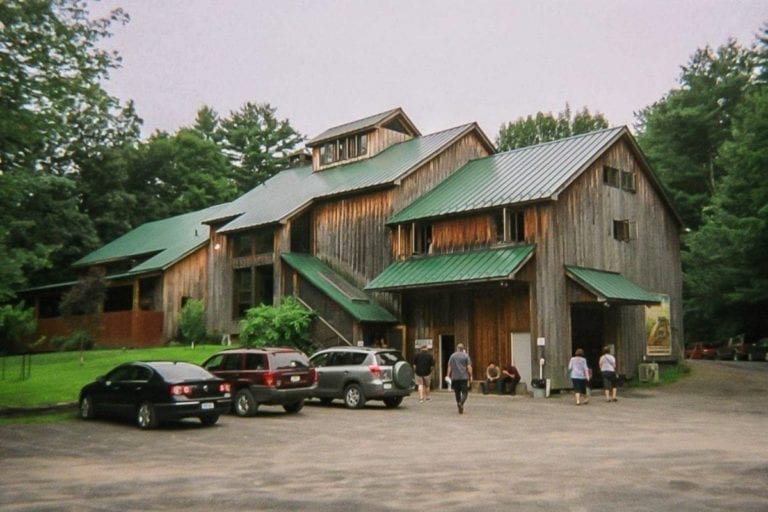
Affectionately known as “The Barn,” Levon Helm Studios is a nondescript building set off a country road on the outer edges of Woodstock. This building has an air of reverence about it as soon as you approach it. Once inside, its easy to get the feeling of being inside a church. High, vaulted ceilings with impeccable woodwork force one to take in the architecture. It’s not uncommon to see first-timers looking around with jaws agape at the craftsmanship that went into building this structure.
The story of The Barn has its origins as the home and recording studio of Levon Helm. Helm was best known as the drummer for The Band but also took turns acting in such films as “Coal Miner’s Daughter,” “The Right Stuff” and “Feeling Minnesota” among others. The Arkansas-born musician grew up with minstrel shows and wanted to recreate that in his home studio. What became known as The Midnight Ramble was born out of necessity, but also out of a love for the informal feel of a simple jam session. Helm’s Midnight Rambles began in 2004. Word spread in the musical community and Helm and his Midnight Ramble Band (guitarist/mandolinist/fiddler Larry Campbell, guitarist Jimmy Vivino, Helm’s daughter Amy and Campbell’s wife Teresa Williams) began attracting the likes of Elvis Costello, Phil Lesh, Dr. John, Emmylou Harris, My Morning Jacket and Norah Jones to this tiny Catskills hamlet two hours north of New York City.
When Helm died in April of 2012, his final words to Amy and his manager Barbara O’Brien were, “Keep it going.” And keep it going they have. The Midnight Rambles occur regularly and provide an opportunity for musicians of Helm’s ilk to “keep it going.”
The magic that occurs at The Barn isn’t just with the music and the venue. What is truly magical about this venue, is experiencing the reactions of first-time attendees. NYS Music photographer Brian Cornish attended his first Ramble with his brother in 2006. The joy in his retelling of his first Ramble is consistent with so many others who have experienced this jewel of a venue:
It was November of 2006. My brother had heard about these house parties in Woodstock where you could buy a ticket and listen to Levon Helm sing and play, and the kicker was that it was in his own home/studio. We decided to go. Following the opening act, with no fanfare and no announcement, Helm and his band emerged and walked down a hallway to the studio. He preferred to set up on stage left, to be able to look directly at all of the other musicians and catch their eye, read their moves, maybe give them a cue or a nod, or maybe grin and point a drumstick at someone approvingly at the end of a song. Due to this atypical arrangement, we astonishingly found ourselves seated at his left elbow, six feet or so from an American treasure. With a brief flourish on the snare drum, he set the tempo, the horns kicked in, and the band followed. “Boards on the window, mail by the door…” The entire crowd was immediately dancing, tapping their feet, or singing along. It was magical. It still is.
Cornish’s proximity to Helm during his first Ramble is what makes this venue so unique and keeps people coming back. You’re not attending a concert at Levon Helm Studios. You’re celebrating music in a pure listening room with friends, friends you know and friends you just haven’t yet met. The capacity is around 200 and there isn’t a bad spot in the house. It lends itself to chatting with your neighbor between songs and the chance of chatting with any of the musicians at some point during the night.
Amy Helm taking in a performance at “The Barn”
Cornish continues with another Ramble experience:
One time, I and a few friends were seated behind the keyboards so we could look across the room at Levon. A man emerged to the right of my friends, stood at the end of the row, nodded hello, and exchanged small talk between songs in the semi-darkness. After ten or fifteen minutes, he said, “It’s been nice talking to you folks, but I have to go to work.” Only when he was under the stage lights and grabbed his guitar did we realize we’d been chatting with John Prine. Unannounced drop-in guest appearances and unexpected moments are hallmarks of many Midnight Rambles.
Cornish has made it his mission to introduce as many of his music-loving friends as possible to this experience by gifting a ticket to a first-timer as long as the next time that person goes, he or she brings another first-timer and does the same. This writer was the recipient of one such gifted ticket to a Ramble. We were joined by two other music loving friends, Dan Frieden and Rob Bishton for a performance of Amy Helm and Friends on Black Friday 2015. What made this performance so incredibly special was the appearance of Donald Fagen of Steely Dan sitting in for a performance of his band’s “Black Friday.” The fact that this musical legend was mere feet away from us during this performance was not lost on us that night and is the stuff that will be remembered for a lifetime. Two new converts to the Church of Levon were made that night.
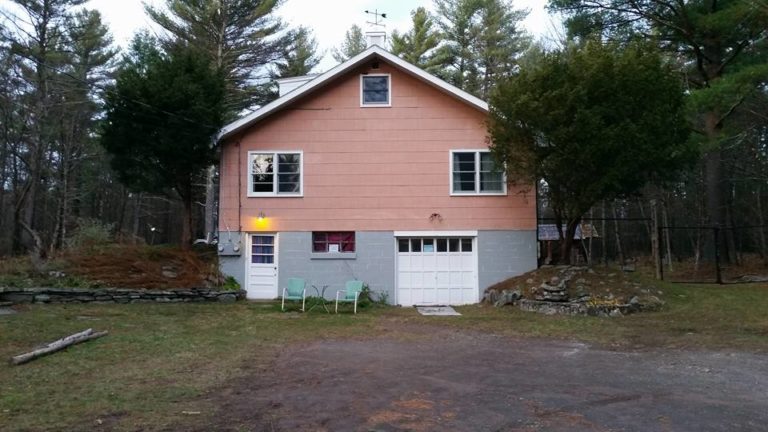
A visit to Woodstock isn’t complete without stopping by Big Pink, the house rented by the members of The Band as they killed time waiting for Bob Dylan to recover from injuries suffered in a motorcycle accident in 1966. Dylan lived in Woodstock at the time and the members of what would become The Band were members of Dylan’s backing band. Band members Rick Danko, Richard Manuel and Garth Hudson lived in this rental in the town of West Saugerties and spent time in the basement recording covers and Dylan originals. The time spent at Big Pink, so named for the pink siding that adorned the house, solidified The Band’s sound and resulted in the oft-bootlegged and finally released album The Basement Tapes in 1975.
Each time this writer visits Levon Helm Studios, a visit to Big Pink is on the itinerary, as well as a stop at Catskill Mountain Pizza Company, a pilgrimage if you will. It will be left to the reader as to how to find this legendary abode. Anyone familiar with the music of Dylan or The Band can feel the ghosts surrounding this property. Frieden described it this way:
There is an energy at Big Pink. I had never been a big Dylan fan, but being on a property that sparked so much musical creativity made me wonder what it is that really flipped the artists’ “on” switch.
A recent visit to Woodstock for a performance by Joe Henry and Rose Cousins on December 9 indoctrinated April and Enzo Cacciatore to The Barn and Big Pink. Witnessing each of them as they took in the entire experience is what sharing a Ramble is all about.
The nearly two and a half hour trip from Rome took longer than anticipated due to a Nor’easter clipping the southeast section of the state. Despite that, a visit to Big Pink still occurred as did a dinner of pizza and craft beers at Catskill Mountain. Traveling through Downtown Woodstock during Christmas season, especially in the midst of a snow storm, is magical in itself. The storefronts are all decorated as is the town square. The snow cover offered an added air of peacefulness to the town that prides itself on the ideal of peace.
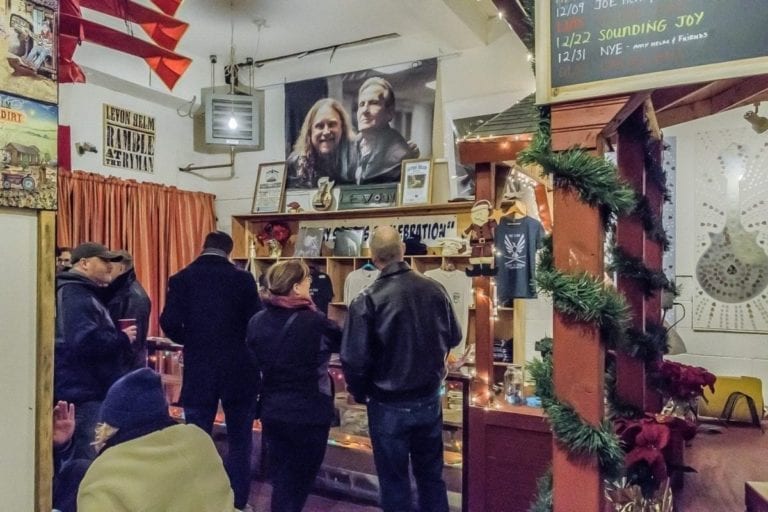
Adding to the family gathering atmosphere at the barn is the communal food table in the merchandise area. Each person is asked to bring a “dish to pass” just like at the potluck dinners of yore. This communal space in what would normally be a garage, is a place for all to gather, share food and talk music. Here, you’ll hear tales of past shows at The Barn or encounters with musicians. This is also the area where the artists’ merchandise is sold, often by themselves after their set, as was the case with Rose Cousins on this night. Cousins was friendly and quick with a joke with each person she dealt with.
Once inside, the Cacciatores took in every inch of the space. Enzo has been in the construction business as a licensed plumber and pipe fitter for almost 40 years. He’s a man who appreciates good construction and good music. He and his wife, April are 17-year veterans of the Poconos Blues Festival and regularly attend the Chenango Blues Festival. His pure appreciation for the architecture of the room was worth the price of admission. He commented that the room is perfectly built for acoustics.
April is a massage therapist and completely took in the arts-centered culture of Woodstock. Those who know April, know she wears her heart on her sleeve and this was clear in her appreciation of the music that she was just being exposed to on this night. She warned earlier in the day that tears may flow early and often throughout the show and while that can’t be proven, the emotion exhibited on stage between Cousins’ and Henry’s sets would lean this writer to believe that there were some tears shed.
Joe Henry is no stranger to this setting. His previous performance at Levon Helm Studios was with British folk/punk troubadour Billy Bragg in 2016 as they were touring their train songs album,Shine a Light. Henry commented during his performance that he and his band don’t view a stop at The Barn as just another tour stop. He likened it to being at a church, deserving of reverence.
The fact that a venue such as Levon Helm Studios exists in the age of big sheds and ticket brokers is a miracle in itself. The down-home flavor that accompanies the attendance at a Ramble and the pure magic of the room itself makes this venue a required trip for any music aficionado.
Upcoming shows at Levon Helm Studios include blues guitarist Carolyn Wonderland on January 19, The Weight Band on February 17, David Bromberg on March 3, the Zombies on March 9 and Jorma Kaukonen on March 10. To purchase tickets, you must visit the studio’s website. You will not receive a physical ticket, but rather a wristband with a number. The number on your wristband determines when you are allowed to enter the venue to claim your spot.
Join the congregation. You won’t regret the services, that’s for sure.
After the original Woodstock Music Festival in 1969, there were many people who wanted to replicate the magic of peace, love and rock n roll. But not all future endeavors were destined for success. Two music festivals in particular, the Bach to Rock Festival in 1970 and the Hamlet of Hurleyville Music Festival in 1979, were both little-known festivals in small New York State towns that ultimately failed and were mostly forgotten with the passage of time. Today we look back on these festivals that were doomed from the start.
The “Bach To Rock” Fiasco
The Bach To Rock Festival was set to take place near the Catskills in Sullivan County in the hamlet of Mountaindale. This was only about 25 miles away from Bethel, NY where Woodstock was first held. It was envisioned as a summer long cultural series with a mixture of opera, broadway music, dance and rock. The promoters hoped to attract 50,000 patrons and host events six days a week from July through August.
The small hamlet of Mountaindale – Photo from Wikimedia Commons
The ambitious festival was contentious from the start. After last year’s wild festivities at Woodstock, many locals in Mountaindale were opposed to the sex, drugs and other “unsavory” activities that would likely occur during the event. The disaster at the infamous Altamont festival back in December was still fresh in many minds as well.
Nevertheless, the festival site continued to be developed as a land deal was struck and $250,000 was put into the groundwork. The bill originally boasted acts like Joe Cocker, Grand Funk Railroad, Jethro Tull. However a concert on Randall’s Island that was occurring that same summer left many of the bands legally tied up and unable to perform again in such close proximity.
A flyer from the festival – Photo via Reddit
New bands were booked including the Grateful Dead, Van Morrison and The Band.
Then in early July, days before the start of the festival, a restraining order was issued against the Mountaindale Music Festival, prohibiting large public gatherings. The decision was later upheld on by the Sullivan County Supreme Court, one day before the concert was set to take place.
Promoter Budd Filippo pictured on the festival grounds in Mountaindale. (Photo originally appeared in NY Daily News).
On that day, July 7, the New York Times covered the ruling with an article titled “Court Order Delays Mountaindale Rock Festival.” The Times said the following:
“A borscht circuit of rock musicals that seemed to be developing in the Catskills after last August’s Woodstock Festival suffered a new setback yesterday,” the Times reported, alluding as well to a 54-hour long rock festival that had just concluded, drawing 2,000 people to Saugerties. “A temporary restraining order against the Mountaindale Music and Arts Festival, scheduled to open tonight on its own 700-acre tract in eastern Sullivan County, was upheld by Appellate Justice Michael E. Sweeney.”
But by then over 10,000 people were already on the way to to the small town of Mountaindale. The train was already in motion.
Hippies gather in Mountaindale – Photo from the New York Daily News
The New York Daily News reported, “Bands of hip mountaineers roamed the Catskills today in a nomadic search for a rock festival that was canceled at the 11th hour by a politician on the other side of the generation gap.”
While the festival was officially canceled, the masses of people threw together a free concert at hotel in South Fallsburg about ten miles from Mountaindale. There were rumors that the Grateful Dead would make an appearance, but besides some local bands the only major act who showed was Richie Havens. Havens had famously been the opener at the original Woodstock festival the year prior.
Richie Havens, famed musician who opened at Woodstock and was the only performer at the failed Mountaindale festival -Photo: Gunter Zint/K & K Ulf Kruger OHG/Redferns
After the fact, the county’s rulings were upheld in the higher courts establishing a precedent for future mass gatherings, which greatly affected proposals for other music festivals to come.
The Hamlet of Hurleyville Music Festival
Ten years after the original Woodstock, and 9 years after the failed “Bach To Rock”, Sullivan County was once again abuzz with the hopes of music. A three-day festival was set in the Hamlet of Hurleyville with a lineup that included Joni Mitchell, Hall & Oats, Cheap Trick and REO Speedwagon, among others. Promoters expected to sell around 250,000 tickets. Tickets were priced at $37.50 for all three days. There were also plans to make an album and documentary film of the festival.
The Hamlet of Hurleyville – Photo from Visithurleyville.org
The hopes with this festival was to kick off a new permanent music venue in the area with the hopes of improving the local economy. The festival was envisioned by a local promoter Leon Greenberg who had previously managed to revitalize the Monticello Raceway.
A photo of Leon Greenberg in the 70’s – Photo via New York Almanac
A brief snippet in the New York Times described plans for the Hamlet of Hurleyville Music Festival – Photo from New York Times TimesMachine Archive
Previous laws against mass gatherings established in Bach to Rock made a large number of hurdles and many locals were opposed to the festivities. A public relations campaign was launched to turn people’s sentiment, with the tagline “Success is a Traffic Jam,” which appeared on buttons and bumperstickers around town.
Ultimately, Greenberg was unable to sway the tides and the town board voted unanimously to deny a permit. The envisioned music venue which was meant to repurpose the site of the old Columbia Farm Hotel remains unused to this day.
The Columbia Farm Hotel circa 1940. It closed in 1969 and burned in a massive fire on Christmas Eve, 1971. – Photo via New York Almanac
On a positive note, the Hamlet of Hurleyville now hosts an annual Hurleyville Music Festival through the Hurleyville Performing Arts Center which engages local artists and the community in a weekend of arts, music and culture.
A biography of The Band’s Richard Manuel is slated to release this spring for the 50th anniversary of the group’s 1974 tour.
The biography is titled, Richard Manuel: His Life and Music, from the Hawks and Bob Dylan to The Band (Schiffer Publishing, on sale May 28, 2025) celebrates Manuel’s immeasurable contributions to music, ensuring his soulful voice and profound artistry endure in the annals of rock. Richard Manuel sang and played piano for The Band, which originated in Toronto, Canada and Woodstock.
The Band began as a backing group for the legendary Bob Dylan. The Band is often credited with helping to define the sound of roots rock and Americana, blending rock, country, blues, and folk into a cohesive and groundbreaking style. Their music was characterized by a raw, earthy quality that bridged the gap between traditional American folk music and modern rock.
Richard Manuel was sweetly soulful and creatively multifaceted, leaving his mark on rock history that is still celebrated today. Through insightful analysis and interviews, his troubled yet inspired spirit is contextualized within music history. From his role in forming the Band to his iconic vocals and songwriting, Manuel’s influence resonates deeply.
Author Stephen Lewis is a rock-and-roll archivist, collector, and storyteller. He owns and operates the Talk from the Rock Room website and podcast and has been writing about music for over 20 years, including contributing articles on Summer Jam and Little Feat for NYS Music. He delves into Manuel’s influence on the history of rock, along with discussing some of Manuel’s life as told through his forth coming book.
The Band in London, June 1971. From left: Levon Helm, Richard Manuel, Robbie Robertson, Rick Danko and Garth Hudson.
For more information on the biography Richard Manuel: His Life and Music, from the Hawks and Bob Dylan to The Bandclick here.
Maverick Concerts in Woodstock has announced their new Green Room Project as part of a multi-step fundraising project to revitalize and retain the historic hall.
Maverick Concerts is the oldest ongoing summer chamber music festival in the U.S., attracting the best musicians in the world for 100 years. In addition to classical music, Maverick features jazz, contemporary, folk and world music. Maverick Family Saturdays offers free music, demonstrations and discovery for the whole family. The mainstay of the festival, which runs from June to September, is to be found in the Sunday chamber music concerts performed by renowned soloists and ensembles. Jazz and Contemporary Music presentations have been given more prominence in recent seasons.
Maverick Concerts is located in Hurley on the outskirts of Woodstock, in Ulster County. TZHe barn-like, rectangular building with its gambrel roof was built by hand as part of the Maverick Colony in 1916 by the utopian writer and philosopher Hervey White.
With a roof of wood shingles and a frame of heavy timber, to which the walls—sheaths of wide planks—are nailed directly, the wooden construction and luminous acoustics create an environment perfectly suited to the intimacy of live chamber music. Maverick Concerts, a multi-starred destination by the National Register of Historic Places since 1999, was awarded for Excellence in Historic Preservation by the Preservation League of New York State.
This fall, the iconic venue plans to harbor new initiative in the creation of the new Green Room. Maverick Concerts has been awarded $457,000 in New York State grants for two capital projects vital to retaining the historic hall as an artistic home. The Green Room project starts this fall and as a first step in this multi-step fundraising project we are focusing on raising the full $257,000 of the New York State Council on the Arts matching grant.
The Green Room Project is an exciting new addition to the already fantastic venue. With the newly added Green Room, the Maverick Concert Hall expands their possibilities and capacity. $146,000 has been raised so far and with help they can raise the remaining $111,000 to better utilize the building for the expansion of musical legacy.
For more information on Maverick Concerts, upcoming events, and the Green Room Project, click here.
Singer-songwriter Mihali has announced the dates for his annual Mihalidaze tour spanning nine venues across the Northeast, including three nights around New York State.
Photo by Dave DeCrescente
Reggae artist Mihali Savoulidis has spent the past few years spreading his good vibes through sound and live performance. Formerly the frontman and founding member of rock band Twiddle, Mihali began his solo career formally in the midst of the Covid-19 pandemic in 2020, bringing in fans new and old with a series of singles and albums following in the following months and years.
Most recently, Mihali has been on a collaboration streak, making tunes with the likes of Andy Frasco, Coyote Island, and Collie Buddz, in addition to touring the country as a solo headliner and supporting musical acts G. Love & Special Sauce and The Movement on their recent tours.
Wrapping his incredibly successful year in an exciting bow, Mihali has announced the 2024 dates of his annual ‘Mihalidaze’ holiday themed tour, returning to some of his favorite venues including a few in Syracuse, Saratoga, and Woodstock with both his live band and his solo looping act.
Composed of Scott Hannay on keys, Adrian Tramontano on drums, Zdenek Gubb on bass, and Mihali himself on guitar and vocals, the band will kick off the tour in Massachusetts and make their way through the Northeast- including stops at the Westcott Theater on December 11, Putnam Place on December 12, and Bearsville Theater on December 14. A celebration of family, friends, and the holiday season, this tradition is not one to be missed.
“Every year, I get super excited to announce my Mihalidaze celebrations. The holidays are so important for friends and family to come together and celebrate life, and I can’t think of a better way to do that than with live music!”
– Mihali Savoulidis
Tickets to Mihali’s Mihalidaze tour are available now- for more information on how to attend, ticket purchasing, and Mihali’s other adventures, visit his website here.
Her famous dad may not have played the renowned festival, but Moon Unit Zappa certainly was a hit when she ventured to Woodstock to discuss Earth to Moon(Deyst/William Morrow Books), her acclaimed memoir of growing up in the unconventional household of her iconic musician dad, Frank Zappa.
The October 12 event was sponsored by The Golden Notebook, Woodstock’s premiere independent bookshop since 1978. The shop’s co-owners, Jacqueline Kellachan and James Conrad, have brought many outstanding writers to town for lively readings, including notable musicians like Blondie’s Chris Stein and Steve Earle. To accommodate the 100 attendees, the event was moved from The Golden Notebook’s cozy location on Tinker Street to the larger Mountain View Studios.
With wit, humor, and humility, Moon addressed the cost of being raised by her largely absent genius father (who she idolizes above all others) and controlling mother – a woman whose anger arose, in no small part, due to her father’s constant philandering. Moon also discussed her much-varied career as an MTV and VH-1 VJ, an actress, author and the founder of an upscale food concern, Moon Unit® Tea. She also conversed on her spiritual quest to rise above the challenges of her youth and become a better parent to her daughter, Mathilda. And, of course, there was plenty about her time in the spotlight helping to create what would become her father’s biggest hit, “Valley Girl.” For a more in-depth look, read our earlier review of the book here.
In true Zappa tradition, the event kicked off with an unannounced surprise. It was a high-energy performance of “Valley Girl” by Mona Freaka, a quintet of teenage girls from Woodstock who truly captured the punky and snarky spirit of Moon and Frank’s original recording.
Martha Frankel, the Executive Director of the annual Woodstock Bookfest, moderated the discussion with insight and humor that matched the tenor of Moon’s wonderfully rich memoir. Frankel began by saying that the Zappa household was “truly the epicenter of lax parenting.” She added what would’ve been her advice to Moon’s parents if she had known them – “If you’re going to be doing bad shit, you probably shouldn’t let your kids have diaries!” Moon credits her lifelong interest in writing to her parents in the book, who gave her a new leather-bound diary every year. These diaries provided much of the source material for her memoir.
In the Q&A with Frankel, Moon discussed the many challenges she faced in writing the book. It was a process that took place over four and a half years and several drafts. Due to the well-publicized squabbles between Moon and her three siblings generated by her mother’s uneven distribution of control of her father’s legacy in her will, she mentioned how her first go at the book was “a f*ck you draft that I ultimately decided to throw out.” Another thing she first left out of the early drafts of the book was the chapter on the whirlwind created by the unlikely success of “Valley Girl.” Unfortunately, this sudden fame came to her during her “awkward teenage phase.” The fact that this novelty tune was the massively productive Frank’s most significant commercial success was something he greeted with chagrin.
Midway through the event, Moon Zappa teared up reading the chapter where she and her brother Dweezil are invited into Frank’s most sacred space – the rehearsal hall. They each got their turn at the mic, as their father conducted the band with a wide smile.
Moon also shared some humorous and heartbreaking facts not covered in the book. These included her unlikely teenage crushes: the stern ABC newsman Sam Donaldson, humorist Spalding Gray and comedian Sam Kinison and how, though she was hugely impressed with it, she was “mortified by my father’s music … largely because it wasn’t lady friendly.” She also mentioned her idea of pursuing a documentary where she would interview the many women her father had affairs with over the years. She also observed that she and her siblings are all “serial monogamists” and very attentive parents, an oppositional reaction to their experiences with their parents.
Like the book itself, Moon’s discussions of her life with her parents are anything but a bitch fest. Even with their many faults, Moon’s love and admiration for both came through. Moderator Frankel would comment more than once during the event that Moon was “probably the most forgiving person on the planet.”
To hear more, check out the extensive interview with Moon on my podcast, “Reading Is Funktamental.”
On Friday, Oct. 18 at the Bearsville Theater, the documentary Left Behind will premiere as part of the 25 annual Woodstock Film Festival.
The feature documentary Left Behind follows a group of determined moms who band together to open NYC’s first public school for dyslexic students. The documentary depicts the long journey as the heroes face both institutional and personal hurdles as they try to upend a system for the city’s dyslexic youth.
The film gives insight into the ways that the public school system ignores the needs of students with learning disabilities and, in doing so, contributes to the school-to-prison pipeline. It examines the current public education system and evaluates it is not built to help students with learning disabilities succeed or thrive. This becomes especially a problem for lower income families as just about every single dyslexia-centered school in the country is privately owned. Anna Toomey’s gripping documentary chronicles a group of advocates in their struggle to start New York City’s first public school for dyslexia.
“Powerful…inspiring Left Behind is an urgent call to action to help dyslexic kids”
Anderson Cooper
Director, Anna Toomey, is an Emmy Award winner as a Producer for ABC News, Good Morning America, ABC News long-form unit, and Peter Jennings Reporting on projects including The Gun Fight, an inside look at the NRA, The Century, and more. Left Behind began in 2020 after her son was diagnosed with dyslexia and she realized the inadequate resources for millions of children across the country. Toomey created, developed and directed the film and it is her first feature length independent documentary. She owns her own production company, Sandy Dog Productions, where she works on independent film projects.
Following the screening on Oct. 18, Juju Chang, multiple Emmy Award-winning co-anchor of ABC News’ “Nightline,” will host a Q&A on the emotional impact of dyslexia within families and the global issue of the school to prison pipeline.
The Hudson Valley’s Catskill Mountains are known as the powerhouse of folk music. The land’s rich history is a testament to its iconic music scene. No matter where you wander through the Catskills, you’ll pick up the musical culture that these small communities have. But what brought folk music to the Catskills in the first place?
To start, the history of colonial Catskills is right there in the name. Dutch settlers in the 1600s brought many of their traditions and their language to the Catskills. The old Dutch word “kill” translates to river or stream in English. The word “kaats” translates to cat, referring to the bobcats and mountain lions. So the region was coined “Kaatskill,” later anglicized to Catskill.
In pre-colonial times the Catskills was made up of the Mohican, Munsee and Lenape nations, that is until Henry Hudson sailed up the river now named after him in 1609. Robert Juet, one of Hudson’s crew members, was said to be the first European to take note of the Catskills specifically.
In 1667 the Anglo-Dutch War ended with the Breda Treaty in which England received “New Netherlands.” In the decades to come, more English settlers moved to the land, but the Catskills never lost its Dutch Heritage. Sojourner Truth, who was born over a century later, grew up in a Dutch Plantation in Ulster County. Although she spoke English, she never lost her Dutch accent.
As more European settlers moved to the Catskills, different ethnic towns like Germantown, located east of the river, began to pop up.
Although New York had long been colonized, it was still too unexplored throughout the 19th century to be substantially populated. The Catskills were partially desolate but it was the land itself that maintained a community of people in the area. Fur trade and beaver trapping were both profitable trades. The abundance of hemlock bark in the areas allowed tanneries to flourish. Needless to say, these industries brought more and more families to the Catskills.
New York City began to become dependent on the Catskills. Reservoirs in the land have been providing water to the city’s residents since 1916.
As water was flowing from the Catskill reservoirs, the region pulled in more and more city residents. In 1906 the Arts Students League of New York City opened a summer school in Woodstock. This was the beginning of the arts and music town that we know today.
The League brought in mostly visual artists, around 200 students a year from 1906-1922 and again from 1947-1979. They were said to continue their individualistic lives, enjoying their solitude outside of the city.
Perhaps the most famous artist that moved to Woodstock was Bob Dylan. Dylan moved to the small town in 1965 after visiting with his then girlfriend Joan Baez. It was above Cafe Espresso on Tinker Street that he wrote Another Side of Bob Dylan and Bringing It All Back Home.
Self Portrait
After a motorcycle accident, he continued his private life in Woodstock and turned to a new artistic outlet- painting. In 1970 he painted his album cover for Self Portrait. He also started working with a group of musicians called The Hawks, now known as The Band. They collaborated on Dylan’s album The Basement Tapes and The Band’s album Music From Big Pink. Dylan also created the Big Pink album art. The Band’s Levon Helm went on to make a lasting creation in Woodstock with Levon Helm Studios.
It wasn’t only artists that flocked to the Catskills. The year-round scenery drew tourists from all over New York to high end resorts and hotels. Perhaps the most significant hotel in Catskill history was The Catskill Mountain House located in Palenville. This almost mythical house opened in 1824 and was visited by presidents U.S Grant, Chester A. Arthur, and Theodore Roosevelt. The Catskills began to be overshadowed by a more Upstate park, The Adirondacks, and the mountain house had its last season in 1941. It was demolished in 1963 despite the passions of preservationists.
The modern equivalent to the Catskill Mountain House may be the Mohonk Mountain House, a resort and spa located overlooking a glacial lake. The Victorian style castle was built in 1869 and brings in guests from all over the world. The house sits on top of 40,000 acres of protected land thanks to conservationist efforts of the past.
In 1904 the state gained ownership of 92,708 acres of land officially making The Catskills a protected State Park.
Catskill tourism began to bring in families specifically of Jewish faith. This became known as the BorschtBelt, referring to the Eastern European soup. In the Borscht Belt heyday during the ’50s and ’60s, more than 1000 Jewish resorts were scattered the Hudson Valley. Today, the Borscht Belt Museum in Ellenville is dedicated to the rich Jewish history in the Hudson Valley.
With its forests, mountains and streams, the Catskills were the perfect terrains for summer camps, one of which was Camp Woodland. Woodland was founded in 1940 by Norman Studer who was an educator at the Elizabeth Irwin School in New York City. Studer’s purpose with Woodland was to give children a destination full of diverse folk culture.
Michael Pastor, who was a Woodland camper from New York City, remembers what it was like to be a part of this famous camp in folk history. Pastor says the eight weeks of camp he attended annually from 1958 to its last year in 1962 consisted of classic camp activities like football, games, outdoor excursions and of course music.
“A lot of campers played guitars, and so there was an awful lot of music going on all the time. I started playing guitar when I was 12 at camp,” He said. “It was kind of hard to hear yourself anyway, because there were 30 other guitars playing and a few banjo players as well.”
In a time of McCarthyism in America, Woodland was called “Camp Red” by conservatives referring to its teachings of inclusion and community building. According to Pastor, there was never any outright democratic or communist values being preached, but many of the families that sent their children to Woodland were leftward leaning.
photo courtesy of Camp Woodland, Phoenicia, New York Facebook.com
Pastor remembers the diverse music the campers performed. “Some of the music were Union songs from the 1930s. Also, there was a variety of international flavor to the music. We would learn songs from different languages,” he said.
Studor was always reaching out to the local community to teach kids about the history of the area. Pastor says he remembers community members including a local historian coming in to tell stories of the tanneries and music of the past.
Woodland also attracted legendary artists like Ella Jenkins and Pete Seeger. Seeger performed every year for all age groups, inspiring the whole camp.
Pastor says that being around music all summer and seeing artists like Seeger sharing their talents ignited a passion for music for campers. “A person who I met during my very first summer camp, my very first day of camp, Peter Simon, he and I are still very close friends and he, inspired by Pete Seeger, became a banjo player. We had a bluegrass band when we were in high school and we still get together regularly and play sort of old time traditional countries,” Pastor noted.
Seeger was born in New York City and raised in Dutchess County. He was first inspired to pick up the banjo when he traveled to Bascom Lamar Lunsford’s folk festival in Asheville, North Carolina at the age of 16. In 1938, he settled in New York City with other folk musicians known as The Almanac Singers in “The Almanac House.”
In 1949 he began to perform with a group known as The Weavers. A year later, the anti-communist book Red Channels came out which accused Seeger of being a communist. He became a blacklisted musician and the accusation loomed over Seeger’s head for decades.
According to his daughter he was never a self proclaimed communist. “He believed in community and he believed in it, whether it was a family, a school, a town, a country, the earth, but he wasn’t a communist. He was more like a ‘communityist,’” said one of his daughters Tinya Seeger. “He wanted good people who could do good things in office. That would be where his politics lay.”
She said that although he was never a communist himself, he was curious about life under communism. He visited North Vietnam during the Vietnam war along with communist China and Soviet Russia multiple times.
In 1955 he was called before the House of Un-American Activities Committee and was questioned about his political beliefs. He refused to answer their questions leading to 10 counts of contempt in 1956 followed by an indictment two years later.
During his blacklisted period, Seeger still created new music and performed all over the country. Some critics believe it was in these years that his best work transpired. He played gigs in smaller venues and college campuses, communities where folk itself began. His children’s albums were a huge success in summer schools and camps like Woodland.
At multiple performances, conservative community members would protest outside the venue but it never stopped him from performing. “He was happy when he saw free speech. He really believed very much in a person’s right to express how they feel, that you should be able to do that and life goes on,” remarked Seeger.
No two Pete Seeger shows were one in the same. He based his performance on the people that were in the audience. If there were children, he would play children’s songs like “Abiyoyo” or “The Foolish Frog.” If the audience was mostly older adults he would play songs to remind them of their childhood like “If I Had A Hammer.” His set list wouldn’t be determined until he was on stage.
At some of his concerts, audience members could leave him notes on the stage before the performance started. He made sure to read every one of them.
Seeger narrowly escaped prison time in 1962 when a Court of Appeals decided his 1961 conviction was faulty and deserted the case. Already infamous within right leaning circles, he became heavily involved in the civil rights movement and antiwar movement during the Vietnam War.
He was also active in local initiatives as well. His home in Beacon was located along the polluted Hudson River and he was determined to help this ecosystem. Seeger, along with some of his friends in the community, built a sloop named Clearwater, modeling the same boats that sailed the Hudson in the 18th and 19th centuries.
He sailed up and down the river educating listeners about the problem and collecting donations in his banjo case. His efforts actually cleared the river and although the river isn’t completely absent of garbage and pollutants, Hudson Valley residents today enjoy a much cleaner river than those in the 1960s “In those last 10 years of his life, he was trying to say things that were meaningful,” Seeger said.
Seeger understood the relationship between the art of folk music and community. According to his daughter, he liked living in Beacon with his family and a generation of adults that were raised on his music. “He created something that was like a camp experience within the Hudson Valley. Maybe it’s just that the same people were coming to the smaller gatherings that were happening around,” Seeger notes. “I think they were carrying on the tradition.”
Pastor, who is one of those campers carrying on the tradition, says he feels a strong community surrounding folk. “There is a bond that people feel throughout all these decades and I think if you were to ask people, you would find that music is a part of that shared experience, that’s part of that bond. Music was so interwoven with camp life, it’s kind of hard to describe,” he said.
Seeger is survived by his family including Tinya Seeger who lives in the Seeger home in Beacon, New York.
A decade after Seeger’s death, the tradition of Catskill folk continues. The music that was birthed from the land is dependent on the story of the Catskills. Folk was a distraction from work, a time of recreation and bonding for rural families. It was an expression of self for the collection of artists that gathered in the region.
Another family that carries on the trend of intergenerational folk is the Helm Family. The Arkansas native Levon Helm of The Band settled in Woodstock in 1967. In 1975, he built Levon Helm Studios, putting down permanent roots in Woodstock. His family, including his daughter Amy Helm, continue his legacy with “The Helm Family Midnight Ramble,” an annual celebration of his art at Levon Helm Studios.
Today, the studio showcases independent artists and bands from all over the country.
Eggy at Levon Helm Studios – photo by Zak Radick
Helm recorded the Dirt Farmer album in his studio which won a Grammy Award for Best Traditional Folk Album in 2008. Guitarist Larry Campbell, who also worked with Dylan, produced the album alongside Amy Helm. They both sang and performed on the album as well.
Dirt Farmer is not only an award-winning album, but it was deeply personal for Helm. It was his comeback album, his first since 1982. He started recording as he was battling throat cancer, despite the damage to his vocals.
The acoustic tracks are a nod to his Arkansas roots, but they have a clear Catskill influence. Each song tells a story of the human condition. “Anna Lee” is about children who remember their late mother by her lullabies. “Wide River To Cross” is the final track on the album. In it Levon describes his journey of life, being “only halfway home.”
Amy Helm, who has recorded solo music at the studio, was born in Woodstock and grew up watching her father perform. With her three folk albums, she continues to carry on her family’s legacy and tour around the country.
The Catskills and its history have shaped perhaps hundreds of solo folk musicians as well as contemporary bands.
The Felice Brothers, originally from Palenville in the Catskills, are one of the most popular folk groups today. They’ve released ten albums including their latest 2024 album Valley of Abandoned Songs. Ian Felice (guitar/vocals), James Felice (piano/vocals), Jeske Hume (bass), and Will Lawrence (drums) bring back the raw, acoustic sound of the region.
In a recent interview with NYS Music, James Felice stated that the category of Folk and Americana felt limiting to the band early in its takeoff, but later, he embraced the labels. “All of our music, the way we play and the music we grew up with is folk music. It’s the music that we are most connected to. So yeah, I’m okay with that. I think we’ve been doing this long enough to have our sort of thing,” he said.
Valley of Abandoned Songs
Hudson Valley artist Mikaela Davis moved from Rochester, after her first album, Delivery. Davis got her degree in harp performance at the Crane School of Music in Potsdam. The harp, an unusual instrument in the genre of folk, compliments her whimsical vocals and takes the instrumentation to a new level. She produces a blend of indie-pop and Catskill folk inspired by sounds from the ’60s, the golden era of music in this region.
Davis records and performs with her own musical family. She has known her drummer Alex Coté since childhood, guitarist Cian McCarthy and bassist Shane McCarthy from college and she met steel guitarist Kurt Johnson in her early twenties.
The Bones of J.R Jones, another artist from Central New York, started his musical career playing in hardcore punk bands until he became more interested in American blues and folk musicians of the 1930s and ’40s. He officially launched his musical project, The Bones of J.R Jones, in 2012 as an independent artist.
Although his music is categorized as folk, indie and punk, he doesn’t write with genre in mind. “I honestly believe the music we create is a reflection of life experiences,” he said. Since his start, he has released five albums. In 2021, he relocated from Brooklyn to a Catskill farmhouse.
He says, in his experience, the Catskills have been a welcoming environment for him and the music community is supportive and uplifting. There is also something very special about the slow sleepy hills and mountains here. “We are just out of the reach of the weekend crowd from NYC so in a way, it stays true to itself. It’s a magical place full of inspiration,” he notes.
Upstate, with Brooklyn connections, settled in The Hudson Valley and over the past 11 years of performing together, have released three bold harmonious albums.
Members Mary Webster, Melanie Glenn, Harry D’Agostino and Dylan McKinstry recorded their most recent album, You Only Got A Few, in the Hudson Valley at The Building in Marlboro, New York and Greenpoint Recording Collective in Brooklyn, another musical hotspot for independent music.
Laura Zarougian is a solo artist who describes herself as an “Armenian Cowgirl,” inspired by American folk as well as her Armenian roots. She is a multi-instrumentalist and a powerful vocalist. Her songs tell stories of her family lineage and explore themes of searching for home. “Cairo,” from her 2023 album Nayri, tells the story of her great grandfather’s death and her grandmother’s journey to bring his body back to Cairo.
Zarougian grew up in Boston, but her musical career blossomed in Brooklyn. She now lives in Red Hook, a town right next to the Hudson River. “I do feel like there is a really strong sense of community here in which people want to support local musicians and do their best to promote them,” she said. Nayri is a seven-track album recorded with her partner, drummer Mike Alan Hams. The storytelling in her music captures the spirit of Catskill folk. “It’s definitely got some twang and elements of Americana and folk. But a lot of my songs, especially on my first album, had to do with my Armenian American identity,” she remarked. “I think folk songs have to do with place and longing and all of these things that are just part of the human experience.”
The folks that are keeping folk alive are the “grassroots” groups and families that create music without the pressure commercial industry influences.
Just days before his passing in 2014, Seeger attended the annual celebration of Martin Luther King, Jr., in Beacon.
“What did my father do? You know, sometimes I say he was a singer and entertainer, but he was somebody that was really trying to help people get along,” Seeger said. “His version of helping them communicate was to write music.”
Seeger is still one of the most well-known folk singers in America and his work in activism and the folk revival movement live on.
New York City based Americana and roots-rock group Jamie McLean Band will be bringing their One Step Forward Tour, celebrating their upcoming release of the same name, to four venues across New York State.
A triple threat of New Orleans soul, middle Americana roots, and New York City dazzle, Jamie McLean Band create energetic and captivating live experiences each and every time they step on to the stage. Fronted by McLean himself with southern soul vocals, deft guitar skills, and heartfelt, profound songwriting, the band’s live performances are brought to life with the collaboration of drummer Brian Griffin, bassist Chris Anderson, and the return of Jamie McLean Band’s original keyboardist, Jon Solo.
Following six albums, several singles, and a handful of live releases, Jamie McClean band returns with One Step Forward, to be released on October 25. Featuring themes of life, loss, and love, the tracks of One Step Forward explore the bright lights that provide joy and motivation as well as the heavier experiences of loss and grieving.
Written after the loss of a dear friend to suicide, one of the most poignant tracks on the album “Don’t Leave Us Now” grapples with the tragedy and calls listeners to action- to help the ones they love around them, and to help themselves, as there is no shame in being the one in need.
The One Step Forward Tour, which began on August 22 in Pawling, coincides with their upcoming release and will continue throughout the country- including upcoming stops at the Falcon in Marlboro on October 4 and The 443 Social Club & Lounge in Syracuse on October 12, in addition to later dates at the Colony in Woodstock on November 8 and the Drom in New York City on November 22.
Tickets for the tour are on sale now. Visit Jamie McLean Band’s website here for further information and ticket purchasing.
The full list of upcoming tour dates is featured below.