Tag: New York

  • New York Series: Bob Dylan ‘Talkin’ New York’

    New York State has a rich and extensive history of music. From classic songs you sang in elementary school social studies class about the Erie Canal to Frank Sinatra crooning of the wonders of New York City, countless areas throughout the state have drastically influenced musicians, and left an imprint on their artistic growth. NYS Music’s New York Series is a project dedicated to exploring the history of music created and inspired by the diverse areas of the state. Each week we will focus on a different part of New York, how that area inspired a song or album by artists of various genres, and how the area changed over time. This week we will look at Bob Dylan’s ‘Talkin’ New York’ and Greenwich Village’s influence on his writing of the song, as well as how the area shaped his growing career.


    Bob Dylan- ‘Talkin’ New York’

    “You sound like a hillbilly; We want folk singers here.”

    In the winter of 1961, a 19-year-old University of Minnesota drop out named Robert Zimmerman arrived in New York for the first time in hopes of finding his folk-singer idol, Woody Guthrie. It was the coldest winter in seventeen years, and he did not know a soul. ‘Talkin’ New York,’ the second song on Bob Dylan’s self-titled first album, is a talking blues which narrates the difficulties the young folk-singer experienced when he first moved to the Big Apple. Soon after his arrival, Zimmerman moved to Greenwich Village, changed his name to Bob Dylan, and launched one of the most successful music careers in history. 1

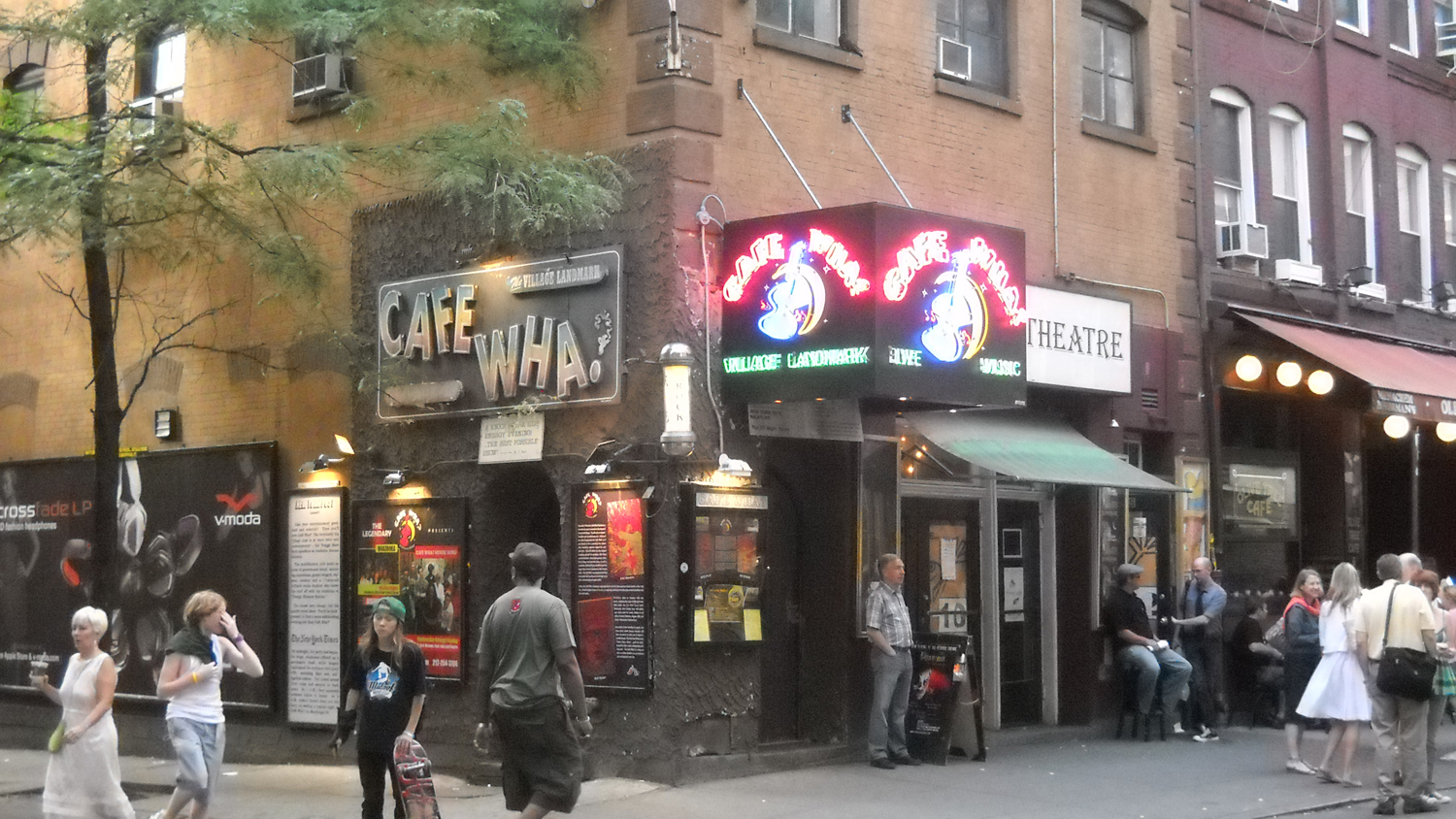
    Greenwich Village in the early 1960’s was a hub for artists, poets, musicians and activists to meet, exchange ideas, and grow. When Dylan first arrived, the first thing he did was head over to Café Wha? on Macdougal Street, introduced himself as a musician, and booked himself a gig- as described in the lyrics of ‘Talkin’ New York’. His goal was to immerse himself in the culture, and establish himself as force to be reckoned with in the folk scene. After being fired for being late to three gigs at Café Wha? Dylan jumped around, exploring the many clubs and cafés Greenwich Village had to offer. He played coffee houses such as Caffe Reggio, the Commons, Caffe Dante, and underground clubs like the Gaslight Café, the Fat Black Pussycat, and the Bitter End. 2 New York was the perfect place for Dylan to experiment, meet new people who would greatly influence his career, and develop as an artist. At any point you could walk into a coffee shop and listen to a folk-singer performing, attend a poetry reading, or have an in-depth discussion about direction of the country the with like-minded political activists.

    Talkin' New York
    Fred W. McDarrah/Getty Images

    Talkin’ New York’ chronicles Dylan’s initial experience in New York. It tells the story of his arrival and describes the struggles of trying to make it as a folk-singer in a new town. The area was impoverished at the time, and for the first year Dylan spent most of his time sleeping on floors. He established himself as a vagabond, and his songs began to reflect his lifestyle. After a year he found a place to live relatively cheaply which allowed him to spend more time developing his songs. Because the clubs could not pay performers, Dylan began wearing a hat and passing it around the cafes. The Gaslight Cafe was known for “basket-passing nights” where the only money performers would pocket was what was given to them by audience donations.3

    Talkin' New York
    Cafe Wha? 1960’s
    Talkin' New York
    Cafe Wha? Today

    Today Greenwich Village is a different neighborhood. NYU has taken over much of the real estate in the area, and the rest has seen a drastic price increase since the 1960’s. It is far too expensive for young aspiring artists to live, but still an area worth visiting often. There are a few relics from the past, and you can go on a walking tour of the sites Dylan and other artists frequented, but today a vagabond could not arrive in the Village and squat in run-down apartments like Dylan did. A few of the old hangouts remain, but they too have evolved with the times. Caffe Dante became Dante NYC, and has moved on from folk-singers to gourmet cuisine. Café Wha? closed in 1968, but reopened in 1987, with music still playing often and the Café Wha? house band headlining many nights. The Bitter End is also still standing, and prides themselves on being New York’s oldest rock club. You can still catch a show any night of the week. While Greenwich Village has changed over the years, there is still a feeling of artistic freedom and counter-culture in many of the bars and coffee shops.

    ‘Talkin’ New York’ Lyrics:

    Rambling out of the wild west
    Leaving the towns I love best
    Thought I’d seen some ups and down
    ‘Till I come into New York town
    People going down to the ground
    Building going up to the sky

    Wintertime in New York town
    The wind blowing snow around
    Walk around with nowhere to go
    Somebody could freeze right to the bone
    I froze right to the bone
    New York Times said it was the coldest winter in seventeen years
    I didn’t feel so cold then

    I swung on to my old guitar
    Grabbed hold of a subway car
    And after a rocking, reeling, rolling ride
    I landed up on the downtown side
    Greenwich Village

    I walked down there and ended up
    In one of them coffee-houses on the block
    Got on the stage to sing and play
    Man there said, come back some other day
    You sound like a hillbilly
    We want folksingers here

    Well, I got a harmonica job, begun to play
    Blowing my lungs out for a dollar a day
    I blowed inside out and upside down
    The man there said he loved my sound
    He was raving about he loved my sound
    Dollar a day’s worth

    After weeks and weeks of hanging around
    I finally got a job in New York town
    In a bigger place, bigger money too
    Even joined the union and paid my dues

    Now, a very great man once said
    That some people rob you with a fountain pen
    It don’t take too long to find out
    Just what he was talking about
    A lot of people don’t have much food on their table
    But they got a lot of forks and knives
    And they gotta cut something

    So one morning when the sun was warm
    I rambled out of New York town
    Pulled my cap down over my eyes
    And heated out for the western skies
    So long New York
    Howdy, East Orange

  • Interpol sells out NYC for their 20th Anniversary of “Antics.”

    There’s something about anniversary shows that really gets a crowd going. Pressed against each other in the pit, hands swaying, chanting in time to favorite songs. What better way to celebrate 20 years of Interpol’s Antics than a 3-day sold out show at Brooklyn Steel? Longtime fans gathered for opening night on December 3. Ready to revel in the gritty, driving force of rich guitar playing and powerful lyricism.

    Lead guitarist Daniel Kessler, of Interpol

    Around since 1997, Interpol was formed under New York University doors, beginning with lead guitarist Daniel Kessler, frontman Paul Banks and drummer Greg Drudy. Their post-punk sound has become a staple amongst New Yorkers, emerging as a key rock revivalist of the early 2000s. In hopes to sound sleek and mysterious, they derived their name from The International Police Association, signing with Matador Records in 2002. Now, Interpol has played at a multitude of venues across the world, joined by Sam Fogarino on the drums.

    Interpol's frontman Paul Banks, preforming at Brooklyn Steel

    With white sheer curtains draped across the front, a hush fell over the crowd as Interpol took stage a few minutes past 9:15pm. Opening with “Next Exit”, the band remained obscured. The crowd focused on projections of their silhouettes, jumping back and forth across the curtains. Once their second song, “Evil” reached crescendo, the lighting crew scrambled into the photo pit. The crew pulled back the expansive white sheet to reveal the band, dressed to the nines in black tailored suits.

    After every song, fans whooped and hollered, dazed by the thick smoke and dramatic strobe lights. Lush storytelling balanced out catchy choruses, pairing with intricate guitar riffs to make a visually immersive performance. Their iconic color scheme of black, white and red alongside a sharp typeface held true. Non stop energy created through intriguing lighting choices and special effects.

    As Interpol performed fan favorites such as “C’mere” and “Rest my Chemistry” the crowd pushed forward to the edge of the barricade, unable to peel their eyes off of the stage. By the time the 21 song setlist came to a close, the venue was absolutely packed. Reveling in the rush, fans lingered in the pit, chatting excitedly while sharing videos and treasured moments. 

    Interpol – Brooklyn Steel – Tuesday, December 3, 2024

    Set 1 (Antics): Next Exit, Evil, Narc, Take You on a Cruise, Slow Hands, Not Even Jail, Public Pervert, C’mere, Length of Love, A Time to Be So Small
    Set 2: Pioneer to the Falls, No I in Threesome, The Rover, Rest My Chemistry, My Desire, Roland, Lights, All the Rage Back Home, Obstacle 1
    Encore: The New, PDA

  • The Empire State of Phish

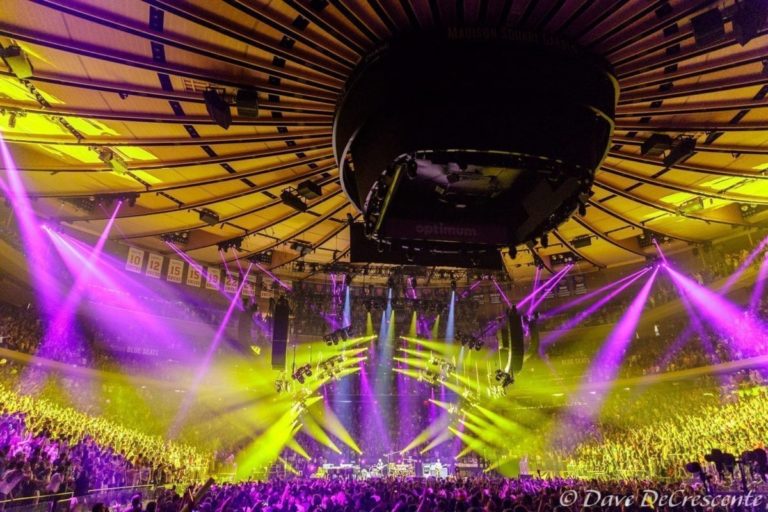
    While the origin of Phish is firmly rooted in Vermont, the band’s history in neighboring New York runs almost as deep. The band made the slow and natural progression from private parties and gigs at frat houses, to small clubs and theaters, later graduating to full scale amphitheaters, to now selling out Madison Square Garden on a regular basis. Phish may have been born and raised in the Green Mountain State, but its more recent history is firmly entrenched in the Empire State.

    photo by Dave Decrescente

    It took a few years after the band’s inception, but Phish finally waded into New York waters in 1987 with a now-legendary show at Ian McLean’s Farm in Hebron, NY on August 21, 1987 with three sets of music that included the first known performance of their cover of “Hold Your Head Up.” Phish would continue to make New York a regular part of their touring schedule in the early ’90s, with 1992 featuring more NY shows than any other year to date.

    Phish New York

    Lower show totals would follow in the late ’90s and early aughts as the band started to tour globally and play shows all throughout the country. But the “3.0” era of Phish has seen an influx of NY shows, primarily due to the renovations done to Madison Square Garden which has made The World’s Most Famous Arena the band’s preferred choice for multiple night New Year’s Eve runs. And the modern day pinnacle was set in 2017 with Phish’s legendary Baker’s Dozen Run of thirteen shows over three weeks which served as the foundation for “17 (shows) in ’17” at MSG which also included a 4-night New Year’s run.

    In 2023, Phish came fairly close to matching this number with 14 shows spread throughout New York State which included another 11 at MSG. To date, Phish has played 288 total shows in The Empire State, so NY show #300 is certainly on the horizon.

    Phish NYC license plate Empire state
    Photo via Marshall Chasan, frame via phrames.com

    To showcase this long-standing and still evolving relationship between Phish and New York, NYS Music presents our own reference guide, a map of every show the band has played in the Empire State. In the same vein as our Grateful Dead Map, this will link to each and every article published here with our own take on the show or appearance.

    Big thanks to Alex Grosby of the Phishsonian Institute for helping us map out all of the New York venues and locations you see below.

  • Oneness Tour with Santana, Counting Crows Summer Jam at Jones Beach

    In what would have originally seemed as an odd tour grouping, Counting Crows and Santana have embarked on a summer tour across North America playing a total of 29 shows.

    For long time fans of both bands, this will of course not come as a shock as back in 2002 both bands toured together for the first time.

    The tour kicked off in Florida and made its way to Long Island this past weekend, with a sold out show at Northwell Health at Jones Beach Theater in Wantagh. Counting Crows opening the night with a 13 song, 70 min set and Santana and his massive band ripping through 19 songs during their 105 min set.

    Counting Crows Setlist: Hard Candy, Richard Manuel Is Dead, Mr. Jones, Colorblind, Omaha, Anna Begins, Miami, Big Yellow Taxi (Joni Mitchell cover), Round Here, Rain King, the 1 (Taylor Swift cover), A Long December, Hanginaround, Holiday in Spain

    Santana Setlist: Soul Sacrifice, Jin-go-lo-ba (Babatunde Olatunji cover), Evil Ways (Willie Bobo cover), Black Magic Woman / Gypsy Queen, Oye cómo va (Tito Puente cover), Everybody’s Everything, Europa (Earth’s Cry, Heaven’s Smile), The Game of Love, She’s Not There / Spill the Wine / Papa Was a Rolling Stone / In-A-Gadda-Da-Vida, Sacalo, Hope You’re Feeling Better, (Da le) Yaleo, Put Your Lights On, Corazón espinado, Maria Maria, Foo Foo
    Encore: Are You Ready (The Chambers Brothers cover), Drum Solo, Smooth

  • Roc Marciano Leads the New School with Marciology [Prolific Penmanship]

    Underground hip-hop always outlasts the mainstream appeal. Look no further than Roc Marciano for the ultimate proof of talent mastery. Since the jump, Roc Marci sets out to fine-tune his pen along the road to craftsmanship. Steel sharpens steel and this man puts forth bodies of work that prove to be ironclad. Recently, he dropped Marciology which contains some serious gems.

    Leaders of the New School

    For those who know – Roc Marciano remains a lowkey legend. This latest release convinced fans that the ‘Marcberg’ era returned. Busta Rhymes discovered this man through ‘seven degrees of separation’ as Roc made a debut with aptly titled, ‘Marcberg in 2010. Fast forward to 2024 and Marciano continues to take dynamic groundbreaking approaches while crafting music. Consistency combined with continuous adaptation to the times exhibits the reason why this man stands the test of time.

    Masterfully, Roc produced the majority of Marciology. Add in Alchemist and Animoss for additional splashes on production and you have yourself a project. Keep scrolling to see which tracks took the cake on this all-time album.

    Roc Marciano

    Standout Tracks

    True Love – this song serves as an anthem type track. Sounds like it deserves to be blared throughout your hometown. Makes one want to celebrate winning achievements of any sorts. Truly a blessing of a song.

    Tapeworm – the most blare-worthy of any song on this entire list. Incredibly poignant placement from Animoss. Big fan of songs that have different versions of the chorus after each verse. Roc serves revolving door type hooks on this track and really makes a believer out of the listener. 

    Leflair – real old school vibe and a great song to kickback and relax. Sounds like it deserves to be performed by a grand orchestra. Makes one want to explore a Haunted House and escape unscathed. Definitely a top-tier track amidst a collection of brilliant songs.

    Phenomenal Philosophies

    For those who know – they know Roc Marciano and how much he has put on for the entire underground scene. Amongst underground circles, Roc Marciano continues to show and prove his highly earned ranking and stature as an emcee. He resonates greatly and sits atop the temple of lowkey legends. 

    Economically, not everyone manages to blend exuberance with agency and exigency quite like Roc Marci. Beneath the Marciology cover, his album has a mysterious handwritten note. Look closely and you may see a cult. Rather than focus on sorcery – try to interpret the reason he chose to spook the listener with the artwork. 

    Roc Marciano

    Never one to sacrifice the purity of his artwork – Roc flies so gracefully under the radar. Rather than sign a bogus contract – he would rather experiment with music to create according to the variable nature of the artwork. By branching out of his comfort zone – he continues to push the culture forward and leave massive imprints within the underground kingdom.

    Overall, this album turned out to be incredibly enjoyable. For those who have never heard from the likes of this man – now is your chance. His braggadocious nature combines swiftly with his smooth laid back raps. He strikes the right balance between just smooth enough to hit you in the heart and strong uptempo to get you going. 

  • New York Series: “New York Is Not My Home” by Jim Croce

    New York City is famously known as the place where dreams are made. Countless musicians from Jay-Z to Billy Joel have risen from the concrete jungle and in turn paid homage to the city in their respective music. Their songs like “New York State of Mind” and “Empire State of Mind”  solidify the iconography, nostalgia and incomparable energy of NYC.

    But not all musicians have the same experience. Jim Croce and his song “New York’s Not My Home” is the antithesis of the other New York classics. A soft, folky, acoustic ballad, Croce expresses disillusionment with the famed city and the need to get out.

    “New York’s Not My Home” was released in 1972, the third track on Croce’s third studio album You Don’t Mess Around With Jim. This was his first album recorded with ABC Records and featured many of the tunes that skyrocketed him into the public eye, including “Time in a Bottle.”

    New York Series: "New York Is Not My Home" by Jim Croce
    “You Don’t Mess Around With Jim” album art

    Croce grew up in South Philadelphia, Pennsylvania. He spent many of his formative years there, and went on to attend college at Villanova University in 1961. Croce would eventually travel far and wide but he continually was drawn back to the state of Pennsylvania his entire life. As such, he never had much attachment to New York City. In fact, he only lived there for a short period of time, in 1968. Croce moved there with his wife and fellow musician Ingrid Croce, when he was 30-years-old. With a record deal in hand, they hoped the city would lead to their big break. However, after becoming disenchanted with both the city and the music industry, the couple moved to the countryside back in Pennsylvania.

    According to Ingrid, the idea for this song came as they were leaving New York and driving to their new home. As the tale goes, the couple spent the night sleeping in their car in a parking lot in New Jersey. The sight of the New York City skyline from where they were parked gave Jim the idea for the song.

    In the first verse, Croce paints the scene and begins with the inkling that something here just isn’t working. 

    Things were spinnin’ ’round me

    And all my thoughts were cloudy

    And I had begun to doubt all the things that were me

    Been in so many places, you know I’ve run so many races

    I looked into the empty faces of the people of the night

    Somethin’ is just not right

    As the lyrics suggest Croce worked many jobs and traveled many places in his lifetime. Croce worked on construction crews and taught guitar at a summer camp. He joined the U.S. Army National Guard for a brief stint. He worked as a teacher at a junior high school and he also did a foreign exchange program in Africa and the Middle East. In most cases, Pennsylvania always pulled Croce back. In this respect, New York was never really his home and never a place he felt deeply connected with.

    The chorus repeats Croce’s need to leave New York City and find a new place.

    ‘Cause I know that I’ve gotta get outta here

    I’m so alone

    Don’t you know that I gotta get outta here

    ‘Cause New York’s not my home

    The second verse gets much more literal with Croce as he delves into his reasons for wanting to leave New York. While New York is a place where dreams are conventionally made, Croce never experienced commercial success there and instead became fed up with the rat race of the industry. Croce had secured a deal with Capitol Records but the contract heavily favored the record company and there were delays with the recording process. The couple could barely afford to live in NYC as a result, so they headed for the countryside in Pennsylvania, going as far as to sell their guitars before making the move.

    Though all the streets are crowded

    There’s somethin’ strange about it

    I lived there ’bout a year and I never once felt at home

    I thought I’d make the big time

    I learned a lot of lessons awfully quick

    And now I’m tellin’ you that they were not the nice kind

    It has been so long since I have felt fine

    But even in Pennsylvania, Croce continued to write and it was here that he penned perhaps his most famous tune “Time in a Bottle.” That song, as well as “New York’s Not My Home,” were both featured on You Don’t Mess Around With Jim. The album saw immediate success with a string of hit songs and throughout 1972-1973 Croce furiously toured the country.  While commercial success didn’t come in New York, Croce did things his way and it paid off.

    Towards the end of “New York’s Not My Home”, Croce fittingly ruminates on New York being someone else’s fantasy. New York may be where some dreams are made, but as Croce proves, it’s certainly not where all of them are.

     “The dream’s not mine anyway…So I’m going back to find…Some peace of mind in San Francisco.”