Tag: Louis Armstrong

  • Cab Calloway: The Hi De Ho Man

    Cabell “Cab” Calloway III was born on Christmas Day, 1907 in Rochester, living on Sycamore Street. His mother was a teacher and church organist and his father was a lawyer. When Calloway was 11, they moved to Baltimore. After he was caught playing dice on the church steps, his mother sent him to a reform school in Pennsylvania.

    When he returned to Baltimore, Calloway began private voice lessons and continued his study of music throughout school. He soon began performing at nightclubs in Baltimore and was mentored by Chick Webb and Johnny Jones.
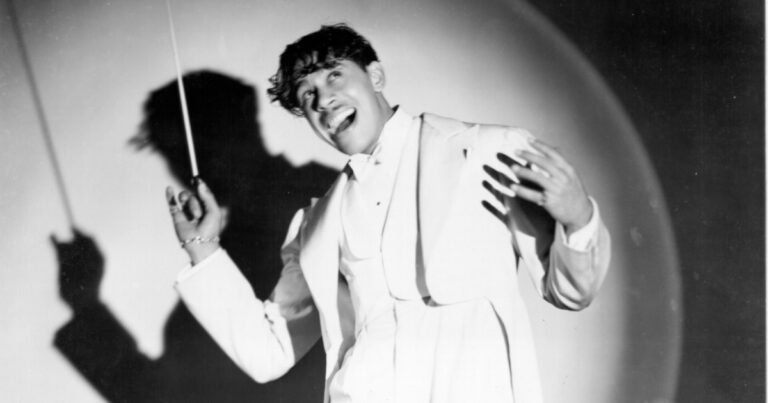
    cab calloway

    In 1927, Calloway joined his older sister, Blanche, in a tour of Plantation Days. She achieved success first, he often credited her as an inspiration to enter show business. His parents wanted him to follow in his father’s footsteps and become a lawyer. Therefore, he enrolled to college in Chicago, but spent his nights at the Dreamland Ballroom, Sunset Cafe, and the Club Berlin. At the Sunset Cafe, he was an understudy for Adelaide Hall. He also met and performed with Louis Armstrong.

    Harlem

    In 1929, Calloway moved to Harlem, performing with the Alabamians band. They opened at the Savoy Ballroom and broke up soon after. With help from Armstrong, Calloway established himself as a vocalist by singing “Ain’t Misbehavin’” by Fats Waller. Soon after, The Missourians asked Calloway to join and front them.

    The following year, the band name shifted to Cab Calloway and His Orchestra. In 1931, the band replaced the Duke Ellington Orchestra at the Cotton Club while they were on tour. Due to the increased popularity, they were offered a permanent position there.
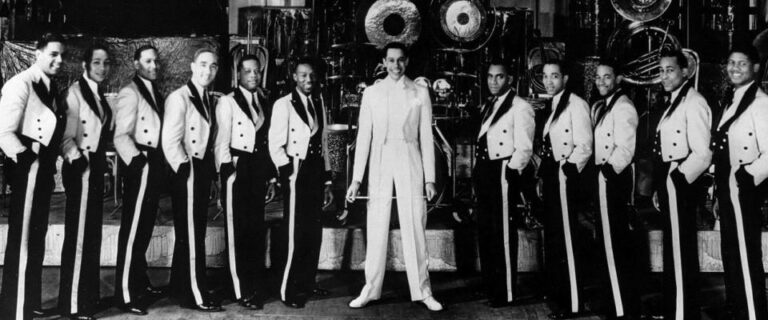
    cab calloway

    The band also performed regularly on radio broadcasts on NBC. Calloway also appeared on radio programs with Walter Winchell and Bing Crosby became the first African-American to have a nationally syndicated radio show. During the heights of the Great Depression, Calloway was earning $50,000 per year at the age of 23.

    The 30’s and 40’s

    In 1931, Calloway recorded his most famous song, “Minnie the Moocher.” This is the first single song by an African-American to sell one million records. Three of his songs, “The Old Man of the Mountain,” “St. James Infirmary Blues” and “Minnie the Moocher”, were performed in Betty Boop cartoons.

    Calloway soon received the nickname “The Hi De Ho Man.” He performed in the 1930s in short films for Paramount. In these, Calloway performs a gliding backstep dance move, a possible precursor to Michael Jackson’s moonwalk.

    Calloway’s band in the 1930s and 1940s included many notable musicians, such as Ben Webster, Ed Swayze, Cozy Cole, and Dizzy Gillespie. In 1940, Strike Up the Band, starring Mickey Rooney and Judy Garland, has a line of “You are not Cab Calloway” after playing poorly.

    In 1941, Calloway fired Gillespie from his orchestra after an onstage fracas erupted when Calloway was hit with spitballs. He wrongly accused Gillespie, who stabbed Calloway in the leg with a small knife.

    cab calloway

    In 1956, Clarence Robinson, who produced revues at the original Cotton Club and the Apollo Theater, and choreographed the movie Stormy Weather, cast Calloway as the main attraction for his project in Miami. The Cotton Club of Miami featured a troupe of 48 people, including singer Sallie Blair, George Kirby, Abbey Lincoln, and the dance troupe of Norma Miller. The success of the shows led to the Cotton Club Revue of 1957 which had stops at the Royal Nevada Hotel in Las Vegas, the Theatre Under The Sky in Central Park, Town Casino in Buffalo.

    Later Years

    The Cotton Club Revue of 1959 traveled to South America for engagements in Rio de Janeiro and Sao Paulo. They also stopped in Uruguay and Argentina before returning to North America which included a run on Broadway. Directed by Mervyn Nelson and choreographed by Joel Nobel, this edition featured Ketty Lester, The Three Chocolateers. The revue toured Europe in 1959 and 1960, bringing their act to Madrid, Paris, and London.

    Calloway remained a household name due to TV appearances and occasional concerts in the US and Europe. In 1961 and 1962, he toured with the Harlem Globetrotters, providing halftime entertainment during games.
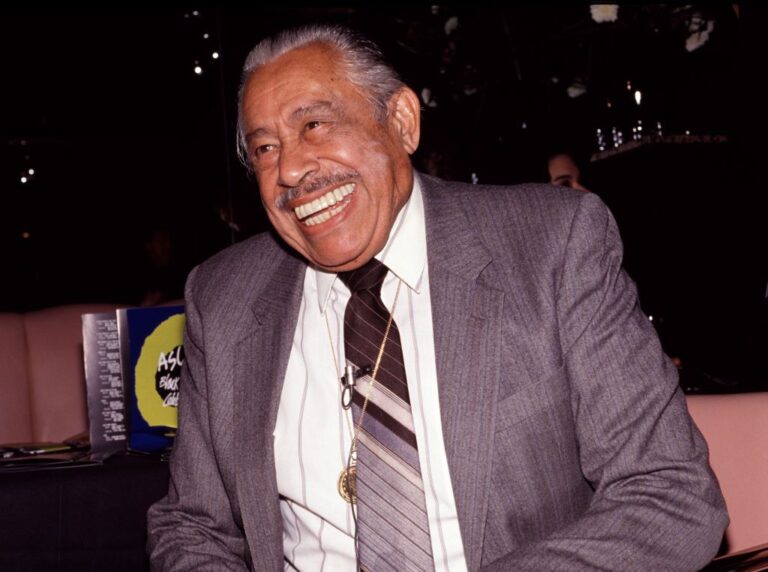
    cab calloway

    In 1985, Calloway and his Orchestra appeared at The Ritz London Hotel where he was filmed for a 60-minute BBC TV show called The Cotton Club Comes to the Ritz. Adelaide Hall, Doc Cheatham, Max Roach, and the Nicholas Brothers also appeared on the bill. A performance with the Cincinnati Pops Orchestra directed by Erich Kunzel in August 1988 was recorded on video and features a classic presentation of “Minnie the Moocher”, 57 years after he first recorded it.

    On June 12, 1994, Calloway suffered a stroke at his home in Westchester County. He died five months later from pneumonia on November 18, 1994, at age 86, at a nursing home in Hockessin, Delaware.

    Awards and Accomplishments

    In 1990, Calloway was presented with the Beacons in Jazz Award from The New School. The NYC mayor at the time, David Dinkins, proclaimed the day “Cab Calloway Day.”

    The Cab Calloway School of the Arts was founded in Wilmington, Delaware in 1992.

    The New York Racing Association (NYRA) annually honors the jazz legend, a native of Rochester, with a stakes races restricted to NY-bred three-year-olds, as part of their New York Stallion Series. First run in 2003, The Calloway has since undergone various distance and surface changes. The race is currently run at Saratoga Racecourse, one of America’s most popular, premier racetracks. The Cab Calloway Stakes celebrated its 13th renewal on July 24, 2019.

    He is also a recipient of an Outer Critics Circle Award (1967), member of the Big Band and Jazz Hall of Fame (1987), Beacons in Jazz Award (1990), National Medal of Arts (1993), International Jazz Hall of Fame (1995), Grammy Hall of Fame for “Minnie the Moocher” (1999), and a Grammy Lifetime Achievement Award (2008). “Minnie the Moocher” was added to the Library of Congress National Registry in 2019.

  • “A Wonderful World” Review – Louis Armstrong’s Biography Unfolds on the Broadway Stage

    Trees of green, red roses, and timeless jazz standards await audiences in Andrew Delaplaine and Christopher Renshaw’s “A Wonderful World”. The new Broadway presentation of Louis Armstrong’s personal life and music career opened at Studio 54 on November 12th. 

    James Monroe Iglehart in “A Wonderful World”. Photo by Jeremy Daniel

    As I took my seat at Studio 54, it was clear that the audience was a mixed bag of casual listeners, broadway lovers, jazz enthusiasts, and Louis Armstrong superfans. No matter what group each person fell into, we all knew at least one detail of Louis Armstrong’s story: the instantly identifiable tone of his voice.

    From the very first word of Aurin Squire’s book, it was clear that star and co-Director James Monroe Iglehart was able to channel Armstrong and imitate the gravelly tone with great precision. He fully embodies the icon in both his captivating vocals and his dialogue, the latter of which volleys seamlessly between dramatic and comedic throughout the production.

    As the story unfolds, we find that Squire’s book takes a brilliant approach to Armstrong’s biography, choosing to utilize the legend’s four wives to advance the plot through the 50+ years that are covered on stage. Each romance marks the beginning of a new chapter on the Studio 54 stage in a fast-paced narrative. This format not only lends itself well to walking the audience through Armstrong’s life and career, but it also treats us to four strong leading women.

    Most notably, Darlesia Cearcy, last seen on a Broadway stage earlier this year in “How To Dance In Ohio,” delivers a masterful performance as Louis Armstrong’s fourth and final wife Lucille Watson. Cearcy gives such a wide range of emotion in her lines that makes her one of the most well developed characters in the show despite the fact that she is not introduced until after intermission.

    James Monroe Iglehart and Darlesia Cearcy in “A Wonderful World”. Photo by Jeremy Daniel

    While the cast delivered an excellent performance, I was most impressed by a duo who was never on stage. Set Designers Adam Koch and Steven Royal somehow created a stage that was both simple and sophisticated, vintage and modern, and all around perfect for this story. The versatile scenery masterfully uses one stage design to carry audiences from jazz clubs to dining rooms to tour buses and beyond with very few changes between scenes. 

    “A Wonderful World”. Photo by Jeremy Daniel

    Overall, “A Wonderful World” delicately walks the line between a feel-good musical and an American history lesson. The beautiful set, joyous music, and captivating drama are sure to entertain audiences through their bright blessed days and their dark sacred nights.

  • Louis Armstrong House Museum Wins National Museum Award

    What a wonderful world it is for Queens’ Louis Armstrong House Museum after winning the IMLS National Medal for Museums, the nation’s highest honor given to museums and libraries that demonstrate significant impact in their communities. The beloved monument was among the 10 Museum and Library Awards recipients, while the Louis Armstrong House Museum is the only honor recipient in New York State. Executive Director Regina Bain will accept the award at a ceremony in Washington, D.C. in July.

    Executive Director Regina Bain will accept the ISML National Medal for Museums on behalf of Louis Armstrong House
    Executive Director Regina Bain will accept the award on behalf of the Louis Armstrong House Museum

    In her role Brooklyn-based educator and artist Regina Bain look to preserve and further the legacy of America’s first Black popular music icon. Sharing, “This signifies recognition of our dedication to preserving the legacy of Louis Armstrong, a cultural icon whose impact transcends generations and borders. It also serves as a validation of our mission to preserve and interpret Armstrong’s house and grounds, collect and share archival materials that document Armstrong’s life and legacy, develop programs for the public that educate and inspire, and engage with contemporary artists to create performances and new works.” Moreover, in her role Bain further connects the LAHM’s family-friendly blend of arts and education with its surrounding community. 

    About the Louis Armstrong House Museum

    Following Louis Armstrong’s passing in 1971. His wife, Lucille, continued to live in their home — on 107th Street in Corona, Queens — working to ensure that it became a National and New York Historic Landmark. After Lucille’s passing in 1983, she willed the home and its contents to the city of New York which designated the City University of New York, Queens College to shepherd the process. Despite a slow churn, the archives became public in the ’90’s, while the historic home opened for tours in 2003. In the time since the LAHM has become its own entity with official non-profit status.

  • Louis Armstrong’s “What a Wonderful World” Certified 5x Platinum

    Ahead of the release of the live album LOUIS IN LONDONthe RIAA has announced that Louis Armstrong’s legendary track “What a Wonderful World” has been certified 5x Platinum, marking the original recording’s cumulative US sales of more than 5 million since its first release in 1967.

    To coincide with this milestone moment, Verve Records is releasing the official performance video of the track, along with a live recording of his GRAMMY-Award-winning Hello, Dolly!

    Louis Armstrong's "What a Wonderful World
    left to right: Jamie Krents – President, Verve and Impulse; Wynton Marsalis – President of the Louis Armstrong Educational Foundation / Managing and Artistic Director at Jazz at Lincoln Center; Jackie Harris – Executive Director of the Louis Armstrong Educational Foundation; Ken Druker – Senior Vice President, Jazz Development at Verve and Impulse; Oliver Schrage – Senior Director, Marketing and Jazz Development at Verve and Impulse

    Recorded at the BBC in 1968, Louis Armstrong’s live rendition of “What a Wonderful World” marked his last great live performance. He had done the recording just weeks after the song hit #1 on the UK’s top charts, and afterward, it became the biggest song in the country for that year. Along with his biggest hit, Armstrong had recorded an entire concert in London with the BBC.

    An iconic figure who transformed the world of music, Louis Armstrong continues to be honored by the Recording Academy and celebrated worldwide. Born in New Orleans, Louis Armstrong rose to prominence in the world of jazz and eventually moved to New York City. He quickly became an iconic figure at The Cotton Club, the most famous jazz club in Harlem. He lived the rest of his life in New York City and was buried in Flushing Cemetery in Queens.

    The Louis Armstrong House Museum, located in Queens, holds hundreds of collected items that document his life, both in and outside the world of music. The upcoming album includes insider-exclusive liner notes by Armstrong’s biographer and Director of Research Collections for the Louis Armstrong House Museum, Ricky Riccardi.

    The posthumous live album Louis In London contains 13 live performances recorded in London in 1968. In addition to the live recordings, the collection features six previously unreleased tracks, including “(Back Home Again) In Indiana,” “You’ll Never Walk Alone,” “Ole Miss,” and “Blueberry Hill.” The album will be released on July 12, 2024.

    The Louis in London album will be available for purchase and download on July 12, 2024. Pre-orders are available here.

  • ‘Louis in London’ Live Album to Release July 12

    Verve Records has announced the release of Louis in London, Louis Armstrong’s last great live performance on July 12. The album will be released on digital, CD, and exclusive black-and-blue vinyl.

    Louis in London releases July 12, 2024

    Anyone who has listened to jazz is sure to recognize the music of Louis Armstrong. Throughout his five decade career, he revolutionized jazz trumpet and singing, achieving critical and commercial success never seen before. While born in New Orleans, Armstrong settled in Queens, NY, where he worked for much of his life. His work altered jazz, placing emphasis on improvised solos, crafting the jazz we know today. Off of the success of hits like “Hello Dolly” and “What a Wonderful World,” Armstrong and his All-star Band played across the world.

    In 1968, they traveled to London to play the BBC Show of the Week. The performance was one “full of vitality and joy,” with some of Armstrong’s most inspired singing and trumpeting. Armstrong realized the impact of this recording, choosing to share it with his close friends more than any of his other works. Additionally, Armstrong hoped that the world could enjoy the recording, affixing a note that read “for the fans” on the tape box after receiving it. Now over five decades later, the recording is being released to the public, just as Armstrong hoped. 

    “Armstrong once claimed he was here ‘in the cause of happiness.’ All these decades later, albums like LOUIS IN LONDON continue his life’s mission at a time when we still need to be reminded that maybe it still is a wonderful world and maybe we’ll never walk alone after all.”

    -Ricky Riccardi

    The Album features eleven of the greatest songs recorded by Armstrong and The All Stars. Additionally, the release will feature extensive liner notes from Ricky Riccardi, an Armstrong biographer and director of research collections at the Louis Armstrong House Museum

    To preorder the album, follow the link here

    Louis in London Tracklist:

    When It’s Sleepy Time Down South

    (Back Home Again) In Indiana

    A Kiss To Build a Dream On

    Hello, Dolly!

    Mame

    You’ll Never Walk Alone

    Ole Miss

    Blueberry Hill

    Mack The Knife

    Rockin’ Chair

    The Bare Necessities

    What a Wonderful World

    When The Saints Go Marching In

    Louis Armstrong: trumpet, vocals

    The All Stars:

    Tyree Glenn: trombone | Joe Muranyi: clarinet

    Marty Napoleon: piano | Buddy Catlett: bass

    Danny Barcelona: drums