New York State has a rich and extensive history of music. From classic songs you sang in elementary school social studies class about the Erie Canal to Frank Sinatra crooning of the wonders of New York City, countless areas throughout the state have drastically influenced musicians, and left an imprint on their artistic growth. NYS Music’s New York Series is a project dedicated to exploring the history of music created and inspired by the diverse areas of the state. Each week we will focus on a different part of New York, how that area inspired a song or album by artists of various genres, and how the area changed over time. This week we will look at Bob Dylan’s ‘Talkin’ New York’ and Greenwich Village’s influence on his writing of the song, as well as how the area shaped his growing career.
Bob Dylan- ‘Talkin’ New York’
“You sound like a hillbilly; We want folk singers here.”
In the winter of 1961, a 19-year-old University of Minnesota drop out named Robert Zimmerman arrived in New York for the first time in hopes of finding his folk-singer idol, Woody Guthrie. It was the coldest winter in seventeen years, and he did not know a soul. ‘Talkin’ New York,’ the second song on Bob Dylan’s self-titled first album, is a talking blues which narrates the difficulties the young folk-singer experienced when he first moved to the Big Apple. Soon after his arrival, Zimmerman moved to Greenwich Village, changed his name to Bob Dylan, and launched one of the most successful music careers in history. 1
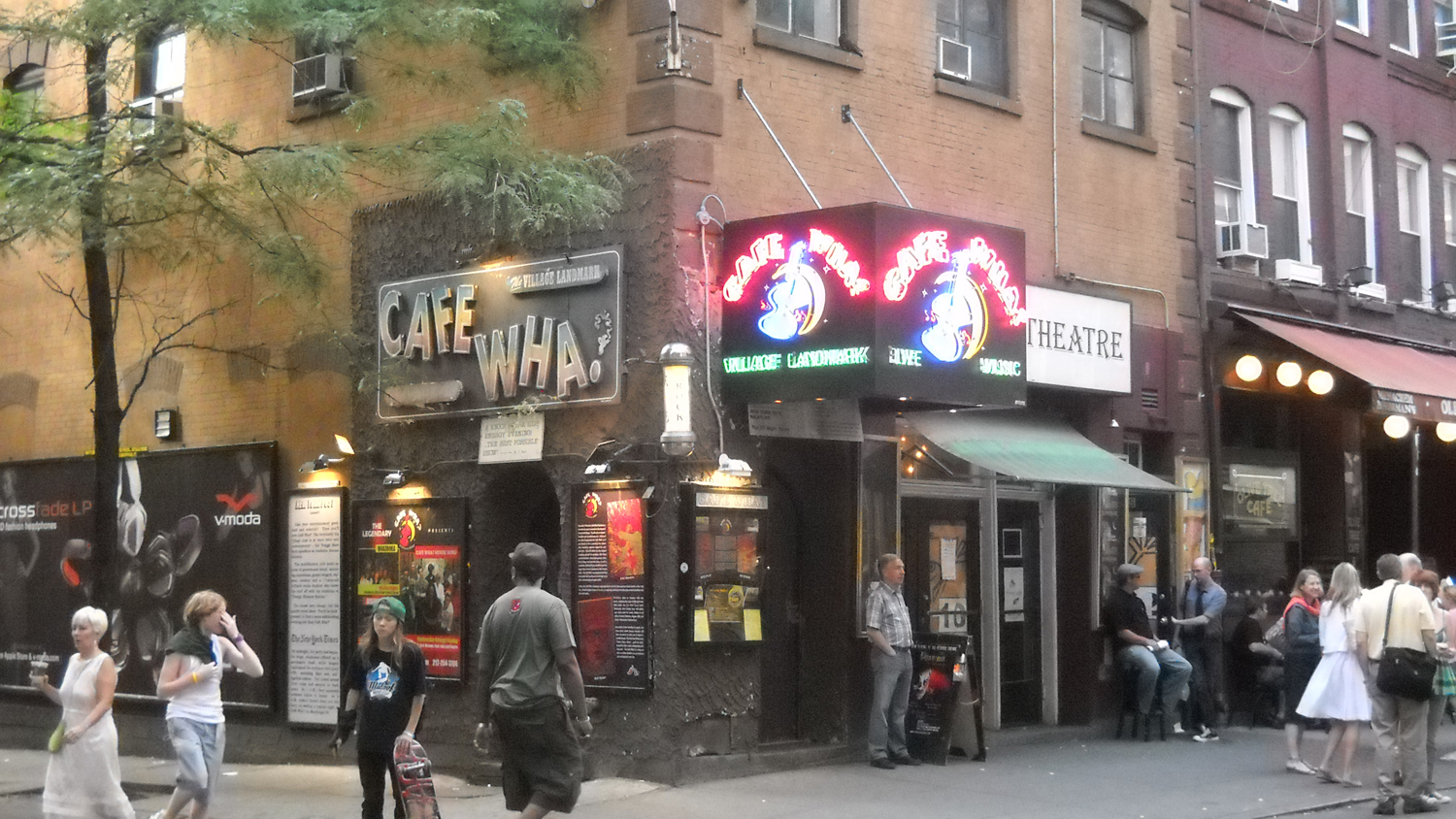
Greenwich Village in the early 1960’s was a hub for artists, poets, musicians and activists to meet, exchange ideas, and grow. When Dylan first arrived, the first thing he did was head over to Café Wha? on Macdougal Street, introduced himself as a musician, and booked himself a gig- as described in the lyrics of ‘Talkin’ New York’. His goal was to immerse himself in the culture, and establish himself as force to be reckoned with in the folk scene. After being fired for being late to three gigs at Café Wha? Dylan jumped around, exploring the many clubs and cafés Greenwich Village had to offer. He played coffee houses such as Caffe Reggio, the Commons, Caffe Dante, and underground clubs like the Gaslight Café, the Fat Black Pussycat, and the Bitter End. 2 New York was the perfect place for Dylan to experiment, meet new people who would greatly influence his career, and develop as an artist. At any point you could walk into a coffee shop and listen to a folk-singer performing, attend a poetry reading, or have an in-depth discussion about direction of the country the with like-minded political activists.
Fred W. McDarrah/Getty Images
‘Talkin’ New York’ chronicles Dylan’s initial experience in New York. It tells the story of his arrival and describes the struggles of trying to make it as a folk-singer in a new town. The area was impoverished at the time, and for the first year Dylan spent most of his time sleeping on floors. He established himself as a vagabond, and his songs began to reflect his lifestyle. After a year he found a place to live relatively cheaply which allowed him to spend more time developing his songs. Because the clubs could not pay performers, Dylan began wearing a hat and passing it around the cafes. The Gaslight Cafe was known for “basket-passing nights” where the only money performers would pocket was what was given to them by audience donations.3
Cafe Wha? 1960’sCafe Wha? Today
Today Greenwich Village is a different neighborhood. NYU has taken over much of the real estate in the area, and the rest has seen a drastic price increase since the 1960’s. It is far too expensive for young aspiring artists to live, but still an area worth visiting often. There are a few relics from the past, and you can go on a walking tour of the sites Dylan and other artists frequented, but today a vagabond could not arrive in the Village and squat in run-down apartments like Dylan did. A few of the old hangouts remain, but they too have evolved with the times. Caffe Dante became Dante NYC, and has moved on from folk-singers to gourmet cuisine. Café Wha? closed in 1968, but reopened in 1987, with music still playing often and the Café Wha? house band headlining many nights. The Bitter End is also still standing, and prides themselves on being New York’s oldest rock club. You can still catch a show any night of the week. While Greenwich Village has changed over the years, there is still a feeling of artistic freedom and counter-culture in many of the bars and coffee shops.
‘Talkin’ New York’ Lyrics:
Rambling out of the wild west
Leaving the towns I love best
Thought I’d seen some ups and down
‘Till I come into New York town
People going down to the ground
Building going up to the sky
Wintertime in New York town
The wind blowing snow around
Walk around with nowhere to go
Somebody could freeze right to the bone
I froze right to the bone
New York Times said it was the coldest winter in seventeen years
I didn’t feel so cold then
I swung on to my old guitar
Grabbed hold of a subway car
And after a rocking, reeling, rolling ride
I landed up on the downtown side
Greenwich Village
I walked down there and ended up
In one of them coffee-houses on the block
Got on the stage to sing and play
Man there said, come back some other day
You sound like a hillbilly
We want folksingers here
Well, I got a harmonica job, begun to play
Blowing my lungs out for a dollar a day
I blowed inside out and upside down
The man there said he loved my sound
He was raving about he loved my sound
Dollar a day’s worth
After weeks and weeks of hanging around
I finally got a job in New York town
In a bigger place, bigger money too
Even joined the union and paid my dues
Now, a very great man once said
That some people rob you with a fountain pen
It don’t take too long to find out
Just what he was talking about
A lot of people don’t have much food on their table
But they got a lot of forks and knives
And they gotta cut something
So one morning when the sun was warm
I rambled out of New York town
Pulled my cap down over my eyes
And heated out for the western skies
So long New York
Howdy, East Orange
Sam Kogon has released his latest single “America”. The track arrives as a timely commentary on the current political landscape, just as the 2024 election season begins to heat up.
“America” was born during the tumultuous period of COVID-19 lockdowns and widespread protests, capturing the zeitgeist of a nation grappling with its identity and future. The song’s lyrics touch on various hot-button issues, from voting rights and social justice to healthcare and reparations, all wrapped in Kogon’s signature blend of catchy melodies and thought-provoking wordplay. This single is a precursor to whatâs next for Kogon, who recently completed recording a full album’s worth of material with Agnello this past spring.
This new body of work promises to build on the success of his previous releases, including his self-titled EP from 2022, which garnered critical acclaim and expanded his fanbase. Kogon has collaborated with notable artists throughout his career, including Al Jardine of The Beach Boys and Grammy Award nominee Patty Smyth. He also fronted the revived baroque pop group The Left Banke, known for their classic hit “Walk Away Renee.” These experiences have enriched Kogon’s musical palette, allowing him to blend influences from various genres into his own unique sound.
The track was co-produced by Jeff Berrall of the band Caveman and Zach Brewer, with Sam Kogon himself also taking on production duties. It features Kogon’s own vocals, guitar, and organ, alongside Graeme Gengras on piano and the rhythm section of Caveman providing bass and drums. The song was mixed by industry veteran John Agnello, whose credits include Dinosaur Jr. and Kurt Vile, adding a polished sheen to Kogon’s raw, emotive style.
With its timely release and politically charged lyrics, “America” is poised to resonate with listeners as they navigate the complex landscape of the upcoming election year. The chorus encapsulates the frustration and hope that many Americans are feeling: “You bought it, you broke it / How come nothing gets done right around here? / You built it, now fix it / We can’t wait another 4 more years.”
For more information on Sam Kogon’s music and to listen to his latest single, click here.
Folk-rock sweetheart Patty Larkin comes to Cohoes Music Hall on November 21 for an evening of riveting musicianship.
Patty Larkin is a visionary of sound and wonder, a real deal version of artistry made of equal parts guitar wizardry, vocals shot through with soul and inventive lyrics that ripple across the terrain of the heart. Patty has captured audiences for over 30 years with an imagination, enchantment, and technical artistry that has redefined the boundaries of the guitar driven singer songwriter.
With eleven studio albums and two live recordings under her belt, Patty mines the intersections of poetry and song with her innovative 14th release, Bird in a Cage, released on her own Road Narrows Records. Patty’s musical style resembles something of folk-rock with an urban feel and pop energy.
She is best known for being a founding member of the band, Four Bitchin’ Babes. Cohoes Music Hall is set to host the artist for “An Evening with Patty Larkin.” At the event, Patty plans to play various works ranging from her early stuff to her recent poetic tracks off Bird in a Cage.
This new album leaves standard songwriting forms behind, crossing instead into a world where rhyme is optional, and phrases unfold at their own speed. Bird in a Cage embraces those creative spaces where boundaries are fluid; its ten tracks are full of cross-disciplinary energy, the hot spark of one artist collaborating with another.
For more information and to purchase tickets to Patty Larkin’s upcoming show at Cohoes Music Hall on November 21, click here.
The Hudson Valley’s Catskill Mountains are known as the powerhouse of folk music. The land’s rich history is a testament to its iconic music scene. No matter where you wander through the Catskills, you’ll pick up the musical culture that these small communities have. But what brought folk music to the Catskills in the first place?
To start, the history of colonial Catskills is right there in the name. Dutch settlers in the 1600s brought many of their traditions and their language to the Catskills. The old Dutch word “kill” translates to river or stream in English. The word “kaats” translates to cat, referring to the bobcats and mountain lions. So the region was coined “Kaatskill,” later anglicized to Catskill.
In pre-colonial times the Catskills was made up of the Mohican, Munsee and Lenape nations, that is until Henry Hudson sailed up the river now named after him in 1609. Robert Juet, one of Hudson’s crew members, was said to be the first European to take note of the Catskills specifically.
In 1667 the Anglo-Dutch War ended with the Breda Treaty in which England received “New Netherlands.” In the decades to come, more English settlers moved to the land, but the Catskills never lost its Dutch Heritage. Sojourner Truth, who was born over a century later, grew up in a Dutch Plantation in Ulster County. Although she spoke English, she never lost her Dutch accent.
As more European settlers moved to the Catskills, different ethnic towns like Germantown, located east of the river, began to pop up.
Although New York had long been colonized, it was still too unexplored throughout the 19th century to be substantially populated. The Catskills were partially desolate but it was the land itself that maintained a community of people in the area. Fur trade and beaver trapping were both profitable trades. The abundance of hemlock bark in the areas allowed tanneries to flourish. Needless to say, these industries brought more and more families to the Catskills.
New York City began to become dependent on the Catskills. Reservoirs in the land have been providing water to the city’s residents since 1916.
As water was flowing from the Catskill reservoirs, the region pulled in more and more city residents. In 1906 the Arts Students League of New York City opened a summer school in Woodstock. This was the beginning of the arts and music town that we know today.
The League brought in mostly visual artists, around 200 students a year from 1906-1922 and again from 1947-1979. They were said to continue their individualistic lives, enjoying their solitude outside of the city.
Perhaps the most famous artist that moved to Woodstock was Bob Dylan. Dylan moved to the small town in 1965 after visiting with his then girlfriend Joan Baez. It was above Cafe Espresso on Tinker Street that he wrote Another Side of Bob Dylan and Bringing It All Back Home.
Self Portrait
After a motorcycle accident, he continued his private life in Woodstock and turned to a new artistic outlet- painting. In 1970 he painted his album cover for Self Portrait. He also started working with a group of musicians called The Hawks, now known as The Band. They collaborated on Dylan’s album The Basement Tapes and The Band’s album Music From Big Pink. Dylan also created the Big Pink album art. The Band’s Levon Helm went on to make a lasting creation in Woodstock with Levon Helm Studios.
It wasn’t only artists that flocked to the Catskills. The year-round scenery drew tourists from all over New York to high end resorts and hotels. Perhaps the most significant hotel in Catskill history was The Catskill Mountain House located in Palenville. This almost mythical house opened in 1824 and was visited by presidents U.S Grant, Chester A. Arthur, and Theodore Roosevelt. The Catskills began to be overshadowed by a more Upstate park, The Adirondacks, and the mountain house had its last season in 1941. It was demolished in 1963 despite the passions of preservationists.
The modern equivalent to the Catskill Mountain House may be the Mohonk Mountain House, a resort and spa located overlooking a glacial lake. The Victorian style castle was built in 1869 and brings in guests from all over the world. The house sits on top of 40,000 acres of protected land thanks to conservationist efforts of the past.
In 1904 the state gained ownership of 92,708 acres of land officially making The Catskills a protected State Park.
Catskill tourism began to bring in families specifically of Jewish faith. This became known as the BorschtBelt, referring to the Eastern European soup. In the Borscht Belt heyday during the ’50s and ’60s, more than 1000 Jewish resorts were scattered the Hudson Valley. Today, the Borscht Belt Museum in Ellenville is dedicated to the rich Jewish history in the Hudson Valley.
With its forests, mountains and streams, the Catskills were the perfect terrains for summer camps, one of which was Camp Woodland. Woodland was founded in 1940 by Norman Studer who was an educator at the Elizabeth Irwin School in New York City. Studer’s purpose with Woodland was to give children a destination full of diverse folk culture.
Michael Pastor, who was a Woodland camper from New York City, remembers what it was like to be a part of this famous camp in folk history. Pastor says the eight weeks of camp he attended annually from 1958 to its last year in 1962 consisted of classic camp activities like football, games, outdoor excursions and of course music.
“A lot of campers played guitars, and so there was an awful lot of music going on all the time. I started playing guitar when I was 12 at camp,” He said. “It was kind of hard to hear yourself anyway, because there were 30 other guitars playing and a few banjo players as well.”
In a time of McCarthyism in America, Woodland was called “Camp Red” by conservatives referring to its teachings of inclusion and community building. According to Pastor, there was never any outright democratic or communist values being preached, but many of the families that sent their children to Woodland were leftward leaning.
photo courtesy of Camp Woodland, Phoenicia, New York Facebook.com
Pastor remembers the diverse music the campers performed. “Some of the music were Union songs from the 1930s. Also, there was a variety of international flavor to the music. We would learn songs from different languages,” he said.
Studor was always reaching out to the local community to teach kids about the history of the area. Pastor says he remembers community members including a local historian coming in to tell stories of the tanneries and music of the past.
Woodland also attracted legendary artists like Ella Jenkins and Pete Seeger. Seeger performed every year for all age groups, inspiring the whole camp.
Pastor says that being around music all summer and seeing artists like Seeger sharing their talents ignited a passion for music for campers. “A person who I met during my very first summer camp, my very first day of camp, Peter Simon, he and I are still very close friends and he, inspired by Pete Seeger, became a banjo player. We had a bluegrass band when we were in high school and we still get together regularly and play sort of old time traditional countries,” Pastor noted.
Seeger was born in New York City and raised in Dutchess County. He was first inspired to pick up the banjo when he traveled to Bascom Lamar Lunsford’s folk festival in Asheville, North Carolina at the age of 16. In 1938, he settled in New York City with other folk musicians known as The Almanac Singers in “The Almanac House.”
In 1949 he began to perform with a group known as The Weavers. A year later, the anti-communist book Red Channels came out which accused Seeger of being a communist. He became a blacklisted musician and the accusation loomed over Seeger’s head for decades.
According to his daughter he was never a self proclaimed communist. “He believed in community and he believed in it, whether it was a family, a school, a town, a country, the earth, but he wasn’t a communist. He was more like a ‘communityist,’” said one of his daughters Tinya Seeger. “He wanted good people who could do good things in office. That would be where his politics lay.”
She said that although he was never a communist himself, he was curious about life under communism. He visited North Vietnam during the Vietnam war along with communist China and Soviet Russia multiple times.
In 1955 he was called before the House of Un-American Activities Committee and was questioned about his political beliefs. He refused to answer their questions leading to 10 counts of contempt in 1956 followed by an indictment two years later.
During his blacklisted period, Seeger still created new music and performed all over the country. Some critics believe it was in these years that his best work transpired. He played gigs in smaller venues and college campuses, communities where folk itself began. His children’s albums were a huge success in summer schools and camps like Woodland.
At multiple performances, conservative community members would protest outside the venue but it never stopped him from performing. “He was happy when he saw free speech. He really believed very much in a person’s right to express how they feel, that you should be able to do that and life goes on,” remarked Seeger.
No two Pete Seeger shows were one in the same. He based his performance on the people that were in the audience. If there were children, he would play children’s songs like “Abiyoyo” or “The Foolish Frog.” If the audience was mostly older adults he would play songs to remind them of their childhood like “If I Had A Hammer.” His set list wouldn’t be determined until he was on stage.
At some of his concerts, audience members could leave him notes on the stage before the performance started. He made sure to read every one of them.
Seeger narrowly escaped prison time in 1962 when a Court of Appeals decided his 1961 conviction was faulty and deserted the case. Already infamous within right leaning circles, he became heavily involved in the civil rights movement and antiwar movement during the Vietnam War.
He was also active in local initiatives as well. His home in Beacon was located along the polluted Hudson River and he was determined to help this ecosystem. Seeger, along with some of his friends in the community, built a sloop named Clearwater, modeling the same boats that sailed the Hudson in the 18th and 19th centuries.
He sailed up and down the river educating listeners about the problem and collecting donations in his banjo case. His efforts actually cleared the river and although the river isn’t completely absent of garbage and pollutants, Hudson Valley residents today enjoy a much cleaner river than those in the 1960s “In those last 10 years of his life, he was trying to say things that were meaningful,” Seeger said.
Seeger understood the relationship between the art of folk music and community. According to his daughter, he liked living in Beacon with his family and a generation of adults that were raised on his music. “He created something that was like a camp experience within the Hudson Valley. Maybe it’s just that the same people were coming to the smaller gatherings that were happening around,” Seeger notes. “I think they were carrying on the tradition.”
Pastor, who is one of those campers carrying on the tradition, says he feels a strong community surrounding folk. “There is a bond that people feel throughout all these decades and I think if you were to ask people, you would find that music is a part of that shared experience, that’s part of that bond. Music was so interwoven with camp life, it’s kind of hard to describe,” he said.
Seeger is survived by his family including Tinya Seeger who lives in the Seeger home in Beacon, New York.
A decade after Seeger’s death, the tradition of Catskill folk continues. The music that was birthed from the land is dependent on the story of the Catskills. Folk was a distraction from work, a time of recreation and bonding for rural families. It was an expression of self for the collection of artists that gathered in the region.
Another family that carries on the trend of intergenerational folk is the Helm Family. The Arkansas native Levon Helm of The Band settled in Woodstock in 1967. In 1975, he built Levon Helm Studios, putting down permanent roots in Woodstock. His family, including his daughter Amy Helm, continue his legacy with “The Helm Family Midnight Ramble,” an annual celebration of his art at Levon Helm Studios.
Today, the studio showcases independent artists and bands from all over the country.
Eggy at Levon Helm Studios – photo by Zak Radick
Helm recorded the Dirt Farmer album in his studio which won a Grammy Award for Best Traditional Folk Album in 2008. Guitarist Larry Campbell, who also worked with Dylan, produced the album alongside Amy Helm. They both sang and performed on the album as well.
Dirt Farmer is not only an award-winning album, but it was deeply personal for Helm. It was his comeback album, his first since 1982. He started recording as he was battling throat cancer, despite the damage to his vocals.
The acoustic tracks are a nod to his Arkansas roots, but they have a clear Catskill influence. Each song tells a story of the human condition. “Anna Lee” is about children who remember their late mother by her lullabies. “Wide River To Cross” is the final track on the album. In it Levon describes his journey of life, being “only halfway home.”
Amy Helm, who has recorded solo music at the studio, was born in Woodstock and grew up watching her father perform. With her three folk albums, she continues to carry on her family’s legacy and tour around the country.
The Catskills and its history have shaped perhaps hundreds of solo folk musicians as well as contemporary bands.
The Felice Brothers, originally from Palenville in the Catskills, are one of the most popular folk groups today. They’ve released ten albums including their latest 2024 album Valley of Abandoned Songs. Ian Felice (guitar/vocals), James Felice (piano/vocals), Jeske Hume (bass), and Will Lawrence (drums) bring back the raw, acoustic sound of the region.
In a recent interview with NYS Music, James Felice stated that the category of Folk and Americana felt limiting to the band early in its takeoff, but later, he embraced the labels. “All of our music, the way we play and the music we grew up with is folk music. It’s the music that we are most connected to. So yeah, I’m okay with that. I think we’ve been doing this long enough to have our sort of thing,” he said.
Valley of Abandoned Songs
Hudson Valley artist Mikaela Davis moved from Rochester, after her first album, Delivery. Davis got her degree in harp performance at the Crane School of Music in Potsdam. The harp, an unusual instrument in the genre of folk, compliments her whimsical vocals and takes the instrumentation to a new level. She produces a blend of indie-pop and Catskill folk inspired by sounds from the ’60s, the golden era of music in this region.
Davis records and performs with her own musical family. She has known her drummer Alex Coté since childhood, guitarist Cian McCarthy and bassist Shane McCarthy from college and she met steel guitarist Kurt Johnson in her early twenties.
The Bones of J.R Jones, another artist from Central New York, started his musical career playing in hardcore punk bands until he became more interested in American blues and folk musicians of the 1930s and ’40s. He officially launched his musical project, The Bones of J.R Jones, in 2012 as an independent artist.
Although his music is categorized as folk, indie and punk, he doesn’t write with genre in mind. “I honestly believe the music we create is a reflection of life experiences,” he said. Since his start, he has released five albums. In 2021, he relocated from Brooklyn to a Catskill farmhouse.
He says, in his experience, the Catskills have been a welcoming environment for him and the music community is supportive and uplifting. There is also something very special about the slow sleepy hills and mountains here. “We are just out of the reach of the weekend crowd from NYC so in a way, it stays true to itself. It’s a magical place full of inspiration,” he notes.
Upstate, with Brooklyn connections, settled in The Hudson Valley and over the past 11 years of performing together, have released three bold harmonious albums.
Members Mary Webster, Melanie Glenn, Harry D’Agostino and Dylan McKinstry recorded their most recent album, You Only Got A Few, in the Hudson Valley at The Building in Marlboro, New York and Greenpoint Recording Collective in Brooklyn, another musical hotspot for independent music.
Laura Zarougian is a solo artist who describes herself as an “Armenian Cowgirl,” inspired by American folk as well as her Armenian roots. She is a multi-instrumentalist and a powerful vocalist. Her songs tell stories of her family lineage and explore themes of searching for home. “Cairo,” from her 2023 album Nayri, tells the story of her great grandfather’s death and her grandmother’s journey to bring his body back to Cairo.
Zarougian grew up in Boston, but her musical career blossomed in Brooklyn. She now lives in Red Hook, a town right next to the Hudson River. “I do feel like there is a really strong sense of community here in which people want to support local musicians and do their best to promote them,” she said. Nayri is a seven-track album recorded with her partner, drummer Mike Alan Hams. The storytelling in her music captures the spirit of Catskill folk. “It’s definitely got some twang and elements of Americana and folk. But a lot of my songs, especially on my first album, had to do with my Armenian American identity,” she remarked. “I think folk songs have to do with place and longing and all of these things that are just part of the human experience.”
The folks that are keeping folk alive are the “grassroots” groups and families that create music without the pressure commercial industry influences.
Just days before his passing in 2014, Seeger attended the annual celebration of Martin Luther King, Jr., in Beacon.
“What did my father do? You know, sometimes I say he was a singer and entertainer, but he was somebody that was really trying to help people get along,” Seeger said. “His version of helping them communicate was to write music.”
Seeger is still one of the most well-known folk singers in America and his work in activism and the folk revival movement live on.
Hudson West Music Festival will provide a day of Americana, folk, and roots music on Saturday, Sept 28, 2024, from noon to 10:00 pm in Downtown Jersey City at the Nimbus Arts Center.
Founded in 2016, as a non-profit organization, the Hudson West Fest is an Americana, Folk & Roots music festival that presents performers from across North America to both play and teach. New Jersey’s Hudson West Fest annually holds an all-day music festival but has also expanded its music programming over the years to include Music Workshops, a Talent Search, Open Mics, Free Concerts presenting local musicians, and School Music Programs. This year the festival will include a free street festival that will take place on Warren street right in front of the Nimbus Art center from 2:00 to 7:00. The street festival will include a book signing with Terri Thal, music lessons, performances, and a jam.
You can enjoy all the performances indoors as well as a variety of music workshops on topics such as guitar tricks and song writing taught by this year’s Hudson West Fest performers and Welcome Home New Jersey will bring a taste of ethnic foods. Entry is $35 each person, or $40 at the door.
Hudson West says their mission is “to enable fine musicians to earn a living from their art.” and “to help the larger community hear high quality music and gain a greater appreciation.”
Hudson West Music Festival Mainstage Lineup
Jenni Muldaur & Teddy Thompson, with David Mansfield
On Friday, August 23, Woodstock-based Americana musician Eddy Lee Ryder released her debut album, Sweet Delusions. The album is a testament to Ryder’s storytelling ability, ironically recounting one of the worst parts of life through playfully catchy tunes that still bring out hers, and our own, deepest emotions.
After releasing a collection of singles and EPs, Ryder amassed a decent following through her emotional storytelling and unique, nostalgic musical style. With the help of musicians like producer Father John Misty, drummer/musical director Dan Bailey, multi-instrumentalist Daniel Chae (Zach Bryan, Kacey Musgraves), and keyboardists Todd Caldwell (Crosby, Stills & Nash, James Taylor) and Dave Shephard, along with harmonies and other help from NYC friends like Rebecca Haviland and pianist Abby Payne, Sweet Delusions is an opus two years in the making.
Throughout the entirety of the album, Ryder wears her heart on her sleeve, showing her anger, bitterness, and frustration in a failed relationship. Yet, even through all those negative feelings, there is a deep sense of romanticism behind the music, as if she’s looking back on these particular events and trying to decide whether they were positive or negative. Despite the ending of the album resembling the end of a relationship, the conflicts presented in the music leave the audience wishing they could be a fly on a wall during any one of these recording sessions.
“I want my music to carry multiple emotions, just like every experience,” Ryder says. “Nostalgia, absurdity, humor, and sorrow.”
Sweet Delusions is no exception. At its core, it is a quintessential breakup album with all the turmoil and heartbreak dripping from each track. With this album, Ryder goes back to the folky sounds of the 70s, with a slight southern twang that she herself admitted was purely accidental. Ironically, it feels like the perfect genre to express those emotions of heartbreak, sadness, and the emotional turmoil of a relationship heading in the wrong direction.
Through tracks like “Highwaymen” and “Only Real Cowboy,” Ryder perfectly depicts a toxic relationship. In the lead single, “Highwaymen,” she compares her relationship to that of Thelma and Louise, knowing something would lead to disaster and terrible consequences but eagerly doing it anyway out of sheer excitement and adrenaline. Through “Only Real Cowboy,” her sense of romanticism comes back full circle, singing about a completely bipolar relationship. Ryder depicts this secretive recluse and the emotional turmoil that comes with that type of relationship in an almost Lana Del Rey-like fashion.
However, leading single “Bad Decisions” expresses the complete opposite. While the romanticization of Ryder’s past relationship is definitely present in other singles, “Bad Decisions” brings us back to reality. The track reminds the audience to be angry at everything that happened, repeating, “Don’t say you love me if you’re here for a good time.” While “Highwaymen” tells us of the excitement of something new and potentially toxic, tracks like “Bad Decisions” and “Joke is on Me” bring us back to those dreadful feelings where the rose-tinted glasses come off and reality sinks in. By “County Fair,” the depression with realizing a relationship must end comes in full swing, and the listener gets to see the path of growth and healing it takes to come to that decision.
Regardless of whether the country music vibes were “accidental”, Eddy Lee Ryder definitely uses it to her advantage. The end of this relationship brought forth plenty of anxiety, anger, and depression that is depicted in a perfect way. As a whole, the intimate nature of country music gives us a deeper understanding of Ryder’s feelings. The intimacy definitely pays off throughout the entirety of the album, and she depicts the whirlwind of emotions in a perfect way.
It’s safe to say that Eddy Lee Ryder’s debut album was a surmounting success. Her goal of carrying multiple emotions was definitely met, and it was almost whiplash-inducing to go back and forth between her emotions. After the release of Sweet Delusions, it’s exciting to see what will come next from Eddy Lee Ryder.
Sweet Delusions is out now on all streaming platforms and fans can visit Ryder’s website for any updates and new releases.
Billie Marten played a surprise show at Union Pool on Wednesday, July 24. The British indie/folk singer-songwriter announced the show in a handwritten note on Instagram teasing “mostly new stuff” to be played. Marten began her set with an announcement of a new record that she had just spent ten days recording down the street from Union Pool. She didn’t give a solid idea of when this new album might be coming out, but Marten’s last album, Drop Cherries, released just over a year ago on April 7, 2023.
Opening for Billie Marten was writer and musician Jana Horn. If you like Big Thief and Adrianne Lenker, you might also enjoy Jana Horn’s work. Intimate, interpersonal talk singing poetry over folksy drums and unique bass lines. She rode the line between banter and awkwardness perfectly, and the crowd had a great time. Marten then came out quietly onto the stage in Union Pool’s back room, which has the vibe of a Christmassy saloon. One pink light drenched Marten onstage with her acoustic guitar in her spaghetti strap top, light wash jeans, and red converse.
The show was very low-key. Marten’s pickup came loose and the sound engineer scrambled down from his spot up on the balcony as the crowd parted around him. Billie Marten told the audience to talk amongst themselves, and the room filled with a buzz until she was ready to play again. There was plenty of audience banter as Marten changed tunings between each song. We only got to hear four or five new songs, so there is definitely more to come down the road. Hopefully, Billie Marten will be able to put the finishing touches on her album soon, as we are all eagerly awaiting her next show in NY.
On Friday, June 21, Buffalo-based alt-folk artist Evan Anstey released his latest EP, Alternates II. As the second installment of Anstey’s “Alternates” series, this EP explores a wide range of genres and musical styles. With Alternates II, audiences can expect an awesome mix of hard rock, techno, and of course, a bit of bluegrass.
Debuting in 2016 with his EP Recent Time, Evan Anstey has played a role in the Western New York music scene. Born and raised in the area, Anstey began playing music at the age of 8. As he grew older, he began writing and performing his own music, both as a solo and group artist. Anstey co-founded, played guitar, and sang with rock bands Arrowdrive and The Moon Hunters. Since he was 17, Evan has served as a vocalist, guitarist, and occasional bassist in the indie-prog outfit Meat Raffle.
Evan Anstey’s alt-folk sound draws inspiration ranging from classic artists like Flatt & Scruggs to the progressive bluegrass of Nickel Creek and modern folk stylings of Aoife O’Donovan, John Paul White and Declan O’Rourke. His last EP, Alternates I, stayed true to his inspirations in folk and indie music. The instrumentation of the EP was mostly acoustic. However, its sequel is quite different.
For years, Evan Anstey gained traction as a folk artist. But with this EP, Anstey explored elements of other genres like hard rock and techno. The blend of these genres may come as a surprise to some, but the experimentation had been expertly handled. Like his last album, however, each track was a creative retelling of past songs he had performed live or co-wrote with his other groups. Anstey had the help of guest musicians to fully compose his vision.
Anstey played various instruments on Alternates II, including guitar, violin, bass, mandolin, keyboards, and ukulele. Guests artists Darryl Tonemah, LP Tonemah, Kris Brayley, Ernest “E.C.” Palmer, Alex Feig, and James Robert Kibby all feature on the six-track EP, each providing their own instrumentation and elements to the work.
I wanted to step out of the box on this one. Plans changed along the way, but that’s one of my favorite parts about making a record — the fluidity of art.
Evan Anstey
Alternates II is available on all streaming and download platforms. For more information on Evan Anstey, visit here.
Caffè Lena has been a continuously operating folk coffee house since 1960 and Tom Rush has been a continuously performing folk musician for just about as long. That certainly made Rush, who released his first album in 1962 and recorded for Prestige, Elektra, and Columbia records in the 60s and 70s, a perfect selection for Caffè Lena’s Folk Heritage Series which brought the New England troubadour to the stage for two shows on Friday, May 31.
Tom Rush at Caffe Lena. Photo by Derek Java.
In the early bird set, which kicked off just after 5 pm to the delight of the mostly-baby boomer crowd, Rush performed a tight 70 minute set that showcased his wide-ranging skills as a songwriter, storyteller, bluesman, interpreter, and champion of other songwriters from his generation.
Tom Rush at Caffe Lena. Photo by Derek Java.
After the packed house welcomed Rush to the stage, he joked that he was in the sixty-third year of his farewell tour and kicked into “Making the Best of a Bad Situation” a talking blues that featured a number of narrative follies and established the lighthearted and humorous nature that continued throughout the set.
Upon completion of the first number, Matt Nakoa took the helm of the legendary Caffè Lena upright piano and accompanied Rush for most of the night. Nakoa, a songwriter who hails from Kerhonkson, NY, looks startlingly like the young, pre-mustachioed Tom Rush as captured in the photo that adorns the album cover of The Circle Game (1968). Nakoa also displayed a dexterous and adaptable approach to the keyboards all night, ranging in styles from barrelhouse to boogie-woogie to straight ahead rock n’ roll. “Hot Tonight” was an apt place in the set for Nakoa to join in since his playing certainly raised the temperature of the music on the stage for the duration of the concert.
Matt Nakoa caught in reflection at Caffe Lena. Photo by Derek Java.
Nakoa is also the producer of Rush’s most recent album “Gardens Old, Flowers New”, which was released in March of this year. “Won’t Be Back At All” was the first of three numbers that the duo played from this latest album. Rush joked that he learned a long time ago that he should play new songs early in a set in case he needed to redeem himself for any missteps, but despite his self-deprecation, the three new songs included in the set were among the most poignant of the night.
True to his word, Rush followed a recently recorded track with a song nearly 60 years old: Joni Mitchell’s “The Circle Game”. Rush recounted that he first met Joni Mitchell in 1966 while he was doing a two week residency in Detroit at the famed The Chess Mate folk and blues club. He was two years overdue on an album for Elektra and asked the budding songstress if she had anything he could record. Shortly thereafter, Mitchell sent Rush a six song demo tape, humbly introducing “The Circle Game” as something she didn’t think was all that good. Rush’s reverential rendition reminded the audience of just how wrong Mitchell was – the lyrics remain spellbinding and perceptive. In many ways, Rush’s baritone, grown gravelly with age, continues to be the perfect foil for the lyrics, “we can’t return, we can only look / behind from where we came / and go round and round / in the circle game. Rush, who alternated between a standard-tuned acoustic, a 12-string, and his open-tuned, signature Martin guitar (replete with naked-lady-wrapped-up-in-a-snake inlay) mentioned that while David Crosby takes the credit, he’s pretty sure he was the one to first introduce Mitchell to open-tuning (something she became famous for). Rush said he’s pretty sure he was the one who showed Crosby how to do it too!
Tom Rush at Caffe Lena. Photo by Derek Java.
Rush continued to school the audience in the ways of the old folk house with Sleepy John Estes’ “Drop Down Mama” which featured an exquisite barroom piano solo by Nakoa. Rush, who hails from New Hampshire, went to college at Harvard and got a second degree in the folk music of 1960s Cambridge clubs where he saw numerous blues and bluegrass legends, Estes included.
Rush then turned the stage over to Nakoa for an interlude of piano instrumentals that shared one quality – they were scores for film. “Tumbleweed Tango” was a clever and playful piece that was commissioned to score a short animation about two balloon animal dogs (check out the video on YouTube if you get a chance). The impressionistic “8MM Home Movies” was inspired by Nakoa’s COVID lockdown with his father. Instead of family movie night, Nakoa’s dad fired up old 8MM home videos and Nakoa was inspired to rewrite an old composition from his high school days that conjured up the images of his youthful grandparents.
Matt Nakoa at Caffe Lena. Photo by Derek Java.
Then Rush returned to the mic for “The Remember Song”, which was probably the highlight of the evening in terms of crowd response. Written by Steven Walters, the song captures exactly what it feels like to misplace the phone or walk into a room without knowing quite why you’re in there. Improbably, a 2007 upload of “The Remember Song” has 7.7M views on YouTube (a true viral sensation)– and Rush made it clear he’s never seen a dime from those clicks. Maybe, he mused, it was the same guy clicking it over and over and forgetting that he’d watched it in the first place.
“Siena’s Song” was a tender ballad for his daughter. Rush wrote the track more than 20 years ago and revisited the lyrics at the behest of his 25-year-old daughter. His young daughter may also have influenced the addendum Rush added to the lyrics of “Ladies Love Outlaws” to bring the 70s hit for Waylon Jennings up to date in 2024: “Outlaws touch the ladies somewhere deep down in their soul, but never without proper consent,” sang the hip octogenarian.
Tom Rush at Caffe Lena. Photo by Derek Java.
In the same way Rush paid tribute to Mitchell, his take on Jackson Browne’s classic “These Days” was a reminder of Rush’s role as champion of great songwriters. Browne wrote the song when he was only 16 and Rush was one of the first to record any songs written by the young prodigy.
“Lost My Drivin’ Wheel”, penned by Canadian David Wiffen, followed the Browne number and brought to mind Rush’s years as a Columbia recording artist in the 1970s at the height of the country- and folk-rock music. “Drivin’ Wheel” featured an extended soulful and percussive organ solo from Nakoa. The rock and roll spirit continued for a medley of the rock standards “Who Do You Love?” and “Hey! Bo Diddley”. Rush, a clever, twinkle-in-the-eye English major at heart, cracked up the audience by singing the lyrics “WHOM do you love?”.
Tom Rush at Caffe Lena. Photo by Derek Java.
The encore for the early evening was the aptly titled “I Quit” which also closes out Rush’s new album. The tune could apply to quitting a job or relationship or a music career, but Tom Rush is in no hurry to leave the spotlight and shows no signs of slowing down. Heck, he had a second sold out show at 8 pm.
Setlist: Making the Best of a Bad Situation, Hot Tonight*, Won’t Be Back At All*, Circle Game*, Drop Down Mama*, Tumbleweed Tango**, 8MM Home Movies**, The Remember Song, Siena’s Song, Ladies Love Outlaws*, These Days*, Lost My Drivin’ Wheel*, Who Do You Love?/Hey! Bo Diddley Medley*
Encore: I Quit *
*Accompanied by Matt Nakoa on piano and keyboard ** Matt Nakoa solo (instrumental piano compositions)
Tom Rush at Caffe Lena. Photo by Derek Java.Tom Rush at Caffe Lena. Photo by Derek Java.Tom Rush at Caffe Lena. Photo by Derek Java.Tom Rush at Caffe Lena. Photo by Derek Java.
Meadowlark Festival — the Stone Ridge, NY three-day festival of indie, roots, and countercultural music that benefits farmers in Hudson Valley and nationwide — confirms its lineup for its 2024 fall festival.
Set for September 13-15, the 3-day event will feature performances from indie rock icons Blonde Redhead, NPR Tiny Desk concert alum and Hudson Valley artist Laura Stevenson, NYC garage rockers and Yep Roc artists Daddy Long Legs, Kentucky songwriter Joan Shelley, Boston Music Award-nominated blues guitarist Ryan Lee Crosby, the “sweetly flavored folk-pop” music of Fruit Bats, WXPN-named “Artist to Watch” Slaughter Beach, Dog, Newport Folk Fest favorites Deer Tick, the psychedelic space rock of KidBess & The Magic Ring, along with Honeycrush and Lulu Lewis. Also performing are the “first couple of Americana” Larry Campbell & Teresa Williams, and artsy Manhattan garage-rockers Jeffrey Lewis & The Voltage, with a special guest set for reveal as the festival draws closer.
Lineup for the 2nd annual Meadowlark Festival revealed
All in all, the 2nd annual Meadowlark Festival continues to garner support for farmers local and nationwide and supports organizations who are aligned with the values of promoting food security and advocacy for local farms. These organizations include Farm Aid, Rondout Valley Growers Association (RVGA), and Hudson Valley Center For Food, Culture & Agriculture. The festival takes place at Stone Ridge Orchard & Farmers Market, a 200-year-old working farm on 115 acres.
Moreover, tickets for Meadowlark Fest 2024 are on sale on the festival website, with prices ranging from an early bird special and day-of pricing. For instance, a 1-Day general admission early bird ticket costs $70, but will be $100 on the day of, with similar rules set for parking passes.
Meadowlark Festival to take place at Stone Ridge Orchard & Farmer’s Market
Additionally, Meadowlark Fest will feature local artisans, food vendors, award-winning artisanal hard apple ciders, and more with more details to come. Less than two hours north of New York City and a twenty-minute car ride from the Kingston Metro North railroad station, Stone Ridge Orchard and Farmers Market in the scenic Roundout Valley sits between the Shawangunk Ridge and the Catskill mountain range in the Hudson Valley region.

.png)