Tag: Ella Fitzgerald

  • New York Series: Duke Ellington ‘Take the A Train’

    At one point in history, the New York City subway system was among the most impressive in the world. These days it resembles what you would imagine a third world country’s subway system would look like, with third string trains donated from cities that upgraded their system years ago and no longer had any use for them, but it still gets you from point A to point B and that’s what matters. Albeit confusing to out of towners, you can hop on a train in midtown Manhattan and get almost anywhere you would like to go in the city.
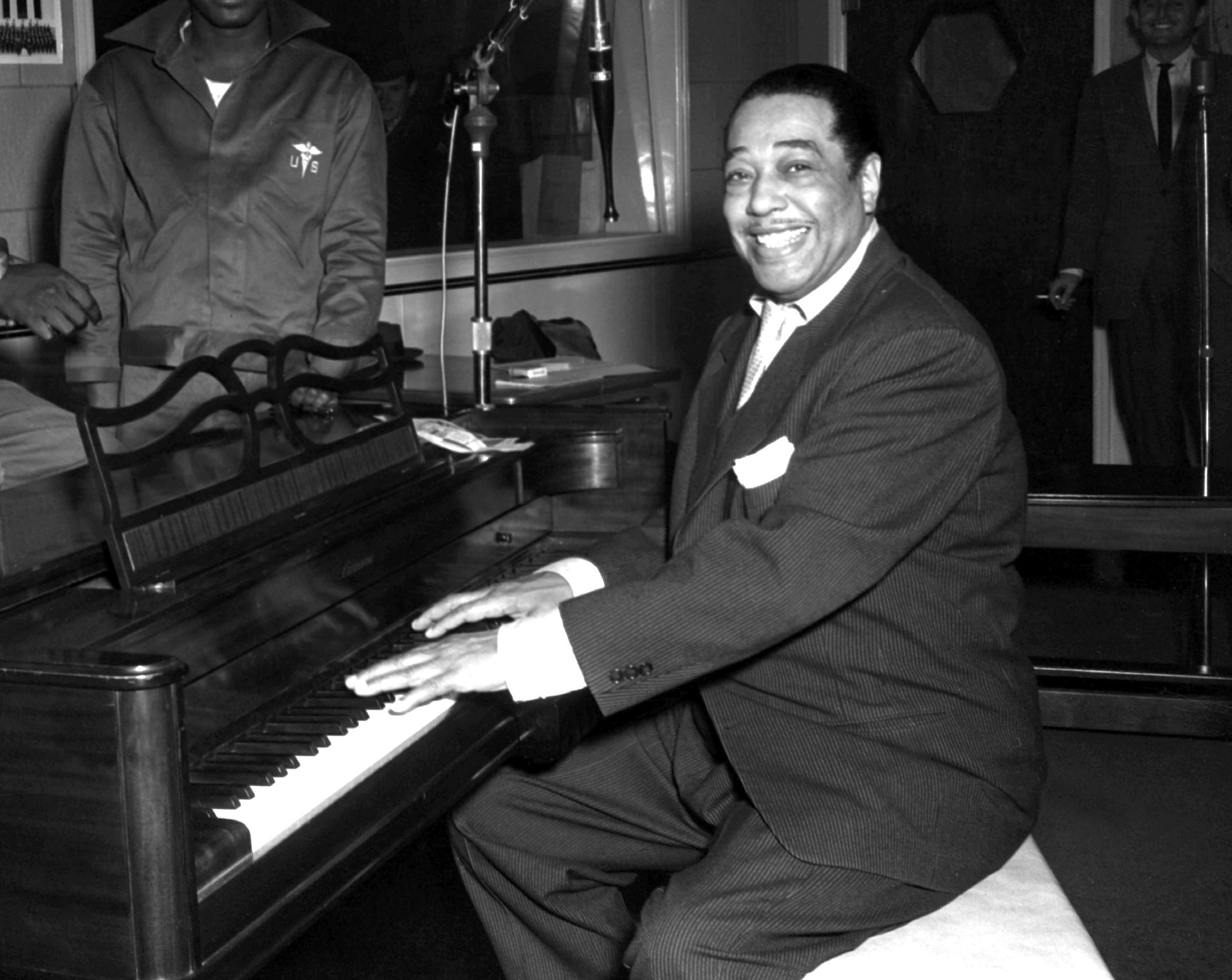
    take the a train
    Photo from Wikimedia Commons Public Domain

    Since it is such an extensive system, those who are completely unfamiliar with New York’s subway system might have a tough time going from borough to borough, and might not even be aware that there are both letter and number trains. However, thanks to Duke Ellington and his infamous 1939 hit “Take the A Train,” almost everyone is aware of at least one line in the NYC subway system, which is more than you can say about almost any other city in the world.

    Although popularized by Duke Ellington, “Take the A Train” was written by long-time collaborator and pianist Billy Strayhorn. The swing anthem became the signature piece for Ellington’s orchestra, and was often used as its opening theme and standout song. For most jazz musicians at that time, bandleaders would not put a song they didn’t write themselves in the spotlight like that, however Ellington and Strayhorn’s relationship was atypical. In his biography, Ellington said Strayhorn “was not, as he was often referred to by many, my alter ego. Billy Strayhorn was my right arm, my left arm, and the eyes in the back of my head.”

    ‘Take the A Train’ was written in Strayhorn’s head while at a party, then put on paper that evening when he got home. The song title was inspired by directions Ellington gave to Strayhorn to get to his house in Sugar Hill, which began with “Take the A Train…,” and the music was influenced by Fletcher Henderson’s style of jazz. Although Ellington’s rendition is instrumental, Ella Fitzgerald released a popular version with the original lyrics Strayhorn wrote about getting to Ellington’s home in Harlem.

    Ellington’s home was located in the Sugar Hill neighborhood of Harlem, which is where the Harlem Renaissance took place between the 1920’s and 1950’s. At the time, Sugar Hill was the ritziest, most elegant African-American neighborhood in the United States. It was deemed “Sugar” Hill because of how sweet it was to live there, with the heart of the neighborhood located between 144th and 155th street. The high-class neighborhood was filled with stately homes and luxury apartments, and inhabited by African-American artists, activists, politicians, and intellectuals. The Harlem Renaissance was responsible for allowing African-Americans to focus on their past, as well as develop a unique identity for themselves, thus creating a culture within a culture. It brought people closer to their roots, and allowed them to celebrate who they were while exploring new creative channels to expression, with the Sugar Hill neighborhood as the epicenter of it all. “Take the A Train” became the anthem of this movement, and was highly praised by all of New York.

    Today the Sugar Hill neighborhood is still lined with elegant homes and beautiful apartment buildings, with the rich, historic culture dominating the neighborhood. As most areas change over time, there has been a recent slight decline in African-Americans living in Sugar Hill to make room for other cultures, however it is still primarily a black neighborhood. Art and creativity thrives within the neighborhood, and you can still take the “A” train uptown anytime you’d like to soak up the culture and be inspired.

    ‘Take The A Train’ Lyrics:

    You must take the A train
    To go to Sugar Hill way up in Harlem
    If you miss the A train
    You’ll find you missed the quickest way to Harlem
    Hurry, get on, now it’s coming
    Listen to those rails a-hummingAll aboard, get on the A train
    Soon you will be on Sugar Hill in Harlem
  • New Ella Fitzgerald Biography Details Singer’s Influence on American Songwriting

    Since Ella Fitzgerald’s passing in 1996, there’s now a major biography that shows the depth of her character and her lasting impact on American Music.

    Written by Judith Tick an authority on American music and women in music, Judith is professor emerita at Northeastern University with award winning books and articles on music to her credit.

    Ella Fitzgerald

    Ella Fitzgerald throughout her life, was a very private person, giving little information about herself and her troubled youth. With Tick’s book the author has managed to incorporate new information and new little known material on Ella’s life and cultural contributions. Tick has been able to achieve this through sources unavailable to past biographers, notably from resources of the 1930s and 1940s such as African American newspapers, some digitized as recently as 2010.

    The author lovingly explains her mother’s love for Ella’s music, her mother’s being born within a year of Ella and the author’s home as she grew up being filled with the music of Ella Fitzgerald, providing a base of life long admiration for the singer which is demonstrated in the author’s writing of her subject.

    Tick concentrates on the theme of “becoming” and “transformation” in Ella’s life as inspiration for writing the book after reading an Ella interview where the singer explains how SongBooks marked a turning point in her musical creativity.

    The biography comprehensively demonstrates Ella’s moxie and mettle in the extraordinary success she achieved from troubled beginnings to international fame. 

    Overcoming poverty, misogyny and racism, Ella Fitzgerald was instrumental is raising the status of female vocalists within the music business. From the 1930s to the 1950s Ella was pursuing mainly jazz singing in clubs and ballrooms. In the 1960s jazz pop evolved as was bossa nova’s popularity with Ella also experimenting with soul and new songwriters, smartly finding a way to appeal to younger audiences. “Across her entire career, the artist was always becoming Ella Fitzgerald,” the author notes. It would be a 60 year career.

    This book differs from prior books on Ella Fitzgerald with the author focusing on three neglected aspects of her life and work: early career, private life and her reception as an artist.

    After her brief childhood in the south, Ella moved to Yonkers where we think of her beginning her career in music. By the time Ella was 9, she was called ambitious and self reliant by her teachers. At age 10, she declared to friends that she would be famous.

    While her mother worked as a cook and a laundress, she managed to supply Ella with piano lessons. The author chronicles Ella’s New York neighborhood and childhood, her early ambitions richly detailed from newly digitized newspaper sources, and describing the New York social club scene that Ella started venturing into.

    One of Ella’s first performances featured in New York Age was her song and dance routine at Twentieth-Century Club in Tarrytown, where she was starting to become known as “the gypsy of song.”

    While trying to earn money to help her family’s finances after her mother’s car accident, Ella became truant from school and was arrested. 

    Labeled “ungovernable”, she was sentenced to 5 years at the New York Training School For Girls in Hudson. In the 1930s the school originally had a good reputation with studies in music and he arts.

    As an adult, having been asked in Lenox, Massachusetts by two visitors from Hudson about her time there, Ella gave this response: “I loved singing and playing the piano a little. Harmony was my tough problem, but there was a wonderful woman at the Hudson training School who helped me out. We worked together for hours until we had real, wonderful harmony. It was really Helen Pitcher who started me out and gave me my first taste for success.”

    “I want you to feel love, just like you were a loving person, not just because I’m a singer”

    Ella Fitzgerald

    When asked to return in the 1960s as a distinguished alumna, Ella unfortunately declined recalling some very negative experiences she also had endured at the Hudson school, which included segregation and not being allowed in the school’s choir. A choir she did “sing her heart out” in was at the Hudson Zion AME Church.

    In this book, the author cites the New York Times article credited with breaking the story of Ella’s time at the Hudson school and her interview of Hudson’s Russ Immarigeon on his research pertaining to Ella’s time in Hudson.

    By 1934 Ella was back in Yonkers and it is still a mystery as to how she got there. 

    The Apollo in Harlem soon became a haven of creativity to her with its lack of segregation, starting her again on her lifelong journey to greatness as a powerful female in music.

Built in Breakdance