New York State has a rich and extensive history of music. From classic songs you sang in elementary school social studies class about the Erie Canal to Frank Sinatra crooning of the wonders of New York City, countless areas throughout the state have drastically influenced musicians, and left an imprint on their artistic growth. NYS Music’s New York Series is a project dedicated to exploring the history of music created and inspired by the diverse areas of the state. Each week we will focus on a different part of New York, how that area inspired a song or album by artists of various genres, and how the area changed over time. This week we will look at Bob Dylan’s ‘Talkin’ New York’ and Greenwich Village’s influence on his writing of the song, as well as how the area shaped his growing career.
Bob Dylan- ‘Talkin’ New York’
“You sound like a hillbilly; We want folk singers here.”
In the winter of 1961, a 19-year-old University of Minnesota drop out named Robert Zimmerman arrived in New York for the first time in hopes of finding his folk-singer idol, Woody Guthrie. It was the coldest winter in seventeen years, and he did not know a soul. ‘Talkin’ New York,’ the second song on Bob Dylan’s self-titled first album, is a talking blues which narrates the difficulties the young folk-singer experienced when he first moved to the Big Apple. Soon after his arrival, Zimmerman moved to Greenwich Village, changed his name to Bob Dylan, and launched one of the most successful music careers in history. 1
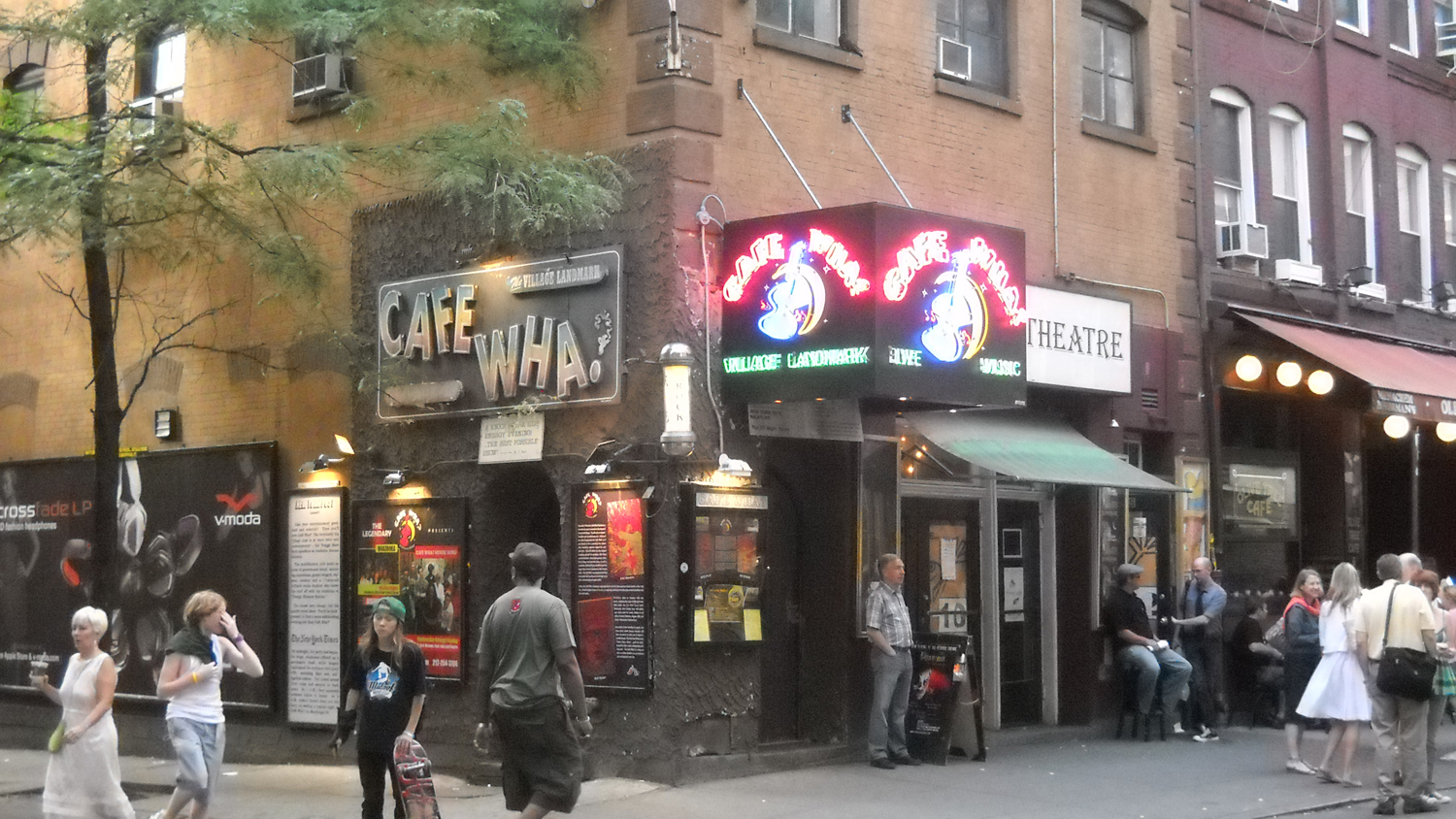
Greenwich Village in the early 1960’s was a hub for artists, poets, musicians and activists to meet, exchange ideas, and grow. When Dylan first arrived, the first thing he did was head over to Café Wha? on Macdougal Street, introduced himself as a musician, and booked himself a gig- as described in the lyrics of ‘Talkin’ New York’. His goal was to immerse himself in the culture, and establish himself as force to be reckoned with in the folk scene. After being fired for being late to three gigs at Café Wha? Dylan jumped around, exploring the many clubs and cafés Greenwich Village had to offer. He played coffee houses such as Caffe Reggio, the Commons, Caffe Dante, and underground clubs like the Gaslight Café, the Fat Black Pussycat, and the Bitter End. 2 New York was the perfect place for Dylan to experiment, meet new people who would greatly influence his career, and develop as an artist. At any point you could walk into a coffee shop and listen to a folk-singer performing, attend a poetry reading, or have an in-depth discussion about direction of the country the with like-minded political activists.
Fred W. McDarrah/Getty Images
‘Talkin’ New York’ chronicles Dylan’s initial experience in New York. It tells the story of his arrival and describes the struggles of trying to make it as a folk-singer in a new town. The area was impoverished at the time, and for the first year Dylan spent most of his time sleeping on floors. He established himself as a vagabond, and his songs began to reflect his lifestyle. After a year he found a place to live relatively cheaply which allowed him to spend more time developing his songs. Because the clubs could not pay performers, Dylan began wearing a hat and passing it around the cafes. The Gaslight Cafe was known for “basket-passing nights” where the only money performers would pocket was what was given to them by audience donations.3
Cafe Wha? 1960’sCafe Wha? Today
Today Greenwich Village is a different neighborhood. NYU has taken over much of the real estate in the area, and the rest has seen a drastic price increase since the 1960’s. It is far too expensive for young aspiring artists to live, but still an area worth visiting often. There are a few relics from the past, and you can go on a walking tour of the sites Dylan and other artists frequented, but today a vagabond could not arrive in the Village and squat in run-down apartments like Dylan did. A few of the old hangouts remain, but they too have evolved with the times. Caffe Dante became Dante NYC, and has moved on from folk-singers to gourmet cuisine. Café Wha? closed in 1968, but reopened in 1987, with music still playing often and the Café Wha? house band headlining many nights. The Bitter End is also still standing, and prides themselves on being New York’s oldest rock club. You can still catch a show any night of the week. While Greenwich Village has changed over the years, there is still a feeling of artistic freedom and counter-culture in many of the bars and coffee shops.
‘Talkin’ New York’ Lyrics:
Rambling out of the wild west
Leaving the towns I love best
Thought I’d seen some ups and down
‘Till I come into New York town
People going down to the ground
Building going up to the sky
Wintertime in New York town
The wind blowing snow around
Walk around with nowhere to go
Somebody could freeze right to the bone
I froze right to the bone
New York Times said it was the coldest winter in seventeen years
I didn’t feel so cold then
I swung on to my old guitar
Grabbed hold of a subway car
And after a rocking, reeling, rolling ride
I landed up on the downtown side
Greenwich Village
I walked down there and ended up
In one of them coffee-houses on the block
Got on the stage to sing and play
Man there said, come back some other day
You sound like a hillbilly
We want folksingers here
Well, I got a harmonica job, begun to play
Blowing my lungs out for a dollar a day
I blowed inside out and upside down
The man there said he loved my sound
He was raving about he loved my sound
Dollar a day’s worth
After weeks and weeks of hanging around
I finally got a job in New York town
In a bigger place, bigger money too
Even joined the union and paid my dues
Now, a very great man once said
That some people rob you with a fountain pen
It don’t take too long to find out
Just what he was talking about
A lot of people don’t have much food on their table
But they got a lot of forks and knives
And they gotta cut something
So one morning when the sun was warm
I rambled out of New York town
Pulled my cap down over my eyes
And heated out for the western skies
So long New York
Howdy, East Orange
A biography of The Band’s Richard Manuel is slated to release this spring for the 50th anniversary of the group’s 1974 tour.
The biography is titled, Richard Manuel: His Life and Music, from the Hawks and Bob Dylan to The Band (Schiffer Publishing, on sale May 28, 2025) celebrates Manuel’s immeasurable contributions to music, ensuring his soulful voice and profound artistry endure in the annals of rock. Richard Manuel sang and played piano for The Band, which originated in Toronto, Canada and Woodstock.
The Band began as a backing group for the legendary Bob Dylan. The Band is often credited with helping to define the sound of roots rock and Americana, blending rock, country, blues, and folk into a cohesive and groundbreaking style. Their music was characterized by a raw, earthy quality that bridged the gap between traditional American folk music and modern rock.
Richard Manuel was sweetly soulful and creatively multifaceted, leaving his mark on rock history that is still celebrated today. Through insightful analysis and interviews, his troubled yet inspired spirit is contextualized within music history. From his role in forming the Band to his iconic vocals and songwriting, Manuel’s influence resonates deeply.
Author Stephen Lewis is a rock-and-roll archivist, collector, and storyteller. He owns and operates the Talk from the Rock Room website and podcast and has been writing about music for over 20 years, including contributing articles on Summer Jam and Little Feat for NYS Music. He delves into Manuel’s influence on the history of rock, along with discussing some of Manuel’s life as told through his forth coming book.
The Band in London, June 1971. From left: Levon Helm, Richard Manuel, Robbie Robertson, Rick Danko and Garth Hudson.
For more information on the biography Richard Manuel: His Life and Music, from the Hawks and Bob Dylan to The Bandclick here.
The Hudson Valley’s Catskill Mountains are known as the powerhouse of folk music. The land’s rich history is a testament to its iconic music scene. No matter where you wander through the Catskills, you’ll pick up the musical culture that these small communities have. But what brought folk music to the Catskills in the first place?
To start, the history of colonial Catskills is right there in the name. Dutch settlers in the 1600s brought many of their traditions and their language to the Catskills. The old Dutch word “kill” translates to river or stream in English. The word “kaats” translates to cat, referring to the bobcats and mountain lions. So the region was coined “Kaatskill,” later anglicized to Catskill.
In pre-colonial times the Catskills was made up of the Mohican, Munsee and Lenape nations, that is until Henry Hudson sailed up the river now named after him in 1609. Robert Juet, one of Hudson’s crew members, was said to be the first European to take note of the Catskills specifically.
In 1667 the Anglo-Dutch War ended with the Breda Treaty in which England received “New Netherlands.” In the decades to come, more English settlers moved to the land, but the Catskills never lost its Dutch Heritage. Sojourner Truth, who was born over a century later, grew up in a Dutch Plantation in Ulster County. Although she spoke English, she never lost her Dutch accent.
As more European settlers moved to the Catskills, different ethnic towns like Germantown, located east of the river, began to pop up.
Although New York had long been colonized, it was still too unexplored throughout the 19th century to be substantially populated. The Catskills were partially desolate but it was the land itself that maintained a community of people in the area. Fur trade and beaver trapping were both profitable trades. The abundance of hemlock bark in the areas allowed tanneries to flourish. Needless to say, these industries brought more and more families to the Catskills.
New York City began to become dependent on the Catskills. Reservoirs in the land have been providing water to the city’s residents since 1916.
As water was flowing from the Catskill reservoirs, the region pulled in more and more city residents. In 1906 the Arts Students League of New York City opened a summer school in Woodstock. This was the beginning of the arts and music town that we know today.
The League brought in mostly visual artists, around 200 students a year from 1906-1922 and again from 1947-1979. They were said to continue their individualistic lives, enjoying their solitude outside of the city.
Perhaps the most famous artist that moved to Woodstock was Bob Dylan. Dylan moved to the small town in 1965 after visiting with his then girlfriend Joan Baez. It was above Cafe Espresso on Tinker Street that he wrote Another Side of Bob Dylan and Bringing It All Back Home.
Self Portrait
After a motorcycle accident, he continued his private life in Woodstock and turned to a new artistic outlet- painting. In 1970 he painted his album cover for Self Portrait. He also started working with a group of musicians called The Hawks, now known as The Band. They collaborated on Dylan’s album The Basement Tapes and The Band’s album Music From Big Pink. Dylan also created the Big Pink album art. The Band’s Levon Helm went on to make a lasting creation in Woodstock with Levon Helm Studios.
It wasn’t only artists that flocked to the Catskills. The year-round scenery drew tourists from all over New York to high end resorts and hotels. Perhaps the most significant hotel in Catskill history was The Catskill Mountain House located in Palenville. This almost mythical house opened in 1824 and was visited by presidents U.S Grant, Chester A. Arthur, and Theodore Roosevelt. The Catskills began to be overshadowed by a more Upstate park, The Adirondacks, and the mountain house had its last season in 1941. It was demolished in 1963 despite the passions of preservationists.
The modern equivalent to the Catskill Mountain House may be the Mohonk Mountain House, a resort and spa located overlooking a glacial lake. The Victorian style castle was built in 1869 and brings in guests from all over the world. The house sits on top of 40,000 acres of protected land thanks to conservationist efforts of the past.
In 1904 the state gained ownership of 92,708 acres of land officially making The Catskills a protected State Park.
Catskill tourism began to bring in families specifically of Jewish faith. This became known as the BorschtBelt, referring to the Eastern European soup. In the Borscht Belt heyday during the ’50s and ’60s, more than 1000 Jewish resorts were scattered the Hudson Valley. Today, the Borscht Belt Museum in Ellenville is dedicated to the rich Jewish history in the Hudson Valley.
With its forests, mountains and streams, the Catskills were the perfect terrains for summer camps, one of which was Camp Woodland. Woodland was founded in 1940 by Norman Studer who was an educator at the Elizabeth Irwin School in New York City. Studer’s purpose with Woodland was to give children a destination full of diverse folk culture.
Michael Pastor, who was a Woodland camper from New York City, remembers what it was like to be a part of this famous camp in folk history. Pastor says the eight weeks of camp he attended annually from 1958 to its last year in 1962 consisted of classic camp activities like football, games, outdoor excursions and of course music.
“A lot of campers played guitars, and so there was an awful lot of music going on all the time. I started playing guitar when I was 12 at camp,” He said. “It was kind of hard to hear yourself anyway, because there were 30 other guitars playing and a few banjo players as well.”
In a time of McCarthyism in America, Woodland was called “Camp Red” by conservatives referring to its teachings of inclusion and community building. According to Pastor, there was never any outright democratic or communist values being preached, but many of the families that sent their children to Woodland were leftward leaning.
photo courtesy of Camp Woodland, Phoenicia, New York Facebook.com
Pastor remembers the diverse music the campers performed. “Some of the music were Union songs from the 1930s. Also, there was a variety of international flavor to the music. We would learn songs from different languages,” he said.
Studor was always reaching out to the local community to teach kids about the history of the area. Pastor says he remembers community members including a local historian coming in to tell stories of the tanneries and music of the past.
Woodland also attracted legendary artists like Ella Jenkins and Pete Seeger. Seeger performed every year for all age groups, inspiring the whole camp.
Pastor says that being around music all summer and seeing artists like Seeger sharing their talents ignited a passion for music for campers. “A person who I met during my very first summer camp, my very first day of camp, Peter Simon, he and I are still very close friends and he, inspired by Pete Seeger, became a banjo player. We had a bluegrass band when we were in high school and we still get together regularly and play sort of old time traditional countries,” Pastor noted.
Seeger was born in New York City and raised in Dutchess County. He was first inspired to pick up the banjo when he traveled to Bascom Lamar Lunsford’s folk festival in Asheville, North Carolina at the age of 16. In 1938, he settled in New York City with other folk musicians known as The Almanac Singers in “The Almanac House.”
In 1949 he began to perform with a group known as The Weavers. A year later, the anti-communist book Red Channels came out which accused Seeger of being a communist. He became a blacklisted musician and the accusation loomed over Seeger’s head for decades.
According to his daughter he was never a self proclaimed communist. “He believed in community and he believed in it, whether it was a family, a school, a town, a country, the earth, but he wasn’t a communist. He was more like a ‘communityist,’” said one of his daughters Tinya Seeger. “He wanted good people who could do good things in office. That would be where his politics lay.”
She said that although he was never a communist himself, he was curious about life under communism. He visited North Vietnam during the Vietnam war along with communist China and Soviet Russia multiple times.
In 1955 he was called before the House of Un-American Activities Committee and was questioned about his political beliefs. He refused to answer their questions leading to 10 counts of contempt in 1956 followed by an indictment two years later.
During his blacklisted period, Seeger still created new music and performed all over the country. Some critics believe it was in these years that his best work transpired. He played gigs in smaller venues and college campuses, communities where folk itself began. His children’s albums were a huge success in summer schools and camps like Woodland.
At multiple performances, conservative community members would protest outside the venue but it never stopped him from performing. “He was happy when he saw free speech. He really believed very much in a person’s right to express how they feel, that you should be able to do that and life goes on,” remarked Seeger.
No two Pete Seeger shows were one in the same. He based his performance on the people that were in the audience. If there were children, he would play children’s songs like “Abiyoyo” or “The Foolish Frog.” If the audience was mostly older adults he would play songs to remind them of their childhood like “If I Had A Hammer.” His set list wouldn’t be determined until he was on stage.
At some of his concerts, audience members could leave him notes on the stage before the performance started. He made sure to read every one of them.
Seeger narrowly escaped prison time in 1962 when a Court of Appeals decided his 1961 conviction was faulty and deserted the case. Already infamous within right leaning circles, he became heavily involved in the civil rights movement and antiwar movement during the Vietnam War.
He was also active in local initiatives as well. His home in Beacon was located along the polluted Hudson River and he was determined to help this ecosystem. Seeger, along with some of his friends in the community, built a sloop named Clearwater, modeling the same boats that sailed the Hudson in the 18th and 19th centuries.
He sailed up and down the river educating listeners about the problem and collecting donations in his banjo case. His efforts actually cleared the river and although the river isn’t completely absent of garbage and pollutants, Hudson Valley residents today enjoy a much cleaner river than those in the 1960s “In those last 10 years of his life, he was trying to say things that were meaningful,” Seeger said.
Seeger understood the relationship between the art of folk music and community. According to his daughter, he liked living in Beacon with his family and a generation of adults that were raised on his music. “He created something that was like a camp experience within the Hudson Valley. Maybe it’s just that the same people were coming to the smaller gatherings that were happening around,” Seeger notes. “I think they were carrying on the tradition.”
Pastor, who is one of those campers carrying on the tradition, says he feels a strong community surrounding folk. “There is a bond that people feel throughout all these decades and I think if you were to ask people, you would find that music is a part of that shared experience, that’s part of that bond. Music was so interwoven with camp life, it’s kind of hard to describe,” he said.
Seeger is survived by his family including Tinya Seeger who lives in the Seeger home in Beacon, New York.
A decade after Seeger’s death, the tradition of Catskill folk continues. The music that was birthed from the land is dependent on the story of the Catskills. Folk was a distraction from work, a time of recreation and bonding for rural families. It was an expression of self for the collection of artists that gathered in the region.
Another family that carries on the trend of intergenerational folk is the Helm Family. The Arkansas native Levon Helm of The Band settled in Woodstock in 1967. In 1975, he built Levon Helm Studios, putting down permanent roots in Woodstock. His family, including his daughter Amy Helm, continue his legacy with “The Helm Family Midnight Ramble,” an annual celebration of his art at Levon Helm Studios.
Today, the studio showcases independent artists and bands from all over the country.
Eggy at Levon Helm Studios – photo by Zak Radick
Helm recorded the Dirt Farmer album in his studio which won a Grammy Award for Best Traditional Folk Album in 2008. Guitarist Larry Campbell, who also worked with Dylan, produced the album alongside Amy Helm. They both sang and performed on the album as well.
Dirt Farmer is not only an award-winning album, but it was deeply personal for Helm. It was his comeback album, his first since 1982. He started recording as he was battling throat cancer, despite the damage to his vocals.
The acoustic tracks are a nod to his Arkansas roots, but they have a clear Catskill influence. Each song tells a story of the human condition. “Anna Lee” is about children who remember their late mother by her lullabies. “Wide River To Cross” is the final track on the album. In it Levon describes his journey of life, being “only halfway home.”
Amy Helm, who has recorded solo music at the studio, was born in Woodstock and grew up watching her father perform. With her three folk albums, she continues to carry on her family’s legacy and tour around the country.
The Catskills and its history have shaped perhaps hundreds of solo folk musicians as well as contemporary bands.
The Felice Brothers, originally from Palenville in the Catskills, are one of the most popular folk groups today. They’ve released ten albums including their latest 2024 album Valley of Abandoned Songs. Ian Felice (guitar/vocals), James Felice (piano/vocals), Jeske Hume (bass), and Will Lawrence (drums) bring back the raw, acoustic sound of the region.
In a recent interview with NYS Music, James Felice stated that the category of Folk and Americana felt limiting to the band early in its takeoff, but later, he embraced the labels. “All of our music, the way we play and the music we grew up with is folk music. It’s the music that we are most connected to. So yeah, I’m okay with that. I think we’ve been doing this long enough to have our sort of thing,” he said.
Valley of Abandoned Songs
Hudson Valley artist Mikaela Davis moved from Rochester, after her first album, Delivery. Davis got her degree in harp performance at the Crane School of Music in Potsdam. The harp, an unusual instrument in the genre of folk, compliments her whimsical vocals and takes the instrumentation to a new level. She produces a blend of indie-pop and Catskill folk inspired by sounds from the ’60s, the golden era of music in this region.
Davis records and performs with her own musical family. She has known her drummer Alex Coté since childhood, guitarist Cian McCarthy and bassist Shane McCarthy from college and she met steel guitarist Kurt Johnson in her early twenties.
The Bones of J.R Jones, another artist from Central New York, started his musical career playing in hardcore punk bands until he became more interested in American blues and folk musicians of the 1930s and ’40s. He officially launched his musical project, The Bones of J.R Jones, in 2012 as an independent artist.
Although his music is categorized as folk, indie and punk, he doesn’t write with genre in mind. “I honestly believe the music we create is a reflection of life experiences,” he said. Since his start, he has released five albums. In 2021, he relocated from Brooklyn to a Catskill farmhouse.
He says, in his experience, the Catskills have been a welcoming environment for him and the music community is supportive and uplifting. There is also something very special about the slow sleepy hills and mountains here. “We are just out of the reach of the weekend crowd from NYC so in a way, it stays true to itself. It’s a magical place full of inspiration,” he notes.
Upstate, with Brooklyn connections, settled in The Hudson Valley and over the past 11 years of performing together, have released three bold harmonious albums.
Members Mary Webster, Melanie Glenn, Harry D’Agostino and Dylan McKinstry recorded their most recent album, You Only Got A Few, in the Hudson Valley at The Building in Marlboro, New York and Greenpoint Recording Collective in Brooklyn, another musical hotspot for independent music.
Laura Zarougian is a solo artist who describes herself as an “Armenian Cowgirl,” inspired by American folk as well as her Armenian roots. She is a multi-instrumentalist and a powerful vocalist. Her songs tell stories of her family lineage and explore themes of searching for home. “Cairo,” from her 2023 album Nayri, tells the story of her great grandfather’s death and her grandmother’s journey to bring his body back to Cairo.
Zarougian grew up in Boston, but her musical career blossomed in Brooklyn. She now lives in Red Hook, a town right next to the Hudson River. “I do feel like there is a really strong sense of community here in which people want to support local musicians and do their best to promote them,” she said. Nayri is a seven-track album recorded with her partner, drummer Mike Alan Hams. The storytelling in her music captures the spirit of Catskill folk. “It’s definitely got some twang and elements of Americana and folk. But a lot of my songs, especially on my first album, had to do with my Armenian American identity,” she remarked. “I think folk songs have to do with place and longing and all of these things that are just part of the human experience.”
The folks that are keeping folk alive are the “grassroots” groups and families that create music without the pressure commercial industry influences.
Just days before his passing in 2014, Seeger attended the annual celebration of Martin Luther King, Jr., in Beacon.
“What did my father do? You know, sometimes I say he was a singer and entertainer, but he was somebody that was really trying to help people get along,” Seeger said. “His version of helping them communicate was to write music.”
Seeger is still one of the most well-known folk singers in America and his work in activism and the folk revival movement live on.
“Just Like Tom Thumb’s Blues” recorded on Jan 30, 1974 at Madison Square Garden has been released ahead of the upcoming Bob Dylan compendium, The 1974 Live Recordings. The album will contain never-before-heard recordings from Dylan and The Band and will be released on Sept 20.
Photo Credit: Barry Feinstein
Columbia Records and Legacy Recordings, the catalog division of Sony Music Entertainment, have released “Just Like Tom Thumb’s Blues” recorded by Bob Dylan and The Band live at Madison Square Garden, on Jan 30, 1974.
From Dylan’s first tour in 8 years, The 1974 Live Recordings is a collection featuring every professionally recorded show from Bob Dylan’s 1974 arena tour with The Band. The complete recordings are out on September 20 celebrating the 50th anniversary of Bob Dylan’s return to touring that year. Bob Dylan and The Band performed 30 dates in 42 days for that tour to an average audience of 18,500.
The collection features 417 never-before-heard versions of some of Dylan’s most beloved songs, as well as some of his lesser known songs. Nearly all the recordings were not included on the original live album Before The Flood. The 1974 Tour was captured on a stereo soundboard mix, on both 1⁄4” tape and cassette.
The collection will be available as a deluxe box set across 27 CDs, and includes 133 recordings newly mixed from 16-track tape, and every single surviving soundboard recording – along with new liner notes by journalist and critic Elizabeth Nelson. Jack White’s Third Man Records has announced the release of The 1974 Live Recordings – The Missing Songs From Before the Flood, a 3-LP / 1 x 7-inch set culled from the same recordings, featuring versions of every song Bob Dylan recorded that was not included on the original 1974 live album. The set will be available through The Vault on Colored Vinyl.
Columbia Records and Legacy Recordings have announced the release of The 1974 Live Recordings, a collection of all professionally recorded shows from Bob Dylan’s 1974 performances backed by The Band, including his January 1974 shows at Madison Square Garden.
The collection will celebrate the 50th anniversary of Bob Dylan’s return to touring and will be released on Friday, September 20.
Photo credit: Barry Feinstein
The 1974 Live Recordings, to be available as a deluxe box set across 27 CDs, will offer fans 417 previously unreleased Bob Dylan live tracks, including 133 recordings newly mixed from 16-track tape and every single surviving soundboard recording, along with new liner notes by journalist and critic Elizabeth Nelson.
In conjunction with The 1974 Live Recordings, Third Man Records has announced the September release of The 1974 Live Recordings – The Missing Songs From Before the Flood, a 3-LP / 1 by 7-inch set culled from the same recordings, featuring hand selected versions of every song Bob Dylan recorded that was not included on the original 1974 live album. Pressed exclusively on colored vinyl, the set will be available through The Vault, Third Man’s direct-to-customer mail order service.
Bob Dylan with the Band at Madison Square Garden in 1974. Photo credit: Larry Morris/The New York Times
Bob Dylan’s 1974 Tour marked his first time touring live in eight years and reunited him with The Band, who had become widely renowned in their own right since backing the artist nearly a decade earlier. Booked into arenas for the first time ever, Bob Dylan and The Band performed 30 dates in 42 days (often playing two sets per day) before an average audience of 18,500, helping set a new standard for what rock concerts could look and sound like. And in front of those crowds, they brought an energy that Rolling Stone’s Ben Fong-Torres described as “searing and soaring, unified and precise…excellent in itself.” Music critic Robert Christgau compared the sound to Bob Dylan “running over his old songs like a truck.”
Tour ‘74 kicked off Jan. 3, 1974, at Chicago Stadium, the largest indoor arena in the world at the time it was built, with a tense and combative rip through the ultimate deep-cut “Hero Blues,” an acoustic-gone-electric outtake from The Freewheelin’ Bob Dylan sessions that he had scarcely performed before or since. Additional rarities, like a wildly reinvented “Ballad of Hollis Brown,” “Song to Woody” (not performed since 1962) and Planet Waves outtake “Nobody ‘Cept You,” would be well received on the tour’s first nights. “We were booed off of every stage in Europe,” The Band’s Robbie Robertson recalled to Newsweek of their previous run together. “What happened tonight in Chicago is so reassuring for us.”
The reception wasn’t the only thing that had changed since Bob Dylan and The Band last toured together in 1966. Since then, The Band had released six LPs, played Woodstock and other famous stages, and recorded a series of historic sessions with Bob Dylan, from The Basement Tapes to Planet Waves. For his part, Bob Dylan had effectively retired from the road altogether following a 1966 motorcycle accident, yet was still “widely regarded as the most influential and significant star in the last 10 years of American popular music,” according to The New York Times.
Photo credit: Barry Feinstein
Though they might not have known it at the time, Bob Dylan and The Band were at the vanguard of a new era. Tour ‘74 would help create the template for the major rock tour and codify many of its shared experiences, from the sight of audiences holding up lighters en masse (as captured in the iconic cover image for Before the Flood) to the bright flash of the house lights during a show’s signal moment, in this case, their performance of “Like a Rolling Stone.” Likewise, many songs performed live for the first time on Tour ‘74—”All Along the Watchtower,” “Forever Young” and the show’s eventual opener-and-closer “Most Likely You Go Your Way (and I’ll Go Mine)” —would take on a life of their own.
At the outset, the 1974 Tour was captured on a stereo soundboard mix on both 1/4-inch tape and cassette. By the tour’s end, Asylum Records’ David Geffen had commissioned recordings on multitrack tape, the standard at the time, for eventual release on Before the Flood. The 1974 Live Recordings includes it all—the cassettes and 1/4-inch tapes and the shows that were recorded on 16-track tape, newly-mixed for this collection.
Preorders for the collection are available here. A previously unreleased performance of “Forever Young,” live in Seattle, on Feb 9, 1974, can be found here. See below for the full track list of The 1974 Live Recordings.
Bob Dylan with the Band at Madison Square Garden in 1974. Photo credit: Chris Charlesworth
Full Tracklist
DISC 1
January 3, 1974 – Chicago Stadium, Chicago, IL
1. Hero Blues
2. Lay, Lady, Lay
3. Tough Mama
4. It Ain’t Me, Babe
5. Leopard-Skin Pill-Box Hat
6. All Along the Watchtower
7. Song to Woody
8. The Lonesome Death of Hattie Carroll
9. Nobody ‘Cept You
10. It’s Alright, Ma (I’m Only Bleeding)
11. Forever Young
12. Something There Is About You
13. Like a Rolling Stone
14. Most Likely You Go Your Way (and I’ll Go Mine)
DISC 2
January 4, 1974 – Chicago Stadium, Chicago, IL
1. Hero Blues
2. Just Like Tom Thumb’s Blues
3. It Ain’t Me, Babe
4. Tough Mama
5. Ballad of a Thin Man
6. Leopard-Skin Pill-Box Hat
7. Knockin’ on Heaven’s Door
8. The Times They Are A-Changin’
9. Love Minus Zero/No Limit
10. The Lonesome Death of Hattie Carroll
11. Nobody ‘Cept You
12. It’s Alright, Ma (I’m Only Bleeding)
13. Maggie’s Farm
DISC 3
January 6, 1974 (Afternoon) – The Spectrum, Philadelphia, PA
1. Ballad of Hollis Brown
2. Lay, Lady, Lay
3. Just Like Tom Thumb’s Blues
4. It Ain’t Me, Babe
5. Tough Mama
6. Ballad of a Thin Man
7. All Along the Watchtower
8. Leopard-Skin Pill-Box Hat
9. Knockin’ on Heaven’s Door
10. To Ramona
11. Mama, You Been on My Mind
12. The Lonesome Death of Hattie Carroll
13. Nobody ‘Cept You
14. It’s Alright, Ma (I’m Only Bleeding)
15. I Don’t Believe You (She Acts Like We Never Have Met)
16. Forever Young
17. Something There Is About You
18. Like a Rolling Stone
DISC 4
January 6, 1974 (Evening) – The Spectrum, Philadelphia, PA
1. Rainy Day Women #12 & 35
2. Lay, Lady, Lay
3. Just Like Tom Thumb’s Blues
4. It Ain’t Me, Babe
5. I Don’t Believe You (She Acts Like We Never Have Met)
6. Ballad of a Thin Man
7. All Along the Watchtower
8. Leopard-Skin Pill-Box Hat
9. Knockin’ on Heaven’s Door
10. The Times They Are A-Changin’
11. It’s All Over Now, Baby Blue
12. Song to Woody
13. Mr. Tambourine Man
14. Nobody ‘Cept You
15. It’s Alright, Ma (I’m Only Bleeding)
16. Forever Young
17. Something There Is About You
18. Like a Rolling Stone
19. Most Likely You Go Your Way (and I’ll Go Mine)
DISC 5
January 7, 1974 – The Spectrum, Philadelphia, PA
1. Rainy Day Women #12 & 35
2. Lay, Lady, Lay
3. Just Like Tom Thumb’s Blues
4. It Ain’t Me, Babe
5. I Don’t Believe You
(She Acts Like We Never Have Met)
6. Ballad of a Thin Man
7. All Along the Watchtower
8. Ballad of Hollis Brown
9. Knockin’ on Heaven’s Door
10. Just Like a Woman
11. Girl from the North Country
12. Wedding Song
13. Nobody ‘Cept You
14. It’s Alright, Ma (I’m Only Bleeding)
15. Forever Young
16. Something There Is About You
17. Like a Rolling Stone
18. Most Likely You Go Your Way (and I’ll Go Mine)
DISC 6
January 9, 1974 – Maple Leaf Gardens, Toronto, Canada
1. Rainy Day Women #12 & 35
2. Lay, Lady, Lay
3. Just Like Tom Thumb’s Blues
4. It Ain’t Me, Babe
5. It Take a Lot to Laugh, It Takes a Train to Cry
6. Ballad of a Thin Man
7. All Along the Watchtower
8. Ballad of Hollis Brown
9. Knockin’ on Heaven’s Door
10. Just Like a Woman
11. Girl from the North Country
12. Wedding Song
13. Nobody ‘Cept You
14. It’s Alright, Ma (I’m Only Bleeding)
15. Forever Young
16. Something There Is About You
17. Like a Rolling Stone
18. Most Likely You Go Your Way (and I’ll Go Mine)
DISC 7
January 11, 1974 – Montreal Forum, Montreal, Canada
1. Most Likely You Go Your Way (and I’ll Go Mine)
2. Lay, Lady, Lay
3. Just Like Tom Thumb’s Blues
4. I Don’t Believe You (She Acts Like We Never Have Met)
5. It Ain’t Me, Babe
6. Ballad of a Thin Man
7. All Along the Watchtower
8. Ballad of Hollis Brown
9. Knockin’ on Heaven’s Door
10. The Times They Are A-Changin’
11. Don’t Think Twice, It’s All Right
12. Gates of Eden
13. Nobody ‘Cept You
14. It’s Alright, Ma (I’m Only Bleeding)
15. Forever Young
16. Something There Is About You
17. Like a Rolling Stone
18. Most Likely You Go Your Way (and I’ll Go Mine)
DISC 8
January 14, 1974 (Afternoon) – Boston Gardens, Boston, MA
1. Rainy Day Women #12 & 35
2. Lay, Lady, Lay
3. Just Like Tom Thumb’s Blues
4. It Ain’t Me, Babe
5. I Don’t Believe You (She Acts Like We Never Have Met)
6. Ballad of a Thin Man
7. All Along the Watchtower
8. Ballad of Hollis Brown
9. Knockin’ on Heaven’s Door
10. The Times They Are A-Changin’
11. Don’t Think Twice, It’s All Right
12. Gates of Eden
13. Just Like a Woman
14. It’s Alright, Ma (I’m Only Bleeding)
15. Forever Young
16. Something There Is About You
17. Like a Rolling Stone
18. Most Likely You Go Your Way (and I’ll Go Mine)
DISC 9
January 15, 1974 – Capital Centre, Largo, MD
1. Most Likely You Go Your Way (and I’ll Go Mine)
2. Lay, Lady, Lay
3. Just Like Tom Thumb’s Blues
4. I Don’t Believe You (She Acts Like We Never Have Met)
5. It Ain’t Me, Babe
6. Ballad of a Thin Man
7. All Along the Watchtower
8. Ballad of Hollis Brown
9. Knockin’ on Heaven’s Door
10. The Times They Are A-Changin’
11. Don’t Think Twice, It’s All Right
12. Wedding Song
13. Just Like a Woman
14. It’s Alright, Ma (I’m Only Bleeding)
15. Forever Young
16. Something There Is About You
17. Like a Rolling Stone
18. Most Likely You Go Your Way (and I’ll Go Mine)
DISC 10
January 16, 1974 – Capital Centre, Largo, MD
1. Most Likely You Go Your Way (and I’ll Go Mine)
2. Lay, Lady, Lay
3. Just Like Tom Thumb’s Blues
4. One Too Many Mornings
5. It Ain’t Me, Babe
6. Ballad of a Thin Man
7. All Along the Watchtower
8. Ballad of Hollis Brown
9. Knockin’ on Heaven’s Door
10. The Times They Are A-Changin’
11. Don’t Think Twice, It’s All Right
12. Gates of Eden
13. Nobody ‘Cept You
14. It’s Alright, Ma (I’m Only Bleeding)
15. Forever Young
16. Something There Is About You
17. Like a Rolling Stone
18. Most Likely You Go Your Way (and I’ll Go Mine)
DISC 11
January 17, 1974 – Coliseum, Charlotte, NC
1. Most Likely You Go Your Way (and I’ll Go Mine)
2. Lay, Lady, Lay
3. Just Like Tom Thumb’s Blues
4. Rainy Day Women #12 & 35
5. It Ain’t Me, Babe
6. Ballad of a Thin Man
7. All Along the Watchtower
8. Ballad of Hollis Brown
9. Knockin’ on Heaven’s Door
10. The Times They Are A-Changin’
11. Don’t Think Twice, It’s All Right
12. Gates of Eden
13. Just Like a Woman
14. It’s Alright, Ma (I’m Only Bleeding)
15. Forever Young
16. Something There Is About You
17. Like a Rolling Stone
18. Most Likely You Go Your Way (and I’ll Go Mine)
DISC 12
January 19, 1974 (Afternoon) – Hollywood Sportatorium, Hollywood, FL
1. All Along the Watchtower
2. Ballad of Hollis Brown
3. Knockin’ on Heaven’s Door
4. The Times They Are A-Changin’
5. Don’t Think Twice, It’s All Right
6. Gates of Eden
7. Just Like a Woman
8. It’s Alright, Ma (I’m Only Bleeding)
9. Forever Young
10. Something There Is About You
11. Like a Rolling Stone
12. Most Likely You Go Your Way (and I’ll Go Mine)
DISC 13
January 21, 1974 – The Omni, Atlanta, GA
1. Most Likely You Go Your Way (and I’ll Go Mine)
2. Lay, Lady, Lay
3. Just Like Tom Thumb’s Blues
4. Leopard-Skin Pill-Box Hat
5. It Ain’t Me, Babe
6. Ballad of a Thin Man
7. All Along the Watchtower
8. Ballad of Hollis Brown
9. Knockin’ on Heaven’s Door
10. The Times They Are A-Changin’
11. Don’t Think Twice, It’s All Right
12. Gates of Eden
13. Just Like a Woman
14. It’s Alright, Ma (I’m Only Bleeding)
15. Forever Young
16. Something There Is About You
17. Like a Rolling Stone
18. Most Likely You Go Your Way (and I’ll Go Mine)
DISC 14
January 22, 1974 – The Omni, Atlanta, GA
1. Most Likely You Go Your Way (and I’ll Go Mine)
2. Lay, Lady, Lay
3. Just Like Tom Thumb’s Blues
4. Rainy Day Women #12 & 35
5. It Ain’t Me, Babe
6. Ballad of a Thin Man
7. Ballad of Hollis Brown
8. Knockin’ on Heaven’s Door
9. The Times They Are A-Changin’
10. Don’t Think Twice, It’s All Right
11. Gates of Eden
12. It’s All Over Now, Baby Blue
13. It’s Alright, Ma (I’m Only Bleeding)
14. Forever Young
15. Something There Is About You
16. Like a Rolling Stone
17. Most Likely You Go Your Way (and I’ll Go Mine)
DISC 15
January 26, 1974 (Afternoon) – Hofheinz Pavilion, Houston, TX
1. Most Likely You Go Your Way (and I’ll Go Mine)
2. Lay, Lady, Lay
3. Just Like Tom Thumb’s Blues
4. Rainy Day Women #12 & 35
5. It Ain’t Me, Babe
6. Ballad of a Thin Man
7. All Along the Watchtower
8. Ballad of Hollis Brown
9. Knockin’ on Heaven’s Door
10. The Times They Are A-Changin’
11. Don’t Think Twice, It’s All Right
12. Gates of Eden
13. Just Like a Woman
14. It’s Alright, Ma (I’m Only Bleeding)
15. Forever Young
16. Something There Is About You
17. Like a Rolling Stone
18. Most Likely You Go Your Way (and I’ll Go Mine)
DISC 16
January 26, 1974 (Evening) – Hofheinz Pavilion, Houston, TX
1. Most Likely You Go Your Way (and I’ll Go Mine)
2. Lay, Lady, Lay
3. Just Like Tom Thumb’s Blues
4. Rainy Day Women #12 & 35
5. It Ain’t Me, Babe
6. Ballad of a Thin Man
7. All Along the Watchtower
8. Ballad of Hollis Brown
9. Knockin’ on Heaven’s Door
10. The Times They Are A-Changin’
11. Don’t Think Twice, It’s All Right
12. Gates of Eden
13. Just Like a Woman
14. It’s Alright, Ma (I’m Only Bleeding)
15. Forever Young
16. Something There Is About You
17. Like a Rolling Stone
18. Most Likely You Go Your Way (and I’ll Go Mine)
DISC 17
January 30, 1974 – Madison Square Garden, New York City, NY
1. Most Likely You Go Your Way (and I’ll Go Mine)
2. Lay, Lady, Lay
3. Just Like Tom Thumb’s Blues
4. All Along the Watchtower
5. Ballad of Hollis Brown
6. Knockin’ on Heaven’s Door – released on Before the Flood
7. The Times They Are A-Changin’
8. Don’t Think Twice, It’s All Right
9. Gates of Eden
10. Just Like a Woman
11. It’s Alright, Ma (I’m Only Bleeding) – Incomplete
12. Forever Young
13. Something There Is About You
14. Like a Rolling Stone
15. Most Likely You Go Your Way (and I’ll Go Mine)
16. Blowin’ in the Wind
DISC 18
January 31, 1974 (Afternoon) – Madison Square Garden, New York City, NY
1. All Along the Watchtower
2. Ballad of Hollis Brown
3. Knockin’ on Heaven’s Door
4. The Times They Are A-Changin’
5. Don’t Think Twice, It’s All Right
6. Gates of Eden – Incomplete
7. Forever Young
8. Highway 61 Revisited – released on A Musical History (The Band)
9. Like a Rolling Stone – Incomplete
DISC 19
January 31, 1974 (Evening) – Madison Square Garden, New York City, NY
1. Most Likely You Go Your Way (and I’ll Go Mine)
2. Lay, Lady, Lay
3. Just Like Tom Thumb’s Blues
4. Rainy Day Women #12 & 35
5. It Ain’t Me, Babe
6. Ballad of a Thin Man
7. All Along the Watchtower – Incomplete
8. Ballad of Hollis Brown
9. Knockin’ on Heaven’s Door
10. The Times They Are A-Changin’
11. Don’t Think Twice, It’s All Right
12. Gates of Eden
13. Just Like a Woman
14. It’s Alright, Ma (I’m Only Bleeding)
15. Forever Young
16. Highway 61 Revisited
17. Like a Rolling Stone
18. Most Likely You Go Your Way (and I’ll Go Mine)
19. Blowin’ in the Wind
DISC 20
February 9, 1974 (Afternoon) – Seattle Center Coliseum, Seattle, WA
1. Most Likely You Go Your Way (and I’ll Go Mine)
2. Lay, Lady, Lay
3. Just Like Tom Thumb’s Blues
4. All Along the Watchtower
5. Ballad of Hollis Brown
6. Knockin’ on Heaven’s Door
7. She Belongs to Me
8. The Times They Are A-Changin’
9. The Lonesome Death of Hattie Carroll
10. Don’t Think Twice, It’s All Right
11. Wedding Song
12. Forever Young
13. Highway 61 Revisited
DISC 21
February 9, 1974 (Evening) – Seattle Center Coliseum, Seattle, WA
1. The Times They Are A-Changin’
2. Just Like a Woman
3. Wedding Song
4. Don’t Think Twice, It’s All Right
5. It’s All Right, Ma (I’m Only Bleeding)
6. Forever Young
7. Highway 61 Revisited
8. Like a Rolling Stone
9. Most Likely You Go Your Way (and I’ll Go Mine)
10. Blowin’ in the Wind
DISC 22
February 11, 1974 (Afternoon) – Alameda County Coliseum, Oakland, CA
1. All Along the Watchtower
2. Ballad of Hollis Brown
3. Knockin’ on Heaven’s Door
4. She Belongs to Me
5. The Times They Are A-Changin’
6. The Lonesome Death of Hattie Carroll
7. Don’t Think Twice, It’s All Right
8. Wedding Song
9. Forever Young
10. Highway 61 Revisited
11. Like a Rolling Stone – Incomplete
12. Most Likely You Go Your Way (and I’ll Go Mine)
13. Blowin’ in the Wind
DISC 23
February 11, 1974 (Evening) – Alameda County Coliseum, Oakland, CA
1. Most Likely You Go Your Way (and I’ll Go Mine)
2. Lay, Lady, Lay
3. Just Like Tom Thumb’s Blues
4. Rainy Day Women #12 & 35
5. It Ain’t Me, Babe
6. Ballad of a Thin Man
7. All Along the Watchtower
8. Ballad of Hollis Brown
9. Knockin’ on Heaven’s Door
10. The Times They Are A-Changin’
11. Just Like a Woman
12. Gates of Eden
13. Don’t Think Twice, It’s All Right – Incomplete
Ray Brothers BBQ will host bob., a tribute to Bob Dylan on August 11. The show will take audiences on a journey through Dylan’s timeless melodies and poignant lyrics.
Musicians from multiple bands will come together to pay tribute to Bob Dylan’s unparalleled artistry. Doors open at 3:00, and the show will run from 4:00 to 7:00.
The performance will feature Al Schnier and Vinnie Amico of the band moe. along with special guests. Known for their captivating stage presence and rhythmic wizardry, moe. has become a pioneering force in the jam band scene. moe. will be joined by Charley Orlando singer and multi-instrumentalist, Brian Lauri on keyboard, and Zach Fleitz on bass. From classic hits like “Highway 61 Revisited” to ballads like “Girl From the North Country,” bob. is sure to deliver a thrilling performance of all your favorites.
Located on Route 20 in Bouckville, Ray Brothers BBQ has received critical acclaim. Additionally, Food Network voted Ray Brothers BBQ the best ribs in the state. Owned by brothers Tucker and Colin Ray, Ray Bros has been serving authentic, slow cooked barbecue since 2014.
Ray Brothers’ outdoor venue offers a great opportunity to enjoy summer weather, great food, and even better music. Ray Bros sell out daily, so don’t miss an opportunity to enjoy critically acclaimed food and music.
More information about the tribute show is available at the following link. Ray Brothers BBQ’s episode of America’s Best Restaurants is available below.
A new exhibition at Fenimore Art Museum in Cooperstown celebrates another impressive aspect of music legend Bob Dylan’s creativity: his talents in visual art.
Bob Dylan Remastered: Drawings from the Road features ninety-two unique, original signed works. The exhibition is on view from May 25–Sept. 15, 2024.
A selection of portraits from the exhibition Bob Dylan Remastered: Drawings from the Road, on view at Fenimore Art Museum in Cooperstown starting May 25. (Photo courtesy of PAN Art Connections).
A dedicated performer, Bob Dylan started what is known as his “Never Ending Tour” in 1988; between 1989 and 1992, as he traveled through North America, Europe, and Asia, he began sketching glimpses of his life on the road. The pencil and charcoal drawings were a way to “refocus a restless mind,” as Dylan claimed, providing him a new outlet to celebrate the comings and goings of everyday life.
“This exhibition allows everyone, including Dylan’s fans, to experience another aspect of the range of talents possessed by this music legend,” said Chris Rossi, Director of Exhibitions at Fenimore Art Museum. “We all recognize him as an accomplished singer/songwriter and visitors will be equally amazed when discovering his work as a visual artist.”
Dylan made three different collections out of the original drawings by “remastering” these works, adding vivid watercolor and gouache to digital enlargements of the drawings to create a new, special edition set entitled The Drawn Blank Series, which is the focus of Fenimore’s exhibition.
All three series were first seen during an exhibition at the prestigious Kunstsammlungen Chemnitz Museum in Germany in 2007. After one additional show in Helsinki, the works returned to Dylan. Today, The Drawn Blank Series is owned by a private collector while the other two sets were sold to a private gallery. His skills as a draughtsman, in keeping with his talents as a songwriter, lie in his ability to tell a tale through the simplest and most evocative means.
We continue our look back at one of the more influential and memorable series of shows The Grateful Dead have ever played in the State of New York. On this day in 1990, the Dead continued their first ever run of shows at The Knick in Albany, formally known as Knickerbocker Arena. The three-night run sees the band in peak form and contains so many musical highlights that it was rightly crafted into a three-disc 1996 live release entitled Dozin’ At The Knick. After a brilliant first night, the band shows no letup in this second night that features a prime portion of the second set that’s all featured on the album.
The show begins with a succinct but crisp “Greatest Story Ever Told,” with Jerry Garcia’s signature guitar tone present early and often. The vocal harmonies of Bob Weir and Brent Mydland are on point as the band seems fully engaged from the get-go. “Touch of Grey” then follows in the two-spot, the Dead’s “hit” from their 1987 In The Dark release that introduced the band to so many. Garcia nails all of the vocals and phrasing, in addition to the signature ripping guitar solo, and Mydland joining in on harmonies seems to take this “Grey” to another level. It’s a surprise this wasn’t include for Dozin’ At The Knick selection.
Weir then leads the band through a bluesy cover of “Wang Dang Doodle” before Mydland does the same on one of his signature tunes, “Never Trust A Woman.” Brent’s soulful vocals combined with increasingly powerful runs on the organ make this one of the finer versions ever played, sadly also one of the last as well. The Dead then cue up a classic love song for the Knick, one familiar to Jerry Garcia Band setlists, “Jack-a-Roe.” The tune about doing anything in the name of love, which can be traced back as far as the early 1800s, features story tale-like lyrics and a couple of ripping runs by Garcia on guitar on the band’s modern day take on it.
They follow this up with another cover, this time a wonderful take of the Bob Dylan-penned “When I Paint My Masterpiece.” Weir handles the bluesy vocals with aplomb, which rise in intensity from start to finish, wrapping up a fun three-song section of the first set. This grouping of songs is prominently featured on the first disc of Dozin’ At The Knick and it’s no surprise why.
The band then shifts back into “jam” mode and unleash a 13-minute “Bird Song” that’s one of the highlights of the show. It features a jam that takes off immediately and, fittingly, bounces and flutters around in a way only the Dead can manipulate. Garcia goes through a multitude of guitar filters and the resumption of the composed section seems to come out of nowhere. Seizing this momentum, the first set then ends with a triumphant “Let It Grow” that’s highlighted by some nimble bass lines from Phil Lesh and more explosive runs from Garcia up and down the fretboard. It caps off a first set at the Knick bookended with two Dead originals played to perfection with a fun mix of cover songs thrown in between.
To begin the second set, “Eyes of the World” quietly starts up in a much slower, groovier tempo than most of its predecessors. It’s a pristine version with some nice interplay between Garcia and Lesh throughout and with the instrumental sections between verses executed to perfection as the band seems fully engaged right away after the set break.
As the “Eyes” jam dwindles down to drums-only, so starts the beginning of “Samson of Delilah” in a clean segue. Mydland shines on keys in a jam that starts off strong and never lets up as the Dead treat the Knick crowd to another one of their takes of a traditional arrangement, this one with Biblical roots. From this, the opening chords of “Crazy Fingers” emerge and Garcia reassumes the helm. It’s a slow. deliberate take on this Dead classic and Garcia drops another guitar solo in an accompanying fashion.
As the tempo finally begins to pick up at the end, the Dead execute another fairly seamless segue into another live staple, “Truckin’.” Weir leads the band on vocals on a brief, but jubilant take of this classic number that doesn’t stretch out too far. Instead, a blues-heavy riff soon develops and the Dead immediately launch into a cover of Howlin’ Wolf’s “Spoonful.” This one gets capped off will a full-on, short but sweet “Mind Left Body” outro jam, with Garcia playing through a trumpet-like filter. This was likely a nod to the full-fledged MLB jam that took place just the night before.
This sets the stage for the traditional mid-second set “Drums” -> “Space” section and drummers Mickey Hart and Bill Kreutzmann proceed to go through every percussive tool at their disposal. The “Space” section is highlighted by Garcia and Mydland both noodling maniacally on their respective instruments before Garcia unleashes a trombone-like guitar effect to change the mood and Mydland slowly starts up another one of his signature tunes, “I Will Take You Home,” in a very silky transition.
Once “Home” finishes up, the mood shifts from sentimental to joyous once more as the Dead treat the Knick to their ripping cover of “Goin’ Down The Feeling Bad.” This yields a brief but jubilant jam with Garcia singing the verses energetically, but as it quickly descends in pace, he quickly slides into the opening licks of the always contemplative “Black Peter” and the Dead deliver a poignant version.
To close out the set, they then launch into a cover of Chuck Berry’s “Around and Around” a song they’ve mastered and made their own by now. Weir belts out the vocals that rise in intensity with each passing verse and the Dead give the Knick crowd one last dose of pure rock and roll as only they can. The entire sequence from “Space” to “Around and Around” is seamless and near flawless and prominently featured for all to enjoy on Disc 3 of Dozin’ at the Knick.
To close out night two of the run, the band shows their love for American-based rock once more with a second Dylan cover, this time it’s “Quinn the Eskimo.” This shuts the door on night two at the Knick, with one left to play.
Check out Archive.org for a great recording of the entire show.
Grateful Dead Knickerbocker Arena – Albany, NY 3/25/90
Set 1: Greatest Strory Ever Told > Touch of Grey, Wang Dang Doodle, Never Trust A Woman, Jack-a-Roe, When I Paint My Masterpiece, Let It Grow
Set 2: Eyes of the World > Samson and Delilah, Crazy Fingers > Truckin’ > Spoonful > Drums > Space > I Will Take You Home > Goin; Down The Road Feeling Bad > Black Peter > Around and Around
E: The Might Quinn (Quinn the Eskimo)
View this and more Grateful Dead shows from across the years in New York State with our interactive map below
Some of outlaw country’s greatest names have announced a nationwide tour, Outlaw Fest 2024. The tour sees several dates across the country, with four across New York State. Willie Nelson, Bob Dylan, Robert Plant, and Alison Krauss are some of the names slated to perform this summer.
The inaugural Outlaw Music Festival made its debut in 2016 in Scranton, PA. The event was so well received that Blackbird, Rothbaum, and Nelson have developed it into one of North Americaâs biggest annual touring franchises. Musicians such as Neil Young, Van Morrison, ZZ Top, Eric Church, Bonnie Raitt, Luke Combs have been involved in years past.
âThis year’s Outlaw Music Festival Tour promises to be the biggest and best yet with this lineup of legendary artists. I am thrilled to get back on the road again with my family and friends playing the music we love for the fans we love.â
Willie Nelson
Chris Stapleton, Sheryl Crow, Sturgill Simpson, The Avett Brothers and many more have been a part of the Outlaw Tour as well. Artist and audience come together to share unforgettable music memories. Unique vendor villages with local food, drinks, and shopping are hosted in Live Nation amphitheaters across the country.
The tour sees legendary talent throughout. Each date in New York will see a stellar lineup of outlaw, country, and rock icons. The tour is set to stop in Syracuse at Empower Amphitheater and in Long Island at Jones Beach Theater. The tour also stops at Bethel Woods Center for the Arts in Bethel and Darien Lake Amphitheater in Buffalo.
2024 OUTLAW MUSIC FESTIVAL TOUR DATES:
Friday, June 21, 2024 – Ameris Bank Amphitheatre, Alpharetta, GA
Saturday, June 22, 2024 -PNC Music Pavilion, Charlotte, NC
Sunday, June 23, 2024 – Coastal Credit Union Music Park, Raleigh, NC
Wednesday, June 26, 2024 – Veterans United Home Loans Amphitheater at Virginia Beach, Virginia Beach, VA
Friday, June 28, 2024 – Empower Federal Credit Union Amphitheater at Lakeview, Syracuse, NY
Saturday, June 29, 2024 – Northwell Health at Jones Beach Theater, Wantagh, NY
Sunday, June 30, 2024 – PNC Bank Arts Center, Holmdel, NJ
Tuesday, July 2, 2024 – Xfinity Center, Mansfield, MA
Saturday, July 6, 2024 – Bethel Woods Center for the Arts, Bethel, NY
Sunday, July 7, 2024 – Hersheypark Stadium, Hershey, PA
Monday, July 29, 2024 – North Island Credit Union Amphitheatre, Chula Vista, CA
Wednesday, July 31, 2024 – Hollywood Bowl, Los Angeles, CA
Saturday, August 3, 2024 – Shoreline Amphitheatre, Mountain View, CA
Sunday, August 4, 2024 – Toyota Amphitheatre, Wheatland, CA
Wednesday, August 7, 2024 – Ford Idaho Center Amphitheater, Boise, ID
Friday, August 9, 2024 – ONE Spokane Stadium, Spokane, WA
Saturday, August 10, 2024 – Gorge Amphitheatre, George, WA
Friday, September 6, 2024 – Somerset Amphitheater, Somerset, WI
Saturday, September 7, 2024 – Credit Union 1 Amphitheatre, Tinley Park, IL
Sunday, September 8, 2024 – Hollywood Casino Amphitheatre, St. Louis, MO
Wednesday, September 11, 2024 – Riverbend Music Center, Cincinnati, OH
Thursday, September 12, 2024 – Blossom Music Center, Cuyahoga Falls, OH
Saturday, September 14, 2024 – The Pavilion at Star Lake, Burgettstown, PA
Sunday, September 15, 2024 – Pine Knob Music Theatre, Clarkston, MI
Tuesday, September 17, 2024 – Darien Lake Amphitheater, Buffalo, NY
Tickets go on sale to the general public this Friday, March 1 at 10 a.m. via OutlawMusicFestival.com. VIP packages will be available, including great seats and exclusive festival merchandise.

.png)