Cyndi Lauper has announced her ‘Girls Just Wanna Have Fun’ farewell tour, which will last from October through December. The tour is Lauper’s first major run in over a decade, including 23 headlining shows. As part of the tour, Lauper will make an October 30th stop at Madison Square Garden.
Cyndi Lauper is a Grammy and Tony award-winning songwriter and performer, who has captivated audiences since the 1980s. Growing up in Queens’ Ozone Park neighborhood, Lauper took in influences from punk, and glam that formed her unique brand of pop music. Lauper broke out into the mainstream with her 1983 debut She’s So Unusual, which won her a Grammy for best new artist. The album spawned four top-5 singles, including “Girls Just Wanna Have Fun,” and “Time After Time.” Since her debut, Lauper has sold over 50 million records, and been inducted into the Songwriters Hall of Fame.
On top of music, Lauper has led successful careers in theater and writing. In 2013 Lauper won the Tony for best original score for Kinky Boots – becoming the first woman to do so. In 2012, she released a New York Times best-selling memoir, detailing her childhood struggles. Lauper has used her fame to fight for a number of marginalized groups, including women, LGBT people, and people with HIV/AIDS.
Lauper’s farewell tour will begin October 18th in Montreal, Canada, before moving its way westward across the US. On October 30th, Lauper will return to her hometown of New York City, to play a show at Manhattan’s Madison Square Garden. This show, along with others across the tour, will feature a special guest who will be revealed at a later date.
Lauper will release a documentary Let the Canary Sing to accompany her farewell tour. The documentary, directed by Emmy-winner Alison Ellwood, will tackle Lauper’s rise to stardom and ever-evolving identity. The film will place a special focus on Lauper’s influence on younger generations, and dedication to social advocacy. There will be a world premiere and Hollywood Walk of Fame print ceremony at Los Angeles’s TCL Chinese Theater on June 4th. In addition, Lauper will make a special guest appearance on Jimmy Kimmel Live on June 5th, 11:35pm ET. Lauper will talk about the release of her documentary, and her farewell tour.
GIRLS JUST WANNA HAVE FUN FAREWELL TOUR DATES:
Fri Oct 18 | Montreal, QC | Bell Centre
Sun Oct 20 | Toronto, ON | Scotiabank Arena
Thu Oct 24 | Detroit, MI | Fox Theatre
Sat Oct 26 | Boston, MA | MGM Music Hall at Fenway
Sun Oct 27 | Washington, DC | Capital One Arena
Wed Oct 30 | New York, NY | Madison Square Garden
Fri Nov 01 | Nashville, TN | Bridgestone Arena
Sun Nov 03 | Columbus, OH | Schottenstein Center
Wed Nov 06 | Tampa, FL | Amalie Arena
Fri Nov 08 | Hollywood, FL | Hard Rock Hollywood
Sun Nov 10 | Atlanta, GA | State Farm Arena
Tue Nov 12 | Dallas, TX | American Airlines Center
Thu Nov 14 | Austin, TX | Moody Center
Sat Nov 16 | Houston, TX | Toyota Center
Tue Nov 19 | Phoenix, AZ | Footprint Center
Wed Nov 20 | San Diego, CA | Viejas Arena
Sat Nov 23 | Los Angeles, CA | Intuit Dome
Sun Nov 24 | Palm Desert, CA | Acrisure Arena
Tue Nov 26 | San Francisco, CA | Chase Center
Sat Nov 30 | Portland, OR | Moda Center
Sun Dec 01 | Seattle, WA | Climate Pledge Arena
Wed Dec 04 | Minneapolis, MN | Target Center
Thu Dec 05 | Chicago, IL | United Center
Tickets will be available starting with an artist presale beginning on Tuesday, June 4. Additional pre-sales will run throughout the week ahead of the general on-sale beginning on Friday, June 7 at 10am. For more information regarding Cyndi Lauper’s Girls Just Wanna Have Fun tour, visit her website here.
Hot 97’s annual Summer Jam concert event came and went this past weekend. The annual hip hop showcase held at Elmont’s UBS arena where artists like Cash Cobain, Lola Brooke, 41, French Montana, Davido, Doja Cat, Sexyy Red and legacy acts such as Method Man & Redman all performed. While the concert celebrated hip hop old and new, Method Man made it clear that this might be his last time performing at the annual hip hop festival.
As Hot 97 took to Instagram to share highlights from the event, Method Man shared in the comments that the audience’s reaction was not to his liking. With the legendary rhymer stating that the audience was “not our crowd at all.” However, the “Tical” rapper held no qualms towards Hot 97 pillars and hosts Ebro and Peter Rosenbengerg, but simply stated that “at this point the generation gap is just too wide for me.”
With the historic radio station celebrating their 30th annual Summer Jam event, Method Man, Redman and the likes of Rakim and Big Daddy Kane were brought out to commemorate three decades of hip hop at the radio station. Moreover, Big Daddy Kane shared a heartfelt moment with the crowd, bringing out the late Mister Cee’s brother and sister to commemorate the legendary, late DJ’s tribute with a moment of silence, instructing the crowd to throw up C’s.
However, despite this, Summer Jam has routinely curated its setlist to cater to hip hop’s newer acts. With focuses on Cash Cobain — who has taken airwaves by storm with his hit-record “Fisherrr”– drill rappers 41 and Sexxy Red, with A Boogie serving as a celebrity host. From afar the lack of crowd reaction seems to be the result of hip hop being quick to discard its legends, rather than learn and study their work, which is a stark contrast to country much and rock & roll acts. As Meth and Red performed their hits includng their 1999 collaborative single “Da Rockwilder,” hip hop showed why it may not always be the best idea to cling to the youth for relevance, as it may result in legends not getting their just due.
A week before the official release of her new album, The Healing, Sarah De Vallière hosted a listening/release party at Tones Studios in Rochester, for fans who booked a spot, which turned out to be close to 60.
In collaboration with Tones Studios, where De Vallière recorded vocals, fans were able to listen to the new album, chat with the talented artist, as well as tour the three floor studio.
Born in Rhode Island and living in Rochester, Sarah has been passionate about music for most of her life, starting with piano at age 3, and eventually graduating from Berklee College of Music. Like many artists, she uses personal experience in her song writing and as well as topics she is passionate about.
Between listening sessions, I had a chance to sit with Sarah for a few questions.
Jamie Mohr: The first time I discovered you, you were portraying Pat Benatar. There is a big difference in music between that and this album, which is very good by the way. Do you have any aspirations or ambitions to do more of that kind of music?
Sarah De Vallière: Not at the moment, though I wouldn’t totally rule it out for the future. I used to be in a relatively popular local 80’s band called the M80s (as the keyboardist) and would sing a bunch of female-led songs, and I did enjoy it. But I’m very passionate about telling stories, particularly through music. As a kid, I originally had an interest in being a filmmaker because I enjoyed storytelling, so I eventually studied film scoring as a way to tie that to my musical skill set. Then, after graduating from music school, I found myself getting right to the heart of what I love, which is telling stories through songs, and performing those songs. Long story short, I have a passion for telling stories, both my story, as well as the story of others, particularly stories that aren’t typically told. I have a deep respect for people who do tributes, and obviously, I have a deep respect for Pat Benatar, but I want to first work on telling my story before emulating someone else’s story.
SarahDe Vallière: No at the moment, that doesn’t mean I would totally rule it out. I was in relatively popular local band 80s called the M-80s (as the keyboardist) but would do a bunch of female songs and I enjoy it, I do enjoy it. I’m very passionate about telling stories and for me music is a way that I do that. I originally had an interest in being a filmmaker, as I’m writing and being an author. And actually, I really like writing music, and studied film scoring, and now I’m back to song writing. Long story short, I really have a passion for telling stories and telling my own story, as well as telling the story of others. Telling stories, that are not told as often. I have deep respect for people who do tributes and that kind of thing. I have deep respect for Pat Benatar, obviously. I want to first work on telling my own story, before I try to emulate a story of someone else.
JM: You mentioned that this is the first music/album that is truly you.
SD: Yes, out of all my previous work, “The Healing” is the fullest expression of me.
JM: The new music seems to have some deep meanings. Is this spiritual or religious based?
SD: Maybe spiritual? I am not religious, although I did grow up in a very religious home, so those themes do end up making their way into my music. Probably what you are referring to in terms of a “religious feeling” comes from one song on the album, “Saint Anne”, which is actually about Leonardo DaVinci. It’s really about his art, and most of his art was religious-themed. But yes, I do have an interest in religious figures. I find them, from a historical and storytelling perspective, very interesting. But when you really look into what I write in my lyrics, it’s likely contrary to what most religious people would want me to think.
JM: First track, “Goddess of The River”…is there a story behind or more a life lesson?
SD: It’s actually a true story of the extinction of the Chinese River Dolphin which went extinct roughly around 2016. I had an interest in writing stories to honor these lost species, and I felt very connected to the idea that the species is lost but we can still learn something from it. Yes, it’s too late for this species to ever come back, but perhaps in remembering its story and thinking of what it meant to the area where it is from, we can resolve to do something about it and save what still remains. “It’s never too late to fail, it’s never too late to mend” means, in a way we failed that species, but we can take its story and feel empowered to do something about it.
JM: One last question. You sat there for 45 minutes or so, what is it like to sit there and listen to your own album in its entirety?
SD: It’s not as difficult as I thought it would be. I thought it would be gut-wrenchingly terrible. This is the first thing I’ve put out that I feel is truly me and because of that, it is a little weird, but I feel good! I liken it to looking in the mirror. When you look in the mirror, you notice all the flaws, and you think “I wish that or that were different”. But at the end of the day, you know, I like my music. And when you have a healthy sense of positive self-image, you look in the mirror and regardless of the flaws, think “You look good”, “You look nice today”, or “You look beautiful”. I’m just happy and appreciative that I can share my true self in this form with people.
JM: Like a gentleman said in there, be proud of this. It’s a great album, super mellow and chill but has very powerful meanings behind each song, which people will talk about.
In an intimate setting of 100 people, Grammy-winning soul singer Bilal delivers a cathartic performance of “All For Love” featuring musical backing from Questlove, Robert Glasper and Burniss Travis. Notably, “All For Love” is the latest single and a small preview into Bilal’s forthcoming live studio albumLive at Glasshaus.
A mid-career retrospective, the project recorded, filmed, and livestreamed from Glasshaus in Brooklyn, NY., is part of the Glasshaus Presents concert series. For his part, Bilal’s eclectic performance features a supergroup of Questlove, Common, Robert Glasper, and Burniss Travis as backing. Keeping in theme, the live rendition of “All For Love” is one of many standout tracks from the Philadelphia native’s discography, with fresh interpretations of the records on Live at Glasshaus.
Bilal’s latest album features reinvented renditions of prior classics.
After all the soul-bearing track was one of many anticipated records from Bilal’s shelved 2006 album, Love for Sale. However, despite its artistic brilliance, the album never saw an official release due to a premature leak and subsequent disputes with his former label, Interscope Records. Even so, as a testament to Bilal’s talent and strong fanbase, the project achieved legendary cult-status among fans and critics alike, while remaining a significant part of Bilal’s musical legacy, and a point of inspiration for this latest star-studded venture.
Bilal’s Live at Glasshaus features Questlove (top left), Common (top right), Robert Glasper (bottom left), and Burniss Travis (bottom right).
Bilal Presents: Live at Glasshaus
Thus after two decades of high profile contributions with the likes of Kendrick Lamar, Jay Z, Beyonce, and Erykah Badu, Bilal’s musical legacy is receiving its just due with this latest 11-track project. After all the man who Questlove heralds as “one of the most pure, honest performance artists of this generation,” and a “true singer’s singer” is a 3-time Grammy winner famous for his musical dexterity. With high profile contributions with the likes of Kendrick Lamar, Jay Z, Beyonce, and Erykah Badu, Common –who performs one of the project’s two inteludes– even makes the claim that Bilal is “somebody that will go down as one of the greatest.“
Bilal’s Live at Glasshaus will release on June 14 duringBlackMusic Month. However, On June 9, fans around the world will have the opportunity to witness the epic one-night-only concert via broadcast livestream. Tickets for Live at Glasshauss are for sale here.
Psychedelic groove circus, Glass Pony, is set to perform at Albany’s The Palace Theatre on June 7 as part of the Palace Sessions.
The Albany native band focuses on danceable music with influences from the 60’s and 70’s and incorporates a jam band style of performance. In 2019 they released their first self titled album and their most recent 2023 album is titled Washed Away. The band is made up of Chanda Dewey (drums), Eddie Hotaling (guitar, lead vocals), Jeff Picarazzi (bass), and Greg Pittz (lead guitar).
Although it was built in 1931, The Palace Performing Arts Centers was established as a not-for-profit corporation in 1984 and since then, has hosted a variety of talent including The Rolling Stones, Jerry Seinfled and Tony Bennet. The theater was always used to entertain the Albany community as it was first used as a cinema for the “talkies.”
The Palace sessions are a series of recorded and filmed live performances. The sessions were created with the help of the city of Albany and Mirth Films in 2020. The goal was to bring live music, via YouTube, to a quarantined audience. Glass Pony’s Palace Sessions set is free to all and you can reserve tickets here.
As we approach the bicentennial of the Erie Canal in 2025, let’s look back at this marvel of modern engineering. Not only did the Canal transform much of Upstate New York, but it also transformed folk music. While known by many names since its composition, “The Erie Canal Song” has become a staple of the American folk songbook. With lyrics reflecting life on the canal, and the changes it brought to the state, it proves a useful tool for exploring New York’s history.
Before the Days of Rapid Transit, Edward Lamson Henry (1841-1919) c.1900 Pencil and watercolor, ht.13 3/4′ x w.34 3/4″ Albany Institute of History & Art Purchase, 1976.7.2
The year is 1807, and the United States is slowly expanding into The Northwest Territories (or what is now the Midwest). This region was rich in the grain and metals needed to supply populations on the East Coast. The only issue was that transporting these resources to the East Coast commercial hubs was difficult to say the least. The Appalachian mountains provided a massive barrier for mule trains, with the journey from New York City to Detroit taking four weeks.
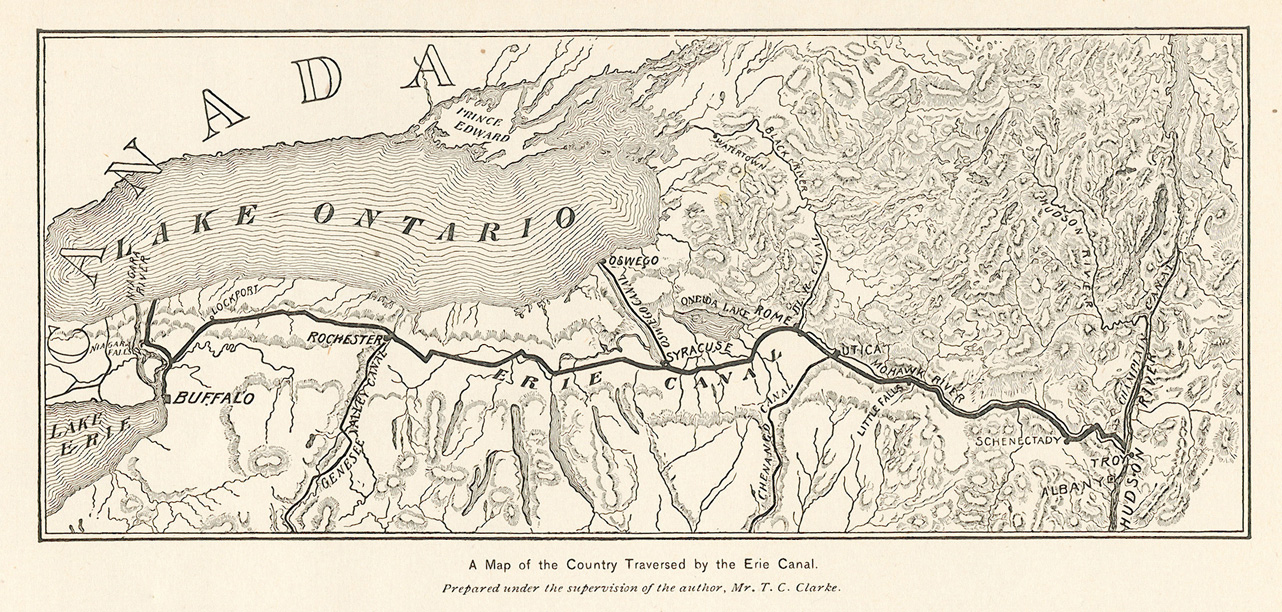
New York was specifically poised to tackle this transportation issue. The Hudson River was the main artery of trade for New York, connecting commercial Manhattan to the capital in Albany. Of the Hudson’s many tributaries, the Mohawk River proved to be the most important. Flowing eastward from Oneida County, it cut a low valley through the Appalachians, the only valley of its kind in the Northeast. Because of this, Governor DeWitt Clinton authorized the construction of a canal along this route in 1817.
Map showing Present and Proposed Canal System, to accompany report of Edward A. Bond, State Engineer and Surveyor of N.Y. (from:Annual report of the State Engineer and Surveyor of the State of New York, for the fiscal year ending September 30, 1903 (Oliver A. Quayle, Albany, 1904) — facing p. 60)
Following eight years of disease, construction accidents, and hard manual labor, the Canal was opened in 1825. The canal was 4 feet deep, 40 feet wide, and spanned 363 miles from Albany to Buffalo. With the construction of the canal, boats could travel from the Hudson River to Lake Erie in less than five days. While many were originally skeptical of the canal, it soon proved its worth. Completed ahead of schedule, and under-budget, the canal paid itself off with tolls in under ten years.
The Erie Canal was one of the first great highways of the United States, bringing goods, ideas, and most importantly people across New York. The Canal revolutionized the economy of Upstate New York, practically creating the cities we know today. In 1817, Buffalo was a village of 2,000 people recently destroyed by the British. Canal commerce turned Buffalo into the world’s premier grain hub, with the city growing into the 9th largest metropolis in the US. Cities sprang up all along the canal route. Hamlets like Rochester, Syracuse, and Schenectady grew into cities with hundreds of thousands of residents, and national centers of industry.
“The most fertile and extensive regions of America will avail themselves of its facilities for a market … [and New York City] will, in the course of time, become the granary of the world, the emporium of commerce, the seat of manufactures, the focus of great moneyed operations.”
– DeWitt Clinton, Governor of New York
Thomas S. Allen
On top of having such economic importance, the canal quickly became a cultural symbol of New York. To many, the canal symbolized their identity as Upstaters, and hope for a prosperous future. One person enamored by the legendary canal was Natick, Massachusetts’s Thomas S. Allen. Allen recalled, “When a boy in school, a picture of the Erie Canal in a Geography attracted my attention and I exclaimed: ‘If I ever see the Eric Canal, I’ll think I’ve seen something worth seeing.’” Sometime around 1910, when traveling to Rochester, Allen finally saw the canal, and immediately knew he had to write a song about it.
It turns out Allen was somewhat of a 1900s musical renaissance man. He was foremost a violinist, playing everywhere from professional orchestras to burlesque shows. On top of this, he directed Vaudeville shows, composing songs for them in the Tin Pan Alley tradition. Throughout his career, he published nine songs under his name, including “The Erie Canal Song.” Originally published in 1913 by Manhattan’s F.B. Haviland Publishing Co, the song was titled “Low Bridge, Everybody Down.” The song looked back to the work of mule barges along the canal.
At the time of its publishing, New York was constructing the Barge Canal System, a mechanized successor to the Erie Canal. Newer diesel and steam powered barges carried much of the cargo down these new canals. Allen’s writing harkened back to a simpler time of mule-drawn ships on the Erie Canal. “We’ve hauled some barges in our day, filled with lumber, coal and hay. And every inch of the way I know, From Albany to Buffalo.” These lines also highlight some of the major midwestern resources that would have flowed Eastward through the canal. Grain and ore were the two specifically that allowed cities like Buffalo to become breadbaskets, and industrial hubs of the East.
The lyrics while romanticizing life on the canal, also speak to the hardships it brought. The repeated chorus “low bridge everybody down,” reflects just one of these difficulties. Nearing the fledgling cities along the canal, extremely low bridges were common obstacles for barges. The cover for the song’s original sheet music depicts this, with the narrator ducking down on his mule to pass under one such bridge. In reality, however, these bridges were bigger dangers for barge passengers. Passengers on barges would commonly ride on top when conditions allowed, having to quickly get down to safely pass under these bridges.
Lift Bridge and Canal St., Canastota, N.Y. — Postcard ; not postmarked ; another slightly variant copy is postmarked Sep. 19, 1907. [CSNYS 1096.1.0890]
The song’s lyrics also play into the themes of hardiness that would fit perfectly in a Spaghetti Western. The lyrics repeatedly mention Sal the Mule’s fighting spirit. Throughout the song Sal brawls her way across the state, sending Mike McGinty to the bottom of the canal, and kicking a man all the way to Buffalo. All of this fighting occurs during the narrator’s 15 years of hard work along the canal. This story of hardy enterprise and masculine bravado call to mind the Wild West. One could easily imagine these stories of barging and brawling taking place in a classic Eastwood or Wayne movie. This makes sense remembering that at the canal’s completion, Upstate New York very much was the “Wild West.”
Since its original composition in 1913, “Low Bridge” has become a folk standard, being performed by countless artists. The first known recording we have of the song is by Billy Murray (not to be confused with actor Bill Murray) from 1912. Murray was a star Tenor of the early 1900s, recording many vaudeville and Tin Pan Alley tracks. This recording is now featured in the Library of Congress’s National Jukebox and Recorded Sound Section.
Aiding in the Canal’s place in American mythology was a recording by folk legend Pete Seeger. Seeger included “The Erie Canal” as track #10 on his 1954 album Frontier Ballads. This album celebrated the stories of workers, and settlers who traveled westward through the new territories of the United States. This album places the Erie Canal alongside stories of Cowboys and railroad workers, placing it firmly within the canon of Americana, and further cementing its Western connection.
Perhaps the latest great recording of “The Erie Canal Song” came from rock legend Bruce Springsteen, as part of his 2006 album We Shall Overcome: The Seeger Sessions. This album included Springsteen’s interpretations of 13 folk and Americana classics popularized by Pete Seeger. Because of this, this version is moreso a Springsteen cover of Seeger’s version, rather than a direct reimagining of the original. The album, including “Erie Canal” shot to number 3 on the billboard top 100, also earning Springsteen a Grammy for best folk album.
Since its publishing 111 years ago, “The Erie Canal Song” has become an icon of American folk music. Not only have massive stars covered it over the years, but it has also really lived up to the definition of folk music, and spread to the masses. Reading comments on the YouTube video of Seeger’s version you see nothing but fond memories. Whether it’s people who learned it as kids in school, or sang it with their grandparents, the song holds an important place in the collective American cultural memory.
On top of all of this, the song speaks to the role the Erie Canal plays in American imagination. It singlehandedly built upstate New York, and connected the country more than it had ever been before. More than just this, it represents a time long gone, where the Wild West wasn’t so far west. Its no wonder why when many people think of New York, they think of the Erie Canal.
“The Erie Canal Song” Lyrics:
I’ve got an old mule, and her name is Sal, Fifteen years on the Erie Canal
She’s a good old worker and a good old pal, Fifteen years on the Erie Canal
We’ve hauled some barges in our day, filled with lumber, coal and hay.
And every inch of the way I know, From Albany to Buffalo
Low bridge, everybody down, Low bridge, we must be getting near a town.
You can always tell your neighbor; you can always tell your pal.
If he’s ever navigated on the Erie Canal
We’d better look ’round for a job old gal, Fifteen years on the Erie Canal
You bet your life I wouldn’t part with Sal, Fifteen years on the Erie Canal
Giddyap there gal we’ve passed that lock, we’ll make Rome ‘fore six o-clock
So one more trip and then we’ll go, Right straight back to Buffalo
Low bridge, everybody down, Low bridge, I’ve got the finest mule in town
Once a man named Mike McGinty tried to put it over Sal
Now he’s way down at the bottom of the Erie Canal
Oh, where would I be if I lost my pal? Fifteen years on the Erie Canal
Oh, I’d like to see a mule as good as Sal, Fifteen years on the Erie Canal
A friend of mine once got her sore, Now, he’s got a broken jaw.
Cause she let fly with her iron toe and kicked him into Buffalo.
Low bridge, everybody down, Low bridge, I’ve got the finest mule in town.
If you’re looking ’round for trouble, better stay away from Sal.
She’s the only fighting donkey on the Erie Canal
I don’t have to call when I want my Sal, Fifteen years on the Erie Canal
She trots from her stall like a good old gal, Fifteen years on the Erie Canal
I eat my meals with Sal each day, I eat beef and she eat hay.
She isn’t so slow if you want to know, she put the “Buff” in Buffalo
Low bridge, everybody down, Low bridge, I’ve got the finest mule in town
Eats a bale of hay for dinner, and on top of that, my Sal.
Tries to drink up all the water in the Erie Canal
You’ll soon hear them sing everything about my gal, Fifteen years on the Erie Canal
It’s a darned fool ditty ’bout my darned fool Sal, Fifteen years on the Erie Canal
Oh, every band will play it soon, Darned fool words and darned fool tune!
You’ll hear it sung everywhere you go, from Mexico to Buffalo
Low bridge, everybody down, Low bridge, I’ve got the finest mule in town.
She’s a perfect, perfect lady, and she blushes like a gal.
If she hears you sing about her and the Erie Canal
Buffalo’s Larkin Square has announced the return of its beloved Live at Larkin and Food Truck Tuesday weekly events this summer. The KeyBank Live at Larkin Summer music series will begin June 5th.
The summer series will include 13 weeks of live shows, ending on August 28th. Larkin’s annual Food Truck Tuesdays season will also begin June 4th, offering a host of curated food trucks and live music until August 27th.
This year marks the 12th season of Live at Larkin, which has become a staple of Buffalo’s Larkinville neighborhood. The site was home to the former Larkin Soap Factory, which supplied the second largest catalog sales business in the country. Since the factory’s closure in the 1940s, there have been many attempts to revitalize the neighborhood. These came to a head in 2012, with the opening of Larkin Square. Since its establishment, the venue has become a community gathering place, offering a host of family-friendly events.
One of the most popular events hosted by Larkin Square is Food Truck Tuesdays. This weekly event begins June 4th, offering around 25 food trucks each Tuesday. Truck offerings range from Italian to Thai to Halal, with each truck offering nutritionist-certified options. The event draws trucks from Buffalo, Rochester, and beyond for visitors to enjoy. Guests can bring their own chairs, but coolers and outside alcohol are prohibited.
In addition to food trucks, the weekly event offers the chance to enjoy live music from local bands. The Walter Kemp 3 will kick off the summer season with their award winning jazz. When not playing with legends like Sun Ra’s Arkestra and Sabu Adeloya, kemp teaches at Buffalo’s Villa Maria College. The event series offers a diverse spectrum of genres, ranging from McCarthyizm‘s garage rock to Dee Adams’ country. With this vast array of music, event-goers are sure to enjoy the performances while enjoying food truck fare.
June 5th also marks the return of the KeyBank Live at Larkin summer concert series. This weekly concert series will feature performances from local groups, as well as other amenities. Concert-goers will be able to purchase bites from a curated array of on-site food trucks each week. In addition, Larkin Square will offer beer, wine, and cocktails for purchase. Larkin Square’s Bratts Hill Restaurant will be open to serve authentic Jamaican cuisine for dinner services during Live at Larkin.
The concert series kicks off at 5pm on June 4th with a performance from John & Mary & the Valkyries. The folk-rock duo is comprised of 10,000 Maniacs members John Lombardo and Mary Ramsey. The series will continue for 13 weeks, until a closing performance by hard rockers Grosh on August 28th. Over the course of the summer series, concert-goers can enjoy tributes to classic groups like Steely Dan, Creedence Clearwater Revival, and Fleetwood Mac.
Food Truck Tuesdays Band Lineup
6/4 – Walter Kemp 3 Quartet
6/11 – McCarthyizm
6/18 – Diyené
6/25 – The Fever Pitch String Quartet
7/2 – Stress Dolls
7/9 – Whitford-Klyma Band
7/23 – Sabu Adeyola & Oasis
7/30 – The Britt Band
8/6 – Zak Ward
8/13 – Dueling Pianos Band
8/20 – Dee Adams’ Grand Isle Opry
8/27 – Jony James Band
Live at Larkin Summer Season Lineup
6/5 – John & Mary & the Valkyries
6/12 – Will Holton & Daniel Powell’s Mid-Week Vibe
6/19 – Juneteenth ft. Farrow & Project Access to A-Free-Kas
6/26 – Dirty Work: A Tribute to Steely Dan
7/3 – Blues 4 Vets w/Miller & the Other Sinners & more
7/10 – Songbirds: A Tribute to Fleetwood Mac
7/17 – Talking Dead Heads
7/24 – Ticketed Event, TBA
7/31 – Big Easy in Buffalo presents: Terrence Simien and the Zydeco Experience with El Batey’s Agua de Liberté”
8/7 – Buffalo’s Last Waltz Band Does Dylan & The Band
8/14 – Handsome Jack Does CCR
8/21 – Stoneflower/ Hollyfeld Does Springsteen
8/28 – Grosh Prime ft. Alex McArthur, Harry Graser & Michael DeLano
Thanks to sponsorship from KeyBank and Independent Health, both Food Truck Tuesdays and Live at Larkin are free events. There will be free parking in lots along Exchange Street and Hydraulic Street.
Larkin Square will continue to announce live events for the summer. For more information and updates, visit the Larkin Square website here.
New York City-based goth and shoegaze band Silent Mass has released a new brooding and dark single, “The Great Chaos.” The song will appear on the band’s forthcoming debut album, The Great Chaos, which is set to come out on June 20.
Silent Mass is an up-and-coming goth and shoegaze band with a unique blend of musical roots. Elements of post-punk, ethereal wave, shoegaze, and 90s alternative are all present in their music, just to name a few. Although only having a total of seven officially released songs available before their debut record, Silent Mass has already cornered in on the perfectly despondent and melancholic aesthetic that allows songs like “Nest of Flowers” and their new single “The Great Chaos” to shine. New York City is a well suited home for Silent Mass considering the melting pot of inspirations that contribute to their music.
Silent Mass began as a solo pursuit by current writer, producer and vocalist Ammo Bankoff. Her debut single, a cover of “Total Recall,” was released in 2020 as a tribute to Adrian Borland & The Sound. Shortly after the single’s release, Bankoff joined audio engineer/guitarist Robert Duncan and relocated to New York City to join drummer/producer Alex Posell.
Once fully assembled, Silent Mass released two singles in 2021 and three more in 2024. Their latest single, “The Great Chaos,” is the title track off of their upcoming long-awaited debut album. “‘The Great Chaos’ finds beauty in the spiral of self-discovery. It’s a love song about mourning a version of your past self,” said Ammo.
“The Great Chaos” sees Silent Mass in their element. The four-minute slow and hazy track is particularly held up by the chilling hook, where Ammo sings, “Can you find a way out, can you find a way out, can you find a way out of this nightmare?” over a wall of percussion, synths and guitar.
With seemingly everything set and ready for their upcoming debut record, “The Great Chaos” may very well be the last taste we get of Silent Mass’s dense and experimental sound before the full record releases on this summer solstice.
Silent Mass also has an upcoming show in New York City on July 13.
After several weeks of great performances, the Geneva Music Festival is wrapping up for the 2024 season. The final week of performances begins on June 4, with a free lakefront concert. This concert is followed by a photography exhibition and chamber performance on June 7 while June 9 marks the end of the season, with an outdoors blues concert closing out the festival.
Violinist Geoffrey Herd founded the Geneva Music Festival in 2011, as a weekend to spread appreciation of classical music. The festival soon evolved into a four-week long celebration, attracting artists from across the globe. While originally based in classical music, the festival also now highlights jazz, and bluegrass artists. The festival’s mission is to spread music appreciation to everyone, being an all-ages event. The event now attracts thousands of concert-goers from across the Finger Lakes.
2024 has already been a busy season for the Geneva Music Festival, hosting a number of spectacular performances. The festival kicked off with a sold-out Musicology Mixer night at Geneva’s Linden Social Club. Week two of the festival saw the acclaimed Brentano Quartet play Hobart and William Smith Colleges’ Gearan Center. The Juilliard-formed quartet played a selection from Haydn, Shostakovich, and Mendelssohn.
Hobart and William Smith Colleges’ Gearan Center for Performing Arts
The festival’s final week will kick off with a free lakefront concert on June 4th, at 8:15pm. This concert will be a preview for the festival’s final artist-in-residence concert. The theme of this year’s final concert is “Night and Day,” with pieces meant to illustrate the progression from dawn to dusk. World-renowned cellist Clive Greensmith, pianist Anna Petrova, and other talented musicians will perform. The concert will begin with “String Quartet Op. 76, No.4” by Haydn, meant to represent the sunrise. It will also feature modern composer Mark Olivieri’s “Artifacts of a Valiant Past”, a Scriabin solo by pianist Anna Petrova, a piano trio by Kaija Saariaho, and a Schoenberg tone-poem for a string sextet.
“The solo piano piece that I’m playing has to do with day and night. The first movement represents the day and the sea in daylight. [Scriabin] was inspired to write this piece when he first saw the sea, and so you can hear the peacefulness and the beauty of that; and the second movement is very turbulent and represents the stormy sea”
– Pianist Anna Petrova
Hobart and William Smith Colleges’ Gearan Center will host the concert on June 7th, at 7:30pm. Prior to the concert, a photography exhibition highlighting local artists will be held at the center’s Melly Lobby.
The final concert of the season will be The Brothers Blue, a local cross-genre bluegrass band. Back by popular demand, the concert will be held outdoors at Geneva on the Lake. The Brothers Blue will close out the season with their invigorating fiddle, mandolin, and banjo playing. This concert will take place June 9th, at 2:00pm.
The Brothers Blue
Tickets for these concerts are currently on sale. Standard ticket price is $35, with discounts for college students available. Children under 18 can attend concerts for free. For more information on the Geneva Music Festival and ticketing, visit the link here.
Hosted by CNY Jazz foundation, the 20th Jazz In The City, a free public health concert series, will commence on June 13 in Syracuse.
Aside from music, the festival includes vendors, food and most importantly its “healthcare village” sponsored by Syracuse Community Health. Urban Neighborhoods in Syracuse continue to face disparities when it comes to healthcare. With COVID-19, the community was unable to receive the care they needed. SCH staff will conduct free screenings and consultations to anyone who requests them.
Syracuse Community Health COO Jessica Yoxall explained in a press release, “we highlight the importance of preventative care and screenings to promote positive health outcomes. By increasing awareness and expanding health education, we together, can achieve health equity and enhance the quality of care in Onondaga County.”
These free concerts and healthcare services will be offered every Thursday from June 13 to August 15 at various parks and community centers in the city. Performances include Syracuse’s own The BlackLites and Albany’s Alex Torres.
CNY Jazz foundation has been bringing Jazz to upstate New York since its establishment in 1998. Along with Jazz In The City, CNY hosts numerous other programs such as Northeast Jazz & Wine, SummerJazz Workshop and the Central New York Jazz Orchestra.
For more information you can visit Jazz In The City’s website.
Jazz In The City 2024 Schedule
June 13: ATLAS with 1Accord Line Dance at Leavenworth Park
June 20: Alex Torres y su Orquesta with La Familia de la Salsa at Skiddy Park
July 1: Double Bass Experience with C-Jack Run Showcase at Syracuse Community Health
July 18: AAPI Jazz Collective with Adanfo Ensemble at Schiller Park
August 8: The BlackLites with 1Accord Line Dance at Dunk & Bright
August 15: Art Sherrod Jr. and Lin Rountree with 1Accord Line Dance at Thornden Park