Christmas time in New York is often filled with magic and wonder. Most people have visions of marveling beneath the tree in Rockefeller Center, window shopping on 5th Avenue, or playing with all the new toys FAO Schwartz has to offer, but that is just a tiny spec of the enchantment to be found in NYC during that time of year. No matter where you are or how you celebrate, the end goals are almost always the same: to spread joy, focus on others, and spend time with your loved ones. While everyone has their own traditions, it is important to remember why you are doing so. That is exactly what Run-DMC was trying to convey with their 1987 hit ‘Christmas in Hollis.’
While Run-DMC were initially opposed to writing a Christmas song at the record company’s request, their opinion changed once they went through a crate of old odd-ball Christmas Records to see if they could be inspired. After a bit of searching, inspiration finally hit once they listened to Clarence George Carter’s funk cut ‘Back Door Santa.’ Once they decided to write the song, Run-DMC decided they were going to combine the fantasy and mysticism that comes with the holiday with real life experiences, detailing past Christmas’ spent with their families in their hometown of Hollis, Queens.
The first verse of the song belonged to Run, which draws listeners in with a surreal experience of finding Santa’s wallet after encountering one of his reindeer but returning it because he didn’t believe it was right to steal from Santa. From that point the song could have gone anywhere, but DMC decided he wanted to relate it to real life because that is the opposite of what everyone was doing with Christmas music at the time.
Run-DMC, Hollis
“Every other Christmas song is like a fantasy,” Run explains. “You know, [Sings.] ‘Santa Claus is coming to town.’ That’s a fantasy. Even Run’s verse, he’s telling a story that’s like it’s been written for a Christmas book. But my story is what really happened in real life, about real people, and what it was like as a kid growing up. It’s so real. [Raps.] “Christmastime in Hollis Queens / Mom’s cooking chicken and collard greens!” It’s funky, it’s soulful, it’s family, it’s real. “Christmas In Hollis” is real, because of my verse.”
Hollis, Queens
Hollis, Queens had an incredibly powerful impact on Run-DMC, which is why they decided to homage the neighborhood in ‘Christmas in Hollis.’ Joseph Simmons (Run), Darryl McDaniels (DMC), and Jason Mizel (Jam Master Jay) formed Run-DMC in the 1983 after being friends at school for years and realizing they had similar interests in music as they got older. At the time of the group’s formation, Hollis was a moderately stable, suburban community with a vibrant and growing hip-hop scene which inspired and cultivated each member of Run-DMC from an early age. It was a family neighborhood, and the love and support they received helped the group achieve their dreams.
As the group got bigger, the area changed, and the tranquil Hollis soon became plagued with drug and gun violence. By the late 1980’s the neighborhood became one of the most severe victims of the growing crack epidemic. Today Hollis has returned to the median income, middle-class neighborhood it once was, but there have been no sightings of Santa since that fateful day in 1987.
‘Christmas in Hollis’ Lyrics:
It was December 24th on Hollis ave in the dark
When I see a man chilling with his dog in the park
I approached very slowly with my heart full of fear
Looked at his dog, oh my god, an ill reindeer
But then I was illin’ because the man had a beard
And a bag full of goodies, 12 o’clock had neared
So I turned my head a second and the man had gone
But he left his driver’s wallet smack dead on the lawn
I picket the wallet up then I took a pause
Took out the license and it cold said “Santa Claus”
A million dollars in it, cold hundreds of G’s
Enough to buy a boat and matching car with ease
But I’d never steal from Santa, cause that ain’t right
So I’m going home to mail it back to him that night
But when I got home I bugged, cause under the tree
Was a letter from Santa and all the dough was for me
It’s Christmas time in Hollis queens
Mom’s cooking chicken and collard greens
Rice and stuffing, macaroni and cheese
And Santa put gifts under Christmas trees
Decorate the house with lights at night
Snow’s on the ground, snow white so bright
In the fireplace is the yule log
Beneath the mistletoe as we drink egg nog
The rhymes you hear are the rhymes of Darryl’s
But each and every year we bust Christmas carrols
Rhymes so loud and proud you hear it
It’s Christmas time and we got the spirit
Jack Frost chillin, the hawk is out
And that’s what Christmas is all about
The time is now, the place is here
And the whole wide world is filled with cheer
My name’s D.M.C. with the mic in my hand
And I’m chillin’ and coolin’ just like a snowman
So open your eyes, lend us an ear
We want to say Merry Christmas and Happy New Year!
On Thursday. December 19, the Jazz at Lincoln Center Orchestra did what they do best – they tossed common musical conventions to the wind while elevating songs to a new level.
Photo Credit: Aidan Lukomnik
The Jazz at Lincoln Center Orchestra, just back from a two-week tour around the U.S., was welcomed to their Big Band Holidays performance with a rousing round of applause. Standing on their home stage of Rose Theater, the Orchestra played ten songs from a catalog of more than thirty holiday standards ranging from religious to anti-holiday. But these weren’t your normal holiday songs.
“You might have heard Frosty the Snowman before, but you’ve never heard it like this,” Musical Director and Trombone player Christopher Crenshaw said. That was the theme that prevailed throughout the show: you ain’t heard it this way before. Across an hour and a half of music, standard holiday compositions were eschewed for new ways to play, throwing each song into a new context and making the audience consider their perception of just what a holiday song sounds like.
Christopher Crenshaw at Rose Hall, Photo Credit: Aidan Lukomnik
Starting with two classics, the band played a sped-up and swung version of “Here Comes Santa Claus” and then transitioned into an extremely melancholic version of “Dreidel, Dreidel, Dreidel.” The first act was spiced up by Robbie Lee singing the anti-holiday song “Blue Xmas (To Whom it May Concern)” and “Merry Christmas Baby.” Lee’s vocal intonation was incredible – moving from a gravelly embodiment of the Grinch in “Blue Xmas” to clear and pure desire in “Merry Christmas Baby.”
However, the pinnacle of the first set was Sherman Irby’s solo in the “Merry Christmas Baby.” His saxophone transported audience members and, it seemed, members of the orchestra from a 1,200+ person venue to a dark and smoky jazz club inches from the stage. For the length of the solo, no one took a breath, and for a moment, all there was in the world was his music. It was a Blues solo at its finest.
Sherman Irby, Photo Credit: Aidan Lukomnik
The second set was punctuated by the dulcet vocals of Ekep Nkwelle, who sang a spiritual version of “Mary Had a Baby” and then upended all religious expectations with a downright sexy version of “Santa Claus, Santa Claus.” Nkwelle’s vocals during “Santa Claus, Santa Claus” felt straight out of film noir with desire, danger, and pain clear as day, while Chris Lewis’ solo put an exclamation point on the number.
As the night came to an end, the hometown crowd responded to the orchestra’s take on holiday classics with their you ain’t heard it this way before swagger, with a standing ovation.
Setlist:
Set 1: Here Comes Santa Claus> Dreidel, Dreidel, Dreidel>Blue Xmas (to Whom it May Concern) > Merry Christmas Baby > (I’m gettin’) Nuttin’ for Christmas
Set 2: Up on the House Top > Mary Had a Baby > Santa Claus, Santa Claus >Blue Christmas > Frosty the Snowman
The Big Band Holidays show has two more performances at Rose Theater on Saturday the 21st and Sunday the 22nd.
A walking music legend, Carole King’s roots in New York run deep. Born and raised in Brooklyn, a graduate of Queens College, and lifetime lover of the Manhattan music scene as both an artist and an audience member, New York is an integral part of King’s work and identity at large.
Photo: Jim McCrary, via caroleking.com
Born Carol Joan Klein to Russian and Polish immigrant parents, Carole arrived in the world not too soon after her mother and father had arrived in Brooklyn via Ellis Island. With her father, a radio announcer turned New York City firefighter, and mother, a secretary at a local high school, Carole’s life has been positively steeped in musicality from day one – as well as a deeply ingrained identity as a New York native and lifelong Brooklyn Dodgers fan since youth.
Famously meeting while in an elevator at Brooklyn College, Carole’s father set the precedent for a Klein behind the microphone with his gig as a radio announcer, and her mother’s studies in and passion for english and drama lent themselves to a rather creative upbringing.
Upon her parents’ separation, Carole sought attention and found the answer in the theater. First being introduced to the glittering world of Broadway at just five years old, Carole fell utterly in love, absorbing all of the media and musical projects her mother put on. Her home was rarely quiet, being constantly introduced to shades of music varying from show tunes to Brahms.
Photo via caroleking.com
Finding a unique outlet for emotions of all ranges, King leaned into the theatrics of the stage as she grew up, eventually auditioning for the High School of Performing Arts – now referred to as the Fiorello H. LaGuardia High School of the same name. While the audition was not a success, it marked a turning point for Carole as the arts became something of possible professional pursuit more concretely in her mind.
As any teenager of the mid 1950s did, Carole often tuned in to her favorite radio stations. However, unlike many other of her rather sheltered white peers, Carole’s station of preference was Alan Freed’s nightly WINS program. Freed was a lover of artists like the Penguins, the Moonglows, the Clovers, Danny Overbea, La Vern Baker, and BB King – a notably African-American lineup that had many white parents positively beside themselves.
In addition, many tracks played on Freed’s station fell under the umbrellas of rock and roll and R&B, both equally scandalous for their promiscuity and narratives on adversity that were up until then rather absent in the public eye’s musical circuit. This scandal was all the better for an adolescent King, however, who found the new wave of music and its consequent conscious style of creation absolutely mesmerizing
Carole has never been one to shy away from advocating for her beliefs. After moving to Idaho in 1977, she became deeply entrenched in the local ecosystem’s wellbeing and has been an outspoken voice for environmental change ever since.
King would go on to participate in her local Women’s March in 2017, holding a sign that read “One Small Voice.” A single titled with the same phrase would be released the next month, utilizing a thinly-veiled emperor’s new clothes metaphor that encourages listeners to “speak out in honesty.”
While many artists’ relationships with New York City begin on the stage, King’s began in the audience. As a young adult who positively adored the cutting-edge music she was hearing over the radio, being able to attend Freed’s Easter Jubilee at the Brooklyn Paramount in 1955 meant the absolute world and sparked a major bout of motivation.
“Moving farther in, we saw Mickey Baker talking to a couple of the Penguins. At that moment I knew I wanted to mean something to these people. I didn’t want to be one of them. I just wanted them to know who I was and consider me worthy of respect. That ambition existed concurrently and in no way conflicted with my ambition to be an actress.”
– Carole King, A Natural Woman
Auditioning for the High School of Performing Arts once more re-inspired, King enrolled in the fall of 1955 and spent a year studying drama and dance alongside fellow students Al Pacino and Rafael Campos. She would depart the school after a year and return to her classmates at James Madison High School, but Carole would take with her the lessons taught by teachers like Mr. Sachs who inadvertently set her up to arrange vocals through his assignments.
Like many teenagers of the area, King perpetually sought out the liberal arts for peer acceptance and self-expression, the heart of an increasingly viable, ever-vibrant scene only a few subway stops away. 1957 marked a time of escapades up and down Bleecker Street and throughout the coffee shops and venues of Greenwich Village with her peers.
After a rare successful infiltration of the Vanguard, Carole King witnessed mind-blowing jazz sets and sat listening to the music while her peers smoked. By default she became the one picking out the records, and that quickly became much more interesting to Carole than the smoking.
After a nudge in the direction of her high school’s annual Sing by her mother, King wrote, arranged, and performed a piece for the first time to a large audience, and the response of her peers in the audience shifted something within her. She soon began to compose in earnest, arranging pieces for the chorus class before turning the passion into a full-on street corner harmony gig. Recruiting three other peers to be the soprano, tenor, and bass to her alto, the group dubbed themselves the Cosines and performed for free at school events and dances.
Photo via caroleking.com
This would mark the beginning of a career in arranging both for a group and for herself, developing a process she would keep well into her career as she wrote for or in collaboration with the likes of Bobby Vee, The Everly Brothers, The Monkees, Aretha Franklin, James Taylor, Mariah Carey, and countless others across the industry.
After deciding to pursue songwriting in earnest, Carole chased down a so-called “Atlantic Records” that Freed had mentioned on his radio station, quickly presenting her work to an executive and landing her first recording contract.
Graduating high school at just sixteen years old, King entered Queens College with little enthusiasm after an unexpected move to Rosedale had uprooted her plans to attend her parents’ alma mater. Just around the corner, however, were fellow freshmen and musical peers Art Garfunkel and Paul Simon, the latter becoming a quick friend and collaborator.
Also at Queens College was Carole King’s future songwriting partner and husband of many years Gerry Goffin. While she first thought they’d never see eye to eye on music – he was very open with his hatred for Rock and Roll – his pitch to collaborate on a song quickly became history. Married at her parents’ home in Rosedale in 1959, Carole and Gerry moved into a one-bedroom apartment on Bedford Avenue, only a block away from her childhood home.
Photo via caroleking.com
Gerry, a chemist in downtown Brooklyn, and Carole, a secretary for a chimney manufacturer in Manhattan, were determined to see their passion for songwriting through and, upon an interaction with Neil Sedaka on the sidewalk of Broadway, the two landed a three-year writing deal that brought the couple out of debt and into a two-bedroom apartment on Brown Street in Brooklyn, an area that had been nothing but corn fields when King was a child.
Working in the highly competitive cubicle space that was Aldon, Gerry and Carole managed their first major hit with “Will You Love Me Tomorrow.” Gerry stepped away from his traditional job and the couple moved into the suburbs of West Orange, New Jersey to raise their second daughter, which is where they would reside together for a number of years before the marriage began to crumble.
When Goffin decided to move to California on his own, King was torn between the vibrancy of what she dubbed “the coolest place she knew” and California, where their children would be able to see their father. Ultimately putting her children before herself, Carole switched Coasts.
Photo via caroleking.com
1970 marked a second beginning for King, who would be brought back to New York and into the spotlight by friend and collaborator James Taylor during his tour. Just prior to their show at Carole’s alma mater Queens College, Taylor requested she sing the lead for “Up on the Roof” to King’s immediate horror and dismay. Terrified about stepping out of the comfortable zone that was just “James’ pianist,” Carole took a breath and performed, receiving raucous applause.
“Up on the Roof” would return in 1971 at King’s first ever performance as a solo act in front of an audience during the now famed June evening at Carnegie Hall. Recorded and later immortalized in a seventeen-track album, the concert featured some of Carole’s first works alongside duets with Taylor for “Up on the Roof”, “Will You Love Me Tomorrow?”, and “You’ve Got a Friend.”
With the turn of the new year came Carole’s 30th birthday, a whopping four GRAMMY wins for her work in Tapestry, and the arrival of her fourth child. The following year, King returned to New York City to deliver a first-of-its-kind Central Park show completely free to the public, a rather poetic homecoming of an estimated 100,000+ attendees.
Recorded and released first as a live album and then a fully-fledged concert documentary in 2023, the Central Park concert remains a sparkling snapshot of King’s commercial and critical peak . Though this level of fame did not come without its drawbacks, with Carole detailing a frenzied crowd of fans crowding her limo after the show in her memoir.
Such situations and the general all-encompassing business that had become her life drew King to the quieter lifestyle of Idaho, though the draw of New York’s creative vibrancy never quite lost her. She would travel back to the city frequently to visit family, friends, and other artists she enjoyed working alongside.
An extended return to New York wouldn’t come into Carole King’s life until she was cast in Hindi Brooks’ A Minor Incident at the West Bank Café Theater in 1987. Performing alongside Paull Hipp who she had met when he was producing the off-Broadway Rockabilly Road, Carole frequently tagged along to Brooks’ recurring gig at the Red Lion Café on Bleecker.
Quietly playing guitar for his sets, she noted that very few would recognize her in their preoccupation with chatting, dining, or drinking, but there were always a few who would glance back and forth at her, nudging their friends with knowing smiles.
Photo: Annie Liebovitz, via caroleking.com
It wouldn’t be until Carole attended Bruce Springsteen’s 1988 Tunnel of Love show at Madison Square Garden that the creative spark would return in full, and her sense of dejection at missing the on-stage magic quickly became determination as she brushed up her latest tracks, re-signed with Capitol Records, and recorded City Streets at Skyline Studios.
Among the tracks developed in this era is “Friday’s Tie-Die Nightmare” that tells the tale of a dream Carole had experienced related to the City’s subway system, at which point in her memoir she takes a moment to impart some subway wisdom: “Subway Lesson 1: when the subway runs smoothly, as it does most of the time, it’s the most efficient and affordable method of getting around New York City, and Subway Lesson 2: the only way to catch an express is to leave early enough to make the entire trip on a local.”
Reminiscing about people-watching and considering her own observations of others, King explains that her third subway lesson is not a sentence – it’s a song. Written upon her realization that the way she perceived the people around her was ultimately a reflection of how she was feeling at the moment, subway lesson three comes in the form of the track “Beautiful” – “You’re gonna find, yes you will, that you’re beautiful as you feel.”
Alongside her return to performance came roles as a teacher in the ABC After-School Special It’s only Rock & Roll shot in Pine Bush, New York and Willy Russell’s Broadway production of Blood Brothers on a ten-month run.
Photo via caroleking.com
While not the star in the most literal sense, Broadway returned to King’s life in 2013 with the previews and eventual debut of Beautiful: The Carole King Musical on January 12, 2014. Exploring her early life and rise to stardom alongside Goffin, the show became the 27th longest running show in Broadway history upon its closure in October of 2019 with a stunning 60 previews and 2,418 shows logged.
Despite not playing herself as the titular role, Carole made a handful of appearances at the Stephen Sondheim Theatre during the show’s run first to surprise lead actress Melissa Benoist in a reprise of “I Feel the Earth Move,” and then to celebrate the production’s fifth anniversary, making appearances during “Beautiful” and the show’s finale.
Beautiful: The Carole King Musical gained endless critical acclaim and won several awards, including two Tonys and a Grammy. A testament to New York’s love for Carole King as a story, an artist, and a human being, the musical immortalizes above all the timeless nature of her work, both honoring and reviving King’s most famous works for a new generation of lifelong fans.
An artist, an advocate, a deft songwriter, a mother, and above all an admirable woman who has pursued nothing less than fulfillment throughout her entire life, King’s legacy is a shining one felt throughout each and every nook and cranny of New York.
The Local in Saugerties, is set to dazzle audiences with an inclusive range of creative talents of nearly 30 music, dance, and cultural events from January to May, 2025.
This vibrant venue has quickly become a cultural hub since opening in 2023, hosting a variety of acclaimed acts and workshops designed to celebrate global and local artistry, with genres featured range from jazz to folk pop and even Tuvan throat singing.
The lineup includes romantic Valentine’s Day performances, a Klezmer/hip-hop dance party, Korean funk rock, and a drumming workshop, inviting residents and visitors alike to explore diverse sounds and cultures in a welcoming atmosphere.
The Local’s commitment to sustaining a vibrant arts scene is evident in its carefully curated winter/spring 2025 schedule. Highlights include a special wine and cheese jazz night on Valentine’s Day featuring the Rachel Z Trio with Omar Hakim and Jonathan Toscano, Irish legends Lúnasa, and a conversation with legendary producer Joe Boyd, known for his work with Pink Floyd and Nick Drake.
The season promises a rich tapestry of performances, including Brazilian music, West African drumming, and contemporary folk, making it a must-visit destination for music lovers.
Co-founder Danny Melnick emphasizes the venue’s mission: “Our goal is to bring a wide array of internationally acclaimed performers and workshops to the Hudson Valley and encourage audiences to explore different cultures and new sounds.” This philosophy is echoed by performers who have experienced the unique atmosphere at The Local, creating memorable evenings for all.
The Local is located at 16 John Street, behind the Saugerties Reformed Church on Main Street.
Samara Joy and The McLendon Family, accompanied by Buffalo’s George Brown and the God’s Purchase Choir, took the stage at UB’s Center of the Arts on December 17. The night was full of smooth jazz and Christmas spirit.
As the audience were walking into the auditorium, Samara had a slideshow going of some of her family photos, giving the audience an insight into her family and her upbringing.
Once the audience settled in their seats, the band, composed of Shedrick Mitchell on Piano, Eric Wheeler on bass, and Charles Haynes on drums, came out first and started to play the intro to “Christmas Time is Here,” then Samara came out and began to sing, getting everyone right into the holiday spirit with her jazz rendition of the song.
After the song, she introduced herself and brought out members of her family to sing a few songs with her. She brought out her father, Antonio McLendon, her uncle, Laurone McLendon, and her cousins Tommy Niblack and Tierra “Lovey” Rowe, and rounding out the crew is Stephy Bloom Samara’s vocal director. She then brought out Buffalo’s George Brown and the God’s Purchase Choir who filled in the riser in the back. With her family and the choir, they perform “O Holy Night” and “Everybody Knows It’s Christmas.” Their renditions of these songs had such a warm gospel feel to them with the full auditorium enjoying every moment.
The night wasn’t just full of Christmas spirit as Samara and her band sprinkled in other songs including songs “You Stepped Out Of A Dream,” “Peace Of Mind/Dreams Come True” and “Now And Then” from her recently released album Portraits. They also performed renditions of “Reincarnation of A Lovebird” by Mingus, “Chega de Saudade,” also known as “No More Blue”s by Antonio Carlos Jobim, and Billie Holiday’s “Left Alone.”
Samara Joy, truly has a once in a generation voice. At such a young age of 25, she already has such a seasoned voice. Being able to resemble some of the great jazz artists, such as Ella Fitzgerald and Billie Holiday, and still having her own sound is a true testament to her talent. Throughout the whole performance, from the moment she started singing, her voice automatically just took you on a journey with her all night.
Rochester-based composer mainTheme has announced the release of his rich new groove track “Take Over Me” (feat. Donno Jay).
Dan Romans plays drum set, synth, keyboard, and voice; composes and arranges music; and performs all styles. He has a diverse musical vocabulary and versatile playing style that is dynamic, expressive, and compositionally focused. mainTheme is a carte blanche repository of sounds and songs drawn from eclectic influences and presented as an approximation of pop music. mainTheme is another variation of Dan Romans’ compositional voice as he dons the figurative producer’s hat.
His latest track “Take Over Me” (feat. Donno Jay) encapsulates mainTheme’s minimal, rich groove and features storytelling and vocal talents of Miami-based hip-hop artist Donno Jay. The track is slated to release on most streaming services by December 27. The track is a powerful, introspective look at the core of one’s life, and the state of the world we all share. With Donno Jay’s cadence and hard-hitting, somber lyrics spit over the desolate electro-synth melodies, this track is strong, catchy, and meaningful.
mainTheme creates music that, to me, breaks down walls. His eclectic, diverse and dynamic range of music paints wondrous soundscapes in each piece of music released. This track, “Take Over Me” is a prime example of this idea. The instrumental to the track is smooth, unique, and presents a vibe that I can best describe as galactic. It is a spacey, synthy, psychedelic piece that contains climbing and falling volumes, with a heightened energy in the middle before slowly dying out like a dimming light. The track is brilliant in both instrumental sound from mainTheme and lyricism from Donno Jay.
For more information on mainTheme’s music and to keep up with “Take Over Me” which releases on December 27, click here.
After a hugely successful European tour, 2024 will be culminating with five highly anticipated shows for The Felice Brothers.
The band’s end of the year run of shows kicks off Friday, December 27 in Williamsburg at Brooklyn Bowl, followed by a show at Brooklyn Bowl in Philadelphia. December 29 finds the group in Rockville Centre at Centre Station, and round the year out with two hometown shows for this incredible Americana band at brand new venue Assembly Kingston.
The Felice Brothers call the Catskill Mountains home, yet much of their success to their early days busking and playing in around New York City. Playing unplugged wherever they could the band found their distinct sound and style, penning such songs as “Frankie’s Gun” from their self titled album and covering “This Land Is your Land” like Woody Guthrie and Bob Dylan, whom Ian Felice’s songwriting has been compared with.
With three new brilliant records the past three years and an entire catalogue from the past 20 years, The Felice Brothers have been leaving audiences in awe with their foot stomping sing alongs, to tender ballads and everything in between.
Through 18 official releases and gosh knows how many secret recordings (check out their black limo recording), The Felice Brothers have stuck to their roots, while experimenting (“Celebration, Florida”), finding new form and maturing as musicians all while capturing the heart of American life, strife, beauty, grit, struggle and the knowledge that each soul has their own unique story. From the rowdiness of their live record Tonight at the Arizona (which was also re-issued ten years later as part of a special record store day recording) to the more produced Yonder is the Clock during their first decade as a band is amazing to go back through as a listener.
This writer was lucky enough to attend the 2019 and 2023 NYE concerts at Colony Woodstock and the band brought in many special guests, playing on songs old and new, amazing covers and so ,many special moments that left all smiling from ear to ear right into the New Year. The Felice Brothers are sure to bring out many more such more moments in celebration of their 20 year Anniversary as America’s top Americana band and the critically acclaimed songwriting that stands the test of time as well as the appreciation of their peers.
The band shared their thoughts on the upcoming shows: “Friends and loved ones, we are doing it again! Holiday shows! Some old favorites and a NEW never before rocked venue in Kingston. Now you know what you’re doing to close out 2024.”
The Felice Brothers have had a few lineup shakeups as their brother Simone moved along very nicely with a solo career, and the band found a new stride in 2014 with the release of Favorite Waitress. The new lineup also but out an incredible record Undress in 2019 and in the past few years has put out From Dreams To Dust (2021), Asylum On The Hill (2023), and Valley of Abandoned Songs (2024) which they have just finished a European tour supporting. Each record is a set of new treasures, and both Ian and James Felice have truly found their voices and are complemented so well by the backline and backing vocals of Jesske Humme (bass), Will Lawrence (drums).
Located in Kingston’s vibrant Uptown/Stockade District, Assembly Kingston is poised to become avcornerstone of the region’s burgeoning arts and culture scene. These New Year’s Eve performances will be a special homecoming for the band, who will take the stage to ring in 2025 with their signature blend of folk, rock, and heartfelt storytelling.
The Felice Brothers’ return home this December will surely lead to an unforgettable New Year’s Eve celebration. The beloved Americana band will perform two back-to-back shows on December 30 and 31, marking the highly anticipated inaugural event at the brand-new venue, Assembly Kingston.
Tickets are available now for the entire tour, and are selling quickly. There is a low ticket alert for both Assembly Kingston shows. You can find them here.
The Annual Tibet House US Benefit Concert, among the longest-running and renowned live cultural events in New York City, returns to The Stern Auditorium/Perelman Stage at Carnegie Hall on March 3, 2025.
Artistic Directors, Philip Glass and Laurie Anderson, take the helm of for an evening full of extraordinary performances, camaraderie, and one-night-only collaborations. Included in the evening are special performances by Anderson, Arooj Aftab, Angélique Kidjo, Gogol Bordello, The Philip Glass Ensemble, Tenzin Choegyal, The Scorchio Quartet and more.
Few events have withstood the test of time, and for more than three-and-a-half decades, this annual event has been a standout. The consistently sold-out concert has assembled some of the most legendary and exciting names in music and art, dazzling concertgoers with its unique mix of surprising and mesmerizing performances.
(Photo Credits L to R: Philip Glass – Danny Clinch; Laurie Anderson – Stephanie Diani; Arooj Aftab – Pooneh Ghana; Angélique Kidjo – Erwan Blaszka; Tenzin Choegyal – Courtesy of the Artist; Gogol Bordello – Ben Wong; The Philip Glass Ensemble – Ravi Sterman; The Scorchio Quartet – Jordan Strauss)
Serving as the evening’s honorary chairs are actors Uma Thurman, Maggie Gyllenhaal and Peter Sarsgaard, writer Arden Wohl and artist Jonah Freeman.
Laurie Anderson will be joined by GRAMMY Award winningalternative jazz artist Arooj Aftab, five-time GRAMMY Award winning African music icon Angélique Kidjo, international punk band Gogol Bordello, The Philip Glass Ensemble (PGE) whosemembers remain inimitable interpreters of Glass’s work, Tibetan artist, composer, activist, musical director, and cultural ambassador Tenzin Choegyal, GRAMMY Award winning cutting edge electro-acoustic string quartet the The Scorchio Quartet, among many more artists to be announced in the new year.
Tickets for the concert are on sale now ($49-$220) – visit www.carnegiehall.org to purchase, call CarnegieCharge at 212.247.7800, or visit the Carnegie Hall Box Office (57th Street and Seventh Avenue). Also available now are special gala packages starting at $500 that include prime concert tickets, an elegant dinner reception with the performers and a who’s who of New York City society. To purchase these packages, visit thus.org/ or call Tibet House US at 212.807.0563.
All proceeds support the work of Tibet House US, a non-profit educational institution and cultural embassy founded in 1987 at the request of His Holiness the Dalai Lama to ensure the survival of the unique Tibetan civilization.
Throughout its rich history, the one-of-a-kind Tibet House US Benefit Concert has had hundreds of world-class artists participate, including Alabama Shakes, boygenius, Maggie Rogers, Carly Simon, David Bowie, Stephen Colbert, Lou Reed, Phoebe Bridgers, Sharon Jones, FKA twigs, The Roots, Jim James, Vampire Weekend, St. Paul and the Broken Bones, Bowen Yang, Joan Baez, Blood Orange, Sigur Ros, R.E.M, Emmylou Harris, Jon Batiste, Nathaniel Rateliff, Jason Isbell, Iggy Pop, The Flaming Lips, Keanu Reeves, Eddie Vedder, Annie Lennox, Brittany Howard, Black Pumas, Cage The Elephant, Cyndi Lauper, Trey Anastasio and many, many more. The event has garnered praise from many, including New York Times, Rolling Stone, Hollywood Reporter, Wall Street Journal, Entertainment Weekly, Associated Press, Billboard, Vogue,and more.
This week, the Federal Trade Commission (FTC) announced a final Junk Fees Rule to prohibit bait-and-switch pricing and other tactics used by live-event ticketing and short-term lodging industries (hotels).
photo by Steve Malinski
Efforts by these corporations to hide the total price of a concert or hotel room bury junk fees have long been seen as unfair, and these deceptive pricing practices harm consumers and undercut honest businesses practices.
“People deserve to know up-front what they’re being asked to pay—without worrying that they’ll later be saddled with mysterious fees that they haven’t budgeted for and can’t avoid,” said FTC Chair Lina M. Khan. “The FTC’s rule will put an end to junk fees around live event tickets, hotels, and vacation rentals, saving Americans billions of dollars and millions of hours in wasted time. I urge enforcers to continue cracking down on these unlawful fees and encourage state and federal policymakers to build on this success with legislation that bans unfair and deceptive junk fees across the economy.”
The Junk Fees Rule will ensure that pricing information is presented in a timely, transparent, and truthful way to consumers of live-event tickets and short-term lodging, two industries whose pricing practices the Commission has studied in particular. Consumers searching for hotels or vacation rentals or seats at a show or sporting event will no longer be surprised by a pile of “resort,” “convenience,” or “service” fees inflating the advertised price. By requiring up-front disclosure of total price including fees, the rule will make comparison shopping easier, resulting in savings for consumers and leveling the competitive playing field.
The Commission launched this rulemaking in 2022 by requesting public input on whether a rule could help eliminate unfair and deceptive pricing tactics. After receiving more than 12,000 comments on how hidden and misleading fees affected personal spending and competition, the FTC announced a proposed rule in October 2023 and invited a second round of comments. The Commission received more than 60,000 additional comments which it considered in developing the final rule announced today.
The Federal Trade Commission estimates that the Junk Fees Rule will save consumers up to 53 million hours per year of wasted time spent searching for the total price for live-event tickets and short-term lodging. This time savings is equivalent to more than $11 billion over the next decade.
The Final Rule
The final rule targets specific and widespread unfair and deceptive pricing practices in the sale of live-event tickets and short-term lodging, while preserving flexibility for businesses. It does not prohibit any type or amount of fee, nor does it prohibit any specific pricing strategies. Rather, it simply requires that businesses that advertise their pricing tell consumers the whole truth up-front about prices and fees.
To accomplish this, the Junk Fees Rule requires that businesses clearly and conspicuously disclose the true total price inclusive of all mandatory fees whenever they offer, display, or advertise any price of live-event tickets or short-term lodging. Businesses cannot misrepresent any fee or charge in any offer, display, or ad for live-event tickets or short-term lodging.
In addition, the rule requires businesses to display the total price more prominently than most other pricing information. This means that the most prominent price in an ad needs to be the all-in total price—truthful itemization and breakdowns are fine but should not overshadow what consumers want to know: the real total.
Finally, the rule requires businesses that exclude allowable fees up front to clearly and conspicuously disclose the nature, purpose, identity, and amount of those fees before consumers consent to pay. For instance, businesses that exclude shipping or taxes from the advertised price must clearly and conspicuously disclose those fees before the consumer enters their payment information.
Industries beyond live-event ticketing and short-term lodging are prohibited from deceiving consumers about fees and pricing per longstanding law. The FTC will use its law enforcement authority to continue to rigorously pursue bait-and-switch pricing tactics, such as drip pricing and misleading fees, in other industries through case-by-case enforcement.
New York State has a rich and extensive history of music. From classic songs you sang in elementary school social studies class about the Erie Canal to Frank Sinatra crooning of the wonders of New York City, countless areas throughout the state have drastically influenced musicians, and left an imprint on their artistic growth. NYS Music’s New York Series is a project dedicated to exploring the history of music created and inspired by the diverse areas of the state. Each week we will focus on a different part of New York, how that area inspired a song or album by artists of various genres, and how the area changed over time. This week we will look at Bob Dylan’s ‘Talkin’ New York’ and Greenwich Village’s influence on his writing of the song, as well as how the area shaped his growing career.
Bob Dylan- ‘Talkin’ New York’
“You sound like a hillbilly; We want folk singers here.”
In the winter of 1961, a 19-year-old University of Minnesota drop out named Robert Zimmerman arrived in New York for the first time in hopes of finding his folk-singer idol, Woody Guthrie. It was the coldest winter in seventeen years, and he did not know a soul. ‘Talkin’ New York,’ the second song on Bob Dylan’s self-titled first album, is a talking blues which narrates the difficulties the young folk-singer experienced when he first moved to the Big Apple. Soon after his arrival, Zimmerman moved to Greenwich Village, changed his name to Bob Dylan, and launched one of the most successful music careers in history. 1
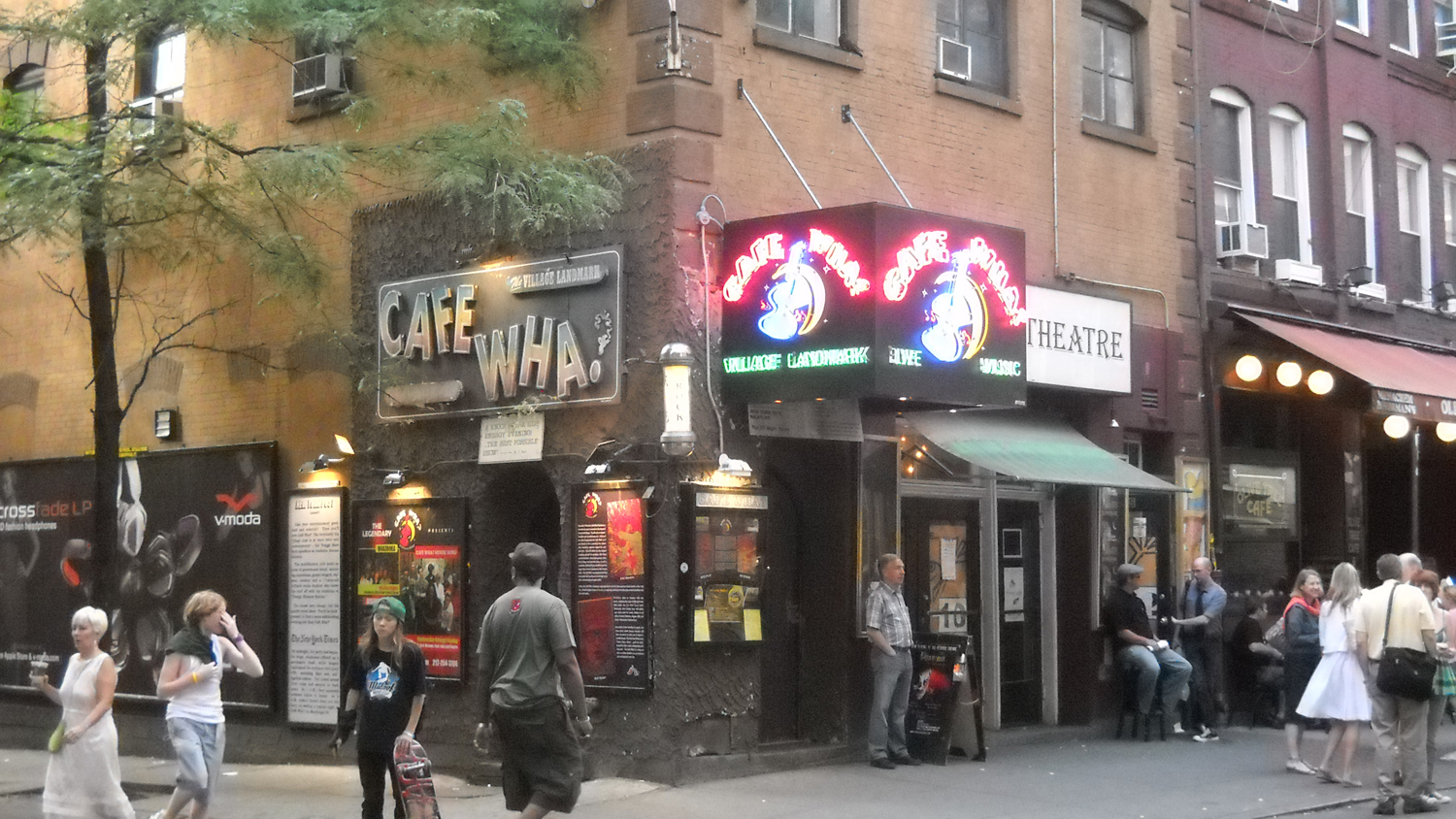
Greenwich Village in the early 1960’s was a hub for artists, poets, musicians and activists to meet, exchange ideas, and grow. When Dylan first arrived, the first thing he did was head over to Café Wha? on Macdougal Street, introduced himself as a musician, and booked himself a gig- as described in the lyrics of ‘Talkin’ New York’. His goal was to immerse himself in the culture, and establish himself as force to be reckoned with in the folk scene. After being fired for being late to three gigs at Café Wha? Dylan jumped around, exploring the many clubs and cafés Greenwich Village had to offer. He played coffee houses such as Caffe Reggio, the Commons, Caffe Dante, and underground clubs like the Gaslight Café, the Fat Black Pussycat, and the Bitter End. 2 New York was the perfect place for Dylan to experiment, meet new people who would greatly influence his career, and develop as an artist. At any point you could walk into a coffee shop and listen to a folk-singer performing, attend a poetry reading, or have an in-depth discussion about direction of the country the with like-minded political activists.
Fred W. McDarrah/Getty Images
‘Talkin’ New York’ chronicles Dylan’s initial experience in New York. It tells the story of his arrival and describes the struggles of trying to make it as a folk-singer in a new town. The area was impoverished at the time, and for the first year Dylan spent most of his time sleeping on floors. He established himself as a vagabond, and his songs began to reflect his lifestyle. After a year he found a place to live relatively cheaply which allowed him to spend more time developing his songs. Because the clubs could not pay performers, Dylan began wearing a hat and passing it around the cafes. The Gaslight Cafe was known for “basket-passing nights” where the only money performers would pocket was what was given to them by audience donations.3
Cafe Wha? 1960’s
Cafe Wha? Today
Today Greenwich Village is a different neighborhood. NYU has taken over much of the real estate in the area, and the rest has seen a drastic price increase since the 1960’s. It is far too expensive for young aspiring artists to live, but still an area worth visiting often. There are a few relics from the past, and you can go on a walking tour of the sites Dylan and other artists frequented, but today a vagabond could not arrive in the Village and squat in run-down apartments like Dylan did. A few of the old hangouts remain, but they too have evolved with the times. Caffe Dante became Dante NYC, and has moved on from folk-singers to gourmet cuisine. Café Wha? closed in 1968, but reopened in 1987, with music still playing often and the Café Wha? house band headlining many nights. The Bitter End is also still standing, and prides themselves on being New York’s oldest rock club. You can still catch a show any night of the week. While Greenwich Village has changed over the years, there is still a feeling of artistic freedom and counter-culture in many of the bars and coffee shops.
‘Talkin’ New York’ Lyrics:
Rambling out of the wild west
Leaving the towns I love best
Thought I’d seen some ups and down
‘Till I come into New York town
People going down to the ground
Building going up to the sky
Wintertime in New York town
The wind blowing snow around
Walk around with nowhere to go
Somebody could freeze right to the bone
I froze right to the bone
New York Times said it was the coldest winter in seventeen years
I didn’t feel so cold then
I swung on to my old guitar
Grabbed hold of a subway car
And after a rocking, reeling, rolling ride
I landed up on the downtown side
Greenwich Village
I walked down there and ended up
In one of them coffee-houses on the block
Got on the stage to sing and play
Man there said, come back some other day
You sound like a hillbilly
We want folksingers here
Well, I got a harmonica job, begun to play
Blowing my lungs out for a dollar a day
I blowed inside out and upside down
The man there said he loved my sound
He was raving about he loved my sound
Dollar a day’s worth
After weeks and weeks of hanging around
I finally got a job in New York town
In a bigger place, bigger money too
Even joined the union and paid my dues
Now, a very great man once said
That some people rob you with a fountain pen
It don’t take too long to find out
Just what he was talking about
A lot of people don’t have much food on their table
But they got a lot of forks and knives
And they gotta cut something
So one morning when the sun was warm
I rambled out of New York town
Pulled my cap down over my eyes
And heated out for the western skies
So long New York
Howdy, East Orange



.png)