The New York Philharmonic has announced the recipients of this year’s Marie-Josée Kravis Prize for New Music. The honor has been awarded to American composers David Lang and Missy Mazzoli.
One of the world’s largest new-music prizes, the Kravis Prize includes $200,000 and a commission for a work that the New York Philharmonic will premiere. Lang’s new work will be premiered in the 2025–26 season, and Mazzoli’s will be premiered in 2026–27. Additionally, the NY Phil has named Kate Soper the Kravis Emerging Composer, an honor bestowed as part of The Marie-Josée Kravis Prize for New Music. Soper receives a $50,000 stipend, including a commission to compose a work that the Philharmonic will premiere in May 2025. Funding for both honors comes from a $10 million gift to the New York Philharmonic in 2009 by Henry R. Kravis in honor of his wife, Marie-Josée, for whom the Prize is named.
The Philharmonic has performed two works by Missy Mazzoli: Sinfonia (for Orbiting Spheres), conducted by Dalia Stasevska (October 2021), and River Rouge Transfiguration, led by Daniela Candillari (February 2023). Musicians from the NY Phil have also performed Mazzoli’s works on CONTACT!, the new-music series (November 2014; April 2015), and Kravis Nightcap (October 2022). In February 2025 Mazzoli will be a featured speaker at the Young People’s Concert: The Future Is Innovation, in which the Orchestra, led by Jerry Hou, will reprise Sinfonia (for Orbiting Spheres).
Missy Mazzoli
The NY Phil has performed five works by David Lang, beginning in January 1991 with the New York Premiere of Eating Living Monkeys, conducted by Zdeněk Mácal, and most recently with the June 2019 World Premiere of prisoner of the state, conducted by then Music Director Jaap van Zweden. Additionally, Lang’s works have been performed by Musicians from the New York Philharmonic on two NY Phil new-music series: CONTACT! (January 2017) and Sound On (June 2019; March 2022).
In naming Kate Soper the Kravis Emerging Composer, the NY Phil is commissioning a work that will mark the Philharmonic’s first performance of one of her orchestral compositions. The NY Phil will give the World Premiere of Kate Soper’s Orpheus Orchestra Opus Onus — the fulfillment of her commission as part of being named a Kravis Emerging Composer — in May 2025, conducted by Gustavo Dudamel. Soper, in her NY Phil debut, will also perform in the work as the soprano soloist. The only previous occasion on which the Philharmonic presented her work was a CONTACT! concert (November 2015), when Musicians from the New York Philharmonic performed Into That World Inverted for horn and piano.
David Lang
For more information on the NY Philharmonic’s Marie-Josée Kravis Prize recipients, click here.
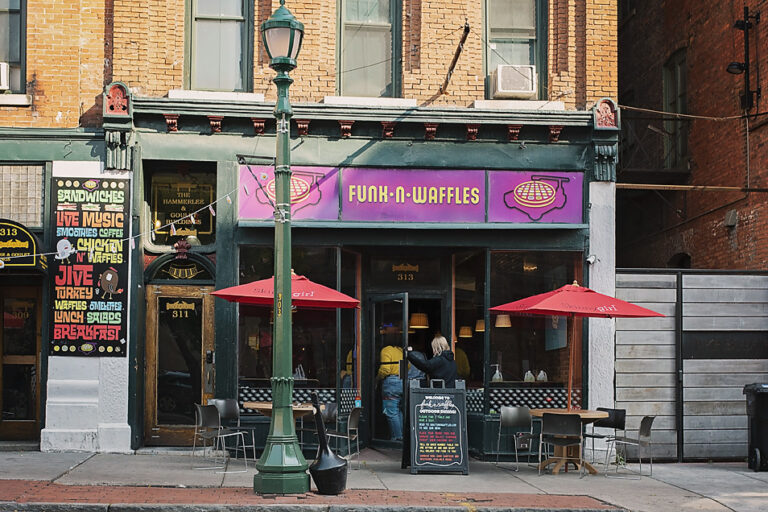
Beloved Syracuse waffle shop and live entertainment venue Funk ‘n Waffles has announced a four-night concert lineup to celebrate its 10th anniversary.
Born from two college students’ love for waffles and live music seventeen years ago, Funk ‘n Waffles offers a truly one of a kind live entertainment experience. Having properly opened their doors as a dual food-and-entertainment space a decade ago now, founder Adam Gold has built quite the reputation for Funk ‘n Waffles as a premiere downtown Syracuse destination.
With an expansive menu of sweet and savory bites and beverages, the venue has been featured countless times on Food Network as one of Guy Fieri’s time-honored favorites. Not to mention the funk half of the venue, with the space consistently stacked on weekends and occasionally even weekdays with shows from folks across all varieties of the sound spectrum.
Drawing in bands and fans from near and afar, Funk ‘n Waffles’ list of artists that have graced their stage goes on into the thousands- and it’s no wonder why. Between an undeniably delicious menu and a lively community of performers and fans alike, Funk ‘n Waffles is going into its 10th year with a bang.
Over the course of four nights – Thursday, December 5 through Sunday, December 8 – Funk ‘n Waffles will be host to several unforgettable nights of live music and entertainment from the likes of Skunk City (whose show will act as the kick-off and be completely free of charge!) on Thursday, Pearly Baker’s Best on Friday, Rootshack with special guest RUHA on Saturday, and Sophistafunk with special guests Nik Greeley & The Operators and The Gunpoets on Sunday.
Tickets for this unforgettable celebration are on sale now, priced at just $15 for presale or $25 at the door. In addition, Funk ‘n Waffles is offering a special weekend price of $30 that offers full access to all three ticketed shows.
For more information on the venue, further details on their anniversary bash, and ticket purchasing, check out their official website here.
Jones Beach State Park has announced that on November 22, Magic of Lights drive-through light show is returning for the holiday season. The event lasts from Nov 22 to Jan 4.
Magic of Lights, the family-friendly, drive-through holiday lights festival, is celebrating the grandest holiday of the year with a dazzling, sparkling, and twinkling series of magical light displays in a 2.5-mile drive-through experience, the longest and brightest ever, at Long Island’s Jones Beach State Park beginning on November 22 and running nightly through January 4. Inside the comfort of their own vehicle, guests will enjoy Magic of Lights’ classic holiday favorites including Winter Wonderland, the 12 Days of Christmas, Toyland, festive Elves and Reindeer Road. In addition to the 200 foot long Enchanting Tunnel of Lights, there will also be other new light tunnels to delight and amaze.
Other illuminated displays include the 32-foot-tall, animated Mattel’s Waving Christmas Barbie®, Prehistoric Christmas featuring life sized dinosaurs celebrating the season, and the legendary BIGFOOT® Monster Truck. Created with over two million sparkling lights, Magic of Lights is a nostalgic and festive event everyone will enjoy. The Toyota Holiday Village, which allows guests to walk through a magical out-of-car area featuring Santa Photos, refreshments, and other holiday activities, will also return at both locations. A new augmented reality feature will be introduced this year as well to make the magical experience even more interactive, with details set to be released in November.
The Magic of Lights uses the latest CAD technology and is hand-crafted at the Magic of Lights warehouse in Medina, OH, then, transported to Long Island. The displays combine for more than 10 miles of LED lighting across all presentations, in the trees, and on the buildings. There are 10 different colors of LED bulbs used. The highest scene is 32-feet tall, and the longest is several hundred feet long.
The steel displays are designed, bent, cut, and welded into about 800 frames combined in different configurations to create each show’s giant winter holiday scenes. Magic of Lights is open Sunday through Thursday from 5 p.m. (dusk) until 10 p.m. and Friday and Saturday from 5 p.m. (dusk) until 11 p.m. Admission is $30 in advance or $35 at the gate on weekdays and $30 in advance or $40 at the gate on weekends through November. Price is based per car. Special pricing is available for limousines and buses.
Group ticket rates are available and can be purchased online. For dates, times, and ticket availability, visit magicoflights.com.
A benefit concert for Creative Music Studio will be held at (Le) Poisson Rouge in Greenwich Village on Wednesday, Dec. 11.
This special event will feature a diverse lineup of artists performing everything from experimental surf rock to poetry to beloved tunes by Medeski Martin & Wood through both solo and improvised group jam sessions. Artists such as Ava Mendoza, Billy Martin aka illy B, and Joe Russo, will be performing at the benefit, among other instrumentalists and poets. All proceeds from this show will go to the Creative Music Foundation.
Creative Music Studio aims to engage musicians and listeners through workshops, recordings, and concerts worldwide. For 40 years, Creative Music’s main program was the Creative Music Studio, a physical 45-acre campus in Woodstock NY where musicians lived. Residents include hundreds of Guiding Artists, including several MacArthur ‘Genius’ Award winners (George Lewis, John Zorn, Cecil Taylor, John Cage, Charlie Haden). Over 550 concerts were recorded and were digitized as part of the CMS Archive Project.
Since 2008, (Le) Poisson Rouge has had indie rock, contemporary classical, electronica, metal, jazz, world music, and everything in-between on its stage. in the heart of New York City’s historic Greenwich Village to reflect the rich musical culture of the city it calls home. A Gallery Bar that hosts art exhibitions, stand-up comedy, and drag queen bingo make LPR the most eclectically independent venue in NYC.
General Admission – Advance Standing room tickets – $51.50 | 7:00 PM GA doors
Four years from the frays of the pandemic, Tiffany Majette, the New Jersey-born Orion Sun, is finally getting to live her dream out on the road. In the tender confessional on her Brooklyn Steel set on Thursday, November 7, the R&B songwriter reminisced on her first time in the Big Apple (the event marking the second occurrence), though, as she admits, what should’ve been a milestone performance felt like it didn’t really count.
Photos by Zachary Giller
“I was performing to an empty room, to a screen and there were clapping emojis at the end of every song,” she professed. “I remember being really scared that this was the new normal.”
Photos by Zachary Giller
Ever the optimist, Orion Sun didn’t let the stark anecdote’s sentimentality linger around long enough to sour, urging listeners to “don’t think about it too hard” into her lapse of vulnerability, choosing instead to let her music do all the heavy lifting.
Photos by Zachary Giller
Unbeknownst to her, despite all the worldly circumstances, 2020 proved to be a groundbreaking year. The singer-songwriter released two seminal albums, A Collection of Fleeting Moments and Daydreams and Hold Space For Me two months apart at the year’s emergence. And despite the catastrophic shutdowns that began mere days before the release of Hold Space For Me, Orion Sun forged ahead, gaining millions of eager fans with similar grievances and all the time in the world to slow down and listen.
Photos by Zachary Giller
On the stage set in East Williamsburg, a neighborhood teeming with hipsters and bearing a reputation as such, Orion alludes to a childhood of poverty and the embers of hope back when her days felt as dark as the obsidian-drenched room she currently occupied. With a timbre that oozes honey-like sincerity and eau de Jorja (Smith) tonality, she seduces with the throes “Space Jam – An Odyssey,” a track revealing dreams of a faraway home, as someone once intimately familiar with the rows of homelessness and housing insecurity:
“You wear Michael Jordans, I can’t afford them / I got dreams of Paris, I’d love to share them / I wanna go real far, like really, really far,” Orion croons, voice ringing with the disarming tenderness and lucidity of a teenager forced to grow up too quickly.
Photos by Zachary Giller
And travel Orion does, even within the confines of the 20,000-square-foot arena, never beholden to one place or once stagnating as she bounces lightly from left stage to right, surely making up for lost time, vocals even-kneeled and steady alongside improvised yet fluid choreography.
Photos by Zachary Giller
Her status as a former theater kid may serve as the resume for her captivating stage presence and even reserves Orion Sun the right to show off a little, with all the towel-flinging theatrics, a show-stopping megawatt smile, and endless gestures of gratitude in the form of generous leapfrogging daps and unadulterated quirks inundated with outbursts like “throat coat” and cheeky requests for a “No Judgement Zone.” As she leans into the opening acoustics of “These Days,” making promises that it’s really love that keeps us warm on days you’re “trying to keep your head above water,” you’re inclined to believe her, surrendering all lackluster cases against her indomitable thesis.
Photos by Zachary Giller
Fiddling with dials and clacks of a synthesizer, the self-made producer gave a glimpse at the honed skills that allowed her to retain all her masters as the sole writer and producer on her earlier works (“They want a ransom but if you make it yourself, the beat is free,” she sings cheekily in “Sailing”) and which attracted offers from big-time record labels. A twist here and a tap there, a dialed back reverb, and it’s a remix, on the fly: “This sounds better,” she joked, re-upping an intro with the click of a button.
Photos by Zachary Giller
Maybe predictably from someone who earlier in the night confessed to a craving of human interaction, Orion Sun proved to be a flight risk. Traipsing her way from left stage, confusion flooded the room from wall-to-wall as the top of Orion’s head disappeared — and re-emerged moments later in the crowd, weaving through shepherds of long-time fans and their equally enthralled compatriots, who parted for her like the Red Sea, granting her the hearty New York welcome she’d imagined many fortnights ago.
Photos by Zachary Giller
And to the dormant insurrected by her dare-to-dream purview, she leaves a ray of light as a parting gift. “For the creatives, do it for the archive first,” she urged, lessons she’s not only learned the hard way but intrinsically, forever embedded in her discography and way of life.
Photos by Zachary GillerPhotos by Zachary GillerPhotos by Zachary GillerPhotos by Zachary GillerPhotos by Zachary GillerPhotos by Zachary GillerPhotos by Zachary GillerPhotos by Zachary GillerPhotos by Zachary GillerPhotos by Zachary GillerPhotos by Zachary GillerPhotos by Zachary GillerPhotos by Zachary GillerPhotos by Zachary Giller
The Binghamton Philharmonic Orchestra has announced a new concert entitled “Thresholds,” the second event of the M&T Bank Symphonic Series. This event takes place on November 16 at Broome County Forum Theatre.
Composer Hilary Purrington
The program opens with young composer Hilary Purrington’s 2020 piece “Threshold,” an atmospheric soundscape of driving rhythms that explores the boundaries between motion and stillness. Next is Felix Mendelssohn’s evocative Hebrides Overture, one of the masterworks of 19th-century Romantic program music. Finally, the Philharmonic will conclude with the first performance of a symphony by Anton Bruckner in our region in 60 years, the Sixth Symphony in A Major, a monumental work long celebrated for the complexity of its harmonic language and the profundity of its emotional impact. The Philharmonic’s performance of Bruckner’s Sixth Symphony, coinciding with the 200th anniversary of the composer’s birth, will be an unforgettable experience for seasoned classical music lovers and new audiences alike.
The public is invited to a Pre-Concert Chat at 6:30pm, “Mist and Myth in 19th-Century Music,” led by the Philharmonic’s Director of Education and Community Engagement Dr. Julia Grella O’Connell, about the visual and historical imagination in Mendelssohn and Bruckner. The main event begins at 7:30pm. Tickets are $28 to $69. Kids 17 and under attend free, thanks to Symphonic Series Sponsor M&T Bank. Today, the Binghamton Philharmonic serves up to 10,000 people annually through innovative, engaging, and affordable programming, meeting its mission of “Building Community Through the Power of Live Music.” This upcoming “Thresholds” program encapsulates the organization’s mission statement beautifully.
For more information on the Binghamton Philharmonic’s upcoming “Thresholds” concert and to purchase tickets, click here.
SNL has officially returned, celebrating its 50th year on the air. Since its start in 1975, the show has introduced Americans to classic comedy skits, ranging from Wayne’s World to the Blues Brothers. On top of that, comedy icons like Eddie Murphy, Adam Sandler, and countless others have SNL to thank for launching their careers. But let’s not forget an often overlooked part of SNL’s history: its musical guests.
To celebrate SNL’s 50th anniversary, let’s take a look back at 50 classic performances from throughout the show’s history. In this installment, we’ll travel back to SNL of the 1980s to see some of the decade-defining acts that grace the 30 Rockefeller Plaza stage.
The B-52’s (1/26/1980)
To kick off the 1980s, New Wave icons the B-52’s performed an energetic set. Hailing from the college town of Athens, Georgia, the band was riding high after the release of their debut self-titled album. So in January, 1980, they made the trek up to New York City to soundtrack an episode hosted by the late-actress Teri Garr.
To start off their set, the band played their biggest hit at the time – “Rock Lobster.” Before the music even started, nothing stood out more than the band’s style. Their eclectic eighties meets fifties fashion was on full display. Cindy Wilson and Kate Pierson’s mile-high beehive haircuts instantly gave the audience a taste of the B-52’s ethos. They were deeply rooted in retro aesthetics, but also spearheading a New Wave of punk.
The audience did not have much time to gawk at the band’s style, because Ricky Wilson immediately fired into the iconic “Rock Lobster” riff. Alongside guitar, singer Fred Schneider played SNL’s favorite instrument – the cowbell. Throughout the song, Schneider bopped around the stage, waving his cowbell and drumstick. This dance party of a song dramatically halted at the bridge, with the band members collapsing as Schneider yells “Down! Down!” Following this, the band immediately sprung back up, whirling around the stage. Even Keyboardist Kate Pierson left her station to join in on the vortex. The B-52’s, unlike any band from that era, matched campy theatrics with a rough punk edge.
Following a number of skits, the band returned to play “Dance This Mess Around.” This track started off much differently than their opener, with harsh keyboard stabs and dissonant guitar. For this number, Schneider passed off vocals to Cindy Wilson. Her soft vocals grew into screaming as the chorus neared, with Schenider’s distinctive yelping backing joining in soon after. Throughout the song, the band all erratically danced, while somehow remaining unsettlingly still, mirroring their SNL predecessor Devo.
With this performance, the B-52’s both carried on history, and made history of their own. They brought the 1970s New Wave of Devo and Elvis Costello to a new decade. This performance, while unassuming at the time, hinted at a decade that both New Wave and the B-52s would thrive in.
Funky 4+1 (2/14/1981)
In 1981, a Bronx-based quintet made SNL history with a single performance. On Valentine’s Day, Funky 4 +1 played the first Hip-hop performance, not only on SNL, but on all of national television.
Known hip-hop aficionado Debby Harry hosted that night, and personally vouched for the band. During her work with Blondie, Harry formed a great appreciation for hip-hop. In 1981, Blondie made history with “Rapture,” becoming the first song with a rap verse to reach number one. As part of this, Harry became close friends with rap icon Fab 5 Freddy, who introduced her to Funky 4 +1.
From the first second of their SNL performance, “That’s the Joint” was a straight blast of joy. The Funky 4 all in matching red sweaters accentuate their female lead Sha-Rock. In a way, the monochrome male backers and the standout female lead vocalist wasn’t too different from Blondie itself. A sample of “Rescue Me” by A Taste of Honey propels the song forward with funky bass and horns. Over this disco beat, the five rappers pass off lines between each other, making for a great early hip-hop track.
One key member of the band wasn’t even a member, but rather a DJ. Throughout the performance, he can be seen spinning records in front of the group. This sampling-based number marks a radical shift in the style of musical performances on SNL, foregoing live instrumentation altogether. This showing also revolutionized how rap artists performed live. Rather than bopping to the beat, the band adopted fully choreographed synchronized dance moves. Drawing from older Motown acts, the band looked more akin to the Jackson 5 than the Sugarhill Gang on stage.
Only one week after Funky 4 + 1, SNL introduced a future superstar to the world. Prince, the artist formerly known as Prince, or Ƭ̵̬̊, whatever you want to call him, he made his special debut appearance on February 21st, 1981. While not the musical guest – that was rock icon Todd Rundgren – SNL invited Prince to perform one song from Dirty Mind. This performance marked the first of four guest slots Prince filled during his life.
Following two performances by Rundgren, it was Prince’s turn to perform “Partyup.” Prince and his band emerged on stage in matching trench coats. Under his trench coat, Prince wore only a bandana, short-shorts, and stockings, mirroring the cover of Dirty Mind. The performance got off to an energetic start, driven by funky synths, bass, and guitars. Throughout the funk number, Prince’s iconic falsetto vocals soared. However, one vocal line also caused controversy. Some claimed Prince sang the original lyric “Fighting war is such a f*cking bore,” violating broadcasting regulations. Prince himself, however, claims he said “Freakin.”
Funnily enough, yet another F-bomb overshadowed this performance, this time coming from cast member Charles Rocket. During the farewell, Rocket, parodying JR from Dallas, angered TV censors yet again. Turning to the camera he said “Oh man, it’s the first time I’ve ever been shot in my life. I’d like to know who f*ckin’ did it.” Needless to say, the cast and broadcast staff were all shocked, and Michaels promptly fired Rocket. This, however, was the last time anyone outshined Prince, as he would go on to dominate for the rest of the eighties.
This performance is sadly near impossible to find in its entirety online. Whether due to the multiple swears, or Prince’s estate’s strict licensing policy is unsure. It is a shame, as it is one of the best to ever grace 30 Rock. Immediately after, Jeffrey Doumanian writing for Rolling Stone said, “I was blown away, he was just the most original act I had seen in a long time.
FEAR (10/31/1981)
For one night only, the SNL stage transformed into a no-holds-bar mosh pit. That night was Halloween of 1981, when Lorne Michaels invited LA-based hardcore band FEAR onto the program. With his previous bad luck with punks *cough, cough, Elvis Costello* why would Michaels push his luck with an even rowdier crowd? The answer is pretty simple: he didn’t. In fact, it was SNL alum and notorious party animal John Belushi who pitched the idea.
John Belushi was an avid fan of all things punk rock, quickly becoming close friends with FEAR. Earlier that year, he even offered the band the opportunity to soundtrack his movie Neighbors. The studio, however, was not impressed and thought the band’s music was highly inappropriate. Belushi, being the good friend he was, offered FEAR a musical slot on SNL to make up.
Belushi’s plan, however, was much more complex than just having the band perform. He pitched Michaels his idea – to turn 30 Rock into a full-fledged punk venue with slam dancers. Then, Belushi began making calls to punks across New York and Washington DC. By Halloween night, 40 punks closed in on the SNL studio, including future Minor Threat singer Ian Mackaye. For the dress rehearsal, the punks mellowed out, lulling Michaels into a false sense of security. But when have punks ever been ones to follow the rules?
When FEAR took the stage that night, all hell broke loose. They began with “Beef Bologna,” a breakneck pace hardcore track with screamed vocals and fiery guitars. As soon as the music began, the punks in the audience showed what they were really made of. Some dove across the camera, others stormed the stage, and all of them indulged in the pure chaos. As singer Lee Ving recalled, “The real audience at Saturday Night Live was scared to death.” Luckily for everyone at 30 Rock, after the relatively short song, the crowd seemed to calm down slightly.
It wouldn’t last. Ving – the comedian he is – grabbed the mic and said, “It’s very nice to be here in New Jersey,” warranting immediate boos. This segued into their second track “New York’s Alright if You Like Saxophones.” Sonically, this song is unique among eighties hardcore, featuring dissonant saxophone at its center. The audience couldn’t savor this musical complexity, as not even two seconds into the song, the moshing resumed. In the mayhem, the mic even fell into the audience. The young DC-raised Ian Mackaye seized on this opportunity, yelling “New York Sucks,” starting a small fight.
The band’s final track was “Let’s Start a War,” which seemed like a good reflection on what they were doing in the studio. Unfortunately for FEAR, they did not have the chance to finish this performance. In fact, they didn’t even get 15 seconds in. From stage right, a man entered holding a massive pumpkin. Lumbering across the stage, he then chucked it directly at producer Dick Ebersol’s chest. In a panic, SNL cut to dead air for the first time in its history. After some hesitation, the broadcast resumed with a pre-recorded Eddie Murphy skit. As audiences watched on, cops chased the 40 punks out of the studio, restoring order to 30 Rock. Needless to say, Lorne Michaels never invited FEAR back to SNL.
Queen (9/25/1982)
SNL’s eighth season began with a performance by one of the biggest legends in rock: Queen. With SNL alum Chevy Chase hosting, the band joined to perform two songs from their 80s discography. This should have been an easy slam dunk: iconic host, equally iconic band, how could it go wrong? The issue came with Queen’s touring schedule. The SNL premiere came on the back of a 27-city US tour. The band were all exhausted, and Freddy Mercury’s booming voice was shot. Queen, however, were never a band to shy away from a challenge, and persevered. Playing sped up, more rock-edged versions of their tracks, they stunned the audience.
The first track they performed was #1 hit “Crazy Little Thing Called Love.” This performance was a much more beefed-up rock version of the hit. It began with Mercury front-and-center, surprisingly playing the acoustic guitar. Maybe it was because of his vocal limitations, or the need for the song’s iconic riff, Mercury ditched the keyboard for the guitar. Once the song started, honky tonk pianos and a jazzy electric guitar riff from Brian May joined in. Listening to the performance, you couldn’t even tell Mercury’s voice was all but destroyed from a month of touring. To close out the track, May laid down a legendary extended electric guitar solo.
Later in the episode, Queen returned to the stage to perform “Under Pressure.” Although their latest album Hot Space was a commercial disappointment, its lead single – a debut with David Bowie – was an instant classic. Prior to Mercury’s passing in 1991, “Under Pressure” was a sole Queen live track – with or without Bowie. Beginning with the song’s iconic bassline, everything started according to plan. However, when Mercury’s vocals begin, his exhaustion was much more noticeable. There was no way he would be able to hit the song’s rising vocal lines. As a result, he had to alter the melodies, allowing his more limited register to boom through the studio. Throughout the song, he confidently strutted across the stage in a leather jacket. It was clear that his voice didn’t phase him in the slightest.
This performance marks a sad moment in music history. SNL was the final performance the band ever played in the US prior to Mercury’s passing from AIDS 9 years later. Even though it was their final American show, and the band were clearly not at their highest, it was a clear show of force. They may have been exhausted and had no voice, but their musical prowess and stage presence made all of that unimportant. Watching the performance, there is no question why Queen was one of the greatest bands to ever do it.
The Replacements (1/18/1986)
Yet another punk band banned from SNL for disorderly behavior – I guess third times a charm. This story, much like Elvis Costello, began with a last-minute fill in by Lorne Michaels. Originally, SNL booked the Pointer Sisters to perform on a Harry Dean Stanton hosted episode. However, when they canceled, Lorne Michaels called in Minnesota-based alternative band The Replacements.
Riding on the success of their major label debut Tim, the Replacements’ SNL performance was a medium to prove themselves on a live stage. What better way to prepare for such a momentous occasion than partying like there’s no tomorrow. Leading up to the performance, the band made a day of binge-drinking with Harry Dean Stanton. And did they drink…and drink…and drink. When it came time to go up on stage, guitarist Bob Stinson tripped and fell, smashing his guitar.
Once a replacement guitar was given to the Replacements, they took the stage for their first song. From the first second of “Bastards of Young,” it was clear something was off. It seemed like each band member was playing in a different key. In other words, their drinking had caught up to them and the performance was a mess. Clearly, the band was already at odds with Lorne Michaels, poking fun at him during the performance. As Paul Westerberg sang, “The ones who love us least are the ones we’ll die to please,” he gave a big exaggerated wink right in Michaels’ direction.
The real trouble came right after this. Westerberg was worried that Stinson was so intoxicated that he would miss his cue for the song’s guitar solo. Taking action into his own hands, Westerberg yelled, “Come on f*cker” to cue Stinson himself. Michaels was furious, fearing backlash from network censors for this use of profanity.
Michaels, however, did let the Replacements take the stage for another song. When the band reemerged, they seemed to have swapped outfits with each other for some reason. Maybe it was the outfit change, or the extra time to sober up, but their performance of “Kiss Me on the Bus” was much more composed. The band played together, in tune, and in key. When the moment of truth came for Stinson to play his solo, he was even able to do so without any swearing needed.
This cleanup job was not enough to quell Michael’s anger however. By the time the Replacements left the stage, Michaels had banned them. For the third time in SNL’s history, a punk act’s hijinx had gotten them banned from the show. Singer Paul Westerberg, however, was allowed to return to the show seven years later as a solo act. During this performance, he even played a Replacements track – “Can’t Hardly Wait.” The band’s next performance at 30 Rock wasn’t until a 2014 appearance on Jimmy Fallon – a whopping 32 years later.
Phillip Glass (3/22/1986)
Who screams SNL musical guest more than pianist and experimental composer Phillip Glass? If you thought literally anybody else, you’d most likely be correct. However, for one special episode of SNL, Glass performed and soundtracked the whole night. This decision, while odd at first glance, makes much more sense in the greater context of the unique episode it soundtracked.
On March 22nd, 1986, filmmaker Francis Ford Coppola hosted alongside comedian George Wendt. This episode, unlike SNL’s normal skit-based format, this night had an overarching narrative arc. It followed Coppola in his quest for an Emmy award. To do this, he directed the entire episode, repeatedly misunderstanding and twisting SNL’s concept to make it more artful. This vision was put on display immediately after the cold open. In place of the show’s fun intro was a moody opening credits sequence. Glass’s track “Facades” from Glassworks substituted the usual upbeat jazz theme.
After this, the show’s skits doubled down on its concept. First came Wendt’s monologue, which Coppola repeatedly interrupted hoping to capture the perfect take. To add onto this, he even told the audience how they should laugh in response. Following the monologue was a number of experimental, esoteric, and realist sketches tackling everything from Vietnam to The Honeymooners. Coppola even recorded a number of satirical commercials to make sure every aspect of the broadcast was up to his standards.
Throughout this experiment in television broadcasting, Coppola invited the Phillip Glass Ensemble to perform twice. The first of these was “Lightning” from Glass’s 1986 album Songs from Liquid Days. This track was unlike anything 30 Rock had witnessed previously. In Glass’s normal fashion, repetitive whirling percussion and winds propelled the song forward. Minor-key keyboard stabs supplemented this, creating an almost alien atmosphere. At the center of the piece was Janis Pendarvis’ beautiful operatic vocals, performing lyrics by Suzanne Vega. This track marked one of the most accessible moments in Glass’s discography, while remaining musically complex.
Glass’s second performance was “Rubric,” an excerpt from his 1982 classical opus Glassworks. This track was much more abstract than its predecessor. Keyboard and woodwind arpeggios drove the song forward. This song was much more emblematic of Glass’s discography, being a repetitive, deeply-minimalist composition. As it went on, it grew more and more lush, adding operatic vocals on top of the mix. As the ensemble performed, clips from the experimental documentary Koyaanisqatsi overlaid the show. The excerpts, featuring nighttime timelapses of a city, only added to the monumental aura of the performance.
Due to the unorthodox one-off nature of this episode, it is unlikely that 30 Rock will witness anything else like it again. It really is too bad, as the Phillip Glass Ensemble’s appearance was one for the ages. Equal parts experimental and approachable, minimalist and lush, the performance bent the rules of what an SNL performance could really entail.
Elvis Costello (3/25/1989)
So far, Lorne Michaels has not shied away from banning anyone he disagreed with. Play a song he didn’t like – banned. Said a naughty word on air – really banned. However, on March 25th, 1989, Michaels felt in a much more forgiving mood. After a 12 year ban, SNL invited back New Wave icon Elvis Costello for a solo performance. 12 years prior, Elvis Costello and the Attractions received a “lifetime” ban for going off script. Instead of playing “Less than Zero” like planned, Costello switched into a rendition of “Radio, Radio,” which angered Michaels beyond belief. Now a solo artist, Costello returned to support his hit album Spike, playing two new songs.
In the leadup to Costello’s first song, host Mary Tyler Moore made one of the strangest performance announcements in the history of SNL. Continuing a streak of raunchy language, she told the audience “Elvis Costello’s penis is here tonight, so stick around, we’ll be right back.” After that strange introduction, Costello took the stage to perform top-20 hit “Veronica.” Co-written by Paul McCartney, the song was an upbeat pop-rock number, lacking Costello’s punk edge that got him in hot water during his first appearance. Picking up an acoustic guitar, Costello led the band, singing about a woman slowly losing her memories with old age. Despite the sad lyrics of the song, you would have no idea based on Costello’s lively energy.
Following this, Costello returned to perform “Let Him Dangle.” This track is noticeably more solemn than his opener, discussing a man preparing for the gallows. The mostly acoustic track provided a comedown from the frenetic energy of “Veronica.” Despite the more serious nature of Costello’s tracks that night, he managed to stay in Michaels’ good graces. All it took was Costello staying on script. This forgiveness appears to have lasted, with Costello making two additional guest appearances throughout the 1990s.
On top of this performance, the episode was also notable for its sketches. Following Costello’s second song, SNL debuted a new sketch. Featuring Mike Myers and Dana Carvey, it introduced the world to the Wayne’s World public access television show. The charming sketch, featuring the two loveable music nerds in Wayne’s basement, quickly became a fan-favorite. Within just four years, it became a recurring sketch, spawned two movies, and got an entire generation saying “Wayne’s World, Wayne’s World. Party time! Excellent!” This one unassuming episode not only mended SNL’s past conflicts, but also paved the way to its future.
Tom Petty (5/20/1989)
In 1989, Tom Petty arrived at 30 Rock for his third appearance on SNL. This episode, hosted by Steve Martin, however, marked Petty’s first time without the Heartbreakers backing band. His solo SNL debut was also preceded by tragedy. That night, SNL original cast member Gilda Radner passed away following a battle with ovarian cancer. In response, Petty made his performance a tribute to the legendary comedian
Petty’s first song was “Runnin’ Down a Dream.” Starting with its iconic descending riff, the song quickly jumped into an upbeat rock groove.With chugging guitars and Petty’s soft vocals, the song lilted along for a really fun two minute stretch. After this, the song erupted into a fiery guitar solo from Mike Campbell to close it out. With this amped up shredding over his usual heartland rock, Petty entered his solo career with a bang.
Prior to the episode, Petty had planned to play his hit “I Won’t Back Down,” to close his set. However, as Saturday approached, he felt it did not fit the mood of the night. Instead, he opted to play a yet-unreleased track off his new album Full Moon Fever. This track was the future megahit “Free Fallin’.” Originally, his label was unconvinced, wanting him to play his tried and tested current hit. In response, Petty told them that “Free Fallin’” was actually the late Radner’s favorite song, so they relented.
This SNL episode marked the first live performance of what many consider Petty’s signature song. Unlike the album cut, this live performance featured much more lush instrumentation, mirroring a wall of sound. In place of acoustic guitar is an immensely reverberated electric one. With synth strings, piano, and reverb vocals, the song echoed like Petty was performing in a cathedral. Aiding in this feeling were the Renaissance paintings surrounding the band on stage. To end this beautiful performance, Petty decided to make things a little awkward. As the song ended, he went to hug Howie Epstein who did not seem interested. So, they both just buffered in place awkwardly until the camera faded.
In this performance, Petty took a somber occasion and made it a celebration of life. In doing so, he not only introduced audiences to his new hit, but also his new path forward as a solo artist. Following this performance, Petty returned to 30 Rock a whopping five times as a musical guest.
Neil Young (9/30/1989)
To close out the 1980s, Lorne Michaels finally caught his white whale. For the past 10 years, SNL attempted to nab Neil Young as a musical guest. The first time they tried, SNL ended up stuck with weirdo new wavers Devo. Finally, the folk legend was in the building to perform a three song set.
At the time of this performance, Young was far from young. At the ripe age of 43, Young was still at the top of his game. When he entered 30 Rock, he sported an Elvis t-shirt, leather jacket, patched up jeans, and maple leafs gears. This outfit was equal parts cool and puzzling, but one thing for sure was that it was 100% Neil Young. In his three decades performing, Young had built up a routine for putting on amazing live shows, saving the upbeat rockers for last. After hours of building up adrenaline and intensity, he would rip out fiery guitar solos like they were nothing. For SNL he had to reach this intensity level instantly. To do this, he took up an intense training regimen, including weightlifting and calisthenics. This training paid off, as Young went on to unleash one of if not the greatest SNL performance ever.
Young’s first song was his newest hit “Rockin’ in the Free World” from 1989’s Freedom. The track kicked off with its iconic chugging guitar riff imbued with fiery distortion. As Young’s lyrics entered, they only added to the sonic intensity. The lyrics initially seem patriotic, referencing the “colors on the street, red, white, and blue.” As the song continued, Young’s lyrics transformed into an indictment of HW Bush-era America as fiery as its guitar tone. With lyrics attacking everything from drug addiction, pollution, and gun violence, the song was a scathing criticism of the US. As the song continued, Young stomped and headbanged across the stage, before erupting into a legendary guitar solo. While firing out metallic guitar bends, Young jumped on the drum kit and crashed into his bandmates. Apparently, Young’s training regimen worked, with the performance having the intensity of a grunge concert.
Following this incendiary performance, Young returned with a much more somber song. The solo acoustic rendition of “The Needle and the Damage Done” worked as a much needed comedown from the explosive energy of Young’s opener. Upon retaking the stage, Young received immediate applause. The song’s lyrics tackled the issues of heroin addiction and the overdose of Young’s Crazy Horse bandmate Danny Whitten in 1972. Following applause throughout the song, Young swapped out his acoustic guitar for an electric one to begin “No More.”
As Young swapped out his gear, his band rejoined him on stage for this last piece. Young originally wrote this track as a spiritual successor to “The Needle and the Damage Done,” and it continued many of its themes. Throughout the song, Young sang of the difficulty to kick drug addiction, accompanied by bluesy solos. Compared to “Rockin’ in the Free World,” the song was much more mellow, finding a comfortable middle ground with the rest of the set. When Young reached the repeated chorus of “no more,” harsh guitar stabs amped up the track. By the time the track ended, Young made all of Lorne Michaels’s greatest wishes come true. He had finally caught his white whale, and Young’s performance was well worth the decade-long wait.
In celebration of The Black Parade, My Chemical Romance will play the album in its entirety on a 2025 stadium tour. Dates include MetLife Stadium on August 9, (with special guest Death Cab for Cutie and Thursday) and Citizens Bank Park in Philadelphia on August 15 (with special guest Alice Cooper).
After performing The Black Parade album in its entirety at the most recent When We Were Young Festival, My Chemical Romance (Gerard Way, Ray Toro, Frank Iero, and Mikey Way) will be celebrating The Black Parade this coming summer. The iconic album was named one of Rolling Stone’s “500 Greatest Albums of All Time.” The band will be performing the full album in only ten cities across North America. Each show will feature a different renowned act to open for the band.
Since the band’s 2002 self-released debut album, the New Jersey natives have proved to be definitively one of the most popular and enduring alt bands of the 2000s. Both 2004’s Three Cheers for Sweet Revenge and 2006’s The Black Parade have been certified platinum three times.
Tickets go on sale this Friday, November 15, 2024 at 10 am. Learn more and purchase tickets here.
“Long Live” The Black Parade 2025 Tour Dates:
July 11, 2025 – Seattle, WA – T-Mobile Park
Special Guest: Violent Femmes
July 19, 2025 – San Francisco, CA – Oracle Park
Special Guest: 100 Gecs
July 26, 2025 – Los Angeles, CA – Dodger Stadium
Special Guest: Wallows
August 2, 2025 – Arlington, TX – Globe Life Field
Special Guest: Garbage
August 9, 2025 – East Rutherford, NJ – MetLife Stadium
Special Guests: Death Cab for Cutie and Thursday
August 15, 2025 – Philadelphia, PA – Citizens Bank Park
Special Guest: Alice Cooper
August 22, 2025 – Toronto, ON – Rogers Centre
Special Guest: Pixies
August 29, 2025 – Chicago, IL – Soldier Field
Special Guest: Devo
September 7, 2025 – Boston, MA – Fenway Park
Special Guest: IDLES
September 13, 2025 – Tampa, FL – Raymond James Stadium
Prospective performing musicians have announced show cancellations at the East Village’s Rockwood Music Hall following the venue’s sudden closure.
Known for their seemingly never ending roster of all flavors of live music, Rockwood Music Hall has built quite the reputation for themselves over the past twenty-odd years of operating.
Boasting up to ten performances a day by local, national, and global artists alike on their nine-by-nine foot stage, Rockwood provided smaller artists the chance to work with a larger venue with high-quality production and fans the opportunity to know they’re a part of something much bigger than themselves.
Many household names got their start at Rockwood, including Sara Bareilles, Lady Gaga, and Elle King among countless others. With such an extensive daily schedule, artists were offered opportunities to return routinely and build their audience while retaining 100% of merch sales made within the venue’s walls – something invaluable to smaller acts.
In addition to their live performances, Rockwood records thousands of live shows each year with many being released formally. Notable live releases include Johnnyswim, The Marcus King Band, and Gretchen Parlato’s Grammy-nominated “Live in NYC” album.
It’s for all of these reasons and more that the sudden removal of Rockwood’s events calendar on their website and subsequent announcements from several upcoming performers of show cancellations left regulars and newcomers alike in shock.
Posts from New York’s Finest’s Oscar Bautista, Americana artist Arielle Silver, and several others detail the surprise and disappointment felt in response to an e-mail seemingly received by all artists on the morning of November 10 that were booked for upcoming and future dates at Rockwood .
“Due to circumstances beyond our control, this Rockwood Music Hall location has closed its doors today, Sunday November 10 2024. Hence all shows going forward are cancelled. Apologies for the short notice and thank you for your support. Please reach out if needed.”
– Rockwood Music Hall, in email to artists
The end of Rockwood Music Hall marks the end of an era for New York City’s music scene, and it’s not difficult to say the same for the music industry as a whole. A beloved venue for avid music listeners and up-and-coming stars alike, the loss of Rockwood is sure to be felt sorely.
As of writing, there is no formal announcement on Rockwood Music Hall’s website or social media accounts concerning the venue’s closure.
On Friday, November 22 at 8 pm, saxophonist Eric Alexander and his quartet will perform a set of bebop jazz at Flushing Town Hall.
Eric Alexander, joined by David Williams (bass), Neal Smith (drums), and Rick Germanson (piano), has been described by NPR as “one of the finest bebop saxophonists in the world.” After releasing more than 40 albums as a quartet or sextet leader, and being heard in over 100 albums that feature his playing, Alexander has been on the cutting edge of the jazz scene for over 30 years.
Eric Alexander started on the piano at the age of six and took up the clarinet three years later. He switched to alto sax when he was 12 and studied classical music. When he was 18 years old, he fell in love with jazz and settled for the tenor saxophone. At William Paterson College in New Jersey, he advanced his studies under the tutelage of Harold Mabern, Joe Lovano, Rufus Reid, and others.
In 1991, Alexander placed second behind jazz saxophonist Joshua Redman, and ahead of Chris Potter, in the Thelonious Monk International Saxophone Competition. He then decided to become a professional jazz musician. In 1992, Alexander released his debut album, Straight Up for Delmark. More recordings followed, including Man with a Horn (1997) and a 1998 quartet with George Mraz, John Hicks, and Idris Muhammad, Solid!. That year also marked Alexander’s first recording with One For All, his enduring jazz sextet with Jim Rotondi, Steve Davis, Joe Farnsworth, Peter Washington, and Dave Hazeltine.
”Jazz plays such an important part in the history of Queens,” says Clyde Bullard, Flushing Town Hall’s Jazz Producer in Residence. “We at Flushing Town Hall want to continue the legacy of great jazz with outstanding established as well as emerging jazz artists on our stage. We are delighted to welcome the extremely talented Eric Alexander.”