After wrapping a standout year of headlining shows, including a performance to over 100,000 fans in downtown Nashville for the World’s Largest Album Release Party, multi-Platinum country-rock artist, Brantley Gilbert has announced his Tattoos Tour 2025 following the release of his seventh studio album, Tattoos.
“Music has always been about bringing people together and offering a break from the grind, even if it’s just for a few hours,” says Gilbert. “My hope is that with tickets starting at $25, people can step away from everyday stresses and enjoy themselves—whether it’s making it a fun evening with the family or giving mom and dad the chance to hire a babysitter and have a night out just for them.”
Tickets start at $25.00 plus applicable fees and go on sale Friday, Nov. 29, at 10 am. Learn more and purchase tickets here.
Full Tatoos Tour Dates:
Feb. 27 – Angel Of The Winds Arena – Everett, WA
Feb. 28 – Missoula, MT – Missoula, MT
Mar. 01 – Toyota Center – Kennewick, WA
Mar. 06 – Toyota Arena – Ontario, CA
Mar. 07 – Findlay Toyota Center – Prescott Valley, AZ
Mar. 08 – Mullett Arena – Tempe, AZ
Mar. 13 – Grossinger Motors Arena – Bloomington, IL
Mar. 14 – Alliant Energy PowerHouse – Cedar Rapids, IA
Mar. 15 – Cable Dahmer Arena – Independence, MO
Mar. 20 – Salem Civic Center – Salem, VA
Mar. 21 – The Classic Center – Athens, GA
Mar. 22 – Orion Amphitheater – Huntsville, AL
Mar. 27 – Tsongas Center at UMass Lowell – Lowell, MA
Mar. 28 – Cross Insurance Arena – Portland, ME
Mar. 29 – Total Mortgage Arena – Bridgeport, CT
Apr. 24 – MVP Arena – Albany, NY
Apr. 25 – Utica Memorial Auditorium – Utica, NY
Apr. 26 – Mohegan Sun Arena At Casey Plaza – Wilkes Barre, PA
Jun. 08 – Carolina Country Music Fest 2025 – Myrtle Beach, SC
Jun. 20 – WYRK Taste of Country 2025 – Buffalo, NY
Saxophonist, multi-wind artist, composer, and arranger Kris Jensen will perform a one-time intimate show at The Other Side in Utica on Nov. 16. Door opens at 7:00 p.m.
Kris Jensen, a versatile musician, has performed throughout the United States, Canada, the Caribbean, Bangkok, Thailand, and Switzerland. Jensen has performed alongside many prominent artists in both jazz and rock, most notably, the legendary Allman Brothers Band and many of the individual members’ bands including Gregg Allman and Friends, Jaimoe’s Jasssz Band, Dickey Betts and Great Southern. He has also played with trumpet legend Maynard Ferguson, and many others.
In 1996, Jensen was a semi-finalist in the prestigious Thelonious Monk International Jazz Competition. He has studied Jazz and African-American music at the University of Hartford, where he would later teach. Jensen has recently appeared with jazz legends such as trombonist Curtis Fuller, alto saxophonist Phil Woods, and pianist Larry Willis. He has appeared on New Jersey Public Television with Maynard Ferguson, on “Late Night with David Letterman” with Gregg Allman & Friends, and on stage with The Allman Brothers Band, and The Dave Matthews Band.
The Other Side is a small community space dedicated to offering a platform for expression to artists and activists from around the region and beyond. Since 2007, The Other Side has been the go-to destination for jazz musicians and audiences alike.
Orrin Evans adds, “I have been listening to our next jazz guest, saxophonist, flautist & composer Kris Jensen and I’m happy to report that our music director, Dr Mike Dubaniewicz has done it again. Kris Jensen is a ‘beast’ whether blowing w/ the Allmans or with a jazz contingent. The backing band w/ Mike D. on sax, Dan Pugh on organ and Mike Cortese, drums is going to rock the joint.”
Learn more about The Other Side in Utica and purchase tickets here.
Utica’s Stanley Theatre will present the premiere of the holiday comedy “The Christmas Letter” – written by Ilion, NY native Michael Cunningham – on Saturday, November 9.
The film features scenes filmed in Utica and surrounding towns.
Directed by Tori Hunter, the movie follows Joe Michaels, a man determined to top his wealthy friend’s extravagant holiday letter by creating unforgettable experiences with his family.
“I was born and raised in Ilion and had always dreamed of bringing something back to the valley in some way,” Cunningham said. “And while I didn’t build a factory, I did create a story which was built on my life here, so it only made sense to film here. The Utica/Rome/Mohawk Valley region has so much to offer filmmakers. There is a vast palette of unique landscapes and buildings imbued with character and history, and the people are the best.”
This festive film reunites Chevy Chase and Randy Quaid, the iconic duo from “National Lampoon’s Christmas Vacation.”
“I don’t think it really hit me that this was all happening until I heard Brian Doyle-Murray deliver one of my lines for the first time,” Michael Cunningham said. “It was magical. And then having the likes of Chevy Chase and Randy Quaid add their legendary comedic talents just made the whole experience even more surreal.”
Film Utica played a key role in supporting the production of “The Christmas Letter” by assisting with local logistics and helping to secure filming locations. Their involvement helped bring portions of the movie to life, including scenes shot at The Stanley Theatre.
“The premiere of “The Christmas Letter” marks the culmination of many years of work with what is now Film Utica – our local film commission,” Utica Mayor Mike Galime said. “With Oneida County joining in support for this premiere, we could not be more delighted. The sets and scenes of The Christmas Letter are a clear example of how partnering on local trades, including within the arts, are part of our regional renaissance.”
The screening of “The Christmas Letter” at The Stanley Theatre is an opportunity for families to enjoy a festive movie together as they begin their holiday celebrations.
“We are thrilled to support the premiere of “The Christmas Letter” at the Stanley Theatre,” Oneida County Executive Anthony J. Picente Jr. said, “This film not only showcases the incredible talent of a local writer, but also highlights the beauty and charm of several beloved locations here in Oneida County. By contributing to this event, we are investing in and promoting our local arts community and celebrating the unique stories that make our region special. We look forward to seeing our home shine on the big screen.”
Tickets are just $5 and are available for purchase in person at the box office or by phone at 315-724-4000 (will call only).
When people hear the word Birdland, they often think of the world famous Manhattan Jazz Club. However, during the 60s and 70s Utica had its very own Birdland. While not as famous as its NYC counterpart, Utica’s Birdland stood at the center of the city’s African American music scene. In an era of immense racial prejudice, Birdland and its founder Dickie Frank broke barriers in Utica, paving the way for musical and social advancement in the decades to come.
Birdland’s behind-bar mural, Photo from Paula Frank Workman
The history of Utica’s Birdland starts with its founder Dickie Frank. Frank was born in Utica on August 12th, 1931. As a young man, Frank lost his mother Marion Moorehand-Frank, and went into the custody of his grandmother. These humble beginnings hardly reflect his future as Utica’s first African American celebrity.
Frank’s career began at the Utica Free Academy, where he rose to prominence as a star athlete. Alongside his brothers, Frank was a standout on the school’s basketball, football, and baseball teams. His fame only continued following his graduation from the academy. On January 5th, 1953, the Utica Police Department hired Frank as an officer. This move made history, with Frank being only the second African American officer in the city’s history.
Dickie Frank, Photo from Paula Frank Workman
Frank’s career with the UPD continued for the next nine years before his retirement in 1962. Shortly after ending his police career, Frank began his new venture: a jazz club. This club, named Birdland, soon became an important stop for touring African American musicians. On top of hosting national musicians, it helped foster Utica’s own music scene.
Birdland sat at the center of an already established African American tour route, known as the “Chitlin Circuit.” Extreme racial prejudices plagued the United States, especially the South for much of the early 20th century. Jim Crow laws segregated public facilities by race, lynchings were commonplace, and KKK membership had reached record highs. These factors made much of the US extremely dangerous for African American performers.
The earliest attempts to organize African American artists came in 1909. That year, vaudeville star Sherman Dudley founded an organization of safe venues for African American performers across the South. By 1914, it expanded to twenty theaters owned or operated by African Americans. This organization formed the basis for the Theatre Owners Booking Association (TOBA), founded in 1920. This organization had an integrated structure with ⅓ of its theaters being owned by African Americans.
For the next decade, TOBA booked Black jazz, soul, and vaudeville performers across the Eastern US – the only organization to do this. During its existence, TOBA was the only organization catering towards African American audiences in the South. This came to an abrupt halt in 1930 as TOBA, much like many other businesses, crumbled during the Great Depression.
In its place, Denver and Sea Ferguson rose to prominence. The brothers sold their printing business to open clubs in their hometown of Indianapolis. By 1940, they expanded their business, founding the Ferguson Brothers Booking Company. This company soon grew into the largest black owned entertainment company, launching cross country tours. These tours spawned the Chitlin Circuit.
Stretching from Boston to Texas, the Chitlin Circuit encompassed hundreds of venues friendly to African American performers. Among these venues were massive theaters, like Harlem’s Apollo, and small bars like Club Ebony in Indianola, Mississippi. This circuit helped fill a much needed desire for entertainment in African American communities across the US.
On top of this, the circuit launched the careers of legendary jazz, soul, and rock artists. Billie Holiday, James Brown, Fats Domino, Aretha Franklin, and Otis Redding all regularly toured the circuit. One regular was a young Jimi Hendrix who remembered, “You really had to play, ’cause those people were really hard to please.…That’s where I learned to play.” Many times, performers were compensated with only meals, spawning the Chitlin Circuit’s name – deriving from a popular soul food.
Dickie Frank’s Birdland sat at the Northeastern corner of the Chitlin Circuit. Located in Baggs Square, the club was just outside Utica’s downtown. From its start, the club grew comparisons to its New York namesake. A February 23rd, 1962 edition of the Utica College Tangerine reported, “The jazz gallery in New York City is more lavish, but Utica’s Birdland, well decorated, is less expensive.”
At its founding, Birdland was the only African American club in all of Utica, making it a clear choice for performers traveling through the city. Like many Chitlin Circuit venues, Birdland’s welcoming atmosphere drew crowds. Birdland was a place where everyone in the community could get together to enjoy music, regardless of their race, age or sexuality. As Utican Corky Logan remembers, “It was magnetic; an attraction. It was really friendly.”
“Musicians sense the friendly attitude, and consequently relax and play better. Believe me, word spreads about the conductive atmosphere”
Lawrence Jacksina, Utica College Tangerine, November 2nd, 1962
While Birdland welcomed all, it grew especially popular among the youth of Utica. Of special note were students at Utica College, who frequently featured Birdland’s programming in their school newspaper, The Tangerine. Throughout the 1960s, reviews of jazz performances were common features of the paper, frequently being front-page stories.
For years, Birdland sat at the center of Utica’s live music scene. Alongside venues like Thompson’s and Club George, Birdland attracted touring jazz performers from around the Northeast. Of the many fondly remembered acts are saxophonists Eddie Harris and Tina Brooks. While attracting crowds, these shows often highlighted boundary-pressing jazz performances. For example, the Utica College Tangerine reported on Eddie Harris’ December 13th, 1963 performance, saying, “Harris plays some things the average jazz fan would consider way out.”
On top of these national artists, Birdland was also a haven for local Utican musicians. Many artists, like keyboardist Rick Montalbano, got their start playing at the club. Montalbano fondly remembers the club’s keyboard. He noted, “The house Hammond B-3 was tweaked over the years by some killer organists and sounded like none I’ve played since.”
Photo from Paula Frank Workman
For many, going to Birdland was a special occasion. Guests would don their nicest clothes and go to the club to hear the newest in jazz. In this way, Birdland acted as a melting pot for Utica’s music scene. Hearing influences from jazz musicians across the country, local artists were inspired in their own music. As Utica music legend Lynn Mishalanie recalls, “I went for the music; if it hadn’t been for Birdland and listening to the music, the live jazz and the famous people who came through, I wouldn’t be who I am today.”
Birdland remained a staple of Utica’s live music scene for eight fruitful years. Despite its growing popularity, Frank closed the club in 1970. With the closure of the club, Frank went on to pursue a career in public service.
As the inclusive environment of Birdland showed, Dickie Frank was always dedicated to social progress. While operating Birdland, Frank remained a deeply political man. A photo of Frank from 1969 shows him leading a march in memory of Martin Luther King, Jr. Frank stands at the forefront of the march, even preceding then-mayor Louis LaPolla. For the next few decades, Frank was a mainstay of Utica politics, regularly consulting with local politicians. He even sought office in the Municipal Housing Authority and District Council. While this career change seems drastic, Frank saw a clear connection to his work at Birdland. “Of course my background will help…I ran a nightclub and still have many personal contacts,” he said in 1971.
Frank leading a commemorative march for Dr. Martin Luther King Jr., December 1969
Even after reaching his sixties, Frank continued to break barriers. In the 1990s, he was appointed Dean of Students for Utica College, becoming the schools first black administrator. As dean, he spoke at a 2008 racial justice forum, saying, “To sit back and hate, or to feel like you don’t want to sit down with somebody and talk about their lifestyle, it’s not right.” He continued in his dedication to the community until his retirement to Florida in 2007.
On November 9th, 2022, Dickie Frank died at age 91. Frank left behind an unshakable legacy as a boundary breaker and community icon. Even though it closed long ago, Dickie Frank’s Birdland is still fondly remembered by members of Utica’s music scene. It, much like Frank himself, stood at the forefront of social progress, all while fostering community ties that still hold Utican musicians together.
The Levitt AMP Utica Concert Series in Kopernik Park has announced its summer 2024 lineup, running June 17 through Aug 19.
Concerts will happen every Monday starting the 17th of June, welcoming artists from around the world to play in downtown Utica. These free performances are family friendly and sponsored by the Mortimer & Mimi Levitt Foundation, which encourages communities to take advantage of underused public spaces for concerts. Utica is one of 33 cities that have been awarded the Levitt AMP $30,000 grant to fund the concert series. Utica Monday Nite, founded by Lynne Mishalanie, is the fiscal sponsor for the concert series.Â
The series involves young musicians in the community as well. With the Letter internship program, kids can perform after the opener, sometimes as their first paid musical gig.
While the majority of the artists performing are from the United States, Utica has international guests as well. Kommuna Lux from Ukraine will be playing what they call âOdesa Gangsta Folkâ on June 24. They combine Eastern European Melodies combined with Gangster music from the multicultural community of Odesa.
OKAN, a Cuban born duo from Toronto will perform on July 1. They are also genre benders, infusing their Afro-Cuban roots with jazz and folk.
Levitt AMP 2024 Lineup
June 17: Shamarr Allen
June 24: Kommuna Lux
July 1: OKAN
July 8: Joslyn & the Sweet Compression
July 15: The Mallett Brothers Band
July 22: Joe Samba
July 29: Larry & Joe
August 5: Laura Rain & the Caesars
August 12: The Sensational Barnes Brothers
August 19: Angie K
For More information on the series you can visit Levitt.org.
Central New York boasts a vibrant music scene with a diverse array of venues, offering everything from intimate live performances to large-scale concerts. These venues contribute to the region’s rich cultural tapestry, providing platforms for both local and national acts.
Glimmerglass Festival is found at Alice Busch Opera Theater as a professional non-profit summer opera company dedicated to producing new productions each season. The company continues its tradition of four new fully staged productions, now including three operas and one work of American musical theater, performed with full orchestra, large cast and no sound amplification. These four productions are supplemented by special performances, cabarets, concerts, lectures and symposiums throughout the season.
A 112-year-old orchard located just south of Syracuse in Lafayette, Beak and Skiff offers a tasting room, distillery and general store, plus a summer concert series that garnered great attention during the social distancing of 2020 and has continued to bring a strong number of artists to a scenic location in southern Onondaga County.
Black Oak Tavern has been a staple for the Central New York social scene for almost 50 years, priding itself on great drinks, a friendly atmosphere, and fantastic live events.
Crouse Hinds Theater – Mulroy Civic Center At Oncenter(Syracuse)
The Oncenter Crouse Hinds Theater contains one of the largest stages in Upstate New York. Symphoria performs concerts on its Masterworks and Pops series at this theater.
Cortland Beer Company has been a part of the scene in Historic Downtown Cortland for over a decade, serving as a popular music venue with indoor and outdoor stages.
Deep Diveâs mission is to provide a safe and inclusive space for artists, patrons, and staff, a neighborhood joint for all walks of people, showcasing a calendar of top-class, unique, and inspiring musicians and performers
This state-of-the-art facility comfortably seats up to 17,500 avid music lovers. The venue, managed by ASM Global and promoted by Live Nation, opened its gates on September 3rd, 2015.
The Folkus Project brings high-quality live acoustic music to Central New York audiences and nurtures the experience of community that live music creates.
Address: May Memorial UU Society, 3800 E. Genesee St., Syracuse 13214
The Hangar Theatre is a non-profit, regional theatre. Its mainstage season and children’s shows occur during the summer, but the Hangar, and other organizations, utilize the space year-round for special events.
The Homer Center for the Arts is known for hosting national music concerts, feature film screenings, a community theater program (Center Players) and showcase artwork by regional, national, and international visual artists in the art gallery. The Center also hosts classes, workshops and programs throughout the year, and adds to the economic vitality of Central New York.
Founded in 1976 by Greg Italiano, The Lost Horizon is one of the longest operational club-sized concert venues in Central New York, playing host to hardcore, hip-hop and variety acts on an irregular basis.
McGirks Irish Pub is a great restaurant for lunch, dinner, take-out, catering, with specials on beer, wine, spirits, and live music on Thursday, Friday, Saturday.
The Other Side is a Utica-based, not-for-profit organization committed to providing space for community initiatives. In addition to sponsoring its own musical, cultural, and social events, The Other Side is available to members of the community who wish to utilize it for yoga classes, musical gatherings, craft fairs, used-record sales, meditation groups, reading groups, and the like.
During the summer months, Saranac Brewery welcomes bands to perform on their outdoor stage, offering live music in the heart of downtown Utica. F.X. Matt Brewing Company is the fourth oldest family-owned brewery in the United States and serves up tasty beers during the shows, with an array of food options for each show.
Seven Of Jazz Lounge opened its doors on Jan. 5, 2023 with the goal of offering a ârelaxing environmentâ for those who want to listen to live music or even just hang out with friends. It is currently under renovations.
Having opened in 1969 as a small corner bar, Shifty’s has maintained its presence in the Lincoln Hill section of Syracuse, offering live music five nights a week, along with award winning wings and veteran staff.
Amid evergreens that create a cozy campground and the backdrop for incredible music, the home of Sterling Stage music festivals and other concerts since 1995, are offered on two unique stages. Welcoming families and kids of all ages, dogs, grills and coolers are permitted at Sterling Stage, with overnight camping included with all tickets.
The State Theatre of Ithaca is a historic, 1600-seat theatre located at Ithaca in Tompkins County, New York that hosts various events from bands, to plays, to comedy acts, to silent films, and more. It was listed on the National Register of Historic Places in 1996
Located in the Southern Tier and close to the Pennsylvania border, this diamond in the rough serves a desert of live music, with rock and country acts performing each summer at Tag’s Summer Stage.
A 1920s speakeasy-style bar that is located in the cellar of Oh My Darling restaurant in Downtown Syracuse, The Fitz offers a variety of music to pair with craft cocktails in a unique space, located close to the Landmark Theatre for pre and post show music and libations.
A classic hunting lodge, now offering weddings and event space, The “G” Lodge welcomes events hosted by Hey Dude After Hours, who bring community-driven and family friendly music events, as well as summer and fall music festivals.
Upstate Medical University Arena at Onondaga County War Memorial (Syracuse)
The Upstate Medical University Arena at The Oncenter War Memorial is a multi-functional 7,000 seat venue with event space available on three levels, and home to the Syracuse Crunch, hosting concerts around the year.
The Westcott Theater is a 700-person multi-purpose concert venue in Syracuse’s Westcott neighborhood. Known for its cinema-style setting, the venue accommodates various genres but has particularly expanded its electronic music acts in recent years.
Wonderland Forest is more than just a forest: it has hiking trails, campgrounds, a wedding venue, and more recently, an outdoor music venue with various bands, food vendors, and other activities from across the United States. They have played host to the 50th anniversary of Summer Jam, Biscoland, Trey Anastasio, and many more concerts on tap for 2024.
Built on the site of Dopps Run, Dave Woods started Woods Valley in 1964, and Woods Valley Ski Area has been teaching families to ski for 60 years. Plenty of music can be found year round in the lodge, with performances by touring and regional bands peppering the calendar and warming up the nights after skiing the slopes at Woods Valley.
As we approach the bicentennial of the Erie Canal in 2025, let’s look back at this marvel of modern engineering. Not only did the Canal transform much of Upstate New York, but it also transformed folk music. While known by many names since its composition, “The Erie Canal Song” has become a staple of the American folk songbook. With lyrics reflecting life on the canal, and the changes it brought to the state, it proves a useful tool for exploring New York’s history.
Before the Days of Rapid Transit, Edward Lamson Henry (1841-1919) c.1900 Pencil and watercolor, ht.13 3/4′ x w.34 3/4″ Albany Institute of History & Art Purchase, 1976.7.2
The year is 1807, and the United States is slowly expanding into The Northwest Territories (or what is now the Midwest). This region was rich in the grain and metals needed to supply populations on the East Coast. The only issue was that transporting these resources to the East Coast commercial hubs was difficult to say the least. The Appalachian mountains provided a massive barrier for mule trains, with the journey from New York City to Detroit taking four weeks.
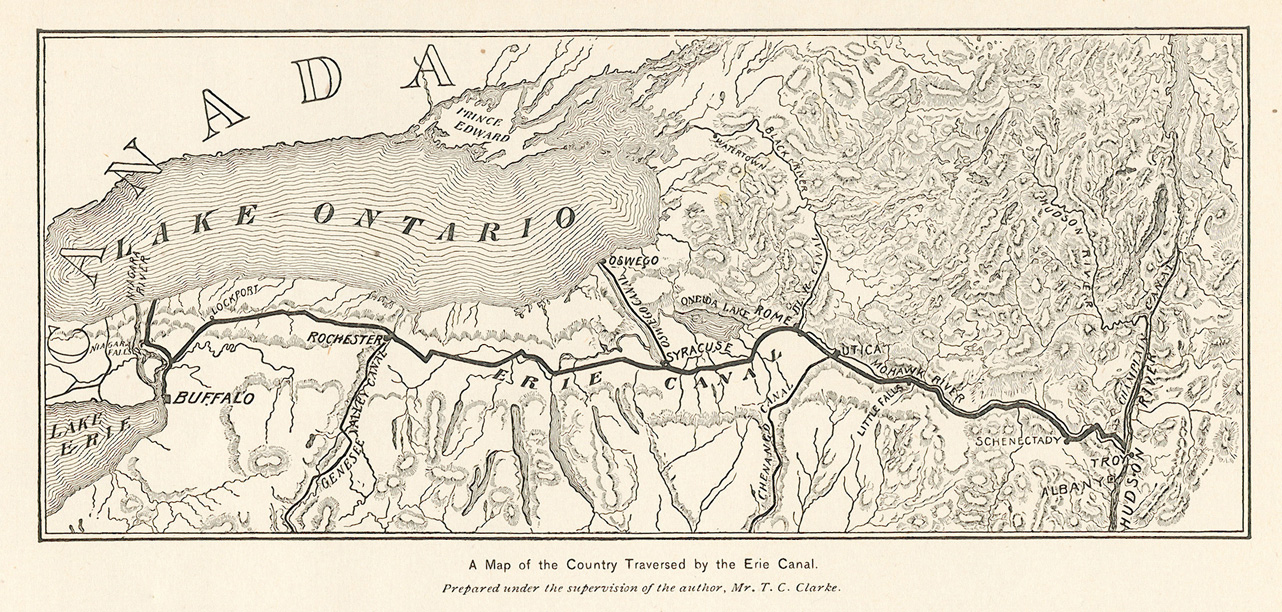
New York was specifically poised to tackle this transportation issue. The Hudson River was the main artery of trade for New York, connecting commercial Manhattan to the capital in Albany. Of the Hudson’s many tributaries, the Mohawk River proved to be the most important. Flowing eastward from Oneida County, it cut a low valley through the Appalachians, the only valley of its kind in the Northeast. Because of this, Governor DeWitt Clinton authorized the construction of a canal along this route in 1817.
Map showing Present and Proposed Canal System, to accompany report of Edward A. Bond, State Engineer and Surveyor of N.Y. (from:Annual report of the State Engineer and Surveyor of the State of New York, for the fiscal year ending September 30, 1903 (Oliver A. Quayle, Albany, 1904) — facing p. 60)
Following eight years of disease, construction accidents, and hard manual labor, the Canal was opened in 1825. The canal was 4 feet deep, 40 feet wide, and spanned 363 miles from Albany to Buffalo. With the construction of the canal, boats could travel from the Hudson River to Lake Erie in less than five days. While many were originally skeptical of the canal, it soon proved its worth. Completed ahead of schedule, and under-budget, the canal paid itself off with tolls in under ten years.
The Erie Canal was one of the first great highways of the United States, bringing goods, ideas, and most importantly people across New York. The Canal revolutionized the economy of Upstate New York, practically creating the cities we know today. In 1817, Buffalo was a village of 2,000 people recently destroyed by the British. Canal commerce turned Buffalo into the world’s premier grain hub, with the city growing into the 9th largest metropolis in the US. Cities sprang up all along the canal route. Hamlets like Rochester, Syracuse, and Schenectady grew into cities with hundreds of thousands of residents, and national centers of industry.
“The most fertile and extensive regions of America will avail themselves of its facilities for a market … [and New York City] will, in the course of time, become the granary of the world, the emporium of commerce, the seat of manufactures, the focus of great moneyed operations.”
– DeWitt Clinton, Governor of New York
Thomas S. Allen
On top of having such economic importance, the canal quickly became a cultural symbol of New York. To many, the canal symbolized their identity as Upstaters, and hope for a prosperous future. One person enamored by the legendary canal was Natick, Massachusetts’s Thomas S. Allen. Allen recalled, “When a boy in school, a picture of the Erie Canal in a Geography attracted my attention and I exclaimed: ‘If I ever see the Eric Canal, I’ll think I’ve seen something worth seeing.’” Sometime around 1910, when traveling to Rochester, Allen finally saw the canal, and immediately knew he had to write a song about it.
It turns out Allen was somewhat of a 1900s musical renaissance man. He was foremost a violinist, playing everywhere from professional orchestras to burlesque shows. On top of this, he directed Vaudeville shows, composing songs for them in the Tin Pan Alley tradition. Throughout his career, he published nine songs under his name, including “The Erie Canal Song.” Originally published in 1913 by Manhattan’s F.B. Haviland Publishing Co, the song was titled “Low Bridge, Everybody Down.” The song looked back to the work of mule barges along the canal.
At the time of its publishing, New York was constructing the Barge Canal System, a mechanized successor to the Erie Canal. Newer diesel and steam powered barges carried much of the cargo down these new canals. Allen’s writing harkened back to a simpler time of mule-drawn ships on the Erie Canal. “We’ve hauled some barges in our day, filled with lumber, coal and hay. And every inch of the way I know, From Albany to Buffalo.” These lines also highlight some of the major midwestern resources that would have flowed Eastward through the canal. Grain and ore were the two specifically that allowed cities like Buffalo to become breadbaskets, and industrial hubs of the East.
The lyrics while romanticizing life on the canal, also speak to the hardships it brought. The repeated chorus “low bridge everybody down,” reflects just one of these difficulties. Nearing the fledgling cities along the canal, extremely low bridges were common obstacles for barges. The cover for the song’s original sheet music depicts this, with the narrator ducking down on his mule to pass under one such bridge. In reality, however, these bridges were bigger dangers for barge passengers. Passengers on barges would commonly ride on top when conditions allowed, having to quickly get down to safely pass under these bridges.
Lift Bridge and Canal St., Canastota, N.Y. — Postcard ; not postmarked ; another slightly variant copy is postmarked Sep. 19, 1907. [CSNYS 1096.1.0890]
The song’s lyrics also play into the themes of hardiness that would fit perfectly in a Spaghetti Western. The lyrics repeatedly mention Sal the Mule’s fighting spirit. Throughout the song Sal brawls her way across the state, sending Mike McGinty to the bottom of the canal, and kicking a man all the way to Buffalo. All of this fighting occurs during the narrator’s 15 years of hard work along the canal. This story of hardy enterprise and masculine bravado call to mind the Wild West. One could easily imagine these stories of barging and brawling taking place in a classic Eastwood or Wayne movie. This makes sense remembering that at the canal’s completion, Upstate New York very much was the “Wild West.”
Since its original composition in 1913, “Low Bridge” has become a folk standard, being performed by countless artists. The first known recording we have of the song is by Billy Murray (not to be confused with actor Bill Murray) from 1912. Murray was a star Tenor of the early 1900s, recording many vaudeville and Tin Pan Alley tracks. This recording is now featured in the Library of Congress’s National Jukebox and Recorded Sound Section.
Aiding in the Canal’s place in American mythology was a recording by folk legend Pete Seeger. Seeger included “The Erie Canal” as track #10 on his 1954 album Frontier Ballads. This album celebrated the stories of workers, and settlers who traveled westward through the new territories of the United States. This album places the Erie Canal alongside stories of Cowboys and railroad workers, placing it firmly within the canon of Americana, and further cementing its Western connection.
Perhaps the latest great recording of “The Erie Canal Song” came from rock legend Bruce Springsteen, as part of his 2006 album We Shall Overcome: The Seeger Sessions. This album included Springsteen’s interpretations of 13 folk and Americana classics popularized by Pete Seeger. Because of this, this version is moreso a Springsteen cover of Seeger’s version, rather than a direct reimagining of the original. The album, including “Erie Canal” shot to number 3 on the billboard top 100, also earning Springsteen a Grammy for best folk album.
Since its publishing 111 years ago, “The Erie Canal Song” has become an icon of American folk music. Not only have massive stars covered it over the years, but it has also really lived up to the definition of folk music, and spread to the masses. Reading comments on the YouTube video of Seeger’s version you see nothing but fond memories. Whether it’s people who learned it as kids in school, or sang it with their grandparents, the song holds an important place in the collective American cultural memory.
On top of all of this, the song speaks to the role the Erie Canal plays in American imagination. It singlehandedly built upstate New York, and connected the country more than it had ever been before. More than just this, it represents a time long gone, where the Wild West wasn’t so far west. Its no wonder why when many people think of New York, they think of the Erie Canal.
“The Erie Canal Song” Lyrics:
I’ve got an old mule, and her name is Sal, Fifteen years on the Erie Canal
She’s a good old worker and a good old pal, Fifteen years on the Erie Canal
We’ve hauled some barges in our day, filled with lumber, coal and hay.
And every inch of the way I know, From Albany to Buffalo
Low bridge, everybody down, Low bridge, we must be getting near a town.
You can always tell your neighbor; you can always tell your pal.
If he’s ever navigated on the Erie Canal
We’d better look ’round for a job old gal, Fifteen years on the Erie Canal
You bet your life I wouldn’t part with Sal, Fifteen years on the Erie Canal
Giddyap there gal we’ve passed that lock, we’ll make Rome ‘fore six o-clock
So one more trip and then we’ll go, Right straight back to Buffalo
Low bridge, everybody down, Low bridge, I’ve got the finest mule in town
Once a man named Mike McGinty tried to put it over Sal
Now he’s way down at the bottom of the Erie Canal
Oh, where would I be if I lost my pal? Fifteen years on the Erie Canal
Oh, I’d like to see a mule as good as Sal, Fifteen years on the Erie Canal
A friend of mine once got her sore, Now, he’s got a broken jaw.
Cause she let fly with her iron toe and kicked him into Buffalo.
Low bridge, everybody down, Low bridge, I’ve got the finest mule in town.
If you’re looking ’round for trouble, better stay away from Sal.
She’s the only fighting donkey on the Erie Canal
I don’t have to call when I want my Sal, Fifteen years on the Erie Canal
She trots from her stall like a good old gal, Fifteen years on the Erie Canal
I eat my meals with Sal each day, I eat beef and she eat hay.
She isn’t so slow if you want to know, she put the “Buff” in Buffalo
Low bridge, everybody down, Low bridge, I’ve got the finest mule in town
Eats a bale of hay for dinner, and on top of that, my Sal.
Tries to drink up all the water in the Erie Canal
You’ll soon hear them sing everything about my gal, Fifteen years on the Erie Canal
It’s a darned fool ditty ’bout my darned fool Sal, Fifteen years on the Erie Canal
Oh, every band will play it soon, Darned fool words and darned fool tune!
You’ll hear it sung everywhere you go, from Mexico to Buffalo
Low bridge, everybody down, Low bridge, I’ve got the finest mule in town.
She’s a perfect, perfect lady, and she blushes like a gal.
If she hears you sing about her and the Erie Canal
On Thursday March 14, Dark Star Orchestra (DSO) kicked off their Spring 2024 Tour at Utica’s Stanley Theatre. DSO has been performing continuously for 26 years paying tribute to The Grateful Dead. Known for playing The Dead’s actual concert setlists DSO treated the Utica Deadhead faithful to their own uniquely crafted setlist.
The show opened with classic Grateful Dead opening song “Cold Rain and Snow” which featured all seven DSO musicians on stage. Vocalist Lisa Mackey left the stage for the Bob Weir classic “Black Throated Wind”. Balloons and some varying scents began to fill the air when the band broke into the standard “Deep Ellum Blues”, a song covered by Jerry Garcia’s solo projects as well as The Grateful Dead. Part of the fun of DSO shows is to guess what Grateful Dead concert they may be playing.
Discover Grateful Dead shows from over the years across New York State with our interactive map below
After “Deep Ellum Blues” there was a lot of chatter in the crowd about what show this could possibly be. Keyboardist Rob Barraco switched from piano to organ and the band kicked into the opening riffs of The Dead’s 80’s rarity “My Brother Esau”. It seemed as if there was a collective epiphany from the crowd that We were in the midst of an original DSO setlist. “I like how they did their own set list and how they have the low energy and then bring in the high energy.” Said Debbie Rathbun. The band next slowed things down with the Hunter/Garcia ballad “So Many Roads” featuring Jeff Mattson on lead guitar and vocals. This was one of those “close your eyes moments” in which Mattson’s guitar tone and phrasing was beautiful and so spot on to Garcia’s. DSO kept it mellow following up with the Brent Mydland song “We Can Run”, sung by Rob Barraco. Earlier in March Barraco performed two shows with original Grateful Dead bassist Phil Lesh celebrating Lesh’s 84th birthday at The Capitol Theater in Port Chester, NY.
DSO continued to mix Grateful Dead favorites, rarities and Jerry Garcia Band staples in set 2. The first deep jam of the night came shortly after the opening song, “Help on The Way”. The instrumental “Slipknot!” showed off DSO’s prowess, tightness and put on display live in Utica why they are the world’s premiere Dead tribute. “Franklin’s Tower” seemed to have the entire crowd inside the beautiful Stanley Theatre on their feet. The band sounded fresh and really seemed to be having fun with smiles abound. Rob Eaton delivered Bob Weir’s “Corrina” with ferocity and passion. The band continued to groove and segway from song to song eventually turning over the stage to Dino English and Rob Koritz for a lengthy, trance-like “Drums”; a staple of The Grateful Dead experience. Set 2 concluded with “One More Saturday Night”, appropriate after a night of weekend energy on a Thursday Night.
The Rolling Stones “Honky Tonk Women” was the lone encore, capping off a night of fun, song surprises, reminiscing and originality in Utica from the world’s number one Grateful Dead tribute.
Dark Star Orchestra – The Stanley Theatre, Utica, NY – March 14, 2024
Set 1: Cold Rain and Snow, Black Throated Wind, Deep Elem Blues, My Brother Esau, So Many Roads, We Can Run, Midnight Moonlight, Box of Rain, Greatest Story Ever Told, Shakedown Street
Set 2: Help on the way > Slipknot > Franklin’s tower> Corrina > Crazy Fingers > Uncle John’s Band > Drums and Space > UJB reprise > Lonesome and a Long Way From Home > Saint of Circumstance > China Doll > One More Saturday Night
The dynamic tribute band, The Frank White Experience will hit the Parish on Broadway in downtown Utica on April 13 to perform a tribute show to honor the legendary rapper Notorious B.I.G.
The Frank White Experience is a tribute band that pays homage to the late great rapper Notorious B.I.G. With their authentic sound and electrifying performances, the band brings the spirit and essence of Biggie Smalls back to life on stage. The Frank White Experience has become renowned for their commitment to capturing the heat of Notorious B.I.G.’s music and persona. With their flawless flow and meticulous attention to lyrical details, the trio delivers a musical experience that transports the audience back to the golden era of hip-hop.
When fans witness The Frank White Experience in action, they can expect to be transported back to the 1990s, reliving the magic of Biggie’s music and the vibrant hip-hop and R&B culture of that era. The Bands’ shows are a celebration of Hip Hop history, and their dedication to preserving the legacy of Notorious B.I.G. is evident in every rhyme and rhythm they deliver.
The trio will perform the nostalgic journey throughout hip-hop history at the Parish on Broadway in downtown Utica on April 13 with tickets exclusively available through Eventbrite.
The 2024 Australian Pink Floyd Show tour will bring to the stage the songs that mean so much to Pink Floyd fans all over the world and will make a stop in Utica on June 25 at The Stanley Theatre.
State of the art lighting and video, pinpoint lasers, huge inflatables and flawless live sound that was the benchmark of Pink Floyd shows, and Australian Pink Floyd Show guarantees to deliver a memorable live experience for audiences old and new.
The Australian Pink Floyd Show gave its first ever concert in Adelaide, Australia in 1988. Since then, they have performed in over 35 countries worldwide; played at David Gilmour’s 50th birthday celebration and were even joined on stage by David and Rick Wright. The Australian Pink Floyd Show is the leading show of its kind in the world, performing the music of Pink Floyd with note for note perfection.
The critically acclaimed show has been astonishing audiences worldwide for more than three decades, always striving to reproduce the complete Pink Floyd experience and bring the music to new audiences.
A stunning light and laser show, video animations, state of the art, high resolution LED screen technology and other special effects are combined with, in true Pink Floyd fashion, there are several huge inflatables including a giant pig, and their own unique Pink Kangaroo.
Often described as being much more than a tribute band, The Australian Pink Floyd Show is the first Pink Floyd tribute show that took the concept into the worldwide arena circuit. The band has played to sell out audiences throughout Europe, UK, America, Canada & South America.
Replicating music from every phase of Pink Floyd’s journey, this tour reinforces TAPFS’s dedication to the heritage of Barrett, Waters, Gilmour, Wright & Mason with a show that pays sincere and genuine tribute to those legendary Pink Floyd productions.
The Australian Pink Flow Show 2024 band lineup includes David Domminney Fowler (Guitar & Vocals), Paul Bonney (Drums), Luc Ledy-Lepine (Guitar), Ricky Howard (Bass & Vocals), Chris Barnes (Vocals), David Parsons (Keyboards), Alex Francois (Saxophone), Lorelei McBroom, Lara Smiles and Emily Lynn (Backing Vocals).
Tour dates include a show at the Paramount in Huntington, making these the only two New York shows of their 2024 world tour. Full tour dates can be found here.
Tickets for all shows, including Australian Pink Floyd Show at the Stanley Theatre in Utica go on sale Friday, February 2nd at 10 AM at thestanley.org, or by calling 315-724-4000.