The Oswego Music Hall has announced their latest calendar listings from September 27 to December 7. Kicking off this season of events is guest host Jane Zell, who steers the series into action.
All ages and experience levels are welcome at the Oswego Music Hall. Budding performers, singer-songwriters and musicians of all genres are given an opportunity to perform in a supportive environment using cutting edge professional sound and lighting equipment.
Syracuse Native, Jane Zell finds her groove in musical variety. Influenced early on by the country blues, Jane learned to finger pick and lace single lines into her rhythm playing. She performs classic covers along with crowd pleasing originals laced with blues, funk, and jazz. A solid guitar player, vocalist and songwriter, Zellâs performances are upbeat, warm, expressive, and oft-times willful.
Guests can expect the National Stage 47th Season. This series contains five shows each with a unique and enchanting musical performance. This season includes shows by Alice Howe & Freebo, Peter Mulvey, Carsie Blanton, Abbie Gardner, and the McKrells.
The wheelchair accessible venue is located in the McCrobie Civic Center, on 41 Lake Street in Oswego. It is adjacent to Breitbeck Park and overlooks Lake Ontario and the Oswego Harbor. The atmosphere is intimate with candle-lit tables surrounding a small stage with light refreshments available.
Oswego Music Hall is a family-friendly, non-profit organization that has been run entirely by volunteers since its inception in 1977. Volunteers can earn admission to shows through various tasks â from running the sound board to making popcorn. Students can also earn credit for community service.
Alice Howe and Freebo
2024 Oswego Music Hall Events Calendar
National Stage 47th season
Sept 28 Alice Howe & Freebo w/Cam Caruso opening
Oct 19 Peter Mulvey w/ Mark Wahl opening
Nov. 2 Carsie Blanton
16 Abbie Gardner w/Ryan David Green (from Ryanhood) opening
Dec. 7 The McKrells
Open Mic Friday
Sept. 27 Jane Zell
Oct. 18 Steve Watson
Nov. 1 Bob Raymonda
Nov. 15 Rich Hart
Dec. 6 Marc Warner
Guest Curator Jazz-by-the-Lake
Oct. 26 Opus Black Strings (Jazz-by-the-Lake)
Nov. 23 Taj (Jazz-by-the-Lake)
Carsie Blanton
For more information on Oswego Music Hall’s upcoming events and to purchase tickets, click here.
Central New York boasts a vibrant music scene with a diverse array of venues, offering everything from intimate live performances to large-scale concerts. These venues contribute to the region’s rich cultural tapestry, providing platforms for both local and national acts.
Glimmerglass Festival is found at Alice Busch Opera Theater as a professional non-profit summer opera company dedicated to producing new productions each season. The company continues its tradition of four new fully staged productions, now including three operas and one work of American musical theater, performed with full orchestra, large cast and no sound amplification. These four productions are supplemented by special performances, cabarets, concerts, lectures and symposiums throughout the season.
A 112-year-old orchard located just south of Syracuse in Lafayette, Beak and Skiff offers a tasting room, distillery and general store, plus a summer concert series that garnered great attention during the social distancing of 2020 and has continued to bring a strong number of artists to a scenic location in southern Onondaga County.
Black Oak Tavern has been a staple for the Central New York social scene for almost 50 years, priding itself on great drinks, a friendly atmosphere, and fantastic live events.
Crouse Hinds Theater – Mulroy Civic Center At Oncenter(Syracuse)
The Oncenter Crouse Hinds Theater contains one of the largest stages in Upstate New York. Symphoria performs concerts on its Masterworks and Pops series at this theater.
Cortland Beer Company has been a part of the scene in Historic Downtown Cortland for over a decade, serving as a popular music venue with indoor and outdoor stages.
Deep Diveâs mission is to provide a safe and inclusive space for artists, patrons, and staff, a neighborhood joint for all walks of people, showcasing a calendar of top-class, unique, and inspiring musicians and performers
This state-of-the-art facility comfortably seats up to 17,500 avid music lovers. The venue, managed by ASM Global and promoted by Live Nation, opened its gates on September 3rd, 2015.
The Folkus Project brings high-quality live acoustic music to Central New York audiences and nurtures the experience of community that live music creates.
Address: May Memorial UU Society, 3800 E. Genesee St., Syracuse 13214
The Hangar Theatre is a non-profit, regional theatre. Its mainstage season and children’s shows occur during the summer, but the Hangar, and other organizations, utilize the space year-round for special events.
The Homer Center for the Arts is known for hosting national music concerts, feature film screenings, a community theater program (Center Players) and showcase artwork by regional, national, and international visual artists in the art gallery. The Center also hosts classes, workshops and programs throughout the year, and adds to the economic vitality of Central New York.
Founded in 1976 by Greg Italiano, The Lost Horizon is one of the longest operational club-sized concert venues in Central New York, playing host to hardcore, hip-hop and variety acts on an irregular basis.
McGirks Irish Pub is a great restaurant for lunch, dinner, take-out, catering, with specials on beer, wine, spirits, and live music on Thursday, Friday, Saturday.
The Other Side is a Utica-based, not-for-profit organization committed to providing space for community initiatives. In addition to sponsoring its own musical, cultural, and social events, The Other Side is available to members of the community who wish to utilize it for yoga classes, musical gatherings, craft fairs, used-record sales, meditation groups, reading groups, and the like.
During the summer months, Saranac Brewery welcomes bands to perform on their outdoor stage, offering live music in the heart of downtown Utica. F.X. Matt Brewing Company is the fourth oldest family-owned brewery in the United States and serves up tasty beers during the shows, with an array of food options for each show.
Seven Of Jazz Lounge opened its doors on Jan. 5, 2023 with the goal of offering a ârelaxing environmentâ for those who want to listen to live music or even just hang out with friends. It is currently under renovations.
Having opened in 1969 as a small corner bar, Shifty’s has maintained its presence in the Lincoln Hill section of Syracuse, offering live music five nights a week, along with award winning wings and veteran staff.
Amid evergreens that create a cozy campground and the backdrop for incredible music, the home of Sterling Stage music festivals and other concerts since 1995, are offered on two unique stages. Welcoming families and kids of all ages, dogs, grills and coolers are permitted at Sterling Stage, with overnight camping included with all tickets.
The State Theatre of Ithaca is a historic, 1600-seat theatre located at Ithaca in Tompkins County, New York that hosts various events from bands, to plays, to comedy acts, to silent films, and more. It was listed on the National Register of Historic Places in 1996
Located in the Southern Tier and close to the Pennsylvania border, this diamond in the rough serves a desert of live music, with rock and country acts performing each summer at Tag’s Summer Stage.
A 1920s speakeasy-style bar that is located in the cellar of Oh My Darling restaurant in Downtown Syracuse, The Fitz offers a variety of music to pair with craft cocktails in a unique space, located close to the Landmark Theatre for pre and post show music and libations.
A classic hunting lodge, now offering weddings and event space, The “G” Lodge welcomes events hosted by Hey Dude After Hours, who bring community-driven and family friendly music events, as well as summer and fall music festivals.
Upstate Medical University Arena at Onondaga County War Memorial (Syracuse)
The Upstate Medical University Arena at The Oncenter War Memorial is a multi-functional 7,000 seat venue with event space available on three levels, and home to the Syracuse Crunch, hosting concerts around the year.
The Westcott Theater is a 700-person multi-purpose concert venue in Syracuse’s Westcott neighborhood. Known for its cinema-style setting, the venue accommodates various genres but has particularly expanded its electronic music acts in recent years.
Wonderland Forest is more than just a forest: it has hiking trails, campgrounds, a wedding venue, and more recently, an outdoor music venue with various bands, food vendors, and other activities from across the United States. They have played host to the 50th anniversary of Summer Jam, Biscoland, Trey Anastasio, and many more concerts on tap for 2024.
Built on the site of Dopps Run, Dave Woods started Woods Valley in 1964, and Woods Valley Ski Area has been teaching families to ski for 60 years. Plenty of music can be found year round in the lodge, with performances by touring and regional bands peppering the calendar and warming up the nights after skiing the slopes at Woods Valley.
As we approach the bicentennial of the Erie Canal in 2025, let’s look back at this marvel of modern engineering. Not only did the Canal transform much of Upstate New York, but it also transformed folk music. While known by many names since its composition, “The Erie Canal Song” has become a staple of the American folk songbook. With lyrics reflecting life on the canal, and the changes it brought to the state, it proves a useful tool for exploring New York’s history.
Before the Days of Rapid Transit, Edward Lamson Henry (1841-1919) c.1900 Pencil and watercolor, ht.13 3/4′ x w.34 3/4″ Albany Institute of History & Art Purchase, 1976.7.2
The year is 1807, and the United States is slowly expanding into The Northwest Territories (or what is now the Midwest). This region was rich in the grain and metals needed to supply populations on the East Coast. The only issue was that transporting these resources to the East Coast commercial hubs was difficult to say the least. The Appalachian mountains provided a massive barrier for mule trains, with the journey from New York City to Detroit taking four weeks.
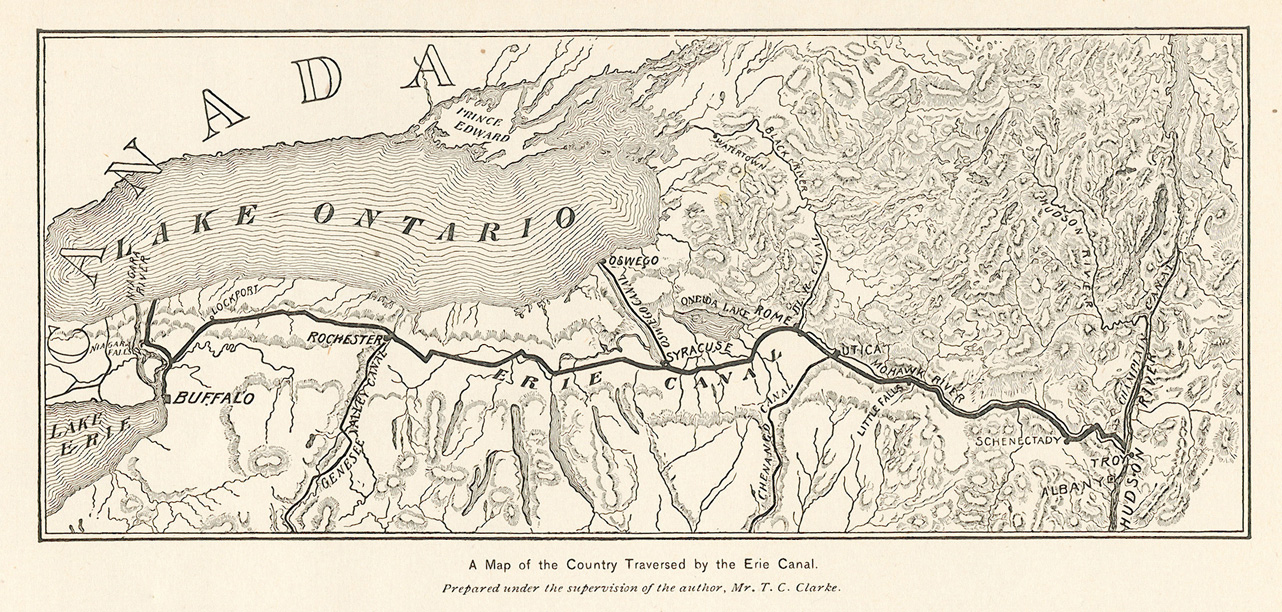
New York was specifically poised to tackle this transportation issue. The Hudson River was the main artery of trade for New York, connecting commercial Manhattan to the capital in Albany. Of the Hudson’s many tributaries, the Mohawk River proved to be the most important. Flowing eastward from Oneida County, it cut a low valley through the Appalachians, the only valley of its kind in the Northeast. Because of this, Governor DeWitt Clinton authorized the construction of a canal along this route in 1817.
Map showing Present and Proposed Canal System, to accompany report of Edward A. Bond, State Engineer and Surveyor of N.Y. (from:Annual report of the State Engineer and Surveyor of the State of New York, for the fiscal year ending September 30, 1903 (Oliver A. Quayle, Albany, 1904) — facing p. 60)
Following eight years of disease, construction accidents, and hard manual labor, the Canal was opened in 1825. The canal was 4 feet deep, 40 feet wide, and spanned 363 miles from Albany to Buffalo. With the construction of the canal, boats could travel from the Hudson River to Lake Erie in less than five days. While many were originally skeptical of the canal, it soon proved its worth. Completed ahead of schedule, and under-budget, the canal paid itself off with tolls in under ten years.
The Erie Canal was one of the first great highways of the United States, bringing goods, ideas, and most importantly people across New York. The Canal revolutionized the economy of Upstate New York, practically creating the cities we know today. In 1817, Buffalo was a village of 2,000 people recently destroyed by the British. Canal commerce turned Buffalo into the world’s premier grain hub, with the city growing into the 9th largest metropolis in the US. Cities sprang up all along the canal route. Hamlets like Rochester, Syracuse, and Schenectady grew into cities with hundreds of thousands of residents, and national centers of industry.
“The most fertile and extensive regions of America will avail themselves of its facilities for a market … [and New York City] will, in the course of time, become the granary of the world, the emporium of commerce, the seat of manufactures, the focus of great moneyed operations.”
– DeWitt Clinton, Governor of New York
Thomas S. Allen
On top of having such economic importance, the canal quickly became a cultural symbol of New York. To many, the canal symbolized their identity as Upstaters, and hope for a prosperous future. One person enamored by the legendary canal was Natick, Massachusetts’s Thomas S. Allen. Allen recalled, “When a boy in school, a picture of the Erie Canal in a Geography attracted my attention and I exclaimed: ‘If I ever see the Eric Canal, I’ll think I’ve seen something worth seeing.’” Sometime around 1910, when traveling to Rochester, Allen finally saw the canal, and immediately knew he had to write a song about it.
It turns out Allen was somewhat of a 1900s musical renaissance man. He was foremost a violinist, playing everywhere from professional orchestras to burlesque shows. On top of this, he directed Vaudeville shows, composing songs for them in the Tin Pan Alley tradition. Throughout his career, he published nine songs under his name, including “The Erie Canal Song.” Originally published in 1913 by Manhattan’s F.B. Haviland Publishing Co, the song was titled “Low Bridge, Everybody Down.” The song looked back to the work of mule barges along the canal.
At the time of its publishing, New York was constructing the Barge Canal System, a mechanized successor to the Erie Canal. Newer diesel and steam powered barges carried much of the cargo down these new canals. Allen’s writing harkened back to a simpler time of mule-drawn ships on the Erie Canal. “We’ve hauled some barges in our day, filled with lumber, coal and hay. And every inch of the way I know, From Albany to Buffalo.” These lines also highlight some of the major midwestern resources that would have flowed Eastward through the canal. Grain and ore were the two specifically that allowed cities like Buffalo to become breadbaskets, and industrial hubs of the East.
The lyrics while romanticizing life on the canal, also speak to the hardships it brought. The repeated chorus “low bridge everybody down,” reflects just one of these difficulties. Nearing the fledgling cities along the canal, extremely low bridges were common obstacles for barges. The cover for the song’s original sheet music depicts this, with the narrator ducking down on his mule to pass under one such bridge. In reality, however, these bridges were bigger dangers for barge passengers. Passengers on barges would commonly ride on top when conditions allowed, having to quickly get down to safely pass under these bridges.
Lift Bridge and Canal St., Canastota, N.Y. — Postcard ; not postmarked ; another slightly variant copy is postmarked Sep. 19, 1907. [CSNYS 1096.1.0890]
The song’s lyrics also play into the themes of hardiness that would fit perfectly in a Spaghetti Western. The lyrics repeatedly mention Sal the Mule’s fighting spirit. Throughout the song Sal brawls her way across the state, sending Mike McGinty to the bottom of the canal, and kicking a man all the way to Buffalo. All of this fighting occurs during the narrator’s 15 years of hard work along the canal. This story of hardy enterprise and masculine bravado call to mind the Wild West. One could easily imagine these stories of barging and brawling taking place in a classic Eastwood or Wayne movie. This makes sense remembering that at the canal’s completion, Upstate New York very much was the “Wild West.”
Since its original composition in 1913, “Low Bridge” has become a folk standard, being performed by countless artists. The first known recording we have of the song is by Billy Murray (not to be confused with actor Bill Murray) from 1912. Murray was a star Tenor of the early 1900s, recording many vaudeville and Tin Pan Alley tracks. This recording is now featured in the Library of Congress’s National Jukebox and Recorded Sound Section.
Aiding in the Canal’s place in American mythology was a recording by folk legend Pete Seeger. Seeger included “The Erie Canal” as track #10 on his 1954 album Frontier Ballads. This album celebrated the stories of workers, and settlers who traveled westward through the new territories of the United States. This album places the Erie Canal alongside stories of Cowboys and railroad workers, placing it firmly within the canon of Americana, and further cementing its Western connection.
Perhaps the latest great recording of “The Erie Canal Song” came from rock legend Bruce Springsteen, as part of his 2006 album We Shall Overcome: The Seeger Sessions. This album included Springsteen’s interpretations of 13 folk and Americana classics popularized by Pete Seeger. Because of this, this version is moreso a Springsteen cover of Seeger’s version, rather than a direct reimagining of the original. The album, including “Erie Canal” shot to number 3 on the billboard top 100, also earning Springsteen a Grammy for best folk album.
Since its publishing 111 years ago, “The Erie Canal Song” has become an icon of American folk music. Not only have massive stars covered it over the years, but it has also really lived up to the definition of folk music, and spread to the masses. Reading comments on the YouTube video of Seeger’s version you see nothing but fond memories. Whether it’s people who learned it as kids in school, or sang it with their grandparents, the song holds an important place in the collective American cultural memory.
On top of all of this, the song speaks to the role the Erie Canal plays in American imagination. It singlehandedly built upstate New York, and connected the country more than it had ever been before. More than just this, it represents a time long gone, where the Wild West wasn’t so far west. Its no wonder why when many people think of New York, they think of the Erie Canal.
“The Erie Canal Song” Lyrics:
I’ve got an old mule, and her name is Sal, Fifteen years on the Erie Canal
She’s a good old worker and a good old pal, Fifteen years on the Erie Canal
We’ve hauled some barges in our day, filled with lumber, coal and hay.
And every inch of the way I know, From Albany to Buffalo
Low bridge, everybody down, Low bridge, we must be getting near a town.
You can always tell your neighbor; you can always tell your pal.
If he’s ever navigated on the Erie Canal
We’d better look ’round for a job old gal, Fifteen years on the Erie Canal
You bet your life I wouldn’t part with Sal, Fifteen years on the Erie Canal
Giddyap there gal we’ve passed that lock, we’ll make Rome ‘fore six o-clock
So one more trip and then we’ll go, Right straight back to Buffalo
Low bridge, everybody down, Low bridge, I’ve got the finest mule in town
Once a man named Mike McGinty tried to put it over Sal
Now he’s way down at the bottom of the Erie Canal
Oh, where would I be if I lost my pal? Fifteen years on the Erie Canal
Oh, I’d like to see a mule as good as Sal, Fifteen years on the Erie Canal
A friend of mine once got her sore, Now, he’s got a broken jaw.
Cause she let fly with her iron toe and kicked him into Buffalo.
Low bridge, everybody down, Low bridge, I’ve got the finest mule in town.
If you’re looking ’round for trouble, better stay away from Sal.
She’s the only fighting donkey on the Erie Canal
I don’t have to call when I want my Sal, Fifteen years on the Erie Canal
She trots from her stall like a good old gal, Fifteen years on the Erie Canal
I eat my meals with Sal each day, I eat beef and she eat hay.
She isn’t so slow if you want to know, she put the “Buff” in Buffalo
Low bridge, everybody down, Low bridge, I’ve got the finest mule in town
Eats a bale of hay for dinner, and on top of that, my Sal.
Tries to drink up all the water in the Erie Canal
You’ll soon hear them sing everything about my gal, Fifteen years on the Erie Canal
It’s a darned fool ditty ’bout my darned fool Sal, Fifteen years on the Erie Canal
Oh, every band will play it soon, Darned fool words and darned fool tune!
You’ll hear it sung everywhere you go, from Mexico to Buffalo
Low bridge, everybody down, Low bridge, I’ve got the finest mule in town.
She’s a perfect, perfect lady, and she blushes like a gal.
If she hears you sing about her and the Erie Canal
The Oswego Music Hall is proud to present Shawna Caspi and Rachael Kilgour, as part of its Women in Music Series, on Saturday, March 23 at 7:30 p.m.
Before the concert, the public is invited to the Annual Member Meeting which will take place at 4:30.
Shawna Caspi. Photo by Terence Gui.
“I’m excited to be kicking off the first year of our new Women in Music Series during Women’s History Month with two talented Canadian singer-songwriters that put on incredible performances at the NERFA conference,” said Tom Lambert, Artistic Director.
The Oswego Music Hall evolved from a little coffee house venue called “The Low Life Cafe,” created by Richard Reinert in 1976, on Water Street in Oswego, known as the Market House Music Hall. Oswego Music Hall was incorporated in 1979 and received 501(c)(3) nonprofit status in 1985. The venue relocated twice before settling into the McCrobie Civic Center, a historic municipal building adjacent to Breitbeck Park, overlooking the Great Lake Ontario.
Run by an incredibly reliable team of volunteers, Oswego Music Hall has produced diverse and high-quality concerts on their National Stage every other Saturday night during their fall, winter/spring seasons, and national stage events for 40 years. Their programs offer Oswego and the Greater Central New York community exposure to top-quality touring musicians, singers, and songwriters of many genres. Most importantly, the venue helps support artists and music not typically heard in the mainstream media, encouraging the development of emerging artists from the community.
Toronto-based singer-songwriter Shawna Caspi takes her time crafting poetic and meaningful lyrics, often using unusual rhymes. She spent years on the road playing solo shows at festivals and in concert halls, train cars, backyards, and living rooms, supporting her warm, clear voice with intricate fingerstyle guitar accompaniment, and drawing energy from shifting landscapes and long drives through Canada and the United States. After taking a break from the road, she returns with her fifth album, Hurricane Coming, a collection of raw, deeply personal songs set against a backdrop of colorful cinematic soundscapes. She also created a series of abstract paintings inspired by the songs on the album.
Hurricane Coming was nominated for a Canadian Folk Music Award for Contemporary Album of the Year and the Ontario Folk Music Award for Album of the Year. Her songs have also won awards from Folk Music Ontario and the Songwriters’ Association of Washington. She strives to tell the truth and empower listeners to come to terms with the parts of themselves and the world that they might find scary.
Rachael Kilgour. Photo by Kara Dupre.
Rachael Kilgour is a Canadian-American songwriter and performing artist whose plain-spoken, lyric-driven work and intimate performances have endeared her to listeners and fellow artists alike. Kilgour has been featured at NYC’s Lincoln Center, The Kennedy Center in Washington D.C., and the Sundance Film Festival.
Her exquisite fourth full-length collection, My Father Loved Me, is a tribute to her late father, produced by JUNO Award-winning songwriter Rose Cousins and recorded in the senior Kilgour’s native Canada. Kilgour gives us a complex portrait of a man through his daughter’s eyes, posing questions about identity, inheritance, and grief, affirming the value of one ordinary working man’s life in an often indifferent world.
Tickets are on sale online or at the Rivers End Bookstore in Oswego.
Oswego Music Hall Events Calendar
Mar 16 The Intention – Jazz by the Lake
Mar 22 Open Mic w/Hosts Frank Stefanek and Julie Clement
Mar 23 Shawna Caspi and Rachael Kilgour (Women in Music Series)
Apr 12 Open Mic w/Host Mark Zane
Apr 13 Big Sky Quartet
Apr 20 Count Blastula w/Special Guest Mike Dubaniewicz Jazz by the Lake
Apr 26 Open Mic w/Host Larry Kyle
Apr 27 Livingston Taylor w/Ash & Eric opening
May 11 Season Finale – Sam Robbins & Emerging Artists Showcase
The Oswego Music Hall, also known as the Ontario Performing Arts Center, has announced its 2024 calendar of events, featuring diverse band Mile Twelve, and Americana Upstate-NY group Driftwood, among others.
The Oswego Music Hall evolved from a little coffee house venue called “The Low Life Cafe,” created by Richard Reinert back in 1976, on Water Street in Oswego where it was known as the Market House Music Hall. Oswego Music Hall was incorporated in 1979 and received 501(c)(3) nonprofit status in 1985. The venue relocated twice before settling into the McCrobie Civic Center, a historic municipal building adjacent to Breitbeck Park, overlooking the Great Lake Ontario.
Run by an incredibly reliable team of volunteers, Oswego Music Hall has produced diverse and high-quality concerts on their National Stage every other Saturday night during their fall, winter/spring seasons, and national stage events for 40 years. Their programs offer Oswego and the Greater Central New York community exposure to top-quality touring musicians, singers, and songwriters of many genres. Most importantly, the venue helps support artists and music not typically heard in the mainstream media, encouraging the development of emerging artists from the community.
Their first Main Stage event of the year is on January 27 at 7:30 p.m. with Boston group Mile Twelve. The group has won several awards, and recently added two new members: fiddler and vocalist Ella Jordan and mandolinist Korey Brodsky, adding a new dimension to the band. With a variety of songs and genres, people can expect to hear a little bit of everything.
Tom Rush at the Oswego Music Hall.
The next Main Stage event is on February 10 with Driftwood performing. Anyone familiar with the Americana music scene knows this Upstate, New York-based band has cut their teeth on a killer live show. With a never-ending tour schedule and a steady buzz, they have built a very solid underground fan base.
National Stage acts coming to the venue include Vance Gilbert, Frank Solivan & Dirty Kitchen, Shawna Caspi and Rachael Kilgour, Big Sky Quartet, and many more.
To purchase tickets and for more information, visit here.
Oswego Music Hall Events Calendar
Jan 27 Mile Twelve
Feb 9 Open Mic w/Mark Wahl opening
Feb 10 Driftwood
Feb 17 Jazz by the Lake
Feb 23 Open Mic w/Kenny Roffo opening
Feb 24 Vance Gilbert, w/Cam Caruso opening
Mar 2 Imagining Kerouac, curated by Don Masterson
Mar 8 Open Mic w/Jane Zell opening
Mar 9 Frank Solivan & Dirty Kitchen
Mar 16 Jazz by the Lake
Mar 22 Open Mic w/Frank Stefanek and Julie Clement opening
Mar 23 Shawna Caspi and Rachael Kilgour (Women in Music Series)
Apr 12 Open Mic w/Mark Zane opening
Apr 13 Big Sky Quartet
Apr 20 Jazz by the Lake
Apr 26 Open Mic w/Larry Kyle opening
Apr 27 Livingston Taylor
May 11 Sam Robbins (Season Finale, Emerging Artists Showcase)