Hayley Jane and Laura Leigh paired up for an unforgettable night of music at Ophelia’s in Albany on the bitter cold night of December 21st.
Photo by Pat Rogers
The show capped off a week that saw Ophelia’s welcome Slidin’ Dirty relocating from Troy and serving up a deep menu of top notch burgers and more.
Photo by Chris Bobillo
The evening was presented by Guthrie/Bell Productions and also the final Jam for Tots show of the holiday season. (thanks to all who brought an unwrapped toy!)
Photo by Pat Rogers
A natural pairing for this show, Hayley Jane and Laura Leigh have performed shows together since 2022. Hayley pulls inspiration from so many styles – 60s + 70s rock + pop, musical theater, folk, blues, soul, psychedelic, funk + bluegrass – and offers a no holds barred approach to her sets. This made each song a performance, nothing less. Hayley Jane’s passion and energy are expressed out to the audience, bouncing back off and driving each show to new heights.
Opening up, Laura Leigh’s set picked up steam slowly and offered no break once the wheels were turning. Hailing from Cambridge in Washington County, Laura Leigh has gone from busking around the Capital Region to performing on local stages to a growing audience. Her 2021 albumLivin’ in Cambridge painted a picture of her small town, and newer songs since written offer a glimpse into a songwriter’s journey.
Ross Goldstein released his brand new album, Blunders on November 15 on OddCat Records. The nine track, polished LP takes a deep dive into the world of psychedelia and features producer Eric Goulden (Wreckless Eric). This is Goldstein’s fifth full-length record, following his 2021 release Chutes and Ladders.
Artwork by Robert Beatty
Recorded in Catskill, NY at Goulden’s home studio, Blunders was co-produced and engineered by Wreckless Eric. Both Goldstein and Goulden are credited with playing almost every instrument on the record. Despite a morose subject matter, there’s a noticeable warmth that encapsulates Blunders.
Goldstein refers to the LP as “bummer psychedelia” and states that he was “aiming to achieve a cinematic mood and a feeling of being alone and lost on the road in America. Living on the road and feeling lonely and isolated are central themes of the record – attempting to pick up the pieces after relationships fall apart – both accepting and embracing failures.”
Goldstein cites 60’s and 70’s pop, artists like Neil Young, The Beatles, and Grateful Dead as his primary influences as a songwriter. He also references Holland, the 1973 release by The Beach Boys as a major source of inspiration.
Goldstein’s arrangements, eclectic songwriting and heavy use of imagery in his lyrics allow for each song to stand alone – yet they are pieced together in a way that not only establishes his goal of cinematic musicality, but creates a captivating piece of art from Blunders’ first note, to its last. From the country americana, tinged by psychedelia vibes of “My Slippers”, to the dreamy, albeit uneasy soundscapes on tracks like “The Village”, this record has a welcoming yet dark in nature attitude.
His eccentric tones, emotional guitar solos, goosebump inducing textures and production techniques are reminiscent of bands like Pink Floyd and Ween. His use of spoken word on “Carrizozo” and “Ticker Tape”, the funk grooves of “Odd Man Out” and the seemingly not so lyrically serious “I Forgot To Comb My Hair” are just a few examples of how this genre-blending, borderline defying release synthesize under an umbrella of psychedelic folky goodness.
Blunders is currently available on all streaming services – learn more and support Ross Goldstein here.
In its sixth year, Black Bear Americana Music Fest presented three full days of roots, contemporary and traditional folk, country, blues, bluegrass and mixed-genre solo artists and bands on its main stage, acoustic stage, gazebo stage and workshop stages to an audience that ranged from those of us who are of Woodstock era to kids chasing soap bubbles.
Black Bear ran from Friday, October 11, through Sunday, October 13 at the Goshen Fairgrounds, Goshen, CT.
The Crowd – Victor Wainwright & The Train
The festivals producers, Ian Campbell and Beth Murphy, did a fantastic job and managed to present a festival that brought acts from the unknown to those who needed no introduction.
Although the festival’s first “official” day was Friday, many arrived on Thursday to set up their tent or RV sites. On Thursday night the festival opened, “unofficially”, with the Big Orange Tarp Songwriter Circle, created by Alan Rowoth decades ago in connection with other festivals, and currently presented by Rowoth and singer songwriter Andrew Dunn of CT, who performed at the festival on Sunday.
Andrew Dunn, Hosting Big Orange Tarp
What follows is a quick look at most of the performers at Black Bear. The simultaneous multiplicity of performances on separate stages made full coverage impossible.
Lucas Neil of Saratoga Springs, performing his Americana and indie-folk originals, Glori Wilder of western CT’s R&B and eclectic mix, and Red Smith of Wilmington, DE highly energized originals flavored by influences of country, folk, rock, bluegrass, and soul with vocals that turned on a dime from sweet to gravel and grit, opened the festival on the Acoustic Stage, each with a set of their original songs, in the “Songwriter Showcase”.
Lucas NeilGlori WilderRed Smith
The Midnight Anthem, a group based in CT fronted by three cousins, opened the Main Stage for the day with a set of their country-oriented Americana songs, followed by Burlington, VT’s Tall Travis, an indie folk band with bluegrass folk/punk influences, on the Acoustic State, with one of their two performances for the weekend.
Tall Travis
Over on the Gazebo Stage, Charlie Diamond performed a set of his pop/folk flavored Americana original story type songs with a Dylan-esque type voice that matched his songs perfectly.
Charlie Diamond
Back at the Acoustic Stage, highly regarded Canadian songwriter Scott Cook and Pamela Mae, currently on tour in the US and Canada, performed a set of well-crafted songs, primarily of hope and positive messages, mostly based upon Scott’s life experiences.
Scott Cook and Pamela Mae
Long time folk- favorite New England singer songwriter Cheryl Wheeler, whose songs have been covered by artists as diverse and Garth Brooks and Bette Midler, took the Main Stage where she delivered some long time favorites, as well as some of her newer work.
Cheryl Wheeler
The Rough & Tumble, multi-instrumentalists from New Hampshire, took the Acoustic stage to perform what they describe as their “Dumpster – Folk/Triftstore – Americana” originals for an appreciative crowd.
The Rough and Tumble
The Currys, from Charlottesville, VA , fronted by two brothers and a cousin, played a set of their original indie-folk rock songs with tight vocal harmonies on the Main Stage.
The Currys
Meghan Cary, a Billboard Magazine’s Critic’s Choice Award Winner, performed a beautiful set of her originals from folk rock power ballads to touching songs of hope, backed up on keys by Peter Farrell.
Meghan Cary
Over on the Workshop Stage, Bryan Titus, Marc Apostolides and Shawn Taylor presented songs, stories and photos, from their collective thru-hikes and long-distance hikes on the Appalachian Trail, The Long Trail, The John Muir Trail and the Pacific Crest Trail.
Arm Chair Boogie, a jamgrass/newgrass act from Wisconsin did an excellent performance on the Main Stage which go the crowd to its feet.
Arm Chair Boogie
In addition to performers, there were a number of organizations at Black Bear. “Meals for Music” was an especially compelling organization. It is a non-profit which provides home cooked meals for musicians on the road not only to feed those low on cash, but also for making those on tour feel a bit “at home”…Currently serving the Connecticut area, they are an organization worth looking at.
Meals for Music
The Best Times band performed a set of their original indie rock songs on the Gazebo Stage.
The Best Times
Back across the fields, The Decker Bandits of Collinsville, CT filled the Acoustic Stage with a mix of bluegrass, funk rock/dance originals delivered their own energy to the crowd.
The Decker Bandits
The final act of Friday night was grammy nominated, award winning Victor Wainwright’s Victor Wainwright & The Train, whose piano, electric guitar, horns and rhythm section got the crowd up and moving with their original Americana, blues and wide ranging roots music, with sprinklings of boogie-woogie, honky-tonk, and New Orleans piano.
Victor Wainwright & The Train
Jason Ingriselli & The Miles North opened up Saturday’s performances on the Main Stage showcasing Ingriselli’s powerful voice and songs which he calls New England Country Music.
Jason Ingriselli and The Miles North
Drank The Gold, an Upstate NY based duo brought their soaring vocal harmonies fiddle, guitar/banjo Irish and American old-time and contemporary traditionalist songs to the Acoustic Stage to round out the morning.
Drank The Gold
Kerri Powers bought her original blues and soulful earthy songs on acoustic and resophonic guitars to the Main Stage to an appreciative crowd.
Kerri Powers
Massachusett’s Sean Maqwire, who has fast become one of this writer’s favorite songwriters, brought a handful of his well-crafted songs to the Acoustic Stage.
Sean Magwire
Goodnight Moonshine, a duo, delivered their original folk songs with beautiful vocal harmonies, and an improvisational style and feel more common to jazz than typical folk music.
Goodnight Moonshine
In addition to continuous performances each day on three separate stages, Black Bear presented thirteen different workshops over the three-day festival, including some in songwriting, music production, performance, improv and other music related subjects, all while Main, Acoustic and Gazebo Stage performances continued. This writer took the time to venture over to the Workshop stage mid-afternoon on Saturday to catch workshops on Improv musicianship and songwriting, and then made it back to the Main and Acoustic Stage to see the rest of the performances.
The Slambovian Circus of Dreams, a Central NY based group that has been together for about twenty years, delivered their songs of fantastic stories with a high energy, crowd engaging performance, in what has been called “Woodstock-tinged psychedelia..[with] a hint of southern rock, Celtic and British folk combined with solid songwriting..” that moved the audience and brought it to its feet.
The Slambovian Circus of Dreams
Tall Travis, an indie folk band from Burlington, VT, with its unique bluegrass folk/punk influences, filled the Acoustic stage for the second time over the weekend and lit up the stage with their own brand of musical energy.
Tall Travis
Saturday night’s finale was delivered by Quebec’s Le Vent du Nord who delivered songs and performances of both traditional and original compositions, with highly rhythmic and soulful music, rooted in the Celtic diaspora, enhanced with a broad range of global influences. And when festival producers Ian Campbell and Beth Murphy took the stage before the encore the crowd yelled for the band to be brought back again next year.
Le Vent du Nord
After the stages shut down for the night, those in the know headed for the songwriter circles put on by Big Orange Tarp, Pirates Camp and the Jubilee Jam Tent.
Sunday morning started out with a Main Stage performance by folk legend Vance Gilbert who engaged the audience with a brilliant combination of original songs and banter. Gilbert also offered an excellent performance critique for musicians at the festival at the Workshop stage in the afternoon.
Vance Gilbert
Terra Coda, a band of five percussionists, delivered their unique music to an appreciative crowd, just before the rains came.
Tera Coda
Performers scheduled for later in the day included Ash & Eric, Josh Joplin Group, Two Crows for Comfort, Way Down Wanderers, Shanna In A Dress, Whiskey Talks and Adam Ezra Group.
A truly special component of Black Bear are the songwriter-in-the-round events that feature both featured acts at the festival and other songwriters picked by the various event’s creators or organizers, where a small group of songwriters alternate delivering their songs, solo, for a few rounds, and then the next group comes in, repeating the rounds until the wee hours of the morning. “In the round” events were held each day and night at “The Big Orange Tarp (aka the BOT)”, “Pirate Camp”, the Jubilee Jam Tent. For many, these songwriter circles are a significant part of what makes a festival like Black Bear such a highly respected musical event.
One of these, the “Big Orange Tarp”, or BOT as it’s known by its fans, featured solo performances in the round each night of the festival and into the wee hours of the morning by a number of those who performed at the festival, as well as by other songwriters, including this writer, all handpicked by Rowoth or Dunn. For many, the BOT, and the other in the round songwriter circles, represent one of the most cherished events at this and many other festivals (Kerrville, Falcon Ridge, and more) and represent what many feel is the best way to hear songs, unadorned by stage sound support, performed “in the raw” by the people who wrote them.
Big Orange Tarp, Songwriter Circle
In addition to the fantastic and well curated music and music related workshops for musicians and music lovers, the Black Bear Americana Music Fest provided a varied array of food vendors; workshops in glass making, painting, gel plate printing, pumpkin carving and jewelry making; chili tasting and interactive cocktail making classes; and cannabis related classes from making edibles at home, to growing and harvesting; and the Festival provided AA meetings each morning.
All in all Black Bear was an excellent music festival and one which many will surely attend again next year.
Thank you Ian Campbell and Beth Murphy for a fantastic 2024 Black Bear. See you next year!
Ian Campbell and Beth MurphyVictor Wainwright and The TrainVictor Wainwright and The TrainVictor Wainwright and The TrainVictor Wainwright and The TrainVictor Wainwright and The TrainVictor Wainwright and; The TrainVictor Wainwright and The TrainVictor Wainwright and The TrainVictor Wainwright and The TrainVictor Wainwright and The TrainVictor Wainwright and The TrainVictor Wainwright and The TrainVictor Wainwright and The TrainVictor Wainwright and The TrainVictor Wainwright and The TrainVance GilbertVance GilbertThe New StudentsThe Decker BanditsThe CurrysTall TravisTall TravisBlack Bear Americana Music FestivaThe Slambovian Circus of DreamsThe Slambovian Circus of DreamsThe Slambovian Circus of DreamsThe Slambovian Circus of DreamsThe Slambovian Circus of DreamsThe Slambovian Circus of DreamsThe Slambovian Circus of DreamsThe Slambovian Circus of DreamsThe Slambovian Circus of DreamsThe Slambovian Circus of DreamsThe Slambovian Circus of DreamsThe Slambovian Circus of DreamsThe Slambovian Circus of DreamsThe Slambovian Circus of DreamsThe Slambovian Circus of DreamsSean MagwireSean MagwireSean MagwireScott Cook and Pamela MaeScott Cook and Pamela MaeScott Cook and Pamela MaeThe Rough and TumbleRed SmithMeghan CaryMeghan CaryMeghan CaryMeghan CaryPamela Mae, Scott Cook, Andrew DunnLucas NeilLe Vent du NordLe Vent du NordLe Vent du NordLe Vent du NordLe Vent du NordLe Vent du NordKerri PowersKerri PowersGoodnight MoonshineCoffee Guys
Cheryl WheelerCharlie DiamondBlack Bear Americana Music Festival – 2024Arm Chair BoogieArm Chair Boogie
A walking music legend, Carole King’s roots in New York run deep. Born and raised in Brooklyn, a graduate of Queens College, and lifetime lover of the Manhattan music scene as both an artist and an audience member, New York is an integral part of King’s work and identity at large.
Photo: Jim McCrary, via caroleking.com
Born Carol Joan Klein to Russian and Polish immigrant parents, Carole arrived in the world not too soon after her mother and father had arrived in Brooklyn via Ellis Island. With her father, a radio announcer turned New York City firefighter, and mother, a secretary at a local high school, Carole’s life has been positively steeped in musicality from day one – as well as a deeply ingrained identity as a New York native and lifelong Brooklyn Dodgers fan since youth.
Famously meeting while in an elevator at Brooklyn College, Carole’s father set the precedent for a Klein behind the microphone with his gig as a radio announcer, and her mother’s studies in and passion for english and drama lent themselves to a rather creative upbringing.
Upon her parents’ separation, Carole sought attention and found the answer in the theater. First being introduced to the glittering world of Broadway at just five years old, Carole fell utterly in love, absorbing all of the media and musical projects her mother put on. Her home was rarely quiet, being constantly introduced to shades of music varying from show tunes to Brahms.
Photo via caroleking.com
Finding a unique outlet for emotions of all ranges, King leaned into the theatrics of the stage as she grew up, eventually auditioning for the High School of Performing Arts – now referred to as the Fiorello H. LaGuardia High School of the same name. While the audition was not a success, it marked a turning point for Carole as the arts became something of possible professional pursuit more concretely in her mind.
As any teenager of the mid 1950s did, Carole often tuned in to her favorite radio stations. However, unlike many other of her rather sheltered white peers, Carole’s station of preference was Alan Freed’s nightly WINS program. Freed was a lover of artists like the Penguins, the Moonglows, the Clovers, Danny Overbea, La Vern Baker, and BB King – a notably African-American lineup that had many white parents positively beside themselves.
In addition, many tracks played on Freed’s station fell under the umbrellas of rock and roll and R&B, both equally scandalous for their promiscuity and narratives on adversity that were up until then rather absent in the public eye’s musical circuit. This scandal was all the better for an adolescent King, however, who found the new wave of music and its consequent conscious style of creation absolutely mesmerizing
Carole has never been one to shy away from advocating for her beliefs. After moving to Idaho in 1977, she became deeply entrenched in the local ecosystem’s wellbeing and has been an outspoken voice for environmental change ever since.
King would go on to participate in her local Women’s March in 2017, holding a sign that read “One Small Voice.” A single titled with the same phrase would be released the next month, utilizing a thinly-veiled emperor’s new clothes metaphor that encourages listeners to “speak out in honesty.”
While many artists’ relationships with New York City begin on the stage, King’s began in the audience. As a young adult who positively adored the cutting-edge music she was hearing over the radio, being able to attend Freed’s Easter Jubilee at the Brooklyn Paramount in 1955 meant the absolute world and sparked a major bout of motivation.
“Moving farther in, we saw Mickey Baker talking to a couple of the Penguins. At that moment I knew I wanted to mean something to these people. I didn’t want to be one of them. I just wanted them to know who I was and consider me worthy of respect. That ambition existed concurrently and in no way conflicted with my ambition to be an actress.”
– Carole King, A Natural Woman
Auditioning for the High School of Performing Arts once more re-inspired, King enrolled in the fall of 1955 and spent a year studying drama and dance alongside fellow students Al Pacino and Rafael Campos. She would depart the school after a year and return to her classmates at James Madison High School, but Carole would take with her the lessons taught by teachers like Mr. Sachs who inadvertently set her up to arrange vocals through his assignments.
Like many teenagers of the area, King perpetually sought out the liberal arts for peer acceptance and self-expression, the heart of an increasingly viable, ever-vibrant scene only a few subway stops away. 1957 marked a time of escapades up and down Bleecker Street and throughout the coffee shops and venues of Greenwich Village with her peers.
After a rare successful infiltration of the Vanguard, Carole King witnessed mind-blowing jazz sets and sat listening to the music while her peers smoked. By default she became the one picking out the records, and that quickly became much more interesting to Carole than the smoking.
After a nudge in the direction of her high school’s annual Sing by her mother, King wrote, arranged, and performed a piece for the first time to a large audience, and the response of her peers in the audience shifted something within her. She soon began to compose in earnest, arranging pieces for the chorus class before turning the passion into a full-on street corner harmony gig. Recruiting three other peers to be the soprano, tenor, and bass to her alto, the group dubbed themselves the Cosines and performed for free at school events and dances.
Photo via caroleking.com
This would mark the beginning of a career in arranging both for a group and for herself, developing a process she would keep well into her career as she wrote for or in collaboration with the likes of Bobby Vee, The Everly Brothers, The Monkees, Aretha Franklin, James Taylor, Mariah Carey, and countless others across the industry.
After deciding to pursue songwriting in earnest, Carole chased down a so-called “Atlantic Records” that Freed had mentioned on his radio station, quickly presenting her work to an executive and landing her first recording contract.
Graduating high school at just sixteen years old, King entered Queens College with little enthusiasm after an unexpected move to Rosedale had uprooted her plans to attend her parents’ alma mater. Just around the corner, however, were fellow freshmen and musical peers Art Garfunkel and Paul Simon, the latter becoming a quick friend and collaborator.
Also at Queens College was Carole King’s future songwriting partner and husband of many years Gerry Goffin. While she first thought they’d never see eye to eye on music – he was very open with his hatred for Rock and Roll – his pitch to collaborate on a song quickly became history. Married at her parents’ home in Rosedale in 1959, Carole and Gerry moved into a one-bedroom apartment on Bedford Avenue, only a block away from her childhood home.
Photo via caroleking.com
Gerry, a chemist in downtown Brooklyn, and Carole, a secretary for a chimney manufacturer in Manhattan, were determined to see their passion for songwriting through and, upon an interaction with Neil Sedaka on the sidewalk of Broadway, the two landed a three-year writing deal that brought the couple out of debt and into a two-bedroom apartment on Brown Street in Brooklyn, an area that had been nothing but corn fields when King was a child.
Working in the highly competitive cubicle space that was Aldon, Gerry and Carole managed their first major hit with “Will You Love Me Tomorrow.” Gerry stepped away from his traditional job and the couple moved into the suburbs of West Orange, New Jersey to raise their second daughter, which is where they would reside together for a number of years before the marriage began to crumble.
When Goffin decided to move to California on his own, King was torn between the vibrancy of what she dubbed “the coolest place she knew” and California, where their children would be able to see their father. Ultimately putting her children before herself, Carole switched Coasts.
Photo via caroleking.com
1970 marked a second beginning for King, who would be brought back to New York and into the spotlight by friend and collaborator James Taylor during his tour. Just prior to their show at Carole’s alma mater Queens College, Taylor requested she sing the lead for “Up on the Roof” to King’s immediate horror and dismay. Terrified about stepping out of the comfortable zone that was just “James’ pianist,” Carole took a breath and performed, receiving raucous applause.
“Up on the Roof” would return in 1971 at King’s first ever performance as a solo act in front of an audience during the now famed June evening at Carnegie Hall. Recorded and later immortalized in a seventeen-track album, the concert featured some of Carole’s first works alongside duets with Taylor for “Up on the Roof”, “Will You Love Me Tomorrow?”, and “You’ve Got a Friend.”
With the turn of the new year came Carole’s 30th birthday, a whopping four GRAMMY wins for her work in Tapestry, and the arrival of her fourth child. The following year, King returned to New York City to deliver a first-of-its-kind Central Park show completely free to the public, a rather poetic homecoming of an estimated 100,000+ attendees.
Recorded and released first as a live album and then a fully-fledged concert documentary in 2023, the Central Park concert remains a sparkling snapshot of King’s commercial and critical peak . Though this level of fame did not come without its drawbacks, with Carole detailing a frenzied crowd of fans crowding her limo after the show in her memoir.
Such situations and the general all-encompassing business that had become her life drew King to the quieter lifestyle of Idaho, though the draw of New York’s creative vibrancy never quite lost her. She would travel back to the city frequently to visit family, friends, and other artists she enjoyed working alongside.
An extended return to New York wouldn’t come into Carole King’s life until she was cast in Hindi Brooks’ A Minor Incident at the West Bank Café Theater in 1987. Performing alongside Paull Hipp who she had met when he was producing the off-Broadway Rockabilly Road, Carole frequently tagged along to Brooks’ recurring gig at the Red Lion Café on Bleecker.
Quietly playing guitar for his sets, she noted that very few would recognize her in their preoccupation with chatting, dining, or drinking, but there were always a few who would glance back and forth at her, nudging their friends with knowing smiles.
Photo: Annie Liebovitz, via caroleking.com
It wouldn’t be until Carole attended Bruce Springsteen’s 1988 Tunnel of Love show at Madison Square Garden that the creative spark would return in full, and her sense of dejection at missing the on-stage magic quickly became determination as she brushed up her latest tracks, re-signed with Capitol Records, and recorded City Streets at Skyline Studios.
Among the tracks developed in this era is “Friday’s Tie-Die Nightmare” that tells the tale of a dream Carole had experienced related to the City’s subway system, at which point in her memoir she takes a moment to impart some subway wisdom: “Subway Lesson 1: when the subway runs smoothly, as it does most of the time, it’s the most efficient and affordable method of getting around New York City, and Subway Lesson 2: the only way to catch an express is to leave early enough to make the entire trip on a local.”
Reminiscing about people-watching and considering her own observations of others, King explains that her third subway lesson is not a sentence – it’s a song. Written upon her realization that the way she perceived the people around her was ultimately a reflection of how she was feeling at the moment, subway lesson three comes in the form of the track “Beautiful” – “You’re gonna find, yes you will, that you’re beautiful as you feel.”
Alongside her return to performance came roles as a teacher in the ABC After-School Special It’s only Rock & Roll shot in Pine Bush, New York and Willy Russell’s Broadway production of Blood Brothers on a ten-month run.
Photo via caroleking.com
While not the star in the most literal sense, Broadway returned to King’s life in 2013 with the previews and eventual debut of Beautiful: The Carole King Musical on January 12, 2014. Exploring her early life and rise to stardom alongside Goffin, the show became the 27th longest running show in Broadway history upon its closure in October of 2019 with a stunning 60 previews and 2,418 shows logged.
Despite not playing herself as the titular role, Carole made a handful of appearances at the Stephen Sondheim Theatre during the show’s run first to surprise lead actress Melissa Benoist in a reprise of “I Feel the Earth Move,” and then to celebrate the production’s fifth anniversary, making appearances during “Beautiful” and the show’s finale.
Beautiful: The Carole King Musical gained endless critical acclaim and won several awards, including two Tonys and a Grammy. A testament to New York’s love for Carole King as a story, an artist, and a human being, the musical immortalizes above all the timeless nature of her work, both honoring and reviving King’s most famous works for a new generation of lifelong fans.
An artist, an advocate, a deft songwriter, a mother, and above all an admirable woman who has pursued nothing less than fulfillment throughout her entire life, King’s legacy is a shining one felt throughout each and every nook and cranny of New York.
After a hugely successful European tour, 2024 will be culminating with five highly anticipated shows for The Felice Brothers.
The band’s end of the year run of shows kicks off Friday, December 27 in Williamsburg at Brooklyn Bowl, followed by a show at Brooklyn Bowl in Philadelphia. December 29 finds the group in Rockville Centre at Centre Station, and round the year out with two hometown shows for this incredible Americana band at brand new venue Assembly Kingston.
The Felice Brothers call the Catskill Mountains home, yet much of their success to their early days busking and playing in around New York City. Playing unplugged wherever they could the band found their distinct sound and style, penning such songs as “Frankie’s Gun” from their self titled album and covering “This Land Is your Land” like Woody Guthrie and Bob Dylan, whom Ian Felice’s songwriting has been compared with.
With three new brilliant records the past three years and an entire catalogue from the past 20 years, The Felice Brothers have been leaving audiences in awe with their foot stomping sing alongs, to tender ballads and everything in between.
Through 18 official releases and gosh knows how many secret recordings (check out their black limo recording), The Felice Brothers have stuck to their roots, while experimenting (“Celebration, Florida”), finding new form and maturing as musicians all while capturing the heart of American life, strife, beauty, grit, struggle and the knowledge that each soul has their own unique story. From the rowdiness of their live record Tonight at the Arizona (which was also re-issued ten years later as part of a special record store day recording) to the more produced Yonder is the Clock during their first decade as a band is amazing to go back through as a listener.
This writer was lucky enough to attend the 2019 and 2023 NYE concerts at Colony Woodstock and the band brought in many special guests, playing on songs old and new, amazing covers and so ,many special moments that left all smiling from ear to ear right into the New Year. The Felice Brothers are sure to bring out many more such more moments in celebration of their 20 year Anniversary as America’s top Americana band and the critically acclaimed songwriting that stands the test of time as well as the appreciation of their peers.
The band shared their thoughts on the upcoming shows: “Friends and loved ones, we are doing it again! Holiday shows! Some old favorites and a NEW never before rocked venue in Kingston. Now you know what you’re doing to close out 2024.”
The Felice Brothers have had a few lineup shakeups as their brother Simone moved along very nicely with a solo career, and the band found a new stride in 2014 with the release of Favorite Waitress. The new lineup also but out an incredible record Undress in 2019 and in the past few years has put out From Dreams To Dust (2021), Asylum On The Hill (2023), and Valley of Abandoned Songs (2024) which they have just finished a European tour supporting. Each record is a set of new treasures, and both Ian and James Felice have truly found their voices and are complemented so well by the backline and backing vocals of Jesske Humme (bass), Will Lawrence (drums).
Located in Kingston’s vibrant Uptown/Stockade District, Assembly Kingston is poised to become avcornerstone of the region’s burgeoning arts and culture scene. These New Year’s Eve performances will be a special homecoming for the band, who will take the stage to ring in 2025 with their signature blend of folk, rock, and heartfelt storytelling.
The Felice Brothers’ return home this December will surely lead to an unforgettable New Year’s Eve celebration. The beloved Americana band will perform two back-to-back shows on December 30 and 31, marking the highly anticipated inaugural event at the brand-new venue, Assembly Kingston.
Tickets are available now for the entire tour, and are selling quickly. There is a low ticket alert for both Assembly Kingston shows. You can find them here.
New York State has a rich and extensive history of music. From classic songs you sang in elementary school social studies class about the Erie Canal to Frank Sinatra crooning of the wonders of New York City, countless areas throughout the state have drastically influenced musicians, and left an imprint on their artistic growth. NYS Music’s New York Series is a project dedicated to exploring the history of music created and inspired by the diverse areas of the state. Each week we will focus on a different part of New York, how that area inspired a song or album by artists of various genres, and how the area changed over time. This week we will look at Bob Dylan’s ‘Talkin’ New York’ and Greenwich Village’s influence on his writing of the song, as well as how the area shaped his growing career.
Bob Dylan- ‘Talkin’ New York’
“You sound like a hillbilly; We want folk singers here.”
In the winter of 1961, a 19-year-old University of Minnesota drop out named Robert Zimmerman arrived in New York for the first time in hopes of finding his folk-singer idol, Woody Guthrie. It was the coldest winter in seventeen years, and he did not know a soul. ‘Talkin’ New York,’ the second song on Bob Dylan’s self-titled first album, is a talking blues which narrates the difficulties the young folk-singer experienced when he first moved to the Big Apple. Soon after his arrival, Zimmerman moved to Greenwich Village, changed his name to Bob Dylan, and launched one of the most successful music careers in history. 1
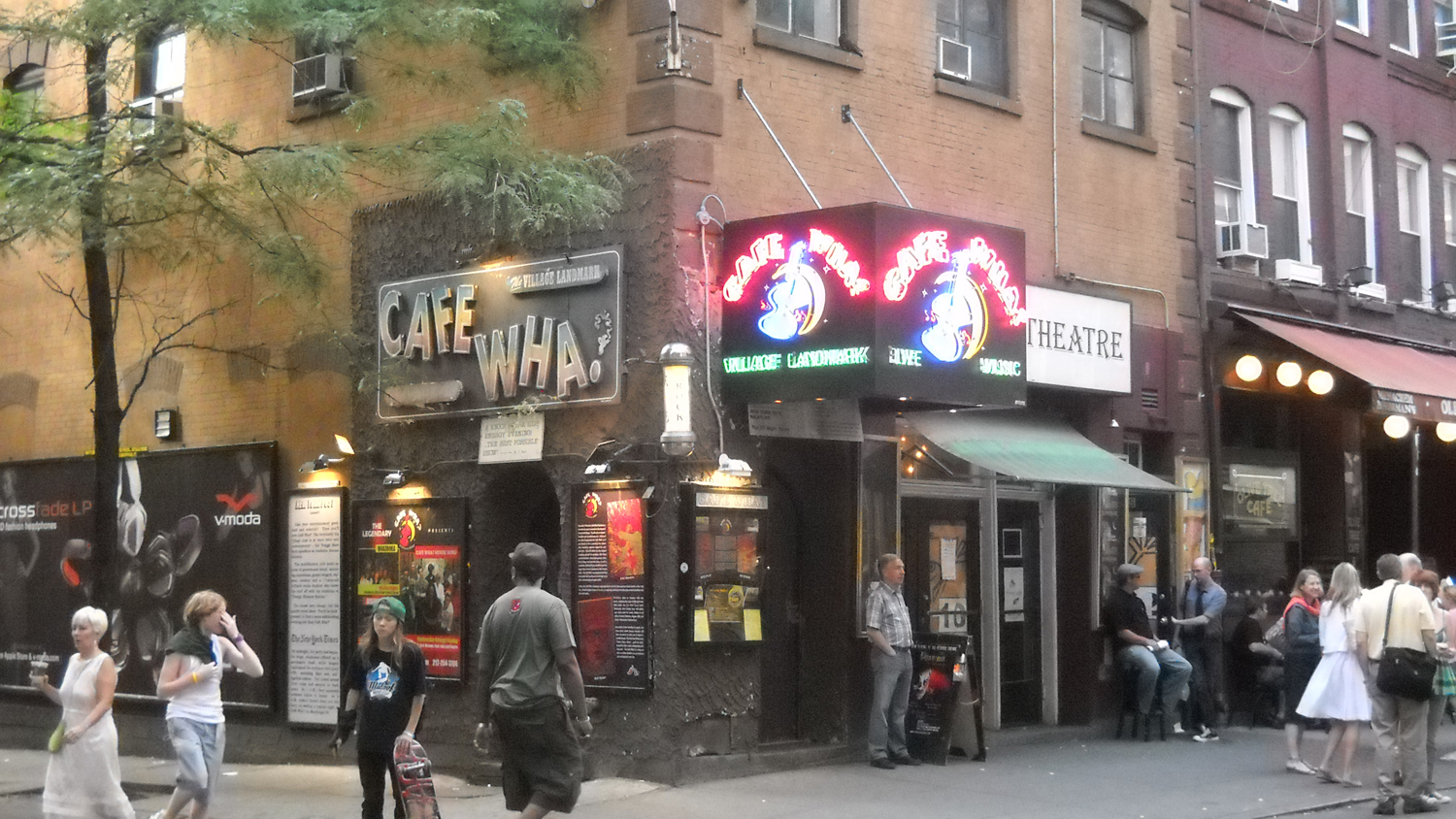
Greenwich Village in the early 1960’s was a hub for artists, poets, musicians and activists to meet, exchange ideas, and grow. When Dylan first arrived, the first thing he did was head over to Café Wha? on Macdougal Street, introduced himself as a musician, and booked himself a gig- as described in the lyrics of ‘Talkin’ New York’. His goal was to immerse himself in the culture, and establish himself as force to be reckoned with in the folk scene. After being fired for being late to three gigs at Café Wha? Dylan jumped around, exploring the many clubs and cafés Greenwich Village had to offer. He played coffee houses such as Caffe Reggio, the Commons, Caffe Dante, and underground clubs like the Gaslight Café, the Fat Black Pussycat, and the Bitter End. 2 New York was the perfect place for Dylan to experiment, meet new people who would greatly influence his career, and develop as an artist. At any point you could walk into a coffee shop and listen to a folk-singer performing, attend a poetry reading, or have an in-depth discussion about direction of the country the with like-minded political activists.
Fred W. McDarrah/Getty Images
‘Talkin’ New York’ chronicles Dylan’s initial experience in New York. It tells the story of his arrival and describes the struggles of trying to make it as a folk-singer in a new town. The area was impoverished at the time, and for the first year Dylan spent most of his time sleeping on floors. He established himself as a vagabond, and his songs began to reflect his lifestyle. After a year he found a place to live relatively cheaply which allowed him to spend more time developing his songs. Because the clubs could not pay performers, Dylan began wearing a hat and passing it around the cafes. The Gaslight Cafe was known for “basket-passing nights” where the only money performers would pocket was what was given to them by audience donations.3
Cafe Wha? 1960’s
Cafe Wha? Today
Today Greenwich Village is a different neighborhood. NYU has taken over much of the real estate in the area, and the rest has seen a drastic price increase since the 1960’s. It is far too expensive for young aspiring artists to live, but still an area worth visiting often. There are a few relics from the past, and you can go on a walking tour of the sites Dylan and other artists frequented, but today a vagabond could not arrive in the Village and squat in run-down apartments like Dylan did. A few of the old hangouts remain, but they too have evolved with the times. Caffe Dante became Dante NYC, and has moved on from folk-singers to gourmet cuisine. Café Wha? closed in 1968, but reopened in 1987, with music still playing often and the Café Wha? house band headlining many nights. The Bitter End is also still standing, and prides themselves on being New York’s oldest rock club. You can still catch a show any night of the week. While Greenwich Village has changed over the years, there is still a feeling of artistic freedom and counter-culture in many of the bars and coffee shops.
‘Talkin’ New York’ Lyrics:
Rambling out of the wild west
Leaving the towns I love best
Thought I’d seen some ups and down
‘Till I come into New York town
People going down to the ground
Building going up to the sky
Wintertime in New York town
The wind blowing snow around
Walk around with nowhere to go
Somebody could freeze right to the bone
I froze right to the bone
New York Times said it was the coldest winter in seventeen years
I didn’t feel so cold then
I swung on to my old guitar
Grabbed hold of a subway car
And after a rocking, reeling, rolling ride
I landed up on the downtown side
Greenwich Village
I walked down there and ended up
In one of them coffee-houses on the block
Got on the stage to sing and play
Man there said, come back some other day
You sound like a hillbilly
We want folksingers here
Well, I got a harmonica job, begun to play
Blowing my lungs out for a dollar a day
I blowed inside out and upside down
The man there said he loved my sound
He was raving about he loved my sound
Dollar a day’s worth
After weeks and weeks of hanging around
I finally got a job in New York town
In a bigger place, bigger money too
Even joined the union and paid my dues
Now, a very great man once said
That some people rob you with a fountain pen
It don’t take too long to find out
Just what he was talking about
A lot of people don’t have much food on their table
But they got a lot of forks and knives
And they gotta cut something
So one morning when the sun was warm
I rambled out of New York town
Pulled my cap down over my eyes
And heated out for the western skies
So long New York
Howdy, East Orange
Singer-songwriter Cosby Gibson has returned for her seventh album, the poetic and wonderfully whimsical The Hollow Crown.
Hailing from near the Adirondacks, Cosby Gibson is a singer-songwriter who specializes in unique and original folk-style songs on guitar and dulcimer. With multiple Capital District Music awards among many other trophies on her shelf, she spins whimsical tales on life in all of its aspects- the beautiful and the less than so.
Returning for her seventh album, Gibson has released The Hollow Crown– an album capturing the chase for something empty that she aptly dubs a “hollow crown”- something ultimately fruitless or unimportant.
At its core, however, the album tackles what is worth one’s time- remembering. Remembering the good, to remind oneself of the foundation you stand upon, and the bad to untangle the brambles of negative emotion.
Entwined with a sense of the magical between Gibson’s gentle vocals, deft acoustic guitar, and vivid lyricism, tracks like “In This Kind of Rain” and “Asking The Lilies” craft a sense of imagined adventure through the woods, pondering the complications of meanings of life while observing babbling brooks or blooming flowers.
Imagery is also rich in “Spinning in Spirals,” a song full of roses and sparkles and a sense of excited wanderlust, which is contrasted in the vulnerable and insightful “What’s Happening Is You” that decides that lyrical honesty is best for the frank conversation being had.
Wonderfully poetic and positively teeming with flora and fauna, The Hollow Crown is a beautifully crafted collection of tracks that balance emotional honesty with the whimsical. The full album is available now both in digital and physical format through Gibson’s Bandcamp page here.
To learn more about Cosby Gibson, listen to more of her work and The Hollow Crown, and keep up with all of her latest endeavors, be sure to explore her official website here.
Hudson Valley singer-songwriter Ginger Winn has released her newest single in honor of musical icon John Lennon, “Dear John.”
Based in the Hudson Valley, Ginger Winn is a singer-songwriter and guitarist who was launched into the spotlight after a captivating performance at Woodstock Way Hotel.
Since this fateful performance, Winn’s folk-tinged guitar and melancholy-tinted vocals have captivated folks across the Hudson Valley and beyond- eventually resulting in a gig touring the west coast alongside Gipsy Kings.
Released earlier this year, Winn debuted with Stop-Motion, a ten track album that quickly set the tone for Ginger’s career as a promising one.
Returning with her latest work, Winn has released “Dear John,” a heartfelt single dedicated to John Lennon that was published on the anniversary of his untimely passing; a crestfallen letter to a hero she’ll never have the opportunity to meet.
“John Lennon has inspired me from an early age. I remember being about 12 and buying a magazine that told his life story. It taught me a lot about being an artist, following the path you feel is right, and making sure that path leads you to a destination that is best for you, which I’ve used as a guiding light in my journey. He’s a true creative who did whatever he wanted to do, no matter the consequences.”
– Ginger Winn
Co-written with Matthew Baione, co-founder of Keep Good Company Records, “Dear John” has its roots in Paul Goresh’s images capturing Lennon’s interaction with Mark David Chapman, Chapman’s manifesto, the moment in the Imagine documentary where John invites the stalkers on his property in for tea, and the famous image of Pope John Paul II forgiving his would-be assassin.
“The song is as beautiful as it is tragic and John has always been an inspiration; we share a birthday and I’ve always admired his audacity, creativity, search for interconnectivity in society, and his attempts at leading with love, especially near his life’s end. He was a dreamer.”
– Matthew Baione
Following this release, Winn will be performing “Dear John” and other works of hers live at two upcoming shows in New York City. She’ll be gracing the stage of the Bowery Electric on December 29, and Arlene’s Grocery on January 29.
For more information on these shows, Winn’s previous works, and to keep up with all of her future endeavors, be sure to visit her official website here.
Long Island native Roger Street Friedman has released his newest americana single, “Banks of the Brazos.” The track is a powerful ode to the “Sugarland 95,” a group of Black convict laborers sentenced to brutal work in Texas sugarcane fields in the post-reconstruction era.
“Banks of the Brazos” is the third single from his upcoming album Long Shadows, due out January 24, the song is a powerful and evocative story that looks into the hidden history of the “Sugarland 95,” a group of African American men who were often victims of unjust laws designed to control the lives of newly freed people.
When the bodies of the Sugarland 95 were unearthed along the banks of the Brazos River, Roger Street Freidman was inspired to write a song from the perspective of one of these laborers. The song aligns with a viral TikTok that Roger posted last year, garnering nearly a million views, resonating with audiences for his honest storytelling.
The song holds a strong outlaw americana feel. The western country flare paired with the dark nature of the song’s backstory sets the listener up to feel it in their heart. Each strum of the guitar shows Roger Street Friedman’s passion and grit for music and exposing history’s many injustices. The track is dynamic, with many changing musical tides throughout the track, but with a meaningfully brawn backbone allowing for wide arrays of sound.
Even the opening sounds from the electric and acoustic guitars simultaneously made me feel something. Followed by the consistent, strong kick and snare, this track immerses the listener from the very start. Both Friedman’s hearty solo vocals and the powerful harmonizing vocals truly touch the heart and soul of whomever may be listening, especially when you factor in how Roger is soulfully expressing his outlook on the horrible enslavement of the Sugarland 95. The track sees a phenomenal climax with soaring vocals followed by a spirit-touching finish that brilliantly yet softly wraps up the hearty ode.
For more information on Roger Street Friedman and his latest single, “Banks of the Brazos,” click here.
Silver Bay YMCA’s bluegrass festival, Bluegrass in Heaven, is undergoing a rebrand to open the festival up to more people. The festival will now be known as “Silver Bay’s Mountain Music Festival.”
The new name aims to open the festival up to more people who enjoy the genres that fall into the mountain music category such as americana and folk. In addition to the new name, the festival is also sporting a new logo to help the rebrand along. The logo features a sun with some music notes behind a mountain range with the text Silver Bay’s Mountain Music Festival below it.
Silver Bay’s bluegrass festival originated in 2023, with the planning for it starting in 2022, when a long-time Silver Bay employee and volunteer, Terry Baker, approached Silver Bay with the idea. Silver Bay’s Mountain Music Festival is set to take place September 12 – 14. The lineup for the festival will be announced in the new year.
Silver Bay YMCA, founded in 1902, is in Silver Bay, NY, just minutes south of Hague. Its 700-acre campus along one mile of Lake George shoreline offers a breadth of programs for all ages. Silver Bay YMCA is consistently ranked one of the top ten family reunion sites in the country and is on the National Register of Historic Places with the U.S. Department of the Interior. As a mission-based charity, Silver Bay YMCA offers outreach programs in addition to its core activities as a premier conference and family retreat center.
For more information on Silver Bay YMCA and their upcoming Silver Bay’s Mountain Music Festival, click here.


.png)