Christmas time in New York is often filled with magic and wonder. Most people have visions of marveling beneath the tree in Rockefeller Center, window shopping on 5th Avenue, or playing with all the new toys FAO Schwartz has to offer, but that is just a tiny spec of the enchantment to be found in NYC during that time of year. No matter where you are or how you celebrate, the end goals are almost always the same: to spread joy, focus on others, and spend time with your loved ones. While everyone has their own traditions, it is important to remember why you are doing so. That is exactly what Run-DMC was trying to convey with their 1987 hit ‘Christmas in Hollis.’
While Run-DMC were initially opposed to writing a Christmas song at the record company’s request, their opinion changed once they went through a crate of old odd-ball Christmas Records to see if they could be inspired. After a bit of searching, inspiration finally hit once they listened to Clarence George Carter’s funk cut ‘Back Door Santa.’ Once they decided to write the song, Run-DMC decided they were going to combine the fantasy and mysticism that comes with the holiday with real life experiences, detailing past Christmas’ spent with their families in their hometown of Hollis, Queens.
The first verse of the song belonged to Run, which draws listeners in with a surreal experience of finding Santa’s wallet after encountering one of his reindeer but returning it because he didn’t believe it was right to steal from Santa. From that point the song could have gone anywhere, but DMC decided he wanted to relate it to real life because that is the opposite of what everyone was doing with Christmas music at the time.
Run-DMC, Hollis
“Every other Christmas song is like a fantasy,” Run explains. “You know, [Sings.] ‘Santa Claus is coming to town.’ That’s a fantasy. Even Run’s verse, he’s telling a story that’s like it’s been written for a Christmas book. But my story is what really happened in real life, about real people, and what it was like as a kid growing up. It’s so real. [Raps.] “Christmastime in Hollis Queens / Mom’s cooking chicken and collard greens!” It’s funky, it’s soulful, it’s family, it’s real. “Christmas In Hollis” is real, because of my verse.”
Hollis, Queens
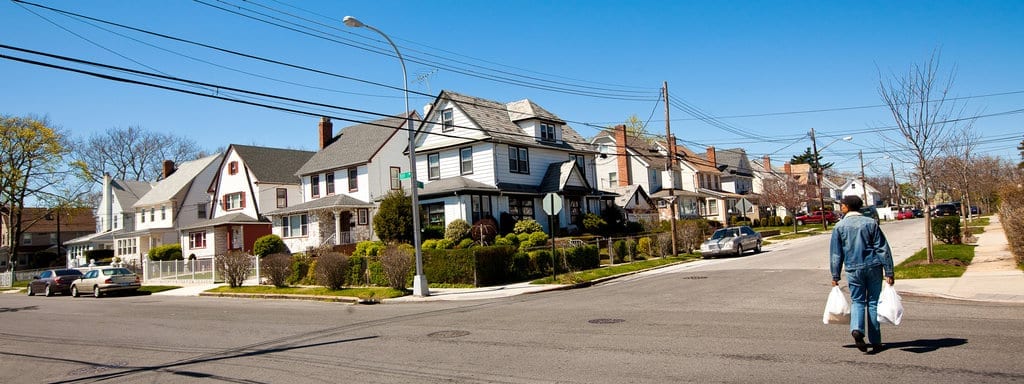
Hollis, Queens had an incredibly powerful impact on Run-DMC, which is why they decided to homage the neighborhood in ‘Christmas in Hollis.’ Joseph Simmons (Run), Darryl McDaniels (DMC), and Jason Mizel (Jam Master Jay) formed Run-DMC in the 1983 after being friends at school for years and realizing they had similar interests in music as they got older. At the time of the group’s formation, Hollis was a moderately stable, suburban community with a vibrant and growing hip-hop scene which inspired and cultivated each member of Run-DMC from an early age. It was a family neighborhood, and the love and support they received helped the group achieve their dreams.
As the group got bigger, the area changed, and the tranquil Hollis soon became plagued with drug and gun violence. By the late 1980’s the neighborhood became one of the most severe victims of the growing crack epidemic. Today Hollis has returned to the median income, middle-class neighborhood it once was, but there have been no sightings of Santa since that fateful day in 1987.
‘Christmas in Hollis’ Lyrics:
It was December 24th on Hollis ave in the dark
When I see a man chilling with his dog in the park
I approached very slowly with my heart full of fear
Looked at his dog, oh my god, an ill reindeer
But then I was illin’ because the man had a beard
And a bag full of goodies, 12 o’clock had neared
So I turned my head a second and the man had gone
But he left his driver’s wallet smack dead on the lawn
I picket the wallet up then I took a pause
Took out the license and it cold said “Santa Claus”
A million dollars in it, cold hundreds of G’s
Enough to buy a boat and matching car with ease
But I’d never steal from Santa, cause that ain’t right
So I’m going home to mail it back to him that night
But when I got home I bugged, cause under the tree
Was a letter from Santa and all the dough was for me
It’s Christmas time in Hollis queens
Mom’s cooking chicken and collard greens
Rice and stuffing, macaroni and cheese
And Santa put gifts under Christmas trees
Decorate the house with lights at night
Snow’s on the ground, snow white so bright
In the fireplace is the yule log
Beneath the mistletoe as we drink egg nog
The rhymes you hear are the rhymes of Darryl’s
But each and every year we bust Christmas carrols
Rhymes so loud and proud you hear it
It’s Christmas time and we got the spirit
Jack Frost chillin, the hawk is out
And that’s what Christmas is all about
The time is now, the place is here
And the whole wide world is filled with cheer
My name’s D.M.C. with the mic in my hand
And I’m chillin’ and coolin’ just like a snowman
So open your eyes, lend us an ear
We want to say Merry Christmas and Happy New Year!
A walking music legend, Carole King’s roots in New York run deep. Born and raised in Brooklyn, a graduate of Queens College, and lifetime lover of the Manhattan music scene as both an artist and an audience member, New York is an integral part of King’s work and identity at large.
Photo: Jim McCrary, via caroleking.com
Born Carol Joan Klein to Russian and Polish immigrant parents, Carole arrived in the world not too soon after her mother and father had arrived in Brooklyn via Ellis Island. With her father, a radio announcer turned New York City firefighter, and mother, a secretary at a local high school, Carole’s life has been positively steeped in musicality from day one – as well as a deeply ingrained identity as a New York native and lifelong Brooklyn Dodgers fan since youth.
Famously meeting while in an elevator at Brooklyn College, Carole’s father set the precedent for a Klein behind the microphone with his gig as a radio announcer, and her mother’s studies in and passion for english and drama lent themselves to a rather creative upbringing.
Upon her parents’ separation, Carole sought attention and found the answer in the theater. First being introduced to the glittering world of Broadway at just five years old, Carole fell utterly in love, absorbing all of the media and musical projects her mother put on. Her home was rarely quiet, being constantly introduced to shades of music varying from show tunes to Brahms.
Photo via caroleking.com
Finding a unique outlet for emotions of all ranges, King leaned into the theatrics of the stage as she grew up, eventually auditioning for the High School of Performing Arts – now referred to as the Fiorello H. LaGuardia High School of the same name. While the audition was not a success, it marked a turning point for Carole as the arts became something of possible professional pursuit more concretely in her mind.
As any teenager of the mid 1950s did, Carole often tuned in to her favorite radio stations. However, unlike many other of her rather sheltered white peers, Carole’s station of preference was Alan Freed’s nightly WINS program. Freed was a lover of artists like the Penguins, the Moonglows, the Clovers, Danny Overbea, La Vern Baker, and BB King – a notably African-American lineup that had many white parents positively beside themselves.
In addition, many tracks played on Freed’s station fell under the umbrellas of rock and roll and R&B, both equally scandalous for their promiscuity and narratives on adversity that were up until then rather absent in the public eye’s musical circuit. This scandal was all the better for an adolescent King, however, who found the new wave of music and its consequent conscious style of creation absolutely mesmerizing
Carole has never been one to shy away from advocating for her beliefs. After moving to Idaho in 1977, she became deeply entrenched in the local ecosystem’s wellbeing and has been an outspoken voice for environmental change ever since.
King would go on to participate in her local Women’s March in 2017, holding a sign that read “One Small Voice.” A single titled with the same phrase would be released the next month, utilizing a thinly-veiled emperor’s new clothes metaphor that encourages listeners to “speak out in honesty.”
While many artists’ relationships with New York City begin on the stage, King’s began in the audience. As a young adult who positively adored the cutting-edge music she was hearing over the radio, being able to attend Freed’s Easter Jubilee at the Brooklyn Paramount in 1955 meant the absolute world and sparked a major bout of motivation.
“Moving farther in, we saw Mickey Baker talking to a couple of the Penguins. At that moment I knew I wanted to mean something to these people. I didn’t want to be one of them. I just wanted them to know who I was and consider me worthy of respect. That ambition existed concurrently and in no way conflicted with my ambition to be an actress.”
– Carole King, A Natural Woman
Auditioning for the High School of Performing Arts once more re-inspired, King enrolled in the fall of 1955 and spent a year studying drama and dance alongside fellow students Al Pacino and Rafael Campos. She would depart the school after a year and return to her classmates at James Madison High School, but Carole would take with her the lessons taught by teachers like Mr. Sachs who inadvertently set her up to arrange vocals through his assignments.
Like many teenagers of the area, King perpetually sought out the liberal arts for peer acceptance and self-expression, the heart of an increasingly viable, ever-vibrant scene only a few subway stops away. 1957 marked a time of escapades up and down Bleecker Street and throughout the coffee shops and venues of Greenwich Village with her peers.
After a rare successful infiltration of the Vanguard, Carole King witnessed mind-blowing jazz sets and sat listening to the music while her peers smoked. By default she became the one picking out the records, and that quickly became much more interesting to Carole than the smoking.
After a nudge in the direction of her high school’s annual Sing by her mother, King wrote, arranged, and performed a piece for the first time to a large audience, and the response of her peers in the audience shifted something within her. She soon began to compose in earnest, arranging pieces for the chorus class before turning the passion into a full-on street corner harmony gig. Recruiting three other peers to be the soprano, tenor, and bass to her alto, the group dubbed themselves the Cosines and performed for free at school events and dances.
Photo via caroleking.com
This would mark the beginning of a career in arranging both for a group and for herself, developing a process she would keep well into her career as she wrote for or in collaboration with the likes of Bobby Vee, The Everly Brothers, The Monkees, Aretha Franklin, James Taylor, Mariah Carey, and countless others across the industry.
After deciding to pursue songwriting in earnest, Carole chased down a so-called “Atlantic Records” that Freed had mentioned on his radio station, quickly presenting her work to an executive and landing her first recording contract.
Graduating high school at just sixteen years old, King entered Queens College with little enthusiasm after an unexpected move to Rosedale had uprooted her plans to attend her parents’ alma mater. Just around the corner, however, were fellow freshmen and musical peers Art Garfunkel and Paul Simon, the latter becoming a quick friend and collaborator.
Also at Queens College was Carole King’s future songwriting partner and husband of many years Gerry Goffin. While she first thought they’d never see eye to eye on music – he was very open with his hatred for Rock and Roll – his pitch to collaborate on a song quickly became history. Married at her parents’ home in Rosedale in 1959, Carole and Gerry moved into a one-bedroom apartment on Bedford Avenue, only a block away from her childhood home.
Photo via caroleking.com
Gerry, a chemist in downtown Brooklyn, and Carole, a secretary for a chimney manufacturer in Manhattan, were determined to see their passion for songwriting through and, upon an interaction with Neil Sedaka on the sidewalk of Broadway, the two landed a three-year writing deal that brought the couple out of debt and into a two-bedroom apartment on Brown Street in Brooklyn, an area that had been nothing but corn fields when King was a child.
Working in the highly competitive cubicle space that was Aldon, Gerry and Carole managed their first major hit with “Will You Love Me Tomorrow.” Gerry stepped away from his traditional job and the couple moved into the suburbs of West Orange, New Jersey to raise their second daughter, which is where they would reside together for a number of years before the marriage began to crumble.
When Goffin decided to move to California on his own, King was torn between the vibrancy of what she dubbed “the coolest place she knew” and California, where their children would be able to see their father. Ultimately putting her children before herself, Carole switched Coasts.
Photo via caroleking.com
1970 marked a second beginning for King, who would be brought back to New York and into the spotlight by friend and collaborator James Taylor during his tour. Just prior to their show at Carole’s alma mater Queens College, Taylor requested she sing the lead for “Up on the Roof” to King’s immediate horror and dismay. Terrified about stepping out of the comfortable zone that was just “James’ pianist,” Carole took a breath and performed, receiving raucous applause.
“Up on the Roof” would return in 1971 at King’s first ever performance as a solo act in front of an audience during the now famed June evening at Carnegie Hall. Recorded and later immortalized in a seventeen-track album, the concert featured some of Carole’s first works alongside duets with Taylor for “Up on the Roof”, “Will You Love Me Tomorrow?”, and “You’ve Got a Friend.”
With the turn of the new year came Carole’s 30th birthday, a whopping four GRAMMY wins for her work in Tapestry, and the arrival of her fourth child. The following year, King returned to New York City to deliver a first-of-its-kind Central Park show completely free to the public, a rather poetic homecoming of an estimated 100,000+ attendees.
Recorded and released first as a live album and then a fully-fledged concert documentary in 2023, the Central Park concert remains a sparkling snapshot of King’s commercial and critical peak . Though this level of fame did not come without its drawbacks, with Carole detailing a frenzied crowd of fans crowding her limo after the show in her memoir.
Such situations and the general all-encompassing business that had become her life drew King to the quieter lifestyle of Idaho, though the draw of New York’s creative vibrancy never quite lost her. She would travel back to the city frequently to visit family, friends, and other artists she enjoyed working alongside.
An extended return to New York wouldn’t come into Carole King’s life until she was cast in Hindi Brooks’ A Minor Incident at the West Bank Café Theater in 1987. Performing alongside Paull Hipp who she had met when he was producing the off-Broadway Rockabilly Road, Carole frequently tagged along to Brooks’ recurring gig at the Red Lion Café on Bleecker.
Quietly playing guitar for his sets, she noted that very few would recognize her in their preoccupation with chatting, dining, or drinking, but there were always a few who would glance back and forth at her, nudging their friends with knowing smiles.
Photo: Annie Liebovitz, via caroleking.com
It wouldn’t be until Carole attended Bruce Springsteen’s 1988 Tunnel of Love show at Madison Square Garden that the creative spark would return in full, and her sense of dejection at missing the on-stage magic quickly became determination as she brushed up her latest tracks, re-signed with Capitol Records, and recorded City Streets at Skyline Studios.
Among the tracks developed in this era is “Friday’s Tie-Die Nightmare” that tells the tale of a dream Carole had experienced related to the City’s subway system, at which point in her memoir she takes a moment to impart some subway wisdom: “Subway Lesson 1: when the subway runs smoothly, as it does most of the time, it’s the most efficient and affordable method of getting around New York City, and Subway Lesson 2: the only way to catch an express is to leave early enough to make the entire trip on a local.”
Reminiscing about people-watching and considering her own observations of others, King explains that her third subway lesson is not a sentence – it’s a song. Written upon her realization that the way she perceived the people around her was ultimately a reflection of how she was feeling at the moment, subway lesson three comes in the form of the track “Beautiful” – “You’re gonna find, yes you will, that you’re beautiful as you feel.”
Alongside her return to performance came roles as a teacher in the ABC After-School Special It’s only Rock & Roll shot in Pine Bush, New York and Willy Russell’s Broadway production of Blood Brothers on a ten-month run.
Photo via caroleking.com
While not the star in the most literal sense, Broadway returned to King’s life in 2013 with the previews and eventual debut of Beautiful: The Carole King Musical on January 12, 2014. Exploring her early life and rise to stardom alongside Goffin, the show became the 27th longest running show in Broadway history upon its closure in October of 2019 with a stunning 60 previews and 2,418 shows logged.
Despite not playing herself as the titular role, Carole made a handful of appearances at the Stephen Sondheim Theatre during the show’s run first to surprise lead actress Melissa Benoist in a reprise of “I Feel the Earth Move,” and then to celebrate the production’s fifth anniversary, making appearances during “Beautiful” and the show’s finale.
Beautiful: The Carole King Musical gained endless critical acclaim and won several awards, including two Tonys and a Grammy. A testament to New York’s love for Carole King as a story, an artist, and a human being, the musical immortalizes above all the timeless nature of her work, both honoring and reviving King’s most famous works for a new generation of lifelong fans.
An artist, an advocate, a deft songwriter, a mother, and above all an admirable woman who has pursued nothing less than fulfillment throughout her entire life, King’s legacy is a shining one felt throughout each and every nook and cranny of New York.
New York State has a rich and extensive history of music. From classic songs you sang in elementary school social studies class about the Erie Canal to Frank Sinatra crooning of the wonders of New York City, countless areas throughout the state have drastically influenced musicians, and left an imprint on their artistic growth. NYS Music’s New York Series is a project dedicated to exploring the history of music created and inspired by the diverse areas of the state. Each week we will focus on a different part of New York, how that area inspired a song or album by artists of various genres, and how the area changed over time. This week we will look at Bob Dylan’s ‘Talkin’ New York’ and Greenwich Village’s influence on his writing of the song, as well as how the area shaped his growing career.
Bob Dylan- ‘Talkin’ New York’
“You sound like a hillbilly; We want folk singers here.”
In the winter of 1961, a 19-year-old University of Minnesota drop out named Robert Zimmerman arrived in New York for the first time in hopes of finding his folk-singer idol, Woody Guthrie. It was the coldest winter in seventeen years, and he did not know a soul. ‘Talkin’ New York,’ the second song on Bob Dylan’s self-titled first album, is a talking blues which narrates the difficulties the young folk-singer experienced when he first moved to the Big Apple. Soon after his arrival, Zimmerman moved to Greenwich Village, changed his name to Bob Dylan, and launched one of the most successful music careers in history. 1
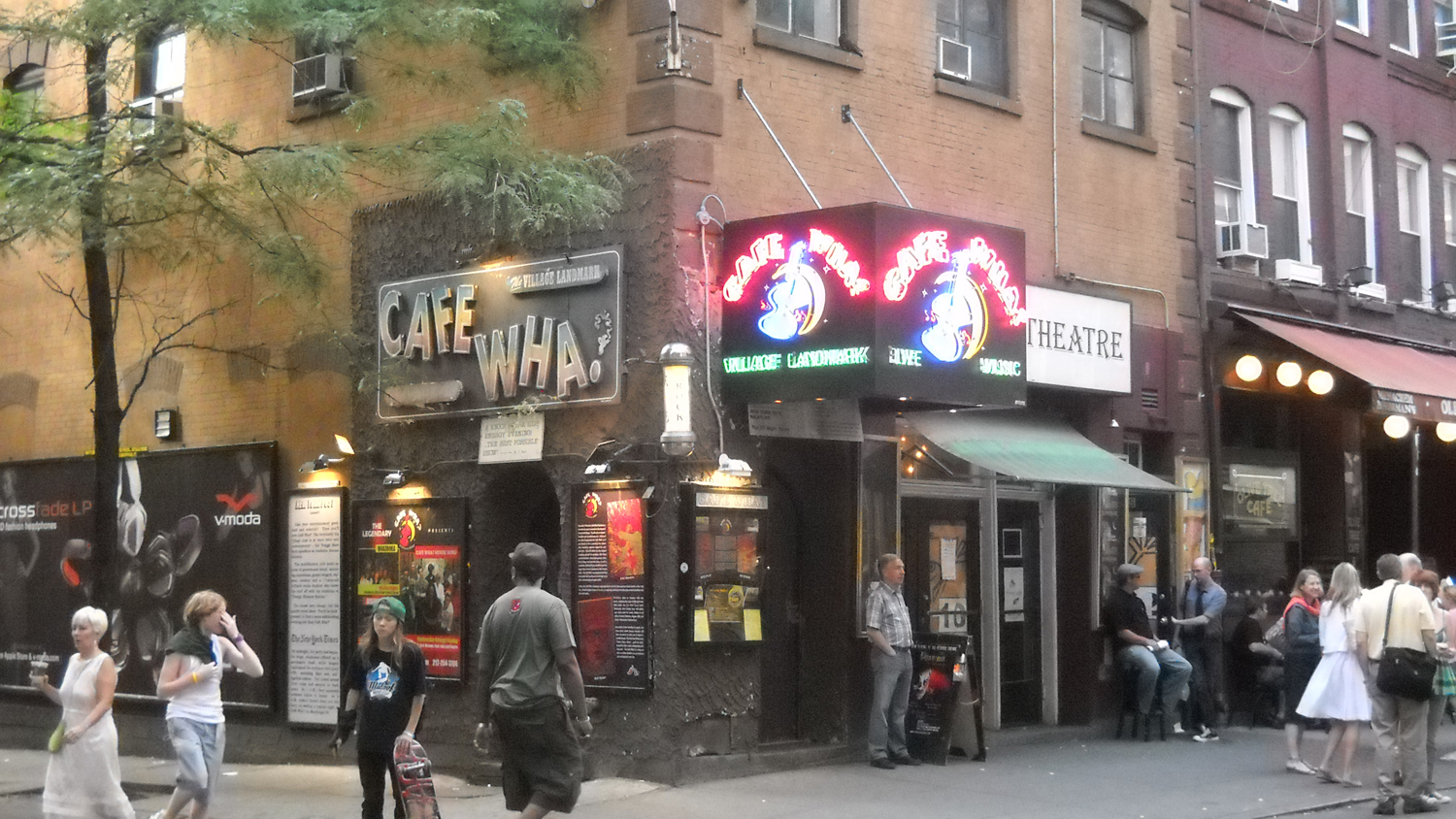
Greenwich Village in the early 1960’s was a hub for artists, poets, musicians and activists to meet, exchange ideas, and grow. When Dylan first arrived, the first thing he did was head over to Café Wha? on Macdougal Street, introduced himself as a musician, and booked himself a gig- as described in the lyrics of ‘Talkin’ New York’. His goal was to immerse himself in the culture, and establish himself as force to be reckoned with in the folk scene. After being fired for being late to three gigs at Café Wha? Dylan jumped around, exploring the many clubs and cafés Greenwich Village had to offer. He played coffee houses such as Caffe Reggio, the Commons, Caffe Dante, and underground clubs like the Gaslight Café, the Fat Black Pussycat, and the Bitter End. 2 New York was the perfect place for Dylan to experiment, meet new people who would greatly influence his career, and develop as an artist. At any point you could walk into a coffee shop and listen to a folk-singer performing, attend a poetry reading, or have an in-depth discussion about direction of the country the with like-minded political activists.
Fred W. McDarrah/Getty Images
‘Talkin’ New York’ chronicles Dylan’s initial experience in New York. It tells the story of his arrival and describes the struggles of trying to make it as a folk-singer in a new town. The area was impoverished at the time, and for the first year Dylan spent most of his time sleeping on floors. He established himself as a vagabond, and his songs began to reflect his lifestyle. After a year he found a place to live relatively cheaply which allowed him to spend more time developing his songs. Because the clubs could not pay performers, Dylan began wearing a hat and passing it around the cafes. The Gaslight Cafe was known for “basket-passing nights” where the only money performers would pocket was what was given to them by audience donations.3
Cafe Wha? 1960’s
Cafe Wha? Today
Today Greenwich Village is a different neighborhood. NYU has taken over much of the real estate in the area, and the rest has seen a drastic price increase since the 1960’s. It is far too expensive for young aspiring artists to live, but still an area worth visiting often. There are a few relics from the past, and you can go on a walking tour of the sites Dylan and other artists frequented, but today a vagabond could not arrive in the Village and squat in run-down apartments like Dylan did. A few of the old hangouts remain, but they too have evolved with the times. Caffe Dante became Dante NYC, and has moved on from folk-singers to gourmet cuisine. Café Wha? closed in 1968, but reopened in 1987, with music still playing often and the Café Wha? house band headlining many nights. The Bitter End is also still standing, and prides themselves on being New York’s oldest rock club. You can still catch a show any night of the week. While Greenwich Village has changed over the years, there is still a feeling of artistic freedom and counter-culture in many of the bars and coffee shops.
‘Talkin’ New York’ Lyrics:
Rambling out of the wild west
Leaving the towns I love best
Thought I’d seen some ups and down
‘Till I come into New York town
People going down to the ground
Building going up to the sky
Wintertime in New York town
The wind blowing snow around
Walk around with nowhere to go
Somebody could freeze right to the bone
I froze right to the bone
New York Times said it was the coldest winter in seventeen years
I didn’t feel so cold then
I swung on to my old guitar
Grabbed hold of a subway car
And after a rocking, reeling, rolling ride
I landed up on the downtown side
Greenwich Village
I walked down there and ended up
In one of them coffee-houses on the block
Got on the stage to sing and play
Man there said, come back some other day
You sound like a hillbilly
We want folksingers here
Well, I got a harmonica job, begun to play
Blowing my lungs out for a dollar a day
I blowed inside out and upside down
The man there said he loved my sound
He was raving about he loved my sound
Dollar a day’s worth
After weeks and weeks of hanging around
I finally got a job in New York town
In a bigger place, bigger money too
Even joined the union and paid my dues
Now, a very great man once said
That some people rob you with a fountain pen
It don’t take too long to find out
Just what he was talking about
A lot of people don’t have much food on their table
But they got a lot of forks and knives
And they gotta cut something
So one morning when the sun was warm
I rambled out of New York town
Pulled my cap down over my eyes
And heated out for the western skies
So long New York
Howdy, East Orange
At one point in history, the New York City subway system was among the most impressive in the world. These days it resembles what you would imagine a third world country’s subway system would look like, with third string trains donated from cities that upgraded their system years ago and no longer had any use for them, but it still gets you from point A to point B and that’s what matters. Albeit confusing to out of towners, you can hop on a train in midtown Manhattan and get almost anywhere you would like to go in the city.
Photo from Wikimedia Commons Public Domain
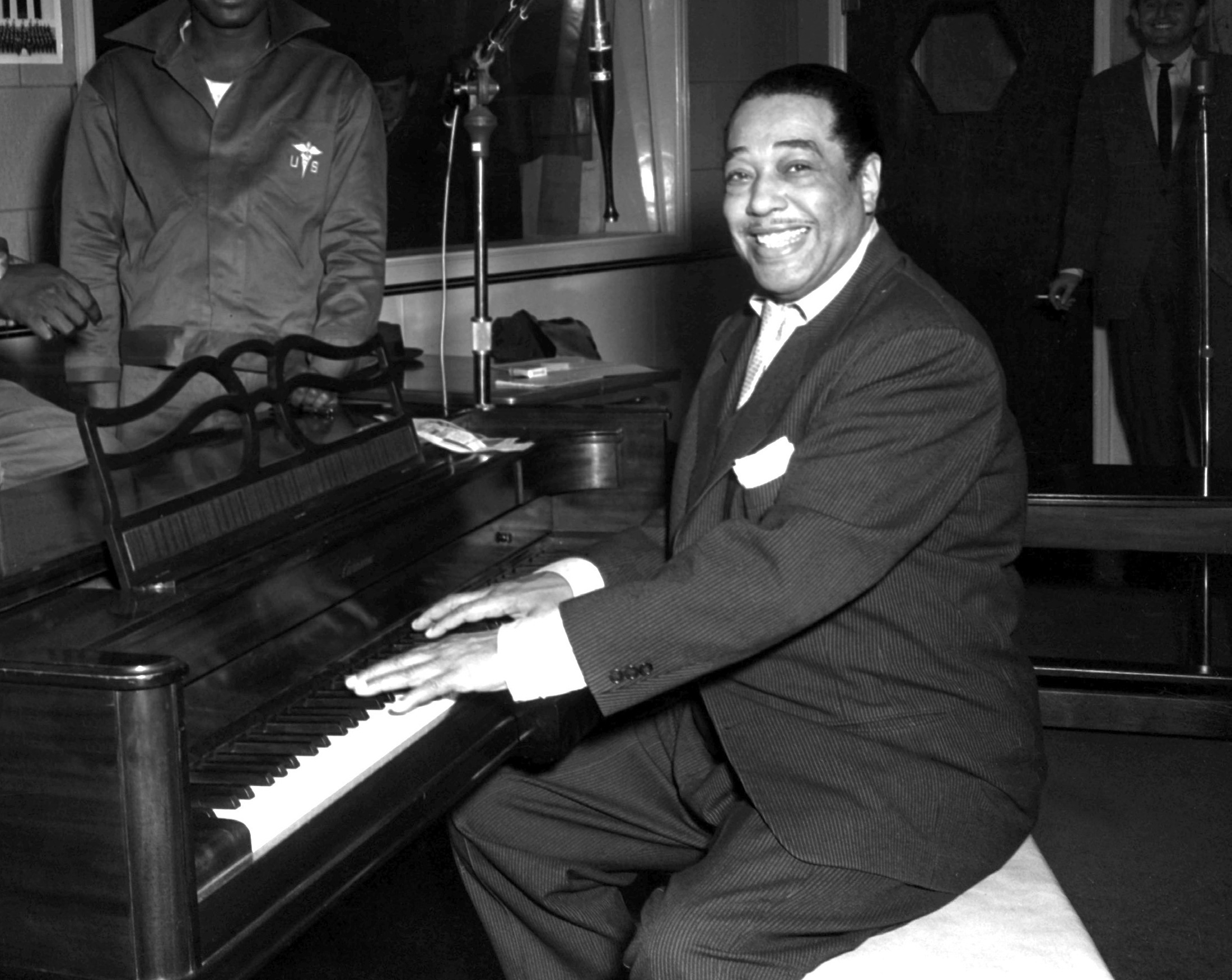
Since it is such an extensive system, those who are completely unfamiliar with New York’s subway system might have a tough time going from borough to borough, and might not even be aware that there are both letter and number trains. However, thanks to Duke Ellington and his infamous 1939 hit “Take the A Train,” almost everyone is aware of at least one line in the NYC subway system, which is more than you can say about almost any other city in the world.
Although popularized by Duke Ellington, “Take the A Train” was written by long-time collaborator and pianist Billy Strayhorn. The swing anthem became the signature piece for Ellington’s orchestra, and was often used as its opening theme and standout song. For most jazz musicians at that time, bandleaders would not put a song they didn’t write themselves in the spotlight like that, however Ellington and Strayhorn’s relationship was atypical. In his biography, Ellington said Strayhorn “was not, as he was often referred to by many, my alter ego. Billy Strayhorn was my right arm, my left arm, and the eyes in the back of my head.”
‘Take the A Train’ was written in Strayhorn’s head while at a party, then put on paper that evening when he got home. The song title was inspired by directions Ellington gave to Strayhorn to get to his house in Sugar Hill, which began with “Take the A Train…,” and the music was influenced by Fletcher Henderson’s style of jazz. Although Ellington’s rendition is instrumental, Ella Fitzgerald released a popular version with the original lyrics Strayhorn wrote about getting to Ellington’s home in Harlem.
Ellington’s home was located in the Sugar Hill neighborhood of Harlem, which is where the Harlem Renaissance took place between the 1920’s and 1950’s. At the time, Sugar Hill was the ritziest, most elegant African-American neighborhood in the United States. It was deemed “Sugar” Hill because of how sweet it was to live there, with the heart of the neighborhood located between 144th and 155th street. The high-class neighborhood was filled with stately homes and luxury apartments, and inhabited by African-American artists, activists, politicians, and intellectuals. The Harlem Renaissance was responsible for allowing African-Americans to focus on their past, as well as develop a unique identity for themselves, thus creating a culture within a culture. It brought people closer to their roots, and allowed them to celebrate who they were while exploring new creative channels to expression, with the Sugar Hill neighborhood as the epicenter of it all. “Take the A Train” became the anthem of this movement, and was highly praised by all of New York.
Today the Sugar Hill neighborhood is still lined with elegant homes and beautiful apartment buildings, with the rich, historic culture dominating the neighborhood. As most areas change over time, there has been a recent slight decline in African-Americans living in Sugar Hill to make room for other cultures, however it is still primarily a black neighborhood. Art and creativity thrives within the neighborhood, and you can still take the “A” train uptown anytime you’d like to soak up the culture and be inspired.
‘Take The A Train’ Lyrics:
You must take the A train
To go to Sugar Hill way up in Harlem
If you miss the A train
You’ll find you missed the quickest way to Harlem
Hurry, get on, now it’s coming
Listen to those rails a-hummingAll aboard, get on the A train
Soon you will be on Sugar Hill in Harlem
The date Dec. 8, 1980 will be remembered infamously throughout history as the night John Lennon was shot outside his New York City apartment. The Beatles member and songwriter was returning home from the Record Plant recording studio with his wife Yoko Ono, fresh off their recently released collaborative album, Double Fantasy, when tragedy struck.
Left: John Lennon, Right: Christine Lavin – photos via CNN and Fleming Artists
Lennon was shot four times in the back and was pronounced dead on arrival at the hospital. Fans mourned his death afterwards gathering outside The Dakota, the apartment building where he lived and outside of which he was killed.
Double Fantasy, album by John Lennon and Yoko Ono, released 1980
Four years later, Lennon’s tragic murder was recalled by Christine Lavin, a long-time folk singer-songwriter and guitarist in her song, aptly titled “The Dakota.”
Newspaper headline in Liverpool Photo, Dec. 9th, 1980 via rarenewspapers.com
The song is the final track on her 13 song, self-produced album, Future Fossils, released in 1984. “The Dakota” was actually written a year or two following Lennon’s death, the song inspired by Lavin being stuck in rush hour traffic in NYC as “Imagine” happened to play on the taxi radio.
Album art for Fossil Fuels by Christine Lavin, released 1984
Lavin never actually mentions Lennon by name in the song, alluding to his death primarily through her imagery of the events that unfolded outside of the Dakota. Lavin spent much of her professional career playing venues in New York City and lived only a few blocks away from the Dakota at the time Lennon was killed.
To see one of her musical idols, murdered in a city she called home, was shocking she said in an interview with NYS Music. “That night is burned into my memory,” she said. “To this, day I can’t walk near the scene of the crime without thinking about it.”
In her song, the building serves as an unmoving reminder of that horrific night, a symbol of senseless death that is difficult to escape.
John Lennon and Yoko Ono outside the Dakota – Photo via Getty Images
The chorus finds herself reflecting on the night of Lennon’s death with soft emotion and heartbreak as Lavin sings:
“Every time I see the Dakota, I think about that night. Shots ringing out, the angry shouts, A man losing his life.”
“The Dakota” – Christine Lavin
The closest Lavin comes to referencing Lennon himself is by quoting one of his most popular and enduring songs, “Imagine.” In a unique twist however, Lavin takes the familiar, hopeful tune and bitterly exposes the unrealistic idyllic world, Lennon so vividly painted.
I don’t believe in coincidence So why then on the radio Did an old familiar voice Echo back from not so long ago? “Imagine all the people Living life in peace.” Well, it’s hard to do When you are on this blood-stained street.
“The Dakota” – Christine Lavin
Lavin’s grief and anger over the famed singer’s unnecessary death reaches its peak at this point, the bridge and climax of the song. The lyrics play out like a conversation with herself, as a harmony of voices sing Lennon’s famed lines, and Lavin replies with her honest answer.
Album art for Imagine by John Lennon
“It was just the way I felt at the time,” Lavin explained. “Imagine is so optimistic but it’s almost too optimistic in ways when we think of how the world is today. And it is harder to [be optimistic] when your on that street because to think the man that wrote those lines had such a tragic and violent end doesn’t make sense. Its such a contradiction.”
Still, Lavin said she tries to use her power as a songwriter to find a glimmer of light in a dark situation.
“As songwriters anything we can right that can help us to overcome the dark side of our nature I think we owe to the world,” she said. “It’s acknowledging the world we live in, but knowing we can do better and that it is our duty to do better.”
Lavin said the decision not to mention Lennon’s name in the song was purposeful – she didn’t want to look like she was exploiting the situation. Quite the contrary, Yoko One ended up publishing Lavin’s lyrics in a book she edited about John Lennon.
Memories of John Lennon by Yoko Ono, the book Lavin’s song is featured in
As the song continues, Lavin reflects further on her anger, asking for peace of mind.
I wish I had the answer To the simple question, ‘Why?’ … I wish I could take these bitter thoughts And just shake them from my mind
“The Dakota” Christine Lavin
In what would be Lennon’s last interview before his death, he talked with a crew from RKO Radio in his home in the Dakota. Eerily enough, at one point during the conversation, Lennon pondered themes of death and getting older.
“When we were kids, 30 was death, right?” he said. “I’m 40 now and I feel just … I feel better than before.” He later added, “I consider that my work won’t be finished until I’m dead and buried and I hope that’s a long, long time.”
The Dakota as seen from Central Park West – Photo via Wikipedia
Even in 2022, memories of Lennon’s death haunt the state of New York. Although, The Dakota has undergone extensive renovations, it still maintains its signature gothic architecture and remains home to numerous celebrities, thanks to its prime location facing Central Park.
Lennon’s killer, now 67, also lives, albeit behind bars at the Green Haven Correctional Facility in New York. Just this September, he was denied parole for the 12th time. Yoko Ono, has historically sent a letter to the parole board every two years to request her husband’s murderer remain in prison, CNN reported.
Despite the painful reminders, Lennon’s legacy and hope for a better world persists long after his death as well.
An annual tribute concert is held in Lennon’s name in NYC bringing together famous musicians and celebrities in a night of song and remembrance. Proceeds also go to supporting songwriting programs in elementary schools. One selected artist is also awarded with the John Lennon Real Love Award, this year given to Joan Osborne.
Joan Osborne to receive this years John Lennon Real Love Award
Lavin’s final lyrics capture the conflicting emotions around wanting to forget the tragedy but remember Lennon’s greatness as she closes out the chorus singing:
“Well, it’s something we shouldn’t dwell upon But it’s something we shouldn’t ignore Too many good men have been cut down Let’s pray there won’t be any more.”
“The Dakota” – Christine Lavin
John Lennon is memorialized in “Strawberry Fields,” a section of Central Park across the street from the Dakota that Yoko Ono landscaped in honor of her husband.
Originally profiled in 2018, we take a look at the Syracuse Fight Song “Down the Field,” its origins and place in Syracuse University history.
The month of March signifies the end of winter, and the hope that Spring brings. It reintroduces the world to sunlight after 6 pm, walking around in a single layer of clothing, and the occasional bunny in your backyard. While some people look forward to eating lamb on Easter Sunday or drinking their weight in green beer on St. Patrick’s Day, there is only one thing on the minds of people from Syracuse during the month of March: Basketball.
The 2018 NCAA Tournament is set to begin, and features Syracuse playing Arizona State in a First Four Midwest Region game at 9:10 pm on March 14 in Dayton, Ohio. There you will hear buzzers buzzing, fans cheering, and the infamous Syracuse fight song ‘Down the Field’ played by the Sour Sitrus Society.
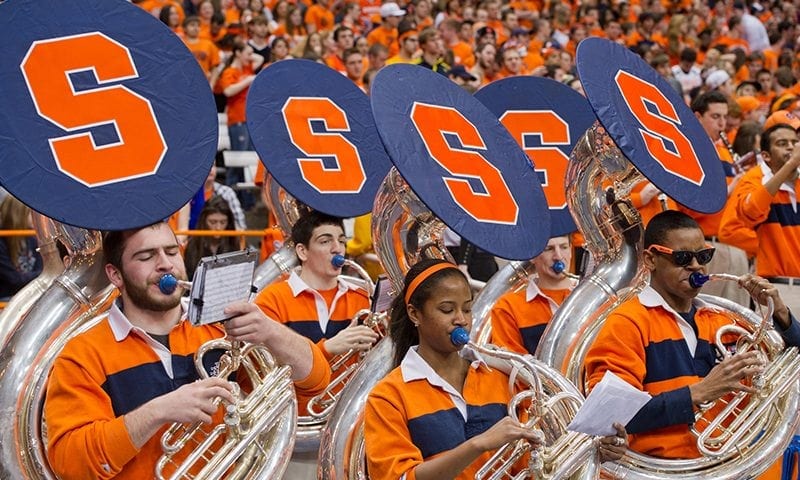
Originally written in 1914 by Ralph Murphy (Class of 1916) and composed by Harold Lewis (Class of 1915), Syracuse University’s fight song has stood the test of time.It’s used as a device to pump up the crowd and draw support for the team, and something every Syracuse University student and alumni has etched in their brains for life.
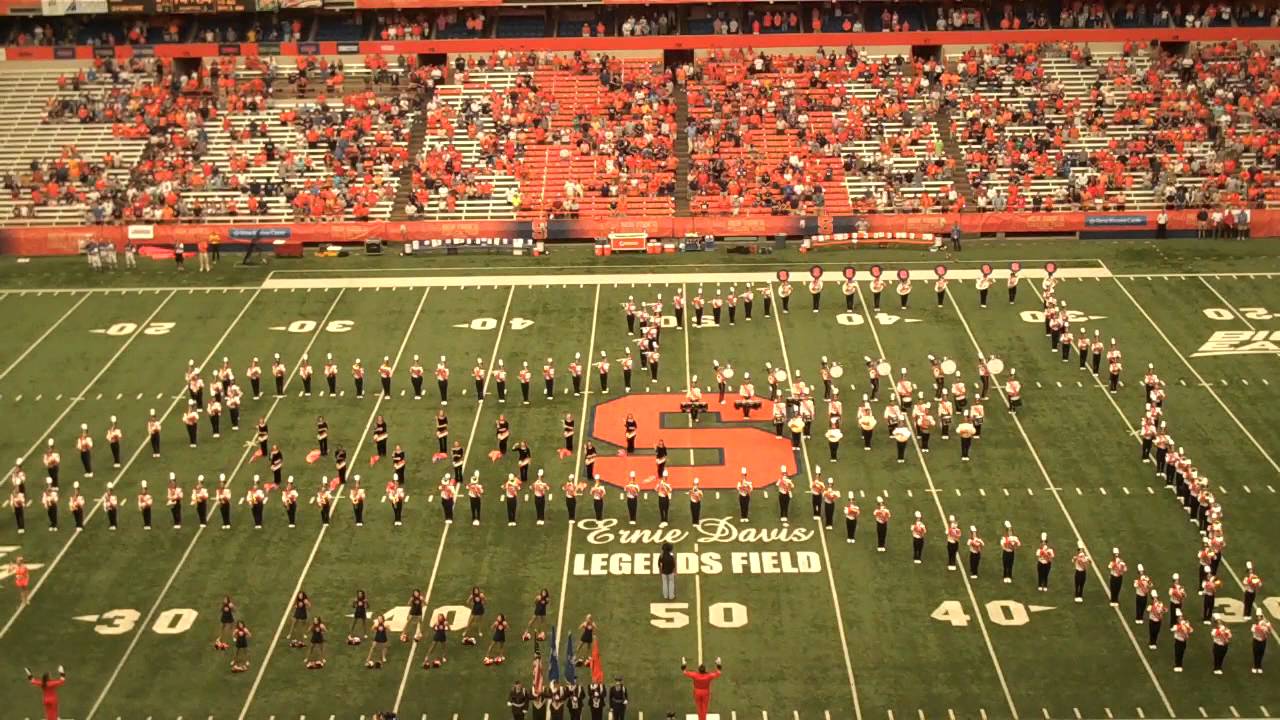
Katie Canete, Drum Major of the Syracuse University Marching Band (SUMB) in 2017, was one of three who conducted/lead the band through every rehearsal and performance. The marching band consists of approximately 200 members, and is one of the oldest collegiate bands in the nation.
“’’Down the Field,’ or better known as Syracuse University’s fight song, is played and sung by the Syracuse University Marching Band at every home football game and Sour Sitrus Society at every home basketball game,” Canete said. “A lot of the fans don’t know all of the words, but the entire crowd always claps along once they hear the tune! It’s infectious!”
The SUMB’s home turf is the Carrier Dome, a domed sports stadium located on Syracuse University’s campus in the University Hill neighborhood. It holds nearly 50,000 people for football games, 35,446 for basketball games, and 56,250 for concerts. Additionally, the SUMB can be see playing local parades and other assorted performances throughout the year. As March Madness begins, you can be sure to hear the Rah! Rah! Rah’s of ‘Down the Field’ when Syracuse scores some big points.
‘Down the Field’ Lyrics
Down, down the field goes old Syracuse, Just see those backs hit the line and go thro’. Down, down the field they go marching, Fighting for the Orange staunch and true.
Rah! Rah! Rah!
Vict’ry’s in sight for old Syracuse, Each loyal son knows she ne’er more will lose, For we’ll fight, yes, we’ll fight, and with all our might For the glory of Syracuse.
On Monday, November 18, the New York City Council passed a resolution designating every November 30 as “Shirley Chisholm Day,” honoring the longtime Bedford-Stuyvesant resident, political pioneer, as well as the first Black woman elected to Congress and first woman to run for President.
Chisholm speaking at the 1972 Decmocratic National Convention – photo via Library of Congress
The honor arrives a week that would have ended with Chisholm’s 100th birthday, on Saturday, November 30.
“This legislation is … an affirmation of the contribution of Shirley Anita Chisholm, who unlocked and opened doors for generations of political leaders who were excluded simply for being Black.”
Brooklyn Councilmember Farah Louis – regarding “Shirley Chisholm Day”
Earlier this year, breakout vocalist Samara Joy released an original single, “Why I’m Here,” a song so triumphant it was chosen for the Netflix film Shirley, starring Oscar winner Regina King as the title character.
Co-written with GRAMMY winner PJ Morton, “Why I’m Here” captures the inspiring drive of Chisholm. with Joy noting, “For me, this song was a representation of how Shirley Chisholm’s commitment to pursuing her purpose has affected us all, whether we realize it or not.”
The song further establishes Samara Joy as a voice to be reckoned with, both in the world of jazz and beyond. Likewise, Chisholm was a force to be reckoned with, and a passionate leader for decades.
Born in 1924 in Brooklyn as Shirley Anita St. Hill, Chisholm noted in her 1970 memoir “Unbought and Unbossed” that she was taken to Barbados at an early age to live with her grandmother, later returning to Brooklyn when she was 10. There, she lived with her parents and siblings in an “unheated, four-room, cold-water railroad flat” in Brownsville, a mostly-Jewish neighborhood at the time.
Chisholm graduated from Brooklyn College and in 1951 received a master’s degree in early childhood education from Columbia University before eventually joining the League of Women Voters and the NAACP. In 1964, she became the second African American in the New York State Legislature and in 1968 she won a seat in Congress, advocating for early childhood education, among other causes.
Chisholm represented Brooklyn’s 12th Congressional District, which covered much of Bed-Stuy, for seven terms from 1969 to 1983. In recent years her legacy has been celebrated with various honors, including a posthumous Presidential Medal of Freedom in 2015 and a statue in Prospect Park approved by city officials.
In the lead up to her run for the Democratic nomination for president in 1970, Chisholm argued, “Our representative democracy is not working, because the Congress that is supposed to represent the voters does not respond to their needs. I believe the chief reason for this is that it is ruled by a small group of old men.” Chisholm’s words from more than a half-century ago echo loudly today in the wake of the most recent presidential election.
The lyrics to “Why I’m Here” follow the course of Chisholm’s trailblazing career, with the chorus, “An easy road was never promised, and so much has been from taken from us, but I won’t stop no matter how much I have to go through, I won’t shed one tear, I know why I’m here,” solidifying the icon’s tenacity in the face of oppression, racism and sexism.
Photo by Ambe J. Williams
In February 2024 at the 66th GRAMMY Awards, Samara Joy added to her accolades by taking home Best Jazz Performance for her single “Tight.” Self-produced, the winner features Joy with her working band – pianist Luther Allison, bassist Mikey Migliore and drummer Evan Sherman – recorded at the legendary Electric Lady Studios in NYC.
Samara Joy is currently on tour, with a few upcoming New york performances, before heading to Europe to start 2025.
December 13 – United Palace, New York, NY
Decemeber 16 – Hart Theatre at The Egg, Albany, NY
December 17 – “A Joyful Holiday” Feat. The McLendon Family – UB Center for the Arts – Mainstage Theatre, Buffalo, NY
Shirleycan be seen on Netflix, starring Regina King as Chisholm and directed by Oscar winner John Ridley (“12 Years a Slave,” “Jimi: All Is By My Side”). Shirley follows Chisholm’s 1972 presidential campaign and the impact she left on modern culture.
Samara Joy “Why I’m Here” Lyrics Fight! Fight! Bending but never broken Knocked down but I keep going I’ve decided to stand my ground I will not be moved And I have no fear I know why I’m here
An easy road was never promised And so much has been taken from us But I won’t stop no matter how much I have to go through I won’t shed one tear I know why I’m here
The future is in our hands Now’s the time to stand Together we’ll pave the way Those who walk by faith With their heads held high Have the power to change the world
Bending but I can’t be broken I’ve been knocked down But I choose to keep going I’ve decided to stand my ground I will not be moved And I have no fear So don’t you shed one tear Cause I know why I’m here
While Sullivan and Ulster counties today are known for their countless miles of Catskills trails, quaint hippie towns and world-class climbing spots, they were once known for housing one of the grandest collections of summer resorts in all of America: the Borscht Belt.
For over 50 years, more than 500 hotels and thousands of bungalows catered to countless guests annually, creating a bubbling cultural scene like no other. Though the Borscht Belt era is now long-gone, the impact that it had on Jewish and American culture is undeniable and one that won’t be forgotten any time soon.
Early Years
Initially created in reaction to the increases in anti-Semitism in the New York City area during the early 1920s, the Borscht Belt was a safe haven for Jewish people who had been excluded and banned from other resorts and hotels in New York and surrounding states. Due to the massive demand and lack of alternative vacation destinations, Borscht Belt resorts quickly became a popular holiday spot for Jewish people in the region. Only 100 miles from New York City, the Catskills Borscht Belt resorts were extremely close and traveling there was simple. Frequent train service even gave those without cars a simple way to get north.
Once the Borscht Belt gained a reputation through word of mouth, Jewish families began flocking to the Catskills in droves. Many of them would even spend multiple months in the resorts, which led to the region becoming extremely special for much of the New York Jewish population. And why wouldn’t it be? Borscht Belt accommodations not only provided a nondiscriminatory vacation destination for Jewish people but also boasted luxurious hotels, top-tier music and entertainment and stunning natural beauty.
In addition to resorts for the more well-off patrons, the Catskills also had thousands of bungalows, which usually had a kitchen/living room/dinette, one bedroom, and a screened porch, which less well-off people were usually able to afford. Regardless of class and creed, there was a place for everyone to visit in the Borscht Belt.
Prime
In the Borscht Belt’s prime, over 500 resorts and 50,000 bungalows dotted the scenic hills of the Catskills. From Memorial Day to Labor Day every year, thousands of people would flood to the region, enjoying the virtually unlimited lavish amenities. Despite the resorts catering largely to their Jewish clientele, the food, music and entertainment were all top-notch, not just for the region or religion but for all of America.
Walking into one of the high-end resorts was an experience like no other. One would be met with hundreds of workers hurriedly walking around, buffets lined with more food than anyone could eat and happy guests walking to the pool or golf course. There was no shortage of entertainment in the Borscht Belt. Even busboys would have little acts they would do while serving patrons, just to get a better tip. And with all the people in such close quarters having grand times, resorts also gained the reputation of being the place to go to find your future partner.
For a few decades, the Borscht Belt looked unstoppable. Business was consistent, the resorts and bungalows kept filling up and food kept flying off the plates.
The Stars
With the Borscht Belt being so successful for many decades, naturally, the money was there to bring in the finest talent. With Vaudeville dying out 1930s with the arrival of moving pictures, comedians had to go somewhere else, which, in combination with the Borscht Belt’s rise, gave way to the perfect storm. Some of the country’s best all-time comedians, like Milton Berle, Rodney Dangerfield, Woody Allen and Jackie Mason, all got their start or regularly performed in Borscht Belt venues. Audiences were used to seeing the best of the best and would not shy away from giving vocal criticism, so the Borscht Belt became known as a comedy bootcamp for comedians looking to rise to the next level.
During the few decades of the Borscht Belt’s prime, already established comedy legends like Norm Crosby, Jack Carter and Shecky Greene butted heads with rising talents and future stars like David Brenner, Bill Dana and Robert Klein. A young Jerry Seinfeld even used to sneak into watch shows, which greatly influenced his future career as a comedy megastar. The high-pressure environments that comedians had to endure, just like how pressure makes diamonds, led to some of the greatest comedy shows of all time going down in the Catskills.
Comedy was massive in the Borscht Belt, but it wasn’t everything. While the music scene in the region lacked the star power that the comedy scene had, the quality was far from lacking. Hundreds of musicians were employed by the resorts to provide constant performances for guests, which heavily contributed to the festive reputation of the Borscht Belt era. No matter where you went, whether it be a small bungalow colony or the Concord Resort Hotel, music was everywhere, and that’s how people liked it.
The Fall
In the late 1950s and ’60s when air travel became more simple and affordable, people’s options for where they could vacation widely increased. The trains that used to frequently run up to the Catskills from New York City also decreased in frequency. These changes in travel, alongside the decrease in anti-Semitism in the decades following World War II, gave Jewish people more places to go to which were also more accepting of their faith. Another major development in the 1950s was television’s replacement of the radio as America’s most dominant broadcast medium. Now, people didn’t have to go up to the Catskills to catch a comedy or music show, they just had to turn on the TV.
As the ’60s gave way into the ’70s and ’80s, more and more of the once-thriving Borscht Belt resorts closed their doors for good. The closings acted as a domino effect: some resorts would close, which would lead to fewer overall guests vacationing in the Borscht belt. The lack of customers would cause more disrepair, which would lead to more closures, and the cycle would continue. First, the bungalow colonies fell, then the small hotels, then the large resorts. By the time 2000 rolled around, the Borscht Belt was a shell of its former self. In 2013, Kutsher’s Hotel, the last of the staple resorts, fell, signifying the official end to the already long-gone Borscht Belt era.
Photography by Marisa Scheinfeld
Today
Although the Borscht Beltâs prime is long gone, the region’s rich history has lived on. Documentaries including “When Comedy Went to School” have done excellent jobs at painting the picture of what the golden era of the Borscht Belt was like to experience, highlighting the comedic superstars that ruled over the Catskills.
The Borscht Belt Museum, a museum documenting the golden age of the Catskills resort era, also opened in 2023 and has already done a lot to document and spread Borscht Belt culture, frequently updating their historical exhibits that are open to all visitors. The museum also recently hosted their second annual Borscht Belt Festival, which, in their words, is “a project which is dedicated to preserving the legacy of the Borscht Belt resort era, and celebrating its history as a refuge from bigotry, the cradle of stand-up comedy and a cultural catalyst that left deep imprints on America.”
The Borscht Belt Museum in Ellenville, NY
Many people have also been paying homage to the traditional Jewish music that rang through the Catskills decades ago, creating and sharing music honoring times past. The Jews Brothers Band is a modern Klezmer band that makes music inspired by their director’s grandfather’s old Jewish music. One of their top songs, “Up in the Borscht Belt,” harkens back to the Borscht Belt’s prime and all of the wonderful qualities that made it such a special destination.
Aaron Bendich is a 30-year-old New Yorker who, inspired by memories with his grandfather in New York City, has created and hosted two Jewish music radio shows, with the more recent one being named “Borscht Beat.” Although The Borscht Belt’s prime lasted for nearly a half-century, the impact on not just Jewish culture but American comedy and music culture is everlasting. Indeed, the Borscht Belt is alive and well. L’Chaim!
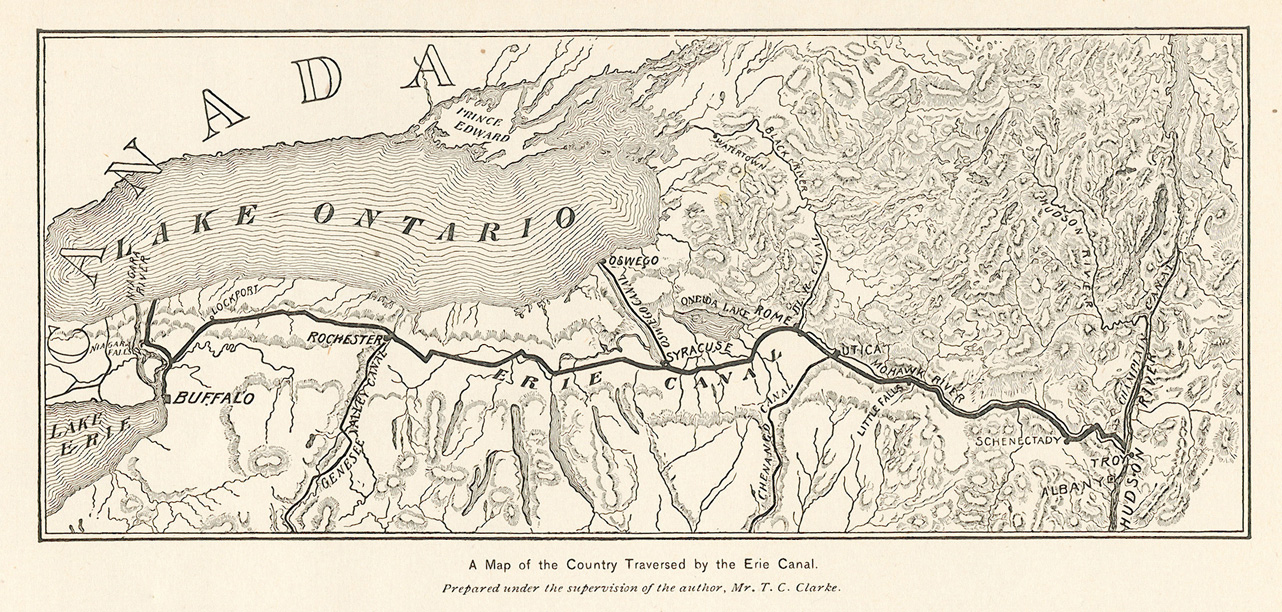
As we approach the bicentennial of the Erie Canal in 2025, let’s look back at this marvel of modern engineering. Not only did the Canal transform much of Upstate New York, but it also transformed folk music. While known by many names since its composition, “The Erie Canal Song” has become a staple of the American folk songbook. With lyrics reflecting life on the canal, and the changes it brought to the state, it proves a useful tool for exploring New York’s history.
Before the Days of Rapid Transit, Edward Lamson Henry (1841-1919) c.1900 Pencil and watercolor, ht.13 3/4′ x w.34 3/4″ Albany Institute of History & Art Purchase, 1976.7.2
The year is 1807, and the United States is slowly expanding into The Northwest Territories (or what is now the Midwest). This region was rich in the grain and metals needed to supply populations on the East Coast. The only issue was that transporting these resources to the East Coast commercial hubs was difficult to say the least. The Appalachian mountains provided a massive barrier for mule trains, with the journey from New York City to Detroit taking four weeks.
New York was specifically poised to tackle this transportation issue. The Hudson River was the main artery of trade for New York, connecting commercial Manhattan to the capital in Albany. Of the Hudson’s many tributaries, the Mohawk River proved to be the most important. Flowing eastward from Oneida County, it cut a low valley through the Appalachians, the only valley of its kind in the Northeast. Because of this, Governor DeWitt Clinton authorized the construction of a canal along this route in 1817.
Map showing Present and Proposed Canal System, to accompany report of Edward A. Bond, State Engineer and Surveyor of N.Y. (from:Annual report of the State Engineer and Surveyor of the State of New York, for the fiscal year ending September 30, 1903 (Oliver A. Quayle, Albany, 1904) — facing p. 60)
Following eight years of disease, construction accidents, and hard manual labor, the Canal was opened in 1825. The canal was 4 feet deep, 40 feet wide, and spanned 363 miles from Albany to Buffalo. With the construction of the canal, boats could travel from the Hudson River to Lake Erie in less than five days. While many were originally skeptical of the canal, it soon proved its worth. Completed ahead of schedule, and under-budget, the canal paid itself off with tolls in under ten years.
The Erie Canal was one of the first great highways of the United States, bringing goods, ideas, and most importantly people across New York. The Canal revolutionized the economy of Upstate New York, practically creating the cities we know today. In 1817, Buffalo was a village of 2,000 people recently destroyed by the British. Canal commerce turned Buffalo into the world’s premier grain hub, with the city growing into the 9th largest metropolis in the US. Cities sprang up all along the canal route. Hamlets like Rochester, Syracuse, and Schenectady grew into cities with hundreds of thousands of residents, and national centers of industry.
“The most fertile and extensive regions of America will avail themselves of its facilities for a market … [and New York City] will, in the course of time, become the granary of the world, the emporium of commerce, the seat of manufactures, the focus of great moneyed operations.”
– DeWitt Clinton, Governor of New York
Thomas S. Allen
On top of having such economic importance, the canal quickly became a cultural symbol of New York. To many, the canal symbolized their identity as Upstaters, and hope for a prosperous future. One person enamored by the legendary canal was Natick, Massachusetts’s Thomas S. Allen. Allen recalled, “When a boy in school, a picture of the Erie Canal in a Geography attracted my attention and I exclaimed: ‘If I ever see the Eric Canal, I’ll think I’ve seen something worth seeing.’” Sometime around 1910, when traveling to Rochester, Allen finally saw the canal, and immediately knew he had to write a song about it.
It turns out Allen was somewhat of a 1900s musical renaissance man. He was foremost a violinist, playing everywhere from professional orchestras to burlesque shows. On top of this, he directed Vaudeville shows, composing songs for them in the Tin Pan Alley tradition. Throughout his career, he published nine songs under his name, including “The Erie Canal Song.” Originally published in 1913 by Manhattan’s F.B. Haviland Publishing Co, the song was titled “Low Bridge, Everybody Down.” The song looked back to the work of mule barges along the canal.
At the time of its publishing, New York was constructing the Barge Canal System, a mechanized successor to the Erie Canal. Newer diesel and steam powered barges carried much of the cargo down these new canals. Allen’s writing harkened back to a simpler time of mule-drawn ships on the Erie Canal. “We’ve hauled some barges in our day, filled with lumber, coal and hay. And every inch of the way I know, From Albany to Buffalo.” These lines also highlight some of the major midwestern resources that would have flowed Eastward through the canal. Grain and ore were the two specifically that allowed cities like Buffalo to become breadbaskets, and industrial hubs of the East.
The lyrics while romanticizing life on the canal, also speak to the hardships it brought. The repeated chorus “low bridge everybody down,” reflects just one of these difficulties. Nearing the fledgling cities along the canal, extremely low bridges were common obstacles for barges. The cover for the song’s original sheet music depicts this, with the narrator ducking down on his mule to pass under one such bridge. In reality, however, these bridges were bigger dangers for barge passengers. Passengers on barges would commonly ride on top when conditions allowed, having to quickly get down to safely pass under these bridges.
Lift Bridge and Canal St., Canastota, N.Y. — Postcard ; not postmarked ; another slightly variant copy is postmarked Sep. 19, 1907. [CSNYS 1096.1.0890]
The song’s lyrics also play into the themes of hardiness that would fit perfectly in a Spaghetti Western. The lyrics repeatedly mention Sal the Mule’s fighting spirit. Throughout the song Sal brawls her way across the state, sending Mike McGinty to the bottom of the canal, and kicking a man all the way to Buffalo. All of this fighting occurs during the narrator’s 15 years of hard work along the canal. This story of hardy enterprise and masculine bravado call to mind the Wild West. One could easily imagine these stories of barging and brawling taking place in a classic Eastwood or Wayne movie. This makes sense remembering that at the canal’s completion, Upstate New York very much was the “Wild West.”
Since its original composition in 1913, “Low Bridge” has become a folk standard, being performed by countless artists. The first known recording we have of the song is by Billy Murray (not to be confused with actor Bill Murray) from 1912. Murray was a star Tenor of the early 1900s, recording many vaudeville and Tin Pan Alley tracks. This recording is now featured in the Library of Congress’s National Jukebox and Recorded Sound Section.
Aiding in the Canal’s place in American mythology was a recording by folk legend Pete Seeger. Seeger included “The Erie Canal” as track #10 on his 1954 album Frontier Ballads. This album celebrated the stories of workers, and settlers who traveled westward through the new territories of the United States. This album places the Erie Canal alongside stories of Cowboys and railroad workers, placing it firmly within the canon of Americana, and further cementing its Western connection.
Perhaps the latest great recording of “The Erie Canal Song” came from rock legend Bruce Springsteen, as part of his 2006 album We Shall Overcome: The Seeger Sessions. This album included Springsteen’s interpretations of 13 folk and Americana classics popularized by Pete Seeger. Because of this, this version is moreso a Springsteen cover of Seeger’s version, rather than a direct reimagining of the original. The album, including “Erie Canal” shot to number 3 on the billboard top 100, also earning Springsteen a Grammy for best folk album.
Since its publishing 111 years ago, “The Erie Canal Song” has become an icon of American folk music. Not only have massive stars covered it over the years, but it has also really lived up to the definition of folk music, and spread to the masses. Reading comments on the YouTube video of Seeger’s version you see nothing but fond memories. Whether it’s people who learned it as kids in school, or sang it with their grandparents, the song holds an important place in the collective American cultural memory.
On top of all of this, the song speaks to the role the Erie Canal plays in American imagination. It singlehandedly built upstate New York, and connected the country more than it had ever been before. More than just this, it represents a time long gone, where the Wild West wasn’t so far west. Its no wonder why when many people think of New York, they think of the Erie Canal.
“The Erie Canal Song” Lyrics:
I’ve got an old mule, and her name is Sal, Fifteen years on the Erie Canal
She’s a good old worker and a good old pal, Fifteen years on the Erie Canal
We’ve hauled some barges in our day, filled with lumber, coal and hay.
And every inch of the way I know, From Albany to Buffalo
Low bridge, everybody down, Low bridge, we must be getting near a town.
You can always tell your neighbor; you can always tell your pal.
If he’s ever navigated on the Erie Canal
We’d better look ’round for a job old gal, Fifteen years on the Erie Canal
You bet your life I wouldn’t part with Sal, Fifteen years on the Erie Canal
Giddyap there gal we’ve passed that lock, we’ll make Rome ‘fore six o-clock
So one more trip and then we’ll go, Right straight back to Buffalo
Low bridge, everybody down, Low bridge, I’ve got the finest mule in town
Once a man named Mike McGinty tried to put it over Sal
Now he’s way down at the bottom of the Erie Canal
Oh, where would I be if I lost my pal? Fifteen years on the Erie Canal
Oh, I’d like to see a mule as good as Sal, Fifteen years on the Erie Canal
A friend of mine once got her sore, Now, he’s got a broken jaw.
Cause she let fly with her iron toe and kicked him into Buffalo.
Low bridge, everybody down, Low bridge, I’ve got the finest mule in town.
If you’re looking ’round for trouble, better stay away from Sal.
She’s the only fighting donkey on the Erie Canal
I don’t have to call when I want my Sal, Fifteen years on the Erie Canal
She trots from her stall like a good old gal, Fifteen years on the Erie Canal
I eat my meals with Sal each day, I eat beef and she eat hay.
She isn’t so slow if you want to know, she put the “Buff” in Buffalo
Low bridge, everybody down, Low bridge, I’ve got the finest mule in town
Eats a bale of hay for dinner, and on top of that, my Sal.
Tries to drink up all the water in the Erie Canal
You’ll soon hear them sing everything about my gal, Fifteen years on the Erie Canal
It’s a darned fool ditty ’bout my darned fool Sal, Fifteen years on the Erie Canal
Oh, every band will play it soon, Darned fool words and darned fool tune!
You’ll hear it sung everywhere you go, from Mexico to Buffalo
Low bridge, everybody down, Low bridge, I’ve got the finest mule in town.
She’s a perfect, perfect lady, and she blushes like a gal.
If she hears you sing about her and the Erie Canal
In honor of Black History Month, we take a dive into the pivotal people, places, and events that have kept lasting impressions on the culture of America. The Harlem Renaissance was one of the monumental events in history that altered the way we as a collective view the world.
A 1930s photograph of Cafe Society’s packed entrance
With the Harlem Renaissance taking musical culture by storm in the 20s and 30s, musicians and music enjoyers alike found refuge from harsh realities in multi-cultural venues of the time period. These venues were beacons of hope and togetherness, where music was the uniting factor, and the outside world could not penetrate that.
Cafe Society – A Refuge in Greenwich Village
Opening their doors on December 18th, 1938, Cafe Society in Greenwich Village, Manhattan was home to a multitude of unique musicians and comics. The mind behind the club, Jewish shoe salesman Barney Josephson, hailed from Trenton, NJ and was a lover of jazz music.
Barney was incensed at the fact that in the Cotton Club, blacks were limited to the back one-third of the club. It infuriated him that even in their own ghetto they had to deal with this treatment. Of course, in any club below Harlem, which had black entertainment, such as the Kit Kat Club, a Black person couldn’t even get in.
A few notable acts from the era that were no stranger to the venue include Art Tatum, Lena Horne, Sarah Vaughn, Mary Lou Williams, Lester Young, Burl Ives, the Golden Gate Quartet, Billie Holiday and Ella Fitzgerald.
An early performance by Billie Holiday at Cafe Society
Racial Harmony in 1938
The Harlem Renaissance saw a monumental explosion of musicianship, racial harmony, and advancements in art. Cafe Society was a perfect example of this. Folks of all races, ethnicities, religions, and art forms attended crowds at Cafe Society. It was a community of tolerance, artistic expression, and racial harmony and prosperity in a time when this was furthest from the norm. The jazz club was a bastion of solitude, a beacon of hope, and mothership of talent.
Barney wanted to create a club so inclusive and so different from the rest and wished to change from the norms that other nearby jazz clubs have set as standard. He wanted to create a place where folks of all races, ethnicities, religions, and orientations could join together and enjoy the music of the city – jazz.
Billie Holiday’s Legendary Start
Billie Holiday, one of the most iconic jazz vocalists of all time, made a significant impact during her early career at Cafe Society. In 1938, she began performing regularly at Cafe Society Downtown, the venue’s location in Greenwich Village. Holiday’s emotionally charged and distinctive voice, coupled with her unique interpretations of jazz standards, quickly garnered admiration.
The intimate layout of Cafe Society allowed her to connect with the audience sharply and meaningfully. Holiday’s performances there contributed significantly to her rise to fame. Billie Holiday performed “Strange Fruit,” a powerful anti-lynching anthem that took the crowd by storm. Billie Holiday’s time at Cafe Society marked a pivotal chapter in her career, showcasing her as a renegade in the jazz world and a courageous voice against social injustice, a common theme of the club.
Far From Typical
Cafe Society’s commitment to left-wing politics was not merely symbolic, it was deeply ingrained in the club’s firmament. Barney Josephson envisioned the club as a space where artists could freely express their political and social views through their performances. The location became a hub for artists and intellectuals sympathetic to leftist causes, such as civil rights, workers’ rights, and anti-fascism. This kind of club was far from the standard and quite eccentric to many. The club hosted acts that addressed these issues in their music and engaged in discussions about social and political matters.
Performers like Billie Holiday, Paul Robeson, and Josh White were known for their activism. These artists found a platform at Cafe Society to use their art as a means of social commentary and political action. The club’s left-wing orientation also extended to its audience, attracting a diverse and politically conscious crowd. In an era marked by racial segregation, Cafe Society stood out as a progressive and inclusive space that challenged norms and ushered in a sense of unity and community among its patrons.
Cafe Society was known as “the right place for the wrong people.” In short, the place was strictly anti-snob, anti-segregation, and anti-standard. The building was draped in eccentric cartoon murals and the club’s doorman was intentionally dressed in raggedy, tarnished clothing to mock the notion that poor folk could not gain entry into the club. Josephson wanted all to know that all were welcome, not just upper-class snobs.
Cafe Society’s Policy
The club had a very unorthodox means of contracting artists. Firstly, Josephson was not a believer of traditional contracts. In fact, there weren’t any. Josephson believed an artist should never be bound to a contract or club, instead he offered long, several-week engagements that would also allow artists to play at other clubs in between.
Along with this, the club was extremely pro-union, something quite rare for the time. Josephson was a committed advocate for workers’ rights and ensured that all the musicians who performed at his club were members of the musicians’ union. This policy helped to guarantee fair wages, reasonable working conditions, and benefits for the artists. In an industry where exploitation of performers was not uncommon, Cafe Society stood out as a venue that prioritized the welfare of its musicians.
Cafe Society’s building today (taken 2024)
The Club’s Closure and Legacy
Cafe Society Jazz Club faced closure due to a combination of financial challenges and changing cultural dynamics. The original Downtown location closed its doors in 1948, primarily attributed to economic struggles and declining attendance. Along with this, the Josephson brothers’ leftist views landed them in hot water with the FBI, specifically his brother Leon. The club struggled to maintain financial viability. New owners eventually took over the club, but it was later closed permanently due to the new owner’s failure to pay back taxes.
The changing cultural landscape, combined with financial difficulties, led to the closure of the Uptown location in 1950. Cafe Society’s legacy, however, endures as a pioneering venue that championed racial integration, left-wing politics, and fair treatment of artists. The club left an indelible mark on the history of jazz and racial integration.
Barney Josephson went on to open The Cookery, also in Greenwich Village. This establishment opened in the early 1960’s as a music-supper club, where many artists would perform while audiences ate dinner. Much like Cafe Society, The Cookery was an all-inclusive, racially integrated, and culturally diverse place where standards were challenged.
The location where Cafe Society jazz club once was is now a historical landmark. The building is part commercial, and part residential. What has stayed the same, is the memory and legacy of Cafe Society. Its indelible mark will never be forgotten.



.png)