On December 2, 2012, the King of Blues, B.B. King played Westbury Music Fair, which is now know as NYCB Theatre in Westbury, New York. At the time he was 87 years but still enjoyed playing for his adoring fans.
King started his music career in 1949 on Beale Street in Downtown Memphis, Tennessee. He named his first guitar Lucille when he ran into a burning building to save it, and later learned that the fire was caused by two men knocking over a barrel of kerosene while fighting over a girl named Lucille. His guitars were usually black Gibson guitars and in 1980, Gibson introduced a B.B. King custom model.
King recorded some of the greatest rock n’ roll hits of all time like “3 O’Clock Blues,” “You Know I Love You,” “Woke Up This Morning,” “Please Love Me,” “Every Day I Have the Blues,” “You Upset Me Baby” and of course his signature hit single “Lucille,” just to name a few. He also found commercial success through a series of all-star collaborations.
On his 1997 album Deuces Wild, he enlisted artists such as Van Morrison, Bonnie Raitt, Eric Clapton, Joe Cocker, The Rolling Stones and Willie Nelson. In 2000, he collaborated again with Eric Clapton for the Grammy winning album Riding with the King. He has released 43 studio albums and 16 live albums and a number of compilations.
AllMusic recognized B.B as “the single most important electric guitarist of the last half of the 20th century.” He was inducted into the Blues Hall of Fame in 1980 and the Rock and Roll Hall of Fame in 1987. He is one of he most influential blues musicians of all time. He is also ranked at No. 6 in Rolling Stone magazine’s 100 Greatest Guitarists of All Time. Over the course of his 60 year-plus career, he has received 18 Grammy awards, the Presidential Medal of Freedom and the Kennedy Center Honors, among many other awards.
King died in May of 2015 at the age of 89. His body was flown to Memphis and a funeral procession went down Beale Street with thousands of people watching and a brass marching band playing “When the Saints Go Marching In.” His body was then driven down Route 61 to his hometown of Indianola, Mississippi where he was laid to rest.
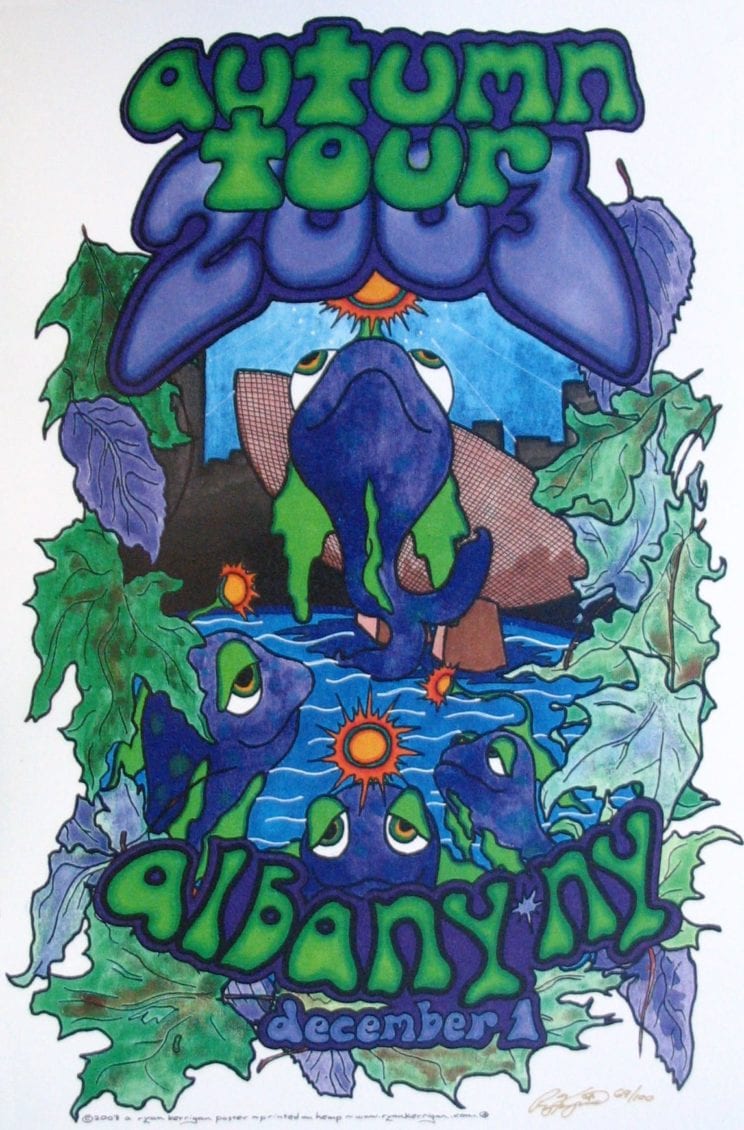
Phish and the City of Albany have always had a cozy relationship. Going to back to 1989 and their first gig at Pauly’s Hotel, Phish has played a total of 17 shows in Albany during the course of their career. Shows in the early 90’s at the Palace Theatre helped establish their Upstate New York following. So it would come as no surprise when their 2003 20th Anniversary Tour rolled around that Albany would be one of the stops. This would only be a short, four-show trek around the Northeast, culminating in the “anniversary” of their first ever show on December 2.
The first two shows of the tour did not disappoint at all. Special guests like the Dude of Life popped out for the encore in Long Island on November 28, and Tom Marshall joined in on a classic version of “Buffalo Bill” the night before in Philadelphia. Now it was Albany’s turn and the band went even further back in their history for tonight’s guest selection.
Picking up on the palpable December pre-show energy, the show begins with a “Chalkdust Torture” that ramps it up even more. The entire Pepsi Arena crowd seems to join in on the “Can’t I live while I’m young” line. A blistering guitar solo from Trey Anastasio highlights this one before all is said and done. The “Stash” that comes next allows for plenty more audience participation. It eventually develops into a dark, yet fairly uneventful jam. A standard run-through of “Guyute” then follows, with the Albany crowd audibly loving every minute of this first set Phish staple.
An interesting little juxtaposition of both styles and song histories then proceeds this. The delicately mellow “Thunderhead,” from 2002’s Round Room release, makes a rare appearance. It’s only the sixth live performance ever of this song. And, to date, it has yet to be played a seventh time. After a tidy little jam that gradually picks up in intensity, “Sparkle” emerges. The high pace, first set romper dates all the way back to 1991 and has been played hundreds of times.
“Wolfman’s Brother” finally gives the band a chance to stretch things out a little again. Aside from “Stash,” this is really the only other true “jam” of the first set. Mike Gordon’s aggressive bass play provides the fuel for this one and dominates throughout. Gradually, the rest of the band seems to catch up in this “Wolfman’s” that easily glides past the 15-minute mark after an exuberant finish. “Good Times Bad Times” then puts a cap on a rockin’ but relatively quick first set. Perhaps this was done to allow some additional set break practice time with the still-TBA special guest.
Before said guest would be revealed, there was still some business to tend to first. Phish would grace the Albany crowd with three classic songs sure to make any show memorable. “Tweezer” promptly begins the second set. It sees more inspired guitar play from Anastasio atop the funky rhythms generated by Gordon and drummer Jon Fishman. The jam continues to ascend accordingly until about the ten-minute mark, when it takes an ambient hard left turn. The music continues to devolve and get spacey for another few minutes before Fishman slyly increases the tempo and the band is off and running with the instrumental “Also Sprach Zarathustra” aka the theme to Stanley Kubrick’s 2001: A Space Odyssey. Keyboardist Page McConnell takes control early on with his standard electric keyboard fills complementing Anastasio’s iconic guitar riffs.
Before the last remnant of “2001” even finish echoing, Phish launches into “You Enjoy Myself,” further delighting the Albany faithful with an epic start to the second set. There’s no issues with this version at all as the band rips through the composed sections with ease. Then another cohesive, psychedelic jam emerges with McConnell continuing to dazzle on piano.
Finally, it was time to reveal tonight’s special guest. It would be none other than Jeff Holdsworth, one of the original members and co-guitarists of Phish from its inception in 1983. Jeff would eventually leave the band before they gained much notoriety. Tonight marked the first time he played with Phish since a gig on May 17, 1986 at Goddard College in Plainfield, VT. As befitting for an anniversary run, they would play a few of the songs he wrote that are still regular fixtures at Phish shows to this day.
The first of these was “Camel Walk.” Holdsworth seems to have a little issue with the lyrics early on, but manages to keep it together for this longtime favorite. Trey then gives him proper thanks for writing that song as well as the next one, “Possum.” Despite some feedback issues, they manage to maneuver through this Phish classic as well, with Anastasio doing a lot of the heavy lifting.
Jeff stays on stage and even takes lead vocals on the first song Phish ever played as a band, a cover of The Hollies’ “Long Cool Woman In A Black Dress.” Understandably, he seems to be a little more comfortable singing on this one than the Phish songs he hadn’t played in more than 17 years.
“Run Like An Antelope” would then go on to close the second set. While Holdsworth would remain on stage to play guitar, he must have been turned down fairly low in the mix. This also gave Phish one last chance to surprise the Albany crowd. Longtime lyricist and friend of the band Tom Marshall emerged to deliver the song-ending vocals. One last cover, Jimi Hendrix’s “Fire,” would complete one of the more interesting and memorable Phish show in Albany’s rich history.
Check out the full audio below, or go here for track-by-track selections.
Phish – December 1, 2003 – Pepsi Arena – Albany, NY
Set 1: Chalkdust Torture, Stash, Guyute, Thunderhead -> Sparkle, Wolfman’s Brother -> Good Times Bad Times
Set 2: Tweezer -> Also Sprach Zarathustra > You Enjoy Myself, Camel Walk, Possum, Long Cool Woman in a Black Dress > Run Like an Antelope
Encore: Fire
Note – Camel Walk through Fire with Jeff Holdsworth on guitar
With Phil Lentz Presents… Vol. II, New York City-based jazz composer and pianist Phil Lentz returns with his signature sound, crafting a genre-blending album with new emotional heights and technical finesse.
Building on the warm reception of his 2022 debut, Lentz delivers a fresh, diverse, and uplifting listening experience that feels both timeless and unmistakably current.
Featuring standout tracks like “Play Your Melody,” “I Remember the Early Days,” and “Bebopping Along,” the album weaves jazz, pop, folk, and classical influences into a seamless tapestry, making it an instant favorite for music lovers of all backgrounds. The album’s lush arrangements blend alto saxophones, violins, and rich vocal textures, creating a soundscape that invites listeners to lose themselves in a melodic journey filled with nostalgia, joy, and introspection.
“This time, I wanted to step beyond the boundaries of traditional jazz,” Lentz shares. “Drawing in elements of folk and classical felt natural, adding layers of texture and depth to the compositions. Each track aims to capture those fleeting moments of peace and joy we all seek.”
Phil Lentz Presents… Vol. II is brought to life by a talented ensemble, including Dennis Harte on guitar, Wolfgang Lugomarsini on bass, Dave Young on drums, and features the soulful sounds of Red Heller and Richard Philbin on alto sax, with Bob Cohen’s violin adding a dynamic flair. Produced by Dennis Harte, recorded at Studio Mozart in New Jersey, and expertly mastered by Tom Hutten at Bionic Mastering, the album offers a finely crafted and resonant listening experience.
Released on November 22 on CD and across all major digital platforms, Vol. II is more than just a follow-up, but rather a testament to Phil Lentz’s artistic growth and his boundless vision for contemporary jazz.
On Sunday, November 24, Madison Square Garden hosted the Soulshine Concert, a powerful evening of music and charity dedicated to hurricane relief and recovery.
Net proceeds from the event supported the SOULSHINE Concert Fund at the Charlottesville Area Community Foundation, benefiting non-profits aiding communities in North Carolina and Florida heavily impacted by recent storms. At the heart of the event was Warren Haynes, renowned for both his musical talent and commitment to philanthropy.
Through ticket sales, merchandise, sponsorships, and donations, the event raised over $4.5M for the Soulshine Concert Fund, which will distribute funds to a variety of organizations on the ground in North Carolina and Florida.
While Haynes played a pivotal role in curating the lineup, the concert was a collaborative production by Dayglo Presents and Live Nation, delivering an unforgettable night of performances for a worthy cause.
A Star-Studded Lineup
The concert began with an intimate acoustic performance of “Soulshine” by Warren Haynes and Dave Matthews, setting the tone for the night with heartfelt emotion. The baton was then passed to Goose, whose electrifying set featured collaborations with some of the biggest names in music. Highlights included:
“Give It Time” with Robert Randolph
“Hungersite” with Derek Trucks
“Baby Donât You Do It” with Susan Tedeschi and Derek Trucks
“The Way It Is” (a Bruce Hornsby cover) with Dave Matthews
The collaborative spirit continued as Haynes joined forces with Tedeschi and Trucks for a moving acoustic rendition of “700 Houses”, a song with deep emotional resonance.
The stage then welcomed the Warren Haynes Band, who delivered a fiery set punctuated by guest appearances:
“Man in Motion” with Trombone Shorty
“This Life as We Know It” with Robert Randolph
“Shakedown Street” with Joe Russo
“These Changes” with Derek Trucks
A show-stopping “Whipping Post” featuring Trucks and Russo
Next, Susan Tedeschi and Dave Matthews delivered an acoustic version of “Angel from Montgomery”, honoring John Prineâs timeless legacy.
Nathaniel Rateliff & the Night Sweats Bring the Party
The soulful energy of Nathaniel Rateliff & the Night Sweats followed, featuring crowd favorites like “Look It Here”, “You Worry Me”, and “Call Me Whatever You Like”.
The set crescendoed with Mavis Staples joining for a heartwarming rendition of “Friendship”, culminating in a raucous performance of “S.O.B.”, with Robert Randolph and Trombone Shorty adding their flair.
Closing Acoustic and Dave Matthews Band Finale
Warren Haynes and Dave Matthews returned for a poignant acoustic segment, performing:
“Carolina on My Mind”
“Southern Accents” with Derek Trucks
“Waste” with Trey Anastasio
Finally, Dave Matthews Band headlined the evening with a dynamic set, launching with “The Weight”, featuring Susan Tedeschi, Nathaniel Rateliff, and Trey Anastasio. The band delivered a mix of classics and collaborations, including:
“Rapunzel”
“So Much to Say” into “Too Much”
“Jimi Thing” with Trombone Shorty
“Brick House” with Trombone Shorty
“Lie in Our Graves” with Trey Anastasio
A beautiful rendition of the Allman Brothersâ “Melissa” with Warren Haynes, Derek Trucks, and Trey
The grand finale brought all the nightâs performers back on stage for a powerful rendition of “Come Together”, symbolizing the unity and purpose of the evening.
A Night to Remember
The Soulshine Concert was more than a musical extravaganzaâit was a testament to the power of music to bring people together in the face of adversity. With its all-star lineup and heartfelt performances, the event left an indelible mark on attendees while raising much-needed funds for hurricane relief.
As Warren Haynes has proven time and again, music can shine a light in even the darkest times, and the Soulshine Concert at MSG was a beacon of hope for those in need.
Melodic harp sounds reverberated through the Center for the Arts in Homer on Wednesday November 20, as Mikaela Davis brought her Solo+Acoustic tour to the refurbished church. John Lee Shannon opened the show.
Davis has risen to stardom over the last several years, thanks to a nearly relentless touring schedule. The Rochester native and classically trained harpist has performed muti-week residencies through out various music venues across New York State on several occasions the last two years. Those shows saw Davis joined by her band, Southern Star, and took on a very upbeat, jam-oriented vibe. For this run of dates, Davis stripped her music to its core, performing on either the harp or keyboard.
The evening opened with a set by John Lee Shannon. Shannon performed a 40 minute set of acoustic instrumental tracks, primarily off of Shannon’s 2020 release In & Of.
After a brief intermission, Davis took to the stage and took seat at her harp. She opened with the hauntingly beautiful “Cinderella” (off her latest release, And Southern Star), and followed up with “A Letter I’ll Never Send” and “In My Groove”. Stripped down to their foundation, the songs took on a different life and allowed Davis’ songwriting to shine. Davis would take turns performing on the harp and keyboard, while opener John Lee Shannon would add acoustic guitar for a new offering from Davis, “Rose Colored Glasses”.
Early in the show, Davis stated that this was the first time she felt nervous performing in a very long time. She talked about the fears that the audience would become bored and leave early. Any of those fears were squashed early on in the evening, as the theater became engrossed in the music. To say that the theater was so quiet you could hear a pin drop would be an understatement. The theater was so quiet, you could hear the click on the effect pedals as Davis switched amongst them during her songs. To garner such attention from the audience is a true testament to Davis’ abilities as a songwriter and performer.
Mikaela Davis – Homer Center for the Arts, Homer, NY – Wednesday, November 20, 2024
Setlist: Cinderella, A Letter That I’ll Never Send, In My Groove, Home in the Country, The Pearl, Promise, One of these Days, Delivery, Natural Women (Carol King), Rose Colored Glasses, Far From You, Little Bird, Emily, Saturday Morning
It was a great week for Pink Floyd fans when David Gilmour enthralled the crowds at Madison Square Garden for five nights. The five city, 20+ performance tour in support of his latest album, Luck and Strange concluded with these five magnificent nights at MSG.
Gilmour’s previous visit to the Big Apple in 2016 was a three-night spectacle unto itself, befallen upon Radio City Music Hall and Madison Square Garden. With the imprint those shows left on the city it’s no surprise that three nights sold out in a flash with two additional nights added to satiate the ticket demand.
“5 A.M.” served as the perfect opening for the evening, lending an ambience for Gilmour’s signature guitar sound to break through like a beam of light. Those first few notes seemed enough to already leave people lost for words on what they were in for the rest of the evening. The true spectacle of the shows were his iconic guitar solos – a roaring jam in “Fat Old Sun,” the melodic monologue of “Marooned,” a wailing lamentation concluding “In Any Tongue,” the helpless reminiscence of “High Hopes,” and of course, the unforgettable denouement of “Comfortably Numb.” It is easy to converse with fellow Pink Floyd fans which is the “best” or most “profound,” but in the context of Gilmour’s live shows at The Garden there can be no debate as his guitar work was so masterfully presented in each of his solos.
Luck and Strange was released only a few weeks before he began his tour in Rome, Italy, which gave a limited period for fans to listen to the new material before seeing the shows. It made sense that a few of the new songs had a less boisterous response compared to mainstays from the Pink Floyd catalogue. However, the entirety of Luck and Strange made it into the setlist unlike 2016’s Rattle That Lock which featured just a few songs from the album in that tour. It was very respectable to see the inclusion of the full album when so many fan favorites from Pink Floyd’s history could be selected.
Gilmour structured his two sets with a perfect blend of his new songs and later Pink Floyd era songs, along with a few quintessential songs from Dark Side of the Moon, Wish You Were Here, and The Wall. Weaving of the new songs with familiar territory created an exciting and refreshing concert experience for hearing the entirety of a brand new album.
Gilmour’s touring band was nothing short of a compliment of talent to each other and to Gilmour himself. His long-time collaborator, Guy Pratt (on bass), has worked with Pink Floyd since the A Momentary Lapse of Reason tour and also toured with Nick Mason’s A Saucerful of Secrets band showcasing the early years of Pink Floyd. Gilmour’s daughter, Romany Gilmour, took lead vocals on “Between Two Points” (a Montgolfier Brothers song) and sang beautifully on an acoustic, stripped-down version of “The Great Gig in the Sky,” demonstrating the forging of a musical legacy on stage within the Gilmour family. Completing the lineup are Greg Phillinganes and Rob Gentry on keyboards, Adam Betts on drums, Ben Worsley on guitar, Louise Marshall on piano/vocals, and the Webb Sisters; Hattie Webb on harp/vocals, and Charley Webb on guitar/ukulele/vocals.
Just as he did at the conclusion of his three 2016 shows in NYC, Gilmour bid the crowd goodnight after thunderous applause, remarking “…we hope to see you again soon.” That statement came true eight years later in 2024, so the door may be open for a few more shows down the road. Until then, let’s remember those nights as priceless musical treasures.
Set 1: 5 A.M., Black Cat, Luck and Strange, Speak to Me, Breathe (In the Air), Time, Breathe (Reprise), Fat Old Sun, Marooned, A Single Spark, Wish You Were Here, Vita Brevis, Between Two Points, High Hopes
Set 2: Sorrow, The Piper’s Call, A Great Day For Freedom, In Any Tongue, The Great Gig in the Sky, A Boat Lies Waiting, Coming Back to Life, Dark and Velvet Nights, Sings, Scattered
The queer femme rock trio has had quite the year since their last visit to the Capital Region. They’ve opened for Spoon Benders, released four music videos, and brought back cassettes? Razor Braids released six singles, five of which ended up on their sophomore album ‘Big Wave.’ They are a talented group of musicians who bring a unique vibe and visual to indie rock.
Though they were the headliner, in typical No Fun fashion, they did not close out the show. They were the second of 3 acts to take the stage. Razor Braids dawned their signature all red outfits for this show. They played a 45 minute set to a modest crowd of about 50 young adults. There was great chemistry displayed on stage between the band members.
Notable moments was in an anecdote before playing “JR” lead vocalist and bassist, Hollye Bynum, said the song was about “a s***ty dude” she once dated. A person in the crowd then yelled out “we are all someone’s s***ty dude,” which brought about great laughter among the crowd. Before the end of their set, the members of Razor Braids celebrated the birthday of their drummer Brian.
Screenager at No Fun
Razor Braids was preceded by a 30 minute set from Screenager out of New Jersey. They were succeeded by local artist, Toriendofstory, with Canella.
Razor Braids‘ next show will at the Meadows in Brooklyn on December 1st.
Razor Braids Setlist: Not Dead, Not Yet, Nashville, B26, Sharpe Ave, Drugs, JR, Berate Me, 42
Screenager at No FunScreenager at No FunScreenager at No FunScreenager at No FunScreenager at No FunScreenager at No FunScreenager at No FunScreenager at No Fun Razor Braids at No FunToriendofstory at No FunToriendofstory at No FunToriendofstory at No FunToriendofstory at No Fun
Tokyo Police Club performed their final show on US soil at Irving Plaza on Thursday, November 20. This was night two of the group’s NYC run for their farewell tour. Opening the show was fellow Canadian indie rock band Born Ruffians.Â
Both Born Ruffians and Tokyo Police Club got their start in Ontario, Canada in the early 2000s. In between songs, Born Ruffians’ Luke Lalonde reminisced on the bands coming up together at the same time. Now getting to perform together on Tokyo Police Clubâs final tour, it feels like a bittersweet, full-circle ending. The band has been making their way throughout the US this fall, playing two nights at Irving Plaza before continuing to Canada to finish off their tour.
Starting their set, Tokyo Police Club played a run through of their 2010 album Champ, followed by additional songs from their nearly two decade discography. The night was filled with nostalgic banter as Dave Monks reminisced on moments the band has experienced together throughout their career. He spoke about performing in New York City for the first time in 2006 and the feeling of stepping out of a rental car to play Mercury Lounge as well as their performance on Letterman.
Friends since the 4th grade, Tokyo Police Club has amassed a large fan base since choosing to form a band in 2005. With their first EP released in 2006, A Lesson In Crime, they entered the indie rock scene. Coming into the early 2000s, we saw an âindie rock renaissance.â The band was welcomed in, quickly performing festivals with other quintessential bands from this era including Modest Mouse and Death Cab for Cutie.
Tokyo Police Club will be continuing “The Final Tour” with a run of sold-out shows throughout Ontario, Canada through the end of November. These shows will be the last shows the band plans to play together. At this time, the band has no plans to reunite.
Setlist: Favourite Food, Favourite Colour, Breakneck Speed, Wait Up (Boots of Danger), Centennial, In a Cave, Juno, Graves, New Blues, Simple Dude, Pigs, Hang Your Heart, Toy Guns, Hands Reversed, End of a Spark, Bambi, Frankenstein, Argentina (Parts I, II, III), Nature of the Experiment, Citizens of Tomorrow, Shoulders & Arms, Listen to the Math, Tessellate
Encore:The Harrowing Adventures Of..., Ready to Win, Cheer It On, Your English Is Good
The Orchestra Now (TŌN), conducted by Leon Botstein, performed a set of works by modernist American composer Charles Ives at Manhattan’s Carnegie Hall, on Thursday, November 21st.
The evening concluded a Bard College Ives festival, one of four Ives festivals supported this season by the National Endowment for the Humanities.
The Orchestra Now, conducted by Leon Botstein (Credit: David DeNee)
The concert highlighted pieces in which Ives used themes from famous American tunes, each work being preceded by a mini-lecture by J. Peter Burkholder. Snippets of the original pieces were also played on piano by Donald Perlman and sung by William Sharp.
The opening piece, The Fourth of July from A Symphony: New England Holidays, begins with a whispering and sighing of strings, a kiss of cymbals. Just when the audience has been tricked into thinking it can relax into this performance, Botstein is suddenly waving his arms and driving the orchestra into crashing crescendo.
Like the other pieces played in the first half of the concert, The Fourth of July falls into the ‘modernist’ classical genre associated with musical innovation away from rigid classical principles. (Jazz can be considered a modernist art form.)
In practical terms, Ives modernist work eschews such stuffy principles as ‘playing in time’ and ‘playing notes that sound good together’, in favor of less conventional means of constructing themes and musical ideas. Towards the end of the piece one feels that some part of the orchestra or another has lost the beat – the percussion is ahead, or no, the strings are behind, or, oh no it’s all falling apart! – until all of a sudden Botstein slams on the brakes. An exhausted sigh seems to emanate from the stage and all is – briefly – silent.
Then tolls, from somewhere in the back, an impish bell – just once. The audience is reminded that Botstein and his players, recreating the kind of wild and competitive soundscape of a parade, were in control the whole time. Just how is hard to say.
This is followed by Central Park in the Dark, a 7-minute tone poem about what one might hear during a steamy summer’s night in Central Park at the start of the 20th Century. We are invited to consider the mixture of sounds Ives might have heard before, according to the composer himself, “the combustion engine and radio monopolized the earth and air.”
The piece begins with a slow, painful lament by the string section, described in the program notes by Haley Maurer Gillia, TŌN violinist, as representing “the omnipresent heat and the surrounding nature” that Ives might have felt.
After the strings comes, from somewhere uptown maybe, a piano. But this pianist must not have been listening because now – vying with the sad, dissonant strings – we have ragtime?! And if that’s not enough, in chimes a trumpeter, warming up in a different key in the parlor of a nearby apartment.
Balancing these different instruments, allowing them to pierce into our attention so suddenly and violently at times, must be somewhat novel for an orchestral conductor. Botstein’s day job presumably involves balancing the parts of an orchestra, letting soloist augment, without overwhelming, the accompanying musicians. Here, it feels as if the very point of the work is to accentuate this competition between sounds, all the more redolent for its clashing nature.
The music cannot readily be described as beautiful, but it is so much more rewarding for its being challenging. Ives was not widely recognized in his time (other than for being a successful proto-finance bro), but there is a freedom, a playfulness to the performance which is hard to find elsewhere in classical music.
But where were we? – the whole thing seems to have veered off course again: what Ives has put down on the page just can’t be, the whole thing is just becoming too literal, too wonderfully overwhelming. Once again Botstein has to wrest back control, exhorting his percussionists to beat some order into the rest of the orchestra. Back we find ourselves in the original theme, those sweet, hot, sticky violins on a warm night.
The final performance before the interval is of Orchestral Set No. 2, which features themes from popular American hymns such as Bringing in the Sheaves by Knowles Shaw and George Minor (a ‘sheaf’, if for some reason you didn’t know, is a bunch of cereal crop tied together after a harvest).
Snippets of the original pieces were also played on piano by Donald Perlman and sung by William Sharp. (Credit: David DeNee)
The piece is opened by double bass and timpani – an ominous pairing. Listening to Ives’ work requires you to open your ear in a different way. In this kind of music, no use looking out for the violins or the oboes; better not try to contrast the clarinets and French horn with one another. The dissonance and, at times, lack of discernable rhythm invite you to listen to the thing as a whole, as a monolith.
The work therefore seems challenging to play, the musicians needing to shed their desire to play notes from conventional chords and at the same time. How one actually plays this, let alone conducts it; how the whole thing falls together just right – these are questions I am not qualified to answer.
Today there is a reasonable acknowledgement of the legitimacy of ‘borrowing’ ideas in music: from sampling to vernacular folk musics to – well, just about any ‘genre’ you care to name. Yet it is though hard to tell what Ives means through his musical borrowing.
Most of the songs he borrows from are innocent, patriotic, simplistic pieces of music: Fourth of July parades, Protestant harvest hymns etc. Yet Ives’ work feels as much written with the hammer at the anvil than with the pencil at the bureau. Simplistic, balanced phrases are melted down and violently annealed into dissonant, chaotic ideas. Is there something irreverent about Ives’ use of old-school Americana? What drove Ives to work like this?
After the interval, the final set of works is Ives’ Symphony No. 2. This is a return to more ‘conventional’ musical forms and, refreshments in hand, the audience can relax a little – no more errant drum rolls or angry trumpet notes flying overhead. I suspect that some members of the orchestra feel a little more relaxed now too.
The symphony is honey-sweet, Ives passing the silken memories of his New England youth through the loom into perhaps the most indulgent art form around, the orchestral symphony. As with the rest of the performance, TŌN’s musicians handle the work with love and care and Carnegie Hall is, of course, a wonderful place to hear this. (At one point I was certain that the harp was being plucked not on stage but somewhere over my head. It is a magical experience.)
Whether Charles Ives was an iconoclast or a proud patriot; whether he achieved his goal of writing the first Great American Symphony – these questions are not really relevant. Even though Ives was an innovator, his contemporaries chose not to enjoy his music in the way TŌN and Botstein treated us to in 2024. Their loss.
You want a rock concert? A mosh-pitting, floor-bouncing, head-yelling, crowd-surfing rock show? That’s exactly what Telescreens brought to Webster Hall on November 19. Hometown fans crowded the 1,500-person Grand Ballroom and for a few hours were swept up in the power of rock.
Telescreens Credit Aidan Lukomnik
Telescreens formed after frontman and lead guitarist Jackson Hamm moved to New York to attend the Clive Davis Institute of Recorded Music. There he met keyboardist Josiah Valerius and bassist/keyboardist Austin Brenner in 2016. The final member of the band, drummer Oliver Graf, joined the other three in 2019 – adding to their explosive sound. The band started playing gigs around the city before COVID-19 but was forced to stop because of the pandemic. Since their return to live touring, they’ve played Austin City Limits and Governor’s Ball.
Telescreens Credit Aidan Lukomnik
On Tuesday, hometown bands Skorts and Kareem Rahma & Tiny Gun opened the show. Skorts amped the crowd up with head-banging energy and a light show with more than enough fog to fill the room. The one problem was Skorts’ drummer hidden in a wall of mist. Following Skorts, the multi-hyphenate singer/ comedian/ interviewer Kareem Rahma came on stage with his trademark sunglasses – which he never took off. Playing off his success as a video creator, the band’s song “Content Machine” got the audience jumping as the singer poked fun at his other jobs.
Kareem Rahma Credit Aidan Lukomnik
By the time Telescreens came on, the audience was ready, and a moshpit formed almost immediately. Within the first two songs Jackson Hamm jumped from the stage into the crowd to re-form the pit in the middle of the room. Once he was back on stage, moshing started again, and the floor of the ballroom roiled like the ocean – visibly shaking and bouncing from the audience’s movement.
Throughout the night, Hamm encouraged the audience to lose themselves to the music, asking them to “take this as an opportunity to push yourself a little out of your comfort zone.” The lead singer also admonished wallflowers who weren’t engaging with the music, “You on the sides, why do you wanna be so fucking cool?”
Jackson Hamm reforms the Moshpit, Credit Aidan Lukomnik
It’s clear that Hamm believes in the power of rock. Throughout the set, the singer and guitarist worked up a sweat and, at one point, said: This [Rock and Roll] is like a religion. You have to believe it will make you feel better. You’re not supposed to stand there with your arms crossed. You’re supposed to move your feet. You’re supposed to get your heart rate up.
Telescreens, Credit Aidan Lukomnik
As the night wore on, mosh pits formed and closed, and dozens of people crowd surfed, egged on by Hamm, who said, “Keep crowd surfing, that shit feels good, I promise.” As crowd surfing escalated, Webster Hall had to call in extra security to ensure everyone was safe.
A crowd surfer, Credit Aidan Lukomnik
Telescreens ended their set with Hamm ripping chords, jumping from the stage to the crowd and back (again), and the band leaving it all out for their hometown fans.