There’s something about anniversary shows that really gets a crowd going. Pressed against each other in the pit, hands swaying, chanting in time to favorite songs. What better way to celebrate 20 years of Interpol’sAntics than a 3-day sold out show at Brooklyn Steel? Longtime fans gathered for opening night on December 3. Ready to revel in the gritty, driving force of rich guitar playing and powerful lyricism.
Around since 1997, Interpol was formed under New York University doors, beginning with lead guitarist Daniel Kessler, frontman Paul Banks and drummer Greg Drudy. Their post-punk sound has become a staple amongst New Yorkers, emerging as a key rock revivalist of the early 2000s. In hopes to sound sleek and mysterious, they derived their name from The International Police Association, signing with Matador Records in 2002. Now, Interpol has played at a multitude of venues across the world, joined by Sam Fogarino on the drums.
With white sheer curtains draped across the front, a hush fell over the crowd as Interpol took stage a few minutes past 9:15pm. Opening with “Next Exit”, the band remained obscured. The crowd focused on projections of their silhouettes, jumping back and forth across the curtains. Once their second song, “Evil” reached crescendo, the lighting crew scrambled into the photo pit. The crew pulled back the expansive white sheet to reveal the band, dressed to the nines in black tailored suits.
After every song, fans whooped and hollered, dazed by the thick smoke and dramatic strobe lights. Lush storytelling balanced out catchy choruses, pairing with intricate guitar riffs to make a visually immersive performance. Their iconic color scheme of black, white and red alongside a sharp typeface held true. Non stop energy created through intriguing lighting choices and special effects.
As Interpol performed fan favorites such as “C’mere” and “Rest my Chemistry” the crowd pushed forward to the edge of the barricade, unable to peel their eyes off of the stage. By the time the 21 song setlist came to a close, the venue was absolutely packed. Reveling in the rush, fans lingered in the pit, chatting excitedly while sharing videos and treasured moments.
Interpol – Brooklyn Steel – Tuesday, December 3, 2024
Set 1 (Antics): Next Exit, Evil, Narc, Take You on a Cruise, Slow Hands, Not Even Jail, Public Pervert, C’mere, Length of Love, A Time to Be So Small Set 2: Pioneer to the Falls, No I in Threesome, The Rover, Rest My Chemistry, My Desire, Roland, Lights, All the Rage Back Home, Obstacle 1 Encore: The New, PDA
The date Dec. 8, 1980 will be remembered infamously throughout history as the night John Lennon was shot outside his New York City apartment. The Beatles member and songwriter was returning home from the Record Plant recording studio with his wife Yoko Ono, fresh off their recently released collaborative album, Double Fantasy, when tragedy struck.
Left: John Lennon, Right: Christine Lavin – photos via CNN and Fleming Artists
Lennon was shot four times in the back and was pronounced dead on arrival at the hospital. Fans mourned his death afterwards gathering outside The Dakota, the apartment building where he lived and outside of which he was killed.
Double Fantasy, album by John Lennon and Yoko Ono, released 1980
Four years later, Lennon’s tragic murder was recalled by Christine Lavin, a long-time folk singer-songwriter and guitarist in her song, aptly titled “The Dakota.”
Newspaper headline in Liverpool Photo, Dec. 9th, 1980 via rarenewspapers.com
The song is the final track on her 13 song, self-produced album, Future Fossils, released in 1984. “The Dakota” was actually written a year or two following Lennon’s death, the song inspired by Lavin being stuck in rush hour traffic in NYC as “Imagine” happened to play on the taxi radio.
Album art for Fossil Fuels by Christine Lavin, released 1984
Lavin never actually mentions Lennon by name in the song, alluding to his death primarily through her imagery of the events that unfolded outside of the Dakota. Lavin spent much of her professional career playing venues in New York City and lived only a few blocks away from the Dakota at the time Lennon was killed.
To see one of her musical idols, murdered in a city she called home, was shocking she said in an interview with NYS Music. “That night is burned into my memory,” she said. “To this, day I can’t walk near the scene of the crime without thinking about it.”
In her song, the building serves as an unmoving reminder of that horrific night, a symbol of senseless death that is difficult to escape.
John Lennon and Yoko Ono outside the Dakota – Photo via Getty Images
The chorus finds herself reflecting on the night of Lennon’s death with soft emotion and heartbreak as Lavin sings:
“Every time I see the Dakota, I think about that night. Shots ringing out, the angry shouts, A man losing his life.”
“The Dakota” – Christine Lavin
The closest Lavin comes to referencing Lennon himself is by quoting one of his most popular and enduring songs, “Imagine.” In a unique twist however, Lavin takes the familiar, hopeful tune and bitterly exposes the unrealistic idyllic world, Lennon so vividly painted.
I don’t believe in coincidence So why then on the radio Did an old familiar voice Echo back from not so long ago? “Imagine all the people Living life in peace.” Well, it’s hard to do When you are on this blood-stained street.
“The Dakota” – Christine Lavin
Lavin’s grief and anger over the famed singer’s unnecessary death reaches its peak at this point, the bridge and climax of the song. The lyrics play out like a conversation with herself, as a harmony of voices sing Lennon’s famed lines, and Lavin replies with her honest answer.
Album art for Imagine by John Lennon
“It was just the way I felt at the time,” Lavin explained. “Imagine is so optimistic but it’s almost too optimistic in ways when we think of how the world is today. And it is harder to [be optimistic] when your on that street because to think the man that wrote those lines had such a tragic and violent end doesn’t make sense. Its such a contradiction.”
Still, Lavin said she tries to use her power as a songwriter to find a glimmer of light in a dark situation.
“As songwriters anything we can right that can help us to overcome the dark side of our nature I think we owe to the world,” she said. “It’s acknowledging the world we live in, but knowing we can do better and that it is our duty to do better.”
Lavin said the decision not to mention Lennon’s name in the song was purposeful – she didn’t want to look like she was exploiting the situation. Quite the contrary, Yoko One ended up publishing Lavin’s lyrics in a book she edited about John Lennon.
Memories of John Lennon by Yoko Ono, the book Lavin’s song is featured in
As the song continues, Lavin reflects further on her anger, asking for peace of mind.
I wish I had the answer To the simple question, ‘Why?’ … I wish I could take these bitter thoughts And just shake them from my mind
“The Dakota” Christine Lavin
In what would be Lennon’s last interview before his death, he talked with a crew from RKO Radio in his home in the Dakota. Eerily enough, at one point during the conversation, Lennon pondered themes of death and getting older.
“When we were kids, 30 was death, right?” he said. “I’m 40 now and I feel just … I feel better than before.” He later added, “I consider that my work won’t be finished until I’m dead and buried and I hope that’s a long, long time.”
The Dakota as seen from Central Park West – Photo via Wikipedia
Even in 2022, memories of Lennon’s death haunt the state of New York. Although, The Dakota has undergone extensive renovations, it still maintains its signature gothic architecture and remains home to numerous celebrities, thanks to its prime location facing Central Park.
Lennon’s killer, now 67, also lives, albeit behind bars at the Green Haven Correctional Facility in New York. Just this September, he was denied parole for the 12th time. Yoko Ono, has historically sent a letter to the parole board every two years to request her husband’s murderer remain in prison, CNN reported.
Despite the painful reminders, Lennon’s legacy and hope for a better world persists long after his death as well.
An annual tribute concert is held in Lennon’s name in NYC bringing together famous musicians and celebrities in a night of song and remembrance. Proceeds also go to supporting songwriting programs in elementary schools. One selected artist is also awarded with the John Lennon Real Love Award, this year given to Joan Osborne.
Joan Osborne to receive this years John Lennon Real Love Award
Lavin’s final lyrics capture the conflicting emotions around wanting to forget the tragedy but remember Lennon’s greatness as she closes out the chorus singing:
“Well, it’s something we shouldn’t dwell upon But it’s something we shouldn’t ignore Too many good men have been cut down Let’s pray there won’t be any more.”
“The Dakota” – Christine Lavin
John Lennon is memorialized in “Strawberry Fields,” a section of Central Park across the street from the Dakota that Yoko Ono landscaped in honor of her husband.
Phish has made their way across New York State in the Fall many times over the years, particularly in 1995 and 1997. Those stand out years in Phish history overshadow 1999, and the December 5 show in Rochester deserves a second look for more than the “Jennifer Dances” premiere with which it has come to be associated.
A warm afternoon before the show gave way to a cold and windy night, just the weather shift you’d expect near Lake Ontario in early December. Two years removed from their December 11 show at Blue Cross Arena, which featured a monster “Down with Disease” and the debut of Ween’s “Roses are Free,” you’d be forgiven if you didn’t listen to the other Rochester Phish show from the tail end of the 90s. But what a show this one was too.
An overlooked Fall Tour show, this one captures ‘Never Miss a Sunday Show’ perfectly. Give a listen via Phish Tracks and you’ll see why. The first set begins with “Carini” busting out of the gate for a short and sweet version. “Gotta Jibboo,” was just beginning a span of heavy rotation that went through Fall 2000, and featured deep bass from Mike Gordon who tucked himself right into the pocket of the groove, with Trey Anastasio accelerating towards a hearty finish.
“Back on the Train” follows, adding another of the four Farmhouse tracks heard this night, then a top tier “Taste” that clocked in over 13 minutes is a must hear version as well. “Bug” and “Sparkle” follow, and then BAM!, a strong “Tube” with added keys from Trey who explored this added outlet many times on this tour, all the way through Big Cypress.
“Lawn Boy” and “Ginseng Sullivan” filled in before a new twist on “Twist” emerged, with a new arrangement that would continue to evolve over time, and may feel even more familiar to fans these days than versions prior. This long and winding “Twist” keeps it up for 12 minutes to close the first set.
Starting set 2 with “Mike’s Song” boded well and ol’ reliable did not shy away from stretching its legs until an unexpected segue into “Meatstick,” which had been finding frequent plays since that summer. While this version clocks in at a strong 12 minutes, it is only the second most notable version from New York State (at that time,) as the band led an effort to have the crowd perform the “Meatstick” dance at Camp Oswego enter the Guinness Book of World Records. Little did the Rochester audience know that this song would usher in the new millenium a mere 26 days later.
This version of “Meatstick” is now unique in that it does not feature Japanese lyrics, something that would not appear until the next summer in Japan, and later in America, becoming a staple of nearly every version of since 2009.
After “I am Hydrogen” segued out of “Meatstick,” a fiery “Weekapaug Groove” with no let up wrapped up this Mike’s Groove. A loud speaker hiss can be heard before the start of “Brian and Robert,” and after this breather, Trey spoke to the audience, saying,
Thank you, we played here a few years ago and we were talking backstage, this is definitely a very favorite room of ours, people are very cool and its a special place and we apprecaite being here. we’re going to trying out a brand new song on you, it’s called “Jennifer Dances”
Trey Anastasio, preparing the world for “Jennifer Dances”
With a little less salt in the gravy this night, the excitement and elation of getting a debut original was palpable, and the crowd got the first of the storied “Jennifer Dances.” Maybe you enjoy it, maybe you chase it, and perhaps you loathe the mention of this ‘ballad,’ but on this night, the audience was laser focused on the new tune.
The remainder of the set picked up after the dip in the middle that the interrupted the flow. The “Maze” clocks in at nearly 15 minutes, full of driving funk via Page McConnell’s keys, and is followed up nicely by “Fluffhead,” adding an exclamation point to the “Maze.” But wait, there’s more! “Chalkdust Torture” > “Frankenstein” closed the set with as much back to back energy as pounding a Red Bull and following up with a 5 Hour Energy – hearts were pumping at full capacity for the final half of this set.
For an encore, the band left the stage and returned to a microphone set up on Page Side, so those on the floor gravitated over for an up close version of the barbershop quartet “Hello My Baby, ” by then a fading acapella number and the last one until 2009. “Character Zero” found the energy from the second set, bottled it up and unleashed on the crowd to close the night.
Phish have made their presence known in Rochester over the years and made their December 1999 show as memorable as the 1997 show that garners the most attention. In that way, December 5, 1999 is the Jan Brady of Phish shows in the Flower City. Stream the show via Phish Tracks.
Phish, December 5, 1999 – Blue Cross Arena, Rochester, NY
Set 1: Carini > Gotta Jibboo, Back on the Train, Taste, Bug, Sparkle, Tube, Lawn Boy, Ginseng Sullivan, Twist[1] Set 2: Mike’s Song -> Meatstick > I Am Hydrogen > Weekapaug Groove, Brian and Robert, Jennifer Dances[2], Maze, Fluffhead > Chalk Dust Torture > Frankenstein Encore: Character Zero, Hello My Baby [1] Slightly new arrangement. [2] Debut.
In 1986, Bob Mugge, the foremost documentarian of music giants, decided to make a film about jazz’s greatest living improviser, the “Saxophone Colossus” himself, Sonny Rollins.
Prior to tackling the mighty Rollins, Mugge had created acclaimed documentaries profiling Latin pop star/political activist Ruben Blades, proto-rapper Gil Scott-Heron, soul/gospel legend Al Green, intergalactic jazz visionary Sun Ra and a bevy of reggae’s biggest stars at 1983’s Sunsplash Festival.
To capture Rollins, Mugge would first travel to Tokyo for the world premiere of his “Concerto for Tenor Saxophone and Orchestra” with the Yomiuri Nippon Symphony. The director then sought to contrast the pageantry of the symphony hall by documenting Rollins at what he called a “bread and butter gig,” a typical performance by Sonny and his four-man touring band of the time.
In search of a suitably dramatic background, Mugge first attempted to get approval to film Rollins and band on a Circle Line Jazz Cruise on the Hudson River in Manhattan. When this fell through, Mugge lucked into something that proved even more unique. It was a concert already on Rollins’ schedule that would take place upon a rock stage at one of America’s most impressive earthworks, the sculpted rock quarry Opus 40 in Saugerties, New York.
Created by pioneering artist Harvey Fite between 1939 and his death in 1976, Opus 40 is a world-famous sculpture park and museum with 50 acres of meadows, forested paths and bluestone quarries — including 6.5 acres of earthwork sculpture — in the heart of the Hudson Valley in Saugerties, NY. Called “the Stonehenge of North America,” Opus 40 welcomes more than 20,000 visitors yearly. It has also been the site of scores of concerts by artists like Richie Havens, Pete Seeger and Jimmy Cliff, theater stagings ranging from Macbeth to Hair and numerous films and music videos, including Amanda Palmer’s version of Pink Floyd’s “Mother.”
But no event would have the lasting impact of the performance by Rollins on August 16, 1986, one which is cemented forever as the centerpiece of Mugge’s recently re-released and expanded documentary, SAXOPHONE COLOSSUS.
“When it came to planning my next film, I thought what would be more interesting than doing a film on the greatest living jazz improviser,” recalls Mugge. “Sonny’s wife and manager Lucille also wanted to show that Sonny was still playing great, the best of his career perhaps. As a nice coincidence, they were then preparing for the world premiere of Rollins’ concerto taking place in Japan, so we filmed that then the Opus 40 show.
“Opus 40 is a sculpture rock quarry made by another lone genius” Mugge continues. “The monument coming out of it (the 9 ton, 14-foot tall bluestone monolith called “Flame”) proved to be the perfect opening image for the film. It embodied the ‘Saxophone Colossus’ which I knew would be the title of the film, which is also the title of one of Sonny’s most heralded albums.”
“I can’t remember how we originally booked Sonny, but a week before the concert I got a call from Mugge,” says Tad Richards, a writer, visual artist and Fite’s stepson who has run the Opus 40 non-profit with his wife Pat since 1986. “He said they were making a film and that the Circle Line gig fell through and needed to set something up quickly. He had seen us on Sonny’s itinerary and wondered if they could film it. I said we’d be honored.
“Neither of us really knew what we were getting into as holding concerts was still relatively new here and we had no idea what filming would entail,” continues Richards. “To say we were pleasantly surprised, that doesn’t do it justice.”
The film kicks off with the jaw-dropping “G-Man,” a 15-minute plus excursion where Rollins proves he is indeed the world’s greatest jazz improviser.
As the camera pans down from the monolith, we come up from behind to see Sonny Rollins and his band on the rocky stage with a huge audience in the foreground. After the simple four-bar head is repeated a couple of times, Rollins is galloping off, digging deeper and deeper, with rapid-fire chromatic licks and arpeggios alternating with long held notes and basso growls, often powered by cheeks puffed out from circular breathing. Every so often, he returns to the head and you think he is winding down, just to go off again for another few minutes of profoundly melodic and deeply emotional improvisation. With every new chapter and return, Sonny ups the energy and excitement, seeming to spiritually levitate the large and intensely focused crowd seated on Opus 40’s spacious lawn.
“’G-Man’ proved as much as anything else that he was at the peak of his powers,” adds Mugge. “It became the centerpiece of the soundtrack CD and the film.”
The real drama came later, when in the midst of a long solo improvisation in which he prowled the stone stage like a panther, Sonny Rollins decided to leap off it onto another stone outcropping six feet below.
Tad Richards recalls: “I was sitting with Lucille Rollins on the lawn, stage right, when Sonny suddenly disappeared, stage left. The audience gasped, Lucille especially, and everything stopped. And then, still out of sight, Sonny started playing again, so powerfully and beautifully that everyone in the place assumed it was part of the show, even the musicians. You can see them in the movie; first shocked, then laughing as he starts playing again.
“After a few minutes, Sonny is still playing, still out of sight and Lucille says – ‘I’m a little worried, can you go and check on him?’ So I did and I found Sonny lying on his back, playing with the cameraman standing over him. We waited until he finished his solo and then helped him to his feet.
“Sonny asked how long we wanted him to play and I said I would stop the concert right then, if he needed medical attention. ‘No man,’ he growled, “I’m going to finish the gig’ which he did standing, propped up on one foot. Afterwards, two of our volunteers who were EMTs took him over to Northern Dutchess Hospital where they confirmed he had broken his heel.”
Another witness that day was local saxophonist Gus Mancini.
“What happened was that Sonny was doing one of his long solos, quoting every song there is between these incredible improvised riffs,” remembers Mancini. “Suddenly, he leaps from the flat stone stage to one below and disappears. After a slight pause, he starts playing again, for a long time, still out of sight. Everyone kept wondering where he was. Turns out he broke his heel and was taken off in a golf cart. I actually saw him the next day on TV in a cast and was amazed at how much longer he played at the concert, with his foot in that condition.”
Mugge concludes: “It was a very surreal moment that became famous in the jazz community even before the film was finished.”
The film soundtrack CD, “G-Man,” includes other remarkable performances from that day at Opus 40. These include lengthy outings on two Rollins’ classics, “Don’t Stop the Carnival” and “Tenor Madness,” but none as fiery as the concert and film opener.
I have had the pleasure of seeing Rollins a half dozen times over the years. These included shows at NYC’s The Bottom Line, the Village Gate and his legendary 80th birthday show at Carnegie Hall, where he played for the first time on stage with Ornette Coleman. I also saw the discussed Circle Line Cruise show, a week after his outing at Opus 40.
The Circle Line concert was, with little doubt, one of the three best shows I’ve ever seen. At it, Rollins played with his casted foot elevated, laying back in a Lazy Boy Lounger! It was typical of the Sonny shows I saw. He started off with an equally exciting and lengthy version of “G-Man,” building and digging deeper with each passing minute, without ever being boring or repetitious. He did an even more amazing and lengthy exploration on Stevie Wonder’s “Isn’t She Lovely,” the encore of this boat show. I saw him do the same thing on his opening number shortly thereafter at The Bottom Line show.
After these first numbers, I always asked myself if I should just leave. What more could he possibly do to impress, entertain, enlighten? I had certainly gotten my money’s worth. It was always pure musical gladiator stuff – creativity, craft and soulsmanship of the highest order from a lone genius. A performance checkmate in one move.
Today, 90-year old Sonny Rollins lives the quiet life in Woodstock, N.Y., retired from playing due to respiratory issues linked to his being in downtown NYC on 9/11. You can enjoy him speaking about his life and craft, and at the height of his improvisational powers with his Opus 40 performance and footage from his never-released concerto with Mugge’s new expanded Blu-Ray version of the documentary.
For more jazz goodness, check out Tad Richards’ Listening to Prestige, a multipart book series and blog that is chronicling all the releases from this great independent jazz label of 50s and 60s (530 and counting to date). For the past 22 years, Gus Mancini has been performing live every Sunday morning on WDST/Radio Woodstock’s “Woodstock Roundtable with Doug Grunther,” as well as gigging with numerous outfits including his rotating cast of improv warriors, The Sonic Soul Band. And for another spirited but definitely less awe-inspiring musical chapter from Opus 40 past, catch this writer performing “Divine Nonchalance” with his Spaghetti Eastern Music under the monolith at a show on Labor Day 2018.
On Nov. 15, Brooklyn-based multi-instrumentalist Ciao Malz (Malia DelaCruz) released her newest single “Two Feet Tall.” The single is the first from her debut EP, Safe Then Sorry, to be released via Audio Antihero on Dec. 6.
The memorable melodies and infectious chorus sticks in your head long after the song ends while the emotionally rich lyrics leave you with much to think about. In true Bedroom Pop fashion, the cheerful verses are complemented by thoughtful, albeit pessimistic, moments of sheer honesty as the chorus comes back around.
Each time the tempo slows, the song avoids hitting a resolving note until it returns to the verse. As the song ends, DelaCruz’s repetition of the phrase “I can never tell” hits home in a genuine way that most songs lack. The production on the song is top-tier and makes the track fit comfortably on any college radio rotation, or indie pop playlist you can imagine. All this, combined with the thematically resonant vocal delivery and wobbly guitars, strikes a distinct note, helping “Two Feet Tall” quickly become her most-streamed song since its release.
Ciao Malz draws inspiration from artists such as Elliott Smith, Jerry Jeff Walker, and Men I Trust, blending witty introspection with a dynamic musical style. While her self-released demos garnered attention from NPR, WFUV, Loud Women, and others, this latest work is her most mature, eclectic, and polished to date.
Her music first reached the Audio Antihero label when she issued a cover of Frog’s “You Know I’m Down” in 2023, and the label then offered to work with her on this debut. In addition to numerous other collaborations at her Lower East Side studio, Malia DelaCruz has also been played bass for the acclaimed Sister.group (with Hannah Pruzinsky, Ceci Sturman, and James Chrisman).
On Oct. 3, Brooklyn-based rock project sweet93, fronted by lead vocalist Chloe Kohanski, released their latest single, “what’s true?”
The titular question drives the melancholy track to a desolate dreamscape in three-quarter time. “what’s true?” represents a foray deep into Dream Pop. Drawing inspiration from notable groups such as Beach House, sweet93 moves away from the angst-ridden, rougher sound of previous singles (“Stars Above” and “Be My Best“) and continue down that path of introspection, getting tighter more straightforward in their songwriting.
The loss of hope conveyed so clearly in “what’s true?” is most recognizable in Kohanski’s 2023 OurVinyl Sessions Acoustic EP. However, sweet93’s newest effort delivers layers of ambient noise, reverberated into oblivion, creating a sound that holds up on all fronts. On the acoustic live EP, Kohanski’s vocals shine brilliantly, proving beyond any shadow of a doubt that she’s a talented singer. Yet, the professional-grade production on their newest song only adds to the list of factors that make sweet93 a standout listen.
The best thing about sweet93 is they’re a new act that’s still trying to find their sound. When every sound they try sounds great, you know you have a special group on your hands, especially when Kohanski’s vocals sound like a young, mellow Janis Joplin.
Since 2021, sweet93 has been apart of the NYC music scene collaborating with friends like Porches and playing shows with Ovlov and untitled (halo). sweet93 opened for Porches, at their most recent gig at Brooklyn Steel on Nov. 20, and contributed vocals to his latest album Shirt, on the song “Bread Believer.”
sweet93 informs us “There’s more music on the way, they’re constantly trying new things and experimenting in the studio.”
On a late-fall Sunday evening in Albany, Nine Inch Nails brought their “Further Down the Spiral Tour” to the Knickerbocker Arena (now MVP Arena). The December 4, 1994 performance was notable not just for the opening acts – Marilyn Manson and Jim Rose Circus – but also a show cut short when a fan threw a shoe at the head of NIN drummer, Chris Vrenna.
Ticket stub – Nine Inch Nails, Albany, NY – December 4, 1994
The second part of Nine Inch Nails’ Self Destruct Tour saw shows in Buffalo and New York City coming on either side of the Albany show, and following the release of the critically acclaimed album The Downward Spiral. With recent performances that summer – not only the legendary mud show at Woodstock 94, but also in Poughkeepsie at the Mid-Hudson Civic Center a few weeks prior on August 3, 1994 – the Albany show was hotly anticipated by grunge loving teens.
And while this show’s openers were Marilyn Manson and Jim Rose Circus, other openers this tour included bands from the grunge era – Hole, The Melvins and Pop Will Eat Itself.
Manson and his band were introduced onto the stage by the Jim Rose Circus, with a lineup including serial killer inspired aliases – Daisy Berkowitz (guitar), Twiggy Ramirez (bass), Madonna Wayne Gacy (keyboard) and Sara Lee Lucas (drums). This was among the first times fans could see the controversial Marilyn Manson live, and while memories of the opening set are fleeting – the 30 minute set likely began close to the ticket time of 7:30pm, with many fans still waiting to get inside – one fan recalls from Manson’s set a vulgar tirade directed at a young woman in the crowd.
Both before, during and especially after Manson’s set, hundreds of fans in seated sections rushed down the aisles past security, packing the floor to nearly uncomfortable levels even before Jim Rose Circus took the stage. The ensuing snarl of bodies on the floor meant the circus – a freak show, really – meant that there were many more eyes on the stage for graphic stunts. The modern-day circus freak show that first made its name at Lollapalooza 1992, had interjections from Rose who kept the crowd on the hook as ringmaster, guiding the captive audience through a series of tricks and stunts taking place across the stage.
Early 1994 NIN Tour After-Show Pass
Among the acts were swallowing and regurgitating razor blades, smashing a cinder block on a strongman’s chest, ‘eating’ sparks from a grinding machine, and one member of the circus taking a unstrung 1970s tennis racket (smaller than today) and squeezing his entire body through the racket, slowly but surely dislocating appendages and succeeding in the act. For the more adventurous, click here to see what the performance included, but for those in attendance, time has thankfully aided in forgetting some of this set.
Note – I was a week away from turning 17, and still to this day, have only rushed the floor at a concert once. While the Nine Inch Nails performance was as memorable as could be, the Jim Rose Circus interlude has stuck with me for 30 years. I don’t know where my seats actually were for the show, but they sure weren’t on the floor. Of all the times to rush the floor and crowd near the stage…
photo by Paul Carter
And for the next 20 minutes or so as the freak show went away and a screen lowered behind Nine Inch Nails’ gear, the anticipation grew steadily for an already GRAMMY-winning band (Best Metal Performance – “Wish”) to play songs from the new album, as well as the previous seven ‘halos‘. What would amount to a 74-minute show due to the aforementioned shoe to the head, was nothing short of memorable, albiet confusing at the end.
The Nine Inch Nails lineup for this tour included frontman Trent Reznor (vocals, guitar, keys), Robin Finck (guitar, keys, backing vocals), Danny Lohner (bass, guitar, keyboards, backing vocals), Chris Vrenna (drums), and James Woolley (keys, programming, backing vocals). With a sepia-toned screen/banner behind the band, projections followed along with the music as themes of darkness, death and generally disturbing imagery were shone, adding a visual layer to a band that drew heavily on imagery in music videos for “Closer” and “Hurt,” in addition to previous videos.
Ticket stub – Nine Inch Nails, Albany, NY – December 4, 1994
The band went through the setlist (seen below) as they likely did for many shows that tour – a good deal of The Downward Spiral songs, plus some older songs, and the anger-filled anthem “Head Like a Hole” closing the show. It was during this song that someone in the audience threw a shoe (rumored to be a boot, but alas, a sneaker) and hit drummer Chris Vrenna in the head. Presumably, someone threw someone else’s shoe, making it easier to avoid being caught for the offending toss.
Vrenna finished the song, the band left the stage, and a few moments later, an announcement would come over the public address system, saying “The drummer suffered a concussion. The band is unable to continue.â With that, the lights were up and the show was over. Confusion abounded but the crowd was shuffled out towards South Pearl Street, an abrupt ending to an epic evening.
Without a basis for pop-culture shoe-throwing references, this notable tennis shoe toss was relegated to urban legend status, as the incident took place a full three years before Austin Powers coined the phrase “Who throws a shoe, honestly?” and 14 years before an Iraqi journalist threw a shoe at then-President Bush.
photo by Paul Carter
On December 17, 1994, the Daily Gazette gave brief mention of the show in the “Spotlight” section of the paper by writer M.L., under the heading “Really Nailed.”
“For Nine Inch Nails drummer Chris Vrenna, the show ends when the shoe hits him in the head. The Nails refused to come back for an encore after their Dec. 4 show at the Knickerbocker Arena when Vrenna was beaned in the noggin by a sneaker thrown by rowdy fans, according to Soo Hyun, a music publicist in New York City.”
It does not seem though that Vrenna had a concussion, but given the circumstances and sudden stopping of the show, giving the audience a reason was paramount at the time.
This author’s NIN cap from the 90s, still in good/used condition
M.L. continues, “Although the show left a nice bruise on Vrenna’s head, it seems the offending sneaker injured the drummer’s pride more than his body, Hyun said. “There was no damage, it was just a shoe,” Hyun said. “He’s played while bleeding before without any problems.”
The show marked a first for Vrenna, as it was the first time he had been hit while performing on stage by fan throw items. Hyun continued “While fans often chuck objects at the band during their shows, the Knick concert was the first time that Vrenna has been struck while playing. They really expect this kind of stuff to happen.
Luckily, two audience recordings of this show are available here (Sony ECM-155 + Aiwa J505) and here (Sonic Studio DSM6 Mics + Sony TCD-D7). The recordings are decent for the time period, with a little chatter over ambient sections of songs. A close listen to “Head Like a Hole” may indicate when in the song Vrenna was struck – Head, meet Sole – but kept playing til the end.
The memory of the non-encore stands out, and looking back on setlists of the tour, “Closer” and “Something I Can Never Have” were among the songs the crowd missed out on. Still, between rushing the floor, a musical freak, a freak show, and Nine Inch Nails, the night of December 4, 1994 at the Knickerbocker Arena was nothing short of memorable.
Ticket stub – Nine Inch Nails, Albany, NY – December 4, 1994
While no video footage of the show exists, you can view the Nine Inch Nails performance a few days later at Madison Square Garden, on December 7 and 9, 1994, which shows what the entire show in Albany would have been like, encore and all.
Nine Inch Nails – December 4, 1994 – The Knickerbocker Arena, Albany
Setlist: Pinion. Mr. Self Destruct, Sin, March of the Pigs, Piggy, Reptile, Gave Up, Happiness in Slavery, Eraser, Hurt, The Downward Spiral, Wish, Suck, The Only Time, Down In It, Head Like a Hole
In the fall of 2010, I became acutely aware of a ringing and slight pain in my ears. I ignored it yet it persisted the next few days as well. Over the next week, the ringing faded to non-existence, but a week later at a club show, I found myself taking pictures near a speaker and later that night, I felt the ringing come back, quite strongly. The ringing this time did not go away and I continued to see live music but kept away from speakers.
In December of that year I contacted an ear/nose/throat specialist and he informed me that I likely had tinnitus, the constant ringing sensation in my ears that would not go away, and was noticeable, especially in the silence before I went to sleep each night. Earplugs were in order.
This is when I decided it was time to invest in a good pair of ear plugs. For nearly every show since December 2010, I have worn earplugs and not missed a note of music and as a result, the ringing has subsided somewhat. While I have a couple of pairs of ear plugs that work well, I continue to notice, more than four years later that many of my friends and regulars at shows do not wear earplugs. The typical response is because they didn’t want to miss the sound of the show. The benefits of earplugs cannot be understated, as they filter out some of the unnecessary noise and improve the quality of the live music experience rather than hamper it. Around the time of this diagnosis, I sought out different styles and brands of earplugs to test which ones worked best and to share the benefit of earplugs with others so that fewer do not succumb to tinnitus, or worse, hearing loss. Four years later and I still have tinnitus but my hearing is no worse than it was in late 2010, but it would be a different story without a small investment in earplugs.
For parents who wish to bring their children to concerts and live music events, hearing protection is of paramount concern, as younger ears are more easily susceptible to damage. Doctors advise choosing to protect children’s hearing especially, noting “Had I not been educated as to how fragile a child’s hearing was, I may have not protected both my kids early enough to ensure they won’t have hearing loss. Now, they wear them to fireworks, music, anything loud. My son even has them on right now while doing his homework in his bedroom.” For parents looking into hearing protection for their children, a variety of earmuffs are compared here.
However, musicians are in a precarious position, especially bands that are just starting out, because they are faced with three choices – earplugs (affordable), in ear monitors (expensive) or no hearing protection at all (expensive in the long run). Each musician is different, where in ear monitors work for one, earplugs work for another. In the case of some musicians, needing to hear the subtleties of every note played is necessary and can be an issue when playing on stage, but still carry the side effects of being subjected to loud decibel levels of music for hours at a time, both in practice and during a performance. The dilemna for musicians is real.
I spoke with Dr. Michael Devito, an ENT specialist, or Otolaryngologist, practicing in the Capital District of New York regarding hearing protection, the benefits of earplugs and what can happen without proper hearing protection.
“Tinnitus is a subjective noise that some people describe as a motor running, a high pitch, etc…, but because it is subjective, there is no real objective way to solve it, and thus, treatment is difficult. It was originally thought Tinnitus came from the ear cells in your inner ear as they get floppy and move around, which gives a neural impulse to the brain and the sound is then interpreted as a ringing. However, instead it may originate in the auditory cortex of the brain.”
Dr. Devito notes that the hazards associated with lack of hearing protection are quite severe.
“If it is continuing to ring for a month, then the ringing might not go away at that point. Hearing loss is the other concern for protracted, long-term noise exposure. Depending on the music, artists and your proximity to the speakers, the sound can greatly impact you. The more decibels, the worse it can be on unprotected ears.”
With that in mind, let’s talk ear plug basics:
Attenuation
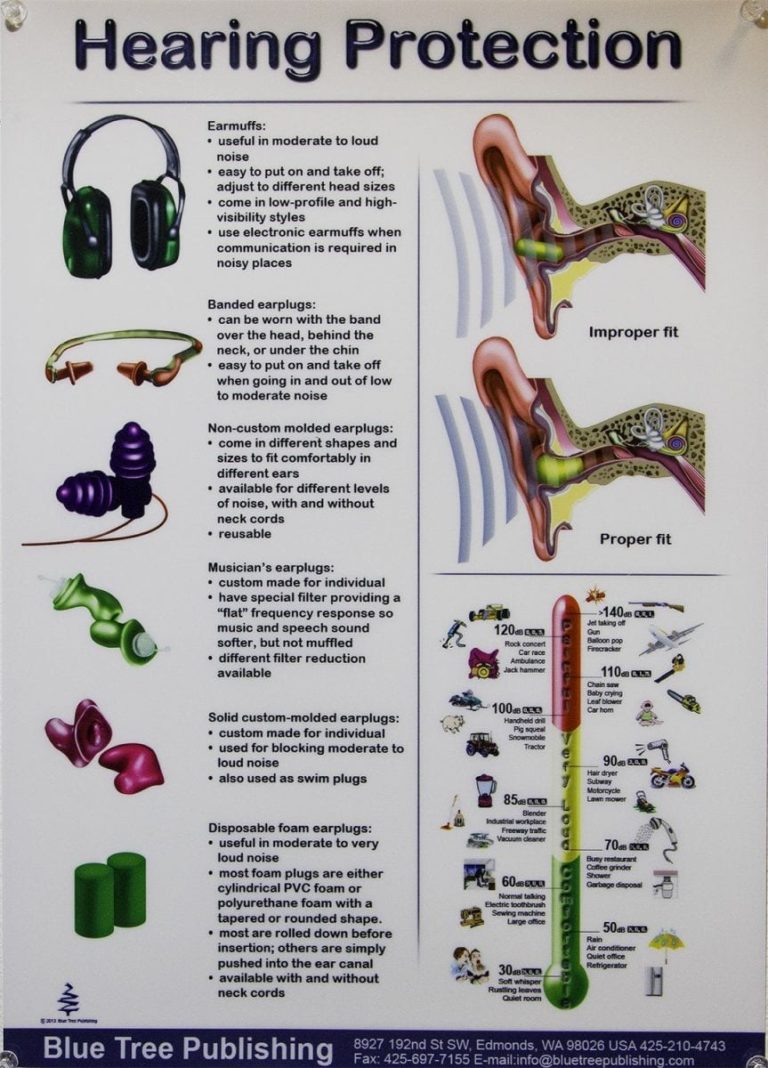
When looking at earplugs, the most important thing to look for on a package or website is the Mean Attenuation. This refers to how many decibels (dB) the hearing protection will reduce the sound, or how much the sound will be dampened based on quality of hearing product. If a given earplug gives you 20 db of attenuation, it will make 100 dB sound like 80 dB, without lessening the sound.
Proper insertion
Make sure to insert all earplugs properly. This is done by putting your left arm behind your back and pulling your right outer ear backwards from the lobe. Gently insert the earplug with a light twist with your left hand. Repeat with the opposite hand for the other ear. This is sometimes called the ‘monkey grip’ (per KillNoise). Do not over-insert into the ear, only to the point where you can remove them successfully.
Proper care
Keep earplugs in a case (most of those sampled below come with cases) and gently wash with soap and water – earplugs do need to be cleaned from time to time. If you use disposable ear plugs you can wipe them off, but they don’t need to be washed since they are designed for single use.
Brands
Of the brands surveyed below, none of these will fall out or feel like they might slip, provided they are properly inserted. Dance, rock out, rage proper and the earplugs will stay securely in your ear.
Matrix Orange (single use), made by HowardLeight.com. This pair is firmer and may be tough to get into your ear but once in, they do not dull the music much and it feels almost the same as not having them in.
Mean Attenuation at 2000 hertz: 36 db
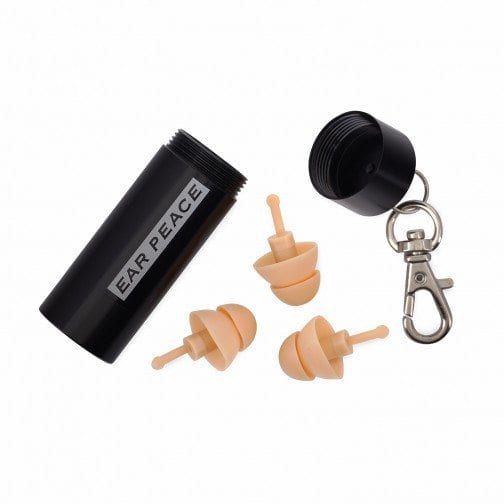
Ear Peace: These are the smallest pair sampled for this article and very light. They can hide in your ears so well that no one can see them at all and it can feel like you are seeing a show without earplugs inserted. Being so small, they can be a bit weird to remove, as there is a tiny rubber end that allows you to pull the entire plug out at once. Removal becomes easier the more you use them. Bonus – these come with an awesome case on a small key chain. One size fits all.
Mean Attenuation at 2000 hertz: 22 db
HEAROSHigh Fidelity for small ear canals: It’s not the size of your ear canal that matter – get what feels best and fits best. These earplugs can be angled at three depths, denoted by soft ridges on the plugs. Comes with a case
Mean Attenuation at 2000 hertz: 22.5 db
Etymotic High-definition Earplugs: This pair of earplugs comes with a cord that attaches the two earplugs together, so that you can put them in and take them out and let them hang around your neck when the music isn’t playing. They fit in nicely, much like the HEAROS mentioned above (Etymotic also makes HEAROS) and keep the static out evenly without lessening the music experience.
Mean Attenuation at 2000 hertz: 20 db
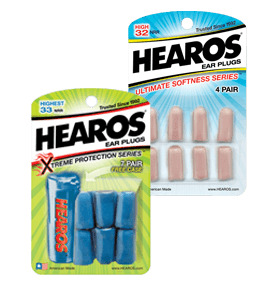
HEAROS Xtreme Protection: Made out of soft squishy foam, these make music easier to tolerate close up, without making it quieter; they simply take away the bass and static that you wouldn’t recognize otherwise. When away from the music, it can be difficult to hear so you may have to take them out and reinsert them. They also roll up nicely, fit tight and are soft to touch. No case, but they fit easily into a wallet or purse.
Mean Attenuation at 2000 hertz: 38.6 db
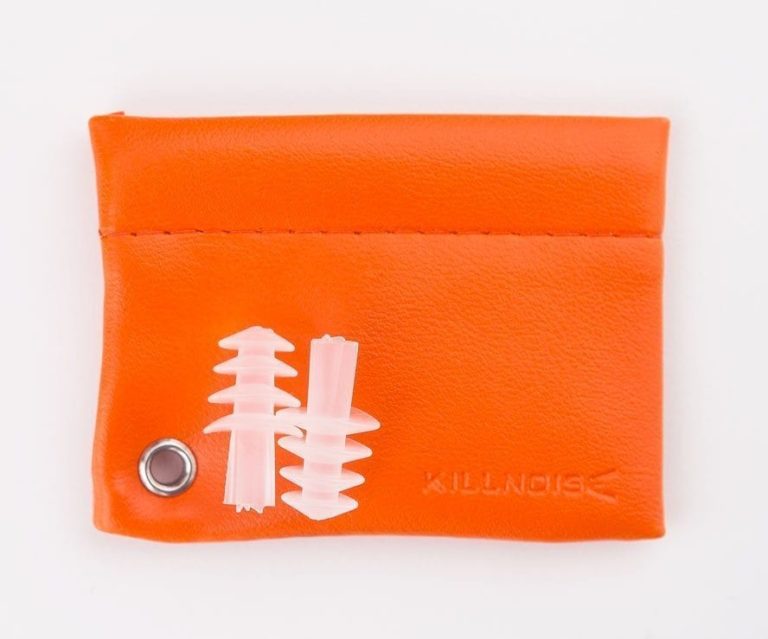
Kill Noise: Developed in Sweden, these small rubbery earplugs fit in easily with four depth levels and a rubber disc to stop them from going in too far. They definitely kill the noise, but only the bad stuff; the music gets through cleanly and clearly. It may take a few tries to get them in right, since they are a bit flexible and could have more rigidity but once they are in, they fit just right. They come with flat a snap-shut case.
Mean Attenuation at 2000 hertz: 23 db
Keep a pair in your backpack for a festival, your glovebox for club and theater shows, and a pair in your purse or wallet – cover all your bases. Don’t see live music without them if you want to continue hearing live music for many years to come. Taking care of your hearing is the most important thing live music fans should do for themselves, to ensure that the music never stops.
Time Limits For Hearing DamageBelow are the accepted standards for recommended permissible exposure time for continuous time weighted average noise, according to NIOSH (National Institute for Occupational Safety and Health) and CDC (Centers for Disease Control and Prevention), 2002. For every 3 dBs over 85dB, the permissible exposure time before possible damage can occur is cut in half.
On Friday, November 29, perhaps the two biggest rising stars in the jam-band scene – Dogs in a Pile and Eggy – took another giant leap, packing out The Capitol Theatre to near capacity.
The first time both bands were set to headline the iconic venue, Dogs In A Pile and Eggy had their fans pour in early to check out a pre-show at Garcia’s featuring Residual Groove. The link between the two fanbases was as clear as day, as was the decision to make the two evenings a co-headlining spectacle.
As announced on social media by Peter Shapiro a few days prior via a coin-toss, Dogs In A Pile were set to open Day 1 with Eggy following, and the reverse happened the next day.
Dogs In A Pile hit the stage at 8pm sharp on Friday night, busting of the gate strong with “Look Johnny ll”. Hailing from Asbury Park, New Jersey, Dogs In A Pile have become a nationally recognized act, touring all around the country with great frequency. Certainly no stranger to the New York music scene, playing huge shows like the Phish after show last year at Sony Hall, Great South Bay Music Festival, as well as going on tour with Andy Frasco at Pier 17 and The Capitol Theatre itself, though this time, under a very different circumstance.
Childhood friends who met fellow students at Berklee, the band consists of Jimmy Law on Guitar and Vocals, Joey Babick on Drums, Jeremy Kaplan on Keys and Vocals, Sam Lucid on Bass, and Brian Murray on Guitar and Vocals. Ending on a real high note, a difficult task was set upon Eggy, following what had just occurred was no small feat.
Eggy gracefully took the stage to great anticipation. In quite fitting fashion, “Here and Now” was the designated opening number as dancing re-emerged throughout the audience. Fresh off the release of their new album, “Waiting Game“, the band consists of Jake Brownstein on Guitar and Vocals, Dani Battat on Keys and Vocals, Mike Goodman on Bass and Vocals, and Alex Bailey on Drums and Vocals.
New York is a frequent stop for Eggy, and its easy to see why. Their impressive song writing abilities, along with deep experimentation of the material, a fantastic tour-de-force is always on full display. As the first set winded down, Dani Battat slowed things down, paying tribute to his bandmate and dear friend, Jake, to celebrate his birthday.
A cake was brought out as this touching moment was rang in by Bailey switching to his cajon and Goodman to his standup bass. An acoustic set brought the evening home, but the festivities were not over just yet.
For an encore, Dogs In A Pile came back on stage to join Eggy in family band style fashion. Paying homage to the day, “Black Friday” by Steely Dan rang out, followed by the Hunter/Garcia classic, “Bird Song”.
The evening concluded with strong enthusiasm as another epic night of music awaited everyone the following evening. Though the two bands have similar fanbases and style, their momentums are respectively separate and strong.
Dogs In A Pile go on to play more dates throughout December, including a 4 night run through New Years in Saratoga Springs at Putnam Palace. Eggy will also be playing in New York at the end of this month, hitting Electric City in Buffalo on the 27th, and Levon Helm Studios in Woodstock on the 29th. Tickets for all shows are available now.
Brooklyn-based Indie Pop artist Ski Team (Lucie Lozinski) has announced Dec. 3. as the release date for the music video of “Me”.
“Me” is about “the struggle of adjusting someone’s role in your life, or your own role to them, and giving up control in that process,” shares Lucie Lozinski, otherwise known as Ski Team. “It’s about realizing if you have to assign roles, maybe it’s not as special as you think. And, like, challenging this idea of roles being the whole of someone’s identity. It’s scary to not know who’s on your roster, or who you are without a particular person/job/trait/whatever, and just go forth into life’s abyss as a human, but it’s often better for everyone involved to get on with it.”
While the song is classified as experimental, there is enough common elements to make the song relatable to the average listener. The saxophone that begins the song is a nice touch and each time the sax makes an appearance in the mix it is always a welcome addition. The lyrics take the song to a personal level that gives the feeling of listening to a journal entry.
The video reflects the isolation and mundanity of the roles we play in everyday life by the use of the grey office space, escalators, and packed public transportation. Lozinski wears her hair pinned back as tight as can be and an all-white suit and tie combined with a long flowing skirt and a fo-leather jacket. All this draws stark connections to Apple’s famous “1984 Macintosh” commercial in the sense of routine and technology controlling life. With fantastic editing and shots that beautifully depict the liminal, the music video is an incredibly impressive achievement.
Lozinski found the saxophone player on Hinge. He had a bunch of videos of him playing sax, and she reached out saying, “hey I don’t want to date each other, but can you come put down some saxophone on this song?” And he did. Ski Team collaborated with popular producer Daniel Knowles (Sharon Van Etten, Cigarettes After Sex) on the new single. Ski Team has received praise from the likes of American Songwriter, Atwood Magazine and more.


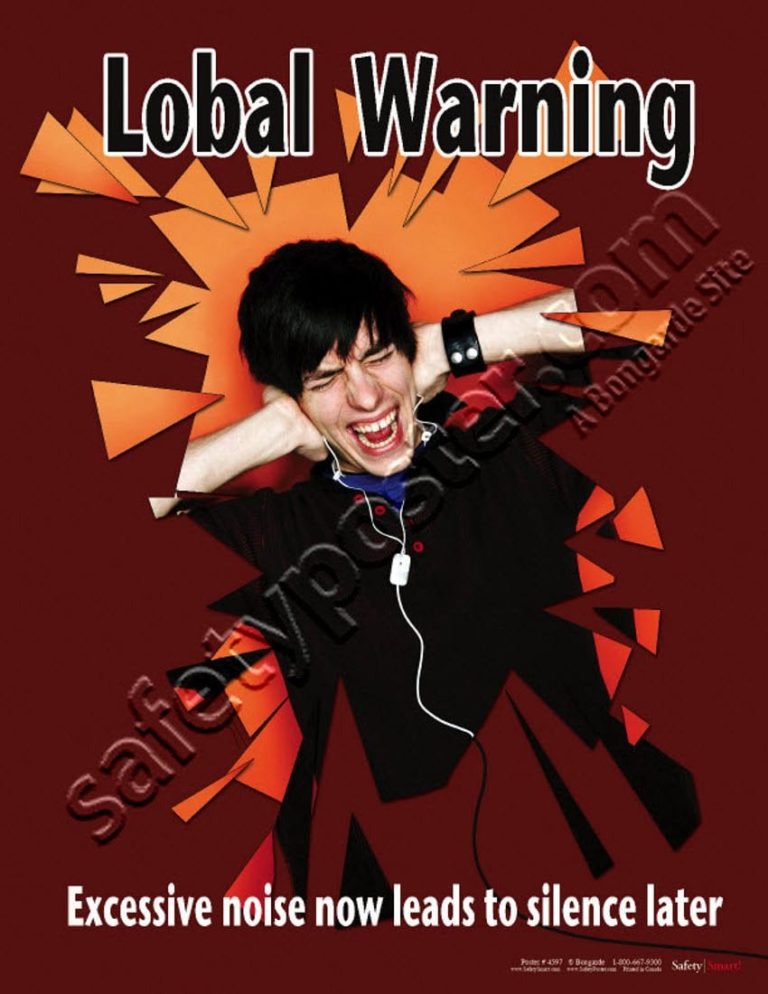 This is when I decided it was time to invest in a good pair of ear plugs. For nearly every show since December 2010, I have worn earplugs and not missed a note of music and as a result, the ringing has subsided somewhat. While I have a couple of pairs of ear plugs that work well, I continue to notice, more than four years later that many of my friends and regulars at shows do not wear earplugs. The typical response is because they didn’t want to miss the sound of the show. The benefits of earplugs cannot be understated, as they filter out some of the unnecessary noise and improve the quality of the live music experience rather than hamper it. Around the time of this diagnosis, I sought out different styles and brands of earplugs to test which ones worked best and to share the benefit of earplugs with others so that fewer do not succumb to tinnitus, or worse, hearing loss. Four years later and I still have tinnitus but my hearing is no worse than it was in late 2010, but it would be a different story without a small investment in earplugs.
 For parents who wish to bring their children to concerts and live music events, hearing protection is of paramount concern, as younger ears are more easily susceptible to damage. Doctors advise choosing to protect children’s hearing especially, noting “Had I not been educated as to how fragile a child’s hearing was, I may have not protected both my kids early enough to ensure they won’t have hearing loss. Now, they wear them to fireworks, music, anything loud. My son even has them on right now while doing his homework in his bedroom.” For parents looking into hearing protection for their children,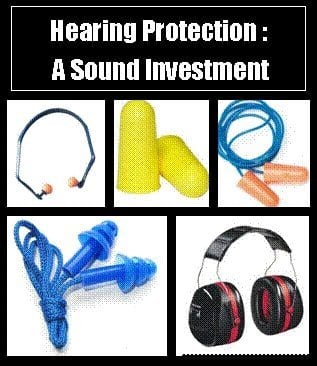
 Etymotic High-definition Earplugs
 HEAROS Xtreme Protection
 Kill Noise:


