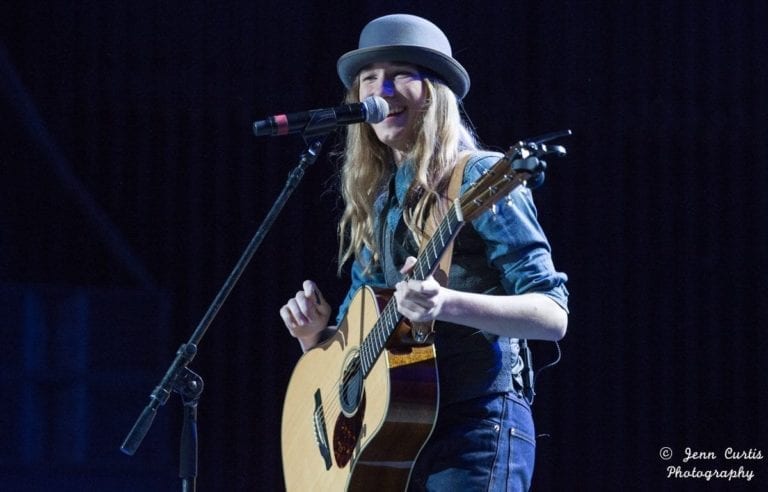
Trey treated an appreciative audience to a mix of electric and acoustic music that delivered both high energy and subtle thrills. The setlist was a testament to the band’s versatility and musical prowess, spanning both familiar classics and experimental improvisations. From the infectious groove of “Gotta Jibboo” to the introspective “Water in the Sky,” each song pulled the crowd in and sent them on satisfied.
Wonderland Forest is a newer venue in the Syracuse area and a great place to see a show. It’s ten miles south of the city near Lafayette, sitting on 400 acres of forests and fields. When you initially enter the venue you walk down a gravel path through trees until entering a pristine clearing with a lovely pond. Vendors are clustered around the water, with a small stage for an opening act to use in the back. Walking further into a forest lit by brightly colored lights once the sun sets, you come to a beautiful amphitheater nestled in a grove.
As dusk descended upon this verdant expanse, eager concertgoers gathered under the canopies, their whispers mingling with the rustle of leaves, anticipating a night of transcendental music. They weren’t disappointed. Trey took the stage a little after 8 pm, opening with a driving, pulsating “Sand,” followed by some nice soloing on “Back on the Train.” He continued with “Stealing Time From the Faulty Plan” and then “Steam” before pulling out the acoustic guitar for “Heavy Things.” The crowd was then treated to the debut of a never before played song called “It’s Happening Again,” followed by the first performance of “Windora Bug” in three years.
Set Two featured a few songs off of Phish’s upcoming album Evolve like “Oblivion” and “Pillow Jets” as well as Phish classics like “Ghost” and “Blaze On,” and Trey Anastasio originals. After finishing, the band took the stage for a two-song encore, with Trey pulling out the acoustic guitar for “Water in the Sky” and then finishing with an electric “Prince Caspian.”
As the final notes of the encore faded, the crowd walked away happy – many no doubt on their way to catch the next stop in the tour. It was a high-energy night of music, only marred by a little rain, and a satisfying experience. Trey and Classic TAB’s playing was imbued with a sense of purpose and passion that resonated with every note. They are bringing their A-game on this tour and it is not to be missed.
Trey Anastasio and Classic TAB – Wonderland Forest, Lafayette, NY – Saturday, May 18, 2024
Set 1: Sand, Back on the Train, Stealing Time From the Faulty Plan, Steam, Heavy Things, It’s Happening Again, Windora Bug, I Never Left Home, Gotta Jibboo, I Never Needed You Like This Before
Set 2: Drifting, Oblivion, Ghost, Outside the Lines, Broken Into Pieces, Pillow Jets, Liquidate the Moon, Blaze On, A Wave of Hope, 46 Days
Acclaimed New York City-based electronic musician, producer and activist Moby celebrates the life of Benjamin Zephaniah with the new track “where is your pride?,” out now taken from his 22nd studio album always centered at night, due out June 14th .
Moby, photo credit: Lindsay Hicks
The break-beat-driven track is spoken word with a powerful message delivered in the late dub poet’s characteristically warm burr. “Where is your love? / Where is your faith? / Where is your hope? / Where is your place? / Where is your pride?” Moby is proud to share a track with the late Benjamin Zephaniah to continue celebrating his life and note their aligned ideals: “As a vegan activist, and as a wise and compassionate man, Benjamin inspired me for many years. I hope that ‘where is your pride’ honors his legacy and also draws people’s attention to his life, work, and principles.”
Benjamin Zephaniah was a British writer, dub poet, actor, musician, and poetry and creative writing professor. He was included in The Times list of Britain’s top 50 post-war writers in 2008. He won the BBC Radio 4 Young Playwrights Festival Award in 1998 and received at least sixteen honorary doctorates.
Benjamin Zephaniah | Photo credit: Adrian Pope.
Moby was born Richard Melville Hall, in Harlem, in 1965. His father gave him his nickname, Moby, because of his hereditary relationship with Herman Melville. Moby started playing classical music and studying music theory when he was nine and came of age musically in the punk rock scene in and around New York in the early 80’s. He released his first single, “Go,” in 1991 (listed as one of Rolling Stone magazine’s best records) and has been making albums ever since. He has sold over 20,000,000 albums worldwide.
Even by Moby’s standards, always centered at night is special. The album features 13 collaborations from names many might recognize to others many undoubtedly will come to know. The captivating voices on always centered at night include Sudanese, Netherlands-based chanteuse Gaidaa, London-based, Burundian royal refugee J.P. Bimeni, and Kingston-raised, London-based Aynzli Jones. These are often personal songs, and the personal is the political, as is the border-defying nature of the work.
In his pursuit of new sounds, Moby has become a collector of voices. He’s a connoisseur of the timbre and texture of human vocal chords, whether sampling artists like Bessie Jones, Vera Hall, or Boy Blue, or working with superstars like David Bowie.
Thrilled to bring this dynamic body of work to the world, Moby explains, “For the last 30 years, I’ve worked with amazing singers–everyone from David Bowie to Freddie Mercury, Gregory Porter to Jill Scott. Always centered at night continues my love of collaborating, but has a focus of working with amazing singers who might not be as well known as David Bowie and Gregory Porter.” Though all tracks are collaborations, the music remains unmistakably Moby, dripping with glittery melodies and warm, hypnotic instrumentals.
Sports and hip hop have long been synonymous. In a world where athletes and rappers envy one another, the shared racial dissonance of black entertainers likens them. Thus maintaining a symbiotic link between an era’s biggest rappers and its biggest sports stars. Similarly, the shared cultural influence trickles down to fans and listeners alike, shaping the zeitgeist of the era. However, as we’re firmly entrenched in the “okay, boomer” era, pivotal moments in hip hop and sports have become a tolerated happenstance.
Yet, despite the cultural ambivalence towards the past, multimedia recountings maintain a niche audience. It’s in this essence that Saigon and Fredro’s debut collaborative effort, The Jordan Era, came to fruition. After all the veteran MC was initially only writing and recording a few records for two of Starz’s hit tv-shows Raising Kanan and  BMF — which chronicles the rise of the real life Black Mafia Family drug empire.
Saigon and Fredro capture a moment in time on “The Jordan Era.”
Markedly, BMF gained steam during the late 1980’s and became one of the nation’s largest drug-trafficking outfits during the 1990’s, a time of great cultural significance in urban America. Including the influx of street-level drug dealers making loads of money as a result of the crack cocaine epidemic, rendering them either neighborhood heroes or the latest cautionary tale. Nonetheless, the rise of the DIY pharmacist served as inspiration for hip hop’s golden age as rapper’s mimicked the style of the street hustlers and shared their war stories with the world. All of this combined with the peak of the world’s most popular sportsman — in Michael Jordan — resulted in a protracted cultural nirvana which Saigon and Fredro have summed up as, The Jordan Era.
The Jordan Era Album Review
I was making whole songs and they were only using like 10 seconds of it. I told Fredro we should make a whole album. I had all these great records that sound like ’80’s and ’90’s but I didn’t have any features. That’s when I got on the phone with Grand Puba and I called all these guys.
– Saigon
Much like other renowned biopics such as Walk The Line, Straight Outta Compton, or Ray, The Jordan Era is a time capsule into a significant period in American culture. Produced entirely by Swedish producer Fredro, the album features hip-hop pioneers the likes of Grandmaster Caz, Pete Rock, Big Daddy Kane, Grand Puba, Kool G Rap, and more. Moreover, the album showcases Saigon’s raw ability as an MC. Emerging from the gagster rap craze of the early 2000’s the former Entourage actor is no stranger to hard-hitting lyricism. Yet, his versatility and creativity is at full showcase as he offers his own rendition of the greats that preceded him.
Saigon & Fredro hosted a “The Jordan Era” listening party/ Photo by Rob Tellerman
Standout Tracks
Beginning with the first song on The Jordan Era “G Miller” where he impersonates a fly talking rapper over 1980’s club music. “G Miller is my alter ego,” Saigon divulged during an album listening event. “It’s me just going in the booth and having fun just trying to be one of those fly ’80’s rappers that I grew up with.”
Following “G Miller” is “Lyrical Genius” featuring Grandmaster Caz, a quick-witted, upbeat lyrical onslaught where Grandmaster Caz reminds listeners of his songwriting prowess. In the ensuing music video Saigon goes full ensamble, sporting a full ’80’s style puma getup along with a kangol hat and the requisite dance moves. Immediately after comes “Think Twice” featuring Grand Puba, an upbeat, honest record reminding listeners that hip hop began with a “keep it real” mantra as Saigon spits “a rapper rapping about a killer and ya’ll say he’s the man, I see right through that n**** like he suran.”
As the album ages, so do the records, the beat selection and the lyrical subject, mimicking the dark undertones hip hop undertook in the early-to-mid 1990’s. Namely, Saigon recruits one of the pioneers of the mafioso sub-genre in Kool G Rap for “Make Money.” But all in all, the “The Letter P” rapper seemed focused on bringing back the essence of hip hop, showcasing his status as a professional MC with real, impassioned raps that serve as a tutelage for listeners sans any overt profanity.
Album Production
While Saigon’s skills as a songwriter are apparent, Fredro is a testament to hip hop’s global reach. Hailing from Sweden the multi-platinum producer began his career working with a whose who of the pop world from Sinead O’Connor to Christina Millian. However, hip hop was never too far away. “Hip hop was always the foundation,” Fredro shared. “Even if I work with a girl group in Tokyo there’s some kind of element of hip hop in there.”
As soon as the genre made its way to Sweden in the early 1980’s Fredro became a student and what was presumed a fad became a staple of their music culture. “Everything goes in cycles. This kind of sound is coming back. What’s funny is like boom bap never left Europe or Japan, its huge. All your favorite artists tour Europe and they go to Australia and Japan and Korea, they fanbase always stayed and never left.”
As a result Fredro produced every track on the album except one and even did all the scratches on the records. “I always loved scratching, it’s such a great element of hip hop that no one is doing. It’s like a guitar solo in rock & roll, it should be there.”
Ultimately, Saigon and Fredro offer a small glimpse into the world of yesteryear. Nonetheless, fans of classic hip hop and all its internal components (production, scratching, lyricism, songwriting) will be glad to spend a day in The Jordan Era.
Drummer Danny Eberle has always been the epicenter of the madness. Whether it was with his experimental rock band Lip Critic on the SUNY Purchase campus, or his rock band On Pink at venues across upstate New York, his arms were sure to blur with intense motion as he churned out a sweaty set for a basement filled with thrashing college kids baking in the body heat. He stayed wired into his craft as his fast-paced hits and rapid-fire movements clashed against the loud guitars — a perfect background for the kids to mosh to. This was the environment that he called home during the pre-COVID years, roots that he still wears on his sleeve.
Eberle has since graduated out of those sweaty student-run basements. Last year he drummed through the Netherlands, Prague and Italy, as a part of hardcore rapper Lil Darkie’s backing band. He now plays with Lip Critic, as they plan for their first international tour as a band this summer in support of their newest album, “Hex Dealer,” which dropped on May 17. He’s been around the world, but always seems to find a way back to his beloved hometown of Staten Island.
Photos by @Makaylamber
While growing up in the borough, Eberle was multiple things at once, moving around quickly and sporadically — like he does onstage. He started his music career taking guitar and bass lessons as a kid, but it wasn’t clicking for him. From there, he messed around in D.I.Y. bands with his lifelong friend and classmate, Joe Ippolito, while attending Manhattan’s music-oriented LaGuardia High School. The two were inspired by the garage rock duet style of Black Keys, White Stripes, but, most characteristically, 90s indie band Ween. One early project that actually got a name — Strangelands — covered Ween frequently, inspired by their carefree, jokey attitude that rubbed off on their own project.
“We didn’t take ourselves seriously at all, but we took the music seriously,” he said.
The duo started their Strangelands career with daytime shows at dive bars on Staten Island, playing to family members. Eager to break out at city venues — anywhere that would let their young, high school selves shred a couple songs, the band turned to recording studios and low-key venues in Times Square. One of these holes in the wall was Funkadelic Studios, a small building tucked within the Garment District that allowed high school students to rent rooms to play shows without charge, and immerse themselves in a DIY-esque space early on.
“We’re small dudes, so we definitely stuck out like a sore thumb in these places of just kids, like, doing drugs,” said Ippolito. “We were kind of just there to play and see music.”
“That was my first experience being around other music minded people, skaters, all that stuff,” he said. “That was definitely eye-opening. It was great to perform in front of audiences in that sense, because it’s beyond playing drums at a recital.”
photo by @elyzareinhart
At LaGuardia, where everyone dreamed of being like its alumni stars of the past, the energy in the classroom felt too high-stakes and traditional. Eberle equates their austere jazz program to being on a varsity sports team, finding himself much more drawn to the DIY aspects of after-school projects he formed with his classmates. He started at SUNY Purchase in 2018 — after lifelong friend and future Lip Critic bandmate Ilan Natter pushed him to attend, enticing him with the bustling, colorful music scene that awaited.
“I remember telling him that Purchase is really what you want, which is to be able to play loads of music without being a music major,” he said. “I couldn’t speak to other schools, but I was like, ‘If you come here, you will play drums in every band.’”
“It was like LaGuardia 2.0,” Eberle said of Purchase. A majority of the people in his classes were fellow alumni, and the musical connections they shared followed them all the way to Westchester. He was constantly seeing old classmates perform during shows at The Stood, Purchase’s very own on campus venue — a space that constantly brewed the freshest sounds and budding artists.
“Because of that, you’re meeting musicians,” he said. “It sets a foundation for how you can start bands and actively play. It’s super accessible and no one’s gonna judge you. You can test the waters by playing a show and seeing if people show up.”
Lip Critic assembled during Eberle’s freshman year at Purchase, originally an improv act. It spawned from the ashes of previous failed projects started with musicians he was meeting during his first few weeks at the college. When a member of one of their many bands couldn’t attend practice, Eberle and Natter — the other drummer of the band — were left to experiment. After bringing in two other artists that they’d met at house parties, singer Bret Kaser and sampler Connor Kleitz, the band took the stage at The Stood for the very first time for a hectic, live jam session that was “received super weird” by the venue’s typical student crowd. “Everyone was like, ‘what the hell’s going on?’” Eberle laughs. “They thought we were strange.”
Lip Critic’s sound refuses to slow down for those who can’t keep up. Their fast-paced, glitchy take on rock music draws similarities to loud noise acts such as Death Grips — Eberle’s speedy and distorted drumming heightening the beautiful, collective chaos.
photo by @heydoodypantsitsizzy
The band started picking up speed very quickly, releasing their first EP, “Lip Critic II,” in 2020. They supported the release with a long-awaited slew of upstate New York and NYC shows once COVID restrictions were lifted in 2021. The band shipped their first project around to every record company they could think of, waiting on any sort of reply. They spent the next couple years riding the rise to local scene notoriety, gaining more than 20k monthly Spotify listeners and playing for sold out crowds at established New York City venues such as Elsewhere Hall.
In early 2023, Eberle woke up to a text one day from Alex Wacksman — a.k.a. Wendigo — a producer he met through mutual friends that works with Lil Darkie. The rapper just put out his newest album, and needed a drummer to join him on tour. “Do you have any plans for May?” it read. “Do you want to come to Europe?”
Not even a month later, Eberle was on a flight to Switzerland to rehearse drums with the rapper. They had never played together — or even met — and it was his first time going to Europe in general. Eberle reflects on the experience breezily, gushing about how easy it was to make friends through the backing band — similar to how quickly he connected with musicians from Purchase. After all, they all spoke the same language.
“He assimilated pretty quickly into making it seem like he’s never not been a part of this band,” said Ippolito, who watched him tour from the States. “Even though he’s not necessarily a guitar player or a bass player, he’s got ideas on that front that he can pretty easily communicate to people who do play those instruments.”
The chemistry between Eberle and Darkie’s band made being in unfamiliar territory, getting chauffeured around by personal drivers from the Czech Republic and meeting all of the “crazy motherfuckers” that Europe had to offer almost like living in a dream. In a mere matter of weeks, Eberle jumped from playing for the Stood’s few dozen stragglers to selling out buzzing venues filled with hundreds of people — such as the legendary Academy in Dublin, a rite of passage for indie bands of the past.
“Every show was mayhem,” he said. “The fans were so fucking young, so they were there to go crazy. I could feed off of that so easily because I’m looking at these kids right in the eyes and I’m like, ‘Keep going!’”
Photos by @Makaylamber
On stage, Eberle thrives off of mutual energy. Lil Darkie’s fans were remiscent of the Times Square teens that filled the crowds during his Strangelands days, eager and jumping at the sounds of his rapid, pulsating beats. Once Lip Critic started to score opening slots for bigger acts such as post-punk giants IDLES and Viagra Boys, he found it harder to connect with standstill crowds that weren’t sure what to expect from him. Still, he develops his own ways to force the audience to engage with him — and they seem to be working.
“If there’s some dude crossing his arms, just looking pissed off, I’m gonna look him dead in the eyes, on some scary shit. I’m not about to kill you, but I’m gonna look at you like I’m about to kill you.”
Eberle ends up back in Staten Island — the home he loves unapologetically. For a borough that gets so much — in his opinion — unnecessary slack, he reps it shamelessly everywhere he goes. It’s where many of his early bands started up, where he’s met some of his closest musical comrades and where he still plays gigs at hidden-gem dives, like the north shore’s Mother Pugs and beloved Flagship Brewery — opportunities he’ll never take for granted.
“Growing up in a suburb like this, you learn to appreciate what’s around you. I think there’s always been a good scene here, even when I was starting. When I was a kid playing the drums, I was able to practice in my basement. With Lip Critic, it feels right to rep Staten Island because our first practice was here.”
As the band currently tours through England, they plan to come back to Staten Island for a hometown show at MakerParkRadio’s studio — the borough’s independent radio station — this July.
As an artist, Eberle has many places he can call home — Purchase, the NYC D.I.Y. scene, Staten Island and now, the world. He’s unsure of what awaits Lip Critic, and his personal career. Still, he’s not worried. “I like having these multiple identities,” he said. “I’m meeting all of these dudes that are playing drums and writing songs that aren’t just pop songs. These people listen to the same bands or came from the same scenes that I did. It’s cool to see that all these communities exist.”
On May 17, Brooklyn-based punk band Castle Black released their new single, “Fly (Just Try),” a powerful rock anthem that dives into the traumatic experience of dealing with the lead singer’s health issues.
Formed in 2015 by lead singer and frontwoman Leigh Celent and drummer Joey Russo, Castle Black is a post-punk powerhouse that combines elements of punk, grunge, and new wave into one showstopping rock duo. The last 10 years before the release of their first album have brought Castle Black’s sound all across North America, performing in several festivals and making their mark as one of the few female-fronted punk bands emerging out of New York City.
Since their inception, Castle Black has released four EPs: Find You There (2015), Losing Forever (2016), Trapped Under All You Know (2017), and the gods that adored you (2018). Furthermore, the first single of their upcoming album, “Bright-Eyed,” was released in November 2023 and received critical acclaim, being named as one of the top 20 songs of 2023 by Scenes from the Underground.
Released during Women’s Health Month, “Fly (Just Try)” is an anthem for women who have had traumatic and life-changing experiences with their health. Castle Black’s single is no different. Leigh included her experiences with her own health as inspiration. Above all, this single served as Leigh’s way of expressing what the experience was like, from the symptoms, the diagnosis, treatment, and even the stigma against these issues.
“The song coincides with Women’s Health Month and is a tune largely about my own personal journey with endometriosis, adenomyosis, and fibroids.”
Leigh Celent, lead singer
“Fly (Just Try)” is an ode to those women who have struggled not just with reproductive health issues but with their mental and physical health, as well as the damage that illness can cause to their bodies. A music video for the single will be released on May 23, 2024. The highly emotional and personal single is the third to come from the band off their upcoming album, The Highway at Night, set to release on June 21, 2024.
Following the release of their album, Castle Black will tour all over North America in June and July, including two shows in Brooklyn.
Following a 26 year hiatus, NYC alternative band, The Bogmen have returned with their third album In My Kingdom. The Bogmen will release In My Kingdom on May 31.
Singer Billy Campion and brothers Billy and Brendan Ryan formed The Bogmen in 1990, united by a love of alternative, soul, and afrobeat. The group toured clubs, colleges, and venues around the NYC metro, forging a devoted cult following. Their 1994 debut Life Begins at 40 Million produced by Talking Heads keyboardist-guitarist Jerry Harrison, propelled The Bogmen into stardom. Throughout the 90s, they toured with legends like Shane McGowan, The Barenaked Ladies and Patti Smith, selling out national venues across the country.
Despite their success, the band broke up in 1998, citing frustration with the music industry and creative differences. For the next two decades, the band members’ lives were marked with hardship. Brendan Ryan’s wife died in the 9/11 attacks and other members continued to struggle with addiction and the music business. Despite this hardship, the band continued to sporadically reunite for live shows and EPs before breaking up again. The pandemic ironically brought the group back together, with its members falling back on music to cope with the chaos of lockdown. Following the loss of a close friend, they reunited to write a host of new songs. Those pandemic-era songs make up their new album In My Kingdom.
In My Kingdom is an ambitious collection of tracks, blending alternative, pop, and country. The album’s lyrical themes highlight a wiser Bogmen, tempered with age. Themes tackle ideas of looking back at your youth, wanting to connect with nature, and wanting to get out in the world. With this mature instrumentation and lyricism, The Bogmen return at the top of their musical game.
The album begins slowly with the title track “In My Kingdom.” The track eases in with a spoken word intro, building a utopian setting for the rest of the album. Singer Billy Campion invites the saints, prophets, and Gods of various religions into his kingdom, setting the stage for the album’s more introspective mood. The track slowly grows into a smooth rock song propelled by warm synths and clean guitars. The lyrics reflect the band’s return during Covid, discussing hope for the future in a world full of anxiety. With this opener, The Bogmen prove that they still have the groove of their debut, but with more mature lyricism to propel them into this new era of their career.
The standout of the album is single “Summer of Soul”, a triumphant announcement of the band’s return. Crafted during the height of Covid, and inspired by the isolation and loss of a friend, the track contains heavy lyricism. Campion sings “One thing that I love is being born again, out here on the sea. You need a helping hand, so throw me the rope, I promise not to hang myself.” Despite dark lyrics, the song is overall hopeful for a reemergence into the world, appreciating life’s beauty. A dreamy reverb guitar and piano intro, and lush instrumentation throughout really make this anthem stand out.
The album’s rich lyricism and genre bending aren’t restricted to its singles. “Life on the Ranch” is a track deeply indebted to the outlaw country of Marty Robbins and Johnny Cash. With a driving acoustic backing, aided by clean electric guitar and horns, the song is a real pleasure to listen to. Its lyrics cleverly parallel someone running from their problemsnwith a Western bandit running from the law. Another great track was “Pandemic Blues.” Despite its name, the track is not blues, but rather a motown-inspired soul tune, driven by catchy horns. The song uses Covid-19 as a metaphor for being alone in love. The narrator wishes he could just walk out the door to find love, but is instead trapped dancing alone in his room. Album tracks like these illustrate the Bogmen’s success in cross-genre experiments and deep lyricism.
The Bogmen close out the album with a re-recording of “Raga” from their debut album. This remake is truly jubilant, crafting a celebratory, vibrant atmosphere around it. Incorporating Latin rhythms, choral vocals, and dancy instrumentation, the song is a really enjoyable sendoff. If anything, this song illustrates the band’s growth more than any other, matching the energy of the original but with more fleshed-out production and instrumentation.Overall, In My Kingdom is a testament to The Bogmen’s musical staying power, retaining the energy of their 90s output, but with clear signs of growth.
The Bogmen will release their return album In My Kingdom on Friday, May 31st, 2024. To accompany its release, they will perform a release show at Manhattan’s Irving Plaza. The show, set for May 30th at 7:00 PM, will feature The Bogmen accompanied by Indie-Rockers Pan Arcadia. In addition, The Bogmen have released music videos to accompany the album’s three singles, which can be viewed at their youtube page here.
More information on the release of In My Kingdom and future shows can be found at The Bogmen’s website here.
Eccentric and creative are just two words someone could use to describe the Pittsburgh-based iconic artist Andy Warhol. From the timeless Campbell’s Soup Cans to battling Sydenham chorea, for decades Warhol seamlessly integrated himself into one of the most significant artists of the time and fit in seamlessly with the New York music and art scene.
Early Life and Hobbies
Andrew Warhola was born on August 6, 1928, in a working-class Pittsburgh neighborhood, in a two-room apartment. His parents, Andrej and Julia Warhola, were Carpatho-Rusyn immigrants from a region in the Carpathian Mountains in what is now Eastern Slovakia. They had three sons: Paul, John, and Andy, the youngest.
Warhol had Sydenham chorea as a child, a neurological condition that causes uncontrollable movements and is often referred to as St. Vitus dance. Warhol would periodically miss school due to the disease, during which he would read comic books and Hollywood magazines and experiment with paper cutouts. His family didn’t have many luxuries while living in Pittsburgh during the Great Depression, but when Warhol was eight years old, his parents gave him his first camera. Before enrolling in Schenley High School in 1942, he completed his basic education at Holmes School and attended free Tam O’Shanter art lessons given by Joseph Fitzpatrick at Carnegie Institute (now Carnegie Museum of Art).
After realizing his son’s potential, Andrej put money aside to send Warhol to Carnegie Institute of Technology, which is now Carnegie Mellon University, where he studied from 1945 to 1949. After graduating from art school with a degree in Pictorial Design, Andy moved to New York City to pursue a career as a commercial artist, and later dropped the last “a” in Warhola. Together with his classmate Philip Pearlstein, he moved and formed a close-knit group of friends that included dancer Francesca Boas and college friends Leila Davies Singeles.
Illustrator and Entrepreneur
Andy became a successful commercial illustrator on Madison Avenue in the 1950s during the heyday of advertising. He was hired to draw for Glamour, Vogue, and Harper’s Bazaar, to name a few, using a blotted line technique he created.
His work in the commercial scene taught him many tricks of the trade, and he would later use this advertising know-how in the world of high art in terms of branding and popularity. His time as a commercial illustrator was a major piece of the Warhol puzzle.
His artwork debuted in a Glamour magazine edition where he provided the illustrations for the story “What is Success?” This was an era where Warhol quickly became an award-winning illustrator and got hired to draw for these publications. Warhol was well-known for his blotted-line ink drawings, which he produced in the 1950s after perfecting his technique in college. By combining sketching and simple printed techniques, Warhol was able to generate numerous illustrations based on a single concept and to repeat an image. In response to demands from clients, he could also make swift adjustments to composition or color. His work in the commercial scene taught him many tricks of the trade that he would later use this advertising knowledge in the world of high art in terms of branding and popularity.
Warhol illustration for a 1949 article in “Glamour” magazine. From a private collection.
In addition to being an artist, Warhol was also an entrepreneur. In order to fund his creative endeavors, he began his work as a commercial illustrator, earning a sizable income. Growing up in the era of post-World War II consumer culture in the United States and England, Warhol saw the advantages of assembly lines in industry and used processes and studio personnel to help him produce art. He was also able to successfully combine avant-garde, underground work with commercial and entrepreneurial pursuits.
Repetition
After creating the infamous blotted line technique, and blending printmaking fundamentals with drawing, this process became crucial to his success as a commercial illustrator since it allowed him to present clients with multiple options. Famously joking, Warhol said, “I want to be a machine,” implying that he was interested in mass production. His most famous technique, photographic silkscreen printing, imitated the appearance of advertising campaigns. Warhol was able to experiment with different processes including registration (aligning colors on a single image), over-printing (printing one color on top of another), and color combinations while still receiving an accurate replication of his original works. In a sense, this was a true extension of what the 1960s were all about. People were buying plastic, dressing for fun, and demanding more options than ever before. The so-called “Pop Life” was a lot more colorful than at any other time in history. Pop art just means popular art. To put it briefly, it’s art for the masses, art for everybody. It was a lifestyle that was quickly gaining popularity as well as a cultural phenomenon that many artists were emulating.
In 1962, Warhol shifted to what is arguably his most famous technique “photographic silkscreen printing.” He was able to readily replicate the pictures he appropriated from popular culture because of this commercial procedure. He debuted his iconic Campbell’s soup cans in the same year, and would later exhibit painted screen prints of celebrities including Elizabeth Taylor, Michael Jackson, Elvis Presley, and most famously, Marilyn Monroe. The silkscreen process became his trademark. Before Warhol, silkscreen printing was mainly used for making wallpaper on a large scale. It was the perfect medium for his mass-produced art about a mass-produced culture.
Music
After making his name in the publishing world, the world saw Warhol move into the music scene and start to design album covers. Warhol worked with Craig Braun, an actor and a graphic designer and the two designed the cover for The Rolling Stones’s 1971 album Sticky Fingers, which was later nominated for a Grammy Award. Warhol had been commissioned previously for album cover designs and painted portraits, but in the 1970s he began to receive hundreds of commissions from socialites, film stars and of course music.
The newly emerging sounds of the era, especially with the legendary band the Velvet Underground, proved to be a natural ally for Warhol’s venture into performance art. Living in the same New York environment, Warhol and the Velvet Underground collaborated to create a new style that was a symbiotic relationship rather than just art affecting music or vice versa. As a result of their collaborations, the band created the multimedia spectacular known as the Exploding Plastic Inevitable, which left a lasting impression on music history. Warhol’s avant-garde graphics blended effortlessly with the band’s experimental sounds. With Warhol as their manager and artistic mentor, The Velvet Underground challenged conventional notions of rock music, embracing themes of urban decay, alternative lifestyles, and avant-garde experimentation. Their self-titled debut album, produced by Warhol and featuring Nico on vocals, remains a landmark in the history of music, influencing countless artists and genres in its wake.
The Exploding Plastic Inevitable, simply Plastic Inevitable or EPI, was a series of multimedia events organized by Andy Warhol in the 1960s, and featured musical performances by rock band The Velvet Underground and singer-songwriter Nico. EPI also included screenings of Warhol’s films, dancing and performances by regulars of Warhol’s Factory, especially Mary Woronov an actress, writer, and figurative painter, and Gerard Malanga a photographer and a poet. The EPI first started in an event staged on January 13, 1966, at a dinner for the New York Society for Clinical Psychiatry. This event, called “Up-Tight,” included performances by the Velvet Underground and Nico, along with Malanga and Edie Sedgwick as dancers and Barbara Rubin as a performance artist.
The EPI left a lasting legacy on Warhols name and influenced Andy Warhol’s lights engineer Danny Williams who pioneered many innovations that have since become standard practice in rock music light shows. From May 27–29 the EPI played The Fillmore in San Francisco, where Williams built a light show including stroboscopes, slides and film projections onstage.
Film maker Jonas Mekas (who pioneered film projections during concerts at New York’s Cinematheque), Andy Warhol and Danny Williams’ influential ideas contributed much to the legendary Fillmore Auditorium’s prestige and were also used at the Fillmore East and Fillmore West, both opening in 1968.
The influence of Warhol continued through the hallways of rock ‘n’ roll royalty, even outside of the Velvet Underground. His relationships with music icons such as Blondie, the Rolling Stones, David Bowie and the Cars highlighted his ability to move fluidly across different artistic genres. Warhol’s influence on these iconic bands’ visual identities, whether through album cover design or creative direction, is an everlasting tribute to his versatility as an artist.
However, Warhol’s artistic domain extended beyond the realm of music; His collaboration with poet Gerard Malanga, who later became his main printing assistant, exemplified the fusion of various artistic mediums. By examining the relationship between words and images, together they pushed the bounds of traditional craftsmanship and opened the door for a fresh generation of creative expression. Through events like the EPI, Warhol provided a platform for experimental musicians to reach new audiences and explore new sonic territories. His embrace of multimedia collaboration foreshadowed the interdisciplinary approach that would come to define the modern music industry, paving the way for future generations of artists to push the boundaries of creativity.
However, the most fascinating part of Warhol’s legacy might be his close ties with icons like Mick Jagger and John Lennon. These connections went beyond simple celebrity friendships; they were based on respect for one another and a shared vision/common goal of cultural innovation. Unquestionably, Warhol had an impact on both Lennon’s artwork and Jagger’s persona. This proves the lasting value of artistic collaboration.
Warhol’s influence on the history of music goes much beyond his work as a visual artist. His ability as a designer was demonstrated by the numerous classic record covers that had his distinctive visual style. From the ethereal charm of the Velvet Underground’s debut album to the slick sophistication of the Rolling Stones’ “Sticky Fingers,” Warhol’s creations came to symbolize the spirit of a time when artistic experimentation and experimental creativity were the norm.
Looking back, it’s clear that Andy Warhol’s influence goes beyond a single creative medium. He was a visionary whose influence still resonates in the modern artistic scene, having penetrated the cultural fabric of his period. Whether it’s through his creative poetic studies, his ground-breaking collaborations with musicians, or his enduring friendships with rock ‘n’ roll superstars, Warhol’s influence is timeless and serves as a constant reminder of the transforming potential of artistic innovation and collaborative effort.
Influences and Controversy
In certain aspects, Andy Warhol was a brand within himself. He completely reinvented his image by making bold fashion statements and dressing up in wigs and sunglasses day and night. Even though it was said that he had very sensitive eyes, he nonetheless set trends. He expanded beyond painting, printing, and film, publishing multiple books and even experimenting in sculpture, photography, and television. Decades after he first started creating art, his influences and duplicates can still be seen everywhere, from coffee cups to T-shirts. In many ways, he changed the way we see the world forever and his effect on modern art is still felt more than 50 years later.
From his 1950s illustration style and his silkscreen printing methods, Andys’ style is still widely used by modern artists, and the practice of utilizing everyday objects as artwork, which was unheard of before Warhol, is now popular in art galleries all over the world.
It is also possible to consider it in terms of personal branding. In the 60s, when Warhol was printing his own portrait over and over again, this was not the norm. But, it’s interesting how it affected the way his fans and people perceived him. People sharing their “personal brand” is something anyone with a social media account can do every day, subconsciously or otherwise. It’s just another example of how ahead of his time Warhol was. In the ultimate irony, the man and his artwork have become major brands, and his critique of consumer culture has ultimately become consumer culture. “Making money is art, working is art, and good business is the best art,” he said.
In the art world, Warhol was a quite a controversial figure and a mysterious individual. Not everyone agreed that his creations qualified as art at all. Some considered his art to be a masterfully satirical depiction of popular culture. Some thought it was absurd and fraudulent. One of the main criticisms leveled at his work was that it was “unoriginal,” which his defenders would argue that was the whole idea. The topic of whether originality affected the value of art created some uproar in the art world. Warhol gave voice to the idea that perhaps the meaning of an artwork lies not in its technical skill but rather in its idea. It’s the idea behind the artwork that’s important and never the skill used to make it.
Andy’s life and work were always intertwined. He once said, “If you want to know all about Andy Warhol, just look at the surface of my paintings and films and me and there I am. There’s nothing behind it.”
These kinds of cryptic remarks provide light on his peculiar manner and how frequently he irritated the public. Was there satire in his work? Was he mimicking pop culture and mass consumerism with his Pop Art? Or was his way of living and expressing himself a celebration of materialism?, Art critics are still debating his remarkable contradiction.
Andy Warhol had a big influence on the 1960s and later New York music landscape. Warhol helped to redefine the boundaries of music and art through his collaborations, experimental events, and lasting influence. This opened up new creative opportunities for upcoming generations of musicians and artists. His influence may still be heard in the varied and diversified soundscape of modern music, serving as a constant reminder of the lasting value of artistic experimentation and collaboration. There is no doubt about that, after Warhol, nothing was the same in the art world.
Once again, today is May 18, or, 518 Day. The 518 is a huge region of New York State, an area code established in 1947 and covering 24 counties.
The 518 area code extends from the Mohawk Valley just west of Utica, to the Vermont and Massachusetts borders, and north to Canada, and includes Albany, Schenectady, Troy, Glens Falls, Plattsburgh and the entire North Country, Saranac Lake and the entire High Peaks region, plus Schoharie, Catskill, Hunter and Caroga Lake. A huge area of the state, and combined with the new 838 area code, covers more than 2 million New Yorkers!
Among this wide swath of the state is a great deal of music, from bands to venues, festivals to promoters, concert series and figures in the scene, the 518 has a rich amount of music, so much that we thought a great way to celebrate 518 Day (May 18), was to come up with a list of Five Hundred Eighteen things that make the 518 a great place for music.
But we wanted to keep this digestible, and in working with our friends at 518scene.com, we came up with at least a start – 51.8 (rounded up to 52) music venues, bands, promoters, series and more, that make the 518 so great. We started in May 2023 with our list and that of 518scene, and for 2024, we’ve got 52 more things that make the 518 great.
Read our list below and 518scene’s list for 2024 here.
1. 518 Day of Giving
Let’s start with a great way to give back – 518 Day of Giving is the first online, regional fundraiser of its kind on May 18, 2024. The day intends to harness the power of community to connect nonprofit organizations with new and existing donors, while raising funds and awareness for the nonprofit community. Collectively, participating nonprofits hope to raise $518,000 to continue to provide vital supports and services throughout the Capital Region and beyond. Donate to a variety of organizations here.
2. The Erie Canal Song
You likely learned this in grade school if you grew up anywhere near the Mohawk or Hudson Rivers. Originally titled “Low Bridge, Everybody Down,” the song by Thomas S. Allen recounts the history of the Erie Canal, and was first published in 1913 when the New York Barge Canal replaced the Erie Canal. While the sheet music cover shows a boy on a mule ducking down to pass under a bridge, the reference to “low bridge” in the song actually refers to travelers who would typically ride on top of the boats and need to lower their heads to allow for safe passage. Taking a geographic trip from Buffalo to Albany, the final lyrics of the song are “Low bridge, everybody down, Low bridge, I’ve got the finest mule in town. She’s a perfect, perfect lady, and she blushes like a gal. If she hears you sing about her and the Erie Canal.”
Stay tuned for a full history on the song this summer, ahead of next year’s Bicentennial of the Erie Canal’s opening!
3. Jive Hive Live
Located in Albany, Jive Hive Live is an intimate, state of the art, private space built for live recording and video livestream productions. Their mission is to provide a resource of both people and “things” that will enable talented musicians, artists and other creatives to share their work with “the world” in a professional manner typically out of reach. The goal is to build a self sustaining community that is “better together” vs the typical “zero sum game” environment.
4. Jazz on Jay
If you like jazz, then Jay Street in Schenectady is the place to be Thursday’s from 12-130pm at the corner of Jay Street and State Street for free outdoor concerts and enjoy some of the best live jazz acts in the 518.
5. WEQX
Founded in November 1984 by Brooks Brown as an independent radio station, WEQX may be stationed in Vermont at Mount Equinox (hence the call sign EQX), but the broadcast reach hits much of the 518, and as far east as New Hampshire. EQX is a sponsor of numerous live music events and presents a variety of concerts in the Capital Region. Entering their 40th year, WEQX is a true independent radio station, highlighting artists from across the 518 and New England with shows such as EQXposure, Going Underground, Jam n’ Toast and many more.
6. Starlite Music Theatre
Here’s a throwback for folks in Colonie. The Starlite Music Theatre was a theatre in the round, seating 3,000 attendees around a center stage, originally opening in 1958. Designed for theater as well as live music and comedy, the venue hosted the lives of Rodney Dangerfield, Three Dog Night, George Carlin, “Weird Al” Yankovic, B.B. King, The Beach Boys, Gallagher and many more. The located was closed in the early 2000s and demolished in 2012, making way for what was to be the headquarters of Ayco, but seems to be an open lot currently.
photo by Sara Ayers
7. Sawyer Fredericks
An Americana singer-songwriter from Glen in Montgomery County, Sawyer Fredericks, began playing local farmers markets, open mics, and iconic New York venues at the age of 13. With his deep, beyond-his-years original lyrics and melodies, soulful vocals, and powerful live performances, Sawyer seemed an unlikely match for reality tv, but he won over audiences to win season 8 of NBC’s The Voice. He continues to perform around the Capital Region and elsewhere.
8. Skyway Collective
The Skyway Collective started in the summer of 2023 as an idea to utilize Albany’s newly built Skyway. The idea: get together some DJ’s, decks, and speakers, and have a pop-up hang. Word quickly got out about the Monday night weekly pop-up dubbed Minimal Monday’s, gaining a social media stamp of approval from Mayor Kathy Sheehan, and the idea started to blossom into a community. With its swift growth and high demand, Steve Mink (SM INK), Connor Heid (Cauzee), Kellen Hagen and Devan Collins (DRC) began discussing where to go from there, and during one Monday night brainstorm on the skyway, “The Skyway Collective“ was born. The Collective has since evolved into its own production company with its signature “Skyway sound” system which the team utilizes to host club events and hold residencies around the capital district. As The Collective will soon be celebrate their 1st anniversary in June, they continue to make strides build the house/techno scene in upstate NY.
9. Washington Park Lakehouse
Located in Albany’s Washington Park, this Spanish Revival structure was designed by Albany architect J. Russell White and has been a feature of the park for many years, although not part of the original scope of the park, which opened in 1873. The interior of the lakehouse is detailed and has terrazzo floors and wrought-iron chandeliers. The outdoor amphitheater area is used for live music during the annual Tulip Festival, and hosts Park Playhouse theatrical performances during the summer. The Lake House is situated on 90 acres of rolling urban parkland, and the landscape architecture was inspired by Fredrick Law Olmsted.
10. Bogies
A staple of the Albany club scene in the 1990s and opened in the mid-1970s, Bogies was a beloved hole in the wall venue located at 297 Ontario Street that closed its doors for good in 2015, after ample efforts to revive the dive. Small, packed for shows, Bogies was THE place for underground music in Albany throughout its tenure and featured bands such as State Champs, Blink 182, PVRIS, Black Flag, Ice Nine Kills, The Replacements and dozens of metal bands in its latter years, plus other bands so briefly tenured, they’re lost to history. RIP Bogies.
11. The Eddies
The Capital Region Thomas Edison Music Awards Show and the Hall of Fame was created in 2019 by Sal Prizio and Jim Murphy of Proctors Theatre, to shine a light on the incredible talent of the local music scene, both past and present. Hundreds of individuals, groups and companies working in the artistic, technical, managerial, media and support areas of the Capital Region music industry are nominated every year, with an annual award show, typically in April. The Eddies are a part of Proctors Collaborative.
12. Dad Fest
Dad Fest is the City of Albany’s celebration of all the fantastic fathers out there, featuring a Classic Car Show, great food, music and vendors. Dad Fest is a chance for the whole family to kick back and enjoy an early summer afternoon at one of the Capital Region’s most picturesque parks. You don’t have to be a dad to enjoy Dad Fest as this event offers a little fun for everyone.
13. Eastbound Jesus
Eastbound Jesus was formed almost in 2010 in Greenwich, NY, a group of friends who clicked when writing music. They slowly picked up shows, dubbed their genre ‘Northern Rock’ and proceeded from there. The band has an intense local following in the 518, with packed shows across the region.
14. WAMC
WAMC/Northeast Public Radio is a regional public radio network serving parts of seven northeastern states, stretching across the 518 of New York, as well as the 315 and points south, they also cover events and news as far as Massachusetts, Connecticut, Vermont, New Jersey, New Hampshire and Pennsylvania. Stations and translators are in twenty-nine locations throughout the region, with offices and studios in Albany broadcasting 24 hours a day with a wide variety of publicly funded programming. NYS Music is a proud sponsor of WAMC.
15. Universal Preservation Hall
Located at 25 Washington Street in Saratoga Springs, Universal Preservation Hall (UPH) is a year-round arts and community events venue managed by Proctors Collaborative. With seating up to 700, this venue is one of the few ‘theatres in the round’ still in existence. The building opened February 29, 2020 after being restored to be a performance hall and rental venue, and despite the timing, it was a success starting with an exhibit of Rock n Roll pinball machines, as well as concerts and the Capital Region Music Music Hall of Fame induction each year.
A view of Universal Preservation Hall is seen during the media tour and ribbon cutting of the new concert hall in Saratoga Springs, N.Y., on Saturday, Feb. 29, 2020. (Jenn March, Special to the Times Union)
16. Washington County Fair
Located in Greenwich, what has come to be called the Washington County Fair was first held in 1890 and named the “Morganza Fair” serving as many fairs did, to exhibit and sell sheep and cattle. Now, more than 130 years later, the annual event offers the full Washington County experience including live entertainment, 4-H displays, foods you can only find at the fair, and your favorite fair rides. Get your tickets here.
17. Lake George Art Project Wednesdays in the Park
The Lake George Art Project sponsors a Wednesday evening concert series in Shepards Park, and for 2024 they’ll be held on July 3, 10, 17, 24, 31 and August 7, 14, 21, and 28 with a special Saturday show on June 29. This year’s lineup features The E-block, Angelina Valente and many others. Bring a lawn chair and enjoy the night by the Queen of American Lakes!
18. Blind Owl Band
Based in Saranac Lake, The Blind Owl Band is a bluegrass/country/folk-rock band that formed in 2011 and includes Arthur Buezo (guitar, vocals), Christian Cardiello (bass), James Ford (banjo, vocals), and Eric Munley, (mandolin, vocals), who is now the proprietor of the Waterhole. The group met while studying at Paul Smith’s College and trace their name to an incident while performing at Paul Smith’s, when a saw-whet owl flew into a window. The owl got up and stared at the band for a moment before flying away, and with a saw-whet owl nicknamed a ‘blind owl’, the name stuck. Blind Owl Band now perform intermittently around the state, but bring a feisty sound and crowd with them in each performance.
19. Albany Civic Theatre
With an intent to provide education and training in acting, directing, writing, speech, staging, producing, reviewing, and other aspects of the dramatic arts, Albany Civic Theatre has a unique role in the 518, as they aim to encourage and foster community interest and participation in the dramatic arts through the non-profit sponsorship of plays, lectures, publications, workshops, study groups, drama libraries and related activities. Check out their upcoming season here.
20. Ophelia’s on Broadway
Replacing Parish Public House in Albany is Ophelia’s on Broadway, which boasts a return-to-roots feel, including an homage to Red Square (the name prior to Parish), a fresh menu and a perfect location for late night shows or continuing the party after Alive at 5 this summer.
21. WEXT
The Capital District has a great listener-supported roots and rock radio station in WEXT, with an eclectic, unique and diverse lineup of music. 97.7 FM and 106.1 WEXT from WMHT Educational Telecommunications with a goal to provide listeners with a unique listening experience with music that knows no boundary of genre. WEXT focuses on emerging artists, plus classic songs that regular radio has forgotten and especially music from the Local 518.
22. Park Theater Foundation
The Park Theater Foundation is a 501(c)(3) non-profit organization dedicated to enhancing the quality of life in the Glens Falls community by providing a venue for quality and affordable entertainment and educational opportunities in the performing arts. NYS Music is a proud sponsor of the Park Theater Foundation.
23. Glass Pony
Self-described as a high-energy psychedelic groove circus, Glass Pony has been turning heads and becoming a staple of the 518 since 2018. The four-piece band comprised of Chanda Dewey (drums), Eddie Hotaling (guitar, lead vocals), Jeff Picarazzi (bass), and Greg Pittz (lead guitar) combine for a continually unique and entertaining experience. Glass Pony live performances incorporate danceable grooves, interesting set lists, and creative and compelling improvisation with a wide variety of influences from 60’s and 70’s rock, 80’s post-punk and 90’s jamband. Catch them soon – check out their upcoming shows here.
24. John Brown song
Songs are often measured by their ability to stand the test of time. “John Brown’s Body” is one of those songs that has held up even into the present day. Although the tune has gone by many names and many iterations over the centuries, the hymn turned revolutionary anthem retains its status as one of the most memorable songs of the Civil War. Read more on the history of this Civil War era song from Ryan Bieber here.
25. SingleCut North Clifton Park
With a tap room in Astoria, as well as in Clifton Park, the delicious beer from SingleCut Tap Room features music from a variety of bands, with food trucks located outside for full enjoyment of tasty brews and music made right in the 518. Check out upcoming events here.
26. Blotto
What more can be said about arguably the biggest band to come from Albany? Blotto combined new wave and soul with R&B and comedic themes, and sported pseudonyms on recordings and on stage. You’d hear them on Dr. Demento‘s radio show in the early 80s, and the band was featured on MTV on the first day of broadcast, with the video for “I Wanna Be a Lifeguard” becoming infamous, rated by some as the worst music of all time, but featuring numerous locations across the 518 – watch for yourself and see how many you can spot!
Ed note: new area code 838 is popping up in the 518, and we welcome a challenge to find Eight Hundred Thirty Eight things that make this region the best for music, but let’s take this one area code at a time.
The Dead Daisies released their brand-new single, “Light ‘Em Up,” on May 10, 2024. The tune – which is the title track of the upcoming album – features John Corabi on lead vocals. This marks the first time since 2018 that Corabi has been on a studio recording with the band.
Corabi originally departed on good terms from the band in 2019. He was replaced by “The Voice of Rock,” Glenn Hughes. That all changed in the spring of 2023 when Corabi returned to the band ahead of a United States tour. Prior to joining The Dead Daisies, Corabi had been in bands like The Scream, and Union and was Vince Neil’s replacement in Mötley Crüe.
The band has announced a United States tour that will span the month of June before heading to Europe. The band’s first show of the tour will be at Racket NYC in New York City.
Before the band’s opening night of the tour, John Corabi joined Michael Singer to discuss rejoining the band, life on the road and Muscle Shoals Studios.
“I’m not saying I’m a master here, but the difference between the master and the student is that the master has failed more times than the student has tried.”
Although notedly understated, Robert Castelli is the definition of a masterful musician. Incorporating a lifetime’s worth of experiences, influences, and chops, Castelli has led a career on his own terms. With his current band BOOM!, Castelli defies genre and crafts music that could loosely be defined as jazz, but incorporates influences from all corners of the globe. Trained on the drums, piano and guitar, Castelli is a modern renaissance man.
Castelli at 15 years old, playing a local gig
Music has always been a constant present in Castelli’s life. He grew up in Ossining to a musical family, with his dad, grandfather and uncle all being professional drummers. Family, however, was not the biggest influence for Castelli growing up. Like many other kids, he credits his early influences to AM radio, television and his older brother’s record collection. Castelli thanks growing up outside New York specifically for his wide influences. Turning on the radio, Castelli recalls, “Bam, it’s The Beatles, and then next it’s James Brown, and then it’s Beethoven.”
As a kid, Castelli was able to find musical influences everywhere. “I think because my father was almost blind,” he remembers. “I had a way of perceiving the world more aurally than visually.” Watching TV as a child, Castelli recalls the themes of shows like Hawaii Five-O, Mission Impossible, and Sanford and Sons, which further piqued his interest in composition.
If Castelli’s influences began with radio and television, they were tempered by participation in New York City’s live music scene. As a young man, Castelli immersed himself in the many musical traditions of New York City. At the city’s Latin Clubs, he was introduced to Afro-Cuban rhythms, and playing with a band from Jamaica, he learned Caribbean melodies. In Castelli’s words, he always kept “his mind, his heart and his ears open.”
Castelli admits that despite his passion, living as a performing artist in America was not all roses. Slowly, Castelli became disillusioned with the increasing materialism he saw in the music industry, political corruption and a general toxic energy in the US. On top of this, Castelli faced many personal losses during this time, with twelve people in his life passing away. This made Castelli contemplate life, and pushed him to take a chance and travel to Europe in 2003.
At first, Europe was a temporary pitstop for Castelli. He met an Austrian guitarist, who, despite never having played with him, wanted to start a band and tour Europe. Castelli recalls him saying, “If it doesn’t work out, no hard feelings,” which was an attitude he respected. Soon Castelli was settled in Vienna, where he encountered a whole new outlook on music. “They didn’t say he plays guitar better than someone else. They all came and celebrated life or the harvest or whatever. And that’s the purpose of music and the human experience.” To Castelli, this attitude represented “folk music” in its truest form: not a genre, but the music of the people.
Castelli playing drums at Jazzland Vienna in 2014
Soon, Castelli found himself in Barcelona, the vibrant heart of Spain’s Catalonia region. Since moving to Barcelona, Castelli has immersed himself in cultural traditions from across the world. Playing live shows in Barcelona, he had chances to collaborate with musicians from Brazil, Russia, Cuba and more. Balkan musicians gave him the opportunity to experiment with odd meters, and Sudanese musicians introduced him to Afro-Arab rhythms. These experiences speak to the reality of jazz as “an ever evolving art form with influences from other cultures.”
This vibrant mixing of influences pervades Castelli’s music, most notably his newest release Party at One World Plaza. The album defies genre, seamlessly slipping between disparate ends of the Earth. The opener “Vamos” incorporates syncopated Afro-Cuban rhythms reminiscent of his youth in New York’s Latin jazz clubs. “Floatin”’s groovy rock influenced guitar harkens back to Castelli’s childhood influences in The Beatles and Jimi Hendrix.
The standout track is “For the Fallen,” a dreamy and meditative journey aided by soft keys and guitars. Castelli wrote this track in memory of the twelve people he lost before moving to Europe. Before playing, Castelli asks his audiences for 10 seconds of silence to remember everyone that has been lost.
The title track and “Samba Wamba Bamba” reflect his experiences playing with artists from around the world while living in Europe. In all, this album is like a roadmap through Castelli’s life giving audiences an idea of a fraction of his influences and experiences. In other words, this album reflects Castelli’s own definition of music – “the human heart and an intellect filtered by life experience.”
In a life full of change, there has been one constant for Casteli: live music. Castelli views live shows as a conversation between musician and audience. “Somebody says something, it makes you laugh. Those people laugh. Something makes you think, makes you feel, makes you cry.” This energy bouncing between the stage and the audience unites everyone in the room. Thinking of his live shows, Castelli recalls “whether it was 500 or 30,000 people, they all became like one consciousness. That is the real power of music.” To Castelli, in a world where we have more and more entertainment at our fingertips, it is important to go out and support live music venues. Live music, to Castelli, not only supports the artist and the club, but is a personal experience like no other.
Castelli, however, has noticed some issues in the live music scene that need addressing. A growing materialism in the music industry has led many venues to support what will make the most money, rather than what music is most meaningful. Additionally, this material focus has led to an increased burden on the musicians themselves to attract audiences.
He pointed out some more institutional issues regarding youth involvement with music as well. “If you don’t have those university connections or you’re not in the club every night it’s really hard to get a situation where you can get viable work.” Castelli says that access to money gives many university-trained musicians a leg up when building connections. This has dissuaded many people who don’t have the resources to get professional training from continuing. Castelli argues that we need to break this stigma, citing the greats. “A lot of the best jazz musicians were not formally trained. They just stayed with it.”
Castelli still sees many young people staying with it, giving hope for the future of live music. Many young people have things pulling them in directions other than music. Castelli remembers his childhood, with a father afraid he was a poser, and a mother wanting him to find other work. In face of obstacles like these, Castelli has noticed drive among youth – “the young people that I know that play music have a passion for it.”
Robert Castelli is returning to the US in May for a series of shows in and around New York City. On May 30th, he will play Jazz on Main in Mt Kisco, NY. Following this show near his hometown of Ossining, he will head to Manhattan. On June 1, he will play Harlem’s Shrine World Music Venue, followed by a set at Silvana on June 2. After these American shows, Castelli will head back across the pond to London, England to record a series of instructional videos.
35 years after beginning his career, Castelli is still paving his own path through the music world. He remains dedicated to sharing the importance of live music and ensuring that the next generation of musical talent can perform and absorb music like he has.
Enjoy Robert Castelli and his band BOOM! performing “Vamos” at Vienna’s Porgy & Bess Jazz Club.