A week before the official release of her new album, The Healing, Sarah De Vallière hosted a listening/release party at Tones Studios in Rochester, for fans who booked a spot, which turned out to be close to 60.
In collaboration with Tones Studios, where De Vallière recorded vocals, fans were able to listen to the new album, chat with the talented artist, as well as tour the three floor studio.
Born in Rhode Island and living in Rochester, Sarah has been passionate about music for most of her life, starting with piano at age 3, and eventually graduating from Berklee College of Music. Like many artists, she uses personal experience in her song writing and as well as topics she is passionate about.
Between listening sessions, I had a chance to sit with Sarah for a few questions.
Jamie Mohr: The first time I discovered you, you were portraying Pat Benatar. There is a big difference in music between that and this album, which is very good by the way. Do you have any aspirations or ambitions to do more of that kind of music?
Sarah De Vallière: Not at the moment, though I wouldn’t totally rule it out for the future. I used to be in a relatively popular local 80’s band called the M80s (as the keyboardist) and would sing a bunch of female-led songs, and I did enjoy it. But I’m very passionate about telling stories, particularly through music. As a kid, I originally had an interest in being a filmmaker because I enjoyed storytelling, so I eventually studied film scoring as a way to tie that to my musical skill set. Then, after graduating from music school, I found myself getting right to the heart of what I love, which is telling stories through songs, and performing those songs. Long story short, I have a passion for telling stories, both my story, as well as the story of others, particularly stories that aren’t typically told. I have a deep respect for people who do tributes, and obviously, I have a deep respect for Pat Benatar, but I want to first work on telling my story before emulating someone else’s story.
SarahDe Vallière: No at the moment, that doesn’t mean I would totally rule it out. I was in relatively popular local band 80s called the M-80s (as the keyboardist) but would do a bunch of female songs and I enjoy it, I do enjoy it. I’m very passionate about telling stories and for me music is a way that I do that. I originally had an interest in being a filmmaker, as I’m writing and being an author. And actually, I really like writing music, and studied film scoring, and now I’m back to song writing. Long story short, I really have a passion for telling stories and telling my own story, as well as telling the story of others. Telling stories, that are not told as often. I have deep respect for people who do tributes and that kind of thing. I have deep respect for Pat Benatar, obviously. I want to first work on telling my own story, before I try to emulate a story of someone else.
JM: You mentioned that this is the first music/album that is truly you.
SD: Yes, out of all my previous work, “The Healing” is the fullest expression of me.
JM: The new music seems to have some deep meanings. Is this spiritual or religious based?
SD: Maybe spiritual? I am not religious, although I did grow up in a very religious home, so those themes do end up making their way into my music. Probably what you are referring to in terms of a “religious feeling” comes from one song on the album, “Saint Anne”, which is actually about Leonardo DaVinci. It’s really about his art, and most of his art was religious-themed. But yes, I do have an interest in religious figures. I find them, from a historical and storytelling perspective, very interesting. But when you really look into what I write in my lyrics, it’s likely contrary to what most religious people would want me to think.
JM: First track, “Goddess of The River”…is there a story behind or more a life lesson?
SD: It’s actually a true story of the extinction of the Chinese River Dolphin which went extinct roughly around 2016. I had an interest in writing stories to honor these lost species, and I felt very connected to the idea that the species is lost but we can still learn something from it. Yes, it’s too late for this species to ever come back, but perhaps in remembering its story and thinking of what it meant to the area where it is from, we can resolve to do something about it and save what still remains. “It’s never too late to fail, it’s never too late to mend” means, in a way we failed that species, but we can take its story and feel empowered to do something about it.
JM: One last question. You sat there for 45 minutes or so, what is it like to sit there and listen to your own album in its entirety?
SD: It’s not as difficult as I thought it would be. I thought it would be gut-wrenchingly terrible. This is the first thing I’ve put out that I feel is truly me and because of that, it is a little weird, but I feel good! I liken it to looking in the mirror. When you look in the mirror, you notice all the flaws, and you think “I wish that or that were different”. But at the end of the day, you know, I like my music. And when you have a healthy sense of positive self-image, you look in the mirror and regardless of the flaws, think “You look good”, “You look nice today”, or “You look beautiful”. I’m just happy and appreciative that I can share my true self in this form with people.
JM: Like a gentleman said in there, be proud of this. It’s a great album, super mellow and chill but has very powerful meanings behind each song, which people will talk about.
As we approach the bicentennial of the Erie Canal in 2025, let’s look back at this marvel of modern engineering. Not only did the Canal transform much of Upstate New York, but it also transformed folk music. While known by many names since its composition, “The Erie Canal Song” has become a staple of the American folk songbook. With lyrics reflecting life on the canal, and the changes it brought to the state, it proves a useful tool for exploring New York’s history.
Before the Days of Rapid Transit, Edward Lamson Henry (1841-1919) c.1900 Pencil and watercolor, ht.13 3/4′ x w.34 3/4″ Albany Institute of History & Art Purchase, 1976.7.2
The year is 1807, and the United States is slowly expanding into The Northwest Territories (or what is now the Midwest). This region was rich in the grain and metals needed to supply populations on the East Coast. The only issue was that transporting these resources to the East Coast commercial hubs was difficult to say the least. The Appalachian mountains provided a massive barrier for mule trains, with the journey from New York City to Detroit taking four weeks.
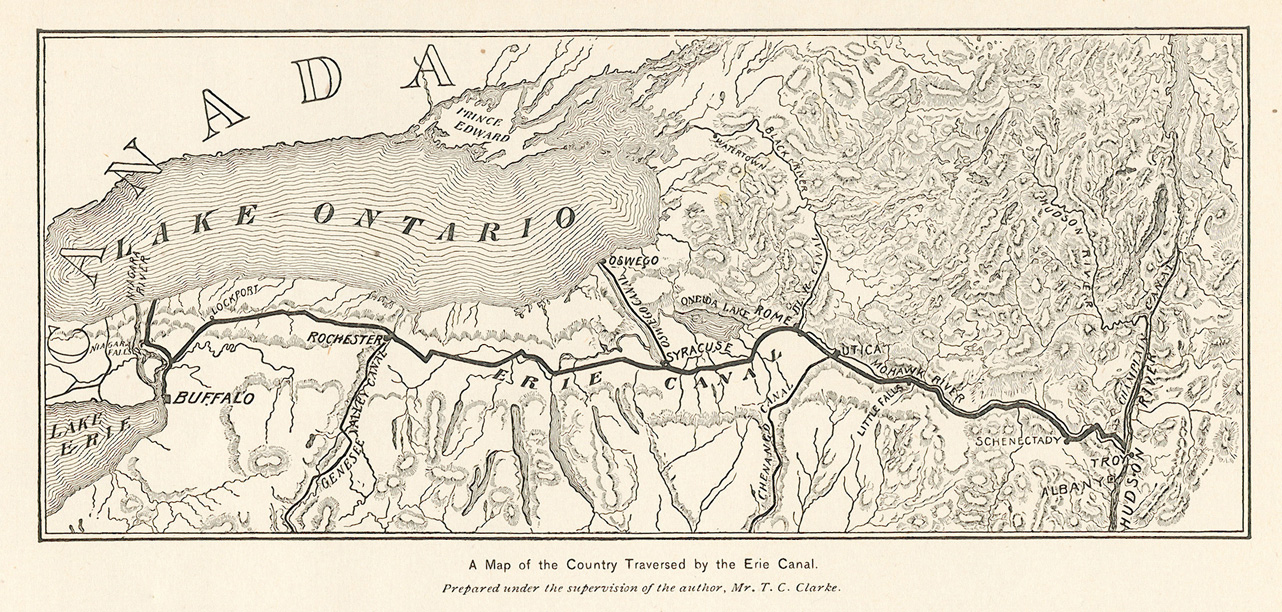
New York was specifically poised to tackle this transportation issue. The Hudson River was the main artery of trade for New York, connecting commercial Manhattan to the capital in Albany. Of the Hudson’s many tributaries, the Mohawk River proved to be the most important. Flowing eastward from Oneida County, it cut a low valley through the Appalachians, the only valley of its kind in the Northeast. Because of this, Governor DeWitt Clinton authorized the construction of a canal along this route in 1817.
Map showing Present and Proposed Canal System, to accompany report of Edward A. Bond, State Engineer and Surveyor of N.Y. (from:Annual report of the State Engineer and Surveyor of the State of New York, for the fiscal year ending September 30, 1903 (Oliver A. Quayle, Albany, 1904) — facing p. 60)
Following eight years of disease, construction accidents, and hard manual labor, the Canal was opened in 1825. The canal was 4 feet deep, 40 feet wide, and spanned 363 miles from Albany to Buffalo. With the construction of the canal, boats could travel from the Hudson River to Lake Erie in less than five days. While many were originally skeptical of the canal, it soon proved its worth. Completed ahead of schedule, and under-budget, the canal paid itself off with tolls in under ten years.
The Erie Canal was one of the first great highways of the United States, bringing goods, ideas, and most importantly people across New York. The Canal revolutionized the economy of Upstate New York, practically creating the cities we know today. In 1817, Buffalo was a village of 2,000 people recently destroyed by the British. Canal commerce turned Buffalo into the world’s premier grain hub, with the city growing into the 9th largest metropolis in the US. Cities sprang up all along the canal route. Hamlets like Rochester, Syracuse, and Schenectady grew into cities with hundreds of thousands of residents, and national centers of industry.
“The most fertile and extensive regions of America will avail themselves of its facilities for a market … [and New York City] will, in the course of time, become the granary of the world, the emporium of commerce, the seat of manufactures, the focus of great moneyed operations.”
– DeWitt Clinton, Governor of New York
Thomas S. Allen
On top of having such economic importance, the canal quickly became a cultural symbol of New York. To many, the canal symbolized their identity as Upstaters, and hope for a prosperous future. One person enamored by the legendary canal was Natick, Massachusetts’s Thomas S. Allen. Allen recalled, “When a boy in school, a picture of the Erie Canal in a Geography attracted my attention and I exclaimed: ‘If I ever see the Eric Canal, I’ll think I’ve seen something worth seeing.’” Sometime around 1910, when traveling to Rochester, Allen finally saw the canal, and immediately knew he had to write a song about it.
It turns out Allen was somewhat of a 1900s musical renaissance man. He was foremost a violinist, playing everywhere from professional orchestras to burlesque shows. On top of this, he directed Vaudeville shows, composing songs for them in the Tin Pan Alley tradition. Throughout his career, he published nine songs under his name, including “The Erie Canal Song.” Originally published in 1913 by Manhattan’s F.B. Haviland Publishing Co, the song was titled “Low Bridge, Everybody Down.” The song looked back to the work of mule barges along the canal.
At the time of its publishing, New York was constructing the Barge Canal System, a mechanized successor to the Erie Canal. Newer diesel and steam powered barges carried much of the cargo down these new canals. Allen’s writing harkened back to a simpler time of mule-drawn ships on the Erie Canal. “We’ve hauled some barges in our day, filled with lumber, coal and hay. And every inch of the way I know, From Albany to Buffalo.” These lines also highlight some of the major midwestern resources that would have flowed Eastward through the canal. Grain and ore were the two specifically that allowed cities like Buffalo to become breadbaskets, and industrial hubs of the East.
The lyrics while romanticizing life on the canal, also speak to the hardships it brought. The repeated chorus “low bridge everybody down,” reflects just one of these difficulties. Nearing the fledgling cities along the canal, extremely low bridges were common obstacles for barges. The cover for the song’s original sheet music depicts this, with the narrator ducking down on his mule to pass under one such bridge. In reality, however, these bridges were bigger dangers for barge passengers. Passengers on barges would commonly ride on top when conditions allowed, having to quickly get down to safely pass under these bridges.
Lift Bridge and Canal St., Canastota, N.Y. — Postcard ; not postmarked ; another slightly variant copy is postmarked Sep. 19, 1907. [CSNYS 1096.1.0890]
The song’s lyrics also play into the themes of hardiness that would fit perfectly in a Spaghetti Western. The lyrics repeatedly mention Sal the Mule’s fighting spirit. Throughout the song Sal brawls her way across the state, sending Mike McGinty to the bottom of the canal, and kicking a man all the way to Buffalo. All of this fighting occurs during the narrator’s 15 years of hard work along the canal. This story of hardy enterprise and masculine bravado call to mind the Wild West. One could easily imagine these stories of barging and brawling taking place in a classic Eastwood or Wayne movie. This makes sense remembering that at the canal’s completion, Upstate New York very much was the “Wild West.”
Since its original composition in 1913, “Low Bridge” has become a folk standard, being performed by countless artists. The first known recording we have of the song is by Billy Murray (not to be confused with actor Bill Murray) from 1912. Murray was a star Tenor of the early 1900s, recording many vaudeville and Tin Pan Alley tracks. This recording is now featured in the Library of Congress’s National Jukebox and Recorded Sound Section.
Aiding in the Canal’s place in American mythology was a recording by folk legend Pete Seeger. Seeger included “The Erie Canal” as track #10 on his 1954 album Frontier Ballads. This album celebrated the stories of workers, and settlers who traveled westward through the new territories of the United States. This album places the Erie Canal alongside stories of Cowboys and railroad workers, placing it firmly within the canon of Americana, and further cementing its Western connection.
Perhaps the latest great recording of “The Erie Canal Song” came from rock legend Bruce Springsteen, as part of his 2006 album We Shall Overcome: The Seeger Sessions. This album included Springsteen’s interpretations of 13 folk and Americana classics popularized by Pete Seeger. Because of this, this version is moreso a Springsteen cover of Seeger’s version, rather than a direct reimagining of the original. The album, including “Erie Canal” shot to number 3 on the billboard top 100, also earning Springsteen a Grammy for best folk album.
Since its publishing 111 years ago, “The Erie Canal Song” has become an icon of American folk music. Not only have massive stars covered it over the years, but it has also really lived up to the definition of folk music, and spread to the masses. Reading comments on the YouTube video of Seeger’s version you see nothing but fond memories. Whether it’s people who learned it as kids in school, or sang it with their grandparents, the song holds an important place in the collective American cultural memory.
On top of all of this, the song speaks to the role the Erie Canal plays in American imagination. It singlehandedly built upstate New York, and connected the country more than it had ever been before. More than just this, it represents a time long gone, where the Wild West wasn’t so far west. Its no wonder why when many people think of New York, they think of the Erie Canal.
“The Erie Canal Song” Lyrics:
I’ve got an old mule, and her name is Sal, Fifteen years on the Erie Canal
She’s a good old worker and a good old pal, Fifteen years on the Erie Canal
We’ve hauled some barges in our day, filled with lumber, coal and hay.
And every inch of the way I know, From Albany to Buffalo
Low bridge, everybody down, Low bridge, we must be getting near a town.
You can always tell your neighbor; you can always tell your pal.
If he’s ever navigated on the Erie Canal
We’d better look ’round for a job old gal, Fifteen years on the Erie Canal
You bet your life I wouldn’t part with Sal, Fifteen years on the Erie Canal
Giddyap there gal we’ve passed that lock, we’ll make Rome ‘fore six o-clock
So one more trip and then we’ll go, Right straight back to Buffalo
Low bridge, everybody down, Low bridge, I’ve got the finest mule in town
Once a man named Mike McGinty tried to put it over Sal
Now he’s way down at the bottom of the Erie Canal
Oh, where would I be if I lost my pal? Fifteen years on the Erie Canal
Oh, I’d like to see a mule as good as Sal, Fifteen years on the Erie Canal
A friend of mine once got her sore, Now, he’s got a broken jaw.
Cause she let fly with her iron toe and kicked him into Buffalo.
Low bridge, everybody down, Low bridge, I’ve got the finest mule in town.
If you’re looking ’round for trouble, better stay away from Sal.
She’s the only fighting donkey on the Erie Canal
I don’t have to call when I want my Sal, Fifteen years on the Erie Canal
She trots from her stall like a good old gal, Fifteen years on the Erie Canal
I eat my meals with Sal each day, I eat beef and she eat hay.
She isn’t so slow if you want to know, she put the “Buff” in Buffalo
Low bridge, everybody down, Low bridge, I’ve got the finest mule in town
Eats a bale of hay for dinner, and on top of that, my Sal.
Tries to drink up all the water in the Erie Canal
You’ll soon hear them sing everything about my gal, Fifteen years on the Erie Canal
It’s a darned fool ditty ’bout my darned fool Sal, Fifteen years on the Erie Canal
Oh, every band will play it soon, Darned fool words and darned fool tune!
You’ll hear it sung everywhere you go, from Mexico to Buffalo
Low bridge, everybody down, Low bridge, I’ve got the finest mule in town.
She’s a perfect, perfect lady, and she blushes like a gal.
If she hears you sing about her and the Erie Canal
New York City-based goth and shoegaze band Silent Mass has released a new brooding and dark single, “The Great Chaos.” The song will appear on the band’s forthcoming debut album, The Great Chaos, which is set to come out on June 20.
Silent Mass is an up-and-coming goth and shoegaze band with a unique blend of musical roots. Elements of post-punk, ethereal wave, shoegaze, and 90s alternative are all present in their music, just to name a few. Although only having a total of seven officially released songs available before their debut record, Silent Mass has already cornered in on the perfectly despondent and melancholic aesthetic that allows songs like “Nest of Flowers” and their new single “The Great Chaos” to shine. New York City is a well suited home for Silent Mass considering the melting pot of inspirations that contribute to their music.
Silent Mass began as a solo pursuit by current writer, producer and vocalist Ammo Bankoff. Her debut single, a cover of “Total Recall,” was released in 2020 as a tribute to Adrian Borland & The Sound. Shortly after the single’s release, Bankoff joined audio engineer/guitarist Robert Duncan and relocated to New York City to join drummer/producer Alex Posell.
Once fully assembled, Silent Mass released two singles in 2021 and three more in 2024. Their latest single, “The Great Chaos,” is the title track off of their upcoming long-awaited debut album. “‘The Great Chaos’ finds beauty in the spiral of self-discovery. It’s a love song about mourning a version of your past self,” said Ammo.
“The Great Chaos” sees Silent Mass in their element. The four-minute slow and hazy track is particularly held up by the chilling hook, where Ammo sings, “Can you find a way out, can you find a way out, can you find a way out of this nightmare?” over a wall of percussion, synths and guitar.
With seemingly everything set and ready for their upcoming debut record, “The Great Chaos” may very well be the last taste we get of Silent Mass’s dense and experimental sound before the full record releases on this summer solstice.
Silent Mass also has an upcoming show in New York City on July 13.
She’s the German actress and amateur singer-songwriter who achieved notoriety three decades after she made the humble home recordings that were released in 2006 as the critically acclaimed Colour Green. Now the reclusive Sibylle Baier is making a rare appearance at the Saugerties’ Orpheum Theatre for the June 9 screening of Wim Wenders’ 1974 classic Alice in the Cities.
“Sibylle Baier and her daughter Julia appeared briefly in Wim Wenders’ film Alice in the Cities. The two protagonists come across Sibylle standing on the ferry, holding her daughter as she sings one of her songs entitled ‘Softly’.. Through the early 1970s, Baier made lo-fi acoustic recordings of songs she wrote for her pleasure alone, ones that Robby gathered onto a CD gifted to friends to mark his mother’s 60th birthday. One recipient was Dinosaur Jr’s J. Mascis who secured its commercial release as the 14-track collection, Colour Green, on Orange Twin label.
Baier’s breathy, stripped-back acoustic sound is often compared to Leonard Cohen, Nick Drake and a folky Nico. Her fans number musicians like Kim Gordon, who included her on a playlist of favorites in a 2015 article in the New York Times. Her evocative music has since been licensed for many projects including the films Drinking Buddies and My Salinger Year and the TV show, End of the F**cking World. A new recording, “Let Us Know,” was featured in Wenders’ film, Palermo Shooting.
Although she will not be performing live, Baier will be playing tracks from Colour Green.
Sibylle Baier
The event will take place in “The Mark,” the brand-new screening room at Upstate Films’ Orpheum Theatre in Saugerties. The Mark’s most notable elements are its acoustics with its Dolby Atmos sound system, engineered with WSDG and cinema specialist Dave Berti, which provides precision sound that envelops the audience, immersing them in the heart of the film. WSDG, led by John Storyk, has previously designed venues and studios for Bruce Springsteen, UCLA, Lincoln Center, Spotify, Jay-Z, MTV, Alicia Keys, NYU, and, at the beginning of Storyk’s career, Jimi Hendrix’s Electric Lady Studios.
For more information and tickets, visit Upstate Films
Raz Fresco collaborated with Billie Essco? Say less, though! It’s only right that these two also teamed up with The 6th Letter – an underground producer who emerged circa 2010-2011. Hence, this mixtape takes it all the way back to the back of the Cadillac and makes you feel so fly. The smooth tunes will certainly take you for a ride and makes you want hoodie season to be every season.
Initially, the internal rhymes stood out between Fresco/Essco – the interesting part about this mixtape on paper points to the Jonny Shipes connection. Shipes propelled Joey Bada$$ and Pro Era a great deal amongst several talented others along the way. 6th Letter/Raz Fresco opened on Jonny Shipes ‘Smokers Club’ Tour in 2011. Later, they hosted their own ‘Bakers Club’ in Toronto, Raz/6th’s respective hometown.
Furthermore, Kazaa/Ares/Limewire Days evolved into the MySpace/Worldstar/Datpiff essentially within decades. Judiciously, the pace of the world continues to turn on its axis. Rotationally, each spin may contain an urge to splurge on some Bape – quick hint – hit Pondon for authentic gear. Either way, when these tracks play it puts the listener in a space-time-continuum loop that engulfs the audience all throughout the experience.
Nonetheless, sensationalism within journalism must perish. Within the aura and orchestral collection of gems these gentlemen pieced together a fully textured and evenly weaved garment of a mixtape. Truly, a piece of history to have heard this formulaic foundry of intertwined intricacies.
TCT Track Reviews
Track: Getting Baked in the Bakery
Notes: “Mary go round” line symbolizes the amount of haziness provided.
Music supplies, “Homeostasis brainwave shifts.”
“Closet is brolic” means that their apparel selection and wardrobe stands next to impeccable.
Cream team on these tracks represent the trifecta of making the listener feel fly.
Thus, the accompaniment of “wisdom and mic divine” together combine to make an incredible project.
Track: 05 Baby Milo
Notes: Track brings great energy and tempo to an all-inclusive listening experience.
Track: Favorite Sweater
Notes: This track definitely has the most bop and best soul out of any of them
Quotable: “She turned the capital sweater into a crop top
Almost got cut off for that but she my top stop
We go back like blank tees from Top Shop
Calmly mami graduate to Givenchy.”
Track: Patent Leather Bapestas
Notes: These artists hit the track with a trifecta of angles. This track reminds you of an old school Wale track as this whole tape makes the listener feel fly.
Quotables: “All Star Lebron the blue resembling Neptune
Basquiats in the bedroom
On the flights you know it’s emergency
Real leg room in first class
I ain’t camera shy get real close and see the details.”
Other tracks like “Japanese Fabrics” and “Multiple Choice” stood out amongst a collection of wavy tunes. Make sure to tap in and ride the waves.
The town of Chateaugay, NY will host Adirondack Vet Fest, July 20 and 21. All proceeds go to North Country Honor Flight, an organization that brings veterans to Washington D.C.
The festival has a lineup of musical groups throughout the two days at the Chateaugay Town Hall Theatre. Along with the performances, guests can find food vendors, crafts and merchandise and a silent auction.
Vet Fest starts at 10:00 and on July 20, the festival’s special event begins at 6:30 with Artimus Pyle band. Drummer and marine veteran, Artimus Pyle was a former member of Lynyrd Skynyrd. In 1977, he survived the plane crash that killed songwriter Ronnie Van Zant, guitarist Steve Gaines, and backing vocalist Cassie Gaines. After his close encounter with death, he went on to produce solo singles and is now touring with the Artimus Pyle band, performing Lynyrd Skynyrd tributes.
The festival has an optional donation towards North Country Honor Flight. The organization gives veterans in New York and Vermont a chance to fly to Washington D.C. and visit memorials honoring themselves. World War ll and Korean war veterans can apply on the website for this opportunity. To see Artimus Pyle band guests can purchase the $25 tickets in cash at the Chateaugay Town Hall Theatre.
Caffè Lena has been a continuously operating folk coffee house since 1960 and Tom Rush has been a continuously performing folk musician for just about as long. That certainly made Rush, who released his first album in 1962 and recorded for Prestige, Elektra, and Columbia records in the 60s and 70s, a perfect selection for Caffè Lena’s Folk Heritage Series which brought the New England troubadour to the stage for two shows on Friday, May 31.
Tom Rush at Caffe Lena. Photo by Derek Java.
In the early bird set, which kicked off just after 5 pm to the delight of the mostly-baby boomer crowd, Rush performed a tight 70 minute set that showcased his wide-ranging skills as a songwriter, storyteller, bluesman, interpreter, and champion of other songwriters from his generation.
Tom Rush at Caffe Lena. Photo by Derek Java.
After the packed house welcomed Rush to the stage, he joked that he was in the sixty-third year of his farewell tour and kicked into “Making the Best of a Bad Situation” a talking blues that featured a number of narrative follies and established the lighthearted and humorous nature that continued throughout the set.
Upon completion of the first number, Matt Nakoa took the helm of the legendary Caffè Lena upright piano and accompanied Rush for most of the night. Nakoa, a songwriter who hails from Kerhonkson, NY, looks startlingly like the young, pre-mustachioed Tom Rush as captured in the photo that adorns the album cover of The Circle Game (1968). Nakoa also displayed a dexterous and adaptable approach to the keyboards all night, ranging in styles from barrelhouse to boogie-woogie to straight ahead rock n’ roll. “Hot Tonight” was an apt place in the set for Nakoa to join in since his playing certainly raised the temperature of the music on the stage for the duration of the concert.
Matt Nakoa caught in reflection at Caffe Lena. Photo by Derek Java.
Nakoa is also the producer of Rush’s most recent album “Gardens Old, Flowers New”, which was released in March of this year. “Won’t Be Back At All” was the first of three numbers that the duo played from this latest album. Rush joked that he learned a long time ago that he should play new songs early in a set in case he needed to redeem himself for any missteps, but despite his self-deprecation, the three new songs included in the set were among the most poignant of the night.
True to his word, Rush followed a recently recorded track with a song nearly 60 years old: Joni Mitchell’s “The Circle Game”. Rush recounted that he first met Joni Mitchell in 1966 while he was doing a two week residency in Detroit at the famed The Chess Mate folk and blues club. He was two years overdue on an album for Elektra and asked the budding songstress if she had anything he could record. Shortly thereafter, Mitchell sent Rush a six song demo tape, humbly introducing “The Circle Game” as something she didn’t think was all that good. Rush’s reverential rendition reminded the audience of just how wrong Mitchell was – the lyrics remain spellbinding and perceptive. In many ways, Rush’s baritone, grown gravelly with age, continues to be the perfect foil for the lyrics, “we can’t return, we can only look / behind from where we came / and go round and round / in the circle game. Rush, who alternated between a standard-tuned acoustic, a 12-string, and his open-tuned, signature Martin guitar (replete with naked-lady-wrapped-up-in-a-snake inlay) mentioned that while David Crosby takes the credit, he’s pretty sure he was the one to first introduce Mitchell to open-tuning (something she became famous for). Rush said he’s pretty sure he was the one who showed Crosby how to do it too!
Tom Rush at Caffe Lena. Photo by Derek Java.
Rush continued to school the audience in the ways of the old folk house with Sleepy John Estes’ “Drop Down Mama” which featured an exquisite barroom piano solo by Nakoa. Rush, who hails from New Hampshire, went to college at Harvard and got a second degree in the folk music of 1960s Cambridge clubs where he saw numerous blues and bluegrass legends, Estes included.
Rush then turned the stage over to Nakoa for an interlude of piano instrumentals that shared one quality – they were scores for film. “Tumbleweed Tango” was a clever and playful piece that was commissioned to score a short animation about two balloon animal dogs (check out the video on YouTube if you get a chance). The impressionistic “8MM Home Movies” was inspired by Nakoa’s COVID lockdown with his father. Instead of family movie night, Nakoa’s dad fired up old 8MM home videos and Nakoa was inspired to rewrite an old composition from his high school days that conjured up the images of his youthful grandparents.
Matt Nakoa at Caffe Lena. Photo by Derek Java.
Then Rush returned to the mic for “The Remember Song”, which was probably the highlight of the evening in terms of crowd response. Written by Steven Walters, the song captures exactly what it feels like to misplace the phone or walk into a room without knowing quite why you’re in there. Improbably, a 2007 upload of “The Remember Song” has 7.7M views on YouTube (a true viral sensation)– and Rush made it clear he’s never seen a dime from those clicks. Maybe, he mused, it was the same guy clicking it over and over and forgetting that he’d watched it in the first place.
“Siena’s Song” was a tender ballad for his daughter. Rush wrote the track more than 20 years ago and revisited the lyrics at the behest of his 25-year-old daughter. His young daughter may also have influenced the addendum Rush added to the lyrics of “Ladies Love Outlaws” to bring the 70s hit for Waylon Jennings up to date in 2024: “Outlaws touch the ladies somewhere deep down in their soul, but never without proper consent,” sang the hip octogenarian.
Tom Rush at Caffe Lena. Photo by Derek Java.
In the same way Rush paid tribute to Mitchell, his take on Jackson Browne’s classic “These Days” was a reminder of Rush’s role as champion of great songwriters. Browne wrote the song when he was only 16 and Rush was one of the first to record any songs written by the young prodigy.
“Lost My Drivin’ Wheel”, penned by Canadian David Wiffen, followed the Browne number and brought to mind Rush’s years as a Columbia recording artist in the 1970s at the height of the country- and folk-rock music. “Drivin’ Wheel” featured an extended soulful and percussive organ solo from Nakoa. The rock and roll spirit continued for a medley of the rock standards “Who Do You Love?” and “Hey! Bo Diddley”. Rush, a clever, twinkle-in-the-eye English major at heart, cracked up the audience by singing the lyrics “WHOM do you love?”.
Tom Rush at Caffe Lena. Photo by Derek Java.
The encore for the early evening was the aptly titled “I Quit” which also closes out Rush’s new album. The tune could apply to quitting a job or relationship or a music career, but Tom Rush is in no hurry to leave the spotlight and shows no signs of slowing down. Heck, he had a second sold out show at 8 pm.
Setlist: Making the Best of a Bad Situation, Hot Tonight*, Won’t Be Back At All*, Circle Game*, Drop Down Mama*, Tumbleweed Tango**, 8MM Home Movies**, The Remember Song, Siena’s Song, Ladies Love Outlaws*, These Days*, Lost My Drivin’ Wheel*, Who Do You Love?/Hey! Bo Diddley Medley*
Encore: I Quit *
*Accompanied by Matt Nakoa on piano and keyboard ** Matt Nakoa solo (instrumental piano compositions)
Tom Rush at Caffe Lena. Photo by Derek Java.Tom Rush at Caffe Lena. Photo by Derek Java.Tom Rush at Caffe Lena. Photo by Derek Java.Tom Rush at Caffe Lena. Photo by Derek Java.
In an upcoming interview with NYS Music, owner and CEO of Lounge Studios in Manhattan Walt Randall revealed that he is starting a new surround sound company for his studio called Spatio. The company will launch during the first week of June and allow independent artists to record their music in Atmos Spatial Audio. This new surround-sound format allows for a more realistic and immersive recording experience.
The Dolby-Certified Solaris Room is the latest addition to Lounge Studios where artists will record their music in Atmos Spatial Audio. Credit: Walt Randall.
However, this new format is pricey and creates roadblocks for independent artists.
“All major labels make it mandatory to release Atmos, but it’s too expensive for independent artists. The going rate is between $500-$1500/song. This makes it impossible for independent musicians to get their songs done in Atmos Spatial Audio,” Randall said.
Randall realized what an obstacle this posed for independent artists, and decided to do something about it at Lounge.
“When I realized that this amazing format would pose insurmountable obstacles to independent artists, it became my mission to even the playing field”, Randall said.
Randall described the process of making Atmos Spatial Audio more accessible to independent artists.
“I started by building one of only three Dolby Certified, Atmos Studios in Manhattan. I then developed proprietary software systems that would help speed up the mixing process. Lastly, I trained some of Lounge Studios’ best engineers to work with Spatio,” Randall said.
Randall added, “To date, we have done Atmos mixes for every major record label and have done some of the biggest stars in every genre of music, including The Wallows and Lil Baby.”
Randall emphasized what a big deal Spatio will be for rising musicians.
“It’s going to be huge for independent artists and will change the playing field.”
Khruangbin came to Buffalo to play outside the AKG Art Museum on May 25. Rain was in the forecast and it started to drizzle as fantastic opener John Carroll Kirby took the stage. The set was cut short a few songs later as a threat of lighting shut everything down.
As the sky darkened, it started to rain and people scurried to various spots for cover, the smarter people going inside (I was not one of them). The rain came down harder and I was starting to think that Khruangbin were going to get rained out. There was more and more movement onstage and credit to the crew, they were actually able to get the stage ready even though it was still pouring out.
Khruangbin breaks their show up into two sets, on this tour the first one was a play through of their fantastic new album, A La Sala. The album is a little more laid back than previous efforts, but it is full of luscious textures and melodies, which were often a slow burn that really simmered in the night with the rain coming down.
You could tell the Texas trio (Mark Speer on guitar, Laura Lee Ochoa on bass and DJ Johnson on Drums, with everyone sharing vocal duties) was enjoying playing the new tunes. The highlights from the album were my highlights from the set, (“May Ninth, “Hold Me Up (Thank you)”, and “Three From Two”) and the set peaked with the blissful ending of “A Love International”. The album closer then ended the set, the dreamlike “Les Petits Gris” and they took a quick break.
A “Bin Bin” started off set two and got the crowd moving. After playing the new album, the second set was more of their older crowd favorites. The rain was a little too much for some, so the crowd thinned out and we seemed to lose some talkers and some of the more fairweather fans, so the crowd during this part of the show was really locked in.
Khruangbin’s vibe is generally a deep groove but right during the last section of “Lady and Man”, they seemed to flip the switch and the rest of the set felt like music you’d hear in a club vs. on a beach. The drenched crowd ate it up and tried to unsuccessfully to dance themselves dry, though the rain did finally let up towards the end of the second set.
Khruangbin next heads to the Midwest before wrapping up their US summer tour in Bonnaroo.
Set 1: Fifteen Fifty-Three, May Ninth, Ada Jean, Farolim de Felgueiras, Pon Pon, Todavia Viva, Juegos y Nube, Hold Me Up (Thank You), Caja de la Sala, Three from Two, A Love International, Les Petits Gris
Set 2: Bin Bin, August 10, Master of Life, Father Bird, Mother Bird, Lady and Man, So We Won’t Forget, Even Finds the Third Room, Time (You and I), People Everywhere (Still Alive)
On May 18, From Ashes to New electrified the stage at Waterstreet Music Hall with their Blackout Tour Part Two. They were joined by an exciting lineup of Ejiajh, Phix, Ekoh, and Point North, making it an unforgettable night for fans of rock, metal, and rap.
Ejiajh Opens the Show
The evening kicked off with Ejiajh, a dynamic rock/metal band hailing from Austin, TX. Their high-energy performance set the tone for the night, captivating the audience with their powerful riffs and commanding stage presence. Ejiajh’s set was a perfect blend of raw energy and technical prowess, leaving the crowd eagerly anticipating the acts to follow.
Phix Keeps the Momentum
Next up was Phix, a talented rapper and songwriter also from Texas. Phix brought a unique blend of lyrical depth and stage charisma, engaging the audience with his sharp rhymes and catchy hooks. A special highlight of Phix’s performance was the appearance of 11-year-old drumming prodigy Bronx Sandoval. Despite his young age, Bronx is no stranger to the stage, having completed four tours with the band. During a brief technical difficulty, Ekoh’s drummer joined Bronx for an impromptu jam session, showcasing their incredible synergy and adding a spontaneous thrill to the set.
Ekoh Takes the Stage
Following Phix was Ekoh, a rapper who has been rapidly gaining fame on social media platforms like TikTok and X. Ekoh’s performance was nothing short of electrifying, as he connected with the audience through his relatable lyrics and energetic delivery. His growing popularity was evident, with many fans in the crowd singing along to every word. Ekoh’s stage presence and interaction with the audience made for a highly engaging set.
Point North’s Dynamic Performance
The penultimate act of the night was Point North, a band based in Los Angeles, CA. Point North delivered a high-octane performance, blending elements of rock and punk with infectious energy. Their tight musicianship and engaging stage presence kept the momentum going strong, leaving the audience primed and ready for the headlining act.
From Ashes to New’s Triumphant Return
Finally, From Ashes to New took the stage, led by local favorite Danny, who previously fronted the band Vanity Strikes. The band’s performance was a triumphant homecoming for Danny, and the energy in the room was palpable. From Ashes to New delivered a powerful set, seamlessly
blending their signature mix of rock, rap, and electronic elements. Danny’s connection to the local crowd added an extra layer of intensity to the performance, making it a night to remember.
Overall, the Blackout Tour Part Two at Waterstreet Music Hall was a resounding success. Each act brought their unique flair to the stage, creating a diverse and exhilarating concert experience and leaving the fans buzzing with excitement.