Category: Features

  • No Country For Old Men: Why Hip Hop Remains a Young Man’s Game

    If there’s an irrefutable truth about the hip hop ecosystem is that it caters to the youth. Much like Wu Tang Clan‘s popular mantra, hip hop really is for the children. After all, since its inception, rap music has long resembled youthful cosplay in a reflection of one’s environment and beliefs. From the Village People attire of Afrikaa Bambaataa and crew, to crack era MC’s putting on their best street hustler ensemble, hip hop’s rise came as a change of pace from the conforming hymns of jazz & soul music.

    hip hop's revolving ethos made kids a prime marketing target
    Hip hop’s ethos was ever-changing before settling on what we see today.

    With the golden era rappers of the ’80’s and ’90’s acting as vanguards for artistic representation, rap music — thought to be a fad more than a respected art form — was brought to new heights with inventive forms of story-telling. Albums like Paid In Full, Criminal Minded, It Takes a Nation of Millions to Hold Us Back, The Score, 36 Chambers, Ready to Die, Illmatic and many more transformed the movement from frantic, counter-culture and youthful exuberance, into dissectible urban diaries.

    After all, at its peak the literary elements warranted examination much like a James Baldwin poem. The raw anger, angst and imagery, for better or worse, is the product of socio-economic plight which demanded thought-provoking conversation. Ultimately, as its popularity soared, hip hop took the form of an uncouth political candidate with an in-your-face bravado as it pandered to the roar of a pent-up generation wanting its voice heard.

    hip hop controversial rappers
    Controversy Sells

    Soon enough label execs began cashing in on the latest trend. And subsequently conscious raps made way for more abrasive lyrics with a focus on aggressiveness and over-the-top hubris. In the end hip hop’s bouncy beats and mercurial nature made kids and young adults a prime market.

    Growing Pains

    Nonetheless, rap music’s raunchy and explicit nature fit right in with the late 80’s and ’90’s ethos of violence and erratic behavior, a time where pop culture’s biggest stars struggled to exist as functional human beings. However, unlike other genres, rappers don’t string together guitar solo’s or sing beautiful high notes. They become stars by selling you themselves, or who they say they are. Thus in a world where “Money, Cash, Hoes” is the modus operandi, they became caricatures, while typecasting themselves artistically for record sales.

    Truthfully I wanna rhyme like Common Sense But I did 5 mill’ – I ain’t been rhyming like Common since 

    -Jay – Z, “Moment of Clarity”

    And as the business of hip hop grew rappers became spokes in a wheel. With the formula for success as redundant as it is profitable. Your typical major label rapper consists of a charismatic individual with inner-city cultural norms, armed with the gift of gab and quick-witted use urban of idioms. Equipped with the latest fashion and jewelry, yet lacking the tools for artistic transcendency. Thus, after some time, many rappers become frozen in their distinct era, becoming human time-capsules. And in an ever-changing world, the sound of hip hop has done a complete 180, going from rigid boom bap to fluid and experimental, which continuously leaves rappers feeling dated .

    Where Do We Go From Here?

    Fundamentally, when your target audience’s prefrontal cortex has yet to form, it leaves little room for character development. For instance, sitcoms on Disney Channel or Nickelodeon only last about 3 seasons — as it doesn’t make sense to develop characters and shows that will eventually age out of their demographic. In hip hop, very few rappers get the opportunity to mature their sound and if they do, it is almost always well past the point of commercial appeal. Consequently most promising rap careers tend to mirror that of a once-great NFL running back. For every Peyton Hillis, Jay Ajayi and Todd Gurley, there is a Blocboy JB, Makonnen and Desiigner, amongst many, many more.

    Hip hop star chance the rapper and Todd Gurley
    Can you spot the difference?

    Under those circumstances older acts that wish to maintain relevance must evolve (or de-volve) as their sound must have a Benjamin Button like trajectory, consistently aging down to make way for the new norm. It’s why a megastar like Drake perpetually stays tapped in to younger, underground artists, often employing younger acts to aid in his creative process. Because, despite his best efforts to present a contrary image, Drake doesn’t think like a teen or young adult.

    hip hop's big 3 are not immune to the changing music landscape
    Even the big 3 have to adapt to hip hop’s revolving landscape

    Similarly, J. Cole’s latest track “Grippy,” a remix of Cash Cobain’s hit-record “Dunk Contest,” is in accordance with this phenomenon. The “No Role Modelz” rapper’s attempt at the”sexy drill” sound has quickly become social media fodder, with Cole sounding out-of-touch while letting Nas down in the process. Hell, even the likes of Kendrick Lamar needed an easily digestible follow-up to the critically-acclaimed To Pimp A Butterfly. 50 years in the making, hip hop is firmly entrenched in a civil war between old and new.

    On To The Next One

    However, despite all the constant rethoric regarding “OGs,” in hip hop, make no mistake, the youth set the pace. With every 40 plus occupier of the culture ready to placate their younger counterparts in a means to avoid the poignant rays of “old head” that would leave them outside the club of relevancy. For this reason rappers and media personalities alike must duck, dodge and weave in the never-ending battle for the fountain of youth.

    Young rappers in hip hop
    Youth is akin to a superpower in rap’s revolving landscape

    Yet, sadly, this leaves many legends of the genre outside the scope of musical relevancy. And for better or worse, the ageism in hip hop only affects the talent, the faces that you see. The ones you don’t are the one signing the checks and profiting from it all. Yet when a legend like Method Man feels out of place in an ecosystem he once thrived in, it serves as an eye opener to the hip hop’s cyclic nature. Moreover, as we’re firmly in the streaming era, maturation in hip hop is once again on the back burner. As artists look for their next Tik Tok hit and viral moment, there is no time to look back and appreciate the past (unless there’s a sample to be had), as hip hop is perpetually on the lookout for the next trend.

  • Rebounder Celebrates ‘Born In The USA’ With Lofi Cover

    NYC Band Rebounder is back with new music, starting with a cover of “Born In The USA” by Bruce Springsteen. 

    rebounder born in the USA

    Patrick Holland from the Canadian indie-rock band TOPS, co-produced and mixed the unique spin on the classic song just in time for the 40th anniversary of the original album. The song is a slower toned-down version of the Springsteen song. Instead of classic American rock, it’s an indie-lofi song. “Born In The USA” is accompanied by a DIY style music video featuring American scenes of highways, cityscapes and rural farmland. 

    rebounder born in the USA

    In 2020, Rebounder put their name on the map when they released their first EP, Subway Songs, including the song “Japanese Posters,” which gained 23 million streams on Spotify. In 2021, they released “Change Shapes” in collaboration with Jesse Rutherford. They’ve also collaborated with Chris Thompson of Vampire Weekend on production and toured with Phoenix, MUNA, Dayglow and Cautious Clay. The band’s frontman is Dylan Chenfeld. He, his brother Noah Chenfeld and their childhood friends Zack Kantor and Cobey Arner make up Rebounder. 

    Fans can expect more from them as their second studio EP Sunset Vision is set to release on Aug 15. Watch the video for Rebounder’s cover of “Born in the USA’ below.

  • Gladys Bentley: Singer, Entertainer, and LBGT Trailblazer

    Looking back into history, the 1920s was a time marked by intense racial and sexual discrimination. In the South, Jim Crow laws were in full effect, leaving African-Americans as second class citizens. Throughout the country, KKK membership expanded to almost 4 million, only worsening racist violence. LGBTQ Americans also faced similar discrimination, with homosexuality being labeled as a mental illness, and the media spreading homophobic stories of sensationalized sex crimes.

    During this period of intense discrimination, blues singer Gladys Bentley, a queer African-American woman, managed to overcome these obstacles and become one of the most popular entertainers of Harlem. In doing so, Bentley not only made a name for herself, but also paved the way for future generations of LGBT artists to succeed.

    Gladys Bentley

    Gladys Bentley was born in 1907 in Philadelphia, PA to an African-American father, and Trinidadian mother. From a young age, Gladys pushed the constraints of gender expectations, often wearing her four younger brothers’ suits to school. As she recalled to Ebony Magazine later in her life: “It seems I was born different. At least, I always thought so…From the time I can remember anything, even as I was toddling, I never wanted a man to touch me…Soon I began to feel more comfortable in boy’s clothes than in dresses.” 

    Sexual discrimination marked Gladys’ childhood in Philadelphia. Her classmates often mocked her for being overweight, and dressing too masculine. In addition, following a crush on a female teacher, her parents forced Gladys to see doctors in failed attempts to “cure” her lesbianism. Gladys’ way of dealing with this childhood trauma was writing and performing songs. Wanting to seek freedom from this discrimination and true expression, Gladys ran away to New York City at age 16. 

    Harlem’s Gay Club Scene

    Following the passage of the 18th Amendment in 1919, which prohibited the sale of alcohol, Harlem’s clubs went underground. Venues like the Cotton Club, Connie’s Inn, and the Savoy Ballroom became hubs for entertainment, African American arts, and stigmatized activities. Vendors sold crab, peanuts, and cannabis, and everybody – including the neighborhood police – were engaged in illicit lotteries. In these Harlem nightclubs, the Harlem Renaissance truly blossomed. Soon, entertainers like Cab Calloway and Ethel Waters became some of the most well known celebrities not only in New York, but the whole country. 

    A map of Harlem’s Night Clubs illustrated by E. Simms Campbell in 1932

    This flourishing of the nightclub scene came with a public fascination with the LGBT community in New York City. During the “Pansy Craze” of the 1920s and 30s, queer performers were more visible and successful than ever before. Throughout Harlem, Greenwich Village, and Times Square, drag balls captivated audiences. At these events, women could be found in tuxedos, and men in stockings and makeup. As the African-American newspaper The New York Age reported, “Wigs, where necessary, were in evidence.”

    While homophobic discrimination did exist, Manhattan was much more tolerant of the LGBT community than much of the country. While some identified publicly as queer, many people did not associate with any identity at all. As Harlem Renaissance artist Richard Bruce Nugent said “You just did what you wanted to do. Nobody was in the closet. There wasn’t any closet.” 

    Career in New York

    The active club scene, and more widespread acceptance of openly queer lifestyles allowed Gladys Bentley to rise to stardom in Harlem. Following her arrival in New York, Bentey made a name for herself at rent parties across the city. At these rent parties, artists would perform and pool proceeds made to help low-income tenants pay their rent. These parties provided African-American New Yorkers a forum to dance, enjoy Black art, and form a sense of community. It was at these rent parties that Bentley built the connections that forged her later career. At one such party, Bentley got the chance to audition for 133rd Street’s Mad House, which needed a male pianist. This position would launch her career into New York’s nightclub scene.

    An invitation to a NYC Rent Party, preserved by Langston Hughes

    Bentley soon found work as a performer at Harry Hansberry’s Clam House on 133rd Street. The Clam House – one of the city’s most visible gay speakeasies – allowed Bentley’s career to flourish. She made a name for herself with her deep alto voice, and piano skills, which she used to cover classic songs. What made Bentley stand out was the raunchy lyrics she would add to these classic covers, which both enthralled and shocked audiences. One such example was her cover of “My Alice Blue Gown” from the Broadway musical Irene, which referenced anal sex. 

    “And he said, ‘Dearie, please turn around’ And he shoved that big thing up my brown. He tore it. I bored it. Lord, how I adored it. My Sweet Little Alice Blue Gown”

    – Gladys Bentley’s cover of “My Alice Blue Gown”

    These racy lyrics, as well as the spectacle of Bentley’s live performances made her famous among Harlem’s performers. Bentley’s 250-pound figure, dressed in an iconic black tuxedo and hat, enamored audiences regardless of race of sexuality. During performances, Bentley would often flirt with women in the audiences in her deep gruff voice. For many, the illicit nature of her lyrics and performances played into the underground nature of the club scene during prohibition.

    Throughout her heyday in the early 1930s, Bentley enjoyed performances across New York, and record releases. In 1933, Bentley headlined the Cotton Club, and Apollo Theater, some of the most famous in New York City. In the early 1930s, Bentley also released eight singles on record, and hosted her own weekly radio program.

    With Bentley’s success also came scandal. She shocked the public with the announcement of the marriage to her white female lover in a New Jersey civil union. While there is no official documentation confirming this marriage, it speaks to Bentley’s openness about her sexuality and ability to control public attention.

    “An amazing exhibition of musical energy—a large, dark, masculine lady, whose feet pounded the floor while her fingers pounded the keyboard—a perfect piece of African sculpture, animated by her own rhythm.”

    – Langston Hughes

    The pinnacle of Bentley’s Career however, was her residency at the Harlem’s Ubangi Club from 1934-37. A former speakeasy, the club was rechristened following the repeal of prohibition in 1933. The club’s name evoked voodoo, marketing it as a place both exotic and mysterious. At the club, Bentley performed her self-produced musical revue, backed by eight male dancers in drag. This success, however, began to wane following the end of prohibition. Soon, as queer acts fell further out of favor, police raids and harassment became more commonplace.

    Gladys Bentley
    An Ubangi Club advertisement featuring Gladys Bentley’s music revue

    Wanting to escape homophobic harassment in New York City, Bentley relocated to Los Angeles to live with her mother in 1937.

    Later Life

    Bentley’s career in California had a brief resurgence, first in Los Angeles then San Francisco. In the 1940s, the West Coast was marginally more tolerant of queer lifestyles than the rest of the country. Following her relocation, Bentley continued to record music, and perform at gay and lesbian bars in San Francisco. These performances, were often toned down versions of her explicit acts from the 1930s.

    Part of the reason for this self-censoring was the influence of McCarthyism in the 1940s and 50s, which saw increased targeting of LGBT performers. California, while more tolerant, was not devoid of homophobic harassment. In one case on August 8, 1947, Bentley was prevented from performing at Los Angeles’ The Jade due to a police raid.

    A letter from the Musician’s Protective Association regarding the cancelation of Bentley’s Show on August 8, 1947

    By the late 1950s, Bentley had almost completely disavowed her previous life and sexuality. In 1952, Bentley married Charles Roberts, a cook from Santa Barbara, and claimed to have previously married and divorced two men. Also in 1952, Bentley in an interview with Ebony magazine declared, “I am a woman again.” She claimed, “like a great number of lost souls, I inhabited that half-shadow no man’s land which exists between the boundaries of the two sexes,” stating she underwent hormone therapy to “cure” her lesbianism. In public, Bentley began wearing dresses, and decorated her hair with flowers. Many view this either as a reinvention to survive the homophobic tides of McCarthyism, or an attempt to conform to the heteronormative attitudes of the US.

    Following a final 1958 performance on the Groucho Marx show “You Bet Your Life,” Bentley succumbed to illness, eventually passing away of pneumonia in 1960. At the time of her passing, Bentley was only 52 years old.

    Gladys Bentley
    Gladys Bentley in 1932

    Legacy

    Bentley, while often overlooked, paved the path for many African-American and LGBT artists in the decades since her passing. One artists in particular who has taken influence from Bentley’s work and image has been Janelle Monae. Following the release of her 2010 debut The ArchAndroid, Monae sported an androgynous black and white tuxedo, a public image highly reminiscent of that which propelled Bentley to Stardom almost a century earlier.

    Gladys Bentley, while being one of the most popular performers of the Harlem Renaissance, was so much more than just a musician. Through her performances and public image, Bentley defied the heteronormative standards of 1920s America, paving a path for future queer artists to succeed in the music industry. As a singer, pianist, dancer, and provocateur, Bentley was a true “Renaissance man” of the Harlem Renaissance.

    Enjoy an interview and performance by Gladys Bentley on “You Bet Your Life” from 1958.

  • Punk Takeover: Free Punk Fest “Punk Island” Returns to Randall’s Island

    Mohawks, makeshift stages and mosh pit enjoyers of all ages took over Randall’s Island this past Saturday for Punk Island’s sixteenth anniversary. The festival returned to Randall’s Island for the first time since the pandemic, and the day could not have been more perfect for blaring guitars and screaming singers with a view of the East River and Manhattan’s skyscrapers. 

    The six stages had everything from hardcore rock and screamo to indie, alt rock and pop rock. Crush Fund and its passionate rage to the nostalgic sounds of the band Car Becomes Airplane filled the field with all sorts of different sounds. The event featured not only old school bands to reassure the older punkheads that the scene was still alive, but also actively catered to its newer audiences and worked hard to stay up to date with the current culture. 

    Every stage had a decent audience, but there was plenty of room for more to join at each stage. The festival was a wonderful opportunity to discover new music, and it also was the perfect place for bands and show organizers to get experience putting on shows in front of a lively audience. Tall neon mohawks, plaid pants, extravagant makeup and everything in between filled the bus to Randall’s Island. 

    Punk Island began in 2008 when Chloe Anderson, an NYU undergraduate student with an interest in punk was interning at Make Music New York (MMNY), a non-profit that supports free, outdoor music events. When MMNY received its first large grant for an outdoor summer festival, the intern was determined to make a punk festival happen. 

    After a few years, Aaron Friedman, the founder of MMNY, asked ABC No Rio, a punk collective, to take over as organizers of the festival. Joey Steele, a member of ABC No Rio, took the lead. “I love that event,” he told me. “I love the idea of there being an all day, all free, all ages punk show that people just show up to and go to like ten different bands all at once.”

    Punk Island

    He was also a member of the band Cop Out, and he worked hard to make sure the festival accurately depicted New York’s ever changing punk scene. “We organized it on the principle that we are all different but we all work together, and we want to empower and support each other,” he said. 

    Antonio Rodriguez, the current lead organizer, said that this event has remained an all free event, due to the support of the Punk Island Collective and the fiscal support of MMNY. Punk Island raises money year-round through benefit shows, selling merch, and more, while MMNY pays for the logistical aspects — permits, porta-potties and dumpsters, etc — for the event. “Their funding is crucial in making this work,” Rodriguez said, “and you know that’s true of all public arts funding; it’s crucial.” 

    Punk Island

    Punk Island has persevered through the difficulties of the pandemic and general disorganization, but maintained their long-term efforts towards sharing this inclusive community. 

    Now, sixteen years and many organizers since being founded, punks from across the city still come together to put on huge free punk festivals, working hard, not for the profit, but for  the community.  It’s put simply in the collective’s motto: “We aim to support a philosophy of creativity, rebellion and work to feed those who are hungry for a world where passion is valued over profit. We promote a counter-culture through our collective, art, music, writing and events.”  

  • All Things Go Announces Inaugural NYC Festival – Featuring Reneé Rapp, Chappell Roan, and MUNA

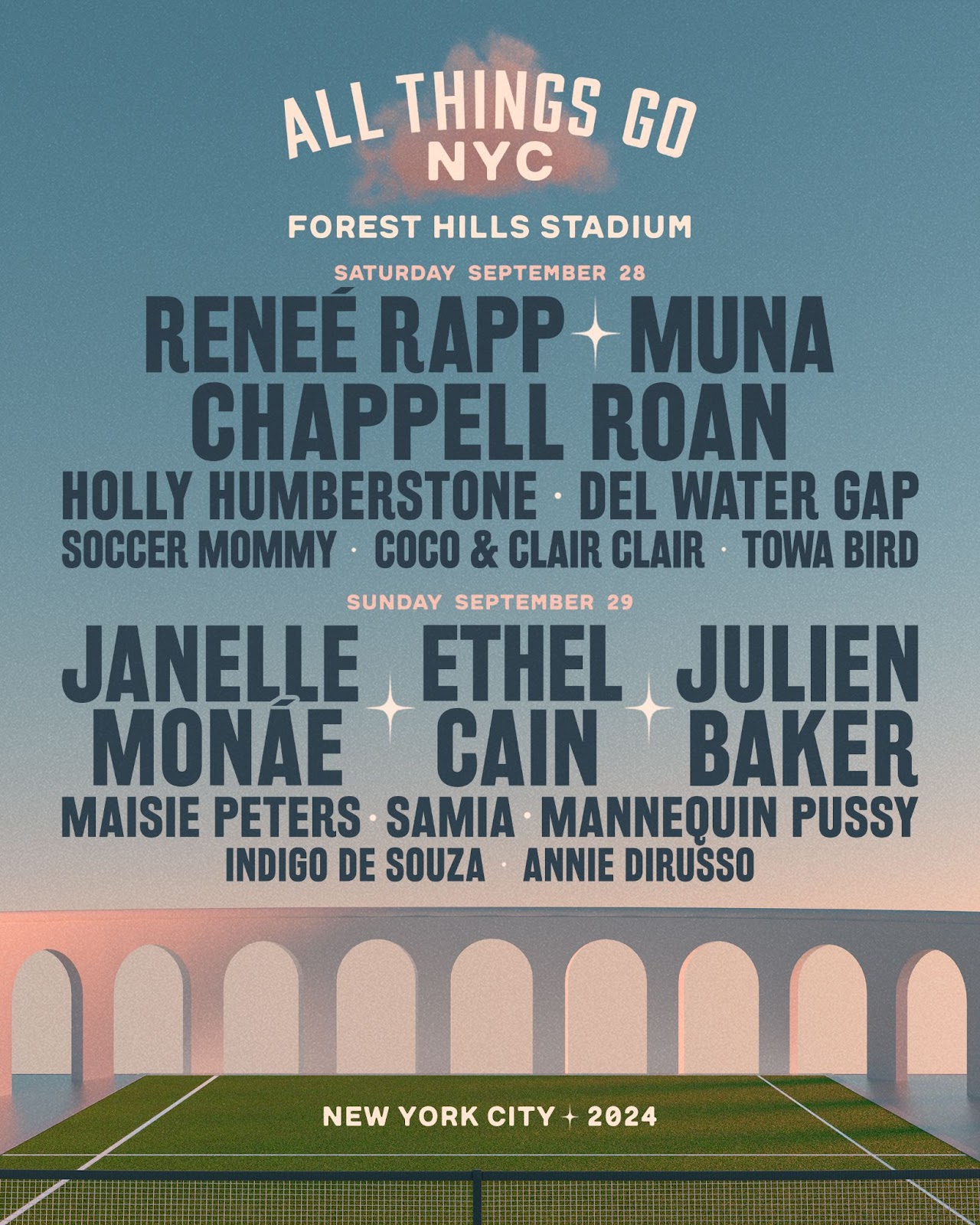
    The All Things Go music festival is making its NYC debut in 2024, adding to its already impressive legacy with an inaugural event at Forest Hills Stadium. Taking place on September 28th – 29th, this marks the festival’s expansion beyond its DC-area roots, where it will celebrate its 10th anniversary.

    Stellar Lineup for All Things Go NYC

    Headlining this year’s New York lineup are powerhouse performers Reneé Rapp, Janelle Monáe, Chappell Roan, MUNA, Ethel Cain, and Julien Baker. The festival continues its tradition of showcasing a diverse and inclusive range of artists, with performances from Holly Humberstone, Del Water Gap, Towa Bird, and more. This female and non-binary-focused lineup underscores All Things Go’s commitment to fostering diverse and inclusive spaces within the music community.

    All Things Go NYC
    boygenius 2023

    A Festival for the Forward-Thinking

    All Things Go has always been more than just a music festival. Since founding in 2011 in Washington, DC, it has dedicated itself to creating forward-thinking digital and live music experiences. The festival has collaborated with a slew of innovative artists, including Billie Eilish, boygenius, Lana Del Rey, Lorde, Mitski, HAIM, Janelle Monáe, Charli XCX, MUNA, Lizzy McAlpine, Carly Rae Jepsen, Bleachers, and Tove Lo, among others.

    All Things Go NYC
    Lana Del Ray 2023

    A Celebration of Inclusivity and Community

    All Things Go has cultivated a renowned community of devoted fans who embrace inclusivity and diversity, embodying the festival’s ethos. This spirit of community and celebration of underrepresented voices has earned the festival accolades and recognition over its 10 year history.

    All Things Go NYC
    Maggie Rogers 2023

    Tickets and More

    For eager fans looking to secure their spots, tickets for the New York edition of All Things Go will go on sale on Friday, June 14th, at 10 AM ET. Purchase tickets through the festival’s official website at allthingsgofestival.com. Given the festival’s history of rapid sell-outs and the stellar lineup, we highly recommend early ticket purchases.

    Muna 2023

    As All Things Go prepares to launch its first New York festival, anticipation is high for what promises to be an unforgettable weekend. With a lineup featuring both heavy-hitters and emerging talents, and a continued commitment to creating inclusive and forward-thinking music experiences, All Things Go NYC is set to become a staple in the city’s vibrant festival scene. Stay tuned to your favorite music news sources for more updates and get ready to be part of music history this September at Forest Hills Stadium.

  • Celebrate Father’s Day Weekend in Syracuse at Westcott CC and Thornden Park

    We’re coming up on Father’s Day Weekend, and in Syracuse, join the Westcott Community Center for live music, visual arts, and William’s Shakespeare’s Hamlet in the Thornden Park Amphitheater and more on Friday, Saturday, and Sunday June 14th-16th.

    Shakespeare in the Park – Kick off the summer with the 22nd season featuring Hamlet in the beautiful Thorden Park Amphitheater! Pack a picnic, bring our friends, and prepare for laughter, love, existential crisis, concern for family, romance, and classic comedy from Friday, June 14th, Saturday the 15th at 5:30PM and Sunday, June 16th at 2:30PM.

    Thornden Park

    Westcott Art Trail – Celebrating it’s 23rd season, enjoy a self-guided tour and explore 70 local artists in their front yards! Pick up your map at the Westcott Community Center and Petit Library on Saturday, June, at 10AM – 6PM.

    Rose Day 2024 – Celebrate the 100th Anniversary of the EM Mills Rose Garden with Syracuse Rose Society located at the Ostrum Ave entrance of Thornden Park. Garden walking tours and skilled demonstrations (rose corsage making, insect and rose disease identification, rose pruning, and more) will be available Saturday June 15th, 11AM-3PM

    Strings in the Garden – Enjoy a free concert performed by the Syracuse Orchestra String Quartet featuring your favorite 1960’s musical selections in the beautiful EM Mills Rose Garden Gazebo located at Ostrum Avenue (entrance to Thornden Park). Enjoy a father’s day weekend full of arts and live music on Sunday, June 17th between 12PM-1PM.

    Thornden Park
  • Interview: Buffalo Solo Rocker akloh.

    The Buffalo music scene is a prominent part of the nightlife in Western New York. Locals have numerous venue and genre choices when attending a live show.

    In a unique rock n’ roll and pop genre mix, akloh. brought Electric Avenue Cafe to life on Monday, June 3. After the show, akloh. sat down and shared some insight on Buffalo, the music scene, and himself.

    Alexandra Clark: Who would you say is your main inspiration or influence currently?

    akloh.: Rock bands that truly value the art of quality songwriting have always been at the top of my list – Green Day, Foo Fighters, Nickelback, Switchfoot, etc. Those really haven’t changed for quite some time now because that “brand” of larger-than-life rock ‘n roll has never ceased to light a fire in me. With that said, I also draw a hefty amount of inspiration from more pop-based acts such as Jonas Brothers, The Struts, Twenty One Pilots, etc. as well as a variety of local acts.

    AC: What do you love about performing live?

    akloh.: I truly believe that I shine in a live-performance setting, especially considering the fact that all of my performances thus far have been delivered as a solo acoustic act. In an era when so many artists focus solely on releasing music and racking up streams/likes/views; when so many bands rely more on backing tracks than their own talents to put forth an engaging live experience; when the human-connection component of being a musician has been lost on so many, it’s a feeling unlike any other when I’m able to get up in front of a crowd armed with nothing more than an acoustic guitar and deliver a performance that’s just as if not more captivating than that of a full band. 

    And while I do have a live band in the works that I hope to perform with on occasion as sort of “special events,” I’m going to continue riding this solo-acoustic wave for as long as I possibly can. As a local-level artist beginning to breed notable success without having released any music or performed with a full band, I think it’s safe to say that there’s something special about the atmosphere I’m able to create with that acoustic guitar.

    AC: What’s your favorite aspect of the Buffalo music scene? What about Buffalo as a whole?

    akloh.: My favorite aspect of the Buffalo music scene has to be the musical diversity present within it – you can truly find acts of nearly every genre that both have originated in and perform around WNY. It’s often relatively easy to pinpoint the most prominent genre coming out of a given city, but with this city that’s simply not the case. 

    Otherwise, I’m an absolute sucker for Buffalo summers. While I’m not much of a fan of our winters, the way in which they create a shared sense of excitement and eagerness to be outside experiencing nature when the weather does (finally) change creates an environment unlike any other.

    AC: What is your dream and or goal for your music career?

    akloh.: My goal – while lofty – is to be the next artist on the forefront of the anthem and arena-rock sounds. I want to continue creating music that is not only true to myself, but that also carries with it a tangible sense of empowerment and vitality that lights the fire in others’ souls and allows them to share in that collective energy – music that 50,000+ people in an arena could relate to individually while singing and dancing along as one.

  • Rochester Artist Sarah De Vallière Releases New Concept Album

    Singer-songwriter Sarah De Vallière’s deeply personal concept album, The Healing, was released on June 7.

    The album is a genre blending, ten song project that explores De Vallière’s grief and trauma during a harsh time in her life, including divorce and Covid-19 lockdown. Members of the Rochester Philharmonic Orchestra collaborated on the album giving its unique blend of classical and Jazz, paying homage to De Vallière’s background in music. The Healing is jazz-inflected Americana.

    De Vallière is a classically trained pianist and graduate of Berklee college of music. Although she moved to Rochester in 2018, she grew up in Providence, RI, always surrounded by music. Her father was a pastor and therefore her upbringing in the church had a big impact on her musical development. She played piano in the congregation multiple times a week and she was writing her own compositions by the time she was a teenager.  

    In 2024, De Vallière released four singles, all of which will appear on the upcoming album. “All is Not Lost,” her most recent single is more upbeat and uplifting than her earlier repertoire. As the title suggests, the song depicts the confidence she regains through her trauma. The Healing exposes De Vallière’s beautiful piano compositions as well as sharp vocals. Her voice has a light feminine sound that can be compared to that of Karen Carpenter or a Disney Princess. 

    On May 31, the album premiered at Tones Studios, a new recording studio outside of Rochester, NY, which gave fans an opportunity to meet the artist herself and be the first to hear The Healing. 

    After The Healing is released, Sarah De Vallière will perform in small venues around the greater Rochester area. You can find her music on all streaming platforms.

    Aug 9 – Webster Jazz Fest (Webster, NY)

    Sept 26  – Iron Smoke Distillery (Fairport, NY)

    Sept 28  – Grape Fest (Naples, NY)

    Oct 9Record Archive (Rochester, NY)

    Nov 2 – Little Theatre Concert Series (Rochester, NY)

    Dec 20 – Lovin’ Cup (Rochester, NY)

  • Governors Ball Day 3: Kevin Abstract, Chappell Roan, SZA, And More

    Governors Ball 2024 wrapped up Day 3 on Sunday, June 9, with a vibrant celebration of music and powerful performances. Sunday was a powerhouse for the pop world, highlighting queer artists this Pride Month, like Chappell Roan and Reneé Rapp.

    Husbands at Governors Ball 6/9/24. Photo by @itchyeyephotos

    Husbands kicked off the day on the IHG Stage with their indie rock sound characterized by distorted guitars and a dancey vibe. The crowd couldn’t help but boogie along, setting a lively tone for the rest of the day.

    Elyanna, the Palestinian-Chilean singer-songwriter, captivated the audience with her soulful voice and unique blend of Middle Eastern and Latin influences. Her performance was a beautiful display of cultural fusion, offering a refreshing and authentic experience to festival-goers.

    Elyanna at Governors Ball 6/9/24. Photo by Lucas Kurzweil

    G Flip rocked the IHG Stage with their energetic performance. The highlight of the set was when Lauren Sanderson made a surprise appearance, joining G Flip on stage and sending the crowd into a frenzy. Their chemistry and stage presence created a memorable and electrifying atmosphere.

    G Flip at Governors Ball 6/9/24. Photo by Lucas Kurzweil

    Baby Queen made her U.S. festival debut on the GoPuff Stage with a high-energy set that included “Quarter Life Crisis,” “I Can’t Get My Shit Together,” and “Buzzkill.” Her performance, marked by shredding on a pink guitar, was both raw and empowering. She hyped the crowd by asking, “Who’s getting drunk today? Well, this is a song about getting fucked up,” before launching into “Raw Thoughts.” Baby Queen’s message, “I want you all to remember you can be whatever you want to be,” resonated deeply with the audience.

    Malcom Todd at Governors Ball 6/9/24. Photo by Lucas Kurzweil

    Malcolm Todd brought a wave of nostalgia by opening with the iconic iCarly theme. His set featured chill vibes and impressive guitar solos, including a memorable performance of TLC’s “Waterfalls” on the catwalk. He expressed his excitement to open for Chappell Roan and wished everyone a “Happy Pride Month,” sharing his love for the community.

    Kevin Abstract at Governors Ball 6/9/24. Photo by Lucas Kurzweil

    Also on the Gopuff stage, Kevin Abstract – known for his work with Brockhampton – delivered an introspective and engaging performance. His set was a mix of humor and heartfelt moments. He engaged with fans by reading signs, including quirky messages like “I’m severely constipated” and “gays only event.” His performance included solo tracks “Empty” and “Tennessee,” as well as Brockhampton favorites “BUZZCUT” and “STAR,” creating a dynamic and engaging set.

    Chappell Roan at Governors Ball 6/9/24. Photo by Lucas Kurzweil

    Chappell Roan’s performance was one of the most anticipated of the day. Fans chanted her name for five minutes before she took the stage, dressed as the Statue of Liberty. Her set began with “Femininomenon,” followed by “Naked in Manhattan” and “Super Graphic Ultra Modern Girl.” She said, “Today I am in drag of the biggest queen of all,” referring to her Statue of Liberty outfit.

    Chappell Roan at Governors Ball 6/9/24. Photo by Lucas Kurzweil

    Chappell used her costume to deliver a powerful message, quoting the inscription on the Statue of Liberty: “Give me your tired, your poor, Your huddled masses yearning to breathe free.” She elaborated, “That means freedom and trans rights, freedom and women’s rights, freedom for all people in oppressed territories,” giving meaning and symbolism beyond just being a “NY Icon.”

    Governors Ball 6/9/24. Photo by Lucas Kurzweil

    After a costume change to match her band’s taxi print, she debuted a new song, further thrilling the crowd. Before performing “Casual,” she explained her outfit change and showed off boots emblazoned with “1-800-ROAN” and checkered gloves. The set concluded with the fan-favorite “Pink Pony Club,” leaving the crowd ecstatic and chanting her name long after she left the stage.

    Reneé Rapp at Governors Ball 6/9/24. Photo by Lucas Kurzweil

    René Rapp’s performance continued the Pride celebrations with a powerful and visually stunning set. Wearing a jersey with “culture” on the back, she opened with “Talk Too Much” and energized the crowd with pyrotechnics. She declared, “Happy Pride everyone! We’re so visible it’s sickening. We viz, we viz, we 4k.”

    Reneé Rapp at Governors Ball 6/9/24. Photo by Lucas Kurzweil

    Rapp’s setlist included “Poison Poison,” “Bruises,” and “Pretty Girls,” during which she prompted the crowd, “If you’re a pretty girl, put your hands up!” She engaged warmly with fans, including a heartfelt interaction with a fan named Sam: “What’s your name, baby?” she asked. “Well, Sam, I need you to hear me when I say you’re one of the prettiest girls out here.”

    Governors Ball 6/9/24. Photo by Lucas Kurzweil

    Introducing her band members, Rapp quipped, “Seldom will I celebrate a man, but today I will.” She wrapped up her performance with “Tummy Hurts” and “In the Kitchen,” dedicating the latter to theater kids and describing it as her “theatrical ballad.” She closed her set with an exuberant shout-out: “Can I get a round of applause for lesbians?” and did a funky little dance, leaving the crowd with smiles and a sense of unity.

    Peso Pluma at Governors Ball 6/9/24. Photo by Lucas Kurzweil

    Peso Pluma brought his signature style to the GoPuff Stage, delivering a performance that resonated deeply with fans. His set was marked by powerful vocals and a commanding presence, leaving a lasting impression on the audience.

    Don Toliver at Governors Ball 6/9/24. Photo by Lucas Kurzweil

    Don Toliver’s set on the GoPuff Stage was a high-energy affair, featuring new and familiar hits. He debuted his new song “Tore Up,” which was met with enthusiastic approval from the crowd. Other highlights included performances of “Bus Stop,” “Smoke,” and “Attitude,” showcasing his versatility and charisma.

    Chappell Roan at Governors Ball 6/9/24. Photo by N Bradley

    SZA closed out the festival on the GovBallNYC Stage with a breathtaking performance. Her setlist included fan favorites such as “Low,” “Normal Girl,” “Kiss Me More,” “Snooze,” “Kill Bill,” and “The Weekend.” Each song showcased her incredible vocal range and emotional depth. The audience was mesmerized by her soulful renditions and the raw emotion she brought to each performance.

    Governors Ball 6/9/24. Photo by Lucas Kurzweil

    Day 3 of Governors Ball 2024 was a testament to the power of live music to bring people together, celebrating diversity, creativity, and the sheer joy of performance. Each artist brought their unique energy to the stage, leaving fans with memories to cherish until next year’s festival.

    Governors Ball 6/9/24. Photo by Lucas Kurzweil

    With 2024 come and gone, we can start speculating about next year. The choice to continue at Flushing Meadows Park was a major success. The lushness of the park continues to prove to be the perfect venue for this festival; with large fields and thick trees providing shade to camping festival goers.

  • The Mastery of Mach Hommy

    Building buzz boils down to the person who strikes awe within fans. The one who puts people in seats and keeps them on their feet. An individual that rejects all societal constructs when it comes to traditional musical approaches goes by the name of Mach Hommy. Much of the time he creates masterpieces without any features except for his latest album, #RichaxxHaitian.

    You might have seen a Mach Hommy vinyl on a Viceland show with 2 Chainz. Furthermore, the quality of music certainly magnifies the enjoyment for any listener. This man proves his brilliancy within bright pockets of sound sampling. 

    Discussion about Mach Hommy as the only man capable of licensing lathe cut technology to cut grooves into vinyl rather than press.

    Speaking the Homily

    Mach weaves intricate textures and interwoven patterns within each record. Realistically, nobody within any sector – underground, mainstream, drill – raps smoother than Mach Hommy and collaborators alike. 

    Mach Hommy

    You may have heard Mach Hommy mentioned within the same breath as Your Old Droog [YOD] 

    YOD, Mach and Tha God Fahim share the DUMP mentality. Every great artist pushes themselves through a phase where they become comfortable being uncomfortable. Each one of these three artists pushed through a time where they released multiple projects within one year. Hence, they DUMPed on the game given the quality in relation to timespan.

    “I’d rather pay double for half the time.”

    Mach Hommy on TIME

    Mainly, Mach Hommy plays a pivotal role within any room. His collaborations with Your Old Droog firmly reject traditional musical methods with nonconformist demeanors. From the sounds of it, Droog stayed independent thanks in great part to wisdom imparted by the omnipotent DUMP Gawd himself – Mach Hommy.

    The most fascinating elements become illuminated when Mach Hommy comes near the function. Details are normally what many people fail to recognize. Crucially, tonal perception and vocabulary determines the depth by which a listener comprehends wordplay.

    Details by way of Tyron de Harlem chronically affect the timeline by which this author discovered Mach Hommy. Normally, one journalist sees another journalist taking ATV rides with an artist yet to reveal his face and they tend to take a look. Insofar, the pen of this author understands and circulates wisdom as well.

    This album deserves an archival article/zine concept.

    Basically, this collection of songs starts off with great amplitude of tribal type hymnals. As it progresses, the sound really transfixes the audience. Here are a few tracks that proved rewind worthy.

    Mach Hommy
    Mach Hommy [L] in the studio with Black Thought [R]

    Rewind Worthy Tracks off #RichaxxHaitian

    Sur Le Pont d’Avignon [Reparation #1]” was produced by Conductor Williams and serves as a calm coastable record. This track sets the tone for transition as the seventh track amidst a collection of exotic tunes. 

    RichaxxHaitian” produced by Kaytranada radiates as an absolute bop.

    Lon Lon” – “He said my DNA wasn’t royal he’s a peasant.”

    Guggenheim Jeune” – “Hommy smilin at your maker I spearheaded my kind with more lines than a comet in the sky you had to pay us.”

    Copy Cold” – “State of the art business ain’t that stupendous.”


    Mach opened up this album for features and it paid off in a major way. Shouts go out to an artist who uplifts his community, empowers others and knocks down doors for himself and everyone in his camp.