Christmas time in New York is often filled with magic and wonder. Most people have visions of marveling beneath the tree in Rockefeller Center, window shopping on 5th Avenue, or playing with all the new toys FAO Schwartz has to offer, but that is just a tiny spec of the enchantment to be found in NYC during that time of year. No matter where you are or how you celebrate, the end goals are almost always the same: to spread joy, focus on others, and spend time with your loved ones. While everyone has their own traditions, it is important to remember why you are doing so. That is exactly what Run-DMC was trying to convey with their 1987 hit ‘Christmas in Hollis.’
While Run-DMC were initially opposed to writing a Christmas song at the record company’s request, their opinion changed once they went through a crate of old odd-ball Christmas Records to see if they could be inspired. After a bit of searching, inspiration finally hit once they listened to Clarence George Carter’s funk cut ‘Back Door Santa.’ Once they decided to write the song, Run-DMC decided they were going to combine the fantasy and mysticism that comes with the holiday with real life experiences, detailing past Christmas’ spent with their families in their hometown of Hollis, Queens.
The first verse of the song belonged to Run, which draws listeners in with a surreal experience of finding Santa’s wallet after encountering one of his reindeer but returning it because he didn’t believe it was right to steal from Santa. From that point the song could have gone anywhere, but DMC decided he wanted to relate it to real life because that is the opposite of what everyone was doing with Christmas music at the time.
Run-DMC, Hollis
“Every other Christmas song is like a fantasy,” Run explains. “You know, [Sings.] ‘Santa Claus is coming to town.’ That’s a fantasy. Even Run’s verse, he’s telling a story that’s like it’s been written for a Christmas book. But my story is what really happened in real life, about real people, and what it was like as a kid growing up. It’s so real. [Raps.] “Christmastime in Hollis Queens / Mom’s cooking chicken and collard greens!” It’s funky, it’s soulful, it’s family, it’s real. “Christmas In Hollis” is real, because of my verse.”
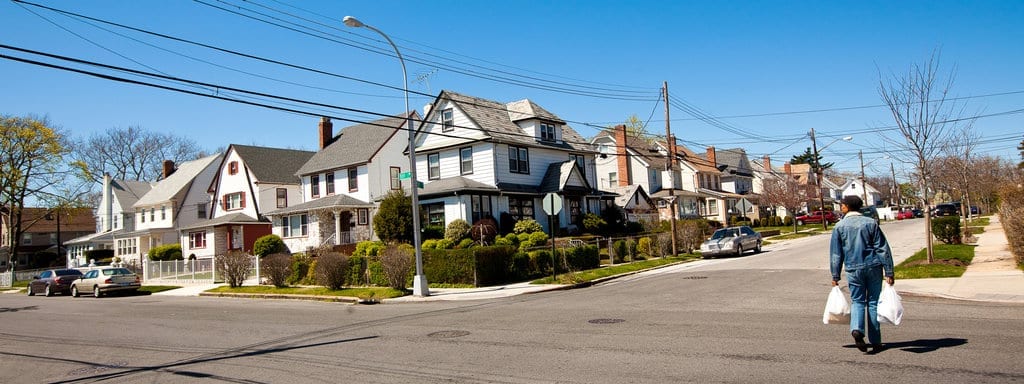
Hollis, Queens
Hollis, Queens had an incredibly powerful impact on Run-DMC, which is why they decided to homage the neighborhood in ‘Christmas in Hollis.’ Joseph Simmons (Run), Darryl McDaniels (DMC), and Jason Mizel (Jam Master Jay) formed Run-DMC in the 1983 after being friends at school for years and realizing they had similar interests in music as they got older. At the time of the group’s formation, Hollis was a moderately stable, suburban community with a vibrant and growing hip-hop scene which inspired and cultivated each member of Run-DMC from an early age. It was a family neighborhood, and the love and support they received helped the group achieve their dreams.
As the group got bigger, the area changed, and the tranquil Hollis soon became plagued with drug and gun violence. By the late 1980’s the neighborhood became one of the most severe victims of the growing crack epidemic. Today Hollis has returned to the median income, middle-class neighborhood it once was, but there have been no sightings of Santa since that fateful day in 1987.
‘Christmas in Hollis’ Lyrics:
It was December 24th on Hollis ave in the dark
When I see a man chilling with his dog in the park
I approached very slowly with my heart full of fear
Looked at his dog, oh my god, an ill reindeer
But then I was illin’ because the man had a beard
And a bag full of goodies, 12 o’clock had neared
So I turned my head a second and the man had gone
But he left his driver’s wallet smack dead on the lawn
I picket the wallet up then I took a pause
Took out the license and it cold said “Santa Claus”
A million dollars in it, cold hundreds of G’s
Enough to buy a boat and matching car with ease
But I’d never steal from Santa, cause that ain’t right
So I’m going home to mail it back to him that night
But when I got home I bugged, cause under the tree
Was a letter from Santa and all the dough was for me
It’s Christmas time in Hollis queens
Mom’s cooking chicken and collard greens
Rice and stuffing, macaroni and cheese
And Santa put gifts under Christmas trees
Decorate the house with lights at night
Snow’s on the ground, snow white so bright
In the fireplace is the yule log
Beneath the mistletoe as we drink egg nog
The rhymes you hear are the rhymes of Darryl’s
But each and every year we bust Christmas carrols
Rhymes so loud and proud you hear it
It’s Christmas time and we got the spirit
Jack Frost chillin, the hawk is out
And that’s what Christmas is all about
The time is now, the place is here
And the whole wide world is filled with cheer
My name’s D.M.C. with the mic in my hand
And I’m chillin’ and coolin’ just like a snowman
So open your eyes, lend us an ear
We want to say Merry Christmas and Happy New Year!
New York State has a rich and extensive history of music. From classic songs you sang in elementary school social studies class about the Erie Canal to Frank Sinatra crooning of the wonders of New York City, countless areas throughout the state have drastically influenced musicians, and left an imprint on their artistic growth. NYS Music’s New York Series is a project dedicated to exploring the history of music created and inspired by the diverse areas of the state. Each week we will focus on a different part of New York, how that area inspired a song or album by artists of various genres, and how the area changed over time. This week we will look at Bob Dylan’s ‘Talkin’ New York’ and Greenwich Village’s influence on his writing of the song, as well as how the area shaped his growing career.
Bob Dylan- ‘Talkin’ New York’
“You sound like a hillbilly; We want folk singers here.”
In the winter of 1961, a 19-year-old University of Minnesota drop out named Robert Zimmerman arrived in New York for the first time in hopes of finding his folk-singer idol, Woody Guthrie. It was the coldest winter in seventeen years, and he did not know a soul. ‘Talkin’ New York,’ the second song on Bob Dylan’s self-titled first album, is a talking blues which narrates the difficulties the young folk-singer experienced when he first moved to the Big Apple. Soon after his arrival, Zimmerman moved to Greenwich Village, changed his name to Bob Dylan, and launched one of the most successful music careers in history. 1
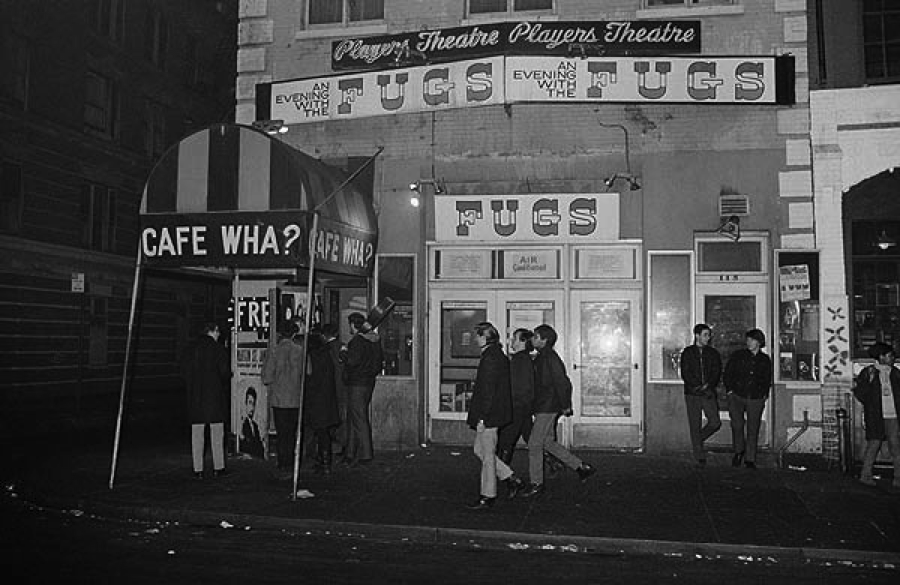
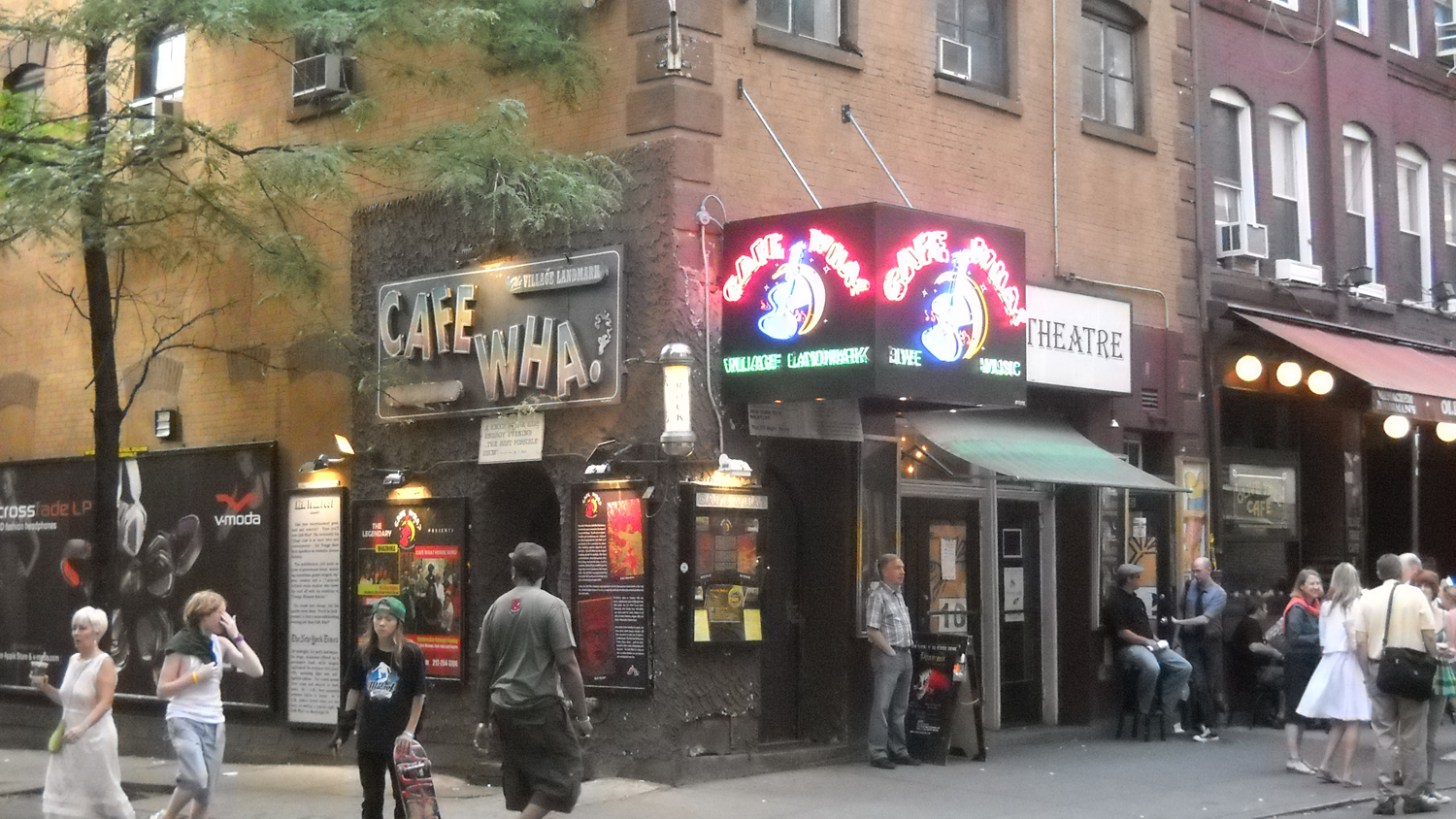
Greenwich Village in the early 1960’s was a hub for artists, poets, musicians and activists to meet, exchange ideas, and grow. When Dylan first arrived, the first thing he did was head over to Café Wha? on Macdougal Street, introduced himself as a musician, and booked himself a gig- as described in the lyrics of ‘Talkin’ New York’. His goal was to immerse himself in the culture, and establish himself as force to be reckoned with in the folk scene. After being fired for being late to three gigs at Café Wha? Dylan jumped around, exploring the many clubs and cafés Greenwich Village had to offer. He played coffee houses such as Caffe Reggio, the Commons, Caffe Dante, and underground clubs like the Gaslight Café, the Fat Black Pussycat, and the Bitter End. 2 New York was the perfect place for Dylan to experiment, meet new people who would greatly influence his career, and develop as an artist. At any point you could walk into a coffee shop and listen to a folk-singer performing, attend a poetry reading, or have an in-depth discussion about direction of the country the with like-minded political activists.
Fred W. McDarrah/Getty Images
‘Talkin’ New York’ chronicles Dylan’s initial experience in New York. It tells the story of his arrival and describes the struggles of trying to make it as a folk-singer in a new town. The area was impoverished at the time, and for the first year Dylan spent most of his time sleeping on floors. He established himself as a vagabond, and his songs began to reflect his lifestyle. After a year he found a place to live relatively cheaply which allowed him to spend more time developing his songs. Because the clubs could not pay performers, Dylan began wearing a hat and passing it around the cafes. The Gaslight Cafe was known for “basket-passing nights” where the only money performers would pocket was what was given to them by audience donations.3
Cafe Wha? 1960’sCafe Wha? Today
Today Greenwich Village is a different neighborhood. NYU has taken over much of the real estate in the area, and the rest has seen a drastic price increase since the 1960’s. It is far too expensive for young aspiring artists to live, but still an area worth visiting often. There are a few relics from the past, and you can go on a walking tour of the sites Dylan and other artists frequented, but today a vagabond could not arrive in the Village and squat in run-down apartments like Dylan did. A few of the old hangouts remain, but they too have evolved with the times. Caffe Dante became Dante NYC, and has moved on from folk-singers to gourmet cuisine. Café Wha? closed in 1968, but reopened in 1987, with music still playing often and the Café Wha? house band headlining many nights. The Bitter End is also still standing, and prides themselves on being New York’s oldest rock club. You can still catch a show any night of the week. While Greenwich Village has changed over the years, there is still a feeling of artistic freedom and counter-culture in many of the bars and coffee shops.
‘Talkin’ New York’ Lyrics:
Rambling out of the wild west
Leaving the towns I love best
Thought I’d seen some ups and down
‘Till I come into New York town
People going down to the ground
Building going up to the sky
Wintertime in New York town
The wind blowing snow around
Walk around with nowhere to go
Somebody could freeze right to the bone
I froze right to the bone
New York Times said it was the coldest winter in seventeen years
I didn’t feel so cold then
I swung on to my old guitar
Grabbed hold of a subway car
And after a rocking, reeling, rolling ride
I landed up on the downtown side
Greenwich Village
I walked down there and ended up
In one of them coffee-houses on the block
Got on the stage to sing and play
Man there said, come back some other day
You sound like a hillbilly
We want folksingers here
Well, I got a harmonica job, begun to play
Blowing my lungs out for a dollar a day
I blowed inside out and upside down
The man there said he loved my sound
He was raving about he loved my sound
Dollar a day’s worth
After weeks and weeks of hanging around
I finally got a job in New York town
In a bigger place, bigger money too
Even joined the union and paid my dues
Now, a very great man once said
That some people rob you with a fountain pen
It don’t take too long to find out
Just what he was talking about
A lot of people don’t have much food on their table
But they got a lot of forks and knives
And they gotta cut something
So one morning when the sun was warm
I rambled out of New York town
Pulled my cap down over my eyes
And heated out for the western skies
So long New York
Howdy, East Orange
At one point in history, the New York City subway system was among the most impressive in the world. These days it resembles what you would imagine a third world country’s subway system would look like, with third string trains donated from cities that upgraded their system years ago and no longer had any use for them, but it still gets you from point A to point B and that’s what matters. Albeit confusing to out of towners, you can hop on a train in midtown Manhattan and get almost anywhere you would like to go in the city.
Photo from Wikimedia Commons Public Domain
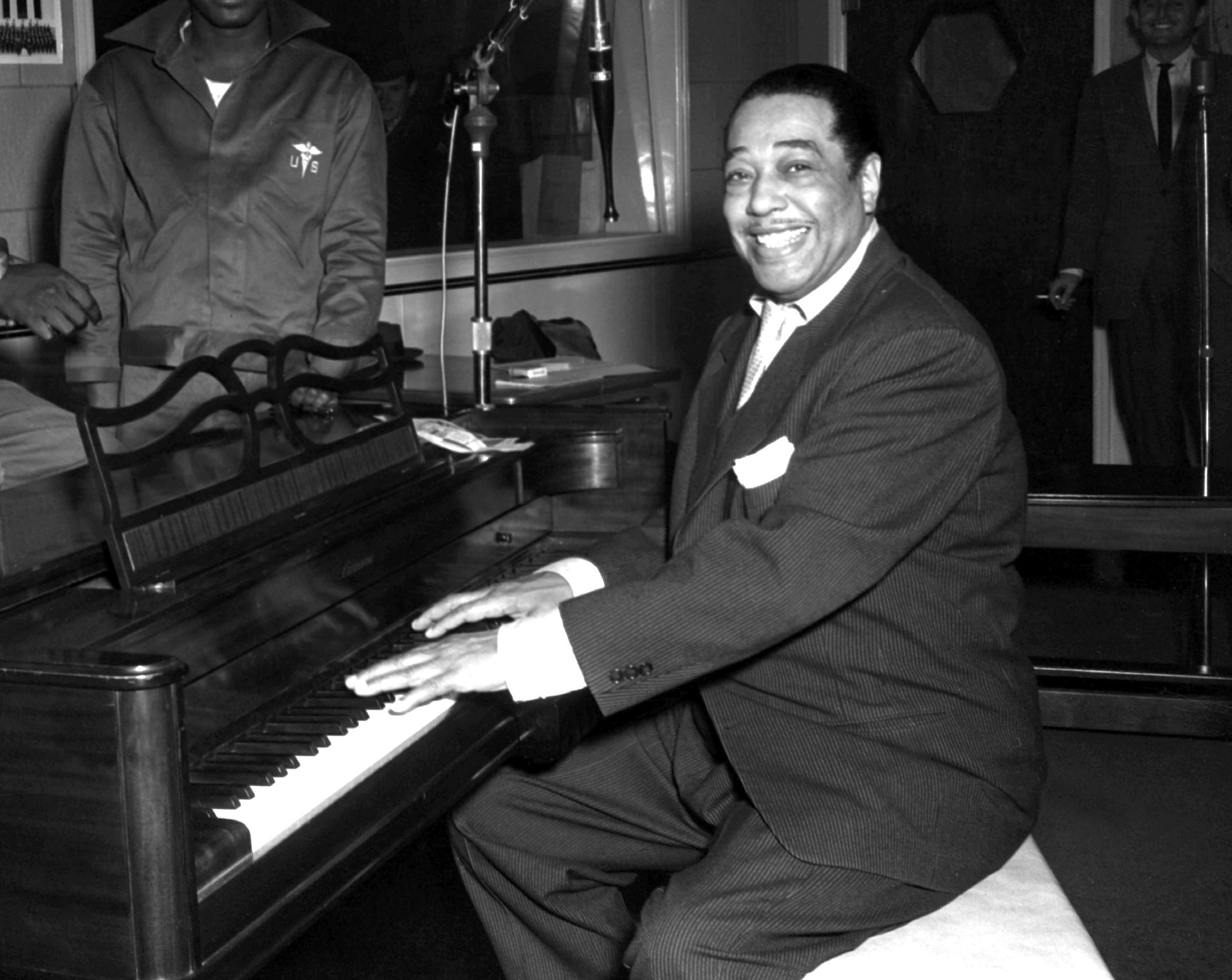
Since it is such an extensive system, those who are completely unfamiliar with New York’s subway system might have a tough time going from borough to borough, and might not even be aware that there are both letter and number trains. However, thanks to Duke Ellington and his infamous 1939 hit “Take the A Train,” almost everyone is aware of at least one line in the NYC subway system, which is more than you can say about almost any other city in the world.
Although popularized by Duke Ellington, “Take the A Train” was written by long-time collaborator and pianist Billy Strayhorn. The swing anthem became the signature piece for Ellington’s orchestra, and was often used as its opening theme and standout song. For most jazz musicians at that time, bandleaders would not put a song they didn’t write themselves in the spotlight like that, however Ellington and Strayhorn’s relationship was atypical. In his biography, Ellington said Strayhorn “was not, as he was often referred to by many, my alter ego. Billy Strayhorn was my right arm, my left arm, and the eyes in the back of my head.”
‘Take the A Train’ was written in Strayhorn’s head while at a party, then put on paper that evening when he got home. The song title was inspired by directions Ellington gave to Strayhorn to get to his house in Sugar Hill, which began with “Take the A Train…,” and the music was influenced by Fletcher Henderson’s style of jazz. Although Ellington’s rendition is instrumental, Ella Fitzgerald released a popular version with the original lyrics Strayhorn wrote about getting to Ellington’s home in Harlem.
Ellington’s home was located in the Sugar Hill neighborhood of Harlem, which is where the Harlem Renaissance took place between the 1920’s and 1950’s. At the time, Sugar Hill was the ritziest, most elegant African-American neighborhood in the United States. It was deemed “Sugar” Hill because of how sweet it was to live there, with the heart of the neighborhood located between 144th and 155th street. The high-class neighborhood was filled with stately homes and luxury apartments, and inhabited by African-American artists, activists, politicians, and intellectuals. The Harlem Renaissance was responsible for allowing African-Americans to focus on their past, as well as develop a unique identity for themselves, thus creating a culture within a culture. It brought people closer to their roots, and allowed them to celebrate who they were while exploring new creative channels to expression, with the Sugar Hill neighborhood as the epicenter of it all. “Take the A Train” became the anthem of this movement, and was highly praised by all of New York.
Today the Sugar Hill neighborhood is still lined with elegant homes and beautiful apartment buildings, with the rich, historic culture dominating the neighborhood. As most areas change over time, there has been a recent slight decline in African-Americans living in Sugar Hill to make room for other cultures, however it is still primarily a black neighborhood. Art and creativity thrives within the neighborhood, and you can still take the “A” train uptown anytime you’d like to soak up the culture and be inspired.
‘Take The A Train’ Lyrics:
You must take the A train
To go to Sugar Hill way up in Harlem
If you miss the A train
You’ll find you missed the quickest way to Harlem
Hurry, get on, now it’s coming
Listen to those rails a-hummingAll aboard, get on the A train
Soon you will be on Sugar Hill in Harlem
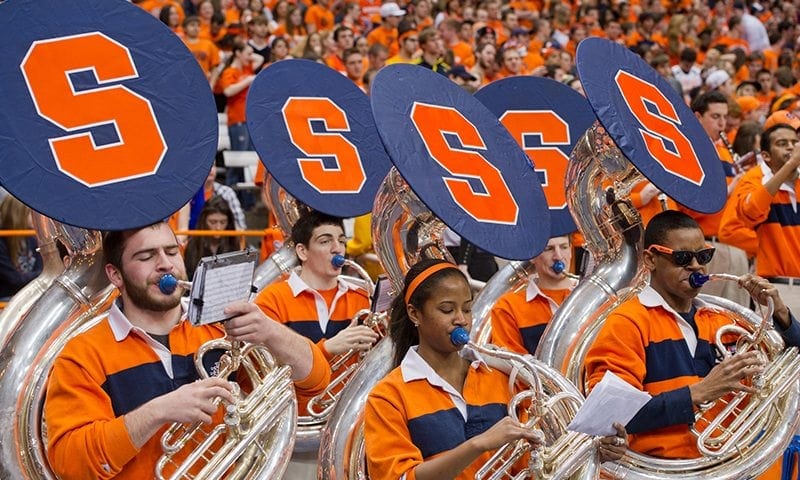
Originally profiled in 2018, we take a look at the Syracuse Fight Song “Down the Field,” its origins and place in Syracuse University history.
The month of March signifies the end of winter, and the hope that Spring brings. It reintroduces the world to sunlight after 6 pm, walking around in a single layer of clothing, and the occasional bunny in your backyard. While some people look forward to eating lamb on Easter Sunday or drinking their weight in green beer on St. Patrick’s Day, there is only one thing on the minds of people from Syracuse during the month of March: Basketball.
The 2018 NCAA Tournament is set to begin, and features Syracuse playing Arizona State in a First Four Midwest Region game at 9:10 pm on March 14 in Dayton, Ohio. There you will hear buzzers buzzing, fans cheering, and the infamous Syracuse fight song ‘Down the Field’ played by the Sour Sitrus Society.
Originally written in 1914 by Ralph Murphy (Class of 1916) and composed by Harold Lewis (Class of 1915), Syracuse University’s fight song has stood the test of time.It’s used as a device to pump up the crowd and draw support for the team, and something every Syracuse University student and alumni has etched in their brains for life.
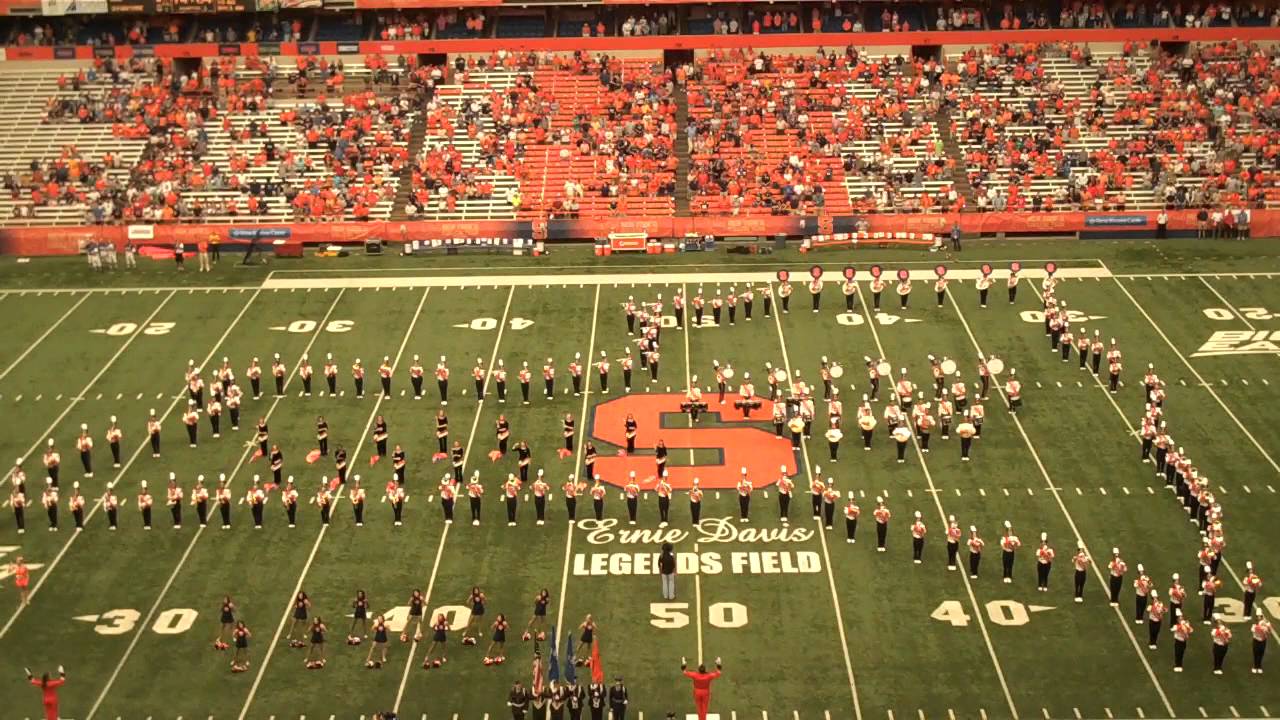
Katie Canete, Drum Major of the Syracuse University Marching Band (SUMB) in 2017, was one of three who conducted/lead the band through every rehearsal and performance. The marching band consists of approximately 200 members, and is one of the oldest collegiate bands in the nation.
“’’Down the Field,’ or better known as Syracuse University’s fight song, is played and sung by the Syracuse University Marching Band at every home football game and Sour Sitrus Society at every home basketball game,” Canete said. “A lot of the fans don’t know all of the words, but the entire crowd always claps along once they hear the tune! It’s infectious!”
The SUMB’s home turf is the Carrier Dome, a domed sports stadium located on Syracuse University’s campus in the University Hill neighborhood. It holds nearly 50,000 people for football games, 35,446 for basketball games, and 56,250 for concerts. Additionally, the SUMB can be see playing local parades and other assorted performances throughout the year. As March Madness begins, you can be sure to hear the Rah! Rah! Rah’s of ‘Down the Field’ when Syracuse scores some big points.
‘Down the Field’ Lyrics
Down, down the field goes old Syracuse, Just see those backs hit the line and go thro’. Down, down the field they go marching, Fighting for the Orange staunch and true.
Rah! Rah! Rah!
Vict’ry’s in sight for old Syracuse, Each loyal son knows she ne’er more will lose, For we’ll fight, yes, we’ll fight, and with all our might For the glory of Syracuse.
This is Part 1 of a series looking at the history of Phish in Albany. Read Part 2 and Part 3 here.
On October 16 and 17, 2018, Phish performed their 16th and 17th shows in Albany, a town that has played host to the band for nearly 30 years. Their long and storied history in New York’s capital dates back to when they were a mere bar band hungry to be heard, and their upward trend of success in their early career can be clearly tracked based on venues they played in the city as the years went on. There are very few cities that Phish still plays where you can track their progression as a band, and get a full snapshot of who they are/were by only listening to shows played in that city.
From the goofy bar band to the machine gun, rockstar days of Trey to cowfunk grooves, you can find almost any kind of Phish by listening to shows they played in Albany, and thankfully for us, that story is far from finished. We take a step back and remember the life-changing shows that took place in the city years before to (somehow) get even more excited for what’s to come.
Pauly’s Hotel, 5/11/1989
The first time Phish came to Albany, they performed to a crowd of 30-40 at Pauly’s Hotel, Albany’s oldest bar, dating back to the Civil War, and served as a home for Union soldiers returning from the conflict. While there is no known setlist for this show, Mike’s notes revealed that his bass was stolen out of the band’s truck (JEMP) at the loadout and never seen again.
Phish fans were few at the time, since this was their first trip to the Capital District from their roots in Burlington, so many in attendance were experiencing Phish simply because they were the band on the bill that night. Pauly’s has a history of music nearly every single night of the week, so you can stop in for a beer and catch a wide variety of musical acts for a small cover charge.
Pauly’s Hotel
Two fans who experienced Phish for the first time this night did so by design, and by accident. John Boeheim of Pawling, NY, was a SUNY Albany student at the time and heard of Phish from a Deadhead friend who went to Union College. Pauly’s was a short walk from his Ontario St. apartment and cover was only $5. John recalls the band playing “You Enjoy Myself” due to the trampolines that were used (likely with minimal effort by Trey and Mike with such a low ceiling above the stage), as well as “La Grange” and “Fee,” because a megaphone was used that night by Trey. There was a lot of banter from the band but no level of anticipation in the building – few, if any, had seen Phish before.
John recently went to Pinks NYC on the Lower East Side of Manhattan for a stream of the shows at Dick’s Sporting Goods park over Labor Day weekend. The experience left an impression on him – “These guys can still draw me to a tiny bar, with people new and unfamiliar, and this is happening at numerous bars around the country. What they are today compared to what they are then, the stream was just a step above couch tour where being 2,000 miles away didn’t damper the enjoyment.”
For John, it was like seeing a bar band, and that first night he may not have written down the setlist but they did have Junta tapes for sale, which he purchased, along with his friend Linda Lawrence, who was also seeing Phish for the first time, but unintentionally.
“I didn’t go to Pauly’s to see them, I went to the bar for beers with a friend who worked at WROW with me in promotions. I was about to drive across the country and live music wasn’t the plan tonight. We sat at the bar and maybe 25-30 people were there, There was crappy weather that night and the rumor was that Mike’s bass was stolen after the show.
“I picked up the Junta cassette from the merch table and I remember them playing “Divided Sky” because they were talking about the Rhombus and I had no idea what that meant. When I listened to Junta, I remembered that part of the show.”
“My first thought influence-wise was that Zappa was an influence of theirs. When Trey talked I thought his voice sounded like Zappa’s and that stuck out in my mind. I got a Zappa feeling about the compositional feel of how they played, and they were weird and goofy. The lyrics were obscure like Mothers of Invention but they were more zany lyrics than Mothers. I liked the jamming parts a lot.”
Palace Theatre, 11/20/1992
After a two year break from New York’s capital, the next time Phish returned their following had grown considerably, affording them to move out of the bars and into theaters. The Palace Theatre opened in 1931 as a “talkie” movie theater which presented vaudeville acts in between pictures. The modern incarnation of the theater opened up in 1989, just a few years before Phish’s first visit, with a capacity of 2,900.
Late into one of their heaviest touring years as a band, Phish came out firing on all cylinders with a high speed “Axilla”, and kept the pace up the entire show with a classic setlist that could have only been played in 1992. The first set highlights include a soaring “Reba,” a then rare extended “Stash” with Linus and Lucy teases, and a playful, unfinished “David Bowie” with a cover of Johnny Cash’s “I Walk the Line” breaking it up and multiple “Ring of Fire” teases tossed in for good measure.
Trey and Mike, Albany 92
The band showcased their compositional abilities in the second set with strong renditions of “Fluffhead,” “You Enjoy Myself,” and “Harry Hood” sprinkled throughout. Following “Hood”, in true early Phish fashion, the band made sure to embarrass Fishman by bringing him front and center with a cover of “Hold Your Head Up” which led to a playful rendition of Syd Barrett’s “Love You.” The band ended the second set with a little help from The Dude of Life who sang “Self,” a song he would record with the band a couple years later. Toss in an acapella “Amazing Grace” and a rocking cover of Led Zeppelin’s “Good Times, Bad Times” and you’ve got yourself a stew.
Mark Durham can recall what the scene was like that night:
“The scene was typical for a Phish show; not too busy outside. There was a parking lot or two that had some folks hanging by the back of their cars, but no “shakedown” yet. It was tiny compared to anything they did later at the Pepsi Arena, but a little busier than the smaller shows. I was still able to walk in the back door showing no ID by saying that I was looking for a friend.”
“The crowd seemed a bit more organic and less frat like. They were still growing, and it seemed that if you didn’t like their music you just didn’t go. That being said, there were still plenty of chompers- just fewer and more spread out.”
“It was just amazing seeing them at the Palace. You know why it’s called that as soon as you walk in. I always felt that Phish played to the venue as well. With their more intricate performances being at places like the theater, and their edgier, harder playing was at the bars. When they got to the palace, they didn’t disappoint.”
Trey mentioned the Dude of Life in Suzy. Stash contained Linus and Lucy teases. Memories and Sweet Adeline were performed without microphones. Trey called Mike “The Man in Black” after I Walk The Line. Bowie was unfinished and included multiple Ring of Fire teases as well as a Jimmy Olsen’s Blues tease from Trey and a Simpsons signal in the intro. Chalk Dust and Tube contained Buried Alive teases from Trey. After Lengthwise, Trey wished a happy birthday to “Curtis” and then briefly teased Curtis Loew. Self (first since November 8, 1991, or 118 shows) featured The Dude of Life on vocals.
Palace Theatre, 5/5/1993
Less than six months after their debut show at the Palace Theatre, Phish returned to the capital district to play two sold out shows that are still highly regarded today. The first of which shares similarities with their 1992 Palace debut in the sense that the first set featured an extended “Stash,” The Dude of Life made a guest appearance, and “Amazing Grace” was performed acapella as an encore, but other than that they sound like a different band.
Mike Jenkins recalled what it was like being a Phish fan at this time, and how it changed:
“The early 90’s shows the relationship between the band and the fan base seemed more intimate. If you look at the ’93 setlist posted all of them have at least 1 song, usually in the 1st encore slot, where they performed acapella without miss. I don’t know if they could pull that off today. Not what they are doing now is better or worse, it’s all about perspective (ie. secret language vs. the woo).”
“Most fans held dear the “best kept secret”, “you don’t know what you’re missing”, and “you get it, or you don’t” vibe. As the band became more polarizing and popularity gained, as expected, the proportion of fans really into the music vs. attendees who wanted to be able to say they went to a show grew. The band and the legitimate fan base grew > grew apart > back together again > It’s all over > Holy Sh!t is this really happening > Growing pains > They’re Baaaaack!!! Personally, I am grateful for the 25+ year relationship I’ve had with this band and it’s fan base. It’s been the primary soundtrack of my life.”
Other than an explosive “Stash” the first set of 5/5/93 is relatively standard, though many of the songs performed were off their new album Rift, and thus never heard by many in attendance. Although the set was not out of the ordinary for 1993 standards each song was well-played with extra energy, and featured some interesting setlist calls, such as the “It’s Ice > Glide > Maze” before ending the set on a fiery “Golgi Apparatus.”
The second set is where things begin to get real interesting, real fast. It opens with an incredible segue fest of “Runaway Jim -> My Friend, My Friend -> Manteca -> My Friend, My Friend” which showcases the band’s ability to weave in and out of songs at will. They took no time to slow down with joyful renditions of “Poor Heart” and “Weigh” before giving the audience a chance to join in with “Big Ball Jam.”
If there was anything people would vividly remember from this run however, it’s the “You Enjoy Myself -> Jam” that closes the set. The stage was lined with musicians as The Dude of Life and the Aquarium Rescue Unit (at least Apt. Q-258 aka Jeff Sipe on drums, Oteil Burbridge on bass and vocals, and Jimmy Herring on guitar) took the stage for a bombardment of sound that just keeps giving and giving. After an acapella “Amazing Grace” in the first slot of the encore the band wasn’t finished messing around as they tossed the jazz classic “Take the A Train” square in the middle of a raging “Cavern.”
Tom Gazda recalled his experience at the show:
“5/5/93 was my second Phish show. During this time frame the band was playing a lot of Rift at shows and that was great for someone new to the band. With this being only my second Phish show, the whole “Big Ball Jam” had me like, “What the hell is this?” in the most positive sense. This seemed so far out the realm of what a rock band typically did. The YEM had a whole mess of additional people join them on stage (who I later learned was ARU and the Dude of Life). I got the sense I was supposed to know who they were, though I didn’t. I remember this going on forever and I actually found it to be slightly boring after a while.”
Phish – Palace Theatre – May 5, 1993
Set 1: Rift, Guelah Papyrus, Foam, Sparkle, Stash, Bouncing Around th Room, It’s Ice > Glide > Maze, Golgi Apparatus
Encore: Amazing Grace[4], Cavern > Take the ‘A’ Train > Cavern
It’s “Ice” contained a tease of “Pop Goes the Weasel” from Page and “Maze” contained Mission: Impossible theme teases from Page. The beginning of “My Friend” featured Trey on acoustic guitar. Trey dedicated “Ya Mar” to Sue on her birthday. “Ya Mar” subsequently included a “Two Princes” tease. YEM contained a “La Marseillaise” tease from Page and “Yield Not to Temptation” teases, did not contain a vocal jam, and was unfinished. The jam after YEM featured “The Aquarium Rescue Unit,” “the Dude of Life,” and Fish on vacuum. Amazing Grace was performed without microphones. The soundcheck’s Funky Bitch Blues contained a Funk #49 tease.
Palace Theatre, 5/6/1993
After wowing the crowd night one, Phish returned to the Palace for a second night where they did just as much damage to the historic building. They came out swinging with a hot “Chalkdust Torture” featuring “Lazy” by Deep Purple teases, a building “Mound” and dissonant “Split Open and Melt” to get the crowd amped. They continued the set with a handful of 1993 standards then broke away from the norm with a secret language filled “Possum” before welcoming up violinist Dick Solberg for an anything but standard “Lawn Boy.” The fun continued as they invited Jeff Walton to sing and play guitar with them as they closed the set as a sextet in true bluegrass fashion with “Why You Been Gone So Long,” “Tennessee Waltz,” and “I Been to Georgia on a Fast Train.”
Albany 93 Palace Theater
The second set opened with an energetic “Suzy Greenburg” followed by a must-hear version of “Tweezer.” The melodic hose jamming in “Tweezer” is what dreams are made from as they jammed on Aerosmith’s “Sweet Emotion” and The Dude of Life’s “Crimes of the Mind” before settling down to a relatively “Tela.” If the “Tweezer” didn’t do it for you, then the “Mikes Song” that follows should do the trick as the band morphs into a jam out of The Beatle’s “Ob-La-Di, Ob-La-Da” with Dick Solberg reentering the stage before a clean segue back down south with “Rocky Top.”
Thomas King recalled what it was like being in attendance for the jam:
“One of my most memorable concert experiences is the -> from Mike’s to Ob-La-Di.I was fourth row in front of Mike, locked in on Trey…until Trey started vanishing. Then the people in front of me started vanishing. The smoke machines were billowing like Mt St Helens, but the sound was so clear. I could barely see my friends next to me- and then, the strobe lights!! During that -> I felt an ecstatic combination of utter freedom with a healthy dose of disorientation. I felt like anything could happen, and the band could do everything they wanted.”
It wouldn’t be right to go an entire run without Fishman taking the spotlight following a classic “Hold Your Head Up” moment. He dedicated “Crackling Rosie” to Neil, who was on tour, before the band concluded the set with Jeff Walton joining them for a unique version of “That’s Alright Mama.” They concluded the run with an acapella “Sweet Adeline” followed by “Contact>Tweezer Reprise” to remind everyone that despite all the fun, they could still rock.
Tom Gazda vividly remembered his experience from the night:
“5/6/93 was an amazing experience for me. The secret language in Possum was very intriguing. I really liked when Dick Solberg and Jeff Walton came out, and the songs they sang. It was as if the show I was seeing was briefly interrupted by a very different, yet also very cool bluegrass/old time country concert. The Big Ball jam, again, was very cool to be a part of as we were on the floor. I remember Page’s ending solo in Squirming Coil really floored me; I couldn’t believe how good it was.”
“But the highlight of the night was the “Ob-La-Di,-Ob-La-Da” during Mike’s. I remember it to this day. They were jamming hard in Mike’s and they were bouncing on the trampolines. Then the smoke machines kicked out the thickest roomful of smoke I’ve ever experienced and then the strobe lights turned on. We were dancing hard in the aisle, about 25 rows back on Mike’s side, jumping up and down along with the band and freaking out to effect the strobe lights created in the smoke that had engulfed us by this point. Then Trey started playing “Ob-La-Di,-Ob-La-Da” and it was nothing sort of magical, one of those moments when time sort of slows down and you get that weird sense of your body being half-numb. 25 years and 70-something shows later, and it remains one of my top Phish experiences, and really, one of my top life experiences. I love thinking about it.”
“Then Fishman came out and playing the hand crash cymbals, lead the crowd on a sing-along of Crackin Rosie, another thing that was so far from what I’ve ever experienced a rock band do. “Why the hell doesn’t every band do shit like this, it’s fun as hell!!!” As an encore they played an unamplified barbershop version of Sweet Adeline, yet another part of this show that was so unique (and cool). I walked out of the show in a state of a punch-drunk euphoria only to end up on the sidewalk next to the theater, between the building and band bus. I saw Page walking out and got to shake his hand and awkwardly told him “Loved the end of Squirming Coil” as only a stoned-out college kid could. We spoke with Jeff Walton for a while who was drinking a beer on the sidewalk and who seemed a bit punch drunk from the experience as well. Then we hung out with Mike a bit, shook his hand and got to hear him explain to a bass-playing girl some of the tricks on how to play the bassline to Split Open and Melt (he admitted it was Trey who wrote the bassline). As walked back to the car I remember me and my buddy Al seriously kicking around the possibility of us driving to New Hampshire for the show that Saturday night (the legendary 5/8/93 show). Listening to this show when it was released as part of the LivePhish series, I strongly regret not going to this show.”
“One the things that really struck me about this band Phish that I couldn’t get over was how different their shows were from the shows I’ve grown used to seeing. Growing up in Queens and having pretty permissive parents, I got to see a lot of arena shows, mostly at MSG and Nassau Coliseum (Shit, the second show I ever saw was the mind-bending 1987 Pink Floyd show at MSG as a wide-eyed 16 year old.) Walking into Phish I was accustomed to what a typical large scale rock concert was like. So, I was quite taken by all the stuff Phish did that was different than that – the trampolines, never-the-same-setlist, next-level lighting that worked so amazing with the music being played, the big ball jams, the non-amplified acapella songs, 2 sets, the secret language, meeting the band outside the gig, the idea that any song can go anywhere on any given night, etc. And while the music was such high energy and reached out and grabbed me like nothing else had before, I also really loved that they punctuated it with elements that was designed to be straight-up FUN.”
Phish – Palace Theatre – May 6, 1993
Set 1: Chalk Dust Torture, Mound, Split Open and Melt, The Horse[1] > Silent in the Morning > All Things Reconsidered >Llama, Fluffhead, Possum[2], Lawn Boy[3], Why You Been Gone So Long?[4], Tennessee Waltz[5], I Been to Georgia on a Fast Train[5]
Set 2: Suzy Greenberg > Tweezer, Tela > Uncle Pen, Big Ball Jam, The Squirming Coil, Mike’s Song -> Ob-La-Di, Ob-La-Da Jam -> Rocky Top[3], Hold Your Head Up[3] > Cracklin’ Rosie[3] > Hold Your Head Up[3], That’s Alright Mama[5]
Chalk Dust Torture contained Lazy (Deep Purple) teases from Trey. The Horse featured Trey on acoustic guitar. Possum contained Simpsons, Key Change, and All Fall Down signals. Why You Been Gone So Long, Tennessee Waltz, I Been To Georgia On A Fast Train and That’s Alright Mama were all Phish debuts. Lawn Boy, Why You Been Gone So Long, Rocky Top, both HYHUs, and Cracklin’ Rosie featured Dick Solberg on violin. Tennessee Waltz, I Been To Georgia On A Fast Train, and That’s Alright Mama featured Solberg on violin and Jeff Walton on acoustic guitar. Why You Been Gone So Long also featured Walton on vocals. Tweezer included a Sweet Emotion tease and a jam on Crimes of the Mind. Mike’s Song contained Cheap Sunglasses teases. Rosie was “dedicated to Neil, who’s on tour now!” Sweet Adeline was performed without microphones.
Knickerbocker Arena, 12/9/1995
Following a year away from New York’s capital, Phish returned in the winter of 1995 to deliver one of the most memorable jams of their career. Far too big to play the Palace again, they relocated to the Knickerbocker Arena (now the Times Union Center) where they played a sold out show to more than 17,000 fans (quite the leap from the 2,900 person venue across town.) The show took place during a full-blown blizzard, causing many fans to either not make it or have issues getting in and out, but stories to last a lifetime.
The first set began with a thrilling “Maze” followed by the new favorite “Theme From the Bottom.” Overall the set does not stand out much in the grand scheme of December 1995, but the entire set was played with restlessness and vigor. Filled with fresh songs from 1995 such as “Free” and “Billy Breathes,” the band used the set as an opportunity to show their growth in songwriting from their last Albany visit and fire up the crowd.
Like all shows during the 1995 Fall Tour, the second set began with an audience chess move (chosen by Antelope Greg Phelps) which continued the tour long game of chess between the band and the audience. “Timber (Jerry The Mule)” opened the set with a sick, demented jam that is often largely forgotten in the grand scheme of things, but absolutely worth checking out. “Wilson” follows next and Trey has fun with the Gamehendge standard by incorporating the soundbites of a Beavis and Butthead doll during the intro. A short, funky “Gumbo” follows before the band embarks on arguably the jam of the year in “You Enjoy Myself.” Anyone who is at all interested in Phish and hasn’t heard this jam needs to check it out immediately as this soaring, 34 minute masterpiece epitomizes the machine-gun sound Trey has perfected in 1995 before transitioning to a delicate and hilarious “silent jam” with Shaft quotes and a vocal jam featuring the Beavis and Butthead dolls once again.
After playing one of the most insane jams of their career, why wouldn’t the band take a break with the Page-led lounge classic “Lawn Boy?” “Slave to the Traffic Light > Crossroads, Sweet Adeline” ends the set with a defiant force that only 1995 Phish can produce. They victory lap with a then uncommon “Loving Cup” and send the crowd back into the blizzard with their minds lost somewhere in the storm clouds above.
12/9/95 was Vincent Alfonsi’s second show, and recalls it well. When asked about his experience he had this to say:
“12-9-95 was my 2nd show; epic YEM with Silent Jam. I already had a long history of great times at the Knick with the Dead. At the time I lived in Malta (just south of SPAC) during the week and West Hartford, CT on the weekend. Work was in Albany, but my friends were all still in CT so that’s where I went to party. As a result, the day of the show I was driving back up to Albany with 2 of my friends from West Hartford; one being my oldest friend of all. It should have been a 1:45 minute ride, but it took almost 5 hours to get there on account of the blizzard and all.”
“We Got there just in time for a slice of pizza before entering the show, and sat in the 200’s behind Fishman. The section was half empty, and very chill. Because of the blizzard we had rows to ourselves. I was enough of a noob to not recognize many songs that were standards, but the jams certainly weren’t lost on me. I was just making the transition from Jerry to Trey at the time. I’ve always felt if the entire crowd has to make extra effort, like standing in the rain or driving through snow, the band puts a little extra into it themselves, and they did. They played great. The Silent Jam was one of the funniest spur of the moment things I’ve ever seen at a show, and I left knowing that I was indeed a Phish fan. That show locked it in, and essentially cost me thousands of dollars in future ticket, webcast, CD, gear and download purchases.”
Adam E. was also in attendance and had this to say about his hazy experience:
“I am from Clifton Park, NY and had been going to the Knick for various shows since 1991. 12/9/95 was my 14th Phish show overall but first time in my “hometown” venue. Since then I’ve seen Phish at the Knick/Pepsi 8 times and it’s still one of my favorite places to see them. Having only seen Phish 4 times in Summer 95 I was excited for the three fall tour shows I had tickets for (Albany, Lake Placid x2). I was an undergrad in Plattsburgh at the time and my buddies and I drove down to Albany the day of the show. The pre-show scene in Albany is always pretty raucous and that day was no exception. It was cold/snowy and I recall the McDonalds on the corner of Madison and S. Pearl was overrun with the Phish crowd. It was a festive, friendly scene all around. The show itself was fantastic, lots of energy. Interestingly, the only vivid memories I have from inside the venue are the Beavis and Butthead doll quotes during Wilson, and the YEM silent jam. Otherwise I recall walking out of there on a cloud, knowing it was a good show.”
Phish – Knickerbocker Arena – December 9, 1995
Set 1: Maze, Theme From the Bottom > NICU > The Sloth > Rift, Bouncing Around the Room, Free, Billy Breathes, Dog Faced Boy, Chalk Dust Torture
Set 2: Timber (Jerry The Mule), Wilson[1] > Gumbo, You Enjoy Myself[2], Lawn Boy, Slave to the Traffic Light > Crossroads, Sweet Adeline
Encore: Loving Cup
Wilson and the YEM vocal jam featured quotes from a talking Beavis and Butthead doll. YEM also included a silent jam and a quote of the theme from Shaft.




 The first set began with a thrilling “Maze” followed by the new favorite “Theme From the Bottom.” Overall the set does not stand out much in the grand scheme of December 1995, but the entire set was played with restlessness and vigor. Filled with fresh songs from 1995 such as “Free” and “Billy Breathes,” the band used the set as an opportunity to show their growth in songwriting from their last Albany visit and fire up the crowd.
 12/9/95 was Vincent Alfonsi’s second show, and recalls it well. When asked about his experience he had this to say:
 Adam E. was also in attendance and had this to say about his hazy experience: