Author: Nicholas Sarris

  • A Guide to New York’s Music Halls of Fame

    New York holds a special place in the history of music, spawning countless superstar artists and musical movements. It is no wonder then, that New York has a host of institutions meant to celebrate its important relationship to music. Across New York State, there are a number of Music Halls of Fame, many of which celebrate the musical heritage of their region. Others instead celebrate entire genres that originated in New York. Let’s explore New York’s Music Halls of Fame, their histories, and what they contain.

    A Map of Music Hall of Fame Locations in New York
    Locations of New York State’s Music Halls of Fame

    New York City Metro

    Long Island Music and Entertainment Hall of Fame

    The Long Island Music Hall of Fame (LIMEHOF) is an organization aiming to preserve and celebrate Long Island’s musical heritage. Inspired by this emergence of Long Island, music historian Norm Prusslin and Rich L Hommedieu founded the Hall in 2004. They were quickly joined by Jim Faith and others. LIMEHOF inducts artists, producers, venues, and radio stars from Suffolk, Nassau, Queens, and Kings counties. Located in Stony Brook, the hall of fame occupies an 8,800 square foot building, which also contains a museum dedicated to Long Island Music History. The museum houses instruments, memorabilia, and awards won by some of its inductees.

    Exterior of the Long Island Music Hall of Fame
    The exterior of the Long Island Music Hall of Fame

    Starting in the 1970s, Long Island slowly began to emerge as a hub of music. Local bands like Zebra and Twisted Sister slowly began to conquer rock radio airwaves in the 1980s. Soon, by the early 2000s, Long Island had become home to its own music festivals, such as the Great South Bay and Long Island Bluegrass festivals. As Billy Joel said in his induction to the hall of fame, “people began to recognize that the ‘Long Island Sound’ wasn’t just a body of water.” Inspired by this emergence of Long Island, music historian Norm Prusslin co-founded the hall of fame in 2004 with Rich L. Hommedieu.

    Since its founding, the hall of fame has inducted over 120 figures, who originated or lived on Long Island. Genre pioneers like punk-rockers the Ramones, and hip-hop legends Run-DMC were among the first inductees. The hall of fame also recognizes nationally-known stars, like Billy Joel, Paul Simon, and Louis Armstrong for their success and influence. Induction, however is not just limited to artists, with execs, producers, and important venues also having spots in the hall of fame.

    Lobby of the Long Island Music Hall of Fame
    The lobby of the hall of fame museum

    The hall of fame is also involved in music education, and community involvement. The museum facilities host a theater that showcases local artists, film screenings and music workshops. In addition to inductions, the hall of fame also awards the Harry Chapin award to artists and organizations dedicated to humanitarian causes on Long Island. Past inductees have included Steven Van Zandt, and the Long Island Cares food bank. The organization also awards annual high school scholarships, and recognitions for Long Island high school orchestras.

    Hip Hop Hall of Fame

    The Hip Hop Hall of Fame is an organization founded in 1992 that is dedicated to the preservation of hip hop as a cultural art. The organization specifically recognizes hip hop’s role in promoting socio-economic empowerment and urban development. In addition to recognizing artists instrumental in hip hop’s foundation, the organization places a special emphasis on community involvement through charity, and education.

    A photo of the inaugural inductees in 1995, with Hip Hop Legends Grandmaster Caz, Mr. Magic, Founder JT Thompson, Kool DJ Red Alert and Ez AD

    New York holds a key place in the development of hip hop as a genre. Hip Hop was born in the Bronx, with many citing its origins in an August 11, 1973 party held by DJ Kool Herc. His use of two turntables to play extended instrumental funk breaks shaped the sound that would become the basis for hip hop. Since its birth, New York has spawned countless superstars, including Notorious B.I.G., Nas, and Jay Z. It is no wonder why the Hip Hop Hall of Fame is based out of New York City.

    The hall of fame’s inaugural induction ceremony was held at Sylvia’s restaurant in Harlem in 1995. Since then, BET has nationally broadcast annual induction ceremony and concert every November to celebrate Hip Hop History Month. Inductees include rappers, DJs, b-boys, and producers. The organization currently has no physical location, but that will soon change. The Hip Hop Hall of Fame is constructing a massive complex in the heart of Manhattan. The entertainment complex will host the hall of fame, museum, a hotel, and stores for visitors. The hall of fame museum will contain memorabilia, and interactive exhibits for each of its inductees. The physical facilities are expected to be completed in late 2026 to early 2027.

    A digital rendering of the museum’s planned exhibits

    The hall of fame holds community involvement and education as a key tenet of its mission. As a result, it offers a host of scholarships, grants, and music industry mentoring programs for inner-city youth. In addition, the organization invests in efforts to register voters, empower local businesses, and provide job training. This is all part of the organization’s belief that hip hop culture can be a positive influence in fixing many of the problems that plague the inner-city.

    Brooklyn Jazz Hall of Fame and Museum

    The Central Brooklyn Jazz Consortium founded the Brooklyn Jazz Hall of Fame in 1999. Its goal is to recognize musicians who had an impact on the cultural landscape of Brooklyn through both musicianship and community involvement. This hall of fame places specific focus on artists whose work has been overlook in comparison to other commercially successful jazz musicians.

    The hall of fame’s origins can be traced to the Central Brooklyn Jazz Consortium, an alliance of venues, community organizations, and musicians. The Consortium places special emphasis on the preservation of jazz as a piece of Brooklyn’s culture, using activism and education to aid in this mission. Specifically, the consortium works to ensure there are accessible, and affordable music shows and programs for Brooklyn’s underserved communities. As part of this mission, the Consortium hosts an annual Brooklyn Jazz Festival.

    The Consortium’s Jazz Hall of Fame is currently an online entity. Its creators however hope that it can one day have a physical location. The envisioned location would contain interactive displays, educational facilities and a performance center. The hall of fames inductees include singers, instrumentalists, composers, and bandleaders. Some notable inductees are Lena Horne, Freddie Hubbard, and Max Roach.

    The Brooklyn Jazz Hall of Fame presenting an award to flautist Herbie Mann

    The Hall of Fame is also dedicated to giving back to the community, and promoting jazz to youth. As a result, they award the annual Deacon Leroy Apple Young Lion Award. The hall of fame presents this award to a young Brooklyn musician with exceptional jazz skills.

    American Theater Hall of Fame

    The American Theater Hall of Fame is the only organization that recognizes lifetime achievement in American theater productions. Earl Blackwell, James M. Nederlander, Gerard Oestreicher and L. Arnold Weissberger founded the hall of fame in 1970 in Manhattan. The organization’s mission is honor the past history of theater, celebrate present productions, and encourage future involvement in the arts.

    The hall of fame is located in the Gershwin Theatre in the heart of Broadway. It takes the form of large gold lettering embossed on the walls of the theater’s entrance. The Gershwin Theatre also houses a small museum dedicated to hall of fame inductees. The second floor lobby houses 22 exhibition cases displaying memorabilia from past inductees. Individual donations, and ticket sales from the theater fund the hall of fame’s memorial and events.

    Since its first induction ceremony in 1972, the hall of fame has honored hundreds of performers, composers, and directors. To be eligible for induction, someone must have performed for over 25 years, and have at least 5 Broadway credits. Each year, a committee of 275 critics and hall of fame members votes on candidates, inducting the top 8. In terms of musicians, the hall of fame has inducted famous composers and conductors such as George Gershwin, and Leonard Bernstein.

    The hall of fame hosts an annual induction ceremony and Gala at the Gershwin Theatre each January. Leaders of the Broadway industry frequently attend the ceremony. Each year’s induction ceremony is videotaped and stored at the New York Public Library for Performing Arts at Lincoln Center.

    Bronx Walk of Fame

    Bronx Borough President Fernando Ferrer founded The Bronx Walk of Fame to honor the achievements the Bronx’s residents. The Walk of Fame came as part of a larger plan to uplift the spirits of the borough’s residents, and improve the external image of the Bronx. Today, the Walk of Fame takes the form of a 23 block long corridor along the Bronx’s Grand Concourse. Along the concourse, street signs celebrate celebrities who were born or lived in the Bronx.

    An aerial view of the Bronx’s Grand Concourse – home to the Walk of Fame

    The bright yellow street signs along the Walk of Fame celebrate not only honorees, but the borough as a whole. One side displays an image of the Bronx County Courthouse, the center of government for the borough. The other illustrates art deco storefronts, hinting at the vibrancy of commerce in the community. Since the Covid-19 pandemic, the signs were redesigned, placing a larger emphasis on the inductees name, removing the building illustrations.

    Each year, the Bronx Borough President, Tourism Council, and Overall Economic Development Corporation vet a series of candidates, before selecting inductees. There is an unveiling ceremony at the County Courthouse, where the signs are displayed for one year, before relocation to the Grand Concourse. The annual Bronx Ball celebration also honors Walk of Fame inductees.

    The Walk of fame includes a number of musicians, spanning many genres and decades. Hinting to the Bronx’s importance to hip hop’s birth, a number of rappers, like Slick Rick and Kurtis Blow have signs along the concourse. Additionally, the Walk of Fame also honors the smooth voices of Luther Vandross, Bobby Darin, and Jerry Vale. The Bronx has historically been a hub for Latin music in the US, so many musical inductees have roots in this genre. Willie Colon, Johnny Pacheco, and Joseito Mateo are just a few salsa and merengue musicians honored on the Walk of Fame.

    Ertegun Jazz Hall of Fame

    The Ertegun Jazz Hall of fame is an organization dedicated to honoring luminary minds of Jazz. The hall’s name comes from Atlantic Records co-founder Nesuhi Ertegun, whose label released many seminal jazz records. Jazz at Lincoln Center founded the hall of fame in 2004 to celebrate the definitive artists that have shaped jazz.

    “The Ertegun Jazz Hall of Fame will provide a center where the lives and the artistry of the greatest jazz musicians will be celebrated, and where people will come to learn about jazz, something to which my brother devoted his life’s work”

    – Ahmet Ertegün

    Today, Lincoln Center’s Frederick P. Rose Hall houses the interactive hall of fame. The hall includes a 14-foot video wall, interactive kiosks, and touch-activated virtual plaques. In addition, the hall’s architecture itself is a celebration of jazz instrumentation. The facilities make use of cork, wood, and brass, that are key materials of jazz instruments.

    A 60 person panel, including artists, and scholars from 17 different countries works to select inductees. The inaugural 2004 induction included legends like Miles Davis, Jelly Roll Morton, Louis Armstrong, and 11 others. Jazz legends, including Herbie Hancock presented awards to inductees’ family members and friends.

    A Display of Hall of Fame inductees in the Frederick P Rose Hall

    Capital Region

    Eddies Music Hall of Fame

    The Thomas Edison Music Hall of Fame, colloquially known as the Eddies Hall of Fame began in 2019. The mission of the hall of fame is to celebrate individuals from the Capital Region who have made a significant impact on the music industry. Their contributions can be national or local, drawing a great diversity of inductees.

    The unveiling of the Eddies Music Hall of Fame
    The Eddies Music Hall of Fame unveiling ceremony

    Jim Murphy and Sal Prizio created the Eddies in 2018 as part of Proctor’s Collaborative. The collaborative is a collection of Capital Region theaters, music schools, and other organizations to push music education and economic development in the area. Each year, the organization hosts the Eddies Awards to recognize musicians of the Capital Region, and induct hall of fame members. The first ceremony was held at Schenectady’s Proctors Theatre, and saw 1,250 attendees.

    Since its establishment, the Eddies Hall of Fame has taken physical shape in Saratoga Springs’ Universal Preservation Hall. The venue houses a wall of plaques honoring each inductee, with a screen of rotating videos telling their life stories.

    Exterior of Saratoga Springs’s Universal Preservation hall

    The hall of fame celebrates not only musicians, but also songwriters, producers, journalists and execs who have impacted the industry. To be eligible for induction, candidates must have spent part of their lives in the Capital Region, and had a music career longer than 20 years. The inaugural class of 2019 only had two inductees: Celtic star Kevin McKrell, and folk singer Ruth Pelham. Since 2019, the hall of fame has expanded to include 40 inductees.

    Dance Hall of Fame

    Marylou and Cornelius Vanderbilt Whitney founded the National Museum of Dance and Hall of Fame in 1986. The organization’s mission is to cultivate appreciation of musical arts, especially dance, in the larger community. The hall of fame additionally partners with the Saratoga Performing Arts Center (SPAC) to aid in arts education.

    A restored bathhouse in Saratoga Spa State Park houses the hall of fame and museum. The museum contains memorabilia from some of the most famous dance artists of all time. Photographs, videos, personal artifacts, and costumes are just some of the objects displayed. Additionally, the hall of fame takes the form of golden plaques with the images and biographies of inducted embossed onto them.

    From 1987-2019 the hall of fame annually inducted members who left a lasting impact on the dance industry. This has included many musicians, including singers, and composers. 2009 saw the induction of the King of Pop Michael Jackson for his chart-topping dance songs, and choreography. In addition, classical ballet composers such as Igor Stravinsky hold a place in the hall of fame.

    The future of the Dance Hall of Fame has been uncertain since the Covid-19 pandemic. The museum remains temporarily closed since 2020, being taken over by SPAC in the meantime. SPAC and museum board member Anthony Ianniello has said that SPAC is working to reopen the museum to the public, with more information being available soon.

    Central New York

    NYS Country Hall of Fame

    Cortland’s Country Music Park & Campground hosts the NYS Country Hall of Fame. Local musician Merlin Reynolds envisioned a hall of fame to recognize the Western artists of New York. In 1984, Reynolds with the help of Loretta and Dr. John Eckel purchased the current property to create the hall of fame.

    Exterior of the NYS Country Music Hall of Fame
    The Country Music Hall of Fame’s Opry Barn

    Located directly off NY-13, the property’s A-frame house hosts the hall of fame. The property contains a hall of fame, and hall of honor, which takes the form of commemorative plaques on the building’s walls. In addition, the property hosts a museum dedicated to country artists from Nashville and New York. The museum has memorabilia, instruments, and costumes from legends like Willie Nelson, and Tammy Wynette. Hall of fame and museum admission is $3 per person, with admission by appointment only.

    In addition to the museum, the hall of fame hosts a vast campground for visitors. The campgrounds have guests lodgings, bbq pits, horseshoe courts, and a performance space. The performance hall, called the Opry Barn, has a 150 sq foot stage, hardwood dance floor, and kitchen for visitors. It is also home to the annual hall of fame induction ceremony.

    A wall from the NYS Country Music Hall of Fame
    One wall of the Hall of Fame, featuring plaques and memorabilia

    Induction into the NYS country hall of fame first requires induction into the organization’s hall of honor. Honorees must have been born or lived in New York, and performed country music for over 10 years. Each year, 3 members of the hall of honor are elevated into the hall of fame at the annual induction dinner dance. In addition, the organization’s lifetime achievement and horizon awards are presented at this event. This ceremony takes place the last Sunday of October. Since its inception, the hall of fame and hall of honor have inducted over 200 musicians.

    SAMMY Hall of Fame

    Since 1993, The SAMMYS awards have celebrated the music scene of Syracuse and Central New York. Since its inception, the awards have included an annual induction into the SAMMYS hall of fame.

    Carolyn Kelly’s induction into the SAMMYS Hall of Fame in 2023

    The first SAMMYS Hall of Fame induction took place at Syracuse’s Landmark Theatre in 1993. Since its founding, the annual ceremony has become the largest music event in Syracuse, drawings hundreds of musicians and guests each year. The hall of fame currently has no physical location, and takes the form of this honor at the annual awards. In addition to awards, the ceremony features live performances from local artists and honorees.

    The hall of fame recognizes musical artists and organizations from Syracuse who have left a lasting impact on the music industry. Since its start in 1993, the hall of fame has inducted over 100 artists, venues, and publications. The first artist inducted was jazz trombonist Spiegle Wilcox in 1993. In addition, the SAMMYS also recognizes a select few with lifetime achievement awards. Lifetime achievement honorees include legends like Lou Reed, and Ronnie James Dio.

    Oswego Music Hall of Fame

    Nancy Spereno and the Oswego Harbofest board established the Oswego Music Hall of Fame in 1990. In the words of the organization, they honor artists “who have kept Oswego dancing, singing, and smiling for years.” Following the 1990 awards, the Hall of Fame went on hiatus until its revival in 2015. For the past nine years, the hall of fame has honored local artists at its annual induction ceremony.

    A performance at the 2018 Oswego Music Hall of Fame induction

    The hall of fame’s inaugural induction honored Joseph Spereno, Charlie Davis, Dick Workmen, Jimmy Gannon and Dick Fellows. These men were recognized for laying the groundwork of Oswego’s music scene, as well as their dedication to the community. Then Mayor John T. Sullivan also presented them with keys to the city at the 1990 Harborfest celebration. Following a 15 year hiatus, the hall of fame was revived with the sole induction of Joseph P. Spereno. Spereno worked as agent for legends like Isaac Hayes, ELO, Tom Petty, and others. He was also honored for his dedication to charities fighting AIDS, and funding music education. The hall of fame now awards the “Joseph P. Spereno Hall of Fame Award,” which is the highest honor at the annual ceremony.

    2023 Oswego Music Hall of Fame inductee John McConnell

    The Oswego Music Hall of Fame has no permanent location, but takes the form of an annual induction dinner each October. The annual ceremony features hall of fame inductions, live music performances, and the awarding of the organization’s annual Joseph P. Spereno Scholarship. The scholarship recognizes a local youth who wishes to pursue a career in music.

    Western New York

    Buffalo Music Hall of Fame

    The Buffalo Music Hall of Fame is an organization dedicated to preserving and promoting the diverse musical heritage of Western New York. Rick and Marsha Falkowski founded the hall of fame in 1983 to honor the musicians and cultural achievement of Erie, Niagara, Allegany, Cattaraugus and Chautauqua counties. The hall of fame not only includes international superstars, but also regional figure’s who shaped the music industry in Buffalo.

    Exterior of the Buffalo Music Hall of Fame

    Following its founding, Niagara Falls’ Hard Rock Cafe housed the hall of fame in a dedicated room. The room displayed memorabilia and artifacts from the hall of fame’s inductees. For years, the hall of fame hoped for a standalone location to house a performance space, displays, plaques, and memorabilia. This dream came true in 2021, with the opening of a physical space in Buffalo’s Black Rock neighborhood.

    Each year, the hall of fame announce its nominees at a midsummer press conference, with official induction taking place at its annual October gala. The 2023 induction gala took place at Buffalo’s Seneca One Tower, with an induction concert taking place the next night. Induction is based on longevity in Western New York, community service in music, music education/mentoring, charitable contributions, recording status, and production credits.

    Since its founding, the hall of fame has inducted hundreds of honorees spanning countless genres. Some standouts include funk legend Rick James, pop icons Goo Goo Dolls, and jazz fusion band Spyro Gyra.

    Interior of the Buffalo Music Hall of Fame

    The hall of fame partners with many local Buffalo organizations to give back to the community. They often collaborate with Music to Remember WNY, and the annual Juneteenth celebration. Additionally, the hall of fame offers annual scholarships for students who study and perform music.

    Niagara Falls Music Hall of Fame

    The Niagara Falls Music Hall of Fame is an organization dedicated to preserving and honoring the musical heritage of the Greater Niagara Falls area. The organization inducts individuals, groups, and businesses that have left a lasting impact on the local, national, and international music scenes.

    Award from the Niagara Falls Music Hall of Fame

    The hall of fame currently has no physical location, but has held induction ceremonies since its founding in 2017. As part of the inductions, an annual ceremony and concert is held, with the 2024 edition set for October 23.

    The hall of fame allows members of the community to nominate individuals, groups, and venues for induction. The nominees are then evaluated based on their impact on the local community, not necessarily their popularity. Nominees must have a definite connection to the region, and a noticeable impact on music or community service. Inductees include everyone from the MacKenzie Highlanders Pipe and Drum band to rock guitarist Frank Grazanti.

    The MacKenzie Highlanders play the 2023 Niagara Falls Music Hall of Fame induction
    The MacKenzie Highlanders play at the 2023 Niagara Falls Music Hall of Fame induction

    In addition to induction, the hall of fame offers an annual Dr. Sam Morreale Award. The award recognizes a musician, promoter, or fan who has shown unparalleled dedication to music in the community. The award’s namesake is Dr. Sam Morreale, a dentist, music historian, and reedist, who served Niagara Falls’ music community for over 70 years.

    Rochester Music Hall of Fame

    The Rochester Music Hall of Fame began in 2009 to recognize the immense talent, and promote appreciation of Rochester’s music scene. The hall of fame recognizes not only Rochester, but much of Western New York, including Monroe, Orleans, Genesee, Wyoming, Livingston, Ontario, Yates, Seneca and Wayne counties.

    In 2009, local musician Karl LaPorta wrote an op-ed in Rochester’s Democrat and Chronicle newspaper envisioning an institution to honor the city’s musicians. Seeing an immensely positive community response, LaPorta assembled a committee, including media, politicians, and musicians, to found the hall of fame.

    Exterior of the Rochester Music Hall of Fame
    The exterior of the Eastman School of Music’s Miller Center

    The hall of fame made a great stride in 2018, opening a physical location in Rochester’s Miller Center. It now shares the building with the Eastman School of Music‘s Sibley Music Library. The hall of fame holds regular events for the community, including book talks and signings as part of its “Books Backstage” events. In addition, since 2019 “The Grove Place Jazz Project” sees jazz performances from music school students each Tuesday evening.

    Since 2012, the hall of fame has inducted yearly honorees, including musicians, radio hosts, venues, and philanthropists. Rock legends like Foreigner’s Lou Gramm and The Beach Boys’ Al Jardine, as well as Jazz icon Cab Calloway are among the inductees. The class of 2024 includes producer and YouTube star Rick Beato for his role in online music education. The hall of fame awards each inductee with a trophy in the shape of a gold treble clef designed by award-winning artists Mark McDermott.

    Awards from the Rochester Music Hall of Fame

    The hall of fame remains dedicated to giving back to the Rochester community, offering a host of outreach programs. They offer a school outreach program to educate students on music history, opportunities in the music industry, and the hall of fame’s activities. Live music performances often accompany these talks. In addition, the hall of fame awards an annual Douglas Lowry award scholarship to a local high school senior wishing to pursue a career in music.

    National Comedy Hall of Fame

    The National Comedy Center in Jamestown, NY houses the newly established Comedy Hall of Fame. The hall of fame is the first one in the country to honor legends of stand-up comedy. The mission of this hall of fame is to honor inductees, provide education on comedic arts, and explore the role of comedy in American history.

    The National Comedy Center, which houses the Comedy Hall of Fame

    A 2022 Netflix special titled “The Hall: Honoring the Greats of Stand-Up” launched the hall of fame, acting as its first induction ceremony. The ceremony was hosted by current comedy icons, like John Stewart, John Mulaney, and Dave Chappelle, who honored inductees, as well as comedians who had recently passed. At this inaugural ceremony, four comedy legends were inducted, including Richard Pryor, George Carlin, Joan Rivers, and Robin Williams.

    John Mulaney presenting at the first induction into the Comedy Hall of Fame

    A brand new wing of the National Comedy Center will house the hall of fame will contain interactive exhibits, archives of rare performances and interviews, and memorabilia from inductees. The National Comedy Center began in 1996 as the Lucille Ball-Desi Arnaz Museum before its rebranding in 2018. On its 37,000 sq foot grounds, the museum invites upwards of 60,000 annual visitors to explore exhibits ranging from vaudeville to internet memes. In addition, the organization has hosted sets by famous comedians, such as Jerry Seinfeld and Trevor Noah. Congress designated the museum as an official US cultural institution in 2019. The museum is located in Jamestown, NY, the hometown of I Love Lucy star Lucille Ball.

    Statewide

    New York Blues Hall of Fame

    The New York Blues Hall of Fame is a subsection of the national Blues Hall of Fame, founded in 1999. Its mission is to preserve the legacy of the blues through local induction ceremonies across New York States. These ceremonies bring artists, fans, and contemporaries together to recognize inductees’ musical prowess. The hall of fame places special emphasis on those who have gone overlooked, tirelessly perform for passionate audiences.

    The Recognition of Jeff Pevar as a Master Blues Artist at the 2016 induction ceremony

    The hall of fame currently has no physical location, but has an extensive e-museum on their website. The website contains a gallery of videos and photos honoring its inductees. Additionally, the e-museum hosts pages on local blues histories, and defining bands and artists of the genre. On top of this, it also provides information on local blues jams and events across the state.

    Whereas the national Blues Hall of Fame began in 1999, the New York edition had its first induction ceremony in 2011 in Middletown. The hall of fame hosted 24 induction ceremonies through 2016, traveling to NYC, the Hudson Valley, Albany, and more.

    In its induction ceremonies, the Blues Hall of Fame honors great artists, photographers, venues, and more. Some honorees of note are Taj Mahal in 2016, Shemekia Copeland in 2013, and Allman Brothers Band drummer Jaimoe also in 2016. The Hall of Fame awards honorees a certificate recognizing them as either a legendary, master, or great blues artist.

  • Saranac Lake Announces 2024 Music on the Green Lineup

    The Village of Saranac Lake has announced the artist lineup for the 2024 Music on the Green Summer concert series. The concert series will showcase a vast array of genres, including funk, folk, indie, and bluegrass. This year’s run will begin on July 3rd, and continue weekly until August 14th, with weekly concerts Wednesday 7-9pm.

    Music on the Green is an annual tradition for Saranac Lake, bringing the community together to enjoy artists. The village’s mission is to provide its residents with live music that is accessible, both in location and price. Due to this, admission to all Music on the Green concerts is free.

    Music on the Green began in 2013, and has since attracted over 68 performing artists to Saranac Lake. In the past, concert-goers have enjoyed performances ranging from alternative rock to swing to folk. The variety in this year’s lineup continues in this tradition of diversity.

    The 2024 season kicks off on July 3rd with a concert from local folk band Nubble. The band’s style mixes alternative with folk. As the band says about their music “Sometimes we get a little sad, but mostly we stay pretty happy.” With this emotional range, it is sure to be a captivating show to start the season.

    Frankie and the Moonlighters will perform on July 10th. The Saranac Lake-based band specializes in covers of well-known 1950s and 60s hits. Their smooth covers feature vocal harmonies, and rhythms that are sure to get audiences dancing.

    Double Axel has captivated audiences for 50 years. This classic North Country band will perform at the July 17th concert. The group will take audiences back in time with decades worth of classic rock.

    July 24th will feature a concert by Massachusetts’ Dis-N-Dat Band. The band’s sound is a fusion of Caribbean sounds, incorporating reggae, dancehall, and R&B. The band has toured the US for over 20 years, with its singer Sista Dee also being resident singer of Holland America cruises.

    Waiting on Mongo will perform on July 31st with their signature funk stylings. Starting from their home of Asbury Park, NJ, the band has lit up concert venues across the country with their powerful psychedelic funk. With danceable guitar riffs, funky horns, and driving organs, each performance by the band is a groovy journey.

    5 Pound Horse

    5 Pound Horse will kick off the August portion of the season with a concert on August 7th. The Berkshires-based ensemble has traveled the world absorbing influences into their sound. The band began by playing roots rock, with steel guitar, fiddle, and driving rhythms. Since their travels, the group has incorporated aspects of African music, pop, and jazz, making each one of their performances extremely captivating.

    An August 14th set by the Beat Authority will close out Summer Season. The Beat Authority has been a staple of North Country Public Radio since its inception. Led by DJ David Sommerstein, the program broadcasts dance music from around the world, ranging from Cumbia to Afrobeat. This set is sure to get audiences dancing to beats from around the globe.

    Artist lineup for 2024 Music on the Green

    Music on the Green Schedule

    7/3 – Nubble

    7/10 – Frankie and the Moonlighters

    7/17 – Double Axel

    7/24 – Dis-N-Dat

    7/31 – Waiting on Mongo

    8/7 – 5 Pound Horse

    8/14 – Beat Authority

    All Concerts take place in Saranac Lake’s Riverside park from 7-9pm. For more information on the summer festival, visit the village website here.

  • Seagle Festival returns for 109th Concert Season

    Schroon Lake’s Seagle Festival has announced its performance lineup for its 109th annual season. Beginning June 16th, the concert season features a host of opera and theater performances. With performances ranging from classic Italian opera to Broadway classics to a special Juneteenth concert, there is a performance for everyone.

    Oscar Seagle Memorial Festival, home of the Seagle Festival performances
    The Oscar Seagle Memorial Theater

    Seagle Festival has been the Adirondacks’ premiere organization for opera and musical theater for over a century. Singer/teacher Oscar Seagle founded the festival in 1915 as a family run operation. In 1920, Seagle purchased the property that now houses the festival, with it quickly becoming a hub for enterprising young musicians. Throughout the past century, it evolved into a non-profit run by leading vocal trainers and theater performers. Today, the organization focuses on cultivating the talent of aspiring performers, and producing high quality theater performances.

    The Summer season begins June 16th at 2:00pm with a special Juneteenth Concert. This performance includes a curated collection of works by eight African American composers, sung by emerging vocalists. Old Friends & New follows this performance, officially kicking off the season. This performance will introduce all 31 emerging performers in both solo and ensemble pieces. Additionally, there will be a post-concert reception where audience members can meet and greet performers. 

    Mainstage performances will begin on July 3rd, with a performance of the Broadway hit Brigadoon. This hit show features classic songs like “The Heather on the Hill,” “Waitin’ for my Dearie,” and “Almost Like Being in Love.” There will be performances on July 3rd, 5th, and 6th at 7:30pm, with a special matinee July 5th at 2:00pm.

    The Seagle Festival’s 2023 production of Romeo and Juliet

    July 17th, 18th, and 20th will feature a performance of the classic Mozart opera Don Giovanni. The opera that follows the Casanova-like Don Giovanni in a story that mixes comedy, drama, and beautiful vocals. The performance will be in its original Italian, with English supertitles. On top of the three evening performances, there will also be a matinee performance July 19th at 2:00pm.

    The third mainstage performance is Dragon’s Breath based on the novel by Charles Frazier. The play’s story tells the tale of a Confederate deserter returning home, in a narrative that mirrors Homer’s Odyssey. This performance is part of the organization’s goal to promote contemporary American opera, and marks the first female-composed opera produced by the festival.

    The final mainstage production of the season is the Sondheim classic Sweeney Todd. With a story that has captivated audiences since 1979, this musical provides a great forum for the festival’s performers to demonstrate their talent. With complex characters, and challenging vocal performances, Sweeney Todd is sure to be an eventful send-off for the mainstage season. 

    The Seagle Festival’s 2023 children’s opera The Ugly Duckling

    In addition to mainstage performances, there will be two additional children-focused events during the season. On July 6th, the festival will present a children’s opera titled Dragon’s Breath. This opera focuses on a boy named Alan who learns to deal with his anger, personified as a dragon. Following this performance, the Seagle Festival will tour the show throughout the North Country’s elementary schools. The Musical World of Disney will close out the concert season with a September 7th performance. The show will celebrate Disney’s centennial with a revue of classics dating back to the 1920s. 

    Performance Schedule

    Juneteenth Concert – June 16 at 2:00 PM 

    Old Friends & New – June 22 at 7:30 PM

    Don Giovanni – July 17, 18, 20 at 7:30 PM, July 19 at 2:00 PM

    Cold Mountain – July 31, August 1, 3 at 7:30 PM, August 2 at 2:00 PM

    Sweeney Todd  – August 14, 15, 17 at 7:30 PM, August 16 at 2:00 PM

    The Musical World of Disney  – September 7 at 7:30 PM

    The Oscar Seagle Memorial Theater on the Seagle Festival campus at 999 Charley Hill Road, Schroon Lake, NY will host all performances unless otherwise noted. For more information on scheduling and ticket prices, visit the Seagle Festival website here.

    Enjoy a performance from the Seagle Festival’s 2018 production of The Great Gatsby.

  • Gladys Bentley: Singer, Entertainer, and LBGT Trailblazer

    Looking back into history, the 1920s was a time marked by intense racial and sexual discrimination. In the South, Jim Crow laws were in full effect, leaving African-Americans as second class citizens. Throughout the country, KKK membership expanded to almost 4 million, only worsening racist violence. LGBTQ Americans also faced similar discrimination, with homosexuality being labeled as a mental illness, and the media spreading homophobic stories of sensationalized sex crimes.

    During this period of intense discrimination, blues singer Gladys Bentley, a queer African-American woman, managed to overcome these obstacles and become one of the most popular entertainers of Harlem. In doing so, Bentley not only made a name for herself, but also paved the way for future generations of LGBT artists to succeed.

    Gladys Bentley

    Gladys Bentley was born in 1907 in Philadelphia, PA to an African-American father, and Trinidadian mother. From a young age, Gladys pushed the constraints of gender expectations, often wearing her four younger brothers’ suits to school. As she recalled to Ebony Magazine later in her life: “It seems I was born different. At least, I always thought so…From the time I can remember anything, even as I was toddling, I never wanted a man to touch me…Soon I began to feel more comfortable in boy’s clothes than in dresses.” 

    Sexual discrimination marked Gladys’ childhood in Philadelphia. Her classmates often mocked her for being overweight, and dressing too masculine. In addition, following a crush on a female teacher, her parents forced Gladys to see doctors in failed attempts to “cure” her lesbianism. Gladys’ way of dealing with this childhood trauma was writing and performing songs. Wanting to seek freedom from this discrimination and true expression, Gladys ran away to New York City at age 16. 

    Harlem’s Gay Club Scene

    Following the passage of the 18th Amendment in 1919, which prohibited the sale of alcohol, Harlem’s clubs went underground. Venues like the Cotton Club, Connie’s Inn, and the Savoy Ballroom became hubs for entertainment, African American arts, and stigmatized activities. Vendors sold crab, peanuts, and cannabis, and everybody – including the neighborhood police – were engaged in illicit lotteries. In these Harlem nightclubs, the Harlem Renaissance truly blossomed. Soon, entertainers like Cab Calloway and Ethel Waters became some of the most well known celebrities not only in New York, but the whole country. 

    A map of Harlem’s Night Clubs illustrated by E. Simms Campbell in 1932

    This flourishing of the nightclub scene came with a public fascination with the LGBT community in New York City. During the “Pansy Craze” of the 1920s and 30s, queer performers were more visible and successful than ever before. Throughout Harlem, Greenwich Village, and Times Square, drag balls captivated audiences. At these events, women could be found in tuxedos, and men in stockings and makeup. As the African-American newspaper The New York Age reported, “Wigs, where necessary, were in evidence.”

    While homophobic discrimination did exist, Manhattan was much more tolerant of the LGBT community than much of the country. While some identified publicly as queer, many people did not associate with any identity at all. As Harlem Renaissance artist Richard Bruce Nugent said “You just did what you wanted to do. Nobody was in the closet. There wasn’t any closet.” 

    Career in New York

    The active club scene, and more widespread acceptance of openly queer lifestyles allowed Gladys Bentley to rise to stardom in Harlem. Following her arrival in New York, Bentey made a name for herself at rent parties across the city. At these rent parties, artists would perform and pool proceeds made to help low-income tenants pay their rent. These parties provided African-American New Yorkers a forum to dance, enjoy Black art, and form a sense of community. It was at these rent parties that Bentley built the connections that forged her later career. At one such party, Bentley got the chance to audition for 133rd Street’s Mad House, which needed a male pianist. This position would launch her career into New York’s nightclub scene.

    An invitation to a NYC Rent Party, preserved by Langston Hughes

    Bentley soon found work as a performer at Harry Hansberry’s Clam House on 133rd Street. The Clam House – one of the city’s most visible gay speakeasies – allowed Bentley’s career to flourish. She made a name for herself with her deep alto voice, and piano skills, which she used to cover classic songs. What made Bentley stand out was the raunchy lyrics she would add to these classic covers, which both enthralled and shocked audiences. One such example was her cover of “My Alice Blue Gown” from the Broadway musical Irene, which referenced anal sex. 

    “And he said, ‘Dearie, please turn around’ And he shoved that big thing up my brown. He tore it. I bored it. Lord, how I adored it. My Sweet Little Alice Blue Gown”

    – Gladys Bentley’s cover of “My Alice Blue Gown”

    These racy lyrics, as well as the spectacle of Bentley’s live performances made her famous among Harlem’s performers. Bentley’s 250-pound figure, dressed in an iconic black tuxedo and hat, enamored audiences regardless of race of sexuality. During performances, Bentley would often flirt with women in the audiences in her deep gruff voice. For many, the illicit nature of her lyrics and performances played into the underground nature of the club scene during prohibition.

    Throughout her heyday in the early 1930s, Bentley enjoyed performances across New York, and record releases. In 1933, Bentley headlined the Cotton Club, and Apollo Theater, some of the most famous in New York City. In the early 1930s, Bentley also released eight singles on record, and hosted her own weekly radio program.

    With Bentley’s success also came scandal. She shocked the public with the announcement of the marriage to her white female lover in a New Jersey civil union. While there is no official documentation confirming this marriage, it speaks to Bentley’s openness about her sexuality and ability to control public attention.

    “An amazing exhibition of musical energy—a large, dark, masculine lady, whose feet pounded the floor while her fingers pounded the keyboard—a perfect piece of African sculpture, animated by her own rhythm.”

    – Langston Hughes

    The pinnacle of Bentley’s Career however, was her residency at the Harlem’s Ubangi Club from 1934-37. A former speakeasy, the club was rechristened following the repeal of prohibition in 1933. The club’s name evoked voodoo, marketing it as a place both exotic and mysterious. At the club, Bentley performed her self-produced musical revue, backed by eight male dancers in drag. This success, however, began to wane following the end of prohibition. Soon, as queer acts fell further out of favor, police raids and harassment became more commonplace.

    Gladys Bentley
    An Ubangi Club advertisement featuring Gladys Bentley’s music revue

    Wanting to escape homophobic harassment in New York City, Bentley relocated to Los Angeles to live with her mother in 1937.

    Later Life

    Bentley’s career in California had a brief resurgence, first in Los Angeles then San Francisco. In the 1940s, the West Coast was marginally more tolerant of queer lifestyles than the rest of the country. Following her relocation, Bentley continued to record music, and perform at gay and lesbian bars in San Francisco. These performances, were often toned down versions of her explicit acts from the 1930s.

    Part of the reason for this self-censoring was the influence of McCarthyism in the 1940s and 50s, which saw increased targeting of LGBT performers. California, while more tolerant, was not devoid of homophobic harassment. In one case on August 8, 1947, Bentley was prevented from performing at Los Angeles’ The Jade due to a police raid.

    A letter from the Musician’s Protective Association regarding the cancelation of Bentley’s Show on August 8, 1947

    By the late 1950s, Bentley had almost completely disavowed her previous life and sexuality. In 1952, Bentley married Charles Roberts, a cook from Santa Barbara, and claimed to have previously married and divorced two men. Also in 1952, Bentley in an interview with Ebony magazine declared, “I am a woman again.” She claimed, “like a great number of lost souls, I inhabited that half-shadow no man’s land which exists between the boundaries of the two sexes,” stating she underwent hormone therapy to “cure” her lesbianism. In public, Bentley began wearing dresses, and decorated her hair with flowers. Many view this either as a reinvention to survive the homophobic tides of McCarthyism, or an attempt to conform to the heteronormative attitudes of the US.

    Following a final 1958 performance on the Groucho Marx show “You Bet Your Life,” Bentley succumbed to illness, eventually passing away of pneumonia in 1960. At the time of her passing, Bentley was only 52 years old.

    Gladys Bentley
    Gladys Bentley in 1932

    Legacy

    Bentley, while often overlooked, paved the path for many African-American and LGBT artists in the decades since her passing. One artists in particular who has taken influence from Bentley’s work and image has been Janelle Monae. Following the release of her 2010 debut The ArchAndroid, Monae sported an androgynous black and white tuxedo, a public image highly reminiscent of that which propelled Bentley to Stardom almost a century earlier.

    Gladys Bentley, while being one of the most popular performers of the Harlem Renaissance, was so much more than just a musician. Through her performances and public image, Bentley defied the heteronormative standards of 1920s America, paving a path for future queer artists to succeed in the music industry. As a singer, pianist, dancer, and provocateur, Bentley was a true “Renaissance man” of the Harlem Renaissance.

    Enjoy an interview and performance by Gladys Bentley on “You Bet Your Life” from 1958.

  • Cyndi Lauper’s ‘Girls Just Wanna Have Fun’ Tour to Stop at MSG

    Cyndi Lauper has announced her ‘Girls Just Wanna Have Fun’ farewell tour, which will last from October through December. The tour is Lauper’s first major run in over a decade, including 23 headlining shows. As part of the tour, Lauper will make an October 30th stop at Madison Square Garden.

    Cyndi Lauper's Girls Just Wanna Have Fun tour

    Cyndi Lauper is a Grammy and Tony award-winning songwriter and performer, who has captivated audiences since the 1980s. Growing up in Queens’ Ozone Park neighborhood, Lauper took in influences from punk, and glam that formed her unique brand of pop music. Lauper broke out into the mainstream with her 1983 debut She’s So Unusual, which won her a Grammy for best new artist. The album spawned four top-5 singles, including “Girls Just Wanna Have Fun,” and “Time After Time.” Since her debut, Lauper has sold over 50 million records, and been inducted into the Songwriters Hall of Fame.

    On top of music, Lauper has led successful careers in theater and writing. In 2013 Lauper won the Tony for best original score for Kinky Boots – becoming the first woman to do so. In 2012, she released a New York Times best-selling memoir, detailing her childhood struggles. Lauper has used her fame to fight for a number of marginalized groups, including women, LGBT people, and people with HIV/AIDS.

    Lauper’s farewell tour will begin October 18th in Montreal, Canada, before moving its way westward across the US. On October 30th, Lauper will return to her hometown of New York City, to play a show at Manhattan’s Madison Square Garden. This show, along with others across the tour, will feature a special guest who will be revealed at a later date.

    Lauper will release a documentary Let the Canary Sing to accompany her farewell tour. The documentary, directed by Emmy-winner Alison Ellwood, will tackle Lauper’s rise to stardom and ever-evolving identity. The film will place a special focus on Lauper’s influence on younger generations, and dedication to social advocacy. There will be a world premiere and Hollywood Walk of Fame print ceremony at Los Angeles’s TCL Chinese Theater on June 4th. In addition, Lauper will make a special guest appearance on Jimmy Kimmel Live on June 5th, 11:35pm ET. Lauper will talk about the release of her documentary, and her farewell tour.

    GIRLS JUST WANNA HAVE FUN FAREWELL TOUR DATES: 

    Fri Oct 18 | Montreal, QC | Bell Centre

    Sun Oct 20 | Toronto, ON | Scotiabank Arena

    Thu Oct 24 | Detroit, MI | Fox Theatre

    Sat Oct 26 | Boston, MA | MGM Music Hall at Fenway

    Sun Oct 27 | Washington, DC | Capital One Arena

    Wed Oct 30 | New York, NY | Madison Square Garden

    Fri Nov 01 | Nashville, TN | Bridgestone Arena

    Sun Nov 03 | Columbus, OH | Schottenstein Center

    Wed Nov 06 | Tampa, FL | Amalie Arena

    Fri Nov 08 | Hollywood, FL | Hard Rock Hollywood

    Sun Nov 10 | Atlanta, GA | State Farm Arena

    Tue Nov 12 | Dallas, TX | American Airlines Center

    Thu Nov 14 | Austin, TX | Moody Center

    Sat Nov 16 | Houston, TX | Toyota Center

    Tue Nov 19 | Phoenix, AZ | Footprint Center

    Wed Nov 20 | San Diego, CA | Viejas Arena

    Sat Nov 23 | Los Angeles, CA | Intuit Dome

    Sun Nov 24 | Palm Desert, CA | Acrisure Arena

    Tue Nov 26 | San Francisco, CA | Chase Center

    Sat Nov 30 | Portland, OR | Moda Center

    Sun Dec 01 | Seattle, WA | Climate Pledge Arena

    Wed Dec 04 | Minneapolis, MN | Target Center

    Thu Dec 05 | Chicago, IL | United Center

    Tickets will be available starting with an artist presale beginning on Tuesday, June 4. Additional pre-sales will run throughout the week ahead of the general on-sale beginning on Friday, June 7 at 10am. For more information regarding Cyndi Lauper’s Girls Just Wanna Have Fun tour, visit her website here.

  • New York Series: ‘The Erie Canal Song’

    As we approach the bicentennial of the Erie Canal in 2025, let’s look back at this marvel of modern engineering. Not only did the Canal transform much of Upstate New York, but it also transformed folk music. While known by many names since its composition, “The Erie Canal Song” has become a staple of the American folk songbook. With lyrics reflecting life on the canal, and the changes it brought to the state, it proves a useful tool for exploring New York’s history. 

    Erie Canal Song
    Before the Days of Rapid Transit, Edward Lamson Henry (1841-1919) c.1900 Pencil and watercolor, ht.13 3/4′ x w.34 3/4″ Albany Institute of History & Art Purchase, 1976.7.2

    The year is 1807, and the United States is slowly expanding into The Northwest Territories (or what is now the Midwest). This region was rich in the grain and metals needed to supply populations on the East Coast. The only issue was that transporting these resources to the East Coast commercial hubs was difficult to say the least. The Appalachian mountains provided a massive barrier for mule trains, with the journey from New York City to Detroit taking four weeks. 

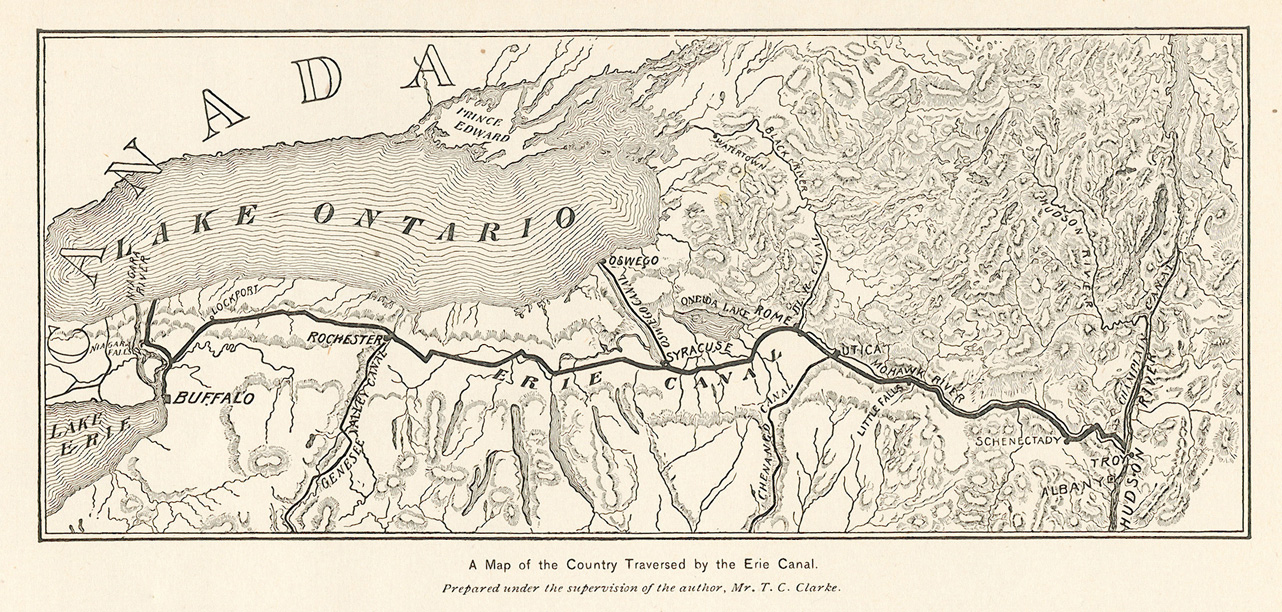
    New York was specifically poised to tackle this transportation issue. The Hudson River was the main artery of trade for New York, connecting commercial Manhattan to the capital in Albany. Of the Hudson’s many tributaries, the Mohawk River proved to be the most important. Flowing eastward from Oneida County, it cut a low valley through the Appalachians, the only valley of its kind in the Northeast. Because of this, Governor DeWitt Clinton authorized the construction of a canal along this route in 1817.

    Map showing Present and Proposed Canal System, to accompany report of Edward A. Bond, State Engineer and Surveyor of N.Y. (from:Annual report of the State Engineer and Surveyor of the State of New York, for the fiscal year ending September 30, 1903 (Oliver A. Quayle, Albany, 1904) — facing p. 60)

    Following eight years of disease, construction accidents, and hard manual labor, the Canal was opened in 1825. The canal was 4 feet deep, 40 feet wide, and spanned 363 miles from Albany to Buffalo. With the construction of the canal, boats could travel from the Hudson River to Lake Erie in less than five days. While many were originally skeptical of the canal, it soon proved its worth. Completed ahead of schedule, and under-budget, the canal paid itself off with tolls in under ten years.

    The Erie Canal was one of the first great highways of the United States, bringing goods, ideas, and most importantly people across New York. The Canal revolutionized the economy of Upstate New York, practically creating the cities we know today. In 1817, Buffalo was a village of 2,000 people recently destroyed by the British. Canal commerce turned Buffalo into the world’s premier grain hub, with the city growing into the 9th largest metropolis in the US. Cities sprang up all along the canal route. Hamlets like Rochester, Syracuse, and Schenectady grew into cities with hundreds of thousands of residents, and national centers of industry. 

    “The most fertile and extensive regions of America will avail themselves of its facilities for a market … [and New York City] will, in the course of time, become the granary of the world, the emporium of commerce, the seat of manufactures, the focus of great moneyed operations.”

    – DeWitt Clinton, Governor of New York
    Thomas S. Allen

    On top of having such economic importance, the canal quickly became a cultural symbol of New York. To many, the canal symbolized their identity as Upstaters, and hope for a prosperous future. One person enamored by the legendary canal was Natick, Massachusetts’s Thomas S. Allen. Allen recalled, “When a boy in school, a picture of the Erie Canal in a Geography attracted my attention and I exclaimed: ‘If I ever see the Eric Canal, I’ll think I’ve seen something worth seeing.’” Sometime around 1910, when traveling to Rochester, Allen finally saw the canal, and immediately knew he had to write a song about it.

    It turns out Allen was somewhat of a 1900s musical renaissance man. He was foremost a violinist, playing everywhere from professional orchestras to burlesque shows. On top of this, he directed Vaudeville shows, composing songs for them in the Tin Pan Alley tradition. Throughout his career, he published nine songs under his name, including “The Erie Canal Song.” Originally published in 1913 by Manhattan’s F.B. Haviland Publishing Co, the song was titled “Low Bridge, Everybody Down.” The song looked back to the work of mule barges along the canal.

    Erie Canal Song

    At the time of its publishing, New York was constructing the Barge Canal System, a mechanized successor to the Erie Canal. Newer diesel and steam powered barges carried much of the cargo down these new canals. Allen’s writing harkened back to a simpler time of mule-drawn ships on the Erie Canal. “We’ve hauled some barges in our day, filled with lumber, coal and hay. And every inch of the way I know, From Albany to Buffalo.” These lines also highlight some of the major midwestern resources that would have flowed Eastward through the canal. Grain and ore were the two specifically that allowed cities like Buffalo to become breadbaskets, and industrial hubs of the East.

    The lyrics while romanticizing life on the canal, also speak to the hardships it brought. The repeated chorus “low bridge everybody down,” reflects just one of these difficulties. Nearing the fledgling cities along the canal, extremely low bridges were common obstacles for barges. The cover for the song’s original sheet music depicts this, with the narrator ducking down on his mule to pass under one such bridge. In reality, however, these bridges were bigger dangers for barge passengers. Passengers on barges would commonly ride on top when conditions allowed, having to quickly get down to safely pass under these bridges.

    Erie Canal Song
    Lift Bridge and Canal St., Canastota, N.Y. — Postcard ; not postmarked ; another slightly variant copy is postmarked Sep. 19, 1907. [CSNYS 1096.1.0890]

    The song’s lyrics also play into the themes of hardiness that would fit perfectly in a Spaghetti Western. The lyrics repeatedly mention Sal the Mule’s fighting spirit. Throughout the song Sal brawls her way across the state, sending Mike McGinty to the bottom of the canal, and kicking a man all the way to Buffalo. All of this fighting occurs during the narrator’s 15 years of hard work along the canal. This story of hardy enterprise and masculine bravado call to mind the Wild West. One could easily imagine these stories of barging and brawling taking place in a classic Eastwood or Wayne movie. This makes sense remembering that at the canal’s completion, Upstate New York very much was the “Wild West.”

    Since its original composition in 1913, “Low Bridge” has become a folk standard, being performed by countless artists. The first known recording we have of the song is by Billy Murray (not to be confused with actor Bill Murray) from 1912. Murray was a star Tenor of the early 1900s, recording many vaudeville and Tin Pan Alley tracks. This recording is now featured in the Library of Congress’s National Jukebox and Recorded Sound Section.

    Aiding in the Canal’s place in American mythology was a recording by folk legend Pete Seeger. Seeger included “The Erie Canal” as track #10 on his 1954 album Frontier Ballads. This album celebrated the stories of workers, and settlers who traveled westward through the new territories of the United States. This album places the Erie Canal alongside stories of Cowboys and railroad workers, placing it firmly within the canon of Americana, and further cementing its Western connection.

    Perhaps the latest great recording of “The Erie Canal Song” came from rock legend Bruce Springsteen, as part of his 2006 album We Shall Overcome: The Seeger Sessions. This album included Springsteen’s interpretations of 13 folk and Americana classics popularized by Pete Seeger. Because of this, this version is moreso a Springsteen cover of Seeger’s version, rather than a direct reimagining of the original. The album, including “Erie Canal” shot to number 3 on the billboard top 100, also earning Springsteen a Grammy for best folk album.

    Since its publishing 111 years ago, “The Erie Canal Song” has become an icon of American folk music. Not only have massive stars covered it over the years, but it has also really lived up to the definition of folk music, and spread to the masses. Reading comments on the YouTube video of Seeger’s version you see nothing but fond memories. Whether it’s people who learned it as kids in school, or sang it with their grandparents, the song holds an important place in the collective American cultural memory.

    On top of all of this, the song speaks to the role the Erie Canal plays in American imagination. It singlehandedly built upstate New York, and connected the country more than it had ever been before. More than just this, it represents a time long gone, where the Wild West wasn’t so far west. Its no wonder why when many people think of New York, they think of the Erie Canal.

    “The Erie Canal Song” Lyrics:

    I’ve got an old mule, and her name is Sal, Fifteen years on the Erie Canal

    She’s a good old worker and a good old pal, Fifteen years on the Erie Canal

    We’ve hauled some barges in our day, filled with lumber, coal and hay.

    And every inch of the way I know, From Albany to Buffalo

    Low bridge, everybody down, Low bridge, we must be getting near a town.

    You can always tell your neighbor; you can always tell your pal.

    If he’s ever navigated on the Erie Canal

    We’d better look ’round for a job old gal, Fifteen years on the Erie Canal

    You bet your life I wouldn’t part with Sal, Fifteen years on the Erie Canal

    Giddyap there gal we’ve passed that lock, we’ll make Rome ‘fore six o-clock

    So one more trip and then we’ll go, Right straight back to Buffalo

    Low bridge, everybody down, Low bridge, I’ve got the finest mule in town

    Once a man named Mike McGinty tried to put it over Sal

    Now he’s way down at the bottom of the Erie Canal

    Oh, where would I be if I lost my pal? Fifteen years on the Erie Canal

    Oh, I’d like to see a mule as good as Sal, Fifteen years on the Erie Canal

    A friend of mine once got her sore, Now, he’s got a broken jaw.

    Cause she let fly with her iron toe and kicked him into Buffalo.

    Low bridge, everybody down, Low bridge, I’ve got the finest mule in town.

    If you’re looking ’round for trouble, better stay away from Sal.

    She’s the only fighting donkey on the Erie Canal

    I don’t have to call when I want my Sal, Fifteen years on the Erie Canal

    She trots from her stall like a good old gal, Fifteen years on the Erie Canal

    I eat my meals with Sal each day, I eat beef and she eat hay.

    She isn’t so slow if you want to know, she put the “Buff” in Buffalo

    Low bridge, everybody down, Low bridge, I’ve got the finest mule in town

    Eats a bale of hay for dinner, and on top of that, my Sal.

    Tries to drink up all the water in the Erie Canal

    You’ll soon hear them sing everything about my gal, Fifteen years on the Erie Canal

    It’s a darned fool ditty ’bout my darned fool Sal, Fifteen years on the Erie Canal

    Oh, every band will play it soon, Darned fool words and darned fool tune!

    You’ll hear it sung everywhere you go, from Mexico to Buffalo

    Low bridge, everybody down, Low bridge, I’ve got the finest mule in town.

    She’s a perfect, perfect lady, and she blushes like a gal.

    If she hears you sing about her and the Erie Canal

  • Larkin Square Announces Summer Concert Events for Buffalo

    Buffalo’s Larkin Square has announced the return of its beloved Live at Larkin and Food Truck Tuesday weekly events this summer. The KeyBank Live at Larkin Summer music series will begin June 5th.

    The summer series will include 13 weeks of live shows, ending on August 28th. Larkin’s annual Food Truck Tuesdays season will also begin June 4th, offering a host of curated food trucks and live music until August 27th.

    This year marks the 12th season of Live at Larkin, which has become a staple of Buffalo’s Larkinville neighborhood. The site was home to the former Larkin Soap Factory, which supplied the second largest catalog sales business in the country. Since the factory’s closure in the 1940s, there have been many attempts to revitalize the neighborhood. These came to a head in 2012, with the opening of Larkin Square. Since its establishment, the venue has become a community gathering place, offering a host of family-friendly events.

    One of the most popular events hosted by Larkin Square is Food Truck Tuesdays. This weekly event begins June 4th, offering around 25 food trucks each Tuesday. Truck offerings range from Italian to Thai to Halal, with each truck offering nutritionist-certified options. The event draws trucks from Buffalo, Rochester, and beyond for visitors to enjoy. Guests can bring their own chairs, but coolers and outside alcohol are prohibited.

    In addition to food trucks, the weekly event offers the chance to enjoy live music from local bands. The Walter Kemp 3 will kick off the summer season with their award winning jazz. When not playing with legends like Sun Ra’s Arkestra and Sabu Adeloya, kemp teaches at Buffalo’s Villa Maria College. The event series offers a diverse spectrum of genres, ranging from McCarthyizm‘s garage rock to Dee Adams’ country. With this vast array of music, event-goers are sure to enjoy the performances while enjoying food truck fare.

    Walter Kemp will play at Larkin Square on June 4th

    June 5th also marks the return of the KeyBank Live at Larkin summer concert series. This weekly concert series will feature performances from local groups, as well as other amenities. Concert-goers will be able to purchase bites from a curated array of on-site food trucks each week. In addition, Larkin Square will offer beer, wine, and cocktails for purchase. Larkin Square’s Bratts Hill Restaurant will be open to serve authentic Jamaican cuisine for dinner services during Live at Larkin.

    The concert series kicks off at 5pm on June 4th with a performance from John & Mary & the Valkyries. The folk-rock duo is comprised of 10,000 Maniacs members John Lombardo and Mary Ramsey. The series will continue for 13 weeks, until a closing performance by hard rockers Grosh on August 28th. Over the course of the summer series, concert-goers can enjoy tributes to classic groups like Steely Dan, Creedence Clearwater Revival, and Fleetwood Mac.

    A performance from Live at Larkin

    Food Truck Tuesdays Band Lineup

    6/4 – Walter Kemp 3 Quartet

    6/11 – McCarthyizm

    6/18 – Diyené

    6/25 – The Fever Pitch String Quartet

    7/2 – Stress Dolls

    7/9 – Whitford-Klyma Band

    7/23 – Sabu Adeyola & Oasis

    7/30 – The Britt Band

    8/6 – Zak Ward

    8/13 – Dueling Pianos Band

    8/20 – Dee Adams’ Grand Isle Opry

    8/27 – Jony James Band

    Live at Larkin Summer Season Lineup 

    6/5 – John & Mary & the Valkyries

    6/12 – Will Holton & Daniel Powell’s Mid-Week Vibe

    6/19 – Juneteenth ft. Farrow & Project Access to A-Free-Kas

    6/26 – Dirty Work: A Tribute to Steely Dan

    7/3   – Blues 4 Vets w/Miller & the Other Sinners & more

    7/10 – Songbirds: A Tribute to Fleetwood Mac

    7/17 – Talking Dead Heads

    7/24 – Ticketed Event, TBA

    7/31  – Big Easy in Buffalo presents: Terrence Simien and the Zydeco Experience with El Batey’s Agua de Liberté”

    8/7   – Buffalo’s Last Waltz Band Does Dylan & The Band

    8/14 – Handsome Jack Does CCR

    8/21 – Stoneflower/ Hollyfeld Does Springsteen

    8/28 – Grosh Prime ft. Alex McArthur, Harry Graser & Michael DeLano

    Thanks to sponsorship from KeyBank and Independent Health, both Food Truck Tuesdays and Live at Larkin are free events. There will be free parking in lots along Exchange Street and Hydraulic Street.

    Larkin Square will continue to announce live events for the summer. For more information and updates, visit the Larkin Square website here.

  • Geneva Music Festival Announces Schedule for Final Week

    After several weeks of great performances, the Geneva Music Festival is wrapping up for the 2024 season. The final week of performances begins on June 4, with a free lakefront concert. This concert is followed by a photography exhibition and chamber performance on June 7 while June 9 marks the end of the season, with an outdoors blues concert closing out the festival.

    The Geneva Music Festival's "Night and Day" performance is scheduled for June 7th at 7:30pm

    Violinist Geoffrey Herd founded the Geneva Music Festival in 2011, as a weekend to spread appreciation of classical music. The festival soon evolved into a four-week long celebration, attracting artists from across the globe. While originally based in classical music, the festival also now highlights jazz, and bluegrass artists. The festival’s mission is to spread music appreciation to everyone, being an all-ages event. The event now attracts thousands of concert-goers from across the Finger Lakes.

    2024 has already been a busy season for the Geneva Music Festival, hosting a number of spectacular performances. The festival kicked off with a sold-out Musicology Mixer night at Geneva’s Linden Social Club. Week two of the festival saw the acclaimed Brentano Quartet play Hobart and William Smith Colleges’ Gearan Center. The Juilliard-formed quartet played a selection from Haydn, Shostakovich, and Mendelssohn.

    Hobart and William Smith Colleges’ Gearan Center for Performing Arts

    The festival’s final week will kick off with a free lakefront concert on June 4th, at 8:15pm. This concert will be a preview for the festival’s final artist-in-residence concert. The theme of this year’s final concert is “Night and Day,” with pieces meant to illustrate the progression from dawn to dusk. World-renowned cellist Clive Greensmith, pianist Anna Petrova, and other talented musicians will perform. The concert will begin with “String Quartet Op. 76, No.4” by Haydn, meant to represent the sunrise. It will also feature modern composer Mark Olivieri’s “Artifacts of a Valiant Past”, a Scriabin solo by pianist Anna Petrova, a piano trio by Kaija Saariaho, and a Schoenberg tone-poem for a string sextet.

    “The solo piano piece that I’m playing has to do with day and night. The first movement represents the day and the sea in daylight. [Scriabin] was inspired to write this piece when he first saw the sea, and so you can hear the peacefulness and the beauty of that; and the second movement is very turbulent and represents the stormy sea”

    – Pianist Anna Petrova

    Hobart and William Smith Colleges’ Gearan Center will host the concert on June 7th, at 7:30pm. Prior to the concert, a photography exhibition highlighting local artists will be held at the center’s Melly Lobby.

    The final concert of the season will be The Brothers Blue, a local cross-genre bluegrass band. Back by popular demand, the concert will be held outdoors at Geneva on the Lake. The Brothers Blue will close out the season with their invigorating fiddle, mandolin, and banjo playing. This concert will take place June 9th, at 2:00pm.

    The Brothers Blue

    Tickets for these concerts are currently on sale. Standard ticket price is $35, with discounts for college students available. Children under 18 can attend concerts for free. For more information on the Geneva Music Festival and ticketing, visit the link here.

  • Nathaniel Rateliff & The Night Sweats Announce MSG Concert

    Nathaniel Rateliff & The Night Sweats have announced a US Arena Tour, including a NYC date at Madison Square Garden. This tour celebrates the group’s fourth studio album South of Here, which releases June 28.

    Nathaniel Rateliff and The Night Sweats

    Nathaniel Rateliff is a Denver-based singer-songwriter renowned for his gruff voice and songwriting prowess. Rateliff’s group The Night Sweats hit the mainstream with their gold-certified 2015 self-titled debut. Since his breakout, Rateliff has collaborated with folk legends, including Paul Simon and Willie Nelson. Led Zeppelin’s Robert Plant has lauded Rateliff’s music, calling him “one of these guys that will just carry the torch. Beautiful songwriting, beautiful singing, great delivery.” Rateliff is already carrying that torch, inspiring a new generation of folk artists, including stars Noah Kahan and Orville Peck. Across their 3 studio albums, Nathaniel Rateliff & the Night Sweats have grown their catalog, and honed their dynamic performances.

    In the lead to their national tour, the band is releasing their fourth studio album South of Here. This new album reckons with love, loss, and hope during a life full of trauma. The songs bear Rateliff’s soul through his vivid storytelling, and the Night Sweat’s R&B-influenced Americana instrumentals. Rateliff hopes “these songs and stories give you an opportunity to better understand your own struggles whatever they may be.” The band collaborated with producer Brad Cook, straight off work with Waxahachie and Bon Ives, to engineer the album. The album is set to release June 28 via Stax.

    The album’s lead single “Heartless” has already hit #1 on Americana radio and #5 on Triple A Charts. Accompanying this single is a new music video directed by the award-winning Kimberly Stuckwisch. Stuckwisch, who has previously worked with Olivia Rodrigo, based the video around the idea of finding freedom through arts. She says ” “Growing up in an impoverished part of Kentuckiana I often found myself running away from my upbringing diving headfirst into books, studies, writing, and theater.” This music video plays into Rateliff’s lyrical themes about moving out West from his childhood hometown in Missouri.

    This arena tour comes after a 2022 sold-out concert at Denver’s Ball Arena, which launched their career to new heights. Starting on August 15 in Oregon, the band will snake their way Eastward across the country, before closing out the tour with a MSG show on March 27.

    NATHANIEL RATELIFF & THE NIGHT SWEATS LIVE

    August 15—Bend, OR—Hayden Homes Amphitheater

    August 16—Boise, ID—Outlaw Field

    August 20—Morrison, CO—Red Rocks Amphitheatre

    August 21—Morrison, CO—Red Rocks Amphitheatre

    October 22—Houston, TX—713 Music Hall

    October 23—Dallas, TX—The Pavilion at Toyota Music Factory

    October 26—Austin, TX—Moody Center

    October 29—Rogers, AR—Walmart Amphitheater

    October 30—St. Louis, MO—Chaifetz Arena

    November 1—Chicago, IL—United Center

    November 2—St. Paul, MN—Excel Center

    March 27, 2025—New York, NY—Madison Square Garden

    Presale for Nathaniel Ratecliff & The Night Sweat’s MSG concert begins Tuesday, June 4th at 10am. General on-sale will begin June 7th at 10am. The band also offers a “Marigold upgrade” for their NYC concert tickets, providing access to an intimate pre-show cocktail lounge, and a limited edition concert print. The proceeds from these upgrades support the band’s Marigold Project, dedicated to promoting economic, social, and racial justice.

    For more information on tour dates and ticketing, visit the band’s website here.

  • The Brentano Quartet to Perform at the Geneva Music Festival

    The acclaimed Brentano Quartet is scheduled to perform at the Geneva Music Festival on May 30. The string quartet will play a number of classical pieces in the festival’s intimate performance space.

    The Brentano Quartet

    Violinist Geoffrey Herd founded the Geneva Music Festival in 2011, to spread appreciation of classical music in his hometown. Originally intended to be a weekend of chamber performances, it soon evolved into a four-week long event, drawing artists from around the world. The festival has expanded to include jazz, bluegrass, and other contemporary musicians on top of classical performances. The festival is an all-ages event, spreading music engagement everywhere from Geneva’s schools to senior living facilities

    2024 has been a busy season for the Geneva Music Festival, already hosting spectacular performances, with more scheduled for the near future. The season kicked off with a sold-out musical mixology night at the Linden Social Club. This night was followed by two “Love and Loathing” concerts, which illustrated the intimacy and passion the festival is known for.

    The Brentano Quartet will kick off week two of the festival. The quartet began at the Juilliard School in 1992, and have been legends of modern classical performance since. They have traveled across 5 continents on tours, most recently holding a residency at the Yale School of Music. Despite these travels, this performance marks the quartet’s first visit to Geneva. Violinist Serena Canin was especially excited, stating “Being in nature centers us, connects us to the Earth, and opens our spirits. The way we connect to our music and to each other changes.  I can’t wait to be near the lakes, the breeze, the trees and the open sky and see what happens.”

    The Brentano Quartet will play three classical pieces at the festival. The quartet will begin with Haydn’s “String Quartet in G Major, Op. 33, No. 5.” They will follow this performance with Shostakovich’s “String Quartet No. 8 in C Minor, Op. 110,” which is a new addition to the quartet’s repertoire. Following an intermission, the quartet will close their set with Mendelssohn’s “String Quartet in D Major, Op. 44, No. 1.”

    Hobart and William Smith Colleges’ Gearan Center

    The Brentano Quartet is only one of many performance during the festival’s second week. On May 31st and June 1st, there will be a performance of “War and Peace,” featuring works by Beethoven, Shostakovich, and Antoine. This is followed by a June 2nd performance by the Kate McGarry and Keith Ganz Ensemble. This show by Grammy-nominated jazz virtuosos is sure to enchant audiences.

    The Brentano Quartet will perform Thursday, May 30th, at 7:30pm. The concert will take place at the Gearan Center on the Hobart and William Smith campus. General admission tickets for the concert are $60. Children under 18 enter free, and college students with Valid ID have reduced ticket prices. Tickets are on sale now at the link here.