The Beacon Sloop Club has announced the musical lineup for the annual Corn Festival. The day-long festival offers visitors fresh snacks (like Hudson Valley fresh picked corn boiled for two minutes), sails on the Sloop Woody Guthrie, and music from 11 artists. The Corn Festival takes place August 11th from 12-5 pm at Pete and Toshi Seeger Memorial Park.
The Beacon Sloop Club traces its origins back to New York folk legend Pete Seeger. In 1966, Pete and Toshi Seeger founded the Hudson River Sloop Clearwater nonprofit to raise awareness of pollution in the Hudson River. For decades, General Electric had polluted the river with factory runoff, which was toxic to the river’s wildlife and people nearby. At the centerpiece of the nonprofit’s mission was the Sloop Clearwater, which sailed the river as a symbol of the Seegers’ mission.
In 1969, the Clearwater sailed to Beacon where the locals set up a welcome festival. This welcome party evolved into the Beacon Sloop Club, with a mission dedicated to community and environment. The group renovated Beacon’s Ferry Diner to make it a headquarters and community gathering space, alongside newly replaced docks. To top off their facilities, Seeger commissioned the Sloop Woody Guthrie – named for the folk legend – to act as the club’s public education space.
One of the Sloop Club’s most popular events is the annual corn festival. The family-friendly event invites all to enjoy hand-picked corn, fresh watermelon, lemonade, and more local delights. Aiding in the Sloop Club’s environmental mission, a large educational tent will feature exhibits on the ecology of the Hudson River watershed. In addition to these exhibits, visitors can enjoy the Hudson first-hand with free rides on the Sloop Woody Guthrie. Weather permitting, sloop ride sign-up will begin at 12pm.
The Sloop Woody Guthrie, Photo by Pete Becerra Jr., 2017
On top of these activities, the festival will feature live music from local artists throughout the day. The festival facilities include two solar-powered stages, with one dedicated solely for children’s entertainment. Among the local bands playing are Last Minute Soulmates, Trouble Sisters, Offshoots, Soil & Soul Creek, and The Seed Song Family Band.
The festival will also feature a number of local singer-songwriters and individual performers. Hudson-based acoustic duo Laurie Siegel & Patrick Jones will perform a set. Also performing is Cosby Gibson. The Adirondacks-based artist rose to local prominence through her dulcimer and guitar-driven folk. Over the years she has won a Capital District Music Award for Best Folk Album and a Dorn Space Arts Award for Music Outreach.
In terms of children’s entertainment, Bindlestick Bill will perform. The Poughkeepsie-based performer works as an elementary school music teacher by day and local music star by night. Bindlestick Bill takes the form of a comedic hobo character, with songs and performances aimed towards children.
Spook Handy and Pete Seeger
The festival will also feature a number of local folk musicians who played with Pete Seeger throughout his career. Among these musicians is New Jersey’s Spook Handy, who played over 50 shows with Seeger after the two met in 2003. The festival will additionally feature music by Pat Lamanna. Lamanna’s folk stylings tackle issues of peace and environmental ills, receiving praise from Pete Seeger and Phil Ochs. Finally, Lydia Adams Davis will perform. Over the years, Davis performed alongside Seeger and the Hudson River Sloop Singers. The New York Times has heralded her as “One of our finest folk composers” for her legendary folk/country stylings.
The Beacon Sloop Club Corn Festival will take place August 11th from 12-5pm. The festival is a free, all-ages event made possible by the Sloop Club’s volunteers. All proceeds from the festival go towards the Woody Guthrie sailing program and other environmental education programs. For more information, visit the Beacon Sloop Club website here.
Alt-country superstar Jeff Tweedy has announced a cross-country Autumn tour with for New York dates. Beginning on September 8th, the tour will stop in Woodstock and Buffalo before making its way westward.
Jeff Tweedy has distinguished himself as an icon of the alt-country genre. His musical career began in high school, performing alongside friends. This band soon evolved into Tweedy’s first big project, Uncle Tupelo. During their 7 years of existence, Uncle Tupelo emerged as standouts of alt-country. Their 1990 record No Depression has been labeled one of the best albums of the genre, and the 1990s as a whole.
By 1994, Uncle Tupelo had disbanded, leaving Tweedy to start his next musical project. This band – made of leftover Uncle Tupelo members – named themselves Wilco. Their first two records A.M. and Being There continued to build on Uncle Tupelo’s country stylings. By their third album, 1999’s Summerteeth, the band began to incorporate elements from Psychedelic pop and alternative rock, creating their iconic sound. Many consider the peak of their career as 2001’s Yankee Hotel Foxtrot, which paired their genre-bending experimentations with unforgettable pop hooks. The album is often quoted as not only one of the best indie albums of all time, but one of the greatest albums ever.
Jeff Tweedy has been busy with his work throughout 2024 – both as the frontman of Wilco and a solo artist. In terms of Wilco, the band released their 13th studio album Cousin, with its accompanying Hot Sun Cool Shroud EP. June saw the band take to the live stage at the Solid Sound Festival in North Adams, Massachusetts. In addition to this performance, they have made waves through their live recording of Lana Del Rey’s “Margaret” alongside Bleachers.
On top of this musical work, Tweedy has pursued writing. 2024 saw the release of his third book WORLD WITHIN A SONG: Music That Changed My Life and Life That Changed My Music. The book recounts fifty songs that changed Tweedy’s life and the memories associated with each of them. Upon its release, the book quickly became a New York Times Bestseller.
To kick off Autumn, Tweedy is launching a cross country tour, beginning on Sunday, September 8th. The tour will start in Tweedy’s home of Chicago, with performances at the Evanston Folk Festival and Chicago Live! Following these two performances, Tweedy will continue on to New York, where he has four scheduled shows.
The New York Leg of the tour will begin with a three-night residency at Woodstock’s Bearsville Theater. The legendary venue dates back to 1989, when it was built to house Bearsville Studios. Since its founding, everyone from Patti Smith to REM has recorded there. The renowned 500-person venue has an intimate atmosphere with near perfect acoustics. Tweedy’s residency will last from Friday, October 11th to Sunday, October 13th.
Immediately following his Woodstock residency, Tweedy will travel to Buffalo to perform at the Buffalo State Performing Arts Center. The theater sits at the center of Buffalo State College, housing its stage productions. Since its original opening in 1987, the theater has undergone extensive renovations with state of the art lighting and sound systems and refurbished seating. The 865-person theater hosts over 50,000 people every year across more than 180 events. Tweedy’s concert will take place on Tuesday, October 15th.
Bearsville Theater
Following these New York performances, Tweedy will continue westward throughout October. He will cap off the Autumn tour with a three-day residency at the Guild Theatre in Menlo Park, California. Tickets go on sale August 2nd at 10am local time. For more information on Jeff Tweedy’s solo tour, visit the Wilco website here.
Jeff Tweedy Tour Dates
Sun. Sept 8 – Evanston, IL @ Evanston Folk Festival, In-Conversation Series
Sat. Sept 21 – Chicago, IL @ Navy Pier / Chicago Live!
Fri. Oct. 11 – Woodstock, NY @ Bearsville Theater
Sat. Oct. 12 – Woodstock, NY @ Bearsville Theater
Sun. Oct. 13 – Woodstock, NY @ Bearsville Theater
Tue. Oct. 15 – Buffalo, NY @ Buffalo State PAC
Wed. Oct. 16 – Columbus, OH @ Southern Theatre
Fri. Oct. 18 – Champaign, IL @ Virginia Theatre
Sat. Oct. 19 – Madison, WI @ Barrymore Theatre
Sun. Oct. 20 – Omaha, NE @ The Admiral
Tue. Oct. 22 – Jackson, WY @ Center for The Arts
Wed. Oct. 23 – Salt Lake City @ Rose Wagner Theater
Fri. Oct. 25 – Grass Valley, CA @ Center for The Arts
Mon. Oct. 28 – Menlo Park, CA @ The Guild Theatre
Tues. Oct. 29 – Menlo Park, CA @ The Guild Theatre
Wed. Oct. 30 – Menlo Park, CA @ The Guild Theatre
Fri. Feb 28 – Miami, St Croix, USVI & St John’s, Antigua @ Cayamo Cruise
On July 24th, Searchlight Pictures released the first trailer for A Complete Unknown. The Bob Dylan biopic follows the legendary singer-songwriter through his early career up to his electric Newport Folk Festival set.
Throughout this period of the early 1960s, Bob Dylan made a name for himself in Greenwich Village’s folk scene, growing to become one of the most consequential musicians in history. Throughout A Complete Unknown’s trailer, many famous New York venues and figures can be seen, shining a spotlight on New York’s rich musical history.
Timothee Chalamet as Bob Dylan in A Complete Unknown
Hotel Chelsea (0:14)
One of the first sites seen in the trailer is the historic Hotel Chelsea. Opened in 1884, the hotel’s 11-story gothic structure looms large over Manhattan’s Chelsea neighborhood. From its beginnings, the hotel’s identity was deeply intertwined with New York’s art scene. Architect Philip Hubert envisioned a housing cooperative that would house a diverse artists’ community. At its opening, the building attracted many well-off professionals, making it “the most profitable and popular of [Hubert’s] enterprises” per the New York Times.
Despite its early success, economic pressures like the crash of 1893 made this model unsustainable. As a result, the Hotel Chelsea was transformed into hotel apartments. In the following decades, the hotel went through a revolving cycle of bankruptcy, buyouts, and renovations. The one constant was its appeal to New York’s artists. Partially due to low rents and close atmosphere, artists of all kinds made the Hotel Chelsea their home during the 40s and 50s. Painters like Jackson Pollock, and writers including Dylan Thomas all inhabited the hotel during this period.
The Hotel Chelsea’s sign, Photo by Chadd Scott
This artistic draw continued into the 1960s, with the hotel becoming home to countless legendary musicians. Of course, Bob Dylan made the hotel home upon his arrival in New York City. Throughout the early 60s, Dylan penned many of his classic songs in the confines of his Chelsea apartment, where he lived alongside his then-girlfriend Sara Lownds. Many tracks off his 1966 magnum opus Blonde on Blonde originate from the Hotel Chelsea. During the blackout of 1965, Dylan penned “Visions of Johanna,” which referenced the atmosphere of the hotel. “Lights flicker from the opposite loft. In this room the heat pipes just cough.” Also said to be written in the hotel are “Sad Eyed Lady of the Lowlands,” and “Sara.”
Throughout the 1960s and 70s, the hotel increasingly became home to rockers and punks. Much of this draw stems from one of the hotel’s most famous residents: Andy Warhol. The hotel acted as Warhol’s muse, inspiring his 1966 avant-garde film Chelsea Girls. The release of this film only increased the hotel’s fame among artists. Throughout the 1960s, psychedelic legends like Jimi Hendrix and Janis Joplin rented rooms in the hotel.
Andy Warhol filming Chelsea Girls in 1966
By the 1970s, the hotel’s fame and rent control made it a hub for New York’s punk rockers. By this point, however, the hotel was in decline. Cockroaches infested the rooms, and graffiti covered much of the building’s walls. As a result, some paid as little as $155 a month on rent. Punks like Patti Smith, Iggy Pop, and Johnny Thunders were all drawn to the hotel during this period. In one of its darkest episodes, Nancy Spungeon was murdered in the hotel, with her boyfriend Sid Vicious of the Sex Pistols charged for the crime. Only a year later, Vicious died of a heroin overdose in the building.
Following years of corporate takeovers and renovations, the Hotel Chelsea was converted into a luxury hotel.
Cafe Wha? (0:21, 1:00)
One of the most pivotal sites in the trailer is Greenwich Village’s Cafe Wha?. In 1959, Manny Roth bought an abandoned horse stable in the heart of Manhattan. Upon seeing the site’s dark basement with horse troughs and dung piles, he knew it was a prime location for his new cafe. After renovations, which involved Roth painting and tiling the building himself, the cafe was ready to open. The cafe was advertised as “Greenwich Village’s swingingest coffee house” and quickly became a haven for Manhattan’s Beatniks.
Cafe Wha? in 1967
From its start, Roth envisioned Cafe Wha? as a forum for aspiring musicians. The cafe regularly hosted “hootenanny” nights akin to an open-mic night. Roth invited the public to come and perform a couple songs, showcasing their talents to the village’s residents. On January 24th, 1961, a hitchhiker from Minnesota entered the cafe, asking Roth if he could perform at Hootenanny night. The young musician, Bob Dylan, was a smash success at the cafe, kicking off his musical career in New York City.
Throughout the remainder of the 1960s, the cafe became a mecca for future stars of music. In the mid-1960s, Roth hired the Blue Flames as the house band. Led by frontman Jimmy James, the band played 5 sets a night, 6 days a week for next to no money. Chas Chandler, bassist for the Animals, noticed James and believed he had potential for stardom. The two traveled together to England, where James renamed himself Jimi Hendrix, and ascended to rock stardom. Following, the Blue Flames, Roth hired the Castiles to play afternoon sets in 1967. The band, led by their frontman Bruce Springsteen, quickly became a local hit.
Jimmy James and the Blue Flames
Even those who weren’t performing played a major role in music history. One of the cafe’s waitresses was Mary Travers, future member of folk trio Peter, Paul, and Mary. Of special note was Manny Roth’s nephew, David Lee Roth who frequented the cafe. Gaining a love for live music, he went on to found the pioneering hair metal band Van Halen in 1973.
In 1968, Roth ceded control of the cafe to Menachem Dworman. Dworman converted it into Cafe Fenjoon, a venue focusing on Middle Eastern music. In 1987, Dworman reverted the club back to its original Cafe Wha? name. To this day, it remains as one of New York City’s most storied live music venues, hosting daily musical performances.
The Town Hall (0:29)
At the center of the trailer is Dylan’s performance of “A Hard Rain’s a-Gonna Fall” at The Town Hall. The hall began as a headquarters for New York’s suffragist movement in the leadup to the 19th Amendment. The League for Political Education envisioned the site as an egalitarian meeting space where they could educate the public on women’s rights. As a result, upon its opening in 1921, the hall featured no box seats, and no obstructed views, making sure all in attendance were equal.
The Town Hall’s interior in 1923
Throughout the 1920s, the venue housed countless classical recitals. Among its first events was Richard Strauss’ presentation of three operatic pieces in December 1921. For the rest of the decade, the Town Hall featured recitals by musicians like Pablo Casals and Andres Segovia, and dancers like Ruth St. Denis. Possibly more important was the venue’s dedication to social progress. It frequently presented public meetings discussing the pressing issues of the day. Whether it was Margaret Sanger’s lectures on birth control or a memorial to Sacco & Vanzetti, the Town Hall remained dedicated to its progressive ideals.
Across the coming decades, the Town Hall sat at the heart of New York’s jazz scene. It regularly hosted performances by legends, including Duke Ellington, Thelonious Monk, and Dizzy Gillespie. During this period, the venue’s public forums elevated it to national fame. In 1935, George V. Denny began to broadcast the Town Hall’s discussions on radio. The program titled America’s Town Meeting of the Air featured discussion of the hot-button issues of the day, highlighting all sides of the argument. The program, intended to continue the hall’s dedication to public education, became one of the first radio talk shows in history. NBC soon syndicated the program, receiving widespread acclaim.
The Town Hall’s importance in A Complete Unknown comes on April 12th, 1963. On that date, Bob Dylan made his first large-concert debut, playing to a crowd of over 1,000. During his 24-song set, Dylan played many self-written pieces, introducing the world to classics like “Don’t Think Twice, It’s All Right” and “Masters of War.” Included in this performance was a rendition of “A Hard Rain’s a-Gonna Fall” off The Freewheelin’ Bob Dylan, which soundtracks the trailer.
The Program for Bob Dylan’s historic performance at the Town Hall
This concert was a smash success that helped cement Dylan as one of the era’s premier songwriters. On April 13th, the New York Times reported on it, stating “He plays excellent guitar and one of the most inventive harmonicas to be heard these days. His voice is small and homely, rough but ready to serve the purposes of displaying his songs. The songs are among the best written in this country’s folk vein since Woody Guthrie stopped composing.”
This period also featured a legendary performance by folk singer Pete Seeger, who is key to A Complete Unknown’s plot. In 1963, performed a children’s concert at the venue, which was later nominated for “Best Recording for Children” at the Grammys.
Throughout the 1970s and 80s, economic uncertainty marked the Town Hall. In 1980, a lack of funding effectively closed the venue. However, a mix of government grants, NYU funding, and individual donations soon provided enough money to renovate and reopen the Town Hall. In 1984, the venue reopened for good. Since its reopening, the Town Hall has continued as a beacon for live music. Everyone from Elvis Costello to Celine Dion has performed at the venue since.
Riverside Church (1:08)
The trailer briefly features Bob Dylan’s performance at an “All-day hootenanny” hosted at the Riverside Church. The church traces its origins to legendary financier and philanthropist John D. Rockefeller Jr. Rockefeller wished to join a church that shared in his progressive social values, so donated $500,000 to Morningside Heights’ Cathedral of St. John the Divine. Soon, the church’s congregation expanded by the hundreds, leaving the facilities too small to accommodate them.
As a result, Rockefeller financed the construction of a new church on Manhattan’s Riverside Drive. Following three years of construction and over $4 million in funding, Riverside Church opened on October 5th, 1930. At its completion, the church was an architectural marvel. It featured gothic elements, like spires, flying buttresses, and slender windows, resembling the monumental cathedrals of France and Spain. Additionally, it remains the tallest church in the US, with its 392-foot tower dwarfing its surroundings.
For the next 20 years, the church welcomed 10,000 visitors a week for religious and social events. During the 1950s, Riverside Church began renovations, including a 15-foot radio tower. Starting in 1961, the church operated its radio station WRVR, which continued operations until 1978.
1961 marks another key moment for the church and for music history. On July 29th, Bob Dylan performed at a hootenanny event hosted by WRVR at Riverside Church. The then-unknown Dylan shrouded himself in mystery, claiming he came from Gallup, NM – in fact he was from Minnesota. During the hootenanny, he played a short five song set. Unlike later performances, none of the songs were written by Dylan himself. Among them were three traditional folk tunes, and two modern pieces written by Danny Kalb and Eric Von Schmidt. WRVR broadcast the performance live as part of a 12-hour music marathon. Luckily for posterity’s sake, a listener taped the live performance, preserving this early moment in Bob Dylan’s career.
The performance features a young Dylan still finding his musical footing. His iconic voice is quiet, sometimes to the point of mumbling. Throughout the recording, his guitar goes out of tune, requiring constant adjustment between songs. This matched with some guitar flubs at the beginning of songs creates a lot of empty space. While listening to the heavily distorted recording, you can hear a musician still anxious at the beginning of his career, but with the seeds of greatness present.
Gerde’s Folk City (1:14)
The trailer features performances by Dylan and Joan Baez at the legendary Gerde’s Folk City. Mike Porco founded Gerde’s foremost as a restaurant, which featured occasional musical performances. This all changed on June 1, 1960, when promoters Izzy Young and Tom Prendergast convinced Porco to rebrand the business as Gerde’s Folk City, a full-fledged music venue. A performance by poet Logan English and singer Carolyn Hester inaugurated the new venue.
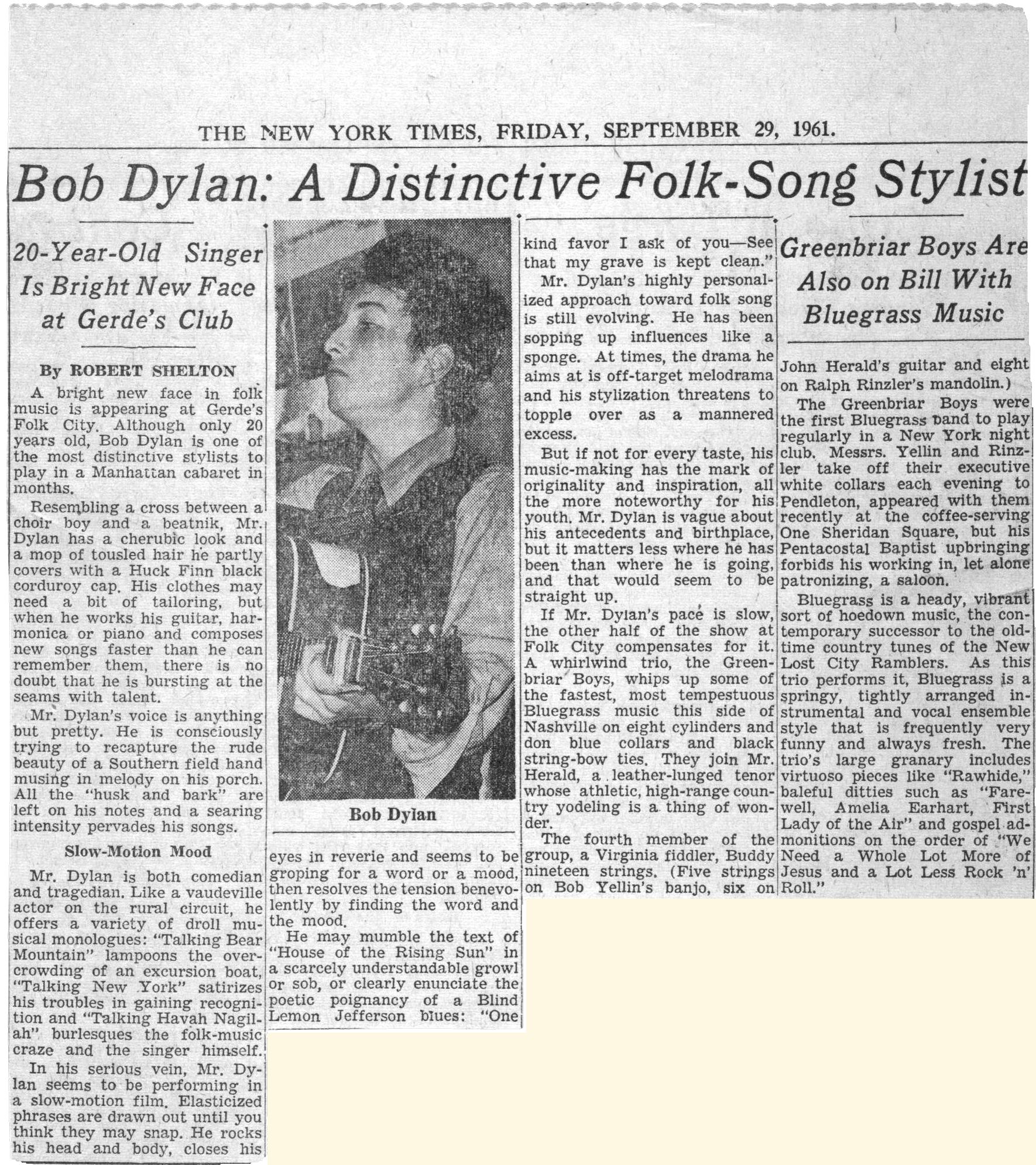
Gerde’s quickly became a haven for Manhattan’s Bohemian crowd and writers for Village Voice who flocked in to hear up-and-coming folk artists. On April 11th, 1961, Bob Dylan performed his first professional set at Gerde’s. The unknown Dylan opened for the legendary blues virtuoso John Lee Hooker. This performance marked one of Dylan’s first chances to display his original pieces. By all definitions, this performance was a success for Dylan, prompting additional shows by Dylan and Hooker. The New York Times reported on these shows in September 1961, stating while Dylan’s outfit and voice were far from pretty, his originality and stage presence marked him for stardom.
Throughout the 1960s, Gerde’s was a necessary stop for any folk singer in New York City. It frequently featured legends like Pete Seeger, the Byrds, Simon and Garfunkel, and Joan Baez. Following a decade of success, Gerde’s moved to West 3rd street, where it continued operations until 1987. In that year, rent tripled, leaving no choice but to close the doors. Although Gerde’s has been closed for almost four decades, it holds a special place in popular memory. In its “Book of Lists,” Rolling Stone ranked it within the top three venues on Earth for its impact on Greenwich Village’s folk scene. Today, Hebrew-Union College inhabits the original location of Gerde’s Folk City.
Pete Seeger
One of the major figures in A Complete Unknown is Pete Seeger, played by Ed Norton. Throughout his career, Seeger cemented himself as the foremost folk musician of his day, as well as an activist. Seeger was born in New York City on May 3rd, 1919. From his birth, Seeger was surrounded by both music and political activism. His father was an ethnomusicologist forced to resign his position at UC Berkeley for his outspoken pacifism during WWI. His mother was just as musical, working as a concert violinist and teacher at Juilliard.
Seeger gravitated towards music at a young age, first picking up the ukulele while at boarding school. His focus soon shifted to the banjo, after visiting a square dance festival with his father in Asheville, North Carolina. In 1938, Seeger enrolled at Harvard, where he consequently joined the Young Communist League. However, he later dropped out to work with Alan Lomax to catalog American folk music. This early job began a lifelong dedication of Seeger’s to preserve America’s folk tradition.
Alan Lomax and Peter Seeger in 1950, Photo source: John Cohen
Seeger’s career truly began in 1940, when he embarked on a cross-country tour with Woody Guthrie. On this tour, Seeger and Guthrie performed a plethora of folk tunes to benefit workers and unions across the nation. The 1940s and the start of WWII also began Seeger’s focus on antifascist efforts. Alongside his first band The Almanac Singers, Seeger recorded the 1940 album Songs of the Lincoln Brigade. This album featured songs of anti-fascist fighters in the Spanish civil War. His career briefly paused, as Seeger was drafted into 1942.
Upon his return to the US, Seeger made two fateful decisions. Firstly, he bought a property in Beacon, NY, along the Hudson river. This began a lifelong mission to clean the heavily polluted river. For decades, Seeger raised public awareness of environmental destruction through the annual Clearwater music festival. Additionally, following years of fighting for legislation and corporate accountability, General Electric agreed to dredge the river to help clear it of contaminants.
The second of Seeger’s decisions was the founding of his new group: The Weavers in 1948. After signing to Decca Records, the Weavers became one of the most popular groups in America. During their heyday, the group sold over four million records, buoyed by hits like “Kisses Sweeter than Wine” and “So Long (It’s Been Good to Know Yuh).” In addition, they remained true to Seeger’s mission of musical preservation, recording folk songs from not only the US, but also South Africa and Israel.
The Weavers’ fame came to a sharp halt in the early 1950s. Leaks to the House Un-American Activities Committee (HUAC) claimed that the Weavers members were communists. These accusations and a subsequent sedition investigation forced the group underground. These tensions came to a head on August 18th, when HUAC subpoenaed Seeger. Seeger refused to answer any questions, leading to a 1961 conviction on 10 counts of contempt of Congress.
Dylan and Seeger at the 1963 Newport Folk Festival
Bob Dylan entered Pete Seeger’s life around this point. In 1961, Seeger introduced Dylan to John Hammond, who went on to produce Dylan’s self-titled debut. Four years later, Seeger made the consequential decision to invite Dylan to the 1965 Newport Folk Festival. Instead of playing a traditional acoustic set, Dylan brought in amplifiers and electric instruments. The crowd booed and heckled Dylan throughout the set, and according to some accounts, Seeger was just as disappointed. In a 2001 interview, Seeger recalled hating the live mixing, because he could not hear Dylan’s lyrics. He also recalled telling the sound engineer “Damn it, if I had an ax, I’d cut the cable right now.”
For the remainder of his life, Seeger remained dedicated to music and activism. He continuously used his platform to fight for environmental protections and civil rights for African Americans. Throughout his later years, he continued to perform at massive shows, including MSG, Farm Aid, and Newport Folk. After nearly seven decades of musical performance, Seeger passed away on January 27th, 2014.
The 22nd annual Albany Riverfront Jazz Festival has announced its artist lineup for 2024. The all-day free concert will feature five live acts on September 14.
Since its start in 2002, the Riverfront Jazz Festival has been a staple of Albany’s live music scene. Each year, the festival has featured legends of jazz music and highlighted local up-and-comers, providing a vast array of sounds for audiences. The 2024 event will likewise feature jazz artists from across the country, each sharing their unique take on the genre.
The first artist to perform is Bright Dog Red at 12:30pm. The Albany-based jazz rap octet has made waves for their unique genre blending. Their sound mixes improvisational jazz in the vein of Ornette Coleman and Mahavishnu Orchestra with 90s hip-hop. The group’s socio-politically charged lyricism has drawn comparisons with legendary acts like A Tribe Called Quest and Digable Planets. Glide Magazine describes the group as “Genre-agnostic, uncategorizable, and intensely thrilling.”
Following up the first performance is a set by Melanie Charles at 2:00pm. The Brooklyn-based musician has gained traction for her blending of jazz, R&B, and soul. Following a 2021 NPR Tiny Desk Concert, Charles was propelled further into the mainstream. In the past years, she has collaborated with everyone from Gorillaz to Mach Hommy. Her music, while heavily indebted to jazz, looks to the future of the genre. She said “I love jazz, I really fell in love with it deeply. But I was interested in young people interacting with it.”
Third-up is the Philadelphia-based septet Snacktime. The group first made a name for themselves playing free shows in Philadelphia’s Rittenhouse Square, with their shows soon growing to sold-out concerts across the country. Their sound combines jazz, funk, punk, and more, creating songs that sound like no one else. Since their start, they have gained endorsements from Portugal. The Man and celebrities like Eric Andre and the Impractical Jokers. This performance comes in the leadup to their studio debut recorded by GRAMMY-nominated producer Will Yip. Snacktime’s set will begin at 3:30pm.
Following these performances is a presentation of the 8th annual Henry Johnson Award for Community Service. The ceremony is set for 4:30 pm with performances resuming at 5:00pm. At this point, Roosevelt Collier will perform a set, exhibiting his pedal steel guitar prowess. Since his start, Collier has performed alongside legends like the Allman Brothers Band and Los Lobos. In 2017, Collier launched his all-star band the “get-downs,” combining gospel, funk, rock, and more.
The final performance of the night comes from Nate Smith at 6:30pm. Hailing from Chesapeake, Virginia, Smith is a composer, drummer, and producer all in one. His emotional and raw style of drumming has brought collaborations with countless artists. Everyone from Norah Jones to Pat Metheny has sought out Smith for his percussion chops. Across his studio albums and collaborations, Smith has received three Grammy nominations. In recent years, his viral videos have introduced millions to Smith’s drumming, making him one of the most influential of this generation.
The Riverfront Jazz Festival is scheduled for Saturday, September 14th at Jenning’s Landing in Albany. The all-day free festival is an all-ages event, featuring music, food, beverages, and local vendors. For more information, visit the Albany Office of Cultural Affairs website here.
The historic Barton Opus 234 pipe organ will soon make a move from Detroit to Rochester. The nearly 100 year old instrument sat at the heart of Detroit’s silent movie industry for years before sitting in storage for over 40 years.
Now, following a restoration process, the Barton Opus will be the centerpiece of the Rochester Institute of Technology (RIT) new performing arts center.
Restorers Carlton Smith and Justin Nimmo with the Barton Opus 234, by Michael Conroy/AP
Built in 1927, the Barton Opus 234 is a timeless marvel of the instrument making industry. Oshkosh, Wisconsin’s Bartola Musical Instrument Co. manufactured the instrument. While many can imagine what an organ sounds like, the Bartola Opus 234 was so much more. Designed to be a jack of all trades needed to soundtrack silent movies, the organ could replicate a whole host of sounds. In addition to organ tones, its keys could mimic strings, flutes, and horns.
Additionally the Opus contains various percussion instruments including cymbals, drums, and a piano aiding in this versatility. On top of all of this were various sound effects: bird whistles, steamboat horns, and more. With its host of instrumentation, the Barton Opus 234 could replicate any musical note or sound effect an organist would ever possibly need to soundtrack a movie.
The history of the Barton Opus 234 begins with the opening of its manufacturer Bartola in 1918. In that year, Dean Barton founded the company to manufacture photoplayers for theaters across the Midwest. These photoplayers were almost like primordial versions of theater organs. Working off the base of an upright piano, Bartola tacked on organ pipes and percussion instruments to aid theater organists in achieving more diverse sounds.
An early Photoplayer organ
Throughout the 1920s, the Silent Movie industry boomed. Each year movies like Fred Niblo’s Ben Hur and the many comedies of Charlie Chaplin were released, raking in millions at the box office. While these movies were silent, music was a necessary part of the theater experience. Musical cues from live musicians built the atmosphere and told audiences how to react to scenes. In this way the silent movie experience was not silent at all.
As silent films grew in popularity, theater organs also grew – more literally. These organs soon began to take over the role of orchestra pits at theaters. They grew larger, sometimes being multiple stories high, and more elaborate with keys to replicate a host of instruments. What made Barton Organs so notably was their intricacy – not only musically, but visually. Organs like the Barton Opus featured exquisite decorated with multi-colored keys and complex wooden inlays.
During its heyday, Bartola made over 250 of these organs for theaters across the Midwest. Movie-goers everywhere from Saginaw, MI to Cedar Rapids, IA could hear their organs during film screenings. Possibly the most famous of their creations was the gargantuan organ that stood in Chicago Stadium – former home of the Blackhawks and Bulls.
Chicago Stadium’s Bartola Organ
The Bartola heyday could not last forever, with the company closing in 1931. As film made the transition into sound productions, the role of silent film organists slowly became obsolete. By the early 1950s, with the advent of television, which brought entertainment to the home, the medium was all but dead.
The individual story of the Barton Opus 234 very much mirrors these larger trends. After its construction, the organ found its home in Michigan, which had become a hub for silent film. Between 1925 and 1928 alone over half a dozen theaters had opened, housing over 23,000 seats. One such theater was the Hollywood Theatre, built in 1927, which went on to house the Barton Opus.
At its completion, the Hollywood Theatre was a sight like no other. Detroiters could see its massive 150 ft tall towers for miles across the city. The exterior of the building was finished with terracotta walls and red brick roofing, giving it the appearance of a Mediterranean castle. Its interior was likewise ornate. The first thing visitors would see was its 60 ft tall lobby, decorated with marble and gold, and featuring a large chandelier at the center of its ceiling.
At the center of the theater’s operations was the Barton Opus 234. At the time of its purchase, the organ was worth a whopping $75,000 – over $1 million today. Throughout its tenure, organist Bob Clarke operated the monstrous instrument, soundtracking the theater’s films and vaudeville performances. Clarke to many was better known as the organist at Olympia Stadium, home of the Detroit Red Wings.
Despite its grandeur, the Hollywood was always playing second-fiddle to other venues around Detroit. At its completion, the theater boasted a massive 3,436 person capacity – still dwarfed by the larger Michigan Theatre. Many even considered the Barton Opus only the second best sounding organ in the city. The Capitol Theatre – later renamed the Detroit Opera House – held that title.
By the 1950s, the Hollywood Theatre was in the throes of death. Its location – far from the residential hub of the city – spelled its doom. As local organist Roger Mumbrue remembered “No one lived down there. It was mostly abandoned freight yards and derelict buildings, so there was just no hope.” Not even special events, like boxing matches or new films could attract a crowd. In 1958 the theater closed for good, becoming a parking lot for Detroit’s school buses.
With the closure of The Hollywood, its assets were auctioned off to the public. Among these was the massive Barton Opus 234. In 1962, a local engineer and music enthusiast named Henry Przybylski placed a winning bid on the instrument for almost $3,500. Following this purchase, the two-story organ had to be disassembled and transported to Przybylski’s home in Dearborn Heights. For the next 40 years, the organ sat disassembled in his garage.
Fortunes changed in 2003, when Steven Ball – head of University of Michigan’s Organ Department – purchased the Barton Opus. Ball’s main goal was the safe storage and restoration of the instrument until it could find a suitable home – ideally a concert hall like it had originally stood. This came to fruition in 2019, when Ball agreed to donate the organ to RIT. It is currently undergoing restoration, with head restorer Carlton Smith estimating the process is about ⅔ complete. Upon completion, it will travel in pieces to Rochester, before reassembly in its new home at the university’s new performing arts center.
A rendering of the RIT Music Performance Theater rehearsal hall
Workers broke ground on RIT’s Music Performance Theater in September, 2023. This project marks the largest theater construction in Rochester’s recent history. Upon completion, the 40,000 square foot theater will boast three stories and 750 seats. At the center of the theater is a large rehearsal hall, with two large balconies overlooking the stage. The centerpiece of this hall will be the restored Barton Opus 234 in its original glory. Upon its completion, the theater will house RIT’s musical theater productions. Current estimates say the theater will to open in January 2026.
As part of their historic farewell tour, Foreigner will play at the Saratoga Performing Arts Center (SPAC) on July 30th. The local Broadalbin-Perth High School Choir (BPHS) will join the group for a performance of the legendary hit “I Want to Know What Love Is.”
In the lead-up to their tour, Foreigner began a contest to involve local schools in their performances. Among the many schools that submitted audition tapes was BPHS, who Foreigner ultimately chose to perform alongside at their Saratoga Springs show. Choir director Alex Hitrick recalled the immense work the students put into this audition. “I had the students figure out the harmonies sung by the New Jersey Mass Choir in the original song, arrange it, then sing it as a group.” To Hitrick, the student’s “ability to put their passions on display while having fun” made their tape stand out.
The BPHS Choir has grown immensely since director Alex Hitrick began five years ago. When he began, the choir only consisted of 12 students, but has since grown to 68. This upcoming year, they will have enough students to field two choirs. These students’ hard work has allowed them to return to the NYSSMA major festival for the first time in years. In light of all of this progress, Hitrick views their upcoming show with Foreigner as “absolutely a natural progression. The students not only put in the work that it takes to be stronger musicians, but have put their hearts into everything they do.”
Since winning the contest, the students have continued to work hard at their musical craft. BPHS will send 25 students to perform alongside Foreigner. These students have worked to fine tune all details of the song during rehearsals leading up to the show. As Hitrick admits, “While they may be a little nervous to be singing in front of thousands, I know being in the moment with each other surrounded by music will calm any nerves they may have.”
The Broadalbin-Perth Senior High School Choir, Source: Broadalbin-Perth Central School District
The main feeling surrounding the choir is excitement. Hitrick noticed that most students “have only heard snippets of music created from the 60s to 80s.” While many were aware of Foreigner’s hits, they did not know much about the band. After explaining Foreigner’s status as Rock and Roll Hall of Fame inductees, the students recognized how important they really were. Now, Hitrick says “They cannot contain their excitement.” He specifically wanted to shout out one of his students “who will be singing every word to every song that they play.”
This performance has already had major impacts on the Broadalbin-Perth music program. Hitrick believes that the publicity from this performance will increase numbers for the choir. He expects that all music ensembles and extracurricular activities in the district will also receive a boost. This new interest can help students explore the “many different avenues of music that students can pursue.” In addition to increased interest, there are more immediate benefits to the performance. As part of the contest, Foreigner will donate $500 to the choir program to aid in its operations.
Hitrick believes that music is a fundamental part of education, “it is the time of day when we get to engage our brains in a different way. It’s the time when students don’t have to think about the pile of standardized tests they have to take or the insurmountable stress that is weighing them down.” In the end, music and creativity is what makes us human, so “When shaping well-rounded individuals to be the best that they can be, we mustn’t neglect the creative side to humans, and in our case, the future of music education.” Based on what Hitrick sees in his students, he says “the future of music looks bright.”
The performance at SPAC comes as part of Foreigner’s historic farewell tour with Styx. This tour comes after a near 50-year career that propelled Foreigner into rock stardom. Across their nine studio albums, Foreigner has racked up 14 top 20 hits. Audiences are sure to know tunes like “Cold As Ice” and “Juke Box Hero.” 2024 marks a big year for the band beyond just this tour. Foreigner’s Rock and Roll Hall of Fame induction is also scheduled for October 19th.
For more information on Foreigner’s July 30th show at SPAC with Broadalbin-Perth High School Choir, visit their website here.
The Allman Betts Family Revival has announced concert dates for its Winter 2024 tour. The tour will begin November 30, 2024 in St. Charles, Illinois, and will feature four dates across New York State.
The Allman Betts Family Revival is an annual celebration of American music, spearheaded by Devon Allman and Duane Betts. The tour brings together the biggest names in blues, americana, and rock in a star-studded celebration of the Allman Brothers catalog.
The Allman Betts Family Revival began with a single 2017 show at the Fillmore in San Francisco. The show began as a memorial to the late Gregg Allman on what would have been his 70th birthday. Following the success of this show, the Allman Betts Family Revival grew into a full-scale annual tour. Now entering its 8th year, the tour is annually one of the most anticipated musical events, being known as “the jam of the year.”
“With the number 8 also being the symbol for infinity, we want the fans to know we’re doing our part to help this music live forever in a live format. We hope to continue to take them back in time”
– Devon Allman
The Allman Betts Family Revival tour will begin on November 30th, outside of Chicago, before snaking its way across the country. On December 4th, the tour will grace Buffalo’s Kleinhans Music Hall. The venue – home to the Buffalo Philharmonic Orchestra – is one of Buffalo’s premier spots for live music. With room for 2,400 fans and world-class acoustics, the hall provides an ideal concert space.
December 6th will kick off a three-day run of concerts in New York State. First, the Allman Betts Family Revival will travel to Port Chester’s Capitol Theatre. The theater has an immense history, dating back to its original opening in 1926. Since its renovations in 2011, the theater has become famous for its state of the art lighting and sound systems, and finely decorated interior.
On December 7th, the tour will hit the Upper West Side’s famous Beacon Theatre. The theater is a world-famous venue for touring musicians, having previously hosted everyone from Miles Davis to Mariah Carey. to Trey Anastasio, and of course the Allman Brothers’ 25 year residency at the theater from 1989 to 2014.
The Beacon Theatre during its 2009 Renovations
The tour’s final New York date will feature a show at Huntington’s Paramount on December 8th. Since its reopening in 2011, the near-100 year old theater has become one of Long Island’s premier concert venues. Its multi-level, 1,500 person space has made it “the best club that’s ever been on Long Island,” according to Billy Joel.
The tour will feature two sets highlighting the Allman Brothers’ 1970s and 1990s output. As part of these sets, the Allman Betts Band will celebrate the group’s enduring hits and extended jams. In addition to the Allman Betts Band, the tour will feature a number of hand-selected musicians from the blues, americana, and rock genres. Luther Dickinson (North Mississippi Allstars), Cody Dickinson (North Mississippi Allstars), Jimmy Hall (Jeff Beck, Wet Willie), Lindsay Lou, Lamar Williams Jr., Alex Orbison (son of Roy Orbison), Jackie Greene, Larry McCray and Anders Osborne will perform at each show on the tour. Additionally, Sierra Hull, Grace Bowers, G. Love, and Jake Shimabukuro will join these artists at select performances.
For more information on dates and ticketing, visit the Allman Betts Family Revival website here
Allman Betts Family Revival Winter 2024 Dates
Nov 30 @ The Arcada Theater | St. Charles, IL
Dec 1 @ State Theatre | Minneapolis, MN
Dec 3 @ The Palace Theatre | Greensburg, PA
Dec 4 @ Kleinhans Music Hall | Buffalo, NY
Dec 5 @ Orpheum Theater | Boston, MA
Dec 6 @ Capitol Theater | Port Chester, NY
Dec 7 @ The Beacon Theater | New York, NY
Dec 8 @ The Paramount | Huntington, NY
Dec 9 @ Capital One Hall | Tysons, VA
Dec 11 @ Van Wezel PAC | Sarasota, FL
Dec 12 @ Gaillard Center | Charleston, SC
Dec 13 @ Norton Center for the Arts | Danville, KY
Dec 14 @ The Factory | St. Louis, MO
Dec 15 @ Uptown Theater | Kansas City, MO
Dec 16 @ Ryman Auditorium | Nashville, TN
Dec 17 @ Moore Theatre | Seattle, WA
Dec 18 @ Paramount Theatre | Denver, CO
Dec 20 @ Grand Sierra Resort/Grand Theatre | Reno, NV
A Music Festival of national acclaim, the annual Farm Aid will return to the Saratoga Performing Arts Center (SPAC) on September 21st. The 2024 edition of the festival will feature performances from the festival’s legendary board members: Neil Young, Willie Nelson, John Mellencamp, Dave Matthews and Margo Price, among other performers.
Farm Aid began in 1985 to raise awareness about the loss of family farms across the country. Bob Dylan’s Live Aid performance, where he commented on the hardships of American farmers, inspired Willie Nelson to begin the festival. In only six weeks the first Farm Aid was organized. Located in Champaign, Illinois, the September 22, 1985 festival drew 80,000 concert-goers. This first farm aid featured legends including Billy Joel, Roy Orbison, and Tom Petty.
Since its founding, the festival has grown into the longest running annual benefit concert, raising over $80 million. The proceeds made by the festival go towards keeping farming families on their land in the face of growing commercial consolidation.
Neil Young, Willie Nelson, and John Mellencamp onstage at Farm Aid 1985
A highlight of Farm Aid was its 2013 edition hosted at SPAC. The festival featured over 20 artists playing to a sold-out crowd of 25,000 fans. In addition to emotional performances from legends like Pete Seeger, the night was dedicated to education and political change. The festival highlighted the issues of GMO seeds and spending cuts to food stamps, among other plights farmers faced.
In 2024, Farm Aid remains true to these convictions. This festival will highlight farmers’ roles in supplying fresh, healthy food for Americans. There will be a specific focus on farmers’ acts of resilience and unity in face of mounting pressures. Rising demand and labor costs coupled with the effects of global warming have had detrimental effects especially for New York’s dairy farmers. In just 5 years, over 3,000 dairy farms across New York have closed due to these pressures.
“We’re energized to be back in New York. The farmers here have always found ways to innovate and contribute to their communities, even as they deal with uncertainties, extreme weather and policies that favor corporations over people”
– Willie Nelson, Farm Aid Founder
The festival will feature performances from its board members as well as a host of other artists. The festival’s founder Willie Nelson is going strong into his 7th decade as a recording artist and will grace the crowd with his world-famous country twang. Also featured is Neil Young, who across his solo albums and work with CSNY, has firmly established himself as one of the greatest folk artists in history. Rock and Roll Hall of Famer John Mellencamp will energize audiences with his iconic heartland rock. The festival’s newest board member Dave Matthews will play a rock set alongside long-time collaborator Tim Reynolds.
In addition to these acts, the festival will feature performances from at least eight other artists. Among these are Mavis Staples, Nathaniel Rateliff, Lukas Nelson, Charley Crockett, Joy Oladokun, Southern Avenue, Cassandra Lewis, and Jesse Welles.
Nathaniel Rateliff and the Night Sweats
In addition to these musical performances, the festival will feature a number of experiences revolving around the importance of small farms. Festival concessions will use family-farm raised ingredients to highlight local specialities. In addition, exhibits will educate festival-goers on soil, water, energy, food and farming.
Presale tickets for Farm Aid in Saratoga Springs at SPAC go on sale Wednesday, July 24, 2024 at 10am ET. Public sale tickets will follow on Friday, July 26 at 10am ET. Ticket prices range from $85 to $325.
For more information, visit the Farm Aid festival website here.
During the 1960s, the Brill Building revolutionized all aspects of the music industry. The operations of this one building turned the fledgling genres of rock and pop into a streamlined machine. In a matter of a few years, the building’s music businesses revolutionized the process of songwriting, recording, and promotion. On top of this, the building produced timeless hits of the 1960s and launched the careers of the biggest singer-songwriters in history. So how is it that a rather unassuming building in the heart of Manhattan could have such an immense impact?
The Brill Building in 1931
Building the Brill
The origin of the Brill Building can be traced back to one man: Abraham Lefcourt. Lefcourt was born in Birmingham, England in 1876 but immigrated to Manhattan in 1882. He worked his way up through the ranks of New York City society, starting work as a shoeshine and newsboy. Lefcourt’s break came when he made his foray into the world of real estate. In 1910, he built a 12-story building housing garment businesses.
By 1930, he had developed 31 multi-million dollar properties throughout Manhattan’s Garment District. In 1929, Lefcourt turned his attention to a property on the corner of Broadway and 49th Street. This property housed the Brill Brother’s men’s clothing store, but Lefcourt had greater ambitions for it. He aspired to build the tallest building on Earth – a 1,050 foot skyscraper – on the site of the store. Lefcourt soon leased the property from the Brills and began construction on his $30 million colossus.
Abraham Lefcourt Photograph, Building Investment and Maintenance, June 1927, Courtesy of Avery Architectural and Fine Arts Library, Columbia University in the City of New York
This plan was far from unique to Lefcourt. During the 1920s, Manhattan moved upward, with firms competing against one another to build the tallest tower in the city. The years following WWI saw the US population and economy boom, leading to a need for 10 times more office space than was available. On an island as small as Manhattan, the only choice was to build upward. As architect Louis Horowitz remembered, “Our bellwether was proven by the sudden hurry of many to lease offices from us-inland manufacturers of everything that fighting soldiers needed. Brokers, lawyers and a host of others signed up for space.”
A growing sense of optimism additionally fueled this upward movement as the US entered the “Roaring Twenties.” The US had become the world’s foremost economic superpower, leading in GDP and per capita income. In line with this was a trend of growing consumerism. More and more people could afford automobiles, radios, and tickets to movies – both silent and sound. In this period of unparalleled growth and prosperity, architectural projects likewise expanded, mirroring this growth.
As soon as there was demand for skyscrapers, there was also competition. By 1930, three Manhattan buildings were vying to be tallest in the world. The first completed was the Bank of Manhattan Trust Building at 40 Wall Street. With its upper pyramid reaching a staggering 927 feet, the building was the largest on record upon its completion in May 1930. The building however would not keep this title for even a year before the Chrysler Building topped it at 1,046 feet. As the legend goes, Chrysler waited for the completion of 40 Wall Street, before raising the Chrysler Building’s trademark spire, giving it the title. Again, within only a year, both towers had been dwarfed by the massive 1,454-foot Empire State Building. In spite of this, Abraham Lefcourt thought that his Brill Building stood a real chance at winning this architectural space race.
The Empire State Building under construction in 1930
The Brill Building, however, was doomed at liftoff. First was the property’s miniscule layout. When constructing the tower, Lefcourt only had 13,000 square feet to work with. This was nothing compared to the Chrysler Building’s 37,000 square foot base, or the Empire State’s 91,000 square foot base. These much larger buildings had already run into issues on their upper floors, with elevators and utilities leaving next to no usable space.
As if the space constraints were not bad enough, the market crashed one month into construction. October 29th, 1929 – known as Black Tuesday – ravaged Wall Street, and kicked off the multi-year Great Depression. By 1932, the US stock market had lost 89% of its value, and unemployment rose to 25% as banks collapsed across the country. Lefcourt surprisingly viewed this as a blessing in disguise. He hoped that investors would abandon the stock market, and invest more in land, only emboldening his construction plans.
It was clear that construction constraints and the collapse of the global economy could not stop Lefcourt. However, personal tragedy in 1930 ended his architectural aspirations. On February 3rd, Lefcourt’s son Alan died of anemia, and within one month Abraham had stopped construction of the building at only ten stories. Abraham christened this new office building the Alan E. Lefcourt Building in honor of his late son.
While nowhere near as tall as its competitors, the Lefcourt building was an architectural marvel in its own right. The white brick tower embodied the Art Deco style of the 1920s standing in stark contrast to the other buildings on Broadway. In addition, it features ornate terracotta reliefs, and brass portrait busts of Alan Lefcourt.
The Brass Portrait bust of Alan E. Lefcourt above the Brill Building’s entrance
When the building opened in 1930, it hosted modern amenities that made it desirable as an executive office space. Upon its opening, the New York Times reported that it boasted “new automatic-stop, high-speed elevators,” and a shopping lobby. Lefcourt began by leasing out entire floors to firms which were to be later subdivided. While some law and accounting firms, as well as utility offices opened, this model was largely a failure. By 1934, many offices were still vacant, leading to a shift in strategy. Floors were divided up into small office spaces that were individually leased to tenants. This proved to be a success, attracting specifically the music industry to the building. Within only ten years, 100 music tenants had moved into the Brill Building.
The Origins of Popular Music in New York
The music industry within the Brill Building built off of a longer tradition of pop music in Manhattan. Since 1890, Midtown Manhattan had housed its own music industry known as Tin Pan Alley. The area along West 28th Street originally housed residential row houses, but shifted towards music with the establishment of M. Witmark and Sons publishing in 1893. By 1900, the block had the largest concentration of music publishers anywhere in the country. On top of this, Tin Pan Alley housed a large concentration of saloons and music halls that worked alongside publishers.
Tin Pan Alley in 1905
In many ways, Tin Pan Alley invented modern music promotion through the process of “plugging.” Plugging was the idea of having as many people as possible hear your song. In an era before radio, TV, or film, plugging required live performance. As a result, Tin Pan Alley publishers allied with local music halls to promote their compositions. These promotions included free sheet music, singalongs, and other events. Because of these plugging techniques, Tin Pan Alley was always alive with the sound of piano tunes. This lively atmosphere gave the area and industry its name, with “tin pan” being slang for the cheap pianos used in the area’s saloons.
Throughout its operations, Tin Pan Alley launched timeless hits and legendary careers. The Alley’s composers penned songs including “Take Me Out to the Ballgame,” “God Bless America,” and “Hello Ma Baby.” Many of these Tin Pan Alley hits transcend era and genre, remaining well known almost a century after their composition. In addition to hits like these, many of the alley’s composers became celebrities in their own right.
Sheet music for a Tin Pan Alley novelty song
One such composer was a young Russian immigrant named Israel Beilin, who immigrated to Manhattan in 1893. Upon his naturalization, immigration authorities legally changed his name to Irving Berlin. At only 19, Berlin was composing songs for Tin Pan Alley publishers. With hits like “Alexander’s Jug Band,” and the aforementioned “God Bless America,” Berlin took over popular music. Throughout his career, he penned hundreds of songs, and topped the charts 25 times.
Tin Pan Alley publishers also revolutionized the music industry through the creation of dance crazes. capitalizing off past theater and ragtime hits, the alley’s composers began writing danceable novelty songs. These – like modern dance crazes – were meant to be fads, spreading quickly and aiding in the sale of sheet music to clubs across the country, Many of these Tin Pan Alley dances were just that, with the “Turkey Trot,” “Grizzly Bear,” and “Cubanola Glide” quickly gaining popularity then falling out of favor. One dance – The Foxtrot – became a craze unlike any other, growing into its own genre. These dance crazes foreshadow a technique that Brill Building songwriters would latch onto decades later. In fact, Brill Building writer Neil Sedaka argues that its songwriting infrastructure was a natural evolution of Tin Pan Alley plugging.
Despite its massive success and revolutionary methods, Tin Pan Alley did not last forever. For one, the local industry could not keep up with the technological advances of the 1920s. Much of Tin Pan Alley’s profits were directly tied to the sale of sheet music, which quickly became outdated as radio and recordings were becoming more widespread. Despite this, many publishers were able to persevere despite lowered sales. The invention of the sound movie – or “Talkie” – was what really ended the alley’s operations. The medium was a great vehicle for song promotion, leading to West Coast entertainment firms buying up many of the local publishers in the alley.
As Tin Pan Alley was dying down, a new genre called Jazz was exploding in Manhattan. During the Harlem Renaissance of the 1920s, New York became a hub for African American musicians and artists. Jazz was not a new genre, with its roots originating from the musical tradition of America’s enslaved population. As the New York Times reported in 1926, “Jazz came to America 300 years ago in chains.” Despite this long history, the 1920s was when jazz really emerged onto the music scene. In Harlem’s speakeasies, like the Cotton Club, artists like Duke Ellington and Louis Armstrong revolutionized the genre and introduced it to larger and larger audiences. As a result of these artists, the 1920s is often remembered as the “Jazz Age.”
Harlem’s Cotton Club in 1937
As the US entered the 1930s, many Jazz artists began incorporating elements of Tin Pan Alley songs. Jazz bands were growing in size, featuring large horn and rhythm sections. Bandleaders began performing slower, lushly orchestrated jazz versions of the foxtrot. This type of swing music became known as “Big Band” due to the size of the ensembles performing it. Big Band soon became the defining sound of the era, with bandleaders like Count Basie, Benny Goodman, and Bob Crosby topping the charts.
The Brill Building Becomes a Music Hub
When Tin Pan Alley’s influence began to wane, many of its songwriters still remained in New York. Needing work, many publishers, songwriters, and promoters began to lease small offices in the Brill Building throughout the 1930s. Stars of the Harlem Renaissance like Cab Calloway and Duke Ellington, as well as big band stars Louis Prima and Nat King Cole all had offices in the building during the decade.
In addition to these big names, songwriters continued their work in the building, adapting the process of plugging for the radio era. These composers would take songs written in the Brill Building and present them to radio stations and orchestras to be made into hits. Brill Building songs were frequent features on Billboard’s Hit Parade radio program, with stars like the Benny Goodman, Glenn Miller, and Tommy Dorsey Orchestras performing them. The building’s operations during the Big Band Era established the framework that its songwriters perfected during the rock n roll age.
The Benny Goodman Orchestra
By the 1950s, Big Band and crooners were falling out of fashion with American teens, who were becoming enthralled by rock ‘n’ roll. Much like its predecessor jazz, rock originated from the musical tradition of enslaved African Americans in the South. This musical tradition, encompassing blues, country, and gospel slowly melded together to form something entirely new. Building off of guitar virtuosos like Robert Johnson, bluesmen like T Bone Walker and Muddy Waters began to incorporate electric instrumentation into their stylings.
These bluesmen established the electric guitar as the centerpiece of the genre, establishing the foundation for rock ‘n’ roll. In 1951, Jackie Brenston released “Rocket 88,” often considered to be the first rock record. The song is heavily indebted to the blues, being led by piano and saxophone with an underlying distorted guitar. The song hit #1 on the Billboard R&B charts, kicking off the rock era. By 1958, with the release of Chuck Berry’s “Johnny B. Goode,” rock had become the genre of American youth. Piggybacking off of this success, radio programs, jukeboxes, and American Bandstand all highlighted rock music.
It was this explosion of rock ‘n’ roll into the American mainstream that truly made the Brill Building. By the end of the 1950s, songwriters played a major role in rock music, penning tunes for rock stars to perform. Perhaps the most influential songwriters were the duo of Jerry Leiber and Mike Stoller, who wrote Elvis hits “Hound Dog,” and “Jailhouse Rock.” With songwriters like these, there was a “professionalization” of the rock genre, with a streamlining of the songwriting, recording, and promotion processes.
The Brill Building quickly became the center of this professionalized rock industry. By 1962, the Brill Building housed 162 music businesses. In 1958, publishing duo Don Kirshner and Al Nevis founded Aldon Music, which quickly became the city’s paramount music business. The firm was originally located at 1650 Broadway – a block away from the Brill Building – but cooperated closely with the building’s businesses. Kirshner and Neivis recognized the importance of marketing towards America’s teens, and created an assembly line for rock music production. Aldon Music realized that teen songwriters could best understand the sensibilities that would appeal to the youth market. As a result they established a team of young writers to crank out pop songs.
“Every day we squeezed into our respective cubby holes with just enough room for a piano, a bench, and maybe a chair for the lyricist if you were lucky. You’d sit there and write and you could hear someone in the next cubby hole composing a song exactly like yours”
– Carole King
This songwriting process was ruthlessly efficient. Writers would work in small offices, often adorned with only an upright piano, penning teen pop songs for hours each day. Once finished, writers would take their songs to the building’s publishers until someone bought them. On top of that, publishers could get arrangements, vocalists, and lead sheets all from within the building’s businesses. With all of those pieces, a demo could be recorded all within the same day. In many ways, the Brill Building was its own self-contained industry, containing all the ingredients needed for pop song writing, recording, and publishing.
“We had an office we worked out of with a piano. It was on the sixth floor and the window didn’t open and the air-conditioning didn’t work, and Hal smoked constantly”
– Burt Bacharach
The Aldon Music Staff
As previously mentioned, Aldon music employed many teenage songwriters, many of whom grew up in musical circles together. One such songwriter was a young Carole King. Born in Manhattan in 1942, King immersed herself in music at a young age, learning music theory and piano as a child. By the time she entered Queens College, she was already writing songs with her friend Paul Simon, who would also go on to work in the Brill Building. It was at Queens College that she met her husband and songwriting partner Gerry Goffin. Together Goffin and King penned countless Brill Building hits.
Carole King and Gerry Goffin in 1959
Their first was the 1960 smash “Will You Still Love Me Tomorrow” by the Shirelles. The song combined doo-wop vocals, lush strings, and upbeat rock rhythms to create a new sound that would define the Brill Building’s hits. The song’s lyrics, discussing the impermanence of love, struck a chord with America’s teens, launching the song to Billboard’s no. 1 spot. This was the first time in history a song by an African-American girl group had achieved this feat. This song not only established the Brill Building’s firms as pop hitmakers, but also started the songwriting career of King and Goffin.
They would continue this success with a bonafide dance hit, building off the Tin Pan Alley tradition. In 1962, the duo penned “The Loco-Motion” sung by Little Eva. Prior to this hit, Eva Boyd was an aspiring singer working as a babysitter for King and Goffin. When Don Kirshner suggested the duo write a pop song akin to “Mashed Potato Time,” they quickly composed “The Loco-Motion,” and had Boyd record a demo of it. When they brought the demo to Kirshner, he decided it was ready to be released. The single soon rocketed to no. 1 on Billboard, spawning its own dance craze soon after. Later artists including Grand Funk Railroad and Kylie Minogue covered this song, spawning hits in their own right. Throughout their 10 year partnership, Goffin and King penned over 80 songs together.
One fellow writer for Aldon Music was King’s childhood friend and songwriting colleague Paul Simon. Simon was born in Newark in 1941, before moving to the Kew Gardens neighborhood of Queens as a child. Starting at the age of 13, Simon began to pen songs with his school friend Art Garfunkel. The duo, going by Tom and Jerry released their first single “Hey Schoolgirl” in 1957. The song was a minor hit, reaching no. 49 on the pop charts.
Simon continued his songwriting at the Brill Building under the alias Jerry Landis. Working for Aldon Music and his own Paul Simon music, he wrote over 30 songs until his departure in 1964. Unfortunately for Simon, none of his songs became radio hits. “The Lone Teen Ranger” was his highest charting song, released under the name Jerry Landis in 1962, reaching no. 97. As his career progressed, Simon grew more and more embarrassed of these early songs, even successfully suing to block their release in 1967.
A young Paul Simon and Carole King in the Brill Building, 1959
Also originating from the same social circle as King and Simon was Neil Sedaka. The Brooklyn-born Sedaka was raised in Brighton Beach, where he picked up classical piano at an early age. It wasn’t until high school that Sedaka embraced rock music, founding the Tokens. This band later topped the charts with the classic “The Lion Sleeps Tonight” without Sedaka who left in 1958. Rock music most importantly led Sedaka to meeting his then-neighbor Howard Greenfield. Sedaka, alongside Greenfield, and his ex-girlfriend Carole King all went on to work together at the Brill Building. Greenfield and Sedaka became an especially prolific duo, selling over 40 million records in their time together.
Sedaka and Greenfield
The duo first hit the mainstream with their 1958 hit “Stupid Cupid” performed by Connie Francis. The song was a defining release of the Brill Building, featuring a clean, upbeat rock groove and handclap percussion. The lyrics are about being madly in love despite wanting otherwise – something extremely relatable for teenage listeners. Francis sings, “I can′t do my homework and I can’t think straight,” giving the song a specifically youthful bent. The song peaked at no. 15 on US charts, but went all the way to no. 1 in the UK.
Following the success of “Stupid Cupid,” Sedaka and Greenfield went on to pen countless hits performed by Neil Sedaka himself. Their countless hits from the Brill Building include “Oh Carol,” “Calendar Girl,” and “Breaking Up Is Hard to Do.” Even following their departure from the Brill Building, the duo continued to pen hits for Captain & Tennille, the Carpenters, and ABBA.
Other Brill Building Songwriters
In addition to the teen songwriting staff of Aldon Music, many other firms in the Brill Building had their own resident songwriters penning bonafide hits. One such writer was Kansas City-born Burt Bacharach. Growing up in Forest Hills, Queens, Bacharach was immersed in a musical family, learning piano, drums, and cello at a young age. During childhood, jazz was Bacarach’s true passion with him often using fake IDs to sneak into local jazz clubs to watch legends like Charlie Parker and Count Basie.
Following music school, Bacharach was drafted into the US Army, where his career really took off. While stationed in Germany, Bacharach met crooner Vic Damone, becoming the conductor for his backing big band. For the next decade, Bacharach toured Europe with Damone and later Marlene Dietrich. Although Bacharach enjoyed these tours, his true passion was songwriting, returning to New York to pursue it full time. As Bacharach remembered in a 2014 interview, “I’d hear some of these songs that were being submitted to the Ames Brothers, and I thought they were so absurdly simple, and maybe very easy to write. So I left to come back to New York to write songs.”
Burt Bacharach and Hal David
After returning to the states, Bacharach quickly found work in the Brill Building, working for Famous Music. Working at this firm, Bacharach quickly became friends with lyricist Hal David. Bacharach and David quickly forged a legendary partnership, with Bacharach composing and David writing lyrics to countless songs. The duo was not immediately successful, however. Bacharach recalled “Hal and I wrote some very terrible songs early on. There was a song called ‘Underneath the Overpass,’ and another called ‘Peggy’s in the Pantry.’ Very bad songs.”
Despite these “very bad songs,” it was not long before the duo broke into stardom. The break came in 1957, as two of their songs became actual hits. “The Story of My Life” performed by Marty Robbins was the first of these hits. By early 1958, the song topped the Country and Western Charts, and was no. 15 overall in the country. Their second hit “Magic Moments” was a far cry from country. Sung by traditional pop legend Perry Como, the song rocketed to no. 4 on the Most Played by Disc Jockeys chart. While these songs were vastly different styles, they both highlight the magic of Bacharach and David’s partnership, featuring lush instrumentation and catchy lyrics.
A major turning point in Bacharach’s career came in 1961 with the recording of The Drifters’ “Mexican Divorce.” During the recording of this R&B track, a backup singer caught Bacharach’s eye. The singer Dionne Warwick had worked her way up in the industry, singing in a number of gospel groups and recording backing vocals for a number of soul tracks. Bacharach noticed her impressive vocals and stage presence and knew she was destined for stardom.
Within a year, Warwick released her solo debut single “Don’t Make Me Over” written by Bacharach and David shot to no. 21 on the Billboard Charts, beginning her path to superstardom. Her big break came in 1964, with her fourth single “Anyone Who Had a Heart,” which reached no. 8 hit and broke the top ten in five other countries.
Warwick and Bacharach’s magnum opus also came in 1964. “Walk On By” highlighted Warwick’s vocal prowess unlike anything else, with softly sung verses and a booming chorus. Bacharach’s lushly orchestrated instrumentation accompanies Warwick’s vocals. Piano, horns, strings, and staccato backing vocals drive the song forward. The centerpiece of the song comes with David’s lyrics about the pain of seeing a past lover you still hold feelings for. The song shot to no. 6 on the Billboard Charts, and spawned countless classic covers by artists like Isaac Hayes, Gloria Gaynor, and Seal. With Warwick, Bacharach and David sold over 12 million records.
The success of the Brill Building’s firms quickly attracted the original rock songwriters: Jerry Leiber and Mike Stoller. In 1964, the duo established Red Bird Records in the building, which quickly went on to become one of its premier record labels. The label employed the then-husband and wife songwriting duo of Jeff Barry and Ellie Greenwich. By this point, the couple had already made a name for themselves writing Brill Building pop songs.
In 1963, Barry and Greenwich reached success with the no. 3 hit “Da Doo Ron Ron” by the Crystals. The lyrics reflect a youthful crush, with the singer falling in love with a man named Bill during their walks home. Most importantly, this song marked the songwriting duo’s first collaboration with writer/producer Phil Spector. Spector co-founded Philles Records, and became the paramount producer of Girl Group songs. On tracks like “Da Doo Ron Ron,” Spector honed his iconic Wall of Sound production technique, layering percussion, backing vocals, and orchestral instrumentation.
The pinnacle of the Barry-Greenwich-Spector alliance also came in 1963. In August, the Ronettes released the timeless classic “Be My Baby.” The song skyrocketed to no. 2 on the Billboard charts, becoming the 35th most successful song of 1963. In addition to this commercial success, the song revolutionized the recording process. “Be My Baby” was the epitome of Spector’s Wall of Sound, featuring warm backing vocals, cellos, handclaps, shakers and countless other instruments from the legendary Wrecking Crew backing band. At the time of recording, engineer Larry Levine was especially moved by the production: “I love those strings, particularly at the end. They made me cry when I was mixing.”
Perhaps no one was as affected by the song as the Beach Boys’ Brian Wilson. Wilson was obsessed with the song, spending countless hours listening to the song to dissect its production. In 1964, Wilson even penned a response titled “Don’t Worry Baby.” The song reached no. 24 on the Hot 100 and marked the beginning of a more experimental era for the Beach Boys. Spector was not a fan to say the least, saying he would have liked “a nickel for every joint” Wilson smoked to understand “Be My Baby” in a 2008 interview.
Since its release, “Be My Baby” has been recognized as a high point in the history of pop music. Rolling Stone, Billboard, and Time have all independently ranked the song within the top 100 greatest of all time. Additionally, the Grammys Hall of Fame inducted the song in 1999.
To close out a year of countless hit songs, the songwriting team released one of the most iconic Christmas songs of all time. In November 1963, Spector’s Phillies Records released A Christmas Gift for You from Philles Records. On this record was the Barry-Greenfield penned “Christmas (Baby Please Come Home)” sung by Darlene Love. The song applied the Brill Building’s trademark angsty teen lyrics to the holidays. On top of Love’s singing is a lush Wall of Sound backing by the Wrecking Crew, which featured a young Cher on backing vocals. In 2010, Rolling Stone recognized this song as the greatest rock and roll Christmas song of all time.
Throughout the remainder of the 1960s, Barry and Greenwich continued to write iconic songs for Red Bird Records. Under this partnership, the duo continued to make a name for themselves as the premier writers of Girl Group hits. In 1964, they released their first song for Red Bird, “Chapel of Love” by The Dixie Cups. The song’s classic vocal harmonies shot it directly to no. 1 on the Hot 100, dethroning the Beatles.
Perhaps the duo’s greatest hit with Red Bird records was The Shangri-Las’ “Leader of the Pack.” The song eschewed the songwriting tropes of other girl group songs, discussing heartbreak and loss. The song tells the story of a girl named Betty who falls in love with Jimmy: the leader of the local motorcycle gang. While the song starts out like other girl group songs, discussing falling in love at a candy shop, it quickly changes tone. Betty’s parents force her to break up with Jimmy, who then dies in a motorcycle crash while speeding away in heartbreak. The song shot to no. 1 on November, 28th, 1964. Since its release, it has been inducted into the Rock and Roll Hall of Fame, and recognized as a timeless pop song.
As the 1960s progressed, Barry and Greenwich’s marriage deteriorated, with the couple divorcing in 1965. Despite this, they continued to pen songs together until the end of the decade, partnering with the recently-discovered Neil Diamond. The duo’s last Hot 100 hit “River Deep – Mountain High” was recorded by Ike and Tina Turner in 1966. While this version only peaked at no. 88, a 1970 cover by the Supremes and the Four Tops went all the way to no. 14.
Decline of the Brill Building
Despite its hit-making power, the Brill Building could not hold its stature at the top of the music industry forever. One of the biggest factors bubbling up through the 1960s was the rise of singer-songwriters. Rather than buying songs procured by professional salaried songwriters, new artists were increasingly performing self-written songs.
Aiding in this rise of the singer-songwriter was the folk revival of the 1960s. Audiences flocked towards artists like Bob Dylan, Joni Mitchell, and Neil Young. Bob Dylan specifically grew to become the voice of a generation with albums like Freewhelin’ Bob Dylan and The Times They Are A-Changin’. His self-penned songs included political critiques and social commentary that brought a new authenticity to the genre. As the decade progressed, music in this vein grew increasingly popular with the growing counterculture and anti-war youth.
Perhaps the group that aided the greatest in this shift away from Brill Building style songwriters was the Beatles. Bursting into the US with their 1964 American debut Introducing…The Beatles, they spearheaded the British Invasion. Soon young British bands were exploding in popularity across the US, performing often self-written songs. The Beatles specifically reached no. 1 on the charts a whopping 20 times with their songs. Ironically, songwriters, who were the driving force for the Brill Building system, aided greatly in its end.
This shift towards the singer-songwriter was not the only factor working against the Brill Building industry in the 1960s. Possibly the biggest force was the larger movement of the entertainment industry to the West Coast. By the early 1970s, most of the building’s music tenants had moved westward, leaving only a select few in the building. Of those remaining were Paul Simon Music, St Nicholas Music, which specialized in Christmas songs, and Broadway Video, founded by Lorne Michaels of SNL fame. Along with these businesses went the Brill Building’s songwriting staff. By the early 1970s, Carole King, Jeff Barry, and Neil Diamond had all made the move to Los Angeles.
Legacy of the Brill Building
Although the Brill Building was only briefly at the helm of pop music, it left a lasting impact felt to this day. Firstly, the Brill Building paved a way for women in pop music, especially women of color. The 1950s and 60s was a time of immense racial and sexual discrimination in the United States. Following World War II, women were increasingly forced into the domestic sphere, as men returned from the war. Societal expectations placed women in a secondary role, expecting them to lose all sense of personal identity as they focused on household duties.
In addition to this, racial discrimination plagued the United States during this period. Throughout the South, Jim Crow laws were in effect, segregating public places and restricting African American voting rights. Even outside the South, racial discrimination permeated life, especially in New York City. In 1964, at the height of the Brill Building’s fame, riots shook Harlem caused by police violence and economic discrimination against the city’s African American population.
Protesters in Harlem, 1964
In this context of extreme discrimination, the Brill Building provided a vehicle for women – especially African American women – to fight the discrimination and social expectations of the era. Artists like Dionne Warwick, Little Eva, and the Ronettes all became superstars, reaching number-one on the charts. Musical feats like this were something unimaginable only a decade earlier. Ronnie Spector of the Ronettes especially reflected this change. During this time when women were expected to be “good girls,” Spector made a name for herself as the original “bad girl of rock and roll.” In a period when girl groups – and women more generally – were expected to conform, she forged a distinct public image, dazzling audiences across the world.
On top of performers, the Brill Building provided an avenue for female songwriters to rise to fame. While women like Patti Page and Rosemary Clooney had reached the top of the charts throughout the 50s, their songs were more often than not written by men. The Brill Building changed all of this. Women like Carole King and Ellie Greenwich wrote songs for women from the perspective of women. This helped cement the concept of professional songwriters and proved that women played an outsized role in the field. With this shift also came a growing maturity and professionalism in the genre of rock and roll. This trend helped shift rock from a genre marketed towards young people towards a more adult-oriented movement.
“Stylistically, its innovations can be credited with much of the responsibility for the increased presence of women as performers and producers of popular music”
– Ian Inglis, Music Historian
While the rise of the singer-songwriter worked to kill the Brill Building industry, the Brill Building also worked to create some of the most famous singer-songwriters of all time. Perhaps the first to make it big independently of the Brill Building was Paul Simon. In 1963, Simon reunited with his former Tom & Jerry bandmate Art Garfunkel. Now going by their real names, the duo recorded their debut Wednesday Morning 3 A.M. The album was unfortunately overshadowed by British Invasion bands such as the Beatles and Rolling Stones, and sold poorly. Due to this, Simon temporarily shelved the project. That was until 1965, when an electric rerecording of “The Sound of Silence” unexpectedly shot to no. 1 on the charts, propelling Simon & Garfunkel into nationwide stardom.
Throughout the remainder of the 60s, the duo recorded 4 more studio albums, culminating with 1970’s Bridge Over Troubled Water. This album represents a pinnacle of the folk and singer-songwriter genres, spawning classics such as “Cecilia,” “The Boxer,” and “Bridge Over Troubled Water.” The importance of this record was recognized upon its release, with it winning the 1971 Grammy for Album of the Year. Since its release, countless publications have included it as one of the greatest albums of all time, including Rolling Stone who ranked it at no. 51.
Following the breakup of Simon & Garfunkel, Paul Simon continued to revolutionize American popular music. Throughout his solo career, Simon repeatedly incorporated aspects of world music, helping to introduce the musical traditions of various cultures to American audiences. This began with his self-titled post-breakup debut in 1972. The album kicks off with “Mother and Child Reunion” – a full fledged reggae track recorded in Kingston, Jamaica, recorded with the legendary reggae group the Maytals. Upon its release, the song shot to Billboard’s no. 4 spot, becoming many Americans’ first introduction to reggae.
Perhaps the highlight of his career was 1986’s Graceland. Prior to its release, Simon had become enamored with South African mbaqanga music after receiving a bootleg cassette from a friend. Simon traveled to South Africa to collaborate with artists, most notably Ladysmith Black Mambazo, who sang alongside Simon on much of the album. This album was significant as it provided support for many Black South African artists during the period of Apartheid discrimination in the country. Additionally, Simon once again helped to introduce new music – this time traditional Zulu music – to American audiences.
The album was additionally very commercially successful. Upon its release, the album sold 16 million copies, becoming Simon’s best selling release of the 1980s. The album additionally spawned countless hits, such as “Graceland,” “Diamonds on the Soles of Her Shoes,” and “You Can Call Me Al.” In 1987, Simon also won the Grammy for Album of the Year. In 2006, the National Recording Registry added the album for its cultural and historic significance. Not too bad for a songwriter who got his start penning novelty tunes in the Brill Building.
If Simon was the most successful Brill Building songwriter to remain in New York, then Carole King was the most influential who moved to Los Angeles alongside the music industry. In 1968, King alongside her children moved to Los Angeles’ Laurel Canyon, which was a hub of songwriters. It was in Laurel Canyon that King came to know legendary singer-songwriters Joni Mitchell and James Taylor.
James Taylor, Joni Mitchell, and Carole King in the Studio
In 1970, King released her first solo album aptly titled Writer. Writer featured rerecordings of songs King had written at the Brill Building. Among the tracks were “Goin’ Back” originally recorded by Dusty Springfield and “Up On the Roof,” which had become a no. 5 hit for the drifters in 1962. This album, however, did not make much of a splash upon release, and King’s breakout had to wait another year.
In 1971, King entered A&M Recording Studios alongside her friends Joni Michell and James Taylor to record her sophomore album. With songwriting aid from her ex-husband Gerry Goffin, King penned and recorded twelve tracks for this new album titled Tapestry. Among the tracks were re-recordings of past King-written hits, including Aretha Franklin’s “(You Make Me Feel Like) a Natural Woman,” and the Shirelles’ “Will You Still Love Me Tomorrow.” In addition to these were newly written tracks, including “I Feel the Earth Move,” and “So Far Away.”
Carole King and her cat Telemachus on the cover of Tapestry
King released Tapestry on February 10th, 1971 to immediate rapturous acclaim. Upon release, the album shot to Billboard’s no. 1 spot, where it remained for five weeks. Tapestry remained on the charts for a then-recordbreaking 313 weeks. Since then, Tapestry has been certified 14x platinum as one of the best-selling records of all time. In addition to this commercial success, the album received immense critical acclaim.King went on to sweep the 1972 Grammys, winning Album of the Year, Record of the Year, and Song of the Year. With her 1972 Grammy wins, King became the first woman to win the record and song of the year awards.
Since the release of Tapestry, King has been recognized as one of the greatest singer-songwriters of all time. King is an inductee in the Long Island Music, Rock and Roll, and Songwriters Halls of Fame. Tapestry is specifically recognized as a high point of the singer-songwriter genre. Both Rolling Stone and Apple Music ranked Tapestry within the top 100 albums of all time, at 25 and 38 respectively.
The Brill Building Today
The Brill Building, while less involved in the music industry, remains in operation to this day. Large electronic billboards cover the building’s original facade, advertising the newest Broadway shows. Where the eponymous Brill Brothers store stood now houses a CVS Pharmacy and TD Bank, a stark change from the bustling music offices that used to rule the building. With all of this change, there have been efforts to recognize the Brill Building’s importance and preserve its structure. In 2010, the New York Landmarks Preservation Comission named the building as a New York City Landmark for its importance to music and architectural history.
Today, while walking through Manhattan’s Theater District, people may not think to look twice at the Brill Building. It’s not the tallest, most modern, or most eye-catching building by any means. However, that unassuming facade hides a storied history dating back to the days of the roaring twenties. The Brill Building single-handedly changed the way popular music is produced and consumed, birthing countless timeless classics in the meantime. So next time you hear a Paul Simon song, or look at the Billboard charts, remember how one little building in Manhattan changed it all.
Greenwich Village’s annual Village Trip Festival will return on Saturday, September 14th. The 2024 edition will feature two full weeks of musical performance, comedy, and lectures.
Village Trip began in 2018, as a way to celebrate Greenwich Village’s countercultural history and spirit. Dating back to the 1910s, Greenwich Village was a hub for boundary-pushing thought. Village Resident and anarchist writer Hippolyte Havel described the village as “a spiritual zone of mind [with]…no boundaries.” In addition to spearheading the movements for women and LGBT rights, Greenwich Village was at the hub of musical innovation throughout the last century.
The 1930s saw legends of jazz and blues, like Leadbelly and Billie Holliday play at its many nightclubs. By the 1960s, its taverns and parks had become hubs for young songwriters in Manhattan. At the center of this musical movement – and Village Trip – was the Music Inn instrument shop. Throughout the 60s and 70s, legends like Bob Dylan, Joan Baez, and George Harrison frequented the shop.
In addition to performances and instrument shopping, Greenwich Village played an important role in inspiring classics of the rock and folk genres. The neighborhood is said to have inspired Joan Baez’s “Diamonds and Rust” and The Mamas & the Papas’ “California Dreamin’” among others.
The Village Trip’s first year featured a free concert by the legendary singer-songwriter Suzanne Vega. Since 2018, the event has expanded to neighborhood wide block parties, concerts, and events for both NYC locals and visitors to enjoy. In addition to music, past festivals have included writing seminars, book talks, and walking tours of the village.
Beginning on September 14, the 2024 Village Trip promises 13 different events for visitors to enjoy. A Block Party on West 4th Street will kick off the festival beginning at 2pm. Centered around the Music Inn, the party will feature performances by artist-emeritus David Amram. With a set featuring percussion, guitar, and bouzouki, the festivities are sure to spill out into the neighboring areas. During the block party, visitors can walk the same streets as Bob Dylan during the writing of The Freewheelin’ Bob Dylan.
September 15 will feature two events: a concert and a film screening. First is a performance by Janis Siegel and Yaron Gershovsky titled Colors of My Life – A Cy Coleman Songbook. Siegel and Gershovsky were both previously members of the legendary vocal jazz group The Manhattan Transfer, as vocalist and keyboardist respectively. This show will highlight the works of legendary Broadway composer/pianist Cy Coleman. With four decades worth of compositions under his belt, critic Clive Barners called Coleman “a permanent gem in Broadway’s musical crown.” The time and location of this performance are not finalized. Tickets will be $30.
September 15 will feature two screenings of Lead Belly: The Man Who Invented Rock & Roll. The film follows legendary bluesman Lead belly through his troubled life, career, and imprisonment. It features interviews with countless rock legends, tracing how Lead Belly’s compositions were key in developing early rock and roll. The film screenings will take place at 4pm and 7:30pm. Following the screening, there will be a Q&A with Alvin Singh II, Director of the Lead Belly Foundation. Tickets start at $25.
September 16 will feature The Music of the Bard: Words & Music of Shakespeare in the Park 1956-1967. This event traces the work of Joe Papp, the visionary behind Shakespeare in the Park and the Public Theatre. The Music of the Bard will feature selections from David Amram’s scores from Shakeapseare in the Park productions. In addition, actors will reenact their favorite scenes, and Gail Merrifield Papp will read excerpts from her memoir Public/Private: My Life with Joe Papp at The Public Theater. The event will last from 7:00-8:15pm, with tickets being $30.
September 17 and 18 will feature talks regarding the history of Greenwich Village. First, Rolling Stone senior writer David Browne will discuss his new book Talkin’ Greenwich Village: The Heady Rise and Slow Fall of America’s Bohemian Music Capital. This talk will discuss how such a small neighborhood fostered so much musical talent, and how government forces acted to subvert that musical innovation. This talk will begin September 17 at 6pm. This will be followed by a talk from Rutgers University history professor Ruth Feldstein. Feldstein’s talk will discuss how Black female entertainers in Greenwich Village impacted the larger pushes for civil rights and women’s liberation. Her talk will begin September 18th at 6pm.
September 17 will also feature a musical celebration of the works of three pioneering New York artists: Georgia O’Keeffe, Edward Hopper, and Jackson Pollock. The event will feature a number of compositions for piano, flute, viola, cello, and vocals inspired by these artists’ works. A screening of PBS documentary on Pollock’s life will precede the performances, with a special talk by the film score’s composer. This event will take place 7-9pm, with tickets starting at $20.
September 19-22 mark the festival’s “American Primitive & Inventors of Genius Weekend.” This stint of events celebrates Greenwich Village artists that have pushed the boundaries of their field. The weekend places a specific focus on the genre of American Primitivism, a classically-inspired strain of acoustic guitar compositions. Throughout the weekend, composer Agustin Castilla-Avila will host free conferences with a host of musicologists analyzing microtonality in the genre.
September 20 will feature a performance from Grammy-winning guitarist John Schneider. His performance will explore the works of pioneering American Primitivist composers Harry Partch and Lou Harrison. Included in the performance are Partch’s December 1942 and Barstow, as well as Harrison’s Just Guitars. The performance will take place from 7-9pm, with tickets starting at $17.50.
Also on September 20, 8x Grammy-nominated drummer Bobby Sanabria will perform his renowned Latin jazz. For over 50 years, Sanabria has mixed free jazz with elements of Cuban and Brazilian folk to craft his award winning brand of jazz. In 2018, his album West Side Story Reimagined (2018) won the Jazz Journalists Association Record of the Year award. Afro-Latin jazz band Ascensión will accompany Sanabria during the performances. Bobby Sanabria & Ascensión will perform at 7pm and 9pm. Tickets start at $25.
September 21 will feature a tribute to Laura Nyro by vocalist Diane Garisto & the Laura Nyro Project. Garisto has made a name for herself signing backup for some of the biggest names in music. She has previously sung with Billy Joel, Paul Simon, Steely Dan, and more. Since the 1990s, Garisto has performed tributes to the late Laura Nyro. Across her 22 studio albums, Nyro established herself as one of the most prolific singer-songwriters in history. She mixed pop, gospel, and rock to write dozens of classic songs. This performance will begin at 7pm, with tickets starting at $25.
Also featured on September 21 is a performance by pianist Eliza Garth. Garth will play Sonatas and Interludes by the legendary New York composer John Cage. Cage’s minimalist compositions helped revolutionize 20th century classical piano. The performance will take place at St Mark’s Church, a historic meeting space for many of the village’s artists, including Cage. Garth’s performance will be from 2-4pm, with tickets starting at $17.50.
September 22 will feature yet another performance from Janis Siegel, this time celebrating the music of Duke Ellington and Billy Strayhorn. This performance will honor the compositions of Ellington and Strayhorn, as well as recognize the hardships of their lives in such a deeply racist and homophobic era. Pianist John di Martino will join Siegel using his grammy-nominated piano chops to bring the Ellington and Strayhorn compositions to life. Tickets for this performance are $30.
On September 23, Village Trip will feature the special event The Parting Glass – A Drop of the Irish. The purpose of this event is to recognize the deep influence of New York’s Irish community on its musical tradition. In addition, the event will remember NYU professor Mick Moloney and singer Dan Milner who recently passed. Following a concert, there will be a special event at Wicked Willy’s pub, where attendees are encouraged to bring instruments and join in on the festivities. The event will begin at 6:30pm, with tickets starting at $25.
September 24 will feature a celebration for the centennial of James Baldwin’s birth. His writings, including his 1953 novel Go Tell It On the Mountain are literary giants, discussing the issues of racial discrimination in the US. Following his early life in New York City, Baldwin joined civil rights leaders in the Selma March and used his platform to call for political change. This celebration will feature readings by actor Daniel Carlton, as well as performances of music enjoyed by Baldwin. The event will begin at 7pm, with tickets at $25.
In contrast to the musically focused events of the festival, September 25 will feature a night of comedy. The Grisly Pear comedy club will feature established and up-and-coming comedians performing observational jokes about modern life. In the past, this venue has featured legends like Lenny Bruce, Jon Stewart, and George Carlin. The night of comedy will begin at 8pm, with tickets starting from $15.
September 27th will feature a special concert titled “From the Courtyard.” This concert seeks to recreate the sounds of an 1890s tenement courtyard, which housed immigrant families in the city. Much like the scene it will recreate, the concert’s performers come from many cultural backgrounds, each offering their own influences. Among the many pieces performed are Yiddish klezmer pieces, Mexican folk, and the Afro-American Suite by Undine Smith Moore. This special performance will take place from 7-9pm, with tickets starting at $20.
Village Trip will conclude with a free concert in Washington Square Park, featuring female musicians. Among the artists playing are the Washington DC-based alt-rockers BETTY. Founded in 1986, the trio’s music has been featured in countless tv shows. Along tours, they used their platform to call for equal rights for women and LGBTQ Americans, gaining feminist icon Gloria Stenem as their biggest fan. BETTY will be joined by Janie Barnett, who will perform her brand of Americana. Barnett got her start in Virginia’s bluegrass scene, before settling in New York where she continued to hone her folk chops. Her work has led to collaborations with legends like Linda Rondstadt and Bonnie Raitt.
The final act to play will be Tish and Snooky Bellomo. The glam-punk duo traces their roots back to the heyday of punk rock at New York’s CBGB club. As singers and owners of the punk boutique Manic Panic, the duo were icons of the Lower East Side, endearing themselves with members of Blondie and the Ramones. The concert will take place on September 28 from 4-7pm.
For more information regarding the Village Trip festival, visit their website here.