Category: Reviews

  • Author Aidan Levy Creates a New Jazz Standard with Sonny Rollins Biography

    In his new book, Saxophone Colossus: The Life and Music of Sonny Rollins, author Aidan Levy has created a work nearly as sprawling and monumental as the seven-decades of sounds crafted by a man widely considered “jazz’s greatest living improviser.”

    Levy devoted seven years to the task of capturing Rollins – the musician, the myth, the civil rights activist, environmentalist and wandering spiritualist – in a whopping 750 very readable pages.  The book is based on more than 200 interviews with Rollins, his family members, friends and collaborators, as well as the artist’s personal archive of letters, journals, photos and press clippings accrued over a career in which he has taken a few notable sabbaticals and sharp stylistic turns.  It pretty much traces every recording session and gig that the Saxophone Colossus participated in. The depth of Levy’s astounding research is furthered by the more than 400 pages of footnotes available only online (including my story for NYSMusic on his legendary concert at Opus 40 in Saugerties). 

    I’m a pretty fast reader but I spent close to three months with Levy’s book. It was devoted to toggling between deep reading and deeper listening to the many corners of Rollins’ 60 solo and live albums, and the multitude of classics on which he guested with Miles Davis, Thelonious Monk, Clifford Brown and the like.

    Rollins was a child of the Harlem Renaissance. Inspired by his Sugar Hill neighbor, tenor great Louis Jordan, he picked up the sax at 8 and landed, beginning as a teenager, on the bandstand and in the recording studio with greats like Bud Powell, Charlie Parker, Miles Davis and Dizzy Gillespie. His youthful exposure to the Calypso music of his familial roots in the West Indies and love of classic Hollywood movies would bear fruit later in his career in respective classics like “St. Thomas” and “I’m An Old Cowhand.”  With drawn-on moustaches, he and his original band formed while attending Franklin High, the Counts of Bop featuring Art Taylor, Walter Bishop, Jackie McLean and Kenny Drew, would head to Minton’s or the phalanx of jazz clubs on 52nd St to watch and hopefully be invited to sit-in with idols like Coleman Hawkins. 

    Sonny Rollins
    Sonny Rollins with Don Cherry and Henry Grimes at the Stockholm Concert Hall, January 17, 1963. Not pictured: Billy Higgins. Ove Alström. Courtesy of The Centre for Swedish Folk Music and Jazz Research and Inger Stjerna

    Sonny’s passion for civil rights and justice was shaped by two early events. The first was his military-lifer father’s court martial and jailing for the crime of “teaching a white woman to dance” at an officer’s party he was managing, an event that made national headlines.  The second was his own experiences in the criminal justice system. This latter was the result of his and his musician pals’ heroin addictions, something plied in a Harlem park they called “Goof Square.” Rollins would do two stretches on Riker’s Island for pickpocketing and a gun charge. It was during a stint at that jail in 1954, while playing in the Protestant chapel band, that Rollins penned three of his much-covered classics, “Airegin,” “Doxy” and “Oleo.”

    In 1955, Rollins turns his life around by starting to kick junk after a stay in Lexington, the famous prison/rehab facility, and a move to Chicago and legendary collaboration with the Max Roach/Clifford Jordan.  He would stay clean working day jobs as a porter, door-to-door salesman and janitor in Chicago. It’s also the city where he would meet his second wife and manager Lucille.

    In 1956, Rollins begins what may be one of the most critically acclaimed and productive runs in jazz history, waxing ten astounding classic albums, six as leader including his twin masterworks, “Tenor Madness” and “Saxophone Colossus.”  He would conjure nine additional solo classics in 1957 and 1958 including “Way Out West,” “Newk’s Time” and “Freedom Suite.”

    For these and the dozens of albums that followed, Levy gives a blow-by-blow on the sessions. He details the careful selection of sidemen and the sometimes dozen-plus takes Rollins would record before hitting on something that met, maybe, his insanely perfectionist standards.

    While by this time he was finally being accorded the acclaim he deserved, the revelation in Levy’s book is how savagely he was treated by critics like Leonard Feather in earlier solo discs and in sessions with Miles Davis and others. 

    A great deal of the myth around Sonny Rollins has been predicated on his sabbaticals from the world of music, ones taken because he didn’t think he was “good enough.”  The most legendary was the one from 1959 – 1961 when Rollins would walk from the apartment he shared with Lucille on Grand Street to the Williamsburg Bridge, where he would play for 15 hours – day and night – to the skyscrapers and ships passing in the harbor below.  This sabbatical, and another in India in 1968, weren’t only about music.  During these times, Rollins explored various religions like Rosicrucianism, anthropology and sociology. He also became deeply committed to nutrition and fitness, practicing Hatha Yoga, juicing and vegetarian diets and weight lifeting.  Later on, Rollins would travel the world with a suitcase full of dumbbells, something that was impossible for any of his bandmates to lift.  Rollins’ devotion to fitness even earned him a place on JFK’s Fitness Committee.

    Great light is shed on Rollins’ methodology and inner thoughts, and those of his Swife/manager Lucille, in the many diaries and letters Levy was granted access too.  Sonny seemed to forever be trying to commit his practice methodology, mixed with life and spiritual lessons, in a never-finished book he sometimes titled “Saxophone Energy & Health.”

    A scourge that returned repeatedly to hamper Rollins’ playing and career were his dental problems, which made playing his marathon live sets nearly impossible.  On many nights, he just played through the pain, creating a brand of improvisatory ecstasy that he may never have felt was properly captured on disc.

    Sonny Rollins
    Sonny Rollins on the Williamsburg Bridge, October 7, 1961. Atsuhiko Kawabata. Courtesy of Hanako Kawabata

    Another thing that is evident in Levy’s book is Rollins never-ending quest for the right group of musicians.  Sonny would fire folks in the middle of sets, actually firing his whole band, one by one, during the opening night of a run at the Village Vanguard.  It wasn’t personal; he was always looking for the right mix, and players who were fired, would often be asked to return.

    Levy devotes a great deal of time to Sonny’s classic eras like his return in 1961 in a quartet, donning a Mohawk haircut, with guitarist Jim Hall, a configuration which yielded albums like “The Bridge.”  Levy also discusses Sonny’s writing and recording of the soundtrack to the classic British film, “Alfie.”

    As someone who has seen Sonny live numerous times and listened to a lot of his discography, I, like many, kind of brushed aside Rollins’ so-called fusion period of 1970s.  Levy’s book made me come to appreciate a lot of the great work on these later albums, the Herbie Hancock Headhunters-inspired “Nucleus” and “Next Album.”  The author also sheds light on Rollins’ guesting with The Rolling Stones on “Tattoo You.”  He didn’t know who they were and didn’t really want to be a part but Lucille insisted, knowing it would heighten his profile with younger music fans.  He made the overdub session, waxing ballsy one-take solos on  tracks including “Waiting On A Friend” and the blazing jam “Slave.” But when they came with a cool million in hand asking him to join them on the road, Sonny said “nyet” because rock was “below jazz.”

    Levy takes us up to the present with Sonny’s story.  In the beginning on the 2000s, he sees many of his contemporary and collaborators – Miles, Monk, Dizzy, etc. – slip the mortal coil. We hear all about the legendary gig at Opus 40 where he breaks a heel jumping off the stone monument stage then continues to finish the concert, drama immortalized in the “Saxophone Colossus” documentary.  I had the pleasure of seeing Sonny on his next gig on a Hudson River cruise boat, where he played a steaming, three-hour set seated in a lounge chair with his wounded foot elevated.  It was one of the top three gigs of my lifetime.  I was also lucky enough to catch another gig detailed in the book, Sonny’s 80th Birthday show at the Beacon Theater. Here he reunited with past collaborators like Jim Hall and Roy Haynes and played, for the first-time on stage, with Ornette Coleman.

    Ahh, the interesting sidebars and detours.  While not central to the story, Levy shares reams of gee-whiz history/trivia. In a discussion of Rollins’ island-inspired classics, he shares how Nation of Islam leader Lewis Farrakhan and novelist Maya Angelou first gain notoriety. It was as calypso singers, The Charmer and Miss Calypso respectfully.  We hear how Dave Brubeck’s sax man Paul Desmond turns Sonny on the wonders of Pepto-Bismol and of the multi-faceted life of Babs Gonzales. Babs was a vocalist/poet/author/promoter/proto-hipster and global playboy with whom Sonny made his recording debut in 1949.

    Sonny finds peace with a move to a farm in Germantown, N.Y, where he will take only the best live gigs, with Lucille minding the business, including touring and record production.  In 2001, he will finally win a Grammy for Best Jazz Instrumental album. 

    Also in 2001, Sonny becomes another victim of 9/11.  Rollins was in his pied-a-terre six blocks from the World Trade Center at the time of the tragedy.  Possibly due to his inhalation of toxic dust from the site in the day it took him to evacuate, Sonny develops pulmonary fibrosis.  In 2004, Sonny’s wife Lucille passes. In 2012, he plays his last concert in Barcelona.  Also, that year, he moves to Woodstock, where he remains being looked in on by friends like drummer Jack DeJohnette and his wife.

    In 2014 due to his lung condition, Sonny totally quits playing sax.  He stays busy with his reading and study of things maybe far greater than jazz.  He believes in reincarnation and tells his dying collaborators that he will just catch them at the next gig in whatever world comes next.

    Levy’s book is a wonderful detailed and insightful journey through the life of an incredible artist and thinker.  It is unlikely anyone will pen anything about Rollins, and maybe any other jazz musician, that will be its equal. 
  • Grateful Dead May 9, 1977 show at Buffalo Memorial Auditorium stands toe to toe with Barton Hall

    Fresh on the heels of the much loved Barton Hall show, the Grateful Dead followed up that evening with a show at Buffalo Memorial Auditorium the next night. Some consider this show to be superior to 5/8/77, one that is overshadowed by years of hype and adoration for the Cornell performance. While the debate will continue, we offer up for your consideration May 9, 1977 as a potentially equal if not better show than the night prior.

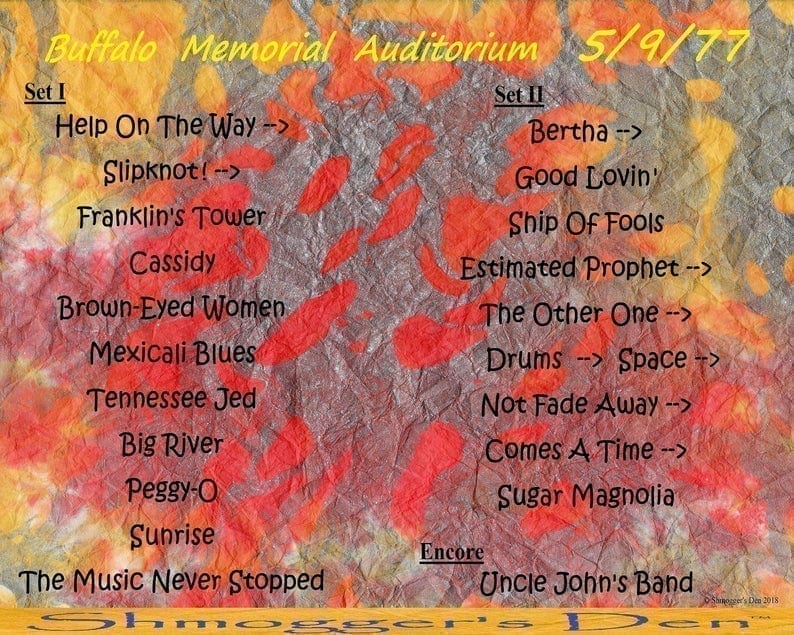
    Starting with a “Help on the Way” > “Slipknot” > “Franklin’s Tower” opening trio, the energy takes off over more than 30 minutes to start the show. From there, stand out versions of “Cassidy,” “Tennessee Jed” and a set closing “The Music Never Stopped.” This first set stand out on its own as one of the best you’ll find among 70s Dead shows.

    The second set kicks off with “Bertha” and The Rascals’ “Good Lovin,” before impressive versions of “Ship of Fools” and “Estimated Prophet.” With Donna and Keith Godchaux on board for this journey, the show features a pair of “Not Fade Away” and “Comes a Time” that stand up to any pairing from the previous night in Ithaca.

    Grateful Dead Buffalo
    Order a puzzle of this tape cover here

    Including the shows on May 5 in Boston and May 6 in New Haven, May 1977: Get Shown The Light covers all four incredible shows, a stellar component of one of the Dead’s best years. Enjoy these two shows from Ithaca and Buffalo, a true sign that the Grateful Dead perform with the highest caliber when in the Empire State.

  • Celebrate the legendary Grateful Dead show at Barton Hall, performed 46 years ago today

    It was 46 years ago today that one of the most notable Grateful Dead shows ever was performed at Barton Hall at Cornell University on May 8, 1977. One of the most revered and traded shows in the band’s history, the Barton Hall show is a thing of legend, a perfect way to introduce new fans to the band and a performance for the ages with stand out versions of numerous Dead songs.

    The band played its first of three shows at Cornell (1977, 1980, and 1981) on May 8, 1977, and were booked by the Cornell Concert Commission after some troubles with booking live acts in the years prior. However, this was not the first live campus appearance from the Grateful Dead members. Jerry Garcia Band had performed at Cornell’s Bailey Hall less than two years prior on October 27, 1975. The lineup for the May 1977 show included the core of Jerry Garcia, Phil Lesh, Bob Weir, Mickey Hart and Bill Kreutzmann, as well as Donna and Keith Godcheaux.

    grateful dead barton hall
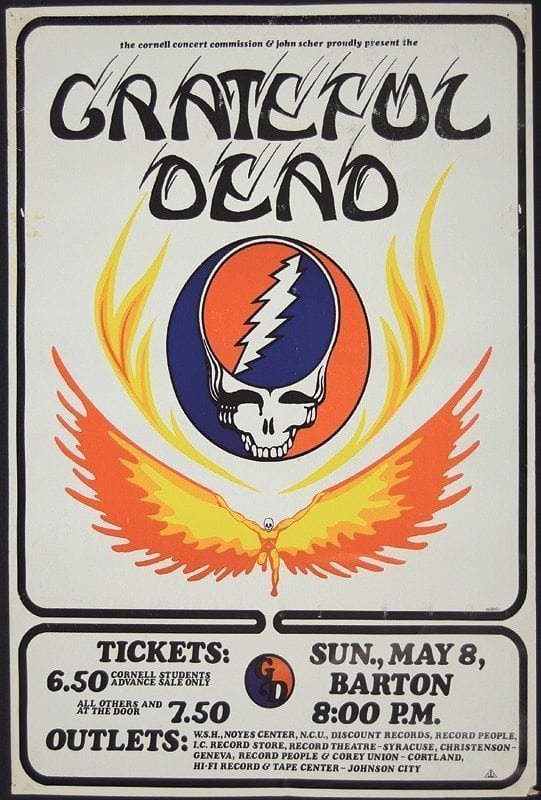
    Cornell ’77 Poster designed by Cornell alumnus Jay Maybrey

    In past years, the Cornell Chimes have commemorated the day with a performance of Grateful Dead tunes on a set of bells housed in historic McGraw Tower. One of the university’s oldest musical traditions, the 21-bells are played primarily by student chimesmasters.

    Read our review of Peter Conners’ ‘Cornell ’77’ and our interview with then-Cornell freshman Larry Reichman who took photos at the legendary show for his book Barton Hall 5/8/77.

    Grateful Dead at Barton Hall, Cornell University, May 8, 1977

    Set 1: New Minglewood Blues, Loser, El Paso, They Love Each Other, Jack Straw, Deal, Lazy Lightnin’, Supplication Blues, Brown Eyed Women, Mama Tried, Row Jimmy, Dancin’ in the Streets

    Set 2: Scarlet Begonias > Fire on the Mountain, Estimated Prophet, St. Stephen > Not Fade Away > St. Stephen, Morning Dew

    Encore: One More Saturday Night

  • In Focus: Mikaela Davis Kicks Off Spring Residency At Funk ‘n Waffles In Syracuse

    A quick walk through Syracuse’s Armory Square on the evening of Thursday, May 4 would have provided an astute listener the sounds to give hope that another winter was behind us.  Conversation drifted from sidewalk tables, birds sang from nearby trees, and the music of Mikaela Davis poured from Syracuse’s Funk ’n Waffles, as the band kicked off their “Here Comes Sunshine” spring residency.  This was the first of three scheduled performances at Funk ‘n Waffles for the band.

    Davis, a native of Rochester, is a classically trained harpist who has toured extensively over the last decade.  She has built the reputation of being one of the brightest rising stars in the music industry.  In 2018 she released her debut solo album, Delivery.  Soon after the release, she joined forces with her backing band Southern Star.  The band, who consist of brothers Shane (bass guitar) and Cian McCarthy (guitar), Alex Cote (drums) and Kurt Johnson (pedal steel, guitar), have compiled an impressive touring resume. They have previously shared the stage with artists such as Bob Weir, Bon Iver, Lake Street Dive, and will tour with The Mountain Goats and later this year.  The five members have contributed to the band’s unique and refreshing sound.

    Of late, the band has become known for their seasonal residency concerts;  three concerts over consecutive weeks in the same city.  The concert consists of two sets of music; one set of original music, and a second set of Grateful Dead covers. After selling out many residency shows across New York State this past winter, the band have again returned for a spring slate.  

    Shortly after 8pm the band took to the stage and launched into the groovy “Don’t Stop Now”.  The song’s drum and bass rhythm would soon be joined by the familiar sounds of Davis’s harp plucking and the night would be under way.  The first set would consist of tracks from 2018’s Delivery as well as offerings from the band’s upcoming release And Southern Star.   The songs placed Davis’s talents on full display, with her vocals and signature harp style blending beautifully with the band’s accompaniment.  A highlight of the first set would be the band’s performance of “Far From You”, the the hauntingly beautiful first offering off of And Southern Star.

    After a short intermission, the band would return to the stage for a set consisting entirely of Grateful Dead covers.  The stage, which was draped in bohemian decor, offered a fitting backdrop for the remainder of the evening.  During this portion of the evening, the band’s musical talent’s were really able to shine.  Grateful Dead classics turned in to musical jam sessions, while the near capacity audience filled the area closest to the stage and danced along.  During one jam session, Davis abandoned her seat at the harp, and each band member took a different percussive instrument.  They led the audience on an extended drum solo jam, much to the audiences’ delight.  

    After a brief encore, the band returned to the stage and closed out the evening with their rendition of Grateful Dead’s “Bird Song”.  The combination of Davis’s vocals and harp playing allowed for the classic track to soar to new heights.  The evening’s combination of original music along with Grateful Dead classics make for an evening of must see music.  Be sure to catch the band on one of their upcoming residency shows.  

    Mikaela Davis Residency Shows

    5/8 – Ithaca NY – Deep Dive

    5/9 – Buffalo NY – 9th Ward at Babeville

    5/10 – Albany NY – Parish Public House

    5/11 – Syracuse NY – Funk ‘n Waffles

    5/15 – Rochester NY – Lilac Festival

    5/16 – Buffalo NY – 9th Ward at Babeville

    5/18 – Syracuse NY – Funk ‘n Waffles

    5/19 – Albany NY – Parish Public House

  • Billy Idol Energizes Fallsview Casino

    Friday, May 5th was the return of Billy Idol to Niagara Falls at the Fallsview Casino in Ontario, Canada. Before Billy Idol took the stage, Kelsey Karter & The Heroines opened the night with their unique blend of rock and pop. The energy of the crowd was palpable as they eagerly awaited the start of the concert.

    Unfortunately, the band faced some challenges as two of their members were denied entry into Canada, resulting in a more mellow set than they had originally planned. Despite this setback, Kelsey Karter & The Heroines still impressed with their impressive vocals and dynamic stage presence.

     Kelsey Karter

    Kelsey Karter’s voice was a highlight of the performance, soaring effortlessly over the band’s catchy melodies. Their set included original songs such as “Bad News,” “Harry,” and “God Knows I’ve Tried,” showcasing their songwriting skills and musical prowess. Despite the unplanned changes, Kelsey Karter & The Heroines still managed to get the audience excited for the main event. Their performance was a great warm-up for Billy Idol, setting the stage for an unforgettable night of music and celebration.

    Overall, the night was a success, with Kelsey Karter & The Heroines paving the way for Billy Idol’s explosive performance. Despite the challenges they faced, they still managed to put on an impressive show and get the audience hyped up for what was to come.

    Billy Idol

    The setlist was fantastic, featuring a mix of Billy Idol’s classic hits and fan favorites. The show started with “Dancing With Myself,” a Generation X song that got the crowd pumped up right from the start. Other hits like “Cradle of Love,” “Flesh for Fantasy,” and “Eyes Without a Face” had everyone singing along. Steve Stevens’ guitar solo was a real showstopper, with him playing Led Zeppelin’s “Over the Hills and Far Away” and “Stairway to Heaven” to the delight of the audience. “Mony Mony,” a Tommy James & the Shondells cover, got the crowd moving and grooving.

    Billy Idol

    The setlist also included lesser-known tracks like “Running From the Ghost” and “One Hundred Punks,” which showed off the depth and range of Billy Idol’s music. The Blue Highway/Top Gun Anthem medley was a lovely tribute to the late composer Harold Faltermeyer. The encore was phenomenal, with Billy Idol belting out “Hot in the City” and “White Wedding.” The night ended on a high note with the entire audience singing along to “Happy Birthday to You” in honor of Steve Stevens.

    Billy Idol

    Overall, the Billy Idol concert at Fallsview Casino was an unforgettable experience. The setlist was impressive, and the performance was top-notch. Billy Idol and his band proved that they still know how to rock the stage after all these years, and the celebration of Steve Stevens’ birthday made the night all the more special. If you ever get a chance to see Billy Idol live, we highly recommend it! For more information about the tour, and to see Idol live, visit here.

  • Brooklyn’s 79.5 Drops New Single “Long Term Parking” Ahead of New LP and Tour

    Brooklyn-based R&B/Soul band 79.5 has had a busy year – their new single, “Long Term Parking,” was released with an accompanying music video ahead of their self-titled sophomore LP out May 5 .

    The band’s tour will make a stop at their home base at Brooklyn Made on June 2. The summer-ready record has earned support from KCRW’s “Today’s Top Tune”, Under The Radar, CABBAGES, SPIN, Ones To Watch, and more. 

    Cover art for “Long Term Parking” the single 79.5 released ahead of their self-titled second LP with a supporting music video. Credit: Charm School Media.

    The band’s self-titled LP takes fans on a magical journey from start to finish, and it’s safe to say 79.5 will relay this same energy live on their tour. “Club Level” starts the LP off perfectly, with a disco sound that makes you want to get up and dance. “Long Term Parking,” perfectly portrays the feeling of being in a relationship so powerful and complicated, that even with a tragic ending, the love forever remains. Other highlights include “B.D.F.Q.,” and “Feel Like Dancin’.” Brooklyn’s 79.5 are sure to have a long and successful career ahead of them.

    Named after an imaginary radio station, Brooklyn’s 79.5 was formed in 2010 by Kate Mattison, who was later joined by singer and rapper Lola Adanna and sax player/flautist Izaak Mills with drummer Caito Sanchez and bassist Andrew Raposo rounding out the rhythm section. The sound of 79.5 is full-bodied and straight from the heart—recalling the thrilling work of Patrice Rushen and the type of dance music that’s been the beating heart of New York City for centuries. Prior to their upcoming self-titled LP, 79.5 self-released an album, Predictions, in 2018.

    Music by 79.5, including their upcoming self-titled LP, is now streaming, and tickets for their upcoming tour, which includes a show at Brooklyn Made, is out now.

    79.5 Tourdates

    5/8: Seattle, WA @ Madame Lou’s

    5/11: San Francisco, CA @ Rickshaw Stop

    5/12: Los Angeles, CA @ The Paramount

    6/2: Brooklyn, NY @ Brooklyn Made

    6/24: Philadelphia, PA, @ Johnny Brenda’s

  • Perpetual Groove bring ‘Sweet Oblivious Antidote’ to Albany

    It was a heavy night of sonic improv and heavy themes at Lark Hall on April 26th, when enduring jam band veterans Perpetual Groove made their long-awaited return to Albany.  Tackling topics of loss and regret, redemption and hope, the band was at the top of their game and demonstrated a level of musical maturity and precision that can only come from decades of playing together.  Commemorating 20 years since the group’s breakout album, Sweet Oblivious Antidote, the evening also marked the debut of the venue’s brand new disco ball.

    Perpetual Groove made their Lark Hall debut on 4/26/2023

    Kicking things around 8pm, The Social Assassins got things off to a loud and progressive start.  Featuring fusion guitarist virtuoso Gabriel Marin of Consider the Source, the band has only played handful of live shows together since their debuting in October of last year.  Marin, along with his trademark Vigier double neck guitar and a bevy of effects pedals, took us on a sonic journey through instrumentals like “Begrudging Acquiescence” and “The Red Hour,” while his high energy band of Assassins pummeled away on songs like “Hora Attik” and “Blood Boi.” Playing before a moderate crowd of concert goers on this Wednesday night, the band turned in a max effort performance for those who were there to appreciate it. A fusion of eastern influences mixed with everything from metal and disco, The Social Assassins surprised everyone with their unique sound, especially on their set closing version of A-ha’s classic sing along “Take On Me.”

    Watch fan shot footage of Social Assassins performing “Take On Me” at Lark Hall on 4/26/23

    After a brief intermission, it was officially time for Perpetual Groove to launch the Lark Hall crowd into orbit. Originally formed in 1997, the Athens, GA based quartet opened their single set performance with “Save For One” from 2007’s Live Love Die album. Sounding fantastic from the opening note to the last, guitarist/vocalist Brock Butler would lead P-Groove straight into a heady version of “Stealy Man” that saw the crowd let out collective cheers and head bangs when it’s extended jam dipped into the ‘heavy’ section before shifting gears into the first cover of the night with The Cars classic song “Drive,” and then finally returning to “Stealy Man” to complete an impressive 30+ minutes of uninterrupted music to start the show.  After a few welcoming words, the groove would pick up again with another oldie in 2005’s “Andromeda.” 

    Watch fan shot footage of Perpetual Groove “Stealy Man” and “Drive” at Lark Hall on 4/26/23

    Despite it being the 20th anniversary of the bands Sweet Oblivious Antidote album, Perpetual-Groove would only play one song from it, “TSM2.” Laying down the tastiest of bass lines, Adam Perry stole the show next on a well-received version of “Crockett and Tubbs” that got the whole place dancing. A bit of a deep cut in “Cairo” was next, allowing keyboardist Matthew McDonald a chance to stretch out both musically and physically. The burley chairman’s other-worldly synth textures were magnified all evening long thanks in part to the venue’s brand-new disco ball that was also making it’s Lark Hall debut during this performance.    

    It’s been 20 years since Perpetual Groove released their breakout album Sweet Oblivious Antidote

    Perhaps the highlight of the show came next when P-Groove would uncork a monstrous version of the hard rocking “Speed Queen” bolstered by Butler’s trademark precision and the heavy hands of the newest member of the band, drummer Darren Stanley, who joined in 2022 after spending time with Jimmy Hearing and Col. Bruce Hampton. The thunderous and cathartic peak would seamlessly transition into a beautiful and introspective version of “Out Here,” a longtime live favorite that was only recently given the studio treatment. Following that up with one of Butler’s most personal songs was “It Starts Where It Ends.” Wailing away on his signature Stratocaster with eyes closed and his back arched, the song featured some of the most expressive playing of the night. Seamlessly transitioning into the set closing “Space Paranoids,” the band performed like a well-oiled machine and spoke a musical language unto themselves, effortlessly communicating changes just by exchanging glances at each other.  

    Watch fan shot footage of Perpetual Groove performing “It Starts Where It Ends” during their Lark Hall on debut 4/26/23

    Rather than go through the typical rigmarole of exiting the stage prior to the encore, P-Groove would simply tell fans this will be their last song of the night and thanked them for coming out to their Lark Hall debut.  Opting to go with a crowd-pleasing cover of Talking Heads “This Must Be the Place (Naïve Melody),” coincidently the same song had also been covered by Ryan Montbleau at the venue just one week prior. Whether by choice or by happy accident, an agreeable theme appears to be emerging at Albany’s newest concert spot.  After yet another night of stellar musicianship,  improvisation and overall good vibes, if Lark Hall isn’t the place, then I don’t know what is.

    Perpetual Groove | April 26, 2023 | Lark Hall | Albany, NY

    Setlist: Save For One > Stealy Man > Drive* > Stealy Man, Andromeda, TSM2, Crockett & Tubbs, Cairo, Speed Queen > Out Here, It Starts Where It Ends > Space Paranoids

    Encore: This Must Be the Place (Naïve Melody)**

    *The Cars cover

    **Talking Heads cover

    Social Assassins | April 26, 2023 | Lark Hall | Albany, NY

    Setlist: Begrudging Acquiescence, The Red Hour, Hora Attik, Blood Boi, A Well-Placed Pen, Take on Me*

    *A-Ha cover

  • Overhand Sam and Bad Weapon Lead Strong Bill at the Bug Jar

    Sam Snyder is a guitar slinging legend on the Rochester scene, most notably as a member of Maybird, but if you’ve seen live music in town for any period of time, you’ve likely seen him play with countless bands. He has the highly unusual method of playing overhand, which is where the more familiar name Overhand Sam comes in. It seems like it would be inhibitive, or perhaps a fun gimmick, but neither is close to the truth. He’ll turn heads first with his style, but his playing commands full attention soon after.

    His band, Overhand Sam and Bad Weapon, rose from the ashes of the great Thunder Body. Dennis Mariano and Snyder were both guitarists in that band, and Benton Sillick played trumpet. With Snyder still on guitar, Mariano on drums, and Sillick on bass, the core of Overhand Sam and Bad Weapon was born. They’ve been kicking around town with sporadic shows for years. 2023 however has seen them break out of relative obscurity with more shows, a fuller tighter sound and a greater sense of purpose.

    At their headlining show at the Bug Jar on April 29, the Weapons were set to stun. Rounded out with Sam Hirsch on keys and Cooper Alexander on percussion, they took the stage and promptly erupted into a manic flourish of sound. The audience didn’t have much chance to get their bearings. The opening salvo called them into the room like a siren song, but they walked right into a hold-on-for-dear-life situation. The trap set, the prey caught, the band relented and settled it into a nice groove. Spinning heads reoriented into the more comfortable rock n roll head bob.

    They weren’t in any rush, letting the grooves completely permeate the room and melt into the appropriately trippy walls and surroundings. Snyder broke in with vocals here and there, but the instruments commanded the night. Mariano’s drums were a maelstrom, pulling and pushing the music into new directions at will. Guitar, bass, keys and percussion swirled into one, sending off a typhoon of psychedelia. Snyder then took control, showcasing his shredding creds with piercing solos. He and Mariano found themselves in cooperative battles, and the victims in the audience were more than happy to submit and surrender.

    Songs flowed from one to the next, flipping from jaunty and hooky to manic and driving to rhythmic and rocking. The set consisted mostly from their album, Bad Weapon. Initially out as a limited release vinyl, they just recently re-released it digitally, giving anyone with internet instant access to these stellar sounds. Highly recommended!

    Another album recently out that is a must-hear is DM Stith’s Fata Morgana. The singer brought along folk duo Archimedes to present his new tunes, their gorgeous harmonies and sparse guitar accompaniment gave his stellar songs a beautiful rendering on stage.

    Stith returned to Rochester during the pandemic after spending time in New York City, eventually working toward the music for the album, which is named for a phenomenon that occurs on Lake Ontario, a sort of mirage appearing just over the horizon, which fit in with the album’s theme of grace in nature. He described Rochester as cozy and welcoming, and that would be a pretty spot on descriptor of the music as well. It was about as lovely a set as you’re going to get at the Bug Jar.

    Second up on the evening was Sun Parade, returning to the Bug Jar from their home in Northampton Massachusetts for the first time in many years. Missing their keyboard player, they played as a quartet, two guitars, bass and drums. Overhand Sam was playing from a re-released album, Stith playing from his brand new album, so it was only appropriate that Sun Parade was playing a bunch from their not-quite-out-yet-not-even-quite-finished album. Decades worth of rock influence came together for some catchy and groovy tunes that delighted the crowd. And a delighted and engaged crowd in turn delighted and impressed the band who were genuinely excited at the positive responses to their music. Hopefully they’ll be back a bit sooner this time, with new album in tow.

    Each set took on a life of it’s own, it didn’t feel like one was opening for another. It was almost like getting three shows for the price of one, and for twelve bucks that was money well spent!

    Overhand Sam and Bad Weapon continue their busy year with a show at Three Heads Brewing on Saturday, May 20. Don’t miss out!

  • A Sold Out Show at Irving Plaza for Valley on “Lost in Translation Tour”

    On Friday, April 28th, the line of eager Valley fans spilled from the doors of Irving Plaza to wrap around the block. Despite the misting rain, the energy pulsing in the camped-out line was warm.

    Photograph by Emma Dowd

    On their “Lost In Translation Tour,” Valley sold out their New York City show. As the venue filled, it became increasingly undeniable that Valley deserved to be at a larger venue. They had performed at the lovely Irving Plaza a year prior, and since then it was clear they’ve collected a larger fanbase.

    Photograph by Emma Dowd

    The opener for Valley , Aidan Bisset, kicked off the night with his pop-grunge music. The crowd immediately received Bisset’s stage presence and relatable lyrics. He sang of toxic romances, new love, and break-ups. With two electric guitars and a drum set, he commanded a fast rhythm and infectious persona of youthful fun and passionate intensity. Bisset performed some of his hits, three unreleased songs, and even took on the vocally renowned cover, Kings of Leon’s, “Sex On Fire.” Bisset engaged with the crowd, taking their BeReals, getting level to level with them to chat, and wooing over new fans. Before leaving the stage, he graciously thanked Valley for having him on their tour.

    Photograph by Emma Dowd

    The set change was fascinating. Usually, microphones are changed and some of the instruments are shifted around. Valley’s upcoming set brought on multiple box-screen televisions to be stacked on top of each other, an ambiguous rectangular frame of notable size with drapes hanging over it, and countless additional lights. Valley’s pre-show setlist had the crowd belting familiar songs in each other’s embrace. Fog began to roll down from the balcony level and off the stage. This grabbed hold of the crowd’s attention. When the lights suddenly shut off and Irving was pitch black, the curious murmur rolled into an uproar of excitement.

    Photograph by Emma Dowd

    The TVs stacked on top of each other switched on. Their screens matched the static sound emanating overhead. Flashes of the band members’ faces and old television clips emerged sporadically through the static. The lights slowly faded from a hint of color to a bright broadcast of a Valley inspired color palette. Bass vibrated the floor, and the crowd stood in awe.

    Eventually the band ran onto the stage. Drummer, Karah James, took her throne behind the drums. Guitarist, Michael Brandolino, and bassist, Alex Dimauro ran to their instruments. They played an adrenaline inducing intro for their lead singer, Rob Laska. Laska ran onto the stage, with an electric guitar slung around his shoulders. The crowd’s response was deafening.

    Photograph by Emma Dowd
    Photograph by Emma Dowd

    Valley opened with one of their most popular songs, “There’s Still A Light In The House.” The song is a tribute to love and the endless possibilities of finding one’s self in New York City. The lyric on the bridge that goes Is it New York? Or Heaven? I can’t think twice now, was sung proudly by the New York City crowd. Laska, infatuated with the crowd’s energy, encouraged their singing. The audience sang back to the band with one collective voice that shared an affinity for their conversational lyrics.

    As the show went on, the performance became more personal. Laska jumped into the pit that separated him from the crowd to sing with some fans. In between songs, he conversed and told stories about band memories in New York City. Laska reminisced, “New York City is special to us, we wrote our first record in this damn city! We’ll be coming back forever.” This led to Valley announcement of their new record Lost In Translation, set to release on June 23rd.

    Photograph by Emma Dowd

    The draped frame that was brought onto the stage during set transitions became a crucial filament of the show. Over half way through the concert, the TVs turned back on and the lights dimmed. Laska approached the frame and tore the drape off to reveal a reflective mirror surface with strobe lights hanging from it. A phone began to ring, and Laska tugged a landline phone from the structure. He sang one of their hits, “A Phone Call In Amsterdam,” into the phone. The entire show was an artistic performance, rather than a band just performing on stage. The appreciation for the theatrics and the attention to detail resembled The 1975’s “At Their Very Best Tour.”

    As Valley trailed towards the end of their setlist, Laska emphasized his gratitude for everyone choosing to be at their show. “There’s a lot of cool shit going on in New York City on a Friday night, so I’m happy we all found each other in this vortex.” Underneath the twirling Irving disco ball, the fans really unified in their fandom. He invited everyone to join them in a state of appreciative awareness for the last couple of songs. Without a clear goodbye, Valley left the stage. The crowd was not going to leave without an encore.

    Photograph by Emma Dowd

    Heads turned in a whiplash from the front of the stage to the back of the venue. A murmur of eager confusion echoed throughout the venue. Suddenly, a spotlight shone on the back of the crowd. Laska began to make his way through the crowd towards the stage, singing “Paper Cup (sorry for myself).” The audience parted like the red sea for him to make his way towards the front of the crowd, where he sang for the remainder of the song. The rest of the band took to the stage, and Laska joined them to finish out their set with their popular song, “hiccup.”

    Photograph by Emma Dowd

    The encore applause was impressive. The sounds of cheers and screams took over Laska’s volume as he thanked the crowd. All the band members joined him at center stage to take their hard-earned bow. Karah James tossed her drumsticks, kisses were blown, and hands clasped in praise for New York City. Laska closed out the night with a sweet send off,  “Take care of each  other, love one another, and we’ll see you very soon!”

    Photo gallery by Emma Dowd

  • In Focus: Giant Panda Guerilla Dub Squad at The Westcott Theater

    On April 22 at the Westcott Theater, reggae jam band Giant Panda Guerilla Dub Squad performed the last show of their 2023 Tour. The band was originally founded in 2001 in Rochester, best known for their authentic reggae and dub live performances. 

    Perri Sage Photography

    The energy of the night started strong at the Westcott, with two opening performances Flying Object and Dirty Blanket. Flying Object, is a smaller group who feature an upright bass, keys and drums into their music. The band kicked off with an upbeat spunky groove engaging the audience awaiting Giant Panda. 

    Dirty Blanket incorporates guitars, upright bass, mandolin and banjo. For the past six years the band has remained local to the Finger Lakes Region. Their song “Better Days” led the crowd roaring and dancing as they closed their act and gave a warm welcome to Giant Panda Guerilla Dub Squad. 

    Perri Sage Photography

    Giant Panda consists of James Searl, Chris O’Brian, Dylan Savage, Tony Gallicchio and Eli Flynn. Some of their top hits include “Time and Reflection,” “Love You More”, “Steady,” “Trouble Deep” and “Good Love.” This tour honored their latest album Love In Time released on April 7th. The diversity of the songs and various production styles truly compliment the album as a whole. This was one of their first times working on music with outside collaborators. 

    Perri Sage Photography

    Although it was announced to be the last show of their 2023 tour, Giant Panda did a fantastic job and put on quite the show for their fans at the Westcott Theater. As fans danced to their mix of reggae, electric beats and rhythm, the band members yelled out to the crowd while engaging with one another on stage. The band is notable for connecting people to the sound of their music and authentic roots. We look forward to what the band has to come as fans anticipate future performances.