Author: ryan bieber

  • Tuning In With The Lost Radio Rounders

    Remember the days before Spotify and Apple Music? The feeling of huddling besides a radio as you waited for your favorite song to maybe come buzzing across those tinny speakers? Even if you don’t, you can find a bit of that old-time magic by listening to the Lost Radio Rounders, an acoustic-Americana trio giving a bit of polish and shine to historic tunes.

    From left to right, Michael Eck, Tom Lindsay and Paul Jossman of the Lost Radio Rounders.
    From left to right, Michael Eck, Tom Lindsay and Paul Jossman – The Lost Radio Rounders

    The Lost Radio Rounders are composed of Michael Eck, Tom Lindsay and most recently Paul Jossman, who joined the band in 2021. Together, they play a range of instruments from banjo, to mandolin and even a dobro (a type of resonator guitar). 

    But it’s their collective voices that are the star attraction, more specifically the songs they sing and the stories they tell.

    The Lost Radio Rounders have carved out a niche with shows that are presented as “themed programs,” each of which covers different aspects of America’s rich and varied musical history. 

    “We wanted to do something a little different, which was present these collections of songs, themed programs that sort of told a story,” band member Tom Lindsay said. 

    One such program titled, “Cowboy Songs and Frontier Ballads” finds the band pulling western ballads and folk music from the ranch and tv shows depicting the lone rancher life. “Song of Our Empire State” pulls listeners from the Big Apple to the relaxed rolling hills of upstate. 

    Politics and Patriots is another unique program featuring American presidential campaign songs. 

    “White House Blues” as performed by the Lost Radio Rounders.

    “We look back to the early 1800s and there’s no PA system, there’s no TV, there’s no radio when the politicians were trying to get their message out,” Lindsay explained. “They would create these little pamphlets called songsters and they’d have sent some lyrics in them about how great their candidate is and how terrible the other guy is.”

    None of the songs or programs feature original tunes; rather they’ve been passed down through the generations. Lindsay has also served as a teacher of New York State cultural and music history among other things. He has devoted much of his free time to cataloging old songs typically passed through word of mouth or through books.

    “What we’re trying to do is keep the songs alive to keep the viewpoints of those people who created them alive,” Lindsay said.

    But he also isn’t opposed to making a few stylistic tweaks of his own.

    “With 20 verses of a song, we’re going to look at that song, we’re going to say which six of these verses tell the story in the best and linear way,” he said. “We are not going to be “Mr. Authentic” and bore audiences in 2023.”

    The Lost Radio Rounders performing live.

    The band still keeps some “old-timey” traditions though. When they play live, all three members huddle round a single condenser microphone to give a vintage sound.

    But covering American folk tunes isn’t where Eck or Lindsay saw themselves nearly half a century ago. The two met on the local gig circuit and collaborated on a punk rock album in the 80s. 

    Now their audience is a bit different. The Lost Radio Rounders mostly play private shows, a lot of which are at senior centers and libraries.

    “I think that if you talked to Michael and I, when we were 18 and told us we’d be doing this when we’re older, we’d be horrified,” Lindsay admitted. “But it’s wonderful, because you go in, and you play for these people … and the focus is on you.”

    The Lost Radio Rounder's first album, released in 2009.
    The Lost Radio Rounder’s first album, released in 2009.

    Put simply, the raucous energy of a crowded bar isn’t conducive to their play style, Lindsay said, which relies on giving a detailed history of the song’s origins. 

    “We will not get the attention in a bar and nightclub situation most of the time, to give context to material … and we just feel that that’s our strongest point,” Lindsay added.

    A private audience on the other hand is more open to the holistic experience the Lost Radio Rounders offer.

    “They want to hear more than just the songs,” Lindsay said. “In other words, it’s our philosophy, a good song is nice, but a good song with a good story behind it is even better.”

    The band took a brief hiatus when member Michael Eck suffered a stroke in 2021. This prompted the addition of Paul Jossman on banjo, who like Eck is an inductee to the Capital Region Thomas Edison Music Hall of Fame.

    Jossman’s addition added new life to the band’s sound, Lindsay said. 

    “It really injected new life and took us to some places we hadn’t been before and maybe made us look at how we arranged older songs and arrangements,” Lindsay explained. “Quite frankly, after Michael had the stroke, Paul Jossman saved us. He’s the guy who pretty much saved this duo and made it a trio.”

    “The Bluestone Quarries” as performed by the Lost Radio Rounders

    Eck still holds his own however. Although he needs to sit down at times during live performances, his playing is just as strong as it once was.

    “Michael is one of those human beings who have to play music, you know, it’s like, it’s like oxygen for him,” Lindsay added.

    But if you are interested in hearing Lost Radio Rounders live, they have a few public shows on the agenda. The band will be playing at the Bennington Museum in Vermont on June 9th at 5pm. On August 27th, they will play at The Linda WAMC Performing Arts Studio in Albany at 8pm. And just announced, they’ll be back at Troy Savings Bank Music Hall on October 10.

    The band also has four studio albums, the most recent of which was released in 2016.

    Upcoming Lost Radio Rounders shows
    Friday, December 22 @ 8:00 – Caffe Lena

    Rounders co-founder Michael Eck can’t wait for the bands December 22 Caffe Lena presentation of
    the Holiday Sampler, a program he says is “A wonderful mix of songs about the winter season, sacred
    and secular Christmas carols, familiar tunes and hidden gems.” Banjo man Paul Jossman added that
    “Tom has created a musical setting Robert Frost’s “Stopping by Woods on a Snowy Evening” that
    people will really enjoy, and all in all, it will be a great way to close out the musical year!”

  • New York Series: The True Story Behind Ace Frehley’s “New York Groove” 

    Ace Frehley turns 72 on April 27th, proving you are never too old to keep rocking and rolling. While the famed guitarist is most known for his prominent role in the hard rock group KISS, he has also enjoyed a fruitful solo career. 

    Perhaps one of his biggest solo hits is “New York Groove” – an anthemic encapsulation of Frehley’s youthful spirit and the city that drove him to new heights. But it might surprise you to hear that he didn’t actually write the tune. And that it was popular in Europe long before it ever reached America.

    Ace Frehley was born Paul Daniel Frehley in 1951. He grew up in the Bronx and first picked up a guitar at the age of 14. It was here in New York City that Frehley saw the Who and Cream perform live, further solidifying aspirations of rock stardom into his young, impressionable brain.

    Frehley cut his teeth on the local NYC scene throughout the late 60s and early 70’s. It was during this time that he answered an ad calling for a guitarist in a hard rock group. It read, “Lead guitarist wanted with flash and ability.”

    That fateful listing brought him into the fold of bassist/singer Gene Simmons, rhythm guitarist/singer Paul Stanley and drummer Peter Criss –  KISS was officially born.

    The band was signed to Casablanca Records in November 1973 and for most of the decade they toured around the world, skyrocketing to the top of their charts. Catchy choruses, searing guitar riffs and a flair for the theatrics helped the band stand out in more ways than one. A string of platinum albums and sold-out tours lasted throughout the late 70’s.

    KISS 1983 - Paul Stanley/Getty images  ace frehley
    KISS 1983 – Paul Stanley/Getty images

    Despite the hectic schedule, all four members of KISS recorded and released respective solo albums on the exact same day in 1978. Frehley’s project was self-titled and featured what would become one of his most popular solo tracks: “New York Groove.”

    While the song feels representative of Frehley’s own experiences in New York, the track is actually a cover, originally written by Russ Ballard and recorded by a glam-inspired rock band called Hello. The original track achieved a fair amount of success in Europe, charting at #9 in the U.K. and #7 in Germany. It was reportedly recorded in less than 5 hours in a studio just north of London.

    Ballard said in an interview that he had the idea for the song while on a plane ride to NYC.

    I felt that’d be a good title for a song,” he said. “The whole idea was of someone going back to New York and singing about the experience.”

    The song encapsulates the feeling of a nostalgic return to a place once called home. It starts with the lyrics: 

    Many years since I was here
    On the street I was passin’ my time away
    To the left and to the right
    Buildings towering to the sky, it’s outta sight

    After years of relentless touring, one would think Frehley could relate to the feeling of coming home for the first time in a while. But apparently, Frehley was not enthusiastic about recording the song; he had never even heard the track before covering it. But alas, the label wanted a more commercial song on the album and so, Frehley went ahead with it.

    In an interview with Louder Sound in 2016, Frehley put it like this:

    “A lot of people think I wrote New York Groove. It’s not a myth that I’ve perpetuated, but that’s the way it is. I wish I would’ve wrote the song, though. I would’ve made a lot more cash out of it, ha-ha-hargh!”

    While most of Frehley’s solo album was recorded in a studio in Connecticut, “New York Groove” was a late addition and was recorded in Plaza Sound Studios, right above Radio City Music Hall. 

    Ace Frehley’s hit single “New York Groove,” released September 18th, 1978

    Frehley, Simmons, Stanley and Criss all released their solo albums on September, 18th 1978. But Frehley was the only one who managed a hit single, with none other than “New York Groove. “It stayed on the U.S. charts for 21 weeks, peaking at #13.

    Frehley told Louder Sound in that same interview that there was no competition among bandmates to have the best record. But he also revealed that he hadn’t really listened to his fellow bandmates’ projects. 

    “I did put Gene’s on once,” he recalled in the interview. “When I heard his version of When You Wish Upon A Star I had to pull it off the turntable, ha-ha-hargh!”

    Origins Vol. 2, released in 2020, featuring classic rock covers such as “Good Times Bad Times” and Jumpin’ Jack Flash

    Frehley has continued to release solo projects in the past few decades. His most recent solo album, Origins Vol. 2, was released on September 18, 2020. It is a follow-up to Origins Vol. 1, released in 2016. Both consist of covers of some of Ace Frehley’s favorite songs. Still, “New York Groove” remains a signature song.

    In an interview, Russ Ballard attributes the song’s success to its simplicity. “I guess it surprised me because it’s so incredibly simple. They say a good song will always sell, and there’s a lot of truth in that.”

    “New York Groove” Lyrics

    Many years since I was here
    On the street I was passin’ my time away
    To the left and to the right, buildings towering to the sky
    It’s outta sight in the dead of night

    (Ooh) Here I am, again in this city
    (Ooh) With a fistful of dollars
    And baby, you’d better believe

    I’m back, back in the New York Groove
    I’m back, back in the New York Groove
    I’m back, back in the New York Groove
    Back in the New York Groove, in the New York Groove
    In the back of my Cadillac
    Wicked lady, sittin’ by my side, sayin’ “Where are we?”
    Stopped at 3rd and 43, exit to the night
    It’s gonna be ecstasy, this place was meant for me

    (Ooh) I feel so good tonight
    (Ooh) Who cares about tomorrow
    So baby, you’d better believe

    I’m back, back in the New York Groove
    I’m back, back in the New York Groove
    I’m back, back in the New York Groove
    Back in the New York Groove, in the New York Groove

    I’m back, back in the New York Groove
    I’m back, back in the New York Groove
    I’m back, back in the New York Groove
    I’m back, back in the New York Groove

    I’m back, back in the New York Groove
    I’m back, back in the New York Groove
    I’m back, back in the New York Groove
    I’m back, back in the New York Groove

    I’m back, back in the New York Groove
    I’m back, back in the New York Groove

  • Inside the Historic Earlville Opera House of Central New York

    New York State is home to hundreds of theaters and music venues both big and small. Each building has their own unique history and character. The Earlville Opera House, located between Madison and Chenango County, in Central New York, is no exception. 

    The Earlville Opera House in Present Day - Photo Courtesy of Earlville Opera House
    The Earlville Opera House in present day – Photo courtesy of Earlville Opera House

    The original Earlville Opera House was constructed back in 1892. It was destroyed by fires twice in its early years, but the current building has stood strong for over 125 years. As of 1974, the Opera House is listed on the National Register of Historic Places. Although the village Earlville has a population of less than 800 people, the Opera House makes this small town a stunning cultural landmark.

    Over the years, the Opera House has served many roles within the community. In the late 1800s and all the way to the Roaring Twenties, the venue was a stage for vaudeville acts, three-penny operas and traveling medicine shows. At one point, it became a silent movie house and at another served as a public auditorium for town meetings and even high school graduations.

    While the Opera House is now a wholly unique feature of Earlville, it wasn’t always that way. In the late 1800s when these sorts of theaters were widely popular, there were as many as six other opera houses in the adjacent towns, including Waterville and New Berlin. Over the years, they became relics of the past and faded from memory both metaphorically and literally. In Central New York, one was torn down to become a parking lot and another in Hamilton was rebuilt into apartments, while another in Oriskany Falls was destroyed by a fire. 

    The Earlville Opera House in 1892 - Photo Courtesy of Earlville Opera House and Tim Carey
    The Earlville Opera House in 1892 – Photo Courtesy of Earlville Opera House and Tim Carey

    The Earlville House experienced nearly all of these fates at one point or another. The theater first closed its doors during the Great Depression. Though it re-opened in 1937 as a theater showing “talking movies,” the Opera House closed once again in 1952 and wouldn’t see the light of day until 1971. It was bought by Joey Skaggs, an artist, activist educator and self-proclaimed “media prankster.” Before he bought the place, it was slated to be torn down into a parking lot just as the Sherburne Opera House had met its end that same year.

    Skaggs proved to be the defining difference between the two theaters. He stopped the motion to turn Earlville’s Opera House into an empty lot and instead placed the theater in the hands of a volunteer board of directors called Earlville Opera House, Inc. He sold them the theater for the grand price of $1.

    Michelle Connelly is now Executive Director of the Opera House and she says she is grateful for Joey Skaggs’ investment in the theater and community.

    “We kind of live off of inspiration and good vibes and that gains momentum when people believe in what you do and support you and it’s inspiring,” she said. “Joey’s mission and vision we keep alive … Our mission is to enrich the Central New York and Southern tier regions through the visual and performing art but also to help maintain our building here for future generations to use.”

    The interior of the Earlville Opera House

    A great deal of restorative work was needed after the theater’s 15 year hiatus. Although the building was updated in many ways, it was merely restored, not changed. The theater remains pretty much the same as when it was first built. It may not have air conditioning, but Connelly said that just adds to the old-school charm. 

    “We have a beautiful venue where we can create events that provide for shared experiences between people that create memories and form community bonds,” she said. “You can’t really articulate the worth of that… it’s absolutely priceless …  It’s an intangible thing, but that’s a byproduct of what we do.”

    According to Connelly, the theater also boasts one of the only remaining horseshoe balconies in the U.S. 

    “It’s sloped and our stage is raked which means it has a slight downward lean to it, so when the balcony also does that, it kind of meets in the middle and the acoustics are incredible in that theater,” Connelly explained.

    The horsehoe shaped balcony inside the Opera House - Photo Courtesy of Earlville Opera House
    The horsehoe shaped balcony inside the Opera House – Photo Courtesy of Earlville Opera House

    In 1976, five years after it was purchased by Skaggs, the Opera House had its first live performance in more than fifty years. It hasn’t looked back since.

    In the past, performing artists have included David Bromberg as well as Heritage Blues Orchestra, Los Blancos, Martha Redbone and Savoy Brown. This year, singer-songwriter and blues musician Carolyn Wonderland will grace the stage. Other notable acts coming to the Opera House include Hazmat Modine and Marcia Ball. For a full list of upcoming performances, click here.

    The theater is largely sustained through grants and other funding. It is well off enough that it actually administers grants of its own to artists and arts organizations in three counties: Broome, Chenango and Oswego. This year the Opera House will re-grant over $230,000 for cultural initiatives and supporting the performance arts. 

    Center stage at the Opera House

    The Opera House continues to be a fixture of the small community in more ways than one.

    In addition to the main stage, an arts cafe and outdoor courtyard allow local and emerging musicians to perform. They also have a free art gallery on site, featuring the works of local artists. There is currently a gallery on display from March 18th until April 22nd featuring painting and photography from three regional artists: Tom Schmitt, Frank Vlossak and Bill Baburchak.

    Workshops are also hosted and open to all, for a small fee. Gary Talley, lead guitarist of the Box Tops, will teach a masterclass guitar course at the theater in July as part of an Earlville guitar workshop weekend hosted by the Opera House from July 28-30th. Talley will then be doing a public performance that weekend on the 29th at 7pm.

    Connelly said being a source of community support like this ties directly into Skaggs original mission to enrich the arts of the surrounding area.

    “If you can make any kind of impact or difference in a positive way, we should,” Connelly said. “That’s the role of the arts. Arts are used to express and help people in many different ways as an avenue of expression.”

  • Main Street Armory Closed Indefinitely, Owner Responds Following Deadly Stampede

    The owner of Main Street Armory in Rochester has finally commented on a deadly stampede in which three people were killed at a Rochester concert on March 5th.

    Grammy-nominated rapper GloRilla and Finnesse2tymes were performing at the venue when rumors of gunfire created a frenzy just after the show ended around 11 pm, according to the Rochester Police Department. Some at the event have said they heard gunshots, but investigators have yet to find evidence of actual gunfire.

    A previous concert hosted inside Main Street Armory - From Main Street Armory's Facebook Page rochester
    A previous concert hosted inside Main Street Armory – From Main Street Armory’s Facebook Page

    Nevertheless, the hysteria prompted by the threat of gunfire resulted in a chaotic stampede that killed three people. At least 7 others were injured and initially treated at local hospitals for non-fatal injuries. They have since been released.

    As of March 13th, Donaldson has now commented on the incident in the form of a written statement released by the law office Gallo & Iacovangelo:

    “The Main Street Armory, Scott Donaldson, and his team are devastated by the events that occurred March 5, 2023. Our deepest condolences go out to the families, friends and loved ones of Rhondesia Belton, Brandy Miller and Aisha Stephens. Over the years, the Armory has successfully hosted hundreds of events.”

    Local Rochester news station, WHEC-TV, interviewed concertgoers who survived the stampede. “Me and the girl next to me were climbing on each other trying to get each other up,” Ikea Hayes, a concert goer told WHEC-TV.

    “I was watching my life flash before my eyes and I still didn’t know what was going on so it’s like, not only am I on the ground, scared, praying like you got to get up,” she said. “You got to move. If you stay here they’re going to keep running you over. So you got to get up. You got to move.”

    The Mayor of Rochester, Malik D. Evans said in a press conference that there would be an investigation to see if the arena had followed proper safety measures. The venue, which is a military base turned concert hall, can hold 5,000 people. However it is unclear how many people were in attendance at the GloRilla concert.

    Fans of The Struts packed the Main Street Armory. Photo by Samantha Rychlicki of NYS Musi GloRilla rochester
    Fans of The Struts packed the Main Street Armory. Photo by Samantha Rychlicki of NYS Music

    Main Street Armory has previously hosted large acts such as Panic! At the Disco, the Struts and Styx. However, the venue has had issues before. As NYS Music originally reported back in August of 2022, a concert by the heavy metal band Anthrax was canceled in August after the stage broke during an opening band’s set. 

    On Twitter, Anthrax guitarist Scott Ian wrote, “Rochester we didn’t want to cancel, we had to. The stage was broken, the venue did not fix it and it was not safe to continue the show.”

    Due to unforeseen production issues, the show tonight at the Main Street Armory in Rochester had to be canceled by both ANTHRAX and BLACK LABEL SOCIETY as it was unsafe for the bands to perform. ANTHRAX and BLACK LABEL SOCIETY do not cancel shows lightly but we could not put the health and safety of the bands and crew at risk. All of the bands tonight apologize for the inconvenience and disappointment. We will be back to Rochester to rock another time. Refunds are available at the point of purchase starting Tuesday, August 23.

    Statement from Anthrax

    Main Street Armory did pass an annual fire safety inspection in December 2022 and is compliant with all fire codes, a city spokesperson told Democrat and Chronicle. The Democrat and Chronicle also reviewed crime reports available at the venue since 2020 on Rochester Police Department’s data portal and found five incidents consisting of petty larceny and assault.

    Last Wednesday the city refused to renew Main Street Armory’s  entertainment license, so the venue is shut down as investigation is underway. The city had planned to meet with the venue’s owner, Scott Donaldson, on Wednesday to discuss voluntarily halting events but Donaldson requested to adjourn the meeting for later in the week, citing an unspecified ongoing legal matter. His request was denied by the RPD resulting in its immediate closure, according to Rochester Police Chief David M. Smith. All scheduled concerts have been canceled for the time being.

    The GloRilla crowd surge at Main Street Armory has brought to mind a similar tragedy from 2021 at Travis Scott’s Astroworld Festival. 10 people were killed in a massive crowd surge, although the incident was not related to potential gunfire.

    GloRilla tweeted on Monday the 6th after hearing about the incident. “I’m just now hearing about what happened wtf,” she wrote. “Praying everybody is ok.”

    She followed up by saying, “I am devastated & heartbroken over the tragic deaths that happened after Sunday’s show. My fans mean the world to me praying for their families & for a speedy recovery of everyone affected.”

    It is unclear when Main Street Armory will reopen or how long police investigations into the matter will last.

    “Lives were lost,” Smith said in a press conference. “We need to take steps to make sure no lives are lost in the future, if indeed this was something that was preventable.”

    Police have taken statements from several witnesses but that anyone with information is asked to call (585) 428-6720 or email psi@cityofrochester.gov.

  • The Action House: Long Island’s Forgotten Music Venue

    New York City is home to dozens of iconic music venues, from the Apollo Theater to Radio City Music Hall. But while these glamorous theaters continue to stand the test of time, others live on in memory rather than physical form. 

    Take CBGB, which closed in 2006. The dark and dingy space nurtured the emerging NY punk scene throughout the 70s, hosting the Ramones and Blondie among others. Now, the punks might be saddened to find, it is home to a high-end Italian art gallery

    But there is one venue, located in Island Park, NY that is even less talked about –The Action House – perhaps Long Island’s premier music venue in the 60’s and 70’s. It was the epitome of cool and a nurturing force for the local music scene, yet it was often overshadowed by New York City’s powerful glow.

    The Action House, located in Island Park, NY – Photo from mindsmokemusic.com

    But the Action House had its own unique vibe. It had grit, grime and a rebellious streak all its own. Part dance hall, part club (a common configuration of the time), the venue was also capable of pulling in big name acts like the Doors and Canned Heat. 

    In perhaps one of the Action House’s most infamous shows, the Doors took the stage for a two night performance on June 16 and 17th, 1967. Legend has it that on the first night, Jim Morrison slugged 15 shots of Jack Daniels whiskey back to back before taking the stage. He would attempt it again once more mid-set. While the first night was certainly one for the ages, the second night was perhaps the Door’s shortest and most lackluster performance ever. The hungover Morrison didn’t sing much, instead moaning into the microphone until his bandmates decided to drag him off the stage.

    Jim Morrison Performs at the Action House in Island Park, NY - Photo from Mild Equator
    Jim Morrison Performs at the Action House in Island Park, NY – Photo from Mild Equator

    Adding to the intrigue, the Action House was also owned by Phil Basile, a known associate of the Lucchese crime family mob. This wasn’t necessarily out of the ordinary for the era, but it did invite a world of chaos and an interesting crowd into the fold of the Action House. 

    Mike Ricciardella, drummer for The Illusion, described it like this:

    “The Action House was a wild place back then. The bouncers were nuts and very wild! The drug scene was wild! The chick scene was wild! The parking lot scene was the wildest, though. Really nuts. The parking lot was the place where the crowd hung out and got high. Inside was rock’n’roll, outside was Fantasyland.”

    – Mike Ricciardella

    Frequent performers included the Vagrants, featuring guitarist Leslie West who would eventually co-found the band, Mountain. The Hassles featured a young Billy Joel. And then there was the Vanilla Fudge. The band was actually managed by Basile, who in addition to owning the club and his various other escapades also served as an artist and tour manager.

    An Action House flyer with the Vagrants and the Vanilla Fudge on the lineup - Photo from mindsmokemusic.com
    An Action House flyer with the Vagrants and the Vanilla Fudge on the lineup – Photo from mindsmokemusic.com

    But this relationship led to some “interesting scenarios,” to put it mildly, as reported by the Long Island Press:

    “The mob-connected Action House was paying The Vagrants an exorbitant $1,500-a-night fee for a grueling 28-day-a-month schedule. This led the garage rockers to get creative with their performances. They incorporated pyrotechnics into their act, having fireworks explode as one of their songs reached its peak. One night after a performance, however, a leftover explosive wound up torching the stage along with all of the band’s instruments. This somehow did not throw them off schedule; the booking agency had them equipped with new instruments and ready to play the very next day.”

    A playbill for the Grateful Dead and The New Riders of The Purple Sage at the Action House on Nov 9-10, 1970 - Photo via concertarchives.org
    A playbill for the Grateful Dead and The New Riders of The Purple Sage at the Action House on Nov 9-10, 1970 – Photo via concertarchives.org

    Other notable performers included the Yardbirds in ‘68 and the Grateful Dead alongside The New Riders of the Purple Sage in November of 1970. (You can listen to parts of the set here)

    Shortly after the Dead’s performance in 1970, the Action House featured a series of name changes. It was briefly known as the Rock Pile, as documented on this short feature piece by the New York Times back in 1971.

    A New York Times article from 1971  when it was known as the Rock Pile.
    A New York Times article from 1971 about the Action House, when it was known as the Rock Pile.

    The club declined further in the 80’s as DJs and dance clubs began to grow in popularity

    It is unclear when the Action House officially closed its doors. As for the present, according to the blog Mind Smoke Music, The Action House was torn down over a decade ago. Back in 2018, the author of the blog found it had since been rezoned for condo development. The parking lot across the street was at the time a self-storage facility.

    Now, the Action House, a relic of a bygone area, lives on only in memory of the lucky and the damned that got to experience it in its heyday. Further tales and legends of the venue can be found in the comment sections on blog sites like Streets You Crossed, where patrons of the Action House fondly recall their own memories of the club. 

    Based on these accounts, the venue lives up it name –  a place where a lot of action went down.

  • New York Series: ”John Brown’s Body,” Song of the Civil War

    Songs are often measured by their ability to stand the test of time. “John Brown’s Body” is one of those songs that has held up even into the present day. Although the tune has gone by many names and many iterations over the centuries, the hymn turned revolutionary anthem retains its status as one of the most memorable songs of the Civil War.

    Gloria Jane 2004 Arrangement of John Brown’s Body. Vocals, Guitar, and added one chorus from another version of the song, changed the words “Shall all be free” to “Were all set free” to fit today.

    The origins of “John Brown’s Body” trace back to Southern methodist camp meetings in the early 1800s. The song “Say, Brother Will You Meet Us,” provided the framework for what would become the famous abolitionist tune. Both feature the now famous chorus, “Glory, glory, hallelujah.”

    “John Brown’s Body” as we know it was originally published in July of 1861. It was reportedly first sung at Fort Warren in Boston on May 12, 1861, and later on July 18 by the 12th Massachusetts Volunteer Infantry, according to American Music Preservation.

    Despite what many believe however, the song was not originally about the famed abolitionist John Brown. In fact, it was about a Scotsman of the same name. This “other” Brown, who served as sergeant in Boston, was well aware of his counterpart, as were his fellow soldiers. They would gleefully tease him with lines like, “His soul’s marching on.” 

    John Brown ascending the gallows. LIBRARY OF CONGRESS
    John Brown ascending the gallows. LIBRARY OF CONGRESS

    But as the song spread across infantries via word of mouth, the nuances of the original joke was lost. Everyone assumed the lyrics referred to the abolitionist who was captured and hung at Harpers Ferry a few years prior. New lyrics were added to the old ones resulting in verses like this:

    Old John Brown’s body is a-mouldering in the dust,
    Old John Brown’s rifleís red with blood-spots turned to rust,
    Old John Brown’s pike has made its last, unflinching thrust, 
    His soul is marching on!

    So “John Brown’s body lies-a-mouldering in the ground” was not originally the revolutionary sentiment it now commonly appears as, it actually began more or less an inside joke.

    Poet Julia Ward Howe would later write her own words to the tune after hearing it sung by troops on a trip she took to Washington. From this she penned “The Battle of the Hymn Republic.” Unfortunately, John Brown the Scottsman never heard this version, having somewhat ironically died early on in the war.

    The United States Army Field Band performs the famous Civil War-era piece, “The Battle Hymn of the Republic” in 2016.

    “John Brown’s Body” has been recorded numerous times in various ways. Pete Seeger covered it in 1960. Bob Dylan wrote his own song simply called “John Brown” back in 1962. In Ithaca, there is even a popular reggae band by the name of John Brown’s Body that has been together for over two decades.

    The band, John Brown’s Body combines reggae and dub.

    John Brown continues to remain relevant even today. He is honored at John Brown Farm, a state historic site located near Lake Placid, NY. It features the home and gravesite of the famed abolitionist.

    In 2021, John Brown Lives!, a nonprofit organization focused on human rights and education created a proposal back in 2021 with plans to build a visitor center and conference center. Just last week, there were even two meetings held to receive public feedback on the ongoing plans.

    John Brown's home at John Brown Farm in North Elba, NY, 3 miles southeast of Lake Placid. capecodphoto/Getty Images
    Brown’s home at John Brown Farm in North Elba, NY, 3 miles southeast of Lake Placid. capecodphoto/Getty Images

    Change however, might not be as fast as Brown probably would have liked. The state agencies expect, following drafts and additional public comment periods, a final plan to be adopted by early 2025 according to Times Union.

    Still, John Brown continues to live a life of fame long after his death, his name memorialized in both song and minds. Even if the tune was never meant for him, his soul indeed goes “marching on “ long after death.

  • The life of Television frontman, Tom Verlaine

    Songwriter, singer and guitarist Tom Verlaine embodied the ideals of punk in more ways than one. From turning down a record deal from Clive Davis to inspiring the Ramones themselves, the famed frontman of the band Television left an indelible mark on the punk/alternative music scene of the 70’s.

    Verlaine died on Saturday, Jan. 28 at the age of 73. The musician passed away from an unspecified “brief illness,” according to Jesse Paris Smith, daughter of Patti Smith

    Tom Verlaine was the frontman and guitarist for the band Television. He died Jan. 28 at the age of 73. Photo via Getty Images
    Tom Verlaine was the frontman and guitarist for the band Television. He died Jan. 28 at the age of 73. Photo via Getty Images

    Before he was a punk icon, Tom Verlaine was simply Tom Miller, a young boy from New Jersey. When he first heard the Rolling Stones as a teen, he traded in his saxophone for a guitar and embarked down the path of rock n’ roll. 

    Still, his earlier jazz influences, listening to the likes of John Coltrane and Stan Getz, would contribute to his unique style of playing long after he picked up the six-string. In favor of punk’s typical style of gritty power chords, Verlain’s sound was often characterized by comparatively clean and improvisational guitar work.

    Together with his school friend Richard Meyers (stage name Richard Hell), Verlaine would form the band Neon Boys, which after a few member rotations, would become Television.

    CBGB played an important role nurturing early punk bands like Television and the Ramones
    CBGB played an important role nurturing early punk bands like Television and the Ramones | photo via Getty Images

    Television became a fixture of the emerging punk scene in New York in the 1970’s. The band frequently played at the music club CBGB, a venue now famous for its role in nurturing early punk bands like the Ramones and Blondie.

    While Television never quite became a mainstream success, their debut album Marquee Moon, released in 1977, is widely regarded as the quintessential punk album of the decade. Its unique approach to the genre would inspire waves of bands – from the Red Hot Chili Peppers to Joy Division – in the years to come. 

    Although only 8 tracks, Marquee Moon was a complex body of work. Its title track alone  is over 10 minutes long. Matt LeMay of Pitchfork, described Veraine’s guitar playing on Marquee Moon in a retrospective review of the album: “Taken out of context, the guitar solos on Marquee Moon aren’t just unimpressive; they’re downright illogical. Everyone who plays guitar will, at some point, learn the solo from “Stairway to Heaven,” but it’s practically impossible to sit down and actually play anything from Marquee Moon.”

    Television's debut album Marquee Moon released 1977. Verlaine, 2nd fromm left
    Television’s debut album Marquee Moon released 1977. Verlaine pictured second from left.

    Initially Marquee Moon ranked on the Billboard 200 albums chart, although it actually performed better in Europe. Decades later the album would be recognized for its truth worth, listed on both Rolling Stone‘s  2003 list of the 500 greatest albums of all time and as number 3 on Pitchfork’s list of the best albums of the 1970s. 

    Television broke up only a year after in 1978, shortly after the release of their second album Adventure. However, in the 90’s they would reunite and release their self-titled third and final album.

    Verlaine was not deterred by the band’s initial breakup, starting his solo career in 1979. Over the decades he put out a mixture of LPs and albums and collaborated with music icons the likes of David Bowie and the Violent Femmes. His last two solo albums, Songs and Other Things and Around, came out in 2006.

    Tom Verlaine of Television playing a modified Jazzmaster | Photo via Reddit
    Tom Verlaine of Television playing a modified Jazzmaster | Photo via Reddit

    Verlaine led a relatively quiet life in the last decade, rarely touring and releasing no new music. He was modest about both his work and career telling the Irish Times in a 2013 interview, that he himself was tired of the hype around Marquee Moon.

    I don’t want to really talk about that record any more. I don’t know why people have such an interest in it. I just don’t get it. So much has been mentioned about that album there’s probably not much more that can be said.

    Tom Verlaine

    He would then add regarding the production, “It’s basically a live record with the mistakes patched up and with some editing here and there. I never think of it in any context in particular. It seems to get rediscovered by a new generation every 10 years or so, which is kinda cool.”

    While Verlaine’s death is tragic, it’s possible even more generations will now discover his iconic work. Those that were already fans of his work now mourn his sudden passing.

    Michale Stipe, formerly of R.E.M said on Instagram, “Bless you Tom Verlaine and thank you for the songs, the lyrics, the voice! And later the laughs, the inspiration, the stories, and the rigorous belief that music and art can alter and change matter, lives, experience. You introduced me to a world that flipped my life upside down. I am forever grateful.”

    Mike Scott of The Waterboys tweeted: “Tom Verlaine has passed over to the beyond that his guitar playing always hinted at. He was the best rock and roll guitarist of all time, and like Hendrix could dance from the spheres of the cosmos to garage rock. That takes a special greatness.”

  • In Memory of Jeff Beck (1944-2023)

    Not many musicians have the chops to replace Eric Clapton, nor the “stones” to turn down Mick Jagger, but legendary guitarist Jeff Beck was anything but ordinary. Across the world, musicians and music fans alike are mourning the passing of Beck who died Tuesday at age 78. His untimely death has been attributed to the sudden contraction of bacterial meningitis, according to his family and representatives.

    Jeff Beck again UPAC in Kingston, October 2022. Photo by Mickey Deneher

    Jeff Beck was a true pioneer in the guitar field, highly experimental, combining jazz and rock in a unique fusion of genres and sounds. Widely hailed as one of the greatest guitar players of all time, Beck paved the way for both instrumental music and guitarists, experimenting with sound through volume control knobs, pickup selectors and whammy bars while simultaneously inspiring countless subgenres of fusion and psych rock.

    While Beck never quite reached the level of commercial success of peers like Jimmy Page or Rod Stewart, he was greatly admired both by star-studded musicians all the same.

    As Slash told Rolling Stone all the way back in 1999, “It’s a lot easier to appreciate Beck’s guitar playing if you’re a guitar player. He just has such a natural control over the instrument. It’s the ability to make it do something that you’ve never heard anybody else do. Blow by Blow is the album I had when I was a kid. He would go from love songs to a really blistering, hard-rock, heavy-sounding guitar without ever going over the top.”

    But it was with that 1975 release, Blow by Blow, Beck’s second solo album, that many music listeners began to take note as well. The album sent waves through the music industry reaching fourth on the charts and eventually becoming a platinum record. From there, Beck went on to collect seven Grammys for instrumental performances, and an eighth for his 2009 work on Herbie Hancock’s The Imagine Project, over the course of his decades-long career.

    Beck was also perhaps his own biggest critic. Upon his induction into the Rock and Roll Hall of Fame with the Yardbirds in 1992 he famously said, “Someone told me I should be proud tonight. But I’m not, because they kicked me out. They did. Fuck them.” This in reference to the fact that the Yardbirds booted him from the band from a series of no-shows on a U.S. tour in 1966.

    But Beck quickly recovered from his departure with the band, forming his own groups and solo projects and collaborating with countless musicians from Buddy Guy to Ozzy Osbourne. He also made it back to the Rock and Roll Hall of Fame stage on the merits of his solo work in 2009. 

    Beck continued playing and creating music up until his death. November marked the end of his most recent tour supporting his newest collaborative album with Johnny Depp, “Loud Hailer.”  Along the way he performed alongside Depp at the Capitol Theatre in Port Chester, the Paramount in Huntington, and the Ulster Performing Arts Center, in Kingston, NY. His final live performance took place Nov. 12 in Reno, Nevada.

    Fellow guitarists took to the internet to remember Beck and his lasting legacy. On Twitter, Jimmy Page wrote, “The six stringed Warrior is no longer here for us to admire the spell he could weave around our mortal emotions. Jeff could channel music from the ethereal. His technique unique. His imaginations apparently limitless. Jeff I will miss you along with your millions of fans.”

    Joe Bonamassa similarly tweeted praise to the guitarist for his innovation of the electric guitar: “You’d just give him a guitar and he’d figure out a way to get these sounds out of it, and that’s complete raw talent, it’s not the equipment, it’s just him. RIP to the legendary Jeff Beck.”

    From his time with the Yardbirds and the Jeff Beck Group, to his own solo career, Beck touched the lives of countless musicians and listeners and forever changed the possibilities of the electric guitar. Ever the rule-breaker, Beck is gone but not forgotten, solidified in the echelons of rock gods for time immemorial.

  • A History of Traditional Music in the Adirondacks

    If you’re in New York and looking for traditional folk music, you might be surprised to find roots closer to home than you thought. While the genre is often associated with the South, in reality, Upstate New York – particularly the Adirondacks – is home to a vibrant past of traditional music composed of folklore, work songs and rich oral traditions.

    Dave Ruch, a Buffalo-based musician, music educator and folk music archivist/historian has been delving deep into the history of traditional music of the Adirondacks for the past 30 years. As he explains, the Adirondacks, with its great wilderness and rural flair provided a perfect breeding ground for the diverse style of music that originated there. 

    Lumber workers gather, dancing and making music in the camps for entertainment | Photo from woods.tauny.org
    Lumber workers gather, dancing and making music in the Adirondack camps for entertainment | Photo from woods.tauny.org

    The Roots of Adirondack Music

    Traditional music as it is commonly known is a genre of music specific to a certain region and local people or culture. It is typically anonymous music, passed down orally and serves as an expression of the life of people in that given community. Traditional Adirondack music in particular is further characterized by a few key elements as Ruch explains.

    “So much of it goes back to work in the woods, lumbering being one of the main occupations there throughout the 19th century and into the 20th,” Ruch said. “That was a real fertile ground for this music to spread and be used. “

    As he continued, very often logging operations would be deep in the woods and the lumber companies would have to build temporary housing units for workers to live in in the forest. By Ruch’s count, anywhere from 30-50 guys crammed into these small living spaces for an entire winter, working 6 days a week. Additionally no booze was usually allowed on the premises.

    Workers in the Adirondack lumber camps pose for a picture | Photo from New York Heritage

    “Singing and entertaining each other became really the primary form of entertainment for a lot of these guys,” Ruch said. “It was a living tradition as well, so they’d be making up new songs about somebody who died on the log drive or to complain about the boss.” 

    Adirondack music was also greatly influenced by the influx of Canadians and Irish immigrants who went to work in the iron mines and lumber camps. These influences found their way into the Adirondacks in a variety of unexpected ways.

    “I was working on a project several years ago and I ended up finding at least one song that a man up in Wilmington, NY had been singing and he was the only person to ever be found in America that was reported to know and sing that song,” Ruch recalled. “It’s been recorded 20-30 different places in Atlantic Canada but it had only been found once in America and that was in that Northeastern corner of New York State. That song followed the people as they migrated.”

    Through the Generations

    While Adirondack music might seem like a thing of the past, its oral traditions trickle downward through the subsequent generations of music makers. Ruch said what makes this music special is that unlike other regions of New York, the Adirondacks seems to be the only place where you can still find people today who have a direct link to this old music. 

    Don Woodcock, pictured with his fiddle in hand | Courtesy of TAUNY Archives/Martha Cooper
    Don Woodcock, pictured with his fiddle in hand | Courtesy of TAUNY Archives/Martha Cooper

    Ruch has talked visited and befriended many of these multigenerational musicians who carry on family legacy and traditions. One such example he cited is Don Woodcock, a musician in St. Lawrence who holds the tile of “Grand Champion Fiddler of New York State.” Woodcock’s father played the fiddle for square dances and had learned such songs from older musicians. Decades later this combined knowledge was all passed down to Don. In some cases, Ruch said these songs don’t even have names, Woodcock simply knows them as “The song my dad always started the square dances off with.”

    “He didn’t learn out of a book and he didn’t learn it because he wanted to learn about local music, he‘s what you’d call a tradition-bearer,” Ruch said. “He’s a living link to this old music that predates radio and T.V. and goes back to a time where people entertained themselves and their neighbors with this traditional music.”

    Change and Loss Over Time

    With each song passed down through the generations, the music of the Adirondacks changes as well.

    Ruch cited another musician by the name of Ermina Pincombe who took her Grandma’s a cappella version of a song called The Lumberjack’s Alphabet – complete with a lumberjack term for every letter of the alphabet – and set guitar chords to the music, based on her own taste for the country and “hillbilly” music that came into the home via 1930’s radio.

    Ermina Pincombe and Dave Ruch smile for the camera | Photo courtesy Dave Ruch
    Ermina Pincombe and Dave Ruch smile for the camera | Photo courtesy Dave Ruch

    “A hallmark of all traditional music is that because there’s no known author and no one set way to do it, people feel pretty free to change a couple words or sing it to a different melody that’s okay, ” Ruch said. “An aspect of the tradition is that it can completely evolve and usually does over time.”

    While Adirondack music continues on, there is an innate risk with the oral tradition. If not enough people carry on the songs, it can be lost forever. Ruch hopes to carry on the legacy of mountain music by sharing these types of songs and stories. As he explained, it’s not just a matter of educating people from across the country, it starts in his own backyard.

    “The folk audiences will often say ‘we knew about music from Kentucky and the Ozark mountains but we had no idea there was this music from New York’ and I tell them, ‘well people in New York don’t realize there’s anything either.’”

    A Night of Adirondack Music

    For those interested in learning more about traditional Adirondack music, Ruch is hosting a show titled, “An Evening of Music and Stories from the Adirondacks and the Erie Canal” on January 18th at the Sportsmen’s Tavern in Buffalo, NY. 

    Dave Ruch pictured performing traditional Adirondack tunes on the banjo | Photo courtesy Dave Ruch

    Ruch will be performing the traditional songs he has learned by talking with musicians in the region and sharing the stories behind the music and its creators. While Ruch’s talks are typically reserved for classrooms, historic societies or libraries, he said the cozy and casual environment of the bar will make for a nice change of pace.

    “It’s always nice to bring it out where ordinary people are and you get to do it with a beer in hand,” Ruch said. “People really love the stories and love to learn the background of the music as much as they love the music itself.”

    Ruch will be performing at the Sportsmen’s Tavern on 326 Amherst St in Buffalo, NY at 7 pm on Jan. 18.  

    You can buy tickets for the event here and learn more about the history of Adirondack music on Ruch’s website on traditional arts in Upstate New York (TAUNY) here.

  • Westchester Guitar Shop Sells Vintage Guitars to the Stars

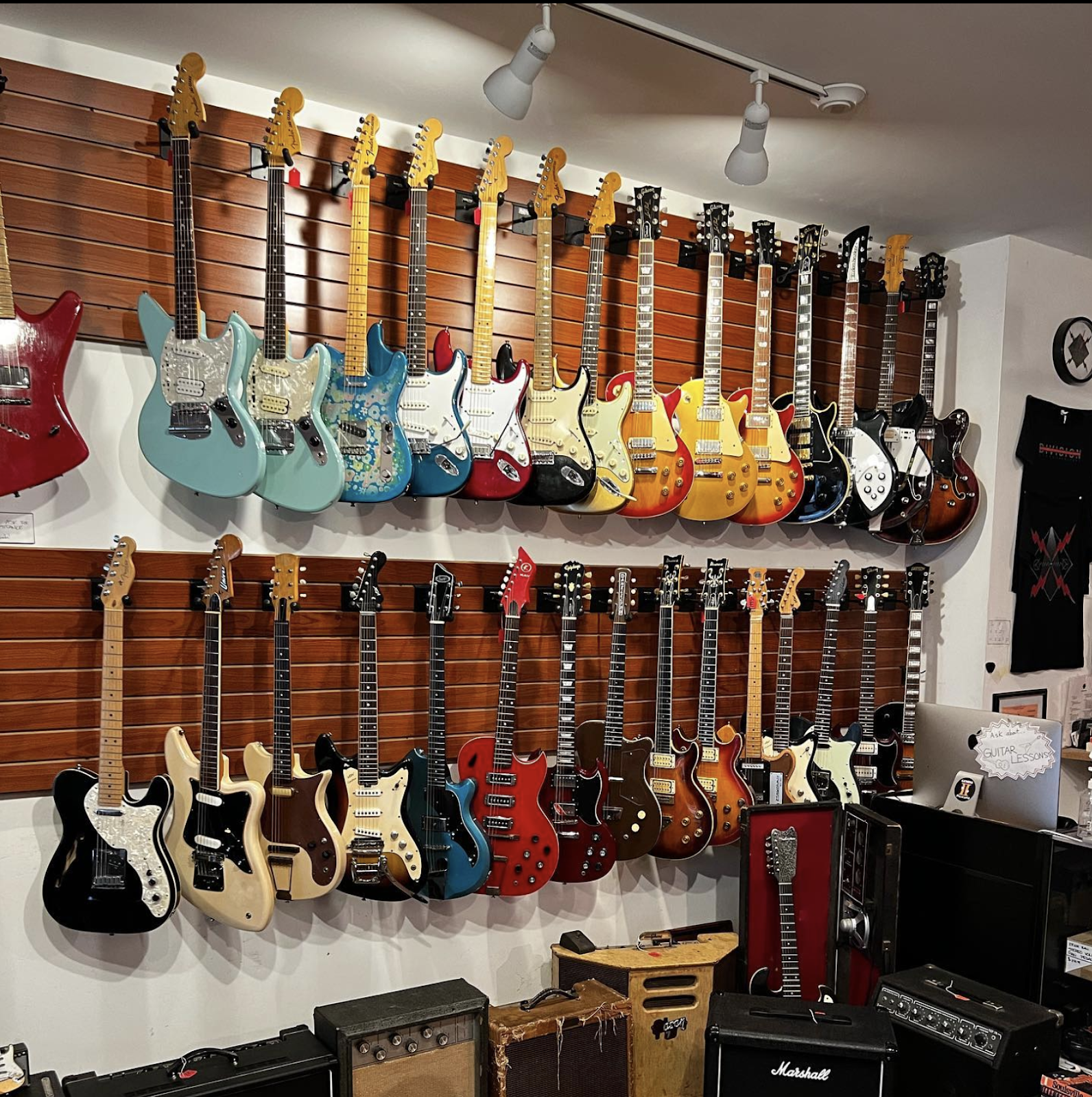
    At the heart of every music town is a guitar shop; Division Street Guitars in Peekskill is no exception. Located right on – you guessed it – North Division Street, the guitar store is a prime attraction in a city bustling with music-goers and artists.

    Just a block away from the Paramount Hudson Valley Theater, the small shop, nestled in between a row of restaurants, is a much needed pit stop for traveling musicians looking to add some vintage flair to their collection.

    Joe Bonamassa shows off his newly bought '57 Strat alongside Division Street Guitar employees. From left to right, Paulie Beladino, Joe Bonamasssa, owner Paul DeCourcey and Matt Labozza
    Joe Bonamassa shows off his newly bought ’57 Strat alongside Division Street Guitar employees. From left to right, Paulie Beladino, Joe Bonamassa, owner Paul DeCourcey and Matt Labozza

    Over the years, owner Paul DeCourcey has sold his high-end wares to the likes of Joe Bonamassa, Boz Scaggs, Melissa Etheridge, and “that guy who made the coexist bumper sticker,” the shop employees chime in with a humble brag.

    An average day is a little less star-studded, but the shop maintains a steady stream of customers from the casual browser to inquisitive sellers and local musicians just stopping by for a chat. No matter the customer, Paul said he brings the same dedication to his craft. 

    “You’ve got to have a certain knack for it and I’ve had that,” DeCourcey said plain and simple.

    DeCourcey’s journey to becoming a luthier (a maker of stringed instruments) started when he was 19 and living in the nearby town of Ossining. There he worked at a local music shop and was mentored by the owner before moving on to become head luthier at Southside Guitars in Brooklyn.

    After a few years commuting to the city, DeCourcey decided to settle down a bit closer to home, opening Division Street Guitars in 2014. Initially, he operated the place mainly as a repair shop but gradually transformed the space into a full-fledged guitar store.

    Unlike chain guitar stores like Sam Ash or Guitar Center, DeCourcey specializes in buying, refurbishing, and selling vintage guitars. And after 20+ years in the biz, he has a pretty good eye for them

    “I just like the older stuff… It’s what I know better,” DeCourcey said. “I think it’s more when you pick it up, you feel right away how it’s made and it kind of speaks to you.”

    At any given time the shop is home to 75-100 guitars as well as a colorful array of used pedals, amps and assorted gear. DeCourcey also sells guitars at trade shows as well as online at reverb.com, an online marketplace for musicians.

    Currently in stock is a 1979 Gibson Les Paul Deluxe, a 1963 Fender Duo Sonic and a 1947 Martin 00-21, as well as plenty of other models from a range of brands.

    Owner Paul DeCourcey keeps Division Street Guitars stocked with anywhere from 75-100 used guitars at any given time
    Owner Paul DeCourcey keeps Division Street Guitars stocked with anywhere from 75-100 used guitars at any given time

    Interestingly enough, DeCourcey said he isn’t a big musician himself, or maybe he’s just being humble. DeCourcey co-wrote Grouplove’s hit song “Colours” when he toured with the band’s frontman Christian Zucconi who also fronted for DeCourcey’s own band Aloke.

    Despite the large quantity of guitars in shop, DeCourcey currently only has two bass guitars (his instrument of choice) at home, a shockingly low-number for a musician of any caliber. Still, the modest guitar store owner said he gets more joy working on guitars than from playing them. Indeed, it’s clear by the way his face lights up when he talks about guitar repairs, that being a luthier is where DeCourcey is most at home. 

    “It’s nice to just get in the zone and work on guitars,” he said.

    DeCourcey has also served as an unofficial mentor to aspiring musicians in the community. His shop is currently staffed by two Peekskill locals, who he trained himself. Paulie Beladino, a local musician has worked the front of house at the shop since he was 19, when he asked Paul to take him under his wing. The gig allows Beladino to rehearse and travel with his band while also maintaining a more steady source of income.

    “Every part of my day is music related and everything I do to make money has to do with music and that sounds like success to me,” he said. “Just rocking and rolling over here.”

    Division Street Guitar's own Paulie Beladino poses for the shop's instagram page
    Division Street Guitar’s own Paulie Beladino poses for the shop’s instagram page

    While Beladino admits to being more of musician than a repairman, he said he still gets the child-like excitement when a new vintage guitar finds its way to the shop.

    “There’s nothing more exciting when you see the case and you know what it could be but you don’t know what it actually is and you open it and it’s like ‘oh my god,’” he said. “Every single one of these guitars has years and years of stories and experiences.”

    Another shop employee, Matt Labozza has a similar story to Beladino. He too has been at Division Street since the beginning and learned under the guiding hand of DeCourcey. While audio engineering is his main passion after hours, Division Street Guitars provides a similar safe haven for learning and enjoying music.

    “Before I worked here, I brought all of my shit to Paul, even basic restrings,” Labozza says, as he now casually restrings a guitar during the interview. “Pretty much everything you see me doing here is thanks to that man.”

    In the eight years the shop has been open, DeCourcey said he hasn’t changed much about the store. From the beginning to now it’s still familiar faces, beautiful guitars and good vibes all around. 

    Division Street Guitars is located at 36 North Division St, Peekskill, NY 10566 and is open Tuesday-Saturday from 12-6pm and Sundays from 12-4 for the holiday season.

    Call them at 914-737-2630 or check out their inventory on Reverb.com