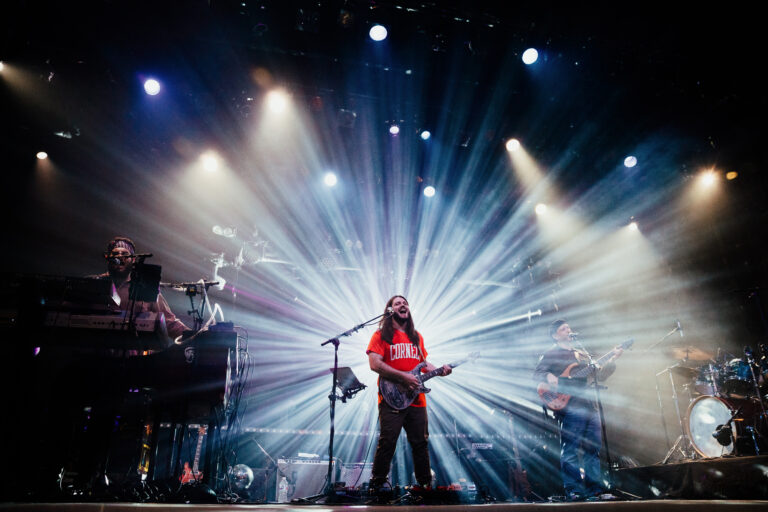
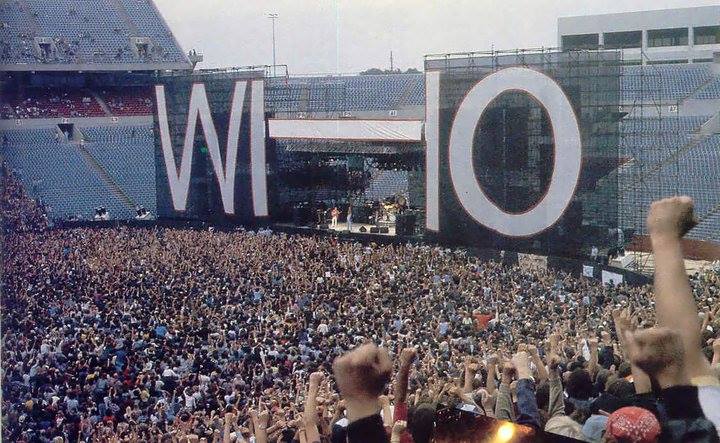
Pink Talking Fish, who perform the music of Pink Floyd, Talking Heads, and Phish, have announced new tour dates for Spring 2022, the most notable of which will be in New York at the Gramercy Theater on April 20.
The New York concert is part of the NYC Phish AfterParty series hosted by the NYC promoter CEG Presents. After major Phish concerts at Madison Square Garden several venues around the city host after parties for those who are still awake, as Phish fans keep the party going.
And what better way to do that than by adding some Talking Heads and Pink Floyd to the mix.
With the new Pink Talking Fish tour stop in New York, what is already a huge show as Phish returns to the Garden on rescheduled New Years dates, the dancing doesn’t have to end just because the concert did. Doors open at 11:30pm and tickets are now available online.
Other than the Gramercy Theater show the new Pink Talking Fish tour will only have one other show in New York state proper, in Saratoga Springs on April 16. There are, still, several other shows in neighboring states: Hartford, CT on Feb. 18, Jay, VT on Feb. 19, and Burlington, VT on March 19.
Other notable stops include a three day stint in Denver, Colo. for a special David Bowie and Prince show. Where they’ll cover songs of the two rock legends alongside guests Chuck Morris from Lotus and The Horn Section, made up of former members of Turkuaz.
Tour Dates
2/18: Hartford CT at Infinity Hall
2/19: Jay VT at Jay Peak Resort
2/26: Ardmore PA at Ardmore Music Hall w/s/g Qway
3/11-12: Denver CO at So Many Roads Brewery
3/13: Denver CO at So Many Roads Brewery – Prince/Bowie featuring PTF, The Horn Section, Chuck from Lotus + more
3/19: Burlington VT at Higher Ground w/s/g Swimmer
4/08: Ventura CA at Ventura County Fairgrounds – Skull And Roses Festival
4/09: Seattle WA at Nectar Lounge
4/16: Saratoga Springs NY at Putnam Place
4/20: New York NY at Gramercy Theater – Phish AfterParty
NY singer-songwriter Sam Kogon has announced a four-track self-titled EP, and the release of his new single “Barbed Wire.”
Kogon describes his new approach to songwriting as an “Upstate country rockabilly crooner,” as he spends his time in the Hudson Valley. He has always been an old soul as he is a big fan of The Beatles, and even worked with Al Jardine of The Beach Boys.
Sam Kogan.
Sam Kogon had a lot to say about the new single.
‘Barbed Wire’ is a song about accepting love, denying love, unrequited love, infatuation, and coming out of the closet. It’s inspired by two friends exchanging songs they write as coded love letters. One friend wants their love to come off the page and the other friend can only express their true feelings in song. Running away with or from someone who isn’t emotionally available can get you tangled in the barbed wire fences they put up at the first signs of vulnerability, so I chose that as the title of the song. The one friend trying to move forward is asking (rhetorically) ‘Is this love? Is this love? I need to know right now…and could you even tell me right now.’ They already know the answer: Sometimes there isn’t a happy ending or closure; sometimes we get burnt like tires, and that’s ok.
“Barbed Wire” is a pop, rock, and country ballad, and makes the listener want to get up and dance. It was produced by John Agnello (Dinosaur Jr., Kurt Vile) and mastered by Steve Fallone (Arcade Fire, Angel Olsen, Big Thieif).
The song is available to stream here, and Sam Kogan’s new self-titled EP will be out in April.
The Who, one of the greatest rock bands in music history, will embark on a 2022 North American Tour this spring and fall. The two final tour stops in May will be at Madison Square Garden and Bethel Woods, while the October leg of the tour brings Townshend and Daltry to UBS Arena in Belmont.
The music of The Who spans generations, with Roger Daltrey’s soaring vocal prowess building off the sparks of Pete Townshend’s songwriting. These two remaining members of the original lineup join together in a shared legacy while time is passing, one found in the pages of their recent autobiographies -Townshend’s Who I Am (2012) and Daltrey’s Thanks A Lot Mr. Kibblewhite; My Story (2018) – and among their regular touring schedule.
Some shows on The Who’s 2022 tour were originally planned for 2019 but delayed due to a vocal ailment Daltrey was suffering from, while some others on the tour are a substitute for those canceled in 2020 due to the COVID-19 pandemic.
Commenting on The Who Hits Back! 2022 tour, Roger Daltrey said:
Pete and I said we’d be back, but we didn’t think we’d have to wait for two years for the privilege. This is making the chance to perform feel even more special this time around. So many livelihoods have been impacted due to Covid, so we are thrilled to get everyone back together – the band, the crew and the fans. We’re gearing up for a great show that hits back in the only way The Who know how. By giving it everything we got.
Roger Daltrey
The Who Hits Back! Tour features a pure and easy lineup including guitarist and backup singer Simon Townshend (Pete’s brother), keyboardist Loren Gold, second keyboardist Emily Marshall, bassist Jon Button, drummer Zak Starkey and backing vocals by Billy Nicholls. Lead violinist Katie Jacoby and lead cellist Audrey Snyder will be getting in tune with orchestra conductor Keith Levenson, delivering many of The Who’s classics, as well as songs from their most recent album, WHO.
Regarding the inclusion of local orchestras and strings for each show, Townshend spoke to Rolling Stone, saying:
It gives me a chance to make sure what I play, what I do, where I look, how I behave on the stage, is more connected with the people around me, and with the audience, and with, to get prosaic about it, an inner sense. In other words, I don’t lose myself the way I did when I used to jump around, have a big adrenaline rush, and then come off the stage and someone would say, ‘Great show,’ or someone would say, ‘Terrible show,’ and I wouldn’t really know what I had done, to be honest, since I was like someone running a marathon. So the orchestra gives me space.
Pete Townshend
The Who’s show at Bethel Woods also marks their return to the site of the original Woodstock Festival, where the group performed a memorable set that began at 5 AM on Sunday, August 17, 1969.
American Express® Card Members can purchase tickets in select markets before the general public beginning today, Monday, February 7 at 10 am through Thursday, February 10 at 10 pm. The Who’s fan club presale starts Wednesday, February 9 at 10 am and runs through Thursday, February 10 at 10 pm.
Professor Louie’s Century will present Blues legends like Joe Louis Walker, Guy Davis, Professor Louie & The Crowmatix, and more. Music will be accompanied by a photographic retrospective Keeping the Blues Alive by JosephA. Rosen. Hudson Valley Blues Society has partnered with these amazing artists to put on a show that will be the first of its kind.
Professor Louie and The CrowMatix
Joe Louis Walker is a Blues Hall of Fame member and four-time Blues Music Award winner. Throughout his life, he has toured all around the world, preforming at mist renowned music festivals throughout the United States, Canada, Glastonbury, Notodden and Montreux. Along with this, he has toured for festivals in Japan, Australia, Taiwan, Ireland, Turkey, European festivals including The North Sea Jazz Festival, and Brazil.
Guy Davis has spent his musical life carrying his message of the blues around the world. He even holds the title of, “An Ambassador of the Blues,” because of his extensive travels from the Equator to the Arctic Circle. His work as an actor, author, and music teacher earmark him as a renaissance man of the blues. Davis often talks about how music and acting have similarities by saying, “…I don’t like people to see the challenging work and the sweat that goes in what I do. I want them to hear me and be uplifted.”
Professor Louie and The CrowMatix emerged from the music industry as the torchbearer of the true spirit of American Roots Music. As a live performer, prolific recording artist and versatile multi-instrumentalist, Professor Louie has the award-winning recording Producer and Engineer, capturing the talents of some of the world’s most highly acclaimed musicians.
The Concert will take place on March 26th, 2022, at 8:00 PM. All adult guests must be fully vaccinated or show proof of a negative COVID-19 test to enter the theatre. Tickets will range from $25 to $40 dollars. To purchase tickets or for more information visit paramounthudsonvalley.com.
Black history month can be a frustrating time of the year. The opportunity to celebrate the numerous Black vanguards is a great honor. Yet, having to encapsulate so much greatness in only 28 short days is a task in itself. How do you prioritize one Black success story over another? The truth is you can’t, but that doesn’t mean you don’t try.
While limiting the importance of Black people to just entertainment can be negligent to the immense contributions made to math, science, architecture and communication that laid the foundation for the modern world… this is a music website.
And while the likes of Malcolm X and Marcus Garvey’s roles as revolutionaries are to be studied and admired, it is the arts that continues to push pop culture forward. There is no greater form of pop culture now than hip hop, having overtaken rock & roll as the world’s most popular genre. Yet, hip hop would not exist without those that paved the way during the Harlem Renaissance.
Black history is everywhere, and New York State occupies some of the most important landmarks, where countless fabled musicians have inhabited. From The Cotton Club — where entertainers during the Harlem renaissance helped bring Black music to the mainstream — to the Marcy Projects that once housed Jay – Z.
Cab Calloway.
Our Black History Maps give readers a chance to view the boroughs, neighborhoods and exact addresses where many a Black history that has shaped the world originated from within New York State, and the accompanying stories deriving from such landmarks. A fun interactive feature, the BHM will also serve music aficionados who may want to see just how close they are to where their favorite artist once frequented.
As the early 1990s progressed, Phish would continue to make their mark in and throughout the Northeast. A major hub for this was obviously New York City. After years of playing The Wetlands, Phish had finally progressed to the Roseland Ballroom, starting with a gig there in March of 1992. The tour that began 1993 would add two more shows here and today marks the anniversary of the second one. Amazingly, this would somehow be their only shows in the city this year as tours began to stretch nationwide. They certainly made the most of their stay though, ending their brief Roseland residency with a show that features a healthy helping of new songs, classic favorites, and a remarkable pair of special guests to help them close it out.
An enthusiastic Roseland crowd seems to recognize “Golgi Apparatus” right away and the show is off and running with the venerable Phish classic. This is followed up with “Foam,” another hit off the band’s seminal Junta release. Despite some brief feedback issues, it’s a quick yet crisp version with a seemingly extra peppy bass line provided by Mike Gordon.
“Wilson” then has a bit of an extended intro with a different feel, with only the band singing the name of the fictional Gamehendge ruler as this pre-dates the now customary crowd chants. In an extended break before the “blap boom” ending portion, Trey Anastasio throws in both “Simpsons” and “Random Note” guitar signals that a good portion of the crowd seems to recognize. Then Phish steers into “My Friend, My Friend,” a track from their album Rift that was officially released just days earlier. As soon as “Friend” finishes, Phish wastes no time in doubling down on first set Rift tunes with Jon Fishman starting up the iconic drum intro to “Maze.” A rousing McConnell organ solo is supplanted with one from Anastasio and the first set at Roseland this evening is officially firing on all cylinders now.
After a standard run through of “Horn,” another first set staple, Phish launches into a flawless “Divided Sky” that features some more wonderful interplay between McConnell and Anastasio, with the latter spitting pure “fire” by song’s end in a potential nod of what was still to come. The now raucous Roseland crowd makes their feelings known after this one before Phish slows things down a tad with McConnell taking lead crooning duties on “Lawn Boy.”
Afterwards, the band breaks out a fairly new song (at the time) with only the third “The Wedge” ever performed live, after debuting three nights prior. It’s got a real jazzy, piano-fueled intro that makes it stand out when compared to its modern day version and McConnell follows this up with a dazzling solo mid-song that seems to have Trey yelling along in approval. A fairly standard “Bouncing Around The Room” follows this before the first set comes to a screaming halt in the form of a rabid “Run Like An Antelope” that has the whole band working together as one to bring the jam to a proper peak.
Tonight’s second set picks up right where the first one left off in the form of “Chalkdust Torture.” While this classic Phish number produces its typical high octane guitar and bass riffs, it doesn’t yield much of a jam. Instead, after a quick wrap up of “Torture,” the band dives back into the Rift chest and pulls out the Mike Gordon-penned “Mound.” But exploratory-wise, the second set doesn’t really take off until the “Stash” that follows, with Anastasio throwing out probing guitar fills atop some intense rhythms generated by Gordon and Fishman.
The call is then made for some mid second-set a cappella and Phish goes with the first “Sweet Adeline” of 1993 before an especially attentive Roseland crowd. Then, after Phish’s instrumental ode to NPR with “All Things Reconsidered,” the heavy hitters come back into play, starting with a “Mike’s Song” with a fun little verse added to the intro. Gordon has a little fun with the standard lyrics as well before the song takes a turn into its typical dark and foreboding ambiance. It’s a standard “Mike’s Groove” with the bliss-filled “I Am Hydrogen” dropped in the middle before “Weekapaug Groove” whips the Roseland crowd back into a collective frenzy. After this classical trifecta, Phish brings it back to the new school with the second ever “Lifeboy” performed live.
After this insightful newcomer, Phish decides to integrate some bluegrass into the show and breaks out an extremely tight “Uncle Pen” before a “Big Ball Jam” breaks out, the short-lived Phish gag in the early ’90s where giant inflatable balls were thrown out into the crowd with each band member “playing” along to a respective ball and its bouncing trajectory. Not much of a jam ensues though so Anastasio jumps behind the drum kit and Fishman then emerges for “a sad song” called “Lengthwise,” despite being prodded by the crowd to recite “The Prison Joke” again. After urging the crowd to break out lighters for the song, he adds an extra verse about burning his finger for holding one too long.
With the Big Ball and Fishman theatrics now out of the way, the show comes to a legendary finish, starting with “Buried Alive” where none other than Blues Traveler’s John Popper emerges to sit in and adds an absolutely ferocious harmonica solo that takes this song to another level. He then stays on for a set-closing “Possum,” adding a lovely touch to the intro before leading one of the more explosive jams of the evening.
As if one special guest weren’t enough tonight, Phish once again doubles down and brings out another one for the encore. With Popper still on stage, Phish do two “fake” botched intros to Jimi Hendrix’s “Fire,” seemingly blaming Gordon for the errors. So instead, Mike moves over to keys and they nonchalantly bring out none other than Noel Redding himself, the original bassist for the Jimi Hendrix Experience, to come out and do the honors. It caps off an incredible finishing sequence to, amazingly, the last New York City show of the year for Phish.
The whole show can be streamed here at PhishTracks with many audio clips found on YouTube as well.
Phish Roseland Ballroom – New York, NY 2/6/93
Set 1: Golgi Apparatus, Foam, Wilson, My Friend My Friend, Maze, Horn, Divided Sky, Lawn Boy, The Wedge, Bouncing Around The Room > Run Like An Antelope
Set 2: Chalkdust Torture, Mound, Stash, Sweet Adeline, All Things Reconsidered, Mike’s Song > I Am Hydrogen > Weekapaug Groove, Lifeboy, Uncle Pen, Big Ball Jam, Hold Your Head Up > Lengthwise > Buried Alive, Possum
The Egg has started their search for a new executive director as long time head, Peter Lesser, steps away. Since starting in August 2000, Lesser has brought together a wide variety of entertainment, from musical performances to comedy shows.
Peter Lesser in front of The Egg, October 2000. Photo by Paul Buckowski for Times Union.
Over the span of almost 22 years, Lesser has worked tirelessly to provide the Capital Region with culture and entertainment from around the world. Before the pandemic caused theaters to close, the venue hosted over 200 events each year. He has helped The Egg overcome a number of challenges, including security issues after 9/11, reductions in state funding and competition from other venues.
Prior to taking over at The Egg, Lesser served as executive director of Troy Savings Bank Music Hall in Troy from 1992 to 2000.
In addition to expanding the music, dance and family programming, Lesser has also been instrumental in creating special projects that focus on developing a statewide performing arts presenter network, commissioning new work and community outreach.
These initiatives have elevated The Egg’s stature as an invaluable cultural asset for the Capital Region and the State of New York, and I am appreciative of the Board’s support as we have worked to enhance our mission and achieve our goals.
Peter Lesser
Lesser’s love for The Egg is evident as he leaves behind not only a legacy, but the tools necessary for the continuation of programming at the venue. The strong foundation he helped to build will spur future administrations on for decades.
In a letter to the Board of Directors, Lesser explains that he is relocating to spend more time with his family, but he will continue to work with The Egg remotely until a candidate has been chosen and transitioned in. Applications for the position are being accepted through February. The job description and information on the application process can be found here.
As the XXIV Olympic Winter Games take place in Beijing, China, we look back 42 years to the XIII Olympic Winter Games held in Lake Placid from February 13, 1980 to February 24, 1980. Home of the Miracle on Ice and speedskater Eric Heiden winning five gold medals, the Lake Placid Winter Olympics brought together 1,072 athletes from 37 countries to take part in 38 official events in February 1980.
Opening ceremony photo courtesy Lake Placid Olympic Sites
The games also featured a theme song, in the form of Rochester Jazz legend Chuck Mangione’s “Give it All You Got,” a tune released a week before the games, that would chart as high as #1 on the Adult Contemporary, #18 on the Billboard 100 and #32 on the R&B chart, and recently named by Billboard as the #1 Olympics theme song of all time. ”Give it All You Got” was Mangione’s second single to reach #1 on the Adult Contemporary chart, after “Feels So Good” achieved that feat in 1978.
Mangione was asked by Roone Arledge, then ABC Sports president, to craft a song for the Winter Olympiad. ABC had used Mangione’s recordings, including “Chase The Clouds Away,” four years earlier during their coverage of the 1976 Summer Olympics in Montreal. Featuring a lineup of Charles Meks (bass), James Bradley Jr. (drums), Grant Geissman (guitar), and Chris Vadalla (saxophone), Mangione, America’s most famous flugelhorn player wrote the Grammy-nominated song for his 1979 album Fun and Games.
This is fusion jazz at its most peppy and pristine, the network TV version of “gritty.” Mangione and saxophonist Chris Vadala volley the theme back and forth for nearly half the track’s six-minute runtime, content to let that breezy melody do most of the work. There’s some inspired composition going on beneath the surface: the way the chord structure keeps dancing between major and minor, the spots where flugelhorn and sax each converge in twin harmony. Throw in Charles Meeks’ slippery bassline and some Nile-Rodgers-style rhythm work from Geissman, and you’ve got the perfect soundtrack for cruising L.A. in a ’74 Stingray convertible.
Mangione told Wesley Hyatt for his 1999 book The Billboard Book of No. 1 Adult Contemporary Hits about the process of composing the music for the instrumental, saying:
(my) vision was to think about the athletes and their efforts to do their best now. They’re giving it all they’ve got. And we almost got to be like the athletes because we also got to perform the song at the ceremonies.
“Give It All You Got” was nominated for best instrumental composition at the 1981 Grammy Awards, losing out to John Williams’ score for The Empire Strikes Back.
Mangione would perform “Give it All You Got” live at the Winter Olympics closing ceremony (as well as the song “Pina Colada”) on Sunday, February 24, 1980, just hours after the conclusion of the gold medal hockey victory for Team USA over Finland along with the Hamilton Philharmonic Orchestra from Ontario, Canada.
In addition to Mangione, the Crane School of Music at SUNY Potsdam contributed to the Lake Placid Winter Olympics as well. A 600-member Olympic chorus and orchestra, a 50 member wind ensemble and three Olympic bands of 50 members each, who were bused in daily and wore weather appropriate parkas and boots, instead of the typical tuxedos and gowns. Brass performers tested their instruments in the meat freezer of the local supermarket in Potsdam as they prepared for the Games.
photo by Christopher Lenney
Feb. 9, 1980 featured the Collegiate Singers, directed by Brock McElheran, as they performed for the International Olympic Committee, along with visiting dignitaries from participating nations.
photo via the Crane School of Music
Four Crane School of Music faculty members composed original works for the Olympic Games, including Elliot Del Borgo, Arthur Frackenpohl, William Maul and Robert Washburn. When American gold medal winners, including speedskater Eric Heiden, received their medals, they were accompanied by an arrangement of the “Star Spangled Banner” by Frackenpohl, who also arranged the Greek and Yugoslavian national anthems. Washburn composed “Parade of Nations” for the opening ceremonies, while Del Borgo wrote the piece played during the closing, “When Dreams Are Dreamed and Dreams Are Won,” and Maul composed “March of the Athletes,” used for the closing ceremonies.
photo via the Crane School of Music
Crane School bands would provide music for the award ceremonies each evening, with Professor Emerita Rebekah Covell leading the Crane Symphonic Band for 14 performances over 14 days. With an added degree of difficulty, Covell and the musicians would often have less than an hour to rehearse national anthems needed for the medal award ceremonies, prior to playing the songs outdoors, often in freezing temperatures. Notably, Robert Mero, a former technical assistant at Crane, came out of retirement to assist musicians with technical services during the Games, per Robert Gibbs, a professor and emeritus member of the Crane School alumni board.
Between Chuck Mangione and students and faculty at the Crane School of Music, all music for the 1980 Winter Olympics can be credited to talented born and/or raised New Yorkers. Here’s to the Winter Olympics returning to Lake Placid in the coming years, perhaps split with Montreal.
While the Allman Betts Band tour has been postponed amid a hiatus, there is now a co-headlining tour with The Devon Allman Project and Samantha Fish Band in its place, with stops in Utica, Albany, Buffalo, Chester, New York City and Westhampton Beach.
Devon Allman.
The Devon Allman Project is a six-piece world-class band that has previously toured almost 20 countries. The band is led by Devon Allman, son of The Allman Brothers guitarist Gregg Allman. The band is known for gracefully blending genres and jam in the same way that the Allman family is known for.
photo by Brian Cornish
Samantha Fish is one of the most inventive artists in the blues scene, with her being placed in Guitar World Magazine’s list of “Top 10 Best Blues Guitarists in the World.”
Speaking of the tour, Devon Allman had this to say:
I can’t wait to get back out and spread some music around with my friends. I’ve known Samantha forever now and she’s such a phenomenal talent, her voice and guitar playing are smokin’ and her new band are world class…we’re gonna have some fun out there
The Devon Allman Project tour with Samantha Fish will be heading to multiple NY cities, and tickets can be found here.
THE DEVON ALLMAN PROJECT + THE SAMANTHA FISH BAND ON TOUR
Mar 3 @ The Kent Stage | Kent, OH Mar 4 @ Riverfront Live | Cincinnati, OH Mar 5 @ Robins Theatre | Warren, OH Mar 6 @ Kemba Live | Columbus, OH Mar 8 @ Jergel’s | Warrendale, PA Mar 9 @ Town Ballroom | Buffalo, NY Mar 10 @ Stanley Theater | Utica, NY Mar 11 @ HMAC | Harrisburg, PA Mar 12 @ Palladium | New York, NY Mar 13 @ Sugar Loaf Performing Arts Center | Chester, NY Mar 16 @ Musikfest Cafe | Bethleham, PA Mar 17 @ Palace Theater | Manchester, NH Mar 18 @ Loos Center for the Arts | Woodstock, CT Mar 19 @ Cabot Theater | Beverly, MA Mar 20 @ Westhampton Beach PAC | Westhampton Beach, NY Mar 23 @ Academy of Music | Northampton, MA Mar 24 @ The Egg | Albany, NY Mar 25 @ Mayo Performing Arts Center | Morristown, NJ Mar 26 @ The Beacon Theatre | Hopewell, VA
THE DEVON ALLMAN PROJECT
Apr 1 @ Hawaii Theatre Center | Honolulu, HI Apr 2 @ Castle Theater | Maui, HA
Three of Central New York’s most notable Native American music artists were announced as nominees for the Native American Music Awards. Notable nominees include The Ripcords, Earl Slick, Pete McMahon and the West Side Social Club.
Irv Lyons Jr., of the Oneida Nation, Wolf Clan, is nominated for four Native American Music Awards, including “Best Rock Recording” and “Artist of the Year” for his EP, Private Invitation, not to mention nominations for “Best Male Vocalist” and “Song of the Year” for “Save The Planet.”
Irv Lyons Blues Fest
Rex Lyons of the Onondaga Nation, Eel Clan., along with Irv Lyons and The Ripcords are also nominated for “Group of the Year” and “Best Blues Recording” for their album, “Unmasked (Live).” Along with this, they’re nominated for “Best Blues Recording” with the group West Side Social Club. This includes Earl Slick, Pete McMahaon and Liz Strodel.
The Ripcords in the studio
The Ripcords are a musical collaboration from cousins, Rex and Irv Lyons. Along with members Jay Gould, Tom Witkowski and Steve Palumbo. They are a versatile group who can deliver various genres of music such as blues, rock, swing and jazz, they even write their own songs as well.
Joanne Shenandoah, Native American singer, composer, and multi-instrumentalist based in the New York, is also on the Private Invitation EP for the song “Save The Planet” which received a “Song of The Year” nomination. She belonged to the Oneida Nation, Wolf Clan, and passed away November 22nd, 2021.
Irv Lyons Blues Fest
“I’m honored and excited to be up for a couple of NAMMY awards!” adds Rex Lyons. “We’ve been making original music for over 2 decades, hopefully 3rd times a charm and we bring home the hardware. Congrats to all my fellow nominees. Good luck!”
“To be nominated for the Native American Music Awards is an amazing honor and great privilege,” says Irv. “Private Invitation is my best work to date. The most complete in lyrics and music. It is a snapshot of my experiences in love, friendship and the heart. These songs are all radio ready as any of them could be on the charts now. My true labor of love that hopefully people will enjoy and play over and over.”