Since 2015, Larry Luttinger has been curating Jazz On Tap, a weekly jazz club, offering some of the best jazz from across Central New York to the town of Skaneateles, just outside of Syracuse. This longest-running weekly jazz offering of CNY Jazz was to be discontinued by Thanksgiving, but will now extend into March 23, 2023, with a sling of new and returning musicians from the area now slated to perform in the spring.
The “jazz club” is hosted in a historic 1880 building, which houses the 60-tap restaurant Finger Lakes on Tap. It’s a cozy, two-story venue with balcony seating available as well, which overlooks the stage. Though they sold the restaurant, which implied the closing of the Jazz Club series as well, the music, as always, prevailed, and will continue concerts in Skaneateles until the property’s lease expires in April.
On New Years’ the lakeside venue will throw down with Angelo Candela and his group, in what has become a traditional celebration of the New Year. Slated for performances in the spring are Stringdom, Mike Houston & Sam Wynn, Julie Howard, Jimmy Johns Trio, Carol Bryant Quartet, Dan Pugh Trio, Little Jazz Trio, Bob Piorun Quartet, Edgar Pagan’s GPL, Julie Falatico & Rick Montalbano, Steve Brown Duo, and Alex Becerra & Friends, and many more.
Larry Lutinger said the concerts, which are every Sunday from 2-5 p.m. are an essential cultural offering to the region.
“The various club series that we present around the area are important introductions to America’s music for many uninitiated music lovers, and folks who still don’t know all that CNY Jazz does. These afternoon sessions are easy listening, engaging, exciting, and eye opening for many new to the genre,” Luttinger said.
These sessions are free, but early arrival is recommended if you want a comfy seat. See the complete schedule of shows here.
Fans of improvisational jazz, electronica and progressive rock will have the perfect sonic meal for their eclectic tastes when Spaghetti Eastern Music’s Two Bass Hit Ensemble returns to Harlem’s Silvana, part of their residency, on Tuesday, December 27 at 8 p.m.
The band is an off-shoot of Spaghetti Eastern Music, the solo venture of genre-leaping NYC/Hudson Valley guitarist Sal Cataldi. The guitarist is joined in this quartet by two esteemed bass players, David C. Gross and Tom Semioli, and veteran NYC drummer/percussionist, David Donen. Collectively, the four have worked with diverse artists including Stephen Stills, Humble Pie, Aztec Two-Step, Chuck Berry, Marc Ribot, The Lenny Kaye Connection, The Joffrey Ballet, performance artist Charles Dennis and the guitar orchestra of minimalist composer Rhys Chatham.
The music of Two Bass Hit draws inspiration from a wide variety of musical styles, from the electric fusion of ‘70s-era Miles Davis, progressive rock like King Crimson and the funk/psychedelia of Jimi Hendrix’s Band of Gypsys. The humbly band takes its name, “Two Bass Hit,” from the title of a Dizzy Gillespie/John Lewis composition featured on Miles Davis’ Milestones album.
While bassist Semioli holds down the grooves, his counterpart Gross plies a broader palate with his extended range six-string electric bass – providing chords and counter-melodies to guitarist Cataldi’s painterly ambient atmospheres and loops and blues and psychedelia-inflected soloing. Drummer Donen provides beats that draw upon rock and tribal patterns.
The December 27 residency engagement for Spaghetti Eastern Music is the latest in the quartet’s on-going residency at Silvana, a venue featuring some of the best jazz, R&B and modern rock acts in NYC. No cover, two drink minimum; Silvana is located at 300 W 116 Street in Harlem.
Bassist Gross has written 17 books and 3 instructional videos. Together with Semioli, he is the co-host “The Notes From An Artist Radio Show” on cygnusradio.com Monday nights at 8 PM EDT, and the “Notes From An Artist” podcast available on iTunes, Spotify, and all podcast platforms. Semioli is the creator of the popular Know Your Bass Player blog.
Spaghetti Eastern Music has received consistent raves since Cataldi’s 2016 debut disc under the moniker, “Sketches of Spam” (Bad Egg Records). The New York Times writes “Cataldi’s original instrumentals and acoustic vocal tunes have a beat unmistakably his own” while Time Out New York says, “the largely instrumental, Eastern-influenced jams are infused with some delicate guitar work and hauntingly moody atmosphere.” Cataldi and his Spaghetti Eastern has been called “a wild ride” by Radio Woodstock, “beautiful and unique” by WFUV’s Mixed Bag, “charmingly melodic and off-center” by WFMU, while NYS Music adds: “If Walt Disney World’s Space Mountain had a secret chill detour, Spaghetti Eastern Music would be the soundtrack.” Hudson Valley One labels the sound:“Part Sergio Leone fever dream, part Ravi Shankar raga, a whirling dervish of musical creation.”
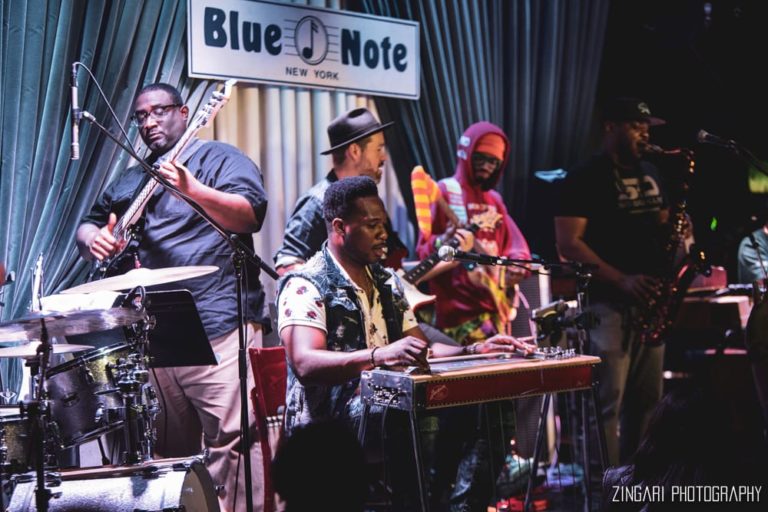
Blue Note New York will bring together a series of new programming in 2023, highlighting the relationship between the funk, jazz and jam music communities.
Among the artists lined up for performances starting in January 2023 at Blue Note are DJ Logic, Soulive, Lettuce, Galactic, Antibalas, Karl Denson, Ghost Note, Butcher Brown and many more. During the series, Blue Note will be a stomping ground for innovation and improvisation, showcasing the fluidity of the artists who perform within these funky genres.
The power of jazz has impacted and influenced many musical genres, and has its fingerprint deep within jam band culture and funk. Blue Note greatly celebrates this legacy and presents a broad range of artistry. We feel it’s important for us to embrace jam band culture, funk, progressive and soulful music all of which have been influenced by jazz.
We’re proud to have genre-bending artists upcoming at Blue Note ranging from Lettuce, Soulive, Galactic & Friends, to Ghost Note, and Butcher Brown. Jazz and improvisation lives and breathes within progressive funk and jam band artistry. As a legendary jazz institution, it’s Blue Note’s responsibility to continue presenting innovative and soulful artists with musical integrity influenced by its exposure to jazz and improvised music.
Blue Note Director of Programming Alex Kurland
Blue Note continues to maintain their historical excellence in providing the audiences with a wide range of dynamic and culturally rich experiences from top artistry. Take a look at the lineup of artists from the funk, jazz and jam worlds coming to Blue Note New York in 2023! Get tickets here.
DJ Logic & Friends (Jan 19 – 22)
Special guests will include:
Jan 19 – 20: James Carter, James Genus, Robert “Sput” Searight, Neal Evans
Jan 21: James Genus, Robert “Sput” Searight, Neal Evans, Casey Benjamin
Jan 22: John Popper, Paul Shaffer, James Genus, Robert “Sput” Searight, Casey Benjamin
As one of the world’s most accomplished turntablists, DJ Logic is widely credited for introducing jazz into the hip–hop realms and is considered by most as a highly-respected session musician and an innovative bandleader.
Galactic (Jan 25 – 29)
Special guests will include:
Jan 25: James Carter
Jan 26 – 27: Robert Randolph
Jan 28: Matisyahu
Jan 29: Nicholas Payton
Galactic draws on 25 years together in order to progress with each performance and subsequent record. After 10 albums, over 2,000 gigs, and tens of millions of streams, the proud New Orleans, LA quintet—Ben Ellman [saxophone, harmonica], Robert Mercurio [bass], Stanton Moore [drums, percussion], Jeffrey Raines [guitar], and Richard Vogal [keyboards]—have kept the torch burning.
Karl Denson Project (Feb 23 – 26)
Band line up will include:
Feb 23 – 26: Keyon Harrold, James Francies, Burniss Travis & Blaque Dynamite
Saxophonist Karl Denson met Lenny Kravitz during a recording session in 1988. The following year, Kravitz called Denson and asked him to do the solo on the single “Let Love Rule” from Kravitz’s album of the same name.
Krasno Moore Project ft. Eric Finland (March 16 – 19)
Soulive and Lettuce co-founder, Eric “Kraz” Krasno is a New York-based Grammy-winning guitarist, songwriter, recording artist, and producer. His own musical roots lie in funk, jazz, rock, and hip-hop, and he has written songs and produced records for a variety of artists in a range of genres including Norah Jones, Aaron Neville, Talib Kweli, Tedeschi Trucks Band, Ledisi, 50 Cent, and Matisyahu.
Butcher Brown with Special Guests (May 8 – 10)
Pulsing from the nerve center of Jellowstone Studios in Richmond VA, Butcher Brown takes careful note of the history and legacy of jazz and throws caution to the wind. Their musical vibe blends jazz with hip hop, funk, rap, rock and soul. The group honors each musical genre and, at the same time, challenges traditional musical boundaries.
Antibalas (May 18 – 21)
It’s hard to believe that more than twenty years have passed since Antibalas’s humble beginning as a neighborhood dance / protest band in the block parties and underground parties in pre-gentrified Williamsburg, Brooklyn. Over the past two decades they have evolved into what The Guardian called “one of the world’s finest Afrobeat bands” while enjoying equal renown for their cross-genre collaborations with legends of popular music.
Ghost Note (June 1 – 4)
Headed by Snarky Puppy’s multi-Grammy–winning percussion duo of Robert “Sput” Searight and Nate Werth, Ghost-Note is an explosion of sound. With an expansive roster of next-level musicians—representing members of Prince, Snoop Dogg, Erykah Badu, Herbie Hancock, Kendrick Lamar, Marcus Miller, Toto, Justin Timberlake, and more.
Lettuce (June 8 – 11, Festival)
Lettuce, a sextet composed of Adam Deitch (drums), Ryan Zoidis (saxophone), Adam Smirnoff (guitar), Erick Coomes (bass), Nigel Hall (keyboards/vocals), and Eric ‘Benny’ Bloom (trumpet), is approaching thirty years since its humble Boston Beginnings.
Soulive (June 15 – 18 & 29 – July 2)
Soulive has never made any bones about what they do best; it’s right there in their name. Since forming in 1999, the trio of guitarist Eric Krasno, drummer Alan Evans and keyboardist Neal Evans has carried the torch for the soul-jazz organ trio.
Next Jazz Legacy announces a celebration of its monumental first year with a performance at the NYC Winter JazzFest at City Winery on Jan. 12.
Next Jazz Legacy is a program by New Music USA and the Berklee Institute of Jazz and Gender Justice that addresses gender and racial inequities by providing opportunities for mentorship and professional development to those who have been underrepresented in jazz. Within their cohort is a lineup of emerging women and nonbinary musicians. The program is co-founded by NEA Jazz Master and founder of the Berklee Institute of Jazz and Gender Justice Terri Lyne Carrington and New Music USA President & CEO Vanessa Reed.
Those involved with the program were able to learn valuable skills, and even had apprenticeships with jazz icons like Esperanza Spalding, Lizz Wright, Marcus Miller, Mary Halvorson, Tia Fuller, Linda May Han Oh, and Chris Potter. Throughout the year, awardees performed on prestigious stages at local and national jazz events throughout the country, including at the Kennedy Center’s Mary Lou Williams Jazz Festivaland as part of a special Livestream Concert produced by WBGO.
On Jan 12. Next Jazz Legacy will be partaking in the Winter Jazzfest at City Winery. Doors open at 5 p.m., and a special panel at 5:30 titled “Why the Jazz World Needs Gender Equity” will occur. The panel will discuss the importance of initiatives like NJL for women and non-binary jazz artists, and how those artists are shaping the music’s future. At 7 p.m., NJL will perform, featuring all seven of the inaugural awardees, who are Ivanna Cuesta (Drums), Lexi Hamner (Vocals Trombone), Keyanna Hutchinson (Guitar), Alexis Lombre (Piano/Keys), Anastassiya Petrova (Keys/Piano), Loke Risberg (Guitar) and Kalia Vandever (Trombone).
The last event of the evening starts at 8 p.m., and it is New Standards live. Curated by Terri Lyne Carrington and featuring an astounding lineup of musicians, this debut performance will celebrate the recent publication of New Standards, a songbook featuring lead sheets by 101 women composers, the first of its kind. Tickets to see the Winter Jazzfest are on sale now.
Doeke (Jorn Swart), a New York-based neo-classical pianist delivers a great deal on his new album Herinner – he is at times poignant, elegant, delicate, intricate, and vulnerable in this continued exploration of his signature dreamy and gentle piano playing style.
With these sonic reflection of stories from the past, present, and future, the album is all about nostalgia, home, and the strange details remembered from childhood, the music transporting the listener to another time and place.
Doeke was my grandfather’s first name. He played the accordion, which inspired me to pick up that instrument as a kid, and later led me to the piano. All the song titles are in Dutch, and many of the compositions are inspired by memories from the Netherlands.
Doeke (Jorn Swart)
Doeke is shaped by a desire to return to simplicity, with Swart’s piano compositions inviting listeners from all over the world to feel a nostalgia that is both melancholic and comforting. Swart moved to the USA in 2010 as a Fulbright Scholar to pursue a master’s degree in jazz piano in New York City, where he’s been living and performing ever since.
Throughout his career, Swart has been busy not only as a composer and a piano soloist, but also as a bandleader, musical director, and recording artist for other musicians. As he built his name, touring throughout the USA and in Europe and garnering international acclaim, audiences told him that his work sounded like it was telling a story. With Doeke, he leans into this quality, with music that has a narrative and the emotional attributes of a film score.
You know how a certain smell can suddenly evoke something that happened a long time ago, something you thought you’d forgotten, and you become instantly overcome with the same feeling you had back then? Music can also send you on these fleeting time travels and the songs on this album capture such transient visceral experiences. Though these recollections are deeply personal for me, music can transcend this and transform the particular into the universal.
Music allows us to collectively experience the most powerful human states of being — nostalgia, joy, melancholy, reflection, excitement — and take comfort in knowing we all feel this way sometimes. Herinner is about these little moments that can seem insignificant, but still endure. It invites the listeners to join and embrace the nostalgic.
Doeke (Jorn Swart)
Herinner is available for streaming on various platforms here.
The Saratoga Performing Arts Center will play host to the 46th Annual Freihofer’s Saratoga Jazz Festival on Saturday, June 24, and Sunday, June 25, 2023, for a full two-day and two-stage thrilling festival experience. The line-up is anchored by musical legends including Bonnie Raitt,Pat Metheny, Angelique Kidjo, and twenty-one more musical ensembles, who will be bringing a variety of genres ranging from jazz to roots, funk, blues and beyond.
Jazz Artist Angelique Kidjo
Grammy Award-winner and Rock and Roll of Fame Inductee Bonnie Raitt will be making her highly suspended return to the festival since 1988. She is known for her blend of blues, R&B, rock and pop classics like “I Can’t Make You Love Me,”, “Something to Talk About” and “Nick of Time”.
Bonnie Raitt
On Saturday, the festival’s major draw will be the explosive 19-piece megaband Snarky Puppy, which is making its second appearance. The enthralling jazz, rock, and funk trio is described as “An exultant throwdown of brilliant danceability” by the Village Voice. The group has won four Grammy Awards, the most recent one in 2021 for Best Contemporary Instrumental Album.
Jazz Ensemble Snarky Puppy
Jazz and funk guitarist Cory Wong, best known as a frequent guest rhythm guitarist for Vulfpeck as well as for his ebullient solo material; eight-piece psychedelia and funk fiery band St. Paul & The Broken Bones; jazz and rock drum dynamo Cindy Blackman Santana, who is the regular touring drummer for Carlos Santana and previously Lenny Kravitz; and “Silky-voiced rising jazz star” (New York Times).
Cory WongCindy Blackman Santana
Having originally been founded as “the Newport Jazz Festival at Saratoga”, the musical event was renamed Freihofer’s Saratoga Jazz Festival in 1998 and is one of the most prominent jazz festivals in North America.
Saratoga Jazz Festival
On Saturday, June 24, performances will begin at 11 a.m. on the Charles R. Wood “Jazz Discovery” Stage and 12 p.m. on the Amphitheater Stage, and at 11:30 a.m. and 12:45 p.m., respectively, on Sunday, June 25. Fans may enjoy a magnificent arts and crafts market, artist CD signings, and fresh and diverse culinary selections in addition to two nonstop days of outstanding music on two stages. Tickets can be purchased here.
2023 FREIHOFER’S SARATOGA JAZZ FESTIVAL LINEUP
SATURDAY, JUNE 24
Amphitheater: Snarky Puppy Angelique Kidjo Cory Wong* Tower of Power Chucho Valdes Quartet Cindy Blackman Santana Band*
Charles R. Wood “Jazz Discovery” Stage: Kurt Rosenwinkel Emmet Cohen Trio* Claudia Acuna* Carolyn Wonderland* Glen David Andrews* Nduduzo Makhathini*
SUNDAY, JUNE 25
Amphitheater: Bonnie Raitt Pat Metheny Side-Eye St. Paul & The Broken Bones* Hiromi: The Piano Quintet feat. PUBLIQuartet
Charles R. Wood “Jazz Discovery” Stage: Samara Joy* Jupiter & Okwess* Melissa Aldana Mark Guiliana* Skidmore Jazz Institute Faculty All-Stars CentennialCelebration of Wes Montgomery, Tito Puente &Dexter Gordon featuring Clay Jenkins, Jimmy Greene, Michael Dease, Dave Stryker, Bill Cunliffe, Todd Coolman and Dennis Mackrel
Capital District drummer/composer Joe Barna hails from Troy and has become the face of the Collar City Jazz scene in the past few years. Having studied orchestral percussion performance/education at SCCC, then later SUNY Purchase’s Conservatory of Music in Westchester, Barna earned a BFA in Jazz Studies in 2004, with a focus on drumset performance & composition.
Since then, Barna has devoted himself to a life of composing and performing, bringing his talents around the globe, sharing the stage with many of the worlds top musicians/groups including The Celtic Tenors, Gary Smulyan, Peter Fisher, Ralph Lalama and jazz recording artists Joe Magnarelli, Ray Vega, Grant Stewart, Dick Oatts, Jim Rotondi, Jon Gordon, Jerry Weldon, Josh Evans, & Stacy Dillard.
Joe has performed with many of the Empire State’s regional greats, including Keith Pray, Brian Patneaude, John Menegon, Lee Shaw, David Gleason, Mark Kleinhaut, Michael Louis Smith, George Muscatello, Lee & Leo Russo, The Joey Thomas Band, The Big Soul Ensemble and his own original group Sketches Of Influence. Barna spoke with Rob Smittix of The Xperience Monthly.
Rob Smittix: Well, it’s nice to finally talk to the man behind the jazz scene.
Joe Barna: I would say I’m the man in front of the jazz scene.
RS: That’s a better way to put it, yeah.
JB: I think everybody knows, the cat’s out of the bag.
RS: It is and you are really bringing jazz to Troy in particular, how’s that going for you? What do you think the response has been?
JB: The response is overwhelming. I just did a what was originally a four-day but turned into a five-day jazz festival at 518 Craft in Troy. They basically wanted to honor me for all of the work that I’ve done for the jazz scene in Troy, so they gave me five nights in a row. They wanted me to have five different bands featuring five different styles of jazz. The first four nights were standing room only, it was packed in there. Every night was insane.
RS: That’s great. How did this all get started?
JB: I lived in NYC and went to SUNY Purchase. I was living in Manhattan and I was working a small jazz club. I was the front end manager of Mezzrow. Every night I was hanging out with the elites of the history of jazz. I was responsible for taking care of them when they were performing, making sure that they got paid correctly, making sure they got drinks, making sure the stages were set up for them, they had the backline they needed and made sure nobody was bothering them. So, I became friends with essentially the top jazz musicians in the world and I did this every night. Befriended them, got to play with a lot of them in jam sessions. It became a network and more about building relationships than the fact that we were musicians. It has allowed me an opportunity that very few people in the Capital Region or smaller areas have had. It’s because of the proximity to NYC, not because I’m special but because I know other guys are doing this but they live in Idaho or Nebraska or they live in Florida. They don’t have the access to these musicians where they can drive in their car last minute and come up two and a half hours to play.
RS: That makes a lot of sense.
JB: The proximity to these people, the city and the five boroughs has opened up a floodgate of opportunities for me. I don’t think anybody outside of maybe Nick Brignola or a couple of his contemporaries. It’s given me an opportunity to do some special things.
RS: Speaking of special opportunities, tell us about what you have going on at Alias Coffee.
JB: Alias Coffee Company is at 219 4th Street in Troy. It’s this little tiny coffee shop, right? This gentleman, Hernan, moved up here from NYC is a master barista. He was serving coffee out of 518 Craft, where I play every Monday night. He wanted his own shop and space, so he left, and he started building up this spot. I went in one day to try the coffee and just say hi, it’s like the size of a closet. You’ve got this little counter, little shop with a couple of chairs and off to the left is this tiny little kitchen area. I got talking to him, I tried the coffee, which is amazing, it’s like velvet in your mouth. The guy is a genius.
RS: I’m drinking Stewart’s right now, but you’ve got my mouth watering.
JB: No man… you won’t go back after you’ve had Alias. So, in this little corridor it looks like there’s a maintenance closet where you would have mops and buckets and crap. I open up the door and it opens up into this enormous, industrial wide-open space. No posts, no poles, no obstructions and there’s two skylights. I walked in and I said, “oh, my God!” I’ve been looking for this space for 20 years. I asked Hernan, “is this yours?” He said “yeah, yeah I rent the whole building.” I said, “do you understand what you have here?” He replied, “I don’t know what you’re talking about.” I said “Hernan this is a bonafide world-class level performance space. You’ve got the potential for one of the greatest performance spaces the Capital Region has ever had.” He said, “do you really believe that?” I said, “not only do I believe it, I will take on the task of doing it for you.” He said “well, if you’re willing to help me, I’m willing to do it. I was looking for something special to do with the space, but I just didn’t know what to do with it.” I said “look man, I will do it myself, I will help you clean it, I will organize the space for you, I will get a carpenter to build the stage and let’s get a grand piano in here. This will be the premiere music space in the Capital Region.” Mark my words.
RS: That’s encouraging.
JB: I’m not saying that other spaces aren’t fantastic but there’s something about this room that when you walk in, you don’t want to walk out. It’s bizarre. The exposed brick, the concrete floor, the two skylights with sunlight or moonlight coming in, it’s wide open and the sound is absolutely impeccable. I said, “please don’t do anything to the room, the sound right now is a performers dream come true. Don’t mess with it, it’s EQ’d perfectly. There’s very little high, there’s a lot of warm lows and some mids but the highs get sucked up by the wooden ceiling. This is going to be my project, let me do this for you.” I already did one show there, we had a soft opening last month. We only had about two weeks to advertise it and had about 54 people there. They all paid $20 to come in. I put out a buffet of food. People donated and my friends were helping subsidize it. We had Defazio’s Pizza, my mother made these really nice artisan cookies, and we had a fully stocked bar. You’re paying for the performance, $20 towards the band and then you get everything else for free! Food, drink or whatever you want is on the house.
RS: You cannot beat that.
JB: As long as you come and support the music, you can have everything else for free. It’s on us.
With his new documentary, INSIDE SCOFIELD, filmmaker Joerg Steineck has crafted one of the truest representations of the compulsively creative lifestyle of a “road dog” jazz master – in this case, the always superlative guitarist John Scofield.
Steineck makes the incredibly wise decision of letting Scofield tell his story in his own words. This comes via voiceover narration and on-camera interviews captured at his home in Katonah, his old stomping grounds in New York City and on tour in Seattle, Portland, Phoenix and Los Angeles. The documentary also boasts some wonderful conversations with longtime collaborators like saxman Joe Lovano, bassists Steve Swallow and Dave Holland and guitarists Pat Metheny and Mike Stern. There are also insights from other A-list musos including drummer Dennis Chambers, guitarist Bill Frisell and the Grateful Dead’s Phil Lesh.
Scofield’s musical journey begins in his still current hometown of Katonah, New York. For this typical suburban kid, the big treat would be to take the Metro North down to NYC to explore. As he hit his teens, Scofield come to take in jazz at the Village Vanguard, rock at Fillmore East and blues at Café A Go Go, where he witnesses the blues power of B.B. King. In the film, Scofield says: “The way B.B. King played guitar, it just blew my mind. The way he could get this vocal sound out of a guitar. That’s when I really got the bug for music.”
As for his turn to jazz, we may have Jimi Hendrix to thank. Scofield recalls: “I heard Hendrix play at a concert and he was so good at blues and rock that I thought I’m going play jazz because I could never do what he could.”
Jazz becomes his total lifestyle when he attends the Berklee College of Music in Boston. It’s where he meets folks like Lovano and begins collaborating, at the tender age of 20, with bass legend Steve Swallow. Word of this new guitar hotshot spreads to saxman Gerry Mulligan who invites Scofield to play a gig at Carnegie Hall with him and Chet Baker. The next month, he is recommended to replace John Abercrombie in drummer Billy Cobham’s band with George Duke and Alphonso Johnson. Shortly thereafter, he gets to play on an album with jazz icon Charles Mingus.
As Scofield tells of his move to the Big Apple in 1975, there are great scenes of him strolling by his old haunts. These include The Blue Note, the former site of “guitar shop row” on 48th Street, a namecheck for the cheap eats at Mamoun’s Falafels and Seventh Avenue South. It was at the latter where Miles Davis would first hear and then enlist Scofield into his band. After his performance at the club, Miles would say to him: “You sound good.” And when Scofield began effusing about Miles’ immense influence on him, the trumpeter would say: “Shut the fuck up!”
“That was the beginning of our relationship,” quips Scofield. “But just to be around him gave me the confidence that I was on the right path, that I should trust my instincts just like Miles did.”
Much of the action in the film takes place on the road with Scofield and his touring quartet, including keyboardist Gerald Clayton, bassist Vincente Archer and longtime drummer Billy Stewart. We see them traveling in van and airplanes, checking into hotels, sound checking, playing sets and killing time before gigs by visiting local guitar stores. One of the best musical moments in the film has Scofield jamming with bassist Archer on a resonator guitar at a guitar store in the Northwest.
“Since 1975, I’ve been on tour half the year, every year, so I’m what’s called ‘a road dog,’” says Scofield. “In the old days, guys didn’t have to leave New York to make a living, but we do.” In the film, Scofield laments the loss of America’s circuit of jazz clubs, where a musician could play for a week or longer versus flying and driving between one-nighters.
Scofield also provides some enlightening observations on the art of improvisation and the creative alchemy of bands.
“The jazz world is like humanity,” he says. “When your styles match and you can play together, it’s a beautiful thing. You might be different people, but you get along because the music is happening… It’s my band, but once the band starts to play I’m just another member.”
Scofield continues: “Improvisation is a natural human thing. The compositions are meant to be taken apart. They go hand in hand – composition and improvisation… Some people have huge vocabularies and it sounds good but there’s nothing happening. I would like to hope that I’m playing less notes but saying more with them.”
One thing I truly loved about Steineck’s film is that he leaves plenty of time to luxuriate in the fantastic live performances. Steineck’s clips of Scofield and his quartet playing live demonstrate that John remains one of the most original and hardest swinging guitarists in modern jazz. There are also great clips of him playing in duets and solo, demonstrating his deep knowledge of harmony and feel, with those bold arpeggiated lyrical solos and his unflagging blues sensibility. The one thing I did miss was mention of Scofield’s participation in the more mainstream “jam band scene” of the early aughts with his Uberjam band.
Steineck’s documentary concludes with Scofield at home in Katonah. Here he enjoys his “nice espresso machine” and does what he loves most of all – playing . “I need to play every day or I don’t play well,” says Scofield. “It’s my favorite part of the day.”
As Scofield wonders what it would be like if he couldn’t play, the documentary takes a turn, colored by some delightfully weird gong-flavored music. The film concludes with Scofield self-isolating during the early days of the COVID-19 epidemic. We see him commiserating with his longtime playing partner Steve Swallow via Zoom saying, “I feel like I’m in a dystopian situation.”
Luckily for us, Scofield returned to the road as COVID abated. And some of the works of the ensembles featured in the film, his 2018 quartet and duo work with Steve Swallow, can be enjoyed on Combo 66 (Verve, 2018) and Swallow Tales (ECM, 2020). Also, not to be missed is the 2017 album Hudson, a collection of covers he made with Hudson Valley-based musicians, Jack DeJohnette, Larry Grenadier and John Medeski.
INSIDE SCOFIELD is available on DVD and video on demand on Vimeo. It will be coming to other platforms in 2023.
Family, friends, local musicians and fans of The Band’s ‘Last Waltz’ got into the Thanksgiving spirit a day early at Lark Hall in Albany on Wednesday, November 23rd.
Based on an idea conceived by drummer Joe Sorbero and building off the success of 2021’s inaugural ‘Last Waltz on Lark Street,’ an impressive ensemble of some of the Capital Region’s best players, eighteen in total, came together to celebrate the famed “farewell” performance that originally took place at Winterland Ballroom in 1976. Martin Scorsese’s iconic documentary film of the same name is considered by many to be the best concert film of all time.
The Last Waltz on Lark Street | 11-23-2022 | Albany, NY | Lark Hall
Set 1: Don’t Do It, Up on Cripple Creek, The Shape I’m In, Ophelia, This Wheel’s On Fire, Further Up the Road, Who Do You Love, Such a Night, Genetic Method, Chest Fever, It Makes No Difference, King Harvest, Life is a Carnival
Set 2: The Night They Drove Ol’ Dixie Down, Acadian Driftwood, Rag Mama Rag, Baby Let Me Follow You Down, Forever Young, Evangeline, Helpless, Four Strong Winds, Caravan, W.S. Walcott Medicine Show, Stage Fright, The Weight
Encore: I Shall Be Released (with all musicians on stage)
On Saturday, November 27, 1943, Duke Ellington and his Orchestra performed in Buffalo at the Trico Products Factory, for a performance that was broadcast on the NBC Blue Network. The show was recorded for the Coca-Cola Spotlight Parade of Bands #372, part of the Victory Parade of Spotlight Bands. The recording was preserved through Special Services and the Internet Archive.
The Trico Factory made windshield wipers and was located at 817 Washington Street, before closing in 2002 after 85 years of operating on the edge of Downtown Buffalo. Where in the building – one that used electroplating, smelting, die-casting, rubber extrusion and metal fabrication – this show took place is as mystery, but all indications point to Trico Products Factory as the venue for this performance.
Most recently, construction on the Trico Building began in September 2022 to convert the factory into loft apartments, a modern repurposing of a building that had been listed on the National Register of Historic Places since 2001.
With the Second World War having been on the front pages of newspapers and forefront of American minds for nearly two years, various military bases and defense plants across the country hosted shows like this one. As a method of paying for the venue space, the promoter and/or artist would simply provide the recordings to Special Services who would repackage them as “Victory Parade” for the Air Force Recruiting Service.
Musicians including Benny Goodman, Charlie Barnet, Les Brown, Guy Lombardo, Ted Fio Rito, Jack Teagarden, Louis Armstrong, Lawrence Welk, as well as the Duke Ellington performance in Buffalo, and many others, would be featured on the program, with broadcasts beginning with a bugle call. A roll call would then start with the band leader, the band members and then the workers at the facility the show was visiting, all giving a military accent to the performance. Old Time Radio Catalog notes that Victory Parade recordings are some of the best of the Swing Era.
Coca-Cola Spotlight Bands was a notable, if not important and influential music radio series that debuted just days before the attack on Pearl Harbor on December 7, 1941. The series initially had various popular bands, instead of just one specific band, and was aired on Mutual Broadcasting System stations six nights a week. From Monday through Friday, a 15-minute program would be broadcast nationally at 10:15-10:30 p.m ET. On Saturday evenings, a 30-minute program would be broadcast at 10:15-10:45 p.m. ET, which would feature the artists with the largest national record sales for the previous week. The identity of the band was kept secret from the national audience until the program went on the air, in order to attract a larger audience.
In August, 1942, Coca-Cola entered into agreement with the Blue Network (formerly the NBC Blue Network) launching the revised “Spotlight Bands” series. The Blue Network was the former NBC Blue Network. In 1945, Blue would become the American Broadcasting Company (ABC) after being purchased by Edward J. Noble. Music historian Wayne Knight notes “Not only did Coca Cola send the bands to these locations at their expense, but, each time, the bands were booked and paid to play a three hour engagement.”
NBC Blue Network logo
With Blue having a wider audience than Mutual Broadcasting System, Coca-Cola and the Blue Network entered into a new 26-week agreement and the name of the program was changed to “The Victory Parade of Spotlight Bands.” The weeknight programs were extended from 15 minutes to 25 minutes, airing at 9:30-9:55 p.m ET, with the last five minutes of the half-hour devoted to news.
Listeners directly influenced the bands which would appear, with two polls – one by civilians and one by service personnel and workers at defense plants – replacing record sales as the criteria. The second series launched on September 21, 1942, with Harry James performing at the Marine Barracks, Parris Island, South Carolina. Click here to read more about Victory Parade Of Spotlight Bands.
An advertising segment of this Duke Ellington performance in Buffalo begins halfway through the recording, with the announcer saying, “From an American soldier somewhere a few thousand miles away, comes a letter with these words.” A second voice says “I’ll tell you another thing I would sure go for right now and that’s a Coca-Cola. My mouth is absolutely watering for one.” While it is doubtful a GI would write an ode to Coca-Cola in a letter home, brands of all sizes showed their support for the war effort, building war propaganda into advertising. The announcer ends the ad spot, saying “For many Americans overseas, that Coke is not so far away, because Coca-Cola is bottled in 35 allied and neutral countries ’round the globe, and there, our soldiers, by the thousands, enjoy the goodness of its cheery refreshment, just as you do at home.”
Giving the listening audience a sense of normalcy among soldiers stationed abroad is punctuated by connecting the listener at home to the soldiers, uniting the war effort to the sugary goodness of this all-American beverage. A commercial from 1944 or 1945 can be seen below, hammering home the Americanness of Coca-Cola, something that German soldier were not unfamiliar with and unable to enjoy. Watch until the end for a surprise bottle opener.
Meanwhile on that day in World War 2, President Franklin D. Roosevelt, Prime Minister of England, Winston Churchill, and President Chiang Kai-shek of the Republic of China were meeting at the Cairo Conference in agreeing to the Cairo Declaration, which said that “all the territories Japan has stolen from the Chinese, such as Manchuria, Formosa, and The Pescadores, shall be restored to the Republic of China” and that U.S., the U.K. and China “covet no gain for themselves and have no thought of territorial expansion”, setting instead the goal that “Japan will also be expelled from all other territories which she has taken by violence and greed” and “that in due course Korea shall become free and independent.”
Meanwhile, the Battle of Wareo began between Australian and Japanese troops in New Guinea, and the Army–Navy Game was played at West Point, with No. 6 Navy defeating No. 7 Army by a score of 13–0. Only 15,000 spectators were on hand due to wartime travel restriction that only allowed residents from within 10 miles of the game site to attend. Thus, the surrounding towns near West Point – Fishkill, Cortlandt Manor, Mahopac, Newburgh, Woodbury and Beacon – would make up the entire crowd that afternoon.
As for the music in Buffalo this evening, Ellington was already well established by this point, having been a staple of the Harlem Renaissance. Ellington had held long engagements at the Hollywood Club (later known as the Kentucky Club) and the Cotton Club, signed with agent/publisher Irving Mills who brought Duke and his recordings to multiple record labels. In 1927, Ellington began a weekly radio broadcast, which increased his name recognition, especially to the white and wealthy clients of the Cotton Club. And Ellington was no stranger to the Queen City, having performed at The Colored Musicians Club in the 1930s.
The variety of music performed in those broadcast – of which only 22 minutes was aired and preserved for audiences today – gives a taste of Ellington’s broad appeal and range. Shrill horns, dance numbers, both male and female vocalists joining in the fun, plus jitterbugs and light comedy that was appropriate for the times. Great thanks to Jazz LIVES for bringing this performance to light.
Joining Ellington this evening were Rex Stewart (cornet), Wallace Jones and Harold “Shorty” Baker (trumpet), Ray Nance (trumpet, violin, vocals), Joe Nanton and Lawrence Brown (trombone), Juan Tizol (valve-trombone), Jimmy Hamilton (clarinet, tenor saxophone), Johnny Hodges (alto saxophone), Otto Hardwick (alto saxophone, clarinet), Skippy Williams (tenor saxophone, clarinet), Harry Carney (baritone saxophone, clarinet, bass clarinet), Fred Guy (guitar), Junior Raglin (string bass), Sonny Greer (drums) Betty Roche and Al Hibbler (vocals) and of course, Duke Ellington on piano.
Listen below to the preserved recording of Duke Ellington and his Orchestra, performed to a wartime audience at an atypical venue for musical performance.
Duke Ellington – Trico Products Factory, Buffalo – November 27, 1943
Set: Blue Skies, Do Nothing Till you Hear From Me, A Slip Of The Lip, Sentimental Baby, I Wonder Why, Rockin’ In Rhythm