The network of original artists on Long Island have brought me from dive bars to aspiring stars. Sam Woolf is a young man with the courage of his convictions. When faced with the pressure to be reinvented to suit the market, Sam chose to stay true to his art.
Intrigued by two recent guests on The Long Island Sound podcast , brothers Como, Andrew and Matt, I was introduced to Sam Woolf. The Como Brothers collaborated with Sam Woolf, and I was impressed both with the original songs and vocal accompaniment. A particular jem is “Give a Little Love”
Sam Woolf & Como Brothers, Andrew and Matt
American Idol Competition
At the age of seventeen Sam Woolf, through the encouragement of his mother, took a chance at an audition for American Idol back in 2014. As an uneasy teen with little to no live performance experience, Sam Woolf got the golden ticket to Hollywood to perform on American Idol. He made all the way to the number five spot in the contest. When I asked Sam about the scrutiny on national television, he has this to say:
… I had really no experience performing live,… no real experience performing in front of an audience. So that that part was like, I just kind of had to muster up the courage and just be like, I gotta do this
Sam Woolf
2014 Sam Woolf on American Idol
American Idol judge Keith Urban was impressed with Sam’s perfect pitch as he performed Ed Sheeran’s Lego House during auditions. Woolf climbed to the number five spot before elimination. What intrigued me was his determination to retain his identity as an independent singer/songwriter. When the American Idol team wanted to transform Sam into some sort of a teen idol, this is how he responded:
Yeah, I certainly was going against it. Because that was the bubble they put me in. The heartthrob, which is how they labeled it… I don’t want to be the heartthrob. Come on, I’m just trying to be that indie singer songwriter
Sam Woolf
A Decade Later
It’s been a decade since Sam competed on National Television, and he has recently moved to New York City to continue with his music career. He’s opened for Jefferson Starship, War and the Doobie Brothers. He stays in touch with Alex Preston and Caleb Johnson who were contestants with him on American Idol. In January he’ll be releasing a new song called, “Worst Thing” and this is what he said about the new release:
It’s called “Worst Thing “, to me, it’s my favorite song, I think, the most honest song I’ve ever written. And I hope people can relate with it in some way, or they could connect with it.
Sam Woolf
Now that Sam has settled in New York, I’m excited to see where he pops up next. I’m sure there will be more collaborations and great music in this guy’s future. If you’d like to hear the rest of the conversation with Sam, check out his episode on The Long Island Sound Podcast.
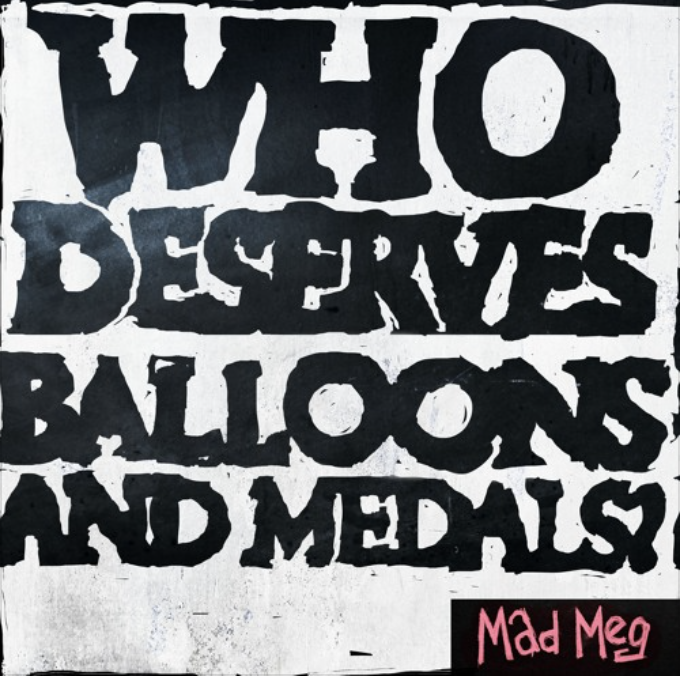
Mad Meg is most likely the smallest international band you’ve never heard of. Their new album “Who Deserves Balloons and Medals?” released Nov. 3 and has since been featured as album of the week on radio stations ranging from Mexico to Germany.
They’ve also toured Eastern Europe, even playing and recording an album in a Lithuanian prison for women. (They got a standing ovation from the prisoners.) The band will have a residency at New Nublu 151 in NYC starting early 2023 as well.
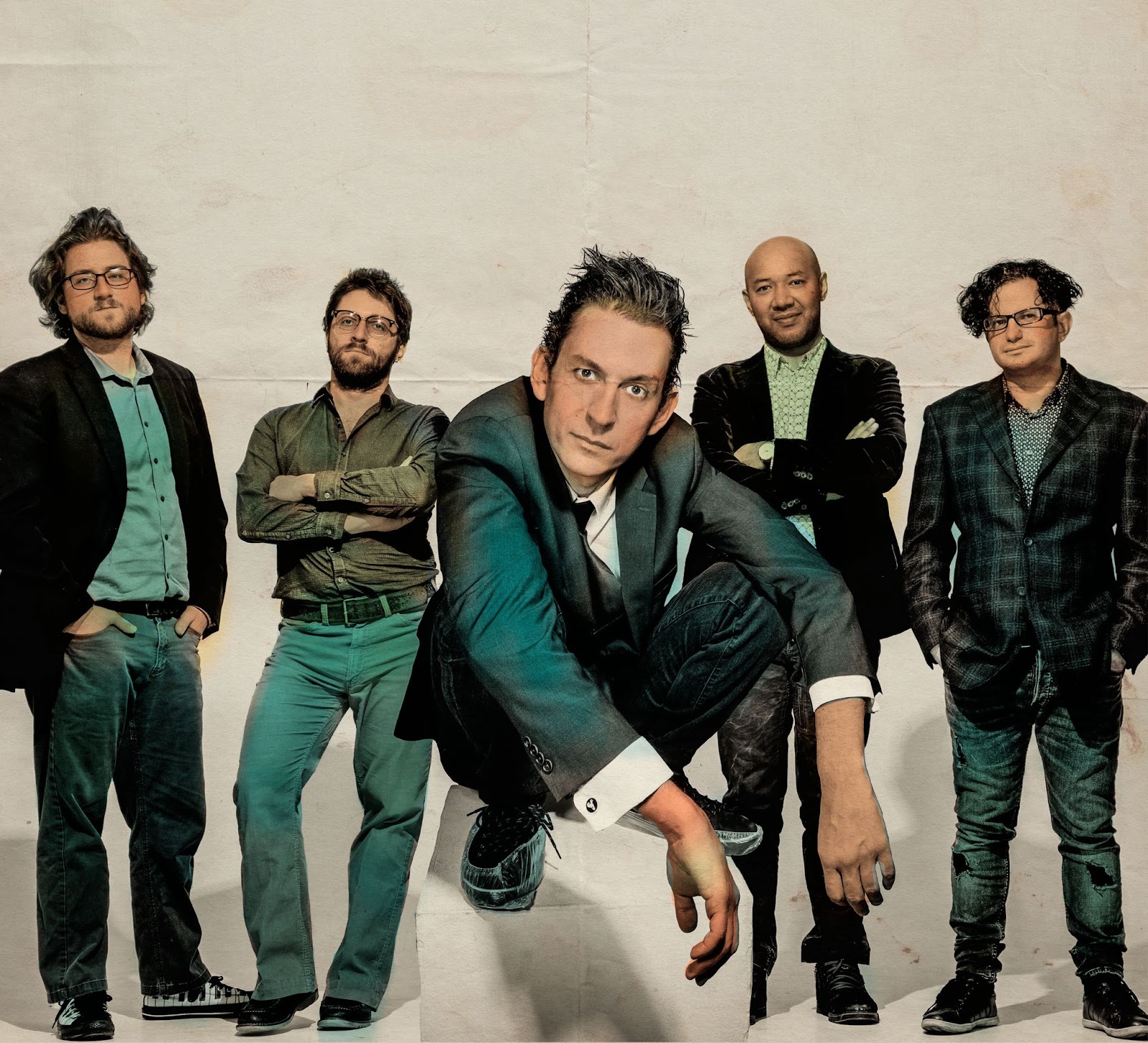
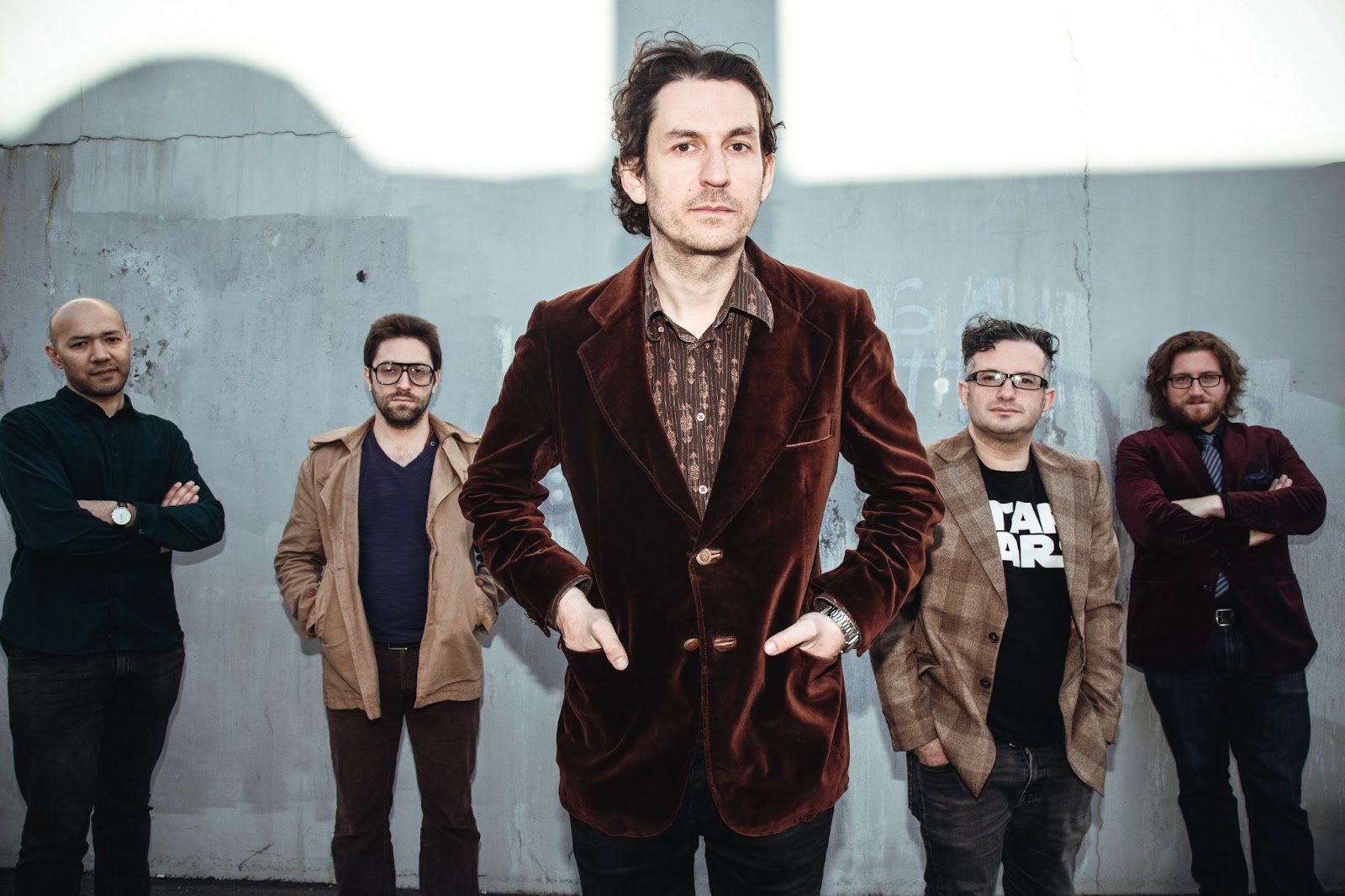
The band members of Mad Meg, posing for a photo shoot. From left to right: Jason Laney, Dan Veksler, Ilya Popenko, Ruslan Baimurzin, Igor Reznik
A self-described “punk crooner noir band, the group is composed of lead vocalist Ilya Popenko, bassist Igor Reznik, keyboardist Jason Laney, guitarist Dan Veksler and drummer Ruslan Baimurzin. If the names didn’t give it away, four of the five members come from countries that were a part of the former Soviet Union, except for outlier Laney, who grew up in Texas.
Through a mixture of fate, all five musicians found themselves working and gigging in NYC and through one way or another joined Mad Meg. While members have rotated over the band’s ten year tenure, Popenko has been the continual face of the band. Under his guiding hand, the current group – which has been together since 2016 – has developed their signature sound, a mix of rock, jazz, cabaret and dark comedy.
Ryan Bieber, contributing writer for NYS Music sat down with all five members of the band to discuss Mad Meg’s recent album and creative process.
*This interview has been edited for length and clarity.
Ryan Bieber: You have a very unique style, which you’ve described as “punk crooner noir.” How would you describe that and the sounds that your band creates?
Dan Veksler: Punk is a sort of the general name for a kind of attitude toward life: this kind of simplistic and very rough, you know, stupid, uncouth way of going about tackling enormous issues.
Igor Reznik: And I think noir is a reference to the kind of film that I think can be imagined when listening to the stuff.
Ilya Popenko: We keep changing our style and the name of the style, because it keeps evolving.
Bieber: And what draws all of you to combine genres in such a way, what do you find interesting about that aspect?
Jason Laney: “We all come from very different places, musically. I think everyone here has an artist that they love that somebody else in this band hates with a fiery passion. It’s taking all of those different strains and getting to a place where all of us can be happy. If we can please the six people in this room, hopefully somebody else will like it.
Ruslan Baimurzin: This is the beauty of it, you know, because each of us represents the genre we like. It’s Bob Dylan, Johnny Cash, Tom Waits … Each of us was inspired by different bands. When we started making music, we tried to satisfy each of us at the same time.
Veksler: You know we don’t set out saying “Let’s make the song in this style or let’s mix these things.” We just play and this happens.
Mad Meg’s second studio album “Who Deserves Balloons and Medals?” released Nov. 3
Bieber: And so when it comes to the actual songwriting process and creating songs on the album, what does it usually look like? Is Ilya coming up with vocals first? Or is someone coming up with a melody on one of the instruments? And how does it go from there?
Popenko: Well, I usually write a song on a guitar and record that demo, either with just a guitar or some rudimentary arrangements. Then the guys, they take it apart, and each one comes up with their own lines.
Reznik: And then I scream somewhere in the song usually. There’s like a cherry on top.
Popenko: And just playing it live, that’s what kind of solidified it, because we don’t go immediately into the studio. It takes us a couple of years of running the songs in front of large live audiences to get it to the place that we want to record.
Reznik: We usually record most of our tracks live. That has been the tendency of the core of the band. And then maybe we put finishing touches, maybe add some tracks on the end.
Bieber: And when it came to making this album, when did you start to realize you had an album on your hands? Was there a particular moment where you were like, ‘Okay, let’s go with this,” or was it just from touring live a bunch that you came up with a solid set of songs?
Laney: This was our pandemic record. So we actually didn’t tour at least some of the material. I don’t think beforehand.
Popenko: It wasn’t like a moment but at some point, it just felt like the right time to kind of put them together because they felt like they were part of one bigger product. This album as opposed to some of our other records is the most conceptually solid one. Like some of the other ones that feels like a pile up of different songs and this feels like a finished product.
Bieber: While your songs can be dark, your lyrics are often tinged with comedy and irony. For instance, one of the tracks “Beyond Repair” tells the story of a broken robot begging its owner to be thrown away
Popenko: Definitely. In fact if something is written without using any type of humor and is supposed to be a serious song, I don’t perceive it as such. I’m suspicious of something overly serious. If a serious subject has some humor in it, it becomes approachable and believable to me.
“Who Deserves Balloons and Medals?” is Mad Meg’s second studio album
Bieber: The album also features a cover of the song “Jolene,” originally by Dolly Parton. How was that decided to be the song that you would all cover?
Laney: It was contentious. There was talk as to whether or not it would even be on the album.
Veksler: It does have a chord progression that is sort of reminiscent of an Eastern European kind of thing, which is not an intuitive thing to think of that song, but it’s true. And I think that probably has something to do with Ilya’s desire to do that one.
Reznik: I think we played Jolene for a while and went through a lot of different versions.
Popenko: Yeah and you can just jam on it forever. And that’s what we did. I think for several of us, the clincher finally to keep it on the record was when Alex [Dreyshner] added throat singing vocals. For me, that’s what put the song in a category where it was really original, even though it’s a song that has been covered many times by many people.
Bieber: What is the meaning behind the album’s name, “Who Deserves Balloons and Medals?”
Popenko: It comes from a song by the band, the Blind Boys of Alabama. “Who Deserves Balloons and Medals” is about you wanting credit for something you’re doing but no one’s going to give it to you but yourself.
Bieber: And even though the question appears largely rhetorical, does your band deserve balloons and medals in your opinion?
When Hudson’s Chris Pellnat released his fifth solo album Go in September, it was yet another mark of a folk musician who simply can’t stick to just folk. While his songwriting stays pretty standard, his playful lyrics and eclectic instrumentation give him a signature mark.
With a well-filled out personal catalog, Pellnat’s collaborative resume has its marks as well. He’s one half of Brooklyn folk pop duo Teeniest. He’s the lead guitarist of Poughkeepsie group The Warp/The Weft, with whom he shows off his straightforward but technical approach through infectious lead riffs on albums such as 2019’s Dead Reckoning.
While the grunge and prog-rock tones of The Warp/The Weft and the upbeat folksy approach of Teeniest are relatively consistent, Pellnat likes his solo work a little all over the place. His 2021 record Crossing bounces from odd displays of vibraphone and clarinet to bright jangle pop to garage rock on a track-by-track basis, something which remains the same on Go, a 10-track, 30 minute exploration.
The opening titular track sets this tone from the get-go, with its wistful verses driven by vibraphone and gurgling synths setting the scene for Pellnat’s personal lyrics. “In my own way, trying to be better, braver wiser, and someday, I leave my burden down at the horizon,” he sings in an untrained tenor.
Pellnat created music videos for each of the record’s first three songs, each of which are brought together in a manner both amateurish yet endearing. “Go” is accompanied by a crude assembly of footage, including time-lapses of his rural Hudson Valley home, shots of him performing outdoors, and a frog.
Next is the adventurous and political “What Are We?” with its muted guitar riff and pulsating synth line that set the scene for Pellnat’s barrage of philosophical questions. “What if we are sick of the crazy, endless lies that will not die,” Pellnat sings on the final verse. “What if we are still trying to fight the evil power still inside?” It has an upbeat tension that reminisces of a storm chase or a search for a UFO.
The video’s combination of odd, color-imbalanced shots of his face juxtaposed with shots of an MRI scan through iMovie-adjacent transitions uphold the song’s mysterious energy, even in this DIY presentation.
Track three, “Existential Dread,” returns to the personal. It’s an upbeat and melodic dulcimer tune that follows the trope of cheery songwriting contrasted by dejected lyrics, as Pellnat talks about the failure of alleviating pain through vices and the permanence of existential dread. “Drinking won’t do it, weed won’t cut through it, I always knew it,” he sings on the chorus.
Its music video is easily the most absurd of the three, where Pellnat fights both caffeine and alcohol addiction alongside a vigorous quest to prove he’s not a robot through an endless series of CAPTCHA quizzes and corporate security questions.
Pellnat describes Go as “a rather positive statement overall” but also “colored by darkness,” with “Existential Dread” serving as an early example on the record. There’s also the sad accordion bluegrass of the following song “What I Want You To Want,” which mires itself in depressed romanticism. “No starry-eyed romantic, I’m talking about overcoming the darkness all around us,” Pellnat sings on the opening verse.
Later on is “Are We Going To Fly?” which despite being more vague in its brooding, is sonically the darkest point of the album with its uncanny guitar melody and echoing clarinet. “Are we going to find our way?” sings Pellnat. “Thought you said we had all day.” Backed by a skittering drum machine, this song shows Pellnat at his most off-kilter.
He still gives plenty of attention to the bright, earthy conventions common to Teeniest though, with exhibits such as the self-described jangle-fest “Earth Shaker.” It’s an endearing love song with summery guitars, making for a songwriting highlight. “Tumbling down the walls we made up, everything we will do it’ll last forever,” Pellnat sings on the chorus.
Then there’s penultimate track “Water Wings,” an acoustic/woodblock tune about climate change. “Typhoons in winter, tornado splinter, now you begin to taste the ocean breeze, it’s how its gonna be,” he sings on the second verse.
Closer “Suburbs of Paradise” continues with this commentary-oriented angle, as Pellnat sarcastically criticizes the uniformity of suburbia over a dusty slide guitar backdrop. He talks about how “the roads they’re all the same, they all just beat around the bush,” and talks about being trapped “in an endless cul de sac” in a short but sweet 1:52.
The other prime point of satire on Go is “This Is Not Rock and Roll,” where the salt and peppered musician calls himself “a walking cliché” with his guitar, says he’s “getting too old” to be a rock star over bluesy guitar licks and a warm plucky bassline.
Go is very personal album from Pellnat. Not in the sense that it’s constantly serious or sappy, but because it’s who he is. It’s vulnerable. It’s goofy. It’s political. It changes when it wants, and stays consistent when it’s comfortable. Chris Pellnat opened this album singing “in my own way” and never stopped, creating a record entirely built on his own endeavor.
Martin Bisi is a producer, songwriter and musician. He has worked with artists across the musical spectrum from Herbie Hancock, to Sonic Youth, to Whitney Houston. He is also the notable founder of BC studios in Brooklyn. On top of that, he is a musician and songwriter in his own right. On Dec. 2, he is releasing a brand new, self-produced LP titled, Feral Myths.
Martin Bisi’s latest project explores ‘tales of the wild state, of New York heroes and villains and random paranormal encounters.
Contributing writer for NYS Music, Ryan Bieber, sat down with Bisi to discuss his recent project and the meaning behind his music.
*This interview has been edited for length and clarity.
Ryan Bieber: So you have this new solo LP Feral Myths. What was the initial catalyst behind this project?
Martin Bisi: ‘I think with all with all my records, and maybe even entire songs, I don’t necessarily have the end picture in mind. I’m always asking myself, ‘Well, what am I really talking about?’ I knew in the back of my mind that I wanted to get back into more narrative songwriting. With the previous two solo records of mine, I got more into … broad social concepts and very existential stuff about religion and even a song about human sacrifice. I knew I wanted to get back to talk about more specific personal experiences.
RB:Feral Myths advertises itself as having ‘tales of the wild state, of New York heroes and villains and random paranormal encounters. What does this mean to you? What were you hoping to achieve with this collection of stories?
Bisi: It’s not a pandemic record … but ultimately, that did kind of happen because there was a lot of time by myself. That was a really wild time. I was really engaged in Black Lives Matter protests like every day, practically. I went down to the occupation at City Hall, and I was helping supplies and stuff and it was a fantastic time because the constraints of society had loosened. You can kind of take over the city, you can take over the streets. There was a perceived ‘lawlessness,’ which I liked. It felt very liberated. And so that felt feral, in a sense.
RB: I found it interesting too that while most songwriters prefer to speak from experience, writing about themselves or their feelings, you on the other hand tend to write about people and concepts you find interesting. What is the mindset behind this approach? What effect does it help you achieve?
Bisi: Right now, our current cultural moment is a lot about personal voice. They say your voice is not heard … and it’s funny because my songs are about other people mostly. I’m a bit detached. It’s my music and I want it to be me, yet on the other hand not every voice on the record has to be mine. Actually, that’s why there are so many other people singing on the record. The reason the other vocalists are all women is because I want two voices, I want them to contrast.
Feral Myths’ album art courtesy of Martin Bisi
RB: I particularly like how the song, “A Storm Called Ida,” combines myth with reality. It’s a song about Hurricane Ida hitting Brooklyn, but the production and lyricism also bring out the almost mythical power of this natural disaster. I think many people would tend to view myths and reality as two things inherently at odds with each other, but you seem to have found the common ground. In my mind, that’s what Feral Myths is all about. How on base am I here?
Bisi: Oh yeah, absolutely. I personified [Hurricane Ida} using Sara Fantry on vocals. That storm itself is gendered, it’s one of the female ones [Ida]. The quality of her voice, it sounds like the power of a storm. It’s punishing, yet we’re still in the graces of nature and it’s bestowing a sort of empathy towards us. So it was conflicted, but then I realized, I don’t need to clarify. It can be both things at one.
RB: I’m sure many people know you as a producer but don’t know you are a songwriter. What made you want to go beyond producing and be an artist yourself? Or was that always the goal?
Bisi: I used to lean more towards producing and then I slowly shifted to songwriting and performing being more of where my heart was. When I first started songwriting, I really felt that was something on the side. I never really thought that I could abandon the recording studio. I knew that I would need that to earn a living. The only reason I could get people to care at all, I think, about my songs is because they care about records that have been recorded here. Now I’ve sort of gotten into a place where it’s both kind of coexisting and feeding off each other.
Bisi playing guitar in the studio
RB: There’s also an obvious mix of genres and influences evident throughout the track. What kind of sounds and overall vibe were you going for with this album?
Bisi: Combining genres is tricky and hard. With Feral Myths, there’s an orchestral quality, especially with the singing being more operatic. And it’s funny, because I’m not that into some of these genres. Another quality that I like in the production is the general sense of disorientation. I like the idea of people kind of losing a sense of what’s going on in the psalms of it … So sometimes, mixing influences or superimposing them is a powerful tool to get the disorientation that I really like.
RB: New York City also seems to have had a big impact on your life. You grew up in Manhattan and later opened up your studio in Brooklyn where you currently reside. You’ve also mentioned being an active member of the Brooklyn community when it comes to activism and protest. How does the energy and history of New York City influence your music but also yourself as a person?
Bisi: I’ve always sort of been in the trenches with New York. I think at this point it would be a difficult choice to leave New York City because I think it would really affect me as an artist. It’s not just an attachment or a love for New York City, it’s been a part of my process of how I work with bands. I need the chaos of New York City to bring the few gems to my door. New York City is crucial to me.
RB: Activism is something you incorporate not just in your daily life but into your songwriting as well. Was this always the case?
Bisi: I’m essentially a musician, but my heroes, the people that I look up to, are revolutionaries. I’ve always had a strong inclination towards the revolutionary aspect underlying music as well. There’s a lot of political punk, Jello Biafra, the Clash. And these were all things that were always very attractive to me. Even if the music specifically wasn’t all the time about politics, it was underlying what I was supporting, so I would support feminist bands or anti-corporate brands. So yeah, it’s always been there.
RB: That’s all of my questions, but is there anything else you want to talk about either behind or specific song or. the general process?
I realized all my records now have a song that is almost like a collage. of song ideas. It’s not a complete song. it’ll be a series of different choruses that don’t repeat. And it’s just sort of songs and ideas that I thought don’t warrant a full song. It’s not even that they’re not good enough, but I just don’t see a path forward to a full song.
I don’t throw away work. I’m not really the type to pick the best stuff and put the strongest songs forward. I think it should all be there. It’s almost like a diary. Every record that’s recorded in the studio is a story in and of itself. It’s a story of my time in New York, every band I’ve worked with, so its all of these diary entries. So whatever made me come up with these ideas should live. [And that is the case with the last song on the album] “The Great Trap in the Creek.”
Feral Myths will be released on all streaming platforms on Dec. 2. You can preorder the LP on Bandcamp: here. Find Bisi’s tour dates: here
Karina Rykman is a name that is often brought up in conversations discussing everything from “who is next ” to “who is doing it best” with good reason. Growing up in New York City and never adhering to a single band or bending the knee to one musical subculture, Karina breaks down genre barriers naturally. Charismatic and upbeat, Karina’s live music experience provides a sense of togetherness during a time of intense isolation and separation. Karina Rykman’s music defies perceptions by providing a big sound with few bodies on the stage.
Photo: Jesse Faatz
Karina is currently hitting the road with her power trio featuring Adam November (Guitar/Looper/Effects) and Chris Corsico (Drums). Destinations will be throughout the Northeast and begin in Upstate New York. She’ll be performing at The Upstairs in Ithaca on November 30th and at Albany’s Lark Hall on December 1st. Karina’s live show provides nourishment for the brain with technical hypnotism while simultaneously allowing stress relief with an attitude heavily weighing on the side of fun.
Photo By Em Walis
Opening the night in Albany for Karina Rykman is Burlington, VT-based Quiltro, who bring a psychedelic sound reminiscent of Circles Around the Sun. Their 2020 debut record has been described as the soundtrack for a dystopian sci-fi film that has yet to be released. Featuring Mark Taylor (guitar/keys), JD Hoffmann (drums) and Mike McKinley (bass), their Lark Hall performance marks the first hometown show for the Albany-native McKinley. Get a taste of what’s in store with their performance of “Antilla,” filmed at Autochrome, a community studio space in the south end of Burlington.
Karina took time to chat with Em Walis about her upcoming tour, creative process, oysters and the metaverse. This conversation took place the week after filling in on Seth Meyers for the second time and before playing a few shows with Marco Benevento. Karina gave insight on how growing up in New York with parents in academia led to a mindset framework for discovery and integration.
Em Walis: Where are you right now?
Karina Rykman: I’m home actually. Unbelievably, I’m home. I will play with Marco tomorrow. It’s nice – a little hometown vibe then off to Connecticut followed by Massachusetts and then home on Sunday. Then Thanksgiving week, and then on to the next. We’re going to enjoy this time. It’s pretty crazy. Last week specifically I thought “oh my god, I have a weekend at home to dial everything in”. I’m really trying to prepare in a big way.
EW: And some recovering I’m sure.
KR: Oh, definitely and in a super big way because my October was so slammed and just, just crazy. I spent two weeks on the road with Marco on the West Coast. And the first weekend of the month my band did a festival in Virginia, and a festival in Pennsylvania. It felt as though I was just on the road the entire time; flying, driving, planes, trains, automobiles. November was going to be chill, rehearsing with my band, and just one weekend with Marco, and then I get a call from my buddy Eric, who’s the producer on Late Night with Seth Meyers asking “Hey, are you around this week?” “Oh snap. Yes, I AM around!”
EW: Stars aligning is awesome.
Photo: Jesse Faatz
KR: Crazy, crazy. And then I did last week and it was amazing. It was on guitar. The last time I publicly played guitar was last December at the Capitol Theater. I played two tunes on guitar for this Headcount benefit. It was with Larry Campbell and so many incredible players. In the past I played guitar on the Today Show, backing up Julia Michaels in 2017. So anyway, all I’m trying to say is there have been very few and far between guitar gigs. I got that call late Monday night, and they asked for me to come in on Wednesday and Thursday. That Tuesday was Election Day, so I was voting and then practicing, just trying to become a confident guitar player again. I just want to do such a good job and I don’t want to let anyone down, almost to a fault. I over prepare and over prepare.
Photo By Em Walis
EW: This can be good. Even if it’s just a visualization or something. I would be curious how you manage all of the hats that you wear? In switching head spaces from Marco mode to solo mode to, you know, selling guitars on the side. Haha
KR: Great question. It definitely requires patience with yourself, as well as actively recognizing that you’re switching gears and shifting hats. When I work with Marco it’s really fun for me because I am a hired gun who’s not in charge of anything.
EW: And he’s really fun.
KR: Oh, he’s the most incredibly fun loving, hysterical, wonderful band leader and mad scientist. He’s just incredible. So all of that combined, results in not a lot of stress for me in the same way that my solo band is. The solo stuff is more pressure on me because it’s my band, it’s my name, I book the hotel rooms and rent the van and figure out all the logistics, and everything. It’s my music. So you’re kind of putting yourself out there in a big way
Photo by Em Walis
EW: On all sides of music, from every angle, it seems we all have this similar internal story going on or a question of how safe is this space for me? Just emotionally and with that, you know, there are different levels. Sometimes it’s totally chill and at other times, as you said, which I think is great. Just a little more active noticing where am I? What’s the actual thing that’s at stake here? Why is everybody here? Sometimes you’re in situations where you feel a little more pressure or more scrutinized. Depending on the venue or if it’s a festival with strangers.
KR: Especially this TV gig, you know? Those nerves never quite go away. Working on a new thing, or taking a new gig, or launching into some sort of uncharted territory, I’m often thinking “I’m so nervous, why do I keep putting myself in these situations?” But honestly, those are the moments where you know you’re doing something cool as shit, because you feel that way. There’s something worth suffering over. And then you overcome it. You’re like, wow, learn from that.
Photo: Michael DiDonna
EW: Absolutely. I’ve been curious about what brain scans of musicians might look as compared to extreme sports dudes. We are acclimated to these huge buckets of epinephrine and dopamine being poured all over us. It seems as though in those down moments, when we can remember that one time that you were home. We look at our laundry. It’s not all the excitement, tea cups are worth of satisfaction from that. I don’t know if that’s worth it.
KR: It’s so funny. I find that especially in the last few years, having adjusted to no gigs for a minute there. Now, with them coming back, you’re in a constant state of readjustment – you’re either adjusting to tour life or adjusting to home life. And honestly, if you do it as much as I do it, you don’t have the time to be fully adjusted to either, but as soon as you do, you have to go home and then you are a total circus freak at home for a minute with this misplaced adrenaline that hits you at midnight when you’re supposed to go to sleep and you’re thinking, ‘Wait, where’s my show? Where’s the show? Where are the people? Where are my friends?’
Photo By Em Walis
EW: I was curious about your creative process and how you manage or if you have any recommendations for those that are newer in this back and forth. Do you have anything that helps you get into it?
KR: That’s a great question. I’m very lucky to have such a great producer and writing partner whose name is Gabe Monro, whom I’ve written almost all my tunes with. I can’t speak too much on this, but I have a whole record that’s going to see the light of day next year. I’m so much more of a social creator, if that makes sense. I don’t go into my bedroom and come out 12 hours later with the greatest song – I find that when I work with Gabe or I work with my band, we make the creative process sort of a communal thing and that elicits better results. For lyrics though, I do need to be alone. Gabe and I have this process where we basically write what we refer to as ‘seedlings’, which can be just an A section and a B section or whatever it might be, but it’s just a vibe. I bring that home with me and if I always know that, if we work in the studio all day and then I come home with a seedling that I’m so geeked on, it’s two in the morning and I HAVE to listen to it, you know that it’s worth developing and worth sticking to. But sometimes you have seedlings and then you listen back the next day, and you’re not inspired at all. So it goes.
EW: We’re not seeing roots. We’re not seeing a little leaf pop out on that paper towel.
KR: Totally. It’s amazing to have folders and folders of seedlings that maybe in a year or two I can go back through them and be like, ‘Oh my god, there was something here! This is an inspiring moment.”
Photo: Steph Port
EW: What’s your view on the balance between a purist straight plugged in sound versus effects driven sound?
KR: I am a big fan of both things in moderation. With my band specifically, I really love the fact that with Adam November on guitar, he’s so much more than just a classically ripping guitar player. He is a complete mad scientist over there with multiple loopers and effects and crazy stuff going on. I don’t even know what to call it or what it is, but I think that’s very specific to us. That is a big part of the sound.It’s obviously a trio, but we are larger than the sum of our parts. I don’t want you to come to my show and think that you’re seeing a measly three piece – you’re seeing a power trio. You’re coming to see a full, lush sonic experience.
EW: I was wondering if you ever, in perhaps middle school years, had any particular musical identity commitments?
KR: You know, from the jump I had very diverse tastes, I had my metal friends, my jam friends, and beyond. I was a sponge. I never pledged allegiance to one style or genre. I would see Slayer on Saturday and Phish on Sunday.
EW: I think sometimes it gets forgotten is that you can you can belong in multiple spaces and be welcomed into multiple spaces and your status or validity does not come from your commitment to one particular scene or your amount of shows on your spreadsheet or you know, which you know which special event with that special seat and you happen to be present for that. There’s so much more.
KR: I never pledged allegiance to one style or genre. I would be at Slayer on Saturday and Phish on Sunday.
Photo By Em Walis
EW: What was music the relationship with music in your house growing up?
KR: Well, my parents are both academics.They both teach at Columbia University. They are so supportive. They’re so thrilled, and can recite to you every lyric of every song I’ve ever written. They’re at every show that they possibly can be at, but there was very little music exposure in my house growing up. My dad would listen to Goldberg Variations (Bach) on CD while he was writing, but they didn’t show me the Beatles, The Stones or Led Zeppelin, or any normal stuff, and I’m super grateful honestly. I was able to form these absolutely insane bonds with the music I enjoy, and it was such a desire of my own and not a desire of somebody else’s. Those were all my own discoveries. I really appreciate them for that.
EW: Beautiful. Correct me if I’m wrong, but it seems your parents provided a framework to pursue a curiosity and manifest a passion. Maybe there wasn’t literally music in the house, but there were many curiosities being pursued.
Photo by Em Walis
KR: In a big way. My dad writes books and gives lectures, he’s a philosopher, and for me growing up, I saw this guy wake up every day, sit on his yellow chair and write and write. And then he goes for a walk, and then he comes back from a walk and, you know, in his super jovial, hilarious manner, has all these thoughts that came to him on his walk, and he runs back to his yellow chair and writes them all down before he forgets them. And seeing his complete dedication and commitment and joy for what it is that he’s interested in, gave me the utmost permission to do the same, and it allowed me to explore the stuff that did it for me in that exact same way.
EW: Thank you again for taking the time. My last question is from Dogs In A Pile. They would like to know what your favorite gas station snack is while on tour?
Never considering myself attracted to post-punk, I was engrossed by the story of both a visual and audio post-punk artist, Blake Sandberg of ALIENS. His story opened me up to a genre I would have not considered to be in my wheelhouse. It is one of a thousand 9/11 attack survival stories and how an artist can dig into his craft to cope with suffering on the way to survival. You can hear the rest of the story in the interview I conducted with Blake on The Long Island Sound Podcast.
EP Release Party in Brooklyn
Blake Sandberg’s New York City post-punk band ALIENS announced the last show of the year and EP release party at Littlefield in Gowanus, Brooklyn. Friday December 2. I was able to sample their songs a few weeks ago.
The AGORAPHONIC EP compiles singles from 2007 to the present. ALIENS new songs were captured in Brooklyn at B.C. Studios, by Martin Bisi. The singles are “Leave Luck to Heaven” and a cover of Leonard Cohen’s “Tower of Song.” The songs feature Blake Sandberg on guitar and vocals with ALIENS new bassist Kevin Jones and George Fiala on drums.
AGORAPHONIC is getting steady radio airplay across the country landing it in the NACC Top 200 and in the Top 20 Alternative Chart – currently at #13. Check out the Brooklyn Release Party at Littlefield’s here.
Blake Sandberg is an accomplished American artist. He creates iconic images and uses words in his paintings to explore meaning and associations with objects in our environments.
The Best Laid Plans
Blake Sandberg battles a rare inner-ear disorder and illnesses from exposure to Ground Zero after 9/11. Blake died in a hospital in 2005 and was resuscitated. He is an artist and has been described as an “idea machine.” His first guitar was given to him by a friend, it became a mission. Words he wrote quickly became songs. Chords bashed out on the guitar to carry them. And his 9/11 story begins with the planned opening of his art exhibit.
BLAKE BY ANDREA BUCCI
… and then 911 happened. And I had an art opening a couple of days before that. And my parents and my brother were in town for it. You know, there were fires a few blocks below me. It was a strange world to be in. So I think it naturally went to painting and writing and things.”
Blake Sandberg
The New EP
ALIENS frontman, Blake Sandberg says “Tower of Song” became important to him during the Covid shutdown.
I thought I might learn the song. I was home playing guitar and looking out the window
Blake Sandberg
Leonard Cohen’s lyrics have similar imagery. One day while walking to get something to eat he found a vinyl copy of Hank Williams Greatest Hits album someone had put out on their steps. He took it as a sign. In the song Cohen says “I said to Hank Williams how lonely does it get?”
Leonard Cohen
Sandberg sped up the song up to a runaway train pace, while managing to cram all the words into the song without ruining it and making something of his own out of it. He also related the current times with political upheaval and division to the lyrics of this song. “I see you standing there on the other side. I don’t know how this river got so wide.” Sandberg takes on the weight of this cover song and his vocal performance is noteworthy. Martin Bisi’s production work keeps the train on the tracks.
“Enjoy Killing Time” was released in the first Covid shutdown in NYC. This track was recorded with guest drummer Hunt Sales, the legendary drummer for Iggy Pop “Lust For Life” and David Bowie’s Tin Machine.
ALIENS are Blake Sandberg, Miguel Vela, and Kevin Jones. Vela has taken over the drums over the last 12 months. As a trio they form a powerful post-punk band capable of scream-along anthems, searing sci-fi guitar riffs, with a heavy dose of Jones’s bass and Vela’s pounding drums.
It’s refreshing to come across an artist who takes his suffering and joys and bangs out raw emotion into his music. Post-punk is a discover, I need to explore, it’s an appropriate megaphone to express what we need to hear. ALIENS deliver!
Multi-platinum recording artist, songwriter and producer, Josh X, brings in winter season with his heartwarming new single “Forever Love.” The snappy, swooping single sees Josh X affirm his feelings of “forever love” in passionate croons. The catchy chorus and bridge confidently shows the singer-songwriter’s evolution as an R&B artist, able to capture the heart in quick wails. Moreover, “Forever Love” gives fans a glimpse of what they may expect on his anticipated forthcoming album, The X Project, expected in early 2023.
I wanted to release “Forever Love” because when it’s cold outside it’s time to cuddle. With everything that’s going on in the world, love is hard to find, and I want people to fight for love when they find it.
-Josh X
The Rise of Josh X
The the KSR Records signee and producer has seen his career ascend since his breakthrough in 2016 with the release of his multi-million streaming hit, “Heaven on My Mind,” featuring Cardi B. All in all, Josh X has been prepping for his time in the limelight since childhood. The Queens native began playing the classical piano at the age of six and attended The Juilliard School’s summer program after receiving a scholarship from the prestigious musical institution. Inspired by music legends Stevie Wonder and Brian McKnight, Josh X’s music is brimming with themes of love and forgiveness, something he shares with his idols.
Prior to stepping in front of the mic, he served as a writer and producer, working with upper echelon artists such as Jadakiss, Swizz Beatz, Cardi B, Nipsy Hussle and Lil Wayne. After signing with Epic Record in 2018, Josh X released his single “All on Me” featuring Rick Ross. The ensuing music video has since been viewed over 5 million times.
Moreover, the Haitian-American singer and producer released the street smash, “Eskize Mwen” in 2020, featuring Haitian superstar, BAKY. The record showcased his diversity and the music video saw Josh X once again eclipse the 1 million views benchmark. During the pandemic, he picked up the role of Derrick in the Amazon Prime series, Sister’s Keeper. Although bitten by the acting bug, Josh X has not forgotten about his forever love.
The recipe for success in the music business starts with honing your craft. Add the right ingredients rooted in passion and persistence, rightaway top it off with a consistent social media presence and you’ve got a winning combination. To put it mildly, the Como Brothers Band is cook’n.
It’s Kismet
It was Kismet that I discovered the Como Brothers when they performed in Bay Shore. While at Fire Island Vines, a relatively new wine and craft beer bar that profiles original music, I was approached by the owner. This particular evening I came to hear Gene Casey, another one of the fantastic guests on The Long Island Sound podcast. I was greeted by Antonio, who said if you like Gene Casey, you’re gonna love the Como Brothers!
Harken the Harmonies
What caught my ear were brothers Andrew and Matt’s vocal harmonies. The music had a familiar rock/pop sound. When they were four to five songs into the set, I realized these guys were pumping out some great original music. As fate would have it, I “checked in” on Facebook, and soon, my daughter Fatih recognized the brothers as the sons of her math teacher, Mr. Como in High School. Como the senior would play his son’s music on occasion in class a decade earlier.
Curiosity Clinches
Curious about the artists behind the music and this kismet connection with my daughter, this had to be some sort of sign to investigate. A quick Google search of the Como Brothers, increased my curiosity as a plethora of songs and collaborative music videos appeared.
After a short conversation the Brothers Como agreed to be on The Long Island Sound podcast. The famous broadcaster Paul Harvey would opine, “And now the rest of the story” can be found in the latest episode of the podcast.
Content is King Backed up by a Queen
Fascinated by the wellspring of music that comes from Long Island, I am intrigued by the exposure artists receive or lack in the marketplace. The Como Brothers seem to have the success recipe nailed down. Maybe it is the Social Media generational divide that is the disadvantage for many artists. For the Como Brothers Band, Social Media is their superpower.
If you take a look at their website, you’d be amazed at the exposure they’ve gained in the marketplace surprisingly in a relatively short period of time. Whether it was being featured in a Canon trade show commercial, or having their music featured on Keeping up with the Kardashian’s, and MTV”s Real World, these guys seem unstoppable.
Secret Ingredient
When I asked about their social media presence, both Matt and Andrew heaped praise on Matt’s fiance Tatiana.
Tatiana is super, she’s actually super involved in what we do not from a songwriting perspective, but she films all of our music videos, helped set up on our website, our online shop. So she has type A, and she’s a band member’s dream. She’s like the Anti Yoko Ono!
Andrew Como
In promoting any artist or creative on the web, I’m intrigued at what seems to be successful. Whether it is deciphering the SEO (Search Engine Optimization) or understanding what a particular platform’s algorithm likes to see, I’m happy to integrate and learn something new.
Collaboration is Key
The common denominator with the video on the band’s site seems to be like-minded collaboration. Sam Woolf, one of the contestants on American Idol, joins the Como Brothers in several videos. Sam’s pop sound blends well with the band, accentuated by Andrew’s creative guitar licks. The humility of the brothers is by their willingness to explore and share their talent with other artists. The collaborators behind the scenes read as a Who’s Who of industry professionals backing up the production of the band’s endeavors. Industry legends grace various tracks. There’s drummer Steve Jordan (John Mayer, Saturday Night Live band, Late Night with David Letterman), keyboardist Andy Burton (Little Stephen & the Disciples of Soul), Aaron Sterling (Taylor Swift), and many others.
How can two young brothers make the industry connections that lead to collaborative projects? I asked them how do you do it? How were you able to connect with Sam Woolf or Kayla Stokert or the many other notables on your tracks? The simple answer I surmise, is that they’ve worked hard traveling and gigging around and they just seem to be nice guys. Artists willing to take the collaborative leap and say, “let’s give it a go”.
The two words that came to my mind when I encountered the Como’s was passion and persistence. As full time musicians with a creative need, they pump out content with Tatiana’s helping hand. Together they package it up into video and social media posts, ever increasing their growing list of fans. I can see their consistent creative content calling me back to discover what they’ve been up to each week.
You can find more on their YouTube Channel, Instagram site and Spotify playlist. Call it Kismet, by looking into my crystal ball, I can see the day when I’ll recount, “you know I knew them way back when.”
NYC-based artist Alexa Dark released her new Old Hollywood-inspired indie rock single “Cool For You” from her upcoming debut EP.
Photo by West Webb.
Alexa Dark is a Spanish/American multi-instrumentalist singer-songwriter raised between Barcelona, Munich, London, and NYC. Her music takes inspiration from her multi-background upbringing. She started writing music and poetry at a young age. Dark began performing live in London, then moved to NYC and released her first song “Fade to Black and Blue” in 2021.
Her upcoming EP will focus on her villain origin story through the lens of a â60s, Bondlike, French new wave film, where the singer goes from heartbroken starlet to a dark feminine, mysterious siren. Through this new era, Dark comments on the nature of feminity and the shadows of oneself, where the enemy is someone’s life is actually them.
“Cool For You” is a dark indie rock anthem, with Dark’s haunting vocals shining through. The song is produced by Matt Chiaravalle, who has worked with the likes of Warren Zevon and Debbie Harry. The lyrics are vampy and set the tone of the Old Hollywood scene. The lyrics “You’re nostalgia/In a black velvet suit/I pick my persona/Like you pick your shoes,” help create a scene in your mind as you listen. Dark tries to be an interesting person to the other person she is describing as she sings “I try to be cool for you/I try not to break in two/But I do.”
Alexa Dark is making a name for herself coming up on her new EP, as she is creating a cult following on apps like TikTok and Instagram, and she doesn’t plan to stop anytime soon.
Native to New York City, Craig Greenberg has been heavily involved in the region’s music scene for over a decade and a half. Greenberg has channeled the spirit of classic alternative and soul musicians, such as Billy Joel, Ben Folds and Randy Newman, while blending their influences with new narratives concomitant to his experiences, in his music.
Craig Greenberg
While his performances on stage in New York City-based venues have harnessed crowds of music fans in the Metro area, the timeline of his works begins in 2007, after the release of his rock debut EP The World and Back. Three years later, his second debut EP Spinning in Time receiving national airplay helps to conjure momentum to his career, following his third release (as well as his first full length album) The Grand Loss & Legacy being covered by Huffington Post and ranking the top of RELIX’s Top 30 Radio albums chart.
2015 “The Grand Loss & Legacy” Album Cover
His 2020 album Phantom Life carries tracks conveying a blend of sounds derived from pop and rock, and lyrical sentiments wielding an axis on life obstacles and opportunities. The Between the Sea and the Sky EP is set to be released on December 16, 2022.
Greenberg’s most recent piece is his single “Quarantine Queen” from September, 2022, which emerged from the period of the COVID-19 pandemic and touches on the frustrations he experienced in his dating life, living in NYC. Craig sat down with NYS Music to discuss his discography and upcoming release of Between the Sea and the Sky.
Heather Occhino: I came across your website and I was reading your bio just to find out more about your background as an artist, so I wanted to ask you, what made you initially pursue a career in music?
Craig Greenberg: Well I actually feel the path chose me.. When I graduated from college and I was mainly just a guitar player I didn’t think I was up for the lifestyle of being a musician. I tried out other creative areas (including comedy writing) and also considered studying creativity for a graduate degree in psychology. It wasn’t until I finished my first few full songs that it started to click in my head that I could actually do it. And then a couple years later when I got my first gig singing in bars (while living abroad in South America), that was my no turning back point.
HO: I read in your bio that your independent work of pop/Americana music started with your ‘The World and Back’ EP back in 2007. What drove you to make music within that genre (were you involved in that music scene growing up?)
CG: I didn’t set out to make music in that genre.. I just got labeled that way. I actually think “Americana” is used as a default when there isn’t a more apt description or if the reviewer is lazy (lol). As far as the “pop” description, I think I’ve always had a good sense of writing hooky melodies, so maybe that’s where that came from.
HO: Going more into your biography on your website, I also saw that your debut album, “The Grand Loss & Legacy” was included in a publication by the Huffington Post and received national airplay and was ranked in another publication as being in the Top 30 Radio albums. (Congratulations) How did that momentum impact you and what did it mean for your career, moving forward from that point?
CG: Well it certainly put me on the map in terms ofindustry recognition.. especially from the singles “That Girl is Wrong for You”, and “Death on the Liberty Line” that got praise from the HuffPost and Relix magazine and received airplay around the country. And that album also gave me confidence to move closer to what my band sounds like live, a more raw and rocking sound. That was rewarding and liberating!
HO: Your latest single that came out last month on the 30th is called “Quarantine Queen”. Is it intended to be about anyone in particular, perhaps someone dear to you in your life?
CG: Well, sometimes my songs are true stories, sometimes they’re based on a true story, and sometimes they’re complete fiction. Quarantine Queen would fall in the last category. It came out of a lonely period during the early days of the pandemic in NYC. I was frustrated with the reality of dating during those weird times and wrote a song about my dream companion to spend lockdown with.
HO: Is this song set to be part of your upcoming EP to be released in December?
CG: Yes
HO: I read that your music reflects the experiences you are going through. That leads me into my next question, which is, do you find that the emotional tones you inject in your music are part of a more spontaneous creative process or do you usually plan prior on what type of energy a project is going to deliver?
CG: I find that the emotional feeling in my songs can come out of my experience, but also could be just a mood I’m in, but for sure it’s never planned in advance–I never sit down and say I want to write a song about this or that topic. Generally I sit at the piano (or guitar) and just see where the feeling in the moment takes me. Though when making an album, the songs I choose to record may be based on wanting to have a variety of mood and energy to give it range.
HO: When and where do you plan on performing next?
CG: Rockwood Music Hall, Dec 21st – it will be the EP release show!
HO: In the last part of your bio, I read that you performed with prominent musicians such as Mike Gordon of Phish, Jackson Browne and Victor DeLorenzo from Violent Femmes. Do you plan on working with musicians like the ones just mentioned again and what has the experience of performing with big names given you?
CG: Well, I would jump at the chance to perform with any of them again. Aside from Jackson Browne, who I’ve had the extreme privilege of getting to know a bit and performing with a few times over the years, the others were more random occurrences. Victor DeLorenzo was at a songwriting event I attended for many years in the mid-west, and we have many musical friends in common, so there’s a decent chance our paths will cross again.